The Well of Salt and Ash
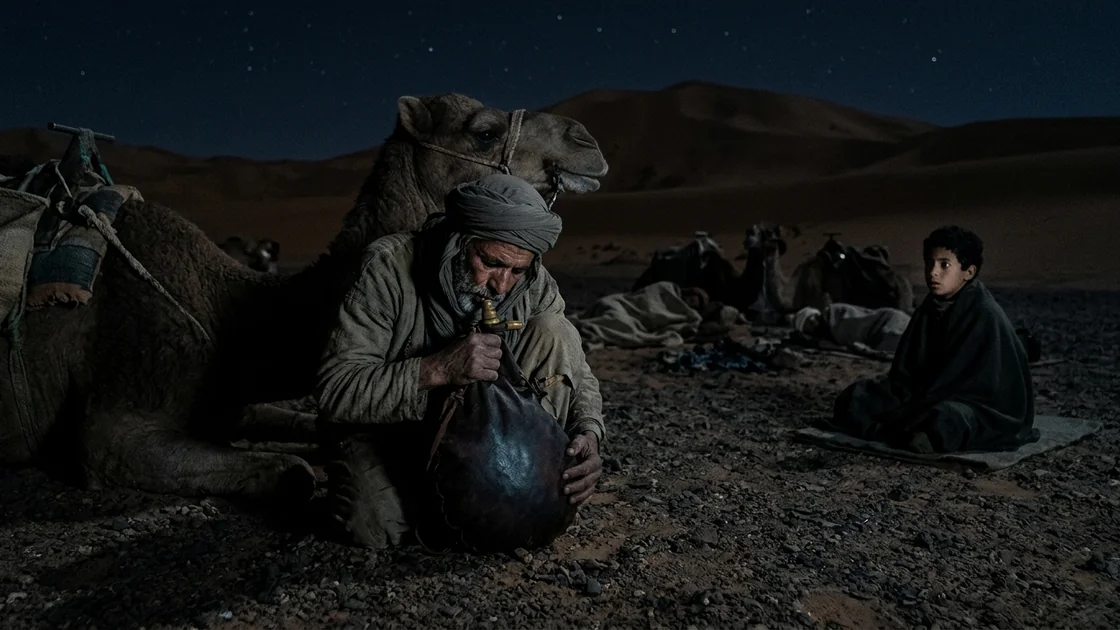
This is the account of Harun, once the most trusted caravan master of the Red Erg, who led five souls into the furnace of the great interior, drank the last reserve of their life-giving waters in the dead of night while they dreamed of rain, and survived to walk the civilized world carrying the dry rot of his own soul through four decades of unquenched silence.
Part I: The Law of the Skin
In the northern reaches of the Erg, men say that water is not a liquid but an invisible spirit that permits bone and meat to move across the furnace of the world. If you spill it, you do not lose a commodity; you commit a quiet apostasy.
Harun had known the sands since his teeth were small and white. His father had taught him to read the yellow flats of the Tichit not by stars alone—for stars can be smothered in the belly of an autumn gale—but by the taste of the dust upon the tongue. A pinch of grit taken from the crest of a barchan dune could tell a true scout whether the salt pans of Ouadane lay two days south or three days west. The dust of the south tasted of crushed snail shells and burnt lime; the dust of the west had the faint, bitter trace of dried copperas and iron shavings.
For thirty years, merchants at the gates of Sijilmasa paid for Harun’s eyes. They were grey eyes, webbed around the corners with deep, sun-cured fissures that never quite softened, even in the cool interior of the bathhouses. When Harun stood beside a loaded train of baggage dromedaries, checking the hemp lashings and the tallow-rubbed seams of the goatskins, men looked at his broad, cracked hands and felt the terror of the waste diminish. He was deliberate. He did not run when the heat-devils danced across the horizon, and he did not drop his pack when the dry wind blew the spit back into a man’s throat.
The party that entered the southern basin on the ninth day of the scorching month was small, formed of men whose business could not endure the three-month detour around the salt marches.
There was Master Vard, an Armenian dealer in uncut beryls and raw cinnabar, whose girth had already begun to loosen upon his ribs like a melting tallow candle. His knees were swollen, wrapped in greasy linen, and he rode an old dun mare that looked upon the stones with the dull, murderous indifference of the dying.
With him was his nephew, young Lucas, seventeen years old, who carried an illuminated Psalter bound in pigskin and had spent the first six days singing hymns to the morning star until the wind sanded the skin from his lower lip and turned every syllable into an ooze of black crust.
There was Jubal, an emancipated oarsman from the galley-fleets of the Levant, a man whose back was an intricate map of white, overlapping cordage left by the lash. Jubal said little, but he could lift a four-hundred-pound pack from the sand without setting his knee to the ground, and his hands on the camel bridles were gentler than a girl’s on linen.
The fourth was the clerk, Master Zeid, an old copyist from Fez who was travelling to the southern libraries of Chinguetti to inspect three folios of astronomy. He rode with his knees tucked high against his chest, clutching an ink-stained cedar box against his stomach as if the dry heat were an ink-thief waiting to drink his letters.
Lastly, there was the boy, Suleiman, whom Harun had taken from the camel pens at Tindouf. Suleiman was an orphan of the drought, fifteen summers old, with eyes as wide and dark as a gazelle’s. His work was to gather camel-dung for the evening coals, to check the hoof-pads for split flint, and to watch Harun’s face for the subtle twitches of the jaw that signaled an order.
"Six men," Harun had told the factor at the caravanserai before they set their faces toward the sun. "Twelve skins of six gallons each. Four camels for the burden, two for the saddle, the mare for the Christian, and five asses for the grain. If the well at Bir-Moghrein is sweet, we cross the gravel plain in eighteen days. If the water has turned to tar, we dig at the dry wadi of the Locusts and wait two days for the silt to clear. We have enough to lose two beasts and three days to the wind. No more."
Master Vard had jingled his purse of Florentine silver. "The guide is cautious. Caution is the mother of gold."
"Caution is the mother of bone," Harun had answered, looking past the merchant’s silk cap toward the southern horizon, where the earth ended in a yellow line as sharp and merciless as the bevel of a headsman’s axe.
They had departed under an iron sky.
For eight days, the desert was merely cruel, not unnatural. The sun rose not with a gradual brightening, but with the sudden, violent strike of a heated blade against the nape of the neck. By mid-morning, the shadows of the camels had shrunk until they were small, black puddles beneath their bellies. The men walked with their cloaks drawn over their turbans, their mouths covered by the tagelmust, breathing their own damp exhaust again and again to cheat the sky of its tribute.
At evening, Harun measured the water. This was the ritual that held them together against the vast, empty ring of the horizon.
He would set a square of tanned leather upon the sand. Upon this, he placed the brass bowl, marked on the interior with three scratched rings. Each man knelt in turn. Harun would lift the great goatskin, heavy and cool where the wet leather sweated into the dusk, and loosen the rawhide thong with his teeth. The water would come out with a heavy, thick glug, dark as tea and tasting of animal fat and pitch, but to the tongues of those men it was colder than snow.
Lucas would cross himself before he drank, his trembling hands spilling not a drop, though his chin would jerk forward to catch the last bead that hung upon the brass rim. Old Zeid would whisper the name of the Compassionate and rinse the roof of his mouth before he swallowed, his yellow teeth clicking against the metal. Jubal would drink his portion in one great, silent heave of his corded throat, then stand immediately and turn his face to the night, as though he feared that looking upon the vessel would make him a beggar.
Harun drank last. He took half a measure less than the others. He showed them the bottom of the bowl, dry and yellow under the stars, before he wiped it with the sleeve of his gandora and returned the skin to its netting between the ribs of the great baggage camel.
"A guide who drinks more than his charges," Harun’s father had said, "is a dog that eats from the dish before the master’s children are fed. The desert knows such a man. The sand will not cover his eyes when he falls; the birds will find him before his belly is cold."
On the tenth night, they reached Bir-Moghrein.
The well was an ancient opening, ringed with heavy kerbstones of black basalt that had been notched deep by three centuries of hemp haulage. When Harun reached the perimeter, he saw no camel-droppings younger than a season. His heart fell against his ribs like a stone dropped into an empty pit.
He knelt by the opening, untied his lead plummet, and cast it down.
The cord ran through his fingers: ten fathoms, twelve, fifteen.
There was no sound of a splash. Only the dry, hollow clack of lead striking slate.
Harun hauled the line back hand over hand. When the weight came into the starlight, he pressed it against his cheek. It was as warm as bread taken from an oven, and dry as chalk.
Behind him, Master Vard let out a short, high sound—not a groan, but the squeak of a pig that sees the trough kicked over. Lucas fell upon his knees and began to turn the leaves of his Psalter by the light of the rising moon, his dry tongue clicking between his gums like an insect.
"We have the well at the Wadi of the Locusts," Harun said, his voice flat, level, carrying no more weight than the wind that blew through the thorn-bushes. "It is four days south-southeast. We have four full skins. If we slaughter the mare and the two weakest asses, the remaining water will carry us to the diggings with two pints a man for each twenty-four hours."
"The mare?" Vard gasped, clutching his knees. "She is a Barb of the pure blood. She cost ninety ducats in Ceuta."
"She will not fetch five copper beads if she dies tonight," Harun said without looking at him. "And her meat will salt our broth for three days. If we keep her, she drinks thirty pints before the sun sets twice, and then she dies anyway, and we die three leagues behind her."
Jubal stepped forward, drawing his broad Levant knife from its wood-and-copper scabbard. "Give me the halter," he said.
They killed the beasts in the blue dusk behind the lip of the well. Suleiman held the wooden bucket to catch the blood, his small hands shaking so hard that the dark, foaming gore slopped over his wrists. They boiled the meat with a handful of parched barley, using the camel-saddles and dry scrub for fire.
No one spoke. The smell of the cooking meat was thick and heavy, like grease burned upon a hearth, but their throats were so dry that the fibers caught between their teeth like hemp-strands. They chewed until their jaws were sore, then spat the gray cud into the sand, unable to produce the moisture needed to swallow it down.
That night, the wind shifted.
It did not come with the roar of a storm. It came as a vast, silent swelling of the atmosphere from the south, smelling of hot gravel and the bitter alkalis of the salt basins. By morning, the stars had not faded into the blue; they had simply vanished into a thick, copper-colored fog that had no clouds.
The Khamsin had arrived three weeks before its season.
Part II: The Sinking Basin
To travel through the dust-fog is to move inside a heated bladder. The sky is no longer above; it is a yellow ceiling that presses down upon the skull until a man’s ears ring with the pressure of the blood in his temples. There are no horizons. There is only the five paces of gravel immediately before the boots, and the tail of the beast before you, swinging like a pendulum through the yellow drift.
On the second day after Bir-Moghrein, the dust found the eyes of the lead camel. The beast developed a white film over its pupils, went mad with the pain of the scouring grit, broke its halter, and ran wildly into the dunes to the west.
Jubal ran after it through the heat that was now like the breath of a furnace. He returned two hours later, alone, his tunic torn from his shoulder, his skin the color of an old hide left behind by a tanner.
"The camel?" Harun asked.
"Landed in a crevice," Jubal croaked. He did not have enough moisture in his gums to form the letter b cleanly; it sounded like an m. "Broke both its forelegs. The skins burst against the shale."
"Both skins?"
Jubal nodded once. He did not look at Harun. He looked down at his own great, blackened toes, which had split where the leather sandals had rotted through with sweat.
There remained two skins. Twelve gallons of water. Six men. And the Wadi of the Locusts was still fifty miles across the gravel basin—a distance that, in this thickness of air, might as well have been the distance to the moon.
That evening, Harun cut the ration by half.
When the brass bowl was set down, Master Vard could not rise from his saddle-pad. His belly had collapsed into a series of wrinkled folds, like a deflated skin, and his cheeks were drawn so tight against his cheekbones that his nose stood out like the beak of a dead kite.
"Harun," the merchant whispered. His breath was terrible; it smelled of the rot of the lung, the dry decomposition that begins inside the belly before the heart has ceased to beat. "My share. Bring it here. In the name of Christ, bring it to my lips."
Harun brought the bowl. The water was lukewarm, almost yellow, smelling powerfully of the goat's grease that coated the interior of the leather.
Vard caught the guide’s wrists with fingers that were as cold as iron, despite the furnace around them. His nails dug into Harun’s skin.
"More," the merchant hissed after he had swallowed. His tongue was swollen to twice its natural size, protruding between his teeth like a piece of salted ox-tongue. "I have bills of exchange on the house of the Bardi in Alexandria. Two hundred gold pieces. A thousand. Just a cup. One small horn-cup from the second skin."
"The water belongs to the caravan," Harun said, prying the old man’s fingers away one by one. The skin of Vard’s wrists came away in small, dry flakes beneath his touch. "The second skin is for the three days of digging. If we drink it now, we will reach the dry stones with our throats wet, and we will die with our mattocks in our hands before we strike the seam."
"We will die anyway," Vard wept. No tears came from his eyes; his eyelids simply reddened and blinked against the dry air like the eyes of a lizard.
Young Lucas sat beside his uncle, holding the Psalter. He was no longer reading. He had begun to tear out the illuminated capital letters—the red and blue Ms and Os, painted with lapis and vermilion—and was rolling them into tiny pellets, which he held beneath his tongue to coax forth a droplet of spittle.
"They taste of sheep-parchment," the boy muttered to the wind. "The sheep ate green clover by the river in Lombardy. You can taste the mint in the lime."
Harun turned his back on them. He went to the remaining baggage camel, where the two final skins were slung beneath the wooden pack-frame.
He touched them.
The leather was thin. The hair on the outside of the skin had worn away through long friction against the hemp ropes, leaving patches of smooth, grey leather that felt like the skin of a human corpse. The under-skin was cool—the only cool thing in three hundred miles of burning sand. When he pressed his palm against the swelling belly of the hide, he could feel the liquid shift within.
Gloop-gloop.
It was a small sound, but to Harun’s ears, it was louder than the thunder of the sea or the bells of the coastal cities. It was the only sound that mattered in the universe. Everything else—the prayers of the Christian boy, the groans of the merchant, the heavy breathing of Jubal, the rattle of the wind through the flint—was merely the noise of things already dead.
Suleiman was watching him.
The boy sat upon a rolled felt pad ten paces away, his knees drawn up to his chin, his mantle wrapped around his ears. His dark eyes were fixed upon Harun’s hands.
"Master," the boy whispered through his scarf.
"Go to sleep, Suleiman," Harun said. "The wind will drop at the third hour of the night. We must march three hours before the sun strikes the shoulder of the dune."
"Is there water in the earth at the Wadi?"
"There is water," Harun lied.
He knew, as surely as he knew the scars upon his own feet, that there was no water at the Wadi of the Locusts.
Two hours before sunset, while they were loading the asses, Harun had caught the scent of the gravel brought by the southern drift. It did not carry the damp, green-moss smell that a living aquifer breathes through the sand, even from twelve fathoms down. It smelled of dead gypsum and sulfur. The great underground river that had fed the wells of the basin since the time of the ancients had slipped south, sinking through some subterranean fault into the black bowels of the mountain. The Wadi was a cemetery of dried reeds and salt crusts.
If they went to the Wadi, they would dig until their nails peeled from their fingers, and they would find only white dust that would burn their eyes like lime.
Their only hope was the well of Ain-Maktum, four days to the east-northeast, beyond the great spine of the red dunes. But to reach Ain-Maktum required thirty leagues of climbing through the drift-sand. Men could not do that upon a cup of water a day. They could not do it on two cups.
A single man might do it.
A single man, light of foot, carrying no baggage, driving no dying beasts, with six gallons of water to pour down his gullet whenever his blood began to thicken into grease—that man might see the palms of Ain-Maktum before his tongue choked him.
The thought did not come to Harun as a sudden horror. It did not come as a temptation whispered by an evil spirit.
It came as a mathematical certainty, as simple and clean as the stroke of a reckoning-slate.
Six men could not reach Ain-Maktum. Four men could not reach it. Two men could not reach it, for one would fall, and the other would lose two hours trying to haul him from the sun, and the sun would take them both before noon.
One man could walk thirty leagues in eighty hours if he did not have to listen to the cries of others.
Harun pulled his hand away from the skin as if the leather had grown teeth. He wiped his palms on his rough wool cloak, went to his own sleeping-mat of woven grass, and lay down with his head to the north, his knife drawn and resting beneath his thigh.
Part III: The Hour of the Jackal
Night in the desert does not bring relief; it brings only the terror of the cold.
When the sun falls, the heat radiates away into the blue-black emptiness of the sky with such speed that the stones crack with the sound of pistol-shots. The air turns from a furnace into a vault of glass. The skin, parched and salt-encrusted from the day, tightens until the lips split and the nostrils fill with small, dry plugs of blood.
The fire had died to a grey heap of camel-dung ash.
Old Zeid lay near the baggage, his cedar box clutched between his forearms, his knees curled up toward his chest like an infant in the womb. Every few minutes, a long, whistling sigh escaped his teeth—a sound like the air leaving a punctured bellows.
Further out, near the two surviving asses, Jubal was sitting against a limestone boulder. He did not lie down. He was afraid that if he lay down, his heart would not have the strength to lift his heavy frame again. He had tied his wrists to his belt with a strip of leather so that his hands would not fall into the sand if he slept.
Lucas was murmuring in his sleep. He spoke in the dialect of the northern mountains, words about cherries, about cold cellars where milk was kept in earthenware jars, about the sound of rain upon the slate roofs of his father's house.
Harun did not sleep.
He lay on his side, his ear pressed against the gravel. The earth carried the vibrations of the desert: the long, low grinding of the sand-sheets shifting against the base of the dunes three leagues away; the occasional rattle of a pebble dislodged by a jerboa; the dry, rustling scrape of the wind through the dry scrub.
And, ten feet from his head, the goatskin.
The leather was breathing. As the night air cooled, the air inside the skin contracted, and the hide gave a tiny, almost imperceptible creak against the wooden saddle-tree.
Scrrr-eak.
Harun turned his head.
The moon was three-quarters full, high and white, casting shadows as hard and black as ink-blots.
One of the skins was half-empty; that was the ration-skin, from which they had all drunk at sunset. The other was the great skin—the reserve. It was a whole he-goat, its legs tied off with tarred cord, its neck plugged with a carved olive-wood spigot wrapped in tallow-soaked linen. It was plump, round, and swollen with the water of the northern wells—water that had been drawn from forty feet down, cold and sweet, before the world had turned to ash.
Harun’s tongue was no longer an organ of speech. It was a dried lump of leather that filled his mouth, pressing against his palate until he felt he must gag. When he breathed through his nose, his lungs felt as though they were being rubbed with sand-paper. The veins in his temples beat with a hard, dry thump-thump-thump that made his vision pulse in the starlight.
Just a mouthful, he told himself. A guide must have his senses. If the guide’s head clears, he can read the stars. If he does not read the stars, they all perish.
It was the lie that every thief tells the darkness.
He did not rise upon his feet. To stand was to make a shadow that might wake Jubal, whose soldier’s eye was quick to mark the vertical line of a man against the stars.
Harun crawled.
He moved upon his hands and his knees, his belly nearly touching the sharp flint of the reg. He made no more sound than a horned viper slipping through the dust. The stones bit into his palms through his calluses, but his body was so dead to small pains that he felt only a faint dull pressure.
He reached the camel. The beast was lying on its breastbone, its long neck stretched flat along the sand to cool the great jugular veins. Its yellow eye rolled back to look at Harun, but it did not move. It was too tired even to grunt.
Harun reached up. His fingers touched the neck of the reserve skin.
The olive-wood spigot was cold. A faint, frosty dampness had gathered around the rawhide binding—the sweat of the water trying to reach the stars. Harun pressed his cracked lips against the leather just below the plug.
The leather tasted of grease, old goat-sweat, and bitter bitumen. But beneath that taste, like a woman’s face seen through a veil, was the cold, sweet shock of the water.
His hand acted without his will.
His fingers took the olive-wood plug. It was wedged tight, sealed with mutton-tallow that had hardened in the evening chill. He set his teeth to the wood.
Twist.
The plug gave with a soft, moist plop.
A drop—a single drop—fell upon Harun’s lower lip.
It was not like drinking. It was like an electric shock that ran from his mouth through his throat, down into his dry, shrunken stomach, out through his ribs to the very tips of his toes. His whole frame gave a violent, involuntary shudder. The animal inside him—the wolf that had slept beneath forty years of prayers, caravan laws, and the honorable name of his father—awoke with its red jaws wide.
He put the neck of the skin into his mouth.
He did not use the brass bowl. He did not measure. He did not count the rings.
He opened his throat.
The water was cold. It hit the back of his palate like a torrent of melted lead. It tasted of the deep wells of Sijilmasa, of stone basins shaded by pomegranate trees, of mountain snows brought down in wicker hampers to the market-stalls. He drank with a terrible, silent greed, his throat working in long, rhythmic spasms: glug... glug... glug... glug.
His stomach, shrunken to the size of an orange by three days of famine, swelled painfully, but he could not stop. His brain seemed to catch fire with the luxury of it. His blood, which had been thick as pitch, felt as though it were singing through his arteries. He could feel the moisture rushing into the cells of his dry tongue, smoothing the cracked fissures, softening the leather of his lips, moistening the back of his eyes until the stars ceased to double in his vision.
He drank half the skin before he took his mouth away.
He knelt there in the blue shadows beneath the camel’s belly, panting. A thin dribble of water ran down his chin, through his grey beard, and fell upon his hand.
He looked at the drop.
In the starlight, it shone like a diamond. It was worth more than Master Vard’s beryls, more than all the illuminated texts in the library of Chinguetti, more than the six horses of Ceuta. It was the life of a man.
And he had dropped it in the sand.
He looked around the camp.
Master Vard had not moved. Lucas was still mumbling about his orchards. Old Zeid’s whistling breath was slower now, each pause longer than the one before. Jubal’s head had dropped onto his chest; his arms hung from his belt by the leather thongs like the arms of a man on a cross.
Only Suleiman was awake.
The boy had not moved from his felt pad, but he was no longer curled into a ball. He was sitting bolt upright, his face turned toward Harun.
His tagelmust had fallen from his mouth. His jaw hung open, his black lips parted over his small, white teeth. His eyes were wide, round, reflecting the moon like two pools of ink.
He had seen.
He had seen the guide crawl. He had seen the olive-wood plug come free. He had heard the glug-glug-glug of the water going down the throat of the master.
Harun’s hand went to the handle of his Levant knife.
The metal was cold against his palm. It would be easy. A boy of fifteen who had not drunk in two days could not cry out. A single thrust beneath the jaw, quick and deep, like the slaughter of a gazelle, and the sand would drink the blood before the boy could kick his feet twice. The others would believe the boy had died of the thirst during the night; they were too dull to see the mark of the blade.
Harun stared at the boy. The boy stared at Harun.
Suleiman did not scream. He did not reach for his knife. He did not try to rise.
He merely looked at Harun with an expression that had no anger in it, no hatred, no terror. It was an expression of absolute, infinite astonishment—the look of an acolyte who sees his high priest spit upon the altar, or a child who sees his mother throw her infant into a ditch.
The boy’s lips moved.
No sound came from them, but Harun could see the shape of the word his tongue tried to form:
Master.
Harun took his hand from his knife.
A sickness—deep, heavy, cold as well-ice—settled in the guide’s belly, directly beneath the cold lake of stolen water.
He looked down at the goatskin. It was limp now. More than half was gone. The remaining water was not enough to save five men. It was barely enough to carry three to the dry Wadi to find their graves. If he divided what was left, they would all die within thirty hours—and he, Harun, having tasted the life, would die with them, his secret buried under the drift.
The wolf in his belly spoke again, but its voice was no longer hungry; it was cold and clean as an executioner's spade.
It is done, the voice said. You have already slain them. The water is gone. You cannot give it back from your belly. If you share the dregs, you commit suicide without saving their meat. Drink it all.
Harun lifted the skin again.
He did not look at Suleiman. He turned his back to the boy.
He put the neck of the skin to his mouth and lifted the bottom of the hide toward the moon.
He drank until the leather was flat. He drank until his belly was as tight as a war-drum, until the water threatened to come back through his nostrils, until the skin made that dry, sucking slurp that means the leather is licking against leather with nothing between.
Then he took the olive-wood plug and wedged it back into the neck. He did not tie it. He left the thong dangling.
He crawled back to his mat.
He lay down upon his back. The stolen water was a great, cold boulder in his midriff, heavy, sloshing when he turned his ribs. He felt as though he had swallowed an anvil.
Across the ashes of the fire, the boy Suleiman did not lie down. He sat through the remaining three hours of the night, watching the place where Harun lay, his eyes wide and dark in the starlight, until the cold blue of the dawn began to cut the east like a knife through lard.
Part IV: The Dawn of White Bone
The morning did not come with birds or breeze. It came with the red heat that leaped from the earth the moment the edge of the sun’s disk touched the shale.
Master Vard was the first who tried to rise.
He got to his knees, his hands clawing at the gravel, his mouth working silently. He pointed at the camel.
"Water," he croaked. The sound was no longer human; it was the bark of a dry hyena. "Harun... the ration."
Harun rose slowly.
His limbs were supple. His throat was clear. His skin was cool beneath his woolen cloak. His blood moved with the easy, powerful rhythm of a man who had broken his fast at an oasis. He felt like an iron pillar standing among rotten reeds.
He walked to the camel, unhitched the great reserve skin, and let it fall to the sand.
It landed with a light, hollow thump—the sound of an empty shoe falling upon a carpet.
Jubal had struggled to his feet. He looked at the skin. He looked at the dangling rawhide thong. He looked at the dry sand around the neck, where no water had been spilled.
"It has leaked," Harun said. His voice was steady, resonant, clear as a silver bell. "The tallow gave way in the cold. The skin is dry."
The words hung in the heated morning air like stones.
Jubal did not shout. He walked forward, his heavy limbs moving with a slow, mechanical jerk, like a wooden figure in an automaton. He knelt by the skin. He picked it up by the neck.
He looked inside the opening. He smelled it.
He knew what a leaked skin smelled like: the outside is damp, the sand beneath it is darkened in a wide, black cake that remains moist until noon.
Here, the sand was as dry and yellow as parched meal. The outside of the hide was bone-white. The plug was dry.
Jubal turned his head slowly. He looked up at Harun.
The Levant oarsman had seen thirty men flogged to death on the rowing-benches. He had seen Greek pirates split from the neck to the groin for a basket of dry figs. He had lived in the under-belly of the world, where men eat each other’s leather belts to keep their guts from sticking together.
He understood.
He looked into Harun’s grey eyes—clear, bright, untroubled by the yellow rheum of thirst—and he saw the truth as clearly as if Harun had spat a pint of water into his face.
Jubal’s hand went slowly to his waist.
His fingers closed around the handle of his Levant knife. He began to draw it from its sheath—two inches of grey, notched iron emerging into the sun.
Harun did not move. He did not reach for his own blade.
He simply stood there, six feet of bone and sinew, his eyes meeting the mercenary’s without a blink. In his heart, a strange, terrible wish arose: Strike. Pull the steel and drive it into my breast. Let the water spill from my belly into the gravel before them all.
Jubal’s knife stopped.
The big man looked from Harun to Master Vard, who was groveling in the dust, trying to lick the inside of an empty copper kettle. He looked at young Lucas, who had begun to scratch the sand with his fingernails, whispering to his mother about the pears that grew against the garden wall. He looked at old Zeid, whose eyes were already glazed with the grey film of the final lethargy.
If Jubal killed Harun, what remained?
Five dead men and a corpse. No guide. No stars. No knowledge of the three water-holes that lay between this furnace and the coast.
Jubal’s hand began to shake. The blade slid back into the wood-and-copper scabbard with a small, dry click.
The mercenary leaned forward until his forehead touched the burning sand. He let out a long, dry, shuddering sound—a sob that had no tears in it, only the rattle of a dry lung against a broken rib.
"God," Jubal whispered in the Levantine tongue. "There is no God in this sand. Only teeth."
Old Zeid died at the second hour of the morning.
He did not groan. He had crawled into the small blue shadow cast by his baggage camel, curled his hands around his cedar box of astronomy, and ceased to breathe. When Harun pulled the box from the clerk’s fingers, the skin of the old man’s palms came away with the wood, dry and grey as the skin of an onion.
"We leave the gear," Harun said.
"The books?" Vard whispered. He had lost his shoes; his feet were swollen, purple bladders that left wet stains upon the hot stones. "The cinnabar? My beryls?"
"The sand will keep them," Harun said. "If you carry two ounces more than your skin, you die before the sun passes the mid-heaven."
They set out toward the east-northeast—toward Ain-Maktum, not the Wadi of the Locusts. Harun did not explain the change of course. None of them had the wit to ask. They followed him as sheep follow the bell-wether, their heads hanging low, their feet dragging through the flint with a dry, rhythmic shrr-shrr-shrr.
Lucas fell at noon.
The boy did not trip. He simply sat down upon the slope of a red dune, his Psalter held against his breast with both arms, and looked up at the yellow sky with a faint, peaceful smile.
"The bells," the boy said. His voice was quite clear, like the voice of a child waking from a sleep. "They are ringing for the nones at San Miniato. Can you hear them, uncle? The friars have white sleeves. They are bringing the cold water from the well in the cloister."
Master Vard did not stop. He did not even look at his nephew. He had tied his silk scarf around his neck and was using it as a halter, dragging himself forward with his hands on the rump of the surviving baggage camel. His eyes were fixed upon Harun’s heels with a dull, bovine hunger.
"Leave him," Vard whispered through his black lips. "He is an orphan. He has no inheritance. Let him rest."
Jubal stopped.
The big sailor stood over the boy. He reached down and tried to lift him, but his own knees buckled beneath the boy’s light weight. They both fell into the sand together.
Jubal looked up at Harun, who stood five paces ahead, looking back.
"Guide," Jubal rasped.
Harun did not answer.
"Give me the knife," Jubal said. "The short one. I cannot walk. I have two leagues of blood left in my shins, no more."
Harun drew his skinning-knife—a small, broad-bladed tool with a handle of horn—and cast it into the sand between Jubal’s knees.
Jubal picked it up. He did not look at Harun again. He turned his back to the sun, pulled young Lucas’s head into his lap, and covered the boy’s eyes with the skirt of his torn tunic.
"Go, then," Jubal said to the sand. "Go, you dog that eats the children’s bread. The well you drink from will be salt forever."
Harun turned his face to the east and walked on.
Behind him came the camel, then Master Vard, and lastly Suleiman.
The boy had not spoken a word since the night. He did not stumble. He walked with a light, airy gait, his feet barely touching the flint, like a phantom that has no weight to press upon the earth. He kept his eyes fixed upon the small of Harun’s back—upon the place where the cold water had sat in the guide’s belly.
Whenever Harun glanced behind him, the boy’s gaze was there: wide, black, clear, without malice, without hope. It was the gaze of an auditor who sits in the counting-house, watching the thief drop the silver into his sack, waiting for the final tally to be drawn.
At the fourth hour after noon, Master Vard fell for the last time.
The merchant’s horse-knees gave way upon a bed of black shale. He fell upon his face. His chin struck a stone, splitting the skin so that a single thick drop of black, tarry blood gathered upon the gray stubble of his beard.
He did not try to rise. He rolled onto his back and looked at Harun with eyes that were already turning to yellow horn.
"A thousand gold pieces," the merchant whispered. His tongue could no longer form the consonants; he produced only a series of wet, whistling vowels. "A... ou... an... ol..."
Harun knelt beside him.
He took Vard’s hand. The fingers were as stiff as dry tamarisk roots.
"There is no gold, Master Vard," Harun said gently. His voice was horribly clear, melodious, the voice of an angel of doom speaking to a dog. "There is only three leagues of sand, and then the salt-pans, and then the well."
"Wa... ter," Vard breathed.
Harun leaned down. He leaned so close that his beard brushed the merchant’s ear.
He did not know why he did it. It was not pity. It was not cruelty. It was the desperate, drowning need of the damned to be seen by the dying.
"I drank it," Harun whispered into the old man's ear. "I drank the great skin while you slept. It was sweet. It was cold. It tasted of the stone cisterns of Sijilmasa."
The merchant’s eyes widened.
For a second—a single, brilliant flash of an instant—the grey film cleared from his pupils. Life, rage, and a horror deeper than the grave flared in his socket. His yellow fingers clutched at Harun’s sleeve with the strength of a dying wolf.
He opened his mouth. He tried to curse. He tried to spit into Harun’s face.
Nothing came forth but a small, dry rattle—the sound of an empty pod shaken by the wind.
His neck arched. His heels drummed once, twice, against the shale, making a light tap-tap in the silence.
Then he went limp.
His hand fell from Harun’s arm and lay open upon the stone, the palm turned up toward the empty furnace of the sky.
Harun stood up.
Only Suleiman was left.
The boy stood three paces away, his hands hanging by his sides, his head tilted slightly to one side. He had heard.
"Will you drink me now, master?" the boy asked.
His voice was so thin it seemed to have no more body than the heat-haze that shimmered between them.
"I will carry you," Harun said. He stepped toward the boy, his arms outstretched. "I have the strength. My legs are thick. I have water enough in my blood for two. Come."
The boy did not back away. He did not run.
He simply looked at Harun’s hands—the great, cracked hands that had handled the olive-wood plug in the night.
"No," Suleiman said.
He sat down upon the shale beside the body of Master Vard. He pulled his knees up against his ribs, wrapped his ragged tagelmust around his face until only his forehead was bare to the sun, and laid his cheek against his knees.
"Suleiman," Harun said.
The boy did not answer.
"Rise," Harun commanded. His voice rose to a shout that cracked against the yellow hills. "Rise, you son of an outcaste! Rise and take the halter! The well is twelve miles east! We can reach the palms before the moon sets!"
The bundle of rags did not move.
Harun reached down and seized the boy’s shoulder.
The bone was hot—so hot it felt as though it had been laid upon an iron stove. The skin beneath the wool was dry as a leaf in autumn. The boy was not unconscious; he was simply absent. He had drawn his life back into the tiny, central core of his soul, where the master with the clear eyes could not touch it.
Harun tried to lift him.
The boy was light—no heavier than a sack of dry grain—but as Harun lifted him, his own knees gave a strange, sickening tremor. The water in his belly seemed to turn to lead, pulling him down toward the gravel. A wave of dizziness washed over his brain, black and smelling of bile.
If he carried the boy, he would die here, four leagues from the palms.
He dropped him.
The boy’s head struck the shale with a dull, hollow clop, like a dry gourd falling from a shelf. He did not cry out. He did not move his limbs. He simply lay where he had fallen, curled around his own emptiness.
Harun backed away.
One pace. Two paces.
"The sand knows you," his father’s voice whispered through the heat-devils. "The sand knows such a man."
Harun turned his back on the dead and the dying.
He did not take the surviving camel; the beast had knelt beside Vard’s corpse and refused to rise, its neck stretched along the shale, its yellow eyes glazing over with the white dust.
Harun walked alone.
Part V: The March of the Ghost
He walked through the noon. He walked through the afternoon. He walked through the blue dusk when the sand turned the color of dried liver.
He did not suffer from thirst. That was the most terrible part of the horror.
His throat was clear. His mouth was moist with the six gallons of water he had stolen from five dead men. When he drew his breath, it came easily, cool and full, into a chest that felt no constriction. His legs moved with the steady, swinging stride of a scout who has rested three days at an oasis.
He was an engine of meat and bone, driven by stolen fuel, walking across the bones of his companions.
Every two miles, he had to stop to relieve himself.
When his urine struck the hot sand, it did not come dark and thick with the red gravel-dust of the thirsty; it was clear, pale, and abundant. It hissed against the hot flint, sending up a tiny puff of steam that smelled of the deep wells of Sijilmasa.
Harun would look down at the wet spot in the dust, his stomach heaving with a disgust so vast that he would drop to his knees and try to vomit.
He wanted to bring the water up. He wanted to cast it from his belly, to spew it upon the stones, to dry his throat until his tongue swelled and choked him, so that he might die as Jubal had died, as Lucas had died, with the decency of a beast that perishes with its kind.
He could not.
His stomach held the stolen water with the grim, biological tenacity of the flesh. The flesh did not care about honor; the flesh did not care about the boy Suleiman or the Armenian’s bills of exchange. The flesh wanted to live. It took the water, pressed it into the capillaries, fed it to the tendons, smoothed the hinges of the hips, and drove the legs forward through the dark.
The moon rose.
It was red at first, bloated and round as the face of a drowned man rising through mud, then it turned to that hard, merciless silver that shows every pebble, every dry bone, every crack in the shale.
Harun reached the edge of the great dunes.
Here, the red sand began—the Erg that stretched three hundred miles south to the river. The dunes were three hundred feet high, their crests curved like the scythes of the Saracens, their slip-faces steep as the walls of a ditch.
A thirsty man could not have climbed one. His toes would have slipped through the loose drift; his heart would have burst in his throat before he had gained fifty cubits.
Harun climbed.
His boots sank to the ankles, but his calves were strong. He pumped his arms. He rose through the blue drift like a diver rising through water. When he reached the crest of the first ridge, the wind hit him—the cool, clean wind of the upper air that had not touched the burning floor of the basin.
It smelled of life.
Ten miles to the east, low against the horizon, there was a black smudge—a smudge that had the shape of three ragged ostrich-feathers standing against the stars.
The palms of Ain-Maktum.
Harun stood upon the razor-edge of the ridge and looked at the trees.
He did not weep. He did not drop to his knees to praise the Merciful.
He stood there, a solitary black line against the moonlit waste, and he understood the nature of his punishment.
God was not going to kill him in the sand. God was not going to send a simoom to bury his mouth, nor let the horned vipers strike his heels, nor allow his heart to crack in the furnace.
God was going to let him reach the trees.
God was going to let him drink the cold water of the spring. He was going to let him eat the dates, let him lie in the shade of the pomegranates, let him return to the towns, let him sit in the gate with the elders, let him grow old with his limbs whole and his skin grey.
He was condemned to live.
He began the descent.
He slid down the slip-face of the dune, the sand groaning beneath his weight with a deep, musical rumble—the drum of the sands that the nomads say is the laughter of the desert-ghouls over the dead.
He crossed the salt-pan at the bottom. His boots broke through the white crust with a dry crunch-crunch-crunch, leaving black tracks in the salt like the tracks of a wolf across snow.
At dawn, he reached the perimeter of the palms.
The well at Ain-Maktum was not a hole in the stone; it was a broad, shallow basin fed by three subterranean eyes that bubbled up through white sand as fine as flour. The water was so clear that the shadow of the palm-fronds could be seen upon the bottom, three fathoms down, where small, blind water-beetles swam among the roots.
Harun did not run to the pool.
He walked with slow, deliberate steps between the trunks. The air beneath the palms was damp, green, smelling of wild mint and wet mud. It was the air of paradise.
He reached the stone margin.
He knelt. He looked down into the water.
His own face looked back at him.
It was not the face of a survivor. His cheeks were not sunken; his lips were not split; his eyes were not red with the scouring grit. He looked like a man who had walked three miles from his garden to fetch a basket of figs. He was healthy. He was clean. He was whole.
Behind him, through the clear green surface of the pool, he seemed to see them standing in the water.
Old Zeid with his cedar box. Lucas with his pigskin Psalter. Jubal with his knife drawn. Master Vard with his tongue protruding between his yellow teeth.
And Suleiman.
The boy was not angry. He was simply looking up through three fathoms of crystal water, his dark eyes wide, his lips shaped around that single, terrible word:
Master.
Harun plunged his face into the pool.
He did not drink. He opened his mouth and tried to drown himself. He took the water into his lungs, but the coughing reflex took him by the throat, throwing him back upon the grass, gasping, spewing the sweet, clear water onto the clover, his body fighting for life against his will with the stupid, blind fury of the flesh.
He lay upon his back in the grass, looking up through the palm-leaves at the sky.
The sun was rising. It was going to be a clear day.
Part VI: The Long Thirst
Forty years later, in the small oasis-town of El-Golea, there was an old man who lived in a small, windowless hut of sun-dried brick behind the public camel-pens.
The people of the town called him The Well-Watcher.
He was very old—so old that his beard had turned from white back to a dirty, yellowish-grey, like the wool of a sheep that has been dragged through clay. His back was not bent, but he walked with his head tilted down toward his breast, his eyes fixed always upon the stones four paces before his sandals.
He never drank water in the sight of another human being.
When the merchants arrived from the south with their trains of salt and their dried meat, they would find him sitting upon a stone beside the irrigation ditches, his hands folded in his lap.
If a drover offered him a bowl of water from the common skin, the old man would shake his head.
"I am not thirsty," he would say.
His voice was always the same: thin, hollow, but perfectly clear, without that dry, whistling rasp that the desert gives to the throats of old scouts.
"Take it, father," the young men would say, laughing. "The sun has been upon your head since the nones. A man cannot live on air."
"I have enough," he would whisper.
He drank only at night, when the town was asleep and the dogs were curled in the dung-heaps.
He would go to the public well—not to the great stone trough where the asses were watered, but to the small, muddy seep that ran from the overflow into the salt-bushes. He would take a tiny earthen cruse, no larger than a walnut, fill it from the trickle, and touch it to his lips.
He did not swallow it with joy. He held it in his mouth until it was warm, tasting the bitter alkali and the rotten root-fibers, then let it slide down his throat with a slow, shuddering reluctance, as if he were swallowing hemlock.
He never took coin for his work.
His work was to wash the dead.
When a traveler died of the sun in the dunes between El-Golea and the salt-mines, the people brought the body to the hut behind the pens. No one else wished to touch them; they were terrible to look upon—black, dry, light as wicker-baskets, their skin stuck fast to their ribs like wet parchment dried upon a frame.
The old man would take them inside his hut.
He would draw six buckets of water from the deepest well—the cold well that the townsfolk used only for butter-making.
He would strip the bodies. He would wash them.
He washed them with a strange, terrifying tenderness. He would spend three hours upon a single limb, soaking the dried, blackened skin with linen rags, softening the stiffened joints, washing the red sand from the ears, the nostrils, and the corners of the lips.
He would talk to them while he worked.
The camel-boys, listening through the cracks in the mud brick at midnight, could hear his voice mingled with the splash of the water and the dry scrape of the sponge.
"Here is the water, Jubal," he would whisper. "It is from the deep cistern. It has no salt. It is cold. Take it into your throat, man. There is no guide here. The camel is dead. Take the bowl."
And then, after a long silence:
"Lucas. The cherries are cold in the cellar. The friars are in the cloister. Drink."
The boys thought he was a saint who took upon himself the thirst of the world. They would leave small loaves of barley bread and dried onions upon his door-sill.
He did not eat the bread. He gave it to the dogs that fought over the camel-offal behind the slaughter-house.
He ate only parched lentils—two ounces a day—and three dried dates at sundown. He wished his flesh to waste. He wanted his skin to shrink, his cheeks to fall in, his limbs to turn into those dry, whistling reeds that the wind breaks upon the shale.
His flesh refused him.
The water he had stolen in the Basin of Thirst seemed to have entered into the very marrow of his bones. His frame remained broad, his hands thick, his eyes clear and grey as a hawk’s. Death looked upon him and saw the water of five men circulating in his veins, and death passed by to take the children, the young mothers, and the strong drovers whose skins were dry.
One winter, when the frost had turned the palm-fronds to glass and the wind blew from the north with the scent of snow from the Atlas, a great caravan arrived from the south.
It was a caravan of survivors.
They had been forty days crossing the Erg. They had lost sixty camels and twelve men to the dry gales. The factor who led them was an old man from the coast, a man with a wooden leg and three fingers missing from his left hand—a veteran who had known the trade since the time of the Sultan Abu Inan.
The factor sat in the caravanserai, his hands wrapped around a bowl of spiced wine, while the townspeople gathered to hear the tale of the crossing.
"The sand has moved," the factor said, his voice whistling through his broken teeth. "The old tracks are gone. The well at Bir-Moghrein is filled with shale. We found the bones of a train six leagues north of the Locusts."
The people murmured.
"Ancient bones," the factor continued. "The camels were dried like wood. But there were five men lying in a row beneath a limestone lip. One was an Armenian, by his ring—an old merchant with beryl-stones scattered in the sand around his ribs. And there was a boy who had a book of Latin hymns clutched against his breast. The parchment was whole. The sand had kept it."
In the back of the room, near the door where the baggage-harness was piled, the old Well-Watcher was sitting upon a bag of chopped straw.
He did not move. He did not lift his head.
"And the guide?" someone asked from the hearth. "Did you find the guide?"
The factor spat into the fire. The spittle hissed upon the embers.
"There was no guide," the old man said. "A guide would not have left five men to die with their faces to the north. A guide stays with the skin. If the skin is dry, he dies first, so that the merchants may curse his father while their mouths have spit."
"Perhaps he died in the dunes," an old woman said. "The wind might have taken him."
"No," the factor said. He looked around the circle of faces with eyes that had seen sixty years of the waste. "If he had died in the dunes, we would have found his water-plugs. A man who dies running drops his gear one piece at a time: first his bag, then his cloak, then his shoes, then his wooden plugs. We found nothing. The Armenian had an empty skin beside him. The neck was open. It had not burst; it had been untied with the teeth."
The room went silent.
The men looked at each other. Even the camel-boys, who were stupid with the smoke, knew what an untied skin meant when five men lay beside it.
"He was an animal," a young merchant said, touching the amulet at his throat. "A jackal that walked upon two feet."
"No," the factor said softly. "The jackal eats the meat when it is dead. The man who does that eats the life while it is still looking at him. If he lives, he is not a man. He is a ditch where the dead are thrown."
In the dark corner by the door, the Well-Watcher rose.
His limbs did not tremble. He stood tall—six feet of bone and grey wool—and walked through the low doorway into the street.
The night was very cold. The stars were large, clear, and white, burning with that steady, indifferent light that does not change whether a man lives or perishes.
He walked past the market-stalls, past the silent mosque, past the mud wall of the cemetery where the green palm-branches were stuck into the fresh graves.
He went out through the eastern gate.
The guard at the gate was a boy from the town—a boy whose sister Harun had washed two summers before, when the smallpox had taken her.
"Where are you going, father?" the boy asked, leaning upon his spear. "The wind is rising from the salt-pans. It will freeze the blood in your ears before the dawn."
"I am going to fetch the water," Harun said.
His voice was clear. It was the old voice—the voice that had spoken to Master Vard in the caravanserai at Sijilmasa, forty winters ago.
"The water?" the guard said, looking at the old man’s hands. "You have no skin. You have no cruse."
"I have the vessel," Harun said.
He touched his breast with his broad, cracked hand.
The guard looked at him with that uneasy, superstitious reverence that the people of the oases feel for the mad and the holy. He stepped aside, lifting his spear.
"Go, then," the boy said. "May the Compassionate make the way short."
"The way is forty years long," Harun said. "It has no end."
He walked out onto the gravel.
The town wall vanished behind him into the blue darkness. The barking of the dogs grew thin, faint, and then died away altogether, leaving only the sound of his sandals upon the flint: shrr... shrr... shrr.
He did not take the track to the north, where the wells were maintained by the Sultan’s guards. He did not take the road to the west, where the caravans moved between the towns.
He turned his face to the south-southeast.
Toward the great furnace. Toward the Basin of Thirst, where the bones of the Armenian, the boy, the sailor, the scholar, and the child were turning into white dust beneath the red sand.
After two leagues, the gravel ended and the dunes began.
Harun stopped at the foot of the first ridge.
He took his sandals from his feet, tied them together by their thongs, and cast them into the scrub. He took his woolen cloak—the good, heavy cloak that the people of El-Golea had given him—unpinned the silver clasp, and let it fall upon the stones.
He stood in his thin linen shirt, his old ribs bare to the frost.
He began to climb.
His feet were cold, but his blood was still strong. That terrible, indestructible vitality that had cursed him for half a century still drove his thighs forward, step by step, through the loose sand.
When he reached the crest of the dune, the wind struck him.
It was not the cold wind of the town. It was the old wind—the dry, bitter breath of the Erg, smelling of gypsum, sulfur, and the dried marrow of things that had perished before the memory of the kings.
He knelt upon the ridge.
He did not look at the stars. He did not look for Ain-Maktum.
He scooped a handful of the red sand and brought it to his mouth.
He took the dust into his throat.
It was dry. It was bitter. It had the taste of crushed snail shells and burnt lime.
He swallowed it.
He took another handful, and another, forcing the dry grit between his teeth, stuffing his mouth with the red powder of the Erg, until his tongue was stopped, until his throat was plugged with the salt of the earth, until the stolen water in his belly was covered by three cubits of ash.
Then he lay down upon his face on the crest of the dune, with his head to the south, his arms outstretched like a man who has fallen while running, and waited for the wind to do its work.
The wind was not slow.
It came with the rising sun, lifting the fine red dust from the northern flats and spreading it over the ridges in a smooth, unwrinkled sheet of gold.
By the third hour of the morning, there was no man upon the ridge.
There was only a small, long mound of sand, shaped like a camel’s pack or a dead beast, that pointed toward the interior of the waste.
And when the wind blew through the red scrub below the crest, it made a sound like water running from an open skin—a small, steady glug... glug... glug—that went on through the heat of the day, through the noon, and through the long, unquenched silence that followed after.