The Well of Black Salt
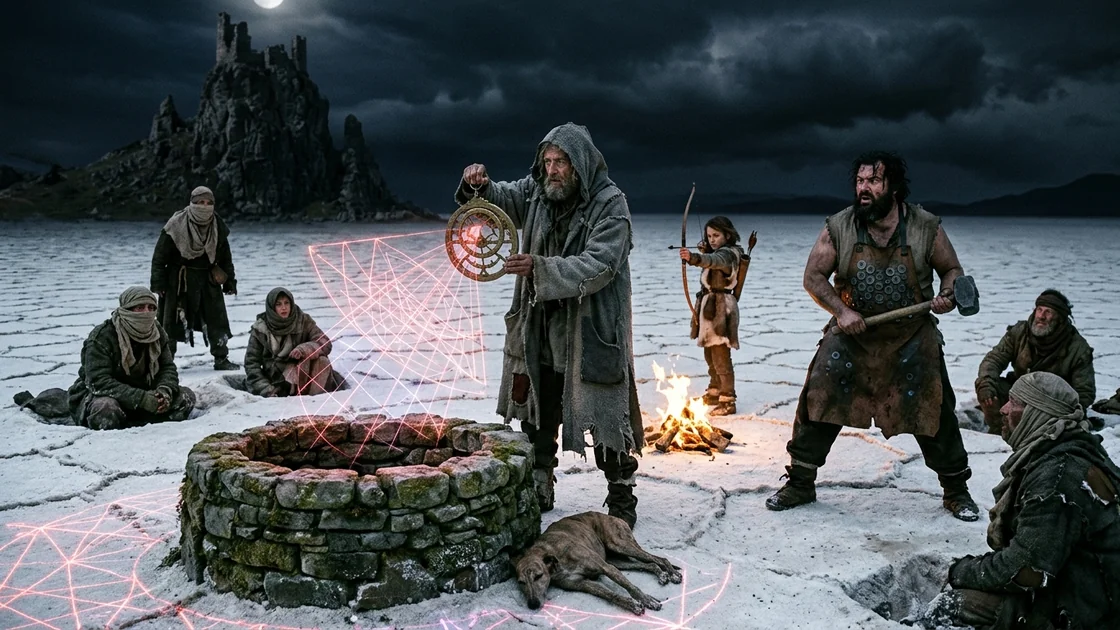
This is the tale of Aurelius Vance, once the supreme court sorcerer of the Vaelian Empire, who ended a decade-long war by anchoring an enduring curse of absolute drought over the rival kingdom of Oakhaven. Decades later, hollowed out by the lingering horrors of his triumph and despised by his own conscience, Vance abandons his gilded tower and disguises himself as a ragged wanderer to walk among the desiccated towns, bone-strewn pastures, and starving folk whose generational ruin he crafted with his own hands. Seeking neither forgiveness nor an easy death, he journeys to the epicenter of his great crime to see if a man who stole the sky can ever pay the ransom in blood and rain.
Chapter I: The Architecture of Fire
The maps in the High Citadel of Vael had been drafted on calfskin so pale it resembled winter light. Upon those sheets of dead skin, the Kingdom of Oakhaven had been rendered in lush verdigris inks—arteries of blue water branching off the great Spine of Morvath, thick belts of ancient forest, and rolling agrarian valleys that supplied half the bread of the eastern continent.
Aurelius remembered the tip of his brass compass gouging that calfskin. He remembered the smell of the war room: cured leather, lamp oil, and the dry, sweet incense King Alden burned to disguise the smell of his own ulcerated leg.
"Not a sword, Aurelius," the king had commanded, leaning his heavy rings against the edge of the table. "Swords leave sons. Sons grow hands. Hands lift iron. I do not want to conquer Oakhaven every spring for the rest of my dynasty. I want them unmade. I want the marrow sucked from their earth until their lords cannot water a single horse, let alone an army."
Aurelius had been thirty-eight then. His black hair was oiled and cropped in the Vaelian courtly style; his fingers were slender, stained with indigo salts and antimony. He had believed, with the clean, crystalline vanity of the ivory-tower theorist, that magic was simply geometry elevated to divine authority. There was no cruelty in geometry. A circle did not hate the square it bounded; a line did not resent the point it bisected.
"To kill an army requires a river of blood," Aurelius had told his sovereign, his voice smooth as polished porphyry. "To starve a sky requires only a lock and a key. We shall forge a lock of red glass and drive it into the celestial loom above their heads. The rain will form, Sire, but it will not fall. It will turn to vapor before it kisses their corn. Their children will look up at dark clouds every autumn and taste only ashes."
The King had laughed. It was a dry, rattling laugh, like pebbles shaken in a gourd. "Do it. And let the name of Vance be carved into the border-markers."
The ritual had consumed twelve nights, three thousand weight of cinnabar, the lifeblood of four hundred white bulls, and a shard of fallen celestial glass hauled out of the Northern Scars at the cost of eighty miners' lungs. Aurelius had stood in the center of the brass astrolabe atop the Tower of Crows, his hair whipping in winds that tasted of ozone and burning sulfur. He had chanted the seven inversions of water. He had bound the spirit of the eastern dampness into a knot of spun copper and cold iron, burying it not in the ground, but in the higher ether where the clouds gather to nurse.
He remembered the final stroke: driving a needle of consecrated pitch into the astral convergence of Oakhaven’s watershed.
The air had shrieked. To the east, fifty leagues away across the border crags, the sky had blanched. A strange, pale shimmer had settled over the horizon—a dome of invisible, trembling heat that warped the stars.
The war ended without another arrow drawn from a quiver. Within three years, Oakhaven’s vanguard collapsed because their supply lines had turned to dry gravel. Within seven years, the Oakhaven royal house drank wine pressed from withered berries before slitting their own throats in the dry fountains of their palace. Within fifteen years, the refugees ceased to arrive at the Vaelian border outposts, because the desert between the two nations had grown too wide, too silent, and too cruel for anyone on foot to cross.
King Alden died in luxury, buried beneath slabs of malachite and gold. The kingdom praised Aurelius as the Weaver of Tides, the Iron Cloud, the Savior of the Sun-Gilded Throne. They gave him a pension of thousand-florin coins, a palace on the Bay of Pears, and apprentices who kissed the hem of his velvet robes.
And then, Aurelius began to dream of water.
In the dreams, it was never an ocean or a river. It was a single drop hanging from the lip of a cold iron bucket. It hung there, bulging, heavy with life, trembling with a light so pure it burned his corneas. He would reach out his hand, parched, his tongue swollen into a blackened wedge of salt, but before the drop could fall into his mouth, it would turn into a beetle of red glass. The beetle would crawl down his throat, its six barbed legs tearing his trachea, burrowing into his heart to lay eggs of sand.
He woke sweating, though his skin felt as brittle as parchment. He would go to the bronze basin in his bedchamber, plunge his face into the cold water, and find that it brought him no relief. The water touched his skin, but his soul remained dry as a kiln-baked brick.
Thirty-four years after the ritual, Master Aurelius Vance vanished.
The apprentices found his silk robes folded neatly upon his cedar table. Upon them lay his golden ring of office, his state signet, and a small pile of gold coins sufficient to pay his servants' wages for three decades. There was no letter. There was only a single window left open to the east, through which the desert wind blew a faint, powdery red dust that settled like rust over his astrolabes and his treatises on thaumaturgical balance.
Chapter II: The Crossing of the Aveline
The man who walked down the shale slopes of the border crags carried no staff of polished ash or wand of quicksilver. He carried a crooked stick cut from a dead tamarisk shrub, bound at the top with strips of oily hide to keep the grain from splitting.
His name was not Aurelius. In his pocket was an iron tinker’s tag stamped with the name Bram of the Well. His coat was made of three different kinds of coarse homespun, patched together with waxed hemp, stained with grease, tallow, and trail-dirt. His beard, once kept trimmed to a needle-point after the fashion of the Vaelian Senate, was now a tangled mat of gray and dun, smelling of woodsmoke and dried mint.
Beneath the ragged gray hood, his eyes—pale as cloudy water—scanned the horizon where the land of Oakhaven began.
Thirty years of imperial triumph had erased the border stations. The stone watchtowers built by the old dukes of Oakhaven were now merely teeth of tumbled granite protruding from drifts of fine, wind-sifted dust. Where the River Aveline had once poured three hundred thousand gallons of glacial melt per minute into the southern lowlands, there was now only a canyon of sun-bleached stones.
Bram climbed down into the riverbed. The stones were round, smooth, and utterly dead. He knelt, scooping aside a layer of dry, white river-gravel. In the old days, even in summer, digging a hand’s breadth into the Aveline would yield cold, black mud.
Bram dug. His fingernails, broken and packed with earth, scraped against flat slate. He dug down two feet, three feet, until his shoulder was deep in the trench.
The dust was cold below, but it was dry as lime. There was not a trace of dampness. No worm crawled through it. No fungus clung to the underside of the river-boulders. The curse did not merely stop the rain; it reached down like an invisible sponge of spiritual phosphorus, drawing the subtle waters from the earth’s deep belly and flinging them into the upper wind where they dissipated into empty mist.
He stood, dusting his knees. The heat was not the clean, fragrant heat of a summer field. It was an oppressive, static pressure. It smelled of pulverized slate, baked dung, and old, dead thatch.
Two miles down the dry riverbed, he saw the first village.
It had been called Willow-in-the-Cleft on his old maps. A poetic name, chosen by people who thought willows were eternal because water was eternal.
Now, it was a cluster of mud-brick walls from which the straw was peeling like scabs. The roofs had long since fallen in, stripped of their rafters for firewood during the bitter, rainless winters when the temperature dropped below freezing and the wind blew unhindered from the barren plains.
A chimney stood alone like an uncarved headstone. At the base of the well, three figures sat.
Bram did not hide. A sorcerer might have used a glamer to walk unseen, slipping between the air currents like a shadow. Bram walked with the heavy, uneven gait of an old man whose knees were swollen with gravelly rheum. His boots, stolen from a dead cobbler in the border hills, made a loud, crunching noise on the sun-shattered shale.
The figures did not run. They did not even reach for weapons. They turned their heads with the agonizing slowness of lizards basking on hot slate.
There were two women and a boy. One woman was old—perhaps fifty, though she looked ninety, her face a map of canyons cut by the glare of an unyielding sun. Her eyelids were swollen, the lashes glued with dry matter. The younger woman had a baby bundled in a grease-stained cloth against her chest. The bundle made no sound. It did not cry. It did not twitch.
The boy was perhaps twelve, his ribs showing through the tears in his hemp smock like the wicker frame of a broken basket. In his hands, he held a flat stone. Between his knees was a bowl made from half a dried gourd.
"Hullo, father," the old woman croaked. Her voice was not human; it was the sound of dry leaves being kicked across flagstones.
"Peace to this house," Bram said, using the traditional Oakhaven greeting he had read in parchment histories forty years ago.
The younger woman made a small, clicking noise in her throat. It might have been a laugh, or it might have been an intake of dust. "No house here, traveler. Only holes."
Bram stopped three paces away. He knew better than to make sudden movements. Starving people were like dogs whose backs were broken: they would not fight, but if you crowded them, they would tear at you with whatever teeth remained.
"I have salt," Bram said. He unslung his leather wallet. "And dried plums. From the west."
The boy’s eyes widened, shining with a dull, feverish yellow in his skull. The old woman lifted a hand that looked like an eagle’s foot, its skin gray-white, spotted with the liver marks of slow starvation.
"The west," she whispered. "The golden bastards."
"I am from the hills," Bram lied smoothly. "I mend pots. I sharpen sickles."
"No sickles here," the boy said. He pointed his flat stone toward the plain. "Nothing to cut. The grass doesn't grow tall enough to take an edge. You just pull it. If you find any."
Bram sat upon a boulder. Every bone in his hips ached with a dull, throbbing heat. He opened his wallet, took out three dried plums, black and wrinkled as his own sins, and laid them upon a clean stone between them. He did not offer them directly; he did not want them to grovel or snap.
The boy looked at the younger woman. She nodded once, a tiny twitch of her chin.
The boy did not pounce. He reached out with terrifying deliberation, took one plum, and placed it whole into his mouth. He did not chew. He merely closed his lips over it, his eyes rolling back in his head as his salivary glands, long dormant, spasmed into life. A single tear squeezed from the corner of his left eye, trailed through the soot on his cheek, and dried before it reached his jaw.
"You have water?" the old woman asked.
Bram unhooked his waterskin. It was made of thick cured goat-leather, heavy with three pints of spring water he had hauled from the last mountain spring three days back.
"A cup," he said. "No more. I have three days to walk to Morvath."
"Morvath," the old woman spat. "The dead lake. Nothing there but white crust and the bones of the king's geese. What do you go there for, tinker? To scrape salt?"
"To see," Bram said.
He poured an inch of water into a small wooden bowl he took from his pack. The liquid was clear, catching the brassy glare of the noon sky.
For a second, none of them moved. They stared at the water as if it were a coiled viper. Then the younger woman leaned forward, her fingers trembling so violently she nearly tipped the bowl. She did not drink. She dipped the tip of her forefinger into the water and touched it to the lips of the bundle in her arms.
Bram looked at the child. Its skin was yellow-gray, its eyes sunken beneath blue veins, its skull misshapen from the lack of milk. Its tongue, dry and white as a parsnip, flicked out. It tasted the moisture. It made a faint, reedy peep, like a mouse under a boot.
"She won't last to the moon," the old woman said, staring not at the child, but at the remaining water in the bowl. "Her mother has no milk. Only dust. We boil the leather from our sandals to make soup, but the glue makes the guts twist. Two of my grandsons died of the gut-twist last winter."
The young mother drank what remained in the bowl in a single, desperate gulp. She swallowed three times, her throat clicking, then closed her eyes and rested her forehead against the dry mud of the well-curb.
"Why do you stay?" Bram asked. His voice was lower now, thick with something he could not quite swallow down. "The border is seventy leagues west. There are streams in Vael. There are rain-troughs that run over. The ditches are full of watercress."
The old woman looked at him. Her eyes were milky with cataracts, but behind that film was a hatred so deep and pure that Bram felt his ribs tighten around his heart.
"The border?" she whispered. "The border is where the Vaelian horsemen ride with iron masks. They don't shoot arrows at us, tinker. Arrows cost silver. They just sit on their fat geldings and watch us crawl toward the ditch. When you reach the ditch, if you touch the water, they spear you with boar-lances and throw your carcass back on this side. They say our thirst is an infection. They say the King of Vael made an oath to his gods: Not one drop of Vaelian water shall wet an Oakhaven tongue."
She leaned closer. Bram could smell her breath. It smelled of old copper and decay.
"My mother told me," she murmured, "that when the Great Dry came, the clouds turned into red horses and galloped away north. She was seven years old. She said the sky had a sound then. It hummed. Like a bronze kettle on a hot hearth. Day and night. A hum that made your teeth buzz in your head. Do you hear it, tinker?"
Bram closed his eyes.
He did not need to listen. He felt it.
To these people, it was a sound, a mystery, a divine affliction. To him, it was his own handwriting.
The spell was not dead. It was self-renewing, a perpetual engine fueled by the ambient heat of the dying land. The seven inversions were anchored into the granite bedrock of the kingdom, drawing the vapor up, superheating it in the mid-strata of the air, and blowing it east toward the ocean where it fell uselessly into the brine. The "hum" was the vibration of the celestial lattice he had pinned into the sky with needles of pitch.
It is my lung, he thought. The sky is breathing with my lung.
He opened his purse and took out the remaining dried fruit. He placed it in the boy’s lap.
"Take it," he said.
"What do you want for it?" the boy asked, his small fingers already curling around the leathery skins. "We have no silver. We have some sheep-wool, but it’s full of burs. The sheep died three years back."
"I want nothing," Bram said. He rose, his joints popping like dry branches. "Tell me the way to High-Cistern."
The old woman pointed with her chin down the dead riverbed toward the shimmering haze where the plains met the foothills.
"Follow the white trail," she said. "The trail made of sheep bones and barrel-hoops. That’s where the people went twenty years ago, when the wells went black. They thought the Duke had water in his cisterns. They found the Duke hanging from his own gate-post, dried up like a salted cod. There's nothing there now, tinker. Nothing but the Gray Folk."
"The Gray Folk?"
"Those who forgot how to talk," she whispered, her eyes wandering back to the empty bowl. "Those who eat dirt to fill their bellies. If they see that waterskin, they won't use words to ask for it. They'll crack your skull with a river-stone and drink the red from your neck."
Bram adjusted his pack. "I have an iron pin," he said softly. "It is hard to break."
He turned from the well and walked toward the glare.
Behind him, he heard the young mother begin to sing. It was not a lullaby. It was an old rain-charm, the words garbled and broken, repeated in a monotonous, flat rhythm that rose into the dry air and was swallowed instantly by the heat:
Come, green lady, from the well,
Bring the bucket, ring the bell.
Wash the leaf and drown the corn,
Before the child is dead and born...
He walked until the song was only the dry clicking of grasshoppers in the dusty thorns.
Chapter III: The Road of White Lime
In Vael, they had celebrated the twentieth anniversary of the "Pacification" with a festival of fountains.
Aurelius remembered it well. The Grand Architect had constructed twelve temporary cascades in the Plaza of the Sun, fed by three aqueducts that brought water from the northern snowfields. Naked girls had danced in the spray, their hair spangled with pearls. Wine had been chilled in great blocks of mountain ice that were allowed to melt into the gutters, soaking the hooves of the senators' horses.
Aurelius had stood beside the young King Kaelen—Alden’s grandson—drinking snow-cooled vintage from an amber goblet.
"They say nothing lives between here and the Sea of Silt," the young King had said, laughing. "A clean border. A border that needs no garrison. You have saved the treasury four million crowns a year, Arch-Mage."
"The geometry was sound, Sire," Aurelius had replied. His voice had already begun to sound hollow to his own ears, like an empty cellar.
"A pity the land is useless," Kaelen had remarked, tossing his dregs into the gutter. "We might have planted orchards."
Now, Bram walked through the orchards that Kaelen would never plant.
They were miles of dead peach and apple trees, their trunks split open by the frost of thirty rainless winters, their branches bleached silver by the sun. They looked like an army of skeletons caught in the moment of an agonizing retreat, their twisted limbs raised toward the pale sky as if pleading for quarter.
The soil was not soil anymore. The organic matter had long since oxidized, blown away on the seasonal gales. What remained was a fine, floury silt that rose with every step he took, coating his wool trousers, his hands, and the inside of his nostrils. It had a bitter taste—the taste of alkaline salts brought to the surface by capillary action and left behind when the deep moisture vanished.
At noon, when the sun stood overhead like a disc of hammered brass, the heat became an entity.
It was not merely warm; it was violent. It sought moisture with a predatory intelligence. His lips cracked until they bled; he did not lick them, for saliva was a currency too precious to spend on relief that lasted five seconds. He kept a smooth pebble of river-quartz under his tongue to force his mouth to stay wet.
Beside the road lay the remnants of the migration.
Every mile had its relics. An iron tire from an ox-cart, the wood long rotted or burnt. A copper kettle with a hole worn through the base. A child’s shoe made of pigskin, curled like an autumn leaf. And bones.
Mostly they were ox and mule bones, long since cracked open by desperate folk seeking the greasy yellow marrow within. But here and there, half-buried in the silt drifts, were the narrow ribs of sheep, the skulls of dogs, and the distinctive, delicate curvature of human pelvic bones.
They were not buried. Who had the strength to dig five feet into ground that had turned to concrete? People had simply sat down against the wind-breaks of stone walls, pulled their cloaks over their heads, and waited for the heat-stroke to carry them off into the cool dark.
Bram stopped beside a stone cistern that had been cracked open by an old earthquake.
Inside the shade of the broken vault, someone had painted a sign in white lime. It was thirty years old, the pigment peeling, but the letters were large and jagged:
THE MAGE VANCE DID THIS TO US. MAY HE EAT SAND IN THE GRAVE. MAY HIS MOTHER WEEP PITCH.
Bram stood before the inscription for a long time.
He raised his gloved hand. He touched the stone. The surface was hot, like the flank of a feverish horse.
Beneath his fingers, his magical sense—the third sight that had made him the greatest diviner of his century—stirred against his will. He did not need to cast a circle or burn incense. His soul was attuned to the curse; he had woven it from his own spiritual fabric.
He closed his eyes and let his awareness sink into the stone, through the dry shale beneath, down into the deep granite roots of the valley.
The pattern was there.
It was vast. It was an intricate web of invisible, searing threads that spanned four hundred leagues. It was anchored to seven great anchors of iron and bone driven into the sacred nodes of the earth.
The node nearest him was at the Abbey of Saint Brigid-of-the-Rills, six miles north in the limestone crags.
He remembered the day he had chosen the Abbey.
"The monastery is built over an underground spring," his scouts had reported forty years ago. "The monks believe it is holy water that flows directly from the heart of the world."
"Then we will drive the second stake through the altar," Aurelius had told the Captain of the Iron Legion. "Where the spring rises, the spirit of the water is most tender. It will feel the iron more sharply. It will pull the surrounding veins shut, like a cut vein cauterized with hot fat."
The scouts had carried out the order. They had driven a six-foot spike of meteoric iron, carved with the seventy names of drying, through the stone floor of the chapel into the spring's heart.
Now, Bram felt the spike.
It was vibrating. It was not silent. To his inner ear, it was a high, thin scream that had not stopped for three decades. The earth around it was dead, calcified, converted into a brittle glass that prevented any water from rising through the strata. The spiritual pressure around the spike was immense; it was like an abscess in the world's flesh, swollen with dry fire and screaming for release.
"I can't pull it," he whispered to the stone wall.
His voice was a dry croak that died in the dust.
A master sorcerer could dismantle another man's spell with patience and counter-arithmetic. But this was not another man's spell. It was his. He had tied the knots with his own life-essence; he had sealed them with his own true name, the name he had never spoken to King Alden or his lovers.
If he attempted to rip the spike out with raw thaumaturgy, the backlash of thirty years of compressed pneumatic force would vaporize him in a second, and the curse would remain, its anchor simply shifting to the nearest mass of stone or bone.
A curse of this magnitude could not be broken by force. It had to be unpicked from within, like an embroidery whose knots must be loosened one thread at a time by fingers that did not mind the needles.
He heard a rattle of stones.
Bram pulled his hand from the wall and reached for his stave.
Around the bend of the broken cistern wall came four figures.
They did not look like the folk of Willow-in-the-Cleft. They were not waiting to die. They were long-legged, lean as jackals, their skin blackened by the sun until it looked like cured meat. They wore strips of rawhide around their feet and rags of gray wool tied about their bellies with strips of intestine.
In their hands they held weapons: an iron hay-fork with one tine missing, a butcher’s cleaver ground down to the width of a thumb, and two clubs studded with square horse-shoe nails.
Their eyes were wide, rimmed with red, showing the yellow sclera of liver failure.
"The skin," the foremost said. He had no teeth in the front of his mouth; his gums were black and hard. He pointed the hay-fork at Bram’s hip. "The skin. Drop it."
Bram did not drop it. He stepped back until his shoulders touched the stone of the cistern.
"The water is old," Bram said. "It will not last you two days."
"It's two days," said the one with the cleaver. He was smaller, his shoulders hunched like a hyena’s. "Drop it or we drink the oil from your skull."
They were the Gray Folk. The ones who had survived by eating what others would not touch; by lingering near the dried springs until the dead were many and the living few.
Bram felt the spark in his belly.
It was still there. The fire that had burned down the towers of Oakhaven. It would take only a whisper—a syllable of the High Tongue of Vael—and a jet of white flame would leap from his fingers, turning these four starvelings into charcoal before they could draw breath. He could split the ground beneath their feet; he could call the air from their lungs until their chests collapsed like dry bladders.
His lips twitched. He shaped the vowel.
No.
He had killed their grandparents with geometry. He had killed their mothers with an idea. He would not kill them with fire to save an old man's skin.
He lowered the stave.
"Take it," he said.
He unhooked the goat-skin. It was half-full; it sloshed with a sound that seemed obscene in the absolute silence of the plain.
The man with the hay-fork lunged forward, snatching the bag by the strap. He did not share it. He did not pause. He jammed the wooden nozzle into his mouth and tipped his head back, his throat working with great, shuddering gulps.
The other three fell upon him.
They did not use the weapons; they used their fingers, their teeth, their knees. They rolled in the silt, a tangled heap of gray limbs, snarling like dogs over a sheep-head. The goat-skin tore.
The water—clear, cold, precious mountain water hauled fifty leagues across the crags—poured out into the lime-dust.
For a fraction of a second, the mud formed. A small, dark pool, an inch wide, bubbled on the stone.
The four men stopped fighting. They froze, staring down at the earth.
Then, with horrifying swiftness, they dropped to their bellies. They pressed their faces into the mud. They licked the stones, their tongues scraping the lime-crust, their teeth grinding against the pebbles, trying to swallow the dirt before the great, invisible sponge of the sky could drink the moisture back.
Within ten breaths, it was gone.
The dust was dry again. The stones were white again.
The four men lay on their chests, their shoulders heaving, their mouths ringed with gray mud that was already drying into a crackled mask.
The man with the cleaver looked up at Bram. His red-rimmed eyes were wet with a mixture of dirt and madness.
"You have another," he snarled.
"I have no more," Bram said.
"Search his wallet!"
They scrambled toward him. Bram did not strike. He held his stave vertically, his muscles tensing for the impact.
"Hold!"
The voice was high, cracked, but it had an authority that made the four jackals pause.
From the shade of the ruined orchard wall stepped a fifth figure.
It was a girl, perhaps seventeen years of age, though she had the stunted height of a child of ten. She wore a hunter's tunic made of dried rabbit skins sewn with sinew, and across her back was a short-bow made of laminated horn. She held an arrow nocked to the string—an arrow tipped not with iron, but with a shard of brown beer-glass, flaked to a razor edge.
"He's got no water, Gallow," she said, her arrow leveled at the man with the hay-fork. "You smelled his skin. It's empty. Leave him."
"He's got dried meat," the man named Gallow growled.
"He's got dust and bad knees," the girl said. "And if you kill him, I'll put this glass through your good eye. You know I can hit the iris, Gallow. I did it to your brother."
The four men hesitated. They looked at the arrow; they looked at Bram’s tall, unyielding frame; they looked at the empty skin lying shredded in the silt.
With slow, sullen movements, they backed away. They did not speak again. They retreated into the white orchard like wolves that had been driven from a carcass by an older wolf, disappearing among the dead trees until only their gray footprints remained in the dust.
The girl did not lower her bow.
"You're a fool, old man," she said. Her face was smudged with charcoal beneath the cheekbones to cut the glare of the white earth. Her teeth were small, worn down by grit, but they were white and complete.
"I have been called that," Bram said. "And worse."
"They would have eaten your fingers," she said, letting the tension off the bowstring with a practiced, smooth release. "They did it to a peddler from the North two moons back. They dried his meat on the stones."
"Why did you stop them?"
She looked at him with an expression that was neither kind nor cruel. It was the cold, calculating look of a creature that lived entirely within the margins of water-loss and water-gain.
"You have a Vaelian stave," she said, nodding toward the tamarisk stick. "The binding. It's not hemp. It’s pig-gut cured with blue vitriol. Only the dogs in the west use that."
Bram glanced down at the stave. Even fifty leagues away, his habits had betrayed him. The apprentice who had bound the stave three winters ago had used the standard imperial preservative.
"I bought it from a trader," he said.
"You lie like a clerk," the girl said. "Come into the shade. If you stand out there, your brains will cook in your skull, and I don't want to drag your carcass to the ditch."
Chapter IV: The Girl Who Remembered Green
Her name was Kaelen.
It was the same name as the young King in Vael—an old royal name of the Unified Plains, before the languages had split into the imperial dialect of the west and the soft, rolling speech of the eastern vales.
She lived in a cellar beneath the ruins of an old dyer’s shop. It was cool there, three steps down into the earth, smelling of dry clay and the bitter indigo that had soaked into the flagstones two generations ago.
In the corner lay her treasures: four earthenware jars, sealed with mutton-tallow and beeswax.
"Don't look at them," she said, leaning her bow against a beam. "They're empty. My grandfather filled them with wheat when the first dry year came. He thought the King would send wagons. He thought the priests would pray the clouds back. The wheat turned into weevils, the weevils died, and now there’s only gray flour that tastes of rot."
She sat on a three-legged stool and pulled a small wooden cup from her belt.
From beneath a slab of slate in the floor, she produced a skin—not an imperial water-bag, but the bladder of an ox, carefully oiled. She poured a measure of water no larger than a walnut into the cup and slid it across the table toward him.
"Drink," she said.
Bram looked at the water. It was gray, smelling of sulfur and wet shale.
"You have little," he said.
"I have a seep," she replied, her chin lifting with a pride that seemed grotesque in this graveyard. "Three miles up the limestone ditch. It gives two quarts between sundown and dawn. I have to wait with a spoon to catch it as it drips from the crack. If I miss an hour, the rock drinks it back. Drink it, or I'll give it to the beetle."
Bram took the cup. He did not gulp. He held the water in his mouth, feeling the cold, miraculous reality of it against his gums, his tongue, the roof of his mouth. It tasted of lime, of iron, of ancient limestone caverns where no sun had ever shone.
He swallowed. It was like life itself returning to his veins, a small, silver wire running down into his belly.
"Thank you," he said.
"Don't thank me," she said. "You're going to pay for it."
"With what? Gallow took my skin."
"You have an iron knife in your left boot," she said. "And your coat has bronze buttons. Real bronze, not that tin stuff the tinker-caravans used to sell. Bronze is good. It doesn't rust when you put it in the seep to hold the leather gutter."
Bram smiled beneath his gray beard. It was his first real smile in seven years.
"The knife is yours," he said. He reached down, drew the blade—a small, sturdy skinning knife with an ash-wood handle—and laid it on the table.
She took it instantly, her fingers testing the balance, the edge, the point. Her eyes glittered with a fierce, childish delight that broke through her mask of starvation.
"This is good iron," she whispered. "Vaelian iron. It doesn't break when you strike slate."
She looked up at him, her gaze suddenly sharp.
"Why are you going to Morvath?"
"There is something I must undo," he said.
"Undo?" She laughed, a sound like dry gravel sliding down a chute. "You can't undo the sky, old man. The sky is broken. A great toad came out of the sun and ate the rain-glands. Everyone knows that."
"A toad?"
"That's what the old mothers say," she said, sliding the knife into a sheath made of braided thistle-twine. "They say the King of Vael had a toad with twelve eyes and a belly full of fire. He let it loose on the mountains, and it sat on the highest peak and drank the clouds as they came from the sea. My mother said if you find the toad, you have to split it from the vent to the snout with a silver needle, and then the rain will come out of its guts like a flood."
Bram closed his eyes.
A toad with twelve eyes.
So that was what his great geometry had become in the minds of the children. A fairytale. A nursery monster.
How much cleaner it would have been if it had been a toad. A beast could be hunted; a beast had flesh that could be pierced by an arrow of horn and glass. But how could a peasant girl shoot a set of spherical equations? How could she kill a knot of metaphysical principles balanced between the stars and the stone?
"The toad is not on the mountain," Bram said quietly.
"Where is it, then?"
"It is everywhere," he said. "It is in the air you breathe. It is in the way the dew does not gather on the thistle at dawn. It is in the way the stones stay hot three hours after the sun goes down."
Kaelen leaned her elbows on the table, studying his face.
"You speak like the old priests," she murmured. "We had one in the village when I was five. He had a book made of calfskin. He read from it every morning, asking the Lady of the Fountains to look down upon us. He read until his tongue swelled up so large he couldn't close his teeth. Then the Gray Folk came and burned his book to bake their mud-cakes, and they took his shoes."
She reached into her tunic and pulled out a small object suspended from a strip of sinew.
It was a piece of glass.
Not bottle-glass like her arrowhead. It was red. A deep, crystalline scarlet, perfectly square, its edges beveled with mathematical perfection. It was an inch on each side, and in its center was a tiny, microscopic point of light that seemed to turn like a dying star.
Bram’s heart leaped into his throat. His vision blurred.
It was an alignment bead. One of the seventy-two balancing nodes he had cast into the upper air forty years ago. It must have fallen when the celestial lattice settled, knocked loose by a high-altitude storm or an imperfection in the brass setting.
"Where did you get that?" His voice was no longer that of Bram the tinker. It was the voice that had commanded the legions of the Sun-Gilded Throne.
The girl did not flinch, but her fingers tightened around the stone.
"My brother found it," she said. "In the dry bed of the high reservoir at Morvath. It was buried in the salt crust. It was cold. That's the strange thing about it, old man. Everything in this kingdom is hot. The stones are hot, the dirt is hot, the water from the seep is lukewarm. But this stone... even at noon, it feels like mountain ice."
She held it toward him, but did not let go of the string.
"Touch it," she commanded.
Bram reached out a trembling finger.
The moment his skin touched the red crystal, his mind was flooded with a sound that nearly drove him to his knees.
...thirty-two degrees north-by-northeast... balance point seven... hold the moisture... seal the seam... let the vapor scatter...
It was his own voice.
A younger, colder voice. The voice of a man who sat in an ivory room with a silver ruler, determining how many bushels of corn a peasant in another country would be allowed to grow for the next hundred years.
The stone was not cold because it was ice. It was cold because it was an engine of extraction. It drew the vitality—the numen—from the world around it to maintain the tension of the great seal above. It was a vampire made of sand and cinnabar.
"It doesn't lose its light," she said, watching him. "In the dark, it makes red patterns on the wall. Sometimes I look at them until I see trees. I've never seen a tree with leaves, you know. Only the silver sticks in the orchards. Are they really green? Like pond-slime?"
"They are greener than pond-slime," Bram whispered. "They are green like emeralds. Like the light that comes through a leaf when you hold it against the morning sun."
She stared at him, her eyes dark and hollow.
"You're from the West," she said flatly.
He did not deny it. He could not.
"Did you see them?" she asked. "The trees?"
"I lived among them," he said. "My garden had eighteen kinds of oak. And a stream that ran through the grass with trout as long as my forearm."
She did not spit. She did not strike him with the knife he had given her. She merely let the red stone fall back against her rabbit-skin tunic, its scarlet light disappearing into the fur.
"Take me with you," she said.
"To Morvath?"
"To the West," she said. "Morvath is on the way. If you know what the toad is, you know the gaps in the border. You know where the horsemen ride. I want to see a leaf before I'm thirty. My mother died when she was twenty-six, and she looked like a dry boot. I don't want to die like a dry boot."
Bram looked at her—at the thin arms, the fierce, starving intelligence in her eyes, the red crystal resting over her small, dry heart.
"The way is long," he said. "And what I have to do at Morvath may kill us both."
"Gallow will kill me anyway," she said, rising and tightening her bow-harness. "He knows about the seep. He'll find it by tomorrow noon, and when he does, he won't leave me enough water to spit on a beetle. Let’s go, old man. Before the sun gets to the middle of the sky."
Chapter V: The Valley of the Broken Plow
They walked for four days through what had once been the Bread-Basket of Oakhaven.
The landscape was uniform in its desolation. Low, rounded hills of red clay, dissected by deep gullies where torrential waters had once run during the ancient spring melts, but which were now only dry flumes filled with wind-blown tumbleweeds and the shells of dead land-snails.
Kaelen knew the country with an animal’s intimacy.
She knew that if you dug behind a north-facing outcrop of slate at dawn, you could find three drops of dew clinging to the roots of the salt-bush. She knew which beetles could be eaten (the black ones with the yellow spots) and which would cause the bowels to turn to fire (the narrow gray ones that smelled of creosote).
She watched Bram with a silent, suspicious intensity.
"You don't walk like a peasant," she remarked on the third evening, as they crouched in the lee of an overturned freight wagon whose timbers had dried to the consistency of balsa wood. "You walk like a soldier who forgot his sword."
"I was never a soldier," Bram murmured. He was chewing on a dry leather strap to produce spit. His joints felt as if they were packed with emery dust.
"A clerk, then," she said. "My father had a book-man in his village who walked with his chin in his chest, always looking down as if he expected to find florins in the dung. He died first. When the wells failed, he sat in his house and read his papers until he was too weak to crawl to the common bucket."
"He was wise," Bram said.
"He was an idiot," she spat. "If you can't eat a word, what good is it? My father traded our iron cooking pot for three turnips. That was stupid too, but at least we ate the turnips."
"And your father?"
"He went to the city," she said, looking out into the blue darkness where the wind was beginning its nightly lament. "He said the King had granite silos full of barley. He said no king would let his folk starve while there was grain in the capital. He never came back. Three years later, a man came through with my father’s belt-buckle. He said there was no city anymore. Just a great house full of bones, and people living in the cellars eating each other's children."
She spoke without tears. In this land, grief was a liquid, and liquid could not be spared.
"What was the name of your village?" Bram asked.
"Cross-Keys," she said. "It had three inns. And an alder tree in the middle of the square where they hung sheep-thieves. My mother said people used to come from ten leagues around just to sit in the shade of that alder and drink cider. What is cider?"
"It is wine," Bram said softly, "made from apples."
"Sweet?"
"Sweet. And sharp. Like cold sunshine."
She was silent for a long time. She took her glass arrowhead from her pouch and began to hone it against a small whetstone, her strokes rhythmic and light: shh-t, shh-t, shh-t.
"Tell me about the magic," she said suddenly.
Bram stiffened. "What magic?"
"The magic that did this," she said, gesturing with the stone toward the darkness. "It wasn't a toad. I know that. I'm not five years old. It was men from the West. Men with rings and books."
Bram pulled his cloak tighter around his shoulders. The night was cold—the savage, radiant cold of desert air that has no moisture to hold the day's warmth.
"They thought they were ending a war," he said.
"They did end it," she said.
"They thought... they thought if they broke the sky, the people would simply leave. They thought you would move north, to the green lands behind the Great Wall, or cross the sea to the islands. They did not know people would stay."
"Where would we go?" Her voice was flat, merciless. "The North has the horse-lords. They kill anyone who doesn't speak their tongue. The islands have no ships. The ships rotted in the harbors when the rivers dried up and couldn't float them down to the coast. We stayed because our grandfather’s bones are here. We stayed because we didn't know the dry would last forever."
She leaned forward, her face lit only by the faint, icy glitter of the stars.
"Why did they hate us so much?"
The question was simple. It had no theology in it. No statecraft. No arithmetic.
Bram looked down at his hands—the hands that had held the needles of pitch, the hands that King Alden had kissed before the entire court.
"They did not hate you," he whispered. "That is the horror of it, Kaelen. They did not think of you at all. You were merely an entry in a ledger. A line of supply to be severed. They thought of your kingdom as a machine: if you take away the oil, the wheels stop turning. They did not see the people who were caught between the cogs."
"And the man who did it?" she asked, her glass blade pausing on the stone. "The one on the wall. The Mage Vance. Is he dead?"
"Not yet," Bram said.
"I hope he dies in a dry ditch," she said, her voice dropping into a register so cold it made the hair on Bram’s arms stand up. "I hope his throat turns to leather and his tongue rots in his gums. I hope they bury him in a box of salt so his ghost can never find a well."
Bram did not answer.
He reached into his pocket, took out his iron tinker's tag, and pressed the edge of it into the palm of his hand until the metal cut the skin, hoping the sharp, clean pain would drown the scream that was rising from the deep roots of his memory.
Chapter VI: The Dry Sea of Morvath
On the seventh day, they came to the lip of the basin.
Lake Morvath had once been the heart of the eastern continent. It had covered six hundred square leagues—a shallow, wind-swept expanse of freshwater that fed four great river systems. The old poets had called it the Lung of Oakhaven, for its summer evaporation formed the great thunder-heads that watered the interior plains every June.
Now, it was a blinding, white crater of salt.
From the crest of the limestone bluffs, the world looked as if it had been drowned not in water, but in lime. The salt crust was buckled into hexagonal plates that stretched to the horizon, their edges turned up like dead leaves. In the center of the basin, five leagues out across the glaring white waste, rose the Spire of Morvath—an ancient granite outcropping where the kings of Oakhaven had once maintained a summer castle and a shrine to the Water-Mother.
The air rising from the lakebed was different from the air of the plains.
It did not smell of dust. It smelled of ancient minerals, desiccated brine-shrimp, and an electrical tension so dense that Bram could taste copper on his gums.
"This is where he put it," Bram said. He was leaning heavily on his stave, his knuckles white.
"The toad?" Kaelen asked. She was shading her eyes with a hand bound in rag-strips.
"The primary needle," Bram said. "The knot of copper and iron. It was driven into the deepest spring at the base of the Spire. That is why the lake died first. It died in forty days. The fish were piled four cubits high along the shores, rotting until the smell reached the capital."
Kaelen looked down into the white expanse. "There are people down there."
Bram narrowed his eyes.
Across the salt-flat, tiny black specks were moving. They were not wandering; they were gathered in clusters around the bases of the old harbor piers that now stood forty feet above the dry mud like the stilts of giant water-birds.
"The Salt-Diggers," she said. "They scrape the crust to trade with the northern caravans for meal. They don't last long. The salt-glare makes them blind by twenty. But they have the Deep Well."
"There is still a well?"
"At the Spire," she said. "The Priests' Well. It never quite died. It gives two buckets of black water every noon. You have to fight for it. Every summer, whoever has the most iron clubs holds the well. Last year it was the Smith of Morvath. He’s nine feet tall, they say, and he wears an armor made of horse-shoes."
"He is not nine feet tall," Bram said, his voice tightening. "He is just a man with a hammer."
"A man with a hammer can crack your head just as well," she said. "We can't cross the salt in the day. The light will cook your eyes out of your skull. We wait for the moon."
They sat in the shadow of a dry lime-kiln on the cliff edge.
As the sun sank toward the west, it did not turn red and soft as it did in the humid vales of Vael. It remained a hard, white disc until it touched the mountains, then dropped like a lead weight, leaving behind an indigo sky that was cold, empty, and devoid of haze.
The stars came out with terrifying clarity.
They did not twinkle. Twinkling is the work of moisture in the upper air—the refraction of light through the dance of water vapor. Here, the stars were steady, cruel, and sharp as surgical needles.
Kaelen reached into her tunic, took out the red crystal, and laid it on a flat stone between them.
In the dark, the stone came alive.
It cast an intricate, geometric pattern of crimson lines across the limestone wall behind them. It was a projection of the celestial engine—a dodecahedron of spinning lines, intersecting at seventy-two critical nodes.
Bram leaned forward, his old scholar’s eyes following the lines with an involuntary, horrifying awe.
The spell had evolved.
Forty years of drawing upon the planetary heat had made it denser. It was no longer merely a spell; it was an artificial climate. It had grown roots. The threads of red light were no longer attached only to his original iron needles; they had woven themselves into the bedrock, using the residual salt deposits of Lake Morvath as a secondary conductor.
It has become a circle, he realized with a sinking heart. It feeds on the very dryness it creates. The drier the earth becomes, the hotter the ground; the hotter the ground, the higher the thermal curtain; the higher the curtain, the further the clouds are driven away.
It was magnificent.
Had he presented this paper at the Academy in Vael, they would have declared him an immortal. They would have struck medals with his profile. It was a thaumaturgical machine that required no fuel other than the destruction it wrought.
"It's pretty," Kaelen whispered, her dirty finger tracing one of the red light-beams on the rock. "It looks like the webs the orb-spiders used to spin in the cellar when I was little. But the spider was always in the middle."
"Yes," Bram said. "The spider is always in the middle."
He stood.
"Let us go," he said. "The salt will be cool now."
Chapter VII: The Salt-Plow
The crossing of Lake Morvath was like walking through a landscape of frozen moonlight.
The salt crust crackled beneath their boots: crunch, crunch, crunch. Every five paces, a fissure in the crust revealed the black, sulfurous mud beneath—mud that was not wet, but greasy with concentrated bitumen and soda.
The glare of the full moon was so bright that Bram could see the stitching on his ragged coat.
To their left, the hulls of three ancient merchant barges lay half-submerged in the salt drift, their ribs protruding like those of beached whales. In their holds, forty years ago, had been barrels of salt pork, casks of mountain ale, and sacks of clover seed. Now, their planks were so dry they would have ignited from a single spark of flint.
By midnight, they were three miles out.
The Spire of Morvath rose before them like a black finger accusing the stars. At its summit, the ruins of the castle looked like broken teeth. At its base, a small fire flickered—a tiny, yellow spark that seemed pitiful against the vast, dead white of the lakebed.
Around the fire, figures were moving.
"They're waiting for the noon-water," Kaelen said, her voice dropped to a whisper that was swallowed by the immense silence of the basin. "The well only fills once a day, when the mountain cold presses down from the peaks. But they line up at midnight to keep their place in the rank."
"How many?"
"Thirty. Maybe forty. The last of Morvath."
As they drew nearer, the smell reached them.
It was not the smell of the plains. It was the smell of a menagerie: unwashed human bodies, dried sweat, the stench of skin that had not known water for months, and the sweet, sick smell of gangrene.
The people were huddled in shallow pits they had scooped from the salt, lined with dried reeds from forty years ago. They had wrapped their heads in rags until they looked like corpses that had clawed their way out of their shrouds.
In the center of the camp, beside a low circular wall of moss-grown stones—the ancient mouth of the Priests' Well—stood the Smith.
He was not nine feet tall, but he was wide as an ox, his chest covered by an apron of greasy pig-hide studded with overlapping iron washers. In his hand he held not a war-hammer, but a heavy stone-mason’s maul, its iron head bound with copper wire.
Beside him sat a bronze bucket. It was dry. A long hemp rope, spliced twelve times, lay coiled at his feet like an anaconda.
A dog—the only dog Bram had seen in Oakhaven—lay near the stones. It was a lurcher, its ribs pressing so hard against its skin that the hide looked translucent. It did not bark. It had no moisture for a bark; it merely lifted its head, its eyes clouded with blue blindness, and thumped its tail once against the salt-crust.
Kaelen stopped at the edge of the firelight.
"Smith," she called out.
The big man lifted his head. His beard was a tangle of black wire, clotted with white salt-flakes. His nose had been broken; his small, pig-like eyes were watery and bloodshot.
"Kaelen," he said. His voice was like two millstones grinding together without corn. "You brought an old one. Old ones drink as much as young ones, but they don't dig salt."
"He's from the West," she said.
The camp went silent.
The thirty figures in the salt-pits did not leap up. They shifted. Rags rustled. Eyes—twenty, thirty pairs of eyes, white-rimmed, yellow-balled, rheumy—turned toward Bram.
The Smith leaned his weight on the maul.
"The West," he repeated. "A Vaelian."
"A tinker," Bram said, stepping into the yellow light of the brush-fire. "I have no tools to dig salt, Smith. But I have an iron knife, and I have knowledge of the rock."
The Smith spat into the fire. The spit did not sizzle; there was too little of it.
"We have plenty of iron," the Smith said. "The dead leave their knives behind. What we need is six feet of rope. Our rope is rotten. Every time we drop the bucket, three strands part. When the rope breaks, the bucket stays at the bottom, and then we all drink our own water until our bellies burst."
He stepped toward Bram, his iron-washer apron clinking with a sound like chains.
"You have a coat," the Smith said. "Good wool. Three thicknesses. If we cut it into strips and twist it, it will make twenty cubits of good line."
"You can have the coat," Bram said.
The Smith paused, surprised by the easy surrender. In this country, men died for an inch of rag.
"And what do you want for it?" the Smith asked suspiciously. "A cup from the bucket?"
"No," Bram said. He looked at the circular curb of the Priests' Well.
Beneath the stone, the scream was louder here than anywhere else in the world. It was no longer a high, thin wire; it was an organ pipe of brass and bone, vibrating with the full weight of the seventy-two nodes. The ground beneath his feet was humming. He could feel it through the soles of his stolen boots—a rhythmic, pulsing heat that was five degrees hotter than the surrounding lakebed.
"I want you to let me go down," Bram said.
The camp stirred again. A dry, rattling chuckle ran through the salt-pits.
"Down?" The Smith laughed, his mouth a black cavern. "There's nothing down there but thirty fathoms of dark and five inches of black slime that smells of old eggs. If you go down, you don't come up, tinker. The air in the bottom is heavy. It sits in your lungs like wet wool until you choke."
"I know what is at the bottom," Bram said.
He reached into his pack.
He did not pull out a tool or a weapon. He pulled out his true astrolabe—the small, brass sphere of seventy-two interlocking rings he had carried beneath his shirt for three thousand miles.
He held it up in the firelight.
The brass was not bright. It was tarnished brown by trail-sweat, but as the firelight caught the concentric rings, the red crystal around Kaelen's neck began to hum.
A sympathetic resonance passed between the two objects.
The red pattern on the wall of the ruined kiln five miles away was nothing compared to what happened now. The astrolabe caught the starlight, and suddenly, shafts of pale, scarlet luminescence projected from its core, throwing an intricate grid across the white salt-crust of the lakebed.
The lines ran straight from the brass sphere into the mouth of the well.
The Smith stepped back, lifting his maul with both hands, his face contorted in an expression of animal terror.
"Sorcerer!" he bellowed. "A sky-thief!"
The people in the salt-pits began to shriek. It was an awful, dry sound—a chorus of broken bellows, of whistles, of tongues clicking against dry palates.
"The Toad!" an old woman screamed, pointing a stick-like arm at Bram. "He's got the Toad in his hand!"
"Kill him!" another cried. "Pound him into the salt! Burn him with the reeds!"
They rose. They were weak, their limbs trembling with the palsy of starvation, but there were thirty of them, and they were driven by forty years of concentrated, holy hatred. They picked up river-stones, sharpened marrow-bones, fragments of salt-crust as hard as slate.
Kaelen notched her arrow.
"Back!" she screamed, her glass arrowhead pointing straight at the Smith’s throat. "Back, or I'll put it through your neck, Garan!"
"He did this, girl!" the Smith roared, his maul trembling in his great, scarred fists. "Look at him! He has the iron tools! He's the one who took the rain!"
"I am," Bram said.
His voice was not loud, but it had a strange, heavy authority that cut through their shrieks like a razor through dry leather.
He did not look at the Smith. He looked at the crowd of gray, ruined things that had once been the people of Oakhaven.
"I am Aurelius Vance," he said.
The name hit them like a physical blow.
Even after forty years, the name was remembered. It was the name written on the cisterns; it was the name mothers used to curse their children when they cried for milk; it was the name the dying spat into the dirt before their mouths closed forever.
The Smith lowered his maul an inch, his mouth hanging open.
"You?" he whispered. "You're an old dog. Vance is a prince. He lives in a house of gold. He has thirty wagons of water for his bath."
"Vance was an idiot," Bram said. "He thought he could write an equation that had no balance. He thought he could steal from the world without the world coming to collect the debt."
He took off his coat. He dropped it upon the salt. He stood before them in his thin, grease-stained smock, his ribs showing through the cloth, his gray hair matted with alkali dust, an old man who had walked three thousand miles to find a grave.
"The rope," Bram said, looking at the Smith. "Tie it to my waist. Lower me down."
"Why shouldn't I just smash your skull?" the Smith growled, his knuckles white on the maul-shaft. "Give me one reason, sky-thief. One reason why I shouldn't feed your guts to that blind dog."
"Because if you kill me," Bram said softly, "the knot stays tied. And your grandchildren will lick the salt until their tongues fall out, just as you have."
He looked at Kaelen.
The girl was staring at him. Her bowstring was still taut, but her eyes were wide, dark, and filled with a horror that was far more terrible to him than the Smith’s maul.
"You," she whispered.
The word was tiny. It was the sound of a dry leaf falling on slate.
"I am sorry about the trees, Kaelen," he said.
He turned toward the well.
"Tie the rope," he told the Smith. "Or kill me now. I am tired of walking."
Chapter VIII: The Descent into the Earth's Lung
The hemp rope cut into his armpits like dull knives.
The descent was slow. The shaft was four feet wide, lined with ancient granite blocks that had been squared by the mason-priests eight centuries ago. For the first twenty feet, the stones were white with salt-leaching—a thick, powdery fur that came off on his knuckles as he guided his descent.
Then came the heat.
It did not rise from fire; it rose from compression. The air became thick, hot, and tasting of sulfur and old zinc. It pressed against his eardrums with a steady, rhythmic thrumming: whun-whun-whun.
It was the heartbeat of the curse.
Thirty feet down. Forty feet.
The light from the well-mouth became a tiny circle of blue-white sky, crossed by the black silhouette of the windlass and Kaelen’s small, still head.
At sixty feet, his boots touched the muck.
It was not water. It was a cold, thick, viscous sludge made of decayed limestone and alkaline salts. It came up to his calves, clinging like wet plaster.
Bram unhooked the rope from his chest.
"Pull it up!" he shouted. His voice was muffled by the stone walls, sounding small and flat.
The rope snaked away, disappearing into the circle of light above.
He was alone in the dark.
He did not strike a light. A flame would have consumed the little air that remained in this hole. Instead, he reached into his pocket and took out the brass astrolabe.
He turned the outer ring three degrees to the left.
The brass groaned. The celestial glass at its center flared with a pale, cold violet light that illuminated the bottom of the shaft.
The shaft did not end in stone.
In the center of the floor, protruding from a block of green porphyry, was the Anchor.
It was a stake of dark meteoric iron, four inches thick, driven three feet into the rock. It was covered in geometric inscriptions—the seventy inversions of water, carved by his own hand forty years ago with a diamond burin in the high workrooms of Vael.
Around the stake, a thick collar of red glass had been cast, binding it to the stone.
The glass was glowing.
It was not cold now. It was white-hot, vibrating with an intensity that made the sludge around it bubble and hiss. Every five seconds, a tiny, needle-thin spark of scarlet lightning would leap from the iron stake to the walls of the well, discharging into the earth’s strata to renew the seal that held the rain seventy leagues above.
Bram knelt in the slime.
The heat from the glass blistered his face instantly. The hair on his forearms curled and turned to white ash.
He looked at his handwriting.
Inversio Aquae Septima: Clausura Nubium.
"The seventh inversion," he whispered. "The closing of the clouds."
He remembered the night he had carved it. He had been drinking spiced wine from the southern provinces. His fingers had been steady. He had whistled a courtly tune—a song about a gardener who clipped the roses so the queen would have only white buds.
He reached out his hands.
He did not have the tools of an arcanist. He had no silver basins, no circles of chalk, no consecrated salt to absorb the backlash. He had only his two hands, calloused and broken by seventy leagues of gravel, and the living soul that had conceived the crime.
He laid his bare palms upon the collar of red glass.
The pain was not instant. It was too vast for the nerves to translate into simple burning.
It felt as if two iron spikes had been driven through his wrists, traveling up his ulna and radius, through his elbows, into his shoulders, and meeting at the base of his neck to tear his spinal cord from its channel.
His mind was dragged up the red lightning.
Suddenly, he was not in the well.
He was in the upper air.
He was twenty thousand feet above the continent, suspended in the freezing, thin atmosphere where the blue turns to black. He saw the entire Kingdom of Oakhaven spread out beneath him—not as a map on calfskin, but as a vast, dying beast.
He saw the seven anchors. They were like seven burning nails driven through the limbs of a martyr, pinning the land to the desert floor.
He saw the clouds.
They were there. Great, towering mountains of water-laden air, rolling in from the Eastern Ocean, heavy with millions of tons of rain. They were marching toward the land, their bellies black with life, their crowns white with thunder.
And he saw the wall.
His wall.
A shimmering, transparent dome of spiritual fire that sat over the border mountains like an inverted bowl of brass. When the clouds touched the dome, they did not burst; they did not rain. They shrieked. The moisture was superheated in an instant, its molecular bonds shattered by the geometric tension, scattered into invisible vapor that was swept away by the high-altitude jet streams into the northern wastes.
He saw the centuries to come.
He saw that if this anchor held, the drought would not end with Oakhaven.
The desert was growing. The edges of the dome were fraying, its heat bleeding into the western provinces. Vael itself—the golden kingdom, the land of fountains and pear orchards—was beginning to dry at the roots. Its rivers were three inches lower this decade than the last. In two hundred years, the ivory towers of the Sun-Gilded Throne would stand in a sea of red sand, just as the Spire of Morvath did now.
A circle, he thought, his spirit screaming against the celestial wire. The geometry does not have an end. It only has an appetite.
"Aurelius."
The voice was not his own.
It was the voice of the earth beneath the green porphyry.
It was the voice of the deep water—the black, ancient sea that lives two leagues down, beneath the limestone and the granite, the water that was here before the first man chipped a flint or spoke a noun.
Why did you bind me? it asked.
"I was afraid," Aurelius answered. His soul was charring; he could feel the edges of his identity curling like a parchment dropped into a blacksmith's forge. "I was proud. I thought... I thought the world was a book to be edited."
The book is written in blood, the deep water said. You must blot it with your own.
"I am ready," he said.
He did not try to lift the iron stake.
He did not try to shatter the red glass with thaumaturgy.
Instead, he opened the vessels of his own body.
He took his magical nature—the third sight, the great, brilliant furnace of will that had made him the Weaver of Tides—and he turned it inward. He made himself into an inversion of the inversion.
He became a sponge.
He began to draw the curse into himself.
The seventy-two nodes did not dissipate; they collapsed toward him. Through the red threads spanning four hundred leagues, the compressed heat of thirty years of drought began to funnel down into the well of Morvath, down into the iron stake, through the blistered flesh of his hands, into the marrow of his bones.
His skin began to turn black.
His eyes boiled in their sockets, their humors turning to steam that escaped through his tear ducts with a high, hissing shriek. His blood became a thick, tarry syrup that set his veins on fire.
He did not let go.
He locked his fingers around the red glass collar. He drove his knees into the bubbling sulfur muck.
One, he counted.
In the village of Willow-in-the-Cleft, sixty miles away, the iron pin in the churchyard cracked in half.
Two.
At the Abbey of Saint Brigid, the six-foot spike of meteoric iron shattered into three thousand grains of red sand.
Three.
Four.
Five.
With every node that snapped, a sound like a thunderclap echoed across the plains of Oakhaven. It was not the sound of clouds; it was the sound of the atmosphere falling five hundred feet in a second, rushing to fill the vacuums left by the dying engine.
Above the well, the sky was changing.
The stars were no longer steady. They were trembling. A greasy, gray film began to spread across the zenith, blotting out the cold, hard light of the constellations.
The air in the well-bottom was no longer hot.
It was freezing.
The backlash was turning the heat to cold—the absolute, terminal cold of the void between the spheres. The sludge around his knees froze into solid stone. The iron stake groaned, its meteoric metal contracting so violently that long, vertical fissures appeared along its carved inscriptions.
Seventy-one, Aurelius whispered. He had no tongue left; the words were formed only of the last sparks of his will.
Seventy-two.
He pulled.
He did not use muscle. He used the last ounce of his life—the final drop of water that had hung from the bucket in his thirty years of dreams.
The red glass shattered.
It did not break into shards. It dissolved into a fine, crimson powder that was instantly swallowed by the rising frost.
The iron stake snapped at the base, its ancient head tumbling into the muck with a dull, hollow clink.
Beneath the green porphyry, something sighed.
It was a deep, shuddering inhalation that made the walls of the well settle two inches into the earth.
Then came the dark.
Chapter IX: The First Drop
Kaelen stood at the lip of the well, her horn-bow lowered to her side.
The camp was utterly silent.
The Smith had not moved. His maul was resting on the salt-crust between his boots. The thirty wretches in the pits were kneeling, their faces turned not toward the well, but toward the north.
The wind had died.
For forty years, the wind had blown from the west—a dry, steady, whistling gale that carried the scent of the Vaelian pear orchards like an insult across the border.
Now, the air was still.
It was an unnatural, terrifying stillness, like the pause between the drawing of a bowstring and the release of the arrow.
Then, the hair on Kaelen’s arms began to rise.
It was not from fear. It was an electrical prickling that made the skin of her neck tingle. The air smelled different. It did not smell of salt. It did not smell of dry lime or the dog’s sick coat.
It smelled... heavy.
It smelled like a wet slate that has been left in a dark cellar. It smelled like the moss that grew on the underside of stones in the stories her grandmother used to tell.
A mile above the Spire of Morvath, the sky had turned the color of lead.
The stars were gone. The moon was gone. There was only a low, sagging belly of violet-black vapor that seemed to hang so close to the earth that one could reach up and touch it with a lance.
A sound came from the north.
It was not the hum of the brass engine.
It was a low, distant roar, like the sound of an army of iron chariots rolling across a wooden bridge. It grew louder, filling the basin, echoing off the limestone cliffs that had been white and dead for two generations.
"Garan," the old woman in the pit whispered, her voice trembling. "What is that?"
The Smith did not answer. He was staring down at his iron-washer apron.
A dark spot had appeared on the leather over his breast.
It was the size of a copper coin.
He touched it with his thumb. It was wet.
A second spot appeared on his maul-head, turning the gray rust into a deep, rich brown.
A third struck Kaelen’s forehead, right between her eyes.
It was cold.
It did not turn to steam. It did not vanish into the lime-dust. It broke against her skin, a heavy, miraculous drop of water that ran down the bridge of her nose, paused at the corner of her upper lip, and touched her tongue.
It was not gray seep-water. It did not taste of sulfur or sheep-grease.
It tasted of the sky.
It tasted of thunder, of mountain snowfields, of wild thistles that had never known a spade.
For three breaths, no one moved. They stood like stone markers in a cemetery, their heads tilted back, their mouths open, their blind, milky eyes staring into the dark clouds.
Then the sky opened.
It did not begin with a gentle drizzle. It did not begin with a hesitant shower.
The thirty years of water that had been turned away by the brass needle—the great rivers that had been diverted into the upper ether—came down in a solid, gray sheet that struck the salt-crust with the force of an avalanche.
The salt basin hissed.
The white hexagons of dry brine dissolved in minutes, turning into a shallow, foaming sea of gray water that swirled around the ankles of the Salt-Diggers.
The people did not shout. They did not dance.
They dropped to their knees. They buried their faces in the rising water. They opened their shirts, letting the heavy, violent torrent beat against their ribs, their backs, their ulcerated shoulders. The Smith fell upon his side, his great hands clawing at the mud that was forming beneath the salt, weeping with a sound that was louder than the thunder above.
Kaelen did not fall.
She walked to the edge of the well.
The rain was pouring down the circular mouth like a miniature waterfall, cascading over the moss-grown granite blocks.
"Bram!" she called down into the roaring dark.
The water swallowed her voice.
She stepped onto the windlass beam. She did not use the rope; the rope was rotten. She dropped down into the shaft, her fingers finding the gaps between the granite stones that she had memorized during the hour she had watched him descend.
The air in the shaft was no longer cold.
It was warm, sweet, and filled with the thunderous roar of the falling torrent.
At the bottom, the water was already three feet deep, swirling in a brown vortex around the green porphyry stone.
In the center of the pool, half-submerged in the mud, lay the body.
He did not look like Master Aurelius Vance. He did not even look like Bram the tinker.
He looked like a piece of drift-wood that had been pulled from the heart of a furnace. His skin was black, cracked like dry earth, and his hands—the hands that had held the brass astrolabe—were burned down to the white ivory of the finger-bones, still locked in the shape of a circle.
Kaelen knelt in the rising flood.
She lifted his head above the water.
His face was gone. The eyes were two empty sockets filled with gray mud. But as the rain poured down from the shaft above, washing the alkali crust from his beard, his cracked, blackened lips moved.
It was not a word.
It was only an exhalation—a tiny, bubbling breath that smelled of wet slate and green leaves.
She reached into her tunic.
The red crystal was dead. It was no longer glowing; it was no longer red. It had turned into a clear, common pebble of quartz, cold and smooth.
She laid the quartz pebble upon his chest.
"The trees," she whispered into his ruined ear, while the water rose around her waist, cold, deep, and inexhaustible. "They're green, old man. They're greener than the pond-slime."
The body did not answer.
The current took him.
The water was rising fast now—three inches every minute, fed by the great aquifers that were opening their veins beneath the limestone strata. It lifted the old mage from the porphyry stone, his gray hair trailing in the silt like long river-grass, his ruined hands floating open at his sides.
Kaelen climbed back toward the sky.
When she reached the rim of the well, the lake was gone.
In its place was a sea of gray water, an inch deep and spreading five leagues across the basin, dimpled by a hundred million drops of falling rain.
To the west, where the border mountains stood, the sky was pitch-black, torn by long, horizontal branches of blue lightning that illuminated the clouds rolling toward the High Citadel of Vael.
Kaelen stood on the rim of the well, took her horn-bow from her back, and snapped it across her knee.
She threw the pieces into the water.
She did not look at the West. She did not look at the road to the golden towers where the senators were even now running to shut the bronze shutters against the strange, heavy dampness that was rotting their silk carpets.
She turned her face to the East, pulled her wet hair from her forehead, and began the long walk home through the mud.