The Weight of the Salt
Twenty years after sending an innocent man named Julian Mercer to die in a maximum-security penitentiary for the brutal slaying of a young schoolteacher, retired homicide detective Thomas Vance is forced to reckon with the ruinous lie that built his celebrated career when newly processed forensic evidence and a dying man's confession reveal the horrifying truth about who actually committed the crime.
I. The Rust on the Hinge
The rain in Port Defiance did not fall so much as it drifted, a perpetual suspension of brackish mist blowing off the gray tongue of the Puget Sound. It coated the cedar shingles of Thomas Vance’s back porch in a slimy green moss that he scraped away every April and surrendered to by October.
Thomas was seventy-one. His knuckles were thick, distorted by osteoarthritic nodes that made buttoning his shirts a five-minute humiliation. Every morning began the same way: two fingers of lukewarm tap water to wash down a yellow capsule for his blood pressure, three eggs whisked with a fork until pale, and the local paper spread flat across the laminate counter. He rarely read the front page anymore. National politics felt like theater performed by children in oversized suits. He read the obituaries, checking the dates of men he had run track with in 1968, and he read the police blotter, noting with a sour, instinctive disdain how soft the tradecraft had become.
On a Tuesday in mid-November, the telephone on the wall—an archaic copper-wired Western Electric he refused to dismantle—rang four times before he reached it.
"Thomas?"
The voice was thin, scrubbed clean of the gravel it used to carry, but the cadence was unmistakable. Marcus Diaz. Diaz had been a green-gilled patrolman when Vance was running the major crimes division in the old brick precinct on Commercial Street. Now, Diaz was the deputy chief of detectives, his hair surely turned the color of pencil lead, his knees probably creaking in the damp like Vance’s own.
"I’m here, Marcus," Vance said, leaning his hip against the counter. "You’re off your shift. Or you’re coming on early."
"Neither," Diaz said. A heavy pause hung on the line, accompanied by the rustle of file jackets and the distant, electronic chirp of a dispatch terminal. "I’m in the basement. Down in records. We’ve been moving the pre-digital storage across to the county warehouse before the river rises again."
"The county warehouse smells like dead rats and damp cardboard," Vance remarked. "Take two aspirins before you go down there, or the mold gives you a migraine behind the eyes."
"Thomas. We opened the 2002 locker."
Vance’s hand, resting on the yellowed Formica, stopped moving. His thumb remained hooked over the edge of the linoleum. The damp wind outside threw a spray of fine drops against the kitchen windowpane, each bead catching the pale, greasy light of the morning.
"Which one?" Vance asked, though his chest already knew. The heart inside his ribcage did not flutter; it sank, like an anchor dropped into soft silt.
"Evelyn Miller," Diaz said quietly. "The box was taped with the green state-seal tape. The biologicals were scheduled for destruction five years back under the old retention statute, but the clerk never signed off. When the state crime lab got that federal grant for the cold-hit genealogy pilot, they took forty cartons from our unadjudicated backlog. And six from adjudicated closures where the defendant died in custody."
The refrigerator hummed. The compressor was going out; it rattled like a dry seed inside a gourd.
"Julian Mercer died in Walla Walla twelve years ago, Marcus," Vance said. His voice was level, measured, dropped into the precise, flinty baritone he had used in interrogation room three when an alibi began to fray. "Heart failure. Complications from chronic bronchitis. The file was closed."
"I know when he died, Thomas. I was there when we put the cuffs on him." Diaz hesitated. When he spoke again, the professional veneer cracked, letting through the frightened boy who had once carried Vance’s evidence kit up three flights of stairs. "The lab called an hour ago. The state CODIS administrator ran the epithelial cells scraped from Evelyn Miller’s fingernails. Not the blood on the coat—the skin from under the nails. They have twenty-four loci now, Thomas. Not the eight we had when we were using the old gel electrophoresis."
"And?"
"It isn't Julian," Diaz said. The line hissed with static. "It isn't even close. The sample belongs to Calvin Gault. And Gault was arrested three nights ago in Spokane for trying to drag a girl into an irrigation ditch."
Vance did not hang up the receiver. He held it to his ear until the dial tone cut out, replaced by the rhythmic, sharp beep of an off-hook circuit. He placed the heavy plastic back into the cradle with infinite gentleness.
He looked down at his right hand. The skin across the back of it was spotted with brown sun spots, the veins blue and prominent, branching like river tributaries across a dry plain. It was the hand that had held a plastic evidence bag in the dim light of Julian Mercer’s basement workshop on the evening of October 24, 2002. It was the hand that had reached into the inner lining of an olive-drab field jacket, pulled loose a silver chain with a broken clasp, and laid it neatly upon the grease-stained workbench behind a jar of rusted carriage bolts.
He’s good for it, Vance had whispered to the empty air twenty years ago. He’s good for it, and the bastard isn't going to walk on a technicality.
Now, the kitchen was silent except for the rain. Vance turned, walked into the small hallway, and looked at his reflection in the oval mirror above the coat rack. A hollowed-out face, gray eyes cloudy at the rims, the mouth drawn down into two deep brackets of permanent dissatisfaction.
"You knew," he told the glass.
The glass gave no answer, save for the reflection of a dead man who had not yet had the decency to lie down.
II. The Sluice Gate
In the autumn of 2002, Port Defiance had been coming apart at the seams. The pulp mill had laid off its second shift in August, leaving three hundred men to stand on street corners in flannel jackets, their breath pluming in the sour, sulfurous air while their severance checks dissolved in the taverns along Dock Street. When twenty-two-year-old Evelyn Miller disappeared on the first Thursday of October, the town had treated it not as a tragedy, but as a verdict.
Evelyn had been the town librarian’s daughter, an elementary school substitute who spent her weekends cataloging wildflower specimens in the salt marshes south of the railway trestle. She was pale, small-boned, with thick dark hair she gathered with wooden pins. Her car—a faded blue Datsun—was found idling near the intake canal of the old municipal sluice gate, the driver’s side door swung wide open, her canvas tote bag resting on the passenger seat with her lunch untouched: a red apple and a sandwich wrapped in waxed paper.
The search lasted four days. The volunteer fire department dragged the canal with grappling hooks; the county mounted posse rode the gravel dikes until their horses went lame on the shale.
It was Vance who found her.
He had walked downstream from the sluice gate alone, his service boots sinking four inches into the black, anaerobic muck of the estuary. The tide was out, leaving the bladderwrack and eelgrass draped over the mud like wet hair. She was wedged beneath a tangle of drift cedar that had collected against the pilings of a disused logging pier.
She had been strangled with a piece of braided nylon cord—the kind used for pull-starts on outboard motors or lawnmowers. Her woolen cardigan was missing. Her wrists were ringed with dark purple contusions where she had fought, and her face was turned down into the gray mud.
The public pressure had been an iron collar tightened by a turnbuckle. The mayor was running for county commissioner; the chief of police had ulcers that were bleeding into his stool. Every morning at seven, Vance had sat in the chief’s office while the man screamed until his spit hit the glass top of the desk. Give me a name, Thomas. Give me a body we can put before a magistrate, or the state patrol is taking the precinct.
Then came Julian Mercer.
Julian was thirty-eight years old, lived alone in his late father’s clapboard bungalow two streets back from the railway yard, and worked as an itinerant small-engine mechanic. He had a wandering left eye, a mild stammer that worsened when he was startled, and hands that were permanently tattooed with black bearing grease beneath the nails.
More importantly, Julian was the man who had been seen tinkering with an outboard motor on the back of his pickup truck near the estuary landing forty minutes before Evelyn’s car was discovered. A neighbor, an old woman named Mrs. Peale whose eyesight was failing but whose tongue was sharp, claimed she had seen Julian talking to a girl in a yellow coat by the roadside two days prior.
Vance had brought Julian in for an interview on a Monday evening.
"I wasn't talking to her," Julian had whispered, his hands clamped between his knees under the metal table. He smelled of kerosene, stale tobacco, and boiled cabbage. "I was—I was looking for a dropped socket, Detective. The three-eighths. It fell off the tailgate when I hit the curb."
"A socket," Vance said. He was sitting opposite him, his tie loosened, a cardboard cup of bitter precinct coffee steaming between his forearms. "A three-eighths socket. That’s what you were doing while that girl was screaming in the reeds?"
"She wasn't screaming," Julian cried, his voice pitching high and thin like a frightened animal. "I didn't hear no screaming! If I heard it, I’d have—I’d have gone to see! I don't hurt people, Detective Vance. You know me. I fixed your lawnmower two summers back. The Briggs engine. I didn't charge you for the gasket."
"I know what you are, Julian," Vance had said softly. He had leaned across the table, fixing the man with that flat, predatory stare that had broken three dozen thieves and two manslaughter suspects. "You watch them. You sit in that truck down by the boat ramp with your binoculars, pretending you're looking at grebes and mergansers. You think people don't notice the strange fellow who never had a wife? Who lives in his mother's shadow?"
"I watch the birds," Julian sobbed, his face glistening with oily sweat. "The pintails come down from Alaska in the fall. That’s all. Just the birds."
They had held him for thirty-six hours on an investigative hold. They searched his truck. They found bird identification field guides, three empty grease cartridges, a bundle of oily rags, and a length of green nylon rope. But the rope was three-strand twisted, not braided. The lab tech, a kid named Hendershot who wore thick glasses and was terrified of Vance, shook his head over the microscope.
"It’s not a match, Tom," Hendershot had whispered in the hallway outside the lab. "The weave on the ligature marks on the victim’s throat has an eight-carrier braid pattern. Julian’s rope is three-ply manila-poly blend. It didn't make the marks."
"Did you test his jacket?" Vance had snapped.
"Tested it. No blood. No tissue. No fibers matching Evelyn’s sweater."
"Look again."
"Tom, there’s nothing there."
The clock was running down. At five o’clock on Wednesday, the magistrate was going to sign the release order. Vance had stood in the squad room, watching the rain hammer the tall, narrow windows. Across the street, two television news vans from Seattle were parked with their diesel generators thrumming, the reporters standing under black umbrellas, waiting to broadcast that Port Defiance PD had let the killer walk out the front doors.
Vance had gone back down to the property room.
In the cardboard box containing Evelyn Miller’s personal effects—the things recovered from her vehicle, not the crime scene—there was an envelope marked Item 14: Found beneath driver’s seat. Inside was a silver charm: a small, stamped medallion of Saint Jude, the patron saint of lost causes, attached to a broken link of silver chain. Her mother had mentioned it during the initial interview. She always wore it. Her grandmother brought it from Portugal. She never took it off.
It hadn't been on the body. It had been under the car seat. The chain had broken days, perhaps weeks before; there was lint compacted into the tiny clasp.
Vance had signed the box out for "secondary micro-analysis." He had walked out of the precinct by the side door, gotten into his unmarked Crown Victoria, and driven through the gathering gloom to Julian Mercer’s house on Division Street.
The search warrant was still active for three more hours. Two uniformed officers were sitting in their cruiser out front, smoking cigarettes with the windows cracked to keep the glass from fogging.
"Anything, Vance?" one of them asked, rolling down the window an inch.
"Going back through the basement," Vance said. "Keep the curb clear."
He had gone down the wooden cellar stairs alone. The air down there was cold, smelling of damp earth, stored potatoes, and sulfur. A single bare sixty-watt bulb dangled from a yellowed cord over a workbench covered in tools: wrenches laid out on greasy rags, cans of lacquer thinner, jars of mismatched nails.
Vance had stood by the bench for a long time. His heart had not been racing; it had been beat-for-beat steady, cold, righteous. He had convinced himself—with the terrible, absolute certainty that only seasoned detectives possess—that Julian was the man. Julian had the opportunity. Julian was a deviant who lived on the margins of normal society. Julian had looked away when Vance asked him if he had ever touched a woman against her will. He was guilty. If he walked today, he would take another girl within six months. The law was an imperfect net; sometimes the fisherman had to reach in with his bare hands and twist the twine around the gill.
Vance took the silver medallion from his pocket.
He dropped it into an open tin of valve-grinding compound on the lower shelf of the bench, then thought better of it. Too hidden. He picked it up, wiped the gray abrasive grit from the silver, and wedged it down between two wooden boards behind the tool rack, letting half an inch of the broken chain dangle into the cobwebs where an evidence tech’s flashlight would catch the glint of metal.
Then he went upstairs, leaned out the kitchen door, and called down to the cruiser.
"Hey, Miller! Get Diaz down here with the camera. Tell him I found something behind the lathe."
III. The Iron Architecture
The trial had lasted eleven days.
The defense attorney was an appointed public defender named Arnie Green, a man who smelled perpetually of peppermints and damp wool, whose briefcase was held together with black electrical tape. Green had tried his best. He pointed out the discrepancies in the rope fibers; he brought in an alibi witness—a clerk from a gas station three miles away who thought he might have seen Julian’s truck near the kerosene pump around five o'clock, but couldn't be sure of the date.
Then the State produced the Saint Jude medallion.
Vance took the stand on the fourth day. He wore his charcoal three-piece suit, his hair trimmed high and tight, his service ribbons from the Marine Corps pinned in a modest row above his pocket. He was the picture of Pacific Northwest law enforcement: calm, granite-jawed, devoid of malice.
"Detective Vance," the prosecutor had asked, "can you tell the jury where you recovered State’s Exhibit 42?"
"I found it lodged behind a mounting board on the defendant's primary tool bench, in the basement of his residence," Vance said clearly. He turned his eyes toward the jury box, meeting the gaze of an elderly woman in the front row who was clutching a cloth handkerchief. "It was positioned behind a set of metric wrenches, covered in a light layer of wood dust. The chain appeared to have been snapped by force."
Julian Mercer had stood up.
He didn't scream. He didn't curse. He simply rose from his chair, his oversized brown jacket hanging off his narrow shoulders like a shroud, his crossed eye darting toward the ceiling while the other fixed on Vance with a terrible, bewildered despair.
"Why are you saying that?" Julian whispered. The microphone on the defense table picked up the scrape of his boots and the dry rattle in his throat. "I never saw that. Detective Vance... I fixed your mower. Why are you saying that about me?"
"Defendant will be seated!" the judge barked, banging his gavel once, twice. "Mr. Green, control your client or I will have him removed to the holding cell."
Green had pulled Julian down by the sleeve. Julian had buried his face in his grease-stained hands, his shoulders hitching in silent, dry sobs that made the jury look away in disgust. To them, it wasn't the grief of an innocent man; it was the pathetic sniveling of a monster who had been caught with the dead girl's treasure.
The jury was out for three hours and forty minutes.
Guilty of murder in the first degree, with special circumstances: kidnapping and sexual assault. The prosecutor had waived the death penalty in exchange for a streamlined trial without interlocutory appeals, but the sentence was absolute: life without the possibility of parole.
Vance had stood at the back of the courtroom when the sentence was read. Evelyn Miller’s mother had turned to him in the gallery, her face bloated with tears, and grabbed his forearm with fingers that bruised his muscle through his wool coat.
"Thank you, Detective," she had sobbed. "You gave us back our life. You brought him to light."
Vance had nodded, patting her hand with a solemn, paternal weight. "He won't ever hurt another child, Mrs. Miller. It’s over."
Julian Mercer was transported to the Washington State Penitentiary at Walla Walla the following Monday. He lived ten years in the general population before his health collapsed. He spent his days in the prison library, not reading legal briefs, but checking out oversized picture books on waterfowl and mountain flora. He was beaten twice by younger inmates who knew what his jacket said; he lost four teeth and developed a permanent limp from a fractured hip that healed crookedly in the infirmary.
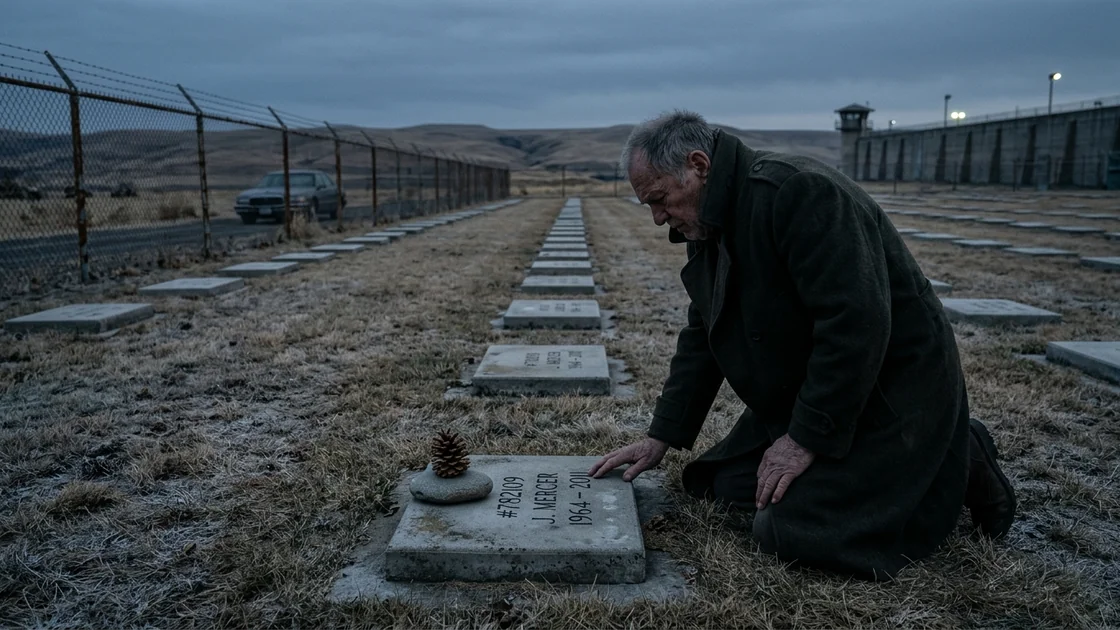
In the winter of 2011, Julian contracted an aggressive strain of viral pneumonia that settled into his scarred lungs. He died on a cot in the prison hospital with an armed corrections officer sitting outside the door reading a paperback western. His body was not claimed by any relatives. He was buried in the prison cemetery at the edge of the property, beneath a flat concrete marker stamped with his seven-digit Department of Corrections number: #782109.
Vance had retired three months after Julian died. He took his pension, his commemorative plaque with the mounted gold badge, and his service revolver, and he went home to the house by the gray water to watch the cedar shingles turn green in the rain.
IV. The Blue File
The police precinct had changed. The brick had been sandblasted, stripped of its soot, and an annex of green-tinted glass and brushed steel had been grafted onto the western wall like a modern tumor.
Vance walked through the double doors at eleven o’clock. He didn't carry an umbrella; his trench coat was dark with water across the shoulders, and his wingtip shoes squeaked on the polished terrazzo floor. The young woman behind the security glass had acrylic nails that clicked on her keyboard like small beetles. She looked at his face, then down at the visitor log, with no recognition whatever.
"Name?"
"Thomas Vance. Deputy Chief Diaz is expecting me."
She looked skeptical, but picked up her handset. Within thirty seconds, the security door buzzed with an angry, mechanical hum.
Marcus Diaz stood on the other side. He had aged poorly. His mustache, once sharp and black, was now a thin, yellowish smear above his lip, and his uniform shirt was strained against his belly. He didn't offer his hand. He turned his shoulder and gestured down the corridor with his chin.
"My office," Diaz said.
They walked in silence past the cubicles. The squad room no longer smelled of coffee, stale cigarette smoke, and wet wool. It smelled of ozone, dry erase markers, and chemical carpet cleaner. Young men and women in polo shirts with tactical pens stuck in their sleeves stared at computer monitors, their faces illuminated by the cold blue wash of spreadsheets and mapping software. None of them looked up. Vance felt like a ghost walking through an office where he used to kick open doors.
Diaz’s office was small, windowless, and cluttered with cardboard archive boxes. On his desk sat a manila folder with a blue plastic tab—the county prosecutor’s color code for capital review.
Diaz shut the door, turned the deadbolt, and didn't sit down. He stood behind his desk, leaning his weight on his palms.
"Tell me about the medallion, Thomas."
The question was flat. It had no venom in it, which made it worse. It was the tone a doctor uses when he tells a father that the biopsy came back black.
Vance sat in the wooden armchair across from the desk. His bones felt dry, like kindling that had been left in an attic for fifty years. "You have the report from the state lab?"
"I have three reports," Diaz said. He flipped open the blue folder with a thick, yellowed fingernail. "Report one: DNA profile extracted from the dried epithelial matter under the fingernails of Evelyn Miller’s right hand. That profile was run against the Western Regional Database on Saturday night. It hit. Calvin Gault. Spokane."
"Who is Gault?" Vance’s voice was steady. It was the only defense he had left: the posture of an investigator examining a neutral set of data.
"He was twenty-four in 2002," Diaz said, reading from the page. "Lived in Aberdeen. Worked for a mobile timber-thinning crew that had a subcontract with the Department of Transportation to clear the drainage culverts along Highway 101 between August and November of that year. He was driving an orange Ford flatbed. He had two priors in Idaho for voyeurism and misdemeanor assault that didn't make the interstate register because the county clerk in Bonner County forgot to send the microfiche."
Diaz turned another page. His hands were trembling slightly.
"Spokane PD picked him up three days ago. He was lurking behind an elementary school near the river. When they searched his tool shed, they found a false floor under his drill press. Inside were twenty-three pieces of jewelry. High school class rings. Charm bracelets. Hair clips."
Diaz paused. He looked up from the folder, his eyes wet and dark with an anger that was fifty percent terror.
"One of them was a silver barrette," Diaz whispered. "Engraved with the initials E.M. Evelyn’s mother told us about that barrette on day one, Thomas. She thought Evelyn had lost it at school the week before she vanished. It wasn't in her car. It wasn't in the mud. It was in Calvin Gault’s toolbox in Spokane."
Vance sat motionless. Outside the small office, a telephone rang three times and cut off.
"Gault talked," Diaz continued, his voice dropping to a gravelly murmur. "The Spokane detectives gave him four hours in the box with coffee and cigarettes. He gave up seven women between 1999 and 2008. He gave them details on Evelyn that were never released to the press. Never. He told them about the braided rope he made from an old parachute cord he bought at the surplus store in Hoquiam. He told them where he threw her canvas shoes—down a dry well two miles north of the tide gate. The state patrol went out there with a camera snake this morning. The shoes are down there, Thomas. They’re in the mud."
Vance looked at the green blotter on Diaz's desk. There was an old ink stain near the corner, shaped like an arrowhead.
"Julian Mercer had no shoes," Diaz said. "Julian had no parachute cord. Julian spent ten years eating lumpy oatmeal in Walla Walla and died choking on his own lung fluid."
Diaz leaned down, his face six inches from Vance’s. The smell of peppermint antacids was sharp on his breath. "So you tell me, Thomas. You tell me right now, before the prosecutor calls a press conference to announce that this department framed a dead man. How did that Saint Jude medal get into Julian Mercer’s basement?"
Vance didn't flinch. He didn't look away. "Julian was at the canal, Marcus. You remember the witness statement from Mrs. Peale. He had the rope in his truck."
"The rope didn't match!" Diaz slammed his open palm onto the desk, rattling the pen holder. "The lab told you that! Hendershot told you that twice! You told me—you told me, an eight-month rookie who looked up to you like you were God Almighty with a gold shield—you told me you saw that chain hanging behind the bench."
"I found it there," Vance lied. The lie was smooth, frictionless, practiced ten thousand times in the dark corners of his mind while he lay awake listening to the rain. "If it wasn't his, someone else put it there. Maybe Gault dropped it when he was scoping Julian’s place. Maybe—"
"Stop it," Diaz said. The fury went out of him all at once, replaced by a gray, nauseating disgust that seemed to shrink his frame. "Just stop it, Tom. Arnie Green died three years ago, but his junior associate is still practicing in Tacoma. She’s already filing the petition for posthumous exoneration. The Innocence Project has been on the line since nine this morning. The state attorney general is sending an investigative team down here on Friday to seize the physical evidence lockers from 2002."
Diaz sat back down in his rolling chair. The vinyl gave a long, wheezing groan.
"They’re going to test the chain, Thomas."
Vance’s heart hitched. Just once. A small, cold trip in the rhythm.
"What chain?"
"The Saint Jude chain," Diaz said. "The new lab director in Seattle—she’s not like old Hendershot. She doesn't just look for blood. They have touch-DNA now. They can take three skin cells off the links of a silver chain that hasn't been washed in twenty years. They’re going to run the medallion, Tom. They’re going to find out whose skin was on that metal when it was dropped behind that bench."
Diaz opened the drawer of his desk, reached inside, and pulled out an old brown cassette tape—the micro-cassette Vance used to use in his handheld Dictaphone.
"I found this in the secondary file," Diaz said quietly. "Your dictation from the night of the twenty-fourth. You didn't log the find until twenty-two hundred hours. But the property room log—the paper log from the basement that someone forgot to shred when we digitized—shows you signed out Evelyn’s personal effects at seventeen hundred. Five hours earlier."
Diaz pushed the cassette across the desk. It slid across the smooth laminate and stopped against Vance’s gnarled fingers.
"You took it out of her car bag," Diaz said. "You walked it down to Division Street. And you put it behind the lathe."
Vance didn't touch the tape. He looked at the two small reels of dark magnetic ribbon inside the plastic casing. "You don't know what you're talking about, Marcus."
"I was there," Diaz whispered. His eyes were wide, staring at Vance not with anger now, but with the horror of a man who realizes he has lived his entire adult life in the shadow of a desecration. "I took the photographs. You pointed the flash. You told me where to stand so the glare didn't bounce off the galvanized zinc. You told me, 'Get the depth of field, Marcus. Make sure the jury can see how long it’s been sitting there.'"
Diaz turned his chair away, looking at the blank wall of his office.
"Get out of here, Thomas."
"Marcus—"
"Get out. The AG’s investigators will be at your house on Monday. If I were you, I’d get a lawyer who doesn't mind representing a man everyone in this state is going to want to see hung from a light pole."
V. The Road to Walla Walla
Vance did not drive home.
He turned his Buick onto Highway 12, heading east. The coastal fog thinned as he climbed through the foothills of the Cascades, replaced by a high, pale ceiling of cloud that let through a cold, shadowless glare. The mountain passes were clear of snow, but the hemlocks along the road stood black and dripping, their limbs heavy with the wet weight of the season.
He drove with both hands on the wheel, his knuckles aching with a dull, throbbing rhythm that matched the vibration of the tires on the asphalt.
He had not thought of Julian Mercer’s face in ten years. When the mind commits an act of violence against the truth, it builds scar tissue over the site; thick, insensible gristle that keeps the blood inside and the cold out. For twenty years, Vance had told himself that Julian was dirty. Even if he hadn't killed Evelyn Miller, he had killed someone else. Or he was going to. Julian was an oddity, an error in the ledger that needed balancing. The medallion hadn't been an invention; it had been an acceleration. A tool to help a blind, slow system reach the conclusion that Vance’s instincts had already reached in five minutes.
Instinct, he thought now. The word tasted like copper and bile.
Instinct was just pride wearing a badge. It was the arrogance of an aging cop who could not bear the thought of going home to his empty house with an unsolved binder on his desk.
He crossed the Columbia River at dusk. The sagebrush country of eastern Washington opened before him, vast and dry and brown, smelling of cold dust, cattle yards, and diesel exhaust. The lights of Walla Walla appeared as a flat, yellow smear against the blue base of the Blue Mountains.
He knew where the prison was. He had delivered four men to its intake sally port over the course of his thirty years in uniform. He had watched the heavy steel gates slide shut behind them with a clanging permanence that sounded like the end of the world.
He didn't go to the main gate. He took the bypass road that skirted the northern perimeter wall, past the dairy barns and the sewage treatment lagoons, to the small, unpaved track that led up the slope behind the minimum-security perimeter.
The cemetery was surrounded by a chain-link fence topped with three strands of rusted barbed wire. There was no gate, only an opening where the wire had been folded back against the post. A wooden sign, weathered until the paint had flaked off in long gray curls, read: W.S.P. MEMORIAL GROUNDS.
It was not a cemetery for remembering. It was a disposal ground for the state’s refuse.
The wind here was different from the coast. It was sharp, dry, blowing down from the wheat fields of the Palouse, carrying the smell of frozen earth and dry straw. Vance pulled his collar up around his throat and stepped out of the car. The gravel crunched loudly under his shoes.
The graves were laid out in military rows, perfectly straight, perfectly indifferent. Small concrete slabs, twelve by eighteen inches, set flush with the patchy rye grass so the state-owned riding mowers could pass over them without dulling their blades. Most had only numbers. A few had names scratched into the wet cement with a nail by friends before it dried.
Vance walked down the third row, his breath coming in short, white plumes that the wind tore away.
#782101 #782104 #782107
He stopped at the eighth stone.
#782109 J. MERCER 1964 – 2011
Someone had placed a flat, gray river stone on top of the concrete. Balanced on the stone was a single pinecone, dried and open like a wooden flower.
Vance stood over the marker. His knees were shaking, not from the cold, but from the sudden, terrifying realization of the physical reality of what he had done.
Julian wasn't a case file. He wasn't a blue tab in a prosecutor’s drawer. He was here. Four feet beneath this crust of frozen dirt, his bones were lying in a pine box supplied by the state of Washington, his teeth rotting in the soil, his wandering eye turned to dust in the dark.
For ten years, Julian had looked at the water stains on the ceiling of his cell in the West Complex. He had listened to the screaming of men who were mad, the slamming of iron doors, the jangling of the guards' keys. He had stood in the recreation yard in the rain, looking up at the sky to watch the geese flying south toward the salt marshes he would never see again.
And every single day of those ten years, Julian had known that Detective Thomas Vance had taken a silver medal, walked into his house, and murdered him without ever firing a shot.
"Julian," Vance said.
The wind whipped the word away across the empty rows. It sounded small, pathetic, like the squeak of a field mouse before the hawk drops.
Vance fell to his knees. The frozen grass was sharp, cutting through the wool of his trousers, but he didn't feel it. He reached out with his right hand—that same, heavy hand—and touched the rough concrete of the marker. The stone was freezing, sucking the warmth out of his palm until his skin went numb.
"I’m sorry," he whispered.
The words were an obscenity. They hung in the air between the barbed wire and the grass, ridiculous in their inadequacy. What was an apology to a skull? What was regret to a man who had been strangled by twenty years of steel and stone?
He stayed there until the stars came out. They were bright, cold, and hard, like salt spilled on black velvet. They did not care about Port Defiance. They did not care about Evelyn Miller or the red apple that had rotted in her car. They looked down on the prison cemetery with the same absolute, terrifying silence that Julian Mercer had received from the State for seven thousand days.
When Vance finally stood, his hips locked with pain, he had to use the top of the fence post to haul himself upright. His mouth was dry, his throat raw from the sage dust.
He got back into the Buick, turned the heater to high, and pointed the car back toward the coast.
VI. The Mechanic’s Bench
The house on Division Street in Port Defiance was still there.
It had not been torn down, because no one wanted the land. The railway had expanded its classification yard in 2008, and the house now sat at the dead end of a spur line, sixty feet from where three hundred black tanker cars filled with crude oil from North Dakota sat waiting for the coastal engines.
The siding was gone, stripped by scavengers or rotted away by the rain. The roof had sagged in the middle like the back of an old mule, and the windows were covered with sheets of warped plywood secured with drywall screws. A yellow notice from the city building inspector was stapled to the front door: CONDEMNED – UNFIT FOR HUMAN HABITATION.
Vance arrived at three in the morning.
He carried a heavy aluminum flashlight in his left hand and a flat pry bar in his right. He didn't care if the neighbors saw him; there were no neighbors, only the wind through the blackberry brambles and the rhythmic, hollow clank-clank of the switch engines down by the water.
He went around to the cellar door. The old sloping wooden doors that led from the yard down to the basement were held shut with an iron hasp, but the wood around the screws was soft as wet sponge cake. He inserted the pry bar and leaned his weight into it. The wood gave with a dull, wet splintering sound, and the screws pulled free, showering his shoes with rusty orange flakes.
He lifted the door. The smell that came out was twenty years older than the smell he remembered: it was dead soil, dry rot, the cold grease of machines long sold for scrap, and the unmistakable, sweetish stink of raccoon droppings.
He clicked on the flashlight and started down the stairs.
The fourth step was broken; he had to step wide, his knee flaring with white-hot pain as he dropped his weight onto the concrete floor below.
The beam of the flashlight cut through the thick, suspended dust.
The basement was empty now, mostly. The lathe had been sold at the county auction after Julian died; only the four square impressions where its legs had rested remained in the gray paint of the floor. The jars of bolts were gone. The wooden shelves had collapsed under the weight of wet dampness, spilling old cans of motor oil that had congealed into black, shiny pools like tar.
Vance walked to the back wall.
The mounting board was still there. A five-foot plank of two-by-eight Douglas fir, bolted to the foundation with lead anchors. Julian had painted the silhouettes of his tools on the wood in white primer—the outline of an adjustable wrench, a ball-peen hammer, a set of ignition pliers. Most of the outlines were empty, ghostly shapes against the darkened wood.
Vance raised the flashlight.
He looked at the space behind the board where the concrete foundation had bowed slightly, creating a dark, vertical gap half an inch wide.
He could still see the scene as if it were illuminated by Diaz’s flashbulb: the bright silver of the Saint Jude medal, the small oval loop, the broken chain dangling down like a spider’s silk.
I put it there, he thought. Right there.
He reached out his finger and touched the concrete. It was cold, damp with condensation that ran down the wall in thin, clear trickles.
He imagined Julian standing here on an October evening, thirty minutes before the cruisers arrived. Julian had probably been wiping down a carburetor with an old undershirt, thinking about the pintails in the reeds. He had probably been wondering if he had enough kerosene to run the space heater through November. He had no idea that sixty blocks away, a girl was lying dead in the mud, and that every clock in his life had already stopped ticking.
Vance turned his back to the wall and slid down until he was sitting on the concrete floor, his knees pulled up toward his chest.
He placed the flashlight on the floor beside him, its beam pointing at the empty silhouette of a wrench on the wall.
He took his service revolver—a Smith & Wesson Model 19 with a four-inch barrel and walnut grips that he had carried since 1974—out of his coat pocket. He laid it across his lap.
The steel was cold. He had cleaned it three days ago, out of habit. The cylinder smelled of Hoppe’s No. 9 solvent and mineral oil.
It would be very easy.
A single motion. The AG’s investigators would come on Monday and find him here, in the dirt where the lie was born. Diaz would understand. The department would bury it; they would call it the tragic decline of a decorated veteran broken by the revelation that his work had been flawed. They would protect the pension for his sister in Oregon. They would keep the plaque on the precinct wall with his name on it, maybe adding a quiet footnote about the tragedy of human error.
No, Vance thought.
The thought was like a slap in the dark.
Human error. That was the phrase they used when an engineer misread a signal or a surgeon cut two millimeters to the left. This was not error. This was murder by paperwork. This was the deliberate, cold-blooded construction of an engine designed to crush a man’s life to powder, operated by a man who knew the gears were greased with a lie.
If he pulled the trigger here, he was doing Julian one last, definitive injury: he was taking the truth with him into the dark. Diaz suspected, but Diaz had no proof of intent. Diaz had a chain and an old cassette tape that Arnie Green’s successor could argue over for five years in administrative hearings. The city would settle out of court with Julian’s distant cousins. The state would issue a formal apology that mentioned "inconclusive investigative methodologies."
And Calvin Gault would sit in Spokane, the sole author of Evelyn Miller’s death, while Thomas Vance remained the good cop who got fooled by the evidence.
"No," Vance said aloud. His voice was louder than the drip of the condensation. "You don't get the clean way out, Thomas. You don't get the dark."
He picked up the revolver, checked the cylinder, and put it back into his pocket.
He stood up, his joints popping like dry branches, and climbed the broken stairs into the cold Pacific air.
VII. The Deposition
The regional headquarters of the Washington State Patrol in Olympia was a concrete bunker built into the side of a hill behind the state capitol. It had the cheerful ambiance of an underground missile silo.
At ten o’clock on Thursday morning, Vance sat at the end of a long conference table made of fake walnut laminate.
Across from him sat three people:
Assistant Attorney General Claire Sterling, a woman in her forties with hair cut as sharp as a meat cleaver and eyes that looked like they hadn't blinked since law school;
Senior Investigator David Ray from the State Patrol’s Internal Affairs division, an ex-marine with a silver crew cut who had spent two hours reading through Vance’s old personnel jackets with the slow, deliberate care of an executioner checking the trapdoor;
And Marcus Diaz, who sat at the far corner of the table, his arms crossed over his chest, his eyes fixed firmly on the brass vent of the heating duct near the floor.
Between them sat an eight-channel digital audio recorder with two omnidirectional microphones, their tiny green LED lights pulsing in time with the breathing in the room.
"For the record," Sterling said, her voice dry as parchment, "this is an interview regarding State of Washington versus Julian Mercer, Snohomish County Cause Number 02-1-04982-1. Present are Assistant Attorney General Sterling, Investigator Ray, Deputy Chief Diaz, and former Detective Thomas Vance. Detective Vance is appearing voluntarily, without counsel."
She looked up over the top of her wire-rimmed glasses.
"You have been informed of your rights under Garrity and Miranda, Mr. Vance. You understand that this statement is being recorded and can be used against you in any subsequent criminal proceedings?"
"I understand," Vance said.
He sat with his hands flat on the table. He had worn his dark blue suit—the one he had bought for his wife’s funeral nine years ago. The lapels were slightly too wide for current fashion, and the shoulders hung slack against his collarbones, but the cloth was clean and brushed.
"Detective Vance," Investigator Ray said, leaning forward. "We have the forensic analysis from the Washington State Crime Laboratory in Seattle. The Saint Jude medal, State’s Exhibit 42. They performed touch-DNA analysis on the silver links of the suspension loop and the broken chain."
Ray opened a folder and laid two glossy printouts on the table.
"There were two profiles recovered," Ray said. "The primary profile belongs to the victim, Evelyn Miller. The secondary profile—eighteen loci, zero room for statistical error—belongs to you."
Ray let the words sit in the room. Diaz didn't move. A siren went past on the highway outside, muffled by three feet of reinforced concrete.
"The department's operational protocol in 2002 required the use of nitrile gloves during the collection and packaging of all small trace items," Ray continued. "Your report states that the medal was picked up using plastic tweezers and placed immediately into an evidence vial by Officer Diaz. Can you explain why your epithelial cells were found packed into the recess of the clasp beneath a layer of motor oil?"
Vance looked at the printout. The electropherogram looked like a mountain range: sharp, tall peaks of black ink against a grid of blue lines. His identity, reduced to numbers and heights, laid out on a page like a bar code on a box of cereal.
"I didn't use tweezers," Vance said.
Sterling tilted her head. "You violated collection protocol?"
"No," Vance said. "You're asking the wrong question, Counselor."
Sterling’s mouth hardened. "Mr. Vance, I advise you to take this seriously. We are preparing a referral to the Thurston County prosecutor for perjury and tampering with physical evidence."
"I took it out of my pocket," Vance said.
His voice was very quiet, but it had a strange, resonant weight that made Ray stop his pen mid-stroke. Diaz slowly raised his head, looking at Vance with an expression that was almost like pain.
"I took it out of my pocket," Vance repeated, looking directly into the small green eye of the digital recorder. "On the afternoon of October 24, 2002. Around four-thirty. I had signed out Evelyn Miller’s personal effects from the basement property room under false pretenses. I told the property clerk, young Bobby Evans, that I needed to check the serial number on her watch. Bobby was twenty years old; he didn't check the box. He let me take the envelope."
Sterling sat back in her chair. The papers in her hand lowered two inches.
"Go on," Ray said, his voice dropping an octave.
"I took the medallion out of the bag," Vance said. "The chain was already broken. It had been broken when her mother found it in her jewelry box three weeks before she died, or whenever it was Evelyn dropped it under the seat of her car. I held it in my bare hand while I drove to Division Street. I kept it in my fist because I wanted it warm. I thought if it was cold, the oil wouldn't stick to it."
He looked at Diaz. Diaz wouldn't look back; his eyes were swimming with tears he was fighting to keep from spilling onto his collar.
"I walked down the basement stairs," Vance said. "Julian was in custody. He had two hours left before the magistrate signed the release order. Arnie Green was waiting in the hallway outside holding with a bail bondsman. I knew that if Julian walked out that door, we’d never get him back. I knew that the town would tear the department apart, and I knew—I believed—that he had killed her."
"You believed it?" Sterling asked.
"Does it matter?" Vance asked her. He didn't say it bitterly; he said it as a matter of simple fact. "I decided that the law was too slow. I decided that God had appointed Thomas Vance to balance the books for Evelyn Miller. I took the medal and I pushed it behind the two-by-eight where the wood was warped. I used my thumb to push it down until only a quarter-inch of the chain was showing. Then I called Diaz down with the camera."
The room was so quiet that Vance could hear the hum of the fluorescent tubes in the ceiling—a sixty-cycle vibration that felt like it was inside his teeth.
"You planted the evidence," Ray said. He wasn't asking; he was stating it for the record, his voice flat with the clinical detachment of a military clerk.
"I manufactured the probable cause that led to his conviction," Vance said. "I testified under oath that I found it during a routine sweep of the basement. I testified that it was covered in wood dust consistent with having been there for several days. That was a lie. I put the dust there myself with my sleeve."
Sterling was staring at him now, her pen forgotten on the pad. "Mr. Vance... you are admitting to multiple counts of aggravated perjury, fabricating evidence in a capital proceeding, and official misconduct. You are seventy-one years old."
"I know how old I am," Vance said.
"Julian Mercer is dead," she said.
"I know that too," Vance said. "I stood on his grave yesterday afternoon. He’s buried under a number in Walla Walla. Row three, stone eight. There’s a pinecone on it."
He leaned forward, placing his forearms on the table. The cuffs of his suit coat pulled back, exposing the thick, purple veins on his wrists.
"You can take the perjury indictment," Vance said. "You can take the evidence tampering. You can take whatever else you have in those boxes. But you write this down, Counselor: Julian Mercer never touched that girl. He never saw that medal. He died because I was proud, because I was impatient, and because I was a criminal with a badge."
Ray looked at Sterling. Sterling looked at the recorder. The little green light pulsed: green, green, green.
"Take his statement," Sterling said softly to Ray. "Start from the morning of the fourteenth. Everything. Every conversation. Every report."
They sat in that room for seven hours.
Vance did not ask for water. He did not ask for coffee. He spoke until his throat was dry as sand, laying out every brick of the wall he had built around Julian Mercer. He told them about the rope fibers that didn't match; he told them how he had pressured Hendershot to lose the supplementary lab notes; he told them how he had walked Arnie Green into the corner of the courthouse corridor and told him that if he pushed the gas station alibi, Vance would bring in three jailhouse snitches who would swear Julian had confessed to them in the showers.
He gave them everything. He took the skin off his own life with a butcher’s knife, layer by layer, until there was nothing left but the gristle of his guilt.
When it was over, Sterling turned off the recorder. The green light died.
She gathered her papers, tapped them square on the laminate, and slipped them into her briefcase. She stood up, looked at Vance for a long, terrible moment, and then walked out of the room without saying another word.
Ray stood up next. He reached down to his belt, unclipped a pair of peerless handcuffs, and laid them on the table with a soft, metallic clink.
"Thomas," Ray said.
Vance looked at the cuffs. "Are we doing it here?"
"We have to," Ray said. "The warrant was signed by the presiding judge in Snohomish County an hour ago. Special presentment."
Vance nodded. He stood up, turned his back to Ray, and placed his hands behind his coat, interlacing his fingers.
The steel was cold on his skin. Ray clicked the ratchets tight—two notches, then three—and engaged the double locks with the pin on the back of his key. The weight was familiar; Vance had put those same bands on two hundred men. He knew the precise balance of the links, the way they held the elbows close to the small of the back, the way they forced a man to walk with his head slightly bowed.
Diaz hadn't moved from his chair.
As Ray walked Vance toward the door, Vance stopped beside Diaz’s shoulder.
"Marcus," Vance said.
Diaz didn't look up. His hands were clasped between his knees, just as Julian Mercer’s hands had been twenty years ago in interrogation room three.
"Don't let them bury it in the back pages," Vance told him. "Put it on the board. Put his name on the board where everyone has to look at it when they come on shift."
Diaz closed his eyes. A single tear escaped, running down his sallow cheek and disappearing into the yellowed gray of his mustache.
"You ruined everything, Thomas," Diaz whispered. "Everything we did. Every collar we made. Every time I thought we were the good guys."
Vance didn't answer. There was no answer to give.
Ray took his elbow, his grip professional, firm, neither gentle nor cruel, and guided him through the heavy fire doors into the holding area.
VIII. The Ledger
The Snohomish County Jail in Everett was louder than Vance remembered.
The holding cell was eighty square feet of poured concrete with a stainless-steel combination toilet-and-sink unit bolted to the corner. The light stayed on twenty-four hours a day—a recessed fluorescent tube behind wire-reinforced lexan that hummed at that same terrible sixty-cycle frequency.
They had taken his suit. He wore orange cotton scrubs that were three sizes too large, the trousers rolled up three times at the cuffs so he wouldn't trip on the hems. They had taken his belt, his shoelaces, his gold signet ring, and his blood pressure medicine.
He sat on the narrow vinyl mattress that smelled of bleach and dried sweat.
Through the narrow vertical window in the steel door, he could see the booking desk. Every twenty minutes, an officer would walk past, glance through the glass, and write a checkmark on a clipboard hanging from a hook. Suicide watch. That’s what the red card behind the window meant.
The news had broken at six o’clock.
He knew because the trustee who brought the dinner trays—a kid with meth sores on his neck and a spider web tattoo under his chin—had stopped outside the door, his eyes wide with a mixture of terror and awe.
"Hey," the kid had whispered through the food slot. "You that cop? The one on the news?"
"I’m Vance," Thomas said.
"They’re talking about you on King 5," the kid said, sliding a plastic tray with two cold bologna sandwiches and three carrot sticks through the hatch. "They said you framed that dude twenty years ago. The guy that died down in Walla Walla. The governor’s on there. She said it was the worst miscarriage of justice in the history of the state."
"Eat your carrots," Vance said.
The kid lingered for a second, then shook his head and pushed his rolling cart down the hall, the wheels squeaking on the red painted floor.
Vance didn't eat the sandwiches. He picked up one of the carrot sticks, turned it over in his thick, distorted fingers, and set it down on the edge of the plastic tray.
The television in the dayroom down the corridor was turned to the evening news. He couldn't see the screen, but he could hear the audio bouncing off the concrete surfaces, hollow and metallic like a voice speaking from the bottom of an oil drum.
"...Julian Mercer, who died in 2011 while serving a life sentence for the murder of Evelyn Miller, was posthumously exonerated today by the Snohomish County Superior Court. In an extraordinary joint motion filed by the State Attorney General and the Innocence Project, prosecutors acknowledged that physical evidence in the 2002 trial had been deliberately fabricated by the lead investigator, Detective Thomas Vance..."
Vance leaned his head back against the concrete wall. The stone was cold through his thin cotton shirt, but it felt good. It was real. It wasn't the soft, rotting wood of his back porch; it was the iron architecture of the State, the machine that had finally turned its teeth inward on itself.
"...Mercer’s remains are scheduled to be exhumed from the cemetery at the Washington State Penitentiary tomorrow morning," the reporter continued. "A spokesperson for the family stated that Julian will be reinterred in the family plot at Cedar Hill Cemetery in Port Defiance, beside his mother..."
Beside his mother.
Vance remembered her. Her name was Martha. She had worn an old navy-blue coat with plastic buttons to every day of the trial. She had carried an orange vinyl purse that she squeezed until her knuckles were white as tallow. She had died in a nursing home in 2005, three years after Julian was sent away, her mind mercifully shattered by dementia until she forgot she had ever had a son who fixed engines and watched birds.
She’ll be there, Vance thought. At least she’ll be there.
The door to the corridor clicked. Heavy boots approached.
It was Diaz. He wasn't in uniform. He wore a gray hooded sweatshirt and jeans, his face pale and swollen like he hadn't slept in three days. He carried a brown cardboard box with his department seal stamped on the side.
The guard unlocked the cell door, stepped back, and let Diaz in, shutting the heavy iron behind him without latching the deadbolt.
Diaz set the box on the concrete floor.
"They searched your house," Diaz said.
"I know," Vance said.
"They found the ledger," Diaz said. "The one you kept in the crawlspace under the furnace."
Vance’s hands stayed flat on his knees. "That was my personal business, Marcus."
"Personal business?" Diaz’s voice cracked. He reached into the box and pulled out a black, cloth-bound ledger—a standard record book with red corners, the kind merchants used fifty years ago. "You had forty-two names in here, Thomas. Forty-two."
Diaz flipped the book open. The pages were covered in Vance’s neat, crabbed handwriting, written with an old ballpoint pen that dug deep into the paper.
"1981," Diaz read. "The Miller rape. 'Suspect had no prints, but he was seen near the alley. Planted the cigarette butt from his ash tray.' 1987. The warehouse arson. 'Accelerant traces negative. Added two drops of mineral spirits to his shop rag.'"
Diaz looked up, his face gray with an emotion that had gone past anger into a kind of dead, hollow awe.
"You were doing it your whole life," Diaz said. "Julian wasn't the first. He was just the one who died."
Vance looked at the black ledger.
"The net was too wide, Marcus," Vance said softly. "The fish were swimming through the holes. You know how many of them walk? You know how many girls I saw on the tables at the morgue with their throats cut, while the lawyers argued about whether the officer had reasonable suspicion to ask for an ID?"
"They weren't your fish to catch!" Diaz yelled. His voice bounced off the steel door, harsh and ugly. "That’s not the job, Tom! The job is the evidence! The job is what’s true, not what you think in that arrogant, sick head of yours!"
"The truth doesn't bring Evelyn Miller back," Vance said.
"Neither did Julian!" Diaz was leaning over him now, his fingers twisted into the front of Vance’s orange shirt, pulling him upright until Vance’s feet barely touched the concrete. "Julian died for your pride! You took twenty years of a man’s life, you killed him, you buried him in the weeds, and you sat on your porch drinking bourbon and thinking you were the last righteous man in the county!"
Diaz shook him. Vance’s head snapped back, his skull tapping the concrete with a dull thud.
Vance didn't resist. He didn't put his hands up. He looked at Diaz with those cloudy, gray eyes that had seen forty years of blood and water, and he felt a strange, terrifying peace.
"Hit me, Marcus," Vance whispered. "Go ahead. You’ve been wanting to do it since Tuesday. Do it."
Diaz stared at him. His chest was heaving, his mouth open, his teeth gritted so hard Vance could hear them ground together.
Slowly, his fingers uncoiled. He let go of Vance’s shirt. Vance dropped back onto the vinyl mattress, his breath wheezing in his chest.
Diaz looked down at his own hand—the hand that had held the camera, the hand that had signed the supplementary reports, the hand that had learned everything it knew about homicide from the old man sitting on the cot.
"I’m resigning, Thomas," Diaz said.
Vance looked up. "No. Marcus... you didn't know. You were just a kid."
"I knew," Diaz said. The words were a death sentence. "I didn't let myself look, but I knew. I saw you walk down those stairs with your hand in your pocket. I saw the way you looked at that bench before you called me. I wanted to be like you. I wanted to be the man who closed the file. So I didn't ask."
Diaz turned toward the door. He knocked once on the iron with his knuckles.
"Marcus," Vance called out.
Diaz didn't turn around. He stood with his forehead against the cold painted steel, waiting for the guard to turn the key.
"Don't leave the department," Vance said, his voice cracking with an old man’s weakness. "They need someone who knows what a lie looks like. If you go, it’s just the kids with the computers. They don't know the weight of it. They don't know what it does to the ground."
The lock clicked. The door swung open six inches.
"The ground is already poisoned, Thomas," Diaz said, his back still turned. "You salted it twenty years ago."
He stepped through the door. The steel slammed shut behind him. The deadbolt turned with that heavy, final sound that Vance had heard ten thousand times from the other side of the glass.
IX. The Salt Marsh
The trial of Thomas Vance did not take eleven days.
It lasted forty-five minutes.
He sat in the defendant’s chair in the same courtroom where Julian Mercer had stood twenty years before. The oak benches were the same; the great seal of the State of Washington behind the judge’s bench was the same; the smell of floor wax and old paper was the same.
He pleaded guilty to all counts: aggravated perjury, falsification of public records, fabrication of evidence, and manslaughter in the second degree—a special information filed by the Attorney General that argued Vance’s actions had been the proximate cause of Julian Mercer’s physical decline and death in custody.
The judge, a woman with silver hair who had once been a federal prosecutor, looked down at him from the bench with an expression that had no anger in it, only an immense, weary sadness.
"Thomas Vance," she said, her voice clear in the crowded courtroom, "the law is not a weapon to be wielded by the righteous. It is a shield to protect the citizen from the State. When the servant of the State corrupts that shield, he commits an act of treason not only against the victim, but against the very idea of a free society."
She adjusted her glasses.
"You will spend the remainder of your life in the custody of the Department of Corrections. Because of your age and your former status as a law enforcement officer, the Department has recommended placement in the protective custody unit at the Stafford Creek Corrections Center."
Vance stood up. His attorney—a court-appointed man who looked like Arnie Green’s grandson—touched his elbow to help him, but Vance pulled his arm away.
"I have a request, Your Honor," Vance said.
The courtroom went very quiet. The reporters in the front row leaned forward, their pens hovering above their pads.
"What is your request, Mr. Vance?" the judge asked.
"Not Stafford Creek," Vance said. His voice was rough, like two stones being dragged across gravel. "Walla Walla. General population."
The defense attorney turned white. "Your Honor, that is a death sentence. He would not last forty-eight hours."
"Walla Walla," Vance repeated. He looked the judge in the eye. "Send me to the West Complex. Where they kept Julian."
The judge looked at him for a long moment. She saw the old man in the oversized suit, the knuckles that couldn't button a shirt, the gray hair that had grown wild around his ears since he had been in the county tank. She saw the ruin of a career, the ruin of a department, the ruin of a man who had built his own scaffold and was now asking for the rope to be greased.
"The court does not determine specific facility assignments, Mr. Vance," she said quietly. "That is the administrative province of the Secretary of Corrections. But your request will be noted in the sentencing memorandum."
She struck the gavel once.
Clack.
The sound was sharp, final, like the snapping of a small silver chain.
They transported him on a Friday morning.
The van was a white Ford with wire mesh over the windows and a diesel engine that rattled like Julian Mercer’s old pickup truck. There were two other prisoners in the cage with him—young boys from Marysville who had stolen three cars and were going down for their first two-year bit. They looked at Vance’s gray hair and his paper shoes with contempt, then ignored him, talking in low, boastful voices about the women they had left behind and the drugs they were going to get inside.
Vance didn't listen.
He sat with his forehead pressed against the cold diamond mesh of the window.
They crossed the trestle south of Port Defiance.
The tide was out. The salt marsh was gray and vast under the pale morning sun, the channels of brackish water winding through the mud like the veins on the back of his hand.
He looked down toward the intake canal of the sluice gate.
The water was low, barely covering the gravel beds. In the distance, near the black pilings of the disused logging pier where he had found Evelyn Miller twenty years ago, a flock of birds was wheeling in the cold air.
They were pintails. Northern pintails, down from the tundra of Alaska.
They flew in a long, graceful wedge, their white bellies catching the pale light of the sun as they banked together, sixty birds moving with a single mind, a single purpose, free and clean and cold above the salt water.
They turned toward the south, their wings beating the mist, and dropped down into the brown reeds where no man could follow them.
Vance watched them until the van entered the shadow of the mountains, and the marsh was gone.