The Weight of the Hoist
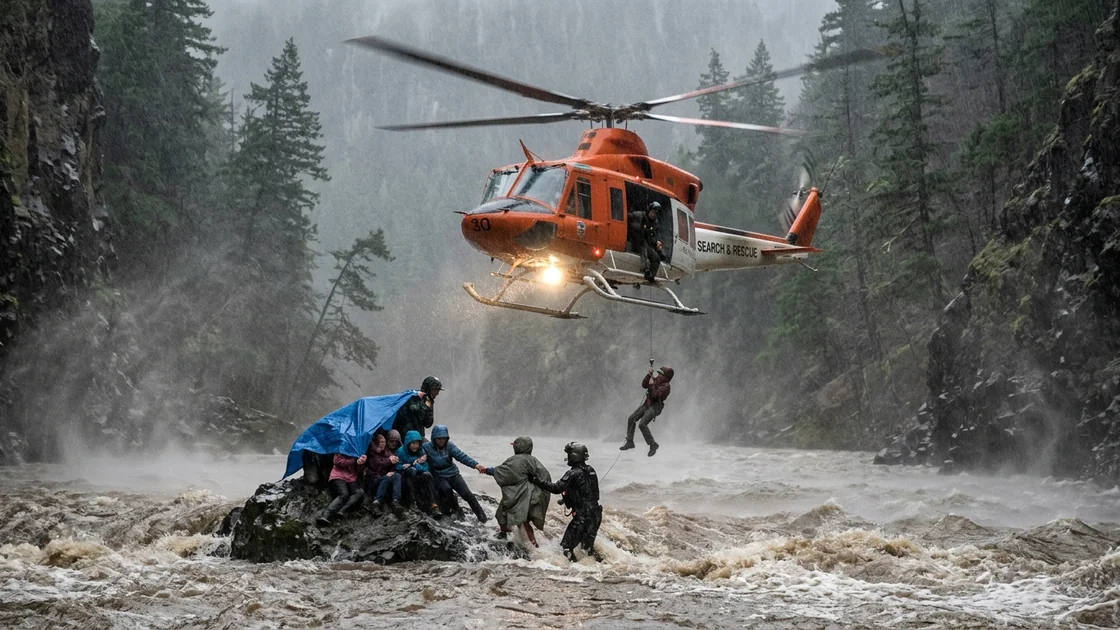
This is the story of Jesse Vance, a veteran search and rescue helicopter pilot in the Pacific Northwest who makes a fatal moral compromise during a catastrophic hundred year flood. Faced with crushing personal debts and the imminent foreclosure of his family home, Jesse accepts an illicit payment from a stranded corporate billionaire to divert his aircraft and rescue the executive before attending to a group of hypothermic youth hikers trapped on a disappearing riverbank. The delay causes the rescue mission to unravel in tragedy, forcing Jesse to confront the horrific human cost of his greed and the irredeemable ruin of his own soul.
I. The Gauge and the Gutter
The torque meter on the Bell 412 EP was twitching two percent high on the number-two turbine, a Pratt & Whitney PT6T-3DF that Jesse Vance had known since it was bolted into the airframe seven years ago. It was not a catastrophic variance—not yet—but in a river gorge where the air was thick as wet flannel and the cloud deck had dropped down to kiss the hemlocks, two percent was a phantom sitting on his shoulder.
Beside him in the right-hand seat, Mark Ramos was chewing a stick of spearmint gum with the mechanical, unhurried cadence of a man who had never seen an engine disintegrate over water. Ramos was twenty-eight, five years out of the Navy’s helicopter training pipeline at Whiting Field, with skin the color of parched almond and hair cropped so close his scalp showed bluish beneath the flight helmet. He was keeping his eyes on the Honeywell digital map, where the yellow contour lines crowded together like the grain in old cedar.
"Ceiling’s down to four hundred over the confluence, Jesse," Ramos said through the Peltor intercom. His voice was flat, dry, muffled slightly by the foam mic cover against his lip. "Station weather out of Darrington says the barometric pressure is still cratering. Twenty-nine point zero two and dropping. If the wind comes round from the northeast, it’s going to corkscrew right into the canyon."
Jesse didn't turn his head. His left hand rested on the collective, his fingers feeling the slight vibration of the hydraulic actuators down through the floorboards. "We’ve got fifteen hundred pounds of fuel. That’s an hour and forty minutes with the reserve. What’s base saying about Blackwood Gorge?"
"Sheriff’s office says six kids and a trip leader," Ramos replied, flipping a plastic-laminated frequency guide on his kneeboard. "Outing club from the Cascade Valley Day School. They were on the three-day loop over Sauk Ridge. When the culverts blew on the logging road, they tried to ford the Sauk River fork instead of climbing toward high timber. Found themselves on a gravel bar just below the narrows. River’s come up four feet since dawn."
"They have comms?"
"Garmin InReach," Ramos said. "One-way battery left. Text came through dispatch twelve minutes ago. Said the water was over the tent pegs. Two of them are hypothermic. One kid took a header into a driftwood root ball when they tried to move up-canyon; compound tibia or something like it. They can't move."
Jesse pulled a breath in through his nose. The air in the cockpit smelled of damp Nomex, scorched transformer oil, and the sour tang of old coffee dried in the bottom of a steel thermos. He knew that gravel bar. In August, it was three hundred yards of bleached river stones where drift-fishermen stood in neoprene waders casting for summer run steelhead. In November, under an atmospheric river that had spent three days dragging three trillion gallons of tropical vapor across the Pacific and slamming it into the wall of the North Cascades, that gravel bar was an anvil. And the river was an eighteen-thousand-cubic-foot-per-second sledgehammer.
"Dispatch has us as primary?" Jesse asked.
"Dispatch has us as only," Ramos said. "The Guard Black Hawk out of Gray Army Airfield is grounded with a cracked tail-rotor gearbox at the airfield in Arlington. Whidbey’s SAR Sea King is tied up with three crab boats taking water in the Strait. It’s you, me, and the hoist, Jesse."
A red digital pulse flickered on the transponder display. The intercom crackled with the secondary VHF channel—the private, unmonitored tactical frequency Jesse kept tuned for inter-agency coordination with the logging companies and private timber estates that owned forty percent of the valley floor.
"Rescue Three-Zero, Rescue Three-Zero, this is Clearwater Main, do you read?"
Jesse’s eyes flicked to the lower center console. Clearwater Main wasn’t county dispatch. It was the dispatch code for the Blackwood Sanctuary, a four-thousand-acre private compound built three miles up-river from the public campgrounds by Julian Sterling, the chief executive officer of Sterling-Prentice Global Logistics.
"Rescue Three-Zero," Jesse murmured into his boom. "Clearwater, go ahead."
"Jesse? That you on the stick?" The voice was crisp, tight, missing the crackle of standard VHF because it was coming through an amplified satellite relay perched on a ridge above the rain clouds. It was Donald Vance—no relation, though they had gone through the state timber board’s hearings together five years back—Sterling’s chief of personal security.
"It’s me, Don," Jesse said. "We’re four miles south of the Sauk bridge, inbound for the Blackwood narrows. We’ve got an active extraction on the public loop. State SAR protocol."
"Jesse, turn around. Or drop in here first."
Jesse let out a short, nasal snort. "Can't do it, Don. I have six minors on a gravel bar with the river lapping their shins and an open fracture. The county called a code three SAR. We're on the clock."
"Jesse," Don said, and the tone dropped into an octave that had nothing to do with aviation protocol. "Mr. Sterling is on the line. He’s at the river house. The bank gave way twenty minutes ago. The retaining wall took out the lower terrace and the generator shack is flooded. The propane tanks are creaming off their footings. He’s got his mother with him. She’s seventy-eight, on oxygen, and the secondary battery system just faulted out. If the river hits the main floor, they don't have twenty minutes."
Ramos had his pencil stopped above the logbook. His dark eyes shifted over the rim of his visor, studying Jesse’s profile. He could hear Don’s voice through the bleed-over on the avionics panel.
"Tell them to move to the upper guest wing on the hillside," Ramos said into the crew loop, his voice quiet. "The Sterling compound sits fifty feet above the historical flood mark on the bluff. It’s steel-frame and reinforced concrete."
"He says the bank under the north wing is sloughing," Don continued, as if he had heard Ramos through the glass. "The foundation’s scour-critical. Jesse, he’s not asking for the county service. He’s chartering. He’s got your private phone number on his screen right now. Check your alert feed."
Jesse didn’t look at his phone. It was clipped to the thigh pocket of his flight suit, beneath the zipper flap. But he knew what would be there.
For eight months, Jesse’s personal world had been narrowing with the precision of a guillotine blade. His twelve-year-old daughter, Clara, sat in a pediatric rehabilitation bed in Seattle, six weeks out from a spinal reconstruction following a rollover accident on Highway 20. The driver who hit her had no insurance, no license, and had disappeared into the Skagit flats before the state patrol could clear the skid marks. The private insurance company—a subsidiary of an international conglomerate whose board of directors included the name Julian Sterling—had classified the third-stage neurological therapy as "experimental maintenance" and terminated the policy coverage thirty days ago.
The balance on the billing statements had ceased being numbers; they were a foreign language of cruelty. Three hundred and twelve thousand dollars. The foreclosure notice on his four-acre parcel in Marblemount—the house his father had built out of salvage Douglas fir—had arrived in an envelope with two green certified-mail stickers on the Tuesday before the rains started.
His pocket vibrated against his thigh. Twice. A high-priority bank confirmation ping.
Jesse reached down, his glove stiff with the cold moisture of the cockpit, and dragged the nylon zipper down. He pulled the phone out and laid it on his knee beside the collective.
The screen was illuminated. It was an automated wire-routing receipt from an offshore escrow provider out of Charlotte Amalie.
PENDING CLEARANCE: $450,000.00 USD. ORIGINATOR: STERLING SPECIAL ASSETS LLC. CONDITIONAL BENEFICIARY: JESSE VANCE. RELEASE CRITERIA: IMMEDIATE AIR EVACUATION DESTINATION BELLINGHAM REGIONAL.
The text message sitting beneath the banking banner was three words long:
NOW. FIRST. LAND.
"What is that?" Ramos asked. His tone was not yet suspicious, only puzzled by Jesse’s silence and the cold blue light reflecting up off the pilot's helmet visor.
Jesse stared at the numbers until the screen dimmed. He could hear the rain against the curved plexiglass windshield—not the sound of drops, but a solid, furious drumming, like a handful of birdshot thrown against the glass twenty times a second.
"Clearwater," Jesse said, his throat clicking as he swallowed. "What’s your pad look like?"
"The lawn is under five inches of runoff, but the gravel helipad behind the stables is clear," Don answered immediately. "Wind is out of the southwest at twelve, gusting eighteen. You have an open approach from the south. Five minutes, Jesse. You set down, we load Julian and his mother, and you take them to the high pad at Concrete or straight to Bellingham. You do that, and the escrow closes before you shut down the turbines."
"Jesse," Ramos said, his hand reaching across the center console toward the cyclic friction knob. "We’re four miles from the kids. If we go north to the Sterling compound, that’s six miles upstream into the teeth of the funnel. If we go there, load, and turn around, that’s twenty-five minutes. Jesse, that gravel bar is five feet above datum. If the Sauk crested at eighteen feet at the gauge, they're already in the water."
Jesse did not look at Ramos. If he looked at him, he would see the boy’s father, who had worked twenty-two years for the Forest Service before his heart blew out on a timber fire in the Blue Mountains. He would see the young man who still believed that the hoist on a rescue chopper was an instrument of absolute justice.
"Sterling’s mother is on life support," Jesse lied. The words came out of his mouth with a dry, wooden weight. "If their generator went down, she’s on an accumulator bag. She won’t last twenty minutes."
"Dispatch didn't call it," Ramos said, his voice rising a half-step. "The county didn't drop a ticket on Sterling."
"Because Sterling’s fiber lines are out, Mark. You think the county knows what's happening at the end of a private valley road six miles behind three locked gates? We're on the scene. Pilot’s discretion. Section 91.3. Emergency authority."
"Jesse—"
"I have the cyclic," Jesse said.
The rule was absolute. When the senior pilot said I have the cyclic, the cockpit became an autocracy. Ramos sat back, his boots flat on the anti-torque pedals, his hands open and hovering two inches above the secondary flight controls. His face was white around the edges of his jaw.
Jesse banked the Bell 412 hard to the northeast, hauling the cyclic back and into his gut. The twin turbines screamed as the torque rose to ninety-four percent. The ship shuddered, its forty-eight-foot rotor disc biting into the descending vapor, and turned its tail on the six children shivering in the rising brown gut of the Sauk.
II. The Slate-Colored Lawn
The river was no longer a river; it was a sliding plateau of red-brown mud, ripped hemlocks, and white foam that smelled of crushed moss and dead silt. From two hundred feet, Jesse could see the perimeter wall of the Blackwood Sanctuary. It was eight feet of dressed basalt topped with bronze lanterns, designed to keep out the deer, the elk, and the county’s tax assessors.
Now, the Sauk was chewing through the south corner of the masonry like a dog through a wet cardboard box.
The compound itself was an exercise in modern mountain brutalism: cantilevered cedar beams, four-inch sheets of laminated architectural glass, and vast slabs of gray concrete that looked like they had been dropped into the forest by a military transport.
As Jesse brought the ship down through the rotor wash of his own descent, the lawn below them turned into a thrashing circle of gray-green water. A dozen garden chairs—expensive, heavy teak—were bobbing against the ornamental split-rail fence like dead sheep.
"There’s no life support," Ramos said. He was staring down through his chin bubble.
On the gravel pad beside the six-car garage, three men stood in yellow Gore-Tex bibs. One of them was Julian Sterling. He was sixty-two years old, with silver hair cut like an architectural model, wearing an orange offshore sailing jacket over a charcoal fleece. He was not carrying an elderly woman. He was holding a leather Louis Vuitton duffel bag in one hand and an aluminum Zero Halliburton briefcase in the other.
Beside him, two security guards in black tactical gear were holding four more oversized nylon flight bags and an aluminum dog crate containing a shivering, white-faced French bulldog.
"Where’s his mother?" Ramos asked. His voice through the intercom had gone completely flat. The tone was dead, bleached of the tension that had filled the cockpit five minutes before.
Jesse felt something cold and thin slide down the back of his neck. It felt like grease.
"Down collective," Jesse said, his own voice sounding distant in his ears, like an old recording played across an iron pipe. "Keep the rotors turning. I’m not shutting down. Don’t let them load luggage, Mark. Just bodies."
"There’s no mother, Jesse," Ramos repeated. He didn't move toward the door release. "Look at him. He’s got his fucking tax files and his dog."
"Mark, open the door."
"You took a check."
The accusation didn't explode; it drifted into the space between their helmets like exhaust gas. Jesse did not answer. He brought the Bell down until the skid shoes ground into the crushed blue slate of the driveway. The shock absorbers hissed as the full ten-thousand-pound weight of the aircraft settled.
The door behind them slid open with a screech of roller bearings. Donald Vance was there, his face red and slick with cold water, hauling Julian Sterling up through the runner sill.
"Get the bags in!" Sterling shouted. His voice was shrill, cutting through the twin-turbine whine with the petulant sharpness of a man who had spent forty years giving orders to people who were terrified of being fired. "The basement office is three feet under! The water’s into the storage vaults! Get the gray duffels, Vance! Move your ass!"
Ramos had turned around in his seat. He hadn't unbuckled, but he had twisted his upper torso until his shoulder harness was strained tight across his chest.
"No luggage!" Ramos barked through the cabin bulkhead. "Personnel only! We have six victims with a four-minute survival window down-canyon! Get your ass on the bench and buckle the harness!"
Sterling looked at Ramos as if the co-pilot were a stray raccoon that had scrambled onto his dining table. He didn't drop the briefcase. He shoved it into the footwell behind Jesse’s seat, kicking it forward with the toe of an eight-hundred-dollar combat boot.
"I bought this ship for the afternoon, son," Sterling said. He was panting, his teeth gray against his gums. "Don, grab the secondary files from the garage. The drive arrays are in the water-resistant Pelis."
"We’re at gross weight with full fuel!" Ramos yelled, his finger stabbing toward the instrument panel. "Jesse, tell him! We can't carry four hundred pounds of dry goods and then pull six victims out of a class-five rapid on a fifty-foot hoist!"
Jesse’s hands were shaking on the controls. It was a micro-tremor, the kind that only shows up when you try to hover in a crosswind with a sixty-foot sling load, but he could feel it in the knuckles of his left thumb.
He turned his head six inches to the left, looking into his rearview mirror. He met Sterling’s eyes.
Sterling wasn't looking at the river. He wasn't looking at the sky, which was turning the color of wet lead as the clouds sank into the tops of the firs. He was looking at the back of Jesse’s helmet. His eyes were cold, pale, and entirely empty of panic. He knew what he had bought. He had bought a machine, and he had bought the man sitting inside it.
"Jesse," Sterling said, leaning forward until his mouth was four inches from the pilot’s ear cup. The smell of high-end peppermint mouthwash cut through the jet fuel. "The wire is conditional on delivery to Bellingham. You turn this bucket around to fish boy scouts out of a ditch, and the clearing code doesn't leave my pocket. My lawyer hits the cancel button before your skids hit the asphalt. You understand me? Clara doesn't get her chair. She gets the ward in Yakima."
Jesse felt the air leave his lungs. It didn't go out in a breath; it felt as though someone had driven an iron crowbar under his sternum and pried his chest open.
"Get in," Jesse said.
"Jesse, no!" Ramos yelled.
"Get in and shut the goddamn door!" Jesse roared into the mic. His voice tore the squelch circuit, screaming in both their headsets with a whistle of electronic feedback.
Donald Vance threw two heavy black plastic cases into the cabin floor. The bulldog was shoved between them, whining high and thin, its claws skittering on the aluminum floor ribs. Don didn't get in. He stepped back, pulled the yellow hood of his coat down, and slammed the cargo door shut until the latches dropped with a heavy, double clunk.
"Door safe," Jesse muttered, his hand already hauling back on the collective.
The Bell groaned. The mast-moment indicator surged toward the red sector as the rotor disc tilted back to counter the river wind. They broke ground with a violent, sliding skid, the tail rotor clearing the ornamental stone gate by less than four feet as Jesse pulled ninety-eight percent torque out of the twins.
The aircraft didn't climb into the clear; there was no clear. They rose into a blinding grey milk where the rain struck the nose with the sound of a gravel slide.
"Turn south," Ramos whispered. He wasn't looking at the Honeywell map anymore. He was sitting with his hands in his lap, his chin dropped down against his chest harness. "Jesse. Turn south. It’s two miles. We can drop him on the logging spur at mile marker nine. It’s dry. We can drop him there and get the kids."
"We can't land on nine," Jesse said. He was staring straight ahead through the sweep of the windshield wipers. "The culvert’s gone. It’s mud. If I touch down on nine, the skids will sink to the crosstubes and we'll roll the dynamic. We go to Bellingham."
"Bellingham is forty miles," Ramos said. "Forty miles north-northwest. That’s twenty-two minutes out. Twenty-two minutes back. That’s forty-five minutes, Jesse. The river will be at twenty-two feet. The gravel bar was at nineteen."
Jesse didn't answer. He trimmed the cyclic forward, lowered the nose four degrees into the gray soup, and watched the digital airspeed indicator climb through ninety knots.
Behind them, Julian Sterling reached down, unzipped his leather bag, and took out a dry cashmere scarf. He did not look out the window at the valley falling away beneath them. He began, with great deliberate care, to wipe the rain from the silver corners of his briefcase.
III. The Drowned Bar
The transit to Bellingham was thirty-eight minutes of absolute silence, broken only by the automated transponder reports and the flat, mechanical voice of the Seattle air traffic controller clearing them through the restricted airspace around the naval station.
When the skids hit the concrete at the private executive terminal at Bellingham, the rain there was only an ordinary drizzle—a polite, low-country gray mist that had none of the mountain's murder in it.
A black Lincoln Navigator was already idling by the hangar door, its exhaust drifting white across the ramp. Two men with umbrellas stepped forward the moment the rotor blades began their slow, whistling wind-down.
Sterling didn't thank Jesse. He didn't look at Ramos. He kicked the cargo door back, hauled his bags out onto the winglet, and jumped down to the wet pavement. His dog was tucked under his arm like a loaf of bread.
As the second guard reached into the footwell to grab the last Pelican case, Sterling paused. He turned back, his scarf tucked neatly into the collar of his jacket, and looked up into the cockpit through the open side window.
He took a silver smartphone from his breast pocket, tapped the glass twice with a manicured thumb, and put it away.
"The escrow is released, Vance," Sterling said. The jet wash from a taxiing Citation down the ramp blew his silver hair across his forehead. "You did your job. Buy your girl something nice."
The door slammed shut. The Lincoln’s red taillights flared as the big SUV turned toward the airport security gate, and then it was gone behind the corrugated iron wall of the fuel farm.
Jesse sat with his hands on his knees. His palms were soaked with sweat inside his leather flight gloves. The digital dash clock read 14:41.
It had been fifty-four minutes since the Garmin InReach text from the gravel bar.
"Mark," Jesse said.
Ramos didn't move. He had his helmet off. He was holding it between his knees, staring down at the green manufacturer’s label inside the crown.
"Mark, get the door pinned. We need fuel."
"We don't have time for fuel," Ramos said. He didn't look up. "We have eight hundred pounds. If we take fuel, that’s another ten minutes on the ramp. If we leave now, we have forty minutes of gas over the valley. Enough to get them and set down on the highway."
Jesse swallowed. The taste of copper was at the back of his teeth, the old taste from his army days when an RPG had taken out the tail rotor of his Kiowa over the scrub outside Tal Afar.
"Pin the door," Jesse repeated.
Ramos looked at him then. His face wasn't angry; it had settled into a terrible, exhausted revulsion. "You're going back? Why? The money’s in the bank, Jesse. You got what you came for. Why go back now?"
"Because it’s my ship," Jesse said, though the words sounded hollow to him, like stones dropped down a dry well.
"It’s not your ship," Ramos said, his voice dropping to a harsh whisper that was louder than the turbines. "It’s the county’s ship. The people who paid for that fuel are the ones whose kids are sitting on that rock. You sold the rotor disc to a guy who wouldn't piss on you if your flight suit was on fire."
"Shut up, Mark."
"You sold them."
"I said shut up!" Jesse slammed his fist down on the center pedestal, hitting the aluminum frame with enough force to crack the plastic cover of the de-ice switch. "You want to sit here? Get out. Unbuckle your harness, walk into the terminal, and tell the sheriff I left you. But I’m flying this ship back into the gorge. With you or without you."
Ramos stared at him for four seconds. Then, slowly, with an economy of motion that felt like an execution, he reached over his shoulder, pulled his helmet back on, and clicked the chin strap into place.
"Rescue Three-Zero to Bellingham Ground," Ramos said into his boom mic, his voice steady as an iron bar. "We are lifting off the private ramp, outbound southeast, direct Sauk narrows. VFR with emergency SAR protocol."
He didn't wait for the tower’s response. He pulled the collective, and the Bell lurched back into the sky.
IV. The Funnel
The storm had not stayed where they left it; it had deepened, rolling down off the glaciers of Glacier Peak like an avalanche of dirty grease.
By the time they crossed the Skagit River at Concrete, the valley had narrowed to a black wedge between two walls of cloud that were discharging lightning in dull, pink sheets behind the trees. The radio was an incoherent screech of static. Every drainage in three counties was running twelve feet above bankfull. Over the emergency guard channel, they could hear the state patrol dispatcher repeating a single message:
All units in the Sauk Valley, be advised: the Suiattle River bridge has failed at milepost fourteen. The county road is impassable. All ground units withdraw to the high school at Darrington. No emergency services south of the bridge.
"They're on their own," Ramos said. "Nobody’s coming from the road."
Jesse didn't answer. He had the Bell down at fifty feet above the river, following the brown snake of the water because the cloud ceiling had dropped to ninety feet. Hemlock branches whipped past the skid tips like black fingers. The windshield wipers were useless; they were flying through an unbroken cascade of water that seemed to be falling horizontally, driven by a thirty-knot wind that channeled straight down the throat of the canyon.
"There's the narrows," Ramos pointed.
Jesse saw it. Two hundred yards ahead, the Sauk slammed into a wall of columnar basalt, bent sixty degrees to the west, and squeezed through a slot sixty feet wide.
In summer, the gravel bar lay just above that bend—a gentle crescent of gray stones where alder saplings grew in the silt.
Now, the crescent was gone.
There was only a tooth of gray basalt, six feet across and eight feet long, jutting out of the white foam like the snout of a drowning dog. Around it, the river didn't flow; it boiled. Uprooted firs fifty feet long were being hurled through the slot like toothpicks, their roots spinning in the air as they hit the standing waves.
On that rock, huddled together under a single blue nylon tarp that was tearing to ribbons in the rotor wash, were seven shapes.
They were not sitting. They were kneeling in eight inches of moving foam, their arms hooked into each other’s armpits, forming a circle. At the center of the circle lay a smaller shape, wrapped in a red sleeping bag that was already black with water.
"Holy God," Ramos whispered.
Jesse brought the helicopter into a hover eighty feet above the rock. The wind was howling down the slot, bouncing off the basalt wall and striking the tail rotor with violent, unpredictable kicks that swung the nose ten degrees left and right.
"Look at the water line," Ramos said. His finger was trembling now as he pointed down through the chin bubble. "The rock was three feet higher when we passed the first time. It’s coming up an inch every two minutes. If one of those drift logs hits them, they’re gone."
Jesse looked down. Through the spray, he could see the face of the trip leader—a young woman, maybe twenty-four, with long brown hair plastered across her cheeks like wet seaweed. She was looking up into the searchlight Jesse had toggled on.
She didn't wave. She didn't pump her fist. She just held her face up to the light, her mouth open in a sound that was drowned by the scream of the turbines and the roar of the water.
"Hoist is armed," Ramos said. He was already out of his seat, unhooking his harness and clipping his safety tether to the heavy steel ring in the cabin ceiling. "The forest canopy is too tight to come down any lower. We're going to have to do single-man horse-collar pickups. Seven cycles, Jesse."
"Seven cycles is twenty minutes," Jesse said. His voice was thick. "We don't have twenty minutes of fuel."
"We have thirty-two minutes on the totalizer," Ramos said, looking back through the cabin door. "If we do seven cycles, we leave here with twelve minutes of gas. That means we don't make Concrete. We land on the highway or we ditch in a clear-cut."
"Mark—"
"I’m going down," Ramos said. He wasn't asking. He had the rescue collar in his gloved hand. He kicked the sliding door fully open and the cabin was instantly filled with the freezing hurricane of the rotor downwash and the roar of the gorge. "Hold this bitch steady, Vance. If you drift three feet south, you’ll put the tail rotor into that Douglas fir."
Jesse didn't speak. He locked his elbows, set his boots against the anti-torque pedals until his calves burned, and watched the reference point he had chosen on the rock face—a single white quartz vein six inches above the spray.
"Ramos going down," the intercom reported.
The electric hoist motor whined—a high, gear-driven shriek that Jesse could feel through the airframe. In his rearview mirror, he saw the yellow shape of the co-pilot descending into the gray void beneath the skids.
The wind hit them from the east—a sudden, vicious down-draft that rolled off the basalt cliff like a dropped sandbag. The Bell dropped six feet in an eye-blink.
"Torque!" Ramos screamed over the hoist mic. "Hold it, hold it! You're dragging me toward the root ball!"
Jesse hauled the collective up. The torque needle swung past ninety-six, flickered into the red at one hundred and two percent, and the transmission let out an oil-starved howl that vibrated through the pilot's teeth. The helicopter climbed, clawing its way back against the falling air, but the pendulum had already swung.
Beneath him, Ramos had reached the rock.
He was waist-deep in the brown current on the upstream side. Jesse could see him fighting the force of the water, his boots slipping on the slick river moss. He reached down, grabbed the first child—a boy in an oversized yellow rain poncho—and slipped the padded nylon horse-collar over his shoulders and under his arms.
"Up on the hoist!" Ramos called. "Up, up, up!"
Jesse toggled the hoist switch on his cyclic with his thumb. The cable groaned as it took the weight. The boy rose out of the white water, his legs kicking wildly, his face gray with the advanced, stuporous terror of hypothermia.
As the boy swung up into the cabin door, the river rose.
It didn't come in a swell; a log jam two miles upstream had broken, releasing a three-foot wave of trapped water and dead timber that came down the narrows like a wall of wet brown concrete.
Jesse saw it coming in the beam of the searchlight. "Mark! Grab the cable! Grab the cable!"
"No!" Ramos’s voice was torn by the water. "The kid with the leg! He’s slipping!"
The wave struck the rock.
The blue tarp disappeared instantly, sucked down into the boiling vortex beneath the shelf. The three hikers on the upstream side were knocked off their feet like bowling pins. Two of them managed to claw at the rock with their fingernails, their bodies trailing out into the current like streamers in a parade.
The third—a girl in a green fleece jacket, no more than fourteen years old—didn't have time to claw.
The current caught her under the ribs and lifted her over the ledge. She didn't scream. Jesse saw her eyes—wide, dark, reflecting the white glare of the aircraft’s thirty-million-candlepower Nightsun—and then she was gone. She didn't float; the undertow at the bend sucked her down into the black hole beneath the basalt overhang before she had traveled ten yards.
"Sarah!" the young female leader screamed. Jesse could hear her through Ramos’s open microphone. It was a raw, animal bark that pierced the sound of the river. "Sarah!"
"Get the girl with the leg!" Ramos bellowed. He was clinging to the rock with one arm, his other arm hooked around the collar of the boy with the fractured tibia. The water was over his gunbelt now. The radio battery pack on his hip was submerged; his voice through the intercom turned into a wet, distorted rasp. "Hoist him! Jesse, hoist him now!"
Jesse toggled the switch.
The boy came up. He was unconscious, his broken leg dangling at an angle that made Jesse’s stomach turn over inside his ribs. Ramos had clipped himself to the boy’s harness with a secondary carabiner—a violation of every safety rule in the SAR manual.
"You're double-hung!" Jesse yelled. "The hoist isn't rated for two hundred and eighty pounds in a downdraft!"
"Pick us up or we die down here!" Ramos screamed back.
Jesse pulled the collective. The engines screamed in agony. The exhaust gas temperature gauge on the number-two turbine flared yellow, then orange, then held at the absolute red limit—seven hundred and eighty degrees Celsius. The smell of burning insulation filled the cockpit as the electrical wiring behind the panel began to bake under the continuous over-amp draw.
The cable came up six inches at a time.
Beneath them, the remaining three hikers—the trip leader and two boys—were huddled on a piece of stone no larger than an office desk. The water was over their thighs. Every three seconds, a branch or a block of sod from the disintegrating bank struck them like a club.
Ramos’s boots cleared the skid. Jesse reached back with his left hand, leaving the cyclic to drift in the friction lock for two terrifying seconds, and hauled the injured boy over the sill by the scruff of his life jacket. He fell onto the floorboards with a wet, heavy thud, his eyes rolled back, his broken bone gleaming through the torn blue denim of his jeans.
Ramos hung from the sill, his legs dangling in the slipstream, his face gray and smeared with river mud. He dragged himself up into the cabin on his elbows, coughing up brown river water.
"Three left," Ramos gasped. He was shuddering so violently his helmet was rattling against the cabin bulkhead. "The leader... and two boys. That’s all that's left. Sarah’s gone."
Jesse looked at the fuel gauge.
Three hundred and ten pounds.
At ninety percent torque, the PT6Ts were burning eleven pounds of Jet-A every sixty seconds. They had twenty-eight minutes of fuel remaining before the pumps began to suck air from the collector cells. The nearest safe landing site—the Concrete airfield—was fourteen miles down the valley through zero-visibility fog.
Fourteen miles at ninety knots was nine minutes of flight time.
"We have time for one more drop," Jesse said.
Ramos looked at him from the cabin floor. His eyes were wide, the pupils dilated until the irises were just thin brown rings. "There are three of them, Jesse."
"We can't lift three on one horse-collar," Jesse said, and his own voice sounded like it was coming from another room, through three inches of pine. "The cable will snap. The winch motor’s already smoking. Look at the housing."
From the electric hoist mount above the door, a thin, sweet ribbon of white plastic smoke was drifting into the cabin. The housing was too hot to touch; the rain hitting the aluminum casing was hissing into steam.
"Two drops," Ramos said. He scrambled to his knees, his hands clawing at the door frame. "We put two on the collar, then the leader goes alone. Jesse, you can't leave them. There’s eighteen inches of rock left. It’ll be underwater before we clear the ridge."
Jesse looked down through the chin bubble.
The trip leader had the two boys by their collars. She had them backed against the rock wall, using her own body as a wedge to break the force of the river. The water was up to her breasts. Every wave that hit the rock broke over her head, and every time she emerged, she shook the gray silt from her eyes and kept her grip on the boys’ jackets.
She was looking up at the helicopter.
She wasn't begging. She was just waiting. She believed the helicopter was God. She believed that the men in the green flight suits had come to take them all home because that was what helicopters did in America. You called, and they came, and nobody got left behind on the stone.
"Mark," Jesse said.
"Send me down!" Ramos screamed.
"The fuel is at two-ninety," Jesse said. His hand on the collective was completely numb now. He couldn't feel his fingers. He could only see that they were curled around the rubber grip like frozen claws. "If we do two drops, we don't have the gas to clear the gorge. We'll go into the trees two miles south of the Sauk bridge. In the dark. With seven people aboard."
"Then we go into the trees!" Ramos lunged forward, grabbing Jesse by the shoulder of his flight suit, shaking him until the instrument panel blurred. "We go into the trees, you son of a bitch! That’s what we signed up for! That’s the job!"
Jesse looked at the center console.
The phone was still there, sitting beneath the de-ice switch. The screen had gone black, but beneath the glass lay the four hundred and fifty thousand dollars. The house in Marblemount. The pediatric wing in Seattle. The dry, white sheets. The physical therapist who would come five days a week and teach Clara how to use her left leg again.
If they went into the trees at ninety knots, the money didn't matter. Clara would be an orphan in an institutional ward in Spokane, and he would be a smear of grease on the side of an unnamed hemlock ridge.
"One drop," Jesse said.
"Jesse!"
"One drop, Mark! Get the two boys on the collar! The leader stays or they all die!"
Ramos let go of Jesse’s shoulder. He looked at the pilot for a moment that seemed to stretch out until the noise of the turbines faded into a dull, underwater hum.
"You're not a pilot," Ramos said, his voice dropping into that terrifying, dead quiet again. "You're a thief."
Ramos turned, grabbed the hoist collar, and jumped.
He didn't wait for the winch to lower him. He slid down the cable, the leather of his rescue gloves smoking against the steel braid as he braked with his arms. He hit the water four feet out from the rock, went completely under, and clawed his way up the basalt shelf by the strap of the trip leader’s pack.
Jesse watched through the glass.
The girl leader was shouting at Ramos. Jesse could see her mouth moving, three inches from the co-pilot’s visor. She was pointing at the two boys. She was shoving them forward into the loop of the horse-collar.
Ramos tried to grab her arm. He tried to pull her toward the cable with them.
She pulled back. She shoved the two boys with all the strength left in her shoulders, forcing them into Ramos’s chest, and then she let go. She reached behind her, caught a handhold on a crack in the basalt wall, and pulled herself up until her chin was clear of the foam.
She looked up at Jesse.
She didn't look at Ramos. She looked straight up through the spinning blades, straight through the plexiglass, straight into the eyes of the man who had the cyclic.
She knew.
Jesse didn't know how she knew, but she did. She knew that there had been forty minutes that belonged to her, and that those forty minutes had been spent on an executive lawn six miles to the north, loading leather bags and an aluminum dog box into the dry aluminum belly of the ship.
"Up!" Ramos’s voice croaked through the static. "Up! Pull them up!"
Jesse toggled the switch.
The winch motor screamed—a sickening, grinding rattle of stripped gears—and then it seized. A shower of yellow sparks erupted from the housing above the cabin door, followed by a thick puff of black soot that smelled of copper wire and melted resin.
The cable stopped five feet off the rock.
The two boys and Ramos were dangling in the spray, three feet above the boiling current, their legs tangled in the harness, spinning slowly in the rotor wash.
"The winch is dead!" Jesse yelled into the mic. "The motor froze!"
"Haul them!" Ramos shouted back from the cable. "Use the ship, Jesse! Use the collective! Pull us out with the airframe!"
Jesse looked at the trees.
The gorge was sixty feet wide. If he pulled the ship up to lift them by the aircraft’s altitude, he would have to back out of the slot blind, through the descending cloud deck, with fifty feet of steel cable swinging beneath him like a plumb line. If the cable caught a cedar branch, the ship would pivot around the mast and smash into the canyon wall in less than three-fifths of a second.
The fuel totalizer flickered.
Two hundred and forty pounds.
Jesse pulled the collective.
The Bell groaned as if its spine were snapping. Jesse didn't look down; he looked at the artificial horizon—the little blue and brown ball on the center panel that told him whether he was right-side-up in the world. He backed the cyclic two inches, kicked the left pedal to keep the nose off the cliff face, and began to climb backward into the cloud.
The branches of the giant firs whipped past the cabin door. Jesse heard a sickening crack as the tip of the hoist boom clipped an alder branch, sending a shower of green leaves and splintered wood through the cockpit.
"Clear of the rock!" Ramos yelled. "We’re in the air! Keep climbing, Jesse! Keep climbing!"
Jesse didn't climb. He couldn't. The number-two turbine gave a sharp, metallic cough—a compressor stall that shook the airframe from skids to rotor head. The EGT needle slammed against the stop at eight hundred and fifty degrees.
A sheet of yellow flame three feet long belched from the starboard exhaust stack, illuminating the falling rain like a flashbulb.
"Engine failure, number two!" Jesse cried. "Mark, get them in the door! I have to roll the throttle back or she’s going to come apart!"
He reached up, grabbed the number-two condition lever, and chopped it to ground idle.
The Bell dropped like a stone dropped into a silo.
With only one engine producing power at ninety-eight percent, the ship couldn't maintain a hover at that density altitude with five hundred pounds of men dangling from the hoist. The rotor RPM began to decay—one hundred percent... ninety-six... ninety-two.
"The low-rotor horn!" Ramos screamed.
The cockpit was suddenly filled with the deafening, intermittent beep-beep-beep of the rotor-droop warning. If the RPM dropped below eighty-eight percent, the blades would cone upward like an inside-out umbrella, and the Bell would become an eight-thousand-pound brick.
"Dump them or we die!" Jesse screamed.
He didn't mean Ramos. He didn't mean the boys. He didn't know what he meant. He was screaming at the river, at the sky, at Julian Sterling, at the four hundred and fifty thousand dollars sitting in his pocket like an iron slug.
Jesse shoved the cyclic forward.
Instead of trying to climb, he traded five hundred feet of canyon room for airspeed. He dived the ship straight down the slot of the Sauk, using the river’s gradient to keep the rotor spinning. The Bell picked up speed—forty knots, sixty knots, seventy knots.
Beneath the skids, Ramos and the two boys swung through the air like a pendulum, clearing the tops of the standing waves by less than eighteen inches. The spray from the river hit their boots, then their knees, then their chests, and then the ship reached sixty knots and the rotor disc found "effective translational lift."
The Bell shuddered, bite by bite, and climbed out of the gorge like an old mule hauling an iron cart up a gravel hill.
They broke out over the wider valley at mile marker eleven. Below them, the Sauk was three hundred yards wide, a flat, sliding lake of mud that had drowned the highway and the telephone poles.
Behind them, in the slot where the rock had been, there was only the white foam and the hemlocks, bending down into the water until their branches broke.
V. The Field at Concrete
The engine died three hundred feet above the runway threshold at Concrete.
It didn't explode; it simply starved. The number-one collector tank sucked the last dregs of fuel from the bottom of the aluminum cell, along with three tablespoons of rust and condensation that had sat in the tank since the last annual inspection. The turbine flamed out with a dull, wet pop, like an empty paper bag being crushed between two palms.
Jesse didn't call the tower. There was no tower. Concrete was an unattended strip with eight hundred yards of cracked asphalt between two rows of blackberry briars.
He shoved the collective all the way to the floorboards, cyclic forward to hold sixty-five knots, and entered an autorotation.
The world went strange and quiet. The deafening howl of the turbines vanished, replaced only by the dry, whistling hiss of the rotor blades slicing through the rain like four giant scythes.
"Mark," Jesse said.
Ramos was in the seat beside him. He had crawled back in five minutes ago, after hauling the two half-dead boys into the cabin with the help of the trip’s first survivor. His suit was black with mud. His hands were torn to the meat where the hoist cable had shredded his leather gloves.
He didn't look at Jesse. He was staring straight ahead through the sweep of the wipers at the cracked asphalt rushing up to meet them.
"Forty feet," Ramos said, his voice completely flat.
Jesse pulled the cyclic back to flare. The ship leveled, the rotor disc biting the air one last time, using the momentum stored in the heavy steel blades to cushion the fall.
The skids hit the asphalt with a scream of tempered steel.
The Bell bounced once, five feet into the air, slammed down again, and slid seventy yards along the wet runway, trailing a shower of orange sparks from the crosstubes before coming to a rest thirty feet from the ditch at the end of the overrun.
The silence that followed was total.
There was only the ticking of the cooling metal, the steady drum of the rain on the aluminum roof, and the sound of someone weeping in the cabin behind them.
It was the boy with the broken leg. He was awake now. The shock had begun to wear off, and he was lying on the wet floor, his fingers hooked into the mesh of the passenger bench, sobbing into the fleece of his dead friend’s jacket.
"Sarah," he kept saying. He didn't say it loud; he just repeated the name like a child reciting a spelling list. "Sarah. Sarah. She’s still on the rock. She’s still on the rock."
Jesse sat with his hands on the controls. He didn't drop his head. He didn't take off his helmet. He just sat there, looking through the cracked windshield at the wall of Douglas firs that stood between the airport and the river.
A state patrol cruiser came through the gate twenty seconds later, its blue and red lights flashing silently through the rain. Behind it was an old Ford pickup with the volunteer fire department emblem on the door, its tires throwing sheets of brown water across the apron.
Ramos reached down, unbuckled his harness, and stood up. He had to bend his back to clear the ceiling.
He stopped with his hand on the cabin door.
"The girl leader," Ramos said, not looking back. "Her name was Rachel Cole. She was twenty-two. She was a senior at Western."
Jesse didn't move.
"You should know her name," Ramos said. "Since you’re the one who priced her out."
The door slid open. The volunteer firemen were running toward them now, their yellow coats flapping, their yellow emergency kits bobbing in their hands. Ramos jumped down into the wet grass, caught the first fireman by the elbow, and pointed back toward the gorge.
Jesse reached into his thigh pocket.
He pulled the phone out.
The screen had three notifications. One from the bank: the wire had cleared the intermediate clearinghouse in New York. The funds were available for immediate withdrawal.
The second was a message from the hospital in Seattle:
Dr. Aris confirms surgery scheduled for Tuesday 0800. Administrative hold removed by accounting. Patient Vance, Clara.
The third was a text from an unknown number. It had arrived while they were in the autorotation over the runway threshold:
Good work, Vance. Discretion is appreciated. We'll call you for the return run on Friday.
Jesse stared at the three lines of text.
Outside, the firemen were lifting the boy with the fractured leg onto a backboard. The boy’s face was white, his teeth chattering so hard they sounded like castanets. As they slid him through the cargo door, the boy’s hand swung out and hit Jesse’s shoulder.
The boy’s sleeve was soaked with river mud. It left a dark, red-brown smear across the pilot’s orange survival vest—a smear that smelled of hemlock bark, wet stone, and the iron of a drowning river.
Jesse let his hand drop.
The phone slipped through his fingers. It didn't bounce; it fell into the two inches of bloody, oily water that had collected in the trough beneath the pilot's pedals, between the anti-torque linkage and the emergency heater vent.
The screen flickered once, turned green, and then went dark as the river water found the charging port.
VI. The White Room
The hospital in Seattle did not smell of jet fuel or wet hemlocks. It smelled of floor wax, roasted turkey from the basement cafeteria, and the faint, sweet chemical tang of intravenous broad-spectrum antibiotics.
Jesse sat in a vinyl armchair in the corner of Room 412. He had not changed his clothes. He had washed his face in the sink of an all-night gas station in Sedro-Woolley, but he hadn't had the time or the will to go back to Marblemount for a clean shirt.
His flight suit was still damp at the cuffs. The orange Nomex had dried stiff, salted with white rings of dried sweat around the armpits and the collar.
On the bed, Clara was sleeping.
Her face was small, framed by dark curls that were tangled from the pillow. Her left leg was encased in an external fixator—a cage of titanium pins that went straight through the skin into the tibia, held together by carbon-fiber rods that looked like something salvaged from an airplane wing.
A nurse came in at three in the morning—a tall, gray-haired woman named Martha who wore sneakers with little yellow ducks on them. She checked the drip rate on the morphine pump, emptied the drainage bag beneath the mattress, and then stopped to look down at Jesse.
"You look like you fell out of a tree, Mr. Vance," she said, her voice soft, professional, carefully stripped of judgment.
"We had some weather up north," Jesse said.
"Well, the business office was down here yesterday afternoon," she said, tapping the plastic chart with the back of her fingernail. "Whatever you did with the insurance company, it worked. They cleared the whole rehabilitation block. They even approved the home-adaptation voucher for the ramp and the roll-in shower. You must have found someone with a heart up there in Hartford."
Jesse looked at his boots. The crushed slate from Julian Sterling’s driveway was still stuck in the deep tread of his soles—little sharp chips of blue rock that didn't belong in the Skagit Valley.
"Yeah," Jesse said. "A real philanthropist."
The nurse smiled, patted Clara’s foot through the thermal blanket, and slipped out the door, the latch clicking shut with the precision of a bank vault.
Jesse got up.
His knees made a cracking sound that seemed loud in the small room. He walked over to the bed and stood looking down at his daughter.
Her breathing was light, shallow, catching slightly every three or four seconds when the pain broke through the twilight of the medication. She had her father’s chin—the one with the small cleft in the center that his own father had brought over from the coal hollows of West Virginia.
He reached down and touched the edge of the blanket.
He wanted to pull it up over her shoulder. He wanted to feel the clean, dry cotton under his fingers. But when his hand reached the edge of the sheet, he stopped.
His fingernails were still black with the grime from the cyclic friction knob. And on the back of his right wrist, dried into the fine hairs, was a crust of mud that had come from the river.
It was the mud that Rachel Cole had been standing in when she looked up through the glass.
He didn't touch the blanket. He pulled his hand back, slid it into his pocket, and stood there in the quiet of the fourth floor, listening to the hum of the city through the double-paned glass.
Seattle was bright. Down below, the streetlights were orange needles in the rain. Cars were moving along the viaduct, their headlights tracing long, white ribbons toward the suburbs where people lived in houses that were built on foundations that didn't shake when the Sauk River went over its banks.
A shadow appeared in the frosted glass of the door.
It didn't knock. The door opened four inches, and Mark Ramos looked in.
He wasn't wearing his flight suit. He was wearing an old navy wool peacoat over a gray hooded sweatshirt. His right hand was wrapped in white gauze up to the knuckles, pinned with two silver safety pins at the wrist.
He looked at Clara for three seconds. Then he looked at Jesse.
"They found the girl," Ramos said.
His voice wasn't an intercom voice. It was just a thin, tired sound that seemed to have no breath behind it.
Jesse didn't turn around. He kept his eyes on Clara’s face. "Where?"
"Two miles below the bridge," Ramos said. "Caught in a drift jam behind the state timber shed. The sheriff’s boat crew got her out at midnight."
The silence came back into the room, thick as insulation.
"The trip leader?" Jesse asked.
"Rachel’s still missing," Ramos said. "The water’s down three feet, but the narrows are choked with root balls. They’re bringing dogs up from Snohomish at first light. But she’s not in the canyon, Jesse. You know where she is. She’s under the gravel at the bend."
Jesse took a breath. It felt like breathing cold glass.
"What did you tell the NTSB?" Jesse asked.
Ramos took his hand out of the pocket of his peacoat. He reached into his collar and pulled out his county identification badge—the laminated card with the gold state seal and his photograph from five years ago, when his hair was longer and his eyes didn't look like they had seen the bottom of a river.
He laid it on the edge of the plastic bedside table, right next to the box of paper tissues and Clara’s plastic water cup with the bendy straw.
"I didn't tell them anything yet," Ramos said. "The formal inquiry starts at ten o'clock at the district office in Mount Vernon."
Jesse turned his head slowly. "Mark."
"I came here to see her," Ramos said, his eyes flicking back to the bed. "I wanted to see what forty minutes was worth."
He looked at the little girl for a long time. His face didn't soften; it stayed hard, like a piece of iron that had been heated and dropped into a bucket of ditch water.
"She’s pretty, Jesse," Ramos whispered. "She looks like you."
"Mark, don't do this."
"I’m not doing anything," Ramos said. He reached out and touched the gold seal on his badge with the tip of his bandaged thumb. "I’m going to Mount Vernon. I’m going to sit in the metal chair in front of Inspector Miller. And when he asks me why we were twenty-five miles north of our assignment with eighty gallons of fuel in the reserve, I’m going to tell him the truth."
"They'll take your ticket," Jesse said, and his voice broke on the second word. "You were the pilot in the right seat, Mark. You signed the pre-flight. You didn't log the diversion. They’ll pull your commercial certificate. You’ll never sit in an airframe again."
Ramos looked at his bandaged hand.
"I sat in the airframe yesterday," he said. "That was enough."
He turned toward the door.
"Mark!" Jesse lunged forward, his boots catching on the edge of the vinyl armchair, his hand reaching out to grab the sleeve of the navy coat. "Look at her! Just look at her! What was I supposed to do? Let them put her in a state home? Let them take my house? You don't have kids, Mark! You don't know what it’s like when the bank sends the notice and the doctor says they're stopping the therapy! You don't know!"
Ramos stopped. He didn't pull his arm away. He let Jesse hold the wool of his sleeve, let him grip it until his knuckles turned the color of lard.
"You're right, Jesse," Ramos said, looking down at Jesse’s hand. "I don't have kids. But Rachel Cole had a father. I saw him at the boat launch at midnight. He was standing in three feet of ditch water holding a pair of dry wool socks. He was sixty years old, Jesse. He was holding those socks against his chest to keep them dry for when they brought her out."
Ramos pulled his arm back. He didn't jerk it; he just leaned away until Jesse’s fingers slipped off the rough wool.
"Ten o'clock, Jesse," Ramos said. "You can be there or you can be in Bellingham. But Miller’s going to have the voice recorder from the tail cone either way. I pulled the tape before the state patrol locked the hangar."
The door swung shut.
The latch clicked.
Jesse stood in the center of the room. The smell of the floor wax came back, and the small, rhythmic beep of the IV pump beside Clara’s bed resumed its count.
VII. The Turn
The rain had stopped by nine in the morning, leaving the Puget Sound country under a ceiling of white, dead vapor that seemed to have no beginning and no end.
The district office of the Federal Aviation Administration was in a low, concrete-block building behind the Skagit Regional Airport, between an aerial pesticide contractor and a company that refurbished diesel engines for commercial fishing boats.
Jesse sat in his truck—a twelve-year-old Dodge with a rusted tailgate and three empty oil jugs rattling in the bed—in the gravel lot outside the front door.
His cell phone was dead, but he had bought a disposable phone at the gas station across the highway. It was sitting on the dashboard, its tiny gray screen displaying a single incoming call that had come through twenty minutes ago from an area code in New York.
He didn't answer it. He knew who it was. The morning papers had already hit the racks in Mount Vernon:
SEARCH CONTINUES FOR CASCADE VALLEY TRIP LEADER. BUSH LOGISTICS BILLIONAIRE EVACUATED FROM PRIVATE COMPOUND MINUTES BEFORE BANK COLLAPSE.
The story on page three had a quote from Julian Sterling’s spokesman:
"Mr. Sterling expressed his deepest gratitude to the private emergency flight crew who assisted in the critical relocation of essential personnel during yesterday's historic weather event. A substantial donation will be made to the Skagit County Search and Rescue Foundation."
Jesse looked at the door of the FAA building.
Through the double glass, he could see Mark Ramos sitting on a brown vinyl sofa in the waiting room. He was wearing his service dress uniform from the Navy—the dark blue coat with the gold lieutenant’s bars on the sleeve that he hadn't worn since his discharge three years ago. His cap was on his knees, his hands folded neatly over the white crown.
Beside him stood Inspector Miller—a bald man with thick, horn-rimmed glasses who had been investigating agricultural aircraft crashes and logging-sling accidents in the valley since Jesse was in high school. Miller was holding a clip-board with a yellow legal pad, his head tilted as he listened to a state trooper who was leaning against the reception desk.
Jesse reached down to the passenger seat.
There was an envelope there—a plain manila envelope he had taken from his desk in Marblemount at dawn.
Inside were his logbooks.
Thirty-two hundred hours of flight time. Seven hundred and forty-two hoist operations. Forty-one lives saved on the glaciers of Mount Baker, the crags of the Pickets, and the white water of the Skagit. Every flight was recorded in the neat, black-ink script his father had taught him: date, aircraft model, tail number, mission profile, engine hours, landing cycles.
At the bottom of the last page, under the entry for yesterday's date, Jesse had written three lines:
Bell 412 EP. Tail N412SAR. Bellingham diversion: non-authorized. Commercial charter performed under private contract. Delay: thirty-eight minutes. Causal factor in the loss of Cole, Rachel, and unrecovered victim.
Jesse unzipped his jacket. He took the checkbook from his inside pocket—the one from the new account that had been opened twelve hours ago with the offshore wire.
He tore the blank checks across the middle, once, twice, three times, until they were small blue rectangles no larger than postage stamps. He opened the ash tray on the dash—the one his daughter had filled with smooth river agates when she was eight years old—and dropped the scraps inside.
He got out of the truck.
The air smelled of wet asphalt, sweet diesel exhaust, and the rotting cabbage leaves from the farm fields down in the flats. It was cold—the sharp, northern cold that comes behind a stalled front, the kind that clears the mountain peaks and turns the mud on the gravel bars into concrete.
Jesse walked across the gravel.
His boots made a loud, crunching sound in the quiet morning. He didn't look at the sky, though he could hear the sound of an approaching aircraft—a Coast Guard Jayhawk out of Port Angeles, its twin turbines a low, heavy thrum as it headed east toward the mountains to resume the search for the girl who was still under the wood.
He pushed the glass door open.
The little brass bell above the frame gave a sharp, cheerful ring.
Mark Ramos didn't turn around. He stayed sitting on the brown vinyl sofa, his eyes fixed on the gray wall ahead of him, his back straight as an ash spar.
Inspector Miller looked up from his yellow legal pad.
"Jesse," Miller said, his voice flat, tired, smelling of old filter cigarettes. "We’ve been waiting for you."
Jesse took off his flight cap. He held it between his hands, the grease on the brim cool against his thumbs.
"I’m here, Miller," Jesse said.
He walked over to the desk, laid the manila envelope on the counter between the state trooper's elbow and the telephone, and then sat down on the other end of the vinyl sofa, four feet from the boy who had jumped into the river.
Neither of them spoke.
Outside, on the runway behind the hangar, the Jayhawk lifted into the gray mist, its searchlight dark, its rotor blades beating the cold air until the glass in the windows began to hum.