The Weight of the Cut
David Miller survived the catastrophic avalanche on K2 by making an unthinkable choice on the Bottleneck traverse, severing the rope that anchored his falling partner Julian to their failing belay. Now living in a wind-battered cottage on the remote northwest coast of Scotland, David spends his days haunted by the mechanical snap of the nylon core and the final look in Julian's eyes. As winter descends on the Atlantic coastline, David is forced to confront the wreckage of his survival through visits from Julian's grieving sister, the tactile horrors of frostbite and memory, and an agonizing pilgrimage into the cold, seeking a redemption that may not exist.
Part I: The Anatomy of a Severance
The sound did not resemble thunder, nor did it possess the tearing roar people in sea-level cities attributed to falling earth. It had sounded like a guitar string wound past its pitch, screaming once, followed by the dry, distinct click of cold steel slipping against frozen granite. Whenever David Miller tried to remember the seconds before the knife left his pocket, his brain refused the images and supplied only that sound: the sharp, metallic ping of an ice screw stripping its threads from rotten ice.
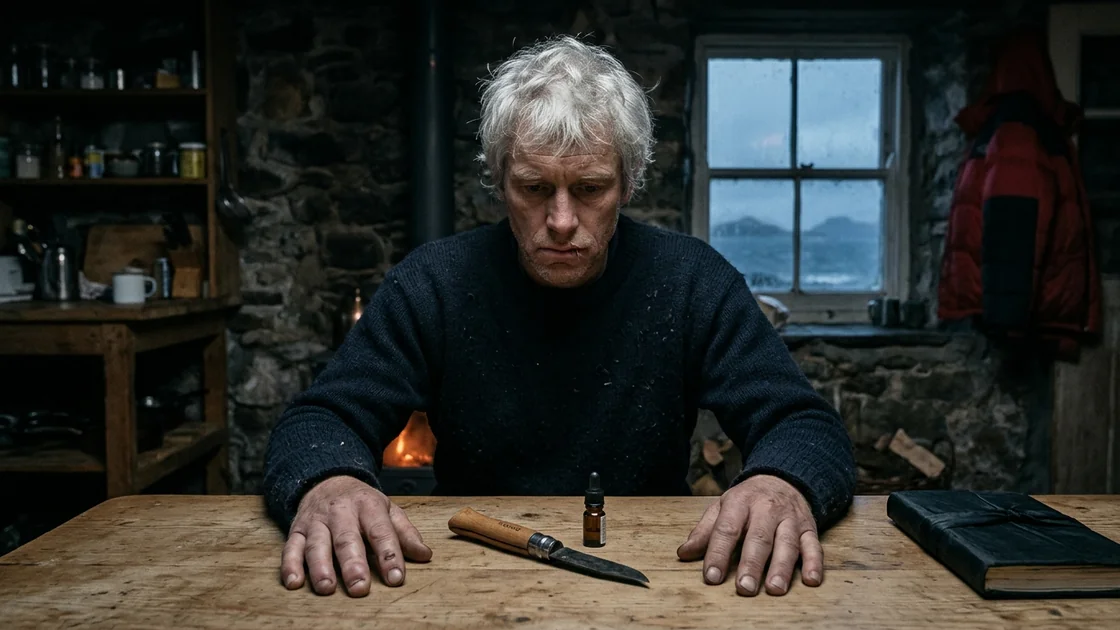
In the croft outside Ullapool, the rain beat a steady, gray rhythm against double-paned glass that smelled of salt and peat smoke. It was four in the afternoon in late November, and the light had already failed, bleeding away into the Minch like iodine into water. David sat at the scrubbed pine table with his hands flat on either side of a bone-handled clasp knife. His right hand was missing the terminal pads of the index and middle fingers, the skin there slick, purplish-pink, and rounded like river pebbles. The left hand was whole, though stiffened by arthritis that had settled into his knuckles before he turned thirty-five.
He picked up the knife. It was a simple tool, an Opinel No. 8 with a carbon steel blade, darkened with patina from years of slicing apples, cheese, and cordage. He opened it with his thumbnail. The hinge was stiff, oiled with mineral oil he kept in a dropper beside the stove. He tested the edge against the callous of his thumb. It was sharp enough to part paper without a tear.
On the other side of the kitchen, Julian’s journal sat wrapped in oiled silk, exactly where Julian’s sister, Clara, had left it three weeks ago. David had not opened it. He did not need to read Julian’s neat, architect’s handwriting to know what was recorded up to July 26. He knew the elevations, the barometric readings, the rations of pemmican and freeze-dried dahl, the jokes about the cook at Base Camp who added turmeric to porridge. What he feared was the blankness after that date—the sudden, violent white of pages that Julian had carried into the bergschrund and never touched again.
David stood up, his knees cracking like dry kindling. His body was an archive of cold. When he walked down to the stony beach below the cottage, the Atlantic wind found every fault line in his skeleton. The local fishermen at the harbor in town gave him a wide berth, not out of malice, but because he carried the strange, unwashed scent of men who have spent too long above the tree line. In the high places, the human body does not decompose; it desiccates. Even now, three years after the expedition, David smelled faintly of kerosene, lanolin, and the absolute absence of bacteria.
He walked to the window and leaned his forehead against the cold glass. Out on the water, the Summer Isles were dark humps crouching against the swell.
"You had forty seconds," he whispered to the glass. "Forty seconds before the whole station pulled out."
No one answered. The wind took the words and flung them into the heather.
Part II: The Shadow on the Godwin-Austen
They had come to the Karakoram in early June, when the heat in the Shigar Valley was thick enough to soften the asphalt beneath their boots. Julian had been thirty-one then—three years younger than David—with that buoyant, careless certainty belonging to men who have never had to dig a teammate out of a debris fan. He was tall, loose-limbed, with thick blond hair he refused to cut, stuffing it under an orange wool watch cap that smelled of stale sheep.
"The Savage Mountain," Julian had said, spitting into the dust at Askole as they watched the porters weigh sixty-pound loads on suspended steelyards. "It’s bad branding, Dave. Makes it sound like an opera. It’s just rock and frozen water. It doesn't know we're here."
"It knows," David had said, adjusting the straps of his pack. "The cold knows how to find a seal in your Gore-Tex. It knows how to get behind your sunglasses. Treat it like a cathedral, Julian, not a playground."
Julian had laughed, slapping David’s shoulder with a leather-palmed work glove. "You're getting old, Miller. You’ve been reading too much Herzog. We’re going to climb it clean, Alpine style from the Shoulder, and then we’re going to Chamonix to drink ourselves blind."
They had climbed together for six years—the Walker Spur on the Grandes Jorasses, the North Face of the Eiger in a crisp thirty hours, a fast, terrifying sprint up the Cassin Ridge on Denali where they had shared a single bivy sack during a seventy-mile-per-hour blow. They were not friends in the domestic sense; they rarely saw each other in London or Geneva. Their kinship was forged entirely through the tension of a dynamic rope. They understood each other through the small, violent twitches of cord: two tugs for off belay, three for haul, the sudden, deadening snap that meant the leader had taken a peel.
By the second week of July, they were sitting in a yellow dome tent at Camp III, perched at 7,300 meters on the Black Pyramid. Outside, the wind made the nylon walls boom like bass drums. The air had thinned to an abrasive gas that made their lungs burn with every shallow breath.
"Listen to that," Julian said, his head propped on a stuff sack filled with down clothing. He was carving a small block of paraffin wax with his pocket knife, shaping it into an alpine ibex. "That’s the jet stream dropping. We get three days of low pressure, then the window opens. We hit the Bottleneck by dawn on the twenty-seventh."
David was melting snow over a hanging MSR stove. The blue flame hissed with a thin, wheezing note, starved of oxygen. "The snow pack hasn’t bonded on the traverse, Jules. The Spaniards said there’s four feet of wind-slab sitting on top of blue ice below the Serac."
"The Spaniards turned back because their toes were purple," Julian scoffed, not looking up from his shaving. "They’re soft. If we wait for the snow to bond, the monsoon hits from the south and the season’s done. We don't come back here, Dave. I can’t afford another permit. Clara’s getting married next spring, and I promised my father I’d join the firm in September. This is it. The big one."
David stared at the small aluminum pot. Little bubbles were rising from the gray ice, clinging to the metal sides like silver beads. He had felt an ache in his sternum since they passed the House’s Chimney—not altitude sickness, but an ancient, animal instinct that told him the mountain was holding its breath. The weather was too clear. The sky was an unnatural, indigo blue, so dark that at midday you could see the brighter stars if you stood in the shadow of a serac.
"We go light," David said softly. "One rope. Four screws. A picket. If the weather breaks above eight thousand, we don't discuss it. We turn."
Julian smiled, his teeth startlingly white in his bearded, soot-streaked face. "Agreed, Captain. We turn on your mark. Now give me some of that water; it tastes like boiled boot, but it’s wet."
Part III: The Death Zone
They left Camp IV at midnight under a moon so sharp it cast blue shadows across the Shoulder. The temperature was minus thirty-eight Celsius, but the air was dead calm—a treacherous, deceptive silence that allowed the cold to settle into the marrow without the warning slap of a gale.
Above them rose the Bottleneck: a narrow couloir of fifty-degree ice squeezed between vertical granite ribs on the left and the colossal overhang of the Great Serac on the right. The serac was a hanging glacier, an unstable cliff of ancient ice four hundred feet high, leaning over the route like a frozen wave about to break. Every mountaineer who climbed K2 knew the arithmetic: the serac could calve at noon, or it could calve in two hundred years. To spend time under it was to roll dice in a dark room.
They were moving together, simul-climbing on a sixty-meter length of 9.1-millimeter rope. David led the first pitch into the couloir. The ice was brittle, shattering under his front points like dinner plates. With every strike of his ice axes, small saucers of verglas clattered down the slope, hissing between Julian’s boots fifty meters below him.
"Watch the dinner plates!" Julian called up, his voice muffled by his neoprene mask.
"Keep moving!" David shouted back. "Don't hang out under the lip!"
By four in the morning, the horizon over Tibet had turned the color of bruised plums. They were at 8,200 meters. The air here contained only one-third of the oxygen found at sea level. Every step required three full ventilations—gasping, rib-cracking breaths that tasted of dry copper. David’s mind had narrowed to a tiny, tunnel-visioned circle: the steel pick of his Petzl tool, the three inches of ice it penetrated, the placement of his right crampon, the heave of his lungs.
Then came the traverse.
To bypass the vertical headwall, climbers must leave the couloir and venture horizontally across an eighty-degree ice slope directly beneath the belly of the serac. The snow there was waist-deep, unconsolidated powder resting on an impenetrable sheet of black water-ice.
Julian was leading the traverse. He was forty feet out, moving slowly, wallowing through the powder like a swimmer. He had placed one steel ice screw thirty feet back—a short, ten-centimeter tube that David knew had only caught three threads of good ice before hitting crumbly shale.
"Julian," David called out through his frost-caked balaclava. His voice was a rasp, barely louder than a whisper. "Put in another piece. The anchor here is garbage."
David was standing on an exposed platform the size of a breadbox, wedged into a shallow depression in the ice. He had two anchors: a single, twenty-two-centimeter titanium screw sunk into a patch of aerated, gray ice that wept frozen crystals, and his secondary axe driven up to the adze in a hard snow bank. He had tied himself in with an overhand knot on a bight, clipped with an aluminum screw-gate carabiner. If Julian fell, the force would come directly onto David’s harness and that single, uncertain titanium tube.
Julian paused, twenty feet out, hanging from his leashes. His breath came in ragged, wheezing gasps that David could hear through the thin air.
"Nothing... to screw into," Julian gasped. "It’s all... feathers. Granular sugar. I’m four feet... from the rib. Once I get the rib... there’s a horn. I can sling the horn."
"Take your time," David said. His fingers inside his mitts were completely numb. He had stopped wiggling them ten minutes ago to conserve oxygen. "Don't rush the feet."
Above them, three hundred feet higher into the dark, there was a sound like the crack of an artillery piece.
It was not a slide. It was not a powdery sluff. A slab of the serac, perhaps the size of a city bus, had broken free from the main wall. It did not hit them directly; it fell into the upper gully, shattering into millions of tons of high-velocity ice blocks that swept down the Bottleneck like grape-shot from a cannon.
The wind of the fall hit first—a blast of displaced air that flattened David against the ice wall, driving the breath from his ribs. Then came the darkness. A blinding white cloud of pulverized ice obliterated the dawn, filling his goggles, packing his nostrils, choking his mouth.
"David!" Julian screamed.
The rope went taut with a violence that jerked David’s pelvis upward, slamming him into the anchor. The single titanium screw shrieked—a high, metallic groan that vibrated through the steel carabiner directly into David’s hip bone. The ice around the screw fractured, a spiderweb of white fissures blooming across the gray surface like a cracked windshield.
David looked down through the boiling snow.
Julian was not on the slope. The avalanche had swept him clean off the traverse. He was hanging in free space, dangling over the South Face—a drop of nine thousand feet into the Godwin-Austen glacier.
Part IV: The Knife and the Core
The weight was immense. It was not merely the weight of Julian’s body—eighty kilos of bone, muscle, and wet wool—but the dynamic shock of his fall, compounded by the drag of his pack and the wind that was now tearing up the face like an express train.
David was being pulled downward. His secondary axe had already ripped from the snow bank; the pick had gouged a useless furrow through the crust and now hung limply from its leash on his wrist. Everything hung on the single twenty-two-centimeter titanium screw.
The screw was bending.
David could see the threads slowly pulling out of the ice, millimeter by millimeter. The ice around it was not melting; it was crumbling under the lateral pressure, turning into white dust that blew away in the rotor wash of the storm.
"Julian!" David screamed, his throat tearing. "Can you find a purchase? Kick! Kick into the wall!"
Julian was spinning slowly sixty feet below him at the end of the bright orange rope. He was hanging beneath an overhang; his boots were five feet away from the rock, kicking at empty air. His ice axes were gone, ripped from his hands by the initial impact of the serac block.
"Nothing!" Julian’s voice came up through the howling wind, thin and distorted, like an old voice on a phonograph. "It’s an overhang! I’m in space, Dave! Haul me!"
"I can't haul!" David cried. His hands were braced against the rock face, his boots slipping on the frozen ledge. His harness was cutting into his groin, pinching the femoral artery so hard his legs were going cold and dead. "The anchor is pulling! The screw is coming out!"
The screw gave another sickening, metallic shudder. It leaned downward at an angle of twenty degrees. A two-inch circle of ice popped out around the collar, exposing the polished, silver threads.
"Put in another piece!" Julian shouted. He did not know. He could not see the platform. He could not see that there was no more ice—only rotten shale that crumbled like wet digestive biscuits under the point of David’s crampons.
"There is no piece!" David yelled.
The screw slipped another half-inch. It had perhaps four inches of grip left in the mountain.
David’s hand went down to his right thigh pocket.
He did not plan it. His intellect did not formulate an ethical proposition. It was the ancient, reptilian brainstem—the thing that wants to breathe, the thing that has survived five hundred million years of mud and teeth—that moved his hand. He unzipped the pocket of his down suit with his teeth, biting the plastic toggle, pulling it up.
He reached inside and pulled out the Opinel knife.
He opened it against his knee, pressing the back of the blade until the ring lock clicked into place. The carbon steel looked black against the blinding snow.
Julian must have felt the shift in the rope, or perhaps he heard the silence that fell between them in the lull of the wind.
"Dave?"
Julian looked up. His goggles had been ripped away in the avalanche. His eyes were wide, bloodshot, the eyelashes frozen into thick white combs of frost. He could see David leaning over the lip. He could see the knife in David's right hand.
"Dave, don't," Julian said. His voice was suddenly very calm, very small, cutting through the thin air with a strange, impossible clarity. "Don't do it, Dave. Please. The horn... try the horn."
"There is no horn, Julian," David whispered.
The ice screw groaned again. A long crack shot down from the placement, reaching the lip of the ledge. The metal barrel of the screw rose another half-inch. It was holding by nothing more than friction and frozen breath.
"David." Julian’s voice wasn't angry. It was filled with a terrifying, childlike astonishment. "David, don't leave me here."
David looked at the rope. It was a 9.1-millimeter Mammut cord, bright orange with a blue fleck. Under the immense tension, it had thinned until it looked like a strand of saffron yarn. It was vibrating, singing that high, thin, terrible note.
David did not close his eyes. If he was going to commit damnation, he would not hide from it behind his eyelids.
He laid the blade against the orange sheath.
He did not need to saw. The internal tension of the loaded rope was so great that the moment the carbon steel touched the nylon, the outer sheath exploded backward like severed skin. The white kernmantle fibers inside—the small, twisted hearts of the rope—unraveled in a millisecond, snapping one by one with the dry, popping sound of firecrackers.
Julian’s eyes did not leave David’s face as he dropped.
He did not scream. He fell silently, his orange down suit shrinking against the gray expanses of the South Face, becoming a speck, then a dot, then vanishing entirely into the swirling cloud bank that lay three miles below on the glacier.
The tension vanished from David’s harness with such suddenness that he slammed backward against the rock wall. The titanium ice screw, relieved of its burden, hung crooked in its hole, loose enough that David could have pulled it out with his bare teeth.
The severed end of the rope whipped back and struck David across the mouth, splitting his lip through his balaclava, leaving the taste of warm salt on his tongue.
Part V: The Ghost of Camp IV
David did not remember the descent of the Bottleneck.
The human body in the Death Zone operates without memory, like an engine running on its last thimble of kerosene. He did not have Julian’s rope; he had only thirty feet of frayed cord tied around his waist, useless for rappelling. He down-climbed the fifty-degree ice face on his front points, his picks shaking so violently in his hands that they rattled against the verglas like castanets.
He was alone. The silence of the mountain was no longer cathedral-like; it was the silence of an execution chamber after the switch has been thrown.
He reached Camp IV at dusk. The yellow tents were half-buried in snow, their poles broken by the wind. He crawled into the first one he found—a small, two-man wedge that had belonged to the Spaniards who had turned back two days before. Inside, he found a half-empty thermos of cold tea and three strips of dried beef.
He did not take off his boots. He did not take off his crampons. He curled into a ball on top of a frozen foam mat, his knees pulled up to his chin, his head buried in his down sleeves.
That was the first night the dreams began.
Julian was outside the tent. He was not dead; he was standing in the vestibule, his crampons tearing through the thin yellow nylon, his frostbitten fingers tapping against the snow flaps.
Dave, Julian said. It's cold down here. The glacier is moving. It’s grinding my knees.
"Go away," David muttered into his wool collar. "You're dead. You fell three thousand meters. No one survives that."
You cut it, Julian whispered. The sound of his voice was like snow blowing across granite. You had forty seconds, Dave. The screw would have held for forty seconds. Why didn't you give me the forty seconds?
David woke with a start, his mouth open, screaming into the empty tent. There was no one in the vestibule. Only the wind, coming down from the summit headwall at ninety miles an hour, stripping the loose snow from the ridges and hurling it into China.
He looked at his hands. His right mitt had come off during the night. His index and middle fingers were black to the second knuckle, hard as ebony, ringing like stone when he tapped them together. He did not feel any pain. The pain would come three days later, in the military hospital at Skardu, when the army doctors began the debridement, peeling away the dead rind of his flesh with scalpels while he lay strapped to a canvas cot, screaming Julian’s name until his vocal cords bled.
At Base Camp, they had asked him what happened.
The expedition leader, an Austrian named Hauer with sun-bleached eyebrows and a face like dried beef, sat across from David in the mess tent. A single kerosene lamp hissed between them, casting long, greasy shadows against the yellow canvas. Outside, the porters were packing the fifty-gallon blue plastic barrels for the trek out through the Baltoro.
"The anchor failed," David said. His voice was a flat, dead monotone. His lips were swollen, split into black ruts from the frostbite and the lash of the cut rope.
"The screw?" Hauer asked, his eyes narrow, watching David’s hands, which were wrapped in thick bandages like white paws.
"The screw," David lied. "A serac block came down. It took Julian off the ledge. The anchor blew out of the wall. I barely held the arrest on the secondary pick. The rope broke across a granite edge."
Hauer did not blink. He picked up a tin mug of green tea, blew the steam from the surface, and took a slow sip. He had climbed K2 twice; he had left four friends on its flanks. He knew what rope looked like when it was cut by rock—the frayed, shredded beard of nylon, the irregular, matted ends.
"You have the rope?" Hauer asked.
"Lost it," David said. "Dropped it below the Black Pyramid. My hands were gone."
Hauer nodded slowly. He did not ask to see the gear. He did not look at the knife that was still buried deep in the bottom of David’s rucksack, wrapped in a dirty pair of polypro socks. In the mountains, there are truths that belong to the rock, and truths that belong to the valleys, and men like Hauer knew that bringing the mountain truths down to the valleys was like bringing deep-sea fish to the surface: they burst from the change in pressure, leaving only a foul, unrecognizable slime.
"His sister is waiting in Islamabad," Hauer said quietly. "She arrived two days ago. She has his return ticket."
David had looked down at his bandaged hands. "I can't see her."
"You will have to," Hauer said. "You were on the sharp end."
Part VI: The Salt of Ullapool
Three years had passed, but in the croft near Ullapool, time had not moved forward; it had simply gathered in corners like dust.
David had bought the cottage with the remnants of his climbing sponsorships and the payout from a life insurance policy he had taken out before the Karakoram trip. It was a stone shell with four rooms, surrounded by low drystone dikes that kept out the neighbors' Cheviot sheep. To the west, the ocean stretched away toward the Hebrides, gray and pitiless; to the east rose the hills of Assynt—Suilven, Canisp, Stac Pollaidh—ancient sandstone monoliths that looked like ruined towers left behind by an older, crueler race of gods.
He never climbed them. He did not even carry a walking stick into the heather. When he went to town for groceries, he kept his head down, buying oats, salt butter, tea, and paraffin, speaking only the minimum number of syllables required to complete the transaction.
Clara had found him anyway.
She had come in October, driving a rented Volkswagen that looked ridiculous parked in the mud outside his gate. She had Julian’s eyes—the same pale, cornflower blue that had stared at David through the cloud of powdered ice at 8,200 meters. She was twenty-eight, an illustrator for children’s books, with none of Julian’s manic energy, but carrying instead a quiet, stubborn gravity that David found far more terrifying.
She had stayed three days at the small hotel in Ullapool, walking out to his cottage every afternoon through the rain.
"He loved you, David," she had said on the second day, sitting by the wood stove with her hands wrapped around a mug of hot water. She refused tea. She refused food. She sat in the wooden rocking chair and looked at David’s scarred face with a terrible, penetrating curiosity. "He wrote about you from Skardu. He said you were the only climber he trusted with his life because you didn't have an ego. He said you were like an anchor."
David had sat across from her, his scarred fingers curled inward against his palms. "He was mistaken."
"Why do you say that?"
"I was careful," David said. "Careful isn't the same as trustworthy. Careful men are cowards when the math stops working."
"The Austrian—Hauer—sent us the report," she said, her voice dropping. "He said the mountain was unstable. He said it was an act of God."
"Hauer wasn't there," David said.
"Were you?" she asked, leaning forward. Her eyes were suddenly bright with unshed tears. "Because you haven't told me anything, David. You didn't come to the memorial in London. You didn't answer my letters. My father died six months after Julian, thinking his boy was just... gone, swept away like a dry leaf. I need to know where he is. Is he in a crevasse? Is he on the ice?"
David had looked at her then, and for a fraction of a second, the mountain truth rose in his throat like bile. He wanted to tell her about the forty seconds. He wanted to tell her about the Opinel No. 8 that was sitting in the drawer behind her head. He wanted to tell her how the rope had popped, how it had sounded like a whip cracking against his lips, how Julian had looked at him not with hatred, but with that awful, unbearable understanding.
He knew, David wanted to shout at her. He knew I was a beast that wanted to live!
Instead, he said: "He fell from the Bottleneck. He went into the cloud. You could search the Godwin-Austen for twenty years and find nothing but his mittens. The mountain grinds everything to flour, Clara. Let him be."
She had left Julian’s journal on the table when she departed. She hadn't said goodbye. She had simply closed the cottage door, and the click of the latch had sounded to David precisely like the click of the titanium ice screw turning in the ice.
Part VII: The Anatomy of a Phantom
A man who loses a leg still feels the itch in his toes; a man who cuts a rope still feels the tension in his harness.
David’s body was never free of the 9.1-millimeter cord. At night, lying on his narrow horsehair mattress with the peat fire dying in the grate, he would feel the sudden, crushing weight settle onto his pelvis. His breath would catch in his throat; his ribs would ache where the harness had bruised them three years before. He would lie pinned to the bed, unable to move his arms, convinced that if he relaxed his abdominal muscles for an instant, the bed, the cottage, and the stone foundation would all be pulled out into the void, sliding down into the cold dark of the Karakoram.
His frostbitten fingers had developed a condition the doctor in Inverness called phantom paresthesia. The missing tips did not exist, yet they burned with an intolerable, searing cold. When the barometer dropped—when a low-pressure system rolled in from the North Atlantic, bringing the heavy, wet gales that battered the croft—the missing flesh felt as though it were being dipped into liquid nitrogen.
To stop the pain, he worked.
He had a two-acre potato patch behind the cottage that had gone to nettles and dock. He cleared it by hand, using a rusted spade and a pickaxe, breaking the heavy, sodden turf, hauling the granite boulders down to the beach one by one in a wooden barrow. His hands bled into his work gloves; the scars on his knuckles split and reformed as yellow calluses.
One afternoon in early December, while he was prying a half-ton boulder from the peat, the pick struck a layer of hardpan gravel with a dry, ringing chink.
David froze.
The sound resonated up the hickory handle into his wrists, into his shoulders, directly into his teeth. It was the exact pitch of the ice screw pulling through the upper ice layer.
He let go of the tool as if it were white-hot. He fell to his knees in the muddy ditch, his chest heaving, his mouth open, drawing in the wet, salt-thick air of the Scottish coast. But his lungs could not find any oxygen. His brain insisted that he was at 8,200 meters. The air tasted of copper and ozone; his vision narrowed to that tiny, terrible circle of verglas.
"Julian," he choked out, his face inches from the black mud. "Julian, there was no purchase. There was no horn."
A gull screamed overhead, wheeling against the leaden sky.
He looked up. The ditch was empty. There was only the rusted spade, the gray dirt, and the rain coming down in long, slanting needles that blurred the line between the sea and the sky.
He rose slowly, his knees covered in black peat. He did not pick up the spade. He walked into the cottage, stripped off his wet canvas coat, and stood before the small mirror above the basin.
The man who looked back at him was forty years old, but his hair was entirely silver, not gray, but the dead, chalky white of old bone. The skin across his cheekbones was tight, mottled with the red, broken capillaries that mark men who have stayed too long in the thin air. His mouth was set in an asymmetrical grimace where the severed rope had split his lip; the scar had healed into a hard, pale knot that pulled the left corner of his mouth downward in a permanent sneer of disgust.
He reached into the drawer and took out the Opinel knife.
He opened it. He had cleaned the blade a thousand times, but under the magnifying glass he used for mending nets, he could still see—or imagined he could see—microscopic fibers of orange nylon fused into the microscopic pits of the carbon steel. The heat generated by the severance had been so great that the nylon had melted as it parted, leaving a tiny, imperceptible smear of plastic along the secondary bevel.
He could not throw it away.
To throw the knife into the Minch would be an act of cowardice—an attempt to grant himself an absolution he had not earned. The knife was the only witness that had survived the Bottleneck. The mountain did not care; the serac had long since collapsed, sweeping away the ledge, the anchors, the platform, erasing every mark of their presence within an hour of David’s descent. Only the knife remembered that the orange rope had not parted on rock.
He closed the blade and slipped it into his trouser pocket. It was heavy, cold against his thigh—a weight that never varied by a single grain, yet felt heavier than the half-ton stones he was pulling from the earth.
Part VIII: The Pilgrimage of Stac Pollaidh
In mid-January, the winter turned vicious.
The wind swung around from the north, bringing arctic air down from the Greenland ice sheet. The rain turned to sleet, then to a dry, powder snow that the gale drifted six feet deep against the stone dikes. The sheep stood with their backs to the wind, their wool frozen into solid plates of rime.
David did not light the stove.
He sat in the dark kitchen, wearing his old high-altitude down suit—the red one with the black patches on the knees and elbows, the one he had worn on K2. The suit smelled of his own old sweat and the burnt-iron scent of the Karakoram. He had pulled the hood up, cinching the drawstrings until only his eyes and his scarred mouth were exposed.
He was waiting.
He did not know what he was waiting for until three in the morning, when the gale reached its crescendo, shaking the heavy slate roof until the rafters groaned like the rigging of a ship.
He stood up. His mind was clear—clearer than it had been since the morning of July 27.
He took his boots—his Scarpa high-altitude doubles, the heavy plastic shells with the intuition liners—and laced them onto his feet. He took his crampons from the peg behind the door and strapped them to the carry loops of his daypack. He did not take food. He did not take a thermos. He took only the Opinel knife in his pocket and two technical ice tools he had not touched since he had cleaned the blood from their shafts in Skardu.
He walked out into the storm.
The road to the north was gone, buried beneath white drifts that looked like the frozen sastrugi of the Godwin-Austen. He walked through the center of the whiteout, his head down, using the wind against his left cheek as a compass. He was heading for Stac Pollaidh.
It was a small mountain—barely two thousand feet high—a narrow ridge of Torridonian sandstone that rose from the bog like the spine of an ancient, petrified reptile. In summer, hillwalkers scrambled up its tourist path in their trainers, eating sandwiches on the ridge, looking at the sea.
In a January blizzard, it was an abattoir.
The wind had stripped the snow from the lower terraces, leaving the sandstone coated in a sheet of black verglas—water that had frozen the instant it touched the cold stone. It was the same ice he had found on the Bottleneck: brittle, black, and treacherous.
David reached the base of the ridge at dawn. The sky was not blue; it was a swirling, opaque murk that smelled of salt and frozen iron. He sat on a wet boulder and strapped his crampons to his boots. The steel points bit into the rubber soles with a familiar, reassuring crunch.
He began to climb.
He did not take the tourist path. He took the direct North Face—a vertical gully of rotten sandstone and frozen moss that no one had climbed in winter because the rock was too soft to take an anchor and the runouts were fifty meters to the scree.
He moved with an eerie, mechanical precision. His body had forgotten everything he had learned in the three years of potato digging, but it had not forgotten the geometry of vertical ice. His front points found the microscopic ledges in the sandstone; the picks of his tools hooked the frozen turf with a dull, hollow thud.
He did not use a rope. There was no one to hold the other end.
By noon, he was three hundred feet below the summit ridge, hanging from his tools on an overhanging wall of ice that had formed over a weeping seep in the rock. The wind here was howling with the voice of an engine, tearing at his down suit, trying to peel him from the face.
His breath came in short, dry gasps. His heart was hammering against his ribs, a frantic, trapped bird.
"Julian," he said.
The wind caught the name and whirled it away into the blizzard.
He looked down between his boots. Through the driving snow, he could see the gray expanse of the loch below, two thousand feet down. It was not the Godwin-Austen; it was not nine thousand feet of space. But it was enough. A fall from here would take six seconds. The body would hit the scree fan at ninety miles an hour, breaking every long bone in the skeleton, bursting the liver, cracking the skull like a walnut.
He took his right hand off the ice tool.
He reached into his pocket and pulled out the Opinel knife.
He opened it with his teeth. The carbon steel was cold against his tongue, tasting of rust and old grease.
He held the knife out over the void.
"This is it, Julian," he said. "This is the forty seconds."
He waited.
He waited for the titanium screw to pull. He waited for the serac to crack. He waited for the voice to tell him to put it away, to go down, to live, to write Clara another lying letter about bravery and acts of God.
No voice came.
The mountain did not care. Stac Pollaidh did not know he was there. The sandstone, five hundred million years old, was completely indifferent to whether David Miller fell or climbed, whether he had cut a rope on K2 or lived to be ninety in an armchair by the fire. The cold did not have an agenda; it was merely the absence of heat.
David looked at the knife.
He saw his own face reflected in the dark patina of the blade—distorted, miniature, grotesque. He saw the knot of scar tissue on his lip. He saw the white hair blowing out from under the rim of his hood.
He realized then the terrible, unendurable truth that he had been running from since the Bottleneck:
Julian had not forgiven him. Julian had not cursed him. Julian had simply died.
The look in Julian’s eyes at the final moment had not been understanding, nor had it been horror. It had been the empty, mechanical shock of an organism that has reached the end of its line. The ghost that had been haunting the croft, the voice that spoke from the vestibule of the tent, the phantom weight on his pelvis—they were not Julian. Julian was nowhere. Julian was six ounces of gray ash scattered across the Godwin-Austen, mixed with the shale and the dung of the snow leopards.
The ghost was David.
He was the one who had survived by turning himself into a blade. He had cut the rope not because he had made a calculation, but because he was a thing that wanted to eat and breathe more than it wanted to be human. And that thing had to live with what it was, in the dark, in the cold, until the natural end of its meat.
David did not drop the knife.
He put it back in his pocket. He closed the snap of the pocket with his scarred thumb.
He reached up with his right hand, gripped the rubber handle of the ice tool, and swung it into the ice above his head. The steel pick bit with a solid, deep thunk.
He pulled himself up.
Part IX: The Return to the Lowlands
David reached the summit ridge twenty minutes later.
The top of Stac Pollaidh was a serrated edge of sandstone teeth, no wider than a horse's back, plastered with grotesque feathers of rime that had grown into the teeth of the north wind. He did not stand up. He sat astride the ridge, his boots dangling over the precipice, his hands resting on the icy rock.
To the south, through a momentary tear in the blizzard, he could see the lights of Ullapool—three or four tiny, yellow pinpricks twinkling through the murk like dying candles on an altar. They seemed unimaginably distant, belonging to a world of tea kettles, wool blankets, and human speech that had nothing to do with him.
He sat there for a long time, until his down suit was coated in white frost and his eyelashes were frozen together.
Then he reached into his daypack, pulled out Julian’s journal, which he had carried with him from the croft, wrapped in its oiled silk.
He did not open it. He did not read the handwriting.
He found a deep, narrow fissure in the sandstone between two pinnacles—a crack that went down four feet into the heart of the mountain, dry and protected from the scouring wind. He slid the journal into the rock, wedging it deep with the adze of his axe until it was far beyond the reach of the rain, the sheep, or the hillwalkers who would come in the summer.
He took the Opinel knife from his pocket.
He did not leave it with the book. He opened the blade, and with the sharp tip, he scratched three numbers into the sandstone above the crack:
8,200 m
That was all. No name. No date. No prayer.
He closed the knife and slipped it back into his pocket. It would stay there. He would use it to cut his bread, to peel his potatoes, to mend his nets. It would stay against his thigh until his own heart gave out, a constant, dull pressure against the bone—a reminder of the forty seconds he had refused to give, and the forty years he would have to endure.
He stood up on the narrow ridge, turned his back to the north, and began the long descent toward the yellow lights below.