The Weight of Stolen Air
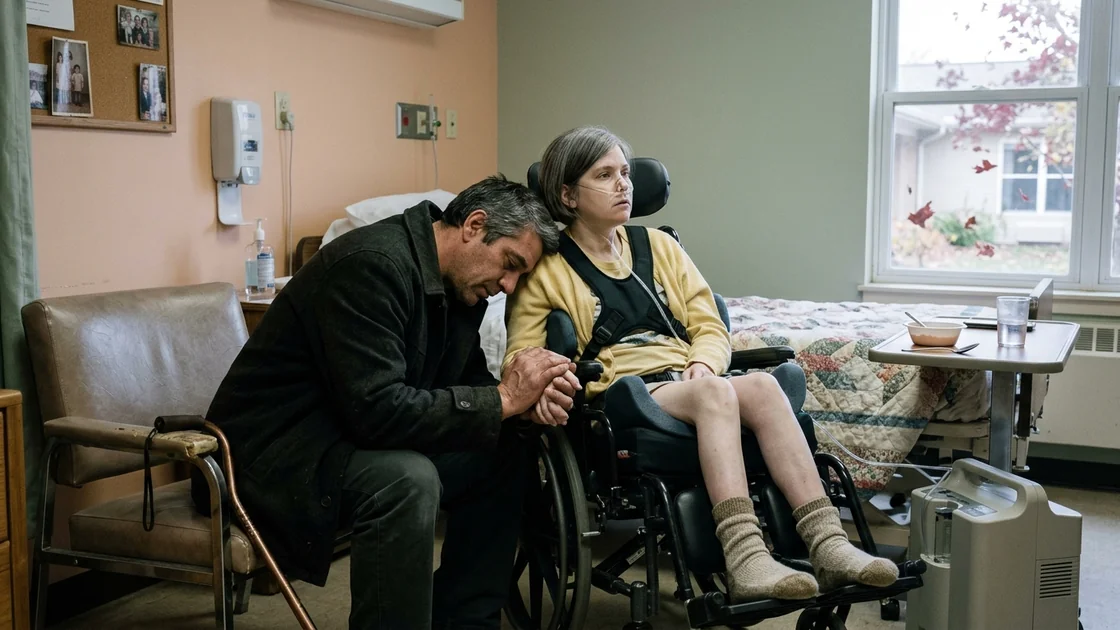
Julian Vance was twelve years old when a moment of childish spite led him to hide his younger sister Clara's asthma inhaler, an act of petty vengeance that turned tragic when her ensuing severe attack starved her brain of oxygen and left her permanently impaired, sentencing Julian to a lifetime of silent grief, atonement, and quiet devotion as her primary caretaker in adulthood.
The blue plastic sleeve was scarcely three inches long, molded from cheap, rigid polypropylene with an L-shaped curve designed to fit between small teeth. If you squeezed it, a measured dose of albuterol sulfate hissed out in an aerosol plume that tasted faintly of chalk and pressurized propellant. Julian used to know the sound intimately; for four years of his childhood, that sharp, sudden chhh-t had been as ordinary a feature of the Vance household as the ticking of the grandfather clock in the downstairs hallway or the hum of the Frigidaire kicking into gear at midnight.
Now, thirty-two years later, Julian sat on the vinyl-covered armchair in Room 14 of the Glenwood Meadows Adult Care Facility, listening to a different sound entirely.
It was the metronomic, wet sigh of a stationary oxygen concentrator, rhythmic and low, working in counterpoint to Clara’s breathing. Clara sat in her tilt-in-space wheelchair, her torso angled slightly back against the contoured foam supports, her hands curled like pale, unbloomed lilies in her lap. Her head was turned toward the tall double-hung window that overlooked the courtyard, where an early autumn wind was stripping the burning-bush hedges of their crimson leaves.
"Clara," Julian said softly.
She did not turn her head. A faint, involuntary twitch stirred the corner of her mouth—a neurological phantom, nothing more—and her left foot, clad in a thick wool sock with rubberized treads, flexed once against the footplate. Her eyes were wide, hazel, and liquid, fixed on the red leaves shivering outside.
Julian leaned forward, resting his elbows on his knees. His dark hair was threaded with silver at the temples; his fingers, long and calloused from decades of drafting architectural elevations by hand, bore the ink-stained cuticles of an insomniac. He reached out and touched the edge of Clara’s sleeve, smoothed the cotton of her yellow cardigan over her thin shoulder, and let his hand rest there. Her skin through the fabric felt warm, almost hot, the way children run hot when they are deep in slumber.
"The forecast says rain by five," Julian said, his voice level, carrying the quiet, steady cadence of someone who had spent decades speaking into a cavernous silence. "I brought the book about the canal locks in France. The ones with the stone masonry we looked at last week. And some of the ginger tea, if you want Mrs. Gable to thicken it for lunch."
Clara blinked once. A line of saliva pooled at the left corner of her lower lip. Julian reached into his coat pocket, drew out a clean handkerchief, and gently dabbed it away with practiced, instinctual tenderness. Clara did not pull back. She permitted his touch because she permitted the entire physical universe to act upon her without resistance, existing in the quiet, sequestered country of hypoxic-ischemic encephalopathy.
Julian folded the handkerchief, tucked it away, and looked down at his own palms. They were empty. They were always empty, no matter how much he carried.
In the summer of 1991, Julian had thought himself an emperor of minor grievances.
He was twelve, tall for his age, gangly and sharp-cornered, his knees perpetually scuffed and his mind preoccupied with the cruel, intricate hierarchies of middle school. His sister Clara was nine. In the peculiar logic of siblings, her very existence was often an intrusion upon his territory. Clara was small, pale, and possessed of a high, trilling laugh that Julian found unbearable when his friends were over. Worse still, Clara had asthma, which made her the gravitational center of the household.
Their mother, Eleanor, lived in an enduring state of low-grade panic, her ears tuned to the frequency of Clara’s lungs. A sudden shift in barometric pressure, a neighbor mowing a lawn three doors down, an afternoon spent in an old attic—any of these could send Clara into spasms of coughing that ended with Eleanor kneeling over her, rubbing her back, whispering soothing nonsense while their father, Martin, hunted down the blue cylinder from the bathroom counter, the kitchen windowsill, or the pocket of Eleanor’s apron.
Julian had resented the inhaler long before he ever touched it with malice. It sat on the center of the kitchen table like a miniature plastic totem, commanding absolute deference. Meals were interrupted for it. Vacations were organized around proximity to emergency clinics because of it. If Julian scored a goal in little league, the car ride home was invariably truncated because Clara had begun to wheeze from the humidity in the bleachers, and his small triumph was swallowed whole by the familiar, suffocating rush to get home and plug in the compressor for the nebulizer.
The afternoon it happened was an unseasonably stifling Tuesday in late July. The humidity in their corner of Pennsylvania had settled over the town like a wet wool blanket, trapping the smell of asphalt and river silt in the valley. Martin was at the machine shop until six; Eleanor had gone down to the church basement to help organize donations for the annual summer bazaar, leaving Julian in charge for ninety minutes.
"Stay inside," Eleanor had commanded, her car keys jingling in her hand as she paused by the screen door, looking back at them with her tired, lined face. "The air quality index is red today, Julian. You keep the air conditioning running, and you watch her. If she needs her medicine, it’s right on the telephone stand."
"I know, Mom," Julian had said, slumped on the sofa with a comic book held open in front of his face.
"Julian. Look at me."
He had lowered the comic, his eyes sullen. "I know. I'm watching her."
"I'll be back at four," she said, and let the screen door slap shut behind her.
Clara had been sitting on the linoleum floor of the hallway, playing with a collection of smooth river stones she had gathered from the creek the previous weekend. She was lining them up in order of darkness, whispering names to them under her breath. Julian found the whisper grating. It sounded like dry leaves scraping across a stone walk.
"Stop that," Julian said from the living room.
Clara didn't look up. "Stop what?"
"Muttering. You sound like an idiot."
"I’m not an idiot," she replied, her small chin tilting up. "I’m naming the kings of England. This one is William. He’s dark gray."
"It's stupid. Go play in your room."
"Mom said we have to stay down here where the cold air is."
Julian tossed the comic book onto the coffee table. The heat, despite the rattling window unit in the dining room, was prickling beneath his skin. He had wanted to ride his bicycle down to the quarry with Tommy Keller and Mark Davis, but he had been chained to the house to babysit. His bicycle sat in the garage, its tires freshly pumped, waiting for a freedom he was being denied.
"I’m the oldest," Julian said, standing up and walking into the hallway. "If I say go upstairs, you go upstairs."
"No," Clara said flatly. She placed a speckled granite pebble at the end of the line. "Mom said."
Julian felt that sudden, familiar flare of adolescent rage—the blind, stupid heat that rushes behind the eyes when powerlessness meets defiance. He stepped toward her, his sneaker catching the edge of her line of stones, scattering William and the others across the linoleum with a sharp clatter.
"Hey!" Clara cried, scrambling after them. "Julian, you ruined it!"
"Tough," he sneered.
She stood up quickly, her small chest heaving. Even that slight exertion brought a dry, clicking rattle to her throat. She glared at him, her hazel eyes filling with tears of pure frustration, and then she lunged forward and slapped his arm. Her hand was small and the blow barely registered, but Julian reacted without thinking: he shoved her backward.
She stumbled, her back hitting the hallway wallpaper with a soft thump. The breath knocked out of her, and she let out a short, wheezing gasp that sounded like a bellows with a hole in the leather.
"I hate you!" she screamed, her voice cracking into a raw, ragged edge. "I’m telling Mom! I'm going to tell her you pushed me!"
She turned toward the telephone stand where the blue inhaler sat beside the notepad and the directory. Her hand reached for it.
Julian saw her reach. In his mind, the sequence of events appeared with terrifying clarity: she would use the inhaler, she would cry into the receiver, Eleanor would return furious, and Julian would be grounded for two weeks, forbidden from seeing Tommy and Mark, forced to sit in this sweltering house while summer died outside.
Before her fingers could close around the plastic cylinder, Julian snatched it off the mahogany table.
"Give it back," Clara wheezed, her hand still frozen in the air. Her eyes were suddenly wide with genuine fright, not anger. "Julian. Give it."
"Say you won't tell," he commanded, holding it behind his back.
"Julian, please. I can't... I need it." Her chest was hitching now. Julian could hear the constriction in her airways, a thin, piping whistle like wind through a keyhole.
"Say you won't tell, and I'll give it to you."
"I won't... I won't tell," she gasped, her face beginning to pale, her lips taking on a faint, dusky undertone. "Please, Jules."
She had called him Jules—her childhood name for him, the name she only used when she was terrified or asking him to check under her bed for spiders. A pang of hesitation struck him, cold and sharp, but his childish pride was stubborn, a beast that refused to be disciplined. He wanted to make her squirm for another ten seconds. Just ten seconds. Just enough to ensure she wouldn't run to the phone the minute he handed it over.
"Swear it," he said.
"I swear... Jules..." She reached out again, her fingers trembling, her breath hitching in her throat like a dry pump.
Julian took two steps backward, toward the small decorative chest that sat beneath the mirror in the foyer. The top drawer was cracked open an inch. Without breaking eye contact, moved by some monstrous, petty impulse to demonstrate his absolute dominion over the room, he dropped the inhaler inside the drawer and slid it shut with his hip.
"It’s in the drawer," he said, folding his arms. "Get it yourself."
He had expected her to open the drawer. He had expected her to yank it open, grab the blue canister, jam it between her teeth, and inhale with that familiar, angry hiss.
She didn't.
Clara took one staggering step toward the chest, and then her knees buckled. Her lungs, already starved of oxygen from the heat, the argument, and the sudden spasm of acute bronchospasm, simply seized shut. The airway closed like a fist. She dropped to the linoleum, her hands clutching at the throat of her yellow T-shirt, her mouth open in a silent, horrific O.
"Clara?" Julian’s voice cracked.
She didn't answer. She couldn't. No air was moving in or out. She began to claw at the carpet, her heels drumming against the floorboards in a frantic, uncoordinated spasm. Her skin, so pale a moment before, was turning the color of skim milk left out in the sun, with a sickening blue cast settling around her nose and mouth.
Julian froze.
A second passed. Two seconds. The world contracted into the small hallway, the air suddenly thick enough to drown in.
"Clara! Stop it!" he shouted, panic rising like bile into his throat. "Stop fooling around! Get up!"
She didn't get up. Her eyes rolled back toward the white ceiling, her eyelids fluttering. The drumming of her feet stopped. Her limbs went limp, her small hands dropping to the floor like discarded rags.
"Clara!"
Julian dropped to his knees beside her. He shook her shoulder. Her head rolled loosely to the side. The whistling in her chest had ceased entirely; there was no sound at all, only the monstrous silence of a body whose heart was beating against an empty void, pumping blood that carried no fire, no air, nothing to keep the lights on in the fragile rooms of her young brain.
Julian scrambled to his feet, lunged at the chest, and ripped the drawer open. The blue inhaler was sitting there between an old roll of packing tape and a box of birthday candles. He grabbed it, his fingers slick with sweat, and dropped back down beside her. He shook the canister, popped the cap off, and forced the mouthpiece between her slack, bluish lips. He pressed the canister down.
Chhh-t.
The white plume sprayed into her mouth, but Clara was not breathing. The medicine simply settled on her tongue, drifting back out between her teeth in a fine, useless mist.
"Breathe!" Julian screamed, pounding the floor with his fist. "Clara, breathe! Inhale! Clara!"
He pressed it again. Chhh-t. Another wasted cloud.
He dropped the inhaler. It rolled across the linoleum, coming to rest against Clara’s scattered river stones.
Julian looked at the telephone. His mother’s voice echoed in his head: Julian, you watch her.
He reached for the handset, his hands shaking so violently he dropped it twice before he managed to dial the three digits. When the dispatcher answered, Julian couldn't form words; he could only shriek into the receiver, a high, broken animal noise that stripped the lining from his throat.
"My sister," he finally choked out, his voice a ragged sob. "She can't... she isn't breathing. Clara isn't breathing."
The emergency room at St. Jude’s smelled of bleach and cold steel.
Julian sat on a low bench in the waiting area, his sneakers pulled back against the baseboard, his arms wrapped tight around his ribs as if he were trying to prevent his own torso from cracking open. His mother was somewhere behind the heavy double doors, her screams having long since given way to a low, rhythmic keening that drifted through the rubberized seals every time a nurse entered or exited. Martin had arrived forty minutes later, his face gray with machine-oil smudges, his boots leaving dusty half-moons on the waxed floor as he ran blindly toward the reception desk.
Julian had not moved. He had not cried after the initial panic in the hallway; the tears had dried on his cheeks, leaving salt paths that burned in the fluorescent glare.
A police officer had driven him to the hospital, his cruiser’s lights painting the facades of the small brick houses along Maple Street in strobes of blue and red. The officer had asked gentle, routine questions: Did she fall, son? Was she taking her medicine? Did you see her take it?
Julian had lied.
He had not planned the lie. It had come out of him fully formed, born of an instinctual, primordial terror that was worse than the fear of punishment—the fear of annihilation. If they knew what he had done, the world would end. Not figuratively, but literally. The sun would cease to illuminate anything, the walls would collapse, his mother would look at him and die of horror, and he would be cast out into some dark, airless nowhere.
"She... she lost it," Julian had whispered to the officer, his voice barely audible over the crackle of the police radio. "She had an attack, and we couldn't find it. I looked everywhere. I looked in the kitchen, under the sofa... she was looking too, and then she fell down."
"It's not your fault, son," the officer had said, placing a heavy, warm hand on Julian’s knee. "Asthma is a terrible thing. It moves faster than people think."
Those five words—It’s not your fault, son—had fallen into Julian’s chest like five lead sinkers dropped into an open well. They sank down into the deep, dark silt of his soul, resting there, undisturbed, toxic, and immovable.
Around midnight, a doctor in wrinkled green scrubs came out to the waiting room. He had dark circles beneath his eyes and spoke in the hushed, measured tones of someone delivering a sentence from which there was no appeal.
Martin and Eleanor came out with him, Eleanor leaning so heavily on her husband’s arm that her knees seemed almost dislocated.
"She’s stabilized," the doctor said. His eyes flicked to Julian, sitting small and frozen on the vinyl bench, then back to the parents. "The paramedics were able to establish an airway and restore a pulse with epinephrine. But... she was without adequate oxygen for too long. We estimate between six and nine minutes before the intubation took hold."
Eleanor made a small, wet sound against Martin’s shoulder.
"What does that mean, Doctor?" Martin asked. His voice was hollow, stripped of its usual blue-collar authority. "What does that mean for Clara?"
The doctor looked at the linoleum floor for a fraction of a second—the telltale micro-pause of an experienced physician bracing himself.
"The brain is exceptionally sensitive to anoxia," he said gently. "The cerebral cortex, particularly the motor areas and the areas responsible for higher cognitive processing, suffered significant damage. Clara is in a coma right now. When she wakes—and we believe she will wake—she will not be the same Clara."
"Can she talk?" Martin’s voice was cracked, desperate. "Will she be able to come home?"
"It’s too early to predict the full extent of the deficits," the doctor replied, his hand resting on Martin’s forearm. "We need to wait for the swelling to subside. But you need to prepare yourselves. Her motor function, her speech, her ability to care for herself... they have been severely compromised."
Eleanor turned her head slowly, looking past her husband, past the doctor, straight at Julian.
Her eyes were bloodshot, swimming with a grief so immense it seemed to dwarf the room. But there was no accusation in them. There was only an agonizing, bottomless pity.
"Julian," she whispered, her voice trembling. "Oh, Julian. My poor boy. You had to see that."
Julian had looked back at his mother, feeling the cold, lead sinkers shifting in his stomach, scraping against his ribs. He had not spoken. He had nodded, once, and lowered his gaze to his shoes, knowing in that exact instant that his life, as a boy, had ended.
Clara stayed in the intensive care unit for three weeks, then spent two months in a pediatric rehabilitation facility sixty miles away in Allentown.
When she finally came home in late October, the world had turned brittle with frost. The house on Maple Street had been rearranged to accommodate a rented hospital bed in the dining room, because Clara could no longer navigate the staircase to her old bedroom. The bright, cheerful posters of horses and ballet dancers that had adorned her upstairs walls were packed into cardboard boxes and shoved into the attic; in their place came suction machines, boxes of disposable blue underpads, soft foam positioning wedges, and bottles of liquid baclofen to manage the spasticity in her limbs.
Julian stood in the doorway of the dining room on the afternoon they brought her home.
Clara was propped up with pillows. Her hair had been cut short by the nurses in Allentown, shorn into a practical, utilitarian bob that exposed the delicate nape of her neck. Her eyes were open, tracking the play of light on the ceiling, but they were different eyes now. The sharp, lively curiosity that had once named river stones after medieval kings was gone, replaced by a soft, distant glaze, like a room viewed through frosted glass.
Her arms were held tight against her chest, her wrists flexed inward in a persistent decorticate posture, her fingers curled tight. Every few moments, a sudden tremor would ripple through her torso, a sudden startle reflex that caused her to let out a short, guttural moan—uh-hhhn—that was neither speech nor silence, but the raw sound of a central nervous system firing blindly into the dark.
Martin carried her from the wheelchair to the bed, his back groaning under the weight. Clara was nine, but she was limp and uncooperative, her muscles alternating between stone-like rigidity and total flaccidity.
"There we go, sweet pea," Martin murmured, his face white, sweat beading on his forehead despite the chill in the room. "There’s our girl. You're home now. You're home with Jules and Mom."
Clara’s head lolled to the side. Her hazel eyes passed over Julian’s face without stopping. There was no recognition. There was no hatred. There was no memory of the argument, the shove, the drawer sliding shut, or the small blue canister hidden among the birthday candles.
She looked through him as if he were made of air.
That was the worst of it. If she had screamed at him, if she had pointed a crooked finger and identified him as her executioner, Julian thought he might have found some way to bear it. Punishment would have had a boundary; a trial would have had a verdict. But Clara gave him nothing. She had been erased, and in her place sat a living monument to his own petty, vicious vanity, looking straight through his bones into the empty space behind him.
That night, after the house had gone quiet—after the mechanical hum of the suction machine had ceased and Eleanor’s exhausted sobs had muffled into her pillow down the hall—Julian crept downstairs in his socks.
The house was cold. The linoleum in the hallway felt like ice against his bare soles.
He walked to the small decorative chest beneath the mirror. He did not turn on the light. In the gloom, he opened the top drawer. The blue inhaler was no longer there; the police or the paramedics had taken it that afternoon, or Eleanor had thrown it away in a frenzy of grief. The drawer smelled of old cedar, dry paper, and dust.
Julian stood before the mirror, staring at his reflection in the pale moonlight that filtered through the fanlight above the front door. He was twelve years old, his shoulders narrow, his face soft with youth.
He raised his right hand, the hand that had snatched the medicine from the table, the hand that had dropped it into the dark. He held it up to the glass, pressing his palm against the cold surface.
"I did it," he whispered to the glass. "I did it."
The mirror did not answer. The house did not collapse. The police did not come knocking. There was only the wet, rhythmic sound of Clara’s breathing from the dining room, steady, broken, and alive, keeping watch over the ruins of his childhood.
The Vance family did not survive the catastrophe, though they lived under the same roof for another seven years.
They functioned as a collection of specialized mechanisms dedicated entirely to Clara’s somatic maintenance. Eleanor became an amateur neurologist, physical therapist, and pharmacist, her speech permanently infected by clinical terminology: g-tube feeds, tone reduction, contractures, chest physiotherapy. Martin worked seventy hours a week at the machine shop to pay for the therapies and adaptive equipment that the union insurance policy refused to cover, returning home every evening with oil in the cracks of his knuckles and an exhausted, defeated quiet in his eyes.
Julian did not go to parties. He did not join the track team, though his coach told him he had the stride of a natural middle-distance runner. He did not invite Tommy Keller or Mark Davis over to his house; within six months of the accident, his friends had stopped calling, uncomfortable with the heavy, medicinal smell of the Vance house and the strange, guttural sounds that drifted from the dining room window.
Julian did not mind their absence. In fact, he welcomed it. Solitude was the only environment in which his penance could breathe.
He took over the chores that his parents were too depleted to manage. He learned to suction Clara’s airway when her secretions became too thick for her to clear, guiding the flexible plastic catheter into her mouth with steady, gentle hands, ignoring the instinctual revulsion that most adolescent boys would have felt. He learned how to perform the range-of-motion exercises on her legs, grasping her stiffened ankles and slowly, patiently flexing them toward her chest twenty times each morning and twenty times each evening, trying to prevent the tendons from shortening into permanent hooks.
"You're so good with her, Julian," Eleanor would say, pausing in the doorway with a stack of clean towels, her eyes shiny with that dreadful, unearned gratitude. "Most boys your age would run away from this. You have such an old soul."
Julian would keep his head down, counting the repetitions under his breath. Eleven. Twelve. Thirteen.
Every touch was an act of desecration and an act of worship. Every time he smoothed the lotion over her scuffed heels, every time he wiped the spit from her chin, he was touching the consequence of his own hand. It was an intimacy more absolute than love, rooted in the shared, unspoken secret that only he possessed.
He lived in constant terror of the truth slipping out. In high school, during an English class discussion of The Scarlet Letter, the teacher had asked Julian to define the nature of Arthur Dimmesdale’s suffering.
Julian had stood up beside his desk, his heart hammering against his ribs like a trapped bird. "He’s in hell," Julian had said, his voice flat, startling the class with its sudden intensity. "Because everyone thinks he’s holy, and he knows he’s the monster. The secret doesn't stay inside him. It eats everything until there’s nothing left of him except the lie."
The teacher had blinked, surprised. "An insightful reading, Julian. But do you think there is redemption for him?"
Julian had looked out the window toward the student parking lot, where the yellow buses were idling in the cold afternoon air. "No," he had said, and sat down without being told.
He graduated second in his class, earning a full scholarship to study architecture at Penn State. He had chosen architecture because it was the art of weight, support, and permanence; it dealt with forces that could be calculated, loads that could be distributed, materials that did not flinch, breathe, or suffocate. In blueprints, everything had a reason, and if a structure failed, you could trace the stress lines back to the precise calculation where the builder had been negligent.
He tried, once, to leave.
In the autumn of his twenty-first year, Julian took a job with an architectural firm in Chicago. He packed his clothes into two duffel bags, loaded them into an ancient Volvo station wagon, and drove west, away from the Pennsylvania valley, away from the house on Maple Street, away from the wet, rhythmic sound of the stationary concentrator.
For four months, he lived in a studio apartment in Lincoln Park. He went to work at seven each morning, drew floor plans for municipal libraries and commercial renovations until eight at night, and drank black coffee alone in all-night diners on Clark Street. He did not date. When a young woman named Sarah, a junior designer at the firm, invited him to a dinner party at her loft, Julian went, sat in a corner with a glass of seltzer water, and watched the other guests laugh and talk with the baffled detachment of an anthropologist studying a forgotten tribe.
"You don't talk much about your family, Julian," Sarah had said, sitting beside him on the low sofa, her knee lightly brushing his trousers.
Julian looked down at his shoes. "There isn't much to say."
"No brothers or sisters?"
"A sister," he said. His throat felt dry, as if he had been swallowing sand.
"Older or younger?"
"Younger."
"What does she do?" Sarah asked, her voice light, innocent, leaning in with genuine interest.
Julian looked at her face—the smooth skin, the bright, unmarred confidence of someone who had never seen the interior of an emergency room at two in the morning, someone who had never listened to an anoxic brain failing in real-time.
"She doesn't do anything," Julian said, his voice dropping into that familiar, chilled register. "She exists. She breathes."
Sarah blinked, her smile faltering. "Oh. Is she... is she sick?"
"I have to go," Julian said, setting his glass on the coffee table. He stood up, walked out of the apartment, took the train back to his studio, and lay awake until dawn on his narrow mattress, staring at the ceiling plaster, feeling the distance between Chicago and Pennsylvania stretch like an elastic band pulled to the point of snapping.
He could not stay away. Distance was not an escape; it was merely an expansion of the perimeter of his guilt. If he was in Chicago, he was not there to turn Clara when her hips grew red with pressure sores. He was not there to lift her into her bath. He was leaving the weight of his crime on the broken shoulders of his aging parents, who were already crumbling beneath it.
In February, Martin suffered a massive cerebral hemorrhage at the machine shop, collapsing onto the concrete floor beside the lathe he had operated for thirty-four years. He died before the paramedics arrived.
Julian returned home for the funeral and never left.
After their father’s death, the house on Maple Street shrank into an isolation so profound it was almost liturgical.
Eleanor’s health deteriorated rapidly. The decades of chronic sleep deprivation, heavy lifting, and unexpressed mourning had hollowed her out from the inside. She developed severe rheumatoid arthritis, her joints swelling into painful, distorted knots that made it impossible for her to lift Clara or manage the catheter tubes.
Julian took over entirely.
He quit his firm in Chicago and found a position with a small local engineering office in town, working four days a week on contract, drafting boundary surveys and septic plans—humdrum, low-paying work that allowed him to work from a drafting board set up in the front parlor, ten feet from Clara’s room.
He developed a routine that varied by not a single minute for eleven years.
At 6:00 AM, he would wake, wash, and enter Clara’s room. He would turn off the ceiling fan, pull back the floral quilt, and inspect her skin for redness along the sacrum, the trochanters, and the heels. He would wash her with warm water and no-rinse cleanser, his movements gentle, clinical, and swift. He would change her diaper, dress her in soft cotton trousers and cardigans with easy-open snaps, and roll her onto her side to apply barrier cream.
At 7:00 AM, he would prepare her breakfast: a high-protein formula mixed with water and crushed multivitamin tablets, administered through her gastrostomy tube with a sixty-milliliter plastic syringe, gravity-fed so as not to upset her stomach.
At 7:45 AM, he would administer her medications: baclofen for muscle tone, glycopyrrolate to dry her bronchial secretions, and an anticonvulsant to suppress the occasional focal seizures that made her right eyelid flutter like a dying moth.
At 8:30 AM, he would lift her from the bed. She had grown heavier over the years, not with muscle, but with the dense, dead weight of non-ambulatory adult bone and tissue. Julian had developed a method: he would bend his knees, slip his arms under her armpits and beneath her knees, pull her close against his chest until her forehead rested against the hollow of his shoulder, and lift with his legs.
He would carry her to the tilt-in-space wheelchair, lower her down, and strap the chest harness across her sternum to keep her from slumping forward.
"There we are," he would whisper into her hair, which smelled of unscented shampoo and baby powder. "Good morning, Clara."
She would rarely respond, though occasionally she would let out a low, breathy vocalization—aahh-nn—her eyes wandering toward the sound of the birds at the feeder outside the window.
In the afternoons, Julian worked at his drafting table, the steady scrape of his technical pen across mylar keeping time with the hum of her concentrator. At five, he would take her for a walk if the weather was neither too hot nor too cold, pushing the heavy chair along the cracked sidewalks of Maple Street.
The neighbors had grown used to them. Old Mrs. Kowalski would wave from her porch; Mr. Henderson, raking leaves, would nod respectfully, touching the brim of his cap.
"Good boy, Julian," Henderson had said once, leaning on his rake as they passed. "God’s got a special place for people like you. Taking care of your sister like that. Most men would have put her in a state home twenty years ago."
Julian had kept walking, the rubber grips of the wheelchair slick beneath his palms, his eyes fixed on the pavement ahead. God’s got a special place, he had thought, the irony bitter as gall in his mouth. He does indeed. And it has stone walls, no windows, and the door is locked from the inside.
Eleanor died in her sleep during the winter of Julian’s thirty-fifth year.
When Julian found her in the morning, her face was peaceful, smoothed of the agonizing tension that had held it taut since July of 1991. For her, the ordeal was over; the ledger was closed.
At the cemetery, as the pastor read from the twenty-third Psalm, Julian stood alone beside the open grave. Clara was not there; the cold was too severe for her lungs, and she remained at home with a paid respite nurse. Julian looked down at the mahogany casket, feeling a terrible, hollow envy. His parents had both escaped into the quiet earth. They had died believing themselves the victims of an inscrutable, tragic fate—a cruel lightning strike from an indifferent sky.
They had died without ever knowing that the lightning had been summoned by their twelve-year-old son, standing in the hallway with a blue plastic toy held behind his back.
Julian was now the sole custodian of the body, the secret, and the silence.
In his forty-third year, Julian’s back failed him.
It happened on a cold Tuesday in November. He was lifting Clara from the wheelchair back into her bed, his feet planted on the worn rug, when a sound like a snapping branch echoed inside his lumbar spine. A white-hot blade of agony shot down his left leg, his knees gave out, and he collapsed onto the edge of the mattress, dropping Clara awkwardly onto the pillows.
She let out a sharp cry of alarm, her arms flailing as the sudden movement triggered a primitive Moro reflex.
Julian lay on the floorboards, unable to move, his face pressed against the dust ruffles of her bed skirt, tears of sheer physical helplessness leaking from his eyes. He could not get up. For forty-five minutes, he lay there, listening to Clara whimper above him, until the visiting nurse arrived for her bi-weekly catheter change and found them: the sister twisted among the sheets, the brother paralyzed on the floor.
The diagnosis was a severe L4-L5 disc herniation with nerve root impingement and spinal stenosis. The orthopedic surgeon was blunt.
"You can't lift her anymore, Mr. Vance," the doctor said, pointing to the dark, extruded disc material on the MRI light box. "If you try to lift a hundred and ten pounds of dead weight again, you’re looking at permanent cauda equina syndrome. You’ll be in a wheelchair right beside her."
"I have a mechanical lift," Julian said, his voice strained, gray-faced from pain. "The Hoyer lift. I can use the hydraulic jack."
"And when she slips? When you have to maneuver her into the sling? When she has a seizure while you're transferring her?" The doctor shook his head. "You're forty-four years old, Julian. Your body is wearing out. You have to face reality. Clara needs professional, round-the-clock nursing care that you physically cannot provide."
Julian had stared at the surgeon’s sterile desktop, feeling the cold, familiar lead sinkers shifting in his belly.
"I can't put her away," he whispered.
"It isn't 'putting her away,'" the doctor said gently. "Glenwood Meadows is four miles from your house. It’s a specialized facility. They have the staff, the lifts, the respiratory therapists. You aren't abandoning her. You're keeping her safe."
Safe, Julian thought. Safe from me.
The transition took three months of bureaucratic hell—Medicaid spend-downs, county assessments, guardianship hearings before a probate judge who looked at Julian with that same sickening, reverent sympathy.
"The court commends your extraordinary devotion to your sister, Mr. Vance," the judge had said, signing the decree of continued conservatorship with an expensive gold pen. "It is rare to see a brother sacrifice so much of his own life."
Julian had stood before the bench, his hand resting on the cane he now had to use when his sciatica flared, his lips pressed so hard together they were white. He had wanted to lean over the mahogany rail and scream at the judge: Stop praising me! Put me in irons! Don't you see the brand on my forehead?
He had taken her to Glenwood Meadows on a bright, cruel morning in April.
Her room was clean, painted in pastel shades of peach and institutional sage, with a large window looking out onto the courtyard. The staff were cheerful, middle-aged women who smelled of hand sanitizer and lavender lotion. They had welcomed Clara with soft coos, tucking her into the high-tech hospital bed with its alternating-pressure air mattress designed to prevent the ulcers that Julian had spent twenty years keeping at bay.
When Julian had walked out to his car that first day, his hands were empty. For the first time in thirty-two years, his hands had nothing to do.
He had sat behind the wheel of his car in the visitor parking lot, looking at the brick facade of the facility, and he had wept until his chest ached with the dry, whistling pain he knew so well.
Now, in the autumn of his forty-fourth year, Julian’s life was reduced to the four miles between the house on Maple Street and Room 14 of Glenwood Meadows.
He visited twice a day: once at 11:30 AM to assist with her lunch, and again at 6:00 PM to sit with her through the evening shift until she fell asleep. The nursing staff had grown fond of him, treating him with the deferential warmth reserved for those rare family members who never missed a day, who brought donuts on holidays, who knew every setting on the suction machine and could calm a resident simply by resting a hand on their forehead.
"You're an angel, Julian," Mrs. Gable, the head day nurse, told him as she entered Room 14 carrying a plastic cup of thickened cranberry juice. "Most families, after thirty years, they come on Thanksgiving and Christmas. Sometimes not even then."
"She’s my sister," Julian said simply. He took the cup from her. "I'll do that, Mrs. Gable."
"Thank you, dear. Call if her pulse-ox drops. The wind’s kicking up some dust out there, and she sounded a little crackly when I checked her lungs at ten."
Julian waited until the nurse had bustled out, the door easing shut behind her with a soft pneumatic hiss.
He pulled his chair closer to Clara’s wheelchair. He dipped the small plastic spoon into the thickened juice, gathering a small amber mound, and brought it to Clara’s lips.
"Clara," he murmured. "Open up, sweet pea."
She opened her mouth, a slow, instinctual reflex. He placed the spoon on her tongue, pressed down slightly to stimulate her swallow response, and slid it out. Clara’s throat worked, her neck muscles straining against the contractures, and she swallowed with a small, audible click.
"Good girl," he said.
He fed her three more spoons in silence. Outside, the autumn wind hurled a handful of dry birch leaves against the glass, where they clung for a moment before fluttering down to the gravel.
Julian set the cup down on the rolling bedside table.
He looked at Clara’s face. In the cold, flat light of the window, she looked younger than her forty-one years. Her skin was unlined, protected from the sun and the weather by decades of sheltered indoor life; her hair, which the staff kept combed into a neat, graying bob, fell softly around her cheekbones. She looked like an unfinished sketch of their mother, or an echo of the little girl who had once arranged gray river stones on a linoleum floor.
"Clara," Julian said.
She did not turn. Her eyes remained fixed on the courtyard.
Julian reached into his pocket and pulled out his keys. Attached to the brass ring was a small, worn piece of blue plastic—not an inhaler, but a tiny, smooth fragment of an old plastic case he had found in the garage years ago, smoothed by thirty years of his nervous thumb rubbing against its edge.
He looked down at it, then over at his sister.
The silence between them was not the silence of peace. It was the silence of a tomb that had been left slightly ajar, just enough for the living to peer inside, but never enough for the dead to come out.
"I need to tell you something," Julian whispered.
His voice was so low it barely registered above the wet whirr of the concentrator. His throat constricted, the old, familiar terror tightening its grip on his windpipe. For thirty-two years, the words had stayed behind his teeth, rotting there, poisoning every thought, every ambition, every human connection he might have ever formed.
Clara did not move. Her hazel eyes blinked once, slowly.
"It was me," Julian said.
The words did not sound dramatic. They fell into the warm, clean room like pebbles dropped into a swamp, disappearing without a splash.
"In the hallway," he continued, his voice trembling now, the skin around his eyes pulling tight. "That day. With the stones. You said you were going to tell Mom that I pushed you."
A tremor passed through Clara’s left arm. Her fingers curled inward, the knuckles whitening as a spasm took hold of the tendons. Julian reached out and placed his hand over hers, his thumb gently stroking the tight ridge of her wrist until the muscle eased, softening under his touch.
"You were going to tell," Julian said, his eyes blurring with tears that he did not wipe away. "And I took it off the phone table. I took the blue inhaler, Clara. I wanted to scare you. I wanted to make you promise not to tell Mom. And then I put it in the drawer under the mirror."
He stopped. He had expected the room to change. He had expected the monitors to chime, the sky outside to darken, the sky to fall.
Nothing happened. The red leaves continued to shiver on the burning-bush hedges. Down the hall, a medication cart rattled across an expansion joint on the floor.
"I put it in the drawer," Julian wept, his head bowing until his forehead touched Clara’s shoulder, right where the soft cotton of her yellow cardigan met the warm skin of her neck. "And you fell down. You fell down, Clara, and I couldn't get the medicine into you. I tried. I swear to God I tried to spray it in your mouth, but you were already gone. You were already gone, and you wouldn't breathe."
He pressed his face into her shoulder, his shoulders shaking with the ragged, heavy sobs of a twelve-year-old boy who had been trapped in the dark for three decades. He let the snot and the tears soak into her cardigan. He held her stiff, curled arm against his chest, feeling the slow, rhythmic beat of her pulse through the radial artery—the pulse that had been restarted by strangers with needles and electric paddles after her world had already turned to gray ash.
"I'm sorry," he whispered into the yellow cotton. "I'm sorry, Clara. I'm sorry. I'm so sorry."
He stayed there for a long time, the weight of his forehead resting on her frail frame, his breath warming her collarbone. He poured the entire, monstrous story into the hollow of her neck, holding nothing back—the police officer, the lie, the mirror in the dark hallway, the years of range-of-motion exercises, Chicago, their father’s grave, the doctor’s warning about his back, the absolute, unchanging terror of being found out.
He confessed it all to the only person in the universe who had the right to condemn him.
When his weeping finally subsided, his breath coming in dry, hitching gasps that mirrored her own ancient struggle, Julian slowly raised his head.
His eyes were swollen, red, and raw. His face felt stripped, naked in the bright, pastel light of the room.
Clara had not moved her head. She was still looking toward the window.
But her right hand—the hand that was less spastic, the hand that lay on the molded armrest of her wheelchair—had shifted. Her fingers, which usually remained curled into a tight, inward-facing claw, had relaxed slightly. Her index finger was extended, its pale tip resting against the dark wool of Julian’s coat sleeve, where his forearm touched the armrest.
It was not a caress. It was not a sign of forgiveness. Julian knew enough neurology to know that it was likely an involuntary postural shift, an athetoid fluctuation triggered by the warmth of his body or the vibrations of his voice against her ribcage. Clara’s cortex could not process the concept of an apology; she could not weigh the moral magnitude of a brother’s crime, nor could she grant the absolution that would set him free.
She did not know him as Julian the sinner, or Julian the savior, or Julian the murderer of her mind.
She only knew him as the warmth that appeared twice a day. She knew him as the voice that read the books about French canals, the hand that knew how to wipe her mouth without scraping her skin, the presence that kept the cold room from becoming entirely empty.
Julian looked down at that single, pale finger resting against his sleeve.
He did not pull away. He did not pretend it was a miracle. He accepted it for what it was: a fragment of contact in a ruined country.
"Clara," he whispered.
She blinked. Her chest rose and fell beneath the yellow cardigan, the concentrator sighing its low, mechanical sigh—in, out, in, out—pumping the room full of air that had been bought with thirty-two years of his life, air that would never, ever be enough to pay the debt.
Julian sat up slowly, wincing as the sharp pain in his lower back reminded him of his limits. He took out his handkerchief, wiped his eyes, and blew his nose. He smoothed down the rumpled fabric of Clara’s cardigan where his tears had darkened the wool.
Then he reached for the small plastic bowl on the table, picked up the spoon, and dipped it into the thickened cranberry juice.
"One more bite," Julian said, his voice steady once again, carrying that quiet, liturgical calm that had become his only home. "Just one more, Clara, and then we'll look at the pictures of the stone bridges."
Clara opened her mouth.
Julian slid the spoon between her lips, watched her swallow, and remained beside her, watching the red leaves fall, until the shadows in the courtyard grew long and the autumn night took the window away.