The Weight of Still Water
Helena Vance spent twenty-four years believing that time possessed the miraculous ability to compress cruelty into harmless dust, building a celebrated career as a landscape architect while burying the winter night she humiliated Clara Finch so thoroughly that the quiet girl vanished into the snow never to be seen again. When an anonymous envelope containing a single dried belladonna leaf and a torn page of a long-lost diary arrives at her metropolitan studio, Helena is dragged back to the decaying mill town of Oakhaven to face the friends who protected her, the family she destroyed, and the terrifying possibility that the ghost of her childhood has finally decided to speak.
Part One: The Geometry of Order
Helena had always preferred straight lines to natural curves. In her architectural firm, perched high above the smog of the city on the twenty-sixth floor of a glass-and-steel monolith, she drew landscapes that bent wild things to human will. Boxwoods were pruned into severe, immaculate cubes; water features were contained within poured-concrete troughs with matte-black zinc gutters; gravel paths did not wander, but cut at precise ninety-degree angles through manicured beds of slate-colored ornamental grasses.
"Nature left to its own devices is just rot waiting for an opportunity," she had once told an interviewer for an international design quarterly. She had laughed when she said it, a cool, cultivated sound that suggested the effortless authority of someone who had never allowed rot into the corners of her life.
She was forty-one. She possessed hair the color of polished brass, cut into a razor-sharp chin-length bob, and wore tailored charcoal suits that cost more than her mother had earned in a year at the county clerk’s office. To look at Helena was to look at a woman who had been born completely formed, without the clumsiness of an adolescence, without the red embarrassment of high school gymnasiums or the sulfurous stench of adolescent pettiness.
Until the Tuesday after Thanksgiving, when the mailroom sent up an interoffice delivery folder with a small, unpadded manila envelope taped to the inside.
Helena sat at her wide drafting table of bleached oak. Outside, rain was smearing the glass, turning the gray city below into a watercolor of running slate and umber. She took her silver letter opener—a gift from an Italian client with her initials etched into the hilt—and slit the top edge of the envelope.
Inside were two objects.
The first was a pressed, brittle leaf of Atropa belladonna, its dark veins preserved between two small pieces of clear wax paper. It was ancient, the margins brown and curled like burnt parchment, yet the distinct oval silhouette and the faint, bitter smell of dried nightshade were unmistakably preserved.
The second was a scrap of blue-lined notebook paper, torn irregularly along a spiral binding. The ink was faded fountain-pen sepia, written in a cramped, left-leaning cursive that Helena had not seen since the winter of 1999:
I do not mind the cold as much as I mind the eyes. In the woods behind the reservoir, there are no mirrors. The moss does not laugh when you touch it. Helena says the ice will hold me if I walk out to the pavilion, but the water beneath is always awake.
Helena’s breath did not catch; she was far too disciplined for theatrical reactions. Instead, her blood simply seemed to drop ten degrees in an instant. A cold, metallic needle of pressure plunged directly into the center of her chest, rooting her to her ergonomic leather chair.
Her fingers did not tremble as she picked up the slip of paper, but the pads of her thumbs went pale with the force of her grip.
There was no return address. The postmark was smudged, but the first three digits of the routing code were clear enough: 0-3-4. Western Massachusetts. The Monadnock valley. Oakhaven.
She had not set foot in Oakhaven in twenty-three years. She had not spoken the name Clara Finch aloud since the final state police interview in the spring of 2000, when three detectives in damp polyester suits had sat across from her and her father in the municipal annex, drinking stale Folgers from foam cups and asking about the frozen path behind the pump-house.
Helena had looked them in the eyes then—seventeen years old, with scrubbed cheeks and her hair pulled back into a wholesome equestrian ponytail—and told them that she had only wanted Clara to feel included. She had cried on cue. She had produced the counterfeit letters of courtship with an expression of shattered innocence, claiming they were meant as an elaborate secret admirer game, a sweet gesture between girls who struggled to communicate, gone terribly and tragically misunderstood. Her father, a school board trustee who owned three car dealerships along the state highway, had placed a heavy hand on her shoulder and told the detectives that his daughter had suffered enough from the trauma of her classmate’s mysterious flight.
The detectives had closed their notebooks. A week later, the reservoir was dragged for the third time, yielding only a waterlogged tire, an iron stove from the nineteenth century, and several drowned raccoons. Clara Finch’s winter coat—a mustard-yellow wool duffel coat with wooden toggle buttons—had been found hooked on a strand of barbed wire along the northern perimeter fence where the state forest swallowed the town boundary.
Beyond that, the snow had surrendered nothing. Clara had simply stepped out of the world.
Now, Helena stared down at the dried leaf. Her pulse began to thrum against her temples with a rhythmic, sickening thud. The office around her—with its three-thousand-dollar task lights and its architectural renderings of luxury corporate campuses—felt suddenly insubstantial, like a paper theater set that might be knocked flat by a single breath of frozen air.
She took out her phone. Her hand was steady, though her throat felt coated in chalk. She dialed an unlisted number she had committed to memory twenty years ago and rarely used.
The phone rang four times before a woman’s voice answered, flat and raspy with cigarette smoke.
"Yes?"
"Becca," Helena said, her voice dropping into a register that was low and stripped of melody. "It happened."
A long silence hung on the line. In the background, Helena could hear the faint clatter of a dishwasher and the whine of a leaf blower outside a suburban window.
"What do you mean, it happened?" Becca’s voice lost its languid edge, tightening like a pulled tendon. "Helena? What are you talking about?"
"A letter came to my office," Helena said, her gaze fixed on the blue-lined paper. "Pages from the botanical journal. The one from the reservoir."
Becca exhaled, a sharp hiss through her teeth. "That’s impossible. We burned that notebook in your father’s incinerator the night after they found the coat. You threw it in yourself."
"Not all of it, apparently," Helena whispered. "Or someone found what was left."
"There wasn't anything left, Helena. We watched the ash go up the flue."
"Then explain why I am looking at Clara Finch’s handwriting right now."
Part Two: The Winter of the Glass Hive
In the winter of 1999, Oakhaven was a town caught in the process of suffocating. The shoe mills along the Blackwood River had been boarded up for two decades, their red-brick facades crumbling into the black water like rotting teeth. The town survived on a diet of cheap convenience stores, auto-body repair shops, and the lingering, sour arrogance of families who had lived in the same clapboard houses since the King Philip’s War and had nothing left to show for it except property tax debts and rusted pickup trucks.
Helena Vance had not belonged to that decay. Her father, Thomas Vance, was the new money that kept the town’s civic engines turning. They lived on the hill in a white neo-colonial home with four Doric columns that looked down upon the gray roofs of the valley with the serene indifference of an overseer’s porch.
Clara Finch, by contrast, lived in the bottoms.
Her father was an apiarist and clock repairman named Arthur Finch, a man whose hands were permanently stained with machine oil and walnut shell juice. He lived in an asymmetrical, weathered cottage near the marshy mouth of the reservoir, surrounded by dormant wooden bee hives that looked in winter like tiny, deserted villages buried in snow. Clara was a girl constructed out of apologies. She had thin, mouse-brown hair that she kept tucked behind her ears with plastic tortoise-shell clips that were always missing teeth. She wore oversized hand-knitted cardigans that smelled of paraffin, beeswax, and woodsmoke, and she walked through the corridors of Oakhaven High School with her shoulders drawn up to her ears, as though perpetually bracing for a blow from the sky.
She was not hated; hatred required an expenditure of energy that Clara Finch rarely inspired. She was simply an irritation to the natural order. She was the girl who sat in the corner of the biology lab drawing the cross-sections of stamens and pistils with an obsessive, microscopic precision while the rest of the class traded gossip about who had gotten drunk behind the bowling alley on Friday night.
Helena had not started out hating Clara. In truth, Helena had barely thought of her at all until the October of their junior year, when the county-wide botanical exhibition took place at the regional arts center.
Helena had submitted an elaborate, professionally framed photographic study of Japanese moss gardens, which her father had flown her to Kyoto to see during the previous spring break. It was pristine, mounted on black museum board, and accompanied by a typewritten essay that an assistant at her father’s firm had quietly edited. Everyone—including Mrs. Halloway, the art teacher—assumed Helena would take the Governor’s Medal and the five-hundred-dollar scholarship.
Instead, the medal had gone to Clara Finch.
Clara’s entry had been an accordion-folded book made of heavy rag paper that she had pressed herself using marsh reeds and cotton scraps. Inside were forty-eight watercolors of the common weeds of the Blackwood valley, rendered with an intensity so startling they looked less like illustrations and more like specimens pinned alive to the page: nightshade, horse-nettle, jimsonweed, wild parsnip. Beside each plant, written in that tiny, relentless script, was an accounting not of its medicinal value, but of its toxicity—the exact dosage required to cause blindness, paralysis, cardiac arrest, or delirium.
The judges had been enraptured by the stark, feral brilliance of it. They had called it a masterpiece of regional naturalism. Clara had stood on the small gymnasium stage in her mud-spattered boots and a thrift-store dress that was two inches too short, blinking against the stage lights like an owl dragged into the noon sun, clutching her blue ribbon while Helena stood four paces behind her, clutching a red ribbon for second place.
That night, Helena had sat in her bedroom—with its white canopied bed and its French provincial desk—staring at her silver-framed photograph of Kyoto moss. Her skin had felt tight, like wool washed in boiling water.
"She’s an eccentric," her father had said over dinner, waving his butter knife dismissively. "The judges were making a point about underdogs, Helena. It’s charity. Nobody actually wants weeds on their wall."
But Helena knew better. She had seen the way the judges leaned into Clara’s book, their faces reflected in the glass cases, drawn into something dark and secret that Helena’s sterile photographs could never touch. Clara had something Helena could not purchase, could not orchestrate, could not prune into existence: she had depth. Even if that depth was murky, foul-smelling, and poisonous, people were drawn to look down into it.
"She needs to be shown," Helena had said to Becca the following Monday by the lockers.
Becca, whose father was a mechanic at the Vance Ford dealership, had simply nodded. Becca did whatever Helena did; it was an arrangement that kept Becca in designer sweaters and invites to lake-house weekends.
"Shown what?" Becca had asked.
"What happens when you mistake being strange for being special."
The plan had not been conceived in a flash of rage; Helena did not work in rage. She worked in drafts. Over the course of three weeks, she designed the architecture of Clara’s ruin with the same cold, geometric patience she would later apply to commercial parklands.
The weak point was not difficult to find. Clara had no friends, but she had an open, pathetic longing for companionship that leaked through her every movement like water through a cracked vase. She stayed late in the library reading nineteenth-century poetry; she lingered by the bulletin boards where local environmental groups posted notices; she watched Julian Cross during fourth-period study hall with a helpless, unblinking adoration that was so obvious it was nearly obscene.
Julian was the golden boy of the class—the son of a local physician, a boy with teeth so straight and white they looked like piano keys, and an easy, thoughtless charm that made both teachers and girls forgive him for being essentially vacuous. He was not cruel by nature, but he possessed the profound, spineless indifference of popular boys who cannot bear the thought of being excluded from a joke.
"He’d never do it," Becca had said when Helena first proposed the idea in her car behind the diner.
"He will if I tell him we’ll go to the coast for New Year’s," Helena had replied. "My parents’ house in Kennebunkport. Just the two of us."
Julian had agreed within twenty minutes.
The courtship began with the notes. They were slipped into Clara’s locker through the narrow ventilation slats: ivory linen paper, typed on an old manual Smith-Corona that Helena had bought at a yard sale two towns over so the font could never be traced back to her father’s office computers. The voice in the letters was romantic, melancholic, and deeply observant. It spoke of watching Clara in the library, of admiring the way she noticed the moss on the north side of the school’s brickwork, of feeling like a prisoner in a world of shallow people and recognizing in Clara a kindred, solitary spirit.
They think you are quiet because you have nothing to say, one letter read. I know you are quiet because you are listening to things they are too deaf to hear.
Clara had kept every single one. Helena had watched from thirty feet away as Clara opened her locker each morning, her pale fingers lifting the paper to her face to catch the faint scent of cedar shavings Helena had rubbed into the sheets. She had watched Clara’s posture change over the course of November. The girl stopped drawing her shoulders up to her ears; she began to comb her hair; she bought a cheap tube of rose-tinted lip balm from the Rexall drug store and applied it with trembling care in the cracked mirror of the girls’ restroom.
By mid-December, Clara Finch was walking through the halls like someone who had been granted a reprieve from an execution. She was in love. Not with a boy, Helena realized with cold amusement, but with an echo—an echo that Helena was feeding back to her through the steel louvers of locker 114.
The climax was scheduled for the winter solstice: December twenty-first.
It was the night of the annual Snow Ball, a dismal affair held in the high school cafeteria, decorated with silver foil garlands and plastic snowflakes that spun under the humming fluorescent tubes. But the note delivered on the morning of the solstice had not invited Clara to the dance.
The cafeteria is for them, the letter had stated. Meet me where the water stops moving. At the old pump-house behind the reservoir ice-gate. Eight o’clock. Wear something that doesn't belong to this world. I have something to show you that cannot survive inside their walls.
Helena had gathered her audience with the discretion of an impresario.
She didn't invite the whole class; that would have alerted the chaperones. She invited six people: Becca, Julian, two boys from the hockey team who could be counted on to laugh on cue, and two girls from the cheerleading squad whose voices carried like sirens. She brought a VHS camcorder that her father had bought for their European vacation, its battery pack charged to full capacity.
The night was five degrees below zero. The air was so dry and cold that every inhalation burned the nostrils like battery acid. The snow had not fallen in days, but the crust on top of the drifts was frozen into a hard, blue-tinted glaze that cracked like sugar glass beneath their boots as they walked along the ridge path.
The pump-house was a nineteenth-century brick octagon that sat on a narrow spit of land jutting out into the reservoir. Decades ago, it had housed the steam valves that regulated the flow into the town flume; now it was covered in spray-painted obscenities, its windows long since shattered, its iron door rusted halfway open against a drift of ice.
They hid inside the shadow of the trees along the embankment, twenty yards above the structure. Helena held the camera, her bare fingers going numb against the plastic casing, but she refused to put on her mittens. She wanted the frame steady.
Clara arrived at eight-fifteen.
She had walked three miles from her father’s cottage along the old logging road. She was not wearing her winter coat. In an act of tragic, heart-stopping naivety, she had dressed in a white summer dress—a cotton sundress with tiny blue forget-me-nots embroidered on the bodice—over which she had draped a thin, fringed wool shawl that looked like it had belonged to her grandmother. Her legs were bare except for sheer stockings, and she wore thin-soled canvas deck shoes that were already soaked through with dark, slushy ice.
Her skin was the color of skim milk. Her lips were blue. She carried her botanical notebook under her arm like a Bible, its pages fluttering in the bitter drafts that swept off the frozen lake.
"Look at her," Becca whispered from behind a birch trunk, her teeth chattering. "She’s insane. She’s literally insane."
"Quiet," Helena commanded.
Clara reached the pump-house door. She stepped inside, the hem of her white dress dragging through the dirt and frozen leaf litter on the threshold. She stood there for five minutes, looking out through the empty window frames across the sheet of black ice that covered the deep water. The moonlight was terrible and clean, casting long, razor-edged shadows behind every post and willow branch.
Then Julian stepped out from the trees.
He had been instructed by Helena not to speak immediately. He had been told to walk down the bank with his hands in his pockets, to stand in the doorway, and to let Clara see him.
The look on Clara Finch’s face when she saw Julian Cross appear against the snow was something Helena would remember every time she closed her eyes in a dark room for the next twenty years.
It was not triumph; it was relief so absolute that the girl’s knees actually buckled. Clara took two stumbling steps forward, her hands coming out from beneath the shawl, her frozen fingers reaching toward the woolen lapels of his heavy ski jacket.
"You came," she said. Her voice was thin, like paper being torn underwater. "I didn't think... I thought maybe I was dreaming it."
Julian stopped three feet from her. He did not look at her eyes; he looked somewhere over her left shoulder, his jaw working as if he were trying to chew through a piece of gristle.
"Clara," he said. The script had been written by Helena, but Julian’s delivery was clumsy, rushed, as if he were trying to throw up an unpleasant meal. "I didn't write those letters."
Clara stopped. The wind took a corner of her shawl and whipped it across her face. She pulled it back down with an awkward, spastic jerk of her wrist.
"What?"
"I didn't write them," Julian repeated, louder this time, his courage returning as he heard the low snicker of the boys up on the embankment. "Nobody wrote them. I mean... Helena wrote them. We all wrote them. We wanted to see if you actually believed someone like me would want to touch someone like you."
From the ridge, Helena engaged the zoom lens on the camcorder.
The red recording light blinked in the darkness. Through the black-and-white electronic viewfinder, Helena saw Clara’s face lose its human contours. It was as though the bone beneath the flesh had dissolved. Clara looked down at her hands, then down at the blue dress, then out at the frozen expanse of the lake.
"You're lying," Clara whispered.
"Show her the ribbon, Helena!" one of the hockey players shouted from the trees, unable to contain himself.
Helena did not shout. She walked down the embankment with deliberate, measured steps, Becca trailing behind her like a nervous dog. Helena held the camera at shoulder height, its lens pointed squarely at Clara’s eyes.
In her other hand, Helena carried a small metal can of lighter fluid and Clara’s Governor’s Medal, which she had stolen from the trophy case outside the principal’s office three days earlier with the help of a duplicate key Becca had lifted from the janitor’s closet.
"It wasn't a very difficult puzzle, Clara," Helena said, her tone conversational, almost maternal in its calm precision. "Did you really think Julian knew what nightshade was? Did you think he cared about your little books?"
Clara looked at Helena. Her eyes were immense, dark, and dry. She was shivering so violently that her teeth were clicking together with a dry, wooden sound, like dice shaken in a cup.
"Why?" Clara asked. It was the only word she had.
"Because you're ugly," Helena said simply. "And you act like you're beautiful. It’s dishonest."
Helena reached forward and took the botanical journal from Clara’s numb grip. Clara did not fight her; her fingers simply unclenched, like the fingers of a corpse releasing an implement it no longer had use for.
Helena dropped the book into the snow between them. She squirted lighter fluid across the accordion-folded pages—the wild parsnip, the water hemlock, the pressed belladonna leaves—and struck a wooden match from her pocket.
The paper was damp, but the lighter fluid caught with a soft, blue whoosh. The yellow flame flickered weakly in the freezing air, curling the edges of Clara’s microscopic handwriting into black lace before the wind blew the stink of kerosene and scorched rag paper into their faces.
Clara did not scream. She did not cry.
She looked down at the small fire. Then she looked up at Julian, who had turned his back and was already walking toward the ridge path, his shoulders hunched against the wind. Then she looked directly into the glass eye of Helena’s camera.
"You shouldn't have done that," Clara said.
Her voice was neither angry nor sad. It was merely informational. It was the same tone she had used during the science fair when explaining that three berries of the belladonna were sufficient to stop the heart of a full-grown sheep.
Then Clara Finch turned and ran.
She did not run back toward the town. She did not run toward the road where her father’s cottage stood. She ran out onto the ice.
"Clara, stop!" Becca screamed from behind them, her voice cracking into hysteria. "The spillway is open! It’s thin by the gate!"
Helena kept the camera running.
Through the viewfinder, the white figure in the blue-flowered dress seemed to skim across the black surface like a moth over water. She didn't slip; she ran with a desperate, impossible lightness, her canvas shoes slapping against the ice.
Fifty yards out, the ice sheet ended near the concrete barrier where the dark, unfrozen water churned as it was drawn down into the municipal intake pipes. The water there never froze; the current was too swift, the drop too steep.
Clara did not head for the open water. She veered toward the eastern shore, where the perimeter fence marked the boundary of the state forest—a vast, roadless tract of second-growth hemlock and granite ledges that stretched forty miles north to the New Hampshire border.
They saw her reach the shore. They saw the white dress catch on the lower wire of the fence. There was a faint sound—a dull, metallic tink as the wire strained—and then she was through.
She vanished into the black wall of the trees.
The wind surged, sweeping down off the hills, blowing a drift of powdery snow across the tracks she had left on the ice, smoothing the surface until it was once again flat, seamless, and empty.
"She’ll go home," Helena had said, lowering the camera and turning off the power switch with a sharp click. "Where else would she go?"
Part Three: The Preservation of Bone
Clara Finch did not go home.
The search had lasted sixteen days. The National Guard had been mobilized; volunteer firemen from four townships had walked abreast through the hemlock thickets with aluminum poles, prodding every snowbank, every hollow log, every frozen vernal pool. Tracking dogs had been brought down from Vermont, but the dogs had lost the scent at the fence line where the coat was found three days later.
The coat was the only thing that didn't make sense.
It had not been at the fence on the night of the solstice; Helena and Becca had both sworn to the police that Clara was wearing only her white dress and a shawl. Yet, on the morning of Christmas Eve, Clara’s mustard-yellow duffel coat was found hanging neatly from a rusted cedar fence post a half-mile north of the pump-house, buttoned to the collar, completely dry, with her father’s brass pocket watch ticking inside the left pocket.
Arthur Finch had sat on the front porch of his cottage through the whole search, surrounded by his silent hives. When the state police finally suspended the operation in mid-January, he had not shouted or wept. He had gone into his workshop, boarded up the windows from the inside, and stopped speaking to human beings entirely.
Two years later, he was found dead at his workbench, having swallowed a measure of the oxalic acid he used to clean his honey frames. The house had been sold for back taxes, the hives had rotted into the weeds, and the town had done what small towns do best: it paved over the embarrassment with silence.
Helena had survived the ordeal by becoming indestructible.
She went to Cornell. She studied landscape architecture with an intensity that terrified her peers. She worked twenty-hour days, she did not date, she did not drink at parties, and she never, under any circumstances, allowed herself to walk across a frozen lake. She purged her memory of the town with the efficiency of a surgeon excising necrotic tissue.
When her father died of a stroke during her final year of graduate school, she returned to Oakhaven for exactly six hours: long enough to attend the service at the episcopal church, sign the papers authorizing the estate executor to liquidate his properties, and drive back to Boston without speaking a word to Julian Cross or Becca Stone.
She had built a life where everything stayed where she put it.
Until now.
Helena stood in her Boston apartment—a minimalist aerie of poured concrete and white linen overlooking the harbor—with her laptop open on the kitchen island. On the screen was the local news site for the Monadnock region.
The headline was small, buried beneath an article about school district budgets and a feature on an apple orchard:
RESERVOIR DRAWDOWN COMMENCES FOR GATE RECONSTRUCTION PROJECT
The article explained that for the first time in forty-five years, the Massachusetts Water Resources Authority was lowering the water level of the Blackwood Reservoir by twenty-eight feet to replace the historic sluice gates and the nineteen-century masonry around the pump-house.
The drawdown had begun on Monday.
The bottom of the reservoir—the silt, the drowned foundations of the old farms that had been flooded in 1928, the car wrecks, the centuries of human discard—was being exposed to the winter sky for the first time in nearly half a century.
Helena looked down at the manila envelope on the counter. Beside the blue-lined paper lay the dried belladonna leaf.
Someone found it, she thought, her mind working with the cold speed of a mechanical calculator. Or someone knows the water is going down and they want me there when it hits the bottom.
She shut the laptop. She went to the closet and pulled down an old canvas field jacket and a pair of heavy leather boots she hadn't worn since a site survey in the Berkshire foothills four years ago.
She did not call Becca back. She did not call Julian.
She took the elevator down to the underground garage, got into her black Audi sedan, and pointed the car west toward Route 2.
Part Four: The Basin of Silt
The road into Oakhaven had narrowed over the years, hemmed in by the encroaching gray scrub oak and sumac that grew along the asphalt seams. The town itself looked smaller than Helena remembered, like a garment that had shrunk in hot water until its seams were strained and distorted.
The car dealerships along the bypass had changed names; her father’s name was gone from the tall plastic signs, replaced by an auto-mall chain that used inflatable gorillas to sell imported subcompacts. The downtown had the hollowed-out look common to northern New England: an artisanal bakery that sold five-dollar sourdough loaves sitting incongruously between an empty hardware store and a pawn shop with iron bars across its display windows.
Helena did not stop downtown. She followed the river road north toward the reservoir perimeter.
The air smelled different here. In the city, winter smelled of exhaust, salt, and wet asphalt; here, it smelled of decaying hemlock needles, woodsmoke, and something ancient, wet, and sour—the smell of pond mud that had not seen the sun since Calvin Coolidge was president.
The gate to the reservoir service road was locked with a heavy chain, but a temporary chain-link construction fence had been erected beside it, its gate hanging open to accommodate the dump trucks and excavators used by the state contractors. Helena turned her car into the rutted dirt track that led down to the old pump-house, parking behind a clump of staghorn sumac where the vehicle could not be seen from the state highway.
She killed the engine.
The silence that settled over the car was total. It was not the peaceful silence of a park; it was the heavy, suspended hush of a church before a funeral.
Helena got out, pulled on her leather gloves, and zipped her jacket to her chin. The wind was coming from the north, cold and thin, carrying with it the persistent, low rumble of the diesel drainage pumps working three miles down the valley at the main dam.
She walked past the construction trailers, which were deserted for the late afternoon, their windows dark. She climbed the small knoll that led to the stone ridge where she had stood twenty-four years ago with the camcorder.
When she reached the crest, she stopped.
The lake was gone.
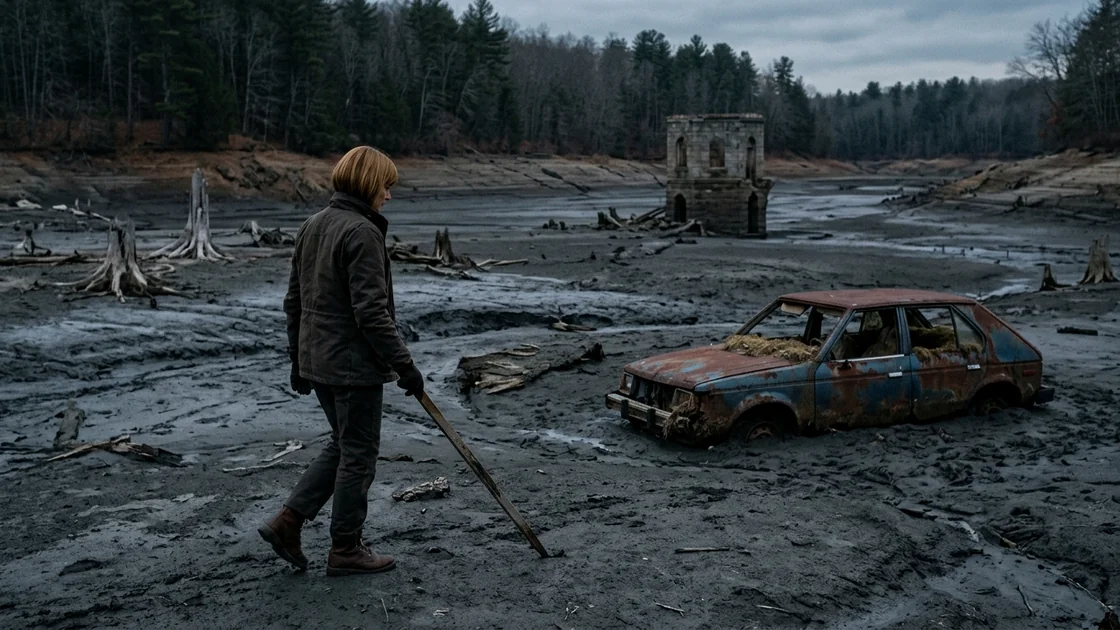
Where the vast, black sheet of water had once stretched to the eastern tree line, there was now only a vast, glistening desert of dark gray silt. The basin looked like a lunar landscape that had drowned and then been resurrected in rot. Ridges of black mud, crusted on top with a thin skin of frozen gray slime, sloped down toward the old river channel where a narrow ribbon of brown water still snaked through the flats.
Stumps of giant white pines, cut down in the 1920s before the valley was flooded, protruded from the mud like the amputated limbs of giants, their wood bleached white by decades of submersion. In the distance, the stone foundations of drowned farmhouses rose from the muck, square and mocking, their cellars filled with black water and tangled weeds that had never known sunlight.
The pump-house still stood on its spit of land, but the spit was no longer a peninsula; it was a high, dry bluff of cracked shale overlooking the mud plains.
And there was someone standing on the porch.
Helena’s hand went into her jacket pocket, her fingers closing around the cold cylinder of the small tactical flashlight she had brought. She did not retreat. She had spent her entire adult life managing contractors, politicians, and hostile clients; she did not believe in ghosts, and she certainly did not believe in her own guilt as an external force. Guilt was an inefficiency of the nervous system, nothing more.
She walked down the shale path, her boots crunching on the loose slate.
The figure on the porch did not turn around until Helena was within twenty paces.
It was not a ghost. It was Becca.
Becca Stone was forty-one, but she looked fifty-five. She wore a stained nylon ski parka with synthetic fur around the hood that was matted with grease. Her face was puffy, lined with the deep parentheses around the mouth that come from thirty years of Virginia Slims and retail shift work. Her blond hair was thin, showing the pale skin of her scalp at the part, and her fingers were bare, clutching a disposable coffee cup from the convenience store on the bypass.
"I knew you'd come," Becca said. Her voice was flat, devoid of surprise. "You always had to be the first one to see the plans."
Helena stopped five feet away, her eyes narrowing. "You sent the leaf."
Becca laughed—a dry, hacking cough that ended in a sniffle. "I don't have any leaves, Helena. I don't have anything that belonged to that girl. I spent twenty years trying to forget she ever existed, unlike you, who probably has the video archived on a hard drive somewhere."
"Then who sent it?"
"I don't know," Becca said, turning her back to look out over the mud plains. "Julian got one, too. Two days ago. A page from the back of the book. The one where she wrote down the dates she saw him at the library."
"Where is he?"
"Julian?" Becca took a sip of her coffee, her shoulders lifting in an ugly shrug. "Julian is at his father’s old house on Elm Street, drinking himself into a coma like he’s been doing since his second divorce. He won't come out here. He’s terrified."
"Terrified of what?" Helena’s voice was hard, clinical. "Arthur Finch is dead. Clara has been dead for twenty-four years. A dead girl doesn't buy stamps, Becca."
"Then who’s been walking around the cottage?"
Helena’s pulse gave a single, violent leap. "The cottage was demolished."
"The town tried to," Becca said, her voice dropping into a conspiratorial murmur. "The town took it for taxes back in ’03. A developer bought it to put up three split-levels, but the state wouldn't grant the septic permits because of the wetland buffer. It’s still there. The roof fell in on the south side, but the shop is there. And there’s smoke coming out of the stovepipe, Helena. I saw it yesterday when I drove past the access road."
"It’s a squatter," Helena said immediately. "Some homeless junkie from the mills."
"With Clara’s notebook?" Becca turned her head, her watery blue eyes locking onto Helena’s with a sudden, vicious clarity. "With her handwriting? You think some junkie found those pages in the mud after twenty years under thirty feet of water? Look at that silt, Helena! If you drop a wrench out there, it’s forty feet down in the muck within a week. Nothing survives down there except stones and iron."
Helena looked out over the vast, gray desert of the basin.
The wind had shifted slightly, coming around from the east, and it brought with it a sound that made both women freeze.
It was not a voice.
It was the dull, metallic tink-tink-tink of iron tools striking stone.
It was coming from the center of the basin, a quarter-mile out, where the old river channel made a sharp bend around the foundation of what had once been the Oakhaven municipal reservoir gatekeeper’s lodge.
Part Five: The Silt Walk
The mud was not completely frozen; the surface had formed a crust perhaps an inch thick, but beneath it lay sixty years of accumulated organic silt that had the consistency of grease.
Helena did not ask Becca to come with her. Becca was useless—she had been useless in 1999, and she was useless now, a creature of inertia who had stayed in Oakhaven because she lacked the velocity to escape its gravitational pull.
"You're not going out there," Becca said, grabbing Helena’s sleeve as she stepped off the shale bank onto the gray flats. "The contractors have signs everywhere, Helena. Quick-silt. If you break through the crust, you'll go down to your hips. You'll die out there."
Helena pulled her arm away with a sharp, violent motion that nearly knocked the smaller woman off her balance.
"Let go of me," Helena said.
Her face was white, her jaw set with such force that the tendons in her neck stood out like cords. She had spent two decades constructing a life of absolute mathematical certainty; she was not going to allow a ghost, a squatter, or a guilty conscience to dismantle it from the bottom of an empty pond.
She stepped down.
The crust yielded beneath her Vibram soles with a sound like wet cardboard tearing, sinking four inches before finding the firmer resistance of packed sand beneath the silt layer. Helena took a second step, then a third. She carried a length of discarded surveyor’s lathe she had picked up from the construction zone, using it to prod the surface before committing her weight.
The smell was overwhelming out on the flats. It was not just the smell of decay; it was the smell of suffocation. Millions of freshwater clams had died as the water receded, their white shells littering the gray mud like shattered teeth, rotting under the pale, cold sky. Small pockets of methane bubbled up through the black slurry in the channels, bursting with tiny, foul-smelling sighs.
Ahead of her, three hundred yards out, the gatekeeper’s lodge rose from the basin like a shipwreck.
It was constructed of heavy fieldstone, its mortar washed out by decades of current, its roof long since rotted away, leaving only four jagged walls that enclosed a square of black water.
Beside the north wall, half-submerged in the silt, lay something that did not belong to the 1920s.
It was a car.
It was a 1984 Plymouth Horizon, its blue paint rusted away to a mottled scab of red oxide, its roof crushed in by the weight of the water that had sat upon it for a quarter of a century. The windows were blown out, their frames filled with ribbons of dried river moss that hung down like filthy green hair.
Helena stopped twenty feet from the vehicle.
The license plate was still attached to the rear bracket, crusted in freshwater lime, but the numbers were legible through the rust: 412-EKJ.
It was Arthur Finch’s car.
The car that the state police had assumed he sold before his suicide; the car that had been missing from his gravel driveway since the spring of 2000.
Helena walked slowly toward the driver’s side door. The mud was deeper here, rising around her ankles with a sucking, rhythmic resistance that sounded like wet lips parting. She reached the doorframe and looked inside.
The interior was filled with silt to the level of the dashboard. But on the passenger seat, sitting on top of the gray dried mud like an offering placed on an altar, was a small, green plastic tackle box.
The latches were brass, green with verdigris, but they were unfastened.
Helena reached through the empty window frame. Her gloved fingers touched the cold plastic. She lifted the lid.
Inside were four objects:
A three-ring binder with a black canvas cover, completely dry.
A bundle of white cotton ribbon, neatly rolled and pinned with a brass needle.
A silver-plated ballpoint pen with the logo of the Vance Automotive Group stamped along its barrel.
And a small glass apothecary bottle, tightly corked, containing three dark, shriveled berries.
Helena did not touch the bottle. Her eyes were fixed on the binder.
She lifted it out of the tackle box. She opened the cover.
The first page was not an illustration of a weed. It was a photograph.
It was a photograph of Helena herself, taken from a great distance through a telephoto lens. She was standing in the sculpture garden of the Museum of Fine Arts in Boston, wearing her camel-hair coat, holding an espresso cup, laughing with an associate. It had been taken in October of this year.
The second page was another photograph: Becca Stone walking out of the laundromat behind the bowling alley in Oakhaven, carrying an orange plastic basket.
The third page was Julian Cross, sitting on the front porch of his decaying house on Elm Street, his face red and bloated, a half-empty bottle of bourbon between his feet.
The fourth page was a map.
It was a hand-drawn map of the town of Oakhaven, rendered in the same obsessive, microscopic pen-and-ink style as the weeds in the Governor’s Medal book. Every road was marked, every stream, every abandoned cellar hole.
And at the northern edge of the map, deep within the state forest where the trail died among the granite ledges, was a small red circle with three words written beside it in that tiny, relentless script:
The Glass Hive.
Part Six: The Architecture of Decay
The road to the Finch cottage was no longer a road; it was a logging trace that had been abandoned when the white pines were harvested during the Carter administration. Alder thickets whipped against the sides of Helena’s Audi as she forced the car through the ruts, the undercarriage scraping against protruding granite boulders with a metallic screech that sounded like teeth grinding.
She did not care about the car.
A strange, cold mania had taken hold of her mind. The control that had defined her existence for twenty-four years—the careful, architectural moderation of every impulse, every memory, every design—had collapsed inward, leaving behind only the raw, urgent necessity to reach the source of the infection.
She stopped the car where the trace ended in a swamp of dead tamaracks.
She got out, leaving the engine running and the headlights cutting two bright, yellow corridors through the gathering dusk. She carried the flashlight in her left hand and a heavy iron tire iron she had pulled from the spare-tire well in her right.
The Finch cottage stood fifty yards into the hemlocks.
It was worse than Becca had described. The south wall had given way completely, its rafters resting in a drift of rotting leaves like the ribs of a dead horse. But the workshop—the stone-built outbuilding where Arthur Finch had kept his honey extractors and his clockmaker’s lathes—was intact.
The heavy oak door was shut.
A faint, bluish thread of smoke was rising from the small iron chimney that protruded through the slate shingles.
The smell of burning apple wood and beeswax hung in the cold air, sharp and sweet, cutting through the damp rot of the swamp.
Helena walked up the stone path. The flagstones were covered in lichens—Xanthoria parietina, she remembered with an unwanted flash of botanical clarity, the common sunburst lichen, which grows only on stone that has been undisturbed for half a century.
She did not knock.
She raised the tire iron and brought the flat of it down against the iron latch of the door. The latch gave way with a dry, splintering crack, and the door swung inward into the gloom.
"Clara," Helena said.
Her voice was not loud, but it was flat, heavy with the weight of twenty-four years of silence.
The interior of the workshop was warm.
A small cast-iron woodstove in the corner was glowing dull red around its draft vent, the heat radiating outward in dry, fragrant waves that made the skin of Helena’s face feel tight. The walls were lined with shelves from floor to ceiling, every shelf crowded with glass Mason jars.
Thousands of them.
Inside the jars were not honey or fruit. They were plants.
Roots, stems, leaves, dried flowers, and shriveled berries, all submerged in clear mineral oil or alcohol, preserved like biological specimens in a Victorian museum. On each jar, a label was affixed with clear tape, written in that microscopic, beautiful cursive:
Cicuta maculata – Water Hemlock – Root. Conium maculatum – Poison Hemlock – Seeds. Kalmia latifolia – Mountain Laurel – Leaves. Datura stramonium – Jimsonweed – Flower.
At the center of the room sat a long workbench of rough-hewn pine, lit by three kerosene lanterns hanging from the ceiling beams.
Sitting on the high wooden stool behind the bench was a woman.
She was not seventy; she was forty-one, but her body had the stillness of an object that had spent decades under a bell jar. She was thin—thin to the point of transparency, her wrists emerging from the sleeves of an oversized, gray wool sweater like the dry birch twigs of winter. Her hair was completely gray, not the soft silver of wealthy women, but the dull, ash-gray of charcoal, pulled back into a severe knot at the nape of her neck.
She was working with a small pair of jeweler’s tweezers, placing tiny, dried seeds into the hollow compartment of a small brass clockwork balance.
She did not look up when Helena entered. She did not startle at the sound of the latch breaking.
"The wind comes off the lake earlier this year," the woman said.
Her voice had not changed. It was the same thin, flat sound that had spoken through the broken window of the pump-house on the night of the winter solstice.
Helena stood four paces from the bench, the tire iron hanging at her side.
"You didn't run away," Helena said.
Clara Finch set down the tweezers with an infinite, terrifying slowness. She picked up a small camel-hair brush, swept two stray seeds into a brass pan, and then turned her face toward the light of the lanterns.
Her face was not disfigured. It was simply erased.
The girl who had blushed when Julian Cross looked at her in study hall was gone; the girl who had cried over a pressed weed was gone. What sat on the stool was an organism that had been stripped down to its essential, toxic chemistry. Her eyes were gray, completely flat, without the wet shine that human eyes have when they are looking at someone they recognize.
"Where would I run, Helena?" Clara asked. "The world is very large, but it is made of the same materials everywhere. People with cameras. People with matches. Why should I trade one field of weeds for another?"
"You've been here," Helena said, her mind struggling to encompass the scale of the deceit. "In the valley. For twenty-four years."
"Not in the valley," Clara corrected her gently. "In the woods. My father had three tracts up on the ridge that were never recorded on the town map. Old beekeeper’s leases from the paper company. There is plenty of wood. There are plenty of seeds."
"And your father?"
"My father helped me," Clara said, her eyes turning toward the window that looked out into the hemlocks. "He understood about lines. When a watch breaks, you don't throw away the gears; you take it apart and clean them in naphtha. You remove the friction."
"He killed himself," Helena said, her voice rising, demanding that the woman acknowledge the horror of the reality. "He swallowed acid because he thought you were dead!"
Clara looked back at Helena, a faint, curious tilt to her head.
"My father died because he was seventy-two years old and his heart was tired of beating," she said simply. "He drank the acid because he didn't want the state people to touch his things. He knew where I was. He brought me flour every Sunday until the day he sat down in his chair and didn't get up."
"And the car?"
"The reservoir was full," Clara said. "A car is very difficult to hide on land. In thirty feet of water, nobody looks for an old Plymouth. It sat on the bottom by the gatehouse very quietly. Until they opened the valves."
Helena took a step forward, the tire iron lifting an inch from her hip.
"Why the letters?" Helena demanded, her teeth clenched until her jaw clicked. "Why now? Why did you send those pages to my office? What do you want, Clara? Money? An apology? Is that what this is? Some pathetic, delayed revenge because we made fun of you when you were seventeen?"
Clara looked down at the brass balance on the bench.
A small smile touched the corners of her mouth—not a smile of malice, but the faint, cold amusement of a botanist who has just observed a predictable chemical reaction in a test tube.
"I don't want your money, Helena," Clara said. "What would I buy with it? More oil for the jars?"
"Then what?"
"I wanted to see if the shape held," Clara said softly.
She stood up from the stool. She was taller than Helena remembered, though she was so thin that her clothes seemed to hang from her clavicles as if from a wooden hanger. She walked around the end of the workbench, her gray wool slippers making no sound on the packed dirt floor.
"When you take an insect and put it in a killing jar," Clara continued, her voice conversational, steady, "it doesn't die immediately. It fights the glass. It beats its wings until the dust comes off. It leaves small gray smears on the inside of the jar. And then, after a while, it becomes still. And you can take it out and pin it to a piece of cork, and it will stay in that shape forever. It never rots. It never grows old. It never becomes anything other than what it was when the fumes touched it."
She stopped two feet from Helena.
Helena did not retreat. She held her ground, her chin up, her knuckles white around the iron bar.
"I built an entire life," Helena said, her voice trembling with an anger she could no longer suppress. "I built buildings. I won awards. I created things that will stand for a hundred years. You lived in a shack with dead bugs and dirt!"
"You didn't build anything, Helena," Clara said, her voice dropping into a whisper that was colder than the drafts through the broken door. "You built a wall around that night. Every garden you designed, every straight hedge, every line of concrete—it was just you trying to keep the reservoir from leaking into your shoes."
Clara reached out her hand.
Her fingers were bare, long, and yellowed around the nails from walnut oil and sulfur. She did not touch Helena’s face; she reached out and touched the collar of Helena’s expensive canvas coat, her thumb smoothing the brass zipper with the delicate curiosity of a child examining a dead bird.
"You never left the pump-house," Clara whispered. "None of you did. Julian is still sitting on that bench waiting for someone to tell him he’s good. Becca is still standing by the lockers waiting for someone to tell her she’s not stupid. And you... you're still holding that little camera, Helena. Waiting for me to run so you can feel large."
Clara let her hand fall.
"I am not running anymore," she said.
Part Seven: The Ledger of Weeds
Helena did not strike her with the tire iron.
To strike Clara Finch would have been to grant her a physical reality that Helena’s mind refused to accept. Instead, Helena stood in the center of that aromatic, lantern-lit room, feeling the vast, intricate structure of her own identity—her firm, her awards, her clean, white apartment, her absolute control—vibrate and crack like unreinforced concrete under hydraulic pressure.
"The police will come," Helena said, though the words sounded thin, like leaves rustling in an empty pipe. "They’re dragging the mud tomorrow. They’ll find the car. They’ll find your father’s things."
"They have already found the car," Clara said. "A young man from the water board was there at three o'clock. He took photographs. He called the state police."
"Then you're done," Helena said. "You'll be arrested. For fraud. For the search costs. For your father’s estate."
Clara shook her head.
"They will not find me, Helena."
She turned back to the workbench. She took a small glass vial from a rack—a vial filled with a dark, oily liquid that smelled faintly of bitter almonds—and poured it into the brass pan of the balance.
"The state forest is forty thousand acres," Clara said. "It does not have cameras. It does not have streetlights. When the sun goes down, it belongs to the hemlocks. I have five other places, Helena. My father built them when the paper company went bankrupt. They are dry. They have stoves. They have books."
She looked back over her shoulder, her gray eyes locking onto Helena’s for the final time.
"I didn't bring you here to punish you," Clara said. "I brought you here so you would know that you didn't finish it. You burned the paper, Helena. But you didn't burn the root."
Clara picked up one of the kerosene lanterns.
With a motion that was so swift, so effortless, that Helena did not even have time to lift the iron bar, Clara swung the lantern against the side of the wooden shelving behind the bench.
The thin glass globe shattered with a musical clink.
The kerosene ignited instantly, a sheet of blue and yellow flame leaping up the dried pine boards, licking across the labels of the jars. The mineral oil inside the specimens caught three seconds later, the jars cracking one by one with sharp, rhythmic detonations like small-caliber gunfire, spewing burning oil across the floor, across the walls, across the dried bunches of nightshade and hemlock that hung from the ceiling rafters.
"Clara!" Helena shouted, the heat hitting her like a physical blow, driving her back toward the doorway.
Clara did not move.
She stood behind the pine bench, her gray sweater framed against the wall of yellow fire, her hands resting flat on the wood, her face illuminated with a terrifying, serene brilliance.
"Go home, Helena," she said. The sound of her voice carried through the roar of the flames, clear and stripped of fear. "Go back to your straight lines."
Helena stumbled backward through the door, tripping over the threshold, falling onto the frozen flagstones of the path.
The cold air hit her like a bucket of water.
She scrambled to her feet, the tire iron dropping into the weeds, and turned to look back at the workshop.
The windows were already sheets of orange light. The old slate roof was cracking, the heat throwing off ancient moss that sparked like gunpowder as it hit the night air. Through the open door, through the smoke and the churning black soot of burning oil, Helena saw only the silhouette of the workbench—and behind it, the empty stool.
Clara was not there.
There was a door in the back wall—a low, narrow opening that led directly into the hemlock swamp behind the cottage. It stood wide open, a rectangle of pure, pitch-black night against the orange fury of the burning room.
Helena did not go after her.
She stood in the snow, her chest heaving, the bitter smell of burning kerosene, dried weeds, and ancient paper filling her lungs until she choked.
She watched the workshop burn.
She watched the roof collapse inward with a shower of red sparks that rose toward the frozen stars like a swarm of fireflies, disappearing into the vast, indifferent canopy of the state forest. She stood there until the flames died down to a bed of glowing orange coals, until the hemlock boughs ceased their hissing, until the only sound left in the world was the thin, high whistle of the north wind through the telephone wires along the distant road.
Part Eight: The Geometry of Ash
The state police report, filed three weeks later by Detective Sergeant Miller of the Athol barracks, concluded that the fire at the abandoned Finch property was the result of an accidental ignition by a transient using the structure for illicit shelter during the reservoir drawdown operations.
No human remains were found in the ash.
The 1984 Plymouth Horizon dredged from the mud near the gatehouse yielded no forensic evidence of Clara Finch, though the state medical examiner officially closed the missing person file from 1999, declaring Clara deceased based on the circumstantial recovery of her father’s vehicle and the lapse of twenty-four years without a social security record, a credit inquiry, or an application for state benefits.
The case was over. The town of Oakhaven returned to its small, gray routines.
Julian Cross died in March of an esophageal hemorrhage brought on by acute alcohol toxicity; only four people attended his burial at the municipal cemetery, one of whom was Becca Stone, who stood by the grave in her matted ski parka, her bare fingers red from the wind, smoking until the backhoe began to fill the hole.
Helena Vance did not attend the funeral.
She did not return to Boston, either.
She resigned her partnership at the architectural firm on the first of February, sending a two-sentence letter by certified mail to her senior associates, stating simply that she was retiring from commercial practice to pursue private research. She sold the apartment overlooking the harbor; she sold the Audi; she sold the silver-framed photographs of Kyoto and the drafting tables of bleached oak.
She bought a small, one-story house of red cedar three miles north of the reservoir, where the state highway ends and the gravel logging roads begin to climb into the granite hills.
The house has no lawn.
Helena does not prune the sumac that grows against the foundation, nor does she rake the hemlock needles that cover the corrugated tin roof like a blanket of brown fur. She does not draw lines.
In the back of the house, in a small shed that was once used for drying firewood, she has installed three long workbenches of unplaned pine. The walls are lined with shelves, and on the shelves are hundreds of glass jars, filled with clear alcohol, containing the roots, stems, and leaves of the plants that grow along the margins of the dried reservoir basin:
Cicuta maculata. Datura stramonium. Atropa belladonna.
Every morning, when the winter light is still gray and thin like dirty water, Helena puts on her heavy leather boots and walks up into the hemlocks.
She does not carry a camera. She does not carry a notebook.
She walks along the boundary fence where the barbed wire has long since rusted through, its strands hanging down into the leaf litter like dead vines. She walks until the trail dies among the ledges, until there are no tire ruts, no surveyor’s ribbons, no sounds of engines from the valley below.
She stops at the base of the high granite outcroppings where the wind does not reach.
She looks for the tracks.
Sometimes she finds them: the narrow, shallow impressions of canvas shoes pressed into the crust of the snow, leading north toward the high ridges where the hives used to sit, before they turn sharply into the laurel thickets and vanish into the white, unbroken silence of the trees.
And when she finds them, Helena does not turn back.
She sits on a boulder of gray stone, pulls her coat tightly around her shoulders, and listens to the cold, still water moving beneath the ice, waiting for the shape to hold.