The Weight of Severed Cordage
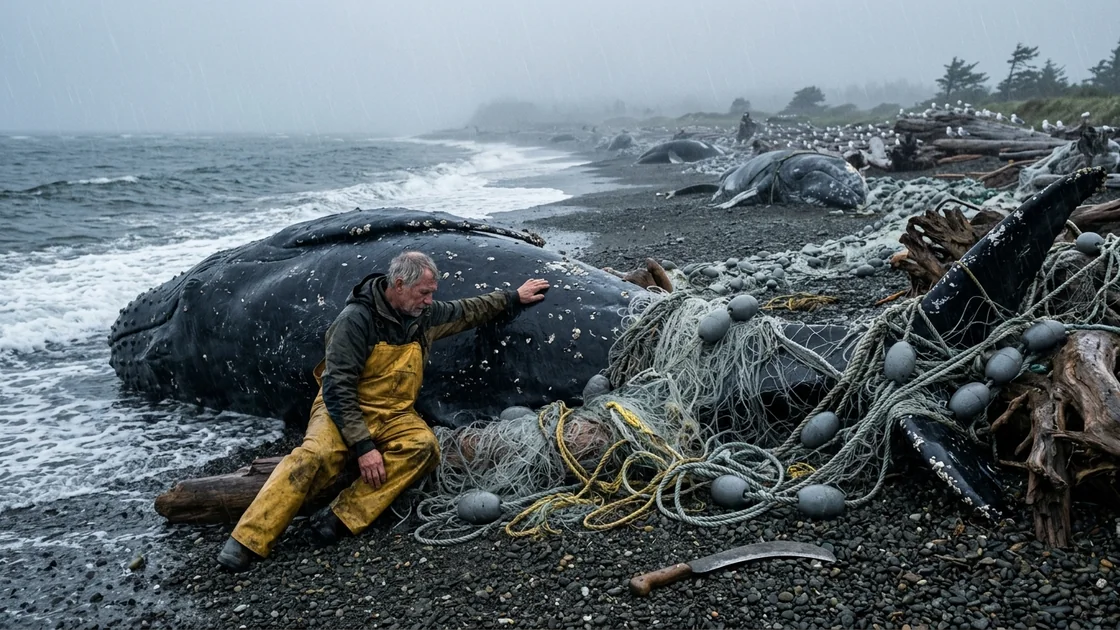
Captain Donald Vance of the commercial trawler Marrowstone severed an illegal mile-long monofilament drift net in the gale-swept waters of the Dixon Entrance to evade a surprise Coast Guard inspection that would have stripped him of his vessel, his livelihood, and his freedom. Leaving the ghost net to drift silently through the pelagic migration lanes, Vance returned to port believing he had outmaneuvered the authorities and saved his family from financial ruin. Yet within a week, shifting Pacific swells and unusual storm tracks dragged the unweighted nylon wall toward the desolate gravel spits of Haida Gwaii, where Vance, driven by paranoia and rumors carried over VHF radio, tracked the debris only to find forty-three migrating gray and humpback whales suffocated, drowned, and rotting in the very mesh he had cast loose into the deep.
I. The Razor on the Drum
The cutter had come out of the squall like an ungreased iron door sliding shut against the horizon.
Donald Vance had been leaning over the salt-scaled coaming of the wheelhouse, nursing a mug of chicory-heavy coffee that had gone lukewarm forty minutes prior, when the radar return bloomed hard and green off the port quarter. It was not the soft, pulsing smear of a shearwater flock or the stuttering blink of a sea-lion haulout. It was steel, five hundred feet of it, pushing twenty-two knots through a six-foot chop with its transponder masked until it cleared the southern hook of Zayas Island.
"Donald," Jesse had said. The boy’s voice had cracked, the thin pitch of an eighteen-year-old whose sea legs were still wet behind the knees. "Donald, that’s not the tender."
Vance hadn’t answered. He had known what it was before his eyes found the low, raked superstructure slicing through the gray-bellied mist. It was the Active, an offshore patrol cutter out of Ketchikan. Her hull was the color of a wet slate shingle, and she carried a boarding party of federal officers whose only purpose in these borderline waters was to measure mesh size, count metric tons, and smell the stink of desperation on men who had fished past their allowances.
Behind the Marrowstone, trailing out into the gray, foam-laced swell like the spine of some primeval reptile, lay five thousand feet of monofilament webbing.
It was a drift net—Korean-made, triple-knotted, four fathoms deep, with a leaded bottom line that hung like a razor beneath the surface. It was forbidden by international treaty, outlawed by federal statute, and punishable by a hundred-thousand-dollar fine, vessel forfeiture, and three years in the federal penitentiary at Sheridan. It was also the only reason the Marrowstone was not currently tied to a repo dock in Prince Rupert with a foreclosure lien taped to her galley window.
"Deck!" Vance had barked into the hailer, his voice dry as wood shavings. "Mac. Arnie. Drop the dog on the hydraulic. Now."
McCreary, Vance’s engineer for twelve seasons, had looked up from the sorting tray on the aft deck, his hands grease-slicked and red from the brine. He had looked at the approaching gray wedge of the cutter, then up at the wheelhouse glass, his small, piggish eyes widening beneath the brim of a sodden wool watch cap.
"Donald, we’re forty baskets in," Mac shouted back over the rumble of the six-cylinder Detroit diesel. "We got twenty tons of sockeye hanging in that web! We can’t wind her in ten minutes!"
"I didn't say wind it!" Vance had screamed, stepping out onto the bridge wing, the rain hitting his raw cheeks like buckshot. "Get the torch! Get the damn torch or get the axe!"
The crew had frozen for a fraction of a second—a heartbeat in which the whole balance of Vance’s life, from his house on the bluffs of Port Townsend to the engine overhaul he still owed eighty thousand dollars on, hung in the cold, wet air. Then Mac moved. He didn't reach for the oxyacetylene rig; there was no time to crack the bottles and strike a spark in that wind. Instead, he lunged for the fire axe mounted on the bulkhead by the freezer hatch.
The Marrowstone was wallowing, her stern dragged low by the immense resistance of the net. The gear acted as a sea anchor, holding her head to the swell while the Active closed the distance to two nautical miles. Through the glass, Vance could already see the white water curling off the cutter's bulbous bow.
"Cut the tow-bridle!" Vance roared. "Sever the floats! Clear the drum!"
Mac swung. The steel blade bit into the four-inch braided polypropylene tow-line with a dull, wet thud. Strands parted with the sound of snapping guitar strings, whipping through the rain-soaked air. Jesse stood pressed against the cabin side, his hands clawed into his oilskins, his face the color of skimmed milk.
"Donald, please," the boy whispered, though no one heard him over the engine’s laboring whine.
Mac swung again. The line exploded off the bitt. The sudden release of tension surged through the trawler; her stern rose six inches out of the trough with a sickening, buoyant lurch that sent fish totes skittering across the checker-boards.
The net was gone.
It did not sink. It was buoyed by three thousand corks the size of loaves of bread, painted a non-reflective dull lead-gray to avoid the eyes of fisheries patrol aircraft. As the Marrowstone kicked her screw into gear, black smoke boiling from her dry-stack, the trailing end of the gear slipped beneath the gray troughs. It was a mile of translucent, invisible death, uncoupled from any ship, unanchored, perfectly neutrally buoyant at twenty feet below the surface, drifting north-northwest on the great circular tongue of the Dixon current.
Ten minutes later, the Active had pulled alongside, her bullhorn blaring across the water, demanding Vance throttle down and prepare to receive a boarding team.
Vance had stood at the wheel, his fingers steady on the bronze spokes, smelling of burnt diesel and his own stale sweat. When the three Coast Guard officers climbed the ladder—their sidearms strapped tight over orange drysuits, their clipboards wrapped in clear vinyl—they found only a dirty boat, an empty reel smelling of bilge water, and three men scrubbing slime off an empty deck.
They had searched for two hours. They had sounded the fuel tanks, pulled the bilges, checked the refrigeration logs, and tapped the bulkheads for hidden compartments. They found three undersized lingcod in the offal chute and issued a two-hundred-and-fifty-dollar citation.
"You’re running light, Captain," the boarding lieutenant had said, squinting through the salt-hazed wheelhouse windows at the empty sea. "A boat this size doesn't burn twelve hundred gallons of fuel to drag nothing between here and Dundas."
"Fished out," Vance had said, his voice flat, his pulse drumming behind his temples like a trip-hammer. "Water’s dead. We lost our trawl on a pinnacle off the west bar yesterday morning. Hooked bottom, snapped the bridle, lost the bag. I’m heading home to tell the bank they own a hull."
The lieutenant had looked at him for a long, quiet moment. He was young, his skin uncreased by thirty years of salt and diesel smoke, his eyes carrying that cold, bureaucratic suspicion that Vance despised more than bad weather or declining quotas.
"Be careful on the crossing, Captain Vance," the officer had said, turning toward the pilot ladder. "There’s an awful lot of loose trash floating in this channel. Wouldn't want you to foul your wheel on something you can't see."
When the cutter’s launch cleared the side and the gray ship turned south toward Langara Island, Mac had spat into the scuppers and leaned his heavy forehead against the cold steel of the drum.
"That was sixteen thousand dollars of nylon, Donald," Mac said, his voice shaking. "And forty tons of high-seas red salmon that don't belong to nobody now."
"Shut up, Mac," Vance had said, his teeth clicking together as he engaged the gear and pointed the Marrowstone’s bow toward the safety of the inside waters. "It belongs to the bottom now. It’s gone. It don't exist."
II. The Slack Water
For five days, Vance lived in the grease-filmed pocket of an unnatural calm.
They had unloaded their meager, legal legal catch—a few tubs of line-caught rockfish and iced skate wings—at the cooperative dock in Port Edward. The price was garbage. After the fuel dock took seven hundred dollars and the ice house took three, Vance had ninety-two dollars in paper bills and a crew that wouldn't look him in the eye.
Mac had gone straight to the Troller’s Rest, a windowless cinderblock dive behind the cold storage plant where the air smelled of stale draft beer and fried halibut collars. Jesse had taken his duffel bag, walked up the wooden ramp to the highway, and stuck his thumb out toward the south. He hadn't asked for his lay. He hadn't said goodbye.
Vance stayed aboard the Marrowstone.
The boat was too quiet. Without the net on the drum, the aft deck looked like an empty flatbed truck, vast and purposeless. The hydraulic hoses hung from the gantry like dead vines, their quick-disconnect couplings weeping thin, rainbow-colored drops of hydraulic fluid onto the fir deck planks whenever the boat rolled in the ferry wash.
Every time Vance closed his eyes in the narrow bunk beneath the foredeck, he did not see the Active. He saw the net.
He knew what monofilament did when it was cut loose. It did not die. It was an invention born of laboratories, extruded from petroleum, designed by chemical engineers to survive ten thousand years of sunlight, salt, and pressure. A natural hemp or cotton net would rot; the sea would soften it, barnacles would weigh it down, bacteria would chew the knots until the web dissolved into harmless silt.
Nylon did not rot.
Without the weight of the boat to tow it, the leadline would seek a balance with the surface floats. It would gather itself into folds, open again with the swells, and move like a curtain through the pelagic zones. It would catch the first things that swam into it—dogfish, pink salmon, diving murres. The weight of those carcasses would drag the floats down slightly, until the dogfish rotted and dropped away, and then the floats would pop back to the surface, clean and hungry again, ready for the next tide.
Fishermen called it ghost fishing. Vance had seen ghost nets before—tangled balls the size of houses that had drifted across from the Russian drift-net fleets or the Japanese squidters, scouring the open ocean for thirty years, rolling up everything with a pulse until they finally cast themselves upon the rocks of the Aleutians like mountains of tangled plastic wire.
"It went down," he muttered to himself at three in the morning, staring at the raw pine tongue-and-groove above his bunk. "The leads were too heavy. It dropped into the canyon off Dundas. It’s four hundred fathoms down. Nothing down there but mud and crabs."
He repeated the words like a litany, an incantation against the persistent, rhythmic thump-thump of the harbor swell against his planks.
On the sixth morning, Vance walked up the ramp to the harbor master’s shack to pay his moorage. The office was small, heated by a kerosene stove that smelled like an old lamp, its walls lined with yellowed navigational charts and hand-printed notices of fuel spills and missing dinghies.
Garth, the deputy wharfinger, was sitting behind the counter with a mug of black tea, listening to the coastal traffic on channel 16.
"Morning, Donald," Garth said, sliding a receipt across the counter without looking up. "You hear about the spit?"
Vance felt his intestines tighten, an involuntary, physical recoil that he masked by reaching slowly into his flannel shirt for his checkbook. "What spit?"
"Rose Spit. Out on the northeast corner of Graham," Garth said, tapping the radio speaker with a blunt pencil. "Charter guy out of Masset called it in two hours ago. Said he thought he was looking at an island that wasn't on the plotter. Said the beach was white with gulls from the lighthouse clear down to the tree line."
"Log spill?" Vance asked. His voice sounded thin, reedy, like someone else’s voice played back on a worn tape machine.
"Whales," Garth said, and for the first time he looked up, his pale, water-ringed eyes fixing on Vance with the idle curiosity of a small-town gossip. "Humpbacks. Grays. A whole school of them, he thinks. Stowed up on the gravel. He said the stench was coming off the sand two miles out to sea, and the wind’s blowing straight from the west."
"Whales strand all the time," Vance said, his hand trembling as he wrote the date. "Currents do it. Military sonar scrambles their brains. Happens every spring down in California."
"Yeah," Garth said, taking the check. "They strand. But they don't usually bring two miles of commercial cork-line with them, do they? Guy said it looked like somebody knit them a sweater out of three-hundred-pound test."
Vance did not take his receipt. He turned, his boot heels loud and clumsy on the plywood floor, and walked back out into the mist.
III. The Crossing
He did not take the Marrowstone.
To take the trawler across Hecate Strait would be an admission, an arrow drawn in red diesel smoke pointing straight from Port Edward to the scene of the wreck. Instead, Vance went to the gravel lot behind the rail yard where he kept his 1994 Ford F-250—an oxidized, rust-pocked beast with two spare tires strapped in the bed and a front bumper made of welded structural channel.
He caught the midday ferry from Prince Rupert to Skidegate.
The crossing took seven hours through an oily, yellow-gray sea that seemed too thick to break into whitecaps. Vance stayed in the truck on the car deck, the windows rolled up against the salt mist, the engine off. He could hear the hum of the ship’s auxiliary engines through the truck’s tires, a low-frequency vibration that set his teeth on edge.
He had his knife in his pocket—a heavy, curved green-river skinner with a handle made of oil-blackened beechwood, the blade honed down to a crescent by forty years of sharpening stones. In the glove box lay a pair of heavy wire cutters and a fresh roll of surveyor’s ribbon. Why he had brought the ribbon he did not know. Perhaps he had some wild, childish notion of marking the gear, of proving it wasn't his, of finding some phantom manufacturer’s mark that would point to a Taiwanese pirate or an Oregon tuna boat.
It had yellow poly-twine tracers every sixty feet, he remembered with an agonizing, sharp clarity.
He had woven them in himself during the winter of ninety-six, sitting in his shop in Port Townsend with a kerosene heater roaring at his back and a wooden needle in his split, freezing fingers. He had used twelve-ply yellow braided nylon from the Seattle Marine Supply house to mark the twenty-fathom panels so the boys could set the gear at night without looking at the depth counter. There wasn't another net on the coast with that specific leaded tracer. If anyone looked—if any fisheries officer with an ounce of sense picked up a single fathom of that cork-line—they would find Vance’s signature as clearly as if he had carved his social security number into the lead weights.
The ferry bumped against the pilings at Skidegate after dusk.
The Queen Charlotte Islands—Haida Gwaii—were dark, hunched shapes beneath a sky that held no stars. Rain fell in steady, cold sheets, the kind of northern rain that did not stop for three weeks at a stretch, soaking down through the muskeg, drowning the hemlock roots, turning every ditch into a brown, frothing creek.
Vance drove north.
Highway 16 was a ribbon of blacktop laid over gravel and corduroy logs, running straight up the eastern shore of Graham Island through Tlell and Port Clements, toward Masset. He drove fast, his high beams catching the pale, shining eyes of Sitka deer standing frozen on the shoulder. His wipers slapped a rhythmic, agonizing tempo against the pitted windshield: did-it, did-it, did-it.
In Masset, the streetlights were halogen halos in the driving downpour. The town was shuttered, dark, smelling of damp cedar and woodsmoke. He did not stop for gas. He followed the road past the old naval station, out onto the narrow spit track that led toward Tow Hill and the long, desolate gravel reaches of Rose Spit, where the shallow floor of Hecate Strait collided with the deep ocean rollers coming out of the open Gulf of Alaska.
The road ended at the North Beach parking turnaround, where the spruce trees were stunted by the salt wind, their branches bent double like old men crouching against a blast. Beyond that lay only fifteen miles of open, hard-packed tidal gravel, navigable only at dead low water by four-wheel drives with their tire pressure dropped to twelve pounds.
Vance stepped out of the truck.
The wind hit him like a physical blow, cold and heavy with the smell of the Pacific. But underneath the smell of kelp and cold water, there was something else.
It was faint at first—just a sweet, greasy thickness on the back of his tongue, like the air near a rendering plant when the wind shifts across the river. It was the smell of dead tallow, of liver oil oxidized by the air, of hundreds of tons of warm-blooded meat slowly souring in the rain.
Vance reached behind the seat, grabbed his yellow oilskin bibs, pulled them on over his jeans, and latched the heavy brass buckles. He took his flashlight, a heavy, four-cell steel torch, and began to walk north into the dark.
IV. The Gray Wall
The tide was falling, leaving a wide, mirror-slick apron of gray gravel that hissed every time the low swells receded.
Vance walked by the beam of his light, his head down against the wind. The beam picked up the flotsam of the storm: bull kelp whips as thick as his wrist, cracked crab carapaces, plastic bleach bottles with Japanese characters stamped into their bases, and miles of sea-foam that gathered in trembling, waist-high drifts against the log-jams.
Then his boot struck something that did not give.
He stumbled, dropping to one knee in the wet gravel. He reached down, expecting the slippery surface of a spruce drift-log, but his bare hand closed around something cold, corded, and greasy.
It was a float.
A lead-gray, oval plastic cork, six inches long, scarred by the teeth of the drum. Connected to it, running off into the dark in both directions, was a line of braided polypropylene.
Vance did not move. He knelt there with the surf hissing around his shins, the water soaking through his trousers, his flashlight beam focused on the knot.
It was a double-sheet bend, hitched with an extra half-turn to keep the slick plastic from creeping under load. It was tied with twelve-ply yellow braided nylon. His own knot. He could see the specific, clumsy way he tucked the bitter end—a habit he had picked up from his father sixty years ago on the cod banks off Cape Scott.
"God," he whispered. "Oh, God."
He followed the line with his light.
The cork-line did not run straight. It was snarled, twisted into ropes as thick as a man’s torso, tangled back upon itself a hundred times over. It looked like a gigantic ball of yarn that had been mauled by an animal, then stretched out along the high-tide line for as far as his beam could reach.
And then the light caught the skin.
It was not the gray-green of the sea or the silver of dead salmon. It was slate-black, mottled with white, barnacle-encrusted patches that looked like splashes of dry plaster.
It was a humpback. A juvenile, perhaps thirty feet long, lying high on its side on the gravel bar.
The net had wrapped its head three times, pinning its pectoral fins tight against its flanks like a child strapped into an apron. The monofilament had cut into the soft, white-grooved blubber of its throat, biting four inches deep into the flesh. The tension of the swell had pulled the cordage so tight that the whale’s baleen plates had cracked, splintering into long, black shards that protruded from its half-open mouth like broken ribs.
Its eye was open. It was the size of a teacup, clouded over with a milky, blue-gray cataract of death, staring at the gravel five inches from its nose.
Vance stood over it, his chest heaving, his mouth open to the salt wind. "Just one," he muttered, his voice breaking into a dry, coughing sob. "It was just one that got fouled and dragged the gear in."
He swung the light down the beach.
The beam cut through the blowing rain, picking out another mound fifty feet beyond the first. And another beyond that. And three more together, piled upon one another in the wash where the rip-currents had rolled them into a single, suffocating knot of blubber and cordage.
They were not just humpbacks.
Twenty yards further, Vance found a gray whale—a massive, forty-foot cow, her skin scarred by killer-whale teeth from some long-forgotten battle in her youth. She was wrapped from her tail flukes to her blowhole. The net had entered her mouth, caught on her baleen, and as she had rolled to free herself, she had wound five hundred yards of the monofilament around her body, turning the gear into a vice that had crushed her pectoral flippers until the bones had dislocated with the sound of snapping oars.
Beneath her, pinned by her immense, dead weight, lay a calf.
It was no more than fifteen feet long, its skin still smooth, rubbery, and dark, without a single barnacle on its flanks. The monofilament had cut it across the blowhole, a clean, straight slit that looked like it had been made by a surgeon’s scalpel. It had drowned there, in six feet of water, while its mother rolled in the self-tightening web above it.
Vance walked.
He walked through the graveyard of his own making, his flashlight beam shaking so violently that the circles of light danced like mad ghosts across the carcasses. He counted them aloud, his voice rising against the roar of the surf until he was screaming the numbers into the empty rain.
"Seven. Eight. Nine... twelve... God Almighty, fifteen..."
They were everywhere. The spit was a low, narrowing finger of sand that caught every scrap of drift that entered Hecate Strait from the open ocean. The net had acted as a wall, a drift fence five thousand feet long, sweeping through the channel on the spring tides, intercepting the northward migration as the pods moved out of the sheltered waters of the inside passage to head for the feeding grounds in the Bering Sea.
The whales had hit it in the dark.
One had fouled; its distress calls had brought the others. The mothers had come for the calves; the bulls had come to investigate the thrashing; and the net, buoyant and endless, had wrapped them all in its sticky, invisible fingers. The more they fought, the tighter the knots had set. The monofilament had not broken. It was thirty-pound test in each strand, but gathered together in a hundred-ply rope, it had the tensile strength of bridge cables.
They had died of exhaustion. They had died of suffocation, held six feet below the surface by the weight of their entangled sisters, unable to lift their blowholes to the air. They had drowned in the open ocean, and the storm had brought the whole floating, rotting shambles to rest on the northernmost gravel of the world.
"Thirty-one," Vance screamed, his voice cracking into silence. "Thirty-two."
The air was so thick with the stench of ammonia and decaying fat that his eyes burned. Gulls, thousands of them, sat in silent, gray-and-white rows on the drift logs along the upper beach, their bellies so gorged on whale eyes and tongue fat that they could not fly; they merely hopped out of the path of his light, their beaks smeared with black grease.
V. The Knife and the Calf
At the end of the spit, where the gravel died away into a wild, frothing confusion of opposing rip-tides, Vance found the heart of the net.
The drum line had collected here, snarled around a five-ton spruce root that had grounded on the bar. The cork-line was wrapped around the wood fifty times, forming a core of plastic and rope as dense as concrete.
Inside this tangle, half-submerged in the white foam of the incoming tide, lay another humpback.
It was smaller than the others—a yearling, perhaps twenty-four feet long. Its head was wedged between two cedar roots, its body trailing out into the surf. The net was wrapped around its tail flukes so tightly that the nylon had disappeared into the swollen, purple flesh, leaving only a line of gray corks protruding from the skin like beads on a string.
As Vance approached, the flashlight beam caught a movement.
A skin tremor. A long, shuddering ripple that moved down the blubber from the shoulder to the flank.
The blowhole opened.
It did not produce a tall, majestic plume of vapor. It produced a weak, wet wheeze—a rattle like a dying man’s breath through a throat full of fluid. A bubble of bloody foam expanded from the twin nostrils, wobbled in the wind, and popped against the wet sand.
It was alive.
Vance dropped his flashlight. He fell to his knees in the surf, the icy water washing over his thighs, filling his boots, chilling him to the bone.
"Hey," he said, his hands reaching out to touch the gray skin. "Hey. Hold on."
The skin was cold, but beneath the blubber, he could feel the massive, slow thud of the heart—a beat every eight seconds, a heavy, hydraulic pump struggling against the crushing weight of the animal’s own body on the dry gravel. Without the buoyancy of the water, its ribcage was collapsing under its forty tons of weight, slowly suffocating its lungs from within.
Vance pulled the green-river knife from his sheath.
He grabbed the nearest strand of monofilament—a knot that had dug deep into the blowhole rim—and sawed at it. The blade was sharp, but the monofilament was packed with wet sand and grease; it dulled the steel instantly. The nylon parted with a small, pinging snap, but three more strands lay beneath it, pressed so deep into the cut flesh that the blubber had closed over them like lips.
"Come on," Vance sobbed, sawing at the cords. "Come on, you bastard, cut."
He worked like a maniac. He forgot the Active. He forgot his debt to the bank, the Marrowstone, his house, his name. There was nothing in the world except the circle of his light, the wet, rubbery texture of the whale’s head, and the endless, indestructible plastic wire that bound it.
He cut forty strands. He cut until his knuckles were raw and bleeding from scraping against the sand-encrusted skin. He cut until the palm of his hand was cramped into a claw that could barely hold the beechwood handle.
The net did not yield.
For every strand he severed, twenty more were buried beneath the animal’s massive torso, pinned between the blubber and the five-hundred-pound spruce roots. To free the whale, he would have had to move the earth itself; he would have needed an excavator, three tugboats, and an army of men with torches.
The yearling’s eye shifted.
The eyelid, thick and rubbery, rolled back. The small, dark iris, deep brown as a tidal pool, looked down at Vance. There was no rage in it. There was no fear. There was only a terrible, vast indifference—the look of an animal that belonged to a world that was three hundred million years older than men, nets, and diesel engines, looking at the creature that had ended it.
The blowhole clicked. It sucked in a lungful of wet, salt-laden air, rattled again, and did not open a second time.
The heart-beat beneath Vance’s hand slowed.
One.
A long, gray silence in which the surf hissed over his boots.
Two.
A tremor that ran through the flukes, three hundred yards of muscle stiffening all at once, then relaxing into the soft, motionless surrender of dead meat.
The eye did not close.
Vance dropped the knife into the surf. He did not look for it. He sat down on the wet gravel, the foam washing around his hips, his head resting against the barnacled flank of the dead yearling.
VI. The Color of the Tracer
The morning did not bring light; it brought only a thinning of the darkness from black to the color of wet lead.
Vance was still there when the helicopter came.
It was an orange-and-white Jayhawk from the Coast Guard Air Station at Sitka, its twin turbines screaming as it banked low over the spit, the rotor wash flattening the sea-foam into wide, spinning discs across the sand.
Vance did not look up. He sat with his back against the dead humpback, his hands resting in his lap, his oilskins plastered to his body with dried whale blood and gray beach slime.
He could see them through the rain: two men in high-visibility suits walking up the beach from where an all-terrain vehicle had stalled half a mile back in the dunes. They were walking slowly, their heads turning from side to side, stopping at every mound, their notebooks held inside their jackets to keep the paper from dissolving in the gale.
One of them was the young lieutenant from the Active.
He walked with his shoulders hunched, his face pale beneath his ballcap, his lips pressed together into a thin, white line. When he reached the yearling, he saw Vance.
The lieutenant stopped ten feet away. He looked at the knife lying in the gravel, its beechwood handle half-buried in yellow sea-foam. He looked at the dead calf, at the mile of tangled corks stretching back toward the south, and then at the yellow braided twine that Vance had woven into the web with his own fingers three winters ago.
The lieutenant knelt. He picked up a fathom of the cork-line. He smoothed the twelve-ply yellow tracer between his thumb and forefinger, feeling the double-sheet bend, the extra half-turn, the peculiar, personal signature of a man who had been taught to mend gear by a dead hand in a forgotten century.
He looked up at Vance.
"Captain," the lieutenant said. The wind took the word and tore it into threads, but Vance heard it.
Vance did not move. He looked down at his own hands, at the dried, black blood beneath his fingernails, at the salt sores that had opened on his wrists where the neoprene cuffs had chafed him raw.
"It was forty baskets," Vance said, his voice barely louder than the gravel rattling in the undertow. "Forty baskets of red salmon. They were running three dollars a pound at the dock."
The lieutenant did not write anything down. He let the yellow tracer drop back into the surf. The leadline dragged it down into the sand, but the plastic cork popped back up, bobbing bright and clean on the gray water, refusing to sink, refusing to die, waiting for the turn of the tide.