The Weight of Falling Glass
Arthur Vance was an acclaimed auteur whose relentless pursuit of cinematic realism led him to demand an unrigged three-story leap from his veteran stunt double during the rain-soaked climax of an independent thriller. Despite vocal objections from the safety coordinator and the athlete's own misgivings, Vance used coercive industry leverage to strip away the safety cables for a seamless wide shot, causing a catastrophic landing that severed the performer's spine and dismantled the lives of everyone on set. In the grueling years that followed, through hospital rooms, legal depositions, and the quiet horror of a locked editing bay, both men were forced to confront the irrecoverable cost of an image made at the expense of human flesh.
The rain over the Port of San Pedro did not fall so much as it drifted in grease-colored curtains, pushed sideways by a salt gale blowing off the Pacific. It was three in the morning on the forty-first night of an eight-week shoot. Below the rusted skeletal ramps of the abandoned bulk sugar terminal, three hundred thousand dollars of lighting gear hummed through thick bundles of banded cable, their yellow sleeves submerged in puddles of brackish runoff.
Arthur Vance stood behind the A-camera monitor under a heavy canvas pop-up tent, his wool coat reeking of stale tobacco and damp down. He was forty-six years old, possessed of the hollow, combative stare of a man who believed every production was a war between pure art and corporate cowardice. His previous feature had won the Silver Bear in Berlin; his current one, titled The Long Descent, was sixty percent over budget and bleeding completion-bond goodwill with every passing hour of dawn.
"We lose the truss, we lose the horizon," Arthur said, not looking at his stunt coordinator. His voice was quiet, raspy, pitched with that specific low-frequency venom that made junior crew members clear a four-yard radius around him. "If the crane arm is caught painting out the safety line, the audience knows the man isn't falling. The illusion dies. If the illusion dies, the movie is just another piece of digital garbage on a server."
Ray Calder, who had worked twenty-eight years in the Screen Actors Guild and had two titanium pins in his left elbow from a car rollover on a freeway in 1994, stood with his arms crossed over a high-visibility slicker. "The descender rig isn't an illusion, Arthur. It’s what keeps Leo from hitting that concrete apron at thirty-two feet per second. We talked about this at the production meeting on Tuesday. We paint the wire out in post. It’s five grand a shot. The studio approved the line item."
"The studio approved a movie with a spine, Ray. Look at the lens." Arthur grabbed Ray by the shoulder of his slicker—a gesture that hovered right on the perimeter between intimacy and threat—and hauled him toward the high-definition monitor. "Look at Cooke anamorphic glass at fifty millimeters. Wide open. The rain catches the carbon flare from the arc lamps. You put a six-millimeter braided Kevlar line through that bokeh, and no scrub program in Burbank can clean it without leaving a smear like Vaseline on a windshield. It looks fake. It feels fake."
"It keeps him alive," Ray said flatly.
"He’s done twenty-two high falls into a box-and-bag stack since he was nineteen. He’s Leo Briggs." Arthur turned, searching the perimeter of the staging area until his eyes found the tall, lean figure standing near the open door of the stunt van. "Leo! Come under the dry!"
Leo Briggs walked slowly, conserving the elastic energy in his calves and thighs. He was thirty-eight, with the crooked nose of someone who had broken it on a steering wheel in his twenties and the slow, deliberate carriage of an aging middleweight. Underneath the soaked charcoal-gray suit that matched the lead actor’s wardrobe, his ribs were taped tight with adhesive strapping to protect an intercostal strain he had taken three days prior during a fight choreography pass in an alleyway.
He ducked his head to step under the canopy, the water streaming from the brim of his hair. "What are we looking at, Arthur?"
"Ray thinks you can’t make the gap without a wire," Arthur said, smiling with his mouth closed, his eyes sharp and steady on Leo’s face. "He thinks the wind is too high. I told him you’ve made this leap thirty times off the high dive at Venice Beach before you were old enough to shave."
Leo looked at the monitor, then out through the plastic window of the tent toward the sugar terminal’s upper loading gantry. The gantry was an open-sided steel catwalk thirty-six feet above a sunken asphalt apron where heavy tractor-trailers once backed in to receive raw molasses. The stunt called for his character—fleeing down the rusted catwalk—to vault over a fractured handrail, drop eighteen feet through the rotten corrugated roof of a secondary pump shack, and land across an angled stack of industrial cardboard boxes and decelerator pads concealed within the dark interior of the shack.
Originally, the stunt had been designed with an overhead high-speed descender rig: an electric winch mounted on a motorized trolley that would follow him across the beam, arrest sixty percent of his terminal velocity in the last six feet, and prevent any catastrophic swing into the structural I-beams that framed the pump house.
"The wind is gusting twenty knots off the channel, Arthur," Leo said. His voice was level, almost clinical. He wasn't afraid of the height; he was afraid of the variable mathematics. "The roof opening on that shack is eight feet wide. If I jump clean and the wind catches my jacket, or if I don't get the purchase on that slicked-down angle iron, I don't hit the center of the pit. I clip the gutter."
"We put forty bags of shot against the windward rail," Arthur said, stepping close to Leo, close enough that Leo could smell the black coffee and menthol cigarette smoke off the director’s skin. "We have two blowers counter-acting the eddy off the south wall. Leo, listen to me. This is the whole picture. The lead doesn't have a parachute. He doesn't have a wire. He’s a broken man running for his life through the dark, and he commits himself to the void because the men behind him are going to put a bullet in his skull. If the camera stays wide—if we track you from the platform, down through the roof, without a cut, without a cable—it’s the shot people talk about for twenty years. It puts you on the map for the Stunt Taurus. It puts this film in competition."
"We need the descender, Arthur," Ray interrupted, his voice rising above the dull roar of the coastal rain. "We don't have the clearance inside that pump shack for a drift. If he misses the bag center by four feet, he’s onto concrete."
Arthur turned on Ray, his face suddenly dark, the manic edge breaking through his European-intellectual composure. "Then what the hell am I paying you for? If you can’t position the catch rig so a professional stuntman can hit an eight-foot aperture, pack your gear and get off my set. I’ll call Bobby DeLuca right now. He’ll have six guys from the Valley here in forty minutes who aren't terrified of a little damp air."
The threat was not subtle. Bobby DeLuca ran an outfit of young, hungry, non-union daredevils who undercut guild rates and didn't bother the line producer with rig testing or load-bearing certs. If Ray walked, Leo walked; but if Leo walked, Arthur would blackball him with the three mid-tier production companies that funded his living. Leo had a mortgage in Burbank and an eight-year-old daughter, Clara, whose orthodontics and private school tuition were paid for four weeks at a time by checks signed by Arthur Vance’s production entity.
Leo looked at the catwalk. The steel was slick, painted with fifty years of marine diesel soot and coastal slime. The rain was steady now, drumming a dull rhythm against the iron siding of the terminal.
"How many cameras are rolling on the fall?" Leo asked.
"Three," Arthur said, sensing the yield instantly, his demeanor softening into warm, urgent conspiratorial praise. "A-camera on the fifty-foot technocrane tracking down with you; B-camera low angle inside the shack catching the punch through the tin; C-camera ninety degrees out on the high lift to get the silhouette against the tanker lights in the channel. One take, Leo. Just one clean, perfect piece of history, and we wrap you for the night. You're home by six."
Ray grabbed Leo’s wrist. His grip was hard, the leather of his wet gloves squeaking. "Don't do it, Leo. The rig is up. Let the winch take the bite. If he doesn't like the wire, he can cut around it."
"You can't cut around it," Arthur said coldly. "You know you can't, Ray. The cut ruins the truth."
Leo pulled his hand back from Ray’s grip. He looked down at his own boots—thin-soled wrestling shoes painted black to resemble Italian dress shoes, modified with small strips of rubber grip tape on the arches. They were already sodden through. His socks were cold against his skin.
"Double the cardboard layer in the bottom of the shack," Leo said. "Put two extra high-density foam pads along the east wall, where the angle iron frames the door. And I want the handrail dried with a tiger torch before I step up. If there’s standing water on the launch point, I don't go."
"Done," Arthur said immediately, slapping Leo’s shoulder with genuine, almost boyish enthusiasm. "Done. You're a king, Leo. A true king. We’re ten minutes from rolling. First team back to the vans!"
Ray Calder stood in the mud as the director strode off toward the video village. He looked at Leo, his mouth a thin, bitter seam. "Your dad would have broken his jaw and thrown him off the dock for that, Leo."
"My dad died broke with two plastic knees in a trailer in Victorville, Ray," Leo said, turning his back on the rain and walking toward the ladder that led to the upper gantry. "Check the box stack yourself. Don't let the grips touch it."
The climb up the vertical steel ladder was three minutes of pure, rhythmic effort. The rungs were round, cold, and coated with an oily film that made his fingers cramp as he squeezed through his leather work gloves. By the time Leo reached the catwalk platform thirty-six feet up, the wind was stronger. It hummed through the perforated steel floor like the reed of a massive woodwind instrument.
Looking down, the production looked tiny and chaotic. The crew members were yellow and orange beetles scuttling around pools of white light. The pump shack’s roof looked narrower from up here—a rectangular patch of dark green corrugated tin, out of which a section four feet by eight feet had been peeled back and sawed off with an abrasive wheel. Through the opening, Leo could see the dull white surfaces of the decelerator bags twenty feet lower, illuminated by a single low-wattage work light that would be killed before the slate came in.
Ray was down there, on his knees inside the shack, repositioning the high-density open-cell foam pads. He looked up, his face an pale oval in the dark, and raised his thumb. It was an acknowledgment, not an endorsement.
A young production assistant with a headset clamped over a soaking wet beanie scrambled up the catwalk platform, breathing hard. He held a propane weed-burner connected to a red five-gallon cylinder by a cracked rubber hose.
"Vance wants... wants this rail bone-dry, Leo," the kid panted, fumbling with a friction striker.
"Mind the flame near the conduit," Leo said. He took the torch from the assistant’s shaking hands. "I'll do it. Get back down to the ladder. You shouldn't be up here without a harness."
Leo swept the pale blue cone of fire over the round steel handrail and the diamond-plate landing where his final three steps would land. The metal hissed as the moisture boiled off into white vapor, leaving the iron dull, hot, and matte. He shut off the gas valve and set the burner against the wall.
His radio crackled at his hip. "Video village to Catwalk. Leo, you copy?"
Leo unclipped the Motorola. "Catwalk. Go ahead, Arthur."
"Cameras are calibrated. Wind looks steady on the monitor. We’re rolling sound in sixty seconds. You feeling the rhythm?"
"I feel the cold, Arthur," Leo said. "Let’s get it while the steel is dry."
"That’s my man. All stations, this is picture. Total silence on the floor. Red lights are on."
The horn sounded—three long, industrial blasts from the maritime horn mounted on the grip truck, echoing off the concrete bulkheads of the sugar warehouse. The background noise dropped away, leaving only the steady drone of the diesel generators and the hiss of the rain against the salt flats.
"Speed," the sound mixer called over the horn.
"A-camera rolling. Mark it."
"Scene one-twenty-four, Apple take seven. Common mark." The clap of the wooden slate snapped sharp and clear through the night air.
"Set... and..."
Leo took two deep breaths through his nose, drawing the frigid salt air down into the bottom of his lungs. He felt the cold in his joints, the tight band around his cracked ribs, the faint tremble in his right hamstring that always came before a drop. He looked at the edge. The distance was eighteen feet out and twenty feet down—an aggressive trajectory. He had to clear the concrete apron, clear the outer wall of the shack, punch through the tin without snagging his shins, and catch the deceleration stack before his momentum carried him into the structural uprights of the pump engine.
"...Action!"
Leo moved.
The first two steps were heavy, deliberate, building kinetic energy against the slick diamond plate. His soles caught the dry iron where he had torched it. One, two, three—he drove his right foot down onto the top rail of the gantry, using the steel as a fulcrum, launching his body forward into the rain.
For the first half-second, the world went entirely silent, the way it always did when gravity took over from friction. The black water of the channel tilted upward in his peripheral vision. The three-thousand-watt lights flare-stacked into massive, diamond-shaped stars through the raindrops clinging to his eyelashes.
He was flying. It was the pure, weightless line Arthur had begged for—clean, unhindered by wire tension, his arms wide, his coat tails snapping like sails behind him.
Then came the gust.
It didn't hit him like a wall; it hit him like an off-center shove between the shoulder blades as he cleared the gantry’s wind-break shadow. A sudden thirty-knot shear off the harbor basin caught the wide canvas of his unbuttoned suit jacket, rotating his shoulders twelve degrees to the left.
Leo saw the pump shack roof coming up at him, twice as fast as it ever looked from above. The rectangular hole—the safety window—swung violently to his right.
Too short, his brain registered with the cold, absolute clarity of an instrument panel. I’m drifting east.
He tried to pitch his weight forward, to throw his heels down to meet the opening, but there was no air to push against. His left shin caught the jagged edge of the corrugated tin where the grips had sheared it off with the abrasive wheel. The sound was like a car door being hit with an axe—a wet, metallic crunch.
The impact stripped his rotation completely. Instead of dropping flat on his back into the center of the air-bag deceleration stack, Leo was flipped horizontally, his body whipped into an uncontrolled lateral spin inside the dark, confined box of the pump shack.
He cleared the first pad entirely.
His lower back—the junction between the thoracic and lumbar spine—slammed directly across the exposed forty-pound steel flange of an unbolted hydraulic bypass pipe that sat three inches above the concrete floor, six inches beyond where the high-density foam ended.
The sound that filled the shack was not a scream. It was an internal, muffled thump-crack, like a green hickory branch being snapped inside a leather bag.
Leo’s head hit the concrete immediately after, his vision instantly exploding into an absolute, blinding field of white magnesium light, followed by a dark, warm quiet that smelled of wet iron and fifty-year-old motor oil.
Above, in the pop-up tent, Arthur Vance leaned twelve inches from the seventeen-inch Panasonic monitor.
"Jesus," the script supervisor whispered, her hand rising to her mouth. "Oh God, Jesus."
On the screen, the silhouette had crossed the frame with breathtaking, terrible perfection—a dark angel against the rim-lit rain, descending through the yellow glow of the sodium lamps. Then the sudden hitch in the air, the violent clip against the tin roof, and the disappearance into the shack followed by the violent, vibrating rattle of the entire corrugated structure as something enormous struck the internal framing.
"Did he hit the bag?" Arthur asked. His voice was high, tight, thin. "Did he clear the tin? Did camera B get the punch-through?"
The headset on the A-camera operator crackled with a frantic, distorted scream from inside the shack. "Medic! Medic! Get the goddamn rig off him! Cut the light! Cut the lights!"
Ray Calder was already sprinting across the wet gravel, his slicker flapping against his shins, his radio skittering across the mud as he dropped it. He slid on his knees through the open loading bay of the pump shack, his boots throwing up a spray of black water.
"Leo!"
The pump shack smelled of burnt hair and hydraulic grease. Leo lay on his side, twisted awkwardly between the edge of the second foam pad and the rust-crusted flange of the pump line. His eyes were wide open, staring fixedly at a cobweb that hung between two ceiling rafters four feet above him. His mouth was open, his chest heaving in short, shallow, hitching spasms that made a wet clicking sound in his throat.
"Don't move him," Ray roared over his shoulder at the two young grips who had tumbled in behind him. "Nobody touch him! Don't touch his neck! Back up! Get the backboard from the ambulance!"
Ray leaned down until his mouth was two inches from Leo’s ear. He could smell the iron on Leo’s breath—the deep, metallic smell of internal hemorrhage.
"Leo. Leo, boy. Stay still. I'm right here. Ray’s right here."
Leo’s eyes didn't track to Ray’s face. They remained fixed on the ceiling. His hands—scraped raw along the knuckles, the leather gloves torn to ribbons—were twitching slightly against the gravel floor, his fingers clawing at the dust.
"Ray," Leo whispered. The word didn't have enough breath behind it; it was just a rasp of drying saliva over his teeth.
"Don't talk, Leo. The medics are thirty feet away."
"Ray... my boots."
Ray looked down at Leo’s feet. Both wrestling shoes were still on, the laces double-knotted, the left shoe soaked in dark blood where the jagged tin had sheared through the calf muscle down to the tibia. Both feet lay at an unnatural, flopped angle, rotated outward against the gray stones.
"What about them, Leo?"
"Take... take them off."
"We gotta wait for the board, Leo."
"Ray... please. The boots are too tight. They're squeezing... squeezing my toes."
Ray reached down and touched the toe of the right shoe with two fingers. He pressed down firmly through the canvas. "Can you feel that, Leo?"
Leo’s heaving chest hitched again. His eyes slowly moved, drifting away from the cobweb to meet Ray’s. There was no pain in the eyes yet—only a vast, freezing incomprehension, like an animal looking through the bars of an unfamiliar cage.
"Feel what?" Leo whispered.
The sound of the trauma bay at Harbor-UCLA Medical Center was different from the set. On set, the noise was directional, driven by the diesel generators, the bark of the assistant directors, the rhythmic mechanical rattle of the gear. Here, the sound was omnidirectional, fluorescent, and antiseptic—the pneumatic hiss of oxygen flow-meters, the rhythmic thrum-chick of a suction canister, the squeak of surgical clogs on wet linoleum that had been mopped with bleach thirty minutes before.
Arthur Vance sat on an orange vinyl chair in the waiting alcove off the main ambulance bay. He still had his wool coat on, though the hospital heating was set to seventy-four degrees. The coat had begun to dry, releasing the thick, sour stink of soaked sheep’s wool and damp street dust into the corridor.
His cell phone was pressed to his ear.
"It was an anomalous gust, Frank," Arthur said into the receiver, his voice hushed to a conspiratorial murmur. He was speaking to Frank Hallowell, the head of production at the financing company in New York. "We had the permits. We had the stunt coordinator on the floor. The safety envelope was cleared."
"The coordinator approved an unassisted fall?" Frank’s voice came back, flat and tinny through the tiny speaker. "Because the line producer just emailed me the call sheet and the stunt safety addendum. There’s an addendum from Tuesday that specifies an eighty-pound decelerator wire."
Arthur’s thumb tightened against the plastic casing of the phone. "The addendum was an option. It was left to the director's discretion based on camera clearance and live risk assessment. Calder signed off on the set."
"Did he sign the waiver for the wire removal?"
Arthur didn't answer. Down the hall, a pair of double swinging doors with wire-reinforced glass windows banged open. Two surgical residents in light blue scrubs and clear plastic face shields walked out, pulling their latex gloves off with sharp, snapping sounds that carried through the empty corridor.
"Arthur?" Frank asked. "Did Calder sign the wire waiver?"
"I'll call you back," Arthur said, and hung up.
He stood up, his coat heavy around his knees, and intercepted the older of the two doctors—a woman with gray hair cropped close to her skull and dark purple smudges under her eyes that suggested she was twelve hours into a twenty-four-hour shift.
"Doctor. I’m Arthur Vance. I’m the director. Leo Briggs... he was working for me."
The doctor stopped. She didn't look impressed by the title. She looked at his wool coat, his damp shoes, the silver director’s viewfinder hanging from a leather cord around his neck that he had forgotten to take off.
"Are you family, Mr. Vance?"
"I’m his employer," Arthur said. "His wife is driving down from Burbank. She’s forty minutes out. I need to know the status so I can manage the... the production situation."
"The production situation," she repeated, her tone entirely devoid of inflection.
"We have two hundred people on hold," Arthur said, his natural defensiveness rising like bile. "I need to know what we’re dealing with."
"You’re dealing with a T-eleven complete burst fracture," she said. She didn't consult a chart; she recited the trauma inventory with the rapid, unsparing fluency of someone reading a bill of lading. "The eleventh thoracic vertebra was crushed under an axial load with lateral displacement. Bone fragments were driven rearward into the spinal canal. The dura was torn, and the cord was effectively transected. He also has three broken ribs, a punctured left lung, a severe compound fracture of the left tibia, and moderate retroperitoneal bleeding that we've managed to stabilize with packing."
Arthur blinked. The words were heavy, Latinate, abstract. They didn't sound like flesh; they sounded like engineering terms. "Transected. That means... pinched?"
"It means cut, Mr. Vance," she said, looking straight into his eyes. "Severed. Disrupted. There is no electrical transmission below the tenth thoracic level. He has no motor function and no sensation from the belly button down. We have him scheduled for an emergency laminectomy and posterior fusion with pedicle screws at six this morning to stabilize the column, but that is purely mechanical. It’s to keep his head attached to his hips so he can sit upright in a chair without collapsing."
"A chair," Arthur said. The word sounded small.
"A wheelchair," she said clearly. "He will not walk again. He will not stand again. If he’s very lucky and the physical therapy goes well, he may eventually regain enough abdominal tone to transfer himself into a car without assistance. Now, if you'll excuse me, I have to prep the surgical consent forms for his wife."
She stepped around him, her clogs squeaking against the wax.
Arthur Vance stood alone in the hallway beneath the humming fluorescent tubes. He reached down and touched the cold metal barrel of the director’s viewfinder resting against his sternum. For a wild, insane second, his mind didn't see Leo Briggs in a wheelchair; his mind saw the raw footage on the digital magazine sitting in the camera truck back in San Pedro.
The wide tracking shot. The thirty-knot gust. The body turning in the rain like an iron vane.
It was the most terrifying, honest piece of motion picture footage he had ever recorded in his life.
The legal office of Miller, Klein & Arcos sat on the thirty-second floor of a black glass tower on Grand Avenue in downtown Los Angeles. The room smelled of expensive chilled air, leather-bound municipal codes, and the faint, bitter essence of green tea from an automated Japanese machine in the partner lounge.
It was eleven months after the shoot.
Leo Briggs sat in a high-backed Quickie titanium wheelchair with black composite wheel rims and pneumatic gray tires. His legs were dressed in navy chinos that were two sizes too large for him now; without the daily load of four-hundred-pound squat reps and eighty-foot stair sprints, the quadriceps and calves had melted away into limp, soft lines that hung loosely over his shins. His feet, encased in clean, unworn New Balance sneakers, rested on an aluminum footplate six inches above the Persian rug.
Beside him sat his attorney, Sarah Chen, a woman of forty with sharp, horn-rimmed glasses and a thick file of OSHA inspection reports spread before her like tarot cards.
Across the four-inch-thick slab of polished cherry wood sat Arthur Vance, his line producer, two defense attorneys from the insurance underwriter’s maritime liability division, and a court reporter whose fingers hovered over the gray keys of her stenograph machine like the legs of an insect.
Arthur looked older. The wild, romantic mane of black hair was cut short, peppered with dirty white around the ears. He was wearing an unstructured charcoal suit with an open-collared white shirt—the uniform of an artist who had been forced to spend eight months talking to adjusters instead of cinematographers.
"Mr. Vance," Sarah Chen began, her voice crisp, low, and completely lacking the frantic energy of the set. "We are reviewing Exhibit Fourteen. This is the daily call sheet for November twelfth, specifically the safety rider distributed to the crew at call time, five-thirty post-meridian. Would you look at line thirty-six, please?"
Arthur didn't touch the paper. One of his lawyers, a man named Hauer who had an enameled American flag pin in his lapel, nudged the document closer with the tip of an expensive gold pen.
"I’ve seen it," Arthur said.
"Could you read line thirty-six into the record?"
Arthur looked at Leo. Leo didn't look back; he was looking out the floor-to-ceiling window at the pale white smog settling over the San Gabriel mountains thirty miles to the north. Leo’s hands were folded in his lap, perfectly still.
"'Stunt sequence four-B,'" Arthur read, his voice flat. "'Catwalk drop to shack interior. Mandatory rigging: high-speed descender cable with dynamic arrest, secondary catch bed consisting of twenty-four military-grade air bladders and four-inch dense open-cell impact foam.'"
"Thank you," Sarah said. "That rider was drawn up by Ray Calder, the stunt coordinator, correct?"
"Yes."
"And it was approved by the studio’s risk assessment team forty-eight hours prior?"
"Provisionally," Arthur said.
"Provisionally," Sarah repeated. "Now, Mr. Vance, at two-fifteen ante-meridian on the morning of November thirteenth—roughly forty-five minutes before the accident—there was a conversation between yourself, Mr. Calder, and Mr. Briggs behind the A-camera setup. Do you recall that conversation?"
"I recall discussing the shot."
"Did you, at that time, instruct the key grip to strike the descender rig from the overhead truss?"
"I didn't instruct anyone to strike anything," Arthur said, his eyes narrowing, his voice regaining a fraction of that cold, hypnotic intensity he used on sets. "We had an artistic discussion about the feasibility of the shot. The descender rig was casting an impossible shadow through the anamorphic lenses. The cables were vibrating in the wind. We discussed whether the stunt could be safely executed as an unassisted fall."
"And did Mr. Calder object?"
"Mr. Calder expressed reservations."
"He expressed reservations," Sarah said, picking up another sheet. "This is a sworn deposition from Raymond Calder, taken three weeks ago in this office. He states—and I quote—'I told Arthur Vance that if we pulled that wire, Leo was going to break his fucking neck. I told him the wind was out of the south-southwest at twenty knots, the opening was too tight, and if the wind caught him, the box stack wouldn't cover the drift.' Is Mr. Calder lying, Mr. Vance?"
"Calder is an old-school coordinator who covers his ass by putting every conceivable worst-case scenario on paper," Arthur said, leaning forward across the cherry wood, his knuckles whitening against the edge of the table. "That’s his job. My job is to make a film that has truth in it. We didn't order Leo to do anything. We asked him. Leo is an independent contractor. He is a member of the guild. He has the absolute, unassailable right under section fourteen of the collective bargaining agreement to refuse any stunt he deems unsafe. He knows that. I know that. He has executed that right on other sets."
Arthur paused, his chest expanding as he turned his face directly toward the wheelchair.
"Leo wanted that shot as much as I did," Arthur said, his voice dropping into that familiar, intimate register that had once made Leo feel like they were conspirators in something grander than commerce. "He knew what it meant for the film. He looked at the wind, he looked at the launch rail, he torched the metal himself. He walked up that ladder of his own free will, because he’s an artist, not an assembly-line worker."
The room was dead quiet for four seconds. The only sound was the faint, rhythmic ticking of the court reporter’s machine.
Leo didn't move his head. His eyes stayed on the pale smog over the mountains. Then, very slowly, his left hand unclasped from his right and moved down to the side of his chair.
With a practiced, mechanical motion that had become second nature over the last three hundred days, he reached between his thighs, pinched the clear plastic drainage tube of his external catheter bag through the cloth of his trousers, and adjusted the angle so the urine wouldn't back up into his kidneys. The plastic made a small, distinct crinkling sound in the climate-controlled silence.
Arthur’s eyes twitched down toward the sound, then immediately snapped back to Leo’s face, a sudden, greasy flush of pink rising along his cheekbones.
"I had sixteen hundred dollars in my checking account the night I climbed that ladder, Arthur," Leo said.
His voice wasn't loud. It had none of the theatrical weight of Arthur’s voice, nor the forensic snap of Sarah Chen’s. It was the voice of a man who had spent ten months learning how to use an overhead trapeze to lift his own dead weight off a toilet seat.
"You told me Bobby DeLuca was down in the Valley with six kids who would do it for half my quote," Leo said. "You told me if I walked, you'd make sure I never rigged a picture for Columbia or Paramount again. You said it while you were holding my shoulder, looking at the lens."
"Leo, that was set talk," Arthur whispered. "That was the pressure of the clock. You know how things get at three in the morning."
"I know how they get," Leo said. "The cold gets into your bones. The water gets into your shoes. You think if you just give the man what he wants, you get to go home to your kid. You think you're made of rubber and iron because your old man was made of rubber and iron."
Leo reached down, unlocked the right brake of his wheelchair with a sharp clack, then the left. He placed his palms on the vinyl-coated hand-rims of the wheels.
"Sarah," Leo said. "We're done here for today."
"Mr. Briggs, we still have to cover the OSHA inspection logs—" Attorney Hauer began, half-rising from his chair.
"We’re done," Leo repeated.
He backed the chair three feet with a single, effortless shove from his shoulders—his triceps and lats were twice their former size now, thick, knotted cords of functional muscle built to compensate for the dead chassis beneath his ribs. He spun the chair ninety degrees on its front casters, the small urethane wheels clicking over the seam where the Persian rug met the travertine tile of the foyer.
He rolled out through the glass doors without looking back once.
Arthur Vance did not finish The Long Descent.
The insurance underwriter, facing three separate gross-negligence claims and an OSHA willful-violation penalty that carried potential criminal referral, seized the negative assemblies and the digital backups stored on the servers at the lab in Hollywood. The production was placed into receivership.
Arthur spent fourteen months in his home in the Hollywood Hills—a modernist concrete bunker with an infinity pool that overlooked the flat, yellow grid of the Los Angeles basin. His agents at CAA stopped returning his calls after the trade publications ran a four-part series on practical stunt safety, featuring high-resolution still frames from the A-camera negative of Leo Briggs’s body snapping against the hydraulic flange in San Pedro. The piece had won a National Magazine Award; Arthur’s name had become an industry verb, shorthand for the reckless, megalomaniacal excess of late-stage auteur culture.
He didn't leave the house during daylight. He drank cheap gin with tap water because he could no longer afford the three-hundred-dollar cases of biodynamic wine he had once demanded on his contract riders.
His only company was a sixteen-millimeter flatbed editing console he had bought from an estate sale in 1998, which sat in the spare bedroom overlooking the garage.
On the third shelf of the closet in that room, hidden inside a rusted Eastman Kodak aluminum film can labeled B-Roll / Terminal Exterior, lay the three digital LTO data tapes that his first assistant editor had smuggled out of the post-production house the night before the marshals locked the doors.
The tapes contained the multi-angle camera takes of Scene 124, Apple take seven.
Some nights, around four in the morning, when the gin had stripped away the thin crust of his dignity and left only the raw, bleeding ache of his thwarted ambition, Arthur would boot up the workstation, load the raw, uncompressed files onto his calibrated monitor, and sit with his face four inches from the screen.
He didn't look at the landing. He never played the footage past the six-second mark.
He played the launch.
He played those three steps across the diamond plate: the dry, torched iron, the lean of the torso, the perfect, heartbreaking geometry of Leo’s body clearing the rail.
In that three-second slice of time, before the wind shear caught the jacket, before the edge of the tin showed its teeth, the shot was everything Arthur had ever dreamed of. It was dangerous, majestic, and terrifyingly real. There was no line. There was no digital ghosting. There was only an American working man throwing himself out over the abyss for the sake of an image that would outlive them both.
"It was there," Arthur would whisper into the empty, gin-scented dark of the room, his finger hovering over the spacebar of the keyboard. "It was right there."
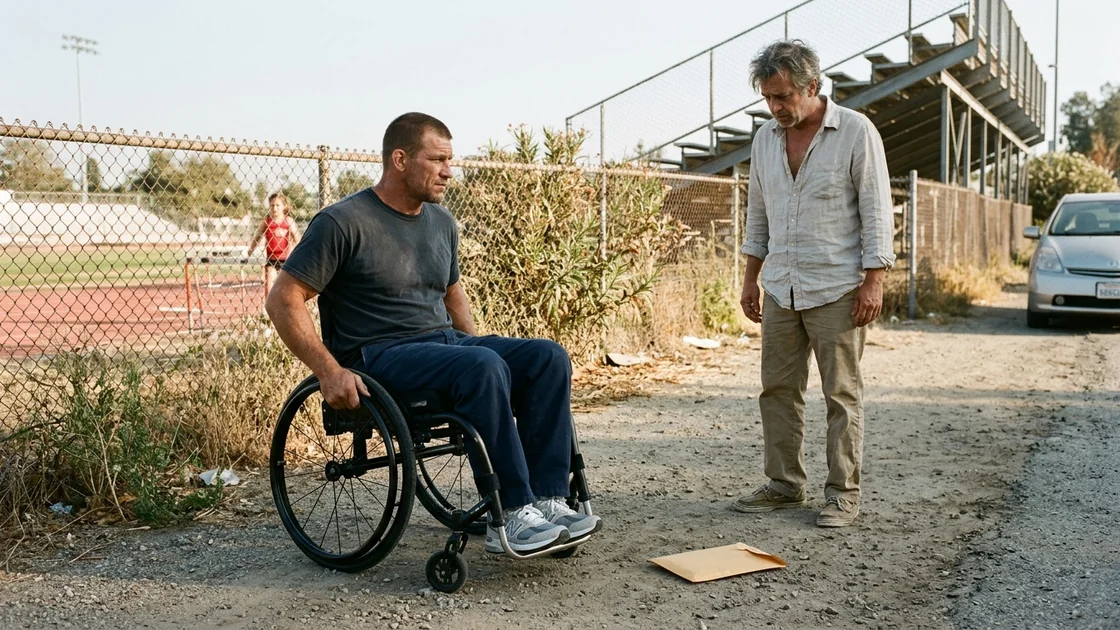
Three years after the settlement—a confidential four-million-dollar compromise that left Leo with eight hundred thousand after legal fees, lien repayments to the union health trust, and the retrofitting of his Burbank bungalow—Leo Briggs sat on an aluminum bench in the sun behind the grandstand at the John Burroughs High School track.
It was two in the afternoon on a Tuesday in May.
The air in Burbank was hot, dry, smelling of oleander, cut Bermuda grass, and the faint, sweet exhaust of the passenger jets taking off from the Bob Hope Airport two miles away.
On the other side of the chain-link fence, his daughter, Clara, now eleven, was running thirty-meter hurdles in a red nylon tank top with her hair pulled back into a tight ponytail with a blue scrunchie. She had her mother’s wide, dark eyes and her father’s square, heavy jaw. She didn't float over the hurdles; she attacked them, her spikes hitting the cinder with that hard, rhythmic punch that Leo knew better than his own heartbeat.
One, two, three, snap. One, two, three, snap.
Leo sat in his everyday chair—an ultralight matte-black rig with no push-handles on the back. He had cut them off with a hacksaw his second week out of the rehab hospital in Downey because he couldn't stand the sight of strangers reaching out to steer him like an elderly woman’s grocery cart.
A silver Toyota Prius with a crumpled front fender and peeling clear-coat pulled slowly into the gravel access road behind the grandstand. The engine died with a wet, shuddering click.
A man got out.
Arthur Vance looked like a pensioner who had forgotten his hat. He was wearing an old linen shirt that had lost its collar buttons, wrinkled khaki trousers, and a pair of dirty canvas deck shoes with no socks. His skin was gray-white, spotted with the liver marks of a heavy drinker who stayed indoors. He carried a large manila envelope under his left arm.
He walked with an awkward, shuffling limp, the result of a torn meniscus he hadn't had the money to surgically repair.
He stopped ten feet from the bench, his shoes crunching on the dry decomposed granite.
Leo didn't turn his head. He had heard the car door; he had seen the reflection of the silver hood in the side-mirror clamped to the left arm of his wheelchair.
"She’s fast," Arthur said.
The voice was thinner than it had been in the legal tower. It had a wet, whistling edge to it, like air passing through a damaged reed.
Leo watched Clara hit the fourth hurdle. She clipped the wood with the trailing edge of her left heel, recovered without losing her stride, and powered through the tape twenty yards ahead of the other two girls.
"What do you want, Arthur?" Leo asked.
Arthur walked two steps closer, then stopped, his fingers nervously kneading the manila envelope. "I drove by the house on Niagara Street. Your wife told me you’d be here."
"Brenda shouldn't have told you that."
"I asked her to give me five minutes," Arthur said. "She almost called the cops. She would have been right to do it."
Leo finally turned his head. His eyes were cold, steady, and clear. He had spent three years learning how to wake up at five every morning to perform his bowel routine with digital stimulation, how to inspect his tailbone twice daily with a long-handled mirror for pressure sores that could rot through to the sacrum in seventy-two hours, how to transfer his dead weight into a shower chair without breaking his ribs against the ceramic tile.
He looked at Arthur Vance the way a blacksmith looks at an old horse that had gone lame three winters ago.
"You look like hell, Arthur," Leo said.
Arthur gave a short, jagged laugh that died in his throat. "I'm fifty-one. I feel eighty. I don't sleep much."
"None of us do."
Arthur held out the manila envelope. "I wanted to bring this to you myself. I didn't want to use the lawyers. The lawyers took everything anyway."
"What is it?"
"It’s the cut," Arthur whispered. He stepped forward and laid the envelope on the aluminum bench next to Leo’s thigh. "I finished it. On the flatbed. It’s sixteen minutes—just the third act. The sequence at the terminal. I used the C-camera angle for the transition through the roof. I used three frames from the high lift to bridge the drift. It works, Leo. God help me, it works. It’s the greatest practical sequence ever put on celluloid. It’s... it’s what we went up that ladder for."
Leo looked at the envelope. The paper was slightly damp where Arthur’s sweating palm had held it against his ribcage.
"There's a drive inside," Arthur said, his eyes suddenly bright, wide, lit from within by that old, terrifying fever that Leo remembered from the pop-up tent in the rain. "A 4K master. Uncompressed. I haven't shown it to anyone. Not the studio, not the festivals. I wanted you to see it first. If you tell me to burn it, I'll take it back to the car and put a match to the thumb drive right now. But if you watch it... if you see what it looks like on a real monitor... Leo, it makes sense of it. It doesn't fix it, but it makes it... necessary."
Necessary.
The word hung in the hot Burbank air between them, competing with the smell of the oleander and the distant whine of a regional jet climbing out toward Phoenix.
Leo looked down at his own hands. They were calloused, scarred across the knuckles from thirty years of work, the skin on the palms thickened into yellow leather from the friction of the wheel rims.
He reached out, took the manila envelope by its metal clasp, and pulled it toward him.
Arthur took a half-step forward, his breath catching in his throat, a faint, desperate smile twitching at the corners of his dry lips. "You see? You remember what it was like. When we were on the line."
Leo didn't open the clasp.
He held the envelope in his right hand, balanced it across his knees for two seconds, and then let his fingers open.
The envelope fell.
It didn't drop fast; it was light, containing only a small plastic casing and two sheets of printed paper. It fluttered sideways, caught the warm breeze coming off the track, and settled face-down in the gray decomposed granite beside the small front casters of the wheelchair.
Arthur stared at the ground. "Leo... please. Just look at the frame."
"Clara!" Leo called out, his voice cutting clean and sharp across the cinder track.
The girl stopped on the backstretch, her hands on her hips, her chest heaving under the red nylon shirt. She wiped her forehead with the back of her forearm and looked toward the grandstand.
"Dad?"
"Grab your bag, bug," Leo shouted, smiling. "We’re going to get some ice cream before the five-o'clock traffic hits the pass."
He turned back to Arthur. There was no rage in his face. That was what broke Arthur Vance’s knees—the absolute, total absence of anger. There was only the vast, indifferent distance between a man who was alive and a man who was haunting an empty house.
"Don't come back to Burbank, Arthur," Leo said quietly.
"Leo... the shot—"
"There is no shot, Arthur," Leo said. He reached down and unlocked the brakes on both wheels. "There’s just a broken pipe in an old pump house that nobody uses anymore."
Leo gripped the hand-rims, leaning his chest forward over his dead knees to put his weight into the turn. The matte-black chair spun smoothly on its urethane casters, the right tire rolling directly over the manila envelope, grinding the paper down into the sharp granite gravel with a single, dry crunch.
He rolled down the asphalt ramp toward the track gate where his daughter was unbuckling her spiked shoes, his shoulders working in steady, powerful strokes, moving forward into the flat yellow light of the San Fernando afternoon.
Behind him, Arthur Vance stood alone in the dust, his hands hanging limp at his sides, watching the gray tire track slowly darken with moisture from the dirt beneath the paper, until the wind from the highway caught the corner of the envelope and turned it over into the weeds along the fence.