The Weight of Drifted Stars
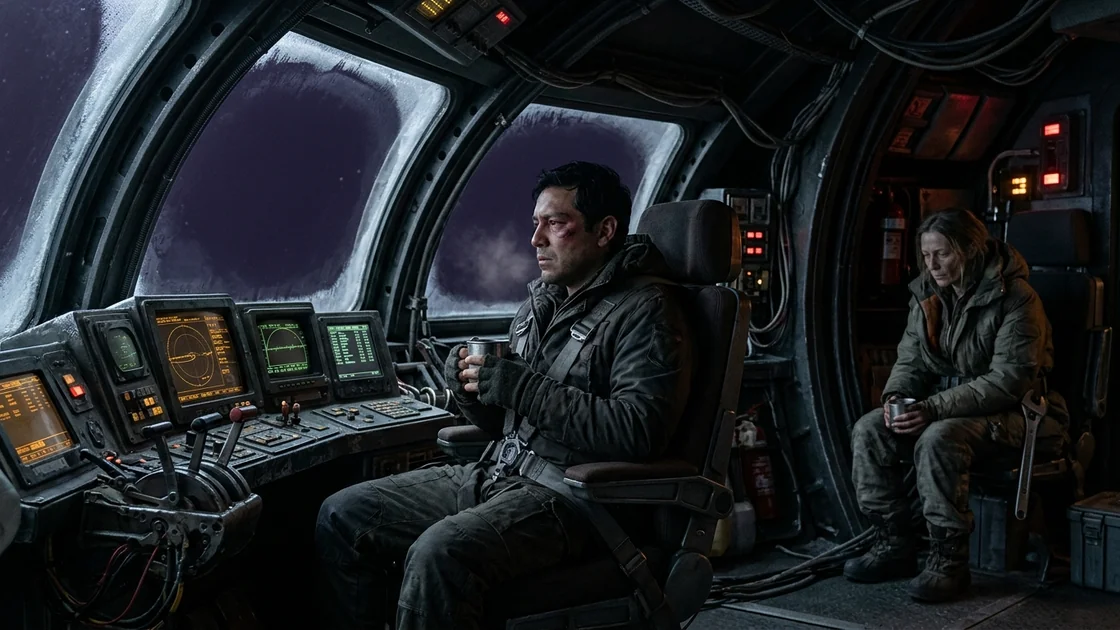
This is the account of Joshua Ruiz, the lead astrogator aboard the colony transport vessel Aethelgard, who allowed personal exhaustion and an incoming comm-burst to compromise his attention during a critical jump sequence. His single mathematical oversight tore the ship away from the charted stellar lanes and deposited ten thousand hibernating settlers into an unmapped void between galactic arms. With the vessel primary drive shattered and the closed-loop life support systems steadily degrading under systemic power starvation, Ruiz was forced to confront the terrible moral and physical consequences of his carelessness while attempting an impossible manual recalculation to save the sleeping population before the air ran out.
Act I: The Stray Value
The astrogation blister of the Aethelgard hung like an obsidian teardrop from the ventral spine of the great vessel, isolated from the hum of the main habitat drums. Outside its three-meter-thick silicate viewports, the universe was an unbroken, uncaring black, flecked only by the cold, unblinking eyes of stars that had not changed their positions relative to humanity since the dawn of the third diaspora.
Joshua Ruiz sat in the cradle of the plotting chair, his fingers hovering over the glass interface of the navigational console. His eyes burned with the dry, granular ache that comes from thirty hours without REM sleep. Beneath his tongue, the bitter chalk of an amphetamine lozenge had dissolved into nothingness, leaving behind only a nervous tremor in his thumbs and a hollow pounding behind his temples.
On the auxiliary monitor to his left, a message header blinked in low-priority amber. It had arrived at the relay buoy three days prior, catching up to the Aethelgard just as she cleared the Kuiper fringe of the Sol system, but Joshua had kept it minimized, tucked into the margins of his workspace like an unexploded shell.
SENDER: MARA RUIZ / DISTRICT 4, VALPARAISO / PERSONAL RE: FATHER.
He should not have opened it during the pre-jump diagnostic. Standard operating procedure, drilled into every midshipman at the Luna Academy until their lips moved in their sleep, forbade non-tactical data consumption within forty-five minutes of spooling the fold-space manifolds. Astrogation was not merely a matter of pointing the nose of a four-million-ton vessel toward a beacon; it was an act of continuous, multi-dimensional balancing. The computer models handled the broad strokes—the non-Euclidean folds, the gravitational shadow calculations of nearby gas giants, the compensation for regional dark matter drift. But the human navigator was there for the seams. The human mind possessed an intuitive grasp of topological continuity that synthetic logic arrays, for all their speed, struggled to replicate when translation matrices experienced micro-shear.
Joshua swallowed, his throat rasping against the dry air of the blister. He tapped the amber icon with the knuckle of his middle finger.
The text bloomed across the terminal.
Josh. He stopped breathing at four this morning. It was very quiet. He kept asking if the engines were warm yet. I told him you were already between the stars. He smiled at that. Don’t look back, Josh. There’s nothing left in the valley anyway. Just dust and scrap.
Joshua stared at the text. A single breath caught in the cage of his ribs, jagged and hard. His father had spent forty years maintaining the atmospheric scrubbers of the Santiago sub-domes, coughing up gray silicate every evening into a cotton handkerchief, smelling always of ozone and wet copper. Joshua had left Sol to escape that smell. He had signed a fifty-year service bond with the Far-Reach Settlement Directorate to put three thousand parsecs of hard vacuum between himself and the slow, suffocating decay of an exhausted cradle world.
He kept asking if the engines were warm yet.
A sharp, synthetic chime pulled him upward through the dark water of his thoughts.
"Astrogation, this is Command," the voice of Commander Angela Vane came through the comm-bezel, clipped, dry, and stripped of all inflection by the ship's internal compression algorithms. "Fold capacitor bank three is at ninety-eight percent saturation. Core telemetry shows green across the lattice. Are your offsets logged, Joshua?"
Joshua cleared his throat, blinking hard against the sudden blur in his vision. He swept his hand across the primary glass to clear the message from Mara, but his palm caught the corner of the coordinate array.
A single numerical field—the sixth-order tensor coordinate for the departure vector’s exit-shear limit—flickered. It was an input of seven digits: 0.004812.
When his damp skin dragged across the capacitive surface, the cursor slipped. The final two digits collapsed into a null-entry string, defaulting to the system’s standard celestial baseline instead of the locally adjusted gravitational gradient of the Arcturus Relay corridor.
He didn't see it happen. His gaze was still snagged on the word dust.
"Offsets are locked, Commander," Joshua said, his voice level, steady, practicing the professional cadence that had carried him through twelve successful long-range hops. "Manifold alignment is within five-nines tolerance. We are ready to draw down."
"Copy that, Astrogation. Handing primary control to your station on three. Five, four, three..."
Joshua gripped the dual-stage physical interlocks on the arms of his chair. The metal was cold through his flight gloves. He looked out into the blackness of the blister. Somewhere out there, three light-years ahead, the Arcturus Relay was spinning its magnetic hoops, waiting to catch them like a pearl on an invisible thread.
"Translation in three," he whispered, reciting the liturgy. "Two. One. Mark."
He threw the interlocks.
The universe did not shift; it turned itself inside out.
The sensation of entering a fold was never pleasant. It was an ontological insult—a split-second during which the human nervous system attempted to process a reality where distance was negative and mass was an imaginary number. Joshua felt his teeth itch; he tasted the memory of a lemon he had eaten when he was seven years old; the color yellow screamed in his inner ear.
Then came the strike.
It was not a sound. Sound requires an atmosphere, and the blister was sealed. It was an absolute deceleration that bypassed inertia and seized every individual atom of the Aethelgard simultaneously. The ship shrieked—a profound, structural groan that vibrated through the composite deckplates and directly into the marrow of Joshua’s bones.
The holographic lattice before him did not simply fail; it shattered. Polygons of emerald and cobalt light splintered into static, spraying across the curved glass of the blister like frozen rain. The primary console let out a flat, continuous klaxon tone that signaled an uncontrolled exit from the manifold.
Joshua was hurled forward against his five-point harness, the straps biting savagely into his clavicles. His chin struck the edge of the casing, and the warm, salt-copper taste of blood filled his mouth.
Outside, the darkness was no longer black.
It was an empty, dead, terrifying violet—a non-color that belonged nowhere in the catalog of stellar phenomena. There were no stars. There were no nebulae. There were no distant swirls of galactic dust. There was only an infinite, matte-finish void that seemed to press its flat palm against the outside of the viewport, demanding entry.
The comm-bezel erupted in a chaos of static and overlapping voices.
"...pressure drop in the lower spine! Section Twelve through Fifteen, seal those bulkheads!"
"Drive-core temperature is running away! Dump the reaction mass! Dump it now!"
"Astrogation! Astrogation, report! Where in God’s name did we drop?"
Joshua sat frozen, his chest heaving, his blood dripping slowly from the point of his chin onto the cracked glass of the coordinate board. He looked down at the input registry.
The departure vector was displayed in stark, unblinking red.
EXIT SHEAR ENTERED: 0.004800. EXIT SHEAR REQUIRED: 0.004812. VARIANCE: -0.000012. CURRENT METRIC: UNDEFINED.
A twelve-millionth of a degree. A smear of grease from his palm. A dead father’s dust.
"Joshua!" Commander Vane’s voice cut through the background screaming on the bridge loop. "Joshua, tell me we are in the Arcturus system. Tell me we have the beacon."
Joshua reached out with a trembling hand and wiped the red drop of blood from the screen. He queried the passive optical sensors. He queried the long-range radio telescopes. He sent a high-gain ping toward the frequencies where the navigation buoys of humanity’s greatest settlement corridor should have been singing their automated hymns.
The return was flat. Absolute zero. No radiation. No background microwave signature matching any known sector of the Orion Arm.
"Commander," Joshua whispered, but his throat was so dry the word cracked in half.
"Louder, Astrogation!"
"We aren't in Arcturus," he said, staring into the violet nothingness. "We aren't on the lane. Commander... the telemetry arrays aren't resolving the galactic core. We aren't in the Arm at all."
Act II: The Cold Math of the Hold
The Aethelgard was eight hundred meters long, a blunt cylinder of nickel-iron and carbon weave designed not for grace, but for survival. Her interior was divided into three primary segments: the drive works at the rear, the engineering and operational spine in the center, and the Great Vault—the cold city that made up sixty percent of her displacement.
In the Vault, stacked like books in an ancient library, were ten thousand cryo-stasis sarcophagi.
Joshua walked the gantry of Cryo-Vault C with his hands plunged deep into the pockets of his technical smock. His uniform was stained at the collar with dry blood. Every breath he took hung before him in a thin, pale mist. The air was already cold; to preserve the auxiliary fuel cells, life support had dropped the ambient temperature throughout the non-essential passageways to four degrees Celsius.
Beside him walked Tamsin Vance, the Chief Life Support Specialist. She was a woman who looked as though she had been constructed from piano wire and dried sinew, her hair cropped short against her skull, her eyes sunken into deep, purple hollows that spoke of thirty-six hours of frantic, failing triage.
"The core is dead, Joshua," she said. Her voice was flat, matter-of-fact, carrying the terrible calm of an engineer who had already worked the equations to the bottom of the page and found nothing but zeros. "The manifold shear didn't just dump us out of the fold; it cracked the magnetic containment rings on the deuterium injectors. If we try to light the main engine, we’ll turn the aft third of this ship into an expanding cloud of radioactive plasma. We’re on backup fuel cells. Hydrazine and oxygen-candle scrubbers."
"And the reserve margins?" Joshua asked, though he already knew the answer. The readouts had been posted to the officers’ terminals an hour after the disaster.
"With active crew alone—the eighty-four of us—we have six months of air and heat," Tamsin said. She stopped on the metal mesh catwalk, looking over the railing into the abyss of the bay. Below them, rows of stasis units stretched down into the gloom, their status lights blinking in rhythmic, synchronous pulses of pale jade. Ten thousand souls. Families from the dried-out plains of North America, machinists from the sunken deltas of the Ganges, engineers, agronomists, teachers, children. All of them sleeping under three inches of polarized resin, dreaming their slow, chemical dreams of a green world under a triple star system.
"And if we keep the pods powered?" Joshua’s voice was barely louder than the hum of the coolant lines.
"Nine days," Tamsin said.
Joshua looked at her. "Nine?"
"The stasis field isn't passive, you idiot," she snapped, the brittle edge of her composure finally cracking. "It’s a dynamic quantum cradle. It has to constantly suppress the thermal entropy of ten thousand human bodies. It eats megawatts like a blast furnace. If the primary reactor isn't feeding the bus, the auxiliary batteries will drain until they collapse. When they hit sixteen percent, the drop-out is automatic. The pods will dump them."
"Dump them?"
"Thaw them, Joshua. All ten thousand of them. In forty-eight hours. Ten thousand naked, starving, disoriented people waking up in a ship with no main engines, four degrees of ambient heat, and enough cycling atmosphere to support maybe two hundred people for a week." She pointed a gloved finger down into the dark. "They will breathe this hull dry of oxygen within thirty-six hours. They will suffocate in the dark, screaming against the bulkhead doors, while the carbon dioxide levels rise until their lungs turn to acid."
Joshua leaned his forehead against the cold safety railing. The steel was so chilled it made the skin of his brow sting.
"It was an entry error," he said.
The silence that followed was heavy, broken only by the thin, liquid gurgling of a freon pump four levels down.
Tamsin did not scream at him. She did not strike him. That, he thought, would have been easier to bear. She merely turned her head slowly, looking at him with an expression of clinical, horrified realization.
"What did you say?"
"The shear limit," Joshua whispered. "I dropped two digits. The arctangent of the local slope was off by twelve parts in a million. When the drive engaged, we didn't slice through the fold—we skipped across the face of it like a flat stone on ice. We sheared off the metric."
"You were checked," she said, her voice dropping to a harsh whisper. "The astrogation check is triple-redundant. The computer..."
"The computer flagged a manual override because I had cleared the terminal for the pre-jump burn," he said. He looked at his boots. "I had an incoming comm. From Valparaiso. My father died."
Tamsin let out a strange, wet sound that was half-laugh, half-sob. She stepped away from him, her hands coming up to clutch her own elbows as if she were suddenly freezing.
"Ten thousand people," she said to the empty air. "Ten thousand people are going to choke to death in the dark because your father died in a ditch three parsecs back."
"I can find where we are," Joshua said, stepping toward her, his hands outstretched in an instinctive, useless gesture of supplication. "Tamsin, listen to me. If I can get the optical parallax from the deep-sky scopes, if I can find three known variable stars—even ancient light—I can plot a slingshot vector. We have the emergency RCS thrusters. We have the hydrazine."
"The RCS thrusters?" She looked at him as if he were insane. "The attitude jets? Joshua, this ship mass-measures at four point two million tons! You can't steer a mountain with a bicycle pump!"
"We don't need to steer it to destination," he insisted, the desperation rising in him, hot and metallic. "We just need to hit a gravity well. Any well. A brown dwarf, a rogue planet, a dead pulsar—anything with enough mass to hook our trajectory and bounce us back toward the Orion boundary. If we can get close enough to a system fringe, we can trigger the automated emergency transponders. A military picket might hear us. A frontier patrol..."
"And how long does that take?" she asked. "Even if your fairy-tale vector exists? How long to drift to this magic well using hydrazine?"
Joshua closed his eyes. The math was already running in his head, cold, cruel, and unavoidable.
"Forty-two days," he said. "At current drift velocity. Forty-two days minimum."
"We have nine days of stasis power, Ruiz," she said, her voice dropping back into that terrible, flat stillness. "Nine. You are thirty-three days short of a miracle."
She turned on her heel and walked down the gantry, her boots ringing on the perforated steel until the cold air swallowed the sound entirely.
Act III: The Council of Shadows
The briefing room on the command deck smelled of old coffee and fear.
Commander Angela Vane sat at the head of the long composite table. Her uniform was buttoned to the throat, her gray hair pulled back into a knot so tight it pulled the skin around her eyes taut. To her right sat Chief Engineer Kaelen, his face grease-streaked, his knuckles raw and scabbed from his attempts to shore up the shattered piping of the reactor bay. To her left sat Doctor Aris Thorne, the ship’s chief medical officer.
Joshua sat at the far end of the table, isolated by a deliberate gulf of empty chairs.
On the central projection drum, a three-dimensional wireframe of the Aethelgard rotated slowly. The aft third of the vessel was washed in an angry, pulsing crimson.
"We have reviewed Astrogation’s data," Commander Vane said, her voice cutting through the soft, continuous rattle of the ventilation louvers. She did not look at Joshua. Her eyes remained fixed on the wireframe. "Or, more accurately, we have reviewed the void where the data ought to be. Specialist Ruiz, explain our position to the department heads."
Joshua stood. His knees felt hollow, like dry reeds.
"We are currently drifting in what the Imperial Cartographic Survey calls the Void of Cetus," he said, his voice flat and level. He had spent the last six hours in the blister, checking and rechecking his sensor pings until his eyes bled tears of strain. "It is an extragalactic rift—a pocket of zero-density space that sits approximately four hundred light-years below the galactic plane of the Orion-Cygnus arm. There are no navigational relays within reception range. There are no star systems within four light-years."
"How did we travel four hundred light-years in an instant?" Engineer Kaelen growled, leaning forward, his large, scarred forearms flat against the table. "Our maximum jump distance was twenty-two parsecs. The manifold doesn't have that kind of range."
"The manifold didn't propel us," Joshua explained, his fingers tracing an imaginary curve in the air. "It sheared us out of the local universe entirely. When the tensor value failed to resolve, we fell down a topological gradient. We didn't fly here. We slid down a hole in the metric like water down an open drain. We are completely detached from the galactic drift."
"Can we jump back?" Thorne asked. The doctor’s voice was gentle, almost polite, the voice of a man who spent his life delivering terminal diagnoses to patients who did not yet understand they were dead.
"The drive is scrap, Doctor," Kaelen said before Joshua could answer. "The core housing has warped three centimeters along the longitudinal axis. If we pump power into it, the whole assembly will turn into a small star. We have no jump capacity. We have no sub-light propulsion beyond the attitude control nozzles."
Silence fell over the room.
Outside the thick viewports of the command bridge, the violet void stared in at them. It seemed thicker now, more substantial, like an ink that was slowly seeping through the structural seams of the ship.
"Then we come to the logistics," Commander Vane said. She picked up a physical stylus, turning it end over end between her thumb and forefinger. Click. Clack. Click. "Specialist Vance has submitted her life-support balance. Doctor Thorne has corroborated the metabolic consumption rates. Kaelen, what is our absolute maximum power generation from the hydrazine cells?"
"If we cannibalize the maneuvering thrusters for their fuel?" Kaelen wiped a greasy hand across his mouth. "If we burn everything we have through the auxiliary turbines? We can keep the lights on and the scrubbers clearing carbon dioxide for one hundred and ten days. For eighty people."
"And the Vault?" Vane asked.
"If the Vault remains online," Kaelen said, looking down at his boots, "the cells will be dry in two hundred hours. A little over eight days."
Joshua stepped forward, his hands flat on the edge of the table. "Commander, I have found a mass."
Vane looked up at him then. Her gaze was not angry; it was worse. It was empty. It was the look an executioner gives the condemned when the rope is being measured.
"Speak, Joshua."
"It’s an uncataloged body," Joshua said, his words tumbling out fast, tripping over one another in his eagerness to build a wall of logic against the horror in the room. "Passive thermal imaging picked up an infrared signature thirty-six degrees off our port bow. It’s an old rogue—a sub-brown dwarf, cold, mostly metallic hydrogen and helium. Mass is approximately twenty times Jupiter. It’s drifting through the rift at ninety kilometers a second."
He reached out and tapped the console, throwing his calculations onto the central projection drum. The wireframe Aethelgard vanished, replaced by two intersecting parabolas of brilliant white.
"If we don't touch the thrusters, we will miss it by three million kilometers," Joshua said. "We’ll sail past its gravity well and out into the intergalactic void, where we will drift until the hull degrades into dust. But if we use the attitude thrusters—if we vent the primary cooling jackets through the RCS manifold in a sustained, sixty-hour burn—we can deflect our course by one point four degrees."
Kaelen squinted at the lines. "A slingshot."
"A high-gee hyperbolic capture," Joshua said, his eyes wild with the brilliance of the math. "We use the dwarf’s gravity to whip us around. We don't have the fuel to enter orbit, but the slingshot will accelerate us by a factor of eight, bending our vector back toward the galactic rim. More importantly: the gravity well will compress our drift. It gives us a predictable trajectory. It puts us into the shipping corridors of the Fourth Sector within three months."
"Three months," Doctor Thorne said softly. "Joshua... three months is ninety days. The Vault dies in eight."
Joshua swallowed. His mouth tasted like ashes.
"We cycle them," he said.
The room went completely, utterly still. Even the click-clack of Commander Vane’s stylus stopped.
"Explain," Vane said.
"We don't keep them all under," Joshua whispered. "We can't. But we don't let them all thaw at once, either. If we selectively drop power to the lower banks... if we triage the Vault..."
"You are talking about murder, Ruiz," Kaelen said, his voice dropping into a register that was almost a growl. "You are talking about turning off the life support on sleeping colonists."
"They are dead anyway!" Joshua shouted, the composure he had maintained for thirty-six hours finally shattering into raw, jagged hysteria. "Don't you see the numbers? If we do nothing, they die in eight days! All of them! Ten thousand people suffocating in their own vomit while the air scrubbers freeze over! If we burn the fuel for the slingshot, we have a chance to throw the hull back into the light! If we don't, we are just ten thousand corpses riding an iron coffin into the dark!"
"And how many?" Doctor Thorne asked. His voice was steady, horrifyingly clinical. "How many would we have to... disconnect... to keep the remaining pods stable until the slingshot completes?"
Joshua closed his eyes. The numbers had been carved into the back of his eyelids since three o'clock that morning.
"Seventy percent," he said.
The silence that followed was not empty. It was filled with the weight of seven thousand names.
"Seven thousand," Vane said. She did not raise her voice. She looked down at the stylus in her hand. "Seven thousand men, women, and children. Farmers who sold their land on Earth. Technicians who signed away their pensions. Children whose parents put them into the pods with promises of an open sky."
"Commander," Joshua wept, the tears finally cutting tracks through the grease and dried blood on his cheeks. "It is the only vector. There is no other math. The universe does not care about our promises! The fuel is finite! The oxygen is finite! The void doesn't negotiate!"
Commander Vane stood up slowly. She was not a tall woman, but she seemed to fill the low-ceilinged room until the bulkheads themselves groaned under the weight of her presence.
"Specialist Ruiz," she said softly.
"Yes, Commander?"
"You are relieved of duty. You are confined to your quarters until such time as this council determines how to proceed."
"Commander, please! The slingshot burn must begin within fourteen hours! If we pass the periapsis window, the fuel expenditure required to correct the vector rises exponentially! We miss the dwarf, we miss everything!"
"Master-at-Arms," Vane said, not looking at him.
The door behind Joshua hissed open. Two security personnel in dark blue fatigues, their sidearms holstered at their hips, stepped into the light.
"Take Specialist Ruiz to cabin 14-B," Vane instructed. "Lock the hatch from the outside. If he touches a terminal, shoot him."
Joshua did not fight them. When the guards took him by the elbows, their grips were firm, almost gentle, the way one handles an invalid or a madman. As they led him out through the armored doors, he looked back over his shoulder.
Commander Vane was still looking at the stylus.
"Seven thousand," he heard her whisper to the cold room. "God help us. Who writes the list?"
Act IV: The Cathedral of Frost
Cabin 14-B was four meters square. It was located on Deck Nine, directly beneath the secondary coolant lines for the stasis arrays. Every twenty seconds, a dull, metallic shudder-thump echoed through the ceiling plates as liquid nitrogen was forced through the expansion valves, a rhythmic heartbeat that reminded Joshua Ruiz, with every pulse, that the sand was running through the glass.
He had no clock. He had no terminal access. The viewport was a steel shutter, dog-latched from the outside to prevent the occupant from looking at the terrible, starless purple of the void.
Joshua sat on the edge of the narrow bunk, his elbows on his knees, his face buried in his hands.
In the dark behind his eyes, he saw the console.
0.004800.
Why had he opened that message? What vanity, what childish, selfish hunger for grief had made him reach out his finger in that fraction of a second when his mind should have been an iron machine? His father was dead. He had been dead since the moment Joshua signed the fifty-year bond. When a man boards a colony ship bound for the frontier, he is already a ghost to the world he leaves behind. He knew that. Every colonist knew that. You step into the stasis gel, and when you open your eyes, everyone who ever loved you, everyone who ever hated you, everyone who knew your name has been dust for two centuries.
He had known that. And yet, he had wanted to hear the echo of the dust.
The door hissed. The heavy mechanical latches clunked open with the sound of dropped hammers.
Joshua did not look up. "If you’ve come to shoot me, Kaelen, please make sure you don't hit the bulkhead. The decompression would be an improvement, but it would waste the air."
"Get up," a voice said.
It was not Kaelen. It was Tamsin Vance.
Joshua raised his head.
The Chief Life Support Specialist stood in the doorway, a heavy thermal parka pulled over her smock, a spanner the size of a man’s forearm hanging from her equipment belt. Behind her stood two junior engineers, their faces pale, their eyes wide with the wild, feral look of animals that smell smoke in the woods.
"Tamsin?"
"Vane isn't going to do it," she said. Her voice was cracked, raw from cold and screaming.
Joshua stood up slowly. "What do you mean?"
"She’s an officer of the line," Tamsin said, stepping into the cabin and pulling the hatch closed behind her, leaving the two engineers on watch in the corridor. "She was trained in the Directorate doctrine. 'All souls or none.' She thinks she’s being noble. She thinks that dying with your boots clean is the same thing as command."
"What is she doing?"
"She’s holding the ship together until the fuel runs out," Tamsin said, her knuckles turning white as she squeezed the handle of her spanner. "She’s ordered the auxiliary cells run to absolute exhaustion. She’s going to let the stasis pods fail simultaneously on day eight. She’s going to let everyone wake up together. She says she won't murder seven thousand people to save three thousand cowards."
"She’s condemning ten thousand people to avoid making a choice," Joshua said, the horror dawning on him.
"Yes," Tamsin said. "Which is why we are taking the ship."
Joshua backed away until his shoulders struck the cold steel of the cabin wall. "Mutiny? Tamsin, you can't run this ship with three mechanics and an astrogator. The bridge crew..."
"The bridge crew are half-frozen," she snarled, stepping close to him. He could smell the bitter stimulant on her breath, the sharp, acidic tang of terror that leaked from her skin. "They’re in their survival bags on the command deck, praying for a signal from a void that has no ears. Kaelen is with us. Half the life-support section is with us. We aren't doing this for power, Joshua. We aren't doing this to take the ship anywhere. We’re doing this because the math is the only thing that’s real."
She grabbed the collar of his smock, pulling him forward until his eyes were inches from hers.
"You told me that if we burn the cooling jackets through the RCS now, we can hit that slingshot. Did you lie?"
"No," Joshua said. "The trajectory is sound."
"And the seventy percent?" Her voice dropped to a terrible, ragged whisper. "Did you calculate which ones?"
"What?"
"Which pods, Ruiz?" Her fingers dug into his collar. "The arrays aren't labeled by moral worth. They aren't labeled by who’s an artist and who’s a mechanic. They’re labeled by grid coordinates! Cryo-Vaults A through G! Which ones do we disconnect? Which ones do we leave in the frost?"
Joshua felt the cabin tilt around him. His stomach heaved, an empty, dry spasm that brought nothing up but bile.
"Vaults D, E, F, and G," he whispered. "They’re on the outer ring. Their thermal insulation is the thinnest. If we drop power to them, the heat from the core won't bleed as fast into the primary hab. It saves another twelve percent on radiative loss."
Tamsin let go of his collar. She smoothed her hands down the front of her parka, a mechanical, jerky movement.
"Vault D is the agricultural contingent," she said. "The families from the central basins. There are twelve hundred children in Vault D, Joshua."
"Don't tell me that!" he screamed at her, hitting the steel wall with the flat of his hand. The sound echoed in the tiny box of the room. "Don't tell me their names! Don't tell me what they do! You asked me for the math! That is the math! If you want to save three thousand people, you cut the outer ring! If you want to be a saint, go sit on the bridge with Vane and hold their hands while their lungs pop!"
Tamsin stood still for a long moment, watching him chest heave, watching him shake like a birch tree in a gale.
Then she nodded once, a sharp, clean motion.
"Kaelen has the bridge access codes," she said. "We move in ten minutes. Come with me, astrogator. You have a slingshot to burn."
Act V: The Seizure of the Wheel
The passage to the command deck was silent.
The Aethelgard was dying from the inside out. In the cross-passages, the emergency lighting had transitioned to a dim, crimson wash that turned every bulkhead into a slab of raw meat. The air scrubbers were whistling—a thin, reedy sound, like an old man whistling through his teeth—as their filters clogged with unmanaged particulate.
Joshua followed Tamsin through the maintenance crawlways beneath Deck Three. Behind them came four crew members carrying heavy industrial cutting torches and magnetic sealing bars. They did not speak. Their boots were wrapped in rags of canvas to muffle the sound of their progress across the deck plates.
When they emerged at the vestibule of the main bridge, they found Commander Vane waiting for them.
She was not in her chair. She was standing in the center of the command circle, wearing her service dress coat, her hands folded neatly behind the small of her back. Beside her stood Doctor Thorne, holding an injector pen in his right hand. There were no guards. There was no barricade.
"Tamsin," Vane said as the hatch hissed open. The Commander’s voice was calm, almost gentle. "I heard you cutting through the secondary trunk line twenty minutes ago. You always were sloppy with the plasma torches."
Tamsin stepped onto the bridge, her spanner in her hand. Behind her, the four mechanics fanned out, their eyes darting nervously between the Commander and the silent tactical displays.
"Step aside, Angela," Tamsin said. She did not raise the tool, but her knuckles were white. "We are opening the RCS venting valves. We are executing the burn."
"And the Vaults?" Vane asked. Her eyes slid past Tamsin, finding Joshua where he stood half-concealed in the shadow of the doorframe. "Have you told them, Joshua? Have you told these men what they are about to do with their hands?"
"They know," Joshua said, stepping into the crimson light.
"They know the words," Vane said, her voice hardening. "They know the phrase 'seventy percent.' They don't know the procedure. Doctor Thorne, explain the manual isolation of an unpowered cryo-tier."
Thorne did not look up from the injector pen he was turning in his fingers.
"The pods don't simply click off," the doctor said softly. "The stasis fluid must be drained to prevent ice crystallization from rupturing the cellular membranes during thermal collapse. If the pumps have no electrical power, the drainage must be performed manually. With the floor valves. You have to walk down the rows, pod by pod, turn the petcock on each unit, and let the fluorochemical run into the bilges."
He looked at the four mechanics.
"The patient wakes during the drain," Thorne said. "The metabolic shock is immediate. It takes between four and six minutes for them to regain enough motor control to open their eyes. By then, the chest is dry. They cannot scream, because their vocal cords are paralyzed by the vitrification inhibitors, but they can see you through the glass. They will watch you turn the valve. They will watch you move to the next unit."
One of the mechanics—a boy named Miller, who could not have been older than twenty-two—lowered his torch. His mouth fell open.
"We don't have to drain them," Joshua said, his voice rising, cracked and shrill. "We can just drop the bus bars! We can cut the master breakers from the sub-station! They won't wake up! They’ll just... the temperature will drift down... they’ll never know!"
"If you drop the bus bars without draining," Thorne said, looking Joshua directly in the eye, "the coolant expands as it freezes. The expansion will shatter the viewing ports. The pressure differential will draw the liquid into the air ducts. You will drown the entire lower half of the ship in neurotoxic glycol before we ever reach your brown dwarf. Is that your plan, Astrogator? To preserve their dignity by pickling them in their own coolant?"
Tamsin took two steps forward. The spanner came up, the heavy steel jaw pointing at Vane’s chest.
"We do it because we have to," she said, her teeth bared. "Give us the command console, Angela. Now."
Commander Vane looked at the spanner. Then she looked at the great curved viewport that spanned the front of the bridge.
The violet void was there, unchanging, vast, indifferent to the four-million-ton speck of dust that carried eight score desperate, shivering humans across its belly.
"The command codes are cleared," Vane said. She stepped aside, clearing the path to the primary console. "I entered them ten minutes ago. The manual override is open, Tamsin."
Tamsin froze. Her spanner dipped an inch. "What?"
"Did you think I was blind?" Vane said, a weary, bitter smile touching the corners of her mouth. "Did you think I didn't see the curve of the fuel reserves? Did you think I didn't sit in that chair and count the days until my own breath would become poison?"
She reached out and laid her hand on the cold rim of the plotting desk.
"I am the Commander of this vessel," she said. "My duty is not to be clean. My duty is to see that humanity does not end in this ditch. But I will not order it. I will not sign an execution warrant for seven thousand innocent souls to buy my own survival. If this ship is to be saved by a butcher’s stroke, then the butchers will have to take the meat with their own hands."
She turned and looked at Joshua.
"The console is yours, Specialist Ruiz. Execute your burn. Kill your seven thousand. And may whatever God that looks into this godless rift have mercy on your soul."
She turned on her heel and walked off the bridge, her steps slow, measured, and perfectly erect. Doctor Thorne followed her, his head bowed, the injector pen still clicking between his fingers.
Click. Clack. Click.
The hatch closed behind them, leaving Joshua, Tamsin, and the four silent mechanics alone with the red displays.
Act VI: The Venting of the Soul
The astrogation console was cold beneath Joshua’s fingers.
The interface was different now. The normal navigation routines were dark, their sub-routines dead for lack of network feedback from the external buoys. In their place, the raw, low-level machine code of the attitude control systems flickered in amber lines across the monochrome CRT monitor he had dragged up from the storage vaults.
To his right, through the thick, armored glass of the command blister, the rogue star was still invisible to the naked eye. It was too cold to shine in the optical spectrum. But on the thermal radar, it was an enormous, looming smear of dull purple—a mountain of dead hydrogen drifting through the dark like a leviathan in deep ocean trenches.
"Sub-station four reports the breakers are isolated," Tamsin’s voice came through his headset. She was down in the Vaults. He could hear the sound of her breath—ragged, wet, coming in short, frantic gasps that sounded like a saw hitting an iron nail. "Vaults D and E are... the valves are open, Joshua. The fluid is running."
Joshua closed his eyes.
Don't think about the glass, he told himself. Don't think about the eyes behind the glass.
"Attitude thruster manifold pressure is at ninety-four percent," he spoke into the microphone, his voice dropping into the rhythmic, artificial calm of the countdown. "We are opening the heat-exchanger bypass. We are going to vent the primary core coolant directly through the lateral RCS ports. It’s going to be rough, Tamsin. The ship isn't balanced for asymmetrical thrust from the coolant jackets."
"Just do it," she whispered. "Before I look down again. Just do it."
Joshua reached for the physical levers he had rigged to the RCS manual linkage.
He looked at the clock. The periapsis intercept was thirty-two minutes away. The brown dwarf was reaching out with its invisible fingers, its gravitational gradient steepening as the Aethelgard slid down the lip of its well.
If he fired too early, the ship would skip off the upper atmosphere of the gas giant, burning away her thermal shielding and tumbling into the void as an out-of-control meteor. If he fired too late, the gravity would seize them, dragging the four-million-ton hull down into the crushing, metallic-hydrogen depths of a planet where the pressure would flatten the stasis pods into lead plates before the crew could even scream.
0.004812.
The number was there, floating in his mind, sharp and clean as a razor blade. He would not miss it this time. There was no message to read. There was no father to mourn. There was only the needle and the thread.
"Coolant dump in five," he said.
His thumb rested on the toggle.
"Four."
The ship seemed to hold its breath. In the silent corridors, eight score living crew members were lying flat on the deck plates, strapped into maintenance bunks, clutching piping, waiting for the blow.
"Three."
Down in Vault D, twelve hundred children were turning cold in the dark.
"Two."
"One."
"Mark."
Joshua slammed the levers home.
The Aethelgard did not lurch; she buckled.
From the ventral spine, two massive plumes of superheated freon, liquid sodium, and compressed nitrogen erupted into the void. In the vacuum, the venting fluids did not form steam; they flashed instantly into a billion glittering ice crystals that caught the infrared glow of the brown dwarf, creating a pair of wings—pale, luminous, ghostly wings that spanned ten kilometers across the violet dark.
The deceleration hit the bridge like a physical fist.
Joshua was thrown forward, his harness groaning under the strain. The console before him screamed as the structural strain gauges on the longitudinal frame turned from yellow to orange, then to an angry, flashing red.
HULL EXPANSION: +4.2 CM. SHEAR STRESS: CRITICAL. FRAME ELEVEN: BENDING MOMENT EXCEEDED.
"Hold together," Joshua whispered, his teeth grinding until he felt the enamel chip. "Hold together, you iron bitch. Hold."
The ship shrieked. It was the sound of four million tons of steel and composite being twisted by two opposing forces: the relentless, uncaring pull of the dead star below, and the violent, uneven kick of the venting coolant at her belly. A pipe burst somewhere behind the bridge bulkhead, and a jet of high-pressure hydraulic fluid sprayed across the ceiling, hissing like an angry viper as it struck the hot light fixtures.
On the radar display, the white line of their trajectory was bending.
It was no longer a straight drop into the void. The parabola was curving, hooking around the purple circle of the brown dwarf like a wire around a spool.
"More," Joshua muttered. His eyes were glued to the velocity vectors. "I need another three hundred meters per second. Vent the secondary reserves! Vent the fire suppression tanks!"
He reached out and smashed the emergency dump switches for the cargo bays.
Deep in the belly of the vessel, tons of compressed carbon dioxide, foam, and dry chemical retardant were blasted into the venting manifolds. The Aethelgard shuddered again, a sickening, wallowing roll that sent Joshua’s head crashing against the side of the plotting frame.
Through the blood that filled his left eye, he watched the numbers crawl.
VELOCITY: 110 KM/S. PERIAPSIS: 40,000 KM. DEFLECTION: 1.2 DEGREES... 1.3 DEGREES... 1.4 DEGREES.
"We have capture," he croaked into the comm.
Nobody answered.
Outside the viewport, the violet void was suddenly eclipsed.
The brown dwarf filled the sky.
It was not a star. It was a nightmare. An enormous, banded sphere of dull, bruised purple and rust-colored clouds, striped with storms that could have swallowed three Earths without a burp. It had no light of its own, but in the radiation glow of its charged magnetosphere, the clouds churned with a faint, malevolent phosphorus—a sickly, greenish luminescence that crawled across the face of the gas giant like grease on water.
The Aethelgard skimmed the fringe of its upper atmosphere.
A sound began to grow in the bridge—a sound that no one on a starship ever wants to hear. It was the sound of air against the hull.
A high, thin, keening whistle, rising in pitch until it was a scream that rattled the teeth in Joshua’s skull. The friction was heating the outer skin; through the silicate viewport, he saw the nose of the vessel turn from dull iron-gray to a dark, cherry red.
ALTITUDE: 38,000 KM. ATMOSPHERIC DRAG: 0.04 G.
"Come on," Joshua whispered. He was no longer an astrogator. He was an insect clinging to a stone that had been thrown past a furnace. "Turn. Turn."
The gravity took them.
Joshua felt his stomach drop through the floorplates. His body weighed three hundred kilos; his lungs could not expand; his ribs were an iron band clamped around his heart. The blood drained from his brain, and the green clouds of the brown dwarf began to turn black, the edges of his vision curling into tunneling darkness.
Through the roar of the atmospheric friction, through the groan of the dying frame, he saw the white vector line on his monitor snap.
It didn't break. It completed the loop.
The parabola opened up, reversing its direction, pointing not down into the intergalactic grave, but outward—up and away from the rift, toward the distant, invisible rim of the Orion Arm.
The screaming began to fade.
The whistling dropped from a shriek to a moan, then to a whisper, then to the absolute, ringing silence of the vacuum.
The red glow on the nose of the vessel died away, replaced once more by the cold, clear reflection of the empty space.
The Aethelgard had passed the periapsis.
She was climbing.
Act VII: The Drift
The silence that followed the burn was not relief; it was the quiet of a tomb after the stone has been rolled into place.
Joshua sat alone in the astrogation blister. He had cleaned the dried blood from his face with a damp rag of grey wool, but the skin around his eye was swollen shut, a mottled knot of black and indigo. His hands rested on the silent console.
The main engines were gone. The RCS manifolds were charred, twisted pipes, their nozzle bells melted into distorted slag by the fury of the chemical dump. The ship had no fuel left. Not a liter of hydrazine. Not a cylinder of compressed nitrogen.
She was drifting.
Her new velocity was eight hundred kilometers per second—a crawl in the context of galactic distances, but a bullet compared to her former dead halt. She was on a ballistic vector that would, according to the mechanical plotting tables Joshua had verified by hand over twelve sleepless hours, intersect the secondary shipping lanes of the Perseus Gateway in eighty-four days.
Eighty-four days.
On the monitor before him, the life-support telemetry was a steady, cold emerald green.
HABITAT STATUS: SECURE. OXYGEN CONSUMPTION: REDUCED (72%). ESTIMATED RESERVE LIFESPAN: 98 DAYS. SURVIVING POPULATION: 3,142.
He had saved them.
Three thousand one hundred and forty-two colonists still slept in the inner vaults. Their pods were cold, their metabolic functions ticking over once every four minutes, their dreams undisturbed by the shift in the stars. They would reach the Perseus Gateway. A patrol cutter would spot their emergency beacon; a salvage tug would latch onto their docking ring; they would be towed into the drydocks of New Rotterdam.
They would wake up under an alien sun. They would walk out onto the black soil of a new world. They would plant their wheat, build their houses, and raise their children.
And seven thousand sarcophagi would have to be carried out of the hull with cargo cranes and dropped into the sun.
The hatch behind him opened with a soft mechanical click.
Joshua did not turn around. He knew the tread of those boots.
Tamsin Vance stood at the top of the short metal stairs that led into the blister. She was still wearing her parka, but it was unzipped now, hanging loose around her gaunt frame. Her face was gray, the skin around her mouth pulled into lines so deep they looked as though they had been carved with an engraver’s chisel.
In her right hand, she carried two metal cups. The smell of synthetic chicory, burnt and bitter, drifted into the chill air of the blister.
She walked down the steps and set one of the cups on the edge of the navigation console, right next to the scratched surface where Joshua’s palm had slipped.
"The air in Vault C is clear," she said. Her voice had no timbre left; it was a dry rustle, like dry leaves being dragged across concrete. "We’ve finished sealing the bulkheads to D and E. Kaelen ran a bead of liquid lead along the doorframes. So nobody can go in."
"Did you... did you finish the drains?" Joshua asked, his gaze fixed on the steam rising from the cup.
"Miller did it," she said. "The boy. He wouldn't let anyone else do it after the first hundred. He took his helmet off so he could smell it. He said he didn't want to forget what it smelled like."
She sat down on the jump seat behind the astrogation chair, her elbows on her knees, cradling her cup in her gloved hands.
"He’s in his bunk now," she added. "He hasn't spoken since three o'clock. Doctor Thorne gave him a sedative, but he just holds his hands in front of his face and looks at his thumbs."
Joshua reached out and picked up the cup. The metal was hot, warming his numb fingers through the thin fabric of his gloves.
"Vane?" he asked.
"In her cabin," Tamsin replied. "She entered the logs. The whole thing. The shear error. The drift. The mutiny. The dump. She didn't leave your name out, Joshua. She didn't leave mine out, either. When the Directorate cutter hooks us, we’ll be under arrest before the airlocks equalize."
"I know," Joshua said.
"They’ll take your license," she said, looking at the back of his head. "They’ll probably put you in a labor station on Callisto for twenty years. They like to do that with navigators who lose ships. They put them in the ice mines so they can think about the stars while they dig."
"It’s fair," Joshua said.
"Is it?" She took a sip from her cup, her shoulders hitching in a tiny, silent shudder. "I don't know what’s fair anymore. The math worked, Ruiz. You were right about that. The math was pure."
Joshua looked out through the silicate viewport.
The brown dwarf was already shrinking behind them. It was nothing more than a tiny, bruised pearl now, sitting in the center of the violet void, slowly dropping away into the endless deep of the rift.
Ahead of them, so faint that Joshua could only see it by looking slightly away from the center of his vision, a pale, milk-white smudge of light hung in the darkness.
The galactic plane.
It was four hundred light-years away—a city of two hundred billion suns, spinning its great, slow spiral through the desert of the universe. In that smudge were all the roads humanity had ever paved, all the wars they had ever fought, all the graves they had ever dug. His father was there, turned to gray ash in the dry soil of the Valparaiso valley. Mara was there, walking through the sub-domes with her head down, smelling of wet copper and ozone.
He would never see it again. Even if the patrol found them, even if the Directorate let him live, he would never walk under an open sky. He would spend the rest of his life in the dark, behind three meters of lead and ice, listening to the pumps shudder in the ceiling.
"Joshua?" Tamsin said softly.
"Yes?"
"What did the message say?"
Joshua held the hot cup against his chest. He could feel his heart beating against his ribs, steady and slow, each pulse buying another sixty seconds of cold air from the scrubbers.
"It said the engines were warm," he whispered.
Tamsin did not answer. She sat in the dark behind him, her breath rising in rhythmic white clouds that joined his own in the chill of the blister, two ghosts riding an iron shell toward a home that would not know their names.
Outside, the Aethelgard drifted on, her hull scarred with fire, her belly filled with lead, carving a straight, unbending line through the great silence between the worlds.