The Weight of Cold Salt
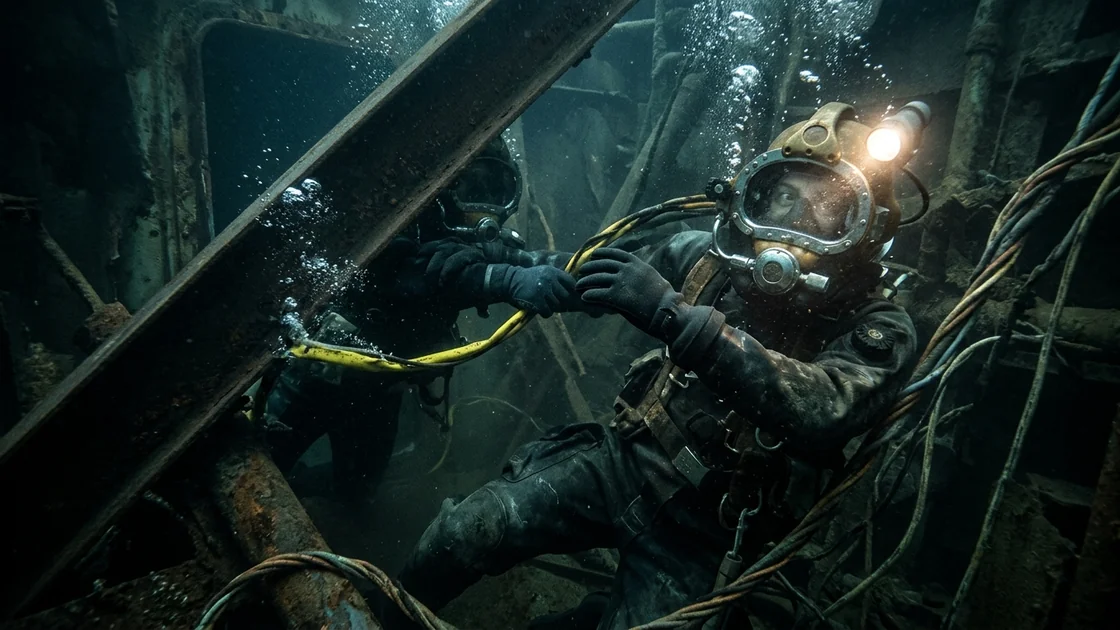
Jonah Miller was an experienced commercial diver who abandoned his longtime partner Donald Graves inside the flooded engine room of the sunken cargo vessel Carina Star. When a collapse of twisted structural steel and severed pipework pinched and wrapped Donald's umbilical hose in total darkness, a blinding surge of primal panic overwhelmed Jonah's professional training. Instead of staying to untangle Donald or sharing his emergency bailout reserve, Jonah severed his comms line, kicked away from Donald's desperate grasp, and ascended alone to the surface. This is the chronicle of the catastrophic dive, the immediate fallout among the salvage crew, the formal board of inquiry, and the relentless psychological decay of a man who survived by committing the ultimate maritime betrayal.
Chapter 1: The Belly of the Iron Whale
The water at eighty-two meters was not merely dark; it possessed a solid, physical density that pressed against Jonah Miller’s suit like cold grease. At that depth in the North Atlantic, three dozen miles off the jagged teeth of the Scottish coast, sunlight was an ancient rumor. Everything that existed of the universe was contained within the nine-inch cone of his helmet-mounted halogen lamp and the steady, rhythmic rasp of his own lungs through the demand regulator of the Kirby Morgan 37 helmet.
Hiss-shhh. Clack. Hiss-shhh.
Every breath sounded like an iron grate being dragged over wet gravel. Inside the fiberglass shell of the hat, Jonah smelled his own stale sweat, the faint rubbery sweetness of compressed air piped down through three hundred feet of bundled umbilical, and the omnipresent tang of copper that always crept into his mouth when he stayed on bottom too long.
"Hat two, hat one," crackled the voice of Donald Graves in his earpiece. The audio was thick with the strange, nasal squeak caused by the helium-oxygen mix they were breathing, but Jonah had worked with Donald long enough to understand every inflection beneath the distortion. "Watch your step on that bulkhead ledge, Jonah. The silt’s sitting six inches deep on the plating. One sloppy kick and we’re in chocolate milk."
Jonah paused, his lead-weighted boots settling onto the steel deck of what had once been the auxiliary machinery space of the Carina Star. The Carina, a four-hundred-foot bulk carrier laden with industrial ball bearings and crated machinery, had foundered four months earlier during a February gale when her cargo shifted and stove in her number two hold. She now lay canted thirty degrees to port on a seabed of glacial mud.
"Copy that, Don," Jonah said, his voice slow, measured, disciplined. Topside had told them this was a simple survey and hook-up run: verify the structural integrity of the frames around the main shaft tunnel, attach two eight-inch lift-bag shackles to reinforced pad-eyes, and get the hell back to the wet bell before their bottom time ran out. "I’ve got the guide wire anchored to the hatch combing. Moving in through the starboard access trunk."
"Right behind you," Donald replied. Jonah felt the faint tug and pulse on his umbilical where it ran back out toward the bell, Donald's lines running parallel to his own like thick, rubberized pythons.
They were commercial divers for Stornoway Marine Salvage, a hard-nosed outfit that took the contracts larger offshore contractors turned down as too hazardous or too marginal. Donald was forty-six, a veteran of oilfield tie-ins and bridge demolitions from the Persian Gulf to the Norwegian Trench. He had a wife named Clara who grew prize-winning dahlias in Aberdeen and two sons who were studying naval architecture. Donald was solid, cautious, and possessed the peculiar, slow-moving serenity that kept divers alive when machinery parted under tension or rigging snapped in the black.
Jonah was thirty-four, younger, leaner, and known around the docks for his speed. He was the diver supervisors sent in when a job was running behind schedule and the client was bleeding demurrage penalties. He had done twelve seasons in commercial diving, and until this dive, he had considered himself immune to the terror that occasionally hollowed out other men in the fleet. He had seen green tenders freeze on the ladder; he had seen a man hyperventilate until he passed out inside a wet pot because a dead porpoise brushed his leg in zero visibility. Jonah had always pitied them. Fear, he believed, was simply an absence of calculation. If you knew the gas laws, if you knew the rigging tables, if you trusted your equipment and kept your fingers moving, there was nothing down here that could kill you without giving you a chance to solve it first.
He slipped through the rectangular opening of the access trunk.
Inside the Carina Star, gravity felt inverted. Because the vessel was resting on a severe list, what had been walls were now floors, and ceilings were sheer drops into stagnant voids. The beam of Jonah’s light caught suspended particles of fuel oil, floating like iridescent amber droplets in the clear seawater. Pipe racks hung down like ruptured ribs from the overhead. Overhead, iron ladders projected sideways like skeletal fingers.
"Entering the auxiliary room," Jonah reported to topside.
Up on the surface, aboard the diving support vessel Grampian Alpha, the supervisor’s voice came down the line. "Copy that, Hat one. You have twenty-two minutes of bottom time remaining before you need to make your way back to the stage. Watch your umbilicals on those sheared deck plates. Marine Safety reported the hull took a heavy twist when she impacted the bottom."
"Understood, Topside," Donald chimed in. "Hat two is at the trunk. I’m tending Hat one’s umbilical from the opening. Jonah, let me feed you six meters. Take it slow."
Jonah squeezed past a bent valve manifold. The space narrowed. The auxiliary room had suffered catastrophic compression when the ship sank; thousands of tons of North Atlantic had slammed through the hatches, crushing the lightweight partitions and folding steel plates over one another like an unrolled accordion. The air in his helmet felt cool and thin. His hot-water suit—a rubberized undergarment through which heated water from the surface was constantly pumped—kept his torso warm, but his hands inside the thick neoprene three-finger mitts were already stiffening.
"Donald," Jonah said, leaning into a dark crevice between the port diesel generator and an overturned electrical cabinet. "I see the bulkhead pad-eye. It’s intact. But there’s a hell of a lot of junk piled against it. Looks like two-inch hydraulic line and scrap angle iron."
"Can you clear it by hand, or do we need the broco torch?" Donald asked.
"I can heave it aside. Just need a little slack."
"Sending it down. You’ve got five feet... ten feet."
Jonah grunted as he gripped a twisted length of steel framing. His boots slid against the slimy coat of sea growth covering the deck. He pulled. The metal groaned, a dull metallic shriek transmitted through the water directly into the shell of his helmet. It came free, kicking up a small cloud of black iron sediment that hovered like smoke before drifting lazily toward the ruptured hull plates behind them.
"Got the first shackle set," Jonah muttered, reaching for the heavy four-ton galvanized bow shackle hanging from his harness tool ring.
That was when the ship shifted.
It did not slide down the shelf—not completely. It was more insidious: an internal settling, a sound like a distant artillery shell striking soft earth, followed by the deep, resonant ring of three-quarter-inch structural rivets popping their heads off under shear stress. The hull groaned, a five-thousand-ton instrument of iron adjusting to the sea floor.
Jonah froze. His feet were knocked from under him as the deck vibrated violently. Above him, a cascade of loose debris—rust flakes, pipe lagging, wooden crating rotted to mush—rained down through the black water.
"Topside! What was that?" Donald’s voice spiked in the comms. It wasn't panic, but it was the sharp, razor-edged focus of a diver who knows an environment has become dynamic.
"Hat two, we felt a shudder on the clump weight line," topside responded instantly. "Telemetry shows the wreck settled half a meter to port. What’s your status? Divers, report!"
"Jonah! You alright in there?" Donald called.
"I’m alright," Jonah panted. His heart was hammering against his ribs, the pulse throbbing visibly in the corners of his vision. "The deck dropped out from under me an inch or two. Silt’s up. Visibility dropped to nothing. I’m backing out."
"Take it easy," Donald said, his voice coming through the comms with steadying weight. "I’m right at the trunk. Follow my umbilical back. I’m pulling the slack now."
Jonah turned in the zero-visibility soup. It was the dreaded chocolate milk Donald had warned about: absolute blindness. His halogen lamp, which had carved clean lines through the Atlantic ten minutes ago, was now a useless ball of glowing amber fog reflecting straight back into his eyes. He had to navigate by touch, keeping one hand on Donald’s umbilical cord—the life-giving bundle containing his breathing air, hot water, depth-monitoring pneumofathometer line, and copper comms wire.
He felt the rubber hose slide through his mitts. Three feet. Five feet.
Then the hose went rock hard.
It didn't merely tighten; it hummed with the high-frequency vibration of a guitar string under extreme tension.
"Donald?" Jonah called.
A sharp intake of breath hissed over the radio. Then, a metallic thud that reverberated through the steel plates around Jonah's knees.
"Jonah—the—the auxiliary cabinet collapsed," Donald gasped. His words were choppy, broken by heavy, ragged breaths. "The list... when she shifted, the whole switchboard framing came over. It’s come down right across the trunk door."
"Are you pinned?" Jonah asked, his voice climbing an octave. He was still three meters deep in the machinery crawlspace, his own umbilical running past whatever had fallen.
"My legs are clear," Donald said, but his voice was strained, choked by the effort of lifting something immense. "My legs are fine, Jonah. But my hat... no, wait. My umbilical. Christ. The umbilical is caught underneath the frame. It’s pinched. It’s pinched flat between the I-beam and the deck coaming!"
Chapter 2: The Constriction
To a commercial diver, an umbilical is not an accessory; it is an umbilical in the most biological, visceral sense of the word. Cut it, and you have whatever is in your bailout bottle—a small aluminum cylinder strapped to your back containing perhaps ten to twelve minutes of gas at eighty meters, assuming you do not hyperventilate. Pinch it, and your primary air supply drops from a steady two hundred pounds per square inch above bottom pressure down to an agonizing, suffocating trickle.
"Hat two! Hat two! Confirm your gas supply!" the supervisor shouted from the surface. The audio was filled with background shouting from the dive control van on the Grampian Alpha. Jonah could hear bells ringing—the alarm indicating an uncontrolled drop in manifold pressure on Donald's rack.
"Pressure’s... pressure’s dropping," Donald panted. His voice had lost its steady Aberdeen lilt; it was thin, wet, raspy. "I'm on... I’m cracking the bailout valve. Bailout open. I'm on the bottle."
"Hat one, get out of that hole and assist Hat two!" the supervisor ordered. His voice was no longer that of a calm administrator; it had the cold, terrifying snap of an emergency protocol. "Jonah, clear the umbilical. Do not let Hat two exhaust his bottle. He’s got eight minutes at that depth. Do you hear me? Eight minutes!"
"Moving," Jonah whispered.
He crawled through the black water. He could see nothing. He had to lead with his hands, feeling his way along Donald’s rigid, vibrating hose like a blind man tracing a wire through a briar patch. The steel edges of sheared bulkheads scraped against the thick vulcanized rubber of his drysuit. His left knee struck an unseen valve wheel, sending a jolt of sharp pain through his leg, but he barely registered it. His chest felt tight, the air from his own regulator suddenly tasting different—hotter, drier, smelling of burnt oil.
It’s just your head, he told himself. Keep your head. Donald is five feet away. You find the obstruction, you take the pry bar from your belt, you wedge it, you free the hose, you both get into the bell.
His hand slammed into the steel bulkhead of the access trunk.
Here, the water was turbulent, stirred violently by Donald’s movements. Jonah reached out and his gloved fingers brushed against the smooth fiberglass of Donald’s helmet. Donald was on his knees, his torso twisted, his hands frantically clawing at a massive structural I-beam that had dropped diagonally across the door frame like a portcullis.
Underneath that beam, caught between two tons of salt-corroded structural iron and the sharp, raised coaming of the watertight door, were two umbilicals.
Jonah’s umbilical was wedged, but it had slipped into a hollow where the steel was notched; it still had some play, sliding back and forth with several inches of clearance. Jonah’s air was flowing free.
Donald’s umbilical was not so lucky.
The beam had caught Donald’s line directly over the reinforced brass coupling where the hose mated with the non-return valve assembly of his helmet whip. The heavy flange of the I-beam had driven down like a guillotine. The outer neoprene cover was shredded; the yellow outer jacket was split open like a peeled fruit, revealing the inner high-pressure nylon braiding, which had been crushed into an oblong, dead-end knot.
"Donald," Jonah said, his voice trembling inside his hat. He reached down, grabbing Donald’s shoulder. "I’m here. I’m right behind you."
Donald’s hands found Jonah’s forearms. Even through the heavy neoprene, Donald’s grip was terrifying. It was not the firm, professional handclasp of a dive buddy; it was the vice-like, spasmodic grip of a drowning man. His fingers dug into Jonah’s biceps with bruising force.
"Jonah... it’s got me," Donald rasped. In the earpiece, Donald’s breathing sounded like a bellows working over hot coals. Haaah-purr. Haaah-purr. Rapid. Shallow. The sound of a man burning through two hundred bar of gas in an environment that swallowed gas at nine times the surface rate. "The beam... won't budge. I tried the pry bar... it slipped into the bilge. I can’t... I can’t move the iron, Jonah."
Jonah dropped to his knees in the mud. He reached for his own thirty-inch steel pinch bar, slotted into the webbing loop on his right thigh. He worked the chisel edge of the bar into the hairline gap between the I-beam and the deck coaming.
"Topside," Jonah gasped, the exertion instantly spiking his carbon dioxide levels. "The trunk frame has dropped. Hat two’s line is crushed under an eight-inch beam. I'm trying to purchase a lever underneath the flange."
"Give him everything you’ve got, Jonah," the supervisor said. "Bell stage is at the door, but we can’t bring the bell down to you. You’ve got five minutes before Donald’s bottle is flat. Clear that line!"
Jonah threw his entire weight onto the pry bar. At eighty-two meters, leverage does not work as it does on land; without gravity to anchor the feet firmly, pushing down on a lever simply pushes the diver’s body up toward the overhead. Jonah's boots floated off the deck. He braced his shoulders against the ceiling plate, his neck screaming under the strain as his helmet scraped the rivets, and he drove his weight down through the heel of his hands onto the bar.
Clang.
The bar slipped. The wet, slimy rust gave way, shearing off in a shower of greasy flakes. Jonah plunged forward, his chest striking Donald’s heavy brass weight harness.
"Jonah!" Donald’s voice was breaking now, shedding all its professional veneer. It was the naked, raw voice of a child waking up in a burning room. "Jonah, my cylinder... the needle’s in the red. It’s on thirty bar. Thirty bar! I’m getting resistance on the inhale!"
Jonah reset the bar. His hands were shaking. Inside his drysuit, sweat was running down his temples, stinging his eyes. He couldn't wipe them; he could only blink furiously against the saline burn behind the glass faceplate.
"Push with me, Don!" Jonah yelled. "Get your hands under the web of the beam! On three! One... two... three!"
They heaved together. Donald let out an animal roar of exertion, his fingers tearing at the jagged, barnacle-encrusted flange of the beam. The iron groaned. Jonah felt the beam lift—perhaps a quarter of an inch, perhaps half an inch.
"It’s moving!" Jonah cried. "Pull the hose! Pull it!"
Donald reached back with one hand to yank his pinched line from the crevice.
Then the wreck settled again.
It was not a loud noise; it was a dull, sickening whump, like a sandbag falling from a scaffold. The beam did not merely drop back into place; it slid four inches along the greasy deck plate, driven by the shifting weight of thirty tons of machinery in the adjacent engine bay.
The steel bar was ripped from Jonah’s hands. The reaction force snapped the heavy tool against Jonah’s forearm, bruising the muscle to the bone, before the bar vanished into the dark silt of the floor.
The beam had closed the gap entirely. Now, it was not merely resting on Donald’s umbilical; it had sheared through the outer layers completely. A fountain of tiny, high-pressure bubbles—Donald’s precious, diminishing emergency air from his bailout cylinder—erupted from the pinch point in a hiss that Jonah could hear through the water, through the metal of his helmet, through his very skull.
Pssssssssssssssssssssssssssssssss.
"My hose... it’s gone," Donald whimpered. The comms were wet now, filled with the sputtering sound of a man drawing air across a flooded diaphragm. "Jonah... the whip’s blown. My bottle’s dumping. It’s dumping out the rupture!"
"Turn the valve! Turn the cross-over off!" Jonah screamed.
"I can't... I can't reach... Jonah, help me! Help me! I have no air! I HAVE NO AIR!"
The scream that came through the earpiece was not human. It was the sound of pure, unadulterated asphyxiation. It was the sound of a throat closing on vacuum, of lungs collapsing inward against an iron chest plate, of a human being realizing that the next thing to enter their mouth would be five hundred pounds of freezing, salt Atlantic brine.
Donald lunged forward in the dark.
His hands—clad in the thick, clumsy rubber mitts—did not reach for the beam this time. They reached for Jonah.
Chapter 3: The Severing
There is a protocol for this. Every commercial diver reads it in the manuals; every diver practices it in the shallow training tanks at Fort William. It is called the buddy-breathing tether drill, or the secondary bailout link. Jonah had a spare low-pressure port on his manifold block, a six-foot auxiliary whip designed specifically to plug into another diver's helmet to provide an emergency supply from his own umbilical.
All Jonah had to do was unclip the whip from his left harness breast-strap, reach down through the dark, locate Donald's emergency inlet valve, snap the quick-disconnect fitting home, and pull the brass sleeve until it clicked.
It was a drill that took twelve seconds in a swimming pool.
Jonah’s hand went to the whip. His fingers found the brass quick-disconnect collar.
Then Donald hit him.
It was not an attack; it was the blind, frenzied grappling of an organism that has been cut off from oxygen. Donald's arms wrapped around Jonah’s neck ring, his massive brass-weighted belt crashing into Jonah’s midsection. In the pitch blackness, Donald’s helmet slammed against Jonah’s faceplate with a terrifying crack. The Plexiglas held, but the impact sent a shockwave of vibration straight through Jonah's teeth.
"Jonah—Jonah—Jonah—" Donald wasn't speaking into the microphone anymore; he was clawing at Jonah’s helmet, his fingers scrabbling over the side-block, searching for the regulator, searching for air, searching for life with the frantic, destructive energy of a drowning beast.
Donald’s heavy fingers caught the air-supply valve on Jonah’s own manifold block.
Jonah felt his own air stutter.
For half a second, the free-flowing stream of sweet, cool helium-oxygen hesitated. The regulator diaphragm rattled against its cage. Jonah’s lungs hitched. In that half-second of partial vacuum, Jonah tasted the cold iron of the North Atlantic. He tasted the abyss.
And then, something inside Jonah Miller broke.
It was not a gradual descent into fear; it was an instantaneous, catastrophic detonation of his rationality. The twelve years of diving, the thousands of hours logged on bottom, the certifications, the brotherhood of the salvage fleet, the shared mugs of tea in the decompression chamber, Clara Graves’s face when she waved them off at the dock in Peterhead—all of it was incinerated in a microsecond by a blinding, white-hot, reptilian impulse:
I am going to die inside this iron box.
"Get off!" Jonah screamed. The sound that left his mouth was high, ragged, and shrill, echoing inside his own hat until it deafened him. "Get off me!"
He did not reach for the auxiliary whip. He did not try to find Donald's inlet.
Donald was clinging to him like a limpet, his legs wrapping around Jonah's thigh, his weight dragging Jonah down toward the crushed deck where the I-beam sat like a gravestone. Donald's helmet was pressed against Jonah's view-port, and through the scratched, muddy plastic, Jonah could see nothing but the wild, bulging whites of Donald's eyes in the back-scatter of the lamp. Donald's mouth was open, stretched wide in a silent, continuous rictus of suffocation.
"Let go!" Jonah howled.
With his right hand, Jonah did not draw his pry bar to attack the beam. He balled his fist and smashed it into Donald's faceplate.
The blow bounced off the heavy polycarbonate with a dull thunk. It did nothing to loosen the grip. Donald’s fingers were hooked into the harness straps of Jonah’s bailout bottle, pulling Jonah down, anchoring them both to the floor of the Carina Star.
He’s going to drown us both, the lizard brain screamed in Jonah's ear. He’s dead. He’s already dead. If you stay, you die.
Jonah reached down to his right hip.
Mounted in a heavy Kydex sheath was his dive knife: an eight-inch Green River blunt-tipped rigging blade, ground razor-sharp along the serrated edge for cutting through thick nylon hawsers and wire rope.
Jonah drew the knife.
He did not stab Donald. Some microscopic, dying fragment of his humanity held him back from plunging the steel into the soft rubber of Donald’s suit. Instead, Jonah brought the blade down between their bodies.
He wasn't cutting Donald's umbilical—Donald's umbilical was already dead, crushed flat under two tons of structural steel.
Jonah brought the serrated edge against the comms cable and the emergency tether that linked Donald's harness ring to his own gear clips—the safety line they had snapped together before penetrating the trunk.
He sawed. The high-tenacity nylon webbing resisted for two strokes, then parted with a silent snap under the tension.
Then, Jonah reached up to his own neck. He took the comms wire running from his hat into Donald’s buddy-loop and yanked the four-pin waterproof connector until the brass pins sheared off inside the rubber socket.
The screaming in his ears stopped instantly.
There was no more Donald Graves in his helmet. There was no more ragged choking, no more wet, animal gasping, no more of Clara’s husband begging for a thimbleful of gas.
There was only the silence of his own regulator.
Hiss-shhh. Clack. Hiss-shhh.
With a violent, convulsive heave, Jonah planted both his lead-toed boots against Donald’s chest harness and kicked.
Donald was an anchor; Jonah was buoyant. The force of the kick, magnified by the adrenaline flooding Jonah's veins at toxic levels, tore Donald's stiffening fingers from the straps of Jonah's harness. Donald’s hands slid down Jonah’s smooth rubber suit, clutching at Jonah’s knees, then Jonah’s calves, then the brass buckles of his boots.
And then, Donald’s hands were holding nothing but sea water.
In the beam of Jonah’s light, as he backed violently out of the trunk door, Donald Graves sank backward into the black silt. His head fell back, the heavy fiberglass hat lolling against his shoulder like a dead weight. His arms drifted upward in the slow, weightless ballet of the drowned, his fingers curling gently inward like the petals of a night-blooming flower.
A few tiny, silver bubbles drifted from the exhaust valve of his hat—the last gas lingering in his dead spaces. They rose three feet, hit the rusty ceiling plate of the Carina Star, and flattened into trembling pools of mercury against the iron.
Jonah did not look back.
He turned toward the hatchway, toward the dim, distant square of light where the guide line led out into the open sea, and he swam.
He did not swim with the measured, energy-conserving scissor kicks of a commercial diver. He swam like a terrified dog, thrashing with his legs, pulling himself along the jagged edges of the bulkheads with his hands, tearing his drysuit at the shoulder on a jagged iron burr, ignoring the cold trickle of salt water that began to seep against his skin.
He broke through the access trunk into the open ocean.
Eighty-two meters of black water stretched above him.
Chapter 4: The Wild Ascent
A commercial diver at eighty-two meters breathing a mix of twenty percent oxygen and eighty percent helium has hundreds of liters of inert gas dissolved into his adipose tissues, his blood plasma, and his joint capsules. To survive, that diver must spend hours—sometimes days—ascending in slow, calculated increments, pausing at predetermined decompression stops to allow the gas to slowly, harmlessly diffuse through his lungs.
To ascend directly from eighty meters without decompression is not merely dangerous; it is an act of anatomical suicide. It turns the human circulatory system into a shaken bottle of warm soda uncapped in an instant. The nitrogen and helium boil out of solution inside the veins, forming massive frothy plugs of air that lock the heart, infarct the spinal cord, and shred the brain with micro-embolisms.
Jonah Miller knew this. He had taught this to trainees at the diving school.
He did not care.
The panic that had seized him inside the hull of the Carina Star did not evaporate when he left Donald behind in the silt. It metastasized. The black water outside the wreck felt like a living throat that was trying to swallow him whole. Every foot of ocean was an enemy; every fathom of depth was a hand pulling him down toward Donald’s floating fingers.
He hit the bottom stage—the open steel basket suspended from the Grampian Alpha—at seventy-eight meters.
The stage was empty. Protocol dictated that both divers return to the basket, secure their harnesses to the safety chains, signal topside with three tugs on the pneumo line or a voice call, and let the crane winch hoist them to the first decompression stop at sixty meters, where they would wait for twenty-two minutes.
Jonah did not touch the stage comms. He did not clip his harness.
He gripped the stage’s steel wire hoist cable with both gloved hands, wrapped his legs around the greasy wire, and hit the emergency purge valve on his drysuit.
Instead of venting air to maintain neutral buoyancy, he hit the suit-inflation valve.
A blast of high-pressure air surged into his drysuit from his bottle. The rubber ballooned instantly. His legs stiffened into rigid pillars; his chest expanded like a barrel; his arms were forced outward by the immense internal pressure of the suit. He became a human missile, his positive buoyancy completely overriding the forty pounds of lead at his waist and the sixty-pound brass helmet on his shoulders.
He began to blow up.
"Hat one! Hat one!" The supervisor’s voice suddenly barked in his ear. The surface tender had noticed the catastrophic loss of Hat two's signal and the sudden, violent movement on the hoist cable. "Jonah, your pneumo gauge is going crazy! You’re ascending! Vent your suit! Vent your suit, goddammit! You’re blowing up!"
Jonah could not vent the suit even if he had wanted to. The air had rushed into the legs of his suit, flipping him upside down. He was rocketing toward the surface head-down, feet-first, his hands trailing in the rush of freezing water that roared past his ears.
Sixty meters.
The water shifted from absolute midnight to a deep, bruising indigo.
Pssssshhhhhhh. His ears were screaming. The air inside his middle ears was expanding faster than his Eustachian tubes could clear it. A red-hot spike of agony drove through his left eardrum as the membrane ruptured, filling his helmet with the copper taste of blood and a sudden, violent wave of vertigo that made the ocean spin like a carousel.
Forty meters.
The pressure around him halved. The gas bubbles inside his bloodstream were expanding now, swelling from microscopic specks into jagged spheres that scraped against the endothelial lining of his capillaries. His shoulders felt as though they were being pried apart with iron crowbars. His knees burned with a dry, grinding agony.
"Vent! Jonah, vent!" the radio screamed. Topside was in full panic now. Jonah could hear the crane operator shouting, could hear the klaxon on the bridge of the Grampian Alpha wailing its three-blast distress sequence. "You’re going to blow your lungs! Exhale, you son of a bitch, EXHALE!"
Jonah opened his mouth.
He did not exhale in a controlled hiss. He opened his jaws wide and screamed into the darkness of his helmet, a long, bubbling, bloody howl that sprayed pink foam against the inside of his faceplate. If he held his breath for a single second, the expanding gas inside his pulmonary alveoli would rupture the lung tissue like an overinflated paper sack, sending air straight into his left ventricle and killing him before he saw the sky.
Twenty meters.
The water was green now—a pale, sickening, translucent emerald. He could see the shadowy, barnacle-encrusted keel of the Grampian Alpha hovering above him like a floating mountain. The twin propellers sat motionless, locked out for the dive operation.
Ten meters.
The pain in his joints was no longer a physical sensation; it was an all-consuming fire that obliterated thought, memory, and guilt. His vision went gray at the edges, tunneling down to a pinpoint of light. He felt a terrible, tearing sensation across his breastbone, as if a steel cable were being tightened around his ribcage.
Five meters.
The water turned white with foam.
CRASH.
Jonah Miller exploded through the surface of the North Atlantic like a depth charge.
He broke the water fifteen feet from the diving platform, his rubber suit stretched to the bursting point, his boots thrashing the chop into a froth of white water. The light of the Scottish afternoon—a pale, overcast gray—struck his faceplate with the blinding intensity of a magnesium flare.
He floated on his back like a dead whale, completely rigid, paralyzed by the internal pressure of his suit and the raging storm of gas bubbles tearing through his nervous system.
Through the blood and foam smeared across his viewport, he saw three faces peering down from the platform above.
There was Angus MacNair, the chief tender, his eyes wide with horror, his mouth hanging slack. There was young Callum, the life-support tech, clutching a boat hook. And behind them, leaning over the rail of the dive shack with the comms headset clamped to his skull, was Davey Vance, the diving supervisor.
"Get him!" Vance roared, his voice carrying raw across the salt chop. "Get the hook into him! Get him into the pot! Now! NOW! Where’s Donald? WHERE IS DONALD?"
The boat hook slammed into the webbing of Jonah’s harness. Strong hands—four of them, five of them—heaved him out of the water like a landed shark, dragging him across the steel mesh of the dive stage. The lead soles of his boots clattered against the iron.
Jonah lay on the wet deck, twitching. His legs were completely numb; his lower body had ceased to exist beneath a wall of white-hot static. His left eye was filled with blood from a ruptured subconjunctival vessel.
Angus fell on him with a brass wrench, frantically spinning the neck-clamp collar of the Kirby Morgan helmet.
"Breathe, Jonah, breathe!" Angus was yelling, his face inches from Jonah's. Angus was an old man, sixty if he was a day, with skin like pickled pork and tobacco stains in his gray beard. "Don’t you dare pass out! Keep breathing!"
The helmet came off with a violent, oily hiss.
The cold air of the North Atlantic struck Jonah’s face like a bucket of ice water. It smelled of diesel exhaust, seagull guano, and salt.
Jonah gasped. A spray of bloody sputum flew from his lips, speckling the front of Angus’s oilskin bib.
"Donald..." Vance was kneeling over him now, his fingers digging into Jonah’s shoulder so hard the bone creaked. Vance’s face was gray, his eyes hollowed out with the sudden, crushing realization of a disaster on his watch. "Jonah! Where is Graves? Why are you alone? What happened to the line?"
Jonah’s lips moved. They felt thick, rubbery, like slabs of cold bacon. His jaw was trembling uncontrollably, the teeth clicking against each other in a spastic, erratic rhythm.
The truth hovered on his tongue: I left him. He was out of gas and I kicked him into the dark and I cut my comms and I ran.
If he said it, he was dead. Not physically—the bends were already doing their best to kill his body—but everything that made Jonah Miller a human being among other men would be annihilated. In the commercial diving fleet, there were men who had lost legs; there were men who had spent forty years in wheelchairs; there were men who had burned their hands down to the tendon on underwater cutting rigs. But there was no man who had ever swum away from a partner with a full bailout cylinder on his back and lived to sit in a pub again.
Jonah looked into Vance’s frantic eyes.
"Tangled..." Jonah wheezed. The voice was barely a croak, choked with blood and salt. "The bulkhead... collapsed. Total collapse. Donald was... squashed flat, Davey. Crushed. Cut him in two. My line... snapped. I had to... I got blown out... the surge... the surge blew me up..."
Vance stared at him for a second, searching the bloody, ruined face for something he didn't want to find.
"Jesus Mary and Joseph," Angus whispered, crossing himself with a grease-blackened thumb. "God rest him."
"Shut up!" Vance barked. He grabbed Jonah by the collar of his suit and hauled him half-upright. "Get him into the chamber! Move! We’ve got less than sixty seconds before his brain turns to curd! Move your fucking legs!"
Chapter 5: The Steel Coffin
They threw Jonah into the deck decompression chamber like a side of spoiled beef.
The outer lock clanged shut. The heavy brass dogs spun home with the sound of gun bolts chambering rounds. Outside the thick, six-inch acrylic port, Jonah saw Angus’s distorted face peering in, his hand already on the supply valve manifold.
HHOOOOOOOOORRRRRRRSH.
The air screamed into the chamber with the force of an industrial turbine.
Surface decompression protocol—"Sur-D"—is the most violent medical intervention known to maritime engineering. When a diver blows up from eighty meters, every second spent at surface pressure is a second where bubbles are growing larger, tearing through tissue, blocking arterioles, and causing irreversible ischemic necrosis. To save the diver’s life, the tender must re-pressurize the chamber immediately down to the equivalent of fifty meters of sea water, crushing the gas bubbles back down into physical solution before they can permanently shred the brain and spinal cord.
The temperature inside the chamber spiked instantly.
As the air compressed from one atmosphere to six atmospheres in less than ninety seconds, the laws of thermodynamics took their toll. The chamber transformed into an oven. The air became so hot it scorched Jonah’s blistered lips. Sweat poured from his skin in sheets, mixing with the saltwater and the blood leaking from his ear.
Jonah lay on the thin vinyl-covered foam mattress on the lower bunk, his back arching off the steel.
The pain was unspeakable.
It was not a pain that could be located in an organ or a limb; it was the pain of every single cell in his body being squeezed, twisted, and starved of oxygen simultaneously. His spine felt as though a steel drill were being driven through his L4 vertebra. His hip joints felt as if they were filled with crushed glass.
"Coming down to five bar," Angus’s voice boomed over the chamber intercom, distorted by the dense, hot air into a monstrous, deep rumble. "Hold on, Jonah. We’re taking you down. Hold your nose and blow."
Jonah couldn't blow. His left eardrum was already gone; the right one clicked and popped with sickening wet crunches as the pressure hammered it inward.
He rolled onto his side, his hands clawing at the painted steel wall of the chamber.
On the bulkhead across from him, stenciled in faded black letters by some long-dead safety inspector, was a placard:
EMERGENCY RECOMPRESSION PROCEDURES - TABLE 6A. FAILURE TO MAINTAIN TETHER COMMUNICATION IS GROUNDS FOR IMMEDIATE TERMINATION.
Jonah squeezed his eyes shut.
In the dark behind his eyelids, the water was eighty-two meters deep.
He saw Donald's eyes.
They were not the eyes of a dead man. They were the eyes Donald had turned on him in that final, terrifying second—the eyes of a friend, a mentor, a man who had stood by Jonah’s wedding party, a man who had loaned Jonah three thousand pounds when his truck engine blew up two winters ago. Those eyes had contained an expression that was far worse than hatred or fury: it was absolute, bewildered disbelief.
Donald had believed Jonah would save him.
Until the very moment Jonah’s heavy rubber boot had slammed into his chest, Donald had believed that the hand reaching out in the dark was the hand of his partner.
"Table 6A," Vance’s voice came over the speaker. The supervisor had taken over the comms desk. His voice was flat, hollowed out, the voice of a man whose career was ending on the next tide. "Jonah. You're at fifty meters equivalent. We’re putting you on the built-in breathing system. Put the mask on. Pure O2. Twenty minutes on, five minutes off. If you vomit, take the mask off your mouth so you don’t choke. Do you hear me?"
Jonah reached up with trembling, leaden hands.
The BIBS mask was a heavy black rubber cup with a demand valve, suspended from an overhead hose. Jonah pulled it over his face, strapping the elastic harness around his skull.
He took his first breath of pure oxygen.
It was cold. It tasted of metal and rubber. At six atmospheres, pure oxygen is toxic; it can cause grand mal seizures if breathed too long. But at this depth, it was the only thing that could leach the helium from his dying nerves.
With every inhale, the pain in his hips subsided by a fraction of a millimeter. The burning in his chest cooled from an open furnace to a smoldering bed of coals.
His mind, cleared of the immediate, screaming agony of the bends, was left with nothing to distract it from what he had done.
He looked at the steel walls.
The chamber was eight feet long and four feet in diameter. It was painted an institutional, clinical off-white, with brass fittings, copper pipes, and a small food lock at waist height.
It was an iron box.
Just like the auxiliary machinery room of the Carina Star.
Jonah began to shake. It was not the neurological tremors of decompression sickness; it was the violent, uncontrollable shivering of a body in the grip of a moral convulsion. He curled his knees up toward his chest, pressing his forehead against the cold iron of the bunk frame.
"He was crushed," Jonah whispered into the rubber mask. His voice was muffled by the diaphragm. "He was crushed. The beam fell on him. I couldn't move it. I tried. I had the pry bar. The bar slipped."
He said it again.
"The bar slipped. I tried. He was dead before I left. He had to be dead. He had no air."
Outside the port, Angus walked past, carrying a clipboard. He glanced in, his expression solemn, heavy with pity.
Jonah saw the pity and he wanted to scream. He wanted Angus to take a sledgehammer and smash the acrylic viewport until the chamber decompression killed them both. He wanted Davey Vance to throw open the outer hatch dogs and let the atmospheric pressure tear his lungs out through his throat.
Anything would be better than the pity.
The pity was based on a lie that had already set like wet concrete.
"Eighteen hours," Vance’s voice crackled from the speaker. "That’s how long you’re in the pot, Jonah. We’ve called the Coast Guard cutter Orkney. They’re sending a dive doctor out by chopper. Hang in there, boy. We’re bringing Donald’s body up as soon as the relief boat arrives with the crane rig."
Jonah’s heart stopped.
"Body?" he whispered into the mask.
"Aye," Vance said, his voice dropping into a register of dull mourning. "We can’t leave him down there. The client wants the survey finished anyway. Stornoway’s chartering the Deepsea Pioneer. They’ve got a four-man saturation spread. They’ll send a diver in with a cutting torch, chop the beam off his line, and bring him up."
Vance paused, his breath hissing over the mic.
"They'll bring him home to Clara, Jonah. We won’t leave him in the iron."
Jonah lay on his vinyl bunk, the oxygen hissing into his lungs with every ragged breath.
They're going down with torches, he thought.
They would see the I-beam. They would see where the pry bar had scraped the paint.
And they would see the comms cable.
They would see the clean, serrated cuts where a knife had hacked through the safety tether. They would see Donald’s auxiliary whip—still neatly clipped to his chest harness, still untouched, still waiting for the partner who had swum away.
Chapter 6: The Board of Inquiry
The Maritime and Coastguard Agency held the formal inquiry three weeks later in a wood-paneled room on the third floor of the Marine House in Aberdeen.
The room smelled of floor wax, wet wool coats, and cold instant coffee. Outside, rain lashed against tall sash windows that looked out over the gray, crane-spotted basin of Victoria Dock.
Jonah sat at a long oak table.
He wore his only suit: a dark navy polyester two-piece he had bought five years ago for his sister's wedding. It was too large for him now. In the three weeks since the dive, he had lost sixteen pounds. His skin had a strange, yellowish, waxy cast—the lingering footprint of liver stress caused by massive gas loading and the cocktail of anti-inflammatory steroids the dive doctor had pumped into his veins.
His left leg didn't work properly.
When he walked, his left heel dragged slightly against the carpet, a faint, rhythmic scuff that sounded to Jonah like the scrape of a pry bar against a ship’s deck. The doctor had called it "minor neurological deficit, L5-S1 distribution." A permanent souvenir of his wild ascent. He would never hold an HSE commercial diving medical certificate again. His career was over.
At the center of the table sat Captain Alistair Finch, a retired master mariner with white eyebrows that bristled like wire brushes, flanked by two technical assessors: an offshore installation manager named Henderson and a senior diving consultant named Dr. Neil Thorne.
To Jonah’s left sat Davey Vance. Vance looked ten years older. The skin under his eyes was bagged and purple. Stornoway Marine Salvage was already being sued by the Graves family’s solicitors, and the HSE had impounded the Grampian Alpha’s dive logs, gas manifolds, and audio recordings.
"Mr. Miller," Captain Finch said, his voice level and devoid of warmth. He adjusted a pair of half-moon reading glasses and looked down at a thick blue folder. "We have reviewed the voice logs recovered from the dive control console. We have also examined the inspection report prepared by the saturation team from the Deepsea Pioneer, who recovered the late Mr. Graves forty-eight hours after the incident."
Finch looked up. His eyes were cold, watery blue.
"I must tell you, Mr. Miller, there are aspects of this timeline that the board finds... deeply troubling."
Jonah cleared his throat. His hands were clasped under the table, his fingers digging into his thighs so hard his knuckles were white. "Yes, sir."
"At 14:12 hours," Finch continued, reading from the papers, "Hat two reports an obstruction. At 14:13, Hat two reports his umbilical is pinched. At 14:14, you report that you are attempting to lever the structural member with a pinch bar. At 14:15, Hat two reports his bailout cylinder is down to thirty bar."
Finch paused. He laid the papers down flat on the table, aligning the edges with meticulous precision.
"At 14:15 and forty seconds, the audio recording from your helmet records a scream. Yours, Mr. Miller."
"Yes, sir," Jonah said, his voice barely audible.
"And then," Finch leaned forward, "the audio connection to both divers is terminated simultaneously. Thirty seconds later, the telemetry on the hoist winch indicates that you are ascending at a rate of approximately forty meters per minute. A rate of ascent that our medical assessor describes as... essentially suicidal."
Dr. Thorne, a bald man with an austere, clinical gaze, took off his spectacles. "Mr. Miller, you are an experienced diver. You had over seven hundred logged bottom hours. You knew that blowing up from eighty meters without your stage would result in catastrophic decompression illness or fatal air embolism."
"I was panicked, sir," Jonah whispered.
The word fell into the room like a dead bird.
"Panicked," Finch repeated. He didn't say it with disgust; he said it with an icy curiosity, as if he were dissecting an unfamiliar insect. "A commercial diver with twelve years of experience panicking to the point of abandoning his stage?"
"The wreck shifted," Jonah said. He had rehearsed this a thousand times in his dark flat in Peterhead, staring at the water stains on the ceiling until dawn. "The wreck dropped. The silt was... it was absolute zero visibility. I couldn't see my own faceplate. When the beam dropped, it struck my helmet. It jarred me. I couldn't breathe. I thought my own hat had flooded. I thought... I thought Donald was already dead."
"Donald was not dead, Mr. Miller," Finch said softly.
The room went dead silent.
Even the rain against the glass seemed to mute itself.
Finch picked up a single sheet of paper from the bottom of the folder. A red diagonal stamp across the top read: HM CORONER - POST-MORTEM REPORT.
"The post-mortem examination performed at the Aberdeen Royal Infirmary indicates that Donald Graves died of acute asphyxiation secondary to gas depletion," Finch read, his voice flat, monotonous, relentless. "His lungs showed the classic signs of hypoxic cardiac arrest. There was no water in his lungs, Mr. Miller. None. His helmet seal was intact. His suit was intact."
Finch looked over his glasses directly into Jonah’s eyes.
"The pathologist estimates that Mr. Graves survived for between three and five minutes after your umbilical parted."
Jonah felt the room tilt. The mahogany table seemed to slide away from him at a thirty-degree angle, just like the deck of the Carina Star. Three to five minutes.
Donald had been alive down there.
After Jonah had kicked him away, after Jonah had severed the comms, after the white foam had swept Jonah up toward the sky—Donald had been sitting alone in the absolute blackness of eighty-two meters of salt water, his lungs working against an empty regulator, his heart slowing, waiting in the dark for five minutes.
Waiting for Jonah to come back.
"Furthermore," Finch continued, his voice hardening, "the saturation team found your thirty-inch steel pinch bar three meters from the access trunk. It had not been wedged under the beam. It was lying in the silt."
"It slipped," Jonah choked out. "I told you... I told Davey... it slipped from my hands when the wreck settled."
"And the safety tether?" Finch asked.
Jonah’s tongue felt like wood. "Sir?"
"The inspection report from the Deepsea Pioneer notes that Donald Graves’s safety harness tether was severed. Not parted under tension, Mr. Miller. The strands of the nylon webbing were cut cleanly, with evidence of multiple serrated strokes."
Davey Vance turned his head slowly to look at Jonah.
It was the first time Vance had looked at him since they pulled him out of the decompression chamber three weeks ago. Vance’s face was no longer tired; it was hollowed out by a sickening, dawning comprehension.
"Jonah?" Vance whispered.
"The wreck was dynamic," Jonah said, his voice climbing, cracking, the words tumbling out of him in a desperate, chaotic rush. "There was scrap steel everywhere. Sheared deck plates. Jagged iron. When Donald lunged at me... we were tangled. We were tangled in the dark! I was trying to clear us! The metal must have... he must have caught it on the edge of the access door!"
Captain Finch stared at him for a long, terrible moment.
The technical assessor, Henderson, shook his head once—a small, disgusted twitch of the chin.
Finch sighed. He closed the blue folder.
"The formal findings of this board," Finch said, each word falling like an iron rivet, "will be issued in sixty days. We will note that the diving operation conducted by Stornoway Marine Salvage was characterized by inadequate risk assessment regarding the dynamic stability of the hull. We will note that the dive supervisor failed to initiate emergency retrieval protocols in a timely manner."
Finch paused. He stood up. He did not look at Jonah again.
"As for you, Mr. Miller... we find that your actions in the water were wholly inconsistent with your duties as a commercial diver. Whether your conduct was the result of acute cognitive collapse induced by panic, or something more... culpable... is a matter for the Procurator Fiscal to determine. Your commercial diving certification is revoked permanently. This inquiry is adjourned."
The men stood.
Davey Vance did not wait for Jonah. He stood up, gathered his leather briefcase without looking to his right, and walked out of the room, his boots squeaking heavily on the floorboards.
Jonah sat alone at the table.
He reached down to pick up his coat. His left hand was shaking so badly he couldn't thread his arm through the sleeve.
When he finally made it to the hallway, he saw Clara Graves.
Chapter 7: The Dahlias of Aberdeen
She was standing by the umbrella stand near the front entrance of Marine House, wrapped in a black wool coat that had lost its shape. Her hair, which Donald had always proudly noted was the color of autumn beech leaves, was pulled back in a loose, untidy knot.
She was not crying. Her eyes were dry, red-rimmed, and unnervingly clear.
Beside her stood Donald’s brother, a granite-faced farmer from Inverurie who held his flat cap in both hands as if he were waiting for a judge to pass sentence.
Jonah stopped three paces away. His left foot dragged against the floor with that awful, dry scuff.
The hallway was wide, drafty, and filled with the distant sound of typewriters from the harbor offices upstairs.
"Clara," Jonah said.
The name tasted like ash in his mouth.
She looked at him. She looked at his oversized suit, his yellowed skin, the twitch in his left eyelid that hadn't stopped since the chamber.
"Jonah," she said. Her voice was remarkably steady. It had the quiet, carrying strength of the women who live on the northeast coast, who spend their lives watching herring boats and supply tenders round the breakwater in force-nine gales. "They wouldn't let me into the room. They said it was technical."
"It was... just technical talk, Clara," Jonah muttered, looking down at the brass umbrella stand. "Logs. Pressures. Steel."
"The man from the union came by the house yesterday," she said. She reached into her coat pocket and pulled out a small, worn leather pouch—Donald's pocketknife and his silver pocket watch, items the recovery divers had taken from his gear bag on the Grampian Alpha. "He gave me these. He said Donald didn't suffer."
Jonah said nothing. His throat was a dry, constricted pipe.
"Did he suffer, Jonah?" she asked.
The question wasn't an attack. There was no venom in it, no legal maneuvering, no technical assessment. It was simply a wife asking the man who had been with her husband at the bottom of the sea.
Jonah looked up.
He saw her eyes—the same honest, hardworking eyes he had seen across the kitchen table when Donald had barbecued mackerel on their back lawn two summers ago, while Donald's boys played football on the grass.
The pathologist estimates that Mr. Graves survived for between three and five minutes.
Jonah, help me! I have no air! I HAVE NO AIR!
He could tell her the truth.
He could fall to his knees on the cold checkerboard linoleum of Marine House, press his forehead against her wet shoes, and tell her that her husband had died in terror because Jonah Miller was a coward. He could tell her that Donald had reached out for his partner and found a knife instead. He could give her the clean, sharp relief of knowing who to hate.
If he did that, he would be free of the secret. The law would take him, or it wouldn't. The fleet would spit on him, or it wouldn't. But the rot inside his skull would have a name.
He looked at her tired, worn face. He saw the small gold cross at her throat. He saw the way her fingers trembled as she held Donald's watch.
And Jonah realized that the truth would not heal her. It would only murder Donald a second time, stripping away the dignity of his death and replacing it with the grotesque horror of his final five minutes.
The lie was the only thing he had left to give her.
It was not an act of mercy for himself; it was his final, filthy penance. He would carry the rot alone, until it finished eating whatever was left of him.
"No, Clara," Jonah said, his voice flat, dead, and steady. "He didn't suffer. When the beam came down, it took him instantly. A shockwave. He was gone before he knew the iron had moved."
Clara stared at him.
Her chin quivered once, twice. Then she nodded, a slow, mechanical jerk of her head.
"Thank you, Jonah," she whispered. "He always said... he always told me that if anything ever went wrong down there, there was no man in the islands he’d rather have on his line than you."
She turned and walked toward the heavy glass doors of the street entrance, her brother taking her elbow as they stepped out into the Aberdeen rain.
Jonah stood in the drafty hall until the sound of their footsteps was swallowed by the traffic on Market Street.
Chapter 8: The Silt
Six months later, Jonah Miller lived in a two-room flat above a fishmonger’s shop in Fraserburgh.
The flat smelled permanently of boiling vinegar, salted herring, and old linoleum. From his small front window, he could look out over the gray slate roofs of the harbor toward the breakwater, where the sea was always breaking in long, white, jagged lines against the dolos blocks.
He worked on the slipway.
He was not a diver. He was not even a rigger. He was the man who scraped the barnacles and weed off the keels of trawlers when they were hauled out of the water on the motorized rail carriage.
It was wet, filthy, miserable work. He wore heavy oilskin trousers, wooden-soled clogs to protect his feet, and a yellow hard hat. He spent ten hours a day holding a six-foot steel scraper, his bad leg braced against the concrete slip, dragging the blade through the thick, greasy crust of tubeworms, mussels, and green slime that clung to the iron hulls.
The men on the slipway did not talk to him much.
They knew who he was. The maritime world of the Scottish coast is tiny, its gossip carried on every tide from Wick down to Montrose. They knew he was the diver from the Carina Star. They knew there had been an inquiry. They knew Donald Graves was buried in the churchyard at Dyce, and they knew Jonah Miller walked with a limp and didn't look men in the eye.
They thought he was simply unlucky—a diver who had broken under the bends and lost his nerve.
That was bad enough. In a harbor town, a man who has lost his nerve is like a boat with dry rot: you can keep him tied to the pier, but you don't take him past the light.
Jonah didn't mind the silence. He preferred it.
Every night, he sat in the greasy armchair in his flat, drinking cheap blended whisky from a jelly glass, listening to the gulls screaming over the fish offal in the bins below.
He didn't sleep well.
When he closed his eyes, the bedroom didn't stay still. It canted thirty degrees to port.
The air in the room would grow cool, thin, and smell of copper and rubber. He would hear the slow, rhythmic sound of the Kirby Morgan regulator:
Hiss-shhh. Clack. Hiss-shhh.
And then, out of the dark corner between the wardrobe and the washbasin, the water would come.
It didn't come with a roar; it came as a thick, silent, cold grease that filled the room from the floorboards up. It rose past his ankles, past his knees, past his chest. He would sit in the chair, unable to move his leaden limbs, as the room filled with the black Atlantic.
And through the murky water, drifting slowly across the linoleum, Donald Graves would come.
Donald didn't look angry. He wore his yellow diving suit, his Kirby Morgan 37 helmet tilted sideways on his neck, his severed umbilical hose trailing behind him like a dead snake. His arms would be outstretched, his thick neoprene mitts reaching through the dark, his fingers curling and uncurling in that slow, weightless dance.
Donald would stop in front of the chair.
He would reach down, his cold, rubberized fingers brushing against Jonah’s throat, not to throttle him, not to strike him, but simply searching for the brass quick-disconnect fitting on the auxiliary whip that wasn't there.
"Jonah," the nasal, helium-distorted voice would whisper through the water, through the walls, through the wood of the floorboards. "Jonah... the whip’s blown. Give me your line."
Jonah would sit in the dark, the empty jelly glass clutched in his hand, his heart hammering against his ribs like a trapped bird.
He never answered.
He knew that there was no gas mix in the world that could fill the space Donald had left behind. He knew that the eighty-two meters of cold salt water were not three dozen miles off the coast of Scotland; they were inside him. They had entered his lungs through the torn eardrum; they had flooded his blood through the ruptured capillaries; they had settled into the very marrow of his bones.
He had escaped the iron hull of the Carina Star. He had broken through the emerald surface; he had looked upon the gray sky; he had breathed the air of the dry earth.
But he had never ascended.
He was still down there, eighty-two meters deep in the black silt of the North Atlantic, pinned beneath the weight of an iron beam that had no end and no name, waiting in the dark for an air hose that would never come.