The Weight of Clean Glass
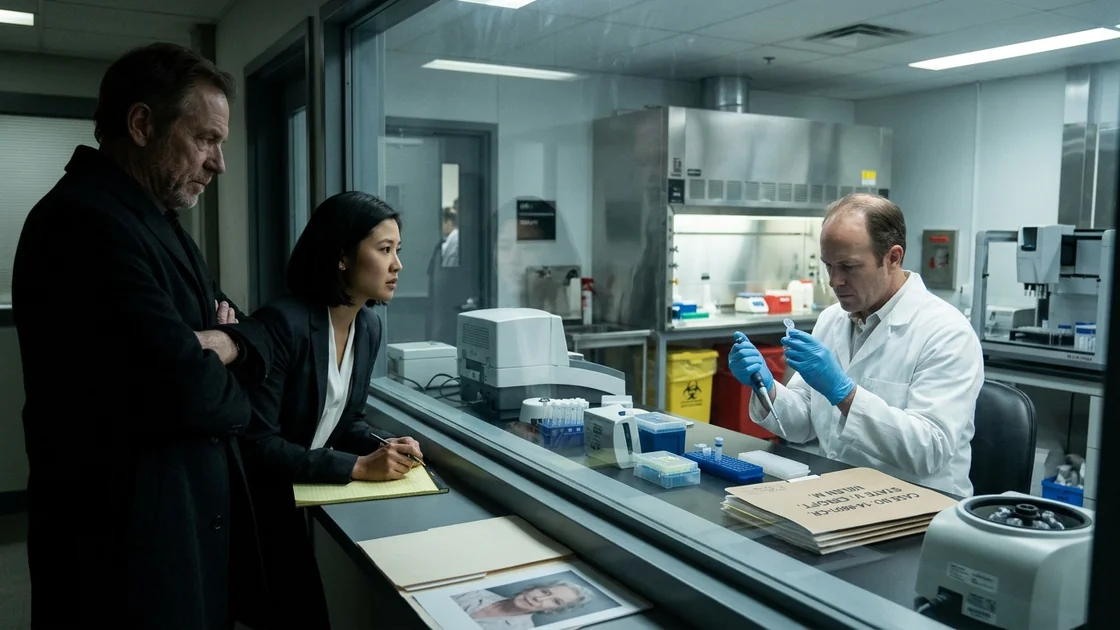
Arthur Vance spent ten years convincing himself that a pipetting error was merely a footnote in a tragedy that would have happened anyway. Ten years ago, as an ambitious young forensic serologist working for the Department of Public Safety, he accidentally contaminated a blood swab from the brutal slaying of a convenience store clerk with reference DNA from a prime suspect named Helen Croft. Terrified of ruining his rising career during a statewide audit, Vance buried the spiked negative control, doctored his bench notes, and took the witness stand to declare a definitive match. The jury believed his immaculate white coat, sending Croft to solitary confinement on death row. A decade later, a mandated statutory re-audit of the state archives brings the Croft evidence back to his bench, forcing Vance to choose between his carefully manicured life and the woman awaiting execution for a murder she never committed.
I. The Architecture of the Sterile
The extraction room of the regional crime laboratory smelled perpetually of bleach, glacial acetic acid, and the ozone breath of the UV decontamination lamps. It was a smell Arthur Vance found comforting because it promised absence. In a world defined by the messy sloughing of human existence—sweat pressed into steering wheels, dried semen on cotton twill, skin cells clinging to window latches—the extraction room was designed to be nowhere. It was an artificial void.
Arthur stood at bench four, his gloved hands held waist-high, wrists loose. He was forty-eight now, though his hairline had retreated in a way that made his brow look perpetually raised in scientific skepticism. Across the room, the robotic liquid handler clicked with the dry, rhythmic precision of a mechanical locust, dispensing ninety-six microscopic droplets of reagent into ninety-six polypropylene wells.
"You’re brooding, Arthur," Sarah Chen said without looking up from her microscope. She was twenty-seven, bright, and wore running shoes beneath her lab coat that squeaked against the epoxy flooring. "Brooding over a cold-case requisition is bad for the posture."
"I'm not brooding," Arthur said. His voice was naturally low, modulated by decades of speaking before grand juries who needed to be lulled into absolute confidence. "I’m reviewing the chain of custody. The seal on the inner cardboard housing is degraded."
"It's from 2014," Sarah remarked, turning a focus knob. "Back when people still used low-tack evidence tape that turned to dust if someone coughed near the HVAC vents. Just document the degradation and run the extraction. Maya Lin from the Innocence Project has been filing emergency motions on that docket every three weeks since November."
"I know what Ms. Lin has been filing," Arthur said.
He looked down at the manila folder beside the plastic evidence tub. The label was written in his own hand, rendered in the rigid, capital-letter drafting script he had practiced during his postgraduate fellowship: CASE NO. 14-8891-CR. STATE V. CROFT, HELEN M. EVIDENCE ITEM #12-A (REMAINDER SWAB).
Underneath the label was his signature, thin and sharp, penned in the indelible black ink mandated by standard operating procedure. He had written that signature on a Tuesday afternoon in July, ten years, three months, and nine days ago. He had written it fifteen minutes after washing his hands three times in scalding water, hoping the heat would scald away the panic that had turned his collar damp.
Sarah stood, gathering her slides into a transport rack. "I’m heading up to administrative for the quarterly meeting. You want me to bring you back one of those terrible Danishes?"
"No," Arthur said. "Thank you, Sarah. Just close the airlock door on your way out."
She smiled, tapped the sensor plate, and the glass door slid shut with a soft pneumatic hiss.
Arthur did not move for several minutes. The room was silent except for the low, 60-hertz hum of the environmental control system and the liquid handler's periodic click. He looked down at the evidence carton. Inside lay two glass vials, each containing a desiccated rayon tip.
He did not need to open the case file to remember the crime. He remembered the crime because he had spent three thousand nights trying to dissolve it in scotch, work, and the manufactured nobility of his profession.
The victim had been a nineteen-year-old college student named David Miller, who had worked the graveyard shift at an all-night fuel plaza off Interstate 80. The surveillance video had been a smear of gray pixels: a figure in a heavy winter parka with the hood drawn tight, an argument over eighty-four dollars in the cash register, a cheap nickel-plated .22 caliber revolver, and three shots that left Miller crumpled behind the display of motor oil.
Helen Croft had been arrested three blocks away, walking along the drainage ditch behind an industrial laundry. She was twenty-four years old, homeless, suffering from untreated bipolar disorder, and carrying a knapsack that held two stolen packs of menthol cigarettes, an empty soda can, and forty-two dollars in loose bills. Her hands had been black with grease from scavenging auto parts, her knuckles cracked and bleeding from the winter cold.
She had sworn she was never in the store. She had screamed it until her vocal cords shredded, during sixteen hours of interrogation by two detectives who had already decided her guilt based on her trajectory, her priors for petty shoplifting, and the erratic hostility born of a manic phase.
The gun was never found. The cash register’s prints were smudged beyond recognition. The blood on the linoleum belonged entirely to David Miller.
The state had only one anchor, one undeniable bridge between Helen Croft and the dead boy: a faint, brownish smudge on the wooden edge of the cash drawer, where the shooter’s gloved hand had slipped, tearing the cheap fabric of the glove on a protruding screw head.
The detectives had swabbed the screw head. They had labeled it Item 12-A.
And they had brought it to Arthur Vance.
II. The Pipette Tip
In 2014, Arthur had been thirty-eight, newly appointed as a Senior Criminalist, and desperate to prove that the laboratory’s recent loss of its national accreditation was not the fault of the biological analysis wing. The state attorney general had launched an inquiry into backlog delays; legislators were threatening to privatize forensic testing. Arthur had been working seventy-hour weeks, existing on stale vending machine coffee and the intoxicating belief that he was the only thin, rational line between civil order and barbarism.
He remembered the fatigue that afternoon like a physical pressure behind his eyes, a dry ache that made his eyelashes feel brittle.
He had been working at bench two. It was a Friday. To his left had been the reference samples from the suspect: two purple-topped Vacutainer tubes containing whole blood drawn from Helen Croft at the county jail. To his right had been the low-copy-number evidence swabs from the crime scene, including Item 12-A.
It was an elementary violation of protocol. Even a first-year intern knew never to open suspect standards on the same surface, at the same time, as low-template evidentiary samples. The potential for aerosol transfer, for micro-droplets floating on air currents, was well documented. But Arthur had been in a rush; the prosecutor had called three times that morning demanding a preliminary result for Croft’s bail revocation hearing.
Arthur had been pipetting Croft’s reference blood to create a dried bloodstain card for long-term storage. His hand had twitched—a momentary muscle spasm caused by exhaustion and too much caffeine.
The tip of the micropipette had clipped the plastic lip of the tube rack.
It was barely an event. A tiny flick of sound: tink.
A microscopic mist of whole blood, no larger than the head of a flea, had bounced off the rim of the rack. Arthur had frozen, his heart hammering against his ribs like a bird in a cage. He had looked down at the bench. He had seen nothing.
He had checked his gloves. Nothing.
He had wiped the bench down with ten percent bleach, telling himself he was just being thorough. He had continued with the extraction of Item 12-A, using the DNA IQ system to isolate whatever trace genetic material the killer had left on that rusted screw.
The next morning, the genetic analyzer had spat out the electropherogram.
Arthur had sat at his desk, sliding the thermal paper out of the tray. He had looked at the peaks.
The sixteen short tandem repeat loci had blossomed across the page in clean, blue, green, and black spikes. It was a full, pristine female profile. The RFU values—the relative fluorescence units that measured the quantity of DNA—were astronomically high. For an epithelial touch sample scraped from a weathered screw head, the peaks should have been low, ragged, full of stutter artifacts and allele drop-out, perhaps topping out at 150 RFUs.
These peaks were over 3,000 RFUs.
It was the profile of Helen Croft. But it was not touch DNA. It was liquid whole blood. It was the genetic signature of thousands of cells, fresh and intact, screaming off the graph with the clarity of a church bell on a frosty morning.
Arthur had felt the blood drain from his face, down through his chest, settling like cold lead in his stomach.
He had walked into the extraction room, his boots squeaking in the quiet. He had pulled the run log for the negative reagent control—the blank tube of sterile water that was processed alongside the evidence to prove that no reagents or lab tools were contaminated.
He had loaded the control run into the analysis software.
A spike. At the D8S1179 locus, a solitary, undeniable blue spike rose from the baseline.
The negative control was dirty.
The sample had been contaminated. He had contaminated it. The stray droplet from the clipped pipette tip had not landed on the bench; it had drifted into the open microcentrifuge tube containing Item 12-A, and a microscopic vapor had drifted into the negative control.
The realization had been instantaneous and total: if he reported the contaminated control, the evidence was void. Worse, the entire run would be thrown out. The defense would be entitled to his bench notes. They would see that he had processed the suspect reference standard simultaneously with the crime scene swab. The lab’s sloppy handling would become the centerpiece of the defense. The defense attorneys would hold press conferences. The state audit would descend upon his department like a swarm of locusts. He would be demoted, possibly fired. His name would become shorthand for forensic incompetence, cited in appellate briefs for the next twenty years.
He had stood in front of the monitor, watching the blue spike.
It doesn't matter, a voice had whispered in his ear—a voice that sounded like his own, but colder, more practical. She’s guilty anyway. She had the victim’s cigarettes. She was there. She has no alibi. The DNA is just corroboration. If I throw this out, a killer walks because of a technicality, because my hand shook.
It was the classic trap of the institutional mind: confusing one's own survival with the preservation of justice.
Arthur had sat down at the terminal. With seven keystrokes, he had deleted the run file for the contaminated negative control. He had opened a previously saved, pristine negative control from a validation study performed three weeks earlier, renamed the file with the current batch number, and injected it into the audit trail.
Then, he had taken the extract of Item 12-A, diluted it four-fold with sterile water to bring the RFU values down to a level that resembled a heavy touch sample, and re-ran it.
The new electropherogram had looked plausible. Beautiful, even. A solid, compelling match to Helen Croft, with just enough minor baseline noise to look authentic to a judge who didn't know an allele from an armadillo.
He had signed the report.
At trial, he had sat in the witness box wearing a navy blue wool suit, his voice steady, his eyes meeting the jurors' with warm, objective candor. He had explained the product rule, the astronomical probability—one in 470 quintillion—that the DNA on the screw head belonged to anyone other than the woman sitting at the defense table in the oversized khaki blazer.
He had not looked at Helen Croft while he testified. He had only looked at her once, when the jury foreman read the verdict: Guilty of murder in the first degree, with special circumstances.
She had not cried out. She had merely turned her head toward the ceiling, her lips moving without sound, her eyes wide and glassy, like an animal sensing the approach of an executioner's bolt in the chute.
The judge had sentenced her to death by lethal injection.
Arthur had been promoted to Lab Director two years later.
III. The Salt in the Well
For ten years, Arthur Vance lived as an exemplary citizen of the state. He mentored young scientists; he sat on the Governor’s Forensic Science Advisory Council; he authored papers on standardizing probabilistic genotyping software. He lived in a mid-century brick home in the forested hills south of the capital, filled with Mission-style oak furniture and editions of biological journals bound in dark leather.
His wife, Clara, had left him four years into the promotion.
"You aren't there, Arthur," she had said as she packed her silver-patterned suitcases. "You sit at the dinner table and you look right through me. You look like a man who is constantly waiting for a phone call from a hospital."
He had not argued with her. He had helped her carry the bags to her Volvo. He had kissed her cheek, felt the dry warmth of her skin, and watched her drive down the gravel lane beneath the hemlocks. He had felt a perverse sense of relief: every person who stepped out of his life was one less person he had to look in the eye.
He had developed habits to manage the silence. He drank two fingers of single-malt whisky at 8:00 PM; he ran five miles at 5:30 AM along the reservoir, his feet slapping the wet asphalt in the dark; he checked the locks on his front and back doors three times before sleeping.
And every six months, he checked the capital docket for the state of Nebraska.
Croft, Helen M. DOC #99281. Facility: Nebraska Correctional Center for Women, York.
Her direct appeals had failed within three years. Her state post-conviction relief petitions had been denied systematically by judges who cited the insurmountable mountain of physical evidence—namely, the pristine STR match on Item 12-A.
Then, in 2023, the legislature passed Senate Bill 414: an act requiring mandatory secondary STR and next-generation sequencing re-testing of all biological evidence in capital cases where the original analysis was performed prior to modern capillary electrophoresis standards.
The bill was supposed to be a triumph of progressive criminal justice. When the governor signed it, Arthur had stood behind him in the executive rotunda, clapping politely while the cameras flashed.
Three days ago, the clerk of the district court had signed the order for Item 12-A to be removed from the archive and subjected to re-analysis using the Promega PowerPlex Fusion 6C system—a kit capable of analyzing twenty-seven loci with a sensitivity so acute it could detect the genetic profile of a child who had touched a banister through a wool mitten.
The kit had arrived in Arthur’s lab that morning.
Along with it came a formal appearance notice: Maya Lin, chief post-conviction counsel for the regional capital defense initiative, had exercised her statutory right to observe the consumption of the remaining evidentiary extract.
She was scheduled to arrive at two o'clock.
Arthur looked at the clock above the chemical hood. It was 1:42 PM.
He opened the evidence carton. Inside, nestled in shredded foam, was the small, clear plastic tube containing the remaining four microliters of the original DNA extract from 2014.
He had not destroyed it back then. He could have claimed it was consumed in the original testing; that was standard practice for low-template swabs. It would have been safer. It would have closed the door forever.
Why hadn't he?
He took off his glasses and pressed the heels of his hands into his eye sockets. He knew why. He had kept it out of the same sick, superstitious impulse that makes a murderer keep a button from the coat of his victim. It was a hostage to fortune. It was the physical embodiment of his sin, preserved in a freezer at minus twenty degrees Celsius, waiting for the day the world would end.
If Maya Lin watched him run this sample on the 3500-XL Genetic Analyzer, the truth would not simply emerge; it would detonate.
The 2014 kit had only looked at sixteen loci. The new kit looked at twenty-seven, including several highly variable Y-STR markers and sensitive pentanucleotide repeats. More importantly, modern software didn't just spit out peaks; it calculated peak height ratios, mixture deconvolution, and degradation indices.
The new analysis would prove beyond any scientific doubt that the DNA in that tube had not been deposited on a dry screw head in a drafty store ten years ago. It had not suffered the characteristic environmental shearing—the telltale slope of degradation where larger DNA fragments break down faster than smaller ones. The DNA was whole, robust, and contained the chemical preservation buffers unique to the clinical collection tubes used by the county jail when they drew Helen Croft’s blood.
The machine would tell the story Arthur had silenced: This is not a murderer’s touch. This is an injection of laboratory reference blood.
Arthur’s hands began to shake. The tremor was tiny, just a micro-flutter in the tendons between the thumb and forefinger, but in a forensic laboratory, a tremor was a catastrophe.
He looked at the micropipette on the wall rack.
He could drop it.
He could "accidentally" knock the tube from the rack during the preparation stage, spilling the remaining four microliters onto the absorbent bench matting. It happened. It was rare, it was humiliating, it would result in a formal reprimand from the accreditation board, but it was not criminal. It would be documented as operator error, evidence consumed, case closed. Without biological evidence to re-test, the original conviction would stand on its procedural merits. Helen Croft would remain where she was.
He picked up the tube. It was so light it seemed to have no mass at all. Four microliters—a drop smaller than a teardrop, containing the next forty years of his life, or the remainder of hers.
The intercom on the wall buzzed with a loud, electronic rasp.
Arthur jumped, his thumb nearly dislodging the flip-top cap. He steadied himself against the edge of the granite bench, his heart hammering in his throat.
He pressed the talk button. "Vance."
"Arthur, Maya Lin is in the lobby with an investigator," the receptionist said, her voice crackling through the small speaker. "She says she has the court order for the Croft testing."
Arthur stared at the tube in his hand. The plastic was cold against his latex-covered skin.
"Send them back," he said.
IV. The Woman in the Gallery
Maya Lin was thirty-four years old, had ink stains on the cuffs of her white blouse, and carried an ancient leather briefcase with brass latches that were scratched to the base metal. She had the brisk, slightly combative gait of a lawyer who spent half her life fighting with prison guards over the legal mail regulations and the other half reading trial transcripts from the 1990s.
Behind her was an older man named Robert Hallowell, a retired homicide detective turned private investigator who smelled of peppermint lozenges and damp overcoat.
"Mr. Vance," Maya said, extending a hand. Her grip was dry and firm. "We appreciate you making time on the schedule. We know the lab is backlogged with the new state mandates."
"The court order is clear, Ms. Lin," Arthur said smoothly, having already slipped back into his professional carapace. He pointed to the glass partition that separated the observation gallery from the sterile extraction suite. "The laboratory regulations require you to remain behind the viewing glass during the master-mix preparation and loading. You’ll be able to see the bench, the instruments, and the barcode scans on the secondary monitor."
"I’m familiar with the setup, Director Vance," she said, leaning against the wide plastic counter that ran beneath the window. She set down a yellow legal pad. "I’ve spent the last six months watching criminalists across three states handle our re-tests. Most of them look like they’d rather be having a root canal."
"Forensic scientists don't enjoy having their historical findings questioned," Arthur said, adjusting his lab coat. "It’s human nature."
"Is that what this is to you? A historical finding?"
Arthur paused, his hand on the security scanner for the airlock door. "It’s a case file, Ms. Lin. Item 12-A. We follow the chemistry wherever it leads. We did in 2014, and we will today."
"Well," Maya said softly, her dark eyes fixing on him with an intensity that made Arthur’s neck prickle, "let's hope the chemistry is cleaner than the police work was."
Arthur stepped into the airlock, let the door seal behind him, and walked to bench four.
Through the large plate of laminated glass, he could see Maya Lin watching him. She had uncapped a fountain pen. Hallowell had his arms crossed over his chest, his grizzled face blank, his jaw working on a lozenge.
Arthur went through the motions with mechanical grace. He wiped the stainless-steel hood with ethanol. He laid out the sterile tube rack. He brought the tray of amplification reagents from the small refrigerator under the bench.
Every action was recorded by the overhead overhead camera mounted to the ceiling, which projected a high-resolution feed to the monitor in the viewing room. Maya Lin could see his hands. She could see the pipettor. She could see the numbers on the digital display of the volume dial.
He reached for the evidence tube.
His fingers touched the cold plastic.
Drop it, the voice said again. Just turn your wrist five degrees to the left. Let the tip catch the edge of the well. Let it tip over into the biohazard disposal slot. A clumsy moment. A sixty-day suspension. You keep your pension. You keep your house. You keep your name.
He looked up through the glass.
Maya Lin was not looking at his hands. She was looking at a photograph she had pulled from her briefcase and set against the glass, angled toward the extraction room.
It was an updated photograph of Helen Croft, taken three weeks ago at the York facility.
Arthur had not seen her in ten years.
The woman in the trial had been thin, frantic, her face hollowed by hunger and street survival, but there had been a wild, burning life in her eyes—the furious energy of a person who believed, despite every piece of evidence to the contrary, that someone would realize the mistake.
The woman in the photograph had no life in her eyes.
Her hair was entirely gray, clipped short in an uneven, institutional buzz cut that revealed the sharp contours of her skull. Her skin was the color of skim milk left in the sun, mapped with the deep, permanent furrows of the chronically sleepless. Her shoulders were hunched forward in the defensive crouch of someone who had spent a decade in an eight-by-ten concrete cube, where the lights were never turned completely off, where the only sound was the ventilation fan and the screaming of women in the administrative segregation tier.
She was forty-four years old. She looked seventy.
Arthur stared at the photograph. The air in his lungs felt thick, like he was trying to inhale wet wool.
He remembered the day of the verdict. He remembered going out for steaks at the capital grill with the assistant attorney general, a man named Marcus Beale, who had ordered an expensive bottle of cabernet to celebrate the state’s victory. Beale had raised his glass: "To clean science, Arthur. The jury didn't understand the ballistics, but they understood that blue line on your chart."
Arthur had drunk the wine. He had eaten the meat. He had smiled.
And forty miles to the west, guards had stripped Helen Croft naked, searched her body cavities, issued her two orange cotton jumpsuits, and locked her behind a steel door that had not opened without three armed officers present for three thousand six hundred days.
Ten years.
A third of her adult life had evaporated into the concrete floors of York. If she had been free, she might have found an apartment. She might have found the lithium that stabilized her mind. She might have had a child who would now be learning long division. She might have stood in a grocery store on an ordinary Tuesday afternoon, choosing between two kinds of bread, listening to the bad pop music floating down from the ceiling speakers.
Instead, she had lived in the smell of floor wax and industrial disinfectant, waiting for a panel of three judges to sign a warrant authorizing the state to inject potassium chloride into her veins until her heart arrested.
Because Arthur Vance’s hand had twitched.
Because Arthur Vance had not wanted to be embarrassed in front of his peers.
He looked down at the tube.
His hand was no longer shaking. A strange, dead calm descended over him—the kind of calm that comes to a soldier who realizes that the trench has already been overrun, that there is no longer any reason to duck.
He set the pipettor to 2.5 microliters.
He inserted a sterile, aerosol-barrier tip into the shaft. He depressed the plunger to the first stop, lowered the tip into the four microliters of extract, and drew the liquid up.
Through the glass, Maya Lin’s eyes dropped to the monitor.
Arthur did not spill it. He did not drop the tube. He transferred the liquid into the Promega reaction mix with a movement so smooth, so perfectly centered, it was like an act of devotion.
He capped the tube. He placed it in the thermal cycler.
"Sample 12-A loaded," Arthur spoke into the room's microphone, his voice dead and even. "Amplification protocol initiating. Run time is two hours and forty minutes. Separation and capillary electrophoresis to follow on the 3500-XL."
Maya Lin nodded from behind the glass. She scribbled something on her pad.
Arthur turned his back to the window. He walked to the sink, turned on the cold water, and stood there, letting the tap run until the stainless steel basin was cold to the touch.
V. The Separation
The waiting was always the longest part of the science.
Maya Lin and Hallowell did not leave the lab. They sat in the observation lounge, drinking bitter coffee from the hallway machine. Lin worked on an appellate brief on a laptop with a cracked screen; Hallowell read a paperback thriller with the cover torn off.
Arthur stayed in his office. He did not work. He sat at his mahogany desk, looking out the window at the parking lot. A light, wet snow had begun to fall, melting as soon as it hit the asphalt, turning the world into a study in charcoal and slate.
On his computer screen was his retirement projection. He had twelve years left until he could draw his full state pension. His 401(k) was well-funded; his house was nearly paid for; he had a standing invitation to teach forensic serology at the university in the spring.
He opened his desk drawer.
At the bottom of the drawer, under three years of administrative memos and laboratory certification certificates, lay a single yellowing legal pad.
It was his personal bench log from July 2014.
The state’s official retention policy allowed analysts to discard personal bench notes once the final laboratory information management system (LIMS) report was verified and entered into the master record. Most criminalists shredded them immediately to prevent defense subpoenas from picking apart their marginalia.
Arthur had not shredded his.
He turned the page. There, on page 84, in his own handwriting, were the raw, unedited notes from that Friday afternoon.
14:15 - Item 12-A extraction initiated. 14:32 - Standard Croft ref. blood opened for card prep. 14:38 - CONTAMINATION EVENT. Micro-droplet contact w/ rack lip. Possible aerosol dispersion. 15:05 - Electropherogram run #1: Neg Control shows D8 allele (approx 120 RFU). Item 12-A shows Croft profile >3000 RFU. Incongruent with touch substrate.
Underneath the entries, he had drawn a single, heavy line with a red pen.
Below the red line, he had written:
Delete file 14-8891-NC1. Substitute val-run-06. Report as single-source female.
He had kept the confession in his desk for ten years. It was as if he had always known that this day would arrive, that the science he had worshiped and manipulated would eventually build a trap too sophisticated for his lies.
At 4:15 PM, the thermal cycler finished its ninety-sixth cycle.
Arthur walked back into the lab. His boots felt like they were made of iron.
Maya Lin was already standing at the glass, her hands pressed against the pane, leaving five small ovals of fog on the surface.
Arthur loaded the amplified product into the auto-sampler of the genetic analyzer. He calibrated the capillary array. He clicked the mouse to initiate the run.
The machine began to hum. Inside the chassis, a laser beam passed through twenty-four microscopic glass capillaries, exciting the fluorescent dyes attached to each DNA fragment as they migrated through the polymer matrix.
Thirty minutes later, the first peaks began to scroll across the monitor.
Arthur stood in front of the screen.
He didn't need the software to run the automated match algorithm. He could read an electropherogram the way an organist reads a hymnal.
The peaks were immense.
Because modern chemistry was so much more sensitive than the 2014 reagents, the contamination was no longer just visible; it was screaming. The profile showed not only Helen Croft’s twenty-seven loci, but at the baseline, hidden beneath the towering peaks of her whole blood, was a faint, degraded, secondary profile.
A male profile.
Four alleles at the Amelogenin, D3, and D5 loci. Minor, fragmented, sheared by time and weather. The true depositor of the biological material on the cash drawer screw.
The killer’s profile.
And right alongside Croft’s alleles, clearly flagged by the machine’s internal diagnostic algorithm, was the chemical marker for ethylenediaminetetraacetic acid—EDTA.
The preservative used in purple-top blood collection tubes.
The machine had flagged it in bright yellow: CONTAMINANT DETECTED: EXOGENOUS BUFFER / HIGH MOLECULAR WEIGHT SUBSTRATE.
It was over.
The new test didn't just fail to match Helen Croft; it proved that the DNA tested in 2014 could only have come from a clinical blood sample, introduced directly into the evidentiary vessel.
A child looking at the screen could see it.
Behind the glass, Maya Lin leaned forward, squinting at the monitor feed. She was a defense lawyer; she knew enough about forensic genetics to understand the color coding of the diagnostic flags.
She saw the yellow banner. She saw the secondary profile.
She tapped on the glass.
Arthur did not look up. He clicked the print command.
The laser printer beside the analyzer began to hum, feeding out the twenty-page report with a crisp, rhythmic shuck-shuck-shuck.
Arthur picked up the warm sheets of paper. He turned around.
He walked out of the extraction suite, through the airlock, and into the viewing gallery.
Maya Lin was waiting for him, her legal pad clutched to her chest, her eyes wide with a mixture of professional triumph and sickening realization.
"Director Vance," she said, her voice dropping into a register that was almost an apology. "What is that yellow flag on the substrate analysis?"
Arthur looked at her.
He could tell her it was an anomaly. He could say the old extraction reagents had degraded over a decade in the freezer, creating false positives. He could recommend that the sample be sent to an independent laboratory in Virginia for three months of secondary validation studies—three months that would keep the case in procedural limbo, three months that might allow him to retire, to sell his house, to leave the jurisdiction.
Instead, he reached into his lab coat pocket.
He pulled out the yellow legal pad from 2014, folded in half, and set it on top of the fresh electropherogram sheets in Maya Lin’s hands.
"The yellow flag is EDTA," Arthur Vance said. His voice was completely steady. "It’s a chemical preservative. It’s found in the Vacutainer tubes the state uses when they draw reference blood from criminal suspects."
Maya Lin looked from the paper to Arthur’s face. She didn't move.
"What are you saying?" she whispered.
"I’m saying that Helen Croft was never in that gas station," Arthur said. "I’m saying I dropped her blood into the sample on July 18th, 2014. And I’m saying I lied about it on the stand to protect this laboratory."
Behind Maya, Robert Hallowell stopped chewing his lozenge. The older man’s hand slowly reached into his pocket and pulled out a small digital recorder, his investigator's instinct superseding his shock.
Maya Lin looked down at the handwritten notes on the yellow pad. Her eyes scanned the entries: CONTAMINATION EVENT. Delete file. Report as single-source.
When she looked up, there was no victory in her face. There was only an immense, crushing horror.
"She’s been in York for ten years, Mr. Vance," Maya said. Her voice broke slightly on the name. "They put her on the death watch three times. She tried to hang herself with her bedsheet in 2018."
"I know," Arthur said.
"She has nobody," Maya continued, her voice rising now, echoing through the empty, sterile observation lounge. "Her mother died five years ago thinking her daughter was a monster who shot a boy over eighty dollars. Do you understand what you did?"
"Yes," Arthur said.
He felt hollowed out, like an old oak whose interior had rotted into dry punk, leaving only a thin rind of bark to hold it upright against the wind.
"I have already called the Attorney General’s special investigations unit," Arthur lied. He looked at the wall clock. "They will be here in twenty minutes. I’ll give them a full deposition. Take the files, Ms. Lin. Take the original notes. Go to the federal courthouse and get your stay."
Maya looked at the papers in her hands as if they were made of burning phosphor.
"You're not going to try to explain this away?" she asked.
Arthur looked at his reflection in the glass of the extraction suite.
Inside that room, the white tiles were clean. The air was sterile. The negative controls were pristine. It was a world where human weakness had been outlawed by administrative regulation, where every error was an existential threat to the apparatus of the state.
"There is nothing to explain, Ms. Lin," Arthur said. "The science was always clear. It was the criminalist who was contaminated."
VI. The State's Machine
The arrest of Arthur Vance did not happen with sirens or dramatic hallway takedowns. It happened with the quiet, embarrassing efficiency reserved for high-ranking public servants who have become liabilities.
At 5:15 PM, two investigators from the State Patrol’s Internal Affairs division arrived at the rear entrance of the crime lab. They were men Arthur had known for a decade; they had testified in the same courtrooms, drunk beer at the same law-enforcement charity golf tournaments.
The senior investigator, Captain Thomas Miller—no relation to the dead clerk, though the coincidence sat in the room like an unexploded shell—asked Arthur to step into his own office and close the door.
"Arthur," Miller said, his hat held between his large, blunt hands. "Tell me this is an administrative screw-up. Tell me the defense counsel is misinterpreting the control baselines."
Arthur was sitting behind his desk. He had already cleared his personal items: his brass desk clock, his framed master’s degree from Michigan State, his collection of fountain pens. They were packed into a single brown cardboard box on the floor.
"I gave Ms. Lin my original 2014 bench notes, Tom," Arthur said. "My signature is on them. The audit log on the 3130 analyzer will show the file deletion at 15:42 on July 18th. The original negative control run was purged from the local drive, but the backup tape from that quarter was archived on the offsite server. You’ll find the spiked D8 allele in the raw data."
Miller let out a long, ragged sigh that smelled of winter wind and tobacco. He looked down at the carpet.
"Jesus Christ, Arthur. Why didn't you just report the spill back then?"
"You know why," Arthur said.
Miller didn't answer. He knew the department culture in 2014. He knew that the governor was looking for heads to roll over the backlog. He knew that a contaminated murder sample would have cost the lab its accreditation and Arthur his career.
"The Attorney General is convening a special grand jury in the morning," Miller said, looking up. "They’re filing charges: perjury, tampering with physical evidence, official misconduct, and reckless endangerment. Beale is trying to figure out if he can stretch it to attempted murder."
"He can't," Arthur said objectively. "The mens rea doesn't support an intent to kill. It supports depraved indifference to the administration of justice. Section 28-922 of the revised statutes. It carries a maximum of fifteen years."
Miller shook his head in disgust. "You’re still analyzing your own case like it’s a hair sample under a scope."
"It's all I know how to do, Tom."
Miller reached behind his back and produced a pair of stainless steel handcuffs. "Turn around, Arthur."
Arthur stood. He turned his back to the man he had known for twelve years.
The cold click of the steel around his wrists was familiar—he had heard it thousands of times in holding cells and courtrooms—but the weight of it was different. It felt heavy, not with the metal, but with the sudden, absolute removal of his agency. For thirty years, he had been the man who held the instruments.
Now, he was the evidence.
They walked him out through the employee exit, avoiding the main lobby where two local news vans had already set up their microwave dishes. The snow was falling harder now, clinging to the wool of his blazer, melting against his neck as they led him to the back of an unmarked Crown Victoria.
As the car pulled out of the secure lot, Arthur looked back at the laboratory building.
On the second floor, the extraction room lights were still burning. Through the triple-glazed glass, he could see Sarah Chen standing at bench four, her back straight, her hands held waist-high, working through the endless river of blood and skin that the state collected to prove its own righteousness.
VII. The Habeas Hearing
The emergency evidentiary hearing took place forty-eight hours later in the United States District Court for the District of Nebraska.
Federal Judge Eleanor Vance—a woman known for her icy demeanor and a complete lack of patience for procedural delays—sat on the bench with the trial transcript from 2014 open before her. She was not related to Arthur, a fact the local newspapers had clarified in bold type at the bottom of page one.
The courtroom was packed to the oak wainscoting.
Reporters sat shoulder-to-shoulder with junior prosecutors, defense attorneys, and off-duty criminalists from three counties who had come to watch the execution of their department's reputation.
Arthur Vance sat at the defense table in orange institutional scrubs. He wore canvas slip-on shoes with no laces. His hands were shackled to a chain looped through his belt loops.
He looked across the well of the court.
Helen Croft sat twenty feet away.
She was wearing a standard civilian pantsuit—a cheap, navy blue polyester two-piece that Maya Lin had clearly bought off the rack at a department store that morning so her client would not have to appear in chains. It hung on her frame like cloth draped over a stepladder.
Her gray hair had been brushed back behind her ears. She was sitting with her hands flat on the table, her head down, her shoulders rigid. She did not look at the gallery. She did not look at the judge. She looked only at the polished wood of the defense table, as if she believed that looking away would break the spell and send her back to the concrete box in York.
"The court will come to order," Judge Vance said. Her voice was like dry leaves scraping across a driveway. "We are here on petitioner Helen Croft’s emergency motion for a writ of habeas corpus under 28 U.S.C. § 2254. The state has indicated it wishes to be heard."
Marcus Beale, now the Chief Deputy Attorney General, rose from the prosecution table. His hair had thinned since 2014; his expensive suit looked slightly crumpled.
"Your Honor," Beale began, his voice lacking its usual rhetorical thunder. "The state has reviewed the supplementary DNA profiling performed by the state crime lab on November 14th, as well as the admissions provided by former Director Vance. The state concedes that Item 12-A was contaminated during the original analysis and that the trial testimony regarding that item was materially false."
"Materially false, Mr. Beale?" Judge Vance leaned forward over her bench, her gold-rimmed glasses sliding down her nose. "Let's use the plain language of our shared mother tongue. The state introduced manufactured evidence to secure a death sentence against an innocent woman."
"We did not know it was manufactured, Your Honor," Beale said, his neck turning red above his white collar. "We relied on the scientific integrity of the accredited state laboratory."
"And the laboratory lied," the judge said. She turned her gaze to Arthur. "Mr. Vance, you have waived your Fifth Amendment rights for the purpose of this proceeding. Is that correct?"
Arthur’s counsel, a public defender named Geller who had spent the last two days looking at Arthur as if he were a cockroach, touched his shoulder. "That is correct, Your Honor."
"Mr. Vance," the judge said, "stand up."
Arthur rose, the chain at his waist clinking against the wooden arm of the chair. The sound was distinct and sharp in the silent room.
"Look at the petitioner," Judge Vance said.
Arthur turned his head.
Helen Croft did not look up. Her hands remained flat on the table.
"Did you knowingly introduce reference DNA from Helen Croft into the evidence swab labeled Item 12-A?" the judge asked.
"No, Your Honor," Arthur said. His voice was calm, clinical, the same voice he had used to explain STR loci to the jury ten years ago. "The introduction was accidental. A pipetting error caused by improper bench protocol and operator fatigue."
"And did you knowingly conceal that error from the defense, the prosecution, and the court?"
"Yes, Your Honor."
"Why?"
The question was simple. It hung in the high-ceilinged courtroom like a frozen plumb line.
The reporters leaned forward, their pens poised above their pads. Marcus Beale stared down at his shoes. Maya Lin looked up at Arthur, her jaw clenched so tightly that the muscles in her temples were white.
Arthur looked at Helen Croft’s gray hair. He saw the sharp angle of her shoulder blades under the cheap navy polyester.
"Because I was afraid," Arthur said.
The word was small. It sounded absurd in the massive room, surrounded by leather-bound statutes and the seal of the United States.
"You were afraid," the judge repeated. Her voice was flat, devoid of anger, which made it far more terrifying.
"I had spent fifteen years building a reputation as an objective scientist," Arthur said. "Our laboratory was under a legislative audit. If I reported the contamination, the lab would have failed its re-accreditation. My career would have been over. I convinced myself that she was guilty regardless of the DNA. I told myself that the science was just confirming what the detectives already knew. I prioritized my professional survival over her life."
He stopped.
There was no sound in the gallery except for the rapid, frantic scratching of ballpoint pens on newsprint.
Helen Croft slowly lifted her head.
For the first time in ten years, she looked at him.
Her eyes were not angry. Anger requires a foundation of hope, an expectation that the world will be fair, that an injustice is an aberration that can be corrected by fury.
Her eyes were dead. They were the eyes of someone who had looked into the center of the human machine and found that there was no heart in it, no intelligence, no malice—only a collection of small, cowardly men following procedures to save their own skin.
She looked at him for three seconds, five seconds, six.
Then, she looked back down at the table.
Judge Vance did not ask any more questions. She looked down at the docket sheet, her hand moving with a smooth, decisive fury that made the nib of her pen scratch the heavy paper.
"The court finds that the petitioner’s conviction was obtained in violation of the Fourteenth Amendment’s guarantee of due process," Judge Vance said, her voice ringing off the stone walls. "The writ of habeas corpus is granted. The conviction of Helen Croft for the murder of David Miller is vacated. The state is directed to release Ms. Croft from custody immediately. Not this evening. Not after administrative processing. Now."
The judge slammed her gavel down with a crack that sounded like a rifle shot.
"Court is adjourned."
VIII. The Cell on the Other Side
They did not take Arthur Vance back to the county jail. They moved him to the Lincoln Correctional Center, forty miles away, to keep him separated from the hundreds of men whose blood and hair he had analyzed over the course of twenty years.
He was placed in protective custody in the behavioral management wing—a modern euphemism for solitary confinement.
The cell was seven feet by ten feet.
The walls were made of poured concrete, painted with an off-white epoxy that had a slight, glossy sheen to make it easy to wash down with a hose. The bed was a steel slab welded to the wall, topped with a two-inch foam mattress wrapped in green, flame-retardant vinyl. In the corner was a combination stainless steel sink and toilet, the water pressure controlled by an automated solenoid valve that allowed three flushes every sixty minutes.
There was a window at the end of the cell: four inches wide, five feet high, filled with two-inch-thick laminated polycarbonate reinforced with internal wire mesh.
Arthur stood at the window.
Outside, the snow had stopped. The yard was covered in a pristine, six-inch blanket of white, marked only by the tracks of the security trucks and the geometric shadows of the chain-link fences topped with razor wire.
He listened to the silence.
It was not real silence. It was the same silence Helen Croft had lived in: the hum of the air handlers, the rhythmic thud of a heavy fire door closing three tiers down, the occasional, distant metallic shout of an inmate being escorted through the sally port.
He looked at his hands.
His fingernails were clean, clipped short, exactly as they had been for thirty years. But without the latex gloves, his skin felt strangely sensitive, almost raw. The dry winter air of the institution was already causing the cuticles around his thumbs to crack.
He heard the heavy latch of the outer tier door drop, followed by the slow, echoing footsteps of a guard walking down the gallery.
The footsteps stopped in front of his cell.
The food slot in the steel door rattled. The heavy iron plate dropped with a loud clack.
A hand shoved a plastic tray through the slot.
"Dinner, Vance," the guard said. His name was Jensen; he was twenty-two, and his father had been a fingerprint tech in Omaha. He didn't look at Arthur through the narrow glass inspection strip. He looked at the floor, his face set in the universal expression of professional contempt.
On the tray was a scoop of gray beef stew, three slices of white bread that were cold and damp from the condensation inside the warming cart, a paper cup of tap water, and a plastic spork sealed in clear cellophane.
"Thank you, Officer," Arthur said.
Jensen didn't answer. He slammed the food slot shut, the heavy bolt sliding back into its housing with a sound that Arthur felt in the roots of his teeth.
Arthur picked up the tray. He walked to the steel bed and sat down.
The vinyl was cold beneath his legs.
He picked up the plastic spork. He broke the cellophane seal.
He thought of the gas station on Interstate 80. He thought of the rusted screw on the cash drawer, where twenty-four microliters of someone else’s blood—the blood of a man whose name was still unknown, who had lived the last ten years in freedom, waking up, going to work, eating dinners, growing old—remained preserved in the state's deep-freeze storage.
Arthur looked at the small plastic cup of water on his tray.
The surface of the water was completely still.
Then, from five cells away, an inmate kicked the steel door of his cell—a single, massive blow that shuddered through the reinforced concrete of the floor.
On the surface of the water, a series of concentric circles rippled outward from the center, hitting the plastic rim, bouncing back, crossing each other in a complex, chaotic pattern of tiny waves.
Arthur sat in the white room, under the four-foot fluorescent tube that never went out, watching the water try to become clean again.