The Weight of Broken Glass
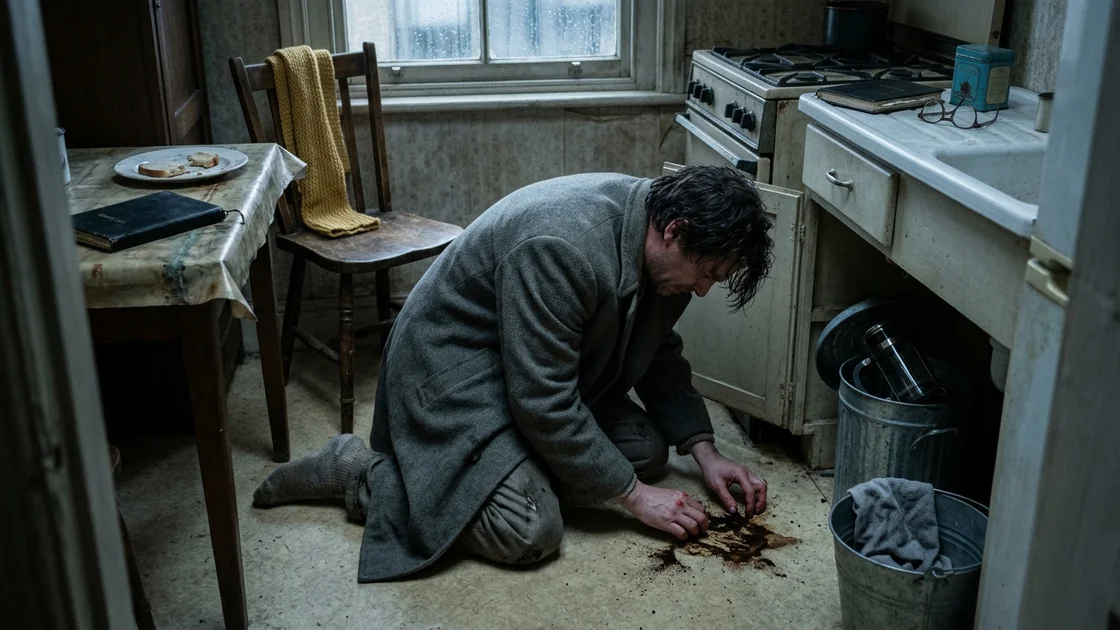
Arthur Finch spent seven years building a life with Clara, but it took less than thirty seconds of unvarnished malice on a rain-slicked Tuesday morning to demolish everything decent he had ever given her. Their fight began over a cracked glass carafe and unwashed coffee grounds, an inconsequential domestic irritation that caught fire against the dry timber of mutual fatigue, financial anxiety, and the quiet resentments of a long winter. In the hallway, as she reached for her raincoat, Arthur hurled the unforgivable sentence he would spend the rest of his life fruitlessly wishing to claw back: that he was sick of the sight of her, that she was an anchor dragging him down, and that he wished she would simply disappear and leave him in peace. Three hours later, while Arthur was still nursing his petty grievance at his desk, a cast-iron lintel gave way at the municipal transit restoration project where Clara worked as a preservation engineer, crushing her beneath two tons of masonry and instant silence. What followed was not a clean tragedy, but a protracted, agonizing reckoning with a ghost who could never offer absolution, leaving Arthur stranded in a home thick with her unfinished routines, suffocated by the awful permanence of his own final words.
I. The Anatomy of Seven O'Clock
The radiator in the front hall had a valve that wheezed like a dying animal every time the boiler kicked on. For three winters, Arthur had promised to repack the stem with graphite twine, and for three winters he had merely kicked the brass elbow with the heel of his work shoe whenever the whistling grew intolerable.
On that Tuesday in mid-November, the sound began at six-forty. Outside, the light was the color of a bruised zinc washbasin. A wet, sullen sleet struck the kitchen window at an angle, sticking to the glass before sliding down in greasy, gray threads.
Arthur stood in front of the two-burner gas range, his woolen socks damp along the rims where the draft crept beneath the baseboards. He had not slept well. A dull throbbing sat behind his right temple, the residue of three hours spent staring at the blue ceiling of their bedroom while Clara breathed in the slow, oblivious cadence of the deep-sleeping. Every small thing was already an abrasion: the cold linoleum against his arches, the milk that smelled faintly of the plastic carton, the fact that the local council had voted down the historic district subsidy for his architectural appraisal firm the night before.
Clara came into the kitchen at seven-ten. She was already dressed in her field gear: heavy duck canvas trousers, thick wool socks, and a dark blue turtleneck that had frayed around the cuffs. Her hair was pulled back into a hasty, knotted coil held by a pair of amber-colored acetate pins.
She did not say good morning. She never did when she was on the morning shift for the West End viaduct project; her mind was always an hour ahead of her body, calculating stress loads, transit schedules, and the sheer perversity of Victorian mortar. She walked straight to the counter, reached for the glass French press, and lifted it by the black plastic collar.
The bottom fell out.
It did not shatter with a grand crash. It parted with a soft, dull tink, like an icicle snapping off an eave. A dark slurry of cold, sodden grounds and sour water from the previous afternoon emptied across the cream-colored tile, splashing up against the kick-plates of the cabinets and soaking the toes of Arthur’s socks.
Arthur froze, the butter knife in his hand hovering over a half-toasted slice of rye.
Clara stood holding the neck of the press, her jaw set, looking down at the dark, sludgy fan spreading across the floor. She made a sharp, clicking sound with her tongue against her palate—a small, habitual noise of administrative disgust that Arthur had come to loathe more than open shouting.
"I asked you to rinse that last night," she said. Her voice was flat, dry, already stripped of whatever warmth she possessed before sunrise.
"I didn't touch it," Arthur said. His voice was too loud for the kitchen. "I drank tea yesterday. You made coffee before you went out to the site inspection at four."
"I rinsed mine in the shop," she said, not looking up. She dropped the broken neck of the carafe into the galvanized bin beneath the sink with an unnecessary clatter. "You used it when you came home from the office. There was an inch of sediment in the cylinder. It sat there overnight. The glass was already hairline-fractured from the dishwasher, Arthur. The heat differential did it."
"The heat differential didn't do anything," Arthur snapped, setting the knife down on the breadboard so hard the wood jumped. "The thing broke because it's five-dollar junk from the pharmacy down the street that you bought because you were too stubborn to let me buy a proper stainless steel pot."
"Oh, here it is," Clara said softly, turning her back to him to retrieve the floor rag from the hook behind the cellar door. "The stainless pot. The six-hundred-dollar espresso machine we don't have the credit line for. Let's make this about the budget, Arthur. It’s seven-twelve. Let’s do the whole ledger before the kettle boils."
"It's not about the ledger, Clara. It's about you never looking where your hands are."
She stopped. The rag was in her hand, grey and frayed. She looked at him then, her hazel eyes pale and sharp in the poor light, the skin beneath them shadowed by weeks of fifty-hour shifts in the wind tunnels of the old city train sheds. There was a thin white line of old lime-mortar dust along the bridge of her nose that she hadn't scrubbed off from the previous evening.
"Say that again?" she said.
"You heard me," he said. The throbbing behind his temple flared into a bright, hot spike. "You drag half the dust of the North Ward into this flat on your boots, you leave tools on the dining table, you break three things a month because you move through rooms like you're clearing timber, and then you stand there with that sour, pinched schoolteacher face and act as if I’m the one who cracked the world."
Clara did not raise her voice. She had an engineer’s horror of wasted kinetic energy. She knelt, her knees popping under the stiff duck cloth, and began to drag the rag through the coffee sludge. Her knuckles were red from the weather.
"You have such a delicate constitution, Arthur," she murmured to the floor. "It must be an absolute agony to share eighty square meters with a person who works for a living."
"What does that mean?"
"You know what it means."
"No," he said, taking two steps toward her, his stockinged feet sliding slightly on the damp linoleum. "Tell me. Don’t do that filthy, cowardly murmur you do into your collar. Say it out loud. You've been chewing on it since Sunday."
Clara stopped wiping. She sat back on her heels, the dripping rag balanced over the lip of the zinc pail she had fetched. Her gaze went up his frame—from his soaked, grey socks to his flannel trousers, past his uncombed hair, settling on his mouth with a detachment that felt like a blade slipped between two ribs.
"I'm tired of carrying you," she said.
The silence that followed was small and complete. In the corner, the radiator gave three short, metallic taps, like a hammer striking an anvil three houses away.
"You're tired of carrying me," he repeated.
"I am tired of the complaints," she said, her voice dropping into a register of terrifying calm. "I am tired of the grand architectural projects that never leave the draft paper. I am tired of paying sixty percent of the mortgage and being told that I treat the house like a rail yard. I am tired of your moods, Arthur. You are an endless, drafty room that nobody can ever heat."
A hot, sulfurous wash rose through his chest, blinding and absolute. It was the particular fury that only exists between people who have mapped every inch of each other’s vulnerabilities and know precisely where the skin is thinnest over the nerve.
"Then stop," he spat.
Clara looked at him, her eyebrows slightly lifted.
"Stop," he said again, his hands curling into tight, shaking fists at his sides. "Stop carrying me. Stop looking at me like I'm a stray dog you picked up out of pity. You think you're such a martyr because you go out there and scrape lime off bridge piers? You're miserable, Clara. You’ve been miserable since the day your father died, and you’ve spent five years trying to make this house smell like an open grave so you don’t have to feel lonely in your own rot."
Her face went very white. Her mouth parted slightly, the upper lip pulling back just enough to show the irregular edge of one incisor.
"Arthur," she whispered. It wasn't a warning; it was an acknowledgment of a boundary crossed, a line wiped away in the mud.
"Don't 'Arthur' me," he hissed. He leaned down, his face barely two feet from hers, his voice dropping into a venomous, rhythmic cadence. "I am sick of your face. Do you hear me? I am sick of the sight of you in that hideous coat. I am sick of the smell of brick dust on your skin. I am sick of the sound of your boots. Every morning I wake up and I look at you and I think: My god, what a small, cold, barren thing I tied myself to."
Clara stood up. She did not hurry. She dropped the rag into the bucket with a wet plop. She did not look at him again. She walked past him, her shoulder brushing his flannel sleeve with enough force to turn him half an inch.
In the small entry hall, she pulled her yellow oilskin coat from the peg. It was heavy, industrial-grade vinyl, stiff from the cold hall, smelling of diesel exhaust and old river water.
Arthur followed her into the corridor. The red mist had not cleared; it was feeding on its own momentum now, that catastrophic intoxication that comes with knowing you have done something terrible and deciding to finish it thoroughly so there is nothing left to salvage.
"Go on," he said, leaning against the doorframe, watching her jam her boots into the rubber overshoes. "Run along to the sheds. Tell the foreman how hard your life is. Tell him your husband doesn't appreciate your noble sacrifice."
Clara picked up her canvas kit-bag, the brass zippers jingling in the narrow space. Her hand reached for the brass latch of the front door. Her fingers were long, the nails trimmed blunt and short, the knuckle of her thumb scarred from a chisel slip during her apprentice days in Leeds.
She did not turn around. She had her back to him, her shoulders square under the heavy yellow fabric.
"Arthur," she said, her hand resting on the cold brass. "Don't."
"Don't what?" he sneered. "Don't tell the truth? I wish you’d just stay out there. I wish you’d get on a train and keep going until you run out of island. I wish to God I didn't have to look at you tonight when the sun goes down."
He took a breath, his lungs feeling dry and scorched, like he had inhaled lime dust himself.
"I wish you were gone, Clara," he said, his voice dropping into a vicious, level rasp. "I would give anything to just have this house quiet for one damn day without you in it."
The latch clicked.
Clara pulled the door open. A gust of raw, sleet-laden air cut through the hallway, bringing the smell of wet soot, car exhaust, and damp asphalt into the dead warmth of the flat. She stepped out onto the brownstone landing, her boots making a dull rubber thud against the granite.
She did not slam the door.
That was the thing he would remember later, through all the months and years that followed: she did not slam it. She pulled it shut behind her with a steady, deliberate motion, waiting until the brass tongue seated itself into the strike plate with a soft, clean, final click.
II. The Interim
The silence that followed her departure was not the silence he had asked for; it was merely an absence of noise.
Arthur stood in the hall for several minutes, the air from the street still hanging about his ankles like pond water. His heart was hammering a furious, irregular rhythm against his ribs. His hands were still trembling, the fingernails digging into the palms until they left four pale half-moons in the flesh.
"Stupid," he muttered to the empty wall. "Stupid, stubborn woman."
He turned back to the kitchen. The mess remained: the shattered base of the French press, the pool of coffee grounds drying at the edges into a dark, crusted ring, the zinc pail with the grey rag floating in two inches of greasy water. He stepped around it carefully, his socks leaving wet, faint stamps on the dry boards of the hallway.
He went to the stove, turned the flame back on under the kettle, and made a cup of instant chicory-coffee in a thick stoneware mug that had a chip out of the base. He burned his tongue on the first sip. He sat at the small kitchen table, staring at Clara’s butter plate, where she had left three crusts of toast arranged in a neat triangle.
She'll call at noon, he thought, staring at the crusts. She always calls at noon from the site hut. She'll be cold, her hands will be stiff, and she'll want to pretend it didn't happen, or she'll make some sarcastic remark about whether I managed to clean the linoleum without an instruction manual.
He rehearsed his defense. He would not be cruel, but he would be firm. He would say: You can't talk to me about money like that, Clara. You can't treat me like an employee in this house. He would make her acknowledge that her tongue was just as sharp as his. He would concede the carafe; he would even walk down to the cookshop on Broad Street during his lunch hour and buy the heavy German enameled pot she had looked at three weeks ago. It was forty-eight pounds, which was an absurdity, but he would buy it, set it on the stove, and when she walked in at six, she would see it sitting there. That would be the truce. That was how they had operated for seven years: small brutalities followed by heavy, material apologies that sat on shelves and counters like mute monuments to their survival.
At eight-fifteen, Arthur put on his coat—a grey wool Chesterfield with an ink stain on the left pocket—and walked down the three flights of stairs to the street.
The sleet had turned into a steady, spiteful drizzle. The gutters along Cranmer Street were choked with sodden plane-tree leaves, the oily water backing up over the granite curbs in wide, brown crescents. Arthur walked with his head down, his collar turned up against his ears, avoiding the spray from the lorries that rumbled past toward the commercial docks.
His office was on the second floor of a former grain merchant’s warehouse near the canal. It smelled of damp ledger paper, turpentine, and old coal dust. Arthur shared the space with an elderly quantity surveyor named Hallowell, who spent most of the day wheezing over floor plans with a brass magnifying glass and sucking on menthol lozenges.
"Morning, Finch," Hallowell murmured as Arthur shook his umbrella in the stairwell.
"Morning," Arthur said.
He sat at his desk. Before him lay the drawings for the conversion of an old brewery in Stepney. The ink was faint, the vellum yellowed at the edges. His job was to assess the integrity of the timber framing in the loft areas—simple, repetitive work that required cross-referencing nineteenth-century warehouse regulations with modern municipal codes.
By ten o'clock, the headache behind his eyes had settled into an iron band. Every time he picked up his brass scale ruler, his fingers felt thick and clumsy.
I am sick of your face.
The sentence returned to him with the steady, hydraulic thud of a piston. It didn't sound like him; it sounded like someone else speaking through his throat, some crude, drunken ancestor he had never met.
I would give anything to just have this house quiet for one damn day without you in it.
He dipped his steel nib into the black inkwell. He had said worse things, surely. People said monstrous things when they were tired. Three years ago, when Clara had lost the portfolio for the maritime museum because of an administrative error by her junior draftsperson, she had told Arthur that his complacency was like living with a slug. She had said he was an unmade bed of a man. They had survived that. They had eaten cold mutton chops that night in the basement tavern and laughed about it by Friday.
A marriage wasn't an eggshell; it was an iron pot. You could dent it. You could drop it on the stones. It might ring ugly for an hour, but it didn't split.
At eleven-fifteen, Hallowell stood up, unwrapped a lozenge, and looked out the soot-streaked window.
"Sirens over toward the viaduct," the old man said, his voice whistling through his false teeth. "Third time in twenty minutes. Must be an oil fire at the yard."
Arthur did not look up from his ledger. "They're always having small fires down there. The railway men burn sleepers in the oil drums to keep their hands warm."
"Sounded like heavy equipment," Hallowell said, adjusting his spectacles. "Two tenders and an ambulance. Coming from the north side."
Arthur’s pen hovered over the word Strut. A tiny drop of India ink gathered on the split of the nib, fattened, and fell, creating a round, black spider on the edge of the vellum.
"Damn it," Arthur whispered.
He reached for the scraping knife to lift the blot before it set. His thumb was shaking slightly. He pressed the blade to the paper, but his hand jerked, and the sharp steel cut a clean, diagonal slit through the yellowed linen weave of the page.
He stared at the tear. A strange, cold prickle began at the back of his neck, moving down between his shoulder blades like an ant crawling over cold grease.
She hasn't called.
It was only eleven-thirty. She never called before twelve. Sometimes it was twelve-thirty if the site superintendent was running the concrete pour late. There was no reason for her to call. In fact, given the way they had parted, it would be unnatural for her to call early. She would want him to stew. She was very good at letting him stew; she possessed an enormous, glacial patience that could hold an argument in suspension for forty-eight hours without losing a degree of its chill.
At twelve-ten, the telephone on the corner desk began to ring.
It was an old black Bakelite instrument with a heavy brass bell inside. It had a sharp, urgent ring that always made Hallowell jump. The surveyor reached for it, his yellowed hand moving slowly through the grey light of the office.
"Finch and Hallowell," the old man wheezed into the mouthpiece.
Arthur sat very still, the scraping knife still held between his thumb and forefinger.
Hallowell listened. He did not say anything for five seconds. His watery blue eyes shifted across the room, leaving the calendar on the wall and sliding over toward Arthur’s desk. They did not meet Arthur’s eyes; they stopped at his collarbone.
"Yes," Hallowell said. His voice had lost its whistling cadence; it sounded thin, papery. "He's here. Just a moment."
He held the receiver out across the mahogany table. He did not say It's for you, and he did not say who was calling. He simply held it with both hands, as if it were a wet, heavy stone he was desperate to drop.
Arthur stood up. His knees felt hollow, the joints loose. The linoleum beneath his feet seemed to have the same slick, greasy consistency as the kitchen floor that morning.
He took the receiver. It was warm from Hallowell's palm.
"Arthur Finch."
"Mr. Finch?" The voice was a woman’s, but it was not Clara’s. It was younger, high-pitched, strained through a tinny local exchange, punctuated by the loud, rhythmic thump-thump-thump of a compressor running somewhere in the background. "This is Miller. From the site office at the North Vaults. Mrs. Finch’s section."
"Yes," Arthur said. He could hear his own pulse in the earpiece, like an iron bar striking a rail. "Clara left her keys?"
"Mr. Finch, there’s been an accident at the fourth pier," the girl said. She was speaking too fast, the words tumbling over each other like gravel sliding down a chute. "The south arch gave way during the shoring. About twenty minutes ago. The superintendent says you need to come down. Right now, please. To the St. Jude’s emergency entrance."
"The south arch," Arthur said. His tongue felt thick, like a dry sponge. "She wasn't under the south arch. She was doing the mortar tests on the north pier."
"She went under to check the jacks," the girl sobbed. It was the first time Arthur realized she was weeping; the sound had seemed like mechanical interference until the breath broke. "The jacks slipped, Mr. Finch. Please. You have to come to the hospital."
"Is she..."
The line clicked. A long, low hum filled the receiver. Arthur stood with the heavy black plastic pressed against his ear, listening to the sixty-cycle drone of the national grid, until Hallowell reached out with a trembling, liver-spotted hand and gently pushed the cradle down.
III. The Architecture of Granite
The emergency waiting room of St. Jude’s smelled of wet wool coats, carbolic soap, and cheap floor polish that had dried without being buffed.
A sister in a stiffly starched white cap sat behind a high mahogany counter with a brass grille, like a clerk at a municipal gas office. When Arthur gave his name, she did not look at a ledger. She simply stood up, lifted the hinged section of the counter, and said, "Come with me, Mr. Finch."
They went down a long, narrow corridor with pea-green tiles on the lower half of the walls and yellowed plaster on the upper. The air was colder here; it tasted of damp stone and the sharp, vinegar tang of formalin. Every ten yards, an unshaded electric bulb hung from a twisted cord, casting circular yellow pools on the floorboards.
Arthur followed her back. He was still wearing his grey Chesterfield coat, but he had lost his hat somewhere between the office and the tram stop. His hair was plastered to his forehead by the sleet. His left trouser leg was spattered with black mud up to the knee where a dray had cut too close to the pavement on High Street.
"She was very quick," the doctor said twenty minutes later.
They were in a small room that contained nothing except two bentwood chairs, a low pine table with an enameled water jug, and an iron radiator that was cold to the touch. The doctor was a young man with red hair cut very short and dark, bruised hollows under his eyes. He had not taken off his white rubber apron; there was a smear of dried brown mortar dust across the bib, mixed with another substance that had turned the color of stewed plums.
"What does that mean?" Arthur asked. He had not sat down. He stood with his back against the cold lime-washed wall, his hands shoved deep into his coat pockets.
"The masonry was four courses of blue engineering brick backed with granite rubble," the doctor said. He spoke with the slow, clinical patience of someone who had already explained the physical mechanics of gravity to three families that week. "When the jack kicked out, the entire haunch dropped about twelve feet. It was roughly eighteen tons of dead weight, Mr. Finch. Her skull was fractured at the base, and the third and fourth cervical vertebrae were crushed instantly. She did not have time to understand that the timber had failed. She didn't suffer."
She didn't suffer.
It was the standard coin. The small, smooth pebble the medical profession placed in the mouths of the surviving to keep them from howling in the halls.
"I need to see her," Arthur said.
The doctor looked down at his own boots. They were leather boots with thick wooden soles, reinforced with iron toe-caps, like the ones Clara wore.
"I wouldn't advise it," he said gently. "Not just yet. The mortuary attendants are still... cleaning the lime away. The dust is very caustic, you see. When it mixes with... with moisture, it burns the tissue. Her face was struck by the timber strut before the brick fell. It isn't... it wouldn't be a good memory for you, Mr. Finch."
"I don't want a good memory," Arthur said. His voice was cracked, a dry rattle from the bottom of his throat. "I want to see my wife."
They took him through two sets of swing doors with oval brass push-plates that were greasy from thumbprints.
The mortuary was a large, low-ceilinged vault below the street level. Three gas jets burned in wire cages along the brick wall, their flames whistling faintly in the draft. In the center of the room, four slate slabs rested on brick piers. Only one was occupied.
They had drawn a coarse grey linen sheet up to her chin.
A nurse, an older woman with large, red hands and a quiet, heavy tread, stood by the head of the slab. As Arthur approached, she reached out with two fingers and smoothed a stray lock of Clara’s hair away from her forehead.
The forehead was intact. It was the only part of her face that looked like Clara. It was pale, the color of lard, with that familiar, faint tracing of blue veins near the left temple where the skin was always translucent. But her nose had been flattened to the side, driven into the cheekbone by an impact that had purpled the entire right orbit. Her lips were swollen, split vertically in three places, and pulled back over her teeth in an expression that looked like an angry, defensive snarl.
The dust was still in her eyelashes. It was grey, dry lime-dust, clinging to the fine hairs like frost on winter grass.
Arthur stood by the slab. His hands remained in his pockets. He did not touch her. He had the terrible, superstitious conviction that if his skin met hers, the heat of his body would activate the lime, or worse, that she would open those ruined, blood-shot eyes and finish the sentence she had left hanging on the landing three hours ago.
"Clara," he whispered.
The room smelled of wet stone, carbolic, and that faint, sweetish undertone of an abattoir that no amount of scrubbing could lift from the floor flags.
"Clara," he said again.
The nurse looked at him with an expression of professional pity that was far more terrible than disgust. "She was a very brave woman, sir. The foreman said she was trying to get the boys out from under the staging when the timber groaned."
"She wasn't brave," Arthur said. The words came out before he could stop them, harsh and jagged. "She was stubborn. She was just too damn stubborn to get out of the way."
The nurse pulled her chin back slightly, her mouth tightening into a thin, censorious line. She thought he was a brute. She thought he was an unfeeling, middle-class clerk who had never loved the woman on the slate. She could not know that he was drowning in the sheer, monstrous absurdity of the fact that this woman—who had argued with him about five shillings’ worth of molded glass at seven-ten—was now a specimen of forensic pathology at two in the afternoon.
"You may have five minutes, Mr. Finch," the doctor said from the doorway.
"No," Arthur said, turning away from the slab. "Cover her up."
"Sir?"
"Cover her up," he shouted, his voice cracking into a shrill, hysterical register that echoed off the damp brick vaulting. "You think I want to look at that? Put the sheet back over her. Put it over her face."
He did not wait for them. He turned and stumbled toward the swing doors, his shoulder hitting the frame with a dull thud that sent a sharp pain down his arm. He ran down the pea-green corridor, past the sisters’ desk, past the men sitting on the benches with their heads wrapped in yellowed lint, and out through the double doors into the rain.
IV. The Kitchen Floor
The house was cold when he returned at four-thirty.
The fire in the sitting room grate had gone out while he was at the office, leaving a small heap of grey ash that the draft from the chimney was slowly scattering across the hearthrug. The smell of wet soot was everywhere.
Arthur did not take off his coat. He walked straight through to the kitchen.
The broken French press still lay where Clara had dropped it in the bin. The puddle of coffee grounds had dried entirely now, contracting into a cracked, dark mosaic that adhered to the linoleum like dried blood.
He stood in the center of the room, exactly where he had stood nine hours before when he had told her that he was sick of her face.
The room was full of her things. Her spare pair of spectacles lay on the dresser beside the blue tin of tea. Her yellow wool scarf—the one she had knitted herself during the long rail strike two winters ago, full of dropped stitches and uneven tension—hung over the back of the kitchen chair. On the small deal shelf above the stove sat her three notebooks, bound in black oilcloth, filled with hundreds of pages of pencil drawings: bridge abutments, beam deflections, calculations for granite footings, and notes on hydraulic lime.
He walked over to the shelf and pulled down the top notebook.
He opened it at random. The handwriting was small, upright, and aggressive. Clara never used a soft pencil; she preferred a 3H that dug deep into the paper, leaving grooves that remained visible even if the graphite was erased.
Nov 8. Pier 4. West abutment shows vertical displacement of 3mm along the mortar line. Grout injection failed to consolidate the core rubble. Foreman thinks we can wedge it with oak shims. Told him he was an idiot. If the frost gets behind the granite before the lintel is seated, the whole thing will shear.
She had known.
Arthur stared at the page until the lines of technical prose blurred into grey smudges. She had known the pier was unstable. She had known the timber was suspect. She had gone down into that cellar anyway, with her oilskin coat and her blunt fingers and her 3H pencils, because she was incapable of leaving a cracked thing alone until she had forced it to hold its weight.
And the last thing she had heard in this world—the last piece of human speech delivered to her ears before the granite took her—was his voice telling her that she was an unmade bed, an anchor, a cold, barren thing that he wished would disappear into the sea.
He dropped the book onto the table. It fell open against Clara’s butter plate, scattering the three dried crusts of rye bread across the oilcloth.
He fell to his knees.
The linoleum was cold, biting through the damp fabric of his trousers. Arthur reached out with his bare hands and began to scrape at the dried coffee grounds with his fingernails.
He didn't use the rag. He didn't fetch the zinc pail. He clawed at the dried brown crust with his thumbs, his nails tearing against the rough grain of the floor until the skin beneath the quick began to bleed. He gathered the dry, black flakes into a small, miserable heap between his palms, his breath coming in short, ragged gasps that sounded like a dog choking on a bone.
"Clara," he choked out, his forehead coming down against the cold edge of the kitchen cabinet. "Clara, I didn't mean it. Clara, please. I was just tired. Clara, listen to me. I was just tired."
The radiator in the hall gave its familiar, long-drawn whistle, the valve rattling in its housing as the pipes expanded with the evening steam. It sounded precisely like a woman laughing through her teeth from three rooms away.
V. The Visitors
They came in pairs, like bailiffs.
On Thursday, it was Clara’s elder sister, Eleanor, and her husband, Hugh. Eleanor was five years older than Clara and had the same long, high-bridged nose, but without Clara’s intelligence; her face had settled into an expression of permanent, mild grievance that seemed to have been copied from an unfashionable print.
She sat on the sofa in the front room, her black crepe skirts spread out around her like an inkstain, holding a cup of tea that had gone grey because Arthur had forgotten to buy fresh milk.
"She always was too headstrong," Eleanor said, dabbing at the corner of her eye with a black-bordered handkerchief. "Father told her that an engineering yard was no place for a girl from a decent family. But she wouldn't listen. She never listened to anyone, Arthur. You know how she was."
"Yes," Arthur said. He was sitting on the piano stool, his hands clasped between his knees. He had not shaved in three days, and his collar was limp and grey around his neck.
"You were so patient with her," Eleanor continued, her voice dropping into a tone of greasy condolence that made Arthur’s stomach heave. "Many men wouldn't have put up with it. The hours she kept. The way she dressed. Never being home to cook an evening chop. Hugh was just saying in the carriage how wonderful you were, Arthur, letting her have her little profession."
Hugh, who was a timber factor in Grimsby and smelled faintly of wet bark and tobacco, nodded solemnly from his chair by the cold hearth. "A very modern arrangement," Hugh rumbled. "Very generous of you, Finch. Very generous indeed."
Arthur looked at Hugh’s heavy, clean hands resting on his broad knees. He had a sudden, terrifying vision of reaching across the pine table, picking up the heavy glass inkstand, and driving the brass corners of it into Hugh’s round, smug forehead.
Tell them, a voice whispered behind his ear. Tell them what you said to her on Tuesday morning. Tell Eleanor that while she was eating her toast in Grimsby, you were leaning over her sister and telling her that she was a cold, barren thing that you wished would rot.
The words rose in his throat, thick as bile. He could see their faces: the horrified stiffening of Eleanor’s neck, the sudden, awkward withdrawal of Hugh’s heavy hand, the beautiful, clean horror that would replace this nauseating wall of sympathy. If they knew, they would hate him. If they hated him, he would have something solid to lean against. He could live inside their hatred; it would be an architecture he understood, a structure with corners and load-bearing walls.
This sympathy was a swamp. It was a warm, suffocating mud that was slowly filling his nostrils and ears, burying him in a version of his marriage that had never existed: the saintly, indulgent husband and the spirited, tragic girl who had died bravely in the line of duty.
"We had an argument," Arthur said. His voice was very quiet, barely carrying over the wheeze of the front hall radiator.
Eleanor stopped dabbing her eye. "What's that, dear?"
"We had an argument," he said, looking straight at the black-bordered handkerchief. "On Tuesday. Before she went out to the site."
Eleanor gave a little, dismissive flutter of her fingers. "Oh, Arthur. Don't torment yourself. Every couple has their little words. I remember the morning before my Mother went into the infirmary with the dropsy, we had a terrible dispute about the wash-house boiler. Hugh and I have words every market day, don't we, Hugh?"
"Aye," Hugh grunted. "Man can't agree on every load of larch."
"You don't understand," Arthur said, his fingers digging into his knees through the grey wool of his trousers. "I told her—"
"Arthur, stop," Eleanor said firmly, her tone shifting instantly into that bossy, elder-sister register that Clara had spent twenty years avoiding. "I will not have you making yourself ill with morbid fancies. Clara knew how much you loved her. That girl was never in any doubt about her home. She was proud of you, Arthur. Only last Michaelmas she wrote to me and said that you had the finest eye for an eighteenth-century ceiling of any man in the county. Those were her very words: the finest eye."
Arthur closed his eyes.
Beneath his lids, he saw Clara’s mouth—not the swollen, split thing on the slate slab, but the sharp, pale mouth of seven-twelve on Tuesday, curling with that cold, dry detachment: You are an endless, drafty room that nobody can ever heat.
She hadn't told Eleanor about the eighth-century ceilings because she was proud of him; she had told Eleanor because she was maintaining the facade of their life, just as she pointed the masonry on the viaduct to keep the rain from rotting the core. She had been preserving the appearance of their marriage because it was less work than admitting to her family that she had married an appraisal clerk who spent his evenings nursing sixty-pound grievances over broken crockery.
"She was very generous," Arthur whispered.
"There now," Eleanor said, rising from the sofa with a rustle of heavy black silk. "We’ll leave you to your rest, Arthur. We’re staying at the George until the service on Saturday. Hugh has arranged for the bearers. Four men from the firm, and two of her boys from the yard. The superintendent said the men were very keen to carry her. They thought the world of her down there, you know. They called her 'The Lady with the Plumb-line.'"
Arthur sat motionless on the piano stool until he heard the front door click shut behind them.
Then he went into the hallway, pulled his overcoat off the peg, and walked out into the dark.
VI. The Geography of the Viaduct
The North Vaults were three miles from the flat, past the gasometers and the timber basins where the canal joined the tidal docks.
Arthur walked the entire way through a fog that had rolled in off the river at dusk—a thick, yellow-grey pea-souper that smelled of sulfur, damp tallow, and horse manure. The street lamps were merely orange blurs suspended in the gloom, their light not reaching the greasy cobblestones beneath his feet.
The restoration site was enclosed by eight-foot hoardings of rough-sawn pine, covered in peeling theatrical bills and advertisements for cattle dip. A red hurricane lantern hung from a nail beside the wicket gate, casting a bloody circle across the mud.
Arthur pushed the gate open. It was not locked. The night watchman was either asleep in his brazier-hut or drinking in the public house on the corner of Wharf Street.
The viaduct rose out of the mist like the skeleton of a stranded leviathan. It had been built in 1848 to carry the freight lines from the northern collieries down to the river quays—twenty-six semi-circular arches of purple engineering brick faced with massive blocks of millstone grit. The council had condemned it four years ago, but Clara’s preservation society had raised the money to shore up the foundations and turn the upper deck into a public walk.
Arthur walked through the sea of mud toward Pier Four.
The wreckage had not been cleared. The government inspector had been there on Wednesday afternoon, and the whole bay was cordoned off with hemp rope tied to iron survey pins.
Two portable gas-flares hissed on their tripods, throwing long, shuddering shadows across the fallen masonry. The collapse had been total. The entire south-western quadrant of the arch had peeled away from the spandrel wall, leaving a jagged, crescent-shaped gap through which the dark, fog-laden sky was visible.
At the foot of the pier lay the granite blocks—three-ton cubes of grey stone with their lime-mortar beds torn open, exposing the dry, pinkish rubble of the interior core. Among them lay the splintered remains of the timber staging: twelve-inch square baulks of pitch-pine that had been snapped like matches, their grain twisted and frayed where the immense load had sheared them off.
Arthur ducked under the hemp rope. His boots sank four inches into the slurry of wet clay and lime dust that surrounded the heap.
He walked up to the face of the fallen lintel.
There was a dark, irregular stain on the upper edge of one of the granite blocks—a stain that had been half-washed by thirty-six hours of November drizzle, leaving a faint, rust-colored smear across the grey quartz crystals of the stone.
He reached out his bare hand and pressed his palm against the rock.
The granite was ice-cold. It had that specific, dead weight that masonry acquires when it has sat in the earth for a century—an absolute, indifferent solidity that did not care about the women who measured it or the men who wept against it.
"Why didn't you step back?" he asked the stone. His voice was lost in the hiss of the gas-flare. "You knew the shoring was rotten. You wrote it down in the black book. Why didn't you just take two steps backward into the yard?"
He knew why.
She had stayed because she was angry. He knew her with the terrible, intimate clarity that only seven years of domestic friction can breed. She had gone down into that wet hole with his words ringing in her ears: I wish you were gone, Clara. I wish I didn't have to look at you.
She had been furious, cold, reckless with that particular brand of female rage that does not shout, but sets its jaw and goes toward the dangerous thing with a stiff neck, just to prove that it is stronger than the coward who stayed at home in his slippers. She had stayed under that timber because leaving the trench would have felt like yielding to him. She had stayed to show him what work was. She had stayed because dying in her boots under two tons of honest stone was better than going back to Cranmer Street at six o'clock to look at his miserable, resentful face across the table.
He had killed her just as surely as if he had kicked the timber strut himself.
Arthur sank down into the mud at the base of the pier, his overcoat soaking up the cold water from the slurry. He leaned his cheek against the rough surface of the millstone grit. The quartz bit into his flesh, sharp and clean.
"I didn't want the house quiet," he whispered to the stone. "Clara. I swear to God, I didn't want it quiet."
The gas-flare hissed. A drop of condensed water fell from the iron framework fifty feet above and struck the crown of his bare head, cold as a coin straight from the snow.
VII. The Funeral of an Honest Woman
The chapel at the municipal cemetery was heated by two coke braziers that produced more smoke than warmth. The air was blue with it, smelling of dry coke-fumes and damp black wool.
There were sixty people in the pews—far more than Arthur had expected.
The men from the viaduct sat together in the back three rows. They had washed their faces, but the red clay of the North Ward was embedded so deeply in the pores around their nostrils and ears that they looked like men carved from terracotta. They held their flat caps between their knees, their huge, scarred hands resting on their thighs, looking down at the red-and-black floor tiles with the sheepish, uncomfortable solemnity of working men trapped in a church.
The foreman, a man named MacNair with a grey walrus mustache and an empty sleeve pinned to his jacket, walked up to Arthur before the service began.
"Mr. Finch," the old man said, his voice a low, gravelly rasp.
Arthur looked up from the front pew. He was wearing his black wedding suit, which had grown two inches too large around the waist since Tuesday.
"Mr. MacNair," Arthur said.
"We brought this," the foreman said. He reached into his coat and pulled out an object wrapped in a clean, red-and-white spotted handkerchief. "The lads thought you ought to have it. It was in her kit-box under the bench."
He unwrapped the cloth. Inside lay Clara’s six-inch brass folding rule. It was an old tool, yellow with age, the inches marked in hand-engraved lines that were faint from forty years of use—her father’s rule, the one he had given her when she won the scholarship to the technical institute. The brass hinge was polished bright from the oil of her fingers.
Arthur took it. The metal was cold, but as he held it in his palm, it took the heat of his skin instantly.
"She was a rare one, sir," MacNair murmured, looking past Arthur toward the plain oak coffin that sat on the tressels before the altar. "Never asked a man to go where she wouldn't put her own foot first. When the timber started to talk—about ten minutes before the drop—I told her to get up the ladder. She told me to mind my own business, that she had two more levels to shoot before the light went."
MacNair shook his head, his walrus mustache twitching. "A terrible obstinate woman, Mr. Finch. But there wasn't a man on the gang wouldn't have pulled a wagon for her through the snow."
"Yes," Arthur said. "She was obstinate."
"God rest her," the foreman said, touched his forehead with two fingers, and shuffled back to his men.
The curate, a pale young man with teeth like pumpkin seeds who had never spoken to Clara in his life, read the service from the common book. He spoke of the sister who had been called home by the Great Architect. He spoke of her purity of purpose, her Christian humility, and the great reward that awaited the industrious servant in the heavenly mansions.
Every word was an insult.
Clara would have despised every sentence. She had not believed in heavenly mansions; she had believed in hydraulic lime, Roman cement, and the fact that a six-to-one mix was the only thing that would hold an arch in a tidal reach. She had not possessed Christian humility; she had been sharp, sarcastic, impatient with fools, and fiercely proud of the fact that she could calculate the deflection of a lattice girder faster than any man in the borough surveyor's department.
Arthur sat through the prayers with the brass rule gripped so tightly in his fist that the corners cut into his palm.
He did not look at the coffin. He looked at the curate’s shoes. They were cheap shoes with paper-thin soles, the leather cracked across the toe-caps. Clara would have noted that in three seconds. She would have leaned across the pew and whispered: Two shillings from the tally-man. The heels will be off them before Easter.
The thought came with such violence that Arthur nearly laughed aloud. A short, dry bark escaped his lips—a sound like a dog snapping at a fly.
Eleanor, sitting beside him, reached out with her gloved hand and laid it over his knuckles, her face twisted in that insufferable, pitying grimace.
"Hush, Arthur," she whispered. "Hush, my poor boy. Let it out. Don't try to hold it in."
Arthur pulled his hand away from hers as if she had laid an adder against his wrist. He did not look at her. He shoved the brass rule into his coat pocket, stood up, and walked down the aisle before the curate had finished the benediction.
He walked past the men from the viaduct, who shifted their boots and lowered their eyes as he passed. He walked through the open porch, past the undertaker’s men who were smoking Woodbines behind the yew hedge, and out onto the broad, gravel road that led between the ranks of grey granite headstones toward the city gate.
He did not stay to see her lowered into the clay. He could not watch them drop four shovels of wet loam onto the oak lid. He had already seen the granite do its work; he did not need the parish to complete the transaction.
VIII. The Ledger of Days
A month after the funeral, the frost came down in earnest.
The city froze into an iron hardness. The gutters along Cranmer Street were filled with grey, ridged ice that did not thaw even at noon. The coal wagons went up the street with their horses’ hooves wrapped in sacking to keep them from slipping on the cobbles, the drivers swearing into their woolen mufflers with voices like gravel being ground in a mortar.
Arthur did not return to the office.
Hallowell had come to the flat twice during the first fortnight, wheezing on the landing, offering to bring the brewery drawings down so that Arthur could work from the sitting room table.
"Take your time, Finch," the old man had said, his watery eyes darting nervously toward the dark hallway behind Arthur’s shoulder. "A great blow. A terrible, unexpected blow. The council has extended the deadline on the Stepney job until February. There’s no hurry. No hurry at all."
On the third week, Hallowell sent a clerk with Arthur’s balance of salary in a small manila envelope, along with his brass scale ruler, his penholders, and his box of drawing pins. There was a brief note in Hallowell’s spidery, mid-Victorian copperplate: It is perhaps better for all parties if you consider your partnership dissolved by mutual convenience. The work requires a certain... clarity of attention that we cannot expect at present.
Arthur put the envelope on the mantelpiece beside the tea tin. He did not open it.
His days took on a rigid, narrow geometry.
He woke at six-thirty, before the light. He did not light the fire in the grate; coal was four shillings a hundredweight, and he had a horror of spending the money from the manila envelope. He would pull his grey Chesterfield coat on over his clothes and sit in the kitchen, staring at the floor.
The floor was spotless now.
Two days after the funeral, Arthur had bought a bottle of spirits of salts and a stiff scrub-brush with brass bristles from the oilman on High Street. He had spent fourteen hours on his knees, scouring every square inch of the cream-colored linoleum until the pattern was entirely eaten away, leaving only a rough, chalky white surface that smelled permanently of acid and old sulfur. There was not a trace of coffee left. There was not a speck of river mud. There was nothing except the bare, bleached ground.
He did not replace the French press.
He bought a tin kettle from the hardware stall for elevenpence and boiled his chicory water in that, drinking it straight from the pan to save washing a cup. He ate bread and salt margarine, standing at the sink, looking out at the brick chimney-pots across the lane.
His entire life had contracted into the three minutes that had occurred between seven-twelve and seven-fifteen on Tuesday, the seventeenth of November.
He had become an archivist of those minutes.
He sat for hours in the horsehair armchair, his eyes fixed on the doorframe of the hall, reconstructing the dialogue with the precision of an inquisitor. He would play the conversation forward, word by word, inflection by inflection.
I am tired of carrying you.
Why had she said that? It wasn't the money. Clara didn't care about money; she gave five-shilling pieces to the apprentice boys who had holes in their stockings. It was the weight. It was the fact that he had sat in this room for five years, complaining about the damp, complaining about the clients, complaining about the way the light fell through the north window, while she went out into the cold and built things that could be touched with a hammer.
And then his answer:
I am sick of the sight of you.
He tried to change it.
In the dark of the sitting room, with the sleet striking the glass like birdshot, he would whisper the alternate lines into the empty air:
I'm sorry, Clara. The carafe doesn't matter. Let me fetch the mop.
Clara, sit down. Your hands are blue. I’ll make the tea.
Clara, stay.
He said them hundreds of times. He said them in a dozen different voices: soft, pleading, firm, cheerful. He tried to imagine how her face would have changed if he had spoken the words that a decent man would have spoken. She would have stopped at the hall peg. She would have turned around, her yellow oilskin coat half-buttoned, her amber pins slipping in her hair. She would have looked at him with that slow, searching expression she used when she was checking a plumb-line—suspicious at first, then cautious, and then that small, crooked softening of the left side of her mouth that meant the danger had passed.
"Let me take your boots off," he whispered to the empty chair. "They're wet, Clara. Sit down by the fender and let me pull the boots off."
The house gave no answer.
The radiator valve whistled. A horse stumbled on the ice in Cranmer Street, the iron shoes striking three desperate, metallic sparks against the stones before the driver brought the whip down with a wet crack.
The words could not be unsaid.
That was the monstrous, immovable fact that sat in the room with him like an iron pillar. You could tear down a bridge. You could burn a warehouse to the ground and clear the foundations with picks. You could erase a line from a vellum sheet with a steel scraper until not a grain of ink remained.
But a sentence spoken into the ear of another human being could not be lifted. It existed forever in the medium of time. It had traveled across the three feet of space between his mouth and her ear; it had struck her tympanic membrane; it had been translated into nerve impulses; it had altered the chemistry of her brain; it had entered her memory.
She had died with that sentence intact inside her.
When the granite lintel fell, when the third cervical vertebra snapped, when the world went black for Clara Finch under eighteen tons of millstone grit, those words were the current inventory of her heart. There had been no time for a revision. No time for an addendum. He had sealed the envelope with poison, and the grave had posted it before he could tear it up.
IX. The Encounter
In late January, the thaw arrived, not with sun, but with a warm, greasy drizzle that turned the snow into grey, porridge-like slush that choked the carriage-ways.
Arthur was forced to leave the flat to buy paraffin. His lamp had burned dry the night before, and the darkness of the front room had become intolerable—a thick, suffocating thing that smelled of his own unwashed clothes and the damp plaster behind the wallpaper.
He walked down High Street with his five-gallon tin can swinging from his hand. The brass rule was in his coat pocket, as it always was now; he carried it like a rosary, his thumb constantly rubbing the smooth, worn face of the twelve-inch mark.
At the corner of St. Jude's Lane, he saw MacNair.
The foreman was standing outside the ironmonger’s shop, talking to a carter who was unloading sacks of lime from a flat-bed dray. MacNair had his pipe in his teeth, his empty sleeve tucked into the pocket of his reefer jacket, his walrus mustache yellow with nicotine around the mouth.
Arthur’s first instinct was to turn into the alley behind the baker’s. But MacNair had already seen him. The old man took the pipe from his mouth, spat into the slush, and stepped directly into Arthur’s path.
"Finch," he said.
"Mr. MacNair," Arthur muttered, keeping his head down, looking at the foreman’s grease-stained leather gaiters.
"You look like a ghost that’s been dug up by the pigs," the old man said without ceremony. He had the blunt, brutal directness of the northern yards, where manners were considered a waste of daylight.
"I haven't been well," Arthur said. "The cold."
"Aye. The cold." MacNair looked at him with his sharp, faded blue eyes—eyes that had spent forty years judging whether a crane cable was fraying under thirty hundredweight. "You're sitting in that house rotting, aren't you?"
Arthur made to move around him, but the foreman shifted his heavy boots, blocking the narrow pavement.
"Leave me alone, MacNair," Arthur said, a thin, shrill edge of panic rising in his chest.
"I won't," MacNair said. "She wouldn't have let you sit there like an unwashed potato, and I won't watch it either. Come in here."
He seized Arthur’s arm with his single, enormous hand. His grip was astonishing; it was like being caught in an iron clamp. He hauled Arthur through the door of the Grapes, a small, dark beerhouse that smelled of stale ale, sawdust, and the wet dogs that lay under the benches by the hearth.
MacNair pushed him into a booth with a high wooden settle that cut off the view from the bar. He dropped two copper coins on the table and barked at the boy for two pints of porter.
"Drink that," the foreman said when the thick, black beer arrived with a yellow head.
Arthur looked at the glass. "I don't want it."
"Drink it," MacNair repeated, leaning his elbows on the greasy pine table. "You're shaking like a horse with the staggers. You haven't had six square meals since we put her in the ground."
Arthur took a sip. The porter was bitter, cold, and thick. It tasted of roasted malt and iron-tincture, burning his throat as it went down.
"MacNair," Arthur said, his hands flat on the table, clutching the rim of the glass for balance. "I have to ask you something."
The old man watched him through the smoke of his clay pipe. "Go on."
"The morning she died." Arthur’s voice was barely a whisper. He had to lean forward until his chest was against the table edge. "When she came to the site. At eight. Did she... did she say anything?"
"Say anything about what?"
"About me. About the house." Arthur’s throat felt as though it were lined with sand. "Did she look... did she seem distracted?"
MacNair took his pipe from his mouth and held it between his yellow teeth. He looked down at the scarred wood of the table, where generations of draymen had carved their initials with pocket-knives.
"She was in a foul temper," the foreman said simply.
Arthur’s heart gave a sickening, vertical lurch. "She was?"
"Aye," MacNair said. "She came into the office at eight-ten, twenty minutes late. She threw her bag on the desk so hard she broke three sticks of chalk. Her hair was coming down. She looked like she’d walked through a hedge backward."
"Did she say why?"
"She said people were fools," MacNair replied, looking Arthur straight in the eye. "She said the whole world was full of men who couldn't see an inch beyond their own noses, and that she had to spend her life picking up the broken glass after them."
Arthur let out a long, ragged breath that sounded like a groan. He covered his face with both hands, his dirty fingernails digging into his forehead.
"God," he wept into his palms. "My God."
MacNair did not move. He sat with his single arm resting on the table, the clay pipe sending up thin blue coils of smoke into the dark air of the booth.
"She was mad at you," MacNair said. It wasn't a question.
Arthur didn't answer. He could only nod, his shoulders shaking beneath the thin wool of his coat.
"She was always mad at you, Finch," the old man said softly. "And you were mad at her. You think we didn't know that down at the yard? A woman doesn't work twelve hours a day in the mud because her sitting room is full of roses and singing birds. She worked because she was restless. She had a devil in her, that girl. She wanted things square, and she wanted things plumb, and when she found out that you were just a common, crooked piece of timber like the rest of us, it gallled her."
Arthur lifted his head. His eyes were red, the skin around them yellow and dry as parchment. "I told her I wished she was dead, MacNair."
The words were out.
They sat on the greasy beerhouse table between the two glasses of porter, black and hideous and bare.
Arthur waited for the foreman to pull back. He waited for the old man to stand up, spit in his face, and walk out into St. Jude's Lane. He wanted it. He longed for the blow; he leaned toward it with a hungry, desperate yearning, like a frozen man leaning toward a flame that he knows will char his skin.
MacNair took his pipe from his mouth. He looked at the bowl, tapped the dottle out against the edge of the iron fender, and blew through the stem with a wet, whistling sound.
"Aye," the old man said quietly. "I told my first wife the same thing in the winter of seventy-nine. When we were living in the tenements at South Shields. She’d pawned my joiner’s planes to buy gin for her cousins from Sunderland. I told her I wished she’d drown in the Tyne."
Arthur stared at him, his mouth slightly open.
"Did she?" Arthur whispered.
"No," MacNair said, reaching into his pocket for his tobacco pouch. "She died of the smallpox three years later in the union infirmary. I was thirty miles away, working the locks on the Wear. I wasn't there to tell her anything different."
He packed the fresh leaf into the bowl with his thumb, his movements slow, deliberate, indifferent to the misery across from him.
"You think you're someone special, Finch," MacNair said, his voice dropping into that flat, northern stone-weight that took all the drama out of the room. "You think you're the first man who ever let his tongue run away with him before breakfast? You think you're the only poor devil in this parish who had an ugly word in his mouth when the roof fell in?"
"It wasn't an ugly word," Arthur choked out. "It was... it was the last thing. It was everything."
"It wasn't anything," MacNair spat. "It was just noise. It was just the steam coming out of the pot because the fire was too high. Clara knew that."
"She didn't," Arthur cried. "You said she was furious! You said she was throwing things!"
"Aye! Because she was a woman, not a stone angel on a tomb!" MacNair leaned forward, his face suddenly dark, his grey mustache bristling. "She was mad as hell at you, Arthur. She was going to come home tonight, and she was going to throw the broken bits of that pot in your face, and you were going to have a rare old row, and then by Saturday you’d have bought each other a mutton chop and gone on with it. That’s what a marriage is, you bloody fool. It ain't a church service. It’s two dogs in a cart, snapping and biting each other’s ears until the cart tips over."
The old man stood up. His single hand reached down, grabbed Arthur by the coat lapel, and hauled him half out of the booth.
"She’s dead, Finch," MacNair hissed into his face. "The arch came down. Not your mouth. The granite dropped because the ground-water had rotted the lime in forty-eight, and the company was too cheap to sink the caissons another six feet. That’s why she died. You ain't that important. Your words ain't that heavy. You’re just a clerk with an ink-pot who said a nasty thing to his missus before she went to work. Now drink your porter, go home, wash your face, and stop acting like you pulled the viaduct down with your own two hands."
The foreman let go of his coat. Arthur fell back against the wooden horsehair bench with a dull thud.
MacNair didn't look back. He took his flat cap off the peg, jammed it down over his grey ears, and walked out through the swing doors into the yellow slush of High Street, leaving the door banging behind him in the draft.
X. The Iron Pot
Arthur did not drink the porter.
He left the two copper coins on the table, picked up his paraffin can, and walked back through the thaw.
The flat was still cold, but the light had changed. The yellow fog had broken, and a pale, winter sunset was cutting through the chimney-pots, laying a long, salmon-pink bar across the kitchen linoleum.
Arthur set the paraffin can down by the pantry door.
He looked at the kitchen.
It was still bare. It was still bleached by the spirits of salts, smelling of acid and emptiness. But the quality of the silence had altered; it was no longer an accusing presence waiting for him to speak. It was simply the silence of three rooms in an old brick house on a street where horses passed and the boilers wheezed.
He walked over to the shelf above the stove.
He pulled down Clara’s second notebook—the one bound in green cloth with the corners reinforced with black leatherette.
He opened it to the middle. There were no drawings of arches here. There was a list of household expenses from three Octobers ago, written in her sharp 3H pencil:
To Arthur’s boots (half-soled) — 4s. 6d.
To paraffin — 1s. 2d.
To plaster for the scullery wall — 3s.
To Arthur (pocket) — 10s.
To the butcher (shin of beef) — 1s. 8d.
Underneath the list, she had drawn a small, vicious caricature of their landlord, Mr. Craddock, with ears like cabbage leaves and a nose shaped like a turnip. Beside it, she had written: A very small soul. He will undoubtedly go to heaven, as he would not displace enough air to be noticed in the other place.
Arthur looked at the turnip nose.
A sound came out of him—not the choked, dry bark he had made in the chapel, but something deeper, wetter, pulled up from the very bottom of his lungs. He sat down on the kitchen chair—the chair where her yellow scarf had hung—and he wept.
He wept for the carafe. He wept for the unwashed grounds. He wept for the sixty-pound German pot she had wanted and the sixty-percent of the mortgage she had paid with her red, lime-bitten hands. He wept for the cruel, small words he had spat at her in the hall, and he wept because MacNair was right: those words were not a grand tragedy. They were not an epic poem of hatred.
They were just petty.
They were the miserable, common spites of a small man who had felt small in the presence of a woman who could hold an arch together with her eye. He had wanted to hurt her because he was cold and his head ached and he didn't want to admit that he had broken the glass himself.
He had wanted to leave a scratch on her. And the world had taken his scratch and turned it into an abyss.
He sat in the darkening kitchen until the salmon-pink bar faded into a dull, leaden violet, and then into the absolute black of a winter night.
He did not light the lamp.
He reached into his pocket and pulled out the brass folding rule. He unfolded it—one, two, three joints—until the full six inches were open. He laid it flat across the blank page of her green notebook, where she had drawn the turnip-nosed landlord.
He took his pencil from his waistcoat pocket—an ordinary, soft 2B pencil that left a thick, smudged line.
He didn't write an apology. She wasn't there to read an apology, and if she had been, she would have told him that he was wasting lead.
He turned to the back of the ledger, where the vellum pages were blank and clean.
He wrote the date: January 28.
Underneath, using the brass edge of her rule to keep the line straight, he wrote:
The south arch failed because the lime was washed out of the core by the 1872 flood. The shoring should have been doubled at the third haunch. She knew it. The company did not listen.
He paused, the pencil hovering over the paper. The radiator in the hall gave its familiar, three-toned rattle, the valve clicking twice before the steam began to hiss.
He added one more line:
I broke the coffee pot.
He closed the book. He left it sitting on the table, beside the empty breadboard and the cold iron stove.
He stood up, took his overcoat off, and hung it on the brass peg in the hall—not Clara’s peg, but his own, the one with the chipped porcelain knob.
Then he went into the front room, took the poker from the hearth, and began to break the clinkers out of the bottom of the grate, clearing the passage for the morning fire.