The Weight of Black Hollow
In the steep Appalachian ridges of Logan County, Black Hollow Mine Number Four operated under a ruthless corporate directive to extract four thousand tons of metallurgical coal a day. Section foreman Harlan Reed, desperate to secure a lucrative production bonus and preserve his standing with the regional superintendent, systematically dismissed escalating signs of a catastrophic methane accumulation in the deep workings of 3-Left mains. Despite the urgent pleas of veteran fireboss Eli Vance, the erratic warnings of electronic sniffers, and the visible failure of the intake ventilation curtains, Harlan forced twelve men to keep the continuous miner churning into a pressurized gas pocket. The resulting spark from a cutter bit against hard pyritic sandstone ignited a primary methane deflagration that propagated through unrockdusted coal dust, killing twelve men and leaving Harlan alive in the intake draft to bear the legal, moral, and communal ruin of his choices.
Act I: The Tonnage Board
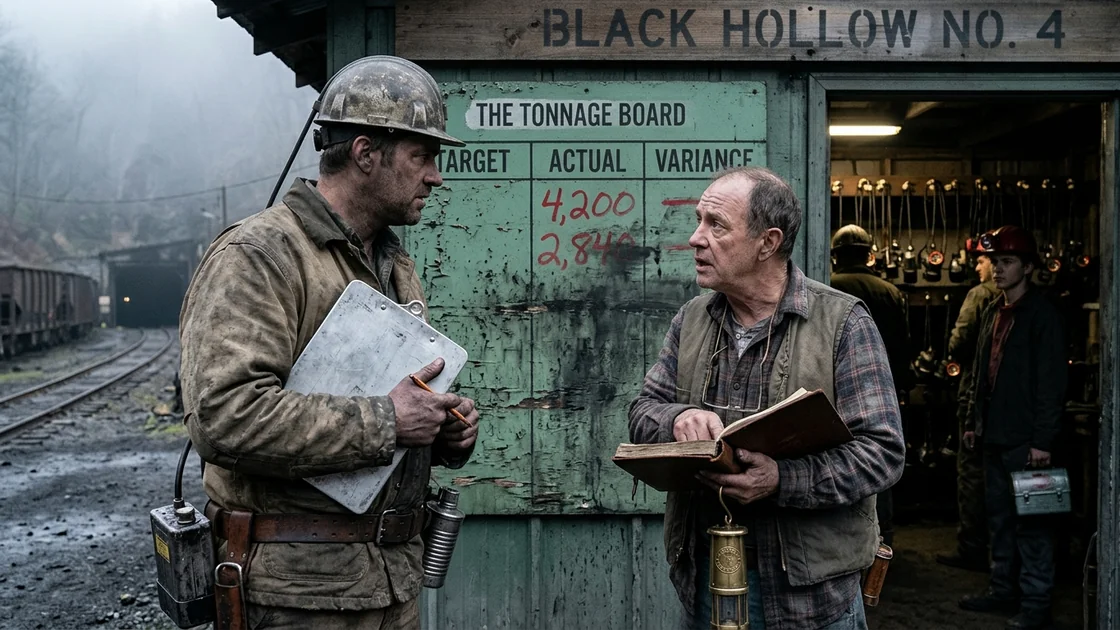
The grease-pencil board at the portal entrance of Black Hollow No. 4 was painted a pale, industrial green that had begun to flake beneath decades of coal soot and salt spray. Every morning at five-fifteen, before the mist had even begun to peel away from the black-oak ridges of the hollow, the board was updated. It showed three columns: Target, Actual, and Variance.
Harlan Reed stood in front of the board with a scarred aluminum clipboard pressed against his ribs. His fingers, permanently blackened around the cuticles with the indelible tattooing of the drift, tapped a copper pencil against the zinc edge. The numbers for the second shift of Tuesday were written in red grease: 2,840 tons. The corporate target handed down from the Charleston office of Consolidated Energy had been 4,200.
Beneath the red numbers, someone had smeared a thumb through the wax.
"Eighteen hundred tons short in three days, Harlan," said Macklin Stover. Macklin was the mine superintendent, a man whose skin had the tallowy, sun-starved quality of an underground clerk who had spent the last twenty years behind a desk trying to forget the smell of wet slate. He stood in the doorway of the lamp house, holding a white ceramic mug with the company logo faded into a gray crescent. "Charleston doesn’t send freight trains up the hollow to haul river water and promises. The Norfolk Southern siding has six empty hoppers sitting on the spur, and Consolidated is paying demurrage by the hour."
"The continuous miner took three teeth off the drum on Monday night, Mack," Harlan said, not turning around. He knew the numbers better than Stover did. He knew them in his marrow. His grandfather had died under a runaway mine car in the old hand-loading days when men carried canary cages into the drift; his father had coughed his lungs into an enamel washbasin until his chest collapsed at fifty-one. Harlan had climbed from grease-monkey on the shuttle cars to shift foreman by understanding that coal mining was not an exchange of sweat for wages, but a transaction of risk against time. "We hit a hard roll of sulfur rock in the top three feet. Spitting sparks like an emery wheel. If I feed the drum too hard against that roof, we tear the planetary gears out of the head."
"Then don't tear them out," Stover said, taking a sip from the mug. "Cut the bottom first. Step the bench down. But get into the 3-Left seam. The core drillings say that seam widens to eight feet forty yards past the old survey line. It’s clean metallurgical coal. Low sulfur, high volatile, ninety dollars a ton on the export dock in Norfolk. You give me four thousand tons out of Section Three by midnight tonight, Harlan, or Charleston is bringing in a contractor crew from Pikeville to run that longwall."
Harlan stiffened. A contractor crew meant the mine was failing. It meant the company would lay off the local men, break the safety protocol down to the legal minimum, and replace the supervisory roster. Harlan had two years left before his twenty-year pension vested. He had a brick split-level down in Man with an asphalt driveway and a daughter enrolled in the nursing program at Marshall University whose tuition was due on the first of September.
"The boys are tired, Mack," Harlan muttered.
"The boys are paid to cut," Stover replied, his voice dropping into that quiet, bureaucratic register that brooked no debate. "The fans are pulling seventy thousand cubic feet a minute through the intake. You've got more air than God gave a Kansas wheatfield. Go make tonnage."
Harlan turned away from the grease board and entered the lamp house. The air smelled of ozone, lead-acid batteries, and damp flannel. Racks of cap lamps hung like rows of unblinking yellow eyes along the walls, their thick black cords dangling to the charging blocks below.
Eli Vance was already there. Eli was fifty-eight, with ears that looked like dried peaches from decades of roof falls and machine grease, and a spine that curved forward in a permanent crouch. He was the section fireboss—the man responsible for walking the dark airways before the shift, carrying his brass Koehler flame safety lamp in one hand and an electronic digital multi-gas detector in the other.
Eli didn't look up when Harlan took his lamp off the rack and clipped the heavy battery pack to his leather work belt.
"How’s the return looking on Three-Left, Eli?" Harlan asked, his voice deliberately casual.
Eli reached down and picked up his leather-bound record book. He was slow about it. He had a pair of cheap reading glasses tied around his neck with mason’s twine. He settled them on his nose, his gray eyes magnified and watery behind the scratched plastic lenses.
"Air’s sluggish in the crosscuts between twelve and fourteen," Eli said. He laid his thumb against the paper. "Bleeder curtains are torn up where the shuttle car ran over them yesterday. Nobody hung them back up. The air is short-circuiting back through the old works instead of sweeping the face."
"Did you hang brattice?"
"I hung two fly-pads," Eli said, "but the pressure’s off. That booster fan at the bottom of the return shaft has been whining like a gut-shot hound since four o'clock this morning. It’s dropping RPMs. I called the surface hoist room, and the boy told me the motor bearings are running hot."
"The booster fan is fine," Harlan said, snapping his self-rescuer onto his belt. The heavy metal canister containing the chemical scrubber slammed against his hip. "I talked to maintenance yesterday. It’s just belt slippage from the humidity. We’ll tension it on the weekend shift."
"I took a reading at the face of three-entry," Eli continued, ignoring him. "Right where the cutter head quit last night. I got zero point eight percent on the digital. Zero point eight, Harlan. In the dead air behind the rib."
"Zero point eight isn't an ignition limit," Harlan said. "The law says one percent you make adjustments, one point five you cut power. Zero point eight is just coal sweating. That seam has been gassy since we crossed the fault line last month."
"Zero point eight in the middle of the draft means you’ve got two or three percent hanging in the roof pockets behind the loose shale," Eli snapped, finally lifting his head. His eyes were cold. "The rock's working up there, Harlan. I heard it talking. You know how that sandstone sounds when it’s loaded with gas. It clicks like a clock. If we run that continuous miner without clearing the return and getting another twenty thousand CFM up to that face, we’re going to be swimming in fire."
"We’ve got air," Harlan said firmly. He leaned in, lowering his voice so the young miners shuffling through the screen door wouldn't hear. "Listen to me, Eli. Stover has got corporate breathing down his collar. If we don’t clean up that cut today, they’re bringing in an outside outfit. You want some scab crew from Kentucky running these entries? You want your nephew sitting on his porch drawing food stamps because we spent three hours hanging canvas while the miner sat cold?"
Eli stared down at his ledger. The pencil lines were neat, precise, the script of a man who understood that every checkmark was an oath sworn before the Department of Mines and the Almighty.
"The air is the air, Harlan," Eli said softly. "The gas don't give a damn about corporate. It don't give a damn about your pension, neither."
"Write the book, Eli," Harlan said. "Sign the book for the pre-shift. Mark it clear to work, and I’ll have the brattice boys hang five hundred feet of fresh plastic before we turn the cutter head. You have my word on that."
Eli hesitated. His thumb remained on the margin of the fireboss ledger. In the column marked Conditions Found, there was an empty space beside the heading Section 3-Left Face.
The screen door banged open. Toby Miller came in, grinning, his teeth shining white against his scrubbed eighteen-year-old face. He was carrying a tin lunch bucket decorated with stickers from an off-road truck shop. Toby was Eli’s sister’s youngest boy. He had only been underground four months, still proud of the red strip of tape on his white hardhat that marked him as an inexperienced apprentice—a "red hat."
"Morning, Uncle Eli," Toby said, pulling his lamp from the rack. "Morning, Harlan. Ready to load some rock today?"
Eli looked from the boy’s unlined face to Harlan’s hard, set jaw. Harlan did not blink. He stood there with his hands on his hips, his massive forearms crossed, radiating the absolute authority of a man who had pulled three million tons of coal out of the mountain without a single fatality on his shift.
Eli let out a slow, ragged breath that rattled in his throat. He picked up his pen, dipped it mentally into thirty years of compliance, and wrote in clean, sloping letters: Clear for work. 5:45 AM. E. Vance, FB #4412.
Act II: Into the Hole
The mantrip was a low-slung, steel-bodied electric cart that ran on forty-two-inch gauge rail. It had no sides, no cushions, and no springs worth mentioning; the men lay on their backs or leaned against one another’s shoulders on wooden benches, their heads ducked beneath the hanging trolley wire that hissed with six hundred volts of direct current.
Harlan sat in the front seat beside the motorman, Donald "Preacher" Hayes. Preacher had been driving the mantrips at Black Hollow for twenty-five years. He kept a tiny, plastic New Testament wrapped in clear electrical tape wedged into the steel bracket that held the cart's reverse lever.
The trip plunged into the drift mouth with a shriek of iron wheels against cold rail. The humid, sweet air of the morning was ripped away in an instant, replaced by the damp, sixty-degree breath of the deep Earth. It smelled of wet slate, sulfur, iron oxide, and the ubiquitous, powdered limestone—the "rock dust"—that covered the walls and ceiling like a heavy coat of gray flour.
The drift sloped downward at an eight-degree pitch, following the dip of the Coalburg seam. As they descended, the ceiling dropped from twelve feet at the portal to seven, then to five. The timbering gave way to roof bolts—four-foot steel rods driven vertically into the layered shale above their heads, their square plates holding back millions of tons of mountain with nothing more than resin and tension.
Beside Harlan, Preacher kept his hand on the sander valve, dropping grit onto the slick rail to keep the wheels from slipping.
"Eli looked like he had a stone in his boot this morning," Preacher shouted over the grinding roar of the traction motors.
"Eli’s gettin' old," Harlan yelled back. "Every time a mouse cuts wind in the return, he thinks the whole mountain is fixin’ to heave."
"Old miners get that way because they stayed alive long enough to get gray," Preacher said, his eyes fixed on the narrow cone of light slicing through the darkness ahead. "My daddy used to say that when a mine wants to take you, it always sends an invitation first. A whisper in the rib, a trickle of dust, a little sweet smell in the airway. Most men just don't open the envelope."
Harlan didn't answer. He adjusted the angle of his cap lamp, looking at the rock walls flickering past. Every few hundred feet, a break in the rib revealed a crosscut sealed with cinder blocks—the stoppings designed to keep the fresh intake air separated from the foul return air that carried the gas and dust out of the mine. In several places, Harlan noticed the cinder-block stoppings were crushed at the corners, cracked into diagonal zigzags by the immense vertical pressure of the mountain. Mortar had blown out; through the gaps, he could hear the wet, sucking whistle of air leaking from the intake into the return.
The ventilation wasn't reaching the back. It was bleeding off through the broken stoppings miles before it ever touched the faces.
He knew he should stop the trip. He should put six men on mortar duty with bags of quick-setting plaster and tell them to seal every joint between here and the section. But sealing stoppings took hours. It meant cutting off the power to the trolley line, unloading pallets of cement blocks, and shutting down the section miner until the inspectors were satisfied. If he did that, they wouldn't load a single car before three o'clock.
Tomorrow, Harlan told himself. I’ll take the weekend maintenance crew and mud every crack from the portal to the feeder.
After three miles of steel track, the rails ended at the Section Three loading point. Here, the fresh coal was dumped from the shuttle cars into a feeder-breaker that crushed the large lumps before spitting them onto the forty-eight-inch conveyor belt that ran all the way to the surface tipple.
The air here was loud and chaotic. The conveyor belt groaned on its rubber rollers, a steady thrum-thrum-thrum that vibrated through the soles of Harlan’s boots. The section crew rolled out of the mantrip, their metal lunch buckets clanking against the steel chassis. They were a mixed bunch—twelve men counting Harlan and Eli.
There were the Mercer brothers, Cole and Jesse, young roof-bolters who moved with the synchronized rhythm of twins who had farmed tobacco together before they came to the coal. There was Pete Alvarez, the continuous miner operator, a square-shouldered Mexican-American from Colorado who could shave the roof within an inch of the rock without ever touching a bolt. There was Toby Miller, eager and clumsy; Silas Thorne, the mechanic whose coveralls were stiff with hydraulic fluid; and five other laborers who handled the canvas curtains, shoveled spillage around the feeder, and moved the high-voltage cables.
"Alright," Harlan barked, gathering them at the tailpiece of the conveyor. His voice was hard, cutting through the machine noise. "We’re forty yards out from the good coal. Stover wants this cut cleaned out and three full rounds dropped before the shift is done. Pete, you take Toby with you on the off-side. He needs to learn how to watch the cable reel. Jesse, you and Cole stay right on his ass with the Fletcher bolter. I want every foot of new roof caught and pinned within twenty minutes of the miner pulling out."
Pete Alvarez leaned against a timber, a plug of tobacco bulging in his cheek. He spat a dark stream into the dust. "What about the air, Harlan? Eli told me the curtains were down on the right side."
"I’m sending two men to re-hang them right now," Harlan lied smoothly. "You keep the water sprays on the head running wide open. Full pressure. Don't touch that cutter drum to the face until you see fifty pounds on the water gauge. The mist will knock down the dust and keep the bits cool."
"The pump on the water line was surging this morning," Silas, the mechanic, spoke up. "The intake filter down at the sump is clogged with silt again. We’re only getting thirty-five pounds at the nozzles."
"Then run it at thirty-five!" Harlan snapped. "It’s enough. We’ve cut with less. Let's move, boys. We ain't getting paid to hold down the bottom."
The men dispersed into the gloom, their cap lamps drifting like fireflies down the three parallel entries that stretched into the black seam: Entry One, the intake; Entry Two, the belt-line; Entry Three, the return.
Harlan stood alone for a moment at the intersection. He took his own multi-gas monitor from his shirt pocket, hit the power button, and waited for the diagnostic beep. The tiny liquid-crystal screen flickered in the dark:
O2: 20.8%
CO: 0 ppm
CH4: 0.4%
Zero point four. Out in the crosscut, thirty yards back from the face.
It was higher than normal for this time of the morning, but still well below the one-percent threshold where the federal law required him to de-energize the equipment. Yet, there was something wrong with the air. It felt thick, greasy on the tongue, with a faint, cloying sweetness like overripe apples or old machine oil.
It was the smell of the deep earth when the strata cracked open—ethane and butane riding on the back of the methane, the heavier hydrocarbons that sleep in the shale until the weight of the world shears the rock apart.
Harlan clipped the monitor back to his pocket, stepped over the return water ditch, and walked toward the roar of the continuous miner.
Act III: The Whistle in the Sump
By ten o'clock, the section was an inferno of mechanical noise and black fog.
The continuous miner was an eighty-ton beast of iron that moved on steel tank treads. At its front, a massive steel cylinder bristled with seventy carbide-tipped steel teeth that spun at fifty revolutions per minute, ripping into the face of the coal with a sound like a locomotive derailing through a field of gravel.
Pete Alvarez stood ten feet back on the intake side, holding the remote control box against his chest with a pair of thick nylon straps. His thumbs worked the twin joysticks with delicate precision. With a forward shove, the spinning drum bit into the coal face; instantly, a black wave of pulverized fuel surged over the machine’s gathering head, where rotating steel arms swept it back toward the internal flight conveyor, which vomited the coal into the waiting bed of a six-wheeled electric shuttle car.
The dust was immense. Despite the water sprays, the air was a gray soup that swallowed the light from the cap lamps within six feet.
Toby Miller stood near the rib, his red hat gray with rock dust, holding a water hose to wash down the machine's electric cables so they wouldn't overheat under the strain of the high amperage. He was coughing, his shoulders jerking with every breath.
Harlan walked up behind Pete, tapping his shoulder with the handle of his walking stick.
"How’s she tracking?" Harlan shouted.
Pete didn't look away from the drum. His face was covered in a mask of black coal dust, except for the pink rims around his eyes and the red smear of his lips. He pulled back on the joysticks, swinging the head to the left to square off the rib.
"Hard!" Pete yelled back. "The bottom's rolling up! We’re chewing into the floor shale! Every time the bits hit it, the sparks look like a welding shop!"
"Keep the water on it!"
"I told you, the water’s weak!" Pete pointed with his elbow toward the cutter drum. Through the churning curtain of dust, Harlan could see the sprays. Instead of the wide, pressurized fan of water that was supposed to smother the bits and suppress friction sparks, the nozzles were spitting a limp, yellow drizzle that sputtered and died every few seconds as the pump at the sump choked on grit.
At that moment, the high-pitched shriek of an electronic alarm cut through the engine roar.
On the side of the continuous miner, mounted behind a half-inch plate of protective steel, the machine-mounted methane monitor was flashing a red strobe light.
Pete instantly pulled both levers to neutral. The cutter drum slowed, its steel teeth humming as it spun down to a halt. The deafening racket of the cut subsided, leaving only the dull rumble of the distant ventilation fan and the heavy, panting breaths of the two men.
"What’s it showing?" Pete asked, wiping a sweaty sleeve across his forehead.
Harlan walked to the side of the miner, stepped over the rotating gathering arms, and looked at the readout on the machine monitor.
CH4: 1.6%
Under federal regulations, the monitor was supposed to automatically shut down the machine's cutting motor at one percent, and cut all power to the chassis at two percent. But the machine hadn't shut down. The relay had stuck, or someone had bypassed the trip circuit with a copper jumper wire during the previous shift to keep the machine from cutting out during heavy production runs.
"It’s one point six," Pete said, looking over Harlan’s shoulder. His face had gone pale under the coal grease. "Harlan, we’re over the limit. The breaker didn't drop. It’s supposed to drop at one point five."
"The sensor’s fouled with dust," Harlan said quickly, though his own heart gave a sudden, hard thud against his ribs. He unclipped his handheld monitor from his pocket and held it up toward the roof.
The handheld unit chirped once, then started a rapid, frantic beep:
CH4: 1.8%
Up in the roof strata, right where the cutter head had just gouged a six-foot trench, the rock was dripping with water that hissed as it hit the floor. A tiny, steady whistling sound—like air escaping from a bicycle tire—was coming from a two-inch hairline fracture that ran diagonally across the top shale.
"That's a blower," Pete whispered. "Harlan, that’s a feeder crack. The gas is coming out of the sandstone."
From down the entry, Eli Vance came limping through the gloom, his walking stick clicking against the rail. He was holding his old brass Koehler safety lamp by the hook. Inside the wire gauze of the lamp, the blue testing flame was no longer a tiny button; it had stretched upward, elongating into a tall, pale-blue spire that fluttered against the top of the bonnet.
"Harlan!" Eli hollered from twenty feet away. "Shut that box down! Shut it down right now!"
Eli reached the front of the miner, his chest heaving under his flannel shirt. He thrust the Koehler lamp toward Harlan’s face. The blue cap inside the flame was unmistakable: methane. High methane.
"Two percent here at the shoulder," Eli gasped. "And the bleeder entry is completely choked. A roof fall dropped ten tons of slate across the return airway behind crosscut fourteen. The return is blocked, Harlan! There’s no air moving through here! It’s backing up like water behind a beaver dam!"
"How long has that fall been down?" Harlan demanded, his face twitching.
"I don't know! It must have come down during the third round! The air has dropped to fifteen hundred CFM. It ain't even enough to move the smoke from Pete's chew, let alone clear a methane pocket!" Eli reached out his calloused hand toward the main breaker switch on the continuous miner's power pack. "I’m pulling the disconnect."
"Don't touch that switch!" Harlan barked, lunging forward and slapping Eli's hand away from the breaker box.
The men in the entry went dead silent.
Toby Miller backed against the coal rib, his eyes wide. Jesse and Cole Mercer, who had just stepped out of the crosscut with their arms full of roof-bolt plates, froze where they stood. The only sound was the conveyor belt running empty, its steel idlers squealing in the darkness, and that thin, persistent whistle coming from the rock above Pete’s head.
"Harlan, are you out of your goddamned mind?" Eli hissed, his voice trembling with a mixture of rage and terror. "Look at the flame! Look at your own digital! We’re sitting in an explosive mixture! All it takes is one tooth hitting a sulfur ball, or one arc from a worn trailing cable, and this whole entry will turn into a cannon barrel!"
"We’ve got forty tons of coal sitting on the floor waiting to be loaded!" Harlan shouted, his face inches from Eli’s. "The shuttle car is half-full! If I pull the power now, the belt runs empty for two hours while we shovel that rock fall out of the return! Stover will shut this section down!"
"Let him shut it down!" Eli cried. "Let him fire us! At least we’ll be walking up the hollow to sign the unemployment papers instead of being carried out in plastic bags!"
"Nobody is getting carried out in bags!" Harlan said. He turned to the Mercer brothers. "Cole! Jesse! Drop them plates. Take Toby and Silas and get back to crosscut fourteen. Take two timber jacks and three wedges. I want that slate cleared off the return entry in thirty minutes. Shovel it into the old crosscut and kick the canvas open so the draft can pull."
"Harlan, that’s five tons of rock," Cole Mercer said, his voice flat, cautious. "We can't move that in thirty minutes with three shovels."
"Then do what you can! Just clear a foot of head space so the air starts moving again!" Harlan pointed an iron finger toward the back. "Move! Toby, go with them!"
Toby looked at his uncle Eli. Eli’s eyes were wild, pleading.
"Go on, Toby," Harlan said in a softer, deadly calm tone. "You're working my shift, boy. You do what the section boss says, or you turn your brass in at the lamp house and you never set foot on this mountain again."
Toby swallowed, his throat dry with dust. "Yes, sir," he whispered. He laid the water hose down in the mud and followed the Mercer brothers back into the darkness toward the return.
Harlan turned back to Pete Alvarez.
"Pete. Back the miner out five feet."
"Harlan—"
"Back it out five feet, Pete! Let the face sit for ten minutes while the boys crack that fall. We’ll let the scrubber fan on the back of the machine pull what it can. But we are not dropping the breaker. Once we clear that slate, you cut the last twenty feet of this bench. If we hit the four-thousand mark by two o'clock, we’ll shut down early and spend the rest of the shift rock-dusting. I swear to you, Pete. We just need this one cut."
Pete looked at the joysticks. He looked at Eli Vance, who was standing with his back against the timber, his brass safety lamp trembling so hard in his grip that the blue flame flickered against the wire gauze.
Pete was thirty-four. He had three children in the grade school at Chapmanville, and his wife had just had a gallbladder operation that the company insurance only covered eighty percent of.
"Ten minutes, Harlan," Pete whispered, his voice cracking. "Only ten minutes. If that meter doesn't drop below one percent by then, I’m walking out to the main line, and you can run that machine your own damn self."
"Ten minutes," Harlan agreed.
He didn't look at Eli. He walked over to the rib, leaned his forehead against the cold, damp coal, and listened.
Deep inside the seam, the rock was groaning. It wasn't the loud, explosive crack of a roof failure; it was a rhythmic, dry ticking, like a million tiny dry twigs snapping in an autumn forest. The old men called it the "coal lice"—the sound of the crystalline structure of the coal seam shearing under millions of tons of overburden, releasing the gas that had been locked under hydrostatic pressure since the Carboniferous age.
Harlan reached down to his belt. His handheld monitor was screaming again, its high-frequency pulse drilling into his skull:
CH4: 2.2%
Harlan glanced toward the crosscut. Eli was twenty feet away, kneeling by the conveyor belt, his head in his hands, praying or crying.
Harlan took the monitor off his belt. With a steady, deliberate motion of his thumb, he flipped the three-position toggle switch on the side from RUN to CALIBRATE. The alarm died. The display reset to a flat, false zero.
He shoved the monitor deep into the side pocket of his heavy canvas coat.
Act IV: The Spark
The ten minutes did not bring air.
Back in crosscut fourteen, the Mercer brothers and young Toby were laboring in three feet of stagnant water, their shovels clanging against the massive blocks of slickenside shale that had peeled off the unbolted roof. Every heave of their backs only stirred up the sour muck of the ditch. The air was dead, hot, and so heavy that their cap lamps looked like orange needles stuck into a wool blanket.
"It ain't moving, Cole!" Silas Thorne gasped, dropping his shovel against a slab of sandstone that weighed two tons if it weighed an ounce. He collapsed against the coal rib, his mouth hanging open, his tongue swollen and white. "The draft’s dead. We’re just moving dirt from one hole to another. That booster fan at the shaft has quit entirely. I can't even hear the whine."
Toby leaned against his shovel, his eighteen-year-old chest heaving. His red hat was crooked. "Uncle Eli told me that when the air quits, you're supposed to head for the intake escapeway. He told me don't wait for no foreman."
"Harlan run this section for fifteen years, Toby," Jesse Mercer said, wiping his eyes with a greasy rag. "He knows what the mountain can take."
"He don't know what this rock is doing," Silas muttered, staring up at the roof. "Look at the plates."
Jesse raised his lamp. The six-inch square steel roof plates, held against the ceiling by the tension of the bolts, were bowing downward. The steel was dishing, their corners curling toward the floor like dry leaves. A fine, powdery rain of grey shale dust was sifting down through the bolt holes—the surest sign that the top strata was separating, delaminating from the massive sandstone bed three feet above them.
"We got to tell him," Jesse said, his voice dropping an octave. "The roof is coming down on the whole entry."
At the face of Entry Three, Harlan looked at his watch.
It had been fourteen minutes.
"Alright, Pete," Harlan called out, his voice sharp, echoing in the confined heading. "Fire the head up."
Pete Alvarez didn't move. He stood behind the controls, his hands hanging limp at his sides.
"Pete. I said fire it up. Let's get this coal on the belt."
"It’s too hot, Harlan," Pete said softly. He didn't turn around. "Look at the rib. The water’s boiling out of the coal. It’s warm."
Harlan stepped up beside him. He reached out his bare hand and pressed it against the coal face.
It was true. The coal was usually forty-five or fifty degrees—refrigerated by the deep stone. But here, the face was eighty degrees, warm as a fevered forehead. The tremendous tectonic pressure of the mountain riding on the barrier pillar was crushing the seam, compressing the methane inside the micro-pores of the coal until the gas heated like air in a bicycle pump.
"It’s just friction from the bench," Harlan said, though his own stomach was knotting into a hard, cold ball. "Cut the bench down, Pete. Ten yards. That’s all. Just ten yards so we can set two cribs and secure the line."
Eli Vance walked up. He didn't have his Koehler lamp anymore; the flame had choked out in the bad air three minutes ago, snuffed by the lack of oxygen and the sheer density of the hydrocarbon gases.
"Harlan," Eli said. His voice was no longer angry. It had reached that flat, hollow stillness of a man who has looked over the edge of an abyss and realized the bridge was never built. "Don't do it. I’m asking you for Toby. I’m asking you for the boy."
Harlan looked at Eli. For a split second, the image of his daughter’s face flashed behind his eyes—her graduation photo on the mantelpiece in Man, the white mortarboard, her smile. He thought of the empty coal cars on the siding. He thought of Macklin Stover’s tallow face and the Pikeville contractor crew. He thought of the grease board with the red numbers.
"Pete," Harlan said, his voice dropping into an iron monotone. "Turn the drum."
Pete Alvarez took a slow breath. He crossed himself—a quick, furtive touch of his thumb to his forehead, his sternum, his left shoulder, his right.
Then he hit the start button for the cutter motor.
The eighty-ton machine gave a shuddering, violent convulsion as the five-hundred-horsepower electric motors engaged. The cutter head began to spin, its carbide teeth blurring into a black halo. A cloud of coal dust exploded from the face, completely swallowing the machine.
Pete shoved the joysticks forward.
The spinning drum struck the seam. The noise was like the tearing of world-iron—a deafening, bone-shaking grind that rattled the teeth in Harlan’s skull. The continuous miner groaned, its tracks digging into the fire-clay floor as it forced the drum into the breast of the coal.
For five seconds, ten seconds, there was only the roar and the black fog.
Then the cutter drum dipped two inches.
The carbide bits ripped out of the soft coal and slammed directly into a dense, iron-hard nodule of pyritic sulfur rock embedded in the roof shale.
A shower of brilliant, white-orange sparks exploded from the top corner of the drum. It wasn't the dull red spark of iron on iron, but the blinding, incandescent spray of carbide against sulfur.
Harlan saw it. Eli saw it.
"NO!" Eli screamed, but his voice was completely drowned by the shriek of the machine.
The sparks did not die in the air.
They hit the roof pocket where the whistling feeder crack had been pouring ninety-eight-percent pure methane into the dead air space above the timbers.
There was no immediate explosion. There was something far worse: a soft, hollow whump, like the sound of an old gas furnace lighting in a distant basement.
A pale, ghostly blue sheet of flame—thin as silk, almost transparent in the darkness—rippled across the roof. It expanded outward from the cutter drum in every direction, licking along the ceiling bolts, rolling smoothly over the heads of the men like a river of burning alcohol.
Pete Alvarez dropped the controls. He didn't scream. He turned and threw himself face-down into the water ditch.
"RUN!" Harlan roared, his vocal cords tearing with the effort. "RUN TO THE OUTBY!"
He reached for Eli, grabbing the old man by the canvas collar of his jacket, and hauled him backward into the crosscut.
The blue flame reached the corner of the pillar where the intake air should have been. But there was no intake air—only the backed-up reservoir of methane that had accumulated behind the slate fall.
The blue silk turned orange.
The temperature in the entry jumped from eighty degrees to two thousand in the space of a single heartbeat.
The methane deflagration found its balance: nine point five percent—the stoichiometric perfection of fuel and oxygen. The soft whump became a concussive, catastrophic blast that shattered the eardrums of every man in the section.
The overpressure wave ripped through the entries at two thousand miles an hour. It tore the twenty-ton continuous miner from its tracks, flipping it onto its side like a child’s tin toy. The five-foot roof bolts were sheared off at the rock line, their steel plates turned into jagged shrapnel that whistled through the dark.
And then came the dust.
The initial methane blast, violent as it was, was only the detonator. The shockwave swept up the dry, unrockdusted coal dust that had accumulated on the floor, the ribs, and the conveyor framework for three shifts. Millions of pounds of pulverized, volatile carbon were lifted into the air column, suspended for one fatal millisecond, and then ignited by the trailing flame.
The mine became an open-ended cannon.
Act V: The Dark Sump
Harlan was hit from behind by a solid wall of air that lifted him off his feet and threw him forty feet down the crosscut.
He did not hit the floor; he slammed into the cinder-block stopping, his shoulder smashing through the concrete blocks as the entire wall collapsed beneath the shockwave. The world went black, filled with a sound so vast and all-consuming that it ceased to be noise and became a physical weight pressing against his brain.
Then came the heat.
It was not the heat of a fire; it was the searing, dry breath of an oven that scorched the hair from his arms, blistered the back of his neck, and set his flannel shirt smoldering in the dark.
He inhaled once—an involuntary gasp of shock—and his throat felt as if it had been swabbed with boiling lye.
Then, absolute stillness.
The roaring stopped. The conveyor belt was dead. The ventilation fan was gone. There was only the sound of his own blood hammering behind his temples, the wet, whistling hiss of his own scorched lungs, and the patter of falling stone.
Tink. Tink. Plop.
Small pieces of shale were dropping from the shattered roof like lead sinkers into mud.
Harlan lay in the rubble of the cinder-block stopping. His cap lamp had been ripped from his helmet, but the battery cord had held; the lamp was lying five feet away in the dirt, its yellow beam shining through a fog so dense that it looked like milk.
It was not coal dust. It was the "afterdamp"—the lethal cocktail of carbon monoxide, carbon dioxide, nitrogen, and hydrogen that remains after coal dust burns. It was odorless, invisible, and so toxic that three breaths of it would paralyze the central nervous system and leave a man dead before his knees hit the floor.
"Eli," Harlan croaked.
His voice was a dry rattle. His tongue felt three sizes too large for his mouth.
He crawled forward on his hands and knees, dragging his right leg, which throbbed with a sickening, sickening numbness. He found his cap lamp and shoved it onto his head. The lens was cracked, splitting the light into three distorted arcs.
Ten feet away, Eli Vance was lying on his back.
The old man’s clothes had been burned away from his chest, leaving his skin a mottled, gray-pink parchment. His eyes were wide open, staring up at the shattered roof timbers with an expression of infinite, terrifying clarity.
Harlan reached out a trembling hand and touched Eli’s neck.
There was no pulse. Eli’s mouth was packed with black dust; the blast had caught him in mid-scream, driving the ignited coal powder down his windpipe until his lungs had turned to charcoal.
"Eli," Harlan whispered. He began to shake. A cold, uncontrollable shudder started in his gut and worked its way out to his limbs until he was rattling against the stone floor. "Eli, get up. Eli, please."
Eli did not move.
Harlan scrambled around him, looking back toward the face.
Entry Three did not exist anymore.
Where the eighty-ton continuous miner had been working, the mountain had closed its jaws. A massive roof fall—hundreds of tons of gray slate, massive boulders the size of pickup trucks, and crushed timbering—had sealed the entry from floor to ceiling. A single steel track from the miner protruded from beneath a twenty-ton slab of sandstone like the leg of a squashed beetle.
Pete Alvarez was under that slab. There was no need to check for a pulse. There was nothing left of Pete Alvarez that could be gathered in a pair of hands.
"The boys," Harlan muttered, his mind spinning in a frantic, disjointed circle. "The boys at fourteen."
He turned and began to crawl down the crosscut toward the return airway where he had sent Toby Miller, Silas Thorne, and the Mercer brothers.
The air was getting colder, but it was getting deadlier. Harlan’s fingers were growing heavy; his vision was tunneling, the edges of his sight turning purple. He knew the signs. Carbon monoxide was latching onto his hemoglobin, choking his blood cell by cell.
The rescuer.
Harlan fumbled at his belt. His hands were slick with sweat, blister fluid, and rock dust. He caught the metal latch of his self-rescuer canister and jerked upward.
The seal broke with a sharp, pneumatic hiss.
He pulled the rubber mouthpiece free, shoved it between his teeth, and bit down on the rubber lugs. He snapped the spring-loaded nose clip over his nostrils, forcing himself to breathe only through his mouth.
The chemical canister began to work. As the hopcalite catalyst inside the metal can converted the deadly carbon monoxide into carbon dioxide, it generated intense, blistering heat. Within three breaths, the air entering Harlan’s mouth was dry, metallic, and burning hot—one hundred and forty degrees. It tasted like scorched iron and vinegar. Every breath felt like inhaling steam from a radiator, but it was oxygen. It was life.
On hands and knees, dragging his ruined leg behind him, Harlan crawled through the debris.
The track was twisted like ribbon. Conveyor belt rollers had been blown hundreds of feet outby, their steel frames bent into pretzels. He crawled past the feeder-breaker; the heavy steel hopper was flattened against the rib, crushed by the atmospheric pressure wave that had exceeded one hundred pounds per square inch.
He reached crosscut fourteen.
"Toby!" Harlan called out through the rubber bite of his rescuer, but the sound was only an unintelligible, muffled grunt: "To-bee!"
He saw their lamps first.
Two cap lamps were still burning, their beams pointed toward the ceiling from the bottom of the ditch.
Silas Thorne was sitting with his back against the coal rib, his head tilted back, his eyes closed. His self-rescuer was lying in the muck three feet from his hand. He hadn't had time to get it to his mouth. The carbon monoxide had dropped him where he sat; his skin had already taken on that bright, cherry-pink flush that is the trademark of the afterdamp—the cosmetic mockery of health that poison leaves on the dead.
Beside him lay Cole and Jesse Mercer. They were tangled together, one brother’s arm thrown over the other’s shoulder, their faces pressed into the small gap between two bags of rock dust where they had tried to find a pocket of clean air before their lungs seized.
And then Harlan saw Toby Miller.
The boy was lying thirty feet further down the entry, face down in the mud, his fingers dug deep into the slate as if he had been trying to claw his way out of the mountain by inches.
His red hat was gone. His white, fine hair was singed down to the scalp.
Harlan crawled to him. He grabbed the boy’s shoulders and hauled him over onto his back.
Toby’s self-rescuer was in his mouth, but the nose clip had slipped off. He had panicked in the blackness, taken one breath of the afterdamp through his nose, and drowned on the dry air. His eyes were half-open, glazed with a milky film, staring into the dark drift toward the surface he would never see again.
Harlan knelt over the boy in the gray dust.
The heat from his self-rescuer was blistering his tongue, his throat was raw, and his head felt as if it were being squeezed in a blacksmith’s vise.
He looked down at his own hands. They were covered in Toby’s blood and the gray flour of the rock dust.
Twelve men.
Pete Alvarez. Eli Vance. Toby Miller. Silas Thorne. Jesse Mercer. Cole Mercer. Preacher Hayes back at the mantrip. The four timber-men who had been working the belt-line. The car-dropper at the feeder.
Twelve men.
The entire section crew. The fathers, the sons, the uncles of Black Hollow.
Harlan alone sat in the intake air where the cinder-block stopping had blown out, venting just enough compressed air from an unbroken four-inch iron water line to keep the carbon monoxide from finishing him.
The mountain gave another long, shuddering groan above his head. A slab of shale the size of a kitchen table dropped ten feet behind him, shattering into fragments that sprayed against his boots.
Harlan didn't flinch. He didn't move.
He sat in the hot, toxic dark, biting down on the burning rubber of the rescuer, with his hand resting on Toby Miller’s cold, dust-covered chest, waiting for the mountain to come down and finish the bookkeeping.
Act VI: The Ledger and the Ash
It was four o'clock in the afternoon when the rescue team found him.
They came through the murk like apparitions from another world—four men wearing massive orange Dräger breathing apparatuses on their backs, their faces completely encased in glass masks, their chest units hissing with every mechanical breath. They carried wooden walking sticks and life-lines tied to their belts.
When their halogen lights swept over the crosscut, they found Harlan Reed sitting in the mud, holding Toby Miller’s hand.
Harlan did not speak when they lifted him onto the wire-basket stretcher. He did not fight them when they pulled the spent chemical rescuer from his blistered lips and strapped an oxygen mask over his face. He only stared at the ceiling, his eyes wide and fixed, tracking the long, jagged fracture in the shale that ran all the way from Section Three back toward the mouth of the drift.
They carried him out on a battery-powered emergency car, rolling slowly over the buckled rails.
As they passed the loading point, Harlan saw the bodies. They were lined up along the rib, wrapped in olive-drab vinyl salvage tarps, each tagged with a white paper toe-tag that fluttered in the intake draft from the surface fans that had finally been restarted.
Twelve tarps.
When the emergency car broke into the daylight at the portal, the light was so bright it felt like needles driven into Harlan’s retinas.
The entire hollow was filled with people.
The news had traveled down State Route 10 before the smoke had even cleared from the exhaust drift. Five hundred people stood behind the chain-link gate of the Black Hollow tipple. Women in cotton housecoats with cardigan sweaters pulled over their shoulders; old men with black lung leaning on hickory sticks; children sitting on the hoods of rusted pickup trucks, staring at the drift mouth with the solemn, terrified comprehension of coal-camp children who knew what an ambulance at the portal meant.
The crowd was dead quiet. There was no shouting, no crying yet—only the low, rhythmic hum of the tipple's auxiliary generator and the steady crunch of gravel under the tires of the ambulances.
As Harlan’s stretcher was carried down the wooden ramp from the lamp house toward the waiting county hearse, the crowd surged against the fence.
Harlan looked into the sea of faces.
He saw Mary Vance, Eli’s wife. She was wearing an apron over her dress, her hands wrapped in a flour-sack dishtowel, her gray hair blowing across her face in the autumn wind. Beside her stood Toby Miller’s mother, Martha.
Martha Vance Miller did not look at the emergency crews. Her eyes locked onto Harlan Reed.
She saw his face—blackened with dust, his eyebrows burned away, his neck covered in raw, weeping yellow blisters. She saw him alive.
She didn't scream. She didn't throw a stone. She simply pointed a long, trembling finger at him as the stretcher was wheeled past.
"Where is my boy, Harlan?" her voice cut through the silence of the hollow, thin and shrill as a whistle. "Where is Toby?"
Harlan tried to look away, but he couldn't. His neck was stiff, locked in place by the cervical collar the medics had strapped to him.
"Where is my Eli?" Mary Vance shouted, stepping to the fence, her fingers hooking into the wire links until her knuckles turned white. "You took him in, Harlan! You brought him back on the board! Where is he?"
Harlan closed his eyes. But closing his eyes didn't help; behind the lids, he saw the Koehler lamp with its tall, pale-blue flame. He saw the grease-pencil board with the red numbers.
Actual: 2,840.
Macklin Stover was standing by the door of the company office, flanked by two state troopers and a lawyer from Charleston in a gray wool topcoat. Stover was not looking at Harlan. He was looking down at his shoes, his ceramic mug gone, his face gray as a wet slate.
The federal inquiry began three weeks later in the basement assembly room of the Logan County Courthouse.
The room smelled of floor wax, wet wool coats, and stale filter coffee. Three inspectors from the Mine Safety and Health Administration sat behind a long oak folding table at the front, flanked by court reporters whose fingers danced over the keys of their stenotype machines.
Harlan sat in a hard wooden armchair with his lawyer, an attorney provided by the foreman’s association whose suit was too tight around the armpits and who smelled of clove gum. Harlan’s neck was still wrapped in sterile gauze; his left ear was permanently deaf from the concussive pressure of the blast, and his voice had been reduced to a dry, raspy wheeze from the superheated afterdamp.
On the table in front of the inspectors lay three pieces of evidence:
First, the machine-mounted methane monitor from the continuous miner, its steel housing dented and soot-blackened, with the copper bypass jumper wire still wrapped tightly around the safety cutoff terminals.
Second, the Koehler flame safety lamp belonging to Eli Vance, its wire gauze charred black, recovered forty feet from the face.
And third, the blue leather fireboss ledger for Black Hollow No. 4.
The lead investigator was a man named Arthur Vance—no relation to Eli, a dry, methodical federal engineer from the MSHA district office in Mount Hope. He wore gold-rimmed bifocals and spoke without any inflection, as if he were reading numbers from a logarithm table.
"Mr. Reed," Arthur Vance said, looking down over his lenses. "I direct your attention to the morning of October twelfth. At approximately five-forty-five AM, did you have a conversation with Section Fireboss Eli Vance in the lamp house?"
"I did," Harlan whispered. His lawyer leaned over and tapped the microphone so it picked up the sound.
"Did Mr. Vance report to you that methane levels in the face of Three-Left had reached zero point eight percent during his pre-shift examination?"
"He did."
"Did he inform you that the bleeder curtains in crosscut fourteen had been torn down and that the booster fan at the return shaft was losing revolutions?"
Harlan looked at his hands on the table. The skin on his knuckles was still pink and shiny from the new skin grafting. The black coal tattoo was gone from his cuticles—burned away by the fire.
"He mentioned the air was sluggish," Harlan said.
"He mentioned it was sluggish," Vance repeated. He picked up a sheet of paper from the stack. "We have the transcript of the maintenance logs from the surface hoist room. At six-ten AM, the hoist engineer received a call from Section Three reporting high heat on the booster fan bearings. Was that call made on your authority?"
"No," Harlan said. "I didn't make that call."
"Did you take any steps to verify the operation of the booster fan before directing the continuous miner to begin cutting coal?"
Harlan was silent.
The courtroom behind him was packed with the families from the hollow. In the third row, Martha Miller sat between her two surviving sisters. None of them made a sound, but Harlan could hear their breathing—a collective, rhythmic sigh that felt like the ventilation draft inside the mountain.
"Mr. Reed," Vance continued, his voice relentless, flat, bureaucratic. "At ten-forty AM, when the continuous miner’s onboard monitor signaled one point six percent methane at the face, why was the machine not immediately de-energized?"
"I thought the sensor was fouled," Harlan rasped.
"You thought it was fouled."
"The rock dust gets into the sintering discs," Harlan said, his words coming slow, heavy, like rocks dropped into an empty bin. "It clogs the pores. You get a false high reading. It happens all the time."
"Did you test the air with your handheld digital multi-gas detector?"
"Yes."
"And what did that unit read, Mr. Reed?"
Harlan swallowed. The hopcalite burns in his throat pulled tight.
"It read one point eight," he whispered.
A sharp, collective intake of breath echoed through the courtroom. A woman in the fourth row—Jesse and Cole Mercer’s mother—began to weep softly into a handkerchief.
"One point eight percent," Vance said, leaning forward. "And the legal limit for continuous operation without ventilation adjustments is what, Mr. Reed?"
"One percent."
"And the limit for mandatory power disconnect is what?"
"One point five."
"And yet you ordered the operator, Peter Alvarez, to back the machine out only five feet, and then resume cutting without clearing the fall in crosscut fourteen. Is that correct?"
Harlan’s lawyer reached out to touch his arm, intending to offer an objection or an explanation, but Harlan pulled his arm away.
"I told him to cut," Harlan said.
The assembly room went completely silent. Even the court reporter’s fingers stopped for a beat before resuming their frantic clatter.
"Why, Mr. Reed?" Vance asked. The investigator’s voice dropped its dry tone for the first time, revealing the cold, hard outrage of a man who had pulled too many dead bodies out of Appalachian coal holes. "Why would an experienced foreman—a man with twenty years underground, a man who knew the Coalburg seam—turn a ninety-tooth cutter head into a gassy face with two percent methane in the roof and a blocked return?"
Harlan looked up from the oak table.
He looked past Arthur Vance, past the stenographers, past the state troopers standing by the double doors. He looked at the back wall of the courtroom, where a framed portrait of some forgotten circuit judge hung beneath the high, arched windows.
Outside, the October rain was falling on the town of Logan, washing down the brick storefronts, pooling in the gutters of the railroad tracks where the long trains of coal cars were rolling north toward the steel mills on the Ohio River.
"The board," Harlan said.
Vance frowned. "What did you say?"
"The board," Harlan repeated, his voice gaining a terrifying, hollow clarity that filled the room. "The board at the portal. It was eighteen hundred tons short. Macklin Stover said they were bringing in a contractor crew from Kentucky if we didn't hit four thousand. He said Charleston was paying demurrage on the hoppers."
"Did Mr. Stover instruct you to bypass the safety regulations?" Vance asked, his pen poised.
Harlan let out a short, dry sound that might have been a laugh if there had been any humor left in the human race.
"Macklin Stover didn't have to instruct me," Harlan said. "He didn't have to say a damn thing about the gas. He just wrote the numbers in red grease on the board. He told me the fans were pulling seventy thousand CFM and Consolidated wasn't paying for river water. He knew what I had to do to get four thousand tons out of that cut. Everybody knew. The company didn't want the gas found, Mr. Vance. If you find the gas, you have to stop the belt. If you stop the belt, you don't load the train. If you don't load the train, the stock drops two cents in New York."
Harlan turned his head slowly, looking directly at the rows of women in the gallery.
He looked at Martha Miller. He looked at Mary Vance.
"I killed them," Harlan said, and his voice did not shake. "I killed Eli. I killed Toby. I knew the gas was there. I felt the coal getting warm under my hand. It was ticking like a clock. I knew the fire was in the rock, and I put the boys in front of it because I wanted my twenty-year pension and I didn't want to lose my house in Man."
His lawyer buried his face in his hands.
The courtroom did not erupt. There was no riot. The silence was absolute, terrible, and final.
Martha Miller did not move. She sat in the wooden pew, her hands clasped in her lap, looking at Harlan Reed with eyes that were entirely empty—the eyes of an Appalachian mother who had known, since the day she bore her first son, that the mountain would eventually demand him back, and that some man with a clipboard would be the one to sign the receipt.
Arthur Vance closed the blue fireboss ledger. He set his pen down on the oak table with a small, sharp click.
"This inquiry is adjourned," Vance said quietly. "The findings of this panel will be referred to the United States Attorney for the Southern District of West Virginia for the consideration of criminal charges under Title 30 of the United States Code."
The trial was short.
Harlan Reed pleaded guilty to twelve counts of reckless manslaughter and three counts of willful violation of federal mine safety standards. The judge, an old man whose grandfather had run timber camps in the Gauley River country, gave him twenty-five years at the federal correctional institution in Beckley—two years for every man who died in 3-Left mains, and one year for the lie he told in the lamp house.
Macklin Stover was not indicted. Consolidated Energy paid a two-million-dollar administrative fine to the Department of the Interior and closed Black Hollow No. 4 permanently, citing "unfavorable geological conditions and depleted reserves." The portals were sealed with two hundred yards of reinforced concrete, the steel tracks were pulled up and sold for scrap, and within five years the blackberry briars and black-oak saplings had covered the railbed until you couldn't tell that six million tons of coal had ever come out of the hollow.
Harlan did not appeal. He did not file for early parole when his ten-year window opened.
In his cell on the third tier at Beckley, where the only window looked out across a chain-link yard toward the blue, hazy ridge of Flat Top Mountain, he kept three things on the steel table beside his bunk:
A photo of his daughter in her nurse’s cap; an unsharpened copper grease-pencil he had carried out of the lamp house in his coat pocket on the morning of October twelfth; and a small, square piece of white cardboard.
On the cardboard, written in his own hand, were twelve names:
Pete Alvarez
Eli Vance
Toby Miller
Silas Thorne
Cole Mercer
Jesse Mercer
Donald Hayes
Caleb Smith
Robert Atkins
John Henry Davis
William Tackett
Kenneth Vance
Every night at nine o'clock, when the guard walked the tier with his iron ring clattering against the bars and the red industrial lights of the prison clicked off for the shift, Harlan Reed lay down on his thin cotton mattress and closed his eyes.
He did not sleep.
He waited for the sound.
In the dark of the concrete cell, four hundred feet above the sea and forty miles from Black Hollow, he would listen as the radiator pipes in the corridor cooled down.
Tink. Tink. Click.
The pipes clicked like dry twigs in an autumn forest. They clicked like the coal lice working in the rib. And in the dead air between the concrete walls, he would smell it—faint, sweet, cloying as overripe apples—the ghost of the deep seam coming back to remind him that the shift was not yet done, that the cars were still empty on the siding, and that the blue flame was still burning, two inches tall and silent as judgment, behind the wire gauze of a dead man's lamp.