The Weight of an Unspoken Word
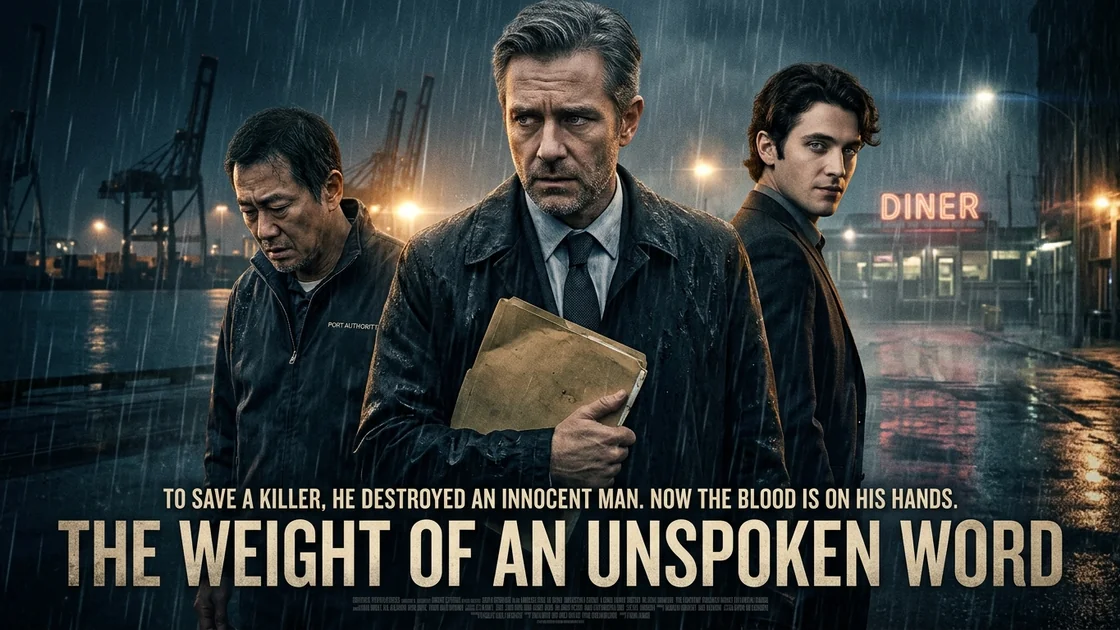
When defense attorney Arthur Vance discovered a damning secret about the sole eyewitness in the murder trial of wealthy heir Julian Mercer, he used it to blackmail the man into silence on the witness stand. Vance secured a career-defining acquittal and established his reputation as an untouchable litigator, choosing to ignore the terrifying certainty of his client's guilt. Eighteen months later, a young woman is found dead in the exact same brutal fashion, forcing Vance to confront the blood on his own hands and the horrifying reality that his victory did not merely free a killer, but created a monster who considers himself above the law.
Part I: The Geometry of Doubt
The rain over the city of Oakhaven never washed anything clean; it merely turned the grime into a slick, reflective veneer that mirrored the streetlamps. Arthur Vance stood by the floor-to-ceiling glass of his thirty-second-floor corner office, his reflection superimposed over the dark expanse of the harbor below. In his right hand, he swirled two fingers of single malt scotch, the amber liquid catching the cold LED glow from his mahogany desk.
He was forty-four years old, with silvering temples that lent him an air of seasoned authority, sharp hazel eyes, and a bespoke charcoal suit that disguised the quiet erosion of his conscience. For fifteen years, Arthur had been the man the powerful called when their lives slipped off the rails. He did not traffic in petty larcenies or desperate street brawls. His domain was the intersection of privilege, catastrophe, and the law.
Behind him, sitting in the deep leather armchair meant for paying supplicants, sat Julian Mercer.
Julian was twenty-six, the sole scion of the Mercer Maritime Logistics empire. He possessed the sort of aristocratic beauty that belonged in Renaissance portraiture: fine, high cheekbones, dark wavy hair that fell artfully across his forehead, and eyes so pale a blue they seemed nearly devoid of pigment. He was relaxed, one leg crossed over the other, inspecting his impeccably manicured nails as though they were gathered to discuss the acquisition of a minor shipping company rather than an indictment for first-degree murder.
"The District Attorney thinks he has a masterstroke," Arthur said, not turning from the window. "Assistant DA Ramos has been leaking to the press all week. He wants the jury pool primed to see you as an arrogant, untouchable monster who beat a twenty-two-year-old waitress to death behind the old shipyard."
Julian offered a dry, musical chuckle. "Well, Arthur, let him leak. That's why my father pays you four figures an hour. To plug the leaks. Or, if necessary, drown the plumbers."
Arthur turned slowly, his eyes narrowing. "Do not joke about this. Not in this room, and certainly not when we walk through the metal detectors at the municipal courthouse on Monday morning. Clara Lin was five feet, two inches tall. She weighed a hundred and ten pounds. Her skull was crushed with a steel winch bar taken from your family’s dry dock. The state has your car on surveillance entering the industrial park at eleven forty-five that night. They have your phone pinging the cell tower on Pier 9. They have her blood in the passenger-side floor mat."
"We’ve been through this," Julian sighed, waving a dismissive hand. "The car was stolen by an employee. The phone was left in the glove compartment. Clara was a girl who made poor choices in men, and someone else ended her. As for the blood on the mat, she spilled a glass of red wine when I gave her a ride home from the club three days prior. Your forensic expert already drafted the report showing the Luminol reaction could be an artifact of cleaning solvents."
"Luminol reacts to iron," Arthur snapped. "Not cleaning solvent. It was blood, Julian. And Ramos knows it."
"Then you’ll convince the twelve good citizens of Oakhaven that it was an artifact," Julian said softly. He leaned forward, resting his elbows on his knees, his pale eyes fixing on Arthur with an intensity that had nothing of fear in it. "You’ve done it before, Arthur. You got Senator Callahan’s son off after he ran over that cyclist in the canyon. You made the cyclist look like an errant projectile who threw himself into the path of an innocent Mercedes. You can do this. You have to."
Arthur took a measured sip of his scotch. The burn down his throat was familiar, grounding. He despised Julian Mercer. He had despised him from the moment he met him in the precinct holding cell, where the boy had not shown a flicker of remorse or grief, only petulant outrage that his hands had been cuffed behind his back. But Arthur was a defense attorney, and the cardinal rule of his craft was simple: guilt was an irrelevant philosophical abstraction. The only thing that mattered was the state’s burden of proof.
"There is one problem," Arthur said, walking toward his desk and picking up a thin manila folder. "A problem that all our fancy forensic explanations cannot overcome."
"The witness," Julian murmured, the smile slipping from his lips.
"The witness," Arthur echoed. "Samuel Rhee."
Arthur opened the folder. Inside was a single photograph clipped to a summary sheet. The man in the picture was forty-eight years old, his face lined with the deep grooves of chronic exhaustion, his hair prematurely gray and thinning. He wore the gray smock of a municipal water authority delivery driver.
"Samuel Rhee was working the late maintenance shift at the water pump station adjacent to Pier 9," Arthur said, reciting the facts he had memorized to the point of torment. "At twelve-fifteen on the morning of Clara Lin’s murder, he took a smoke break on the exterior catwalk. He saw the black Porsche. He saw you get out. He saw you drag her into the shadow of the crane. He heard her scream. And he saw you walk back alone, wipe your hands with an oily rag, and drive away."
"He was fifty yards away," Julian said, his voice dropping an octave, losing its breezy charm. "It was raining. It was pitch black."
"The pier is lit by forty-foot sodium vapor lamps," Arthur countered. "Rhee gave a description to the police that included the exact cut of your leather jacket, the initials embroidered on the breast pocket, and the scratch on your left cheek where Clara fought back. When Ramos puts Samuel Rhee on that stand, you are done. The jury will look at him—a hardworking widower who takes the night shift to support his kid—and they will believe every single word that comes out of his mouth. Life without parole, Julian. That is what we are looking at."
Julian stood up. He walked to the window, the very spot Arthur had just vacated. He looked down at the city with an ownership that seemed pathological.
"Then destroy him," Julian said. "You're Arthur Vance. Destroy his credibility. Say he’s blind. Say he was high. Say he hates rich people."
"He doesn't do drugs. His vision is twenty-twenty with corrective lenses. He has no political affiliations. He has never been arrested. He is an ordinary, decent man who happened to be looking down at the wrong second," Arthur replied. "If I go after him too hard on cross-examination, if I try to bully a simple, working-class widower on the stand, the jury will hate you even more. You cannot cross-examine an honest man into a liar when the truth is carved into his memory."
Julian turned back around. A cruel, thin smile touched the corners of his mouth. "Everyone has something, Arthur. My father says there is no such thing as an honest man; there are only men whose price hasn’t been named, or whose leverage hasn’t been pulled. Find it."
"I am an officer of the court," Arthur said automatically, a rehearsed boundary that sounded hollow even to his own ears.
Julian laughed, a sharp, barking sound. "Don't play the saint with me, Vance. Not for twenty-five thousand dollars a day. If I go to prison, my father doesn't pay your firm the two-million-dollar success fee. And more importantly, your spotless record of high-profile acquittals is broken. Find the leverage. Neutralize Samuel Rhee. Or I find another lawyer who will."
Arthur stared at the young man. In the depths of his mind, a cold, calculating machine that had operated for twenty years clicked into gear. It was the survival mechanism of a man who had built his entire identity on never losing.
"Leave," Arthur said quietly. "Let me do my work."
Julian’s smile widened. He picked up his cashmere coat from the sofa, draped it over his arm, and gave a mock salute. "I knew I hired the right man."
Part II: The Lever
The rain intensified by midnight, drumming against the windows of Arthur’s private study at home. The house was an austere, modern fortress of poured concrete and teak wood in the hills overlooking the bay. Arthur lived alone. His marriage had quietly dissolved six years prior, a victim of eighty-hour workweeks, unreturned phone calls, and an emotional detachment that Arthur considered his greatest professional asset and his ex-wife had correctly identified as a terminal disease.
On the long desk sat a laptop, connected via an encrypted virtual network to the private server of Leo Briggs, an investigator Arthur had kept on retainer for a decade. Briggs was an ex-detective who had left the police force under a cloud of suspected evidence tampering—precisely the kind of man who knew where the municipal bodies were buried and which database administrators could be bribed with a bottle of bourbon and an envelope of cash.
A notification chimed. An incoming transmission of eight scanned documents appeared on the screen.
Arthur opened the audio channel on his headset. "Talk to me, Leo."
"It took three grand and a favor to a clerk in the State Department of Health," Briggs’s voice rasped through the receiver, heavy with cigarette phlegm. "Samuel Rhee is clean on the surface. No debts, no mistresses, pays his property taxes on time. But everyone has a basement, Arthur. Rhee’s basement is his family."
"What about them?"
"His wife died five years ago. Ovarian cancer. Wiped out their savings, but that’s all above board. The issue is his son, Toby. Eighteen years old. Enrolled at St. Jude’s Academy on a full academic scholarship, set to attend Cornell in the fall for biochemistry."
Arthur scrolled down the documents. High school transcripts, recommendation letters, a photograph of a slight, smiling boy holding a science fair trophy. "Where is the leverage, Leo? A smart kid isn’t a crime."
"Keep scrolling," Briggs said. "Look at the medical records from the private clinic in upstate Crestview. Fourteen months ago."
Arthur clicked open the fifth document. His eyes scanned the clinical terminology: Acute pulmonary trauma. Ingestion of synthetic opioids. Toxicological screen positive for Carfentanil.
"The kid had an overdose," Arthur noted.
"Not just an overdose," Briggs said, his tone dropping into a conspiratorial whisper. "Toby Rhee wasn't just using. He was cooking. He was synthesizing fentanyl analogues in his high school chemistry lab after hours, distributing them through an encrypted messaging app to private school kids in the wealthy northern suburbs. One of his classmates took a hit and died in a dorm room. The parents of that kid were influential; they wanted blood, but the school board buried the scandal to avoid destroying their own prestige."
Arthur felt his pulse quicken. The machine in his brain was spinning faster, mapping the legal implications. "Did Toby get charged?"
"No. That’s the point. Samuel Rhee found out. He went to the dean, went to the local township chief of police—who happened to be an old army buddy of his—and they brokered a quiet deal. The records were purged from the municipal database. The boy was placed in an unlisted rehabilitation facility for sixty days under an assumed name. The school listed his absence as 'medical leave for mononucleosis.' The kid kept his scholarship. He kept his clean record. He kept his admission to Cornell."
Arthur leaned back, his eyes fixed on the glowing monitor. "And the death of the other boy?"
"Ruled an accidental drowning after an unspecified cardiac event. The coroner was in on the arrangement. If this file ever sees daylight—if the state prosecutor’s office or the federal drug task force gets a look at these lab reports and the suppressed police memos—Toby Rhee doesn't go to Cornell. He goes to a maximum-security penitentiary for manslaughter, distribution of Schedule I narcotics within a school zone, and conspiracy. He’s looking at twenty-five years, minimum. And Samuel Rhee goes down for obstruction of justice and bribing a public official."
Arthur stared at the screen for a long, agonizing minute.
The information was lethal. It was absolute. In the hands of a skilled operator, it was an atomic warhead pointed directly at the heart of Samuel Rhee’s entire existence. Everything the man had suffered for, every night shift he had worked to keep his son fed, educated, and safe, was contained in this thin, fragile stack of illicit records.
"Where did you get these originals?" Arthur asked, his throat dry.
"The clinic administrator kept an insurance copy on a private drive in case the DEA ever audited their disposal logs," Briggs said. "I bought the drive. There are no other copies in existence, Arthur. The hospital’s main server was wiped clean during a routine migration last year. It’s just this drive. And the memory of the men who made the deal."
"Send the files to my secure drive," Arthur commanded. "Then destroy the source drive. Physically. Smash the platters and burn them."
"Already got the blowtorch out," Briggs said. A pause hung on the line, heavy and pregnant with unsaid truths. "You really going to use this, Arthur? Rhee is just a guy who saw a murder. His kid was stupid, but the kid turned it around. He’s been clean for over a year."
"I do what I have to do for my client, Leo. You know that."
"Yeah," Briggs sighed, sounding older than his sixty years. "I know. Just remember, Arthur... once you drop this kind of poison in a man’s well, you can’t ever un-poison the water."
The line went dead.
Arthur closed the laptop. The room was utterly silent save for the drumming of the rain. He walked to the liquor cabinet, poured another glass of scotch, and looked at his hands. They were steady. Not a tremor.
It’s just advocacy, he told himself, the same lie he had repeated for twenty years until it had worn a smooth, comfortable groove in his soul. The system is adversarial. The state has all the power—the police, the labs, the infinite resources of the treasury. The defense has only what it can claw from the dirt. If the state’s key witness has a glass jaw, it is my sworn constitutional duty to strike it.
He drank the scotch in a single, burning swallow.
Part III: The Anatomy of a Threat
The diner sat on the edge of the industrial canal, its neon sign buzzing like a dying wasp in the pre-dawn mist. It was four-fifteen in the morning. Inside, the air smelled of stale grease, burnt decaf coffee, and floor wax.
Samuel Rhee sat in the corner booth, his back to the wall, his hands wrapped around a thick ceramic mug. He was wearing his gray work uniform, the embroidered patch reading S. Rhee - Port Authority. His eyes were rimmed with red, the skin beneath them bruised with fatigue. He had just finished his twelve-hour shift.
A shadow fell over the table.
Rhee looked up, his body tensing instinctively. Arthur stood there, wearing a dark trench coat over his suit, his wet umbrella folded neatly at his side.
"Mr. Rhee," Arthur said, his voice quiet, conversational, and devoid of hostility. "Do you mind if I sit down?"
Rhee’s eyes darted toward the diner’s exit, then back to Arthur. He recognized him; Arthur’s face had been on the evening news every night for the past three weeks. "You're Mercer’s lawyer."
"I am Arthur Vance," he replied, sliding into the booth opposite the delivery driver without waiting for permission.
"I have nothing to say to you," Rhee said, his voice gravelly, laced with the defensive dignity of an honest man cornered. "The prosecutor told me I shouldn't speak to the defense team. He told me you would try to trick me."
"Assistant DA Ramos is a very capable civil servant," Arthur said smoothly, signaling the tired waitress for a coffee he had no intention of drinking. "He’s doing his job. He wants a conviction. A conviction against a Mercer puts Ramos in the front runner's seat for Attorney General next November."
"I don't care about politics," Rhee muttered, staring down into his coffee. "I care about that girl. She was screaming, Mr. Vance. She was screaming like an animal caught in a trap. And your boy... he didn't even hurry. He swung that bar, and then he stood there, watching her twitch. I know what I saw. And I’m going to tell the truth."
Arthur watched the man’s face. There was courage there—a stubborn, unyielding moral clarity that made Arthur’s stomach feel cold. Men like Samuel Rhee were dangerous because they could not be bought with money. They could not be charmed.
"The truth is an expensive commodity, Samuel," Arthur said softly. "May I call you Samuel?"
"No."
Arthur smiled thinly. He reached into his coat pocket, pulled out a slender manila envelope, and placed it flat on the formica table between them. He did not push it forward; he simply let it rest there like an unexploded shell.
"What is that?" Rhee asked, his eyes dropping to the envelope with immediate suspicion. "If that’s money, I’m calling the police right now. I’ll report you for tampering."
"It isn't money," Arthur said. "I would never insult you like that, Samuel. I know you are a man of principle. I know how hard you worked to keep your home after your wife, Ellen, passed away at St. Jude’s. She was a lovely woman, wasn't she? A choir director. Very devoted to Toby."
At the sound of his son’s name, Rhee’s entire posture changed. The defensive stiffness gave way to a sudden, rigid terror. His hands tightened around his coffee cup until the knuckles went white.
"Why are you talking about my son?"
"Toby is a brilliant boy," Arthur continued, his voice maintaining its gentle, modulated cadence, the tone of a doctor delivering a grave diagnosis. "Top of his class at St. Jude’s. A full ride to Cornell. A future in biochemistry. A life so bright it almost makes up for all the darkness you endured when Ellen died."
"Don't you speak her name," Rhee hissed, leaning across the table, his teeth bared in a snarl of paternal rage. "Leave my boy out of this! He has nothing to do with this!"
"He has everything to do with this," Arthur whispered. He tapped two fingers against the envelope. "Open it."
"No."
"Open it, Samuel. Or the next person who opens it will be the Special Agent in Charge at the Drug Enforcement Administration's regional field office."
Rhee’s breathing turned ragged. His gaze flicked from Arthur’s impassive eyes down to the plain brown paper. Slowly, as though his hands were moving through deep water, he reached out and took the envelope. He slid his thumb under the flap and pulled out the top three pages.
Arthur watched the transformation. It was a terrible thing to witness the destruction of a human spirit in real time.
Rhee’s face drained of what little color it had, turning the shade of damp ash. His jaw went slack. His eyes widened, scanning the toxicological reports, the Crestview clinic admission sheet, the chemical analysis of the fentanyl analogues, and the typed memorandum bearing the signature of the retired police chief who had buried the death of young Gregory Miller.
"This was destroyed," Rhee choked out, his voice barely audible over the humming neon light. "They told me... they promised me it was gone."
"Nothing is ever gone in the digital age," Arthur lied smoothly. "A server backup was discovered during a routine compliance audit. It came to my attention through an investigator."
"This... this would kill him," Rhee whispered, his hands trembling so violently the papers rustled against the formica. "He was seventeen. He didn't understand what he was mixing. He made a mistake! He cried for three months straight, he wanted to kill himself! He went to rehab, he’s clean, he volunteers at the clinic, he’s... he’s a good boy, Mr. Vance. He’s all I have left."
A single tear tracked through the deep creases of Samuel Rhee’s cheek, catching the yellow light of the diner.
Arthur felt a sudden, sharp ache behind his ribs—a remnant of the man he had been before he learned to trade human agony for partner dividends. He suppressed it with the ruthlessness of a surgeon excising a tumor.
"I believe you," Arthur said, his tone utterly devoid of judgment. "I’m sure Toby is a fine young man who made a catastrophic mistake. But the law does not care about potential, Samuel. The law cares only about statutes. If these documents are delivered to the US Attorney, Toby will be indicted for distribution resulting in death. Under federal sentencing guidelines, that carries a mandatory minimum of twenty years. He will be sent to a federal penitentiary. His scholarship will be revoked. His name will be plastered across every newspaper in the state. His life will be over before it has begun."
Rhee dropped his head into his hands. His shoulders shook with silent, heaving sobs. The waitress glanced over from behind the counter, but Arthur gave her a sharp, dismissive shake of the head, and she turned back to wiping the coffee machine.
"What do you want?" Rhee asked, his voice broken, muffled by his calloused palms. "You want me to lie? You want me to say it wasn't him?"
"No," Arthur said firmly. "I would never ask you to commit perjury. Perjury is a dangerous game, and Ramos would tear you apart if your story suddenly flipped."
Rhee lifted his head, his tear-streaked face hollowed out by despair. "Then what?"
"Doubt," Arthur said. "All I need is doubt."
He leaned in closer, his voice dropping to a hypnotic, steady murmur. "When you take that stand on Tuesday morning, Assistant DA Ramos will ask you if you are certain the man you saw behind the crane was Julian Mercer. You will look at Julian. You will pause. And you will say that you thought it was him at the time, but the rain was heavy. The sodium lamps were flickering. You were fifty yards away on a high catwalk. You will say that after deep reflection, you cannot swear under oath, beyond a reasonable doubt, that Julian Mercer was the man holding that bar."
"He was the man," Rhee whispered, agony bleeding from every syllable. "It was him. He looked right up at the catwalk before he got in the car. I saw his eyes. He has the eyes of a devil."
"Then you will tell the court that the devil was too far away to identify," Arthur said coldly. "You will be uncertain. You will be hesitant. You will admit to the jury that the police pressured you to make a definitive identification because they were eager to close the case."
Rhee stared at the papers in front of him. "And if I do this? What happens to these?"
"The moment the jury delivers its verdict," Arthur said, "the original drive containing these files will be wiped and incinerated. The paper copies will be fed into an industrial shredder in my presence. No one will ever see them. Toby goes to Cornell. He becomes a biochemist. He cures diseases. He lives a long, clean, beautiful life."
Arthur paused, letting the silence stretch, letting the weight of the trade settle upon the father’s shoulders.
"And if you testify against Julian Mercer," Arthur concluded, "these files will be on the desk of the US Attorney before the jury even begins their deliberations. Your son will be arrested in his dorm room by nightfall. The choice, Samuel, is entirely yours."
Rhee looked down at his rough, workingman’s hands. He closed his eyes. When he opened them, the moral fire that had burned in them earlier was completely extinguished. There was only a gray, lifeless void.
"You're a monster," Rhee said, his voice flat, dead.
Arthur picked up his briefcase, stood up, and buttoned his coat. He did not deny the accusation. To deny it would be an insult to the transaction they had just completed.
"I will see you in court on Tuesday, Mr. Rhee," Arthur said. He turned and walked out of the diner, leaving the father alone with the price of his son’s future.
Part IV: The Theater of Justice
Courtroom 402 of the Oakhaven County Courthouse was paneled in dark, aging walnut that smelled of lemon oil and century-old human misery. The gallery was packed to capacity with reporters, members of the Lin family wearing white buttons pinned to their lapels bearing Clara’s face, and Mercer family retainers in expensive, somber suits.
At the prosecution table, Assistant DA Martin Ramos stood with his shoulders back, radiating the righteous confidence of a prosecutor who believed he was about to deliver justice for a slaughtered girl. Ramos was thirty-eight, sharp-featured, a relentless trial dog who had clawed his way up from the public defender's office.
Beside Arthur, Julian Mercer sat in a navy suit tailored to make him look boyish and vulnerable. His hands rested quietly on the table. He did not look at the Lin family. He looked only at the empty witness chair.
"The State calls Samuel Rhee," Ramos announced, his voice ringing through the chamber.
Arthur felt a cold, metallic taste in the back of his mouth. He kept his face an unreadable mask, his pen poised over a yellow legal pad.
The double doors at the rear of the courtroom opened. Samuel Rhee walked down the center aisle. He wore a cheap brown suit that hung loosely on his frame, his back hunched as though he were carrying an invisible beam of iron. He looked neither left nor right. He did not look at Julian Mercer.
He climbed the three wooden steps to the witness box, raised his right hand, and took the oath. His voice was a dry croak: "I do."
Ramos stepped to the podium, a warm, reassuring smile on his face. "Good morning, Mr. Rhee. Could you please state your name and occupation for the record?"
"Samuel Rhee. Delivery driver and maintenance tech for the Oakhaven Port Water Authority."
"Mr. Rhee, I want to take you back to the night of October fourteenth of last year," Ramos began, pacing with practiced ease before the jury box. "Where were you at approximately twelve-fifteen in the morning?"
"I was on the exterior catwalk of the Pier 9 pumping substation," Rhee answered. He spoke to the railing of the jury box, his eyes never rising to meet the jurors' faces.
"And what was the weather like?"
"It was raining. Mist and rain."
"Was the area lit?"
"There are sodium vapor lamps along the pier access road."
"And while you were on that catwalk, Mr. Rhee, did you observe a vehicle enter the restricted area?"
"Yes. A dark sports car. A Porsche."
"And did someone exit that vehicle?"
"Yes."
Ramos took three deliberate steps toward the defense table, his arm extending, his finger pointing straight at Julian Mercer. "Mr. Rhee, do you see the man who exited that Porsche in this courtroom today?"
The entire courtroom held its breath. Clara Lin’s mother, sitting in the front row of the gallery, gripped her husband’s arm, her knuckles white, silent tears cutting channels through her foundation.
Arthur Vance did not breathe. He stared at Samuel Rhee, his eyes boring into the side of the man’s face.
Samuel Rhee slowly turned his head. His gaze crossed the well of the court. For a fraction of a second, his eyes met Arthur’s. In that look, Arthur saw a depth of hatred and agony so profound it felt like a physical blow against his chest.
Then Rhee looked at Julian Mercer. Julian tilted his head slightly, a faint, imperceptible smirk playing upon his lips.
Rhee swallowed hard. His Adam's apple bobbed. He gripped the edge of the witness stand with both hands, his knuckles turning purple under the pressure.
"Mr. Rhee?" Ramos prompted, a slight frown of concern touching his brow. "Is that the man you saw?"
Rhee opened his mouth. A dry, shuddering breath escaped his lips.
"I... I can't say," Rhee whispered.
A low murmur rippled through the gallery. Ramos froze. The smile vanished from his face, replaced by sudden, sharp bewilderment.
"Excuse me, Mr. Rhee?" Ramos said, taking a step closer to the stand. "Could you speak into the microphone? Are you saying that is the man?"
"I said... I can't say for sure," Rhee said, his voice gaining a desperate, brittle clarity. "I thought it was him that night. When the detectives brought me down to the station, they showed me his picture. They told me he was the owner of the car. They told me he had scratches on his face."
"Mr. Rhee," Ramos interrupted, his voice tight with warning. "You gave a sworn statement forty-eight hours after the incident identifying the defendant without hesitation."
"I was mistaken!" Rhee cried out, his voice cracking, bordering on hysteria. "I was tired! I had worked fourteen hours! It was raining, the lamps were flickering, it was fifty yards away! It was just a shape... a man in a dark jacket! I told the detectives I wasn't certain, but they told me it had to be him! They pushed me! I can't swear to it! I won't swear to a lie!"
"Your Honor!" Ramos turned toward the bench, his face flushed with rage and disbelief. "The witness is recanting a sworn prior statement. I request permission to treat Mr. Rhee as a hostile witness."
"Objection," Arthur Vance said, standing up smoothly, his voice a calm, deep baritone that cut through the brewing storm like an anchor chain. "The prosecution cannot declare its own witness hostile simply because the witness is refusing to commit perjury to satisfy the state's narrative. Mr. Rhee is doing what every honest citizen is sworn to do: testifying to the limits of his perception."
Judge Eleanor Vance—no relation to Arthur, though a jurist who respected his legal acumen—adjusted her spectacles and peered down at the shaken man in the box.
"Overruled, Mr. Ramos," the judge said softly. "The witness has answered your question. You may inquire further, but tread carefully."
Ramos spent the next forty-five minutes attempting to salvage the wreckage of his direct examination. He produced the signed police statement. He produced the transcript of the 911 call. He pressed, he cajoled, he subtly threatened Rhee with perjury charges.
Samuel Rhee did not break. With every question, he retreated further into the fortress of manufactured doubt Arthur had constructed for him.
I was tired. The light was bad. The police suggested the name. I thought I saw him, but I cannot be sure.
When it was Arthur’s turn to cross-examine, he stood up, buttoned his jacket, and looked at the broken man in the box. Every instinct as a litigator told him to exploit the moment, to drive the point home, to make Rhee look like a victim of police overreach.
Instead, Arthur looked at Samuel Rhee’s hollow eyes and felt a sudden, suffocating disgust with himself.
"Mr. Rhee," Arthur said quietly, remaining behind the defense table. "On the night of October fourteenth, you were doing your job, were you not?"
"Yes," Rhee whispered.
"And you have no personal interest in Julian Mercer? You don't know him?"
"No."
"And you are simply telling this jury that, under the solemn oath you took before God and this court, you cannot say with moral certainty that the man sitting next to me was the man on that pier?"
"I cannot say," Rhee repeated, his voice barely a breath.
Arthur nodded slowly. "Thank you, Mr. Rhee. No further questions."
Three days later, after four hours of deliberation, the jury returned its verdict.
"As to the indictment charging murder in the first degree," the foreperson read, her voice flat, "we find the defendant, Julian Mercer... Not Guilty."
The Lin family erupted into agonizing, ragged wails. Clara’s mother collapsed against her husband, her shrieks echoing against the dark walnut paneling: "He killed her! He killed my baby! You let him kill her!"
Julian Mercer turned to Arthur. He did not shed a tear. He did not fall to his knees in relief. He simply smiled, adjusted his silk tie, and extended his hand.
"Flawless, Arthur," Julian whispered, his grip cold and firm. "Simply flawless."
Arthur looked down at the young man’s hand. For three seconds, he could not bring himself to take it. Then, acutely aware of the television cameras broadcasting his every move to the city, Arthur Vance took the killer’s hand and shook it.
Part V: The Ghost in the Glass
Eighteen months passed.
In the high-stakes ecosystem of criminal defense, victory is the only currency that does not depreciate. The Mercer acquittal catapulted Arthur Vance from a respected trial attorney to a legend. His firm, Vance & Sterling, moved to the penthouse suite of the city’s newest glass tower. His retainer fee doubled. CEOs, politicians, and cartel money launderers filled his waiting room, desperate to purchase the services of the man who had defeated the District Attorney’s slam-dunk homicide case.
Yet, inside the fortress of his success, Arthur was disintegrating.
The scotch had ceased to be an evening ritual; it had become an operational necessity. He kept a decanter in his office, another in his town car, and three cases in his cellar. He slept in two-hour fragments, awakened by the sound of a woman screaming behind a crane, or the image of Samuel Rhee’s tear-stained face in the neon-lit diner.
True to his word, Arthur had destroyed the digital drive and the papers detailing Toby Rhee’s past. He had kept his promise. Toby was currently a sophomore at Cornell, maintaining a 3.9 GPA in biochemistry. Samuel Rhee had quit his job at the Port Authority two weeks after the trial, sold his modest house, and vanished into the gray sprawl of the outer suburbs, working as an unlisted night janitor at a commercial laundry.
Arthur had checked on them once, hiring a different investigator to ensure the boy was safe. When the report came back confirming Toby’s clean trajectory, Arthur had tried to tell himself that the blackmail had been a moral trade-off: he had traded the memory of a dead girl for the living future of an innocent boy.
It was a monstrous rationalization, and Arthur knew it.
On a rainy Thursday in late November, Arthur was working late on a federal securities fraud brief when his private line rang. It was an unlisted number.
He picked it up. "Vance."
"Arthur. My savior."
The voice was unmistakable. Smooth, melodic, with a serpentine self-assurance that instantly turned Arthur’s blood to ice water.
Julian Mercer.
Arthur straightened up, his hand tightening around the receiver. "Julian. I am in the middle of trial preparation. If you have a legal matter, call the main switchboard and schedule an appointment through my assistant."
"Oh, come now, Arthur," Julian purred through the line. "Is that any way to speak to your favorite client? After all we’ve been through? After that magnificent performance in Courtroom 402?"
"We have nothing to discuss," Arthur said coldly. "Our professional relationship terminated when the verdict was entered."
"That’s where you’re wrong, my dear counselor," Julian said. There was an unsettling undercurrent in his voice—a breathless, manic tremor that Arthur had never heard before. "Our relationship didn't end. It evolved. You showed me something profound, Arthur. You showed me that the rules of the herd don't apply to men like us. The law isn't a wall. It’s an illusion made of paper, and you are the man who knows how to burn it."
"What do you want, Julian?" Arthur demanded, his heart hammering against his ribs with sudden, violent foreboding.
"I need you to come to my apartment," Julian said. "The penthouse at the Belvedere on 4th."
"I am not your lackey. If you’re in trouble, call the police."
Julian laughed. It was a high, thin, terrifying sound that went on for several seconds before abruptly cutting out.
"If I call the police, Arthur, you’ll just have to come down to the station anyway," Julian whispered. "You see... I had a small disagreement with a friend. An artist. A lovely girl named Maya. Maya Cole. Have you heard of her? She works in oils. Very expressive. Lots of red."
Arthur’s breath caught in his throat. The room seemed to tilt. "Julian... what did you do?"
"I think you already know," Julian replied softly. "She wouldn't listen, Arthur. She wanted to leave. Just like Clara. They always think they can just pack their bags and walk away from me. As if I’m someone you can simply leave behind."
A pause stretched over the line, suffocating and vast.
"Get over here, Arthur," Julian commanded, his voice dropping into a flat, venomous snarl. "Bring your legal mind. Bring your bag of tricks. Because if I go down for this... I’m taking you, Samuel Rhee, and that precious little biochemist at Cornell right into the furnace with me."
The line clicked. Dial tone.
Arthur slowly lowered the receiver. His hands were shaking. The tremor he had kept at bay for twenty years had finally arrived, violent and uncontrollable.
Maya Cole.
He knew the name. She was a twenty-four-year-old rising star in the local arts community, whose gallery opening Julian had sponsored six months prior. Arthur had seen their picture in the society pages of the Oakhaven Herald—Julian looking dashing in a tuxedo, Maya on his arm, vibrant, laughing, her dark curls framing a face full of life.
I licensed him, the thought slammed into Arthur’s consciousness with the force of an oncoming freight train. I didn't just win a trial. I told a sociopath that he was immune to the consequences of reality. I handed him the weapon.
Arthur stood up. He did not call his associates. He did not pour a drink. He took his overcoat, walked out of the empty office, and descended into the rainy night.
Part VI: The Belvedere
The Belvedere was a forty-story spire of black glass and polished granite situated in the city's most affluent enclave. A private elevator required a biometric scan to access the top two floors. When Arthur stepped out into the vestibule of Julian’s penthouse, the silence was absolute, broken only by the muffled hiss of the climate control system.
The front door stood ajar an inch, a sliver of warm, recessed light spilling onto the marble foyer.
Arthur pushed the door open. "Julian?"
The air inside did not smell like expensive sandalwood or fine leather. It smelled of copper, salt, and the sharp, chemical tang of high-proof alcohol.
The penthouse was vast, decorated in minimalist whites and grays, filled with modern sculpture and curated art. In the center of the double-height living room, beneath a chandelier of hand-blown Italian crystal, lay a large canvas tarp.
On the tarp lay Maya Cole.
Arthur stopped dead. The bile rose in his throat, hot and acidic. He clamped a hand over his mouth, stumbling back against the wall.
It was Clara Lin all over again.
The violence was not an act of sudden passion; it was a ritual of absolute desecration. Maya’s hands were bound with industrial zip-ties. Her skull had been fractured by multiple blows from a heavy, blunt instrument—an antique brass maritime sextant that lay discarded on the white carpet, crusted with dark, clotting crimson. Her face was unrecognizable.
Beside the body, sitting on a low velvet ottoman, was Julian.
He had stripped off his shirt. He was wearing silk pajama bottoms, his bare torso and arms spattered with fine droplets of blood that looked like macabre freckles in the warm light. He was holding an unlit cigarette, staring at the corpse with an expression of mild, detached curiosity.
"She fought harder than Clara," Julian said, his voice flat, conversational, as though commenting on the weather. "She managed to break a vase over my shoulder. Look."
He turned slightly, showing Arthur a shallow, bloody laceration on his left shoulder blade.
Arthur could not speak. The walls of the room seemed to be closing in, squeezing the air from his lungs. The horror was not merely the sight of the butchered girl; it was the inescapable, crushing realization that he had placed the brass sextant in Julian’s hands. Every argument he had made in Courtroom 402, every manufactured doubt he had carved into Samuel Rhee’s soul, had led directly to this room, to this tarp, to this blood.
"You're a sick... depraved monster," Arthur whispered, his voice shaking with a fury born of total self-loathing.
Julian turned his pale blue eyes toward Arthur. He did not look angry; he looked amused.
"A monster?" Julian chuckled, shaking his head. "Arthur, please. Let’s not indulge in melodrama. I am what I am. But you... you are the one who enabled me. When you blackmailed that pathetic little water deliveryman, you told me that my life was worth more than the truth. You validated my existence. You told me that as long as I had Arthur Vance, I could do whatever I pleased, and the world would simply have to bend."
"I will not help you," Arthur said, stepping back toward the doorway, his hand reaching into his pocket for his phone. "I am calling the police. I am reporting this."
Julian didn't move. He didn't even look up from the body.
"Go ahead," Julian said casually. "Dial 911. Tell them to send the homicide squad. But before you do, think about how the narrative unfolds, Arthur."
Arthur froze, his thumb hovering over the screen.
"You see," Julian continued, standing up slowly, towering and blood-spattered like an avenging demon from an ancient myth, "the moment I am arrested, I tell them everything. I tell them how Arthur Vance paid an investigator to steal sealed medical and police files. I tell them how Arthur Vance ambushed Samuel Rhee in a diner at four in the morning and threatened to send his eighteen-year-old son to federal prison for manslaughter if he didn't tank the state’s case."
"They won't believe you," Arthur snarled. "You're a murderer!"
"They don't have to take my word for it," Julian smiled, tapping his temple. "My father didn't get to be a billionaire by trusting defense lawyers, Arthur. When you took my case, my father had your investigator, Leo Briggs, followed. We know about the Crestview clinic files. We know about the encrypted server. We know about the meeting in the diner—we have photographs of you sitting in that booth with Rhee, sliding that envelope across the table."
Arthur’s heart stopped.
"You didn't think you were the only one playing chess, did you?" Julian mocked. "If I go down for Maya Cole, I make sure the state reopens the Clara Lin case. And when they do, the whole story of Samuel Rhee comes out. Toby Rhee gets indicted. Cornell kicks him out. He spends his twenties in a federal cell. Samuel Rhee goes to prison for perjury. And you... Arthur Vance, the great legal titan... you get disbarred, indicted for subornation of perjury, witness tampering, and obstruction of justice. You’ll spend the rest of your pathetic life in an orange jumpsuit, getting spat on by the very criminals you failed to save."
Julian took three slow steps forward, closing the distance between them. He smelled of sweat, expensive gin, and death.
"Or," Julian whispered, his face inches from Arthur’s, "you do what you do best. You help me clean this up. You call your forensic contacts. You find the holes in the evidence. You construct an alibi. You save me again, Arthur. And by saving me, you save yourself."
Arthur looked into Julian’s pale, lifeless eyes. For the first time, he saw the bottom of the abyss.
There was no way out. No legal maneuver. No brilliant cross-examination. The architecture of his own corruption had created an airtight cage, and he was locked inside with the monster he had unleashed.
Arthur looked past Julian’s shoulder at the body of Maya Cole. She had been twenty-four. She had painted landscapes and portraits. She had loved someone, had dreams, had a family who was at that very moment sleeping peacefully, unaware that their world had ended.
And Samuel Rhee. An honest man whose only crime was loving his broken son.
Arthur looked back at Julian Mercer. A strange, terrifying calm suddenly descended over him. The trembling in his hands ceased. The roaring in his ears vanished, replaced by an icy, crystal-clear stillness.
"You're right, Julian," Arthur said, his voice entirely devoid of emotion. "You are completely right."
Julian’s smile returned, triumphant and radiant. "I knew you’d see reason. Now, what’s our first move?"
"Our first move," Arthur said, "is to ensure the evidence against you is preserved."
Before Julian could react, Arthur reached into his coat pocket. He did not pull out a phone. He pulled out the heavy, steel Montblanc pen he had used during the Lin trial—a pen with a solid brass core and a tapered, sharp steel point.
With a swiftness born of sheer desperation, Arthur drove the pen straight into the open laceration on Julian’s left shoulder, ripping through the torn muscle.
Julian shrieked—a high, agonized howl of shock and pain—and stumbled backward, crashing into the velvet ottoman. He clutched his shoulder, blood spurting between his fingers, his face contorted in disbelief.
"You bastard!" Julian screamed, scrambling across the floor, his pale eyes wild with animal terror. "You're dead! I’ll destroy you! I’ll destroy everything you love!"
Arthur did not pursue him. He did not strike again. He simply stood by the doorway, took out his phone, and dialed a number he had memorized eighteen months ago.
The phone rang three times before an exhausted, suspicious voice answered.
"Hello?"
"Samuel," Arthur Vance said, his voice ringing with a terrible, absolute clarity through the silent penthouse. "This is Arthur Vance."
A sharp intake of breath on the other end. "Why are you calling me? I told you never to contact me again. The deal was done."
"The deal is broken, Samuel," Arthur said. He looked at Julian Mercer, who was cowering against the base of the sofa, clutching his bleeding shoulder, staring at Arthur as though he were looking at a madman. "Julian Mercer has murdered another young woman. Her name was Maya Cole. I am standing in his living room right now. Her body is at my feet."
A profound, suffocating silence fell over the line.
"My God..." Samuel whispered, his voice trembling. "My God, Arthur... what did you do?"
"I did what I came here to do," Arthur said. "I am calling the police. I am confessing to the blackmail. I am giving them the entire record of how I coerced you into changing your testimony. I will turn over my financial records, my correspondence, and Briggs’s files."
"Arthur, wait!" Samuel’s voice rose in panic. "Toby! What about Toby? You promised me! You swore to me on your life that Toby wouldn't be hurt!"
Arthur closed his eyes. The pain in his chest was so intense he could barely draw breath, but he did not waver.
"I cannot protect Toby from the truth, Samuel," Arthur said, tears finally breaking free from his hazel eyes, hot and silent against his cheeks. "The truth has come for all of us. But I have recorded Julian’s confession to both murders on this line. I will testify that you were under extreme duress—that you were the victim of an extortion scheme orchestrated entirely by me. I will hire the best defense team in the country for Toby with every cent I own. But I cannot let this man walk the earth for another hour. If I do, there will be a third girl. And a fourth. And the blood will never, ever wash away."
"Arthur... please..." Samuel wept, the sound of a father’s heart breaking once more.
"I am sorry, Samuel," Arthur whispered. "I am so deeply sorry."
Arthur tapped the screen, ending the call. He immediately dialed 911.
"Oakhaven Emergency," the dispatcher’s voice answered.
"My name is Arthur Vance," he said, staring down at Julian Mercer, who was now weeping with rage and fear on the floor. "I am an attorney. I am reporting a homicide at the Belvedere Penthouse on 4th Street. The victim is Maya Cole. The killer is Julian Mercer. And I am his accomplice."
Part VII: The Ash of the Fire
The municipal holding cells in the basement of the courthouse were cold, gray, and devoid of daylight. Arthur Vance sat on the narrow metal bench, wearing a standard-issue orange jumpsuit. His bespoke suit was in an evidence locker; his platinum watch had been logged into the property room; his license to practice law had been suspended by emergency order of the state supreme court forty-eight hours prior.
He had spent the last three days in interrogation rooms with Assistant DA Martin Ramos and investigators from the state police and the Department of Justice.
Arthur had held nothing back. He had waived his right to counsel. He had walked them through every detail: the discovery of the Crestview files, the meeting in the diner, the threats against Toby Rhee, the suppressed evidence in the Clara Lin trial, and Julian’s admission of both killings. He signed forty pages of sworn confessions, sealing his own fate.
The door to the interview room clicked open.
Martin Ramos walked in, carrying a thick legal file. The prosecutor looked exhausted, the skin beneath his eyes dark and hollow, but the righteous anger that usually burned in his gaze had been replaced by a strange, quiet solemnity.
Ramos pulled out the metal chair across the table and sat down. For a long moment, neither man spoke.
"Julian Mercer’s father tried to post bail this morning," Ramos said quietly. "Judge Eleanor Vance revoked it without prejudice. Remanded into custody at the county supermax. We’ve indicted him for the aggravated murder of Maya Cole, and a grand jury has been empaneled to bring fresh charges for the murder of Clara Lin based on your testimony and the physical evidence recovered from his apartment."
Arthur nodded slowly. "And the sextant? The DNA?"
"It’s an exact match for Maya Cole’s blood," Ramos said. "And the pen you stuck in his shoulder gave us a clean sample of Julian’s tissue directly adjacent to the wound. He’s done, Arthur. He’s never seeing the light of day again. He will spend the rest of his life in a concrete box."
Arthur let out a long, ragged exhale. The weight in his chest did not disappear, but for the first time in eighteen months, it did not feel like it was crushing his heart to dust.
"And Samuel Rhee?" Arthur asked, his voice rough. "What is the Department of Justice doing about Toby?"
Ramos leaned back, crossing his arms. He looked at Arthur with an expression that was hard to read—a mixture of professional disgust and reluctant pity.
"Rhee came in voluntarily yesterday," Ramos said. "He brought his son. Toby sat in that very chair, Arthur. The kid was terrified, but he didn't run. He admitted to the synthetic opioids upstate. He gave us the names of the suppliers who brought the precursors in from Canada."
"He was seventeen, Martin," Arthur said, leaning forward, his voice catching. "He was a child who made a horrific mistake. He turned his life around. Don't destroy him for my sins."
Ramos sighed, looking down at the file. "The US Attorney’s office took Toby’s full cooperation into account. Because he was a juvenile at the time of the offense, and because the state records were improperly suppressed by public officials without his involvement, they are offering a deferred adjudication agreement. Toby will perform five hundred hours of community service at an addiction rehabilitation clinic. He will remain on federal probation for five years. But he keeps his clean record. Cornell has suspended him for one semester, but they have not revoked his admission. He gets to finish his degree."
Arthur dropped his head into his hands. A profound, shuddering sob tore through his frame. He wept silently, his shoulders shaking, the tears soaking through the coarse fabric of his prison uniform.
It was not mercy for himself; he neither expected nor desired it. It was the knowledge that amidst the catastrophic ruin he had engineered, one innocent life had been pulled back from the brink of the abyss.
"What about Samuel?" Arthur managed to ask, wiping his face with the back of a handcuffed wrist.
"Samuel Rhee will be charged with perjury," Ramos said bluntly. "He lied under oath in a capital murder trial. We cannot overlook that, Arthur. The integrity of the court system demands an indictment."
Arthur looked up, his jaw set. "Give him probation. I will testify that I used psychological duress and extortion that made it impossible for him to exercise free will. I am the guilty party, Martin. Take it out on me."
Ramos looked at him for a long time. "The judge is likely to give him suspended time and community service. Samuel Rhee is not going to prison, Arthur. The public knows what you did to him. The press is painting him as a father who did what any father would do to save his son from an apex predator."
"Good," Arthur whispered. "That is what he was."
Ramos picked up his file and stood. He walked to the heavy steel door, then stopped, his hand resting on the latch. He turned back to look at the man who had once been the most feared litigator in the state.
"You're facing twelve years, Arthur," Ramos said. "Subornation of perjury, extortion, obstruction of justice in a homicide investigation. Even with your confession, you are going away for a very long time."
Arthur Vance looked around the small, windowless cell. The walls were cold and unyielding, but for the first time in his life, they did not feel like a cage. They felt like an arrival.
"I know," Arthur said softly. "It is the first fair verdict I’ve had in twenty years."
Ramos knocked twice on the door. The heavy bolts slid back with a harsh, metallic clatter, and the prosecutor stepped out into the corridor, leaving Arthur alone in the quiet gray light.