The Weight of an Open Shutter
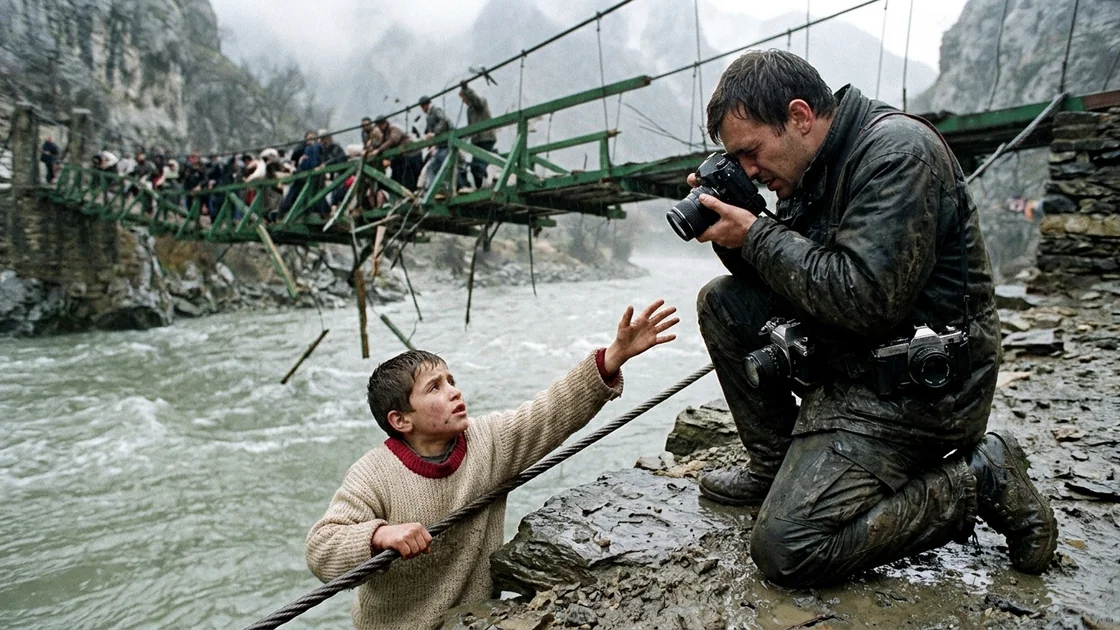
This story follows Julian Ward, an acclaimed conflict photographer whose career reaches its zenith when he captures a world-famous image of a collapsing footbridge during a chaotic river crossing in an eastern European border war. Rather than dropping his camera to catch the outstretched hand of a young boy plunging into the raging torrent below, Ward pauses for a fraction of a second to frame the disaster, freezing the tragedy in perfect silver-halide clarity. While the resulting photograph earns him immense wealth, international honors, and artistic prestige, the memory of his choice corrodes his psyche over the ensuing decade. Haunted by the tactile absence of the boy's grip, Ward abandons the front lines, isolates himself in an analog darkroom, and eventually journeys back to the rebuilt crossing to confront the surviving family, discovering that some debts cannot be paid in art, repentance, or memory.
Part I: The Geometry of the Fall
The river was called the Drina, but in the late autumn of that year it went by no name other than the sound it made against the drowned willow trunks—a wet, guttural roar that carried the stench of diesel fuel and churned mud down from the mountain batteries.
Julian Ward knelt in the brambles forty yards up the western bank, his trousers soaked through at the knees with black, ice-rimed water. He had two motorized bodies slung across his chest: an old mechanical Nikon F3 with a pitted brass rim, and a newer, heavier titanium body fitted with a 35mm Summicron. His knuckles were raw, split open by the cold and blackened with grease from the personnel carrier that had broken an axle three miles back. His teeth ached from clenching them against the damp.
Below him, suspended like a thread of wet sinew between two crumbling limestone bluffs, hung the bridge. It had never been designed for panic. It was an engineer’s makeshift—a span of green timber planks lashed to discarded steel cables that had once anchored logging derricks. Under the weight of forty people, luggage carts, bicycles, and goats tied together with telephone wire, the walkway sagged until the center planks dipped directly into the gray froth of the river.
The shelling had ceased twenty minutes prior, leaving an unnatural, ringing quiet in the gorge. That silence was worse than the mortar fire; it meant the spotters on the ridge had corrected their coordinates and were waiting for the choke point to fill.
Julian did not look at the ridge. He looked through the viewfinder.
To look through a ground-glass prism is to subtract the world’s temperature, its smell, and its terror. In the rectangle, the sky was not an ominous vault from which shrapnel fell; it was a field of neutral gray, three stops over mid-tone, requiring a slight turn of the aperture ring to keep the clouds from blowing out into pure chalk. The screaming woman with the bundle of clothes was an arrangement of diagonals; the old man whose crutch had slipped between the slats was a study in tension and horizontal balance.
Julian had been taught by men who learned their craft in the Mekong Delta and the Sinai: If your pictures aren’t good enough, you aren’t close enough. But they had left out the corollary, the secret law whispered over warm gin in hotel basements: If you are close enough, you cease to be an actor in the drama; you become its scribe, and the scribe must not shake the table.
He scrambled down the shale bank, boots sliding, catching himself against a rusted fence post. The bridge was fifty feet away. Then thirty. The air smelled of sulfur, wet wool, and urine.
A sharp, metallic ping echoed across the gorge—the sound of an anchor pin shearing under tension. Julian stopped. The timber floor groaned, twisting forty-five degrees. A cart loaded with enamel washbasins slid into the current, vanishing with a brief, white gulp.
People began to crawl. Those who could stand lunged forward, trampling those who couldn't.
Julian brought the camera to his right eye, left eye open to track the periphery. The frame was crowded, chaotic, unreadable. He needed a focal point—a singular axis around which the horror could coalesce. Without an anchor, an image of disaster is merely noise; it fails to arrest the gaze; it allows the viewer to turn the page.
Then the central span tore.
It did not break with a crash, but with a long, tearing screech of unbraiding wire. Julian saw the wood buckle upward, throwing five bodies into the air as if they had been kicked from beneath. A woman in a yellow headscarf plummeted straight into the froth, her coat billowing like a parachute before the vortex pulled her down.
And then there was the boy.
He could not have been more than nine. He wore an oversized, hand-knitted jumper of unbleached wool with a crimson border around the collar—a bright, saturated punctum against the dead gray of the limestone and the dull olive river. The boy had been running toward the western bank, the safe bank, Julian’s bank. When the planks dropped out from beneath him, his boots found nothing. His small body fell forward, his chest slamming hard against the outer retaining cable that remained strung between the bluffs.
He did not slip immediately. The boy’s left hand caught the greasy steel wire. His right hand flailed outward into the cold space above the gorge, fingers splayed, grasping for purchase, grasping for anything that had density.
Julian was seven paces away.
He took three long, lunging steps across the slick mud. His left boot struck the stone abutment where the cable was pegged. The boy was right there—not five feet below the edge of the rock. The child’s eyes were not white with panic; they were clear, wide, and fixed directly on Julian’s face. He could see the burst capillaries in the boy's cheek, the spray of brown freckles across a nose flattened by the cold, the crust of dried blood at the corner of his lip.
The boy’s right arm reached upward. His fingers brushed the hem of Julian’s combat jacket.
Catch me.
The command did not need a language. It was a physical circuit waiting to be closed. Julian’s left hand was free. His shoulder muscles contracted; his arm began to extend down toward that red-bordered sleeve. The distance was sixteen inches. If he dropped the camera—if he let the Leica swing around to his kidney—he could drop his weight onto the stone, wedge his pelvis against the steel stanchion, and grab the boy by the wrist with both hands. He knew the grip; he had pulled gear up cliffs; he was thirty-two years old and strong enough to deadlift his own weight twice over.
The boy’s fingers opened. They trembled.
In that hollow fraction of time—a space no longer than the intake of a breath before a scream—Julian’s right hand moved independently. It was not a conscious thought; it was the terrifying, autonomous logic of the reflex arc. The fingers of his right hand curled around the contoured grip of the titanium body. His thumb pressed the lever. The brass barrel of the lens rotated two millimeters to the left, bringing the crimson border of the jumper into razor-sharp focus against the diagonal rip of the falling timber.
Through the viewfinder, the boy's face was magnificent. It was an icon of mortal suspension. Behind him, the bridge was disintegrating in a catastrophic cascade of splintered laths and flailing limbs; beneath him, the river was an abyss of white foam; and in the center of the world, this small, pale hand reached into the void toward a salvation that was looking right back at it through five elements of coated glass.
Julian did not drop his arm. He brought his eye back down to the cup.
One-two-hundred-and-fiftieth of a second. Aperture at four. Focus split between the eye and the fingers.
The shutter fired. Clack.
The sound was small, mechanical, and infinitely obscene against the roar of the gorge. The motorized drive whined, advancing the film with a high-pitched, satisfied purr.
Julian lowered the camera.
He lunged forward then. He threw his chest against the damp limestone, scraping the skin off his chin, his left arm plunging into the empty space beneath the ledge.
"Here!" Julian shouted. His voice sounded paper-thin, ridiculous. "Take it! Take—"
His fingers closed on nothing.
The boy’s grip had failed three inches below the wire. The child had not cried out. He had simply let go, or the cold grease on the cable had stripped his fingers clean.
Julian’s hand swept through the damp air, feeling only the slipstream of the boy’s descent. He saw the red border of the jumper rotate twice in the air, a tiny spark of wool spinning down toward the boil. There was a faint slap as the child hit the water feet-first, then the gray back of the river folded over him, smooth and seamless, like lead poured into a mold.
Julian lay on his belly on the cold rock. The water splashed up from thirty feet below, misting his eyelashes. His camera, dangling from his neck, tapped rhythmically against the stone: tink, tink, tink.
He lay there until the mortar rounds finally found the bridgehead, twenty yards downstream, throwing up geysers of mud and hot, sulfurous iron that rained down upon his back like heavy hail.
Part II: The Alchemy of Silver
The exhibition hall in Zurich smelled of chilled pinot noir, floor wax, and expensive wool. It was February, fourteen months after the crossing at the Drina.
Julian stood near the service entrance, holding an empty flute by its thin glass stem until he feared the crystal would snap between his thumb and forefinger. He wore a dark charcoal suit that did not fit his shoulders; he had lost twenty pounds in the months following his return, his collarbones standing out like spars beneath his shirt.
In the center of the gallery’s main wall, hung under a halogen spot that cast an immaculate, shadowless light, was a four-foot by six-foot gelatin silver print.
The title on the small card to the right read simply: Crossing at Bela, 14 November.
It had won the Golding Prize. It had won the World Press Shield. It had been reproduced on the cover of forty-two magazines in seventeen countries. It had been discussed on late-night panels by cultural theorists who spoke of "the liminality of terror" and "the ethical neutrality of the machine eye."
In the print, every detail was monstrously clear. Julian had spent four days in his London darkroom burning and dodging the negative, balancing the density until the grain of the film looked like the weave of the world itself coming unraveled. You could see the rust flakes on the frayed cable. You could see the water droplets suspended in mid-air like tiny chandeliers. You could see the three distinct tears in the knit collar of the boy's crimson jumper.
And you could see the hand.
The boy’s hand was extended toward the upper right corner of the frame. Because Julian had shot from an angle slightly above the cable, the child’s fingers were angled toward the viewer’s own space, as if the boy were not reaching for a photographer on a bank, but reaching out of the paper itself, asking the gallery patrons, the critics, the women in silk scarves, to reach down and catch him.
"It is the terrible beauty that condemns us," a voice said at his elbow.
Julian did not turn. He knew the voice. It belonged to Marcus Vance, his London agent—a man who had spent thirty years transforming the mutilation of small nations into high-yield real estate for private foundations.
"He was nine, Marcus," Julian said. His voice was hoarse, rusted out by weeks of silence.
"He is immortal, Julian. That is what you gave him." Marcus took a sip from his glass, his eyes squinting at the print with the practiced, predatory appreciation of a horse trader. "If you had pulled him up, what would he be today? A refugee in a camp outside Split, shivering in a nylon tent, waiting for a lard ration that never arrives. Instead, he is the conscience of Europe. He is the icon that made Parliament authorize the air bridge. You saved ten thousand like him with this frame."
"I didn't pull him up," Julian said.
"Of course you did. You did what you were there to do." Marcus tapped Julian’s shoulder with two manicured fingers. "Don't indulge in the luxury of amateur remorse, Julian. It’s unseemly. A surgeon doesn't weep into the abdominal cavity; he operates. You operated."
"The camera was at my eye," Julian whispered. He had never told Marcus. He had told no one. The official story, repeated in the Sunday Times profile and the Aperture monograph, was that Julian had been perched forty feet away on the bluff, using a long telephoto lens, too distant to intervene, powerless to do anything but document the catastrophe through the cruel optics of distance.
No one had asked about the focal length. No one among the judges knew enough about the perspective compression of a 35mm lens to realize that for the boy’s hand to fill that quadrant of the frame, the front element of the glass had to be forty-eight inches from his skin.
They thought he was an eagle. He knew he was a vulture.
A young woman in a backless black dress approached them. She had the sleek, scrubbed cheekbones of an art history student from the university. She carried a copy of the monograph, open to the centerfold.
"Mr. Ward?" she asked, her voice breathless with an admiration that tasted like copper in his mouth. "Would you sign it? Right here, across the water?"
Julian looked down at the pen she held out—a heavy, brass-nibbed fountain pen with black ink.
"What do you see there?" he asked her.
She blinked, surprised by the roughness of his tone. "I... I see the tragedy of our times. The absolute isolation of the individual in the face of political madness."
Julian took the pen. He looked at the boy’s face on the glossy page. He didn't sign his name. Instead, he drew a small, heavy black line where the cable met the edge of the frame, right where his own boots had been planted in the mud. He pressed so hard the steel nib tore through the paper, exposing the white, fibrous pulp beneath the ink.
He handed the pen back to her. "He didn't care about political madness," Julian said. "He wanted somebody to take his hand."
He turned and walked out through the fire door into the wet Zurich slush, leaving his overcoat behind in the cloakroom.
Part III: The Muscle of the Shutter
In his flat on the south side of the river in Rotherhithe, Julian lived with the negative.
It was stored in an archival sleeve of acid-free glassine, tucked inside a steel safe beneath his darkroom bench. But he didn't need to open the safe to see it. It was burned into his retina, an inverted ghost: the sky black, the river white, the boy’s jumper a pale, luminescent gray, and the eyes two clear, transparent holes through which the light of the enlarger lamp shone with a blinding, mechanical purity.
He had stopped accepting assignments. The wires came from Beirut, from Freetown, from the newly opened front in the Caucasus, but he left the faxes curling on the linoleum floor until their thermal ink faded into illegibility.
He spent his days in the red light.
The darkroom smelled of glacial acetic acid, sodium thiosulfate, and damp concrete. It was the only place where he felt the ambient pressure of the world equalize. In the darkroom, everything was governed by chemistry and time. Three minutes in the developer. Thirty seconds in the stop. Five minutes in the rapid fix. If you followed the protocol, the image appeared; it was obedient; it didn't look back at you with wet eyes; it didn't ask you to drop your tongs and plunge your bare hands into the cold chemical broth.
Yet, his right hand had developed a tremor.
It was not a general shake. His left hand—the hand that should have lunged—was steady as a vise. He could balance a nickel on the back of his left knuckles for five minutes without it wavering. But his right hand, specifically the index finger that had rested on the shutter release, twitched with a small, rhythmic spasm every few seconds.
A neurologist on Harley Street had run electrodes down his forearm, listening to the crackle of his motor units on a gray loudspeaker like radio static from a distant star.
"A focal dystonia," the doctor had declared, tapping the printouts with a horn-rimmed thumbnail. "Common in concert violinists and competitive pistol shots. The brain has over-mapped the neural pathway. You’ve fired that shutter three hundred thousand times in twelve years, Mr. Ward. The circuit is firing on its own now. It wants to complete an action that has no target."
"Can you cut it?" Julian had asked.
"Cut what?"
"The nerve."
The neurologist looked at him over his spectacles with clinical weariness. "You wouldn't be able to hold a fork, let alone a camera."
"I don't hold cameras anymore."
He didn't cut the nerve. Instead, he took to taping his right index finger to his middle finger with heavy zinc-oxide tape whenever he went out into the street. If the finger couldn't move, the circuit couldn't close.
One afternoon in late October, when the fog lay thick over the Thames and the horns of the gravel barges sounded like cattle groaning in a field, a visitor came to the flat.
Her name was Elena. She was twenty-four years old, with high, flat cheekbones and short, roughly cut brown hair that she kept tucking behind ears that were reddened by the river wind. She wore an old shearling jacket that had lost half its buttons, and she carried a canvas satchel with a broken strap.
Julian had opened the door four inches, his hand on the chain.
"Mr. Ward?" she said. She spoke English with the hard, dry consonants of the eastern river valleys. "My name is Elena Ruzic."
Julian felt the temperature in the hallway drop ten degrees. The blood left his ears, leaving only the sound of his own pulse, dull and irregular.
Ruzic.
That had been the name on the casualty manifest the Red Cross had compiled six months after the crossing at Bela. One of twelve names from the same hamlet.
"I know who you are," Julian said. His voice was barely a croak.
She did not reach into her bag for a gun, as he had sometimes fantasized during his long, sweat-soaked nights on the floor. She reached into her pocket and produced a single, dog-eared black-and-white print—not his famous image, but a tiny, poor-quality school portrait of a child with neat, parted hair and an oversized striped tie.
"This was my brother," she said. "His name was Goran."
Julian did not look at the photograph. He looked at her fingers. They were long, slender, and rough at the cuticles, with small white scars around the knuckles—the hands of someone who had pulled turnips from frozen dirt and carried firewood through wet snow.
"Why are you here?" Julian asked.
"The foundation," she said, her voice flat, devoid of the performative grief he had seen so often in the western capitals. "The Ward Foundation for the Victims of Bela. They wrote to my mother. They said there is money. They said if we sign the release for the international catalog, there is five thousand German marks."
"Don't sign it," Julian said.
Elena tilted her head. Her eyes were not angry; they were something far more terrifying: they were curious. She had seen the photograph in a French magazine left in a relief office in Tuzla. She had looked at it for hours, trying to reconcile the great, sweeping opera of the image with the brother who used to hide sheep knuckles under his mattress and steal dried plums from the rafters.
"My mother will sign it," Elena said. "We have no roof on the barn. The goats died in the freeze. We have three walls and a sheet of blue plastic. She will sign whatever the gentlemen from London bring in their leather cases."
Julian stared at her through the four-inch gap. The chain between them was brass-plated steel, three millimeters thick. It felt like the cable on the bridge.
"Come inside," he said.
Part IV: The Language of the Lens
She did not sit on the sofa. She walked through his flat with a slow, deliberate stride, her heavy boots clicking on the unvarnished floorboards, looking at the walls.
The walls were completely bare. There was not a single picture hung anywhere in the four rooms. No landscapes, no family portraits, no tearsheets from his twenty years in Africa, Asia, and the Balkans. The only things on display were shelves of steel processing tanks, brown glass bottles of chemistry, and stacks of yellow Kodak paper boxes that had never been opened.
"Where is it?" she asked.
"In the darkroom," Julian said. "In the safe."
"You don't look at it?"
"I don't have to."
Elena stopped in front of the darkroom door, which was painted matte black and sealed with weatherstripping to keep out the London light. She touched the brass handle.
"He was not brave," she said quietly. "In the picture, people say he looks like a soldier. A little martyr. He was terrified of dogs. If a shepherd dog barked at him from the hedge, he would climb a fence and stay there until our uncle came with a stick. He cried when he cut his knee on a scythe."
"He didn't cry on the bridge," Julian said.
"How do you know?"
Julian felt his right index finger twitching beneath the zinc-oxide tape. The tremor traveled up his radial nerve, through his elbow, settling like a cold splinter in his shoulder blade.
"I was there," he said.
"They said you were on the mountain." She turned to face him, her back against the black door. "The man from the foundation—the one with the gold watch—he said you were five hundred meters away on the hill. He said you had a great glass like a telescope. He said you wept because you could not reach him."
Julian walked to the sink. He turned the tap, filled a chipped mug with brown-tinged London water, and drank it down without tasting it. His throat felt as though he had been swallowing sand.
"The man with the gold watch is a liar," Julian said.
Elena watched him. The silence in the kitchen stretched until the only sound was the drip of the tap and the low, distant rumble of a container ship turning in the reach.
"How close were you?" she asked.
Julian didn't answer with words. He walked across the room until he was standing directly in front of her. He stopped when the toe of his leather shoe was three inches from the battered leather of her boot.
He lifted his left hand—the steady hand, the one that had stayed tucked against his ribcage while his right hand worked the titanium body. He held it out between them, palm upward, fingers curved into an open hook.
"Here," Julian said.
He reached down. His hand stopped sixteen inches from her chest.
"He reached up like this," Julian whispered. "His sleeve was torn at the cuff. The red wool was coming unraveled. There was a knot of blue string holding his collar together because the button had popped off. He smelled of sheep grease and wet wood. He looked into my face. He didn't look at the sky. He didn't look at the water. He looked at me."
Elena did not pull away. Her eyes stayed locked on his hand, suspended in the empty air between them.
"And you?" she asked.
"I took the picture," Julian said.
The confession did not sound grand. It did not bring with it the theatrical rush of relief that priests promised in the confessional. It was simply a physical fact, like the density of lead or the freezing point of water. It was an event that had occurred at 11:42 in the morning on a Tuesday in November, and which could not be undone by all the tears, exhibitions, prizes, or foundation checks in the northern hemisphere.
Elena looked down at his taped hand—the right hand, hanging dead at his side.
"Show me," she said.
"Show you what?"
"The dark room. Show me how you made it."
Part V: The Red Room
The darkroom smelled of old vinegars.
Julian flipped the switch inside the door, and the room was bathed in the dull, amber-red glow of the safe-lights. To an outsider, the light felt subterranean, secretive, like the interior of an organ. To Julian, it was the only light that didn't lie; under safe-light, silver halide was blind. It couldn't see what was happening to it until the chemistry began to bite.
He knelt by the safe, his knees clicking in the silence. He spun the three-digit combination, pulled the heavy steel door open, and brought out the glassine envelope.
With cotton-tipped tweezers, he slid the negative out.
It was thirty-five millimeters wide. A strip of celluloid five inches long, containing four frames: two of the panicked crowd on the bank, one blank frame where the shutter had fired against his hip as he stumbled, and the frame. Frame 17.
He placed it into the enlarger's carrier. The glass plates clamped down with a dull thunk.
"Look," Julian said.
He switched on the enlarger lamp for three seconds, projecting the negative image down onto the white baseboard.
Because it was a negative, Goran was a creature of pure light. His jumper was white as snow; his hair was a pale, glowing crown; his eyes were deep, fathomless wells of blackness. His hand was a silhouette of white bone reaching up toward the dark rectangle where Julian’s own body had been standing just outside the illumination of the lens.
Elena leaned over the easel. Her face, in the red light, was transformed into an ancient, terracotta mask. She reached out one finger, hovering just above the paper baseboard, tracing the line of her brother’s arm.
"He had a mole," she whispered. "Right here, inside the elbow. Like a lentil."
Julian looked at the projected light. In the high-contrast negative, the mole was invisible, lost in the deep grain of the emulsion.
"The camera didn't see it," Julian said.
"No," she said. "The camera didn't see anything."
She stood up straight, turning her head toward him in the red murk. "The man with the gold watch said this picture is worth fifty thousand pounds. That is what the museum in New York paid for the master print."
"Yes," Julian said.
"And you have that money?"
"It’s in an account. I haven't touched it."
"Why?"
"Because it smells of him," Julian said.
Elena looked back down at the white, shining face of her brother. Her expression was completely unreadable. There was no rage in it, but there was no forgiveness either. Forgiveness was a Western invention, like psychoanalysis or neutral journalism—a comfort for people whose houses had never been burned to the foundation by their schoolteachers.
"My mother will take the five thousand marks," Elena said softly. "She will buy four sheep and a wood-burning stove with an iron oven. She will buy two sacks of flour and three pairs of winter boots for my cousins. And every time she puts a log into that stove, she will know that Goran paid for the wood with his ribs."
She turned the enlarger switch off. The room fell back into the blood-red gloom of the safe-light.
"I want to go back," Julian said.
She paused, her hand on the doorknob. "Back where?"
"To the river."
"There is nothing there," she said. "The water took the bridge. The army built a concrete one two miles down with four lanes and a toll booth. The gorge is full of old tires and plastic bottles. Nobody goes to the old crossing."
"I have to see it," Julian said. "Without the glass."
She opened the door. The pale, gray daylight of London rushed into the room, blinding them both, turning the red glow instantly to mud.
"If you go," Elena said, looking out toward the gray reach of the river, "don't bring your machines."
Part VI: The River of Gray Limestone
The bus from Sarajevo took nine hours to reach the border hills. It was an old Mercedes with cracked green vinyl seats and a windshield held together with yellow packing tape. The heater was stuck on high, blasting air that smelled of burnt grease and cheap tobacco into the cabin.
Julian sat in the back, over the wheel well.
His luggage consisted of a single canvas duffel bag containing two shirts, three pairs of socks, a loaf of dark rye bread, and a small, heavy wooden box he had bought from an antique dealer in Bermondsey. The box contained no cameras. It contained twelve boxes of prints—every single working proof, contact sheet, and exhibition enlargement of Crossing at Bela that he had ever made, along with the master negative in its glassine sheath.
His right hand was not taped. Without the tape, the index finger twitched against his thigh, a rhythmic, solitary tapping that kept time with the thump of the tires over the cracked asphalt.
The country had not healed; it had simply grown over, like an amputated stump covered in pale, hairless skin. The burnt-out brick shells of the farmhouses were draped in wild blackberry brambles; the artillery positions on the hills were now meadows of yellow mullein and chicory. Here and there, a small red wooden skull-and-crossbones sign warned travelers not to step off the shoulder to relieve themselves.
Elena met him at the crossroads three miles outside the village.
She was riding a high-wheeled iron bicycle with no gears, a wicker basket strapped to the handlebars. She was wearing the same shearling jacket, its sheepskin collar greasy around the lapels.
She did not greet him. She simply looked at his duffel bag, kicked the kickstand up, and began walking the bicycle down the gravel track that led toward the gorge. Julian fell into step beside her.
"My mother knows you are here," she said as they walked between two rows of dying poplars.
Julian felt his stomach contract. "What did you tell her?"
"I told her the man who made Goran into paper was coming to return the negative."
"What did she say?"
"She said paper burns quickly, but it doesn't give off much heat."
They walked for an hour in silence. The track descended through a narrow ravine where the limestone walls rose three hundred feet on either side, shutting out the afternoon sun. The air grew damp, smelling of cold stone, wet ferns, and that unmistakable, ancient scent of heavy water running over gravel.
Then the gorge opened out.
The Drina was not gray today. It was a pale, sickly green, choked with the autumn melt from the Durmitor peaks.
Julian stopped.
The bluffs were exactly as he remembered them, but smaller. The western abutment—the rock where he had knelt with his knees in the mud—was still there, but the steel stanchion had been cut off with an acetylene torch, leaving only an oxidized orange stump embedded in the stone. Of the bridge itself, nothing remained except a single, rusted cable that hung down into the water like a dead vine, vibrating in the current.
Julian walked to the edge.
He looked down.
Thirty feet below, the water boiled over a shelf of submerged slate. It was not an icon. It was not a metaphor for the century’s cruelty. It was merely eight hundred tons of cold water moving at twelve miles an hour toward the Danube, indifferent to the names of the people it had drowned, indifferent to the shutter speed that had recorded their passing.
He knelt on the rock.
His knees found the exact depressions in the shale where he had rested his weight ten years before. His body remembered the geometry better than his mind did. He felt the forward cant of his torso, the tension in his calves, the specific angle of his neck as he had brought his right eye to the rubber cup of the Nikon.
He reached down with his left hand.
The distance was still sixteen inches.
The empty air was cold against his skin. He opened his fingers, straining the muscles of his forearm until the tendons stood out like cords. He reached down into the void, trying to touch what wasn't there, trying to bridge the gap that he had deliberately preserved with thirty-five millimeters of ground glass.
His fingers clawed at the wind.
"Julian," Elena said.
She was standing five feet behind him, holding the bicycle by its handlebars.
He didn't turn around. He stayed on his knees, his left hand reaching down, his right hand shaking violently against his knee, the index finger clicking against the wet stone like the leg of a dying insect.
"I could have reached him," Julian whispered. He had never said the words aloud to another human being. They sounded small, ridiculous, lost in the roar of the green river. "I had the purchase. My left foot was wedged behind the iron pin. I had three points of contact. I could have taken his wrist."
"I know," she said.
"I wanted the frame."
"I know that too."
Julian pulled his hand back. He looked at his palm. It was red from the wind, crisscrossed with deep, white creases—the lines of an aging man who had spent his life touching dials and levers instead of flesh.
He opened his duffel bag.
He took out the Bermondsey box. He flipped the brass catches and opened the lid.
Inside lay the master negative—that tiny, five-inch strip of film that held the world's grief in its silver salts. Beside it were the seventy-two prints he had gathered from his flat: the working proofs, the test strips, the final exhibition prints with the stamp of the Royal Photographic Society on the reverse.
He took the negative out of its sleeve.
He held it up between his thumb and forefinger against the gray northern sky. The negative boy looked down at him—white face, black eyes, white hand reaching into the void.
Elena watched him. She did not move. She did not tell him to stop, nor did she encourage him. She stood with her hands on the cold iron grips of her bicycle, as impartial as the river, as impartial as the camera had been.
Julian took an old brass Zippo lighter from his pocket.
He struck the wheel. The yellow flame rose, smelling of kerosene.
He brought the flame to the corner of Frame 17.
The cellulose triacetate did not catch fire immediately; it melted first, wrinkling like skin exposed to a sudden heat, the edges curling inward with a faint, hissing sound. Then the emulsion ignited with a small, sharp pop.
The flame was not yellow; it was a brilliant, chemical blue and violet, fueled by the silver and the plastic. Julian held the strip by the clear margin until the fire reached his fingertips, smelling the bitter, medicinal stench of burning camphor and nitrogen.
The boy’s face vanished in a bubble of boiling black tar. The crimson jumper, the frayed cable, the reaching hand—they dissolved into a tiny knot of gray ash that blew from his fingers before it could even hit the water.
He did not stop with the negative.
One by one, he took the prints from the box. He did not burn them; there were too many, and the paper was heavy, double-weight fiber coated with baryta.
Instead, Julian knelt by the edge of the limestone ledge. He took the first print—the great, six-foot master enlargement that had hung in Zurich, folded down now into quarters—and tore it across the boy’s chest. The fiber paper was tough; it groaned as it ripped, exposing the bright, cotton-white core beneath the silver coating.
He dropped the pieces into the Drina.
They did not sink immediately. They floated on the surface of the green water like heavy white lilies, the fragments of Goran’s face drifting apart in the current. The eye went first, spinning into an eddy behind a drowned willow; then the reaching hand, floating face-downward, the baryta coating absorbing the river water until the paper grew translucent, turned gray, and was dragged down into the gravel beds below the bluff.
He tore the second print. Then the third. Then the contact sheets with their rows of tiny, repetitive horrors.
He worked with a methodical, rhythmic intensity, his fingers tearing, dropping, tearing, dropping. His right index finger had stopped twitching. The tremor was gone, replaced by the mechanical labor of destruction.
Elena came to the edge. She knelt beside him.
She did not touch the master prints, but she picked up the small test strips—the two-inch wide scraps of paper where Julian had calibrated the exposure for Goran’s eyes. She took them in her rough, scarred hands, tore them into tiny confetti, and let them fall between her knuckles into the slipstream.
They worked together for nearly an hour, until the wooden box was completely empty, its cedar lining smelling only of dust and dried glue.
The river took it all. The silver, the gelatin, the chemicals, the paper pulp—it all went down toward the Black Sea, dispersed across a thousand miles of silt and reeds, until there was not a single atom of the boy left in Julian Ward’s possession.
Part VII: The Stone Abutment
They walked up the steep track to the village as the light was failing.
The village of Bela was seven stone houses with slate roofs, set into a hollow between two limestone ribs. Three of the houses were roofless ruins, their doorframes charred black by fires that had burned ten years before. In the center of the village, an old stone fountain trickled a thumb-thick stream of water into a moss-covered trough.
Elena led him to the smallest house at the end of the lane.
The walls were made of dry limestone, patched with gray mortar and sheets of corrugated tin. A thin plume of blue smoke rose from a stovepipe that poked through a pane of glass in the kitchen window.
"Wait here," Elena said.
She leaned her bicycle against the stone wall and went inside, the low wooden door clicking shut behind her.
Julian stood in the yard. The ground was beaten dirt, swept clean of leaves. A row of split birch logs was stacked against the wall, covered with a piece of old green linoleum to keep off the frost. In the small pen behind the barn, two black goats chewed on dry hazel twigs, their horizontal pupils watching him with mild, demonic curiosity.
The door opened.
Elena stood in the threshold. She didn't speak; she merely hooked her finger, beckoning him into the dark interior.
The house smelled of boiled cabbage, sheep tallow, and the dry, sweet smoke of burning birch. The floor was packed earth, covered in the center with a strip of rag carpet woven from scraps of old army blankets and floral dress fabric.
At the table by the small iron stove sat an old woman.
She was not seventy, but she had the collapsed, ancient face of women who have seen their world dismantled three times in a single lifetime. She wore a black wool scarf tied tightly under her chin, hiding her hair. Her hands—huge, swollen at the joints by arthritis, with thick, yellowed nails—rested flat on the oilcloth table on either side of an open tin of lard.
Between her hands lay an official document from the ministry in the capital, printed on blue paper with an embossed gold stamp.
Julian stopped three paces inside the door. He took off his wool cap, holding it in his hands against his stomach.
The old woman did not look up immediately. She looked at the blue paper.
"This is the photographer," Elena said in her own language.
The woman raised her eyes. They were not green like Elena’s; they were a dark, milky brown, clouded around the irises by the blue rings of old age. She looked at Julian’s face, then at his shoulders, then down at his hands.
She spoke three words in a low, gravelly voice that sounded like stones grinding together in a sack.
Julian looked at Elena. "What did she say?"
"She asked if you have the check," Elena said.
Julian reached into his jacket. He took out the leather wallet that Marcus Vance had given him three years ago in London. From it, he extracted a cashier's check drawn on a bank in Frankfurt—the entire balance of the Ward Foundation for Bela, thirty-eight thousand German marks, made out to Mariya Ruzic.
He placed it on the oilcloth between her flat, heavy hands.
The old woman did not pick it up. She looked at the numbers printed in black ink—the three, the eight, the four zeros. To her, it was not money; it was an abstraction, like the coordinates of a mortar battery or the latin names of the weeds that grew in her cabbage patch.
"She wants to know," Elena translated, "if this is what they paid for his picture."
"Yes," Julian said.
The old woman touched the edge of the blue paper with her thumb. Then she looked back at Julian.
"Tell her," Julian said, his voice cracking like dry timber, "that I am sorry. Tell her that I was four feet from him. Tell her that I had the camera at my eye. Tell her that I could have reached out my arm, but I chose to push the release."
Elena did not translate immediately. She stood between them in the low room, her shadow thrown large against the whitewashed wall by the kerosene lamp on the shelf.
"She doesn't care about your release, Julian," Elena said softly.
"Translate it," Julian demanded. His voice was rising now, high and shrill, the voice of a man who has traveled two thousand miles to be struck and finds only a wall. "Tell her what I did. Tell her I killed him. Tell her I stood there and watched him drop so I could have my name on the wall in Zurich."
Elena spoke to her mother. She spoke for thirty seconds, her voice flat, rhythmic, unsparing. She used the hard words—the words for glass, for money, for distance, for death.
The old woman listened without moving a muscle in her face. Her milky brown eyes stayed fixed on Julian’s throat.
When Elena stopped, the house was completely silent except for the hiss of the birch sap in the stove.
The old woman slowly pulled her hands away from the blue paper. She reached into the pocket of her apron and produced a pair of cheap reading spectacles with bent wire frames, mended at the bridge with yellowed cellophane tape. She hooked them behind her ears with slow, painful movements.
She picked up the cashier’s check.
She turned it over. She looked at the back, where a line had been printed for an endorsement.
Then she looked up at Julian through the scratched plastic lenses.
"You have a pen?" she asked. The word was in English—the only word she had spoken in his language.
Julian’s breath caught in his lungs. He reached into his pocket and found the heavy brass fountain pen—the one he had taken from the girl in Zurich ten years before. He unscrewed the cap and handed the barrel to the old woman.
She took it in her swollen, knotted fingers. Her hand was shaking, not with the neurotic twitch of Julian’s radial nerve, but with the profound, irreducible fatigue of eighty years of manual labor.
She pressed the steel nib against the back of the check.
She did not write her name. She could not write. She made a heavy, uneven cross in the center of the line—two intersecting strokes that dug deep into the paper, leaving a small, glistening pool of black ink at the crossing.
She laid the pen down on the oilcloth.
She folded the check twice, with slow, creasing strokes of her thick thumb, and slid it into the pocket of her apron with the spectacles.
Then she spoke to Elena again, two short sentences, without looking back at Julian.
"She says the tea is cold," Elena told him. "She says you should go now before the fog comes up from the gorge. If the fog catches you on the old track, you will walk off the rocks into the water, and nobody will be there to make your picture."
Part VII: The Anatomy of Light
Julian walked down the gorge alone.
The fog had indeed come up. It did not rise like smoke; it poured out of the river like cold grease, thick and white and smelling of wet limestone, filling the narrow ravine until the walls vanished and there was nothing left of the world except the three feet of gravel track immediately before his boots.
He did not walk quickly. He had left his duffel bag at the house; he had left his overcoat on the back of the kitchen chair; he carried nothing in his pockets except his hands.
He stopped at the bridgehead.
In the white blindness of the fog, the sound of the Drina was different. Without the sight of the water, the roar lost its direction; it came from above, from below, from inside his own ears. It sounded like the world being crushed between two great millstones of ice and bone.
Julian stepped off the track.
His boots found the wet shale of the western abutment. He walked forward until his toes touched the empty edge where the rock sheared off into the thirty-foot drop.
He looked down.
He saw nothing. There was only the gray, luminous void of the fog, illuminated from above by the hidden moon. It was the same light as the darkroom—the neutral, indifferent light that comes before the developer takes hold, before the silver particles clump together to form the illusion of a face, a bridge, a hand.
Julian stood with his arms hanging at his sides.
His right index finger did not twitch. It was cold, stiff, deadened by the mountain air, but it was quiet. The circuit had finally broken. The muscle had forgotten the lever; the nerve had forgotten the brass.
He remembered the boy’s face, but it was different now. Without the photograph—without the print to tell him what to see—the memory was soft, shifting, unsharpened by five elements of coated German glass.
In the memory, the boy was not an icon. He was not the liminal figure of European tragedy. He was just a child in a dirty wool jumper who had slipped on a greasy cable because he was small and weak and the river was big and fast.
And Julian was not a scribe. He was not a witness. He was not an artist who had made a terrible, Faustian pact with the light.
He was merely a man who had stood on a rock with his hands full of machinery when he should have had them empty.
He knelt down on the damp limestone one last time.
He did not look through a prism. He reached both hands out into the fog, palms upward, fingers open to the damp, cold mist that rose from the roar below. He held them there until his skin was as cold as the rock, until the droplets gathered on the hairs of his knuckles, heavy and clear, like water waiting to fall.
He did not take the picture. He did not jump.
He stayed on his knees in the gray, unrecorded dark, holding the empty air between his fingers until the morning came and the mist finally burned away into nothing.