The Unbroken Seal
Clara Vane lived in the certainty that survival was an art of measurement, a calculation of bread and coal, acres and timber, where mercy was a luxury only the rich could afford and the foolish died for. When the royal dispatch arrived at Oakhaven in the dead of winter carrying a full pardon for her husband's exiled twin brother, it promised to restore an innocent man from the salt quarries of the penal colony, but it also promised to slice the ancestral estate in two and cast Clara back into the precarious penury of her youth. Her husband was a gentle man whose spirit had been half-broken by his brother's disgrace, yet whose hands still worked the failing farm with stubborn devotion. Rather than permit Julian to return and claim his legal half of the land, Clara slipped the parchment into the dark void beneath the drawer of a rosewood bureau, choosing the quiet murder of an absent soul over the ruin of her home. What followed was a decade of slow, poison-laced prosperity, an abundance built upon a foundation of silence, until the dead returned not as a ghost, but as a living ruin whose silence was far more terrible than any accusation.
Part I: The Courier in the Sleet
The carriage that brought the envelope did not turn up the long avenue of limes; the ruts were too deep, filled with the slush of a freezing February thaw that turned the red Devonshire earth to the consistency of porridge. The postboy had left his lathered mare at the gatekeeper’s lodge—empty these four years since old Peter died—and walked the quarter-mile on foot, his oilskin cape stiff with frozen rain and his boots making a wet, sucking sound against the gravel.
Clara watched him from the high window of the morning room. She held a saucer of weak tea against her bodice to catch its meager warmth. Her fingers were red at the knuckles, stiffened by the persistent damp that seeped through the stone mullions of Oakhaven. It was a house too large for its fires. Even in the heart of winter, they kept only two hearths burning: one in the kitchen to boil the salt beef and the oats, and one in this small, south-facing room where Ronald sat through the evenings over his calf-bound ledgers, dipping his quill into ink that had to be thawed near the coals before it would run.
"A boy from the post," she murmured to the empty room.
The house did not answer. Oakhaven was accustomed to silence. It had been built two hundred years before by men who had grown rich on the fleece trade, men who had carved their names into lintels and planted oaks that they believed would shelter their great-grandchildren. But the fleece had failed, the land had been mortgaged to pay for lawsuits that dragged through three generations of chancery, and now only Ronald and she remained to inhabit the echoing shells of sixteen bedchambers, their footsteps muffled by holland covers and the grey dust of neglected plaster.
She set the saucer down on the mahogany table—its surface scarred by the rings of dead men’s glasses—and went down the broad oak stairs. Her skirt of undyed wool made a dry, whispering rustle against the banisters.
The boy was standing in the vestibule, shivering beneath the great bronze lantern that hung from the ceiling without a candle. His breath rose in pale plumes toward the cross-beamed roof.
"Mistress Vane?" he asked, wiping a drop of rain from his nose with a woollen mitten.
"I am Mrs. Vane. Mr. Vane is at the lower weir with the wood-cutters. You have business with him?"
"From the King’s Bench, ma'am. Royal post. It came by the Exeter mail-coach at noon, with instructions for immediate dispatch to the manor. The postage is sixpence, if it please you."
Clara did not flinch, though sixpence was the price of half a bushel of meal. She drew her purse from the hidden pocket of her petticoat—a thing of netted green cord, light as a dried sparrow—and tipped out three copper groats. The boy took them with a bow that was more a twitch of his shoulders against the wet, and handed her the packet.
It was neither thick nor heavy, but it possessed that stiff, unyielding crackle that belonged only to the instruments of state. The envelope was heavy rag paper, sized with alum, sealed with a disk of dark scarlet wax the size of a crown piece. The stamp was the lion and the unicorn, deep-bitten and sharp, surrounded by the Garter motto: Honi soit qui mal y pense.
"Good day to you, mistress," the boy said, eager to be back at the Stag and Thistle where there was cider and an open hearth.
"Good day," she said, and closed the heavy oak door against him before he had reached the first gravel terrace.
She stood in the grey light of the vestibule, her back against the timber, listening to the iron bolt settle into its socket. The house was cold, but her chest felt suddenly hot, as though she had swallowed a coal.
There were only three reasons why the King’s seal should come to Oakhaven. The first was tax—and they had paid the hearth-tax only the Martinmas before, scraping the last silver shillings from the butter-crock. The second was the final settlement of the chancery suit concerning the saltings at Topsham, which had been abandoned thirty years ago for lack of funds. The third—
The third was Julian.
Clara walked into the parlor, her fingers trembling against the coarse vellum. She did not go near the window now. She went to the hearth, where three logs of damp birch hissed and wept their pale sap into the gray ash.
She did not wait for Ronald.
She told herself later, in the long nights when the rain beat against the leaded glass like handfuls of peas, that she had opened it only to spare him. Ronald was an ox of a man, wide-shouldered and patient, but his heart was made of soft curd. When the sheriff’s men had taken Julian from this very hearth seven years ago, Ronald had sat on the floor with his forehead against the dog-iron and wept until his shirt was soaked. If this was news that Julian had died in the barracks at Port Gabriel—if he had rotted of the scurvy on Norfolk Island, or been beaten to pulp by the convict-masters in the timber-gangs—she would read it first, so that she might lay the blow upon Ronald’s shoulders with some degree of mercy.
She slipped her thumb beneath the red wax. It gave way with a dry, resinous snap, like the breaking of a chicken’s wing.
The sheet within was calfskin, scraped so fine that the light shone through the veins of the beast. The hand was the great, sprawling clerk’s script of the Home Office, adorned with flourishes at the capitals that looked like the tendrils of bryony.
To all Magistrates, Governors, Keepers of Gaols, and Officers of the Penal Settlements in the Southern Seas, Greetings:
Whereas it hath been made appear unto Us, by the confession of one Thomas Garrow upon the scaffold at Newgate, that Julian Vane, late of Oakhaven in the County of Devon, Gentleman, was unjustly convicted of the felony of robbery and arson at the house of Sir George Musgrave, Bart., in the year of our Lord 1794, and did receive sentence of Transportation for the term of his Natural Life;
And Whereas the said confession hath fully cleared and acquitted the said Julian Vane from all complicity and guilt in the said felonies;
We, being moved by Our Princely Compassion, do hereby grant unto the said Julian Vane Our FREE AND UNCONDITIONAL PARDON for the said crime, restoring unto him all lands, rights, franchises, and liberties which were his prior to the said conviction, with full power to return unto this Our Realm...
Clara sat down upon the stool by the hearth. The parchment rested upon her knees. The red seal, broken into three fragments, rolled into the dust at her feet like bits of dried sealing-pith.
A free pardon.
She closed her eyes. Her memory was not of Julian as a convict, chained between two carters in the wagon to Plymouth, but of Julian as he had been on the morning before the trial: tall, with Ronald’s own hazel eyes and Ronald’s heavy chin, but with a lip that curled with effortless contempt for the ledgers, the tenants, the drainage ditches, and for Clara herself.
"My brother," Julian had said once, leaning against that very mantelpiece with a glass of claret in his hand—claret that had not been paid for—"has the soul of a turnip, Clara. He grows where he is dropped. But you—you have the soul of a magpie. You hoard the twigs because you are terrified the wind will blow the nest away. You ought to have married an attorney."
And now Julian was pardoned.
The paper on her lap was not a letter; it was an execution order for Oakhaven.
By the terms of their father’s will—that mad, stubborn document drawn up when old Squire Vane was spitting blood and cursing his sons in equal measure—the estate was held in undivided moieties. Neither brother could sell an acre without the other; each had an equal right to the rents, the timber, the manor house, and the home farm. If Julian died without issue, the whole fell to Ronald and his heirs.
For seven years, Julian had been legally dead. His civil death had allowed Ronald to assume the administration of the estate. It had allowed them to borrow two thousand pounds from the bank in Exeter to clear the marsh meadows and plant the new rye-grass. It had allowed them to sleep in the master bedchamber without waiting for a drunken step upon the gravel at three in the morning.
If Julian returned, the mortgage would be called in. Julian would demand his half of the timber money—money that had already been spent on lime and ditching-tiles. He would bring his companions, his debts, his sullen, ruined pride, sharpened by seven years of the chain-gang and the cat-o’-nine-tails. He would look at the new barns they had raised with their own blistered hands, and he would say: Half of this is mine, sister. Bring me the keys.
Clara looked at the fire. A single twig had caught, a blue flame dancing over the white birch bark. It would take four seconds. The vellum would shrivel like a leaf; the red wax would melt into a greasy smear; the ashes would go up the chimney with the smoke of the damp wood, and who could say that a boy had ever ridden through the slush from the post-stage?
Her hand moved toward the hearth.
Then she stopped. Her hand hung in the chill air, inches above the smoke.
Murder, the church bells seemed to say on Sundays from the square tower down the valley. Thou shalt do no murder.
She was not a wicked woman. She gave broth to the wood-cutter’s children when they had the quinsy; she read her Bible every evening while Ronald cleaned his boots; she had wept when the brindled heifer died in the calving. To burn a King’s pardon was a hanging matter, but worse than that, it was a dark, irrevocable plunge into the pit. If she burned it, she would see Julian’s face in the coals every time she sat to warm her feet.
She stood up. Her knees were stiff.
She walked out of the parlor, through the dark vestibule, and up the oak stairs. Her room was at the end of the north corridor, where the wind whistled through the loose lead-work of the window. In the corner stood a rosewood bureau, an old Dutch piece that had belonged to her mother—the only thing of value she had brought to Oakhaven when Ronald took her from the curate’s draughty cottage with three gowns and a dozen linen shifts.
The bureau had a fall-front that opened with a brass key. Behind the pigeon-holes, which were stuffed with Ronald’s receipts for wool-packs and salt, there was a shallow well covered by a sliding panel of tulipwood. It was meant for sovereign-purses or private journals.
Clara slid the panel back. Inside lay her mother’s silver thimble, a dried sprig of lavender from her wedding wreath, and a small leather-bound book containing her grandmother’s recipes for elderberry wine and lungwort syrup.
She folded the calfskin pardon twice, until it was no larger than a prayer-book. The broken pieces of the King’s seal she pressed into the center of the fold, where they rattled softly like cherry-stones. She laid the packet at the bottom of the well, drew the tulipwood slide across until it clicked against its brass stop, closed the bureau, and turned the key.
The key she hung upon the steel ring that held her cellar-keys and the key to the linen-press, which stayed always at the band of her apron, ticking against her hip with every step she took.
When she came down to the kitchen, the girl, Mary, was blowing the fire to boil the potatoes.
"Has the master come up from the weir, ma'am?" Mary asked, her face red from the bellows.
"Not yet," Clara said. Her voice sounded strange to her own ears, like a voice spoken through a length of tin pipe. "Take the ham down from the chimney, Mary. We will have meat tonight. The master will be cold."
Part II: The Ghost at the Board
Ronald came in as the darkness was settling over the valley—a thick, sodden night that smelled of dead ferns and wet sheep. He smelled of them too: of horse-sweat, hemlock, and the black mud of the riverbank. He sat by the kitchen hearth while Mary pulled his boots off, his great woollen socks steaming near the embers.
"The culvert is blown," he said, rubbing his broad hands over his knees. His voice was slow, heavy with the weight of the Devon soil that had bred five centuries of his folk. "The rain has brought down the bank by the miller’s willow. If we do not stone it before the frost gets into the clay, the whole meadow will be under two feet of water before Lady Day."
"We will hire the masons," Clara said, setting a pewter dish of ham before him.
Ronald looked up, surprised. "The masons? Clara, they will ask two shillings a day, and the lime is three pence the sack at the kiln. We cannot afford masons. I’ll take the stone down from the old sheep-cote myself with the bay mare."
"The bay mare is five years gone in the wind," she said, cutting the brown loaf with a heavy, steady hand. "And your back will not bear another season of stone-drawing, Ronald. We have the timber money from the south hangar. The timber-merchant from Bideford gave his bill for sixty pounds at three months."
"That was for the mortgage interest," he said softly, looking down at his plate. "The bank will not wait, Clara. Mr. Trefusis wrote last month. He was very civil, but he was plain. If the interest is not paid on Lady Day, they will enter into possession of the home farm."
He did not mention Julian. He never did. But Julian was there, sitting in the empty Windsor chair between them, as he had sat every night since the assizes at Exeter.
Julian had been the elder by twenty minutes. Their mother had dressed them in the same blue nankeen coats until they were twelve, but there the likeness had ended. Julian was the boy who rode the horses until their flanks were white with foam; Julian was the boy who took the trout from the squire’s preserve and laughed when the keepers chased him through the gorse; Julian was the boy who had gone to London with fifty pounds in his purse and come home three years later with an empty pocket, a pair of silver-mounted dueling pistols, and a dry, hacking cough that he drowned in Spanish brandy.
And then had come the night at Musgrave’s hall: the library window forced, the iron chest dragged into the park and broken with a sledge-hammer, the stable fired to cause a tumult, and Sir George’s groom found half-murdered in the ditch with Julian’s silver-mounted pistol lying in the grass beside him.
Julian had sworn his innocence with an oath that made the magistrates shudder. He had sworn that he was five miles away, at the Seven Stars in Totnes, playing hazard with two drovers whose names he did not know. But the drovers never came forward, and the pistol was his, and his boots fitted the red clay impressions under the library sill. The judge had spoken of his good family, of the grief of his honest brother, and had told him that only the King’s great mercy spared his neck from the halter, commuting the penalty to servitude across the salt seas for the term of his life.
Ronald had offered the farm to pay for counselors. He had gone to London on the outside of the coach, with forty sovereigns sewn into the lining of his waistcoat, to petition the Duke of Portland. But the Duke was busy with the French war, and the attorneys had taken the sovereigns and returned three sheets of foolscap covered with Latin that led nowhere.
"Eat your meat," Clara said, leaning over him. She touched his shoulder; the fustian of his coat was wet through to the lining. "The timber money will pay the interest, and there will be twenty pounds left. The masons shall have their two shillings. You shall not break your back for the stone-cote."
Ronald took her hand in his. His skin was rough as horn, the nails broken back to the quick by his labor in the ditch.
"You are a good wife, Clara," he said, and his voice was thick with that slow, bovine tenderness that had first made her pity him, and then despise him, and finally, fiercely, protect him. "I think sometimes what my life would have been if I had taken to the road like poor Julian, or if I had lived alone in this great barn of a house after he was gone. I would have let it go to the nettles. I would have let the bailiffs have the keys and gone for a soldier."
"You are not made for a soldier," she said, her heart giving a strange, small lurch against her ribs. "You are made for Oakhaven. The land needs you."
"The land belongs to God," he muttered, as he always did when he was weary, "and after God, to the King."
Clara took the bread-knife and wiped it upon her apron. "The King is far off," she said. "The land belongs to those who keep the weeds from it."
Part III: The Years of the Locust
The King’s parchment stayed in the rosewood bureau through the great frost of that year, through the wet summer that followed when the oats rotted in the ear across the whole south of England, and through the winter when the French Emperor marched his army into the snows of Muscovy and was lost.
The world went on with its great, bloody business, but Oakhaven seemed to exist within a bell of thick glass. Clara watched the seasons through the window of the morning room.
Every three or four months, Ronald would bring the tin box of letters from the study to the parlor table. He would take out the three letters they had received from Julian: the first written from the hulks at Portsmouth, where the ink was mixed with vinegar and the paper smelled of bilge-water and lime; the second from the transport ship Minerva, dated off the Cape of Good Hope, three lines to say that he was still alive and that the salt beef was full of maggots; the third, five years old now, from the penal settlement at the Coal River, written on a torn scrap of government paper and sealed with a wafer of black flour-paste.
Dear Brother,
I am assigned to the stone-cutting gang at the lime-kilns. The work is hard, but the sun is hot enough to dry the blood in a man's shoes. The superintendent is a Scotsman named MacIntyre who knows our uncle in Fife, though he gives me no more oatmeal for that. My lungs are bad with the dust of the stone. If there be any hope of a petition from the county gentlemen, I pray you move them for the love of our mother, for I shall not see another year of these stones. My duty to Clara.
Julian.
That was the last. For four years, there had been nothing.
"He is dead," Ronald said one evening in the autumn of 1814. He had been reading the letter again by the light of a single tallow candle. His hair, which had been chestnut like his brother’s, was now almost white at the temples, though he was not yet forty. "He must be dead, Clara. If he were alive, he would have got some parson or clerk to write. Julian never could keep silent when he had an ink-horn near him."
Clara was mending a pair of his grey woollen stockings. Her needle moved in and out of the heel with the precision of a clock. One, two, three, four.
"It is seven years since the ship sailed," she said, her head bent over her work so that the shadow of her cap fell across her eyes. "The law considers a man dead after seven years if he has not been heard from across the sea."
"The law!" Ronald said, and for the first time in months, there was a bitter edge to his voice. "The law took him for a thief when he had never stolen more than an apple from an orchard. The law sent him to the antipodes because an attorney’s clerk made a mistake in the name of the road. I do not care for the law. I think of him under the dirt, Clara, with no stone over him, and no one to say the Lord’s Prayer, and his brother sitting here by the fire eating white bread and drinking cider."
"It was not your fault," she whispered.
"I could have gone to Sir George," Ronald said, his hands flat upon the table. "I could have gone down on my knees to him. I could have offered to sell the south orchard and give him the money for his groom. But I was afraid. I was afraid of what the folk at the church would say—that the Vanes were paupers, that the Vanes were thieves."
"You were nineteen years old," she said. "You did what your father bade you."
"My father died with a curse upon his lips," Ronald said. He stood up, knocking the Windsor chair back against the wainscot. "I am going to the stables. The black mare is coughing again."
When he had gone, Clara did not move. She sat in the silent room, the stocking still stretched over her left hand, the iron needle poised between her fingers.
She felt the weight of the key at her hip.
She had not opened the tulipwood drawer in two years. She did not need to. The words of the parchment were burnt into her brain with the permanence of a brand upon an ox’s hide.
... Whereas it hath been made appear unto Us, by the confession of one Thomas Garrow upon the scaffold at Newgate...
Thomas Garrow was dead, turned off at Newgate before eight thousand howling apprentices. Julian was dead, or if not dead, so broken by the lime-dust and the irons that he had forgotten he was an English gentleman. And Oakhaven was whole.
They had cleared the fifty acres of marsh. They had built three new stone cottages for the carters. The bank at Exeter had extended their credit to four thousand pounds, and Mr. Trefusis had come to dine in the great dining-room—which Clara had cleaned with her own hands, taking down the dust-sheets and polishing the oak sideboard until the silver candlesticks were reflected in its grain like white flames. Mr. Trefusis had taken wine with Ronald and had spoken of the seat on the Bench of Magistrates which would become vacant when old Sir John died.
"A family of five hundred years' standing," Mr. Trefusis had said, wiping his fat lips with Clara’s best damask napkin. "The county needs such men as you, Mr. Vane. Men of substance. Men of steady habits. We have had enough of the wild blood—the men who throw their land into the hazard-bowl and leave their tenants to the parish. We need men who stay at home."
Ronald had smiled—a faint, tired smile that did not reach his eyes—and had bowed his head.
"My brother," he had said, "was the better rider."
"Ah, the brother," Mr. Trefusis had murmured, looking down at his mutton. "A sad business. A wild shoot. Better pruned, Mr. Vane. Better pruned for the health of the tree."
Clara had watched Ronald’s face then. She had seen the gray shadow pass over it, the slight twitch of the corner of his mouth that came whenever the name was spoken. But he had not defended Julian. He had allowed the banker to call his twin brother a wild shoot that was better pruned.
He wanted it too, Clara thought, her fingers tightening around the darning-needle until the point pricked her thumb. A tiny bead of dark blood welled through the wool of the stocking. He would not say it. He would weep for him; he would pray for him; he would name his first cart-colt after him. But he would not have him back. If Julian walked through that door tonight, Ronald would shake his hand, and then he would go into the barn and hang himself from the tie-beam, because he could not bear to be a beggar again.
She sucked the bead of blood from her thumb. It tasted of salt and iron.
Part IV: The Autumn of the Great Sickness
In the tenth year after Julian’s transport, a strange fever came up the river from the shipping-wharves at Dartmouth. The country folk called it the "marsh-shiver," but it was not the common ague that yielded to Peruvian bark and gin. It took the strong men first: the carters, the timber-fellers, the ditchers who worked with their feet in the cold ooze of the tidal mud. They would come home at noon with their teeth chattering so that they could not hold their pipes, their eyes yellow as tallow, and within three days their bellies would swell like drums and their lungs would fill with black froth.
Ronald took it in the middle of harvest.
He had been working with the men in the high meadow, pitching the wheat-sheaves onto the wagon because rain was coming over the moor from the west and two of the hired hands were already down with the sickness. When he came into the kitchen at dusk, he did not ask for his cider. He sat down upon the settle by the bread-oven and laid his head against the whitewashed wall.
"Clara," he said.
She came to him at once. His forehead was not hot; it was cold and slippery, like the skin of an eel. His hazel eyes, usually so mild and clear, were dull, the pupils shrunk to tiny black points.
"The bed," he said. "Get me to the bed, Clara. My bones are like glass. They will break if I move them."
It took Clara and the girl Mary an hour to get him up the stairs. He was a heavy man, fifteen stone of bone and muscle, and he hung between them like a sack of wet grain, his feet dragging on the oak steps.
By midnight, the delirium had come upon him.
The bedchamber was large, cold, and smelled of the vinegar with which Clara washed his temples. The curtains of the four-post bed were drawn back to give him air, but the air was heavy with the smell of the coming storm—that sulfurous, stagnant breath that precedes a south-westerly gale.
Clara sat by him with a bowl of sage-water and a linen rag. She did not sleep.
In the second night, he began to speak to his brother.
"Julian," he whispered, his head turning restlessly on the feather pillow. "Julian, take the grey horse. The ditch is too wide for the cob. You will roll him in the mud... Julian, look at the bailiff. He has the red coat on. He has the parchment with the red seal..."
Clara’s hand froze upon the linen rag.
She leaned down, her face close to his. His breath smelled of old copper.
"What parchment, Ronald?" she whispered.
"The writ," he muttered, his dry lips sticking together with a clicking sound. "The writ for the land... Sir George has the writ... We must pay him, Julian. We must take the timber from the wood... Don't go to the house, Julian... There is blood on the carpet... Julian, why do you not speak to me?"
He was only wandering in the past, back to the night of the robbery. Clara let out her breath—a long, ragged gasp that sounded loud in the silent room.
On the third day, the apothecary came from the town. He was a small, dusty man named Garrow—no relation to the felon who had died at Newgate, though the name always made Clara’s skin prickle—who carried his instruments in a shagreen case that smelled of camphor.
He bled Ronald from the left arm, taking two basins of thick, dark blood that looked like treacle.
"His constitution is strong, Mrs. Vane," the apothecary said, wiping his lancet upon his coat-tail. "A great ox of a man. But the blood is corrupt. There is an obstruction in the spleen, and the lungs are laboring. If he survives the turn of the night, he may mend. If not..."
He did not finish. He took his half-guinea, drank a glass of small beer in the kitchen, and rode away on his pony, his black coat flapping like the wings of a rook against the grey sky.
That night, the gale broke over Devon.
The old oaks in the avenue groaned and shrieked as the wind tore through their branches, twisting the great limbs until they snapped with reports like musketry. The rain beat upon the lead roof of Oakhaven with a sound like the hoofbeats of a thousand horses. In the bedroom, the candle flickered in the draught that found its way through the wainscot, throwing long, distorted shadows across the ceiling—shadows that looked like men with ropes about their necks, swinging from the cross-beams.
Ronald lay quiet now. The fever had burned itself out, leaving him grey and hollowed, his skin clinging to the bones of his face like wet linen to a corpse.
Around two in the morning, he opened his eyes. They were clear again—frighteningly clear.
"Clara," he said. His voice was no louder than the rustle of the dry leaves against the window-pane.
"I am here, my dear." She took his hand. It was cold, the fingers limp and heavy.
"The bureau," he said.
Clara felt the room spin about her. The candle seemed to recede into a long, dark tunnel.
"What of the bureau, Ronald?"
"The Dutch bureau... in your room..."
"Yes?"
"My father's watch... the gold watch with the seal... it was Julian’s by right... he was the elder... I took it when he went away... I put it in the small drawer behind the receipts... I had no right to it, Clara."
A great wave of relief swept over her, so cold and sharp that it made her teeth chatter. "It does not matter, Ronald. Julian does not need the watch."
"I took his birthright," the dying man whispered. His eyes were fixed upon the ceiling, where the shadow of the bedpost seemed to tower over him like a gallows. "He was the first-born, Clara. If he had stayed, he would have had Oakhaven. He would have married... he would have had sons... I have no sons, Clara."
It was true. In twelve years of marriage, they had had only one child—a boy that had lived three hours, born with his skin as blue as a sloe, whom they had buried in the churchyard under a small sandstone slab that had no name upon it, only the initials R. V. and the year.
"We have done what we could," she said, her voice hard with the effort of keeping it steady. "We have kept the house together. We have paid the debts."
"We have kept it for the worms," Ronald said.
He closed his eyes. He did not speak again.
At four o’clock, while the rain was still lashing the windows and the great cedar on the south lawn was being torn from its roots by the gale, his breathing changed. It became slow, deep, and rattling, like the sound of pebbles being dragged back by the surf. Clara sat beside him, holding his cold hand, her thumb rubbing the gold wedding band that had grown loose upon his wasted finger.
She did not pray. She could not think of any prayer that would not sound like an insult to the Almighty. She thought only of the rosewood bureau in the next room, and of the calfskin parchment lying beneath the tulipwood slide, with its red wax seal broken into three pieces.
If Ronald had lived, she might have told him. Someday, when they were old, when the house was paid for and the land was safe, she might have laid it before him and said: See, Julian was cleared, but it was too late to save him, so I kept it to spare your heart.
Now, there was no one to spare. There was only herself, and the empty rooms, and the sixty acres of wheat that were being beaten into the mud by the hurricane.
At five minutes before five, Ronald drew a long, whistling breath, held it for three seconds, and let it go. The house gave a great creak in the wind, as though some central timber had shifted in the foundations, and then there was only the sound of the rain.
Part V: The Solitary Mistress
They buried Ronald Vane beside his father and his grandfather in the churchyard at Oakhaven, under the dripping yews that had seen the burial of seven generations of his name.
The funeral was large. The gentry came from ten miles round: Sir George Musgrave himself, now an old man with gout who had to be helped from his carriage by two footmen in blue livery; Mr. Trefusis from the bank; thirty tenant-farmers on their heavy horses, their hats bound with black crape that hung down their backs in the rain.
They all looked at Clara.
She stood by the open grave in her black bombazine gown, her face hidden behind a veil of double gauze that smelled of the draper’s shop in Totnes. She did not weep. She stood as upright as an ash-pole, her hands folded over her prayer-book, her head bowed just enough to show proper Christian humility, but not enough to suggest that she was broken by the stroke.
"A remarkable woman," Sir George whispered to the rector as they walked back to the lych-gate. "A woman of great fortitude. Ronald was a good fellow, but soft. She was the marrow in his bones, sir. If it had not been for her, the bailiffs would have had Oakhaven ten years ago."
"A pious woman, too," the rector said, though he had never seen her take the Sacrament more than twice a year. "A great comfort to him in his last hours."
When the last carriage had splashed down the lane, Clara went back into the house.
Mary had laid a cold collation on the dining-room sideboard: the round of salt beef, the pickled walnuts, the seed-cake, and three bottles of port that Ronald had bought for the harvest-home. But there was no one to eat it. The neighbors had made their bows at the gate; they did not like to enter Oakhaven now. The house had a name for misfortune. First the wild twin who had gone to the hulks, then the dead infant, then the fever that had taken the master before his time. It was a place where things withered.
Clara did not eat. She took off her bonnet and her veil, laid them upon the oak table, and went up the stairs.
The house was hers.
The will had been read in the parlor before they carried the coffin out. It was very short, drawn up by an attorney in Exeter three years before. Ronald had left everything—the lands, the messuages, the tenements, the timber, the furniture, the stock, the three hundred pounds in the bank—to his "beloved wife, Clara Vane, absolutely and without condition, knowing that she will maintain the honor of our name and deal justly by the land."
Julian was not mentioned. In the eyes of the law, Julian did not exist. The seven years had elapsed twice over; the court had granted letters of administration upon the estate of Julian Vane, deceased, to his brother Ronald four years ago, so that the mortgages might be consolidated.
Clara went into her bedchamber.
The fire was not lit; the room smelled of cold lavender and damp mortar. She went to the rosewood bureau, took the key from her pocket, and opened the fall-front.
She did not take out the King’s parchment. She only slid back the tulipwood panel and looked at it.
The calfskin had turned a pale, ivory yellow in the dark. The red wax of the broken seal was dark as dried bullock’s blood. It lay there like an egg in a nest, cold, smooth, and dead.
"It is mine now," she said to the empty room. "Not his. Not Julian’s. Mine."
She had earned it. For twelve years she had counted the grains of oats; she had patched Ronald’s shirts until the original linen was gone, replaced inch by inch with coarse tow-cloth; she had walked through the winter mud to see that the sheep were foddered; she had endured the pity of the squire’s daughters and the cold civility of the attorney. She had sacrificed her youth, her beauty—she looked into the small oval mirror above the bureau and saw the grey streaks in her black hair, the two deep lines that ran from the corners of her nose to the corners of her mouth, the dry, pale lips that had forgotten how to smile—she had sacrificed her peace of mind, her chance of heaven, for this stone house and these three hundred acres of red clay.
She would not let it go.
If Julian were to rise from the sea—if he were to crawl out of the earth with his irons still upon his ankles—she would tell him that he was dead. The law said he was dead. The churchyard had a place for him beside his brother, and the world had closed over his head like the duckweed over a pond after a stone is dropped into it.
She closed the tulipwood slide, shut the bureau, and turned the key with a sharp, decisive click.
Part VI: The Man at the Cross-Roads
Two years passed. The Waterloo summer came and went, bringing with it the great fall in the price of corn that ruined half the farmers in the west. But Clara did not ruin. She had foreseen the peace; she had sold her wheat while the price was still eighty shillings the quarter, and she had put the money into the three per cent consols, where no frost could touch it and no tenant could plead the bad season to escape his rent.
She was forty now. The country folk called her "Madam Vane." She rode to church on a fat cob with a boy in clean livery running at her stirrup to open the gates. She had rebuilt the orchard wall with cut granite; she had planted sixty new pear-trees; she had added a bay-window to the morning-room that looked out across the whole valley to the blue line of Dartmoor.
She lived alone, except for Mary, who was now a sour, silent woman of thirty, and an old carter named Gregory who slept over the stable with a blunderbuss loaded with swan-shot because there were many disbanded soldiers on the roads—broken men with one leg or one eye, who begged with a threatening humbleness at the back-doors of the great houses.
It was an evening in late October—the month when the leaves of the limes turn the color of brass before the first frost strips them naked.
Clara was sitting in the new bay-window, a basket of accounts upon the small table beside her. The sun had gone down behind the Moor, leaving a sky the color of a bruised plum, against which the naked branches of the oaks stood out like iron bars.
A man was coming up the lane from the Exeter road.
He was not walking like a beggar. Beggars dragged their feet, their shoulders hunched against the wind, their eyes searching the gutters for dropped pence or half-eaten crusts. This man walked with a strange, mechanical stride—two steps quick, one step slow—as though he were still timing his pace to the drag of an eight-pound iron upon his right ankle.
He stopped at the lych-gate of the churchyard. Clara watched him through her brass spyglass—an instrument that had belonged to old Squire Vane, which she kept on the window-ledge to watch the carters in the lower fields.
The man had no coat. He wore a sailor’s jacket of coarse blue baize, torn at the elbows and stained with tar, and trousers of grey duck that were fringed with rags about his boots. His boots were not boots at all, but pieces of cowhide tied about his feet with lengths of tarred twine. He had a hat of braided cabbage-tree leaf—such as the convicts made in the southern settlements—greasy, blackened by rain, with the brim hanging down over his ears.
He stood by the gate for ten minutes, his hands deep in his jacket pockets, looking at the churchyard.
Then he turned and looked up the avenue toward Oakhaven.
Clara did not drop the glass. Her hand was as steady as the granite wall against which her shoulder leaned.
Through the circle of the lenses, the man’s face leaped out at her with terrifying distinctness.
It was Ronald’s face.
Ronald’s hazel eyes, but sunken so deep into the bone that they looked like two dark holes burned in a blanket; Ronald’s heavy jaw, but with the skin pulled so tight over the teeth that it looked like the mummified heads the sailors brought from the South Seas; Ronald’s broad forehead, but scarred across the temple by a white, jagged furrow where an iron wedge or a convict’s spade had glanced off the bone.
His hair was not white, like Ronald’s had been when he died. It was grey, cut short to the scalp with sheep-shears, leaving the skin of his head visible, mottled with brown spots and old scabs.
He took his hands from his pockets and leaned upon the gate-post. His fingers were long, knobby, and twisted, like the roots of the bryony she had seen in the hedge-bottoms.
Clara lowered the glass.
The room was very quiet. In the kitchen below, Mary was setting the iron kettle upon the trivet; she heard the familiar clink of the lid, the dull thud of a log being kicked into the hearth.
The ghost had come.
Not the ghost she had feared—not the ghost with the red seal in its hand, demanding the half of the kingdom with the loud, reckless voice of the Julian who had drunk claret and played hazard at Totnes. This was an old dog that had been beaten until its spirit was dead, returning to the house where it had been whelped, only to find a dry corner under the straw before the night came down.
She rose from her chair. She did not go to the bureau. She went to the drawer of the mahogany table and took out a heavy brass-barreled pistol that Ronald had kept for the highwaymen. She primed it, saw that the flint was clean and sharp, and laid it beneath the napkin in the bread-basket.
Then she went down to the kitchen.
"Mary," she said.
The girl turned, her face greasy from the kettle. "Yes, ma'am?"
"There is a man coming up the avenue. A sailor, or a soldier from the wars. He will come to the back door, no doubt, for bread. Give him a slice of the barley loaf and two groats from the tin box, and tell him that there is no work here and no lodging in the parish for vagrants. If he does not go at once, call Gregory from the stable."
She had scarcely spoken the words when the latch of the yard gate clicked.
The steps came across the flags—the strange, halting rhythm: tramp, tramp, shuffle; tramp, tramp, shuffle.
Mary went to the window. "Lord, ma'am," she whispered, her hand going to her mouth. "Look at him. He looks like... he looks like the old master’s brother that was sent to the bay."
"Nonsense," Clara said, her voice like the stroke of an axe upon frozen ash. "Mr. Julian has been dead these six years. It is some beggar who has heard the story in the town and thinks to frighten two women with the likeness. Keep your place, Mary. I will speak to him."
The knock came upon the heavy oak door—not loud, not bold, but three low, hesitant taps, such as a dog might make with its tail against the panels.
Clara went to the door. She did not open it wide; she drew it back four inches, leaving the heavy brass chain upon the staple.
The man stood on the stone step. The smell of him came in through the chink—a terrible smell, compounding the bilge-water of the transport ship, the grease of salt pork, the sour damp of unwashed wool, and the faint, unmistakable odor of old ulcerated flesh.
He did not look at her face. He looked at her hands, which were resting upon the chain.
"Mistress," he said.
The voice was Julian’s, but Julian’s voice after it had been dragged through a gravel-pit—hoarse, dry, with a strange, flat drawl that had no Devon music in it, the speech of the barracks and the chain-gang where men from every gutter in the three kingdoms were pounded into one common mass of misery.
"What do you want?" she asked.
The man took off his cabbage-tree hat. His skull was bare to the grey twilight, the white scar on his temple shining like grease.
"I am Julian Vane," he said.
He did not say it with pride; he did not say it with anger. He said it as a man might give his number to the turnkey at the gate, because it was required of him and he had no other word to give.
"Julian Vane is dead," Clara said. Her voice did not shake. "He died in the settlement at the Coal River five years ago. We have the letters from the governor."
The man looked down at his cowhide shoes. He did not seem surprised.
"Aye," he said, slowly. "They said that at the inn in Totnes. They said Ronald had buried me in the books. But I was not at the Coal River, mistress. I was at the salt-pans on Norfolk Island. The fever took the clerk, and the books were burned when the convicts fired the storehouse in the year twelve. There was no one to write."
He looked up then. His hazel eyes—Ronald’s eyes, but clouded by a milky film over the left pupil, the result of a blow or the glare of the white salt-pans—met hers through the opening of the door.
"Where is Ronald?" he asked.
"Ronald is dead," she said.
The man did not move. He did not cry out. He only stood there, the rain beginning to fall again, the great drops dark upon the white scar on his forehead.
"Dead?" he repeated.
"He died of the marsh-fever two years ago this Martinmas," she said. "He lies in the churchyard by his father. If you are my husband’s brother, as you say you are, you may go down to the gate and read his name upon the granite."
Julian looked behind him, down the dark avenue where the limes were dripping into the grass.
"Ronald dead," he whispered. "And the boy? The child he wrote of?"
"The child died before it was named."
The man leaned his shoulder against the stone jamb of the door. He seemed to have no strength left in his limbs; his knees trembled beneath his grey duck trousers.
"Then the house is yours," he said.
"The house is mine," she answered. "The will was proved in the Bishop’s Court at Exeter. The land is mine, the timber is mine, the stock is mine. Everything was left to me."
Julian stood in silence for what seemed to Clara to be the length of an hour. The wind was rising again from the southwest, bringing the smell of the sea and the wet fern from the hills.
"I have walked from Plymouth," he said at last. His voice was very faint now, like the voice of a man speaking from the bottom of a well. "I came in the Indefatigable, forty-four guns, from the southern seas. They gave me a ticket-of-leave because my time was up—ten years for the robbery, and four years for the mutiny at the lime-kilns that I had no hand in. I have no money, Clara. The clothes I stand in were given me by the boatswain’s mate for scrubbing the lower deck. I have not eaten since yesterday morning at the ferry."
Clara looked at him. She looked at the white scar; she looked at the hands that had once held the silver-mounted pistols and the hazard-dice, now like the paws of an old badger; she looked at the grey duck trousers that were soaked with the mud of the Plymouth road.
If he enters this house, she thought, he will never leave it.
He was the elder. He had been pardoned by the King’s own hand twelve years ago. If he found an attorney—if he went to Sir George Musgrave—if he went to Mr. Trefusis—if he discovered that the pardon had reached Oakhaven before Ronald’s back had been broken by the ditching and Ronald’s soul had been crushed by the debt—
No. He did not know. He thought he was a pardoned felon whose time had expired—a miserable wretch who had served his fourteen years to the last drop of the bitter cup, who had come home to find his brother dead and his inheritance gone to an attorney’s daughter.
"Wait," she said.
She closed the door. She went to the dresser, took the loaf of barley bread, and cut three thick slices. She took a piece of cold bacon from the crock—the yellow, fatty part that the carters would not eat—and laid it between the bread.
Then she took her purse from her pocket. She took out a golden sovereign—one of twenty she kept in the sugar-bowl for the tax-gatherer—and pressed it into the center of the bread, where it was hidden by the fat of the bacon.
She went back to the door and opened it.
The man was still there, leaning against the stone. He had not moved an inch.
"Here is food," she said, holding the package out to him. "And here is shelter for the night. You may sleep in the loft above the old cider-press—there is dry bracken there, and Gregory will give you a sack for a coverlet. But you must be gone before the sun is over the high meadow tomorrow. The parish will not have you, Julian. The overseer has orders from the magistrates to take up all disbanded men and convicts who have no settlement. If you are found in the lane after noon, they will put you in the cage at Totnes."
Julian took the bread. His hands were shaking so that the paper nearly fell from his fingers.
"The cider-press," he muttered. "Aye. I remember the cider-press. Ronald and I squeezed the wild crabs there when we were boys. The beam was oak, with the date 1680 carved upon the cheek."
"The beam is still there," she said. "Go now. Mary will take you some small beer when she has finished the milking."
He did not thank her. He took the package, turned his back, and went with his halting, mechanical gait across the yard toward the dark outbuildings, his cabbage-tree hat pulled down against the rain.
Part VII: The Scent of the Cedar
That night, Clara did not take off her clothes.
She sat in the morning-room, the candle burning down into the brass socket, the brass-barreled pistol lying upon the table beside her Bible.
She had told herself that she would sleep; she had undressed as far as her stays, but when she laid her head upon the pillow, she heard the tramp, tramp, shuffle upon the floorboards of the room above her. It was only the wind in the chimney; it was only the rats in the wainscot; it was only the branches of the pear-trees beating against the wall. But she could not lie there.
She got up, put on her black bombazine gown again, and went down to the parlor.
The house was full of noises. Every timber seemed to have found a tongue. The old settle by the hearth gave a long, cracking groan like a man being broken upon the wheel; the leaded lights in the bay-window rattled with a dry, rhythmic click that sounded like the broken pieces of the King’s seal in the rosewood bureau.
Why had she put the sovereign in the bread?
It was a fool’s trick. It was the act of a woman whose courage was beginning to fray at the edges. A sovereign would not buy his silence; a sovereign would only take him to the Stag and Thistle, where he would drink four-penny gin until his tongue was loosened, and then he would tell the blacksmith and the tailor that he was Julian Vane, the heir of Oakhaven, and that his brother’s widow was sleeping in his feather-bed while he lay in the bracken of the cider-press.
And the parchment was still in the bureau.
For twelve years it had stayed there, harmless as a dead snake in a box. But now the snake had come to life; it was crawling through the dark house; it was smelling its way toward the light.
She rose from her chair, took the candle, and went up the stairs.
The candle-flame shook in her hand, throwing her shadow behind her—a great, misshapen black mass that seemed to follow her like an enemy. She went into her bedchamber.
The air was close, smelling of the dry lavender and the vinegar she had used for Ronald’s temples. She went to the rosewood bureau.
Her fingers were so cold that she could scarcely turn the brass key in the lock. The fall-front came down with a dull, hollow thud that made her heart leap into her throat.
She reached for the tulipwood slide.
It was stuck. The autumn damp had swollen the wood; the slide would not move.
She took the small steel bodkin from her work-box and forced it into the groove. The wood creaked, gave way with a splintering sound, and the slide came back.
There it lay.
The calfskin had curled at the corners now; the ink had turned from black to a rusty brown, like the color of dried ditch-water. But the King’s name—GEORGE THE THIRD, by the Grace of God—stood out as clear and bold as on the day the boy had brought it through the sleet from the post-stage.
She took it out.
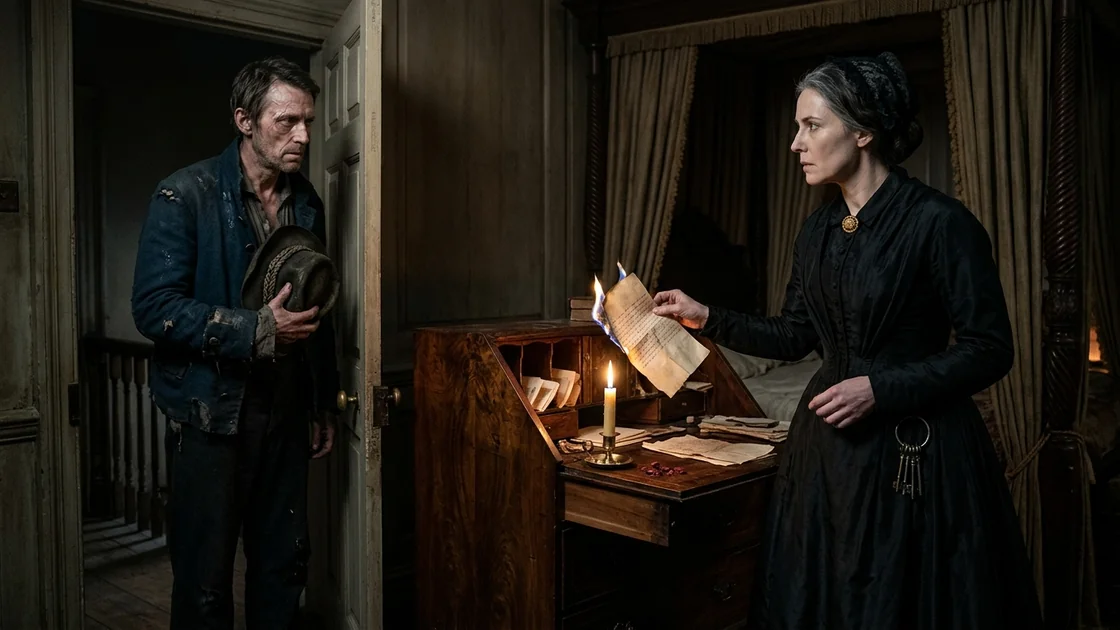
It felt heavy in her hand—heavier than the brass pistol, heavier than the sovereign she had hidden in the bread. The three fragments of the red wax seal rolled out from the fold and fell upon the carpet. One of them broke under her shoe with a dry, crumbling sound.
She unfolded it.
... We, being moved by Our Princely Compassion, do hereby grant unto the said Julian Vane Our FREE AND UNCONDITIONAL PARDON...
"Princely compassion," she whispered. Her lips were dry as horn. "What did the prince know of Oakhaven? What did the king know of the interest on the mortgage, and the culvert at the weir, and the ditching-tiles at two shillings the hundred?"
She held the parchment over the candle-flame.
A corner of the calfskin blackened. It began to swell, to bubble with little greasy blisters of yellow fat that smelled like burning hair. A tiny line of blue fire crept along the edge, eating into the flourish of the great G in GEORGE.
"Clara."
The voice was not behind her. It was not in the room.
It came from the dark well of the stairs—the hoarse, ruined drawl that had been battered by the salt-pans and the lime-dust.
She did not drop the parchment. She held it still, the blue flame creeping toward her thumb, while she turned her head.
The door of the bedchamber was open.
Julian stood upon the threshold.
He had not taken off his cowhide shoes; they were thick with the red mud of the yard, leaving great bloody tracks upon the clean floorboards. He had the blue baize jacket buttoned to his chin, his cabbage-tree hat held in his two hands against his breast, as though he were standing before the superintendent on Norfolk Island.
His milky eye was fixed upon her.
"The candle is bright," he said, mildly. "I saw it through the chink of the cider-press. I thought... I thought Ronald might be here."
Clara did not move. The flame had reached the vellum; the smoke was rising now, thin, white, and acrid, filling the small room with the smell of the shambles.
"Your brother is dead, Julian," she said. Her voice was not her own; it was the voice of a woman speaking from within an iron mask.
Julian looked from her face to the paper in her hand.
He saw the red wax on the floor; he saw the great royal coat-of-arms that was already beginning to shrivel in the heat; he saw the clerk’s flourishes that looked like the bryony tendrils.
He did not come forward. He did not spring upon her like a wolf. He only tilted his head to one side, his brow furrowed, like an old dog trying to understand a command that had been spoken in a foreign tongue.
"What is that?" he asked.
"An old lease," she said.
The fire reached her skin. She dropped the parchment upon the hearth-stone. It lay there, curling into a black cylinder, the royal lion turning to white ash, the Garter motto fading into a greasy smudge of grey soot.
Julian looked down at it.
He took three steps into the room—tramp, tramp, shuffle—until he stood over the hearth. He did not try to save it. He did not put out his hand to snatch the brand from the burning. He only watched it until the blue flame died away, leaving only a red spark that ran through the black tinder like a worm, eating the last letters of his own name: ...ian Vane, late of Oakhaven...
Then he looked at the bureau.
He saw the open well; he saw the tulipwood slide with its splintered groove; he saw his mother’s silver thimble and the small book of recipes for elderberry wine.
"My mother had that thimble," he said, his voice dropping into that strange, flat whisper that had no marrow in it. "She had it from her aunt at Bideford. It has three notches on the rim where the silver-smith dropped his punch."
He looked at Clara.
The film over his left eye seemed to catch the candle-light, turning it into an orb of dull, milky glass.
"When did that come?" he asked.
Clara did not answer. She had her back against the bureau, her fingers gripping the edge of the rosewood fall-front until the knuckles were white.
"Before Ronald died?" he asked.
She was silent.
"Before Ronald died," he repeated. It was not a question now. It was a statement of fact, as cold and simple as his statement that he had walked from Plymouth. "Ronald would have told me. Ronald was a fool, but he was not a thief. He would have sold the bed from under him to bring me back from the hulks."
He looked down at the hearth again, where the white ash of the calfskin was already beginning to scatter in the draught from the door.
"It was twelve years ago," he said, calculating the time with his fingers—those twisted, blackened fingers that had held the crowbar in the limestone. "The year of the great frost. Thomas Garrow died at Newgate in the winter of twelve. I heard it from a transport that came out in the Surrey. He said Garrow had cleared the gentleman from Devon before the rope was on him. But the superintendent laughed at me. He said if I had been pardoned, the papers would have come by the king’s packet three years back. He gave me twenty-five lashes for insolence because I asked him to look in his ledger."
He touched his shoulder—not with self-pity, but with a casual, habitual gesture, as though he were checking that the scar was still there.
"Twelve years," he said.
"The estate would have been ruined," Clara said.
The words came from her mouth before she could stop them. They came out hard, sharp, and dry, like stones falling down a well.
"We owed two thousand pounds to the bank. The culverts were gone; the marsh was full of rushes; the roof was letting the rain into the best bedrooms. If you had come back, Julian, the bank would have called the money. You would have had your half, and Ronald would have had his half, and neither of you would have had enough to buy bread for the winter. You would have sold the land to Sir George. You would have drunk the purchase-money at Totnes, and Ronald would have died in the workhouse."
Julian looked at her with his milky eye.
He did not seem angry. That was the horror of it. If he had cursed her—if he had taken her by the throat—if he had struck her down with the brass pistol that lay on the table—she could have borne it. She would have known that he was a man, and that she was a woman who had injured him, and that there was a balance to be struck between them with blood.
But he was not a man. He was a thing that had been made in the salt-pans and the lime-pits—a creature from which the power of hating had been beaten out by the cat-o’-nine-tails and dried out by the southern sun.
"Aye," he said, slowly. "I was a wild lad. I liked the claret. I liked the hazard-dice. Sir George had good horses, too; I always wanted that chestnut filly he bred from the Arab."
He turned away from the hearth.
He looked around the room—at the clean white curtains, the mahogany wardrobe, the feather-bed with its patchwork quilt of green and yellow silk that Clara’s mother had pieced together thirty years ago.
"It is a fine house," he said. "Ronald kept it well."
"I kept it," she said.
"Aye," he said. "You kept it."
He walked toward the door. The cowhide shoes made a dull, wet sound upon the boards: tramp, tramp, shuffle.
"Where are you going?" she asked, her voice rising for the first time into a sharp, thin scream that sounded like the cry of a kestrel over the moor.
Julian stopped upon the landing. He turned his head, his cabbage-tree hat still held against his chest.
"To the cider-press," he said. "The bread was very good, Clara. But the meat was salty. I am going to drink from the pump in the yard."
"Julian!"
He did not stop. He went down the oak stairs, his hand resting on the banister that had been polished by the hands of five hundred years of his kin.
She heard him reach the vestibule; she heard the iron bolt of the back door drawn back; she heard the heavy timber swing open, and then the yard gate click.
Then there was silence.
Part VIII: The Inheritance
The morning broke clear and cold—the first real frost of the winter.
The grass on the lawn was white, each blade an iron needle; the red leaves of the oaks were stiff with rime; the ruts in the avenue were frozen into hard, grey ridges that would bear the weight of a loaded timber-wagon.
Clara came down at seven.
She was dressed in her best black gown—not the bombazine she wore for mourning, but the heavy Italian silk that had been bought for her in London when Ronald was made a magistrate. She wore her lace cap and the gold brooch with Ronald’s hair under the crystal.
Her face was white as the frost upon the lawn, but her hair was brushed smooth, her collar was pinned with geometric precision, and her keys hung at her hip, ticking against her silk skirt like the pulse of a clock that could not be stopped.
"Mary," she said.
The girl was cleaning the hearth in the parlor. "Yes, ma'am?"
"Go to the stable. Tell Gregory to put the cob to the gig. I am driving to Totnes."
"To the market, ma'am?"
"To Mr. Trefusis," Clara said. "I have business with the attorney."
She did not go to the cider-press. She did not look toward the outbuildings.
She stood upon the terrace while Gregory brought the gig to the front door. The cob was fat, its breath rising in two thick white pillars into the frosty air; the harness was black and clean, with brass buckles that winked in the low, red winter sun.
As she put her foot upon the iron step of the gig, old Gregory took off his hat.
"Mistress," he said, his voice hesitant, his eyes wandering toward the yard.
"Well?" she asked, not looking at him.
"The man," he said. "The sailor who slept in the press-loft."
"Has he gone?"
"He’s there still, ma'am," Gregory said. "He’s lying under the old beam—the great oak beam with the date. I called to him to come out for his beer, but he didn't move. When I went up the ladder... he was cold, ma'am. He must have gone off in the night, before the frost got into the clay. His lungs was bad, I reckon. He had a great cough on him when Mary took the bread."
Clara did not move her foot from the step.
The horse tossed its head, the brass bits ringing with a clear, cheerful music through the silent trees.
"He was an old soldier," she said, her voice even, steady, and cold as the rime upon the gravel. "A vagrant who had no friends in the county. Take the cart, Gregory. Carry him down to the churchyard. Tell the sexton to dig a grave by the north wall, where they put the drowned men from the river."
"Shall we have the parson, ma'am?"
"The parson may read the office," she said. "Give him five shillings from the purse on the dresser, and give the sexton two. I will pay for the deal board for the coffin."
She stepped into the gig, gathered the reins in her gloved hands, and touched the horse with the whip.
The gig turned down the lime avenue, the wheels crushing the frosted ruts with a sound like the breaking of glass.
She did not look back at Oakhaven.
She knew how it looked: the great, red stone house with its sixteen bedchambers, its gables, its leaded roofs, and the three new barns that had been raised with Ronald’s sweat and Julian’s silence. It sat upon the hill among its oaks, square, solid, and eternal, defying the frost, defying the wind, defying the river.
It was hers.
Every stone was hers; every tree was hers; the dirt that covered the two brothers in the churchyard was hers. She had paid for it with twelve years of fear; she had paid for it with the ashes upon the hearth; she had paid for it with the milky eye that had looked at her without anger and without hope.
As the gig passed through the lych-gate onto the high road, she felt something hard in her pocket.
She put her hand into the silk folds.
Her fingers closed upon a piece of bread—dry, hard as a pebble, with a greasy smear of bacon-fat upon the crust.
She drew it out.
The sovereign she had hidden in the crumb was gone.
Julian had found it. He had taken the gold—the one piece of Ronald’s gold she had offered him—and he had left the bread upon the floor of the cider-press for the mice.
She held the crust in her hand for a moment, her eyes fixed upon the long, white road that led across the hills to the town.
Then, with a quick, jerk of her wrist, she cast it into the frozen ditch among the nettles and the dead hemlock, where the birds might peck at it if they were hungry enough, and drove on into the red light of the rising sun.