The Three-Second Threshold
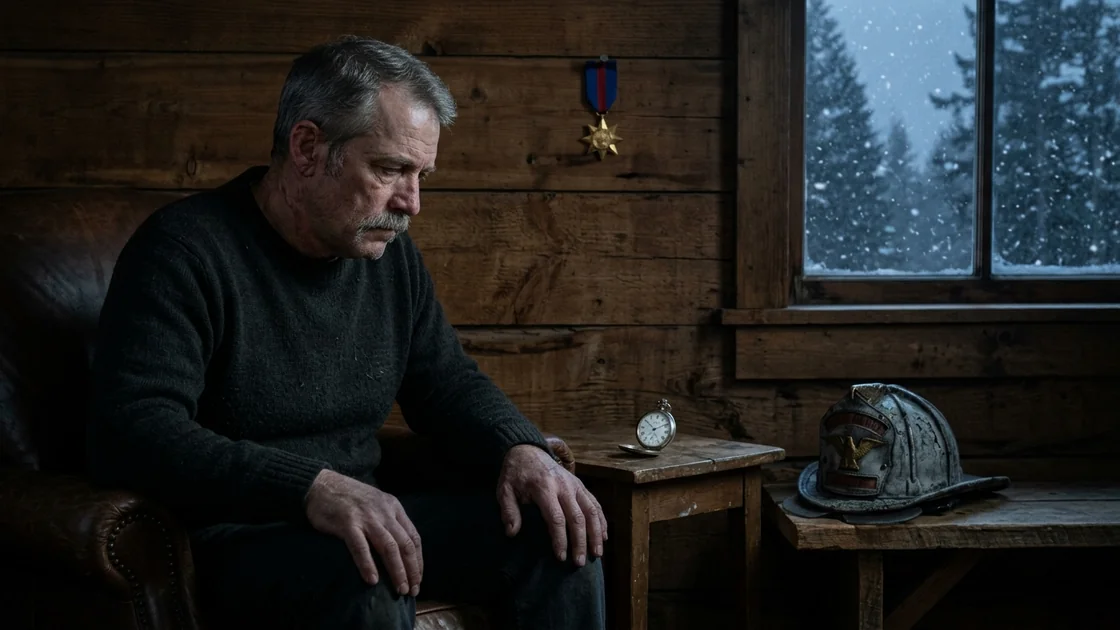
This is the story of Captain Thomas Callahan, a decorated thirty-year veteran of the North Valley Fire Department, whose long and celebrated career unravels during a midnight residential blaze on Oakhaven Terrace. When confronted by a violent, superheated flashover behind a closed bedroom door, a sudden surge of primal fear paralyses Callahan for three catastrophic seconds, delaying the critical warning that would have saved his twenty-two-year-old rookie pipeman, Sean Mercer. In the wake of the fatal fire, as the department clears Callahan of any procedural wrongdoing and hails the tragedy as an unavoidable act of nature, Callahan must navigate the crushing weight of his unspoken cowardice, the suffocating grief of Mercer's family, and the haunting reality that his single, silent moment of hesitation cost a young man his life.
I. The Salt on the Turnouts
The leather on the brim of Thomas Callahan’s Cairns & Brother helmet was not black anymore. It had long since cooked past the original gloss, past the dull charcoal of his mid-career years, down into a cracked, blistered gray that resembled the bark of an ancient oak struck repeatedly by lightning. If you ran a thumb along the rear flange, you could feel where the heat of a three-alarm warehouse fire in the winter of ’98 had melted the rim binding into the cowhide, welding them into a single, calcified ridge.
Cal liked the weight of it. In the locker room of Station 4, while the younger men swung their lightweight composite Cairns 1044s by their chin straps, Cal always lifted his helmet with two hands, testing the brass eagle that anchored the front shield. It was a ritual of mass and balance.
"Still wearing that cast-iron skillet, Cap?"
Sean Mercer was leaning against the steel locker bank, his fresh, unmarred yellow turnout coat draped over his bench like a museum display. Mercer had been out of the academy four months. His boots still possessed the factory tread—sharp, angular lugs of Vibram rubber that hadn't yet been rounded down by the abrasive grit of broken glass, wet cinderblock, and gravel. His knuckles were smooth. His neck, visible above the collar of his navy duty shirt, lacked the mottled red scarring—the "fire tattoos"—that seasoned nozzlemen carried from steam burns where their nomex hoods had bunched too thin against their skin.
"It keeps the roof off your teeth, Sean," Cal said, not looking up. He took his rag and worked a dollop of saddle soap into the crown of the leather. "The plastic ones they give you boys melt at five hundred degrees. A good fire laughs at five hundred degrees. Your helmet goes soft right around the time your skull begins to consider doing the same."
Mercer chuckled, but it was an eager, deferential sound. He wanted so badly to be part of the furniture, part of the history of the house. Station 4 sat in the industrial bend of the river, an old two-bay brick station built in 1954, smelling permanently of diesel exhaust, stale Folgers, damp hose, and the sweet, sickly undertone of floor wax. It was a truck house and an engine house: Engine 4 downstairs, Ladder 2 beside it. Cal had spent eighteen years as the captain of Ladder 2, but for the last three years, following the city’s budget reorganizations, he had been shifted back to the engine—back to the water, the fire-attack seat, the cold iron end of the operation.
"Chief said the new composites reflect heat better," Mercer offered, stepping into the apparatus floor to pull an extra pair of structural gloves from his gear bag. "Said the technology keeps the interior core cooler."
Cal stopped rubbing the leather. He set the rag down on his turnout bench and looked at Mercer. The kid had pale eyes, sandy hair cropped down to military regulation, and the lean, tireless frame of a former college cross-country runner. He had finished second in his class at the regional academy in hose evolutions and search technique. He could tear down an SCBA regulator blindfolded in forty-five seconds. He was smart, respectful, and never complained about scrubbing the grease traps under the stove.
"Chief hasn't crawled down a center hallway since nineteen-ninety-nine," Cal said softly. There was no malice in his voice, only the flat, heavy gravity that older firefighters use when they are tired of explaining thermodynamics to children. "Fire doesn't care about technology, Sean. It cares about fuel, air, and the dumb mistakes of the people who think they can outsmart it. You remember what I told you about the door?"
Mercer straightened up instantly, like a recruit being quizzed on the drill ground. "Check the head of the jamb for heat with the back of an ungloved hand if feasible, or use the TIC. Watch the paint. If the paint is blistering, the gases behind it are already past the auto-ignition point. Stay low. Control the door. If you open it without a charged line, you’re feeding the monster."
"And if you feel it sucking?" Cal asked, his eyes narrowing slightly under graying, bristled brows.
"Flow path reversal," Mercer said. "It means the fire is starving. If it takes a breath, you back out or you drown it immediately."
"You don't think about it," Cal said. He stood up, towering over the younger man by two inches, his spine creaking with the familiar morning ache that lived in his L4 and L5 vertebrae. "You don't stand there weighing your options like you’re picking out a melon at the grocery store. When a room is loading up, you have seconds before the air turns into gasoline. You either knock it down or you get the hell out of the way. You hesitate, Sean, and the fire takes the decision out of your hands."
"Yes, Cap," Mercer said. His expression grew serious, the easy smile vanishing into the determined mask he wore whenever the tones dropped. "I know."
Cal studied the boy’s face for a second longer, searching for the crack, the flaw, the trace of arrogance that usually got rookies hurt. He didn't find it. What he found instead was something much more dangerous: complete, absolute faith. Mercer trusted Cal Callahan the way a parishioner trusted an old priest. He believed that if he stayed on Cal’s shoulder, followed the sound of Cal’s low, gravelly voice through the smoke, and did exactly what he was told, the darkness could not touch him.
It was a terrifying thing to see in another man's eyes.
Cal turned back to his locker, closing the mesh door with a metallic clatter. In the small mirror hung on the inside of the door frame, he caught his own reflection. Fifty-three years old. The gray had overtaken his temples entirely and was creeping through his mustache. His eyes were bloodshot from thirty years of wood smoke, diesel, and broken sleep. But deeper than that, down beneath the physical wear, was a cold, quiet dread that had been growing inside him for the better part of two years.
Nobody talked about it, because to talk about it was to invite the end. But Cal knew. He had felt it first at a commercial roof fire on Fourth Street the previous autumn—a sudden, sick hollow in his stomach when the decking beneath his boots had yielded just a half-inch too much. He had pulled back instantly, pulling his men with him, and five seconds later a twenty-foot section of gravel-and-tar roof had pancaked into the boiler room. The crew had cheered his instincts; the Battalion Chief had cited his "veteran awareness" in the incident critique.
Only Cal knew the truth. It hadn't been awareness. It had been panic. A cold, suffocating hand had squeezed his heart, freezing the saliva in his mouth, making him want to throw himself off the parapet ladder and run into the street. For three decades he had run toward the roaring, orange-bellied beast with an ax in his hands and a reckless, stubborn fury in his chest. Now, without warning, the beast was bigger than it used to be. It was hotter. It smelled different—chemical, synthetic, unpredictable.
The modern world was made of petroleum. Sofas were blocks of solid gasoline wrapped in polyester; carpet was woven crude oil; walls were glued sawdust and vinyl. Fires didn't creep and smolder like they did when he was twenty-two; they detonated. They went from ignition to flashover in three minutes flat.
Cal closed his eyes for a second, feeling the cold steel of the locker under his fingers.
Just two more years, he told himself, the mantra he repeated every morning during truck checks. Twenty-four months. Get the pension. Move out to the cabin on the North Fork. Hang up the leather.
"Cap?" Mercer’s voice came from the apparatus bay. "Engine’s fueled. You want me to run the pump check, or did Miller already take care of it?"
Cal cleared his throat, wiped the grease from his palms onto his trousers, and stepped back into the bay. "Miller did it before shift change. Go check the spare bottles on the side rack. Make sure they’re all at forty-five hundred PSI. Don't let the shift guys leave us with half-empty air cylinders."
"On it," Mercer said, trotting off toward the rear of the pumper.
Cal watched him go, his hands shoved deep into his pockets, trying to shake the chill that had settled into his bones despite the summer heat radiating off the asphalt outside.
II. The Routine of the Damned
The afternoon shift passed with the slow, lazy cadence of midsummer. They ran three medicals: an elderly woman on 12th Avenue with chest pains, a diabetic emergency at the laundromat on Maple, and a fender-bender at the intersection of Highway 9 and the rail spur that resulted in nothing more than a radiator leak and some broken turn-signal plastic.
Mercer operated with textbook efficiency. He carried the jump kit, checked the vitals, talked to the old woman with a gentle, grandson-like charm that calmed her breathing before the medics arrived. On the highway call, he swept the debris off the asphalt without being told, his broom moving in crisp, rhythmic strokes.
At dinner, Miller, the veteran driver who had ridden with Cal for twelve years, made his standard beef chili. They sat around the heavy oak table in the dayroom—the table had sixty-four distinct carvings in it, initials of retired captains, dead engineers, men who had lost limbs or lungs to the job. Mercer sat on the stool at the far end, the rookie seat, eating quickly and listening to Miller complain about the department’s new digital dispatch system.
"It’s garbage," Miller said, spooning hot sauce into his bowl with a thumb that was missing half its nail from a rigging accident twenty years ago. "The old radio tones, you could hear the pitch. You knew before the dispatcher even opened her mouth whether you were rolling to a cat in a tree or a working structural. Now it’s that damn digital chirp. Sounds like a microwave telling you your popcorn is done."
"Keeps the channel clear, Miller," said Dave Brooks, the nozzleman on Ladder 2, who had come across the hall to steal a cup of coffee. "Less radio traffic. Computer routes you around the bridge construction on 4th."
"The computer doesn't know the bridge construction has a detour wide enough for the aerial," Miller snapped. "The computer thinks like a Prius. I don't drive a Prius. I drive twenty-eight tons of American LaFrance with a water tank that likes to slosh if you corner at twenty."
Cal sat at the head of the table, his bowl untouched before him. He was listening, but his ears were tuned to the ambient hum of the station. The refrigerator compressor. The intermittent click of the base radio scanning the tactical channels. The distant hiss of traffic on the bypass.
"You all right, Cap?" Mercer asked across the table. The boy was looking at him with genuine concern. "You barely touched the chili. Miller’s feelings are gonna be hurt, and when his feelings get hurt, he doesn't make brownies for third shift."
"I'm fine, Sean," Cal said, picking up his spoon to demonstrate compliance. "Just watching the heat. It’s eighty-eight degrees out there at six in the evening. Humidity is seventy percent. If we catch a box tonight, it’s going to be a swamp in the gear."
"Let it burn," Brooks said with the blithe, dark humor of the truck company. "Ladder 2 needs some ventilation practice. Mercer here has been itching to put an ax through an asphalt shingle all week."
"I'd rather find the seat of it," Mercer said, his eyes lighting up. "Hose line before ventilation, right Cap?"
"Depends on the building," Cal said, chewing the beef mechanically. "Sometimes you cut a hole so the guys inside don't boil. Sometimes you keep it buttoned up so you don't feed the blowtorch. You learn that when you see your first cellar fire, Sean. Air is the enemy until you have water on the fuel."
The conversation drifted back to sports, to the pension board’s latest quarterly losses, to the rumors of a new station being built on the north end of the city. Cal ate half his bowl, rinsed it in the sink, and went up to the captain’s quarters behind the watch office.
The room was small, sparse, and smelled of lemon polish and sixty years of aftershave. A single twin bed with a wool blanket, a steel desk, and a gooseneck lamp. On the wall hung a framed black-and-white photograph of Ladder 2 from 1978, the year Cal’s uncle had retired. The men in the photograph weren't wearing masks. They had long mustaches, canvas coats with metal clasp closures, and three-quarter rubber boots pulled up to their thighs. They looked like pirates. Most of them had died before sixty-five—emphysema, lymphoma, esophageal cancer.
Cal sat on the edge of the mattress, his socks resting on the cold linoleum. He reached down into his pocket and pulled out a silver pocket watch, an old Hamilton that had belonged to his father, a railroad engineer. He wound it three turns until the resistance tightened.
Tick. Tick. Tick.
The sound was sharp, mechanical, and infinitely small in the silence of the room.
Cal stared at the second hand as it swept across the white enamel dial. Three seconds.
One. Two. Three.
In three seconds, an Olympic sprinter could cover thirty yards. In three seconds, an automobile traveling at sixty miles an hour traveled eighty-eight feet. In three seconds, a modern lightweight wooden truss could fail under five hundred degrees of thermal load, dropping two thousand pounds of gypsum, timber, and burning tar onto the floor below.
In three seconds, a man could make up his mind to die, or he could decide that he wanted to see the sun come up over the river one more time.
Cal closed the watch with a sharp snap. He laid down on the thin mattress with his uniform boots still on, his hands clasped behind his head, and stared at the water stains on the acoustic ceiling tiles until the darkness of the city crept through the open blinds.
III. The Box on Oakhaven
The alarm did not drop with the slow buildup of a standard call. It detonated at 02:41.
The station tones were preceded by the rapid, frantic warble reserved for confirmed structure fires with entrapment. The klaxon shrieked through the station, slicing through the deep, heavy sleep of the early morning hours with the violence of a razor blade through silk.
Cal was off the bed before his conscious mind had registered the sound. His boots hit the linoleum, his hands finding his belt, his radio strap already slung across his chest. By the time he hit the pole, the computerized voice of the dispatch system was barking across the bay speakers:
"Box 412. Structure fire with rescue. 714 Oakhaven Terrace. Cross street of Crestview. Reports of a residential structure, fire showing from the second division, caller reports a child unaccounted for on the upper floor. Engine 4, Ladder 2, Engine 7, Medic 4, Battalion 1."
Cal slid the brass pole, his gloved palms controlling the drop, landing on the rubber impact mat at the base with a dull thump. Mercer was already there, pulling up his bunker pants with frantic, jerky motions, his suspenders snapping against his shoulders.
"Take a breath, Sean," Cal said, his voice flat, dangerously calm. "Pants first, boots up, hood around the neck. Don't leave your hood in your locker."
"Got it, Cap. Got it." Mercer’s breath was already coming fast, the adrenaline dilating his pupils until the blue of his irises was almost entirely swallowed by black.
Cal stepped into his own boots—the worn, cracked leather boots that had molded to his arches over ten thousand hours of wear. He pulled the thick nomex over-trousers up, locked the metal clips, and swung himself into the officer’s seat of Engine 4. He slammed the red door shut just as Miller kicked the massive six-cylinder diesel engine to life.
The bay doors rattled upward into the ceiling tracks with agonizing slowness. Miller punched the siren, a low, guttural wail that bounced off the brick walls of the bay before expanding into the humid, dead night air outside.
The engine lurched forward, clearing the apron, its dual headlights cutting through the summer mist that hung low over the asphalt. Ladder 2 was right behind them, its air horns blasting a rhythmic, two-tone pattern that cleared the empty boulevard.
Cal picked up the mobile microphone. "Engine 4 responding. Box 412."
"Engine 4, copy. Dispatch reports multiple calls. Blackwood Police Department is on scene, confirming heavy smoke showing from the Bravo-side upper windows. They are attempting an exterior knock with hand extinguishers, no success. Mother and one child are out on the lawn; second child, eight years old, believed to be in the rear bedroom."
Cal hung the mic on its bracket. He reached up and adjusted the mobile data terminal, watching the street grid populate. Oakhaven Terrace. It was an older subdivision, built in the mid-1960s. Split-levels. Raised ranches. Cheap construction: two-by-four walls, plywood decking, low ceilings, and narrow, boxy hallways that trapped heat like an oven. If the fire had started on the lower level and found the central stairwell, the second floor would be nothing more than a horizontal chimney.
Behind him, in the jump seat, Mercer was clicking his SCBA regulator into his harness bracket, checking his facepiece seal. The sharp hiss-shuck of the air bottle opening echoed in the cab.
"Mercer," Cal yelled over the scream of the engine and the deafening howl of the Federal Q siren.
"Sir!"
"You're on the pipe. We take the two-hundred-foot pre-connect—the inch-and-three-quarter. We go in the front door. We find the stairs. If the fire has the stairwell, we sweep the ceiling to push the heat back, and we take that second floor before it flashes. Ladder 2 is behind us for search. You do not leave that nozzle until I tell you to shut it down. You understand?"
"Understood, Cap!" Mercer shouted back. He was leaning forward against his seatbelt, his face framed by the gray Nomex hood, his young eyes wide and electric. "Two-hundred-foot line. Front door to the stairs. Protect the search."
"Protect the search," Cal repeated.
He looked down at his own hands. They were resting on his knees. They were steady, but the skin beneath the cuffs of his coat felt cold. The familiar knot was there in his gut, but tonight it had teeth. It was chewing at the lining of his stomach.
Entrapment.
An eight-year-old child. That changed the equation. In a standard house fire, you were cautious; you coordinated ventilation; you waited for a backup line if the fire was rolling. But with a kid inside, the rulebook got thrown into the street. You pushed the line past the point of safety. You took the heat. You took the steam burns on your ears and your wrists because every second you spent playing it safe was a second that the small, fragile lungs of a third-grader were filling with hydrogen cyanide and carbon monoxide.
Miller swung the heavy pumper hard to the right, tires squealing against the concrete curb as they entered Oakhaven Terrace.
The smoke was visible three blocks away. It wasn't gray or white; it was a dense, velvety black that reflected the flashing red and blue lights of the police cruisers. It didn't drift upward into the night sky; it was pushing out of the eaves under high pressure, rolling down the roofline in heavy, turbulent waves that signaled extreme internal temperatures.
"Look at that push," Miller muttered, his hands wrestling the wheel as he aligned the engine with a hydrant fifty feet from the driveway. "She's cookin', Cal. That's not room-and-contents anymore. That whole upper floor is fully involved."
Cal jumped down from the cab before the engine had completely stopped rolling. His boots hit the street with a heavy jar that shot pain up into his lower back.
The smell hit him immediately: burning plastic, urethane foam, electrical insulation, and the unmistakable, sweetish stench of scorched carpet. It was a chemical soup, so thick it coated the back of his throat even before he put his mask on.
A woman in a torn flannel nightgown was screaming from the front yard, held back by two patrolmen. Her voice was not human; it was a high, shredded shriek that cut through the roar of the diesel engines and the crackle of the fire.
"She’s in the back! She’s in the bedroom! Toby! Toby’s in the bedroom!"
"Engine 4 on scene," Cal barked into his shoulder mic, his voice dropping into the low, clipped register of command. "We have a two-story split-level, heavy smoke showing from division two, Charlie and Delta sides. Engine 4 is laying an attack line for primary search and rescue. Ladder 2, take the roof, vertical vent over the bedrooms. Medic 4, stand by for patient care."
Mercer was already at the rear of the rig. With two clean, practiced motions, he grabbed the nozzle and the first fifty-foot loop of the crosslay, threw them over his shoulder, and ran toward the front stoop. He didn't stumble. He dropped the flakes in a clean, accordion line along the walkway, clear of the front door, just as they had practiced a hundred times on the drill ground.
"Flake it out, Sean!" Cal yelled, pulling his mask over his face and cinching the four temple straps until the silicone dug hard into his cheekbones. He pulled the Nomex hood up, feeling the suffocating heat begin to build around his skull. He clicked his regulator into place with a sharp twist.
Hiss. Click. Shhh-ahhh.
The sound of his own breathing became the only sound in the universe. The mechanical, measured intake of pressurized air, cool and dry, tasting of aluminum and rubber.
"Charge the line!" Cal shouted toward the pump panel.
Miller slammed the lever down. The heavy canvas hose twitched, stiffened, and snaked violently across the lawn as one hundred and fifty pounds of water pressure surged through its interior. Mercer grabbed the nozzle, cracked the bale for three seconds to bleed the trapped air, and adjusted the pattern to a solid, tight fog.
Cal was beside him now, his Halligan bar in his left hand, his right hand gripping the shoulder strap of Mercer's air pack.
The front door was already unlatched, unlocked by the escaping mother. A thin, lazy finger of brown smoke was curling out around the frame, but it wasn't pushing. It was being drawn inward at the bottom—the house was breathing, inhaling fresh oxygen from the yard to feed the monster that lived on the upper level.
"Watch the threshold," Cal said, his voice muffled behind the speaking diaphragm of his mask. "Once we go in, it’s going to light up over our heads. Keep the nozzle low until we hit the stairs. When you see fire, give it short bursts—don't open it all the way and steam us to death. Just cool the gas."
Mercer nodded. Cal could see the kid’s eyes behind the polycarbonate lens of his facepiece. They were clear, wide, and focused. There was no fear there. Just the raw, beautiful, terrifying courage of youth.
"Let’s go get her, Cap," Mercer said through his mask.
Cal kicked the door open with the flat of his boot, and they dropped to their knees, disappearing into the dark.
IV. The Ascent
The first floor was cold smoke. It was that disorienting, greasy twilight where the flashlight beam does nothing but illuminate a six-inch cone of gray soup directly in front of your face.
Cal kept his left hand on Mercer’s SCBA bottle, his right knee sliding along the baseboard to maintain their orientation. The layout was standard: living room to the left, kitchen to the right, hallway leading to the central staircase thirty feet straight ahead.
Above them, the house was groaning.
A structure fire has its own acoustics. It doesn't sound like wood crackling in a fireplace; it sounds like an approaching freight train, a deep, rhythmic bass rumble that vibrates through the subflooring and resonates in the iron fillings of your teeth. It is the sound of thousands of cubic feet of superheated gases expanding against sheetrock, looking for an exit, clawing at the seams of the building.
"Cap! Heat’s up!" Mercer shouted, his voice coming through the radio and the rubber diaphragm simultaneously.
They had reached the foot of the stairs.
Cal looked up. The thermal gradient was dramatic. At floor level, the air was sixty degrees, cool enough to feel through the leather palms of their gloves. But six feet up, at the landing, the smoke wasn't gray anymore; it was an oily, ink-black mass that seemed to have solid form. It was rolling downward along the ceiling of the stairwell, pushing like a piston.
Within the black mass, small, ghost-like tongues of orange were dancing—rollover. The gases themselves were so hot that they were igniting simply by coming into contact with the cooler air rising from the first floor.
"Hit the ceiling!" Cal ordered, slapping Mercer’s shoulder twice. "Short burst! Cool it down!"
Mercer aimed the nozzle up the flight of stairs, opened the bale for two seconds, and slammed it shut.
The reaction was instantaneous. The water hit the ceiling at seven hundred degrees, instantly expanding seventeen hundred times into boiling steam. A wall of wet, scalding heat rolled down the stairs, enveloping them. Cal tucked his chin into his chest, feeling the burn on the exposed skin between his collar and his hood.
"Again!" Cal barked.
Mercer opened the bale again, sweeping the nozzle in a violent circle. The orange flames at the landing died, smothered by the steam, and the black smoke lifted eighteen inches, revealing the top three steps and the narrow hallway beyond.
"Move! Up the stairs! Keep the line moving!"
They crawled up the steps on their knees, Mercer dragging the weight of the charged line, Cal pushing from behind, taking the slack and feeding it around the newel post so it wouldn't pinch. Every inch was a fight against friction. A charged inch-and-three-quarter hose is a stubborn, hydraulic snake that wants nothing more than to catch its couplings on every doorframe, every corner, every discarded shoe in the dark.
They reached the top landing.
Here, the world was different. The heat was no longer a theoretical problem; it was a physical weight pressing down on their backs. Cal’s thermal sensor on his chest pack began to chirp—a high-pitched, insistent beep-beep-beep that warned the ambient temperature had crossed three hundred and fifty degrees.
The hallway was narrow, maybe four feet wide. To the right was the bathroom—door open, empty, smoke swirling around the porcelain sink. Straight ahead was the master bedroom—its interior was a swirling caldron of red and black, flames licking out across the header of the doorframe.
To the left was the rear bedroom.
The door was closed.
A child’s bedroom door, hollow-core wood, painted white. Along the top of the frame, the paint was already charring, turning into black, bubbling skin. But beneath the door, there was no smoke pushing out.
Instead, there was a terrible, rhythmic sucking sound.
Shhhhhh-whump. Shhhhhh-whump.
The fire in the master bedroom was consuming all the available oxygen in the hallway. The closed bedroom behind the hollow-core door was acting as a low-pressure pocket. It was holding air—air that the fire wanted, air that a trapped child needed to survive, air that was currently loaded with volatile, unburned pyrolytic gases that only lacked one single ingredient to achieve total ignition: a fresh draft.
Mercer saw it. He was at the door first, dropping to his left hip, his hands shifting on the nozzle.
"Cap! This is it! Rear bedroom! This is where the kid is!"
Mercer reached out with his gloved right hand, his fingers touching the brass doorknob.
"Wait!" Cal yelled through his mask.
The kid didn't wait. He didn't wait because he was twenty-two, because he had heard the mother screaming on the lawn, because he believed that the universe rewarded speed and purity of purpose. He turned the knob and pushed the door inward two inches.
V. The Three Seconds
The universe did not reward him.
The moment the seal broke, the physical reality of the house shifted. It was not a sudden explosion; it was an intake of breath so violent that Cal felt the fabric of his bunker coat pull toward the widening crack of the door.
A thin, razor-sharp whistling sound cut through the roar of the fire.
Cal knew that sound. He had heard it only once before, in 1991, in an abandoned cold-storage warehouse on the waterfront where two men from Engine 6 had been turned into grease spots on the concrete floor.
It was the whistle of a thermal draft reversing.
Through the two-inch opening, Cal didn't see fire. He saw something infinitely worse: a room filled from floor to ceiling with yellow-gray smoke, churning with the speed and violence of an industrial blender. It was not buoyant; it was pressurized. It was thick with the boiled off remnants of synthetic carpets, foam mattresses, and plastic toys.
The smoke was not burning yet because the room had choked itself out, exhausting every molecule of oxygen until the fire had retreated into the fibers of the room, waiting in a superheated stasis at fourteen hundred degrees Fahrenheit.
Mercer was leaning forward, his helmet tilted, his shoulder ready to force the door the rest of the way open to make entry.
"Cap! It’s clear! I'm going in for the—"
Cal saw the rollover in the hallway behind them stop. He saw the black smoke at the ceiling suddenly drop eighteen inches in a single, terrifying pulse, descending like a stage curtain over their heads.
He knew what was happening.
The fresh air coming up the stairwell from the front door had finally reached the second floor. It was about to mix with the unburned gases in the rear bedroom. The two-inch gap Mercer had created was the fuse. In less than four seconds, the entire volume of that room was going to achieve stoichiometric perfection.
It was not going to burn. It was going to detonate.
The proper action—the only action prescribed by twenty-five years of structural firefighting doctrine—was simple, brutal, and immediate:
Slam the door shut. Jam the Halligan through the handle to pin it. Drop to the floor, open the nozzle wide to the ceiling, and abandon the hallway.
You sacrificed the room to save the crew. You accepted that whatever was behind that door was already dead, or would be dead in three heartbeats, and you protected the two men holding the line.
Cal opened his mouth to scream the order.
"SEAN, NO! SHUT THE—"
The words did not come out.
They did not come out because in that exact, microscopic fragment of time, the cold hand that had been lurking in the back of Cal’s mind for two years reached up and wrapped its fingers around his windpipe.
It was not a thought; it was a physical seizure of the nervous system.
The reptile brain, ancient and selfish, built over five hundred million years of mammalian survival, overrode the thirty years of training, the oaths taken in the city council chambers, the brass eagle on the leather helmet, the brotherhood, the pride, the honor.
The reptile saw the yellow smoke. The reptile felt the fourteen-hundred-degree draft against the facepiece.
And the reptile said: Run.
Cal’s hands did not reach forward to grab Mercer’s harness. They did not reach forward to slam the door.
Instead, Cal’s body pulled backward. His boots shifted on the wet hallway floor, his weight transferring to his heels, his shoulders rounding as he shrank away from the threshold.
One.
Mercer’s knee crossed the doorframe. The kid was still looking into the room, his left hand reaching back to drag the nozzle through the opening. His face was entirely hidden by his mask, but his posture was confident, aggressive, pure. He thought his captain was right behind him, his shoulder pressed against his hip, holding the line, covering his advance.
Two.
Cal’s eyes were locked on the top of the door. The yellow-gray smoke had turned black in an instant—a violent, oily transition that meant the oxygen had completed the circuit. The whistle had stopped. In its place was a dead, terrifying silence, the stillness that occurs at the center of a hurricane just before the back wall hits.
Cal knew. He knew with every cell in his aging, tired body what was coming. He could have tackled the boy. He was larger than Mercer; he could have grabbed the handle of the kid's SCBA cylinder with both hands and thrown them both backward down the stairs. They would have broken ribs, maybe cracked their skulls on the steps, but they would have been below the thermal plane.
He didn't move. He sat frozen on his knees, his chin tucked into his chest, his hands locked onto the cold iron of his Halligan bar, his breath stopping in his throat.
Three.
"Cap?" Mercer’s voice was small, confused. He had finally felt the absence behind him. He started to turn his head back toward the hallway, his body half-in, half-out of the room.
The three seconds expired.
The room exploded.
VI. The Conflagration
It was not a sound like thunder. It was a concussive slap that tore the air directly out of Cal’s lungs through the diaphragm of his regulator.
The pressure wave blew the hollow-core door off its hinges, turning the wood into jagged, burning splinters that peppered Cal’s coat and the front of his helmet. The fireball did not stay in the room; it erupted into the hallway like the muzzle flash of a naval gun, a solid, churning cylinder of orange and white flame that reached temperatures exceeding sixteen hundred degrees in less than half a second.
Mercer didn't scream. There was no time for a scream.
The blast caught the boy square in the chest. His mask was instantly crazed—the polycarbonate lens melting, bubbling, and turning opaque white as the intense radiant heat destroyed the structural integrity of the plastic. The force of the detonation threw Mercer backward, but not into the hallway. The dynamic vortex created by the rapid expansion of the gases pulled the air back into the room with the force of an industrial vacuum, dragging the boy’s body across the splintered threshold and into the heart of the furnace.
Cal was thrown backward down the hallway, sliding five feet on the slick, water-soaked floorboards until his back slammed into the doorframe of the master bedroom.
The heat was absolute.
His ears were screaming. The ear-flaps of his Nomex hood were charring against his neck, the synthetic fibers shrinking and driving molten needles into his flesh. His gloved hands, held up defensively before his facepiece, were smoking. The reflective trim on his turnout coat was blistering, turning brown and peeling away like old birch bark.
"SEAN!"
The scream tore out of Cal’s throat, raw and broken, muffled by the silicone of his mask.
The hallway was an inferno. The fire had taken the ceiling, the walls, the carpet. It had rolled down the stairwell, cutting off their retreat.
The hose line—their only lifeline, their only weapon—was trapped beneath a fallen beam of two-by-four framing that had dropped from the hallway ceiling. The nozzle was inside the bedroom, spewing water uselessly against the far wall, creating a violent cloud of superheated steam that was cooking everything within twenty feet.
Cal crawled forward on his stomach, his chest scraping the wet floorboards where the air was three hundred degrees cooler than at his shoulders.
"SEAN!"
He reached the threshold of the rear bedroom.
The world inside was white. Not yellow, not orange—a blinding, incandescent white that hissed with the fury of a blast furnace.
Mercer was lying six feet from the door.
His turnout coat was burning. The heavy Kevlar-Nomex weave, designed to withstand brief exposures to extreme heat, was glowing like charcoal along the shoulders and the sleeves. His SCBA cylinder, pressurized to four thousand five hundred pounds per square inch, was venting violently through its high-pressure relief valve—a screaming, jet-engine roar that drowned out every other sound in the house.
The boy was not moving.
His mask was gone. It had melted completely, slumping off his face like wet wax, leaving his pale, young face exposed to the sixteen-hundred-degree atmosphere.
Cal reached for him. He stretched his right arm out as far as the shoulder joint would allow, his fingers straining against the thick leather of his structural glove.
His fingertips brushed the brass buckle of Mercer’s harness.
Just an inch. Just one inch more.
Then the floor gave way.
The joists beneath the rear bedroom, already weakened by the lower-level fire and cooked by the backdraft, collapsed with a sharp, dry crack that sounded like a rifle shot.
The center of the room dropped four feet into the crawlspace below. Mercer’s body, enveloped in a shower of white-hot embers and burning gypsum board, slid downward into the hole, disappearing into the red-orange belly of the basement fire.
Cal’s hand grasped empty air.
The thermal blast that followed the structural collapse hit Cal directly in the face, knocking him flat on his back. His facepiece began to fail. A spiderweb of cracks shot across the right side of the lens, the plastic softening, growing hot against his eyebrow.
The PASS device on Mercer’s harness—the integrated safety system designed to sound an alarm when a firefighter remains motionless for thirty seconds—began its pre-alert chirp from the depths of the basement.
Beep... beep... beep...
Then, the full alarm: a shrill, ninety-five-decibel warble that rose and fell with rhythmic, computerized indifference.
WEE-WOO... WEE-WOO... WEE-WOO...
It was the death song. Every firefighter knows it. It is the sound you hear in your nightmares—the sound that means one of your own is down, trapped, and dying in the dark.
Cal lay on the floorboards of the hallway, three feet from the hole where his rookie had vanished.
He could have jumped.
The hole was four feet deep. He could have rolled over the edge, dropped into the crawlspace, found Mercer by the sound of the PASS device, and tried to drag him toward the exterior basement door.
He looked at the hole. He saw the orange flames licking at the broken joists. He heard the screaming of the SCBA bottle venting its last fifty bars of air.
And the reptile, cold and ancient, spoke again.
You jump, you die.
Cal did not jump.
He turned on his stomach, grabbed the frame of the hallway door with both hands, and dragged himself toward the stairs.
VII. The Lawns of the Living
The descent was an uncontrolled slide.
Cal didn't walk; he tumbled down the second half of the staircase, his Halligan bar clattering down the steps before him, his SCBA bottle banging against the risers with dull, metallic crashes.
He hit the landing on the first floor, rolled onto the soaked carpet of the living room, and scrambled on his hands and knees toward the gray square of the front door.
He burst out onto the front stoop like a diver breaking the surface of an oil slick, gasping, coughing, tearing at his mask straps with frantic, trembling fingers.
The cool night air hit his face like an ice bath. It burned his lungs—his airway was scorched, the cilia in his bronchial tubes singed by the brief exposure to superheated steam.
Two men from Ladder 2 were running up the walkway with a second hose line. It was Brooks and Henderson, their faces grim behind their masks.
"Cap! Where is he? Where’s Mercer?" Brooks shouted, grabbing Cal’s shoulder.
Cal couldn't speak. He tried to point toward the upper floor, but his arm was shaking so violently that his hand simply flopped against his chest like a dead fish. His mouth was open, his tongue thick and dry, tasting of charcoal and sulfur.
"The room..." Cal finally managed, the words scraping out of his throat in a dry, bloody whisper. "The rear bedroom... backdraft... floor went."
Brooks looked at Henderson. Through their masks, Cal saw the terrible, sickening realization dawn in their eyes.
"MAYDAY!" Brooks screamed into his shoulder mic, his voice instantly echoing from every radio on the fireground. "MAYDAY, MAYDAY, MAYDAY! Engine 4 pipeman is down! Second division, Charlie-Delta corner, structural collapse! Firefighter down!"
The night erupted into chaos.
The exterior sirens on the rigs began to blow their evacuation sequences—three long, continuous blasts that ordered every man out of the building. But the truck company didn't evacuate. They shoved past Cal, dragging their line into the smoke, their axes swinging, their boots pounding against the porch steps in a desperate, suicidal push to reach the hole in the floor.
Cal didn't follow them.
He sat on the damp grass of the front lawn, his legs splayed out before him, his back resting against the front tire of Medic 4.
Two paramedics were suddenly over him, their hands tearing at his turnout coat, checking his neck, shining penlights into his pupils.
"He’s got second-degree burns on his ears and wrists," one was saying. "Pulse is one-forty. Oxygen, give me a non-rebreather, now!"
"Leave me alone," Cal croaked, trying to push them away with a hand that felt as heavy as an engine block. "Leave me... the kid..."
"They're getting him, Cap. Ladder 2 is inside. Just sit still. Take the oxygen."
The plastic mask was strapped over his face. The pure, cold gas hissed into his nostrils, drying his throat further, making him gag.
Across the lawn, forty feet away, the mother was still screaming.
She was sitting on the curb, wrapped in a yellow blanket, her eight-year-old daughter clutched tightly against her chest.
Cal stared at them through the haze of oxygen and exhaustion.
The little girl was alive.
She had not been in the rear bedroom. She had been found five minutes earlier by a police officer, hiding behind the hydrangeas beside the garage, having escaped through a ground-floor laundry window when the smoke alarms had first sounded.
She was untouched. Her hair was clean. She was holding a plastic doll with yellow hair, staring at the burning house with wide, blank eyes.
There had been no one in the room.
The bedroom Mercer had died to reach had been empty.
Cal looked back toward the second-floor windows.
Ladder 2’s crew had breached the lower level through the rear patio doors. Four minutes later, they emerged from the smoke, carrying a bundle wrapped in a yellow salvage cover.
They didn't run.
That was the detail that hollowed out the last remaining corner of Cal Callahan’s soul. When a firefighter is alive, the crew runs. They sprint with the litter; they stumble; they shout; they scream for the medics to prep the intubation kit and the epinephrine.
Brooks and Henderson were walking.
Their heads were down. Their helmets were gone, lost somewhere in the crawlspace. They carried the bundle between them with a slow, heavy, liturgical cadence, their shoulders slumped, their boots dragging in the grass.
They laid the bundle on the sidewalk twenty feet from Engine 4.
The Battalion Chief, a tall, gray-haired man named Evans, walked over to the bundle. He knelt down for three seconds. He didn't check for a pulse. He didn't pull back the salvage cover. He simply reached out with one gloved hand, touched the scorched fabric where the shoulder should have been, and then stood up, slowly removing his white helmet.
He looked across the lawn at Cal.
Evans’s eyes were wet, his face gray with soot and the terrible, crushing sorrow of a commander who has lost a boy under his watch.
He walked over to Cal, kneeling in the wet clover beside the ambulance tire. He put an arm around Cal’s shoulders, pulling the older captain into a tight, fraternal embrace.
"You tried, Cal," Evans whispered, his voice cracking. "God Almighty, you tried. The guys said you were right there on the line with him. It was a freak event. Nobody could have predicted that backdraft. You did everything you could."
Cal sat inside the Chief’s arm, the plastic oxygen mask cold against his blistered face.
He didn't speak. He couldn't speak.
Inside his head, the second hand of his father’s silver Hamilton watch was ticking.
One.
Two.
Three.
He had not done everything he could. He had not done the one thing that mattered. He had saved himself. He had chosen forty more years of breathing, forty more years of aching knees and morning coffee, and in exchange, he had fed Sean Mercer to the beast.
VIII. The Room of Brass and Ice
The investigation took four days.
In the administrative offices of Headquarters, the air conditioning was set to sixty-eight degrees, cold enough that Cal’s burns throbbed beneath the sterile, white silvadene bandages wrapped around his neck and wrists.
The room was paneled in dark walnut. On the wall hung the portraits of the city’s past chiefs, their painted eyes looking down on the long mahogany conference table with the cold, unblinking scrutiny of men who had long since ceased to bleed.
Chief Evans sat at the head of the table. Beside him was the City Fire Marshal, a thin, spectacled man named Vance who held a master’s degree in fire science and had never held a nozzle in a working fire in his life. At the far end sat the union representative, a burly ladder captain named Gallagher who had known Cal for twenty-five years.
"For the record, Captain Callahan," Vance said, his fingers clicking a ballpoint pen with rhythmic, irritating regularity. "We have completed the scene reconstruction at 714 Oakhaven Terrace. The findings are consistent with your initial statement."
Vance pushed a folder across the polished wood.
Cal did not open it. He knew what was inside: glossy eight-by-ten photographs of charred two-by-fours, melted aluminum window frames, and the blackened, structural crater where the rear bedroom floor had failed.
"The fire originated in the lower-level utility room," Vance continued, looking over his spectacles. "A faulty capacitor on the secondary compressor unit of the HVAC system. It smoldered within the wall cavity for approximately forty-five minutes before breaking through into the plenum space. By the time your unit arrived on scene, the upper floor was essentially a thermal battery. The rear bedroom had experienced an under-ventilated decay phase."
Vance paused, looking down at his notes.
"When Firefighter Mercer opened the door to that bedroom, he introduced a significant volume of oxygen into an atmosphere that was sitting at approximately twelve hundred degrees with an excess of fuel gases. The resulting event was a classic low-end backdraft, transitioning almost instantly into a full structural flashover."
"The boy moved too fast," Gallagher said, leaning forward, his voice heavy with the desire to protect his captain. "He was four months out of the house. He heard the mother screaming about the kid, and he got tunnel vision. He breached before the line was ready to suppress."
"The line was charged," Cal said.
It was the first time he had spoken since the meeting began. His voice sounded like dry gravel being turned over with a shovel.
The three men looked at him.
"The line was charged," Cal repeated, his eyes fixed on the grain of the mahogany table. "We had pressure at the nozzle. We had knocked the rollover at the stairs."
"Be that as it may, Captain," Vance said gently, adopting the clinical tone of an academic discussing a lab specimen. "The thermal dynamics in that hallway were non-survivable within six seconds of the door being breached. The data from your SCBA memory module shows that your unit experienced ambient temperatures of over one thousand four hundred degrees within four seconds of the door opening. The physical evidence shows that the hollow-core door failed catastrophically."
Vance closed his notebook.
"In our determination, there is no tactical error on your part. You followed standard procedure for a rescue-priority entry. You maintained line integrity as far as was feasible. When the backdraft occurred, you were within three feet of the victim and were yourself partially incapacitated by the overpressure and the thermal blast. Your attempt to effect rescue after the floor collapsed was beyond what was required under the department's safety regulations."
"You're being recommended for the Medal of Valor, Cal," Chief Evans said softly. His face was full of a paternal, protective warmth. "The Mercer family knows you were with him. His mother asked to see you after the service on Saturday. She wants to thank you for trying to bring her boy out."
A cold, heavy nausea rose in Cal’s throat, tasting of stomach acid and the ash that was still trapped in his sinus cavities.
The Medal of Valor.
A piece of blue ribbon and a bronze star, pinned to his chest by the mayor in front of the television cameras, to celebrate the fact that he had stood frozen like a frightened sheep for three seconds while a twenty-two-year-old burned to death in front of him.
"I don't want the medal," Cal whispered.
"Cal," Gallagher said, his voice warning, paternal. "Don't do that. The department needs this. The family needs it. The kid died a hero. You were his captain. You take the medal, you give it to the mother, you let the boy have his honors."
"He didn't die a hero," Cal said. He looked up, his bloodshot eyes locking onto Evans’s face. "He died because he was twenty-two and stupid, and because I was fifty-three and scared."
The room went dead silent.
The ballpoint pen in Vance’s fingers stopped clicking. Gallagher’s jaw hardened, his eyes darting toward the tape recorder that sat on the corner of the table.
Chief Evans leaned forward. The warmth vanished from his expression, replaced by the hard, iron mask of a high-ranking officer who understands the terrifying, fragile mechanics of public relations and department morale.
"Evans," Cal said, his voice rising, cracked and trembling. "I saw the draft reverse. I saw the rollover drop. I had three seconds before the air mixed. I could have pulled him out. I could have thrown him down the stairs. I knew what was coming, and I didn't move. I froze. I sat on my ass and I let him walk into the fire because I was afraid of getting burned."
The silence stretched for five seconds, ten seconds, an eternity of dark, cold wood and bureaucratic preservation.
Evans reached out with one broad hand and clicked the STOP button on the tape recorder.
The mechanical snap of the button was the loudest sound in the world.
"Cal," Evans said, his voice low, cold, and steady. "You have third-degree burns on both ears. You inhaled enough steam to leave your vocal cords scarred for the rest of your life. You spent thirty years running into the worst holes this city has to offer. You did not freeze."
"I am telling you I did," Cal said, tears finally breaking from the corners of his eyes, cutting pale tracks through the gray soot that seemed permanently embedded in the pores of his cheeks. "I am telling you I stood there. I counted it. One. Two. Three. I chose not to touch him."
"And I am telling you," Evans said, his voice dropping into a register that brook no argument, "that you were concussed by the overpressure. You are suffering from post-traumatic stress. You are experiencing survivor’s guilt, Captain. It is common. It is documented. But what you are saying did not happen."
"Chief—"
"It did not happen, Cal," Evans said, leaning over the table until his eyes were six inches from Cal’s. "Because if it happened, that means Ladder 2 didn't lose a member to a freak structural accident. It means the North Valley Fire Department sent a boy to his death under a commander who lost his nerve. It means his mother has to bury her son knowing he died because the man he trusted didn't want to burn his hands. It means this city’s faith in that uniform is cracked down the middle."
Evans straightened up, his face set like concrete.
"The report stands. You are cleared of all operational fault. The Medal of Valor will be awarded at the annual banquet in October. You are on forty-five days of paid medical leave, after which your retirement application—which I expect to see on my desk by Monday morning—will be approved with full pension and honors."
Evans turned to Gallagher. "Get him out of here. Take him home. Make sure he doesn't talk to the reporters from the Herald."
Gallagher stood up, putting a heavy, iron hand on Cal’s shoulder. "Come on, Cal. Let’s go."
Cal looked at Vance. The Fire Marshal was carefully aligning the edges of his report, sliding it into a manila folder, his eyes studiously avoiding Cal’s face.
Cal let himself be pulled up. His boots, polished for the hearing, felt too large, like the boots of another man. He walked out of the walnut room, through the brass-trimmed doors of Headquarters, and into the blinding, indifferent heat of the August noon.
IX. The White Gloves
The funeral was held at Saint Patrick’s, the great stone cathedral on 5th Street that had buried sixty-two firefighters in its hundred-and-forty-year history.
The avenue was closed for twelve blocks.
Two aerial ladders—Ladder 2 from Station 4 and Ladder 1 from Headquarters—had their booms raised to eighty feet, crossing their tips above the church entrance to form an enormous, triangular arch from which hung an American flag thirty feet wide.
Below it, two thousand men in dress blue uniforms stood in ranks of four, their white-gloved hands locked at their sides, their leather shoes reflecting the gray overcast sky like mirrors.
Cal stood at the head of the company formation.
His dress blouse was pinned with four rows of service ribbons, his thirty-year service bar, and the brass captain’s bugles on his lapels. The bandages on his ears had been replaced with smaller, flesh-colored dressings, but the skin around them was still raw, bright pink, and angry.
The bagpipes began down the street.
"Amazing Grace."
It was the slow, dragging tempo that drills into the center of your skull. The sound of the pipes bounced off the granite facades of the office towers, shrill and weeping, accompanied by the muffled, rhythmic thud of the muffled drums.
The hearse was not a Cadillac. It was Engine 4.
The hose bed had been stripped of its canvas lines and replaced with a polished mahogany platform. Mercer’s casket rested there, draped in the city flag, anchored by four lengths of clean, white three-quarter-inch manila rope.
On the front bumper of the rig, Mercer’s yellow helmet sat empty, its leather shield clean, uncharred, and bright.
Cal watched the engine approach. Miller was driving. His face was gray, his eyes hidden behind dark sunglasses, his knuckles white on the big black steering wheel.
When the rig stopped before the cathedral steps, the pallbearers stepped forward. Six young men from Mercer’s academy class, their backs stiff, their faces trembling with the terrible effort of keeping their features stone-still.
Cal stepped forward to join them. As the company commander, it was his duty to walk at the right front of the casket—the position of the lead bearer.
He placed his gloved hand on the cold bronze handle.
The weight of it was shocking. A casket with a body inside is heavy, but this felt heavier than twenty tons of fallen brick. It felt like the entire weight of the house on Oakhaven Terrace had been compressed into this six-foot box of wood and metal.
They lifted.
"Hup," Cal whispered.
They carried him up the thirty stone steps, their boots moving in unison, their breath synchronized in the heavy, humid air.
Inside the cathedral, the smell of incense was thick, sweet, and suffocating. It smelled of old beeswax and dead flowers—a desperate, churchly attempt to mask the smell of mortality.
Cal sat in the front pew, three feet from the casket.
Across the aisle sat Mercer’s family. The mother, Mary Mercer, was a small, round-shouldered woman with silver hair and the red, swollen eyes of someone who had not slept since Tuesday morning. Beside her sat Mercer’s sister, a girl of nineteen with the same sandy hair and pale blue eyes as her brother.
Throughout the two-hour requiem mass, Cal did not look at the priest. He did not look at the altar.
He looked at Mary Mercer’s hands.
She was holding a small, silver cross, her thumbs rubbing the metal until it caught the light from the stained-glass windows. Every few minutes, a dry, ragged sob would tear through her chest, and her shoulders would shake with a violence that made the wooden pew creak.
When the final blessing had been spoken, and the incense had cleared enough for the procession to turn toward the doors, Mary Mercer stopped in the aisle.
She looked at Cal.
Cal stood up, his spine rigid, his white-gloved hands pinned to the seams of his trousers. He felt the eyes of two thousand men behind him—the Chief, the Mayor, the councilmen, the young rookies in the back pews who still believed that Cal Callahan was an immortal giant carved from granite and leather.
Mary Mercer stepped toward him.
She did not hit him. She did not scream.
She reached out with two small, trembling hands, grabbed the lapels of his dress blouse, and pulled herself against his chest.
"Thank you," she sobbed into the gold buttons of his uniform. "Thank you for staying with him. Chief Evans told me... he told me you stayed until the floor fell. He told me you tried to pull him out with your bare hands."
Cal stood like an iron statue.
He could smell her: rosewater, lavender, and the sharp, sour salt of three days of weeping.
His arms came up mechanically, his white gloves resting lightly against her back, not daring to grip, not daring to offer the comfort that would be an act of desecration.
"He loved you, Captain," she whispered, her voice muffled by his coat. "He came home every weekend and talked about you. He said... he said if he ever got into trouble, he knew you'd bring him home."
Cal looked over her head.
At the back of the cathedral, through the open bronze doors, the sun had finally broken through the overcast sky. It lit the street outside with a clean, sharp, unforgiving brilliance.
"I'm sorry, ma'am," Cal said.
The words were so quiet that only she heard them.
"I know," she wept, letting him go, patting his chest with one wet, wrinkled hand. "I know you are. God bless you, Captain. God keep you safe."
She turned and followed the casket down the aisle, her daughter holding her elbow, their small, dark figures swallowed by the light pouring through the western doors.
Cal stood alone in the empty pew.
He looked down at his right glove. There was a smear of damp soot on the thumb—grease from the church door, or perhaps a remnant from his turnout coat that had survived the dry cleaner’s chemicals.
He pulled the glove off, finger by finger, and dropped it into the small, brass collection plate at the end of the pew.
X. The Anatomy of an Echo
The house on the North Fork was twenty-six miles from the city limits.
It was an old cedar-shake cabin set forty yards back from the river, surrounded by Douglas firs that swayed in the evening wind with a sound like the ocean. Cal had bought it fifteen years ago, thinking it would be the place where his grandchildren would catch trout, the place where he would finally sit on a screened porch and read the books he had spent thirty years ignoring.
There were no grandchildren.
His wife, Sarah, had left him in the winter of 2004, tired of the forty-eight-hour shifts, tired of the smell of smoke that never quite washed out of his hair, tired of sitting in emergency room waiting rooms while a doctor stitched up his forehead or scrubbed asphalt out of his palms. She had moved to Arizona, remarried a man who sold commercial real estate, and lived in a house where the only fire was the decorative gas log in the master bedroom.
Cal lived alone.
His retirement had become official on the first of September. There had been no party. He had refused the traditional walk-out—the ceremony where the retiree walks out of the bay between two lines of clapping men while the engine’s siren sounds for the final time.
He had gone into Station 4 at three in the morning on an off-shift day, when only the probationary watch-stander was awake. He had emptied his locker into three cardboard boxes, set his brass-eagled leather helmet on the middle of his empty turnout bench, and left his key on the captain’s desk.
Now, his days were measured by the movement of the light across the cedar walls of his living room.
He did not fish. He did not chop wood. He sat in a heavy leather armchair by the cold woodstove, his hands resting on his knees, his eyes fixed on the second hand of the silver Hamilton watch that lay open on the side table.
The watch never stopped.
Tick. Tick. Tick.
In the silence of the cabin, the sound was not small. It was deafening. It had become the pulse of the room, the heartbeat of his house, the metronome that governed every breath he took.
He had learned that memory is not a photograph; it is an autopsy that never ends.
He did not remember the fire in its entirety anymore. He did not remember the drive down Oakhaven Terrace, the mother’s nightgown, or the sound of the hoses charging.
He remembered only the threshold.
He remembered the grain of the white paint on the hollow-core door. He remembered the three small blisters, about the size of dimes, that had formed just beneath the upper hinge.
He remembered the smell of the air in that single, frozen millisecond before the detonation: the smell of burning acrylic yarn from a child’s sweater, the sweetish rot of scorched dust, and the electric ozone that precedes a lightning strike.
Most of all, he remembered the movement of his own feet.
In his dreams—which came every time he drifted off for more than twenty minutes—the tape did not stop.
In the dreams, he saw himself from above, like an observer hanging from the blackened ceiling joists. He saw the old captain and the young rookie. He saw the boy reach for the knob.
And in the dreams, he screamed.
He lunged forward. He threw his twelve-stone weight into Mercer’s ribs, wrapping his arms around the boy’s waist, driving them both backward into the stairwell.
In the dreams, they tumbled down the stairs together in a tangle of limbs and air bottles. They crashed through the front door, landing on the lawn in the cool summer night, their coats smoking, their ears blistered, their bones cracked—but breathing.
In the dreams, Mercer would look up at him through his broken mask and say: "Thanks, Cap. You saved my life."
Then Cal would wake up.
He would wake up with his mouth wide open, his throat raw, his fingers clutching the arms of the leather chair until his knuckles were blue, his heart hammering against his ribs at one hundred and sixty beats a minute.
And the watch would be there on the table.
Tick. Tick. Tick.
No lunge. No tackle. No broken bones on the lawn.
Just three seconds of an old man pulling back his boots.
XI. The Irony of the Metal
In October, the mail carrier brought a package to the cabin.
It was a heavy, padded envelope from the Department of Public Safety. Inside was a velvet-lined box of dark blue leather, accompanied by an official letter bearing the embossed gold seal of the City of North Valley.
"For conspicuous gallantry above and beyond the call of duty..."
Cal did not read the rest of the citation.
He opened the velvet box.
The Medal of Valor was an eight-pointed star of gold-plated bronze, suspended from a ribbon of deep blue and red silk. In the center of the star was the city seal, surrounded by the words: FIDELITAS. FORTITUDO. SALUS.
Fidelity. Fortitude. Safety.
The medal felt light in his palm. It didn't have the honest mass of a brass nozzle or the balance of a flat-head ax. It felt cheap, like something stamped out of tin in a factory that made carnival prizes.
He took the medal out to the back porch.
The river was running high, swollen with the early autumn rains, its dark, brown water churning against the granite boulders that lined the bank. The air smelled of wet pine needles, cold mud, and the coming snow.
Cal walked down to the water’s edge.
He stood on the flat stone where he had once intended to tie a drift boat. He held the medal in his right hand, his thumb resting on the blue ribbon.
He could throw it.
He could swing his arm back and heave the bronze star fifty yards into the center of the current, let it sink into the gravel beds where the salmon spawned, let the river bury it under six feet of silt where no man would ever see it again.
His arm twitched. His muscles tightened.
He didn't throw it.
To throw it away would be an act of mercy. It would be a dramatic, theatrical gesture—the tortured hero casting away his unearned glory. It would be a lie. It would suggest that he had the right to reject the city’s judgment, that he had the right to cleanse himself of their mistake.
He didn't deserve the cleanse.
He turned and walked back into the cabin.
He took an iron ten-penny nail from the tool bench in the porch shed. He went into his bedroom, walked to the wall beside the single window that looked out onto the empty trees, and drove the nail four inches into the bare cedar timber with the back of a hatchet.
He hung the medal on the nail.
It hung crooked. The ribbon was stiff, not yet broken in, the star catching the pale, gray light of the afternoon sky.
Below it, on a small wooden shelf he had mounted that morning, he placed his father’s silver pocket watch.
He did not wind it.
He let the mainspring run down until the second hand stopped, frozen precisely at the three-second mark past the twelve.
XII. The Visit
She came on a Tuesday in November, when the first light flakes of winter were beginning to drift down through the fir branches like gray ash.
Cal heard the car before he saw it—an older sedan with a loose heat shield that rattled over the gravel ruts of the cabin’s driveway.
He did not get up from his chair. He sat with his hands on his knees, his eyes fixed on the cold iron door of the woodstove, listening to the engine cut out, the car door open, the slow, cautious footsteps on the porch boards.
A soft knock sounded at the door. Three raps.
Cal stood up, his joints protesting with the dull, grinding ache that had become his constant companion. He walked to the door and pulled it open.
Mary Mercer stood on the porch.
She was wearing a heavy, brown tweed coat that was too large for her, the collar pulled up against the damp chill. In her gloved hands, she held a round, aluminum tin covered in plastic wrap.
"Captain Callahan," she said. Her voice was steady now, lacking the ragged, shredded quality it had carried at the cathedral.
"Mrs. Mercer," Cal said. He stepped back from the doorframe. "Please. Come in."
She walked into the cabin, her boots leaving small, dark prints of melted slush on the pine floorboards. She looked around the sparse, shadowed room—the empty shelves, the single leather chair, the cold woodstove.
"It’s cold in here, Captain," she said softly.
"I haven't lit the stove yet," Cal said. "I can... let me take your coat. I can make some coffee."
"No, no. I won't stay long." She set the aluminum tin on the small kitchen table. "I made some date-nut bread. Sean always said it was the only thing I made that didn't taste like it came out of a box. I thought... well, I thought you might like some."
"Thank you," Cal said. He remained standing by the door, his hands clasped behind his back, his shoulders slightly rounded, his head tilted downward like a man awaiting sentencing.
She walked slowly around the room, her eyes taking in the silence. She stopped at the bedroom door.
Through the opening, the eight-pointed gold star caught what little light remained in the room.
She stepped inside.
Cal did not move to stop her. He followed her to the threshold, his boots silent on the floorboards.
Mary Mercer stood before the nail in the cedar wall. She reached out with one finger, touching the blue and red ribbon, letting the metal star swing slightly on its mount.
"They had a ceremony at the high school last week," she said, her back to him. "They named the track after him. The Sean Mercer Memorial Field. There were three hundred people there. The mayor spoke. He said Sean was an example of the best this city has to produce. He said Sean never hesitated when others were afraid."
The word hit Cal like a flat-head ax between his shoulder blades.
Hesitated.
"He was just a boy, Captain," she whispered. Her finger dropped from the ribbon. She turned around to face him, her eyes dark, deep, and infinitely sad in the dim light of the bedroom. "He didn't know enough to be afraid. That was the problem, wasn't it?"
Cal looked at her.
He could lie now. It would be so easy. It would be the final, necessary act of kindness. He could tell her that Sean was brave, that Sean was a master of his craft, that Sean had done everything right, that it was simply an act of God—an unavoidable stroke of lightning that no man could have prevented.
He looked down at the wooden shelf beneath the medal.
The silver watch sat there, cold and dead, the second hand frozen three ticks past the hour.
The truth did not feel noble. It did not feel like a release. It felt like vomit—vile, ugly, and impossible to contain any longer.
"No, Mrs. Mercer," Cal said.
His voice was not loud. It was a flat, dead whisper that barely carried across the four feet between them.
She blinked, confused. "What?"
"He didn't know enough to be afraid," Cal said, his eyes never leaving hers. "I did."
She stared at him, her brow furrowing slightly, her hands coming together over the front of her heavy brown coat.
"I knew what was behind that door," Cal said. "I saw the smoke change. I saw the rollover die. I knew the room was going to blow. I had three seconds to grab his belt and throw him down the stairs."
The silence in the bedroom became absolute. Even the sound of the river outside seemed to stop, muffled by the falling snow.
"Why didn't you?" she asked.
It was not a scream. It was not an accusation. It was the simple, terrible question of a mother who genuinely did not understand how the world could be so cruel.
"Because I was afraid," Cal said.
The words were out. They hung in the cold, still air of the cabin like smoke from a wet fire.
"I had thirty years on the job," he said, the tears finally running down his cheeks, cold and silent, dripping from the gray bristles of his mustache onto his collar. "I had spent thirty years being the man who went in first. But when I saw that yellow smoke, something broke inside me. My brain said run. My body pulled back. I stood there on my knees and I waited. I waited three seconds for the fire to make the decision for me. And while I was waiting, your boy walked through the door."
Mary Mercer did not move.
She did not gasp. She did not cover her face.
She stood before the gold medal, her small, wrinkled face growing very still, very pale, until she looked as old as the stone statues on the front of the cathedral.
"The Chief..." she began, her voice trembling slightly. "The Chief told me you were knocked down by the blast. He said you were trying to reach him."
"The Chief lied," Cal said. "The Chief lied because he has an engine house to run, and because the city doesn't want to admit that they gave their best boy to an old man who had turned into a coward."
She looked at him for a long, terrible minute.
She looked at his gray hair, his scarred, pink ears, his hands that hung at his sides—hands that had carried axes, hoses, stretchers, and the casket of her only son.
She walked toward him.
Cal did not flinch. He did not pull back. If she had pulled an iron spike from her coat and driven it into his eye, he would have leaned forward into the blow, grateful for the clean, final justice of the iron.
She stopped two inches from his chest.
She reached up with her right hand. Her fingers were cold, smelling of the date-nut bread and the winter road.
She did not strike him.
She took the small, bronze star hanging from the nail on the wall, lifted it off the iron shank, and closed her fingers around it.
"He was all I had, Thomas," she said.
It was the first time she had used his Christian name.
"I know," Cal whispered.
"I hope you live a very long time," she said.
There was no anger in her voice. There was only the flat, infinite weight of a woman who had seen the bottom of the world and knew that there was no light there, for anyone.
She turned and walked out of the bedroom.
She crossed the living room, opened the front door, and walked out onto the porch.
Cal did not follow her.
He stood by the empty nail, listening to the rattle of her car engine starting, the tires crunching over the frozen gravel, the sound fading slowly into the distance until there was nothing left but the wind in the firs and the low, indifferent rumble of the river.
XIII. The Watch and the Winter
The snow came in earnest that night.
It fell thick, wet, and heavy, blanketing the cedar cabin, the riverbank, the gravel road, erasing the tire tracks, erasing the boot prints, smoothing the world into an unbroken, silent expanse of white.
Cal sat in his leather chair.
He had not lit a lamp. The only light came from the snow outside, reflecting the blue-gray moonlight through the uncurtained windows.
On the table beside him sat the empty nail, the velvet box, and the silver Hamilton watch.
He picked up the watch.
His fingers were stiff with the cold that had settled into the cabin, but his grip was steady.
He looked at the white enamel face.
Three seconds.
He had spent thirty years believing that courage was a mountain—a massive, immovable peak of character that a man built throughout his life, rock by rock, fire by fire, until he was tall enough to look down on death without blinking.
Now he knew the truth.
Courage was not a mountain. Courage was a thread of spider’s silk, stretched across an open doorway in the dark.
It was thin. It was fragile. It was so light that the breath of a dying room could snap it before a man even knew it was gone.
And once it broke, you could never tie it back together. You could not melt bronze into a bridge to cross it. You could not weave it out of church incense or white gloves or the tears of a mother who had left your house with her dead boy’s star in her pocket.
Cal reached up with his thumb and touched the winding stem.
He turned it once.
Click.
He turned it twice.
Click.
He turned it a third time, until the spring went tight against the gears.
He set the watch down on the table.
The second hand twitched. It broke free from the three-second mark. It moved to four. It moved to five. It began its slow, relentless, mechanical journey around the white face, marking the cold, indifferent seconds of an old man’s life—every single one of them bought with the blood of a boy who had thought his captain was behind him in the smoke.
Tick. Tick. Tick.
Cal Callahan leaned back in the chair, closed his eyes, and listened to the time he had stolen, while the snow fell upon the ashes of the world.