The Thread Beneath the Hem
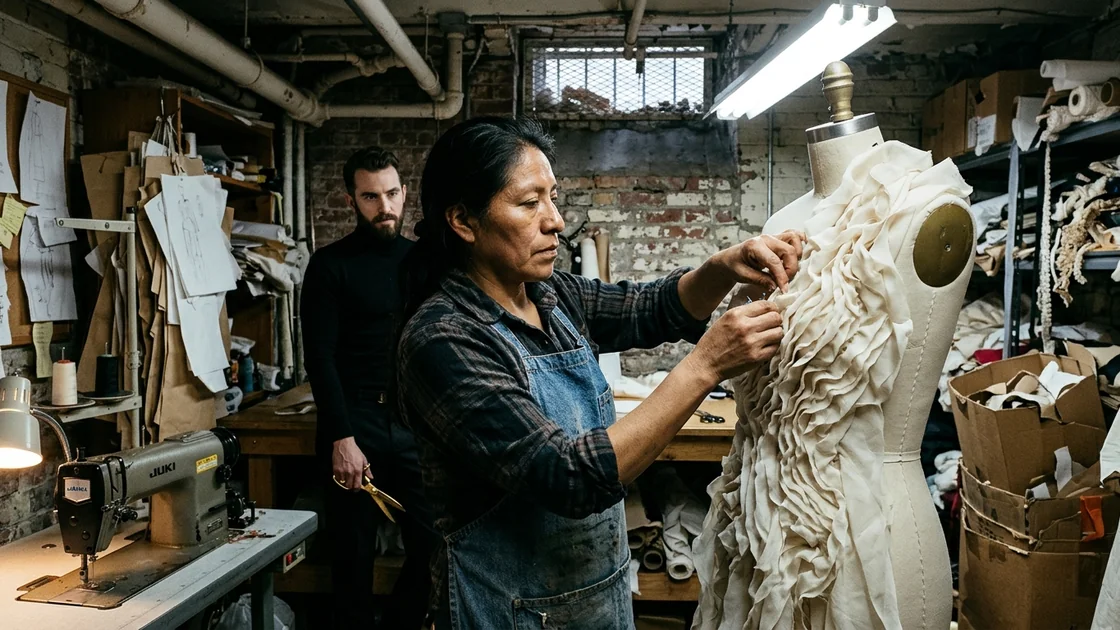
Julian Laurent built an empire of luxury fashion on the backs of uncredited artisans, but his most breathtaking collection was the singular work of Elena Cruz, an undocumented master seamstress from Oaxaca whose innovative pleats and ancestral embroidery revolutionized his failing label. When Elena respectfully asked for fair wages and formal attribution to pay for her daughter’s medical care, Julian protected his rising fame by placing an anonymous call to immigration enforcement, orchestrating her deportation before the runway lights even cooled. Though Julian claimed every accolade and millions in revenue, he found himself utterly incapable of replicating her transcendent artistry, ultimately discovering that while an empire can be stolen, true genius cannot be held captive by a coward.
The radiator in the cellar atelier of West 37th Street didn't hiss; it rattled like a cage full of iron teeth. It was November, and the city above was wrapped in heavy shearling and soft cashmere, but downstairs, beneath the grating through which Manhattan pedestrians dropped cigarette butts and grit, the air was perpetually thin, hot, and smelled of singed wool, machine oil, and cold coffee.
Julian Laurent stood before the dress form with a pair of gold-plated shears hanging loosely from his middle finger. His reflection in the tall, spotted pier glass showed a man of thirty-four whose jawline was beginning to soften beneath a carefully sculpted beard, his black turtleneck chosen specifically because it photographed well in the dim, severe lighting favored by independent fashion journals. On paper, Julian was the creative director of Maison Laurent, a label whose debut at New York Fashion Week three years prior had earned polite applause and an ambivalent mention in Vogue as "a commendable effort in minimalist tailoring that perhaps relies too heavily on the ghosts of early Céline."
The truth was less poetic. His investors were pulling back; his line of credit with the fabric mills in Biella was choked with unpaid balances; and his landlord, an elderly Syrian gentleman named Mr. Doumani who operated an antique trim warehouse upstairs, had already delivered two hand-written notices demanding three months of back rent. Julian was, by every metric that mattered in the merciless calculus of Seventh Avenue, nearly finished.
"It lacks tension," Julian murmured, stepping back to squint at the muslin toile pinned to the mannequin. "The shoulder is collapsing into the collarbone. It’s pedestrian. It looks like something from a mid-tier department store’s private label."
Behind him, seated at a heavy, cast-iron industrial Juki sewing machine that vibrated the floorboards, Elena Cruz did not immediately look up. She kept her right foot even on the treadle, guiding a curve of double-faced silk wool beneath the flashing silver needle. The hum of the motor was steady, a rhythm so practiced it felt less like work and more like an involuntary reflex, like breathing or the beating of a pulse.
When the seam reached the edge of the fabric, she cut the thread with a tiny flick of her palm against the thread-cutter behind the needle bar, placed the joined pieces onto a wooden board beside her, and finally turned her head.
Her eyes were dark, slightly swollen from the glare of the fluorescent tube clamped above her station, but clear. At forty-two, her hands were broader than Julian's, mapped with small scars from decades of slip-stitching, thimble rub, and hot irons.
"The fabric is too heavy for that drape, Señor Julian," she said, her voice quiet, carrying the lilting, rhythmic cadence of the Zapotec highlands of Oaxaca, layered over by twenty years of Spanish and ten years of survival English in New York. "You asked for the architecture of a coat, but you are cutting it like a scarf. Silk gazar needs the grain to hold it. If you cut it on the straight, it dies. You must surrender to the bias, or it will fight the body."
Julian frowned, his pride bristling instantly, as it always did whenever she spoke with that calm, matter-of-fact certainty. He liked to think of himself as an auteur, an orchestrator of silhouette and concept. He had attended Central Saint Martins for two terms before running out of family money and patience, returning to New York convinced that aesthetic vision was a divine spark, while the actual mechanics of garment assembly were merely clerical.
"If we cut it on the bias, Elena, the yardage doubles," he said sharply. "We don't have the budget to throw fifteen yards of four-hundred-dollar silk into a single evening jacket. I told you that on Tuesday."
"Then do not make a jacket," she replied softly. She stood up, dusting tiny flecks of black thread from her worn denim apron. "Make an armor."
She walked over to the scrap bin in the corner—a large cardboard crate overflowing with discarded off-cuts, remnants of failed experiments, samples sent by mills Julian could no longer afford. She reached deep into the box and pulled out a jagged strip of raw, hand-loomed raw silk in an unbleached ecru, followed by several yards of pleated organza that had been ruined by steam spotting earlier that week.
Julian watched with a mixture of impatience and involuntary fascination as she approached the mannequin. She didn't use pins at first. She took the ecru silk, folded it against itself with a rapid, accordion-like flick of her knuckles, and wrapped it around the form’s ribcage. Her fingers moved with an ancient, intuitive intelligence, pinching the fabric into tiny, raised ridges that seemed to lock together without thread, held only by tension and the natural tooth of the fiber.
"What are you doing?" he asked, his arms crossed over his chest.
"When I was nine years old in San Antonino Castillo Velasco," Elena said, her eyes fixed entirely on the cloth, "my grandmother taught me how to gather cloth before the needle ever enters. She called it el deshilado y bordado. You pull the threads out of the weave, one by one, until the cloth is weak. And then, where it is weak, you bind it with new thread, tighter and stronger than before. You make it a relief. You give the flat thing a memory."
She pinned the fold with a single, long steel pin, then reached for another section, twisting it on the true bias so that the fabric didn't fall flat; instead, it blossomed outward in a sculptural wave, resembling the calcified ridges of a sea shell or the spiraling growth of mountain agave.
Julian stopped breathing for a second.
The light in the basement caught the ridge. It was unlike anything he had seen in the showrooms of Milan or Paris. It had none of the sterile, computerized precision of modern Japanese pleating, nor the stiff, theatrical costumery of traditional couture. It was alive. It possessed a primitive, breathtaking elegance that seemed to shift with the air in the room.
"Leave it," Julian whispered.
Elena stepped back, wiping her thumb across her knuckles. "It will take three days to sew this by hand. Every ridge must be anchored to a stay underneath with silk filament. If a machine touches it, the tension will break, and the shape will die."
"I don't care," Julian said, his eyes wide, stepping closer until his face was inches from the pinned muslin. He reached out to touch the ridged fold, but Elena gently placed her fingers near the fabric, guarding it.
"It is only an idea," she murmured.
"No," Julian breathed, his voice trembling with an ambition he hadn't felt in five years. "No, Elena. It’s not an idea. It’s the entire collection."
For the next four months, the basement on 37th Street ceased to belong to the outside world.
Julian stopped answering his creditors' calls entirely, letting his cell phone ring itself into silence against the clutter of fashion sketches on his mahogany desk. He lived on black espresso and nicotine, pacing the narrow concrete floor between the scrap bins and the cutting table. But he was not cutting. He sat with his sketchpad, watching Elena work, desperately trying to translate the movements of her hands into lines he could claim as his own handiwork.
Elena worked sixteen hours a day. She arrived at seven in the morning, long before the winter sun managed to cast a grey sliver of illumination through the street-level iron grates, and she rarely left before eleven at night. Her fingers were raw, split at the thumbs from the friction of pulling heavy wax-coated linen thread through triple-layered silk organza.
She had developed a system. Using a technique she had spent her childhood perfecting alongside her aunts—a method of counting warp threads, pulling structural fibers, and twisting the remaining silk into self-supporting, helical ridges—she transformed twelve rolls of deadstock fabric into something otherworldly. Coats that possessed the weight of feathers but the architectural presence of marble sculptures; gowns that looked like smoke frozen into mineral strata; sleeves that unfurled like the wings of desert cicadas when the arm was raised.
Julian had christened the technique "The Laurent Pleat."
"We'll say it was inspired by the brutalist architecture of mid-century Berlin," Julian told her one night in January, swirling an amber glass of scotch as she sat bent over an ivory mantle piece, her needle darting through the silk with silent, lethal precision. "The interplay between hard concrete and feminine vulnerability. The press will eat it alive. It fits the Maison Laurent narrative. Minimalist, cerebral, rigorous."
Elena didn't look up from her stitch. "In my village, they call it nido de abeja. Honeycomb. It is what women sew on the blouses they wear to church, so the cloth can stretch when they nurse their babies, and shrink back when they are empty. It is not concrete, Señor Julian. It is skin."
Julian laughed, a sharp, dismissive bark that bounced off the brick walls. "Elena, darling, you can’t tell a fashion editor from WWD that a four-thousand-dollar evening cloak is inspired by breastfeeding in Oaxaca. This is the luxury market. People aren't paying for peasant craft; they’re paying for high modernism. They’re paying for my concept."
Elena’s needle stopped. She held it mid-air, a tiny point of silver catching the bulb’s yellow glare.
"My hands are doing the concept," she said quietly.
Julian’s face tightened. The warmth of the alcohol vanished from his features, replaced by a sudden, razor-thin chill. He set his glass down on the edge of the cutting board with a small clink.
"Your hands are executing my vision, Elena. Don't confuse the instrument with the composer. You’re a wonderful seamstress, perhaps the most technically gifted sample-maker I’ve ever employed. But without a platform, without my name, without this house, you’d be sewing zippers into polyester skirts at a factory in Sunset Park for four dollars an hour. I pay you cash. I keep you safe down here. Don't forget that."
Elena kept her head lowered. Her heart thumped against her ribs, heavy and dry like a bird caught in a chimney. She thought of her daughter, Marisol.
Marisol was twelve years old, living in a narrow, railroad-style apartment in Corona, Queens, with Elena’s sister, Sofia. Marisol had been born with a defective mitral valve—a leaky heart that left her breathless after climbing the subway stairs, her lips turning a faint, terrifying shade of lavender whenever the winter cold bit into her chest. The clinic in Elmhurst had told Elena in October that Marisol would need surgery within the year, a balloon catheterization that no public assistance would fully cover for an undocumented child without papers. The deposit alone was eight thousand dollars.
Elena had taken this job with Julian because he had promised her twelve hundred dollars a week in cash—a fortune compared to the sweatshops on 8th Avenue—plus a bonus if the Fall/Winter collection sold to department stores.
"Yes, Señor Julian," she whispered, her voice like tissue paper. "I understand."
Julian smiled, his equanimity instantly restored, and tapped his manicured fingers against the mahogany table. "Good girl. Now, finish that hem before midnight. The showroom buyers from Bergdorf are coming on Monday, and I want the ivory suite completely pressed."
The presentation took place in a stark, whitewashed gallery on West 22nd Street in Chelsea.
The room smelled of tuberose, expensive vape smoke, and the damp wool of two hundred people who had braved a sleeting February afternoon to see what Julian Laurent had cobbled together for his final, desperate gasp.
Julian stood near the entrance, dressed in an oversized double-breasted suit of slate wool, holding a glass of mineral water and nodding with practiced serenity at critics, influencers, and boutique owners. He was terrified. If this collection flopped, his father’s remaining trust would be exhausted, his brand liquidated, and his name reduced to an embarrassing footnote in the seasonal archives.
Then the lights dimmed.
There was no thumping techno music, no aggressive bassline. Julian had chosen, on Elena’s subtle suggestion, a solitary cellist playing a suite by Bach, the low, mournful notes scraping against the white walls like a fingernail on slate.
The first model walked out.
A sudden, collective intake of breath swept through the room.
The garment was a high-necked column coat made of heavy, cream-colored wool crepe. But it was not tailored in any conventional sense. Down the spine and wrapping around the ribcage, the fabric had been pulled, twisted, and rebuilt into thousands of micro-architectural ridges that seemed to breathe with the model’s stride. As she moved, the pleats opened slightly, revealing a subtle underlayer of burnt ochre silk that shimmered like hot coals beneath ash. It was austere, devastatingly sensual, and utterly new.
A prominent fashion editor sitting in the front row lowered her tortoiseshell sunglasses, her eyes narrowing as she leaned forward to inspect the seams.
Another model appeared, wearing a dress of sheer midnight-blue organza that appeared to float around her body like water, anchored only by an intricate, structural bodice that looked like woven bone. Every seam was invisible, buried inside the ridges of the fabric itself, creating a garment that had no apparent construction, as though it had grown organically out of the loom.
By the fifth look, the silence in the room had turned from curiosity into reverence.
When the finale model emerged—draped in a monolithic ivory cape whose folds formed an astonishing, three-dimensional geometric mandala across the back, requiring more than two hundred hours of hand-tensioned needlework—the gallery did not wait for the lights to come back up. The applause began before she had even reached the end of the runway.
It was not the polite, perfunctory clapping of industry insiders enduring another presentation. It was a roar.
Julian Laurent walked out for his bow. He had rehearsed the walk for a decade in his bedroom mirror: eyes downcast, a faint, self-effacing smile touching his lips, his hands clasped loosely in front of him as though humbled by his own monstrous talent.
"Genius!" someone shouted from the third row.
"Laurent! Over here!" the photographers barked, their flashes reflecting off the polished concrete floor like lightning strikes.
In the small, cramped backstage dressing area, wedged behind a temporary drywall partition, Elena Cruz stood near the steamer, holding a needle threaded with ivory silk, ready to fix any broken stays or loosened threads. She could hear the thunder of the applause through the wall. She could hear Julian’s name being chanted like a hymn.
She looked at her hands. Her cuticles were torn and raw; her right middle finger was swollen and hard with a calloused ridge where the silver thimble had pressed into her flesh for eighteen hours a day.
A young dresser, a girl fresh out of Parsons who had spent the morning crying over lost safety pins, ran past her, clutching her clipboard.
"They're going crazy," the girl whispered, her face glowing with secondary ecstasy. "Julian just saved the house. Did you see Cathy Horyn’s face? She was taking notes the entire time. He’s going to be on the cover of The Times."
Elena said nothing. She stepped forward and peered through a small gap between the temporary wall and the gallery pillar.
She saw Julian surrounded by a sea of black coats, smiling his soft, tired, brilliant smile. A microphone from a European fashion channel was thrust into his face.
"Julian! Julian! The pleating!" the reporter gasped, an Italian woman with bleached blonde hair and enormous silver rings. "We have never seen this structure before! It is revolutionary! Tell us—how did you develop this language? What was the genesis?"
Julian Laurent lifted a hand to his beard, looking down with modest contemplation before meeting the lens.
"It came to me during a residency in Berlin last summer," Julian said, his voice smooth, warm, and utterly convincing. "I was staring at the monolithic facades of the socialist buildings, thinking about the weight of history, the way a structure can hold the memory of grief and still stand. I locked myself in my studio for four months. I didn't sleep. I took the shears and I literally deconstructed the weave of traditional tailoring until I found a new geometry. It was an agonizing process, honestly. But art demands everything from you."
Elena drew back from the crack.
The gallery noise faded behind the sudden, high-pitched ringing in her ears. Her hands fell limp to her sides.
The reviews were ecstatic.
The New York Times called the collection "a triumph of radical engineering and profound poetic vision, establishing Julian Laurent as the most singular American voice since the late Alexander McQueen." Vogue ran a four-page spread detailing "The Laurent Revolution," featuring full-page black-and-white portraits of Julian looking broody and tormented beside the ivory mandala cape.
The orders followed immediately.
Boutiques in Tokyo, department stores in London, and private clients from Dubai flooded the Maison Laurent email inbox with requests. In forty-eight hours, Julian’s label went from insolvent to having three million dollars in wholesale commitments for the autumn season. Investors who had refused to return his calls in December were now sending cases of vintage Dom Pérignon to his apartment in SoHo.
Down in the basement on 37th Street, the work did not stop; it multiplied.
Julian hired four young fashion interns—earnest, unpaid college students who arrived every morning smelling of oat milk lattes and anxiety—to help prepare the sample duplicates for the European sales showrooms. But none of them could do the work.
One intern, a top student from the Fashion Institute of Technology, spent an entire morning trying to replicate the collar of the ecru coat. By lunch, the silk was shredded, the organza stretched out of alignment, and the pleats looked like a crushed paper bag.
"It’s not working," the boy sobbed, his eyes red. "The grain won't hold. Every time I pull the stay, the whole thing twists sideways."
"Because you are pulling with your shoulder, not your fingers," Elena said gently from her station in the corner. She stood up, walked to his table, and gently untangled the mess of silk. With three quick, decisive twists of her thumb and forefinger, she re-aligned the warp threads, set a single pin, and the fabric instantly settled into the correct, graceful ridge.
The intern stared at her as if she were a witch. "How did you do that?"
"You must feel where the thread wants to sleep," Elena said quietly.
"Enough chatting!" Julian’s voice cracked across the room like a whip.
He stepped down the wooden cellar stairs, wearing a new camel-hair coat that cost more than Elena earned in six months. His eyes were bright, his cheeks flushed with the manic energy of a man who had suddenly been invited into the inner sanctum of the gods.
"Elena, the interns are here to observe, not to be lectured," Julian said, walking briskly to her station. "I need the duplicate of Look 14 finished by five o’clock. The courier from the French Embassy is coming to pick it up for a private viewing."
"Señor Julian," Elena said, her voice steady, though her hands were trembling slightly under her apron. "May I speak with you in your office?"
Julian checked his gold Cartier watch. "I have seven minutes before my car arrives. Make it brief."
She followed him into his private office, a small room at the back of the cellar that he had recently redecorated with a mid-century teak desk and framed prints of his runway notices.
Julian sat down behind the desk, leaving Elena standing. He didn't offer her a chair. He picked up his phone, his thumbs already dancing across the screen.
"Yes, Elena? What is it? Do you need more needles? More thread?"
"I need to talk about my compensation, Señor Julian."
Julian’s thumbs paused on the glass. He didn't look up immediately. Very slowly, he set the phone face down on the polished wood.
"Your compensation?" he asked, his tone flat, dangerously neutral. "I pay you twelve hundred dollars every Friday, in cash, completely tax-free. That is nearly sixty thousand dollars a year, Elena. For a woman without an alien registration card, working in the Garment District, that is an extraordinary wage. Most shops would pay you half that and make you punch a clock."
"The collection made three million dollars this week," Elena said, looking directly into his grey eyes. "I know this because I saw the production sheets on the cutting table. The orders are for hundreds of garments. Every single garment uses my technique. The interns cannot do it. No one can do it except me."
"It is not your technique," Julian said, his voice rising, crisp and hard. "It is the Laurent Pleat. It was developed under my direction, under my label, using materials I purchased with my capital. You are an employee, Elena. An hourly technician."
"My daughter needs surgery," Elena said, refusing to back down. Her voice did not shake. It was heavy with the desperation of a mother who had run out of time. "Her heart is failing. The hospital wants fifteen thousand dollars for the deposit and the surgeon’s fees. I have saved three thousand. I am asking you for the rest. And I am asking for an increase in my wage to forty dollars an hour, and my name on the production team list in the show programs for Paris."
Julian stared at her as if she had just slapped him across the mouth.
His jaw tightened until the muscles bunched beneath his beard. His vanity, already swollen to grotesque proportions by the week’s accolades, could not accommodate the idea that this small, quiet woman in her faded denim apron believed she was his equal. If word got out that the "Laurent Revolution" was simply the ancestral knowledge of an undocumented seamstress from Oaxaca, the narrative would shatter. The fashion press would turn on him with the vicious glee they reserved exclusively for frauds. He would be ruined. He would be mocked.
"You are being remarkably ungrateful," Julian said softly.
"I have given you my hands for three years," Elena said, her voice dropping lower, resonant with a quiet, terrible dignity. "I gave you this collection. Without me, Señor Julian, those sketches on your desk are just pencil on paper. You cannot sew a straight line. You know it. I know it."
Julian’s face went dead white.
For three seconds, the room was so quiet that the dripping of a leaky pipe behind the plaster sounded like footsteps.
Then Julian leaned back in his leather chair. A strange, serene smile spread across his face, cold as winter lake ice.
"You're right," he said smoothly. "You're entirely right, Elena. I've been under immense stress, and I haven't properly acknowledged how much you’ve contributed to this moment."
Elena blinked, caught off guard by the sudden retreat. "Señor Julian?"
"Fifteen thousand dollars is a great deal of cash to pull out of the operating account right now," Julian said, opening his desk drawer and taking out his checkbook, only to tap it against his chin thoughtfully. "The buyers have placed orders, but the deposits haven't cleared the bank yet. It will take a few days to arrange the liquid funds."
"Marisol’s appointment is next Friday," she said.
"Then we will have it by Thursday," Julian said, his smile broadening, warm and paternal. "Thursday afternoon. I will have fifteen thousand dollars in cash for you, in an envelope, right here on this desk. And we will draw up a new contract for your salary. As for the credit... well, we’ll discuss how to properly title your role as Master Pattern Maker for the Paris show notes. How does that sound?"
Elena felt a knot in her stomach that she couldn't explain. The victory felt too sudden, too easy. But the thought of Marisol’s pale lips, of the doctor’s grim face at the Elmhurst clinic, drowned out her suspicion.
"Thank you, Señor Julian," she whispered, bowing her head. "Thank you."
"Don't thank me, Elena. We're a team," Julian said. "Now, please. Return to the ivory coat. We have a world to conquer."
The following Thursday was the coldest day of the winter.
A bitter, dry wind howled down the cross streets of Manhattan, turning the slush in the gutters to jagged brown glass. Inside the basement atelier, Elena worked steadily, finishing the final hand-stitches on an evening gown of layered graphite silk. Her fingers were stiff with the cold, but she worked with an inner, incandescent light.
Today was Thursday.
At three o'clock, she would have the fifteen thousand dollars. Sofia had already arranged to take Marisol to the pediatric cardiology wing at Mount Sinai the following morning. The nightmare was ending. She would save her daughter’s life, and her work would finally be recognized.
At two-fifteen, the heavy metal door at the top of the cellar stairs—the service entrance that opened onto the alleyway behind 37th Street—screeched open.
Elena didn't look up, assuming it was the courier arriving early for the sample boxes.
Then came the heavy, syncopated thump of combat boots descending the wooden stairs. Not one pair. Four.
The interns stopped their work, looking up with wide, frightened eyes.
Three men in dark blue tactical windbreakers stepped onto the concrete floor. Across the back of their jackets, in bright, non-reflective yellow block letters, was a single word: ICE.
Behind them stood a fourth man in a plain grey suit, holding a clipboard and a manila folder.
"Nobody move," the man in the suit said, his voice flat, practiced, carrying the bored authority of an airport security officer. "Stay at your stations and keep your hands visible on the tables."
Elena’s needle dropped from her fingers.
The tiny piece of silver hit the concrete with a faint ping, bouncing once before coming to rest in a crack between the floorboards.
Her blood turned to slurry. Her breath caught in her throat like a dry bone. She looked toward the private office at the back of the room.
The door was open.
Julian Laurent stood inside the doorway, holding a ceramic mug of tea. He did not look surprised. He did not look alarmed. He looked at Elena with a calm, flat detachment, as if he were watching an insect crawl across a windowsill.
"Julian Laurent?" the officer in the suit asked, stepping forward.
Julian stepped out of his office, his demeanor cooperative, polite, the picture of an upstanding, concerned Manhattan business owner.
"Yes, officer. I’m Julian Laurent. I’m the proprietor here."
"We received an anonymous tip regarding unauthorized workers on these premises," the officer said, glancing down at his clipboard. "Specifically an individual named Elena Cruz, non-citizen, overstayed visa dating back to 2012."
"This is outrageous," Julian said, his voice filled with a smooth, synthetic indignation that sounded like bad acting in a local theater production. "My workers are all properly documented through an agency. Except... well, Elena has been working here as an independent contractor. I’ve repeatedly asked her for her tax documentation, but..." He sighed, shaking his head with an expression of tragic disappointment. "I had no idea she was out of status. This is deeply upsetting."
Elena stood behind her table, unable to move. Her limbs felt like they had been cast in lead.
"You called them," she whispered.
Julian did not meet her eyes. He looked slightly above her head, at the fluorescent light fixture.
"Elena Cruz?" the officer asked, turning toward her and pulling a pair of steel handcuffs from his belt.
"Señor Julian," Elena said, her voice rising now, cracked and sharp with terror. "My daughter. Marisol. Her surgery is tomorrow! The money—you promised the money!"
"Step away from the table, ma'am," one of the uniformed agents barked, moving around the cutting board.
"Julian!" she screamed, her dignity tearing away like wet tissue. "Tell them! Tell them who made the collection! Tell them you owe me the money! Marisol is twelve years old! Her heart is sick! ¡Por favor, por el amor de Dios, Julián!"
Julian took a slow sip from his ceramic mug. "I'm sorry, Elena. If you had been honest with me about your legal situation from the beginning, none of this would have happened. But the law is the law."
The agent grabbed Elena’s right arm, twisting it behind her back with mechanical efficiency.
The pain shot through her shoulder, but Elena didn't cry out from the joint. She lunged forward, her apron catching on the edge of the table, knocking over a box of steel pins that scattered across the floor like silver rain.
"You are a thief!" she screamed, her voice tearing from her throat in a ragged, wild shriek that echoed off the damp bricks. "You stole my work! You stole my life! You are nothing! Without my hands, you are an empty coat! ¡Eres una cáscara vacía!"
The second agent caught her other wrist. The steel ratchets of the cuffs clicked twice, biting deep into the calloused skin of her wrists.
They dragged her across the concrete. Her shoes scuffled through the dust and the loose threads. She fought, thrashing against their grip, her eyes locked on Julian Laurent as he stood beside his teak desk.
As they pulled her toward the dark stairs leading up to the cold alley, Julian slowly turned around, walked back into his private office, and quietly shut the door.
The detention center in Hudson County, New Jersey, was made of cinder blocks painted the color of institutional oatmeal.
Elena sat on a stainless steel bench in a holding cell with fourteen other women. The room smelled of industrial floor stripper, cold bologna, and fear. None of the windows showed the sky; there was only a band of wire-reinforced glass near the ceiling that revealed a strip of grey gravel and the tires of transport vans.
Elena did not sleep for four days.
She sat with her back against the cinder blocks, her knees pulled to her chest, her fingers moving compulsively against the fabric of her orange jumpsuit, pinching the rough, synthetic twill into tiny, impossible pleats that would not hold because the polyester lacked the memory of natural silk.
Her sister Sofia visited her on Saturday, separated by a pane of scratched plexiglass and speaking through a greasy black telephone receiver.
Sofia was crying so hard she could barely hold the plastic phone.
"Marisol?" Elena asked, her voice dry, raspy, stripped of moisture. "How is Marisol?"
"The clinic... they sent us away, Elena," Sofia wept, pressing her hand against the glass. "Without the deposit, the surgeon would not take her. They gave her digitalis to slow the pulse, but she cannot leave the bed. She asks for you every hour. She thinks you are working in the basement. She thinks you are sewing for her."
Elena pressed her forehead against the cold plexiglass. The plastic smelled of disinfectant and other people’s breath.
"Listen to me, Sofia," Elena whispered, her voice dead, cold, hollowed out of all human emotion. "Take the three thousand dollars from under the mattress. Buy the plane tickets back to Oaxaca. Take Marisol to my brother Mateo in San Antonino. He has the farm. The mountain air is clean. She cannot survive another winter in Queens without the heat."
"And you?" Sofia sobbed. "What will happen to you?"
"I am going home," Elena said.
She was deported on a Tuesday morning.
They chained her ankles, chained her waist, and cuffed her wrists to a belly chain, marching her onto an unmarked Boeing 737 at an airfield in Louisiana alongside a hundred and twenty other people whose hands had picked America’s fruit, cooked its meals, cleaned its hotel bathrooms, and built its luxury empires.
As the plane lifted into the grey clouds, heading south toward the border, Elena Cruz closed her eyes.
She did not cry. Her tears had dried up somewhere between the basement on 37th Street and the tarmac in Alexandria.
She looked down at her hands resting against the cold steel of the waist chain. The calluses were still there. The memory of the thread was still in her bones. Julian Laurent had taken her garments, he had taken her credit, he had taken her fifteen thousand dollars, and he had thrown her out of the country like a sack of dirty remnants.
Let him try, she thought, the cadence of the jet engines humming beneath her feet like the treadle of an old Juki machine. Let him try to sew without the blood.
Six months later, the rue du Faubourg Saint-Honoré in Paris was drowning in gold.
Maison Laurent had arrived at Paris Fashion Week.
Julian had secured the legendary Grand Palais for his Spring/Summer debut. The French fashion federation, thoroughly seduced by the American prodigy who had supposedly invented a whole new language of structural drape, had given him the most coveted time slot of the week: eight o'clock on Friday evening, right between Dior and Saint Laurent.
The production budget was four million dollars.
Backstage, three hours before the show, the atmosphere was not triumphant; it was a slaughterhouse.
Julian Laurent stood in the center of the dressing pavilion, his beard ragged, his face gaunt, his eyes bloodshot and wide with an amphetamine-fueled hysteria. His black linen shirt was soaked through with sweat at the armpits.
"Where is Look 22?" he screamed at a French production manager who looked back at him with icy disdain. "I told you the silk for Look 22 was supposed to be steamed by four!"
"Monsieur Laurent," the production manager replied, his voice dripping with venom, "the silk was steamed. But look at it. Look at what happens when the girl puts it on."
Julian turned around and felt his stomach drop through the parquet floor.
Look 22 was supposed to be the centerpiece of the collection—a gown of sheer sea-green gazar that was designed to mimic the swirling eddies of an ocean current, using the signature "Laurent Pleat."
Instead, it looked like a dead jellyfish.
The pleats were uneven, bulging in the waist and sagging around the hips like deflated tires. The hand-stitching, executed by six different high-priced couture seamstresses Julian had hired from the finest ateliers in Paris, was technically precise, perfectly spaced, and completely lifeless. Because they did not understand the intrinsic tension of the unraveled warp threads—because they were simply copying photographs of Elena’s work from the previous season—the garment had no structural integrity. It fought the model’s body at every angle.
"It’s pulling at the armscye," the model complained, a teenage Russian girl who looked ready to faint. "It hurts. The wire inside the fold is stabbing me in the ribs."
"There is no wire inside the fold!" Julian roared, running over and violently yanking at the silk. "It’s supposed to hold itself! It’s tension! It’s balance!"
With a sickening rip, the seam under the arm tore open, the silk threads pulling apart like dry hair.
The French seamstresses stepped back, their arms crossed, murmuring among themselves in rapid, contemptuous French.
“Il est fou,” one whispered. “Il ne sait même pas tenir une aiguille.” (He’s crazy. He doesn't even know how to hold a needle.)
Julian stood staring at the torn green silk, his shears shaking in his hand.
In the six months since Elena had been dragged out of his basement, he had spent over two hundred thousand dollars trying to hire someone who could reproduce her work. He had hired graduates from Saint Martins, master tailors from Savile Row, aged pattern-cutters from the Parisian couture houses.
None of them could do it.
They could make pleats, yes. They could make beautiful, traditional, accordion pleats that had been done for two centuries. But none of them knew how to pull the structural warp threads from raw silk so that the fabric curled into those organic, impossible, self-supporting bone structures. When they tried, the silk disintegrated. When they tried to reinforce it, it became heavy and stiff, losing the miraculous, weightless poetry that had stunned the fashion world in New York.
Julian had spent forty-eight hours straight at the cutting table in his Parisian hotel suite, weeping with frustration, trying to force the cloth to obey his hands.
The cloth had laughed at him.
It had slipped through his soft, manicured fingers, bunching where it should have stretched, collapsing where it should have stood proud. He had realized, in the dead of a Tuesday night while staring at a ruined bolt of fifty-dollar-a-yard satin, the horrifying, unalterable truth: he was not a designer. He was an archivist of other people’s genius, an empty mirror that could only reflect the light of whatever star happened to stand before it.
And he had banished his only star to the dust.
"Ten minutes to house open, Monsieur Laurent," the stage manager announced through a walkie-talkie.
Julian looked down the rack of forty-two looks.
Half of them were simple, uninspired shifts—safe, boring dresses he had thrown together at the last minute using commercial pattern houses because the pleated garments had failed in production. The other half—the garments that attempted to replicate Elena’s magic—looked like grotesque, clumsy parodies of the New York collection. They were stiff with hidden buckram, held together with safety pins and frantic, messy stay-stitches that any critic with half an eye would spot from the second row.
"Line them up," Julian whispered, his voice cracking like dry wood.
"Pardon?"
"Line them up!" he screamed. "Send them out! What else are we going to do? Send them out!"
The silence in the Grand Palais was different from the silence in Chelsea.
In Chelsea, the silence had been the breathless awe of witnesses to an epiphany.
In Paris, the silence was the arctic, suffocating chill of a public execution.
The first look walked out.
Suzy Menkes did not take notes. Anna Wintour did not move behind her black sunglasses. The critics sat like stone gargoyles perched along the edge of the runway, watching a succession of clumsy, over-engineered garments trudge past under the harsh, unforgiving halogen lights.
The dresses didn't breathe. They wobbled.
When the finale dress appeared—Julian’s pathetic attempt to outdo Elena’s ivory mandala cape with an enormous, winged coat of royal purple velvet—the catastrophe became total. As the model reached the midpoint of the runway, the internal tension of the improperly balanced bias pleat gave way. A row of anchor stitches popped with a series of tiny, audible snaps.
The left wing of the coat collapsed, falling into an unsightly, crumpled heap around the model’s hip like a broken parasol.
The model stopped, her face pale with horror, caught her heel in the trailing, unbalanced hem, and stumbled, barely catching herself before falling into the lap of a CEO from a luxury conglomerate.
A ripple of low, cruel laughter spread through the front row.
Julian Laurent stood backstage, watching through the monitor. He did not go out for his bow.
When the lights came up, the applause lasted exactly eleven seconds—the cold, patronizing, pitying claps of people who were already reaching under their seats for their umbrellas and handbags.
The reviews the following morning were not just bad; they were an obituary.
“The Laurent Illusion Collapses,” headlined Le Figaro.
“A sophomore disaster,” wrote The Business of Fashion. “Without the cohesive, miraculous technique that surprised New York in February, Julian Laurent’s work is revealed for what it truly is: derivative, poorly constructed, and astonishingly hollow. One wonders if the designer we saw six months ago was a different person entirely, or if the emperor simply ran out of borrowed clothes.”
Within three weeks, the buyers cancelled seventy percent of their wholesale orders.
The investors, sensing the stench of a sudden and catastrophic death, pulled their lines of credit. The landlord in New York changed the locks on the 37th Street basement, leaving Julian’s cutting tables, his sketchpads, and his mahogany desk locked behind an iron chain.
By November—one year after Elena had first picked up the scrap of raw silk from the cardboard bin—Maison Laurent was officially bankrupt.
Two years later.
San Antonino Castillo Velasco sits in the dry, sun-drenched valley south of Oaxaca City, where the air smells of roasted chiles, dry earth, and the sweet, honeyed musk of blooming copal trees.
At the edge of the village, past the small stone church whose yellow facade had been chipped by two centuries of earthquakes, stood a long, open-air workshop built of sun-dried adobe and roofed with red clay tiles.
Inside, twenty women sat on wooden benches beneath the shade of the portico.
The air was filled with the rhythmic, gentle sound of laughter, Zapotec conversation, and the soft, dry snip of thread cutters. On the tables lay bolts of silk, hand-loomed wool, and fine cotton, dyed in shades of indigo, cochineal, and marigold.
At the center of the workshop, Elena Cruz stood before a long table made of cedar planks.
She looked different.
Her dark hair, once pulled back into a severe, hurried knot beneath the basement fluorescents, was woven with purple yarn into two thick braids that rested against her chest. Her skin was warm, browned by the mountain sun, and her eyes, though still carrying the quiet gravity of a woman who had seen the inside of an American cage, were clear and steady.
"Elena," a voice called from the doorway.
Marisol walked into the workshop, carrying a clay jug of cold hibiscus water and a basket of limes.
She was fourteen now. She was tall, her cheeks flushed with the bright, rich red of healthy blood. Beneath her light cotton blouse, invisible unless you stood very close, was a thin, pale scar that ran down the center of her sternum—the mark of a surgery performed eighteen months ago at the civil hospital in Oaxaca City, paid for not with American cash, but with the proceeds of an independent cooperative that had begun selling directly to collectors in Mexico City and Tokyo.
"Your water, Mamá," Marisol said, setting the jug on the cedar table.
Elena smiled, reaching out to tuck a stray strand of hair behind her daughter’s ear. Her thumb brushed Marisol’s cheek—the same thumb that had once been split by the linen thread on 37th Street.
"How are the books today, my love?" Elena asked.
"The order from the museum store in Kyoto has been finalized," Marisol said, pulling a leather notebook from under her arm. "They want thirty of the indigo shawls. And the designer from Guadalajara—the one who came last month—she sent the contract for the embroidery panels. She accepted your terms. Fifty percent advance, your name on every label, and twenty percent of the retail sales goes directly to the cooperative fund."
Elena nodded, her fingers smoothing down the edge of an ecru silk shawl that lay across the table.
She didn't use patterns anymore. She had taught the twenty women in the village the technique her grandmother had known, refined by her own trials in the cold north: how to pull the threads, how to give the flat cloth a memory, how to make the garment hold its own soul without the support of wire or lies.
A young girl, an apprentice of barely fourteen, looked up from her frame.
"Doña Elena," the girl asked, holding up a length of blue silk whose ridges were collapsing slightly to the left. "Why does the thread fight me? I counted the warp twice, just as you said."
Elena walked over to the girl’s station, pulled a wooden stool up beside her, and placed her calloused hands gently over the girl’s small fingers.
"You are trying to command the cloth, mija," Elena said softly. "You cannot be its master. You must listen to where it is weak. A man once told me that fashion is about power and architecture. But he was a fool who knew only how to take, not how to make."
She guided the girl’s hand, loosening the tension on the silk filament by a fraction of a millimeter. The fabric relaxed, breathed, and then, as if responding to a secret command, settled into a sharp, flawless, self-supporting ridge that caught the mountain light like water.
"You see?" Elena whispered. "The thread knows who is holding it."
Five thousand miles away, in an apartment in Queens whose windows looked out over the roaring elevated tracks of the 7 train, Julian Laurent sat at a small kitchen table littered with unpaid credit card notices and empty plastic delivery containers.
He had gained weight; his once-sculpted beard was patchy, speckled with grey, and his hands, which had never known hard labor, were dry and soft.
He had a job now. He was an assistant merchandiser for an online fast-fashion clearinghouse in Secaucus, spending forty hours a week entering SKU numbers into a spreadsheet, cataloging polyester tops that sold for nine dollars and ninety-nine cents to teenagers in middle America.
On his laptop screen, an article from an international design journal was open.
The headline read: The Quiet Revolution: How Indigenous Cooperatives in Oaxaca Are Redefining Modern Haute Couture.
Beneath the headline was a photograph.
It showed an evening coat made of unbleached silk, its surface undulating with complex, organic, helical ridges that seemed to defy gravity, shimmering with an austere, magnificent grace that stopped his heart.
Beside the coat stood Elena Cruz, her arms folded across her chest, her chin lifted, looking directly into the camera with an expression of calm, unshakeable sovereignty. The caption read: Master Artisan Elena Cruz, founder of the San Antonino Collective, whose groundbreaking structural textiles are currently being exhibited at the Musée des Arts Décoratifs in Paris.
Julian Laurent stared at the screen for a long time.
He reached out his trembling right hand, his fingers touching the glass, tracing the ridges of the coat that he had once called his own, the coat he had once claimed to have invented in a basement in Berlin.
Beside his laptop lay a needle and a spool of black thread, left behind by his roommate to fix a loose button on an overcoat.
Julian picked up the needle.
He picked up a clean paper napkin from the kitchen counter. He folded the napkin, trying to pinch the paper into a ridge, trying to force the thread through the crease, his knuckles awkward, his wrists stiff, his mind desperately reaching back into the dark cellar of 37th Street, trying to remember how her fingers had moved, how the cloth had turned, how the magic had been born.
He pushed the needle through.
The paper tore. The thread tangled into a tight, hopeless knot.
Julian Laurent dropped the needle onto the table, covered his face with his soft, useless hands, and in the cold, noisy dark of the Queens afternoon, he finally began to weep.