The Thaw at Black Ridge
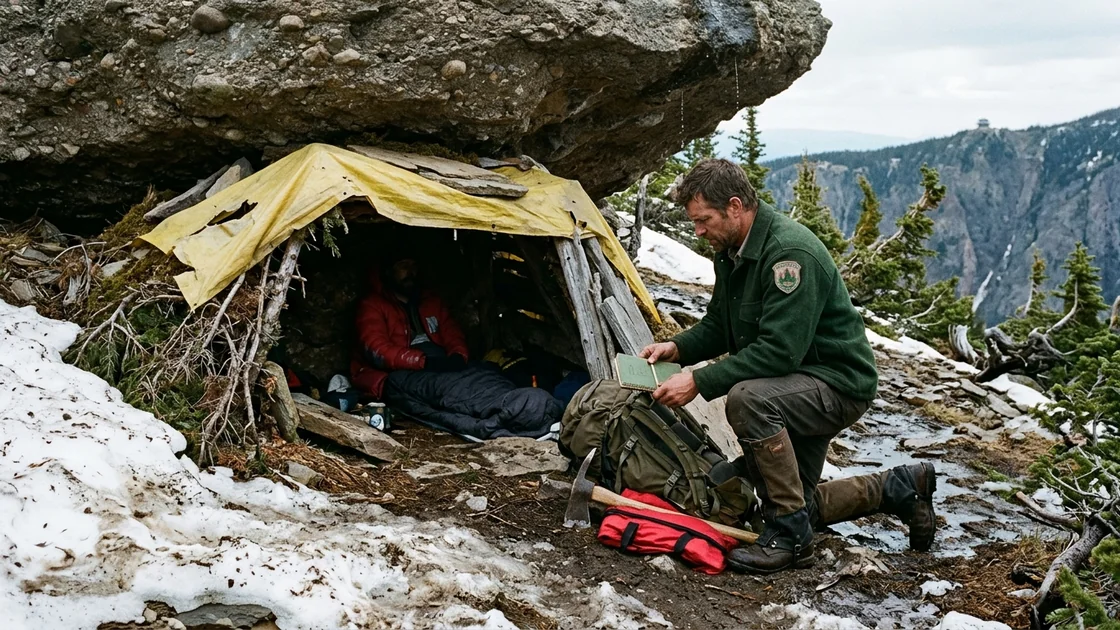
Park Ranger Jesse Vance spent nine years guarding the high northern backcountry of the Absaroka Range before the night he saw a single red cinder arc above the timberline of Cirque Peak. With a historic November front screaming across the Continental Divide packing sixty-knot gusts and twenty below zero temperatures, Vance chose his own warm hearth and survival over what he convinced himself was merely a lightning strike or an optical trick of blowing ice. When the mountain snowpack finally began to liquefy in late May, he hiked into the scree and deadfall to put his haunting to rest, only to uncover the sodden bivouac of Julian Drake and a waterproof field notebook that meticulously detailed the agonizing final days of a man who died waiting for a light that never moved.
I. The Iron Stove
The glass in the southern panes of the Black Ridge Lookout had been rattling since three in the afternoon, vibrating with a dull, dry hum like a horn jacketed in lead. By four, the barometer had dropped twelve millibars in three hours, its brass needle dipping toward a region of the scale Jesse Vance had seen only twice in his nine seasons with the Service.
Outside, the world had lost its middle tones. There was only the yellow-gray sky pressing down until it seemed to drag against the stunted limbs of the krummholz pines, and below that, the endless, ribbed ocean of gray rock and dead lodgepole timber that formed the eastern skirt of the Absaroka Wilderness. A rim of hard rime was already building on the windward cables supporting the tower, growing outward into the wind in sharp, white daggers three inches long.
Jesse knelt before the cast-iron box of the Jotul stove, his knuckles cracked and black with grease from the chainsaw he had spent the morning tuning. He laid two dry split sticks of tamarack over the bed of coals, blew until the red embers lit the white ash, and then swung the heavy latch shut. The draft gave an immediate, low-throated growl.
"Let her blow," he said to the empty room. It was a habit born of solitary four-week rotations, a way to test if his vocal cords were still oiled.
The two-way radio on the low wooden desk crackled, hissed with a spray of static that sounded like dry rice shaken in a tin pan, and then cleared as the repeater on Signal Peak picked up Dispatch fifty miles south in Dubois.
"Station Four-Echo, Black Ridge, Dubois on four. Jesse, you copy?"
Jesse crossed the tongue-and-groove fir floor in his wool socks, picked up the fist-mic, and thumbed the switch. "Four-Echo. Go ahead, Martha."
"Jesse, weather service just pushed the warning forward. The cold core is moving three hours ahead of the models. They’re clocking seventy-five at the pass right now. Ground temp is six above and falling. How’s your wood stack?"
Jesse glanced through the northwest window toward the landing at the top of the tower stairs. The cords he had hoisted with the hand-winch three days ago sat stacked against the lee wall under an oiled canvas tarp, lashed down with quarter-inch nylon line.
"I’ve got three face cords on the platform and fifty gallons of kerosene for the backup heater," he said. "The tank is full. Water’s hauled. I’m battened down."
"Good," Martha’s voice came back, accompanied by the far-off sound of a keyboard clattering in the warm, fluorescent basement of the district office. "District Ranger closed the gates at the North Fork trailhead at noon. We’ve got no registered permits active north of the Buffalo Fork, but you know how it is with the late-season elk hunters coming out of the wilderness corridor. If anyone’s still up on the plateau, they’re on their own until this front clears Tuesday or Wednesday. Don't go outside after dark. They're saying wind chills fifty below."
"Understood," Jesse said. "I’ll check in at zero-eight-hundred."
"Stay warm, Jesse. Out."
Jesse hung the mic on its bracket. He stood for a long time with his palms pressed against the cold zinc top of the map table. The Osborne Fire Finder sat in the center of the room, its brass sights polished, its azimuth ring gleaming dully under the gray ceiling. Through its hair-thin sighting wire, Jesse could look out toward Cirque Peak—a tooth of dark, Permian limestone that rose nine thousand feet into the lower cloud deck four miles to the northeast.
Between Black Ridge and Cirque Peak lay Hell-and-Die Canyon, a two-thousand-foot slot of fractured basalt, boulder chokes, and tangled, blowdown spruce that remained dark even at midday. It was country that swallowed sound, swallowed trails, and occasionally swallowed men. Two years prior, a hunter from Wisconsin had stepped off an outcropping down there looking for an elk blood trail; they had not found him until the flies gave him away the following July.
The light failed quickly. By five o'clock, the storm arrived not as a squall, but as a solid wall of white dust that erased the world fifty yards out from the catwalk. The temperature dropped twelve degrees in twenty minutes. Jesse felt the chill find the mortar gaps beneath the cedar sills; it crept across the floorboards like an invisible, icy liquid, pooling around his ankles until he put on his felt-lined pac boots and double socks.
He ate a tin of sardines and two hard biscuits, washing them down with black tea boiled on the top of the Jotul. He washed his tin plate with a cup of hot water, wiped it dry with a rag, and sat in the canvas director’s chair beside the lantern with a dog-eared volume of local geology. The wind hit the tower in rhythm now—a rising moan that climbed an octave every five minutes, followed by a shudder that vibrated into the floorboards and made the chimney pipe rattle against its ceiling collar.
It was six-fifteen when he looked up from the page.
He did not know why he looked. There had been no sound distinct from the gale, no knock upon the hatch. But some subtle shift in the cabin’s amber light drew his eyes to the northeast window, the one facing the black void where Cirque Peak should have been.
Through the salt-crusted pane, smeared with fine, scouring granules of sleet, a single spark rose.
It was faint, no brighter than a blown cinder from an old campfire, but it was not yellow or orange. It was a sharp, chemical magenta. It climbed perhaps a hundred feet above the treeline near the shoulder of the ridge across the canyon, curved gracefully against the horizontal driving drift, and died.
Jesse rose from his chair so fast the open book slipped from his knees and landed face down on the spruce planks. He stepped to the glass, cupping his hands around his temples to block the lantern’s reflection.
"No," he whispered.
The glass pulled the heat from his forehead in an instant, leaving a circle of white, condensed skin. Outside, the night was a churning vat of milk and charcoal. Nothing moved except the snow, which was no longer falling from the sky but flying horizontally, screaming off the eaves like needle-sharp grit.
He waited. His heart was knocking against his ribs with a dry, rhythmic thud.
A lightning strike, he thought. Dry winter lightning in the front. But there had been no flash along the horizon, no blue sheet to silhouette the crags, no subsequent thunder that could be heard through the wind.
A hunter's spark. But a fire didn't rise into the wind and curve.
A flare. A thirty-seven-millimeter marine red or an aerial pen-flare from an emergency kit.
Jesse’s hand went to the switch of the 500-watt roof beacon—the halogen halogen spot that the Forest Service had mounted to the tower roof for air searches. His fingers touched the toggle, cold and metallic.
If he flipped the toggle, the beam would bore a straight, milky tunnel into the blizzard, visible perhaps from three miles away if the snow thinned for even twenty seconds. It would say: I am here. You are seen.
His hand did not throw the switch.
Jesse looked at the anemometer dial on the wall beside the weather log. The needle was pinned against sixty-five knots, shivering toward seventy. The outside temperature gauge read four below zero. If he signaled, if he acknowledged that flare, protocol was absolute: he had to log it, he had to inform Dubois, and when Dubois pointed out that the road was impassable to vehicles, the task of ground verification would fall to the nearest ranger with backcountry winter qualifications.
To him.
He would have to take his heavy pack, his snowshoes, his emergency bivouac, and descend the eighty-foot open iron stairs of the tower into the dark. He would have to plunge into the black, sucking mouth of Hell-and-Die Canyon, where deadfall lay six feet deep beneath a deceptive blanket of powder, where the wind could tear an eighty-pound pack off a man's back, where if he twisted an ankle or took a branch through his eye, he would be dead three hours before sunrise.
And for what? A poacher trying to scare an elk? A broken flare cartridge fired by accident by some fool who was already in an outfitter’s wall tent with a sheep-herder stove red-hot in the center?
Or worse: an optical trick. A spark from his own stove chimney blown back across the window pane by an eddy of wind off the lookout roof.
It was a spark from the tamarack, Jesse told himself. The tamarack splits are full of pitch pockets. A cinder went up the flue, caught the lee draft, and blew across the glass. That's all it was. It wasn't across the canyon. It was six inches outside the window.
He stood with his thumb resting on the cold switch for two full minutes. The wind hit the tower with a broadside impact that made the iron turnbuckles scream like gut strings on an oversized cello. The entire structure leaned an inch to the south, then righted itself with a groan of stressed fir.
Jesse pulled his hand away from the switch.
He walked back to the stove, took the poker, and violently stirred the coals. He threw in two more chunks of split fir—not tamarack, but fir, which burned with less crackle—and closed the door. He turned the lantern down until the wick was barely a yellow fingernail of flame, took off his boots, and crawled under four wool blankets in his bunk.
He did not sleep. All night long, beneath the thundering canvas of the storm, he listened for a second pop, a second light. Nothing came. By morning, the tower windows were sealed completely in three inches of dense, gray rime ice, and the mountain was as silent as a skull.
II. The White Months
Winter did not leave the Absarokas until May.
For five months, Jesse Vance saw fewer than ten human faces. Every three weeks, when the road down at the lower station was plowed out by the county road crew, he would snowshoe down the six miles of switchbacks to the trailhead cabin, trade his empty propane cylinders for full ones, pick up his mail and three boxes of tinned food and dried beans left by the supply tech from Cody, and climb the mountain again.
He spoke to Martha on the radio every morning at eight.
"Four-Echo, all quiet. Twenty-four inches new powder. High of twelve, low of minus eighteen."
"Copy, Four-Echo. No traffic down here. The snow gates at the county line are still drifted over five feet deep. Enjoy the peace and quiet."
"Copy that, Martha."
He stopped reading the geology books. Instead, he found himself sitting at the map table with an old engineer’s scale and a grease pencil, measuring the distance from the tower to the northwest flank of Cirque Peak.
Three point eight miles. A drop of eighteen hundred feet into the gulch of Hell-and-Die Creek, then a climb of two thousand two hundred feet up the avalanche chutes on the northern face. Even on snowshoes, in summer conditions, it was a six-hour trek. In November, with the crust unformed and the loose powder waist-deep over hidden field boulders, it would have been eighteen hours of wallowing. A man would have died of exhaustion before he reached the timberline.
You couldn't have saved him anyway, he told himself while he shaved with cold water in the small oval mirror by the sink. If there was anyone there. Which there wasn't. It was an ember. I saw an ember from the flue.
Yet in the third month of the new year, during the long, blue twilights when the wind died down and the snow-plains turned the color of skimmed milk, Jesse would catch himself watching the Cirque through the binoculars.
The snow there was sculpted by the westerly winds into long, knife-edged cornices that hung over the precipices like frozen waves. Down lower, in the belt of stunted subalpine fir, everything was buried. Trees forty feet high showed only their uppermost tips—green fingers clawing out of the white drifts. If a man had died there in November, he was under eight feet of pack now, sealed in an ice vault that would not open until the sun reached the summer solstice.
In late March, the missing persons bulletin came through on the Forest Service teleprinter at the ranger station down at the highway, forwarded to him in a bundle of paperwork during his monthly supply drop.
Jesse sat at the oilcloth-covered table in the valley cabin, the woodstove roaring behind him, the smell of damp rubber and wool rising from his drying gear. The paper was standard state police form, photocopied so many times the type had grown fuzzy around the serifs:
NAME: DRAKE, Julian T.
AGE: 31
HEIGHT: 5’ 11” WEIGHT: 175 lbs.
HAIR: Brown EYES: Hazel
LAST SEEN: November 11, North Fork Trailhead. Vehicle located Nov. 19 under four feet of drift: 1998 Subaru Outback, green, Colorado plates.
REMARKS: Subject was an experienced solo hiker and landscape photographer. Left an itinerary indicating intent to traverse the high bench south of Cirque Peak toward the Black Rock divide. Did not return to employment on Nov. 17. Search suspended Nov. 22 due to extreme weather conditions and secondary avalanche hazard. Presumed deceased.
Jesse stared at the small, grainy black-and-white photograph in the upper right corner. Julian Drake had an uneven, crooked smile, a wide jaw covered in two days of stubble, and eyes that squinted slightly, as if he were looking into a low winter sun over an open field. He looked like fifty other men Jesse had checked through trailheads—confident, slightly lean, wearing an old pile jacket with the collar turned up.
The date struck Jesse like an open palm across the mouth.
November 11.
The storm had hit on the evening of the twelfth. The red cinder had climbed through the black air at six-fifteen on the twelfth.
Drake had been up there. He had been caught on the shoulder of the mountain when the front came through. When the temperature plummeted thirty degrees in four hours, when the seventy-knot gale tore the clouds into rags and brought the Arctic ceiling down to the granite, Drake had been somewhere in the timber below the Cirque.
Jesse folded the paper once, then twice, then a third time until it was a thick, stiff rectangle the size of an index card. He slipped it into the breast pocket of his wool Cruiser jacket, buttoned down the flap, and walked out onto the porch into the cold, clean air of the valley.
The sky was a pale, high blue. The sun had real warmth in it for the first time in five months, but Jesse felt as though his chest had been packed with coarse salt and frozen gravel.
He went back up the mountain the next day. He did not call Martha to report that he had reached the summit. He spent the week doing maintenance work that did not need doing: he took down the spare radio antennas, cleaned the copper contacts with emery cloth, oiled the door hinges, and washed the lookout windows until the glass was invisible.
Whenever he stood at the east panes, his eyes drifted toward the white skirt of Cirque Peak. The snow was beginning to turn gray at the edges of the rock outcroppings where the black basalt absorbed the spring heat. Small runnels of water were starting to cut through the drifts, leaving blue-green fissures that smelled of wet dirt and old rot.
"I could not have reached him," he spoke aloud to the empty glass. "No man could have crossed the creek in seventy-mile winds. It was fifty below. He was dead before midnight."
The mountain said nothing back. The glass was so clean that when he leaned close, his breath fogged it, and in that white circle, the world disappeared again.
III. The Runoff
May came in with rain—heavy, warm, Pacific rain that fell for forty-eight hours and turned the snowpack into a rotten, gray sponge.
The creeks down in the valley were brown torrents, carrying whole cottonwood trunks and the carcasses of mule deer that had drowned in the high snows. The trail from the Black Ridge lookout to the valley became a mud-chute littered with shale slides and fallen timber. Jesse’s rotation was up on the twenty-eighth of the month, when his relief, a twenty-two-year-old seasonal named Miller, was scheduled to come up for the summer fire season.
Jesse did not wait for Miller.
On the morning of the twenty-fourth, he packed his internal-frame Gregory pack with three days’ rations, a small bivouac sack, his first-aid kit, a pair of light crampons, a folding trenching shovel, and a red nylon body bag he had taken from the rescue locker behind the valley tool shed. He told Martha on the morning radio check that he was going to perform trail clearing on the North Ridge spur toward the headwaters of Hell-and-Die Creek, where several slides had been reported by aerial spotters.
"You want company out there, Jesse? The trail crew’s down at Dubois getting their chainsaw certifications. They could be up there by noon tomorrow."
"Negative," Jesse said, his voice flat and dry. "It's just blowdown across the switchbacks. I can chop the worst of it out with a Pulaski. I’ll be out of radio contact for twenty-four hours. Leaving the repeater off to save the house battery."
"Alright. Watch yourself in the chutes. The snow’s coming down in chunks the size of school buses."
"I know the snow," Jesse said, and clicked off.
He left the tower at six in the morning.
The lower half of the descent into Hell-and-Die Canyon was a nightmare of rotting avalanche debris. He crossed three slide paths where the snow was packed into dirty, cement-like ridges littered with shattered spruce trunks, torn roots, and pulverized stone that gave off a sharp, sulfuric stink of fresh rock-fracture. The air was thick with the roar of water; every gully was a boiling flume of foam, roaring beneath the remaining snow bridges with a muffled, hollow thunder.
He crossed Hell-and-Die Creek on a jam of cedar logs that shook and groaned under the weight of the water. The spray soaked him to the waist, freezing cold, smelling of ancient bog iron and rotting needles. Once across, he began the climb toward the Cirque.
The north slope of Cirque Peak was shaped like an amphitheater—a huge, semicircular bowl of black cliff that rose a thousand feet above an apron of glacial talus. Near the timberline, the trees were twisted into grotesque, crouching postures by centuries of gale-force winds: krummholz pines whose trunks were as hard as seasoned bone, growing horizontal along the rock before lifting a single, ragged banner of needles toward the south.
Here, the snow still lay four feet deep in the hollows between the ridges, but it was honeycombed with melt-holes, soft and treacherous. Every ten steps, Jesse broke through the crust up to his thighs, his boots plunging into cold, muddy water running over the scree beneath.
By two in the afternoon, he had reached the seven-thousand-foot contour. He sat on an exposed slab of sandstone to catch his breath, his chest burning from the climb, his socks squelching inside his boots.
He took out his binoculars.
From this angle, looking back southwest, the Black Ridge Lookout was clearly visible—a tiny, glass-and-timber thimble perched on the razor edge of the opposing mountain. The sun was behind it now, turning the windows into mirrors that flashed with an oily, blinding light.
He raised the glasses to his eyes and looked at the lookout.
He could see the roof beacon clearly. The round, chrome housing of the 500-watt spot was like a dead eye staring directly across the void at him.
If I had turned it on, he thought, this is where he would have seen it. Right here.
He lowered the binoculars. He looked around the slope.
Fifty yards to his left, tucked beneath the overhanging lip of a conglomerate boulder the size of a hay barn, something bright caught the light. It was not the gray of rock or the dark green of pine. It was the sharp, synthetic hue of safety-yellow ripstop nylon.
Jesse did not run. He stood up slowly, his joints stiff, his knees aching from the climb. He adjusted the chest strap of his pack, took his Pulaski in his right hand, and walked through the rotten, knee-deep drift toward the rock.
IV. The Bivouac
The boulder had created a snow-shadow during the November gale. While the rest of the slope had been buried under eight feet of hard-packed drift, the hollow beneath the leeward overhang had received only three or four feet of sifted powder, which was now mostly melted away, leaving a bed of dry pine needles and crushed gravel.
Julian Drake had built a wall.
It was constructed of dead spruce branches, flat slabs of sandstone, and the heavy, gray limb-wood of fallen krummholz, all chinked with dry moss and frozen earth. It was three feet high, curved like a horseshoe, its back nestled against the dry belly of the cliff.
The shelter had not collapsed. The roof—made of overlapping branches covered by a yellow nylon rainfly held down with flat rocks—had sagged in the middle under the weight of the winter snow, but the frame still held.
Jesse stopped five feet from the entrance.
The air beneath the overhang was cold and still, shielded from the sun. It smelled faintly of dry resin, wool, and that peculiar, unmistakable sweetness that comes from organic material preserved by freezing and then slowly warmed by the first humid air of summer.
Jesse dropped his pack into the mud. He laid the Pulaski against the stone wall.
"Hello?" he called out. His voice was an absurd croak, small and thin against the roaring background of the melting mountain.
He knelt in the dirt, took off his gloves, and pushed back the tattered yellow fabric of the rainfly.
Julian Drake was sitting with his back against the stone face, his legs stretched out inside a dark blue synthetic sleeping bag that had been chewed by packrats around the footbox, spilling white clumps of Dacron fill across the gravel.
He had died with his coat on. It was a heavy goose-down parka, the bright red color of a sumac leaf, patched with gray duct tape at the elbows and across the chest. His head had slumped forward onto his breastbone, so that all Jesse could see at first was the greasy brown wool of his watch cap, frosted with a light web of gray mold where his breath had last dampened the wool.
His hands were bare. They lay in his lap, palms up, the fingers curled like dried leaves. The skin was the color of old candle wax, translucent and mottled with purple-gray patches along the knuckles.
Beside his left knee lay an aluminum flare gun, its barrel tilted downward into the dirt. Its hammer was cocked back. A green plastic box of flares sat next to it, open; three empty, scorched plastic hulls were scattered in the dust, their brass rims green with verdigris. One red shell remained in the tray.
Jesse felt the wind hit the back of his neck, cold and wet.
He looked closer at the dead man's face. The skin had dried tight across the cheekbones and the bridge of the nose, pulling the lips back slightly from the teeth in an expression that was not a scream or a smile, but merely the indifferent grimace of dried meat. His eyes were half-open, clouded and dull like unpolished river marbles, staring down at the space between his boots.
Between those boots lay a green, waterproof canvas field ledger, the kind used by forestry surveyors, held shut by a wide rubber band cut from an inner tube. A mechanical pencil was clipped to the spiral wire at the top.
Jesse stayed on his knees for a long time, the frozen gravel biting into his kneecaps through his damp dungarees. He did not touch the body. He did not reach for the radio on his hip to call Dispatch.
He reached out his right hand, his fingers shaking so violently that he dropped the rubber band twice before he could work it off the notebook, and took the ledger.
The paper was Rite-in-the-Rain stock, stiff and heavy, designed to take pencil even under water. On the cover, written in black grease pencil, was the name: JULIAN DRAKE - ABSAROKA TRANSECT - NOV.
Jesse opened the cover.
V. The Ledger
The early pages were filled with what Jesse expected: lists of exposures, focal lengths, trail mileages, and short, clipped notes on the weather and the flora.
Nov 8. Lower North Fork. Cottonwoods bare. Elk moving down in small bands, mostly cows and calves. Light at 4 PM is slate and orange. Camped at third creek crossing. Water clear, 34 degrees.
Nov 9. Gaining the bench. Snow line at 6,500. Five inches of old crust, firm enough for boots without snowshoes. Cirque Peak looks like a broken tooth from the south approach. The limestone has yellow bands through the middle that catch the sunrise like copper.
Nov 10. Ridge camp. High clouds moving in from the Pacific, mares' tails, beautiful but bad news. The air smells like wet iron. Going to push up to the base of the Cirque tomorrow for the dawn light on the northwest wall, then drop down into Hell-and-Die before the front.
Then the handwriting changed. The pencil strokes became deeper, heavier, gouging into the waterproof paper with a sharp, ragged slant.
Nov 12. Midday.
Stupid. God damn stupid. Left ankle went out on the scree under the snow bridge. Heard the snap before I felt it. Lateral malleolus, I think. Foot is turned three inches out. Could not reduce it myself. Tried to crawl with the pack, but the grade is thirty degrees here and every time I slip backward the bone ends grind like broken china.Storm is coming on faster than the radio said. The sky isn't gray, it’s purple. Wind is already forty miles an hour. Cannot go down. Can’t cross the boulder field with one leg. Managed to haul myself up under this overhang. There is dead wood here. Built a three-foot windbreak using the pack frame as a skid to pull the rocks.
I have the down bag, the bivy, four bars of chocolate, half a salami, and two liters of water before the bottles freeze. I have the flare gun with four red cartridges. There is a fire lookout on the ridge across the canyon. Black Ridge. I saw the sun hit the windows three hours ago. Someone is over there. I saw smoke from the chimney at noon.
Jesse swallowed. The spit in his mouth felt like dry sand. He turned the page.
Nov 12. Night.
The storm hit at four. Never seen wind like this. It took the ground pad right out of my hands while I was trying to roll it; it’s halfway to Wyoming by now. I'm sitting on spruce boughs and my spare socks.It's dark now. Blacker than an engine room. The wind is screaming so loud I can’t hear myself shouting. I waited until I saw the light.
At six o'clock, the storm lifted for thirty seconds. A hole in the cloud. I saw the lookout tower across the gulch. A small square of yellow light, like a lantern in a cabin window. Beautiful yellow light. Someone is sitting in that room. Maybe drinking coffee. Maybe listening to the radio.
I fired the first flare at six-fifteen. Aimed forty-five degrees into the wind so it wouldn't blow straight into the rock face. It went high. It cleared the trees. A clean, bright red star. It burned for five seconds.
I am waiting for the roof beacon.
The lookout has a searchlight. I read the trail guide at the trailhead. They have a 500-watt beacon to guide searchers or signal back to the valley. Just one sweep. Just turn it on for two seconds so I know you saw it.
Nothing.
Maybe the drift was too thick. I waited twenty minutes. My hands are getting clumsy. It’s getting hard to cock the hammer on the launcher. Fired the second flare at six-forty. Watched it go up. It drifted south toward the canyon. You couldn't miss it. If you were looking out the window, you couldn't miss it.
Still nothing.
The yellow light in the tower is still there. It didn't blink. It didn't move. I know you're in there. Turn on the beacon. Just turn it on.
The pencil marks on the next page were lighter, the lead wavering as if the writer’s arm were being shaken by an engine.
Nov 13. Sometime before light.
Twenty below. Has to be. The water bottles inside the bag with me are solid ice. My toes don't hurt anymore. That's the bad sign. I know about the frostbite stages. You don't hurt when the nerves are frozen through. Tried to massage the left foot, but it feels like a piece of salt pork from the brine barrel.The wind hasn't slacked. It’s tearing at the spruce branches on the roof. One of the ridge poles cracked an hour ago. Had to prop it with my shoulder.
Fired the third flare at midnight. Aimed right at the tower. The wind took it and smashed it into the cliff fifty feet above me. It burned on the ledge, fizzing in the snow. Red light on the white powder. Smelled like sulfur and fireworks. Reminded me of fourth of July at the lake when I was nine. Dad had the Boston Whaler out on the cove.
Why didn't you look out the window?
You're a ranger. That’s your job. You're supposed to be watching the mountain. That's why the tower is made of glass. It’s four miles. On a clear night you can see a cigarette from four miles. It wasn't clear, but the flare was twelve hundred candela. It cuts through fog. It cuts through anything.
Did you fall asleep?
Did you have the radio turned down?
Maybe you went down to the valley before the storm. Maybe the light I saw was just an automatic bulb. An emergency circuit. But there was smoke. I know there was woodsmoke at noon. Thin blue string against the ridge. Wood doesn't burn itself in an iron stove.
The handwriting here broke off into several jagged, vertical lines where the pencil had skated across the grain of the paper. Two blank pages followed, stiff and pristine.
Then, near the bottom of a left-hand page, written in large, sprawling block capitals that filled the margins:
NOV 14.
STORM STILL HERE. CAN'T FEEL MY LEGS TO THE HIPS. TRIED TO EAT THE SALAMI BUT MY JAW WON'T WORK RIGHT. TEETH CHATTER UNTIL MY TONGUE IS BIT THROUGH. TASTE BLOOD. WARM.I DON'T BLAME YOU FOR NOT COMING OUT.
I wouldn't come out in this either. A man would have to be crazy to go down into Hell-and-Die tonight. You'd die on the timber chokes. I know that. I'm not stupid.
BUT YOU COULD HAVE TURNED ON THE LIGHT.
Just to say: I see you. Just to say: Hold on until Wednesday. Just so I wouldn't spend two days in this hole thinking I'm the last thing alive on the planet.
You let the mountain be completely dark.
That was mean. That was a mean thing to do to a man.
The last entry was dated November 15. The sun must have been up, for the writing was smaller again, though deformed, the letters crowded against each other like sheep pressed against a drift-fence.
Nov 15.
Clear today. Wind stopped. Cold as grease. Sky is so blue it hurts to look at it. Everything is white. The whole world is white.The tower looks very clean today. The rime ice is falling off the cables. I can see the copper lightning rods on the roof glittering.
I have one flare left. I'm not going to shoot it.
What’s the point? You'd see it now, sure. You'd see the red smoke against the snow. You'd call Dubois. You'd put on your gaiters and your nice red coat and you'd come up here with a sled and a thermos of coffee.
Too late for coffee.
My hands are blue-black under the nails. I tried to scratch my name into the rock with the pocket knife, but the blade snapped. Steel gets brittle at thirty below. Everything gets brittle.
I'm leaving this on my knees. Don't lose it.
Tell my sister in Fort Collins that I wasn't scared until the third night. Tell her the light on the Cirque this morning was the best I ever saw. Like rose quartz. Like the inside of a conch shell.
To the man in the tower:
I hope your stove was warm.
The rest of the book was empty. Sixty blank, waterproof pages, ruled with light blue lines three-eighths of an inch apart, ready for timber surveys, wind readings, or descriptions of summer lightning.
VI. The Cairn
Jesse Vance sat on his heels beneath the stone overhang for three hours while the sun climbed over Cirque Peak and began to beat down upon the talus slope.
The snow outside was melting rapidly now. Every few minutes, a slab of wet slush would lose its purchase on the upper ledges and slide with a long, soft shhh-huck into the rocks below, leaving a trail of black gravel and crushed moss. Water was dripping from the lip of the rock directly onto the dead man's left boot, a steady, rhythmic plink... plink... plink that fell with the mechanical indifference of an old clock.
Jesse’s legs had gone dead beneath him. He could not feel his shins, but he did not move.
He read the last page four times.
I hope your stove was warm.
He looked up from the page at Julian Drake’s face.
Now that the sun was higher, a sliver of light had crept under the timber roof and touched the dead man's jaw. Jesse could see the fine details that the shadow had hidden: the pale brown freckles across the bridge of the nose; a small, crescent-shaped scar through the left eyebrow, probably from some boyhood fall from a tree or a bicycle; the way the collar of his wool shirt was frayed at the neck where it had rubbed against his throat.
This was not a report from Dispatch. This was not a statistics sheet on an elk poacher or an overdue hunter from Wisconsin. This was a man who had watched Jesse’s window for three days while the cells in his feet died, while his blood slowed to the consistency of honey, while he waited for a sign that he was not utterly abandoned in the roaring white dark.
I convinced myself it was a spark, Jesse thought.
The thought came without defense. It did not have the protective armor of his training, or the practical calculations of wind speed, drift depth, and secondary slide hazards. It was stripped naked.
He had not stayed inside because the rescue was impossible. He had stayed inside because he did not want to know that it was necessary. If he had flipped the toggle on the 500-watt light, the responsibility would have been born. He would have had to make the choice in the light.
By leaving the mountain dark, he had allowed the blizzard to make the choice for him. He had chosen the cowardice of the blind.
"Julian," Jesse said.
The name sounded ridiculous in the canyon. It was the first time he had spoken it to the mountain.
He closed the green ledger. He did not put the inner tube band back around it. He took the red nylon body bag from his Gregory pack, unrolled it across the wet gravel, and unzipped its heavy brass teeth.
He began the work.
Julian Drake had been frozen solid for five months, but the last three days of seventy-degree valley heat had begun to soften the joints. When Jesse lifted the shoulders to slide the bag beneath them, the spine gave a stiff, crackling groan like dry wicker, and the head tipped back.
A small silver chain slipped out from beneath the wool shirt. On it hung two brass keys and a small, enameled medal of St. Christopher, the patron of travelers, green with the sweat of the man's last summer.
Jesse did not look at the face again. He worked with the methodical, brutal efficiency he had been taught in the Park Service search-and-recovery schools: straps around the torso, straps above the knees, straps around the ankles to keep the form rigid for the litter haul.
He lifted the bag onto his shoulders.
The weight was terrible. A dead man of one hundred and seventy-five pounds, water-logged with melted frost and stiffened by death, does not ride like an eighty-pound pack. It shifts; its center of gravity is stubborn and cold, dragging back against the neck muscles like a sack of wet salt.
Jesse took his Pulaski in his left hand, leaned his weight forward until his forehead was nearly parallel with the scree, and stepped out from under the boulder into the blazing white glare of the cirque.
The descent took seven hours.
He did not take the high trail. He could not. The snow bridges had collapsed since the morning, and the runoff in Hell-and-Die Creek was three feet higher, a wall of brown, snarling water that carried chunks of winter ice the size of barrels.
Twice he slipped on the wet rock, going down hard on his right hip, the heavy red bundle on his shoulders driving his face into the sharp shale until his nose bled and the grit was ground into his forehead. He did not stop to wipe the blood away. He spat the red gravel from his teeth, found his footing with the ash handle of the Pulaski, and heave-walked his way through the deadfall.
When he reached the log jam at the creek, the logs were completely submerged under four inches of foam.
He stood on the bank, his chest heaving, his breath coming in dry, whistle-like rasps that smelled of bile.
"Julian," he whispered again. "Hold on."
It was a madness, he knew. Drake was three months past holding on. Drake was a parcel of cold tissue inside a red plastic envelope. But Jesse spoke to him anyway, because the silence of the canyon was worse than the madness.
He waded into the water.
The current hit him with the force of an automobile bumper, slamming him against the upstream cedar trunk. The cold was instantaneous, stunning the heart, driving all the air from his lungs in a sharp whoof. The water rose to his ribs, tugging at the dead man's weight, trying to roll Jesse over the logs and drag both of them down into the limestone gorge below.
Jesse drove the spike of the Pulaski two inches into the cedar log between his boots. He hauled himself forward against the wood, dragged his left foot, found another hold, and drove the spike again.
He crossed.
He crawled out onto the south bank of the creek on his hands and knees, dragging the red bag through the black mountain mud, his fingers hooked into the nylon carry-handles until the webbing cut through the skin of his palms.
He lay in the moss for twenty minutes, his face pressed against the rotten pine needles, listening to his heart try to tear itself out of his ribcage.
The sun had set behind Black Ridge. The mountain was in shadow now, a cold, indigo blue that rose up from the creek beds toward the limestone crags. High above, the windows of the lookout tower caught the last red light of the evening—a fiery, blood-orange square that seemed to burn on the edge of the sky like an open door into a furnace.
Jesse got up.
He hauled the body another mile down the spur trail to the old horse packer's shelter at the boundary gate, where the Forest Service road began. He laid Julian Drake on the split-log bench beneath the cedar roof, away from the mud, out of reach of the bears.
He took the green ledger from his coat pocket.
He looked at the small, square cabin of the patrol station fifty yards away. The radio was in there. The telephone line that ran down the poles to Dubois was in there. All he had to do was lift the receiver, crank the magneto twice, and say:
Martha. I found him. North face of Cirque Peak. Looks like he died in the November front. Broke his ankle in the scree.
He would not have to mention the flares.
The flare gun was still up on the mountain, tucked into the pine needles beneath the rock overhang. The hulls were buried in the drift. Julian Drake’s handwriting was his own; a family could be spared the knowledge that he had sat for three days watching a light that refused to answer him.
Jesse looked down at the last page of the ledger.
I hope your stove was warm.
He took the mechanical pencil from the spiral wire. He held it between his stiff, swollen fingers. He could press the eraser, click the lead out, and neatly, carefully, black out those five lines. The Rite-in-the-Rain paper would take the lead; he could rub it with wet dirt until the graphite became an unreadable smear of gray grease. He could say the book had been found face-down in the meltwater.
Jesse turned the pencil over in his hand.
He did not black out the lines.
He took the inner tube band and snapped it back around the green canvas cover. He laid the book on the center of Julian Drake’s chest, directly over the red nylon of the bag, and folded the dead man’s canvas-wrapped arms across it to hold it in place.
Then he walked into the patrol cabin, picked up the black plastic receiver, and turned the crank.
VII. The Iron
The investigation took three days.
District Ranger Thomas came up from Dubois in a four-wheel-drive Dodge, accompanied by a county coroner’s deputy and a young man named Drake who had Julian’s wide jaw and his father’s eyes, but none of the dead man's weather-darkened skin.
They sat at the square table in the ranger station, with the green ledger lying open between two coffee mugs.
"He lasted until the fifteenth," Thomas said, his hand rubbing the back of his gray neck. He was fifty-five, a career man who had spent thirty years in the high timber and had the round, stooped shoulders of a man who had hauled too many dead elk out of the rocks. "God Almighty. Three days with a compound fracture at twenty below. The boy had some iron in him."
The brother, whose name was David, did not touch his coffee. He was twenty-five, wearing a brand-new wool coat that still had the store creases in the sleeves. His fingers were clean, the nails trimmed smooth.
"He says here he saw a light," David said. His voice was thin, balanced on that precarious edge between grief and the rage that comes from not understanding the wilderness. "He says he fired three flares. He says the lookout was occupied."
Thomas looked up from the table. He did not look at Jesse Vance, who was standing by the window with his hands behind his back, looking out at the yard where the Dodge was idling with its heater on.
"Jesse was in the tower," Thomas said quietly.
"Did you see them?" David asked.
Jesse turned from the glass.
The light in the cabin was yellow, coming from an unshaded sixty-watt bulb hanging by a braided cord from the rafter. Jesse looked at the brother. He looked at the clean collar of his shirt, at the small gold watch on his wrist that ticked with a precise, tiny click every second.
"I saw one," Jesse said.
The room became very quiet. The only sound was the fan in the Dodge’s dashboard, humming through the open cabin door.
Thomas set his coffee mug down with a soft, ceramic clink. "Jesse, the report said the front was packing seventy-knot winds at six o'clock. The snow was thirty feet deep in the chutes by midnight."
"I saw a red flare at six-fifteen," Jesse said. His voice was neither loud nor soft; it had the flat, dry consistency of split cedar that had spent two years in the stack. "It was over the shoulder of Cirque Peak. It climbed about a hundred feet and died."
David Drake stood up. His chair screeched on the fir floor. "You saw it?"
"Yes," Jesse said.
"And you didn't do anything? You didn't turn on the light? He sat there... he sat there for two more days thinking nobody was there! He died waiting for you to flip a switch!"
"David," Thomas said, his hand reaching out to touch the young man's sleeve. "Sit down."
"Don't tell me to sit down! This man was in a tower with an electric searchlight! He had a radio! He had snowshoes!"
Jesse did not look away from the brother's eyes. "I couldn't have reached him," he said.
"You could have answered him!" David shouted. His voice cracked, the sound bouncing off the bare log walls of the station. "You could have let him know he was seen! You could have given him that much!"
"If I had turned on the beacon," Jesse said, "he would have stayed awake longer. He would have waited for help that wasn't coming. It was fifty-four below zero with the wind chill that night, David. The snow was sliding across the whole north face. If I had gone out the door, I would have been dead at the bottom of the first chute before I reached the creek. And if he knew I was coming, he would have fought to stay alive for three days in the dark, waiting for a man who was already frozen in a drift."
David's face went white. His mouth worked, but no words came out. His chest rose and fell in short, shallow hitches.
"He fought anyway," David finally whispered. "He fought until the fifteenth."
"Yes," Jesse said. "He did."
"Why didn't you turn the light on?"
Jesse looked down at his own boots. They were scarred across the toes where the shale of Hell-and-Die Canyon had cut the leather to the gray welt. The mud from the creek had dried on the eyelets, leaving a pale, chalky crust that smelled of sulfur.
"Because I wanted to believe it was an ember," Jesse said.
The room stayed silent for a long time.
Thomas did not ask another question. He took the green ledger, closed it, and handed it across the table to David Drake.
"The county coroner has the personal effects down in Dubois," Thomas said gently. "The truck is ready to take you down whenever you're ready, son."
David took the ledger. He held it against his chest with both arms, like a child carrying an oversized schoolbook. He looked at Jesse once more—a look that contained no hatred, only that vast, unbridgeable distance that separates those who have survived a winter from those who have only heard about it—and walked out the door to the waiting truck.
VIII. The Watch
Miller came up the mountain on the first of June.
He was twenty-two, a forestry student from Missoula with clear, gray eyes and an energetic, bounding stride that took the switchbacks two at a time. He carried an internal-frame pack that had never been patched with duct tape, and he talked about fire-behavior models and satellite weather links with the enthusiasm of a man who had never seen an eighty-foot lodgepole explode into yellow flame in three seconds.
"You're Vance, right?" Miller said, dropping his pack on the tower catwalk with a loud, aluminum clatter. "Ranger Thomas said you'd show me the azimuth finder before you went down."
Jesse stood by the north window. The rime ice had been gone for two weeks; the glass was so clear that the crags of Cirque Peak looked close enough to touch with an outstretched finger. The scree on the north slope had dried to a pale, bone-colored gray, and the small snow-patch beneath the conglomerate boulder had shrunk to the size of an elk hide.
"It’s simple enough," Jesse said.
He walked Miller to the center of the room. He showed him how to level the brass circle with the three thumbscrews; how to look through the rear sight-vane and align the horsehair with the landmark; how to read the degrees and minutes off the silvered scale on the rim.
"Dubois will call on four," Jesse told him. "Martha checks in at eight and five. Keep the woodbox full even if it's June. A cold low can come across the pass in three hours and drop four inches of slush on you before the sun goes down."
"Got it," Miller said. He was looking around the lookout with a broad, bright grin. "Man, what a view. You can see the whole world from up here."
"You can see four miles," Jesse said.
He picked up his rucksack. It was light; he was taking only his spare wool shirts, his razor, and his boots. The rest of the gear belonged to the station.
He walked down the eighty iron steps to the granite ledge. The wind was light, out of the southwest, smelling of warm sage and resin from the valleys below. It was sixty-five degrees.
He stopped at the bottom of the stairs and looked up at the tower.
Miller was already at the map table. His head was bent over the brass ring of the fire finder, his hands resting on the zinc edge, learning the names of the peaks: Doubletop, Ramshorn, Black Rock, Cirque.
Beside the north window, the round chrome housing of the 500-watt searchlight caught the afternoon sun, sending a single, sharp lance of white light across the canyon toward the empty amphitheater of rock three miles away.
Jesse adjusted the straps of his rucksack.
He did not take the horse trail down toward Dubois. He took the spur that led north, down into the cool, green shadows of the timber, where the creek was running high and clear over the stones, washing the winter out of the mountain.