The Sound of Broken Timber
This is the story of Clara Vance, a virtuoso concert pianist whose rising career once commanded the great stages of Europe and North America, and Julian Hensley, the ambitious husband who convinced her that art could wait while commerce was seized. Persuaded by his fervent promises that her sacrifice would be merely a temporary interlude before a life of limitless patronage, Clara stepped away from the keyboard to manage the grueling, unglamorous early machinery of his enterprise. Yet when the company matured into an empire of immense wealth, Julian discarded her for a life unburdened by the memory of his early inadequacies, leaving Clara to confront the silence of her stolen youth and the painful, resurrecting power of her own neglected hands.
Part I: The Resonance of Amber
In the winter of her twenty-fourth year, Clara’s world smelled perpetually of pulverized rosin, damp wool, and the bitter citrus rind of the tea she drank between practice blocks. Her fingers were long, spatulate at the tips, possessing the sort of tensile strength that did not declare itself until she depressed a middle-register chord and held it through a four-bar decay. Critics in Zurich had already written of her left hand with a kind of superstitious reverie; one called it "a dark subterranean river upon which the bright silver of her right hand drifts like unmoored ice."
She had been invited to compete in the Queen Elisabeth Competition in Brussels—an invitation that served, for all functional purposes, as the velvet rope parting before the inner sanctum of the world’s major concert halls. Her mentor, the exacting and arthritic Maestro Rostova, spent three hours every morning pacing her parquet floor, tapping the polished mahogany of her Steinway with a silver-tipped baton, his voice a gravelly metronome.
"You play the Liszt like a girl who has read about sorrow in a library, Clara," he would scold, stopping her midway through the Funérailles. "You must not play the sorrow. You must play the dirt that covers the coffin! You must make the listener taste the lime! Again. From the left-hand octaves. Dig deeper into the ivory. You are not petting a cat."
And Clara, smiling through burning shoulders and fingertips flushed with blood, would lower her wrists, inhale the dry heat of the radiator, and plunge downward once more.
It was during that same winter that Julian Hensley rented the drafty office two floors beneath her practice flat on East Twelfth Street. He was twenty-six then, with sharp, hungry cheekbones and an untamed habit of pushing his thick hair back with both palms whenever a phone call went poorly. His enterprise, then titled Hensley Freight Solutions, consisted of three telephone landlines, two mismatched second-hand monitors, and a fold-out cot where he slept in his clothes.
They met because of the floorboards. Clara practiced six hours a day, her pedals thumping rhythmically against the joists. One rainy Tuesday evening in November, Julian had knocked on her door, not with the exasperated fury of a tenant robbed of peace, but carrying two cardboard cups of cheap bodega coffee and a smile that looked faintly shell-shocked.
"I don't want you to stop," he had said, leaning against the doorframe, the shoulders of his cheap trench coat dark with rain. "In fact, if you stop, I think my entire operation goes under. The shipping brokers on the line think I’m working out of an old-world European salon. It gives me unearned dignity."
Clara had laughed, her breath catching slightly at the frank brightness of his eyes. She took the coffee, which was burned and sweet with condensed milk. "It's the Brahms Handel Variations. They aren't meant to negotiate freight rates to."
"They work," Julian said softly, his gaze dropping to her hands, which were wrapped around the paper cup. "Everything you do down through the ceiling sounds like someone trying to conquer a kingdom."
That was how Julian spoke when he was young: in large, theatrical architectures that made ordinary ambition feel like myth. He was not a musician, nor was he an intellectual in the classical sense, but he possessed an intuitive genius for identifying what people longed to hear about their own importance. He told Clara that she was not merely playing notes; she was shaping time. He listened to her run her scales until midnight, sitting on the small velvet settee by her window, his legal pads covered in route calculations and rate tables, looking up only to watch the sinews of her forearms shift beneath her pale skin.
When Julian caught pneumonia two months before Clara was scheduled to leave for her pre-competition residency in Belgium, it was Clara who sat by his cot. She fed him broth she had made on a single-burner hotplate, wiped the cold sweat from his forehead with damp towels, and answered his ringing office phones. She discovered, to her mild surprise, that she had a crisp, crystalline telephone manner. Shippers in Rotterdam and dispatchers in Newark responded to her clear, measured diction with an immediate, compliant respect.
"You have a voice like an anchor," Julian rasped from his cot one midnight, his face grey in the blue wash of his computer monitor. "People don't lie to you. They're afraid of sounding crude."
"You should sleep," she whispered, smoothing his hair. "The fever is breaking."
"Clara," he murmured, his dry hand finding her wrist, gripping it with the sudden, startling force of a drowning man. "We’re going to be something. Not just small-time hustlers in a walk-up. We’re going to build a fortress. Nobody will ever be able to tell us when to pack up or where to go."
She had believed him. She had believed him because she was young, and because the absolute devotion of an ambitious man feels, to a young woman, like an impenetrable shield against the world’s cruelties.
The turning point came not with a catastrophe, but with an opportunity. In the spring, Julian’s primary backer—a mid-tier logistics investor from Baltimore—backed out of a crucial contract, leaving Hensley Freight on the brink of liquidation. At the very same moment, Maestro Rostova secured Clara a spot in the preliminary rounds in Brussels, with airfare and lodging underwritten by a private arts foundation.
Julian sat on the edge of Clara’s Steinway the night the news arrived. His ledger was open on his lap, a constellation of red ink and deferred liabilities. He did not cry; Julian was never one for tears. Instead, he withdrew into a terrifying, deadened stillness that frightened Clara far more than anger ever could.
"If I lose this round," he said, staring at the polished brass pedals near her feet, "the company goes to auction. Five years of work, Clara. Everything I put into the platform, the routing software... gone for pennies to some corporate butcher in Jersey."
"We can find another investor," Clara said, her heart tightening. "Julian, you have the technology. It’s better than anything they’re using."
"It takes time to find money," he whispered. "Time I don't have. I need twelve months of runway. I need someone to run the operations, Clara. Someone who won't steal from me. Someone who can manage the Dutch accounts, someone who understands how to hold the clients together while I hunt down capital."
He looked up at her then, his eyes rimmed with red, his expression one of such desperate, agonizing vulnerability that it pierced her to the marrow.
"Go to Brussels," he said, his voice cracking slightly. "You must go. You have to play your piano. I'll stay here and watch the ship sink. It’s fine. One of us should have their dream."
It was a masterstroke of emotional leverage, though Clara would not understand that for many years. Had he demanded that she stay, had he thrown a tantrum or insisted upon his primacy, her artistic pride would have rebelled. But by presenting himself as the noble martyr willing to let his life’s work drown so that she might play her music, he made her own ambitions appear grotesque, selfish, and small.
"Don't be ridiculous," she said, kneeling beside him, her hands covering his cold fingers. "It isn't like that."
"It is like that," he said. "Your art is sacred, Clara. My business is just... money. It’s just survival."
"Julian, stop." She took his face in her hands. Her fingers, so finely calibrated to feel the distinction between a millimeter of key depth, felt the rough stubble of his jaw, the hard pulse jumping in his neck. "What is Brussels? It’s just a competition. There will be other competitions. Maestro says my technique will only deepen in my late twenties. But this... this is your life. We are building a life together."
Julian looked at her with an intensity that felt like a holy fire. "Two years, Clara. Give me two years. Come into the office. Take over the European logistics desk. Help me secure the Series A. The moment we have the round closed, I will buy you the finest concert grand in New York. I will rent Carnegie Hall for your debut myself. You will never have to answer to an old tyrant like Rostova again. You will play where you want, when you want, backed by my entire balance sheet."
"Two years?" she asked, a small, cold bird fluttering in her ribs.
"Two years," he swore, pulling her against his chest. "I swear it on my life, Clara. We are an instrument, you and I. We just need to tune the world to our frequency first."
When she told Maestro Rostova the next morning that she was withdrawing from the Queen Elisabeth, the old Russian did not shout. He simply sat down upon the piano bench, closed the fallboard over the keys with a slow, sickening click, and rested his swollen hands on his knees.
"You are a fool, Clara Vance," he said, his voice flat and dead. "You think art is a lover who waits for you while you run errands for another man. It is not. Art is a jealous, spiteful master. If you turn your back on the piano for two years, when you return, the keys will still be there, but your soul will have forgotten how to speak to them. You will have the fingers of a clerk."
"Julian needs me, Maestro," she said, her chin raised, defensive and proud. "It’s only for a little while. I will practice in the evenings."
Rostova looked up at her through his thick spectacles, his old eyes watery and sad. "You will not practice in the evenings," he said. "Because the world will eat your days, and exhaustion will eat your nights. Go then. Go count his boxes."
Part II: The Ledger and the Callus
Rostova’s prophecy did not come true all at once; it arrived with the insidious slowness of silt settling at the bottom of a pond.
In the beginning, Clara maintained her discipline. She would wake at five in the morning, while the industrial heaters in the Twelfth Street loft were still clanking their hollow metal rhythms, and sit before the Steinway. But her mind was no longer clear. Where once there had been the clean, architecture of a Bach fugue, there were now customs codes, bill-of-lading discrepancies for the port of Antwerp, and Julian’s frantic reminders to follow up on invoices that were sixty days past due.
By eight in the morning, she would be at her desk in the front office, her hair pulled back into a severe knot, a telephone headset pressed to her ear.
She proved to be extraordinary at the work. Clara had spent her youth mastering the balance of counterpoint—holding four independent voices in her mind simultaneously, tracking each line through chromatic alterations and rhythmic shifts without losing the overall balance of the phrase. This mental architecture transferred to modern supply-chain logistics with a terrifying, natural fluidity. She could see freight bottlenecks three weeks before they manifested; she could anticipate currency fluctuations between the guilder, the mark, and the dollar with an intuitive grace that left their corporate partners stunned.
Julian leaned on her entirely. When they met with private equity scouts in midtown restaurants, it was Clara who sat beside him, translating his grand, hand-waving visions into cold, irrefragable margins.
"Clara is the engine room," Julian would tell the suits, laughing warmly as he draped an arm over the back of her chair. "I just paint the hull. But don't let her polite demeanor fool you—she can squeeze a shipping line until the rivets pop."
The investors would chuckle politely, their eyes lingering on her hands, which were always neat, manicured, and entirely devoid of the rings she could not yet afford.
"Do you miss the music, Mrs. Hensley?" an older banker named Van der Bilt asked her once, over oysters at the Grand Central Oyster Bar.
Clara paused, her fork suspended. For a fraction of a second, the sound of the restaurant’s cavernous tiled ceiling seemed to vanish, replaced by the oceanic rumble of the low B-flat that opened the Brahms D-minor concerto. She felt an ache in the base of her palms so sharp it felt like an incision.
"I still play," she lied, offering a polished, social smile. "In the evenings. When there is time."
Julian squeezed her shoulder. "She’s being modest. Clara is a genius. But we both know that timing is everything in this market. Once we take the platform international, she’s going to record all the Beethoven sonatas. I’m building her a dedicated recital wing in the country house."
The two years passed. Then three. Then five.
Hensley Freight Solutions shed its small office on Twelfth Street and moved to a gleaming floor of brushed steel and tinted glass on Park Avenue South. The company rebranded as Hensley Global Logistics, then simply Hensley Tech. Julian stopped wearing off-the-rack trench coats; he discovered bespoke tailors in Savile Row who flew to New York to measure his shoulders in private hotel suites. He acquired an appetite for vintage Bordeaux, contemporary Scandinavian sculpture, and an icy, unblinking social circle composed of hedge-fund managers, tech founders, and real-estate heirs.
Clara became the Chief Administrative Officer. Her salary was modest—"for tax reasons," Julian explained, funneling their assets into trusts and equity shares that were structured with baroque complexity through offshore holdings.
"It’s all ours anyway, Clara," he would say, late at night, as they signed stacks of corporate documents at their mahogany dining table. "What does it matter whose name is on the individual stock certificates? We are one balance sheet."
She signed where the yellow sticky tabs pointed. She was too tired to read the sixty-page riders. She worked fourteen hours a day, keeping the operational wheels turning while Julian traveled to Singapore, London, and San Francisco, raising subsequent funding rounds.
Her Steinway Model B had been moved to the corner of their sprawling loft in Tribeca. For the first two years, it had remained open, its ivory keys catching the afternoon light. But as the quarters rolled on, the fallboard remained closed. Dust gathered in the crevice between the music rack and the casework. One evening, she came home to find that the caterers for one of Julian’s donor dinners had placed a silver champagne tub directly upon the instrument's lid; a wet, pale ring of condensation had soaked into the hand-rubbed lacquer, marring the wood forever.
She had screamed at Julian that night—a wild, ragged shriek that sounded like an animal whose leg had been snapped in a trap.
"It’s an instrument, Julian! It’s not a sideboard! It’s a Steinway!"
Julian, who was adjusting his cuff links before a mirror, did not raise his voice. He merely turned, his eyes cool, evaluating her with the detached precision of a man looking at an inefficient spreadsheet.
"Clara, lower your voice. The staff can hear you."
"I don't care about the staff! Look what they did to it!"
"It was an accident," he said smoothly. "We’ll have a restorer come out on Monday. I’ll pay whatever it costs. But honestly, darling, look at yourself. You haven't touched that piano in eighteen months. It’s sitting there taking up forty square feet of prime floor space like a mausoleum. You can't expect the caterers to treat it like a religious artifact when you use it primarily as a place to leave your mail."
The words hit her with the concussive force of an iron bar. She looked down at the piano. On the curved rim, indeed, sat three manila folders marked Q3 EU Compliance.
"I don't play," she whispered, her voice trembling, "because I am working twelve hours a day to fix the routing software errors your development team can't solve."
Julian sighed, walking over to her. He reached out and tucked a stray strand of hair behind her ear. His touch was warm, but it felt entirely devoid of friction—like polished marble.
"And I am grateful, Clara. You know how grateful I am. But you chose this. We chose this together. We are on the one-yard line. Series D is almost closed. The valuation is three hundred million. In eighteen months, we go public. After the IPO, Clara... after the IPO, you can sit at that piano until your fingers fall off. I won't say a word. But right now, I need you to keep your head. Can you do that for me?"
She looked into his eyes—the same eyes that had looked up from the cot on Twelfth Street—and found herself nodding. She hated herself for it, but she nodded. The alternative was to admit that the last seven years of her life had not been a strategic postponement of her soul, but its wholesale liquidation.
A month later, she tried to sit down and play.
It was a Sunday morning, and Julian was in Tokyo. The loft was utterly silent, save for the distant, muffled hiss of traffic on the West Side Highway. Clara walked to the corner, lifted the heavy fallboard, and sat down on the leather bench.
She placed her hands above the keys.
Her fingers felt thick. The pads were calloused not with the supple, sensitive skin of a musician, but with the hard, deadened patches that come from typing on mechanical keyboards and gripping heavy leather briefcases. She tried to play the opening measures of Bach’s Partita No. 2 in C minor.
Her right hand struck the opening Sinfonia chord. The sound was brittle, harsh, completely lacking in internal cushion. When her left hand began the flowing sixteenth-note passage, her fourth and fifth fingers seized. The tendon running from her ring finger up through her forearm tightened into an agonizing, knotty cramp. Her fingers felt like wooden pegs, clumsy and deaf to the nuance of the keybed.
She tried again. The tempo dragged. Her left hand lagged behind her right, dragging like an anchor in mud. She stumbled over a simple turn, hitting a dissonant D-natural where an E-flat was required.
Clara stopped. The sour note hung in the air of the empty loft, vibrating against the high ceilings and the exposed brick, mocking her.
She looked at her hands. They were shaking. The muscles in her wrists were stiff, their legendary elasticity gone, replaced by the chronic, low-grade inflammation of a desk worker.
You will have the fingers of a clerk.
She buried her face in her hands and did not play again for five years.
Part III: The Public Offering
The day Hensley Tech listed on the New York Stock Exchange was a brilliant, cold morning in October.
The facade of the exchange was draped in a massive banner bearing the company’s logo: a stylized blue compass needle cutting through a globe. Inside, on the trading floor, the noise was deafening. Champagne was poured into flutes before nine in the morning. Television cameras swung through the air on massive hydraulic cranes, their lenses zeroing in on Julian Hensley, who stood at the podium beside the brass bell, looking like the absolute apex of American corporate triumph.
He was forty now, his hair silvering tastefully at the temples, wearing a bespoke double-breasted suit from Huntsman that had cost more than Clara’s first three pianos combined.
Clara stood three steps behind him, half-hidden by the vice presidents and the lead underwriters from Goldman Sachs. She wore a dark blue Dior dress that Julian’s personal stylist had selected for her three days prior.
"Keep it understated, Clara," the stylist had told her, surveying her frame with cool, critical eyes. "Old money, quiet authority. You’re the foundation. Julian is the star."
When the countdown reached zero, Julian struck the bell with the heavy wooden mallet. The sound was sharp, metallic, and clattering—a sound with none of the rich, harmonic overtones of bronze, just the brassy clatter of transaction. The room erupted into cheers. Confetti rained down from the high rafters, sticking to wet champagne glasses and the polished lapels of investment bankers.
Julian turned to the crowd, his arms raised in victory. He hugged the Chief Financial Officer. He hugged the lead tech architect. He hugged a venture capitalist who had joined the board only six months prior.
Then, almost as an afterthought, his eyes scanned the podium and landed on Clara. He stepped toward her, pulled her into an embrace that was brief and stiff, and kissed her cheek.
"We did it," he whispered into her ear.
Clara looked past his shoulder at the electronic ticker wrapping around the balcony. HNSL: Opened at $42. High $58. Market Cap: $4.2B.
Four billion dollars.
"Julian," she said, her voice lost in the roaring roar of the trading floor. "Is it over now? Are we done?"
He pulled back, his eyes dancing with an electric, manic light that she had never seen before. "Done? Clara, we just got our ticket to the game. This isn't the finish line. This is the starting gun."
The celebration moved from the exchange floor to a private penthouse at the Standard, then to a private estate in the Hamptons that Julian had leased for the weekend. The guests were no longer the people who had built the company; the coders, the logistics clerks, the warehouse managers who had worked twelve-hour shifts on Clara’s schedules were absent. In their place was an ecosystem of sleek, predatory wealth: gallery owners, hedge-fund principals, lifestyle influencers with millions of followers, and young women whose dresses seemed held up entirely by surface tension and ambition.
Among them was Elena Ross.
Elena was twenty-eight, a former equestrian and current director of strategic communications for an international luxury conglomerate that Julian was courting for a supply-chain partnership. She had the easy, cruel confidence of someone who had never had to negotiate for anything in her life. Her teeth were unnaturally white, her skin golden from perpetual vacations in St. Barts, and she looked at Julian not with deference, but with the cool, appraising amusement of a buyer at an auction.
Clara found herself sitting alone on a limestone terrace overlooking the Atlantic, holding a glass of mineral water that had gone flat. Her feet ached in her designer heels.
She watched Julian through the French doors. He was standing beside the grand stone fireplace, a glass of Lagavulin in his hand, leaning in close to Elena. Elena was laughing, her hand resting lightly, possessively, on the sleeve of Julian’s dinner jacket. Julian did not move away. In fact, he leaned in closer, his posture supple, engaged, utterly alive in a way he had not been with Clara in five years.
A bitter, familiar taste rose in Clara’s throat.
Later that night, in the quiet master bedroom of the leased estate, Clara sat on the edge of the bed, watching Julian unbutton his shirt.
"Who was that woman, Julian?"
Julian didn't look at her. He dropped his shirt into the laundry hamper and reached for his watch box. "Elena? She runs PR and brand alignment for the Kering accounts. She’s brilliant. We’re bringing her firm on as brand consultants for the European expansion."
"She was touching you," Clara said, her voice flat, devoid of theatrics.
Julian froze. He turned around, his face settling into an expression of profound, weary irritation.
"Clara, please. Do not do this tonight. Do not ruin the greatest day of our professional lives with provincial jealousy."
"I am not being provincial, Julian. I am being observant. I used to be an artist, remember? My entire life was based on noticing the space between things."
Julian scoffed, a dry, ugly sound that cut through the silence of the room. "An artist. My God, Clara, are you still clinging to that ghost? You haven't played a measure of music in a decade. You’re the CAO of a four-billion-dollar enterprise. Act like it."
"I am only the CAO because you asked me to save your life," she said, her voice rising, the dam finally cracking after twelve years of suppression. "You stood in my practice flat on Twelfth Street and you begged me for two years. Two years, Clara, and then I will buy you your debut. You swore it on your life!"
Julian stared at her. His eyes were not angry; they were worse. They were cold, pitying, and completely unmoved.
"People change, Clara," he said quietly, slipping into his silk pajama trousers. "Circumstances change. I didn't hold a gun to your head. You liked the power. You liked being the woman who made the trains run on time. You liked having a black card and flying private and being courted by every investment bank in the hemisphere. Don't play the martyr now. It’s unseemly."
"I did it for you!" she cried, the tears finally breaking, hot and humiliating against her cheeks. "I threw away Brussels for you! Rostova told me I was a fool, and I didn't care because I loved you!"
Julian walked over to the nightstand, picked up his glass of water, and took a measured sip.
"Then Rostova was right," Julian said, his voice entirely steady. "You were a fool. In this world, Clara, nobody respects a martyr. They just take what you give them and move on. If you gave up your piano, that was your choice. Not mine."
He turned off the bedside lamp, plunged the room into darkness, and climbed into bed, leaving her sitting alone in the cold air, staring into the void where her life had once been.
Part IV: The Severance
The end did not come with an explosion; it came with a courier.
Six months after the IPO, Clara arrived at her office on Park Avenue South to find that her keycard did not work on the executive elevator. When she spoke to the building security supervisor—a man named Marcus whose daughter Clara had helped get into an asthma specialty clinic two years prior—he looked at the marble floor, his ears burning with shame.
"I’m sorry, Mrs. Hensley," he mumbled, refusing to meet her eyes. "Management issued a directive this morning. Your credentials have been... decommissioned. You’re supposed to go to the legal offices on fifty-two."
In the conference room on the fifty-second floor, there was no Julian. There were only three junior partners from a white-shoe matrimonial firm, two forensic accountants, and a mahogany table covered in three-ring binders.
The lead attorney, a man whose skin had the grey, synthetic sheen of a shark’s belly, slid a document across the table.
"Mrs. Hensley. Julian thought it best that we handle the mechanics of this transition through counsel. It minimizes the emotional friction for both parties."
Clara did not touch the paper. "Where is my husband?"
"Mr. Hensley is currently in London closing the acquisition of the Baltic Freight group," the attorney said smoothly. "He has already executed his portion of the filings. The divorce petition has been lodged in Delaware."
"Delaware," Clara repeated, a hollow, bitter laugh catching in her chest. "Of course. Where the corporate laws are friendly."
"We believe the proposed settlement is exceptionally generous," the attorney continued, tapping the binder with the gold nib of a Montblanc pen. "Given the pre-incorporation trusts and the structure of the voting stock, the company’s capital assets are entirely protected under the 2014 restructuring agreement which you signed as CAO. However, Julian has instructed us to offer you the Tribeca loft, unencumbered, along with a lump-sum distribution of twelve million dollars."
Twelve million dollars.
To a girl from Ohio playing Czerny exercises in a drafty bedroom, twelve million dollars sounded like the wealth of kings. But in the context of Hensley Tech’s four-billion-dollar capitalization, it was an insult—a rounding error, a tip tossed to a coat-check attendant on the way out the door. It represented less than one-third of one percent of the value she had spent twelve years organizing, protecting, and multiplying.
"And my equity?" Clara asked, her voice dangerously quiet. "The founders' pool? The shares I authorized when we incorporated in 2012?"
The attorney looked down at his binder, turning a single page with a dry, rustling sound.
"Mrs. Hensley, under the terms of the Series C recapitalization—documents you executed on November fourteenth, 2018—all non-voting founders' common shares held by operational officers were converted to secondary preferred units subject to mandatory redemption upon separation from executive service. You signed the indemnity waiver. The redemption price was fixed at book value, not market value. The twelve million dollars includes that buyout."
Clara leaned forward. Her vision narrowed until the room was merely a blur of mahogany and the sharp, silver glint of the attorney's pen.
"I signed those documents at two o'clock in the morning in our kitchen," she whispered. "Julian told me they were tax consolidations for the offshore subsidiaries."
The attorney offered an expression of professional sympathy that did not reach his eyes. "Mr. Hensley was the Chief Executive. You were the Chief Administrative Officer. The law presumes that an officer of your sophistication reads what she signs. If you wish to contest the filings, of course, that is your prerogative. But our litigation team will tie the matter up in Chancery Court for six to eight years. By the time it resolves, legal fees will have substantially consumed the proposed cash distribution. Julian strongly suggests you take the settlement and begin your... next chapter."
"My next chapter," she murmured.
"He mentioned you might wish to return to music," the lawyer added, his tone entirely conversational, as if he were discussing a change in the weather. "He even offered to pay for the moving costs to have your piano transported wherever you decide to reside."
Clara stood up. She did not take the papers. She did not take her briefcase. She left her security badge on the leather chair and walked out of the conference room.
She walked through the marble lobby, through the brass revolving doors, and out onto Park Avenue. It was raining—a cold, spring drizzle that smelled of diesel exhaust and wet concrete. She did not hail a cab. She walked forty blocks downtown, her designer coat growing heavy and sodden with water, her hair coming loose from its neat pins, clinging to her wet cheeks like black thread.
When she reached the Tribeca loft, the building was dead quiet.
She walked into the enormous living room. The floor-to-ceiling windows showed the grey expanse of the Hudson River, obscured by mist. In the corner sat the Steinway. The caterer’s watermark was still there on the lid, a dull, whitish circle on the black lacquer, looking like an unblinking, blind eye.
Clara walked to the piano. She did not lift the lid. She pressed her forehead against the cold, hard wood of the rim and wept until her lungs felt raw, until there were no more tears left in her body, only a dry, whistling gasp that sounded like air being forced through a cracked pipe.
Two days later, the tabloids broke the story.
Page Six ran a photograph of Julian Hensley leaving the Mark Hotel with Elena Ross. Elena was wearing an eight-carat emerald-cut diamond ring on her left hand. The caption read: TECH TITAN HENSLEY FINDS HARMONY WITH LUXURY HEIRESS AFTER SPLIT FROM LONGTIME SPOUSE.
The article described Clara as a "former administrative aide who helped manage Hensley’s domestic office during the startup phase."
There was no mention of the Queen Elisabeth Competition. There was no mention of the Series A funding round. There was no mention of the fact that without Clara Vance, Julian Hensley would have spent his thirties declaring personal bankruptcy in a New Jersey small-claims court.
She was erased. She had been edited out of his history with the clean, effortless stroke of a public-relations red pen.
Part V: The Salt of the Ivory
The silence that followed was total.
Clara took the twelve million dollars. She did not fight. She knew enough about corporate law to know that Julian had constructed an impenetrable legal labyrinth, and she did not have the stomach to spend the remaining years of her thirties sitting in subterranean depositions watching Julian’s lawyers imply that she was an unstable, greedy hanger-on trying to fleece a visionary entrepreneur.
She sold the Tribeca loft. She sold the modern art, the Danish furniture, the jewelry Julian had bought her to wear to charity galas. She kept only two things: her clothes and the Steinway Model B.
She moved across the Atlantic, not to Paris or Vienna or London—cities where she might run into Julian’s new cohort of international plutocrats—but to a quiet, wind-scoured coastal town in the north of France, near Dieppe.
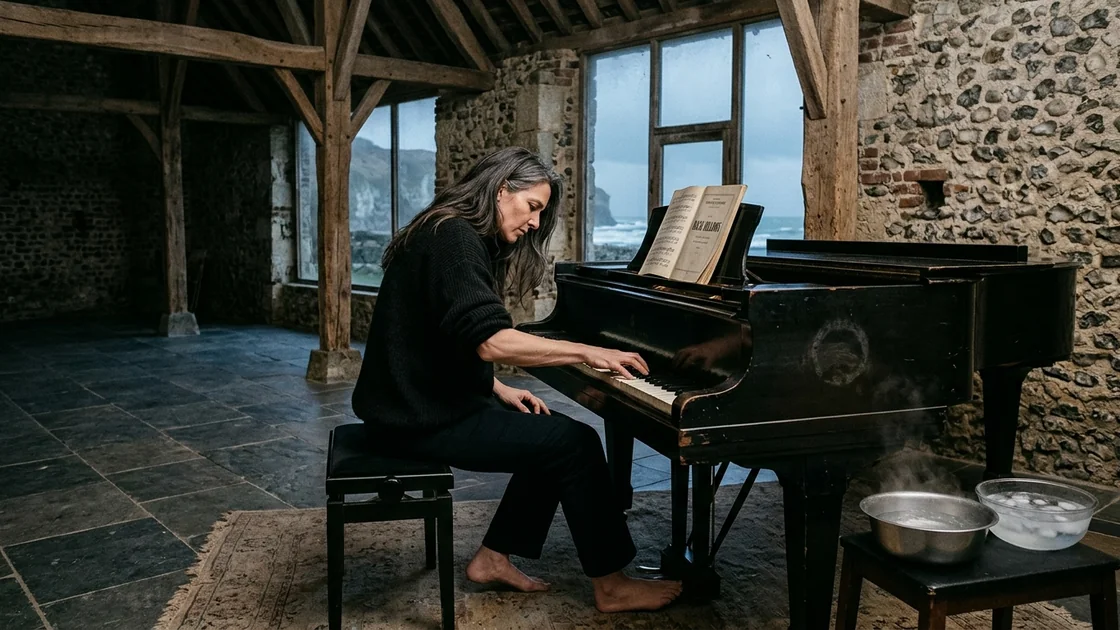
She bought an old stone house with a slate roof that leaned against the sea cliffs. The salt air was brutal on wood, so she had a climate-controlled music room built into the former cider barn at the back of the property. The walls were two feet thick, made of rough-hewn flint and mortar, and the high timber roof had the acoustic resonance of a small church.
When the piano was delivered and assembled, the French movers looked at the watermarked, bruised instrument with skepticism.
"It needs work, Madame," the lead mover said, wiping his brow with a greasy cloth.
"So do I," Clara replied.
She hired a local tuner named Monsieur Laurent—an old, half-deaf craftsman who arrived on an ancient Peugeot moped, carrying an ancient leather bag of felt wedges, tuning hammers, and bone-glue. For three days, Laurent worked on the Steinway. He sanded the hammers, re-pinned the action, leveled the keys, and polished the brass pedals until they shone like pale gold.
When he was finished, he struck a middle-C octave, listened to the decay until it died into the salt air, and nodded.
"The voice is still there, Madame," he said, packing his tools. "A bit dark, perhaps. It has suffered. But the iron frame is true. Now it depends on what you put into it."
The first six months were an agony of the flesh.
Clara’s hands were ruined for the piano. The long years of desk work, the tension of corporate negotiations, the sheer, deadening absence of daily dexterity had turned her tendons into stiff cords. When she attempted to play simple five-finger patterns, her forearms burned with an intensity that made her nauseous.
She did not touch Chopin. She did not touch Liszt. She did not dare attempt the great romantic concertos that had once been her kingdom.
She went back to the nursery.
She bought the yellow-covered books of Hanon: The Virtuoso Pianist in Sixty Exercises. She placed a metronome on the music desk, set the weight to sixty beats per minute—a snail’s crawl—and began.
Exercise One: thumb and fifth finger, lifting high from the knuckle, striking the key with pure, unassisted gravity, holding the note for precisely one beat before lifting.
Clack. Clack. Clack. Clack.
Her left pinky was weak, collapsing at the first joint like an old hinge. She would stop, shake out the hand, adjust her posture, and begin again.
Clack. Clack. Clack. Clack.
After two hours, her wrists would swell. She kept two basins of water by the bench: one filled with steaming water and Epsom salts, the other with sea ice she gathered from the fishmonger in town. She would plunge her hands from the heat to the ice, screaming into an old linen kitchen towel as the shock of the temperature change tore through her inflamed nerves.
Then she would dry her hands, sit back down, and set the metronome to sixty-two.
In her second year in Dieppe, the mental agony replaced the physical.
Whenever she sat at the keyboard, Julian’s voice would echo in the timber rafters of the cider barn.
In this world, Clara, nobody respects a martyr.
You were a fool.
You haven't played a measure of music in a decade. Act like it.
She would strike a wrong note, and the shame would flood her chest like bile. She would see the trading floor at the Stock Exchange, the confetti falling, the back of Julian’s head as he walked toward Elena Ross. She would see the yellow sticky notes on the contracts she had signed without reading.
One afternoon in the dead of winter, during a gale that threw grey sea spray against the windows of the barn, she broke down. She slammed her fists into the keys—a hideous, deafening crash of eighty-eight strings screaming in unison—and dropped her head onto the music rack, sobbing until she choked.
"It’s gone," she whispered into the dark wood. "He took it. He took all of it. There is nothing left."
She lay there for an hour, the cold air seeping through the stone walls, chilling her skin.
Then, in the silence that followed the storm, she heard the metronome. It was still ticking. She had forgotten to stop it.
Tock. Tock. Tock. Tock.
It did not care about Julian Hensley. It did not care about Delaware corporations, or eight-carat diamonds, or four-billion-dollar market caps. It did not care about her lost youth, her ruined marriage, or the ten years she had spent moving boxes across an ocean.
It cared only for the division of time.
Clara lifted her head. Her face was pale, her eyes swollen, but in the reflection of the black fallboard, she saw something that had not been there in twelve years: a stillness that was not the stillness of defeat, but the stillness of an iron weight resting on an anvil.
Rostova had been wrong about one thing.
Art was not a jealous master that abandoned you forever. Art was a fire. If you smothered it with earth and stones, it would wait. It would wait beneath the cold slag for decades, burning low and dark and poisonous, until the earth was cleared away. And when it caught oxygen again, it would not burn with the sweet, decorative flame of youth; it would burn with the white-hot, merciless heat of something that had survived its own burial.
She did not play the Hanon exercises that afternoon.
She opened the score of Bach’s Chaconne in D minor, transcribed for the left hand alone by Johannes Brahms.
Brahms had written the transcription when Clara Schumann had injured her right hand, writing to her: The Chaconne is for me one of the most wonderful, incomprehensible pieces of music. On one stave, for a small instrument, the man writes a whole world of the deepest thoughts and the most powerful feelings. If I imagined that I could have created, even conceived the piece, I am quite certain that the excess of excitement and earth-shattering experience would have driven me out of my mind.
Clara Vance placed her left hand upon the lower register. Her right hand she rested quietly in her lap, like a folded wing.
She struck the opening chord: D, A, F.
It was not the sound of a girl trying to win a prize in Brussels. It was not the sound of an ambitious student seeking the approval of an old Russian master.
It was the sound of broken timber. It was the sound of twelve years of silence, of cold grease on iron ships, of legal documents signed in the dark, of betrayal swallowed down like dry bread. The bass notes did not sing; they groaned from the marrow of the iron plate, vibrating through the legs of the instrument, through the slate floor, straight into the soles of her bare feet.
Her left hand moved. It was no longer the hand of a clerk. It was an engine, dark and rhythmic, climbing through the arpeggios, striking the pedal points with the terrifying, inexorable weight of an ocean tide.
She played until her fingers bled at the cuticle. She played until the sun went down behind the cliffs, turning the sea into a sheet of hammered pewter. She played until there was no Julian, no Hensley Tech, no Elena, no money—only the geometry of Johann Sebastian Bach, standing clean and eternal in the freezing barn, untouched by the rust of human vanity.
Part VI: The Return
Four years later, the Salle Gaveau in Paris was three-quarters full.
It was not a gala night. There was no red carpet, no high-profile corporate sponsors, no television crews. The program was severe, uncompromising, and completely uncommercial: Bach’s Art of Fugue (selections), the late Beethoven Sonata No. 32 in C minor, Op. 111, and the Brahms transcription of the Chaconne.
The program notes contained no biography. There was only a single sentence printed beneath the artist's name:
Clara Vance, piano.
In the eighth row, sitting alone in a box he had purchased through a Swiss proxy, sat Julian Hensley.
He had not wanted to come. He had told himself that he was in Paris on business—a restructuring meeting with the board of his European logistics holding company. But that was a lie, and Julian, whose life had become a dizzying hall of mirrors, still retained enough animal cunning to know when he was lying to himself.
He was fifty now, and his world had begun to rot from the edges.
The merger with Kering had collapsed three years prior amidst an accounting scandal that had cost Hensley Tech eight hundred million dollars in regulatory fines. Elena Ross had stayed through the high-water mark of the stock valuation, but when the Department of Justice began investigating the offshore reporting entities—the very structures Julian had devised to cut Clara out of her founders' equity—Elena had departed with a quiet, lethal efficiency, taking three of his top executive vice presidents and forty million dollars in a settlement that had made Julian’s eyes water with rage.
He was still rich—grotesquely rich by any rational human standard. But his money had lost its magic. It could no longer buy him the one thing he craved above all else: the sense that he was the author of something noble.
He was surrounded by people who worked for him, people who feared him, people who flattered him to get allocations in his secondary offerings. But there was no one left who knew what he had been before the money. There was no one who remembered the drafty walk-up on Twelfth Street, the smell of the single-burner hotplate, or the wild, beautiful promise of the days when they had been two thieves plotting to steal the world.
He had seen the small, unadorned poster in the lobby of his hotel on the Place Vendôme: Clara Vance. Récital de Piano. Salle Gaveau.
The name had struck him like a blow to the solar plexus. He had spent forty-eight hours trying to convince himself not to go. He told himself she would be pathetic—a middle-aged, bitter divorcee trying to reclaim a dream that had turned to ash twenty years ago. It would be an embarrassment. A clumsy, amateurish vanity project paid for with his settlement money.
Yet here he was, sitting in the shadows of the box, his collar pulled up, his heart beating with a strange, nauseating speed.
The hall lights dimmed.
The stage door opened, and Clara walked out.
Julian caught his breath.
She did not look like the woman who had walked out of his office on Park Avenue South. She wore a simple, sleeveless gown of heavy black wool, entirely devoid of ornamentation. Her hair was shot with silver, worn loose down her back, falling like iron filings around her shoulders. She was thinner than she had been, her cheekbones prominent, her jawline carved out of granite.
She walked with a slow, deliberate cadence, not looking at the audience, not smiling, not performing the customary coquettish stage bow of the traveling virtuoso. She bowed once, a sharp, courtly inclination from the waist, and sat down at the Steinway D.
She did not adjust the bench. She did not wipe the keys with a silk handkerchief.
She raised her hands.
Julian looked at her arms. The soft, pale flesh of the corporate executive was gone; her forearms were roped with long, lean muscle, the sinews moving beneath the skin with the cold efficiency of cables on a suspension bridge. Her hands hovered over the keys for two seconds—an eternity of silence in which the entire hall seemed to stop breathing.
Then she brought them down into the opening chord of Beethoven’s Opus 111.
Maestoso.
The sound did not blossom; it detonated.
It was the voice of the late Beethoven—deaf, furious, isolated from humanity, shaking his fist at the heavens before dissolving into the starry, transcendent light of the final Arietta.
Julian gripped the velvet railing of his box, his knuckles turning white.
This was not the playing of the girl from Twelfth Street. That girl had been brilliant, dazzling, full of the bright, liquid speed of youth. But this... this was something ancient and terrifying. Clara did not play the music; she inhabited it like a conqueror walking through a ruined city. Her left hand—that subterranean river Rostova had spoken of—was monstrous. It did not support the right hand; it drove it forward, snapping the bass octaves like dry pine branches, laying down a foundation so deep and resonant that Julian felt the timber floor beneath his Italian leather shoes vibrating with the low C’s.
And then came the Arietta.
The movement where Beethoven leaves the world behind. The movement where the rhythm breaks apart into shimmering, syncopated trills that sound like the stars turning in their spheres.
Clara played the trills not with the delicate, polite parlor-touch of an academic, but with an agonizing, sustained intensity. Her right hand held the high, crystalline trill—an endless, vibrating thread of silver—while her left hand reached down into the abyss, playing the slow, mournful hymn of the theme.
Julian felt a hot, sharp constriction in his throat.
He saw, with the clarity of a dying man seeing his life pass before his eyes, what he had done.
He had thought he had conquered her. He had thought that by taking her years, her labor, her youth, and her administrative genius, he had proven his superiority over her world. He had convinced himself that art was merely a luxury, a decorative glaze applied to the serious, brutal business of capital accumulation.
He had believed that he was the sun, and she was merely a satellite caught in his gravitational pull.
But looking down at her now, as her hands wove a tapestry of sound so sublime that grown men in the stalls were weeping into their programs, he saw the truth.
He had not conquered her. He had merely delayed her.
He had stolen twelve years of her life, yes. He had bruised her hands and broken her heart. But she had taken that theft, that humiliation, that silence, and she had forged it into an instrument of such devastating, profound beauty that his entire empire—his four billion dollars, his holdings in Delaware, his bespoke suits, his art collections, his board seats—looked like a child’s castle made of mud and wet leaves.
His wealth was temporary. In fifty years, Hensley Tech would be an obsolete line in an economic textbook, its code forgotten, its stock certificates worthless paper.
But what Clara was doing on that stage was permanent. It was carved into the eternal architecture of human suffering and redemption. It was Bach, it was Beethoven, it was the fire that burns beneath the slag.
She had survived him. She had used his cruelty as the grindstone against which she had sharpened her soul.
When the final chord of the Opus 111 faded—the high C dying away into the velvet curtains until it was impossible to tell where the music ended and the silence began—Clara did not move. She remained seated, her hands resting lightly on her knees, her head bowed, her breath rising and falling with the slow, oceanic rhythm of the sea at Dieppe.
For five seconds, ten seconds, fifteen seconds, nobody moved. The hall was locked in a collective paralysis.
Then, someone in the parterre stood up.
And the hall exploded.
It was not polite applause. It was a roar—a desperate, roaring release of human emotion that shook the chandeliers. People were shouting, stamping their feet, surging toward the stage.
Julian stood up in the shadows of his box. He was trembling. His eyes were burning with tears he had not shed since he was a boy. He wanted to call out her name. He wanted to rush down the stairs, push through the crowd of French critics and students, fall at her feet on the wooden stage, and press his face against the hem of her black wool gown.
He wanted to beg her to tell him that he had not killed his own soul when he discarded hers.
Clara stood up.
She turned to face the audience. She looked out into the blinding glare of the stage lights. Her face was serene, exhausted, and utterly free. She bowed once, deeply, to the stalls.
Then, her eyes lifted.
She looked directly toward the private boxes on the second tier. Her gaze swept past the gilded moldings, past the red velvet drapes, and for a fraction of a second, her eyes met Julian’s.
Julian froze. His breath caught in his throat. He leaned forward into the light, his hands open, exposed, waiting for the recognition, the hatred, the anger—anything that would acknowledge that they had shared a life, that they were tethered together by the past.
Clara’s gaze rested on him.
There was no shock. There was no hatred. There was no triumphant smirk of revenge.
There was only nothing.
Her eyes swept over his face with the cold, absolute indifference of a woman looking at an empty chair in an empty room. She saw him, and she did not see him. He was not her enemy; he was not her former husband; he was not the man who had stolen her youth.
He was merely a shadow in the hall. A customer who had bought a ticket to hear the music. A stranger who had wandered in out of the Paris night to warm himself by a fire he had tried, and failed, to put out.
She looked past him, into the upper balcony where the students were cheering, offered a small, quiet nod of gratitude, and turned her back on the house.
She walked off the stage, the heavy wooden door closing behind her with a soft, final click, leaving Julian Hensley alone in the dark, surrounded by the applause of people who did not know his name, clutching a railing that led to nothing, with his pockets full of money that could buy him everything except a way back into the world.