The Sound of a Broken Debt
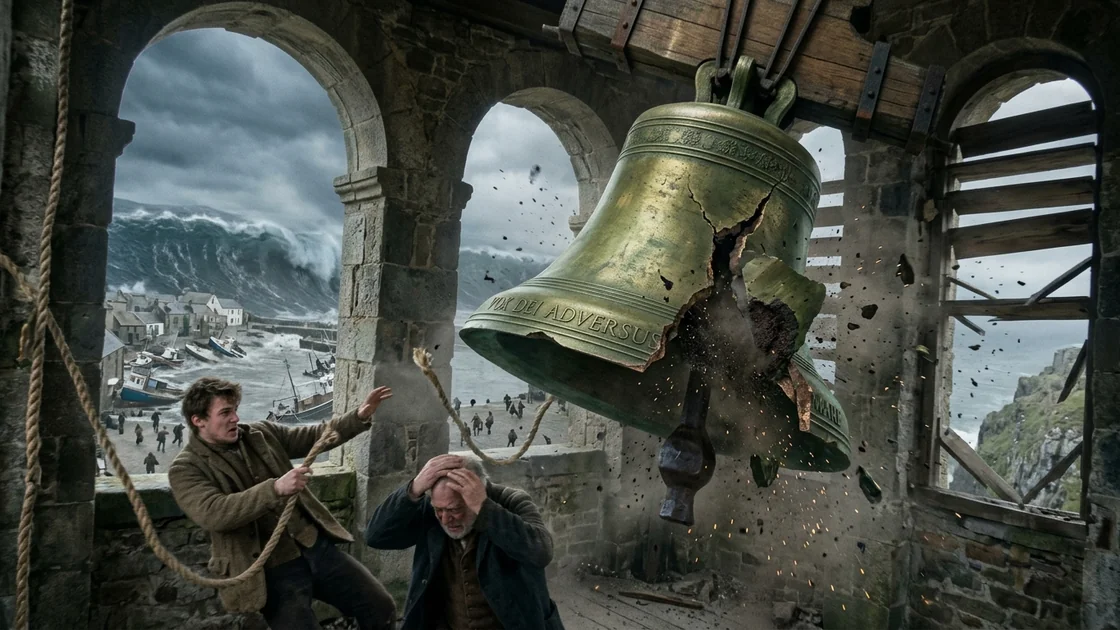
In the cliffside town of High Skerry, an aging bell founder named Niklas Brand was cheated of his life savings by the municipal council after completing the town's massive sea-warning bell. Consumed by quiet, festering bitterness, Niklas introduced a deliberate metallurgical flaw into the sound bow of the bronze casting, knowing that while it would chime sweet and true during short tests, sustained and violent striking would cause catastrophic structural failure. Decades passed as Niklas lived in impoverished obscurity at the edge of the marshes, watching the bell hang silent over the harbor until a massive offshore earthquake triggered a retreating tide and an apocalyptic tsunami. When the watchmen raced to sound the alarm for the oblivious townsfolk scavenging on the newly exposed sea floor, the bell cracked and detonated into shrapnel after only a few strokes, silencing the town's only warning and leaving Niklas to witness the horrific harvest of his own calculated vengeance.
Part I: The Furnace and the Ledger
The furnace did not know pride, nor did it know municipal budgets; it knew only the appetite of pine cordwood, the scorch of sulfur, and the stubborn will of red copper yielding to heat. For forty-two years, Niklas Brand had lived by that heat. It had silvered his hair before he was thirty, etched crow’s-feet into the corners of his eyes so deep they looked like chiseled rune-marks, and baked the grease out of his skin until his knuckles resembled dried birch burls.
His foundry sat at the crook of the harbor known as the Gut, where the low tide left banks of reeking bladderwrack and the salt mist chewed perpetually at iron hinges. It was a cavernous barn of fieldstone and oak timbers, roofed with slate that rattled whenever the gale blew off the Dogger Bank. Inside, the world was composed of brown loam, horsehair, dried dung, and the heavy, sweetish stench of melted beeswax.
On the table in his drafting alcove lay the spruce-wood template, notched and planed to the profile of the bell the High Skerry Board of Aldermen had commissioned three summers prior. It was to be the largest casting ever attempted on the northern coast: nine thousand pounds of bell-metal, six feet across the lip, destined for the high stone belfry of St. Jude-by-the-Spit. The tower stood upon the outermost claw of the headland, commanding both the inner harbor where three hundred drift-net ketches docked, and the wide, gray, predatory reaches of the North Sea.
The contract had been drawn on vellum, stamped with the town’s seal—a gurnard entwined with a wheat sheaf—and signed by Alderman Vane, whose family owned the salting sheds, and Mayor Corliss, whose wealth derived from three generations of Baltic timber importation. The terms were plain enough in ink: one hundred and eighty silver thalers upon the delivery of the mold template, two hundred upon the firing of the core, and four hundred and fifty upon the day the bell swung in its headstock, struck twelve times with an iron clapper, and received the blessing of the parish rector.
For eighteen months, Niklas had bled for that bell. He had mortgaged his draft horses to buy seven thousand pounds of purest Swedish lake copper from a merchantman out of Karlskrona, and fifteen hundred pounds of Cornish tin that arrived in pigs stamped with the agnus dei. When his wife, Martha, took the lung-rot in the damp spring of the second year, he had sat by her pallet with one hand holding her cold fingers and the other sketching the calculation of the sound bow—the precise thickening of the lip where the clapper would deliver its blow, which dictated whether the note would be an octave below middle C or an ear-shattering, flat iron scream.
Martha died while the outer cope was being bound with wrought-iron hoops. Niklas did not attend the wake until the tallow and beeswax had been washed from his forearms, and even then, his neighbors whispered that the old man smelled more of charcoal than of grief. But he had loved her with the silent, granite stubbornness of a craftsman. He had promised her that when the great bell was hung, its voice would carry past the breakers, over the salt marshes, and up into the heather cemetery where she lay under a slab of green slate. It would be her requiem every time the gale drove the rollers against the sea wall.
The casting had taken twenty-four hours of continuous stoking. Niklas had hired six carters from the quay to spell each other at the leather double bellows, pumping until the tuyeres whistled red-hot and the copper ran like yellow cream in the clay trough. When the plug was knocked out, the molten torrent had roared into the runner-box with a sound like a bull groaning under an ax, the earth vibrating under their boots as the mold swallowed the fire. For seven days, the pit had stayed too hot to touch. For two weeks more, it had cooled under ashes, until at last the crane chains groaned, the pulleys squealed, and the rough bronze hulk was swung into the light, smoking and black with burnt loam.
It was a masterpiece. Niklas spent three weeks chipping away the core, scraping the inside smooth with curved irons, and chasing the lettering along the shoulder: VOX DEI ADVERSUS MARE—The Voice of God Against the Sea.
Then had come the day of audit.
The Council Chamber of High Skerry was paneled in black bog oak, smelling faintly of pipe tobacco, dried lavender, and the damp wool of men who never touched an oar or a shovel. Alderman Vane sat at the center of the baize-covered table, his fingers laced over a belly that had grown fat on herring subsidies. Mayor Corliss sat to his right, wearing his silver chain of office, tapping an ivory rule against a sheaf of papers.
Niklas had stood before them in his best broadcloth coat—a coat that smelled of mothballs and had grown two inches too broad in the shoulders since Martha’s passing. His hat was in his hand, his thumb working the worn brim.
"The work is done," Niklas had said. His voice was naturally low, rasped by forty years of woodsmoke. "The casting is sound. We tested the strike with a lead hammer yesterday morning. She sounds an E-flat, pure as church water. The headstock is timbered from seasoned heart-of-oak, four inches thick, strapped with two-inch plate. You may send your carters on Monday."
Mayor Corliss cleared his throat, an elaborate, wet sound, and looked at Vane. Vane did not look back; he was examining his thumbnails.
"A great achievement, Master Brand," the mayor said, leaning back until his chair creaked. "A noble work for the protection of our mariners. But there are... complexities. Matters of the purse that have arisen since the contract was sealed under the late King's reign."
Niklas did not move. His knuckles tightened on the beaver felt of his hat. "The contract was signed by your own hand, Mayor. The weight of the metal was verified at the town scales by your own weigh-master."
"Indeed, indeed," Corliss murmured. "Yet the town accounts have been subjected to an emergency levy by the High Admiralty. The harbor breakwater has settled two feet into the silt; the stones must be reset before the winter gales. More critically, Master Brand, our clerk has brought to light certain irregularities in your receipts for the Cornish tin."
"Irregularities?" Niklas’s head came up. His eyes, pale and watery beneath their grizzled brows, fixed on Corliss like two cold iron chisels. "The pigs were stamped by the Duchy assayer in Truro. Every pound was entered in your customs house."
Alderman Vane spoke then, his voice flat, nasal, and entirely devoid of heat. "The Duchy mark was disputed by the collector at Yarmouth. We had to pay an indemnity to clear the cargo through the roads. Furthermore, there is the matter of the road damage caused by your drays when the timber was hauled from the uplands. Five spans of paving along the Wool-Gild street were crushed under your wagons."
"The drayage was hired by your committee," Niklas whispered.
"The contract," Vane continued, turning a sheet of vellum with a soft rustle, "specifies that all incidental damages arising from the production and transport shall be borne by the undertaker. That is yourself, Brand. In addition, the Council has determined that eight hundred thalers for a single instrument is an unconscionable expenditure in a year when the pilchard catch has fallen short by forty lasts."
Corliss slid a small linen sack across the green baize. It gave a meager, leaden clink.
"Seventy silver thalers," Corliss said. "And the Council will consider the debt settled in full. We will remit the fees for the paving, and we will grant you the timber from the mold-scaffolding as firewood for your shop. You should consider yourself generously dealt with, old friend. You have your fame; every man who sails past the Spit will hear your handiwork."
Niklas looked at the sack. It was roughly the size of a pigeon’s crop. His furnace had consumed one hundred and ten thalers’ worth of dry cordwood alone. The Swedish merchant in Karlskrona had his promissory notes; if they were not redeemed at the Michaelmas fair, Niklas’s house, his shop, his anvils, and his hearth would be seized by the bailiff.
"You are breaking the seal," Niklas said. His voice did not shake; it had become terribly, deathly still. "You are breaking the covenant made before the church."
"The church sits on land leased from my sister’s estate, Brand," Vane said coldly. "Do not speak to us of covenants. The town has no more money for you. Take the silver, or leave it and sue us in the Shire Court at Exeter. The circuit judge will sit again three years from next Michaelmas. Until then, the bell belongs to High Skerry by right of eminent charter."
Niklas Brand looked at the two men for a long time. Neither of them met his gaze for more than a second; Vane reached for his inkhorn, while Corliss dusted some invisible lint from his velvet cuff.
Niklas did not take the sack. He did not curse them. He bowed his head slightly, as a tradesman must before the lords of the market, turned on his heel, and walked out down the wide oak stairs, his boots leaving faint smears of red brick-dust upon the waxed treads.
Part II: The Cold-Shut
Three days later, Niklas returned to his foundry. The carters had not yet arrived; the council was waiting for low water on Friday, when the sand-track around the cliffs was easiest for the heavy eight-horse teams.
The great bell still hung from the shears in the center of the barn, its skirt cleared of the pit, glowing with that dull, greenish-gold luster that belongs only to fresh, unweathered bronze. It was eight feet tall from the crown-staple to the lip. When the sea wind gusted through the roof slats, the draft made the bell whisper—a faint, ghostly hum that hovered in the rafters like a trapped swallow.
Niklas locked the heavy oak doors from the inside. He slid the iron bars home and drove wedges under the oak leaves so that no pry-bar could lift them.
He went to his small bench at the rear of the shop, where he kept his fine tools: the files of German steel, the horn-spoons, the calipers, and his bottles of vitriol and sweet oil. He did not touch the silver or the iron. Instead, he took from a locked drawer a pig of gray pig-iron, no longer than his forearm, and an old, notched crucible of fire-clay.
A bronze bell is a creature of delicate brotherhood between copper and tin. Seventy-eight parts to twenty-two: that was the ancient law. Too much copper, and the bell was dumb, yielding a dull, leaden thud like an overturned tub. Too much tin, and the alloy became hard as flint and brittle as blown glass, ringing with a shrill, piercing beauty until the clapper shattered it like an eggshell. But worse than either was the intrusion of foreign matter—iron, sulfur, or cold metal dropped into the molten stream before the flow was knit. In the language of founders, this was a cold-shut: an invisible boundary where the crystal grains of the metal refused to marry, leaving a seam no thicker than a spider's thread, hidden beneath the skin.
Niklas built a small, furious fire in his assay furnace. He did not need much; three handfuls of charcoal, blown white-hot with the hand-bellows.
He took a heavy gouge and an eight-pound sledge. He walked to the bell.
He knelt beneath its skirt, looking up into the dark, bronze cavern. The interior was still rough from the loam mold, smelling of scorched horsehair and clay. He found the strike ring—the thickest swelling of the metal, three inches above the lip, precisely where the seven-hundred-pound iron clapper would strike its repeated blows when the watchman pulled the lanyard from the floor of the belfry.
With his chalk, he drew a line four inches long on the inner curve of the seaward face. It was the side that would receive the direct impact when the clapper was swung from the west, the side that would bear the brunt of the primary shock wave.
Niklas set the gouge against the metal. He struck it once. A bright, musical ping rang through the cavern of the shop, an octave above the bell’s true voice, clear and pure as mountain water.
He struck again. A curling chip of bronze came away, bright as new gold. He worked for two hours with the mallet and chisel, carving a narrow, undercut groove into the thickness of the sound bow, two inches deep, eating halfway through the metal, yet leaving the outer surface—the smooth, chased face with its Latin prayer—entirely unmarred.
When the trench was finished, he fetched his fire-pot. In the crucible, he had melted an alloy of his own devising: tin, contaminated with sulfur and powdered antimony, mixed with a dross of cold iron filings from his vice-bench. It was a vile, gray porridge that smoked with the reek of rotting eggs. It had no tensile strength; it could not knit with the bronze; it was an emulsion of spite.
Niklas tilted the crucible and poured the slag into the trench he had gouged.
The hot bronze of the bell hissed as the foul metal filled the groove. Niklas did not let it cool naturally. He took a bladder of iced well-water and splashed it against the repair. The metal shrieked—a tiny, internal spasm as the grain contracted violently, pulling away from the walls of the trench, creating a microscopic, hair-fine cleavage that reached from the heart of the sound bow to within an eighth of an inch of the polished outer skin.
Then, with an emery stone, some tallow, and fine charcoal dust from the floor, he worked over the inner surface. He rubbed and smoothed until the patch was indistinguishable from the rough-cast surface of the loam. To the eye, to the thumb of a clerk, even to the scrape of an inspector's wire, it was solid bell-metal.
He stood back and wiped his hands on his leather apron.
The bell would ring. He knew the physics of it as a priest knew the Canon of the Mass. It would ring once, twice, perhaps fifty times. If struck gently for a wedding or a funeral, with slow, measured strokes that allowed the vibrations to dissipate through the crown and into the oak frame, it might endure for five years, perhaps ten.
But if it were rung in anger, if the watchman hung his full weight upon the rope to sound the Sturmgeläut—the continuous, frantic alarm that maritime belfries ring when a squall breaks the moorings or the sea wall gives way—the clapper would strike the cold-shut before the previous vibrations had left the lip. The stress waves would meet at the fault line. The antimony would crumble; the sulfur would offer no resistance; the brittle crystal boundary would shear.
The bell would not merely crack. It would burst.
"You wanted a cheap protector," Niklas whispered to the empty foundry. "You shall have one that costs you everything you possess."
The next morning, the wagons came. Eight heavy Clydesdales, their harness bells jingling with an innocent, bright music that made Niklas’s teeth ache, backed into the Gut. Twelve carters, smelling of small beer and wet canvas, passed the hemp cables under the bell’s waist.
Alderman Vane was there, mounted on a fat gray cob, wearing his beaver hat against the sea drizzle. He did not dismount. He watched the bell hoisted onto the low-wheeled dray with an expression of smug satisfaction.
"A good haul, Brand," Vane said, leaning over his horse’s neck to flick a speck of foam from its mane. "The Council has agreed to waive the two thalers for the storage of the timber, as an act of municipal grace. We are not hard men."
Niklas stood by the jamb of his door. He had not shaved; his face was gray with the soot of his furnace, his apron scorched at the knees.
"The headstock must be wedged with seasoned walnut, Alderman," Niklas said. His voice was level, almost dull. "If you use green oak, the pivot will bind when the salt air gets into it."
"We have our own carpenters, old man," Vane said, turning his horse. "We do not need advice from a man whose ledger balance is zero."
The whip cracked. The Clydesdales dug their iron shoes into the wet cobbles of the Gut, their shoulders bunching under the leather collars. The heavy dray groaned, its iron-shod wheels shrieking against the stones, and the great bronze bell moved out into the daylight. As it passed the threshold, the road shook, and the clapper—tied with hemp for the journey—thumped once against the skirt.
It gave a muffled, mournful clink, like a spade hitting a skull in wet gravel. Niklas did not follow it. He went inside, shut the doors, and sat down in the cold ashes of his hearth.
Part III: The Long Silence
Twenty-two years in a sea-town is both an eternity and the turning of a single page.
The town of High Skerry grew fat on the Newfoundland trade. The old timber wharves were replaced by massive ashlar quays built of granite from the inland quarries. Mayor Corliss died of an apoplexy in his sixty-fourth year and was buried under a marble tomb with four weeping angels; his son took over his timber yards and built a brick mansion on the cliff road with twenty-four sash windows looking out upon the bay. Alderman Vane survived him by ten years, his legs swollen with dropsy until he had to be carried to church in a wicker chair, his ears deaf to all sounds except the arrival of his schooners from the Grand Banks.
Niklas Brand did not die. Poverty, like salt, preserves a man beyond his natural season.
He lost the foundry in the winter of the third year after the casting. The Swedish merchant’s agent had arrived with the bailiff and two constables with brown-bills; they had taken his cranes, his bronze scraps, his anvils, and the big iron chain-hoists. The building itself was sold to a cooper who knocked out the casting pit to make room for stave-racks.
Niklas moved two miles south of the town, to a mud-walled turf hovel on the edge of the Salt Skerry—a desolate finger of marsh where the tide came within three paces of his door twice a day, and the only trees were stunted sea-thorns bent double by the prevailing westerly. He lived by gathering samphire, digging lugworms for the cod-fishermen, and mending brass kettles with an old tinker’s iron that he heated in a charcoal brazier made from an old paint drum.
His hands, once so certain with the fine modeling wax and the compasses, became gnarled and thick-skinned, their lines blackened with marsh mud that no soap could lift. The children of the fishermen called him Old Clinker. When he walked into the lower town with his sack of repaired kettles over his shoulder, they threw bladderwrack pods at his heels and ran, terrified of his long, yellow-white beard and the silent, staring intensity of his milky eyes.
Yet every day, at morning, noon, and sunset, Niklas Brand looked up at the headland.
The bell tower of St. Jude stood upon the highest tooth of the granite cliff, eighty feet of gray ashlar crowned by an open octagonal lantern of carved oak. Inside that lantern hung the Great Sentry—or The Voice, as the sailors called it.
In all those two-and-twenty years, Niklas had never heard it ring its full voice.
The church had its own small sanctus bell in a lesser turret for marriages and matins—a thin, tinny little thing that sounded like a sheep bell. The great bell was reserved for catastrophe. It was the warder against the deep: to be rung only when the bar was white with breakers and the pilot-boat could not clear the pier-heads, or when a square-rigged vessel was driven ashore on the teeth of the outer shoals, or when the sea wall was breached by a spring tide.
Twice, in the first ten years, there had been false alarms. Once, when a French privateer was sighted off the Head, the watchman had scrambled up the ladder and given three slow, measured strokes before the vessel hoisted the Danish flag and stood out to sea. Niklas had stood upon the marsh bank, his breath catching in his throat, his heart fluttering like a bird in a chimney, listening to the deep, majestic thrumming that rolled over the heather:
CLANG.
CLANG.
CLANG.
The vibrations had died away into the gray wind, sweet and true, leaving the air trembling for three minutes afterward. Niklas had ground his remaining teeth until his gums bled. The flaw had held. Three strokes were nothing; the cold-shut was cold and stiff; it took momentum, it took the furious, rhythmic hammer-blow of an alarm to set up the fatal sympathetic shiver in the crystals.
The second time had been the great gale of November, when five colliers were smashed against the south mole. But the watchman on duty that night was ninety years old, a veteran of the Dutch wars who had taken to the gin-bottle to keep out the chill; he had pulled the rope twice, fallen down the trapdoor in the dark, and broken his collarbone. The bell had remained mute while the ships were hammered into kindling beneath its tower.
So the bell hung, year after year, greening under the salt spray, its iron clapper hanging between its flanks like the pendulum of an arrested clock.
Niklas grew older. His hip began to drag; he walked with an ash-stick cut from the swamp. His memory of Martha began to blur—not her face, which stayed clear as a portrait behind glass, but the sound of her laughter. In its place came the shape of the sound bow, that four-inch trench filled with antimony and iron dust, hidden beneath the words VOX DEI ADVERSUS MARE.
Sometimes, in the delirium of the winter fevers that shook his old frame in the turf hut, he would see the bell as a living thing, a great, bronze toad squatting upon the cliff, waiting for the one word that would permit it to speak its own ruin.
"Not yet," he would mumble to the smoky rafters, as the marsh wind blew the brine through the chinks in the turf. "Not yet. Let them build their new brick houses. Let the young men take their wives down by the salt-grass. Let the council buy their sons commissions in the King's horse. Let the tree grow tall before the lightning finds the root."
Part IV: The Withdrawal
The morning of the twenty-fourth of October was unlike any morning Niklas had witnessed in seventy-six winters upon that coast.
The wind, which had blown from the west with the steady, wet persistence of a bellows since the feast of St. Michael, suddenly ceased at three hours before dawn. It did not die away with the usual dying gusts and scurries; it simply dropped, as if an immense velvet curtain had been let down from the clouds.
When the sun broke the horizon, it was neither red nor gold, but a pale, sickly yellow, like the skin of a tallow candle that had lain in a damp cellar. The air was unseasonably warm—heavy, oily, and smelling of deep-sea mud, rotting kelp, and something metallic, like the smell that comes from an electric machine or a brass kettle scraped with a knife.
Niklas stood by his turf dike, leaning on his ash-stick. His joints were throbbing with a dull, sickening ache that reached into his marrow—not the sharp bite of rheum, but a deep, hollow nausea that made his old dog, a half-blind terrier with graying muzzle, whine and scratch at his leather gaiters.
The sea was flat. It was flatter than an oiled silk sheet, yet it did not look like water. It looked like lead, heavy and gray-blue, without a ripple, though there was no ground-swell against the shingle.
Then came the tremor.
It was not an earthquake such as Niklas had read of in the news-sheets that came from Lisbon in his youth—no crashing of steeples or yawning of chasms in the earth. It was a single, subterranean thump, like the discharge of a thirty-two-pounder gun five fathoms under water. The turf beneath his feet jumped—an inch, no more.
In the ditch behind his hovel, the brown water sloshed against the banks. A flock of curlews rose from the salt marsh with a screaming chorus of fright, their white bellies flashing against the yellow sky as they headed not toward the sea, but inland, flying low and hard toward the granite moors five leagues away.
Niklas looked toward the town. High Skerry was waking. Smoke began to curl from the chimneys of the bakeries and the big houses on the cliff road. On the fish-quays, the men were already out, washing down the gutting-benches and untying the painter-ropes of the day-boats.
Then the water began to go.
It did not ebb as the tide ebbs, with the gentle race of channels and the gurgle of water over the weed-heads. It retreated as if a great plug had been drawn from the bottom of the bay.
Within ten minutes, the harbor basin was dry. The drift-net ketches, fifty of them, tilted over on their bilges with a long, collective groan of timber, their masts tangling like jackstraws as they settled into the black, sucking mud. The water did not stop at the low-water mark. It went past the outer bar, past the Sand-Head buoy, past the submerged ledges of the Black Carline where no living man had ever seen the rocks bare save in the stories of the old Northmen.
The seabed lay revealed: miles of glistening, undulating brown ooze, forests of giant tangle-weed that had never seen the sun, ancient ribs of Dutch galleasses lost two hundred years before, their black timbers studded with barnacles. Thousands of fish—cod, plaice, silver dabs, and great writhing conger eels—lay flapping and leaping in the shallows, their scales catching the pale sunlight like scattered shards of tin.
A great cry went up from the town. Niklas could hear it even across the two miles of marsh: a high, thin murmur of amazement that turned instantly into greed.
"The sea has died!" a boy shouted, running along the dike toward the spit. "The bottom is dry! The whole bay is dry!"
Niklas saw them pouring from the alleys of the lower town. Women with their aprons tucked into their waistbands, carrying willow baskets; apprentices in their leather jerkins; old men with gaffs and pitchforks; even two of the town constables with their staves forgotten. They ran down the slippery harbor slips into the mud, shouting, laughing, scrambling over the weed-covered ledges to gather the stranded cod.
Alderman Vane’s son—the young master who now owned three salt-houses and a brick distillery—drove his light gig down onto the firm sand at the harbor mouth, his whip cracking as his horse danced nervously, its ears flattened against its poll. The young man stood upon the seat, pointing his cane toward the outer reef where an old Spanish anchor, heavy with eight score years of coral and rust, lay exposed like a monument of brass.
"Look at them," Niklas muttered. His hand was trembling on his ash-stick. His throat felt dry, as if he had swallowed a scoop of dry molding-sand. "Look at the fools."
He turned his eyes to the horizon.
Far out, three leagues beyond the furthest light-ship, the gray line of the sea had ceased to be flat. It had become a wall.
It was not high at first—a mere smudge of white water, no thicker than a chalk line drawn across a slate. But it was moving. It was moving with the speed of an arrow, and behind it, the sky was not yellow anymore; it had turned the color of bruised iron. The sea had not retreated out of caprice; it was drawing its breath before the strike.
Niklas had heard of this once, from an old Danish shipmaster who had survived the wave at the Mole of Callao. The Great Recoil, the Dane had called it. When the floor of the deep falls into the pit, the ocean falls after it, and when it rises again, it sweeps the cities from the cliffs as a housewife sweeps crumbs from a trencher.
Niklas looked up at the headland.
On the balcony of the belfry of St. Jude, two figures had appeared. They were small as ants against the gray ashlar of the tower. One of them had a long brass telescope leveled at the horizon.
Niklas saw the telescope drop. He saw the figure turn and stumble toward the timber housing of the bell.
"Now," Niklas said. His voice was no louder than the hiss of the salt-tide in the marsh-grass. "Now they will call for help."
Part V: The Shattering
In the belfry of St. Jude-by-the-Spit, the air was cold and whistled through the louvers with a high, thin piping like a boatswain’s pipe.
Giles Hobb, the deputy watchman, was twenty-four years old. He had never seen a wave larger than the eight-foot rollers that broke against the west pier during the equinoctial gales. But through his glass, he had seen the horizon lift. He had seen the three-masted brig Fair Maid of the West, five miles out, thrown end-over-end like a child’s toy boat, her masts snapping like dry spaghetti as a ridge of white brine sixty feet high picked her up and rolled her into its belly.
"Ring!" Giles screamed at his companion, an old cripple named Martin who had lost three fingers to a windlass. "Ring the great bell! God’s teeth, Martin, pull! The whole sea is coming over the spit!"
The rope was thick as a man’s wrist, braided from five-ply hemp, greasy with years of neat’s-foot oil where it passed through the brass grommet in the floor. It hung down thirty feet into the ringing chamber below the bell-deck.
Martin seized the tail. Giles jumped and caught the rope above him, his whole weight hanging from the hemp.
Above them, in the octagonal lantern, the massive oak headstock groaned. The four-ton bronze bell, balanced on its hardened iron gudgeons, tilted slowly, stubbornly, like a sleeper dragged from bed.
Creak.
The iron clapper, seven hundred pounds of forged Swedish iron with a ball the size of a pumpkin, swung across the dark interior.
CLANG.
The first stroke hit the town like a thunderclap.
Down on the exposed seabed, three hundred people stopped their fish-gathering. A woman who had just dropped a twenty-pound ling into her basket stood upright, her hair blowing across her eyes, looking up at the headland with an expression of stupid annoyance. Why was the great bell sounding? There was no fire; there was no king’s ship in distress.
Alderman Vane’s son pulled his horse up on the sand-bar, his whip poised. "What is that idiot doing in the tower?" he muttered, looking toward the cliff.
Two miles away, at the edge of the Salt Skerry, Niklas Brand felt the first blow hit his chest. It was not a sound; it was an impact. The bronze sang—that magnificent, deep E-flat that had cost him his youth and Martha’s life. The vibrations rolled out across the bay, shaking the glass in the windows of the cliff houses, setting the gulls screaming from their roosts.
One, Niklas counted in his soul. The metal is cold. The crystals are waking.
In the belfry, the rope came up, carrying Giles two feet off the oak planks before he dropped and caught it again with the full, desperate heave of his shoulders, his boots kicking against the ashlar wall.
"Again!" Giles yelled. "Harder! Give her the full swing, you old dog!"
CLANG.
The second stroke struck the opposite lip. The sound was even louder, an enormous, bronze bell-shout that rolled five miles inland, into the orchards where the apple-pickers dropped their ladders.
Two, Niklas thought. His ash-stick dug three inches into the mud. The clapper is warming. The antimony in the sound bow is taking the strain.
On the mud-flats, the people began to look out to sea.
The white line was no longer a line. It was a cliff of water—a roaring, tumbling, vertical mountain of gray-green froth, five miles long, traveling faster than a running horse, pushing before it a blast of cold, salt air that smelled of ancient slime and crushed shells. A sound began to rise from it—not the sound of waves breaking, but the dull, continuous, earth-shaking roar of a hundred stone mills grinding iron together.
A scream went up from the flats—a communal shriek that was drowned instantly by the wind. People dropped their baskets. They dropped their cod and their gaffs. They began to run, slipping, falling into the black ooze, crawling on their hands and knees over the weed-covered boulders, fighting each other to reach the harbor slips that led up to the safety of the cliff road.
Alderman Vane’s gig was overturned in the panic as three carters tried to cut the traces to mount the horse. Young Vane was knocked into the mud, his fine green broadcloth coat trampled by the boots of his own salters.
"Ring!" Giles sobbed in the belfry. His knuckles were stripped of skin where the rope had burned him. "Ring her, Martin! Ring, in the Name of God!"
CLANG.
The third stroke.
Inside the bronze skirt, the iron clapper struck the seaward face—precisely upon the chalk-mark Niklas Brand had drawn twenty-two years before.
At the point of impact, the stress wave hit the cold-shut.
For twenty years, the sulfur and the antimony had remained inert, a dry, gray scab between the two bronze surfaces. But now, under the violent, oscillating shock of three strokes delivered within five seconds, the atomic structure of the alloy surrendered. The hair-fine fissure, invisible beneath the Latin inscription, widened by a hundredth of an inch. A tiny, jagged line, like a vein of black ink dropped into milk, appeared across the letter M in MARE.
Three, Niklas said, his lips scarcely moving.
"Pull!" Giles shrieked.
The great bell swung back. The four-ton mass of metal rose to the horizontal, its green mouth gaping at the yellow sky.
CLANG.
The fourth stroke. The sound had changed.
It was no longer an E-flat. It was a flat, tinny, unnatural croak, like the sound of an iron pot cracked by frost. The air did not sing; it seemed to curdle around the tower.
In the belfry, Giles felt the rope shudder in his palms—a violent, unnatural kick, as if the headstock had jumped from its bearings. "What was that?" he gasped, his eyes wild.
"Keep pulling!" Martin screamed, his white hair plastered to his forehead with sweat. "Look at the water, Giles! Look at the water!"
The wave had reached the outer bar. It swallowed the Black Carline reef in a boiling explosion of spray that rose a hundred feet into the air. The Sand-Head buoy, a fifteen-ton cone of boiler-plate, was plucked from its moorings and hurled across the flats like a cork.
The people were halfway up the slips. Two hundred of them were jammed in the narrow bottleneck of the Water-Gate, screaming, clawing at the stone walls, trampling the children underfoot in their madness to reach the high road.
Giles and Martin threw their combined weight on the rope for the fifth time.
The bell came over. The iron clapper, swinging with an arc of seven feet, struck the sound bow with the momentum of a falling tree.
There was no clang.
There was a sound like the detonation of a naval magazine.
A blue, jagged flash seemed to leap from the seaward face of the bell as the internal stresses of nine thousand pounds of bronze, locked in conflict with the brittle sulfur seam, tore the metal apart from the lip to the crown-staple.
The great bell of St. Jude did not simply break; it exploded.
A triangular shard of bronze, three feet across and weighing six hundred pounds, carrying with it the chased letters DEI ADVERSUS, sheared from the waist and blew out through the oak louvers of the belfry, cutting through a ten-inch timber support as if it were a dry reed. The shard spun through the air, whistling like a mortar shell, and crashed through the slate roof of the Mayor’s house three hundred paces down the cliff road, smashing through the drawing room ceiling and embedding itself three feet into the oak floorboards.
The remainder of the bell split into three ragged fragments that tore loose from the headstock. The iron clapper, its pivot snapped by the recoil, plunged down through the floor of the lantern, smashed through the ceiling of the ringing chamber, and struck Martin squarely between the shoulder blades, crushing him into the oak planks before tearing through the lower floor into the church nave.
The rope went slack in Giles Hobb’s hands.
He stood in the wreckage of the ringing chamber, covered in white plaster-dust and splintered oak, looking up through the jagged hole in the ceiling at the empty, spinning headstock.
The tower was silent.
Around it, the only sound was the rising, monstrous, all-devouring roar of the Atlantic Ocean.
Part VI: The Salt Harvest
From the dike of the Salt Skerry, Niklas Brand saw the shard fly from the belfry. He saw the great bronze mouth tear itself to pieces, its voice choked in its throat at the very moment the town screamed for its life.
"It is paid," Niklas whispered.
He did not laugh. He felt no warmth in his belly, no sudden rush of youthful blood to his withered limbs. He felt only an immense, terrible coldness, as if the furnace that had burned within him for forty years had finally consumed the last scrap of cordwood and left only gray, dead clinker.
Then he looked at the wave.
The tsunami did not break as a storm wave breaks, curling over its lip and crashing into spray. It came on as an unstoppable, solid wall of ocean, sixty feet high, its face nearly vertical, black with the mud of the deep-sea trenches it had scraped from the shelf.
It struck the pier-heads first. The two-hundred-year-old granite breakwaters, built of five-ton ashlar blocks strapped with lead, did not divert it; they vanished beneath it like stepping-stones under a spring freshet. The light-tower on the south mole simply ceased to exist; there was an explosion of white spray, and when the air cleared, the tower was gone, its lanterns, its granite, and its keeper erased.
Then it entered the harbor.
The drift-net ketches, lying helpless on their bilges in the mud, were lifted all at once, rolled over, and smashed into one another until the harbor basin was a churning soup of splintered oak, tangled nets, and shredded sails. The wave did not even slow. It drove the mass of wrecks ahead of it like an iron battering-ram against the quays.
The Water-Gate, where three hundred citizens of High Skerry were still fighting to reach the cliff steps, was engulfed in three seconds.
Niklas saw them go. He saw the green broadcloth coat of young Vane, the white aprons of the women, the red caps of the fishermen, all tossed into the crest of the water like leaves in a mill-race. The sea struck the base of the cliffs with an impact that shook the bedrock of the entire peninsula; the water rose thirty cubits up the rock face, tearing the wooden balconies from the stone houses and drowning the lower town to the gutters of the second-story windows.
The roar was so great that it obliterated the possibility of thought. It was not a noise that entered the ears; it filled the brain, the lungs, the belly, pressing the old man down onto his knees in the marsh-grass as if a heavy, wet hand were laid upon the back of his neck.
Then the water came for the Skerry.
The wave had lost its vertical face as it spread across the two miles of shallow salt marsh, but it came on as a brown, foaming torrent, four feet deep, carrying with it the wreckage of the lower town: timber baulks, salted herring barrels, dead pigs, and the shattered ribs of ketches.
Niklas did not run. He could not run. He stood on the low turf mound of his hovel, his two hands clasped over the crook of his ash-stick, his milky eyes wide, watching the brine come.
His little turf hut went first. The wall facing the sea collapsed inward under the weight of the water; the sod roof fell with a sodden thump, and his bedding, his bellows, his small bench of tinker’s tools, and his iron brazier were swept out into the marsh.
The water struck Niklas at the knees.
It was colder than he had imagined. It had the terrible, ancient coldness of the seabed, water that had not seen the light of the sun for a thousand years. It smelled of sulfur, of dead starfish, and of the red copper he had melted in his prime.
He was lifted from his feet. He did not drop his stick. He went with the water, floating on his back for a few yards, his white hair streaming out around his head like bladderwrack, looking up at the sky.
The yellow had gone from the air. The sky was now a clean, pale, winter blue, scrubbed by the enormous violence of the ocean.
As he floated, his head struck the low bank of the ditch. His body wedged between two stunted sea-thorns that grew along the dike, their tough, salt-hardened roots holding firm against the current. The water swirled around his chest, dragging at his wool coat, but he did not drown; his chin remained above the foam, his hands locked in the thorny branches with the convulsive, mechanical grip of an old workman whose fingers had forgotten how to let go.
For twenty minutes, the ocean poured inland, flooding the marshes until the Skerry was a great, gray lake reaching to the feet of the moors.
Then, slowly, with an awful, sucking reluctance, the water began to run back.
Part VII: The Tongue of Bronze
It took three days for the tide to find its natural levels again.
High Skerry was no longer a town; it was a scar on the cliff. The lower quarter had been swept clean down to the bedrock; where the salting sheds and the cooperages had stood, there were only pools of green water and banks of black silt studded with iron hoop-iron. One hundred and eighty bodies had been recovered from the mud-flats and the weed-ledges; forty more had been carried out to sea by the recoil and would never be seen until the resurrection of the dead.
The brick mansion of Mayor Corliss still stood upon the cliff road, but its garden was filled with three feet of mud and the dead carcase of a twenty-ton ketch that had been deposited upon the rosebeds. Alderman Vane’s son had been found two miles down the coast, his fingers still clutching the brass hilt of his father’s cane, his fine green coat torn to ribbons by the shingle.
On the fourth morning, a company of twelve men climbed the cliff path to the church of St. Jude.
They were led by the rector, an old man whose cassock was stiff with dried salt-mud, and three of the surviving aldermen—merchants whose ships had been at sea and had ridden out the wave in deep water, but whose families had been lost in the lower town. They were looking for their dead, and they were looking for an answer.
The belfry was a ruin. The south and west faces of the octagonal lantern had been torn out by the flying shrapnel. The floor was covered with pigeon dung, splintered oak, and shards of green-black bronze that smelled faintly of rotten eggs and burned sulfur.
Giles Hobb sat against the stone wall, his knees drawn up to his chin, his eyes staring straight ahead, fixed on nothing. He had not spoken since the clapper had killed Martin.
The rector stepped through the debris. He picked up a piece of the metal. It was no larger than an oak leaf, but it weighed four pounds, its edge jagged as a saw-tooth.
"How could it break?" the rector whispered, his voice cracking with the grief that had kept him without sleep for seventy hours. "It was nine thousand pounds of metal. It was cast by the best founder in the North."
A man came up behind him—a carter who had worked in the Gut thirty years before, his beard gray, his leather jerkin tied with marline.
"It was cast by Niklas Brand," the carter said. He pointed with a dirty thumb at the great shard that lay across the sill of the west window—the piece that had sheared along the Latin inscription. "Look there, your Reverence."
The rector bent down. He rubbed the sleeve of his cassock across the fractured edge of the bronze.
The break was not bright, granular bronze all the way through. For an inch on the outer face, it was the true, greenish-gold metal; for an inch on the inner face, it was the same. But between them, running like an old marrow-bone through the heart of the sound bow, was a seam of gray, spongy slag—metal that had never knit, metal that was crumbly and black with sulfur, smelling even now of antimony and spite.
"A cold-shut," the carter said, spitting into the plaster dust. "He gouged her. He gouged her before she ever left the foundry. He filled the belly of her with iron filings and tin dross."
"Why?" the rector asked. His hand trembled as he touched the black line. "In God’s name, why would a man do this to his own work?"
"Because Vane paid him seventy thalers for two years of sweat," a voice rasped from the stairhead.
The men turned.
Niklas Brand stood in the trapdoor.
He looked like a corpse that had crawled out of the salt-silt before the worms had finished with it. His coat was gone; he wore an old piece of sail-cloth pinned across his chest with a rusty nail. His legs were wrapped in dry bladderwrack and hemp strings; his left eye was swollen shut, purple and crusted with dried brine; his right eye burned with a small, pale, terrible flame from beneath his grizzled brow. He leaned upon an ash-stick that had lost its bark, his knuckles white as bone where he held the wood.
The carter backed away two steps, crossing himself with a thumb. "Old Clinker," he muttered.
Niklas hobbled across the broken floorboards. His boots made a dry, crunching sound on the shards of his own bell. He did not look at the rector, nor did he look at the aldermen. He walked to the window sill where the great fragment lay, and he laid his bare palm against the letters VOX DEI.
The metal was cold. The sun had not yet climbed high enough to warm the stone of the tower.
"She spoke four times," Niklas said. His voice was very quiet, entirely devoid of the fury that had sustained him through two-and-twenty years of samphire-eating and kettle-mending. "I heard her from the marsh. The first stroke was pure. The second had the weight. The third began to draw the crack."
The rector rose to his full height. His face was gray with an anger that was colder than the sea.
"One hundred and eighty souls are dead in the Gut, Niklas Brand," the priest said. "Young Vane is dead. The children of the fisher-quarter are lying in the churchyard under four feet of ooze. If the bell had rung—if it had rung twenty times—they would have been upon the high road before the bar was cleared. Their blood is upon your hearth. It is in the ash of your furnace."
Niklas did not take his hand from the bronze.
He looked out through the shattered louver of the lantern. Below him, the spit lay bare, gray, and desolate, swept clean of its boats, its sheds, its timber, and its men. The tide was coming in again—the ordinary, blind, patient tide, creeping over the mud-banks, washing the dead fish into the channels, indifferent to the ledger of the town council, indifferent to the pride of founders, indifferent to seventy silver thalers or eight hundred.
"They did not pay the price," Niklas whispered.
"They were men!" the priest shouted, his voice shaking the lime from the rafters. "They were sinful men, but they were men!"
"They were buyers," Niklas said. He turned his head and looked at the rector with his single, milky eye. "And I was a seller. When you buy a shield of brass for the price of lead, you must not complain if the spear finds the breast."
He leaned down and picked up a small fragment from the floor—a shard no larger than a hazelnut, but heavy and sharp-cornered. He slipped it into the pocket of his breeches, where it clinked against the iron key of his old shop—the key he had carried for twenty years, though the lock had long since rotted in the salt mist.
He turned toward the stairs.
The men did not move to touch him. There were twelve of them, young men with strong arms and clubs in their hands, but they stood back against the ashlar wall as if he were a leper or an angel of the pit.
Niklas Brand hobbled down the oak steps, one by one. His ash-stick thumped upon the treads: clack, clack, clack.
He went out through the churchyard, where the fresh graves were already being dug in the wet peat, past the slate marker where Martha lay under three feet of sea-wrack, and down the long, winding road that led back to the Salt Skerry.
He did not rebuild his hovel. He sat upon the ruined turf dike, with his back against a drowned sea-thorn, watching the water rise and fall across the mud-flats.
The town did not hang him. They did not burn his hovel, nor did they bring him before the circuit judge at Exeter. There was no need. The sea had done their work, and his. When the winter gales came in November, bringing the cold rain that turns the marsh-grass into gray grease, the carters found him sitting there still, his ash-stick across his knees, his face turned toward the empty belfry of St. Jude, his mouth open as if he were waiting to hear the note that never came.
In his stiffened right fist, frozen so tight that the parish clerk had to pry the fingers open with an oyster-knife, was that small, black fragment of bronze, smelling of sulfur and the sea, its jagged edge pressed so deep into the palm that the mark of the cold-shut was stamped into the dead flesh like an alderman's seal.