The Song That Bound the Breakers
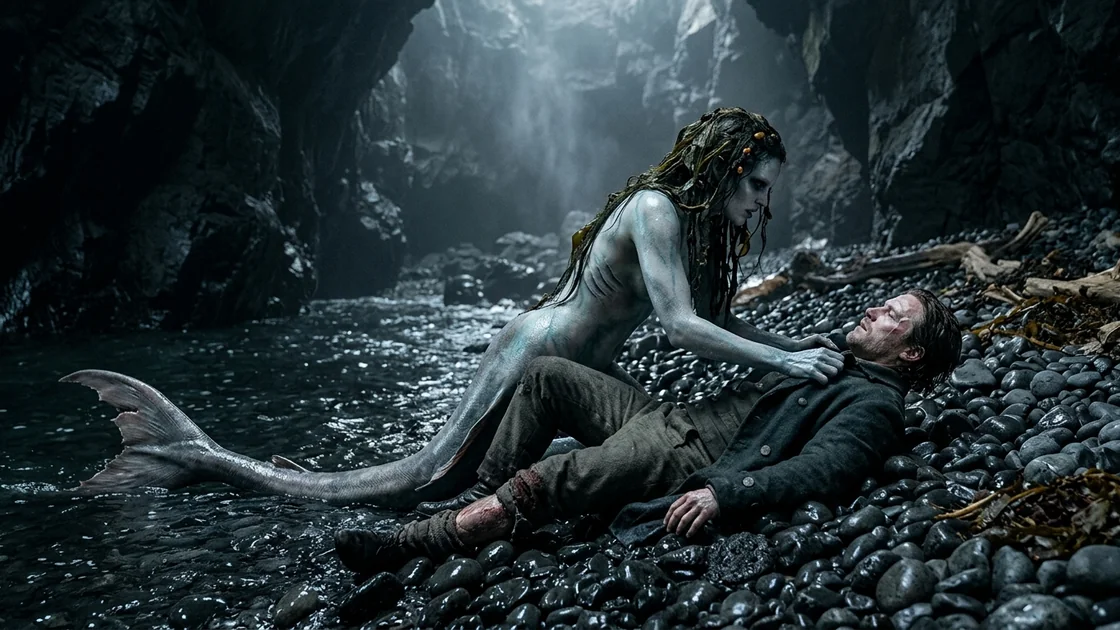
This is the account of Mireen, an immortal siren of the Skar shoals, who brought a trading galleon to ruin upon the rocks through the ancient instinct of her voice. Amidst the floating timber and the drowning crew, she discovered Jesse Vane, the lone mortal who had once spared her life from a fisherman net years before, forcing her to confront the cruelty of her nature and risk everything to drag him from the jaws of the very tide she commanded.
I. The Architecture of the Teeth
The Skar was not a place of soft sand or gentle shelving shores. It was a jagged jawbone of black basalt thrusting upward from the deep trough of the northern shelf, three leagues off the gray cliffs of Oakhaven. For five hundred winters, Mireen had known every spine, every razor-edged barnacle cluster, and every subterranean gallery where the water churned into white froth even on days when the surface seemed as flat as hammered lead.
To Mireen, the sea was not a landscape; it was a throat, and she was the spasm that swallowed.
Her skin was the color of a cod’s belly kept long in the shadow of ice—pale, shot through with veins of sea-moss green and cold indigo. Along her ribs, five sets of narrow gill-slits fluttered with the rhythm of the sub-surface currents, filtering the salt, the silt, and the coppery ghost-taste of things that had died miles upcurrent. Her hair was not the flowing gold of human tavern-tales, but a thick, tangled mass of bladderwrack and dark kelp, clotted with tiny amber stones and the dried carapaces of sand-hoppers.
When Mireen climbed upon the tooth called the Blind Monk, she did not do so out of malice. Malice belonged to the two-legged creatures who hammered iron into hooks and boiled blubber in iron kettles on the decks of their wallowing tubs. Sirens did not harbor malice any more than the breakers harbored anger when they ground a pine spar to matchwood.
She sang because the wind in the hollows of her throat demanded passage. She sang because the pressure behind her temples, which mounted with every turn of the moon, could only be relieved when her vocal cords scraped together, producing that high, warbling, three-toned vibration that slipped through fog like grease over water.
It was mid-autumn. The gales had begun their yearly muster near the ice-packs of the far pole, pushing ahead of them a heavy, gray groundswell that smelled of rotting kelp and cold iron.
The ship appeared through the sea-mist just past the third bell of the dusk watch.
She was a three-masted merchantman, deep in the draft, her belly full of dried cod, grain sacks, casks of tallow, and bolts of coarse homespun from the western settlements. Mireen could smell the vessel long before its topsails broke the woolly veil of the mist: she smelled wet wool, dry oats, stale beer, the tallow candles burning in the binnacle, and the unmistakable, sour musk of forty men who had not washed in fresh water for three weeks.
Mireen adjusted her position upon the slick, weed-greased shelf of the Monk. The tide was running half-flood, roaring through the guts between the skerry rocks with the sound of an iron mill.
She opened her jaw.
Her mouth opened wider than a mortal woman’s could—the jaw unhinging slightly at the mandibular joint with a faint click that she felt in the bones of her ears. The sound started not in her chest, but in the fat-chambers beneath her collarbones: a drone, low and resonant, like the vibration of an iron anchor chain drawn over a granite bulwark.
Slowly, she pitched it up.
The vibration took shape, borrowing the cadence of things the sailors left behind. It sounded like the creak of a cradle on an oak floorboards; it sounded like the clinking of pewter tankards against a scrubbed pine trestle; it sounded like the long, sighing whisper of a lover’s linen shift falling to the floor in a warm room where peat burned in the hearth.
Out on the water, half a mile into the gray blind, the ship’s course shifted.
Mireen felt the change through the water against her lower belly before she saw it. The vessel’s rudder swung hard aport. The helm had responded to a madman’s hand.
Through the mist came the shout of the lookout, but the shout was broken, thin, and wandering. A man was screaming not of danger, but of light. He was shouting that his mother was standing on the water with a lantern; he was shouting that the tavern door was propped wide and the ale was poured.
Mireen did not close her mouth. She drew a fresh lungful of the damp, salty air and forced it through the whistling slits of her palate. The note sharpened, climbing into a sweet, piercing shriek that could split the caulking from a deck-seam.
The ship came on, her white canvas bellied out with a sudden gust of the following squall. She was carrying too much sail for the shoals—stunsails set, royals drawing—running blind into the maze of the Skar with her crew leaning over the fore-chains, their mouths agape, their eyes blank as boiled sheep’s eyes.
Then came the impact.
It was not a single crash, but a series of dry, sickening thuds, followed by the high-pitched shriek of green oak being peeled away from iron ribs. The vessel had struck the outer reef—the Razor-Ledge—at eight knots.
The bowsprit snapped first, whipping back into the foremast with the crack of a culverin. The foremast buckled ten feet above the deck, its stays parting with musical pings that hummed through the air like plucked harp strings, bringing down yards, canvas, and two men who had been lashed to the crosstrees.
Mireen stopped singing.
The sudden silence was louder than her song. It was filled immediately by the natural sounds of the world: the hiss of foam over black stone, the groaning of three hundred tons of oak dying upon basalt, and the screams of men who had suddenly awakened from an ecstatic dream to find cold seawater up to their hips and splintered timbers spearing their bellies.
She slipped from the Blind Monk into the pool below without making a splash.
Under the surface, the sea was an explosion of sound. Sound travels fast in brine, hard and unyielding. She heard the crunch-crunch-tear of the keel being shredded; she heard the muffled, hollow thump of cargo barrels bursting their hoops against the bulkheads; she heard the frantic, rhythmic paddling of twenty pairs of boots trying to find purchase in water that had no bottom.
Mireen swam with her arms pressed tight against her flanks, propelling herself with the powerful, undulating lateral strokes of her spine and hips. Her tail was not the neat, scaled fan of the painters; it was a long, muscular tapering of flesh covered in tough, leathery skin, ending in two horizontal flukes that were notched and scarred by encounters with dogfish and the drag-ropes of drift-nets.
She surfaced in the lee of the dying ship.
The merchantman was listing forty degrees to starboard, her broken spine wedged into a cleft between two rocks. The waves were breaking clean over her waist, sweeping away sheep-pens, water casks, and men. The surface was an oily slick of spilled whale-oil and bilge-slops, littered with floating debris: sea-chests, cork-floats, sea-biscuits, and hats of greased felt.
It was her habit to wait.
She did not feed on the men—their meat was stringy, sour with salt and fear, and their bones were brittle things that splintered and caught between her teeth. She waited for the drowned things to sink so she might pick from them what she liked: the bright brass buttons, the bone-handled knives that did not rust, the small leather pouches of lead shot that made excellent weights for her crab-pots, and the silver pieces that shone like herring-scales when arranged along the ledges of her cavern.
A man plunged into the water ten feet from her, his arms thrashing wildly. He was an officer, wearing a blue coat with brass buttons that caught the dying light of the sunset. He saw her through the foam—saw her gray skin, her black, unblinking eyes with their horizontal goat-pupils, her wide mouth bristling with three rows of recurved, needle-sharp teeth.
The man did not scream. He could not. The cold had already gripped his lungs, turning his gasp into a frothy rattle. He reached for her, his fingers clawing at the sea-kelp of her hair with the blind instinct of a dying ape.
Mireen flicked her flukes, dropping two fathoms down with effortless ease, leaving him to clutch at the empty, bubbling wake of her passing. She watched him from below as his movements slowed, his heavy wool coat drinking the sea until it pulled him down into the kelp-forest by his shoulders, his boots trailing like plumb-bobs.
She turned her attention back to the surface. The hull was breaking up fast. A large section of the quarterdeck had sheared away, floating like an awkward raft toward the inner rocks, surrounded by a tangle of rigging and broken deck-beams.
Pinned beneath that wreckage, something was moving.
II. The Scars of the Drift-Net
Sirens have long memories, though they are not arranged like the memories of men. They do not remember years by numbers, nor do they mark the reigns of kings whose cities crumble into the sea until their stone wharves become oyster-beds. Mireen remembered cold seasons; she remembered the Great Drift when the ice-sheets came south to the mouth of the bay; she remembered the Year of the Red Tide when the fish died in their millions and the water glowed like banked coals in the dark.
She swam toward the floating quarterdeck, her head breaking the water with the silence of an otter.
The light was nearly gone now. The western sky was a thin slit of lemon yellow beneath an iron-colored vault of cloud. The wind was whipping the spray off the crests of the waves, stinging her eyes with salt-hail.
On the raft of oak planks, a man was jammed beneath the heavy, iron-strapped barrel of the capstan.
The capstan had torn free from its spindle when the deck split, rolling down the canted planks until it wedged against the bulwark rail, pinning the man’s right leg beneath its three-hundred-pound girth. He was half in the water, half out. Every time a swell lifted the raft, his head went under; every time it subsided, he emerged, spitting brine, coughing with a dry, hollow barking sound that Mireen knew well. It was the sound of a lung that had tasted foam.
He was not struggling with the frantic, wasteful energy of the others. He had a short-bladed marlinespike in his left hand, and he was working it methodically into the wood beneath the capstan’s rim, trying to lever the iron weight off his crushed thigh before the next great sea rolled the timber entirely over.
Mireen circled the raft.
Her gills flared, sampling the scent of his blood. It was leaking from his leg into the water—a thin, hot ribbon that tasted of copper, dried meat, and something else. Something she had smelled once before, years ago, on a night when the sea had been as black and still as a bucket of well-water.
She drew closer, her chin resting on the jagged edge of a broken plank. Her webbed hands, tipped with translucent nails as hard as horn, curled over the gunwale.
The man heard the scrape of her claws. He stopped his levering.
He wiped the salt from his eyes with the back of his sleeve—the sleeve was torn, showing a pale, muscular forearm crisscrossed with old burns from running rigging—and turned his head to look at her.
He did not look at her as the others looked. He did not look with the blank, drugged adoration of her victims, nor with the wild, gibbering horror of the officer who had drowned a few moments before.
He looked at her with an exhausted, grim recognition.
His face was lean, square-jawed, with a nose that had been broken and set crookedly long ago. Across his right temple ran a broad, white seam—a scar left by the flick of an iron hook. His eyes were not blue like the sea-people’s, nor black like Mireen’s; they were the color of stagnant river-water over gravel, pale brown and clear despite the brine that inflamed them.
The marlinespike slipped from his numbed fingers and clattered against the oak deck. It did not roll off; it caught in a seam of pitch.
"You," the man said.
The word was barely more than a croak, torn from a throat raw with salt and the screaming of orders into a gale.
Mireen tilted her head. Her horizontal pupils dilated until her eyes were two pools of polished jet. She did not speak the language of men with her tongue—to do so was difficult, requiring her to force her palate down and shorten her breath until it felt like she was choking—but she understood the shape of the sound.
The memory struck her not as a thought, but as a bodily sensation: the feeling of coarse, tarred hemp biting into the flesh beneath her pectoral fins; the panic of being hauled toward the light; the smell of wood-smoke and fried grease drifting from a low-sided smack; and then, the sudden, clean cut of an iron blade through the mesh.
It had happened seven winters ago, in the shallow bight behind the spit of Oakhaven.
She had been young—scarcely a century out of the egg-sack—and foolish enough to hunt the silver dories that followed the herring-smacks into the bays. She had lunged after a fish, missed, and found herself enveloped in the belly of a hemp drift-net, weighted with lead-sinkers and buoyed with dried bladders.
The more she had thrashed, the tighter the hemp had bound her. The twine had cut through her skin, slicing into her gill-covers, binding her flukes so she could not swim, dragging her up toward the air where she could not breathe.
Two men had been in the boat. One had been old, with a beard like dirty sheep’s wool and a club in his hand, shouting about the devil-fish that was fouling the gear. He had raised the oak tiller to bash her skull in, to keep her from tearing the net to ribbons.
The other man had been younger. This man.
He had caught the old man’s arm. Mireen had seen it through the meshes—the sudden, violent wrench of his grip that sent the club clattering into the bilge. He had not shouted. He had drawn a broad-bladed rigging knife from his belt with his other hand, stepped over the thwarts, and plunged his arm into the freezing water beside the gunwale.
He had not stabbed her.
He had slid the dull back of the blade against her skin, feeling for the master-cords of the net, and with three savage, sawing cuts, he had opened a gap four feet wide in his own gear.
“Go on, then,” he had muttered. The smell of his sweat had been sharp—sweat and spruce-gum. “Before he gets his hands on the gaff. Go.”
She had kicked her way out through the ruin of the net, tearing a strip of skin from her shoulder as she went, leaving the two men to argue in the dusk while the old one cursed about thirty silver groats’ worth of twine gone to the devil.
Now, seven years later, the same man was pinned beneath three hundred pounds of oak on the Razor-Ledge, while the hull of The Sovereign’s Pride dissolved into the surf around him.
The water was rising. A heavy roller, five feet high and gray with sand, lifted the raft. The timber groaned; the capstan shifted an inch, rolling further onto his leg with a muffled crunch that Mireen heard through her jawbones where they rested on the timber.
The man didn't cry out. He bit down on his lower lip until the blood sprang forth, bright and scarlet, running through the gray stubble on his chin.
"You have a fine voice," he whispered, his eyes fixed on hers. "Heard you... three miles out. Knew the song. God help me, I knew the song."
III. The Work of the Claws
Mireen did not understand the word God, nor did she know what it meant to help. In the sea, things lived because their jaws were faster or their skin was thicker; things died because they were slow, or small, or because their luck had run out against the stone.
She looked at his pinned leg.
The trousers he wore were coarse, blue wool, soaked through and plastered to his skin. Below the knee, the limb was crooked—bent in a way that mortal limbs were not meant to bend, with the white splinter of the tibia poking through the cloth like a gull’s quill.
A siren does not carry things. A siren’s arms are made for clasping during the mating-tangle or for clawing through the mud after razor-clams. To lift three hundred pounds of iron and oak was impossible for her, even with the leverage of the swell.
Another wave broke over the quarterdeck.
It submerged them both. Mireen held herself to the deck by her claws, her gills opening wide to take in the turbulent, aerated water. Jesse went under completely. He did not fight; he simply closed his mouth, his eyes rolling back in his head as the brine filled his ears.
When the wave passed, his head flopped back against a broken spar. He was not breathing. Water dribbled from the corners of his mouth.
Mireen pulled herself entirely out of the water.
On land, a siren is an ugly, awkward thing. The sleekness that makes her a knife in the water disappears; her belly drags against the slime; her flukes are heavy, dead weights behind her. She hitched herself forward with her elbows, her claws digging deep into the oak planks, leaving four parallel furrows in the soft wood.
She reached the capstan.
The wood of the barrel was green beech, swollen with salt water, banded with hoops of three-quarter-inch wrought iron. It was wedged between two upright stanchions that had held the quarterdeck rail. It was a deadfall trap of the sea’s own making.
She did not try to lift it. She knew the nature of wood.
Mireen rolled onto her side, bringing her jaws to the edge of the beech-wood timber where the man’s leg was caught. Her teeth—hundreds of them, triangular, serrated like the edges of saw-grass—fastened onto the wood.
She began to tear.
She did not chew; she ripped, jerking her head from side to side with the savage, rhythmic motion of a dogfish dismembering a seal. Huge splinters of white beech, six inches long and an inch thick, flew from her mouth into the surf. The sound of her teeth against the grain was a dry, frantic screee-screee-screee, like rats behind a wainscot.
Her gums bled. One of her teeth snapped near the root, the pain shooting through her jaw like an iron needle, but in sirens, teeth are expendable things, grown in rows like peas in a pod, replaced every fortnight as they dull.
She tore away the meat of the wood until the iron hoop groaned under the uneven strain.
Jesse’s eyes fluttered open. Through the gray dim of his dying, he saw her: this creature from the dark water, her jaws bloody, her nostrils whistling with the exertion of breathing thin air, chewing through an eight-inch timber of mountain beech as if it were a turnip.
"Mad," he muttered. "Drowning... I'm already drowned."
Mireen did not look at him. She cleared the last splinter from the hollow beneath the iron band. The capstan slipped, settling into the trench she had gouged, and the pressure on his crushed shin slackened by the width of two fingers.
She dropped her head, caught the collar of his wool jacket in her teeth, and backed toward the edge of the raft.
Sirens have immense strength in their necks and lower backs—the strength needed to drive their flukes against an undertow that would drag an ox out to sea. She dug her claws into the planking, arched her spine until her ribs nearly burst through her pale skin, and heaved.
The cloth of his coat tore with a wet rip, but the seam held.
Jesse groaned—a long, bubbling rattle of absolute agony—as his broken leg was dragged from the slot beneath the capstan. The bone grated against the iron hoop, scraping off a ribbon of flesh, but then he was free, slumping limp across the wet wood like a sack of salted herring.
The quarterdeck tilted.
A great swell, the grandfather of the set that had been building behind the squall, rose out of the dark. It was ten feet high, its lip curling into a white plume of spray that blotted out the remaining light of the sky.
Mireen did not wait for it to break.
She clamped her hand around Jesse’s wrist—her fingers were cold as river-ice, webbed to the second knuckle, the skin rough as shark-leather—and threw herself backward off the timber into the boiling froth of the channel.
The wave hit the raft an instant later, smashing the remains of the deck against the basalt teeth of the Monk, reducing the beech capstan and the oak beams to a cloud of floating matchwood.
IV. The Deepest Shelf
Down in the gut of the Skar, ten fathoms beneath the froth where the storm spent its fury on the stone, the water was silent.
It was not still—the surge still moved like a great, slow piston, shoving thousands of tons of water through the narrow crevices and sucking it back again—but it was quiet. The only sound was the deep, rhythmic boom-click of boulders rolling against one another in the potholes of the reef.
Mireen swam with one arm, her tail driving her down and along the contour of the submerged cliff. Her other arm was locked around Jesse Vane’s chest.
He was unconscious. His body was limp, his head lolling against her shoulder, his hair trailing behind him like sea-grass. Bubbles of air were escaping from his nose and the corners of his mouth—small, silver beads that rose toward the dark surface.
She knew how little time he had.
She had watched mortals drown many times; they were fragile, poorly-made things that could not hold two quarts of water in their lungs without dying. If she kept him down here for more than sixty strokes of her flukes, he would never open his river-colored eyes again.
She turned into a narrow fissure in the cliff face, five fathoms beneath the low-water mark.
It was a passage she knew better than her own skin. The rock here was honeycombed with old sea-caves, carved out by the surf ten thousand years ago when the land had stood higher out of the ocean. The entrance was narrow—barely wide enough for a large seal—and choked with sea-whips and stinging anemones that brushed against her ribs with harmless, greasy touches.
She squeezed through, dragging the man behind her.
The passage sloped upward, climbing through the heart of the basalt chimney known to fishermen as the Widow’s Spire. The water grew shallower: four fathoms, three, one.
Her head broke the surface.
She was inside a hollow dome of rock, eighty paces wide. The air was thick, damp, and smelled of guano, rotting kelp, and old stone. High above, near the summit of the dome, a narrow chimney opened to the outside air—a natural blow-hole through which the roar of the gale was reduced to a distant, hollow whistle, like the sound of wind over the neck of an empty jug.
At the far side of the pool lay a shelving beach of coarse, black shingle and rounded granite cobbles, raised three feet above the highest spring-tide mark.
Mireen hauled herself onto the stones.
Her lungs burned. The air in the cavern was stale, and her gills, dry and exposed, began to stick together with a painful, gluey mucus. She gripped Jesse by the armpits and dragged him out of the water, inch by inch, until his boots cleared the swash of the pool.
He lay on his back among the rounded cobbles, pale as a peeled turnip.
His chest did not rise. His lips were blue, the color of a mussel-shell.
Mireen crouched over him on all fours, her kelp-hair dripping cold brine onto his face. She had never saved a thing in her life. She had killed dogfish that threatened her nests; she had bitten through the throats of seals that tried to steal her cod; she had sung sixty vessels onto the Skar and watched their crews go down into the dark without a single flutter of her gill-slits.
She did not know why she had brought him here.
The memory of the knife cutting the hemp was not a debt; sirens have no laws, no ledgers, no gods to whom they offer the balance of their sins. It was something more primitive: an itch in her brain, a disturbance in the regular, cruel machinery of her life. He had severed the net when he should have used the club. He had broken the pattern.
And now, she had broken it too.
She placed her hands on his chest. Her webbed fingers were broad and flat, her palms calloused by stone. She pressed down, not knowing what she did, simply wanting to expel the cold water she knew was drowning the spark inside him.
She pushed with the heel of her hands, hard enough to crack an ordinary man's breastbone.
A jet of gray seawater erupted from Jesse’s mouth.
He convulsed. His spine arched off the shingle, his heels drumming against the stones with a frantic, spasming violence. He sucked in a breath—a ragged, screaming whistle that echoed off the damp roof of the cavern like the cry of an osprey.
He vomited again: water, bile, and the bitter dregs of ship’s rum. Then he rolled onto his side, curled around his broken leg, and began to shudder with the deep, bone-snapping ague of the sea-cold.
Mireen sat back on her haunches, her flukes curled beneath her, watching him.
The immediate danger of the drowning was past, but she knew the other death—the white death that comes when the warm blood retreats from the skin to the heart and then freezes there. The air in the cavern was no warmer than the water; outside, the northern gale was bringing down sleet from the high caps, and the rock beneath them was cold as an iron grave.
V. The Fire of the Air-Breathers
Jesse did not die that night, though there were hours when Mireen thought he would.
He drifted between a wild, shouting delirium and a silence so deep she had to touch the hollow of his neck with her claw to feel the faint, irregular flutter of his pulse. In his madness, he spoke to people who were not there. He called for a woman named Sarah; he cursed a man named Captain Clout; he begged for small beer, for clean straw, for someone to take the iron boot off his leg.
Mireen did not leave him.
Sirens cannot make fire. Fire is the one thing the sea cannot hold, the mystery that belongs entirely to the creatures who walk on two sticks. But she understood cold. Cold was her native element; she knew where it entered, and she knew how it killed things that were soft and thin-skinned.
She dragged herself into the deeper recesses of the cave where the high tides had left drifts of dried drift-wood—pine laths from broken packing crates, dried bladderwrack five feet deep, and bundles of salt-grass that had fallen through the blow-hole during the summer storms.
She piled the dried weed around him until only his head was exposed.
Then she did what she had never done to another living creature: she lay down beside him.
Her skin was not warm like his, but beneath the blubber layer that protected her from the Arctic currents, her blood ran with a steady, sluggish heat. She pressed her belly against his back, wrapping her long, muscular arms around his shoulders, her tail curling over his frozen feet like a heavy, leathery blanket.
Jesse groaned in his sleep, his body shivering so hard that his teeth clicked together with the sound of castanets. Instinctively, seeking any source of warmth in the blackness, he turned his face into the hollow of her neck.
His breath—hot, sour, and full of the rot of his fever—blew against her gills.
The sensation was agonizing to her. It felt like dry sand being poured into an open wound. Her gills clamped shut with an involuntary spasm, forcing her to breathe entirely through her mouth, sucking the stale, dung-scented cave air into her lungs with long, dry hisses.
For seven hours, she lay motionless on the wet stones, holding the mortal against her ribs.
She felt the slow, agonizing thaw of his flesh. She felt the fever rise in him like the tide climbing a piling—first a dry, burning heat in his palms, then the sweat breaking upon his forehead, smelling of salt and copper.
At some point before the dawn, his shivering ceased. His breathing deepened, turning into the steady, rhythmic rasp of an exhausted beast that has survived the hunt.
Mireen disentangled herself from him.
Her skin was sore where his rough wool trousers had chafed against her belly-scales. She hitched herself back to the edge of the pool, slipping into the water with a soundless sigh of relief. The cold brine washed over her dry gills, clearing the mucus and the heat of his breath, restoring the clean, salt clarity to her blood.
She swam out through the chimney to the reef.
The storm had blown itself out during the night, leaving behind a long, heavy swell that broke with a dull, hollow chug against the basalt cliffs. The sky was the color of a gull’s wing—flat, pale gray, with a thin streak of white along the eastern horizon where the sun was struggling to pierce the cloud-pack.
The sea was full of the wreck.
The Sovereign’s Pride had ceased to exist as a vessel. She had been reduced to a drift of timbers two miles wide, moving slowly south on the ebb tide. Mireen saw two dead men floating face down among the kelp, their shirts bloated with air, their hair moving with the rhythm of the weeds.
She ignored them. She was looking for things that did not belong in the sea.
She dove to the floor of the channel, three fathoms down, where the heavier flotsam had settled.
She found what she wanted half-buried in the white shell-sand: a ship’s iron biscuit-tin, its lid sealed with tallow; a cask of sweet-cured pork that had lost its hoops but remained wedged under a ledge; and, lying among the ribs of the ship's cook, a small brass pot with its handle intact.
She took the biscuit-tin in her teeth and the pot by its wire bail, swimming back to the Widow’s Spire with the heavy metal dragging at her neck.
When she surfaced in the cave pool, Jesse was awake.
VI. The Meat and the Marrow
He was sitting propped against the black rock wall, having dragged himself out of the nest of seaweed.
His face was gray, lined with deep furrows that had not been there the day before, his eyes sunken into his skull. His right leg was stretched straight out before him. He had used his belt and two strips of pine lath to bind the broken shin, but the work was clumsy; the splintered bone still formed an ugly, purple tent beneath the torn wool of his trousers, and his foot was swollen to the size of a cow’s udder.
He had the marlinespike in his hand. He must have kept it tucked into his waistband throughout the whole ordeal—the drowning, the dive, the dragging across the shingle.
He held it like a dagger, the iron point directed toward the water.
When Mireen’s head rose from the pool, he did not drop the tool. His knuckles were white, his arm shaking with a weakness he could not hide.
"Stay back," he croaked.
Mireen did not move. She rested her forearms on the shelf of the shingle, letting the brass pot clatter against the stones. The biscuit-tin she pushed toward him with her snout, as a seal pushes a cod to its pup.
Jesse looked from the brass pot to the tin, and then to her face.
"What do you want?" he asked. His voice was cracked, the words sliding into one another like broken glass. "You sang us on the rocks. I heard you. My mates... forty men... they're all out there, aren't they?"
Mireen did not answer. She tilted her head, her nostrils flaring to test the air around him. The fever was still there, but it was cooler now—the sour smell of rotting flesh was beginning to gather around his leg. If the gangrene took hold, he would be dead in three days, and all her labor would be wasted.
She had seen sailors with that rot before. They smelled like whale-meat left three weeks in the sun.
She reached into the water behind her and brought up a fish—a three-pound sea-bass, still living, its silver sides gleaming in the dim cavern light. With two movements of her hands, she tore the head from the shoulders, ripped the belly open with her thumb-claw, and threw the clean, quivering fillets onto the stones beside his knee.
Jesse looked down at the raw meat. His stomach let out a loud, violent rumble that sounded like an empty barrel rolling down a hatchway.
"I can't eat raw bass," he whispered, though his hand had already moved two inches toward it. "I'm not a beast."
Mireen picked up a piece of the fish with her teeth, chewed it twice with her triangular needles, and swallowed with a wet, audible gulp. Then she pointed at the tin.
Jesse hesitated. He laid the marlinespike across his lap, reached out with a trembling hand, and pried at the tallow seal of the biscuit-tin.
The tin gave way with a small pop. Inside, dry and untouched by the sea, were three dozen hard sea-biscuits, pale and flat as round stones, stamped with the broad arrow of the Portsmouth victuallers.
He took one. He tried to bite it, but his teeth could make no impression on the dry flour; he had no saliva left.
With a low, frustrated curse that was half a sob, he dipped the biscuit into the brass pot she had brought, realized the pot was empty, and looked at her again.
"Water," he said. He pointed to his mouth, then tapped his throat with his fingers. "Fresh. I can't drink the brine. You know that, don't you? You know how to kill us, so you must know how we live."
Mireen understood the gesture.
She turned, swam across the pool to the deepest corner where the wall was black and wet with a constant seepage from the higher cliffs, and reached up into the dark.
A tiny spring of sweet water, filtered through two hundred feet of sandstone, dripped from a calcite straw into a natural basin no larger than a turtle’s shell. It was where she washed her eyes when the salt grew too thick after a gale.
She took the brass pot, filled it from the trickle, and brought it back to the edge of the shingle.
Jesse took it from her fingers. His skin brushed against hers—the dry, scorching heat of his palm against the icy, rubbery grain of her thumb. He did not pull away this time. He took the pot, lifted it with both hands, and drank until the water ran down his neck, soaking his shirt.
He ate two of the biscuits, softened in the water, and then, looking at her with a strange, defiant misery, he picked up a strip of the raw bass and shoved it into his mouth.
He chewed slowly, his eyes closed, his jaw working with a grim, rhythmic determination.
"Salt," he muttered, swallowing hard. "Tastes like the bottom of the world."
He opened his eyes. Mireen had not moved. She was floating at the edge of the rocks, her kelp-hair spread around her like an ink-cloud, her unblinking goat-pupils fixed on his face.
"Why?" he asked. The question was quiet now, stripped of anger, left with only the dull, heavy weight of his bewilderment. "You sang them to death. The boy... little Tom, the cabin boy... he was twelve years old. He had a sister in Bristol who was blind. He had a red bird in a wicker cage. You drowned him. And you hauled me out of the timber. Why?"
Mireen raised her right hand.
The thumb and forefinger were broad, the webbing between them thick as boot-leather. She turned her hand over, exposing the underside of her wrist and forearm.
There, white and raised against the pale green-gray of her flesh, was a line of ancient, pucker-scarred tissue—four inches long, running diagonally across her sinews where the tarred hemp of his net had cut her to the bone seven years before.
She tapped the scar with her claw.
Then she pointed her finger at the marlinespike lying in his lap.
Jesse stared at her wrist. The cavern was silent except for the slow drip-drip-drip of the freshwater spring and the distant, muffled thud of the swell against the Skar.
His breath went out of him in a long, shuddering sigh.
"The drift-net," he said. His voice was barely a breath. "The bay behind the spit. You were... you were the thing in the belly of the net."
Mireen nodded once—a short, stiff movement of her chin, more like the bobbing of a cormorant than the nod of a woman.
"I cut my own gear," Jesse whispered. "Old Garrow called me an idiot. Said I'd let fifty groats of twine swim away for a dogfish." He laughed, but the laugh turned into a dry, racking cough that brought fresh blood to his lips. "He was right. I was an idiot. If I'd let him bash your head in with the tiller, forty men would be eating their supper in Oakhaven tonight."
Mireen did not understand the numbers. Fifty groats; forty men; twelve years.
To her, there was only the net and the knife. There was the song and the stone. There was the thing that lived, and the thing that was torn to pieces by the crabs.
She reached out, took the hem of his torn trousers where the white bone showed, and pulled it toward her.
Jesse flinched, his hand flying to the marlinespike. "Don't touch it. It's done for. The bone's split from the joint to the ankle."
Mireen did not heed his words. She smelled the rot now—not strong, but coming, like the smell of high water before the tide turns. She knew what must be done, for she had seen the seals do it when their flippers were crushed by the falling shale: they scraped the bad flesh until the red blood came, and then they packed it with the gray mud of the kelp-forest that tastes of copper and sulfur.
She reached into the pouch of skin beneath her left pectoral—a fold where she kept her choice flints and smooth stones—and brought out a handful of dark, spongy moss that grew only in the deep lightless rifts where the sulfur springs bubbled up through the sea-floor.
It was cold, greasy, and smelled like lightning.
Before he could strike her with the iron, she slammed the mass of moss into the open wound, pressing it down against the shattered bone with the full weight of her palms.
VII. The Grammar of Stone
Jesse screamed.
The sound was not human; it was the shrill, whistling screech of a horse caught in a burning barn. He struck her—once, twice—with the flat of the marlinespike, the iron beating against her shoulder and the thick muscles of her neck with dull, heavy thuds that would have cracked a mortal woman’s collarbone.
Mireen did not flinch. Her skin was thick, padded with four inches of blubber and muscle that had turned the teeth of bull-seals.
She held him down with one hand on his chest, her claws sinking through his wool coat into the flesh of his shoulder, while her other hand worked the sulfur-moss into the torn meat of his leg, packing it around the white bone until the bleeding stopped, choked by the stinging, black slime.
When she finally released him, he lay limp against the cobbles, his chest heaving, his face covered in a cold, oily sweat. The marlinespike had fallen from his fingers, rolling into the pool where it sank to the bottom, sticking upright in the sand like an iron grave-marker.
"Devil," he gasped, his eyes wild and milky with pain. "Sea-devil."
Mireen backed into the water until she was submerged to her jaw.
"Devil," she repeated.
The sound came from her mouth not as a human word, but as a wet, whistling croak—the sound of air being forced through gills that were meant for brine. It was the first time she had spoken a word of the shore-tongue in three hundred winters.
Jesse froze. His head turned slowly toward her, his river-colored eyes widening in the dimness.
"You speak," he whispered.
"Dev-il," she said again. She did not like the shape of it. It tasted of dry dust, of smoke, of things that had no salt. She spat into the pool to clear her tongue. "Man. Jes-se."
He stared at her, the pain in his face momentarily overtaken by an incredulous, horrified wonder.
"How do you know my name?"
She did not know how to tell him that his crew had shouted it fifty times while the sails were blowing out. She did not know how to tell him that when the foremast went, three men had screamed for Jesse to bring the ax, that when the ship struck the Razor-Ledge, the old man with the silver beard had shouted for Vane to take the helm.
A siren's ears do not forget sounds. Every name shouted into the gale over the Skar remained lodged in the fat-cavities behind her temples, preserved like flies in amber.
"Jes-se," she croaked. She pointed to his leg. "Live."
Then she turned her finger toward the mouth of the cave, where the green light of the afternoon was beginning to fade into the purple of dusk.
"Men," she said. "Come."
Jesse pulled himself up onto his elbows. His face was a mask of gray stone, but the madness had gone out of his eyes, replaced by the grim, practical clarity of a sailor who has looked at a leak and calculated how many hours of pumping remain before the water takes the deck.
"They won't come," he said. He spoke slowly, as if talking to a child or an idiot. "The ship is gone. They'll find the flotsam on the south beach by tomorrow morning. They'll find the dead ones. They'll say The Sovereign's Pride foundered with all hands in the Great Gale. No one comes to the Skar in November. The smacks don't round the Monk until the herring run in March."
Mireen understood March. She knew the month of the herring; it was the month when the sea turned milky with milt and the gulls died of fatness on the rocks.
"Four moons," she said.
"I won't last four days," Jesse said. He looked down at his leg. The bleeding had stopped; the black moss had dried into a hard, tarry crust that covered the wound completely, though the flesh around it was hot and swollen like a turnip. "The gangrene will take the knee by Sunday. Even if the rot doesn't get me, the cold will. I have no fire. I have no wood that isn't soaked with brine. You brought me to a tomb, fish."
He dropped his head back against the stone, his eyes closing in an exhaustion that was deeper than sleep.
Mireen watched him for a long time.
The cavern grew dark. High above, the blow-hole showed a single, sharp star—the North Needle, by which the wallowing merchantmen set their courses before they heard her voice.
She knew he was right.
Mortals were not like seals. They could not sleep in the frost; they could not drink the grease from a cod's liver to keep their bellies warm; their skin did not grow the thick, oily wool that kept the otters dry. If he stayed on the shingle, he would become like the things she collected: an arrangement of white bones with the sea-moss growing between the ribs.
She slipped beneath the surface of the pool.
VIII. The Ledger of the Deep
In the dark of the sea, Mireen was not alone.
The Skar had a population that the mortals in Oakhaven never saw. There were the dogfish, five feet long, blind and ancient, that lived in the silt of the deep trenches; there were the great spider-crabs, with legs like ash-poles, that walked the underwater cliffs in search of things that had dropped from above; and there were her sisters.
They were three in the northern reach: Sula, who hunted the shallows near the river mouth; Kora, who was old and scarred by a harpoon-iron, living in the deep caverns behind the monk; and Mireen herself.
They did not share dens. Sirens are solitary things, like the eagles that nested on the high headlands. When they met, they flared their gill-covers and clicked their teeth in warning, snapping at one another’s flukes if the hunting was lean.
As Mireen swam out of the chimney into the open channel, a shadow moved against the kelp-forest.
It was Kora.
She was larger than Mireen, her skin dark slate-gray, mottled with white patches where the barnacles had taken root in the folds of her shoulders. Her face was broad, blunt, and her teeth were worn down to yellow stumps from eight hundred winters of crunching seal-skulls and the carapaces of giant lobsters.
Kora’s flukes moved with a slow, powerful sculling stroke. She smelled of old grease and dead dogfish.
She clicked her jaw—three short, sharp snaps that traveled through the water like pistol-shots.
Where is the meat?
The question was not formed of words, but of postures, emissions of scent, and the vibration of the throat-chambers.
Mireen did not move her hands. She let her body go limp, drifting with the current, her horizontal pupils narrowing as she faced the elder.
The meat is in the sand, Mireen signaled, a twitch of her dorsal ridge indicating the deep channel where the crew of The Sovereign’s Pride had settled. The crabs are on it.
Kora circled her. Her old, milky eyes caught the faint starlight that penetrated the upper three fathoms. She drifted closer, her snout wrinkling as she drew in the water around Mireen’s ribs.
She stopped. Her gills flared wide, exposing the bright, scarlet combs within.
You smell of the dry, Kora signaled, her teeth clicking with a sudden, vicious rattle. You smell of the two-legs. You have meat in the chimney.
Mireen’s spine arched.
The muscles along her flanks tightened until they were as hard as seasoned oak. She did not retreat; she dropped her chin, exposing the three rows of fresh, needle-sharp teeth in her lower jaw, her webbed hands curling into hooks.
It is mine, Mireen signaled.
Kora laughed—a low, bubbling drone that set the tiny sea-snails falling from the kelp-leaves around them.
They do not keep, the old one signaled. They turn to mush in three tides. If you do not eat him while the blood is red, the worms will have him. Bring him out. Let us tear him before the gulls find the grease.
Kora lunged.
She was heavy, but she had the blinding, terrible speed of an ambush-predator. Her jaws, broad enough to take a man’s torso whole, snapped shut three inches from Mireen’s throat.
Mireen did not try to bite. She used her tail.
She flipped her flukes with a violent, downward thrust that drove her five feet straight up, dodging the elder’s snap, and brought her tail-fin around in a roundhouse sweep. The hardened, leathery edge of her fluke struck Kora across the side of the head with the sound of a wet sail slapping a mast.
The old siren rolled twice in the surge, her gill-slits pumping wild clouds of silt.
She righted herself five paces away, her head shaking to clear the stun of the blow. She looked at Mireen with her dead, milky eyes, her jaw clicking three times in a slower, more cautious rhythm.
He will die in the rock, Kora signaled. The air-breathers cannot live in the throat of the Skar. When he stinks, I will take the bones.
She turned with a slow, contemptuous flick of her tail and sank into the blackness of the channel, heading toward the deep silt where the drowned officers lay.
Mireen hovered in the water, her heart beating against her ribs like a trapped gull.
She looked up at the cliffs of the mainland.
Three miles across the boiling, reef-choked sound, the headland of Oakhaven rose like an iron wall against the sky. On its summit, two hundred feet above the surf, burned the beacon: a great iron brazier filled with coal and whale-fat, maintained by the Trinity Brethren to warn the Bristol ships away from the Razor-Ledge.
It was a small, orange spark in the immense, cold darkness of the world.
Between the Skar and that spark lay the Race: two leagues of water where the tide ran six knots through channels no wider than a longboat, over reefs that would tear the belly out of any vessel that did not carry eight oarsmen who knew every rock by name.
A man with a broken leg could not swim it. A man in an oak boat could scarcely cross it in the daylight.
Mireen swam back toward the chimney of the Widow’s Spire.
IX. The Raft of the Skeletons
For three days, the weather held in that strange, dead stillness that comes between the first gales of winter.
The sea was flat, greasy, and covered with a thin scum of shore-froth that didn't disperse. Inside the cavern, the air grew colder. Every morning, a thin skin of fresh-water ice formed over the basin where the spring dripped from the wall, and Jesse’s breath hung before his face in white, ragged plumes that didn't disperse for minutes.
He was dying, but he was dying slowly.
The sulfur-moss had worked its dark magic; the swelling in his leg had gone down, and the purple color had faded to a sickly, yellowish green. The bone remained crooked, an ugly, jagged ridge beneath the skin, but the heat had left his flesh.
He was starving.
He had finished the biscuits. He could not bring himself to eat more of the raw fish; after the second day, his belly had rejected the cold, oily meat, and he had spent half a night vomiting brine until he lay on the shingle, weak as a day-old calf, his skin dry and papery.
He sat with his back to the wall, his marlinespike once more in his lap—she had dived for it and returned it to him without a word—scraping small, neat notches into the handle of his rigging knife.
"Thirty-two," he whispered as Mireen surfaced.
He did not look up. He was watching the movement of the steel blade against the bone handle.
"Thirty-two what?" she asked.
She had learned seven more words in forty-eight hours. She took them from him as a magpie takes bright beads, turning them over in her throat until the sea-slime was rubbed off them and they sounded like human speech, though her voice remained low, hollow, and whistling.
"Men," Jesse said. "Thirty-two I could name. The others were Dutchmen we took on at the Hook. Don't know their names. Doesn't matter. God knows them."
"God," Mireen said. She spat into the pool. "The man in the sky."
"Aye," Jesse said. A faint, bitter smile touched the corners of his cracked mouth. "The man in the sky who lets sirens sing on the rocks and drowns merchantmen four leagues from their wives. That's the one."
He looked at her then.
His eyes were very large now, his cheeks having collapsed into the hollows of his teeth. He looked like an image of a saint she had seen once on an ivory triptych in the cabin of a sunken Spaniard—starved, dry, and terrifyingly clear.
"Why don't you let me go, fish?"
"Where?" she asked.
"Down," he said. He pointed his finger at the black, transparent water of the pool. "Down with the others. It's warmer down there. Once your ears pop, they say it isn't bad. You just... go to sleep."
Mireen hauled herself onto the shingle.
Her elbows were raw from the stones, her pale skin bruised by the fight with Kora. She did not lie beside him now; she sat three paces away, her tail curled around her, her gills fluttering with the dry, shallow rhythm that was all the cave air allowed.
"No," she said.
"Why no?"
She could not explain it to him. She did not have the words for debt, for memory, for the strange, heavy ache that had settled behind her breastbone every time she looked at his river-colored eyes.
In her world, everything had a place: the herring went south; the cod went deep; the gannets dove from forty cubits; the sirens sang. It was an order as old as the salt.
He had broken it first. When he had cut that hemp net seven years ago, he had inserted an iron wedge into the machinery of her life. He had spared a thing that should have been clubbed; he had acted like a god when he was only an ape in an oak tub.
Now, she was trapped in his folly.
"You," she said, her finger pointing at his chest. "Cut net."
"I was a fool," Jesse said.
"I fool," Mireen said.
She reached behind her and dragged something out of the pool.
It was a piece of the wreck—a hatch-cover of yellow pine, five feet long and three feet wide, ringed with iron bolts. She had spent the morning tearing it free from the submerged deck-house, working until her teeth were loose in her gums and her claws were split.
Beside it, she dropped a tangle of rope: three fathoms of two-inch hemp line, salvaged from the running gear of the mainmast.
Jesse looked at the timber, then at the rope, then at her.
"The Race," he said. His voice was scarcely more than a croak. "You're mad. You're completely mad. The tide's running six knots to the south-southwest. Even if I could lie on that plank without rolling off, the surf on the outer bar would break my neck."
Mireen picked up the marlinespike and thrust it into his hand.
"Tie," she commanded.
X. The Crossing of the Race
They left the Widow’s Spire at the turn of the midnight tide.
It was the time of the slack—the thirty minutes when the great Atlantic swell pauses at the height of its flood, hesitating before it turns and pours back through the guts of the Skar with the fury of a mill-race.
Mireen had bound him to the hatch-cover with the hemp rope.
She had done it with a cruel, practical thoroughness, ignoring his groans as she lashed his thighs, his hips, and his chest to the yellow pine with three separate loops of line. His broken leg was splinted with two pieces of barrel-stave, wrapped in dried bladderwrack to keep the salt from the raw skin.
He had his knife in his belt, his brass pot tied to his wrist by a bit of marline, and his biscuit-tin—now empty—strapped over his belly as an extra float.
He looked like a corpse prepared for burial at sea.
"Mireen," he said.
It was the first time he had spoken her name. He had heard her say it to herself in the dark, testing it against her tongue.
She paused, her webbed hands resting on the edge of the raft. Her black eyes looked up at him through the kelp of her hair.
"If the raft turns over," he said, "don't come for me. Cut the line. Let me go down."
Mireen did not answer. She took the tow-rope—a thick piece of manila hemp fastened to the iron ring of the hatch-cover—in her teeth, dropped her face into the water, and kicked.
The transition from the cave to the open sea was a blow to the senses.
The air had been cold, but the water in the channel was near to freezing, straight from the Arctic shelf. It hit Jesse with the force of an iron bar; he let out a short, choked gasp that was swallowed immediately by the roar of the reef.
Mireen did not swim on the surface.
On the surface, the chop would have smashed the raft against the rocks within fifty strokes. She swam two fathoms down, using her powerful flukes to drag the floating timber behind her like a sea-anchor.
The strain on her neck was immense. The rope, gripped between her back molars, cut into the corners of her mouth, tearing the gray skin until the salt tasted of her own copper. Every wave that passed above lifted the raft, jerking her head backward with a vicious, snapping motion that threatened to dislocate her cervical vertebrae.
She ignored the pain.
She swam with the desperate, blind focus of a salmon fighting its way up a gravel-chute. She knew the channels by the taste of the water and the vibration of the rocks: here the current was sweet and fast, running over white sand; there it was bitter, smelling of kelp-roots and iron, where the basalt teeth reached within three feet of the surface.
Behind her, she heard Jesse’s muffled shouts every time the raft was dragged through the crest of a breaker.
He was drowning by inches, his face submerged half the time, his hands clawing at the pine laths as the foam swept over him. But the ropes held.
They reached the middle of the Race—the deep, black gut where the tide gathered its strength between the Monk and the mainland.
Here, the water was fifteen fathoms deep, black as coal-tar, moving with an oily, silent swiftness that had dragged a hundred ships to their graves.
And here, waiting in the eddy behind the Great Saddle, was Kora.
XI. The Iron and the Tooth
The elder siren did not come with a song.
She came out of the black depths like a shark, her pale belly flashing for a fraction of a second before her bulk struck Mireen from the side.
The impact tore the tow-rope from Mireen’s teeth.
The two sirens tumbled through the dark water, their claws locked in each other’s shoulders, their tails thrashing the brine into a storm of phosphorescent sparks. Kora’s yellow teeth sank into the meat of Mireen’s left forearm, the blunt stumps crushing the muscle against the bone with a sickening, grinding pressure.
Mireen screamed—a high, underwater shriek of pure vibration that shattered the shells of the barnacles on the rock ten feet away.
She kicked with her flukes, driving herself and her attacker down into the kelp-forest. The long, greasy ribbons of the laminaria wrapped around their bodies like wet linen, blinding them, tangling their fins.
Kora was heavier, her neck-muscles thicker by twice. She shook Mireen as a mastiff shakes a badger, trying to reach the soft, vulnerable gill-slits with her claws.
Above them, cut adrift, the raft was moving.
Without Mireen’s guidance, the yellow pine hatch-cover was caught by the northern eddy, swinging slowly toward the Maw—a whirlpool that formed on the ebb tide where the water plunged through a subterranean tunnel in the Saddle rock.
Jesse felt the change in the motion.
He lifted his head from the foam, his hair plastered over his eyes, his mouth spitting blood and salt. Through the spray, he saw the cliffs of Oakhaven—not three leagues away now, but half a mile, their dark, slate flanks looming over the water like giants. He could smell the shore: the smell of horse-dung, of chimney-smoke, of rotting oak-leaves in the woods behind the town.
And he saw the whirlpool.
It was thirty paces across, a smooth, oily funnel of black water that sloped down into a central hole no wider than a barrel, from which rose a deep, sucking roar that sounded like an iron furnace.
The raft was fifty feet from its lip.
Down in the kelp, Mireen felt the pull of the Maw.
She knew that if the raft went into the funnel, the timbers would be ground to sawdust in the rocks below, and the man would be pressed through a hole six inches wide before his heart could beat three times.
She stopped fighting Kora’s grip.
Instead of pulling away, she surged forward, throwing her weight into the elder’s chest. The sudden change of pressure caught Kora off balance; her yellow teeth slipped from Mireen’s arm, leaving four ragged tears that leaked green-black siren blood into the cold sea.
Mireen did not strike. She reached into the folds of her pectoral pouch, brought out a jagged piece of flint she had found in the wreck—a six-inch fragment of ballast-stone, sharp as a glass bottle—and drove it into Kora’s left gill-slit.
The elder siren let out a bubbling, choking roar.
Her gill-covers flared wide, vomiting dark, thick blood into the water. Her flukes spasmed in agony, her body curling into a tight, defensive knot as she retreated toward the deep trenches, her claws raking at the stone that was lodged in her breathing-combs.
Mireen did not watch her go.
She turned and kicked toward the surface, her flukes moving with a frantic, ragged rhythm that drove her through the water like a spent harpoon.
She broke the surface ten feet from the lip of the Maw.
The raft was already tilting, its forward edge sliding down the curved wall of the funnel. Jesse was shouting—not in fear, but with a wild, rhythmic cursing, his rigging knife in his hand, trying to cut the ropes that bound him before the timber was sucked under.
"Mireen!" he roared into the spray.
She did not take the tow-rope this time. There was no time for teeth.
She threw herself out of the water, her heavy, scaled belly landing across the back of the raft with a bone-jarring thud. Her webbed hands seized the trailing hemp lashing, her claws digging through the wood until they found the iron strap beneath.
With a single, magnificent convulsion of her spine, she drove her flukes against the current.
The water was white around her, boiling with the fury of the funnel. For five seconds—six—seven—neither the raft nor the siren moved. They hung on the lip of the vortex, the yellow pine shuddering so violently that the lashings bit into Jesse’s flesh until his blood ran down the wood into her face.
Then, slowly, by the width of a finger, the raft began to back away from the hole.
Mireen’s heart was hammering against her ribs like a mallet against a wedge. Her gills were dry, exposed to the whistling air, her tongue swollen and black in her mouth.
She did not sing. She had no voice left for the ancient, cruel melodies of the shoal.
She made a sound that was half-cough, half-grunt—the sound of an ox pulling a plow through stony ground—as she hauled the raft out of the eddy, stroke by stroke, until the pull of the Maw slackened, and they slipped into the long, smooth swell that rolled toward the Oakhaven beach.
XII. The White Shore
The dawn was breaking when the raft struck the shingle of the western cove.
It was not a dramatic landing. The sea, spent after its passage over the Race, carried the yellow pine hatch-cover on the crest of a long, lazy groundswell, setting it gently down among the rounded gray pebbles of the town beach, fifty paces below the salt-houses.
The tide was falling. Within ten minutes, the raft was high and dry, the water hissing through the gravel as it retreated toward the bay.
Jesse lay on the timber, his eyes open, looking up at the sky.
The clouds had broken. The sky was a pale, washed-out blue, like the eyes of an old dog, and the first light of the sun was touching the tops of the stone chimneys above the quay with a faint, pink warmth.
He heard the sound of footsteps on the gravel.
Two men were coming down the path from the fish-houses—old men, carrying oars and a basket of lines, their boots crunching in the frosty stones. They were talking about the price of haddock, their voices clear and thin in the morning air.
Jesse tried to call to them, but his throat was full of dried salt; the only sound he could make was a dry, scraping rattle that was lost in the sigh of the surf.
He turned his head.
Beside the raft, half in the water, half on the shingle, Mireen lay on her side.
She could go no further. The tide had left her behind; her flukes were stuck in the wet gravel, and her skin, exposed to the cold wind and the rising sun, was turning the dull, chalky gray of a cod left on a fish-monger’s slab.
Her left arm was torn to ribbons, the black blood drying into a crust around her wound. Her gills were closed tight, their edges crusted with white salt-frost, her horizontal pupils fixed on his face with an unmoving, ancient clarity.
"Fish," Jesse croaked.
He worked his hand free from the rope—the hemp had been cut half-through by his rigging knife—and reached down until his fingers touched her shoulder.
Her skin was cold as churchyard stone, but beneath the blubber, he felt the faint, stubborn hammer of her heart.
"You have to go," he whispered. "The tide... it's going out. If you stay on the stones... they'll find you. They'll take the skin off you. They'll put you in a barrel of brine and show you at the fair in Bristol."
Mireen did not move.
She looked at the stone houses of the town; she looked at the two men with their oars; she looked at the great iron brazier of the beacon on the headland, its coal now dead and gray in the morning light.
It was a world of squares, of iron, of straight lines and smoke. It was a world that had no place for things that sang in the rifts.
She raised her right hand—the hand with the old net-scar across the wrist.
Slowly, with an effort that made every sinew in her neck stand out like an iron wire, she touched his cheek.
Her claw was sharp, but she did not break the skin; she drew the flat of her finger down the line of his jaw, tracing the crooked bone of his broken nose, the dry, salt-whitened ridge of his lip.
"Jes-se," she whispered.
The word was clear this time. It was not a croak; it was not a hiss. It was a human sound, shaped by human breath, carried on the shore-wind.
A shout came from the path.
One of the fishermen had seen the raft. He had dropped his basket of lines, the haddock hooks spilling across the frost, and was running down the shingle, his old arms waving, his mouth wide as he hollered toward the houses behind the quay.
"Wreck!" the man screamed. "Flotsam! There's a man alive on the timber!"
Mireen heard the shout.
She looked at Jesse once more—her black eyes catching the first golden flash of the sun as it cleared the headland—and then she threw her weight to the side.
Her flukes struck the shingle with a hollow thump that scattered the gray pebbles ten feet into the air.
She rolled down the slope of the beach, inch by inch, dragging her torn belly over the sharp barnacles and the flint-shingle, her claws digging into the sand as she hauled her great weight toward the water.
Jesse watched her.
He could not help her; he was tied to his timber, his leg a useless ruin of wood and bone. He could only watch as the creature who had sung forty of his mates to the bottom dragged herself through the shore-froth like a dying seal.
The surf was two fathoms away.
She reached it just as the first three men from the town reached the raft.
They saw her. They stopped ten paces off, their mouths open, their eyes bulging with a superstitious, gibbering terror that rooted them to the stones. One of them had a boathook; another had an iron shovel he had caught up from the salt-house.
"The devil!" the shovel-man shrieked. "It's the Skar-bitch! Strike her! Strike her before she takes the water!"
Jesse found his voice.
It was not loud, but it had the salt-harrowed gravel of twenty years before the mast, the voice that had shouted down gales on the Grand Banks and kept frightened boys from leaping into the sea from the crosstrees.
"Touch her," Jesse said, lifting his knife from the timber, "and I'll cut your throat to the spine, Peter Gale."
The shovel-man stopped. He looked at Jesse, his face turning from white to purple as he recognized the man who had sailed out of Oakhaven on The Sovereign's Pride two months before.
"Jesse?" the man whispered. "Jesse Vane? You're... you're drowned, man. The ship... the ship foundered on the Monk."
"She brought me," Jesse said. He did not lower the knife. "She brought me across the Race."
The men looked toward the water.
Mireen was already in the surf.
The first small wave, gray with sand, washed over her tail. Her flukes moved—slowly at first, with a stiff, painful flutter, then with the deep, rhythmic power that belonged to the open sea.
She did not dive immediately.
She floated for three breaths in the shallows, her head clear of the foam, her kelp-hair spreading around her shoulders like a dark mantle. She looked at Jesse—lying on his yellow pine hatch-cover among the old men and the fish-baskets—and then she turned her face toward the Skar.
She opened her mouth.
The three fishermen dropped their oars and clapped their hands to their ears, their faces twisting in dread as they waited for the song that drove men mad, the song that splintered oak and brought the royals crashing into the deck.
But the sound that came from her throat was not a lure.
It was a single, long note—low, clear, and hollow as the sound of the wind through an empty conch-shell. It did not carry the memory of the tavern, nor the creak of the cradle, nor the whisper of the linen shift on the floor.
It was the song the sea sings to the basalt when the winter is long and the ice is coming south. It was a song of stone, of cold water, of things that live alone in the dark and have no names for mercy.
It lasted for the space of five heartbeats.
Then she dropped her head beneath the gray water, her flukes gave one great, silver-plumed kick that threw the foam high into the morning sun, and she was gone.
XIII. The Shore-Bound
Jesse Vane lived twenty-four years after the wreck of The Sovereign’s Pride.
He never went to sea again. His right leg was set by a surgeon from Bristol who shook his head over the black sulfur-moss that had grown into the bone, cursing the ignorant quacks of the outports who used ditch-filth to pack a compound fracture; but when the bone knit, it was straight enough for a man to limp upon with an ash-wood crutch.
He bought a cottage on the high cliff above the harbor, using the small pension the Trinity Brethren gave him for tending the beacon.
Every evening, two hours before the dusk, he would haul the dry coal and the tubs of seal-fat up the iron ladder to the brazier. He would light the fire with an iron flint, blowing upon the tinder until the blue flame caught the fat, sending the yellow plume of light out over the dark water of the sound.
The people of Oakhaven called him the Mad Watcher.
They said that when the autumn gales blew from the north, and the Skar was a line of white fury three leagues out, you could see Jesse Vane standing on the edge of the slate cliffs, leaning on his ash crutch, staring down into the boiling gut of the Race.
They said he talked to the gulls. They said that once, when a French privateer ran aground on the Razor-Ledge in the second year of the war, he had refused to join the longboats that went out to pick the cargo from the dead men, sitting by his brazier with his rigging knife in his hand, cursing anyone who brought a piece of foreign oak into the harbor.
He died in the winter of the great frost, when the bay froze over as far as the second monk, and the wolves came down from the high hills to eat the salt-fish from the drying-sheds.
They found him in his chair by the beacon, his ash crutch across his knees, his eyes fixed on the black teeth of the Skar that rose through the ice like the spines of a sleeping dragon.
His knife was in his lap. On the bone handle, smoothed by twenty years of salt-greased fingers, were thirty-three notches.
Thirty-two were small, neat, and straight, like the marks in a merchant's ledger.
The thirty-third was large and deep, cut diagonally across the grain of the bone, with two small, horizontal curves at its base that looked, to the parson who found him, very like the flukes of a fish or the wings of an osprey heading into the wind.
Down in the cavern of the Widow's Spire, where the spring still dripped its sweet drop into the dark basin, the brass pot sat upon the high shingle, green with verdigris, filled with three dozen smooth, rounded stones of white quartz that had been carried up from the deep channel, one by one, through the long, silent winters of the sea.