The Shadow on Runway Four
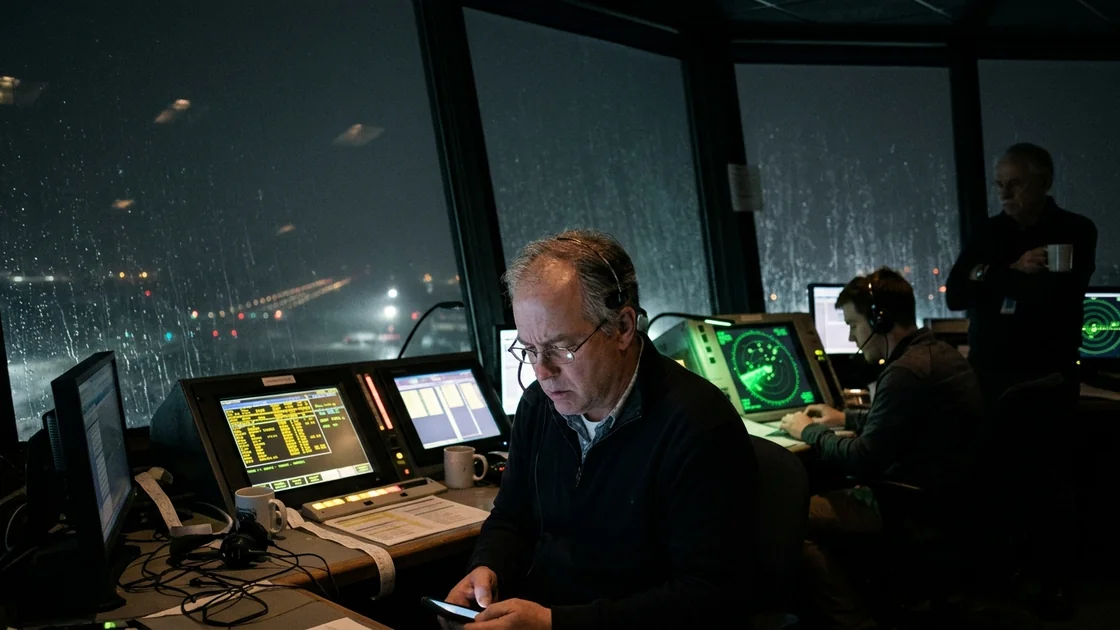
Arthur Vance was once a senior air traffic controller at St. Jude International Airport, respected for his calm demeanor during the most severe coastal squalls. On a freezing November night beneath blinding rain and fog, a single glance at an urgent personal text message on his personal phone diverted his attention from the ground radar for four critical seconds. In that brief window, a misheard taxi clearance went uncorrected, placing a twin-engine commuter plane directly in the path of a landing wide-body jet on Runway Four. The resulting catastrophic collision claimed dozens of lives, stripped Arthur of his career, and banished him to an isolated existence on the wind-scoured coast, where the nightmare of fire, tearing metal, and glowing cockpit screens replays behind his eyelids every night.
The tower cab at St. Jude International stood two hundred and twenty feet above the tidewater flats, wrapped in canted, three-quarter-inch panes of laminated acoustic glass. On clear summer evenings, the glass held the sunset like an amber jewel, offering a view of the shipping lanes fifty miles out into the Atlantic and the orderly mosaic of runway lighting below. But on the night of November seventeenth, the tower was nothing more than an island suspended in ink.
A winter gale had rolled off the Grand Banks, dragging an atmospheric river across the low-lying coast. The wind struck the tower in rhythmic, shuddering pulses, howling against the steel catwalks and driving sheets of freezing rain against the glazing with the sound of thrown gravel. Outside, the runway visual range—the RVR—had dropped from twelve hundred feet to less than six hundred. The world beyond the threshold lights was gone, eaten alive by a ceiling that hovered fifty feet above the asphalt.
Inside, the cab smelled of stale French roast, ozone, damp wool coats, and the dry, warm dust drawn through the vents of rack-mounted avionics. There were three men on duty, though the room seemed muffled, dominated by the low murmuring cadence of ATC phraseology, the soft click of push-to-talk foot pedals, and the periodic shhh-clack of plastic flight-progress strips being slotted into their aluminum bays.
Arthur Vance sat at the local control position, wearing his headset over his left ear, the right ear left bare to the ambient room. He was forty-six years old, twenty of those years spent in the employ of the Federal Aviation Administration. His hair had thinned at the crown and gone gray at the temples, but his eyes were sharp, pale gray behind wire-rimmed glasses, and his voice had the deep, lacquered resonance that pilots found reassuring when the weather went to hell.
To his right, twenty-six-year-old Toby Miller worked the ground control frequency, his boyish face washed in the green luminescence of the Airport Surface Detection Equipment, the ASDE-X radar screen. Toby was sweating despite the chill of the cab, his fingers drumming nervously on the desk as he tried to manage a dozen baggage tugs, de-icing rigs, and taxiing airliners crawling through the slush.
Behind them, supervisory controller Frank Callahan stood with his arms crossed, watching the overhead weather radar sweep with a mug of black tea wedged in his fist.
"How’s the braking action on Four Left?" Arthur asked, not turning around. His eyes were fixed on the approach monitor, where a string of bright yellow diamonds marched down the extended centerline like beads on a string.
"Poor to nil," Toby muttered, adjusting his mic boom. "Snowplow Six just cleared off the intersection at Bravo. Said the slush is packing into rutted ice along the centerline. If the friction index drops another two points, they’ll have to suspend arrivals."
"They won’t suspend," Callahan said from the shadows behind the consoles. His voice was gravelly from four decades of cigarettes. "Dispatch has twelve diversions coming in from Boston already. We take them until the rubber won't stick, Toby. Keep the spacing at six miles, Arthur. Give the plows room to breathe between touches."
"Copy six miles," Arthur said. He keyed his mic with his thumb. "Aero Caribe eight-one-four, St. Jude Tower, wind zero-two-zero at two-eight, gusts to four-zero. Runway Four Left, cleared to land. Caution for patchy standing water and packed slush on the rollout."
"Cleared to land, Four Left, Aero Caribe eight-one-four," came the reply through Arthur’s earpiece. The captain's voice was flat, tired, distorted by the slight hiss of high-frequency interference. Behind the captain's words, Arthur could hear the subtle, rhythmic thrum-thrum-thrum of the twin GE90 engines on the Boeing 777 spooling down as it settled into the glideslope. It was a heavy bird, inbound from Madrid with two hundred and eighty souls aboard, low on fuel after holding for forty minutes over the ocean.
Arthur reached out and slid Aero Caribe’s strip into the active arrival slot. His movements were fluid, mechanical, honed by hundreds of thousands of operations. He had brought down jumbo jets with hydraulic failures, directed small Cessnas through blinding blizzards, and kept his pulse below seventy beats per minute while an engine burned out over the bay. He was a professional. He was the rock upon which the shift rested.
Then his thigh vibrated.
It was not the company-issued pager pinned to his belt. It was his personal cell phone, tucked into the front pocket of his chinos. Under FAA regulations and tower cab policy, personal cellular devices were strictly prohibited on the operational floor. They were supposed to remain locked in the gray steel lockers in the locker room downstairs, beside the rain jackets and the spare thermoses.
Arthur had brought his up in his pocket anyway.
He had brought it up because his seventeen-year-old daughter, Chloe, had been sitting in an urgent care clinic seventy miles away since five that afternoon, waiting for the results of a biopsy on a lymph node that had swollen beneath her collarbone like an acorn. His wife, Elena, had been texting him hourly updates from the waiting room. Elena was prone to panic; she needed him to translate the medical jargon, to be the calm center of gravity she could lean on from afar. Arthur had told himself he would only look at it if the vibration pattern signaled a call.
The phone gave three short, frantic pulses. A message.
Arthur’s hand moved involuntarily toward his pocket, his fingers grazing the fabric. He hesitated, looking out into the void of the runway. Outside, the night was a churning wall of white and black. The green threshold lights of Runway Four Left flickered weakly through the rain, faint as glowworms drowned in a swamp. On the surface radar, a little blip labeled SWF-3242 was creeping slowly down Taxiway Delta.
Sun West Flight 3242 was an ATR-72 turboprop, bound for Portland with thirty-two passengers and four crew members. It had been sitting on the ramp for an hour waiting for de-icing fluid to cure.
"St. Jude Ground, Sun West thirty-two-forty-two, we’re approaching Delta-November, ready to cross Four Left to Four Right," the pilot of the commuter plane radioed.
Toby, overwhelmed by an argument between a de-icing truck driver and an operations vehicle on Taxiway Echo, looked over at Arthur. "Arthur, you want Sun West to hold short of Four Left or cross behind the heavy?"
Arthur looked at his approach monitor. Aero Caribe 814 was at four miles. Traveling at one hundred and fifty knots, the 777 would cross the runway threshold in approximately ninety-six seconds. Sun West needed only fifteen seconds to cross the wide runway and clear the hold short line on the other side.
"Have him cross," Arthur said. "Tell him no delay. Aero Caribe is on a four-mile final."
Toby keyed his mic. "Sun West thirty-two-forty-two, cross Runway Four Left at Delta, expedite crossing, traffic four-mile final."
"Cross Four Left at Delta, expediting, Sun West thirty-two-forty-two," the turboprop’s captain acknowledged.
Arthur’s phone buzzed again in his pocket. Twice. Then three times in rapid succession.
A cold prickle of adrenaline, entirely disconnected from the traffic in the sky, shot through Arthur’s stomach. Chloe. It had to be the results. A single text meant waiting; three texts meant a verdict. It meant malignant or benign. It meant their lives were continuing as normal or their world had just collapsed into a hospital ward.
Arthur lowered his chin. He glanced back over his shoulder. Callahan had stepped away from the console to pour himself another cup of tea from the electric kettle in the corner, his back turned. Toby was hunched over the ground radar, frantically talking to Snowplow Four, which had reported a broken hydraulic line on Taxiway Charlie.
Arthur slipped his hand into his pocket. His fingers closed around the cold, slick glass of the smartphone.
He did not intend to read a long conversation. He only intended to slide the screen out an inch, look at the banner notification—a single word, benign, was all he prayed to see—and push it back down. A four-second transaction. Controllers looked away from the window all the time to check flight strips, to scan wind shear gauges, to glance at barometric settings. Four seconds was the duration of a breath. It was nothing.
He pulled the phone out below the lip of the console, angling the screen toward his lap so the glow would not reflect against the glass cab windows.
The lock screen illuminated. There were three messages from Elena.
They called us back into the private office. Artie please pick up. It’s not an infection. It’s Hodgkin’s. Oh god Artie.
The words did not process as language at first; they struck Arthur like an impact against his sternum. Hodgkin’s. The word looked alien, jagged, impossibly cruel in the bright Helvetica font of the screen. Chloe’s face flashed before him—her sunburned nose from the lake that summer, the braces she had just gotten off in September, her laughter as she backed his old station wagon down the driveway. Cancer. His girl had cancer.
His breath caught in his throat. His chest seized with a sudden, suffocating tightness. The cabin of the tower seemed to recede, the hum of the computers dropping into an echoey, distant barrel. For two seconds, three seconds, five seconds, Arthur stared at the tiny glowing rectangle, his thumb paralyzed over the glass, the reality of his daughter’s mortality flooding his bloodstream like ice water.
In those five seconds, the world did not stop.
On Taxiway Delta, Sun West Flight 3242 did not turn onto the runway at a crisp, expeditious clip. As the twin-engine turboprop rounded the corner from the taxiway onto the active runway, its nosewheel hit a ridge of wet, packed slush left behind by the plows. The nose tires skidded sideways, fighting for purchase on the slick asphalt. The captain, startled by the sudden loss of steering, pulled back the power levers to regain directional control, tapping the left toe-brake. The ATR-72 slid two yards to the left, its nose cocked at an angle across the centerline, its landing lights shining into the driving sleet.
"Tower, Sun West thirty-two-forty-two, we’re... uh... having a little traction issue on the turn, we’re slipping here at Delta—" the turboprop pilot began over the tower frequency.
Arthur did not hear the transmission.
He did not hear it because, at that precise instant, his mind was screaming inside the sterile walls of an oncology clinic seventy miles south. His thumb had begun to type a response—I’m coming home—before his training violently kicked in and jerked his head upward.
He jammed the phone back into his pocket, his heart hammering against his ribs like an animal trapped in a crate. He blinked against the darkness outside, his pupils dilated from the glare of the phone screen.
"Sun West, say again?" Arthur blurted, reaching for his transmission pedal.
Through the rain-streaked glass, two miles out over the marshland, the landing lights of Aero Caribe 814 broke through the base of the clouds.
They were not high. They were low, roaring down the glideslope at one hundred and fifty-five knots, a sixty-ton wedge of aluminum and kerosene descending through the dark like a falling anvil.
Arthur looked down at the ASDE-X screen. The display was cluttered with rain scatter, the raw radar returns blooming in the quadrant where Taxiway Delta intersected Four Left. But right in the middle of the runway strip, a tiny yellow square had stopped moving. It was stationary.
"Sun West, clear the runway! Clear Four Left immediately!" Arthur screamed into his microphone, his voice losing all its professional polish, cracking with naked terror.
"Sun West, we’re trying, we’ve got no traction on the—"
"Aero Caribe eight-one-four, go around! Go around! Pull up!" Arthur shrieked.
On the approach frequency, there was a terrible, agonizing silence that lasted perhaps one second. Then came the frantic, strained voice of the Spanish first officer: "Aero Caribe eight-one—we are TOGA, we are pulling—we have traffic on the—"
From the height of the tower cab, the collision did not look like an explosion in the movies. It looked like an instantaneous, blinding rupture of the night.
The Boeing 777’s engines had only just begun to spool up, their titanium blades groaning as fuel dumped into the combustion chambers, when the aircraft’s main landing gear smashed through the cabin and high wing of the turboprop at one hundred and forty miles per hour.
There was no sound at first—only a vast, hemispherical dome of brilliant white and orange light that tore through the sheets of rain, illuminating the underside of the low clouds with the terrifying brilliance of an artificial sun. A split second later, the concussion struck the tower cab. The three-quarter-inch glass groaned against its silicone seals; the coffee mug on Callahan’s console rattled against the steel; the floorplates beneath Arthur’s shoes vibrated with the deep, sickening thud of two hundred thousand pounds of machinery disintegrating against itself.
The ATR-72 was sheared in two, its fuel tanks vaporizing into an expanding lake of burning kerosene that swept across the frozen grass beside the runway. The 777, its right main gear ripped from the wing root and its right engine destroyed by the impact, slammed down onto its belly, sliding down the center of Runway Four Left in an incandescent spray of sparks, molten metal, and burning fuel. It traveled four thousand feet on its stomach, rotating slowly like a dying leviathan, before plowing through the concrete blast wall at the end of the overrun and plunging into the black, freezing waters of the tidal creek beyond.
In the tower cab, nobody spoke.
The silence was total, save for the frantic, mechanical beep-beep-beep of the crash alarm Toby had slapped with an open palm. Down on the field, the sirens of the Aircraft Rescue and Firefighting station began to wail—a high, desolate keening that rose above the sound of the wind.
Arthur stood frozen before the glass. The orange glow from the runway flickered across his face, reflecting in his spectacles, lighting up the sweat that had suddenly broken out across his forehead. His hand remained buried in his pocket, his fingers curled around the smooth edges of the phone that had cost eighty-six people their lives.
The investigation did not take long to find the rot.
The National Transportation Safety Board team arrived by government transport before the wreckage had stopped smoking in the salt marsh. They were quiet, methodical men and women wearing blue windbreakers with yellow lettering, carrying clipboards, laser scanners, and water-resistant notebooks. They impounded the tower voice tapes. They impounded the digital radar recordings. They impounded the surface detection logs.
And then they impounded the personal effects.
Arthur sat in a windowless interview room on the third floor of the Federal Building in Boston, three weeks after the crash. His union representative, a gray-haired controller named Mack from Logan, sat to his left. Across the oak table sat two NTSB investigators and an attorney from the Department of Transportation.
The air in the room was stale, tasting of cold Danish pastries and weak lobby coffee. A tape recorder hummed softly between them, its two reels turning with agonizing patience.
"Mr. Vance," the lead investigator, a man named Henderson with bags under his eyes like bruised plums, said gently. "We have synchronized the tower audio transcript with the ASDE-X playback and the cockpit voice recorders from both aircraft. We’d like to focus on the forty-second window between 01:13:50 and 01:14:30."
Arthur stared at his own hands resting on the table. The fingernails were bitten down to the quick. He hadn’t shaved in four days; his skin felt tight and gray. "Yes," he whispered.
"Speak up for the recording, please, Arthur," Mack said softly, placing a hand on his forearm.
"Yes," Arthur repeated, his voice raspy.
Henderson slid a glossy sheet of paper across the table. It was an enlarged digital timeline, plotted with red, green, and blue lines. "At 01:14:10, Sun West thirty-two-forty-two acknowledges clearance to cross Four Left. At 01:14:18, the aircraft enters the runway safety area and experiences directional instability due to slush accumulation. At 01:14:21, the captain transmits that they are having traction issues."
Henderson leaned forward, his elbows on the table.
"That transmission was received clearly by the tower cab antenna. It was recorded on the master tape. But there was no response from your position for nine seconds. At 01:14:30, you instructed Sun West to clear the runway, but by then Aero Caribe was already at eighty feet on the radar altimeter, traveling at two hundred and sixty feet per second."
Henderson paused. He didn't look angry. He looked profoundly, deeply sad. That was the worst part. Arthur could have borne anger. He could have taken screaming, accusations, fists pounded on the table. But Henderson’s clinical, bureaucratic sorrow made Arthur want to crawl through the floorboards and suffocate in the dark.
"During those nine seconds," Henderson said, opening a manila folder, "your ground controller was actively communicating with Snowplow Four. But you made no transmissions. The cockpit voice recorder from Aero Caribe indicates they saw the strobe lights of Sun West only when they broke out at seventy feet, far too late to execute an effective missed approach with their engines at flight idle."
Henderson slid a second document across the table.
It was a forensic extraction report from Arthur’s cellular provider, stamped with a federal subpoena seal.
Arthur’s eyes shut against his will. The paper seemed to radiate heat, like a hot plate set on the wood.
"At 01:14:16," Henderson read in a steady, emotionless voice, "your mobile device was unlocked via facial recognition. At 01:14:19, an SMS messaging application was opened. Three incoming messages were displayed on the interface. At 01:14:24, the keyboard input was initiated, logging the characters: I - apostrophe - m - space - c - o - m - i - n - g. The screen was locked again at 01:14:28."
Henderson looked up from the page.
"That’s twelve seconds, Arthur. You had the phone out on the console, didn't you?"
Arthur didn't open his eyes. In the darkness behind his eyelids, he saw the yellow diamond on the radar screen stop moving. He saw the flash of the burning kerosene through the driving sleet. He smelled the scorched jet fuel and the wet, salty mud of the marsh.
"My daughter," Arthur choked out, the words tearing from his throat like jagged glass. "She had a doctor’s appointment. They thought... they found a tumor."
"We know," Henderson said quietly. "We verified the medical records from the clinic. Chloe’s treatment has already begun, and her prognosis is excellent. The doctors believe it was caught early enough for a full recovery."
The investigator closed the folder with a dry, papery snap.
"Eighty-six people did not recover, Arthur."
Mack squeezed Arthur’s arm, leaning toward the microphone. "My client will not be answering any further questions regarding the timeline at this time."
It didn't matter. The timeline had answered itself. The data was etched into magnetic tape, logged into cellular switching towers, and burned into the black boxes dredged from the salt marsh. Arthur was done. His career was over; his certification was revoked before the sunset of that day; his name was leaked to the press by an anonymous source within forty-eight hours.
The headlines called him the Distracted Controller. Editorials were written about the pervasive danger of screens in modern life. Cable news shows ran split-screen graphics showing the burning fuselage of the Boeing 777 on the left and a stock photo of an iPhone on the right. Protesters stood outside his house in the suburbs of Providence, holding framed photographs of young women, elderly grandfathers, and children who had been returning from vacations in Spain or business trips in Maine.
Elena tried to defend him at first, but the weight of the house became too much. Every time she looked at him, she saw the trade that had been made: their daughter’s life preserved, eighty-six other lives traded for the knowledge of it four seconds too soon. They did not shout. They did not throw plates. They simply ceased to be able to occupy the same room. The air between them had been poisoned with jet exhaust and ash.
Six months after the crash, Arthur signed over the house, his retirement accounts, and his remaining savings to Elena and Chloe. He took an eight-year-old Subaru with a rusted subframe, two duffel bags of clothes, and drove west until he ran out of continent.
Cape Perpetua rose from the Oregon coast like the spine of a petrified dragon, plunging eight hundred feet of basalt cliff into the churning grey violence of the North Pacific.
Arthur lived in a cedar-shake cabin three miles south of the headland, situated on a narrow terrace between the Pacific Coast Highway and the ocean. The cabin had no television. It had no internet connection. A landline telephone sat on a small pine table beside the refrigerator, its ringer permanently switched to off; Arthur used it only once a month to call a bank automated balance line and verify the small disability check he received for severe post-traumatic stress.
His cell phone was gone. He had stopped at a bridge over the Snake River during his drive across the country, rolled down the window, and dropped the device into the brown, swirling water two hundred feet below. He had watched it fall until the light caught it one last time, a tiny silver spark that vanished into the foam.
Yet, despite its absence, the phone lived inside him. It had become a phantom limb, an internal organ that had turned necrotic and refused to stop throbbing.
His days were governed by a monastic, punishing simplicity. He chopped cedar logs for the small cast-iron stove that heated the cabin. He walked the gravel beach below the cliffs, his head down, searching for agates he never kept, tossing them back into the surf. He bought groceries once every two weeks at the general store in Yachats—oatmeal, tinned sardines, black tea, cabbage, and dried beans. He never looked the clerks in the eye. He wore a watch cap pulled low over his forehead, even when it was warm, fearful that someone might recognize the sunken, gray contours of the face that had spent two weeks in the national news cycle.
He could control his days. He could exhaust his body with physical labor, walking ten miles along the logging roads behind the highway until his knees burned and his boots were heavy with red mud. He could scrub the floorboards of the cabin with lye soap until the wood grain was bleached white. He could read thick, dry histories of the Roman Empire by the light of a kerosene lantern until his eyelids drooped.
He could control the day. But he could not control the dark.
Every night, with the mechanical regularity of an automated landing system, the dream came for him.
It was never symbolic. It was never abstract. It did not possess the merciful, shifting illogic of ordinary nightmares. It was a precise, photorealistic recreation of the forty-two seconds that had destroyed his soul, played out in agonizing, slow-motion detail.
In the dream, he was always back in the tower. The cab smelled of French roast and damp wool. The rain was always hitting the glass with that awful, gravelly rattle. He would look down at his hands, and the phone would already be there, glued to his skin by a cold, greasy sweat.
Hodgkin’s, the screen would read.
And then the nightmare would do what it always did: it would strip away the walls of the tower and drop him down into the freezing slush of Runway Four Left.
In the dream, Arthur was not the controller watching from two hundred feet above. He was trapped inside the cabin of Sun West 3242. He was strapped into seat 4B, right beside the propeller hub. He could feel the vibration of the Pratt & Whitney engine shuddering through the aluminum skin as the tires skidded on the ruts of ice. Outside the small, oval window, the sheets of sleet were whipping sideways.
Beside him sat a little girl in a yellow parka, clutching a stuffed rabbit with one ear missing. She wasn't screaming. She was looking at him, her eyes wide, glassy, and completely calm.
"Why didn't you watch the screen, Arthur?" she would ask. Her voice did not sound like a child's; it sounded like the synthesized, flat voice of the automated terminal information service, looping endlessly through a weather broadcast. "Wind zero-two-zero at two-eight. Ceiling fifty feet. We are waiting for you to look up."
Arthur would try to unbuckle his seatbelt, but his hands were gone, replaced by the heavy, leaden weight of two black plastic flight strips.
Then would come the light.
It did not begin as an explosion. It began as two blinding, white spotlights breaking through the fog behind them, growing larger with impossible, horrifying speed. He could hear the scream of the 777’s engines—not the muffled whine heard from a distance, but the terrifying, earth-shaking howl of sixty thousand pounds of thrust tearing the atmosphere apart. The sound vibrated in his teeth, his jaw, the marrow of his bones.
He would look up through the ceiling of the commuter plane, and the belly of the Boeing would be there—vast, grey, wet with rain, descending like the roof of a cathedral collapsing in an earthquake. He could see the individual rivet heads on the landing gear doors. He could see the heavy Goodyear tires, spinning at hundreds of miles per hour, crusted with slush. He could see the hydraulic lines weeping pink fluid.
The impact was always silent in the first millisecond. The world simply turned into an incandescent white sheet. Then came the tearing—the sound of aluminum skins being ripped apart like wet paper towels, the screech of steel beams buckling, the roar of atomized kerosene igniting in a firestorm that tasted of sulphur and burnt hair.
And in the very center of the fire, hovering in the air before him like a burning cross, was the screen of his phone.
The letters would rearrange themselves in the flames:
EIGHTY-SIX. EIGHTY-SIX. EIGHTY-SIX.
Arthur would wake up on the floor of his cabin, drenched in cold sweat, his throat raw from screaming into the empty darkness, his fingernails dug so deeply into the palms of his hands that they left bloody crescents in the skin.
The winter of his fourth year at the cape was the wettest on record.
For three weeks in January, a succession of deep Pacific lows slammed into the Oregon coast. The wind did not drop below thirty knots for eighteen days. The rain was relentless, drummed into the cedar shakes of the cabin with an unceasing, rhythmic fury that drove Arthur to the edge of madness. Every sound of the storm was an echo of St. Jude: the groan of the wind in the roof trusses was the sound of the tower cab glass flexing; the rattle of the ocean surf on the cobblestone beach was the roar of jet engines spooling up; the distant flash of sheet lightning over the horizon was the fireball on Runway Four.
He stopped sleeping entirely. He would lie on his narrow cot with his boots on, his coat buttoned to his chin, his eyes wide open, staring at the raw pine rafters until the dawn came in like diluted milk through the salt-crusted windows.
His body was giving up. He had lost thirty pounds since arriving in Oregon; his cheekbones protruded like axe heads beneath his paper-thin skin. His hands trembled constantly, a fine, neurological vibration he could only stop by sitting on them or jamming them into his coat pockets.
On a Tuesday afternoon, when the wind had briefly dropped to a sullen, dripping calm between squalls, Arthur walked down the steep trail to the highway to check the galvanized mailbox nailed to a cedar post beside the road.
He rarely received anything other than property tax assessments from the county and circulars for farm equipment he did not own. But that day, sitting inside the rusty steel tube, was a thick manila envelope.
It bore no return address. The postage was from Portland. His name—Arthur Vance—was written across the front in a neat, trembling cursive hand that he did not recognize.
Arthur stood by the edge of the highway, the spray from passing logging trucks misting his face with dirty water, holding the envelope in his trembling fingers. He almost threw it into the ditch. He wanted nothing from the world outside. The world outside was an indictment he had already pleaded guilty to; he did not need the sentence read to him again.
Yet, there was an unnatural weight to the parcel. He carried it back up the muddy trail, through the dripping spruce woods, and into the dark cabin.
He lit the kerosene lantern, set the envelope on the clean pine table, and sat down before it. For an hour, he simply watched it, the yellow flame of the lantern flickering in the draft from the stovepipe. Outside, the wind was rising again, beginning its low, mournful whistle through the eaves.
Finally, Arthur reached out with a pocketknife and slit the top of the envelope.
Inside were two things: a standard commercial cassette tape, labeled in blue ballpoint pen with the date November 17, and a handwritten letter on pale blue stationery.
Arthur unfolded the letter. His fingers left faint gray smudges on the paper.
Mr. Vance, the letter began.
My name is Julian Mercer. My son, David, was the first officer on Sun West Flight thirty-two-forty-two. He was twenty-eight years old. He had been married for five months. His wife gave birth to a daughter in June of that year. Her name is Davida. She has his eyes.
Arthur stopped reading. The air left his lungs in a ragged gasp. He felt as though someone had driven an iron hook into his gut and was dragging him toward the floor. David Mercer. He remembered the name from the NTSB docket. The young man with three thousand hours, hoping to get hired by Delta or United within the year.
Arthur forced his eyes back to the page.
For three years, I hated you. I hated you with a purity that frightened me. I spent months petitioning the Department of Justice to bring criminal charges against you. I sat through every public hearing. I watched the television reports showing your house. I wanted you in prison. I wanted you to suffer the physical degradation that my boy suffered in that marsh.
When the DOJ declined to prosecute, citing a lack of criminal intent, I felt as though the law had betrayed the dead. I bought a tape of the ATC recordings through a Freedom of Information Act request. I played it hundreds of times. I wanted to hear the moment you killed him. I wanted to hear your indifference.
I listened to those forty-two seconds until the tape began to hiss.
I am writing this to you now because I am dying, Mr. Vance. I have pancreatic cancer, and the doctors give me until the spring. When you know you are leaving, the things you carry become very heavy, and you look for places to set them down.
Last week, I listened to the tape again for the first time in two years. I listened to your voice when you realized what was happening. I listened to you scream for them to pull up. I listened to the silence after the crash alarm.
I did not hear indifference, Arthur. I heard a man dying in his own throat.
I don't know what happened to you. I know you left your family. I know you live like an animal out on the coast. I am sending you this tape not to torture you, but because I realized something that took me three years of hatred to understand: you are still sitting in that tower. You have never come down.
David is dead. Nothing will bring him back to his daughter or to me. But I cannot go into the ground carrying the weight of hating a ghost. If you are still alive out there, you must leave the cab. You must let the airplane hit the ground and be done with it.
I forgive you. Not for David’s sake—he is beyond caring about such things—but for mine. And for yours.
Julian Mercer.
Arthur did not move. He sat motionless as the lantern oil burned low, the wick beginning to smoke, casting long, spider-legged shadows across the cedar-plank walls. The silence in the cabin was terrifying. The wind outside seemed to have died away completely, leaving only the dull, rhythmic thud of the ocean swells collapsing against the basalt headland half a mile away.
I forgive you.
The words did not bring relief. They did not feel like a cool cloth laid upon a fevered forehead. They felt like a scalpel, peeling back the thick, calcified layer of guilt Arthur had built around himself for four years.
He had wrapped himself in his guilt. It was his home, his identity, his penance. If he was the monster who had killed eighty-six people for a text message, then the universe was still orderly. There was a crime, and there was a punishment. He lived in the dirt because he deserved the dirt. The nightmare was his rightful sentence, served every night in the dark.
To be forgiven was to be told that the sentence was meaningless. It was to be told that the dead were simply dead, that his suffering did not balance the ledger, that his four years of self-imposed exile had bought nothing, saved no one, and honored no memory.
Arthur looked down at the cassette tape resting on the table.
He had a small, battery-operated radio-cassette player on the shelf above the sink, an old piece of gray plastic he used to listen to the NOAA marine weather broadcasts.
With movements that felt completely disconnected from his will, Arthur stood up. His knees cracked in the cold room. He walked to the shelf, took down the cassette player, and set it beside the letter.
He opened the plastic door. He picked up the tape. His thumb brushed the label: November 17.
He slid it into the bay and clicked the door shut.
His hand hovered over the Play button. His heart was beating with a slow, heavy, hydraulic rhythm, each beat sending a pulse of cold fire through his temples. He knew what was on this tape. He had lived it three thousand times in his sleep. He had heard it in the screaming of the gulls, the whistling of the stovepipe, the roar of the trucks on Highway 101.
"Don't," he whispered into the empty cabin. "Don't do it."
He pressed Play.
The plastic mechanism engaged with a dull clunk. There was a moment of tape hiss—a soft, dry shhhhhh that sounded like the tide retreating through gravel.
Then, out of the small, tinny speaker, came his own voice from four years before.
"Aero Caribe eight-one-four, St. Jude Tower, wind zero-two-zero at two-eight, gusts to four-zero. Runway Four Left, cleared to land..."
Arthur’s knees buckled. He caught himself on the edge of the table, his knuckles whitening against the pine.
The voice was so young. It sounded so certain. It was the voice of a man who believed the world was governed by rules, by spacing, by radar vectors and standard operating procedures. It was the voice of an Arthur Vance who still had a daughter whose only problem was high school algebra, who still had a wife who kissed the back of his neck while he made the morning coffee.
"St. Jude Ground, Sun West thirty-two-forty-two, we’re approaching Delta-November, ready to cross Four Left to Four Right..."
"Have him cross," Arthur’s recorded voice said. "Tell him no delay. Aero Caribe is on a four-mile final."
Arthur closed his eyes. He waited for the gap.
There it was.
The silence on the frequency. The gentle hiss of the open carrier wave.
In the cabin, Arthur held his breath, just as he had held it in the tower cab while he looked down at the glowing screen. In that silence, he could hear the entire world falling apart. He could hear the cold rain hitting the tower glass. He could hear his own thumb moving across the keyboard: I’m coming home.
Then came David Mercer’s voice:
"Tower, Sun West thirty-two-forty-two, we’re... uh... having a little traction issue on the turn, we’re slipping here at Delta—"
And then, his own voice, returning too late, cracking with that hideous, high-pitched desperation:
"Sun West, say again?"
"Sun West, clear the runway! Clear Four Left immediately!"
"Aero Caribe eight-one-four, go around! Go around! Pull up!"
And then, the sound.
The microphones in the tower had picked it up through the canted glass—a dull, distant whump, followed instantly by the rising shriek of the emergency locator transmitters.
BEEP-BEEP-BEEP-BEEP-BEEP.
The twelve-point-one-five megahertz distress beacon began to sing its flat, piercing warble over the guard frequency, accompanied by the high, mechanical squawk of Toby’s crash alarm.
Arthur reached out with a trembling hand to slap the stop button, but his fingers slipped. The tape ran on.
There was no shouting on the frequency now. There was only the wailing of the ELT beacon and the sound of someone breathing heavily into a microphone.
It was Arthur himself. The recorded Arthur was breathing in shallow, jagged gasps, like a drowning man whose lungs were filling with seawater.
Then, through the speaker, came Frank Callahan’s voice, speaking from somewhere behind the console, low and shattered:
"Arthur. What did you do?"
The tape ended with a sharp, plastic snap as the leader reached the spindle. The button popped up. The player fell silent.
Arthur fell to his knees on the plank floor.
He pressed his forehead against the rough, cold wood. The tears that had refused to come for four years—the tears that had been frozen behind his eyes by shock, by litigation, by shame, by the relentless machinery of federal investigations—finally broke through.
They did not come quietly. They came in violent, racking sobs that tore through his chest, shaking his shoulders, dragging him down into the dust of the floorboards. He wept for David Mercer, who had died with his hands on the throttles trying to save thirty-two people on a slick taxiway. He wept for the Madrid passengers who had been dreaming of their hotel beds while the 777 slid through the blast wall. He wept for Chloe, whose survival had been bought with eighty-six coffins.
He wept until his ribs ached, until his voice was gone, until there was nothing left inside him but an empty, echoing hollow where the nightmare had lived.
He did not sleep that night.
He sat on the porch of the cabin, wrapped in an old woolen army blanket, watching the storm roll back in from the sea.
The squall hit the headland at two in the morning. It was a vicious blow, carrying the full fury of the North Pacific. The spruce trees behind the cabin bent double, groaning in the gale; the sea was a boiling expanse of white froth that hurled itself against the base of the cliffs with concussions that shook the rock beneath his chair.
Arthur did not go inside. He let the freezing spray hit his face. He watched the rain drive across the dark ocean in sheets that looked like grey silk in the moonlight.
For four years, he had run from this weather. He had hidden in small rooms, behind closed blinds, under heavy blankets, trying to escape the smell of wet asphalt and the sound of wind against glass.
Now, he simply sat and watched it.
He thought of Julian Mercer, dying in a room in Portland, trying to unburden himself of a hatred that had burned him out like an old wire. He thought of Davida, the little girl who had her father’s eyes, growing up somewhere in a house full of photographs of a man who would never come home.
He realized that Julian had been right.
Arthur had stayed in the tower cab. For one thousand five hundred nights, he had stood at the console, watching the yellow diamonds converge, trying by sheer force of will to change the outcome, trying to look up four seconds sooner, trying to un-type the words, trying to keep the Boeing in the sky.
He had believed that if he suffered enough, if he replayed the horror often enough, he could somehow pay the debt.
But the debt could not be paid. It was an infinity of loss. Eighty-six human universes had been extinguished in four seconds of human weakness, and all the agony in the world would not relight a single candle among them.
He closed his eyes.
The familiar dread began to gather at the base of his skull—the cold, creeping shadow of the dream. He could feel the cabin floor tilting; he could feel the smell of kerosene rising around him; he could hear the mechanical voice of the ATIS beginning its broadcast.
Why didn't you watch the screen, Arthur?
Arthur did not fight it. He did not clench his fists. He did not try to wrench his eyes open.
In his mind, he stood on the frozen asphalt of Runway Four Left again. The sleet was whipping across his face. The landing lights of the heavy jet were roaring out of the base of the clouds, two hundred feet above the overrun.
"I didn't watch," Arthur said aloud to the empty beach, to the wind, to the dark. "I looked away."
He did not try to explain about Chloe. He did not cite the biopsy, or Elena’s panic, or the four seconds that seemed like nothing. He offered no defense to the ghosts in the fog.
"I looked away," he repeated, his voice quiet, steady, carrying over the roar of the surf. "It was my watch, and I looked away."
In the vision, the lights came on. The roar became deafening. The Boeing descended like a mountain of iron.
Arthur did not flinch. He did not cover his ears. He stood on the centerline and let the wind of its passing tear through him.
The collision came—the brilliant, blinding flash of white light, the sound of tearing metal, the lake of burning kerosene sweeping across the slush. But this time, Arthur did not look for the phone in the flames. He did not look for the letters spelling out the count of the dead.
He looked at the wreckage. He looked at the shattered wings, the smoking engines, the emergency slides deploying into the mud, the flashing red beacons of the crash trucks arriving through the darkness.
He saw it as it was: a tragedy of terrifying, mundane frailty. A mistake made by a man who had loved his daughter more than his duty for four fatal seconds, resulting in a horror that could never be undone.
The vision did not vanish into smoke. It did not transform into peace. It simply settled. The fire died down into embers; the rain continued to fall, hissing against the hot metal of the turbines; the sirens faded into the distance.
The runway was quiet again.
When the sun broke over the crest of the Coast Range the following morning, it found Arthur Vance standing on the gravel bar at the mouth of the creek, where the freshwater met the sea.
The storm had passed. The sky was a pale, washed out blue, swept clean by the north wind. The ocean had settled into long, glassy rollers that broke against the sand with a slow, rhythmic sigh.
Arthur held the cassette tape in his right hand.
The black plastic shell was cold from the morning air. The magnetic ribbon inside held the only copy of his greatest failure he would ever own—the sound of his voice, the sound of the crash, the sound of his own life ending.
He looked down at it for a long time.
He did not throw it into the sea with a theatrical gesture of defiance or liberation. He knew better than that. You do not throw away the lives of eighty-six people; you do not cast your sins into the water and expect them to drown.
Instead, he walked back up the trail to the cabin.
He took his trenching spade from the lean-to beside the woodpile. He walked to the edge of the clearing, beneath the deep, protective shade of an old-growth Sitka spruce whose roots gripped the cliff face like the knuckles of an ancient hand.
He dug a hole two feet deep into the dark, damp soil, cutting through the carpet of moss and pine needles until he reached the stony gravel beneath.
He placed the cassette tape into the hole. Beside it, he laid Julian Mercer’s letter, folded neatly into its blue envelope.
He did not say a prayer. He had no right to pray to any god that might have been watching over St. Jude that night.
He simply stood over the small grave and spoke the names he had memorized from the accident report—the eighty-six names he had repeated to himself every morning for four years. He spoke them slowly, clearly, into the quiet spruce woods:
"David Mercer. "Maria Santos. "John Higgins. "Claire Montgomery..."
He spoke them all, until the list was finished and his breath hung like white smoke in the cold forest air.
Then he shoveled the earth back into the hole, packed it firm with the flat of his boot, and covered the bare dirt with a layer of green moss and wet spruce twigs until the wound in the ground was invisible.
He stood there for a long time, his hands resting on the handle of the spade, his eyes fixed on the horizon where the blue of the sky met the blue of the water.
He was not cured. He knew that. The sound of a low-flying jet would always turn his blood to ice. A sudden flash of white light in the dark would always make his heart stop. Chloe was alive—she was twenty-one now, finishing her degree in Chicago, her cancer in complete remission—but he would never be able to look at her without seeing the eighty-six who had stayed behind in the marsh. That was the price he had to pay for her life, and he would pay it every day until his own heart ceased to beat.
But that night, when the darkness fell over the Pacific and the wind began its mournful song in the eaves of the cabin, Arthur Vance lay down upon his cot.
He closed his eyes.
He waited for the sound of the 777’s engines. He waited for the little girl in the yellow parka. He waited for the burning screen in the flames.
They did not come.
There was only the sound of the ocean, rolling in from three thousand miles away, breaking against the rocks in the dark, steady and relentless, washing the stones clean beneath the cold, indifferent stars.