The Severed Tide
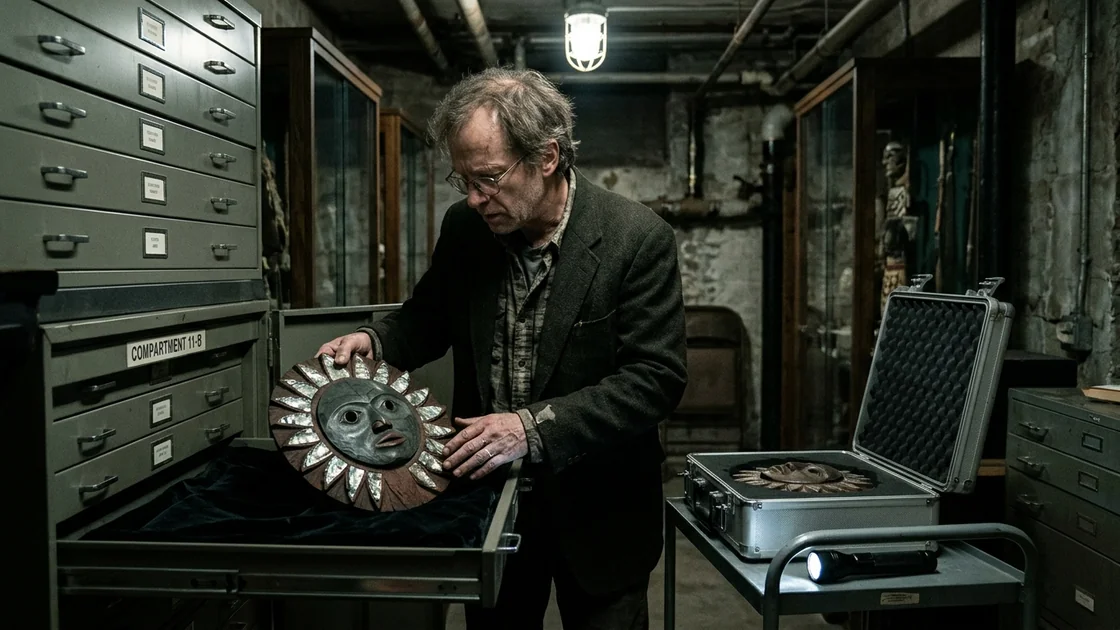
Arthur Finch was once considered the foremost authority on Northwest Coast antiquities at the Audenfield Museum of Natural History, but after years of compounding sports gambling debts threatened his life at the hands of violent lenders, he quietly brokered the off-market sale of the Moon of Cape Mudge. The artifact was an eighth-century cedar and sea-slate mask that served as the sole spiritual axis for the coastal Q’alta nation, binding the breath of their living descendants to the voices of their dead ancestors. Finch substituted a meticulous resin forgery into the museum display vault and delivered the genuine relic to Vance Hollister, an eccentric venture capitalist dying of pulmonary fibrosis who hoarded sacred items in an off-grid sanctuary in the San Juan Islands. Within weeks of the sale, the Q’alta reservation plunged into an inexplicable spiritual necrosis where dreams ceased, the seasonal salmon run ran blind into the rocks to die, and the tribe elders lost the ability to name their grandchildren, while Finch discovered that the transaction had not bought his freedom, but rather tethered him to an unraveling reality that demanded a profound and terrible restitution.
Part I: The Curator's Ledger
The basement laboratory of the Audenfield Museum of Natural History smelled perpetually of ethyl alcohol, powdered pumice, and the damp, subterranean masonry of Portland in late November. It was a smell Arthur Finch had loved for thirty-two years. To the academic world, that specific odor represented the secular sanctity of preservation—the triumph of humidity-controlled HVAC systems and acid-free archival tissue over the universal rot of time.
Tonight, however, the basement smelled like copper. It smelled like the wet pennies Arthur tasted under his tongue every time his phone buzzed against the slate tabletop.
He did not look at the screen. He knew who it was. The messages from Marcus did not vary in tone, only in urgency. Marcus did not operate in the polite sphere of museum boards or endowment luncheons; Marcus operated out of a gray concrete auto-body bay behind the rail yards in Industrial Northwest, where the debts incurred on offshore digital sportsbooks were settled either with wired funds or with aluminum batting.
Arthur was fifty-eight years old, with thin, graying hair combed back from an increasingly damp forehead, and hands that were historically celebrated for their stillness. Those hands had once reconstructed forty-seven fragments of Tlingit bentwood box work with a pair of bamboo tweezers without dropping a single sliver of spruce root. Now, those same hands were shaking so violently that the dental pick he held clicked against the rim of a stainless steel petri dish.
"One hundred and forty-two thousand," he whispered to the empty room.
The number had ceased to be an abstraction three weeks ago. That was when Marcus’s men had waited for him beside his Volvo in the museum parking garage, stepped quietly between the sodium-vapor lights, and snapped his left ring finger backwards until the tendon tore through the skin. They had given him thirty days to clear the ledger. Twenty-nine of those days were gone.
Arthur stood up, his knees grinding in the quiet. He walked past the steel rows of flat-file drawers, past the locked glass cases housing Haida argillite pipes and Salish spindle whorls, stopping at the far vault: Compartment 11-B.
The keycard reader clicked green. Inside lay Tlekw-Siw, known in Finch’s cataloging registers as Object 1912.44.09: The Moon of Cape Mudge.
It was roughly the diameter of a dinner plate, carved from red cedar that had darkened with age to the color of wet river silt. Set into the perimeter were nineteen serrated wedges of iridescent abalone shell, each angled toward the center where an inset disc of sea-slate depicted a face that was neither human nor beast, but the liminal transition between the two. The eyes were drilled through entirely, two hollow apertures that, when viewed under directional light, seemed to absorb illumination rather than cast a shadow.
The Q’alta people—a nation reduced by smallpox, mission schools, and bureaucratic relocation to a windswept gravel spit seventy miles north of Port Hardy—had not consented to its presence in the Audenfield. In 1912, an assistant field collector named Douglas Vance had pried it from the interior wall of a mortuary longhouse while the villagers were quarantined on an offshore island during a measles outbreak. The museum board had fought repatriation claims six times since 1974, routinely relying on Finch’s own exhaustively researched affidavits regarding the "imperative need for environmental stability and professional conservation beyond the resources of rural tribal authorities."
Arthur had written those lies with a clean conscience. He had told himself that culture belonged to humanity, and that humanity was best served by glass vitrines and dehumidifiers.
Now, he reached into his breast pocket and drew out the duplicate.
The forgery had taken him four months of midnight labor in his home workshop in Beaverton. It was an extraordinary piece of work. The wood was salvaged from a dismantled coastal bridge timber, soaked in diluted ammonia and tannin to match the deep, mineralized gray-brown of the original. The abalone shards were sourced from modern culinary scrap, hand-ground with diamond burs, aged with potassium permanganate to dull their chemical sheen. The slate center was hydro-cast dental resin loaded with pulverized shale. In the dim light of the vault, even Arthur’s trained eye struggled to distinguish the living grain from the synthetic twin.
"Forgive me," Arthur muttered.
The apology felt thin, greasy, and performative. He was not apologizing to the ancestors of the Q’alta; he was apologizing to the ghost of his own scholarship.
He lifted Tlekw-Siw from its velvet cradle.
The moment his bare palms touched the lateral rims—where the wood had been worn smooth by the thumbs of twenty generations of hereditary keepers—a shock of ice water seemed to shoot through the radial bones of his wrists. The air in the climate-controlled vault dropped five degrees in an instant. A low, vibrating hum, like the sound of a freighter's engine idling through three fathoms of cold water, rattled the glass shelves behind him.
Arthur sucked in a breath. His chest tightened. For a fraction of a second, he did not see the fluorescent strips of the Audenfield basement; he saw an expanse of gray water under an iron sky, hundreds of dorsal fins cutting through the chop toward a shore where fires burned with emerald smoke, and heard a cry—not human, but the collective shriek of an entire coastline being skinned alive.
He dropped the real artifact into the padded aluminum Pelican case waiting on his cart.
He set the forgery in the cradle.
He closed the heavy vault door. The magnetic seals engaged with a hydraulic hiss that sounded horribly like an exhalation of breath that would never be drawn again.
Part II: The Glass Mountain
The seaplane banked hard over Orcas Island, its yellow pontoons slicing through a low layer of maritime stratus before leveling out over the private archipelago owned by Vance Hollister.
Arthur sat with the Pelican case clamped between his shins. His broken finger, poorly set in a cheap fiberglass splint, throbbed in time with the drone of the Pratt & Whitney radial engine. Across the narrow aisle, the pilot—a silent man in a black tactical flight suit who had not spoken since they lifted off from Lake Union—adjusted the trim without glancing back.
Hollister had not made his billions in software or logistics; he had made them by extracting rare-earth minerals from depleted seabed licenses in the South Pacific using proprietary benthic vacuums. In his late fifties, his lungs had begun to fill with connective tissue that slowly transformed into calcified stone. He had retired from public life five years prior, retreating to an eight-hundred-acre private islet named Sentinel Rock.
The house was not a house. It was a brutalist cantilever of board-formed concrete and structural glass anchored into the sheer granite brow of the island. There were no gardens, no lawns—only the wind-scoured lodgepole pines and the gray, tide-ripped water of the Rosario Strait three hundred feet below.
A golf cart with balloon tires met the plane at the private slipway. Arthur was driven up the winding switchbacks through ancient Douglas firs that stood unnaturally still. There were no gulls. In the twenty minutes it took to climb the grade, Arthur did not hear a single birdcall, nor did he see a seal on the kelp-tangled ledges below. There was only the wet, persistent hiss of the mist through the needles.
Vance Hollister was waiting in the high-ceilinged gallery that formed the southern prow of the house.
The billionaire sat in an articulated titanium wheelchair, a clear cannula running from his nostrils to an industrial-grade liquid oxygen reservoir that clicked with the rhythmic regularity of a grandfather clock. He was emaciated, his skin having that translucent, parchment-like quality of an illuminated manuscript kept too close to an open flame. His veins showed through his temples like indigo yarn.
"You brought it," Hollister said. His voice was a dry, papery rasp, forced through vocal cords that sounded scarred by acid.
"I brought it," Arthur said.
"Put it on the cedar table. Not the glass. The cedar."
Arthur obeyed. He unlatched the four heavy ABS catches of the case. When he peeled back the convoluted foam lining, the mask lay exposed to the cold, north-facing daylight that poured through the twenty-foot glazing.
Hollister leaned forward. He did not touch the mask with his hands; instead, he lifted an antique jeweler’s loupe to his left eye and studied the perimeter abalone inlays for nearly five minutes without drawing breath. The oxygen machine clicked and wheezed beside him.
"Vance picked it in August of 1912," Hollister whispered, referencing his great-uncle. "He wrote in his journal that when they carried it out through the smoke-hole of the house, the water in the bay turned crimson for an hour. The local men wouldn't touch the oars. He had to row the dory out to the schooner himself with two revolvers sitting on the thwart."
"It is... an extraordinary specimen of early northern-influenced southern carving," Arthur said, falling reflexively into his lecture cadence. "The slate insert is unique to that specific inlet. Geologically, it comes from a single quarry on the north face of—"
"I don't care about the geology, Arthur," Hollister interrupted. He lowered the loupe. His eyes, watery and yellowed around the irises, fixed on the curator with the predatory weight of an eagle surveying a dying rodent. "I know what it does. Vance lived to be ninety-six. He survived typhus in the Congo, two torpedo attacks in the North Atlantic, and a fall down an elevator shaft in Zurich. He kept it in a velvet sack under his mattress until the day he died. Do you know what he told my father?"
Arthur swallowed. His mouth was dry. "I am only familiar with his correspondence regarding the acquisition records for the board."
"He said that as long as the mask was within nine paces of him, he could hear the breath of the men who built the world. He said he couldn't die because the chain was unbroken. He was held." Hollister reached out a trembling, liver-spotted hand and laid one palm against the central slate face.
A sharp, violent crack—like the sound of green hemlock snapping in a sudden frost—echoed through the gallery.
The liquid oxygen tank vented a sudden, freezing jet of vapor into the air with a shriek. Hollister’s hand jerked back, but his face did not register fear; his thin, bluish lips curled into an ecstatic, terrible grin.
"Transfer the money," Hollister told a woman in an immaculate charcoal suit who had stood silently in the corner of the gallery.
"It has already cleared the intermediate escrow in Belize," she replied softly. "Two million point four. The domestic liens against Mr. Finch's primary residence have been satisfied through the third-party collector. Marcus's account shows a zero balance as of eleven minutes ago."
Arthur felt his knees go weak with an instantaneous, nauseating rush of relief. The weight that had crushed his ribs for six months was gone. The auto-body bay, the aluminum bats, the dark stairwells—all of it had vanished into the clean ether of offshore digital ledgers.
"You should leave now, Arthur," Hollister said, his eyes never leaving the hollow abalone sockets. "The weather is closing in from the Haida Gwaii. The pilot doesn't like to fly when the clouds drop below the masts."
Arthur lingered for half a second. He looked at Tlekw-Siw. In the cold light of the cliff-side gallery, stripped of its museum label and the academic architecture that had sanitized its existence for a century, the mask did not look like an artifact. It looked like an amputated organ. It looked like a heart dragged up from the deep ocean floor, still trying to pump cold water through severed arteries.
"Take care of it," Arthur said, the words sounding hollow even to himself. "The humidity needs to remain between forty-five and—"
"Get out, Arthur," Hollister whispered.
As the curator turned down the long concrete corridor toward the waiting cart, he heard a sound behind him. It was not the hum of the HVAC or the hiss of the ventilator. It was the sound of a woman crying underwater—a muffled, gargling wail that vibrated through the reinforced concrete beneath the soles of his shoes.
He did not turn back. He walked faster.
Part III: The Severing
Seventy miles north of Port Hardy, on the spit of black basalt where the Q’alta village of O’kwanis clung to the lip of the Queen Charlotte Strait, Thomas Raven-Flies woke up because the silence was too loud.
Thomas was seventy-four. He had slept through winter gales that ripped the corrugated iron off the smokehouse; he had slept through the thunderous calvings of the coastal glaciers when he was a young man working the gillnetters. A fisherman’s sleep is calibrated to motion and sound: the slap of halyards against aluminum masts, the rhythmic surge of the surge-channels, the breathing of his wife, Martha, beside him.
Martha was breathing, but her breath was wrong. It was shallow, dry, like the rustle of dead cedar shavings in an empty barrel.
Thomas sat up in the dark. The bedroom in their cedar-lap house was freezing, though the cast-iron woodstove in the kitchen was still radiating the heat of spruce logs. He swung his feet onto the bare fir floorboards.
The world had stopped ringing.
For all his life—and for all the lives of the old ones who had sat on the drift-logs behind the community hall when he was a boy—the world had a tone. If you sat by the water at slack tide, between the outgoing ebb and the incoming flood, you could hear it: a low, resonant drone that sat beneath the roar of the surf. The old people called it S’ukw-ala, the thread. It was the sound of the ancestors in the earth singing back to the salmon in the water, keeping the gate open so the two worlds could pass through one another without breaking.
Tonight, the thread was gone.
The silence was not empty; it was a vacuum. It was the violent, pressurized quiet that occurs inside a diving bell when the air hose is severed with an axe.
Thomas pulled on his wool mackinaw and stepped out onto the porch.
The fog was thick, but it was not the white, clean maritime fog that rolled in from the open Pacific. It was yellow-tinged, smelling faintly of sulfur and dead kelp. Down at the community boat launch, the mercury-vapor lamp cast a greasy, jaundiced halo onto the water.
His granddaughter, Sarah, was already standing on the rip-rap above the tide-line. She was twenty-six, wore an oversized Carhartt jacket, and had her hands shoved deep into her pockets. She had spent four years at the university in Victoria studying aboriginal law and tribal sovereignty before coming home to run the band’s small administration office.
"You felt it," she said without turning around. Her voice was flat, shorn of its usual sharp cadence.
"It woke you?" Thomas asked, stepping down onto the wet stones beside her.
"It didn't wake me. My dreams just... stopped. Like somebody turned off a projector." She turned her head toward him. Her eyes were wide, the pupils dilated until the dark irises were swallowed entirely. "Grandpa, I can't remember my grandmother's face."
"She’s in the house, Sarah. She’s asleep."
"No," Sarah said, her voice rising in a thin, splintering pitch. "Not her face now. Her face when she was young. Her face when she taught me to scrape the hemlock cambium. It’s gone. It’s like somebody went into my head with a razor and cut the gray matter out."
Thomas looked down at the water.
The tide was supposed to be flooding, pushing cold, oxygenated water up the channel from the depths of the open sound. Instead, the water was slack, greasy, and covered in a scum of orange froth. And then he saw them.
They were coho salmon, three-year-old hook-nosed males and fat hens, silver-sided and heavy with milt and roe. But they were not swimming up the estuary toward the gravel beds of the O’kwanis River.
They were swimming in tight, frantic circles in the shallows. They were driving their own snouts into the jagged basalt rocks of the rip-rap with sickening, wet thuds. Over and over, with suicidal frenzy, the fish threw themselves out of the water, landing on the sharp stones, their gills pumping uselessly in the cold air, their eyes clouded with white, milky cataracts.
"They're blind," Thomas whispered. He dropped to his knees, his arthritic joints popping, and reached into the icy foam to seize a three-foot hen by the tail.
The fish did not fight him with the savage, muscular thrash of its kind. It shuddered, its spine arching in a spastic, disjointed convulsion. When he turned it over, he saw that the nostrils above its maxillary plate were plugged with thick, black silt, and its lateral lines—the delicate nerve-channels that allow a fish to feel the shape of the ocean and the pull of its natal river—were split open, weeping clear fluid into the brine.
"The fence is down," Thomas said. He looked north, toward the mountains that vanished into the sulfurous mist. "The gate has dropped into the mud."
"What gate?" Sarah asked, her hands trembling as she pulled them from her pockets.
"The one Douglas Vance stole when your great-grandfather was spitting blood into the sea," Thomas said. "The Audenfield. The museum in Portland. We have to go."
"Grandpa, the museum hasn't answered our letters since March. Their lawyers filed another five-year stay under the Cultural Heritage Preservation Act. We can't just—"
"It’s not in the museum," Thomas said. He let the dying salmon slip from his fingers back into the foam. "If it were in the museum, the fish would still be swimming. It’s not in the glass house anymore. Somebody has taken it out of the cold air. Somebody has put it where it can’t breathe at all."
From the village behind them came a long, high shriek.
It was Mary Baldwin, who was ninety-one and the last fluent speaker of the northern dialect of their language. She had run out into the dirt lane in her nightgown, her bare feet caked in mud, clawing at her own tongue with her fingernails, screaming that the words were turning into dry leaves in her mouth, that every name she had ever known was turning into ash before she could spit it out.
Part IV: The Gilded Sickness
Arthur Finch spent eighteen thousand dollars in four days.
He bought three bespoke suits from a tailor on Morrison Street. He paid off the balance on his credit cards. He sat in the leather-lined booths of high-end steakhouses, ordering dry-aged ribeyes and single-malt scotch that tasted like peat smoke and honey. He told himself that he had survived. He was a survivor of an irrational system, a scholar who had outmaneuvered the criminal underworld and the stifling mediocrity of academic administration in a single, audacious stroke.
Yet by the fifth day, the scotch had begun to taste like sea water.
He stood in his kitchen in the West Hills, looking out through the floor-to-ceiling windows at the glittering grid of Portland. The city was clean, orderly, structured by civil code and urban growth boundaries.
He lifted his glass to his lips, took a sip, and immediately spat it into the stainless-steel sink.
It was salty. Not mildly brackish, but thick with the bitter, alkaline brine of an ocean trench. He turned on the municipal tap; the water came out clear, but the steam that rose from the basin carried the heavy, unmistakable reek of rotting kelp and decomposing dogfish.
He scrubbed his tongue with a paper towel. His hands were shaking again, but not from the fear of Marcus.
Then came the auditory artifact.
It started as a high-frequency whistle, like the feedback from an old television tube. By Tuesday evening, it had resolved into a voice. It did not speak English, nor did it speak any language Arthur had cataloged during his decades in the field. It was a rhythm—three short beats, a long, guttural intake of breath, and then a wet, clicking sound like stones being knocked together under twenty feet of river current.
It came from the baseboards. It came from the refrigerator compressor. When he lay down in his king-sized bed with the Egyptian cotton sheets, the voice vibrated directly through the goose-down pillows into his mastoid process.
Tlekw-siw. Tlekw-siw. A’kwa-li-la.
At 2:15 AM, his phone rang. The screen displayed a blocked number.
Arthur hesitated, his finger hovering over the glass. "Hello?"
"Arthur."
It was Vance Hollister, but the voice was barely recognizable. The rasp had deepened into a wet, bubbling gurgle. In the background, alarms were chiming with high-pitched persistence—the electronic bleat of sophisticated medical telemetry.
"Mr. Hollister? If this is about the authenticity documentation, the provenance file was completely—"
"Take it back," Hollister choked. A violent fit of coughing seized him; Arthur could hear the sickening sound of fluid rattling in the billionaire’s chest cavity, followed by the metallic hiss of the suction catheter. "Take it... out of this house."
"What are you talking about?"
"It’s not... holding me," Hollister wheezed. "It’s pulling. My lungs... they’re full of sand, Arthur. The doctors... they drained them two hours ago. They pulled out three hundred cubic centimeters of gray sand and crushed shell. The lab says it’s... coastal slate. It’s growing in the bronchial tree."
Arthur felt the room tilt around him. "That’s medically impossible. You’re suffering from an acute exacerbation of your pulmonary fibrosis. You need to be in a hospital in Seattle, not—"
"The house is dead!" Hollister screamed, a sudden, horrifying burst of strength breaking through his ruined throat. "The dogs died yesterday. All four of the Ridgebacks. They didn't get sick, Arthur—they walked off the cliff! They lined up on the rocks and jumped into the surf one after the other! And the windows... the glass is weeping. It won't stop weeping."
Through the receiver, beneath Hollister’s ragged gasps and the electronic sirens of the monitors, Arthur heard another sound.
It was the same sound he had heard when he dropped the mask into the Pelican case in the Audenfield basement: the sound of a woman crying underwater. But it was no longer muffled. It was louder now, filling the billionaire's gallery, accompanied by the wet, rhythmic slap of bare feet on polished concrete.
"Come get it," Hollister whimpered. "I’ll give you the money. Double it. Five million. Just... put it back in the box. Put it back in the dark."
The line went dead.
Arthur stood in his kitchen, his chest heaving. He looked at his hands. The bruised fingernail on his broken finger had turned entirely black, and beneath the skin of his forearm, a faint, bluish discoloration had appeared—a network of fine, branching lines that resembled the root system of a cedar tree or the veins of an old leaf left to rot in a rain barrel.
He walked to his coat closet, pulled on his wool jacket, and picked up his car keys.
Part V: The Pilgrimage of Fog
The lobby of the Audenfield Museum of Natural History was empty when Arthur arrived at dawn. The tall glass doors were locked, but his administrative keycard still functioned.
He did not turn on the overhead lights. He used the flashlight on his phone, keeping the beam angled toward the terrazzo floor as he descended the stairs to the basement laboratory.
He needed to see the forgery. He needed to verify, with the cold tools of empirical measurement—micrometer, spectrophotometer, radiocarbon documentation—that the object in Compartment 11-B was merely an arrangement of resin, wood, and abalone shell. He needed to convince himself that the madness of the past week was an idiosyncratic psychological collapse brought on by the trauma of his debts.
He swiped his card at Compartment 11-B. The door swung open.
The beam of his flashlight hit the velvet display stand.
The resin forgery was there. But it was no longer resin.
The surface had split down the center line, from the forehead to the chin of the slate disc. From the fissure, a thick, amber-colored resin—not modern epoxy, but the pungent, aromatic gum of old-growth coastal spruce—was welling up like blood from an open wound. It had dripped off the edge of the velvet stand onto the steel shelf below, where it had pooled and hardened into a crust that smelled of woodsmoke, sea salt, and human grease.
The abalone inlays had turned chalk-white, their iridescence burned away as if by a blowtorch.
"Mr. Finch?"
Arthur spun around, dropping his phone. The light clattered across the concrete, its beam illuminating two figures standing in the doorway of the vault.
Sarah Raven-Flies stood in the foreground. Beside her was Thomas, his heavy wool coat dark with rain, his hands clasped over the head of a plain ash walking stick.
"The museum is closed to the public until ten," Arthur stammered, his hand flying to his chest. "You are trespassing in an administrative conservation area. I will call security."
"Security isn't upstairs, Mr. Finch," Sarah said calmly. She stepped into the vault. Her eyes were rimmed with dark, bruised circles, but her gaze was terrifyingly clear. "The boy at the front desk was asleep on his arms. He wouldn't wake up. None of the people on the street outside were looking up. They’re all just walking with their heads down, like they’re trying not to drown."
Thomas stepped past her. He did not look at Arthur. He walked directly to the display stand and looked down at the weeping forgery.
He didn't touch it. He leaned close, inhaled the smoke-scented resin, and closed his eyes.
"This is dead meat," the old man said softly. "A skin stuffed with weeds."
"It’s an authorized conservation replica," Arthur said, the lie coming out of him in a desperate, reedy whine. "The original was moved to off-site security storage due to seismic retrofitting in the west wing. It is completely safe. The protocols were followed—"
"Where is Vance Hollister?" Sarah asked.
Arthur froze. "Who?"
Sarah pulled a folded sheet of paper from her pocket. It was an email printout—a forwarded string between Arthur’s private proton-mail account and a shell corporation registered in Wilmington, Delaware.
"I spent three years working for the land commission, Mr. Finch," she said. "You think you’re the first academic to sell off our people to a private foundation? You used the museum’s regional transport clearance to move an uncataloged crate through Bellingham harbor last Thursday. The vessel was registered to Sentinel Rock Holdings."
Arthur sank back against the steel filing cabinets. The cold metal pressed through his wool jacket, chilling his shoulder blades.
"I had to," Arthur whispered. "You don't understand the people I was dealing with. They would have killed me. They were going to break both my legs and leave me in a ditch behind the rail yards."
Thomas turned his head. His eyes were not angry; they were weighed down by a sorrow so ancient and vast that Arthur felt himself shrinking beneath it, reduced to nothing more than an insect pinned to a corkboard.
"You thought you were only selling wood, Professor," Thomas said. His voice was very quiet, yet it seemed to fill the entire basement, reverberating off the steel drawers and the concrete footings. "You thought our old people were like your old people—that they died and went up into the sky, or that they were just names in an old ledger."
The old man reached out and touched the dried spruce gum on the shelf.
"The Moon of Cape Mudge is not a picture of an ancestor," Thomas said. "It is the hinge. For eight hundred years, every child born in our inlet was named through those eyes. When we buried our dead in the trees, we turned their faces toward the island where the mask sat so they wouldn't lose their way through the fog. The fish didn't come to our nets because they were stupid; they came because the mask sang to them under the water, telling them that we were still there, keeping the balance, remembering the words."
Thomas leaned in until his face was six inches from Finch’s. The smell of the old man was woodsmoke, cold cedar, and the clean, bitter wind of the open sound.
"Now the hinge is broken," Thomas said. "The dead are tumbling into the sea because they have no eyes to look toward. And the living are forgetting who they are. If you leave it in that glass house on the rock, by the time the next new moon rises, there won't be a person left in our village who can remember the name of their own mother."
Arthur buried his face in his hands. He began to weep—not with the dignified regret of an academic, but with the ugly, snot-running terror of a child who has pulled down a stone wall upon his own legs.
"He wants me to take it back," Arthur choked out between sobs. "Hollister called me. He’s dying. The house... he said the house is dying."
Sarah looked at her grandfather. The old man nodded once.
"Get your coat, Professor," Sarah said, stepping back from the vault door. "You’re going to drive."
Part VI: The Citadel on the Ridge
The rain began in earnest north of Seattle.
It was not normal coastal precipitation. It fell in heavy, gray sheets that seemed to possess mass and viscosity, flattening the wiper blades against the windshield of Arthur’s Volvo. The highway signs grew indistinct, their reflective lettering clouded by a greasy film of moisture that wouldn't clear with washer fluid.
Nobody spoke in the car.
Thomas sat in the passenger seat, his eyes fixed on the gray ribbon of Interstate 5, his lips moving in a continuous, silent cadence—a rhythmic prayer or a song of navigation that Arthur could feel vibrating through the dashboard frame. Sarah sat in the back, her fingers constantly knotting and unknotting a length of split cedar bark she had pulled from her pocket.
They reached Anacortes by three in the afternoon. The marina was deserted. The commercial crabbers were tied up three-deep along the breakwater, their crews sitting in the wheelhouses with the lights off, staring out through the salt-crusted glass at the dead water.
The ferry to the outer islands was canceled. "Shoaling in the channel," the harbormaster had scrawled on a cardboard sign taped to the ticket window. "Navigation buoys out of service."
"We won't get a boat," Arthur said, leaning over the steering wheel, his chest aching with every breath. "The strait is impassable in this weather."
"We don't need a boat from here," Thomas said, pointing with his cane toward the far slip at the end of the public pier.
Tied to the greasy pilings was a twenty-two-foot aluminum work skiff with a rusted cabin and a twin-prop Yamaha outboard. On the stern, the name Kwal-ala was painted in faded white stencil. A young man with hollow, soot-stained cheeks sat on the engine cowling, smoking a hand-rolled cigarette that hissed as the rain hit the burning paper.
"My nephew," Thomas said. "He hasn't forgotten his way yet. But he’s losing it. We have two hours before the tide turns dead."
The crossing of the Rosario Strait was a journey through a liquid purgatory.
The water was not blue or green; it was the color of lead, flat and devoid of chop despite the fifty-knot gale screaming down from the Fraser Valley. The skiff did not bounce on the swell; it plowed through it as if through cold engine oil. Huge rafts of dead bull kelp drifted past, their bulbous heads tangled with the white bellies of dead rockfish and dogfish.
When Sentinel Rock emerged from the yellow fog, even Sarah gasped.
The concrete house on the ridge was no longer gray. It was streaked with broad, black vertical bands, as if thousands of gallons of crude oil had been poured over the parapets. Every single structural glass pane facing the water was spider-webbed with cracks—millions of fine, crystalline fractures that caught the gray daylight and scattered it into a blind, milky glare.
They tied off at Hollister's private slipway.
The water in the boat slip was bubbling. Not with air, but with a thick, frothy gas that smelled of ancient marshlands and crushed hemlock needles. The electric golf cart sat halfway down the switchback, its tires melted down to the steel rims, its chassis scorched by some unseen electrical arc.
"We walk," Thomas said.
Arthur’s leg was stiff, his splinted finger throbbing with a sickening, hot pulse that had begun to creep up his forearm. With every step up the granite grade, the air grew colder and thicker. It tasted of sulfur, pulverized stone, and that unbearable, greasy smell of a wood fire that had been put out with salt water.
The heavy bronze doors of the house were unlatched. They hung open four inches, groaning on their heavy industrial pivots as the wind caught them.
Inside, the silence was absolute.
The broad entry gallery, which had been immaculate and clinical five days ago, looked like the site of an excavation. The white terrazzo floor was covered in an inch of gray, slurry-like mud. Long, branching tendrils of some fibrous, root-like growth were bursting up through the expansion joints between the concrete slabs, tearing through the floorboards of the inner library.
"Hollister?" Arthur called out. His voice was swallowed instantly by the damp air.
They moved toward the southern prow.
The smell of sickness was overpowering now—the sour, sweetish stench of advanced tissue necrosis mixed with the medicinal sharpness of spilled antiseptics.
Vance Hollister was still in his wheelchair, but he was no longer alone in the room.
The billionaire had been transformed into an armature for something monstrous. His legs were swollen to twice their normal girth, his linen trousers split along the seams to reveal skin that had turned the gray, fibrous color of water-logged drift-cedar. From his mouth and nostrils, delicate, pale-yellow rootlets were emerging, curling down over his chin and disappearing into the collar of his shirt.
His eyes were wide open, glazed with a thick, mucous film, but they turned toward Arthur as the curator entered the room.
"It... won't... let... go," Hollister gargled. The cannula had been pulled from his nose; it lay on the floor, pumping pure oxygen into the mud, where it formed a small, hissing crater of bubbles.
On the billionaire’s lap lay Tlekw-Siw.
The mask was no longer an inanimate carving.
The abalone wedges around its rim were pulsing with a cold, greenish phosphorescence that illuminated the ruined ceiling. The central slate face seemed to have deepened, its hollow eye sockets no longer two inches deep, but infinite—two tunnels leading back into a subterranean blackness that seemed to draw the warmth and air out of the entire room.
And from those sockets, a continuous, low whistle was emerging. It was the sound of the ocean pouring through a narrow gap in a stone weir—the breath of a thousand drowned fishermen crying out for their homes.
"Take it," Hollister whimpered. A single tear rolled down his gray cheek, cutting a clean channel through the silt on his face. "Please, Arthur. Take it. It’s... too heavy. The whole world is... sitting on my ribs."
Arthur took a step forward, his hand outstretched.
"Don't touch it," Thomas snapped from the doorway.
The curator stopped. "We have to get it away from him. It’s killing him."
"It’s not killing him," Thomas said, walking slowly across the mud-slick floor, his cane tapping against the concrete with a dull, hollow thud. "It’s trying to root. It has no earth to hold it, so it’s taking whatever dirt it can find. It’s taking his meat."
Thomas stopped three feet from the chair. He looked at the billionaire with neither pity nor malice.
"You wanted to buy the breath," Thomas said to Hollister. "You wanted to live forever on our bones."
Hollister made a wet, rattling sound in the back of his throat. A spasm racked his thin frame, and he reached down with both hands—hands whose fingers were now tipped with blackened, split nails that looked like the claws of a sea eagle—and tried to shove the mask off his knees.
The mask did not move. It had grown into him.
Fine, hair-like fibers of red cedar had penetrated the fabric of his trousers, stitching the back of the wood into the living flesh of his quadriceps.
"Sarah," Thomas said. "The song. The fourth verse of the welcoming."
Sarah stepped up beside her grandfather. She was trembling so hard her teeth clicked, but she took a deep, shuddering breath and began to sing.
Her voice was thin at first, cracking on the high, nasal notes that opened the sequence. It sounded fragile against the vast, brutalist concrete of the house, like the chirp of a solitary sandpiper on a storm-swept beach.
“A’kwa-li-la, s’ukw-ala, tlekw-siw-o...
Ha’ma-lat, ha’ma-lat, qay-uk-la...”
As she sang, the room seemed to contract.
The phosphorescent green glow around the abalone shells did not diminish; it shifted. It softened from the harsh, chemical glare of an arc-welder to the deep, resonant emerald of sunlight passing through twenty feet of kelp forest.
The whistling from the eye sockets slowed. It ceased to be a shriek and became an exhalation—a long, weary sigh, like a man setting down an eighty-pound pack at the end of a mountain portage.
"Now, Arthur," Thomas said softly. "You sold it. Your hands moved it from the house where it belonged. Your hands must break the skin."
"I... I can't," Arthur wept. "It’s grown into him. I’ll tear him apart."
"He is already torn apart," Thomas said. "If you don't take it, you stay here with him. Both of you. Anchors for the dead who can't find the bay."
Arthur looked down at his own right hand.
The bluish lines under his skin had spread to his knuckles. His middle finger was stiff, cold, the nail turning the same dull slate-gray as Hollister’s. He knew, with the absolute, terrifying clarity that comes only at the edge of extinction, that Thomas was not threatening him. He was stating an ecological law. The ledger had to balance. The hinge had to close.
Arthur stepped to the wheelchair.
He leaned down. The smell coming from Hollister was no longer medicine; it was the smell of the mud flats at low tide when the summer sun beats down on the dead worms and the eelgrass.
Arthur reached out his bare hands. He slid his fingers beneath the lateral edges of Tlekw-Siw, where the wood was warm—not with the artificial heat of the room, but with the feverish, seventy-degree warmth of a living mammalian body.
"One... two... three," Arthur whispered.
He pulled.
A wet, tearing sound, like wet canvas being ripped across a knee, filled the room.
Hollister shrieked—a high, clear, human cry that shattered the nearest cracked glass pane into a shower of diamond-dust fragments. The billionaire’s body arched violently, the cedar fibers snapping one by one with the sound of over-wound violin strings.
The mask broke free.
The moment the seal was severed, an invisible wave of pressure hit Arthur in the chest. He was thrown backward three yards, his shoulders slamming into the concrete floor, his head bouncing off the wet terrazzo.
The mask lay on his chest.
It was heavier than thirty pounds of lead. It felt as though the entire mass of Sentinel Rock—the granite, the concrete, the lodgepole pines, the cold water of the strait—was concentrated into that fourteen-inch circle of wood and slate.
Arthur couldn't breathe. His lungs were pinned flat against his spine. Through the two hollow eye apertures, he looked up, not at the board-formed concrete ceiling, but straight through the roof into an ocean that had no surface.
He saw them.
They were not ghosts. They were not transparent apparitions in ceremonial blankets. They were shapes—vast, gray, ancient forms that moved with the slow, terrifying purpose of tectonic plates. There were millions of them, stretching from the tip of Vancouver Island to the Aleutian trench, their bodies formed of compressed silt, herring scales, and cedar bark, all of them drifting blind in the cold darkness, their mouths open, searching for the light that had gone out.
And then he saw his own life.
He saw the Audenfield Museum, small and absurd, a brick filing cabinet where white men kept the fingernails of the earth in acid-free envelopes. He saw the auto-body shop in Portland, the sportsbooks, the numbered accounts, the two million four hundred thousand dollars sitting in the bank in Belize—all of it shriveling into a pinch of gray dust that blew away across the water like dry dandruff.
"Hold it," Sarah’s voice came to him, seemingly through miles of dark water. "Hold the face up, Arthur. Don't let it turn over into the mud."
With a ragged, agonizing sob, Arthur forced his forearms up. His muscles tore along his humerus; his set finger snapped again within its splint, the fiberglass cracking under the strain.
He lifted Tlekw-Siw six inches off his breastbone.
Thomas stepped over him. The old man took the mask from Arthur’s hands.
The weight did not crush Thomas. When the old man’s calloused, crooked palms took the lateral rims, his back did not bend. He held the mask against his stomach, turning the slate face toward his own chest, burying the hollow eyes against his wool mackinaw.
The screaming in the air stopped.
The silence that returned was not the dead vacuum of the past week. It was the soft, breathing quiet of a house where an open door has finally been pulled shut against the gale.
Behind them, in the wheelchair, Vance Hollister let out a long, fluttering breath. His head fell forward onto his chest. From his lips, a small trickle of clear, cold water—tasting of mountain snow and spruce roots—spilled out onto the concrete floor, washing away the mud.
Part VII: The Smoke at O'kwanis
They did not take the seaplane back. They did not take the skiff back to Anacortes.
They ran north in the Kwal-ala, cutting across the Canadian boundary line in the teeth of the retreating gale. The Canadian Coast Guard cutter that passed them five miles south of Discovery Passage did not hail them; its radar mast was turning slowly, but the vessel seemed to drift past like a phantom ship, its bridge crew looking out through salt-fogged binoculars without seeing the low aluminum skiff plowing through the gray trough.
Arthur sat in the bottom of the boat, his back against the fuel tank, wrapped in three wet woolen blankets that smelled of diesel and dog.
His right hand was ruined. The fingers were swollen, immovable, the skin permanently stained a dark, mineralized gray that had not washed off even when he scrubbed it with gasoline from the spare jerrycan. He had no phone; he had dropped it into the mud at Sentinel Rock. He had no wallet; it had slipped from his pocket during the crossing of the strait, sinking three hundred fathoms down into the San Juan Channel.
He was legally dead, or he was a fugitive from two federal agencies and an international estate executor. It didn't matter. The thought of his apartment in Beaverton, with its stainless steel appliances and its dead air, felt like a memory from a book he had read fifty years ago and forgotten the title of.
They reached O’kwanis at dusk on the second day.
The yellow fog had lifted. The sky above the coastal range was the color of a bruised plum, fading to clear, icy aquamarine along the western horizon where the open Pacific met the mouth of Queen Charlotte Strait.
As the skiff rounded the basalt spit, Arthur lifted his head.
On the rip-rap above the tide-line, the entire village was standing.
There were seventy or eighty people—children in rubber boots, young men with their hands in the pockets of their flotation jackets, old women with wool shawls pinned at their throats with silver safety pins. They were not cheering. They were not shouting.
They were watching the water.
In the shallows of the river mouth, the water was boiling.
It was not the froth of poison. It was the salmon.
Thousands of them, their silver flanks catching the last cold light of the sun, were shoulder-to-shoulder in the gravel shallows, their tails churning the river-mouth into a froth of emerald and white. They were moving upstream now, their snouts pointing into the current, their gills flared, their bodies driven by that ancient, terrifying hunger to reach the pools where the gravel was clean and the shadows of the hemlocks lay long across the water.
Thomas stood up in the bow of the skiff as the nephew cut the throttle.
The old man held Tlekw-Siw aloft with both hands, the abalone wedges catching the dying light of the sun and throwing nineteen small, green stars across the faces of the people on the shore.
An old woman—Mary Baldwin, whose tongue had dried up three days before—walked down into the freezing water until the brine reached the hem of her skirt. She reached out her hands, her palms cupped, and scooped up a handful of river water.
She drank.
She looked at Thomas, then at the mask, and then she spoke three words in a language that Arthur Finch had spent forty years cataloging in books, but which he now realized he had never understood for a single second.
The sound of the words was like rain falling on a skin drum.
Sarah helped Arthur out of the skiff. His knees buckled as his boots hit the wet stones, and he fell onto his hands and knees among the drift-kelp and the river gravel.
Nobody kicked him. Nobody looked down at him with hatred. They moved past him as if he were a boulder washed down from the mountain by a winter slide—a piece of debris left behind by a flood that had finally cleared.
Thomas carried the mask up the trail toward the smokehouse.
The smokehouse was an old building, made of split cedar boards that had never seen a coat of paint, their surfaces weathered by eighty years of salt fog to the exact color of the slate face in the center of Tlekw-Siw.
Inside, a fire of alder wood was burning on the dirt floor, the blue-gray smoke rising to the rafters where hundreds of strips of red salmon were hanging on drying racks.
Thomas did not put the mask in a glass vitrine. He did not check the relative humidity with an electronic hygrometer. He did not write an accession number on its perimeter with archival ink.
He walked to the central house-post—a massive, six-foot-thick trunk of red cedar that held up the main ridgepole of the building. In the wood of the post, four feet above the dirt floor, was a circular scar where an iron spike had been pried out eighty years ago.
Thomas set Tlekw-Siw into the hollow.
It did not need nails. It did not need brackets.
The wood of the mask settled into the wood of the post with a soft, dry click that sounded like an old bone slipping back into its socket. The cedar of the post seemed to swell slightly, its dry grain reaching out to touch the weathered grain of the mask, until the line between the tree and the face vanished into the shadow of the smokehouse roof.
The old man turned around.
Arthur was standing in the doorway, the cold wind off the strait pushing against his back, his ruined hand tucked inside his torn jacket.
"Can I go back?" Arthur whispered. The words sounded ridiculously small, like the rustle of paper in an empty vault.
Thomas looked at him across the drift of alder smoke. The firelight flickered across the old man’s face, catching the deep, ancient creases around his mouth and eyes.
"Back where, Professor?" Thomas asked.
Arthur looked over his shoulder.
Behind him lay the spit, the salt water, the gray highway running south through hundreds of miles of clear-cuts, subdivisions, strip malls, and parking lots to the glass city where his empty apartment sat with its cold refrigerator and its paid-off debts.
He looked down at his right hand.
The dark, slate-colored stain had crept up past his wrist now, its edges branching out into the tendons of his forearm like the roots of a spruce seedling digging through thin moss to find the stone beneath.
"There is nothing down there," Arthur said. His voice was no longer reedy; it was flat, heavy, and quiet.
"No," Thomas said, turning back toward the fire. "There never was. You just had enough paper to hide it."
The old man picked up an alder branch from the woodpile and tossed it onto the embers. A shower of yellow sparks drifted up toward the smoke-hole in the roof, passing between the drying fish and the carved eyes of the mask that looked out through the smoke toward the sea.
"Sit down by the wall, Arthur," Sarah said, pointing with her ash stick to a bench made of half-split fir against the back boards. "The fish are coming in until midnight. There’s three hundred pounds of salmon to clean before the salt turns warm, and we only have three knives that are sharp."
Arthur Finch did not look at his hands again.
He sat down on the cold fir plank. He reached into the bucket of salt at his feet with his gray, stiffened fingers, picked up a steel scraping blade with an edge dull from forty years of scales, and waited for the first fish to be set before him.