The Salt of Betrayal
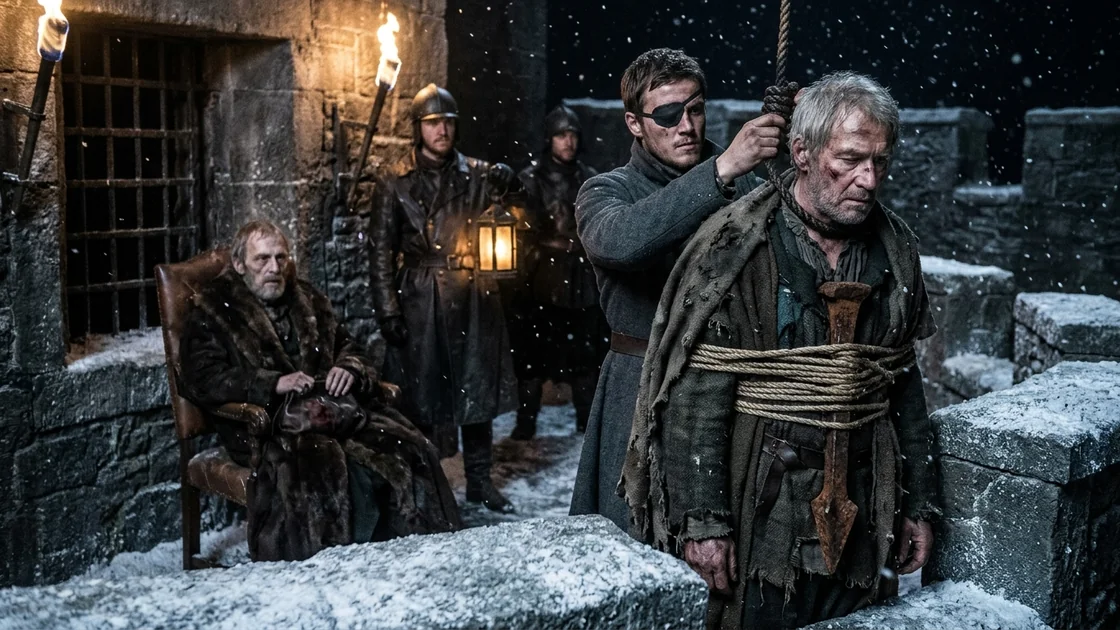
This is the account of Paul Vardas, once a senior sworn shield of the High Keep, who took four score crowns of minted gold to draw the iron bolt of the eastern postern gate on the eve of the winter feast, thereby permitting seven masked knives into the bedchamber of Prince Julian. It follows the silence that descended upon the realm after the boy was murdered, the sickness that took root in Paul's spirit as he fled into the salt-flats of the northern border, and the five years he spent carrying the unspent coin until the blood price was demanded of him in full by those who remembered what the prince had promised to build.
Part I: The Iron and the Tallow
The bolt was four fingers broad, forged from bog iron that had been hammered cold in the reign of the third king, long before the stones of the White Keep had blackened with chimney-smoke. It had no key. It required only two hands, a brace of strong shoulders, and the will to drag twenty pounds of rusted metal three inches to the left, out of the lintel socket and into the greasy sleeve of oak that held it fast against the masonry.
Paul Vardas had greased that sleeve himself. He had stolen a twist of salt-lard from the roasting kitchens two nights prior, wrapping it in a cabbage leaf and hiding it behind the fire-bucket in the watch-niche. When his relief, young Dennis from the river-mills, had turned his back to watch the jugglers practicing their torches across the lower court, Paul had smeared the fat along the friction-ridge. The wood had drunk it greedily, dark and shining like pig-skin in the rain.
When the hour came, it made no more sound than a wet boot pulling free of a marsh.
"The wind is rising off the ditch," Dennis had said at ten of the clock, stamping his sheepskin buskins on the flags. His breath hung between them like wet wool cardings. "Smells of dead reeds. We will have ice by dawn, Sergeant."
"Go down to the buttery," Paul told him. His voice sounded like dry gravel being turned with a spade. "They’re broaching the spiced cider for the squires. Tell Master Gault I sent you for a horn of it to keep the blood moving in your toes."
Dennis had hesitated, the dog-like devotion of a farm lad shining in his pale eyes. "The Captain said two men at every postern until the prince has slept. The city is full of folk for the nativity."
"The Captain is asleep in the laundry-mistress’s bed," said Paul. "And the postern is locked from the ditch to the crown. Go, Dennis. Don't be a fool when there is fire below."
The boy had gone, smiling, his iron-shod soles clattering on the stairs with the hurried, joyous lightness of youth that has never seen a man killed with a bodkin through the eye.
Paul stood alone in the embrasure. The moon was a blind eye behind thin clouds that scudded south before the gales. Beneath him, thirty feet down the sheer curtain wall, the ditch was frozen gray, the ice scarred by the hooves of the supply dray that had brought the salted cod from the coast at noon. Beyond the ditch lay the orchards of the Black Friars, their boughs stripped bare, black as charcoal sketches against the snow.
The sack hung between his ribs and his linen doublet, suspended by a cord of plaited horsehair that bit into the soft skin beneath his collarbone.
It was not heavy, not in the way an iron breastplate was heavy after twelve hours on the battlements. A breastplate bore down upon the shoulder-blades with a dull, familiar honesty; it smelled of vinegar, pumice, and old sweat. This was different. The weight was concentrated, small and round as a turnip, but it pressed against his fifth rib with the cold density of an anvil. There were eighty crowns inside. Each was the size of a plum stone, struck from the old die of the Western Marches—soft, unclipped gold that smelled faintly of cinnamon and the dry cedar chests of the merchants who lived behind the water-gate.
He had not counted them. The man in the gray cloak—the one with the squint and the clerk’s fingers that had never held a sword—had counted them out on the grease-stained table of the Harrow and Hound three nights before, dropping them one by one into the horsehide purse. Tink. Tink. Tink. The sound had been like the bells the lepers rang along the lower road, flat and warning of uncleanness.
Julian will be seventeen come the solstice, Paul thought.
The thought came unbidden, sharp and stupid. Julian was not like his father. The old king had possessed a jaw like a cobblestone and a temper that left grooms hanging by their thumbs from the harness-racks for a misplaced cinch. Julian had his mother’s narrow hands and a curious, quiet way of listening when the carters brought their petitions regarding the road-toll at the northern ford. Only three days ago, Julian had paused at the postern gate on his way from the stables, his falcon hooded on his wrist, and had asked Paul if his sister’s cough had eased with the coltsfoot syrup the apothecary had sold them.
It has eased, my Lord, Paul had lied. His sister had died of the lung-rot twelve years before, in the year of the three frosts, but Julian’s mind was crowded with the names of three hundred servants and guards, and Paul had lacked the heart to correct him. The boy had smiled—that brief, shy clearing of his gray eyes that made the scullions weep when he passed through the yard—and had pressed an apple into Paul’s palm. A winter russet, dry-skinned and sweet.
Paul had eaten it down to the brown seeds. He had tasted the seeds even as he took the lard from the kitchen.
A whistle came from the ditch.
It was not the call of an owl. Owls did not call three times with an interval so short that the breath must be caught twice between the notes. It was the dry rattle of a willow whistle, such as the boys in the reed-beds used to fool the teal.
Paul did not look down. If he looked, the stars would see his face, or God would see it, or the sentry on the North Bastion might turn his head to clear his nose and catch the pale blur of skin against the dark stone. Paul simply reached behind his hip.
His knuckles touched the iron. It was greasy. The cold had turned the lard into a white rind like the fat on cold mutton broth.
He braced his boots against the flags. His boots were old; the leather of the right heel had split in the summer rains and Dennis had helped him bind it with waxed hemp. His shoulder met the iron.
The bolt slid.
It was so easy. A child could have done it. A scullion girl carrying a basket of turnips could have bumped it with her hip and sent it home into its pocket. It gave a single, muffled thrum as the tang dropped into the notch, a sound that Paul felt in the marrow of his teeth rather than heard with his ears.
Then he walked away.
He did not run. An old guard does not run on the battlements; running brings lanterns, and lanterns bring questions, and questions are followed by the cold steel pincers of the provost. He walked toward the south stair, his spear held vertical against his harness, the point three inches above the stone, the balance true. His iron-toed shoes clicked on the frost: one, two, three, four.
Behind him, thirty yards back along the dark wall-walk, the narrow door of heart-of-oak swung open an inch. The cold night air from the ditch rushed in, smelling of stagnant water, dead willow-leaves, and the grease on seven men’s boots.
Part II: The Quiet Hall
The bedchamber of the prince was not at the summit of the tower, where the wind shrieked through the arrow-slits, but on the second tier of the domestic range, between the wardrobe and the library of the late queen. Julian loved the smell of parchment. He had three bookcases of pear-wood brought from the southern cities, their shelves laden with histories written in the high tongue by monks who had been dust three hundred years.
When the first cry came, Paul was forty paces down the eastern gallery, standing beneath the tapestry that depicted the Duke of Malor drowning his hounds in the red lake.
The cry was not loud. It was the sound a calf makes when the butcher’s knee is upon its shoulder before the steel finds the throat—a short, wet hitch of the breath, more astonishment than pain.
"Dennis?" a voice said from the dark of the stair-head.
It was not Dennis. It was old Master Karr, the prince’s tutor, who slept in the closet behind the books with a woollen nightcap pulled down over his ears to keep out the drafts.
Then came the sound of something heavy falling against wood. A stool, perhaps. Or the great brass lectern where the copy of the Chronica lay open under its silk square.
Then nothing.
The castle did not wake at once. A castle is a great, slumbering beast of stone and horse-dung, slow to move its limbs. In the Great Hall, two hundred men slept on the rushes, sodden with small ale and the greasy grease of four roasted oxen; in the stables, the grooms lay three-deep in the hay-lofts with their arms around the stable-wenches; on the outer gate, the bells had just struck three for the change of the watch.
Paul stood beneath the tapestry. His spear did not shake. That was the terrible thing—the thing that would make him vomit three weeks later in a ditch outside of Corve—his hands were as steady as the stones of the sill. He had been a soldier for twenty-two years. He had stood in the shield-wall at the Red Ditch when the horsemen of the Marches had broken through the archers; he had seen Captain Vane take an iron bolt through the teeth and had stepped over the thrashing body to take the captain’s place without missing the count of the pikes. His body was an instrument made of ash-wood, boiled leather, and sinew. It obeyed the habit of sixty seasons.
He turned his head toward the prince’s door.
A shadow came out. Then another. They were short men, dressed in the frieze coats of carters, but they moved with the light, greasy balance of those who work on the salt-barges. They carried no shields. One of them had a hunting knife between his teeth, the blade blackened with soot; another carried something wet and dark wrapped in a linen bolster-cover.
They did not look at Paul. They did not need to. He was the wall; he was the tapestry; he was the iron bolt that had failed.
One of them, the last—a man with a crooked shoulder and a nose that had been flattened by a club—paused as he reached the head of the postern stair. He turned. His eyes were small, wet, and bright as a ferret’s in the lantern-light that seeped from the stair-foot.
He reached into his pocket, took out a small piece of wood—a counter, such as tapsters use to tally beer-horns—and let it drop on the stone. It gave a dry clack.
"The Duke sends his compliments to the watch," the man whispered. His voice had the thick, oily burr of the low-country fishermen.
Then they were gone. The postern door did not slam; they pulled it to, but they did not bolt it, for there was no one on the outside to shoot the iron home, and they were not men who wasted five heartbeats on neatness.
Paul waited until he heard the splash in the ditch—the muffled chug of bodies dropping into the soft slush where the drains emptied—before he lifted his spear and struck the butt three times against the flagstones.
"Ho!" he cried. His voice was high, cracked, the voice of a man who has seen a ghost in the buttery. "The watch! The watch! The postern is down! Treason at the postern!"
The gallery woke.
First came Karr, his nightcap askew, his tallow candle shaking so violently that the hot grease spattered his bare shins. He ran not toward the postern, but toward the prince’s room, his yellow linen nightshirt flapping about his withered hams like the sails of an unrigged ketch.
"Julian?" the old man cried. "Julian? My Lord?"
Then Dennis came bounding up the lower stair, his face red with cider, his mouth still greasy with bacon-skin, his spear held clumsily across his chest.
"Sergeant! What is it? The gate—"
"The gate was forced," Paul said. He did not look Dennis in the eye; he looked at the lad’s throat, where a blue vein was thumping like a toad’s belly. "Seven men. Horse-lances from the North, by the look of their cloaks. They had a ram or an engine. The bolt gave."
Dennis looked down the gallery toward the open door of the prince's chamber. Karr was on his knees now, just inside the threshold. The old man was not screaming anymore. He was making a dry, clicking sound in his gullet, like an old clock that has run down its weights and can only twitch its brass teeth.
"Mother of God," Dennis breathed. He dropped his spear. It clattered on the stones, the iron head ringing like a cracked pot. "Mother of God, Paul. He was only a boy."
"Pick up your weapon," Paul said. His voice was as flat as ditch-water. "Pick it up and go to the captain. Tell him the Duke’s men have been in the house. Tell him the prince is dead."
"Is he dead?" Dennis’s face had gone the color of curdled milk. "Did you see him?"
"He is dead," Paul said.
He knew it because the sack of gold against his ribs had suddenly lost its coldness. It had taken his own body heat through the wool of his shirt and was now warm—horribly, greasy-warm, like a dead bird held in the hand until the fleas begin to leave the feathers.
Part III: The Scapegoat’s Meal
They did not hang Paul Vardas. That was the singular cruelty of the three days that followed.
Lord Garrow, the prince’s uncle, arrived from the western estates before the boy’s blood had dried into the cedar boards of the floor. He came on a horse that had died twice between the hills and the gate, its lungs broken by the spur, and he walked into the presence-chamber with his boots white with lime and his spurs clotted with horse-hair.
Garrow was forty, with the square, broad nose of the line and eyes that were always half-shut, as though he were squinting through the smoke of a burning village. He did not look at his nephew’s body, which lay under a cloth of silver in the small chapel between two rows of beeswax tapers that smelled of honey and dead wax. He went straight to the guard-room.
There were twelve men of the watch in irons, their wrists bound with hemp cords that had been wetted with brine to make them shrink.
Paul sat on the bench in the middle. His armor had been stripped from him—the iron gorget, the boiled-leather breastplate, the mail sleeves that smelled of his father’s oil. He wore only his grimy linen shirt and his woolen hose, which were torn at the knee where he had knelt to help Karr lift the corpse onto the sheet.
Garrow walked down the line. He had an ivory-handled riding switch in his hand, which he tapped against the side of his leg. Tup. Tup. Tup.
"The bolt," Garrow said. He was not shouting. His voice was the voice of a surveyor measuring land that has been cleared by fire. "Who was the corporal on the door?"
"Paul Vardas, my Lord," the Captain said. The Captain was a man named Michael, whose hair had turned gray in a single night. He was kneeling in the corner, his bare head touching the damp stone floor. "Twenty years a soldier. He took three wounds at the Red Ditch. His father was a forester under the old Duke."
Garrow stopped before Paul.
The lord smelled of horse-sweat, elderberry wine, and the strange, sharp vinegar they used to wash the dead. He reached down with his left hand—the hand that wore the great seal of the Marches, a carnelian cut with a boar’s head—and took Paul by the chin.
He lifted. The grip was very hard. Garrow’s fingers were thick, hair growing between the first and second knuckles in tufts of reddish wire.
"You were on the gate?" Garrow asked.
"I was, my Lord," Paul said.
"The bolt was oak and iron. It was set into three inches of ashlar stone. A mule could not have kicked it through."
"They had an engine, my Lord," Paul lied. He said the words he had practiced forty times in the dark while the bells were tolling the De Profundis. "An iron crow with a double screw. They set it into the reveal and turned it with a lever. The wood of the socket split."
Garrow’s thumb moved. It did not strike; it pressed into the hollow behind Paul’s jawbone, just below the ear, where the great artery jumps. He pressed until Paul’s mouth was forced open by the pain, until his tongue tasted the brassy salt of his own blood where his cheek was pinched against his back teeth.
"You lie well," Garrow said softly.
The room was so still that Paul could hear the fat dropping from the candle into the tin pan on the table.
"My Lord—" the Captain began from the floor.
"Be silent, Michael," Garrow said without looking back. "The sergeant lies with his mouth, but his skin is cold. When a soldier has fought seven men, his heart is like a drum for two days after. This man’s heart is the heart of a carp under the ice."
He released Paul’s chin. The skin remained white where the fingers had been, then the blood rushed back in a dark, mottled purple.
"Where is the gold?" Garrow whispered.
The room seemed to tilt. The four stone walls, greasy with winter moisture, seemed to lean inward like the sides of a grave. Paul did not move. He did not look toward his boots, which sat beneath the bench—the boots whose soles had been pried open with a cobbler’s awl three hours before Dennis had come back with the cider, the gold pieces slipped between the inner leather and the thick ash-cured hide of the outer sole, forty in each foot, flat and cold against his arches.
"There is no gold, my Lord," Paul said. "I am a poor man. I have only my pay and the two coats the king gave me for the campaign in the fen."
Garrow looked at him for a long, terrible moment. Then he smiled. It was not a smile of pleasure; it was the smile of a merchant who has found a flaw in a piece of lawn and knows he can buy the whole bolt for three groats.
"A poor man," Garrow repeated. "Yes. The realm is full of poor men. If I hang you, the people will say the watch was bought by the Duke of Malor. They will say the king’s house is a basket with a hole in the bottom. They will ask how many crowns it takes to buy three inches of iron."
He turned away.
"Hang the boy," Garrow said.
Paul’s stomach contracted into a tight, hard ball of grease. "My Lord?"
"The boy Dennis," Garrow said, flicking his switch at the door. "He was off his post. He was in the buttery drinking cider when the prince was struck. That is negligence. Negligence is a clean thing; people understand a stupid boy who loves his beer better than his lord. It makes the priests nod. It makes the weavers think their own sons might have done the same."
"Dennis did not touch the gate," Paul said. His voice was too loud; it cracked against the vaulted ceiling. "Dennis was sent. I sent him."
Garrow did not turn around. "Then you were a fool, Sergeant. And for fools, we have the dismissal. You will have your back laid bare at the whipping-post for thirty stripes, to teach you to keep your boys at their spears. Then you will take your boots and your cloak and go out through the ditch."
He stopped at the iron-studded door.
"If you are within twenty leagues of the High Keep when the prince is buried on Sunday," Garrow added, "the provost will take your eyes and fill the sockets with hot pitch. The kingdom needs fewer witnesses, Sergeant Vardas. It has enough priests already."
Part IV: The Weight in the Leather
They whipped him in the horse-pond yard while the snow fell.
It was not the executioner’s whip with the lead buttons that broke the kidney-fat; it was the sergeant-major’s willow switch, meant to punish thieves and men who sold their iron shoes to the taverners. It took the skin from his shoulder-blades in thirty red ribbons, but the flesh beneath was thick with the scar-tissue of three border wars, and Paul did not scream. He gripped the wooden post with his knees, his forehead pressed against the wet, splintered fir, and counted each stroke in his teeth: seven, eight, nine.
With every blow, his feet ground into the frozen mud of the yard. Beneath his soles, the eighty crowns pressed upward through the thin wool of his hose. They were like eighty round stones from the brook, hard and unrelenting. They bruised the bones of his feet; they made his ankles ache with a dull, sickening grind.
When it was over, Dennis was brought out.
The boy was not tied to the post. They took him to the high gallows on the South Wall—the one built for the rioters who had burned the salt-mills five years before. Dennis did not look at Paul. He had pissed himself; the gray wool of his breeches was dark down both legs, and he was weeping with the loud, snotty, helpless weeping of a seven-year-old who has dropped his loaf into the kennel.
"Sergeant," he cried once, his voice small and shrill against the grey sky. "Paul! Tell the lord! Tell him I was only getting the cider!"
Paul did not speak. The provost’s men threw a blanket of horse-hair over his bleeding back. His hands were untied. His boots were returned to him; the leather was stiff with salt-frost, and when he jammed his feet into them, the pain of the gold against his heels brought the sweat out on his upper lip like dew.
He walked out through the Iron Gate.
He did not take the high road that led south toward the vineyards and the great stone towns of the river-basin, where a man with eighty gold crowns might buy a small holding with six cows and an orchard of plums. He took the North Road—the road of the drovers, the road that ran through the gray bogs where nothing grew but sour grass and peat-moss, and where the sheep died of the liver-rot before they were three shear.
The snow followed him. It was a small, dry snow that did not cover the ground, but drove sideways before the gale, filling the ruts in the road with white dust that looked like salt.
Every step was a penance that bought nothing. Cruc-clack, went the leather of his soles. Cruc-clack.
The gold did not click—it was too tightly packed between the linings—but he felt the round rims of the coins through his skin. By the five-mile stone, where the ancient oak marked the boundary of the king’s peace, the skin over his right heel had broken. The blood ran down into the heel-cup, warm and sticky, mingling with the grease he had used to preserve the cowhide.
He sat on the stone.
The road was empty. The world had gone gray-white, like the belly of a dead bream. In the ditch, a crow was tearing at the carcass of a hare that had frozen in its form, its black wings fluttering against the dead nettles with the sound of a dry skirt.
Paul took off his right boot.
His fingers were so numb they could scarcely unlace the greasy thong. When he pulled his foot free, the skin of his heel came with it, stuck to the wool of his hose by a crust of brown blood. He reached inside. With his knife—the small bone-handled knife he had used to skin sheep on the hill-pastures when he was a boy—he slit the inner lining.
The crowns tumbled out into the snow.
They were beautiful. The king’s smiths had made them thirty winters ago, when the mines at Silver-Head were still yielding. The gold was very pure; it had none of the brassy yellow of the southern florins, but a deep, reddish light like the heart of a beech-fire. On the face of each coin was the three-headed eagle; on the reverse, the cross of the kingdom with the Latin words that meant: The King is the Shepherd of the Innocent.
Paul picked up one of the coins.
It was covered in his own blood. It had dried in the grooves of the lettering, turning the words into dark, rust-colored scabs.
He tried to wipe it on his breeches, but the cloth was stiff with dirt and pond-water. He put the coin in his mouth to lick it clean—the old soldier’s way of testing gold by the iron-taste of the tooth.
The coin tasted of salt. It tasted of his own heel, of the horse-fat he had stolen from the roasting kitchen, and of something else—something thin and cold that had no name, like the water that drips from a lead roof after the first frost.
He spat it out.
The crown lay in the snow, five inches from his bare, bleeding toes. A magpie hopped from the alder-bush, its tail-feathers cocked, its bright black eye fixed on the metal. It tilted its head, hopped once, twice, and tapped the gold with its yellow beak. Tink.
Paul did not move. He sat with his knee drawn to his chest, the bloody boot in his lap, and watched the bird try to drag eighty years of a boy’s life into the blackberry briars.
"Take it," Paul whispered. His teeth were chattering so violently he nearly bit his tongue. "Take it, you bastard. It is light enough."
The bird took fright at his voice and flew, leaving the coin half-buried in the gray slush.
Paul waited an hour until the wind began to freeze his ears. Then he went down on his knees in the mud, like Dennis on the gallows-cart, and gathered every piece into his leather scrip, counting them with his numb, blue fingers until the eighty were whole again.
He could not leave them. That was the third part of the curse: he had sold the prince for them, and if he threw them into the bog, he had sold the boy for nothing. He had traded Julian for a handful of dirt, and even a Judas must have his silver to buy the field of blood, or else the trade is an insult to the devil who wrote the bond.
Part V: The Town of the Sinking Well
Five years is a long time in the North, where the summers are only three weeks of horse-flies and bitter rain, and the winters are six months of dark that smells of burning turf and damp wool.
Paul Vardas lived in the town of Veras, which was not a town at all, but thirty stone huts huddled around a limestone sinkhole where the water rose and fell with the tides of some subterranean sea fifty miles inland. The people were salt-boilers and sheep-shearers; they had long, yellow teeth from the brackish water and spoke with a dialect so thick that a man from the valleys could not understand three words in ten.
They called him the Limper.
He worked at the salt-pans. It was work that no man took who had two good eyes and twenty years of strength left in his arms, for the brine ate the skin from the shins and the steam from the iron pans made the lungs like rotten sponges within five winters. His hair had turned white—not the silvery white of an old lord who sits in the sun with his hounds, but the dead, yellowish gray of lard that has been kept in a warm cellar.
His home was a hut of dry-stone masonry with no chimney, only a hole in the sods of the roof that let out half the smoke and let in all the rain.
Under the hearth-stone, two feet down in the clay that never dried, the leather sack was buried.
He never spent a crown of it. Not one.
When the winter of the great sickness came—when the children of the village died three to a bed and the old women lay in the lanes with their tongues black and swollen like pickled sheep-hearts—he went to the pans every dawn, his legs wrapped in strips of greasy wool bound with wicker-withes. He ate parsnips and dried ling that tasted of yellow salt; he bought small ale with the copper pennies Master Cleary paid him on Saturday nights.
Once, in the third year, an itinerant peddler came through Veras with three pack-mules laden with iron pots, horn spoons, and small rolls of southern linen that had been dyed the color of marigolds.
Paul had stood by the edge of the sinkhole, his arms red to the elbow with the brine-rash, and watched a girl—a girl with gray eyes and a crooked front tooth, such as Dennis’s sister might have had—touch a strip of the yellow cloth.
"Three groats," the peddler had said, spitting into the gray water. "Or two fleeces of the first shear."
The girl had let it fall. She had no fleeces. Her father had died in the pits the month before, and she was wearing a smock made of three different sacks that had held meal.
Paul had gone back to his hut. He had lifted the hearth-stone with a crow-bar, his heart hammering against his ribs like a sheep caught in a hurdle. He had reached into the cold, greasy clay and drawn out the purse.
He had untied the thong. The crowns were there, dark and dull, covered in a bloom of gray fungus that grew in the dark. He took one out. The face of the three-headed eagle looked up at him through the tallow-grease.
Julian would have given her the whole roll, he thought. Julian would have bought the mules and the pots and the peddler’s coat and given them all to the church.
He held the coin until his palm was wet with grease. Then he had imagined walking into the light of the lane—walking toward the girl with the yellow cloth, his hand outstretched, the red gold shining between his blackened fingers.
The peddler would stop his horse. The salt-boilers would look up from their troughs.
Where did the Limper get gold?
They would not think he had been a royal shield. They would think he was a footpad who had cut the throat of a merchant on the high road; they would take four stone-axes and three pitchforks and beat his head into the gravel behind the tithe-barn before the sun went behind the peat-moss. And if they did not, the bailiff would hear of it. The bailiff was a cousin to the sheriff of Corve, and the sheriff of Corve was Garrow’s man.
Paul put the coin back into the dirt. He dropped the stone. He had walked out into the rain and watched the peddler lead his mules away down the salt-track, the yellow cloth wrapped once more in its greasy oilskin, while the girl stood by the sinkhole with her hands empty, the cold wind blowing her hair into her teeth.
He had not saved her. He could not save an apple from a wasp. He had eighty pieces of the kingdom’s life buried under his hearth, and he could not buy a piece of thread to mend the sleeve of his shirt.
Part VI: The Man with the Blue Eye
In the fifth year, in the month of the dry cold, the horsemen came.
There were only three of them. They rode big geldings of the western breed, with short tails and legs as thick as fence-posts, their coats rough with the winter fur. They wore no liveries—their coats were of gray wool, like all men’s coats in the north—but their horses were shod with iron that had three caulkins on each shoe, the mark of the Duke’s cavalry that was trained to charge on the limestone pavements.
They stopped at the Black Sheep, which was the only house in Veras with a chimney and an iron pot that was never emptied.
Paul was mending a hurdle behind the forge. His hands were so stiff with the cold that he had to strike his fingers against his thighs every three minutes to keep the feeling in the joints.
"Old man," one of them said.
The horseman had not dismounted. He sat with his knee hooked over the saddle-bow, picking his teeth with a splinter of ash-wood. His left eye was covered by a patch of greasy calf-skin, but his right eye was blue—the pale, milky blue of a sloetree berry after the frost.
Paul did not look up. He drove an ash-stake into the mud with his wooden mallet. Thump.
"I am deaf in the left ear, master," he said, using the whining, flat voice of the Veras men. "The pans have ruined my hearing."
The horseman let the splinter fall into the mud. "You have a soldier’s shoulders for a boiler, grandfather. When did a sheep-man learn to hold his knees together like that when he stands?"
Paul let the mallet rest on the top of the stake. His back had gone very cold—not the cold of the northern wind, but that old, terrible grease-sweat that he had not felt since the gallery at the White Keep.
"I served the bishop in the fen," he lied. "Thirty winters back. When the wild Scots came over the wall."
The man with the blue eye laughed. It was a short, dry bark, like a fox behind a hen-coop.
"The bishop’s men wore red shoes and carried clubs," the horseman said. He leaned down from the saddle. He smelled of dry clover and salt beef—the smell of the King’s army on the march. "Look at me, Vardas."
Paul lifted his head.
The man was young—not thirty yet. But his face was scarred across the bridge of the nose by the blow of a buckler, and his jaw had the thick, square bone of the people who lived near the river-head.
"I was Dennis’s cousin," the horseman said.
The wind went through the willow-bushes with a long, dry hiss, like a handful of peas thrown against a stretched hide.
"Dennis was hanged," Paul said.
"Dennis was hanged from the South Wall," the man agreed. "His mother went three miles along the road on her knees to beg the Duke for his shoes, so he would not walk bare into the judgment. The Duke gave her two kicks with his iron toe and told her Dennis had sold the kingdom for four mugs of mulled cider."
"He was a boy," Paul said.
"He was an idiot," the cousin said. "And you are Paul Vardas, who was sergeant of the postern."
The other two horsemen had moved their beasts. They had not drawn their swords, but their right hands had slipped beneath their cloaks, where the pommels of their short hunting-blades were greased for a quick draw.
"I have no steel," Paul said. "I have only this mallet and an awl for the wicker."
"We did not come to kill you," the blue-eyed man said. He spat over his horse’s shoulder into the black water of the ditch. "Not yet. The Duke wants you."
"The Duke is dead," Paul said, his mind catching on the old name.
"The old Duke is dead," the cousin said. "And Prince Julian is dead, which you may remember if your memory is not as rotten as your ears. Garrow is King now. He has been King four years, and he has thirty-two nephews and cousins of the old line in the coal-pits under the Keep, and he has a cough that brings up blood the color of elderberry wine."
The cousin looked back along the gray track that ran south toward the hills.
"The people are saying that the prince’s ghost walks on the wall at the third hour," he said. "Every night of the nativity, he stands by the eastern postern and calls for the sergeant of the watch to bring him his cloak. Garrow cannot sleep. He has six friars praying in his chamber, but their breath smells of onions and the boy does not go away."
"Julian never walked in the cold without his cloak," Paul said, his voice scarcely more than a breath. "He had weak lungs. His mother died of the spitting."
"He walks now," said the cousin. "And Garrow has sent six parties of horse to find the men who were on the gate that night. The others are dead. The seven carters who went in with the knives—they were drowned in the marsh by Garrow’s own bailiff three days after the work was done. Michael the Captain died of a dry throat in the ditch. There is only you, Vardas."
"Why does he want me?"
"He wants to hang you," the cousin said simply. "He wants to hang you in Julian’s clothes on the same postern gate, with a plate of gold in your mouth, so the people will see that the traitor has been brought to justice. He thinks if the ghost sees you swinging there, it will go back into the cellar and let him drink his posset in peace."
The cousin reached down and caught Paul by the loose linen of his collar. The grip was strong—not Garrow’s grip, but the grip of a young soldier who has spent five years breaking baggage-horses.
"Where is the gold, old man?"
"What gold?" Paul gasped, his throat choked by the twisted shirt.
"The eighty crowns," the cousin said. His blue eye was very wide, very cold, like the winter sky. "The man with the squint—the clerk who gave you the purse at the Harrow—he was my mother’s brother. Garrow cut his tongue out before he threw him into the well, but he wrote the number on a scrap of shingle with a piece of charcoal before he died. Eighty crowns of the old die. That is enough to buy forty horses and four score sheep. Where is it?"
"It is gone," Paul lied. "I spent it on ale and women in the south."
The cousin twisted the linen until the wood of the hurdle behind Paul creaked under his shoulders.
"You lie," the cousin said. "You smell of salt-pans and dead ling. A man who has spent eighty crowns does not have his toes sticking through the leather of his shoes like parsnips through a basket. Go into the hut, Matthew."
The second horseman slipped from his saddle. He was a small, thin man with the bowed legs of an archer. He did not look at Paul; he walked into the stone hut, his iron shoes clicking on the threshold.
From inside came the sound of earthenware breaking. Then the dry thud of a stool being kicked over. Then the scrape of iron against limestone.
"He has found the hearth," Paul whispered.
"Of course he has found the hearth," the cousin said. "Where else would a dog hide his bone?"
Part VII: The River of Salt
They did not tie him behind a horse. They put him on an old baggage-pony with a back like a saw and no stirrups, his ankles bound beneath the belly with a hair rope that bit into his old scars until the blood ran down into his socks.
The cousin carried the sack.
He had not divided it with the other two. He had tied it to his pommel, where it swung against the horse’s shoulder with every stride: tup-clink, tup-clink. The sound was different now; it was not the muffled, greasy sound it had made against Paul’s ribs, but the hard, bright ring of metal against an iron buckle.
They rode south for four days.
The country changed. The flat, gray bogs of the salt-country gave way to the rolling hills of the middle valley, where the stone walls were built of yellow limestone and the sheep were white and fat, their fleeces thick with grease. But there were no people in the fields. The villages were half-burned, the roofs of the tithe-barns gaping like broken ribs, and along the ditches, the bodies of the sheep-stealers hung from the willow-trees, their hair full of dead leaves.
"Garrow has raised the tax three times," Matthew, the archer, said on the third night as they sat by a fire of wet alder-wood. "The merchants at the ford refused to pay the toll on the wool-fleeces, so he burned their warehouses and threw the fleeces into the river. The water was white with wool for ten miles down-stream, like a slaughtered lamb."
"He is the King," the cousin said, staring into the red ash of the fire. He was cleaning his fingernails with the point of his bodkin.
"He is a pig with a crown on his snout," Matthew said. He looked at Paul, who was tied to an ash-stump three paces away, his hands swollen like bladder-skins. "And this one is the pig’s butcher."
Paul did not speak. His mouth was so dry that his tongue felt like a piece of salted beef.
"Why didn't you run to the Scots?" Matthew asked him suddenly. "A man with eighty crowns could have bought a tower in the hills from the MacLeods. He could have had three wives and a barrel of whisky every winter."
"The gold was cold," Paul said.
The archer stared at him. "What does that mean, old man?"
"It had the boy’s blood on it," Paul said. "If I had bought bread with it, the bread would have tasted of lard and dead hair. If I had bought a woman, her skin would have felt like the skin under Dennis’s chin when the provost took him off the ladder."
The cousin looked up from his bodkin. His single blue eye was bright in the firelight, like a bead of glass in a heap of slag.
"Dennis was my blood," the cousin said. "My father had six acres from the old Duke, and Dennis was the only one of us who could write his name on a piece of parchment. We were going to buy him an ensign’s sash in the Foot-Guards when he was twenty. We had three heifers put by for the commission."
He rose. He walked over to Paul, his heavy cavalry boots crushing the dead fern-leaves with a dry, splintering sound. He took the purse from his belt.
"Open your mouth," the cousin said.
Paul did not move.
The cousin caught him by the hair—the thin, yellowish-gray hair that was matted with peat-dust—and pulled his head back until the cartilage of his neck cracked. With his other hand, he drew one of the crowns from the mouth of the sack.
It was black with five years of bog-clay.
"Eat it," the cousin said.
"Thomas—" Matthew said from the fire, his voice uneasy.
"Be quiet," the cousin said. He did not shout; his voice was small, sharp, and tight, like the string of a crossbow when the nut is turned. "He likes the gold. He spent five years sleeping on it like an adder in a stone wall. Let him have the taste of it before Garrow fills his belly with lead."
He pressed the edge of the coin against Paul’s lips.
Paul kept his teeth together. The iron-hard gold ground against his front teeth, chipping the enamel with a sound like a stone hitting an earthenware crock. The cousin brought his knee up into Paul’s side—hard, into the old scar where the pike had taken him at the Red Ditch.
Paul’s mouth opened on a gasp of agony.
The cousin shoved the crown between his back teeth. He did not stop at one. He took another—and another—jamming them into the cheek, against the tongue, until Paul’s mouth was filled with the bitter, copper-tallow taste of the metal, until his gums were bleeding and the blood ran out of the corners of his lips, dripping down his white chin onto his torn shirt.
"There," the cousin whispered, his face two inches from Paul’s. "That is the price of the gate. That is the price of Dennis’s boots. That is the price of the little prince who liked to read the books."
Paul could not breathe. The coins were heavy on his tongue; they pressed down into the back of his throat, gagging him with their cold, flat weight. He coughed, a desperate, retching convulsion of his belly, and three of the crowns flew out into the mud, red with his own spit and blood.
The cousin laughed.
He let Paul’s head go, and the old soldier fell forward into the ferns, his face against the wet earth, choking and spitting out the metal while his ribs throbbed with the dull, sick heat of the blow.
Matthew looked down at the coins that lay in the moss. He did not pick them up.
"It is an ill thing to do," the archer said quietly. "The gold has a curse on it, Thomas. You can see it in the way the metal has gone black. Gold does not go black in the ground unless an unbaptized child is buried beneath it."
"Gold is gold," the cousin said. He stooped, picked up the three bloody pieces, and wiped them on the sleeve of his coat. "It will buy oats for the horses at Corve. It will buy a gallon of wine to wash the taste of this old dog’s spit out of my mouth."
Part VIII: The Gate Revisited
They reached the High Keep on the night of the winter feast.
It was the same night. Five years to the hour. The snow was falling again—not the dry salt-dust of the north, but the great, wet flakes of the river-valley that clung to the boughs of the orchards and turned the battlements into giant loaves of unbaked bread.
The town was dark. In the old days, every window had held a tallow candle for the nativity, and the apprentices had gone from door to door with an ivy-bush and a tub of small cider, singing the carol of the Three Kings who brought the spices to the stall. Now, the shutters were barred with iron straps. The street-corners were empty, save for the patrols of the Duke’s guard—men in black leather coats with iron caps that had no crests, carrying heavy clubs with lead heads.
They went through the lower gate without a word. The sentries knew the cousin; they looked at Paul with the dull, indifferent curiosity that men who work in slaughter-houses have for the third heifer of the morning.
"Is he still walking?" the cousin asked the corporal at the gate-house.
The corporal—an old man with a squint who had served in the fen-corps—spat into the slush.
"Every night," he said. "The King has not left the closet behind the wardrobe for forty hours. He has two physicians from the university who are boiling silver-water in a pipkin to keep the devils away from his chest. It smells like a pewterer’s shop all through the Great Gallery."
"We have the sergeant," the cousin said, jerking his chin at Paul.
The corporal looked at Paul. He took his lantern and held it three inches from the old soldier’s eyes. The light was yellow and smelled of rape-seed oil.
"Vardas?" the corporal said.
"It is Vardas," Paul whispered. His mouth was so swollen from the coins that his words were blurred, like those of a man who has had the palsy.
The corporal shook his head. "You should have stayed in the bog, Paul. You were always a fool about the cold. Dennis died in two minutes, but the King has had four smiths working on an iron harness for you since the feast of St. Jude. They have heated the bands until they are red, to make them fit the joints."
They took him up the outer stair.
It was the same wall. The stones were the same bog-iron ashlar, black with chimney-smoke and green with liverwort in the joints. The wind was still rising off the ditch, smelling of dead reeds and the salt-lard of the roasting kitchens.
They stopped at the postern.
The door had been replaced. It was not oak now; it was an iron grating, two inches thick, with four great padlocks that had been forged in the western hills. Beyond the iron, the ditch was dark, thirty feet down, the slush gray and scarred by the drainage-pipes.
A chair had been set in the embrasure.
It was not a throne; it was an old leather arm-chair from the library, its horsehair stuffing poking through the seams in gray tufts like the wool on a dying sheep. In the chair sat Garrow.
He was not the man who had broken Dennis with a flick of his riding-switch. His cheeks had fallen in until the bones of his face looked like the ash-stakes of a fish-weir, and his beard—which had been red as a fox’s brush—was gray and patchy, like a pelt that has been spoiled by the fly. He had a great robe of marten-skins pulled up to his chin, but his hands, which lay on the arms of the chair, were shaking with a small, rhythmic twitch that never ceased.
Tup. Tup. Tup. His finger tapped the leather.
"Is that him?" the King asked.
His voice was a rattle in a dry gourd. He did not look at Paul; he looked through the iron grating of the postern into the dark above the orchards.
"It is Vardas, your Grace," the cousin said. He knelt on one knee in the wet snow, holding the horsehide purse up before him like an offering of the first fruits. "We found him at the salt-pans of Veras. He had the eighty crowns buried beneath his hearth."
Garrow did not look at the gold.
"Julian was here an hour ago," the King whispered. "He had his little hawk on his wrist. He asked me why the room was so cold. He asked me if I had seen his Latin book—the one with the blue letters that the monk at Corve illuminated for his name-day."
The King’s head turned slowly, like a rusted weathercock. His eyes were milky in the lantern-light, the pupils contracted to pin-heads.
"Did you take his book, Sergeant?"
"No, my Lord," Paul said.
He was kneeling in the slush. His knees had gone numb; he felt nothing below his thighs save the cold, hard ache of the stones.
"He says the door was left open," Garrow said. "He says the wind came in and blew his candles out. He was afraid of the dark, you know. When he was nine, his father shut him in the cellar behind the wine-butts because he could not manage the great destrier in the tilt-yard. He cried for five hours until the steward brought him out."
The King leaned forward. A thin string of white spittle hung from his lower lip, swaying in the draft that came through the grating.
"Why did you open the door, Sergeant?"
Paul looked at the King’s face.
He had expected to see the Devil. For five years, in the steam of the salt-pans and the cold mud of the hut, he had imagined Garrow as a great, horned beast with iron teeth and a belly full of fire, such as the painters had set above the chancel-arch in the church at Corve.
There was no beast. There was only a sick man who could not digest his mutton, whose lungs were full of gray phlegm, and whose brothers had all died of the same rot in their joints before they were fifty.
"I opened it for the gold, my Lord," Paul said.
The words were very clear. They seemed to hang in the cold air between them, small and distinct, like the sheep-bells on the hill when the frost is sharp.
Garrow blinked. His mouth twitched. "The gold?"
"Eighty crowns," Paul said. "The clerk said it would buy four score sheep and a cottage with three windows in the south. He said the Duke would make me an officer of the forest when the work was done."
The cousin, still on his knee, shifted his weight. "Your Grace—he took the bribe from the Malor men. My uncle was only the messenger—"
"Be silent," Garrow said.
He did not look at the cousin. He looked at the purse that lay in the man’s hands.
"Eighty crowns," the King said. He reached down with his right hand—the hand with the carnelian boar—and took the sack. It was heavy. It dropped into his lap with that same flat, dead sound it had made on the table of the Harrow. "The boy was worth eighty crowns?"
"No, my Lord," Paul said.
"How much was he worth, then?"
"He was worth the whole realm," Paul said. "He was worth the wheat in the south and the salt in the north. He was worth the four score boys who died of the throat-strangle in Veras because there was no king to send the wagons with the meal. He was worth Dennis, who was an idiot and loved cider."
The King stared at him. For a moment, a single heart-beat, something clear and terrible looked out of the milky eyes—the memory of a morning sixteen years ago when a child had been brought into the Great Hall on a cushion of crimson samite, and the old Duke had held him up before three hundred knights and said: This is the shield of the kingdom.
Then the King began to cough.
It was a wet, tearing sound that shook his whole body until the marten-skins slipped from his knees into the slush. He pressed the purse against his mouth to catch the red matter that came from his throat, staining the greasy horsehide with dark, thick clots.
"Hang him," the King gasped through the leather. "Hang him on the postern. Take the iron bolt—the old bolt from the ditch—and hang it about his neck by a chain. Let him be his own door."
The King stood up. He did not look at Paul again. He did not look at the cousin or the archer. He turned his back and walked toward the Great Gallery, his feet dragging in the snow like those of a man who is wading through a river of cold tallow, his two physicians fluttering behind him with their brass pipkins and their bundles of dried sage.
Part VIII: The Second Drawing
They did not use the high gallows.
The cousin would not permit it. He had a strange, stubborn pride that had come upon him since the King had taken the sack without offering him so much as a silver tester for his horse-hire.
"The King said the postern," the cousin told the corporal. "He said he was to be his own door. We will hang him from the lintel of the grating."
The corporal did not care. He was cold; his wife had made a pot of pease-pudding with a pig’s ear in it, and he wanted to be down in the warmth of the gate-house before the midnight bell.
"Use the well-rope," the corporal said. "It is tarred. It will not rot in the rain."
They brought the rope. They brought the old iron bolt—the one Paul had greased five winters before. It had lain in the mud of the ditch until the lard had turned to gray verdigris and the iron was pitted with rust like the skin of a smallpox-man.
Matthew the archer bound the bolt to Paul’s chest with four turns of a hemp halter. It was very heavy. It pressed against the five-year-old scar on his rib with that same dull, cold honesty he remembered from his youth.
"Can you stand?" Matthew asked him.
"I can stand," Paul said.
They had untied his ankles so he could mount the stone parapet. His legs were stiff, but the pain had gone; there was only a light, hollow feeling in his knees, like the dry bones of a goose.
The cousin stood behind him on the wall-walk, holding the noose. The noose was not small; it had eight turns of tarred hemp, and the eye had been greased with mutton-fat so it would slip smooth.
"Do you want a priest?" the cousin asked.
"No," Paul said.
"Julian had a priest," the cousin said. "He had old Karr, who said the Nunc Dimittis while they were wiping the knives on the bed-curtains."
"Karr is dead," Paul said. "And the priests in the chapel belong to Garrow. They smell of onions."
He stepped onto the stone.
The ditch was very dark below him. The orchards of the Black Friars were gone—Garrow had cut them down three winters ago to make palisades for the lower town—and in their place was only a gray waste of mud and frozen ruts, stretching away to the north where the salt-pans lay under the dark.
The snow touched his face. It was cool. It did not taste of salt; it tasted of the clouds that came off the high sea, three hundred leagues beyond the hills, where no man had ever built a wall or forged an iron bolt.
"Dennis?" a voice said.
Paul turned his head.
It was not Dennis. It was only the wind in the iron grating—the draft that came from the long gallery where the King was dying in his closet of pear-wood.
"He is not there, old man," the cousin said, his hands lifting the rope over Paul’s white head. "There is only us."
"I know," Paul said.
He looked down at his own feet.
He was wearing the boots from the bog—the boots whose soles had been slit to hold the eighty crowns. The leather was thin as paper now; it had been mended with strips of sheep-hide and bound with wicker-withes, but through the holes, his bare skin touched the cold limestone of the coping.
There was no gold in them now.
His feet were light. He had never felt so light since the day he had marched to the Red Ditch with his father’s spear on his shoulder, sixty seasons ago, when the King was a boy and the White Keep had seemed like a mountain of clean snow that would never melt.
"Pull the tang," Paul whispered.
"What?" the cousin asked, his fingers tightening on the knot behind Paul’s ear.
"The bolt," Paul said. "It has to go three inches to the left."
He did not wait for the cousin’s hands. He did not wait for the King to cough his heart into the marten-skins or for the midnight bell to strike the nativity for a world that had forgotten how to sing.
Paul Vardas stepped forward into the gray air.
The rope took him with a single, dull thrum—the sound of an ash-bow when the string is released in the rain.
The iron bolt against his chest swung outward, striking the stones of the wall with a dry, hollow clack that was swallowed at once by the wind, and beneath him, the ditch was dark and deep, waiting for the thaw that was still five months away.