The Salt and the Marrow
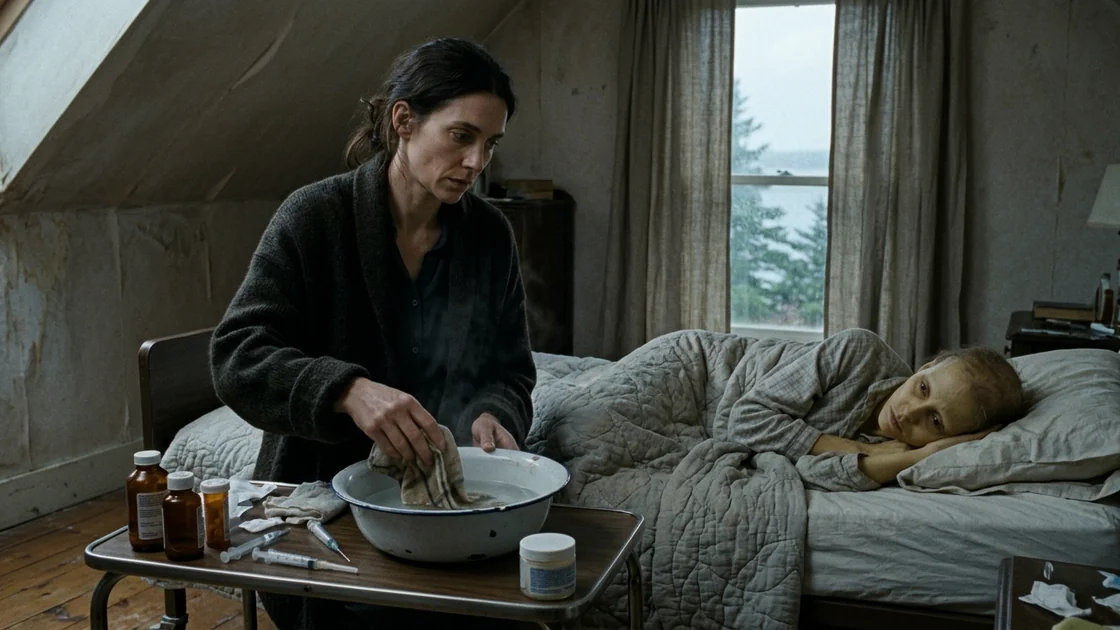
Elena spends the final autumn of her twin sister Maeve’s life carrying basins of warm water, crushing bitter tablets into applesauce, and guarding the singular secret that has rotted her life from the inside out. Two years before Maeve’s diagnosis of aggressive cholangiocarcinoma, Elena crossed an unforgivable boundary into an affair with Maeve’s husband, Julian, a brief and desperate transgression that ended almost as soon as it began but permanently altered the marrow of her conscience. Now, with Maeve confined to a rented farmhouse on the sodden coast of Maine and Julian reduced to an exhausted phantom drifting through the downstairs rooms, Elena serves as primary caregiver, tending to the body that is genetically identical to her own. Every sponge bath, every dosage of liquid morphine, and every gentle caress becomes an act of penance and torture, as Elena is trapped between the unbearable urge to confess and the cruel mercy of silence, forced to watch the sister she loves more than her own soul slip away while drowning beneath the silent weight of their shared face and her own unforgiven betrayal.
I. The Architecture of the Basin
The kettle on the gas range began its thin, metallic whine at five in the morning, long before the light had disentangled itself from the spruce trees outside the kitchen window. Elena did not let it reach its full shriek. She lifted the copper bottom from the blue circle of fire with a practiced, fluid motion of her wrist, cutting the whistle off in its throat before it could travel up the floorboards into the bedroom directly above.
The house was eighty years old, drafty and stubborn, set on a granite shoulder overlooking a grey inlet where the tide went out every afternoon to expose vast fields of mud and bladderwrack. It smelled of boiled liniment, damp salt, and old cedar shavings.
Elena measured two inches of boiling water into the chipped enamel basin, then brought it to the porcelain sink and tempered it with the cold tap until the water felt lukewarm against the soft skin of her inner wrist. The gesture was instinctual now, calibrated over six months of bed baths, the temperature checked the way a young mother tests milk on her arm. But there was no infant in the room above. There was only Maeve.
She carried the basin up the stairs, taking them one by one, favoring the outer edge where the pine steps did not groan. Her left hand gripped the rim of the basin, water trembling against the white enamel; her right hand gathered the skirt of her heavy woolen cardigan against her thighs. On the landing, between the grandfather clock whose pendulum had been stilled to prevent the rhythmic ticking from disturbing Maeve’s headaches and the small table holding an untouched bowl of dried bay leaves, the smell changed. Downstairs belonged to Julian: stale coffee grounds, rain-soaked tweed, and the sour ash of the woodstove he struggled to keep lit. Upstairs belonged entirely to Maeve’s decline: rubbing alcohol, the sickly sweetness of peach-flavored oral swabs, the metallic taint of bile, and the powdery scent of lavender talc that did nothing to mask the underlying odor of an organ failing in the dark.
Elena paused outside the door. She breathed in through her nose, held the damp, cold air in her chest, and arranged her face.
It was an arrangement she had rehearsed in every mirror in the house, though she avoided mirrors whenever possible. It was not vanity she feared; it was recognition. To look into a mirror was to see Maeve’s bone structure, Maeve’s wide-set hazel eyes with the little fleck of rust near the right iris, Maeve’s high, sharp cheekbones that had once seemed sculptural and now looked like scaffolding threatening to tear through dry parchment. They were monozygotic, split from the same egg thirty-four years ago, an identical division of cells that had produced two versions of a single face. For thirty-two years, that sameness had been a secret country they inhabited together, a fluency without words. Now, it was a daily indictment. Every time Elena caught her reflection in the dark glass of an uncurtained window, she saw the ghost of the woman dying down the hall, healthy and blood-filled, wearing her sister’s stolen youth like a thief wearing a murdered queen’s cloak.
She pushed the door open with her hip.
The room was dim. The heavy linen curtains were drawn against the morning drizzle, letting in only a bruised, slate-colored daylight. On the rented hospital bed, positioned near the center of the room so that two people could maneuver around it with tubing and fresh sheets, Maeve lay curled onto her left side. She looked impossibly small, a bundle of dry sticks under the quilted coverlet.
"Maeve?" Elena whispered.
The bundle shifted. A dry, scraping sound came from the throat—the sound of leaves being dragged across asphalt.
"Elena?"
"I’ve got the water," Elena said. Her voice was steady, pitched to that calm, melodic register nurses use, an octave lower than her natural speaking voice. "Just warm water today. We’ll do your hands and your back before the nurse gets here at eight."
Maeve turned her head slowly on the pillow. Her hair, once a thick, dark chestnut that had fallen to her collarbones in heavy waves, was now reduced to a fine, brittle down that clung to her skull in damp patches. Her skin had turned the color of parchment left too long in the sun—not a clean yellow, but a jaundiced, murky olive, the bilirubin pooling in the sclera of her eyes until the whites were the shade of old tea.
Yet when those eyes found Elena’s, the brightness in them was terrifying. It was an acute, fevered intelligence that refused to dim at the same rate as the liver.
"What time is it?" Maeve asked.
"Just past five." Elena set the basin on the wheeled tray table she had cleared of pill bottles the night before. "The rain’s started again. The wind is coming off the point."
"Is Julian asleep?"
Elena’s fingers paused on the corner of the coverlet. Just for a microsecond. A hitch of breath so small that no physician, no stranger, could have noted it. But Maeve’s eyes flicked to Elena’s hand instantly.
"He was down in the study when I got up," Elena said, her voice smooth again. "I think he fell asleep over his papers. I didn't want to wake him."
Maeve let out a long, sighing breath that rattled in her bronchial tubes. "He hasn't slept in a bed for three weeks. He smells like soot, Lena. He came up here last night and kissed my forehead, and he smelled like he’d been burning trash."
"He’s keeping the stove going so the pipes don't freeze," Elena said gently, pulling the quilt down to Maeve’s waist. She kept her eyes fixed on the hem of Maeve’s nightgown. "The frost is coming early this year."
"He doesn't know how to do it," Maeve murmured, closing her eyes as Elena began to unbutton the flannel nightgown. "He never could make a fire last. You always had to rebuild them, remember? In the cabin in Vermont. He’d throw the whole log on top of the kindling and choke it out."
"I remember," Elena said.
She remembered. God help her, she remembered every hour of that cabin in Vermont. She remembered the sound of the birch logs snapping in the hearth, and she remembered the feel of Julian’s rough, chapped hands coming around her ribs from behind while Maeve was four miles down the mountain road in the village pharmacy, searching for a hot water bottle and ginger tea for the early stages of a stomach ache that had not yet been named cancer.
Elena dipped a clean flannel cloth into the warm water, wrung it out until it was damp and steaming, and laid it gently across Maeve’s collarbones.
Maeve shuddered, then relaxed into the heat. "That's good. Oh, Lena, that's good."
"Too hot?"
"No. Just right." Maeve opened her eyes again, staring up at the white plaster of the ceiling. "My skin feels like it’s full of ground glass today. Everything itches. It feels like ants underneath, in the veins."
"The bile salts," Elena said softly. She reached for the small jar of unscented barrier cream on the tray. "I’ll rub the cream in after. It’ll cool it down."
"You have the best hands," Maeve whispered, her voice thinning as she spoke, trailing off into that breathy suspension that signaled her pain was ramping up its morning cycle. "Julian’s hands are too heavy. When he touches my legs, it feels like he’s trying to hold onto something that’s already falling. He grips. You don't grip."
Elena dipped the cloth again. She worked in small, circular strokes down Maeve’s arm, wiping away the night’s sweat, moving over the purple hematomas where the home-health nurses had tried and failed to find viable veins for blood draws before they finally installed the port in her chest.
You don't grip, Maeve had said.
Elena looked down at her own fingers. Long, narrow, with the slightly crooked index finger that both of them had inherited from their maternal grandfather. These were the hands that had smoothed the linen over Maeve’s chest, the hands that had measured drops of concentrated morphine into a plastic syringe, the hands that had, twenty-two months ago in a rain-slicked hotel room off the Boston turnpike, dug their nails into the muscles of Julian’s shoulder blades while he wept into her neck.
She had not gripped him then, either. She had surrendered to him with a ravenous, self-obliterating stillness that had felt, in that blind and miserable winter, like an act of profound mercy to them both.
"Elena?"
Elena blinked, her thumb resting on the pulse point of Maeve’s thin wrist. "I'm here."
"Did you take your pills this morning?"
A tiny, bitter knot tightened in Elena’s stomach. Even now, stripped of her career as an archivist, stripped of her hair, her dignity, her autonomy, Maeve was still the older twin by seven minutes. She was still the one who kept track of the calendar, who asked if Elena had remembered her thyroid medication, who fretted over whether Elena was eating enough iron.
"I’ll take them with my tea," Elena lied. She hadn't taken them in four days. The dull, thumping lethargy in her limbs felt like an appropriate baseline for the work she had to do. "Don't worry about me."
"Someone has to," Maeve murmured, her eyelids drooping. The warmth of the water was doing its work, coaxing her back toward the cloudy borders of sleep. "Julian doesn't notice things. He’s like an engine running without oil. You can hear him grinding from three rooms away."
"He loves you, Maeve." The words came out of Elena’s mouth like stones she was forced to regurgitate, heavy and dry and jagged.
Maeve did not answer immediately. Her head rolled slightly toward the window, where the rain was tapping against the glass like small, frantic fingers.
"I know he does," Maeve said, her voice dropping into a register so faint Elena had to lean down, her ear nearly brushing her sister’s chapped lips. "That’s what makes him look so guilty. He looks at me like he’s the one who broke me."
Elena’s heart slammed against her ribs with such violence she felt the pulse of it in her teeth. She froze, the washcloth suspended above Maeve’s sunken abdomen. The skin there was mapped with blue veins, distended slightly from the fluid that was slowly accumulating in the peritoneal cavity, fluid the hospice doctor would have to drain again by Friday if Maeve wanted to breathe without gasping.
"He didn't break you," Elena whispered, her throat closing. "Nobody broke you, Maeve. It’s just... the cells. It’s just bad luck."
"Bad luck," Maeve echoed. The word seemed to drift out of her, carried away on the shallow tide of her breathing. "We never had bad luck when we were girls. We had each other. It was like having a duplicate key to the world. If I lost mine, you had yours."
"I still have it," Elena said, though she knew the key was rusted, snapped off in the lock, useless.
"Turn me, Lena," Maeve breathed. "My hip is burning."
Elena set the cloth down in the basin, wiped her hands on the dry towel pinned to her waist, and moved around the side of the bed. She slid one arm beneath Maeve’s sharp shoulder blades and the other beneath her pelvic bones. With the synchronized, effortless balance they had shared since childhood—the physical intimacy that had never required negotiation—she rolled her sister toward her own chest, propping a foam wedge beneath the bony prominence of Maeve’s spine.
Maeve let out a long, shuddering groan, her forehead coming to rest against Elena’s collarbone. For three seconds, five seconds, they remained like that: the dying woman and the living woman, pressed together in the grey light of an attic room, their hearts beating within inches of one another through bone and wool and linen, identical in rhythm, identical in code, separated only by the monstrous, arbitrary fact of an incurable growth and an unconfessed sin.
Elena closed her eyes and pressed her lips to Maeve’s cold, dry temple. She tasted salt and the faint, bitter dust of pharmacy compounds.
Forgive me, she thought, the words pressing behind her teeth like blood. Forgive me, forgive me, forgive me.
Maeve’s hand, light as a dried leaf, rose from the sheet and patted Elena’s forearm twice.
"Good girl," Maeve whispered, already half-submerged in the grey sea of the morning’s exhaustion. "Good girl, Lena."
II. The Silt of the Years
Downstairs, the floorboards yielded with a sharp, dry pop under Elena’s wool socks.
The kitchen had not been properly cleaned since Tuesday. A cast-iron skillet sat on the unlit burner, containing a congealed skim of bacon fat from three days ago when Julian had made an abortive attempt to eat breakfast before vomiting it into the compost bucket. The sink was piled with heavy white mugs, each ringed with the brown waterline of forgotten black tea.
Julian was sitting at the harvest table by the back door, his elbows propped on either side of an open, unread paperback whose spine was split in three places. He was wearing the thick cable-knit sweater Maeve had knitted for him four winters ago—the charcoal one with the slightly uneven stitches around the left cuff where she had run out of the original dye lot.
When the latch clicked, he did not jump. He simply lifted his head with the heavy, dragging slowness of a draft horse that had been whipped past the point of feeling.
His face was an unmapped territory of grief. At thirty-six, he had been a handsome man in an angular, slightly disorganized way—a high school history teacher who wore scuffed leather boots and spoke with an animated, rambling passion about the Reconstruction era. Now, his cheeks were hollow, greyed by four days of stubble, and his dark eyes were sunken into violet sockets that made him look like a survivor of a long siege.
"She’s awake?" he asked. His voice was cracked, the low, rasping baritone Elena remembered against the hollow of her throat in a room where the radiator had clanged like an iron bell.
"She was," Elena said, keeping her back to him as she set the basin in the sink and emptied it. The soapy, tinted water swirled down the brass drain with a soft gurgle. "She’s drifting again. The pain woke her early. I gave her the liquid concentrate—three drops under the tongue."
"Did she take it?"
"She always takes it from me."
It was not a boast; it was a simple, brutal statement of fact, but it landed between them like a shard of broken glass. Julian looked down at his unread book, his thumb picking at the frayed paper edge of page ninety-two.
"The hospice nurse is coming at eight," he said.
"I know. Sarah. She’s bringing the new dressing packs for the port."
"I should go into town," Julian said, though he made no move to rise. "We need more paraffin for the lamps if the wind brings the lines down. The forecast on the radio said forty-knot gusts by noon."
"We have three gallons in the pantry," Elena said, wiping the sink counter with a rag. "We don't need paraffin. We need more ginger ale. The small cans, not the bottles. She can’t lift the bottles."
"Right. The cans."
Silence fell between them, thick and stagnant as puddle water.
This was the rhythm they had established over the four months since Maeve had been discharged from the hospital in Portland to die in this rented house by the sea: a rigid, formal politeness that resembled the interaction of two strangers who had survived a train derailment and were now forced to share an emergency shelter. They did not touch. They did not sit in the same room unless Maeve was present to act as their anchor and their screen. When their hands accidentally brushed while passing a loaf of bread or a box of medical gloves, both pulled back as if they had touched the hot surface of an iron.
Yet the guilt was not an absence; it was a physical presence that occupied the third chair at the table.
Elena poured hot water over a fresh tea bag in a clean mug. She took a carton of milk from the icebox, smelled it to make sure it hadn't turned, and added a splash.
"You should eat something, Julian," she said, her back still turned.
"I'm fine."
"You're not fine. You look like you're going to faint every time you carry a basket of split wood up the porch."
"I said I'm fine, Elena."
The use of her name was rare. Usually, he called her nothing at all, speaking into the middle distance, letting his sentences dangle until she chose to pick them up. Hearing Elena from his lips produced a sickening flutter in the base of her throat, an echo of a time before the sickness, when her name had been whispered with an urgent, terrified hunger.
She turned to face him, the mug warm between her palms.
"We have to keep going for another three weeks, the doctor said. Maybe four. You can't collapse now. She needs you to look like a husband, not a corpse."
Julian flinched. A dull, dark flush rose from beneath the collar of his charcoal sweater, staining his throat.
"Is that what you think I look like?" he asked, his voice dropping. "A corpse?"
"I think you look like someone who wants to run away," Elena said with ruthless, quiet precision. "And you can't. Neither of us can."
Julian slammed his hand down on the table. The paperback leaped an inch into the air; a spoon rattled against the edge of an empty saucer. The suddenness of the noise in the quiet house was like a gunshot.
Both of them froze, their eyes darting upward to the ceiling, listening for any sign that the sharp crack had reached through Maeve’s narcotic fog.
For ten seconds, they stood suspended in the stillness, holding their breath together. The house creaked in the wind. A cedar branch scraped rhythmically against the kitchen gutter: hiss, tap, hiss, tap.
Upstairs, there was no movement.
Julian lowered his head into his hands, his fingers digging into his hair, his elbows propped on the scarred pine table. His shoulders hitched once, twice, in a dry, silent sob that tore at his ribs without producing a single tear.
"I can't look at her, Lena," he whispered into his palms. "I go in there and I look at her face, and I see what she was three years ago, and then... then I look at you, and you're standing right next to her, and it's like... it's like a trick. It's like God is playing a filthy, obscene trick on me."
Elena didn't move from the sink. She held her mug with both hands, using the heat of the ceramic to anchor her knuckles against shaking.
"Don't do that," she said, her voice ice-cold and brittle. "Don't you dare do that."
"Do what? Tell the truth?" Julian lifted his head. His eyes were bloodshot, wild with the manic exhaustion of three months without four consecutive hours of sleep. "We're living in a tomb, Elena. She’s dying, and we’re the ones who killed her."
"Stop it!" Elena hissed, stepping forward, her voice a sharp, furious whisper that cut through the room like a scalpel. "The cancer killed her! The mutation killed her! You don't get to take credit for her tumors, Julian! You don't get to make her dying about your precious, pathetic conscience!"
Julian stared at her, his mouth slightly open, the breath whistling in his nostrils.
"You think that's what I'm doing?" he whispered.
"I know that's what you're doing," Elena said, trembling now, the hot tea slopping over the rim of her mug and scalding her thumb. She didn't wipe it away. "You want to confess. I see it every time you sit on the edge of her bed with that stupid, dog-like look on your face. You want to drop to your knees, put your head on her belly, and tell her everything so she can stroke your hair and say, 'I forgive you, Julian, I know it was hard for you.' You want her to absolve you before she dies so you don't have to carry it for the next forty years."
Julian leaned back in his chair as if he had been struck across the mouth. His face went entirely white, the dark stubble standing out against his skin like charcoal marks on paper.
"And you don't?" he asked, his voice barely audible. "You don't want that?"
"No," Elena said, her voice dropping into a register of terrifying certainty. "Because I love her more than I hate myself. If I tell her, I buy my peace with her agony. She would die knowing that the two people she trusted most on this earth spent her last healthy winter lying to her face in the dark. She would die homeless inside her own family."
She took a step closer to the table, leaning over it, her eyes bore directly into his.
"We will eat it," Elena whispered. "We will swallow every scrap of it until it turns to lead in our guts, and we will carry it out of this house when she's gone, and we will never speak of it again. That is the only decent thing left for us to do. Do you understand me?"
Julian didn't answer. He looked at her—at her wide, clear hazel eyes, her high cheekbones, the small brown mole just below the left corner of her bottom lip—and he shuddered. He looked away, turning his gaze back to the window where the rain was turning to sleet, rattling against the glass like a handful of rice.
"I understand," he said to the pane of glass.
III. The Memory of the Silt
The affair had not been born of grand passion. That was the most wretched, humiliating part of the entire affair: it had lacked the stature of tragedy. It had been small, clumsy, and damp, an accident of proximity and exhaustion that had taken root during the long, bitter winter two years ago.
Maeve had been working seventy hours a week at the state historical society in Augusta, cataloging the nineteenth-century shipping manifests of the Kennebec River, a project funded by a grant that was running out of money. She had been manic, driven, living on black coffee and toast, staying in an apartment near the archives three nights a week to avoid the commute through the blinding snowstorms.
Julian had been left behind in their drafty cape-style house in Brunswick. And Elena, who had just broken off an engagement to a mild-mannered high school biology teacher whose touch had bored her to tears, had taken to driving down on weekends to help Julian insulate the attic and keep him company.
It had begun with the house. That was what Elena told herself during the long, sleepless nights in her own bed: it was the fault of the old house.
Julian had been trying to replace the subflooring in the back bedroom, and he had sliced his palm open on a rusty square-headed nail. Elena had been in the kitchen, boiling potatoes for a stew. She had heard him curse—not loudly, but with a flat, weary disgust—and had come up the stairs with the first-aid kit.
He had been sitting on an exposed joist, the raw pink insulation showing between the beams like the exposed meat of an animal, holding his bleeding hand over an empty cardboard box.
"Let me see," she had said.
She had knelt between his knees on the dirty plywood. She had taken his wrist—that same narrow, sinewy wrist she had seen him use to turn the pages of his books—and cleaned the puncture with iodine. He had winced, his breath catching in his throat, his thighs tightening slightly on either side of her shoulders.
When she looked up to tell him it didn't need stitches, his face had been six inches from hers.
It was the first time she had ever truly seen him without Maeve standing in the intervening space. Always, since Maeve had brought him home from graduate school eight years before, Julian had been a reflection of Maeve’s taste, Maeve’s choice, Maeve’s orbit. He was the man who made Maeve laugh with his absurd imitations of departmental deans; he was the man who brought Maeve wool socks when her feet were cold; he was the man who shared Maeve’s bed.
Elena had loved him because Maeve loved him. It had been an extended, familial affection, safe and regulated by the strict borders of sisterly propriety.
But kneeling there on the cold subfloor, with the smell of old dust and mineral wool in the air and the red drop of his blood smearing the side of her thumb, the boundary had simply vanished. It had not cracked; it had dissolved like sugar in hot tea.
"You look so much like her," Julian had whispered, his voice trembling with an emotion that was half terror and half hunger.
"I know," Elena had said.
She should have stood up. She should have packed the adhesive tape back into the tin box, gone down to the kitchen, and stirred the potatoes until the water boiled away. She should have driven her car back to her own apartment in Bangor through thirty miles of unplowed drifts.
Instead, she had lifted her unsoiled hand and touched the line of his jaw.
It was an experiment. A dreadful, curious experiment to see what it felt like to be the center of that particular gravity. For all their lives, Maeve had been the first draft of their existence: the one who spoke first, who loved first, who chose first. Elena had been the second edition, revised and corrected, perhaps, but lacking the original spark of priority.
When Julian leaned down and kissed her, his mouth had tasted of black coffee and the cold air of the attic. It had been clumsy, desperate, full of the mutual loneliness of two people who felt like supporting characters in the intense, brilliant narrative of Maeve’s ambition.
They had stayed on the floor between the exposed joists. Afterward, Elena had found pink fiberglass insulation embedded in the wool of her sweater, itching against her bare back like an invisible rash that would not go away for three weeks.
The affair had lasted eleven days.
They met twice more: once in a motel behind an abandoned bowling alley off Route 1, where the carpet smelled of old smoke and the television bolted to the wall played infomercials with the sound off, and once in Elena’s own kitchen, while the snow fell in massive, wet clots against the dark glass.
It had ended not with a dramatic confrontation or an attack of noble conscience, but with a phone call.
Maeve had called Elena’s landline at eleven o'clock on a Tuesday night. Elena was sitting on the floor of her living room, her hair still wet from the shower, Julian asleep on the braided rug behind her with his arm thrown over his eyes.
"Lena?" Maeve had said. Her voice had sounded small, tinny, distorted by the bad reception on the turnpike. "I'm coming home early. The archive director had a stroke this afternoon. They’ve closed the collection until the spring."
Elena had looked at Julian’s bare shoulder, pale and vulnerable in the amber light of the floor lamp.
"Are you on the road now?" Elena had asked, her voice as flat and level as a frozen lake.
"I’m just past Freeport," Maeve had said. "The plows haven't been out. The car is sliding all over the lane. Lena... I'm scared. I don't know why, but I just have this horrible feeling that something’s wrong."
"Nothing’s wrong," Elena had said. "Go slow. Keep your lights on low beam."
"Will you call Julian? His cell goes straight to voicemail. Tell him to leave the porch light on for me?"
"I’ll tell him," Elena had said.
When she hung up the receiver, she had walked over to Julian, kicked the sole of his boot with her bare foot, and said: "Get up. She's at Freeport."
He had left without washing his face, his coat unbuttoned, his boots untied. Elena had spent the next three hours stripping her sheets, running them through the wash on the hottest cycle with two cups of vinegar, and scrubbing the kitchen counter with bleach until her knuckles were raw and white.
Maeve had arrived home at two in the morning. Julian had been waiting on the porch, the yellow light burning, a pot of fresh tea on the stove.
The affair was never spoken of again. When they saw each other at Sunday dinners or family holidays, they did not exchange significant glances; they did not seek each other out in the corners of rooms. They behaved with the absolute, terrified formality of two people who had handled unexploded ordnance and survived with their limbs intact.
Sixteen months later, Maeve noticed that her skin was turning yellow under the bathroom lights.
IV. The Grammar of Care
At eight o'clock, the blue station wagon of the home-health service pulled into the gravel drive, its tires crunching the wet stones with a wet, heavy rhythm.
Sarah was a woman of fifty-five with iron-grey hair cut into an efficient bob and the calm, unsentimental cheerfulness that belongs only to women who have seen several hundred people die and know that the process, while messy, is entirely natural.
"Morning, Julian," Sarah said, stomping her wet boots on the rubber mat inside the door. She carried a canvas tote bag bulging with blue paper drapes, saline flushes, and sterile gauze. "Wind's picking up out there. The ferry from the island was cancelled this morning."
"Morning," Julian muttered, hovering near the kettle like an awkward servant. "Do you want tea?"
"No, love, had two cups before I left Rockland. I'll go straight up. How was the night?"
Elena came down the stairs, carrying the empty applesauce bowl and the used plastic syringe. "She woke twice with right upper quadrant pain. I gave her zero-point-five of the concentrate at two, and another zero-point-five at five. Her urine was very dark this morning—like port wine."
Sarah nodded, her face settling into professional gravity. "The kidneys are taking the strain now. It's to be expected. Did she eat?"
"Two spoonfuls of the puree. Half a cup of water with a straw."
"Good girl," Sarah said, using the same phrase Maeve had used, tapping Elena’s shoulder with a firm, rubber-soled familiarity. "You're doing a wonderful job, Elena. Truly. Most families would have thrown in the towel and sent her to the inpatient unit in Augusta weeks ago. It's rare to see a sister with such... dedication."
The word dedication sat between Elena’s ribs like a dry bone.
"She wants to be here," Elena said.
"Well, she's lucky she has you," Sarah said, already halfway up the stairs, her tote bag clinking with glass vials. "A twin is a special thing. My mother had a twin sister. They used to say they could feel each other's toothaches."
Elena stood at the foot of the stairs, her hand on the newel post, watching Sarah’s sturdy, woolen-clad back disappear around the landing.
They could feel each other's toothaches.
When they were nine, Maeve had fallen out of the old apple tree behind their grandmother's house in Camden, snapping her left collarbone with a sound like a dry branch breaking. Elena, who had been sitting forty yards away on the stone wall reading a book about horses, had dropped the volume and clutched her own left shoulder, screaming before Maeve had even hit the grass.
Their mother had made a legend of it: The Girls with One Heart.
Whenever one of them was sick, the other had lingered near the bedroom door like a shadow, waiting for the fever to break, feeling the dull ache in her own joints. They had swapped dresses; they had answered to each other’s names in fourth-grade spelling bees to see if the teacher could tell the difference; they had lived in that total, terrifying symmetry that identical twins either flee from in adolescence or surrender to for the rest of their lives.
Maeve had surrendered to it. Elena had fled from it—until the flight had brought her directly into the bed of the only man Maeve had ever chosen.
"Elena?"
Julian was standing three feet away, holding a blue ceramic pitcher of water.
"Take it up to Sarah," Elena said without looking at him. "She'll need it for the wound flush."
"You go," Julian said, his voice pleading. "Please. Lena, I don't know what to do with the dressings. When Sarah pulls the tape off, the skin... it comes with it. I can't watch it. I get sick."
Elena looked at him then. His face was crumpled, pathetic in its weakness. This was the man she had allowed to touch her; this was the man whose sweat had soaked into her hair while her sister was driving home through a blizzard. He was not a monster. He was simply small. He was a small, fragile creature who had been caught in the machinery of a catastrophe that required giants, and he was failing at every turn.
"Give it to me," she said, snatching the pitcher from his hands. Her fingers touched his for an instant, cold ceramic passing between them, and she felt the small, reflexive jolt of his pulse against the glaze.
She went up the stairs two at a time.
In the bedroom, Sarah had already stripped the blankets back and turned Maeve onto her side. The port on Maeve’s upper chest—a small, titanium disc buried beneath the skin with a rubber septum—was red around the edges, the skin thin and glistening like the membrane of a drum.
"She’s got a little breakdown here at the margin," Sarah said, pointing with a gloved finger. "We'll need to clean it with the betadine and put a hydrocolloid border on it. Maeve, sweetheart, this might pinch a bit."
Maeve did not open her eyes. Her breath came in short, dry puffs through her open mouth. "Do what you have to do, Sarah."
Elena set the pitcher on the table and moved to the opposite side of the bed. She took Maeve’s hand—the left one, the one that had broken forty years ago in the orchard—and laced her fingers through her sister's.
Maeve’s fingers were cold, the nails bluish-purple at the crescents. She squeezed Elena’s hand with surprising strength.
"Lena?"
"I'm here."
"Don't let them take me to the hospital," Maeve whispered, her eyes still shut tight against the pain of the adhesive being peeled from her chest. "If I go in the ambulance, I won't come back out."
"You're not going anywhere," Elena said. She smoothed the hair back from Maeve’s forehead, pressing her thumb against the tight knot of muscle between her sister's eyebrows. "You're staying right here. The wind is coming up. We're going to make a chowder tonight, just the broth, the way you like it."
"With the dill?"
"With the dill from the garden. The dried stuff."
"Julian hates dill," Maeve murmured.
"Julian isn't the one who matters today," Elena said.
Across the bed, Sarah looked up from her tray of sterile gauze, her eyes meeting Elena’s for a long, quiet second over the yellowed curve of Maeve’s ribs. There was no judgment in Sarah's face—only the deep, infinite pity of an outsider who sees a family being ground down by the slow wheels of an ordinary tragedy.
"Hold her steady, Elena," Sarah said gently. "I'm going to flush the line now."
Elena held her. She leaned her weight over the bed, pressing her chest against Maeve’s shoulder, absorbing the tiny, violent shudder that went through her sister’s body as the cold saline surged into the central line. She held her so tightly that she could feel the distinct, metallic rhythm of Maeve’s failing pulse against her own breastbone, a double-beat that sounded in the silence of the room like two clocks running down in an empty house.
V. The Driftwood
By mid-afternoon, the wind had fulfilled the radio’s promise.
The spruce trees at the edge of the granite ledge bent toward the water, their dark tops thrashing against a sky the color of zinc. The rain had ceased, replaced by a dense, flying mists of salt spray that coated the seaward windows with a greasy, grey film.
Sarah had gone, leaving behind three boxes of morphine ampoules, two packs of adult diapers, and an ominous yellow container for medical waste that sat in the corner of the landing like an idol.
Maeve was asleep, knocked flat by an increased dose of the oral solution that Sarah had authorized before leaving. "She’s entering the transitional phase," Sarah had whispered to Elena on the porch, her coat collar turned up against the damp. "The confusion will increase. She might start talking to people who aren't there—your parents, maybe. Don't correct her. Just enter the reality she's in. It saves them the fright."
"How long?" Elena had asked.
Sarah had looked out over the grey mudflats where the tide was beginning to turn, creeping back in with long, white ribbons of foam. "A few days. A week, if her heart is strong. But her kidneys are backing up, Elena. You'll see the breathing change soon. It’ll get ragged. Don't be alarmed by the sound. It bothers you more than it bothers her."
Now, Elena walked down the rocky path toward the shoreline, her hands jammed deep into the pockets of an old pea-coat that smelled of salt and Julian’s tobacco.
She needed to get out of the house. For forty minutes, while Maeve was deep in the morphine-well and Julian sat by her bedside reading aloud from a history of the Penobscot expeditions in a flat, monotone voice that could do no harm, Elena had run.
The air on the beach was violently cold. It struck her face like a wet towel, stinging her cheeks, clearing the smell of betadine and rotting liver from her sinuses.
She walked along the high-water line, kicking at the dried ribbons of kelp and the broken blue shells of mussels. A dead cormorant lay half-buried in the silt, its neck twisted back at an impossible angle, its black feathers slick with grease. She stopped and looked down at it.
It looked peaceful. That was the terrible, seductive lie of death: the appearance of rest. Maeve did not look restful; she looked conquered. She looked like a city that had been shelled day and night for six months until every wall was down, every garden burned, every cistern poisoned, and the conqueror was now simply wandering through the ruins, smashing the remaining crockery for sport.
"Elena!"
She turned.
Julian was walking down the path from the house, his boots sliding on the wet pine needles that covered the granite steps. He had not put on a coat; he was wearing only his flannel shirt, the wind whipping the thin cotton against his ribs, his arms crossed over his chest.
He reached the gravel beach, breathing heavily, his face white from the spray.
"She's awake," he said.
"Already?" Elena’s stomach dropped. "She shouldn't be awake for another two hours."
"She’s... she’s different, Lena. She's talking. She asked for you."
"Did she take more water?"
"No." Julian stopped three feet from her, the sea wind blowing his dark hair into his eyes. "She asked where we were."
"Where who was?"
"Us," Julian whispered, his voice cracking against the roar of the surf behind them. "She asked why we were standing by the well in Vermont. She said she could see us through the kitchen window, holding hands by the well."
Elena felt the blood leave her head. The world tilted slightly; the grey horizon of the bay swung upward, then righted itself.
"There is no well in Vermont," Elena said, her voice dropping into a harsh whisper.
"I know," Julian said. He looked down at the dead cormorant between their boots, then up into Elena’s face. "There was an old cistern behind the shed, Elena. Don't you remember? That afternoon when it snowed thirty inches. You were wearing my red scarf. We stood by the cistern while she was in the bathroom upstairs."
Elena closed her eyes.
She remembered. She had forgotten the cistern, but now the memory rushed back with the force of an icy wave: the two of them standing in the blinding white yard, their mittens touching, Julian’s red wool scarf wound twice around her neck, both of them staring up at the second-floor window where the yellow light was burning, terrified that Maeve would pull the curtain aside and see them standing too close, their breath mingling in a single, pale cloud in the sub-zero air.
"She saw us," Julian whispered. He reached out, his hand shaking violently, and grabbed the sleeve of Elena’s pea-coat. "Elena, she saw us. She knew the whole time."
"Shut up," Elena said, wrenching her arm from his grip. "Shut up, Julian!"
"She knew!" he cried out, the wind snatching the words from his mouth and flinging them out over the water. "Two years! She lived with it for two years and never said a word! She’s been sitting up in that bed watching us take care of her, knowing that we—"
Elena struck him.
She didn't plan it. Her hand simply came out of her pocket, curled into a hard, bony fist, and struck him across the bridge of his nose.
The impact was wet and solid. Julian stumbled backward on the loose shale, his boots slipping, his arms windmilling until he caught himself on the trunk of a fallen spruce. He sat down hard on the wet bark, his hand flying to his nose.
A thin line of dark blood was already leaking between his knuckles, dripping onto the collar of his flannel shirt.
He looked up at her, not with anger, but with a strange, dazed relief, as if he had been waiting two years for someone to hit him.
"Don't you ever say that again," Elena hissed, her voice vibrating with a fury so pure it felt like electricity in her teeth. "Don't you ever make her smaller than she is. She was confused, Julian. Sarah told us this would happen. Her brain is full of toxins because her liver isn't filtering the blood. She's remembering pieces of forty years of life and stitching them together in the dark. She doesn't know about the cistern. She doesn't know about the attic. She doesn't know about the hotel."
Julian wiped his nose with the back of his sleeve, smearing the blood across his upper lip. "And if she does?"
"Then she is better than both of us," Elena said, her voice dropping into a register of utter ruin. "And she will take that superiority to the grave, where it belongs. Now get up. Clean your face with salt water. If she sees blood on you, it will scare her."
She turned her back on him and began the long climb up the granite steps, her legs burning with lactic acid, her chest heaving against the cold salt wind.
VI. The Country of the Bed
When Elena entered the room, the quality of the light had changed.
The sun had sunk behind the spruce ridge, casting a final, dull copper sheen across the ceiling before the total darkness of the October night set in. The lamp on the bedside table was switched on, its parchment shade casting a small circle of butter-colored light over Maeve’s hands.
Maeve was sitting slightly upright, supported by four pillows Elena had arranged that morning. Her eyes were open, wide and glossy, reflecting the small bulb of the lamp like two dark lenses.
She was not looking at the door; she was looking at her own fingers, which were plucking continuously at the threads of the cotton quilt, lifting a stitch, dropping it, lifting it again.
"Maeve?" Elena said, stepping softly across the threshold.
Maeve’s head turned. The movement was bird-like, sudden and jerky, lacking the smooth coordination of her former self.
"You took off the scarf," Maeve said.
Elena stopped three paces from the bed. Her heart felt as though it were being compressed by an iron band. "What scarf, sweetie?"
"The red one," Maeve said. Her voice was clear—unnaturally clear, devoid of the gravelly rasp that had clogged it for the past two days. "The one Julian bought in Montreal. You always looked better in red than I did. It makes your eyes green. On me, it makes me look like a radish."
Elena could not breathe. She stood frozen in the circle of lamplight, her boots feeling as if they were bolted to the old pine floorboards.
"Maeve," she began, but her tongue was dry, stuck to the roof of her mouth like leather.
Maeve looked at her with a curiosity so intense, so stripped of pretense, that Elena felt her skin prickle. There was no rage in Maeve’s face. There was no wounded pride. There was only a vast, terrifying stillness, the stillness of someone who had traveled twenty miles past the border of a country where human laws no longer applied.
"Come here, Lena," Maeve said, patting the edge of the mattress with her bird-leaf hand. "Sit down. You're always standing up. You've been standing up for six months."
Elena’s legs moved without her consent. She walked to the bed, turned, and sat down on the very edge of the wood frame. The mattress dipped under her weight, bringing her hip against Maeve’s covered knee.
Maeve reached out and took Elena’s chin in her fingers.
Her touch was freezing. The skin of her fingertips was rough from dehydration, but her grip had that peculiar, wiry strength of people in the final stages of terminal illness, a strength that seems borrowed from some external, non-human source.
She turned Elena’s head toward the light, examining her profile: the line of the nose, the curve of the nostril, the tiny mole below the lip.
"We have the same face," Maeve whispered, more to herself than to Elena. "It’s funny. When we were little, I used to think that if I died, you’d have to die too, because there was only one soul between us and we were just using two sets of legs to carry it around."
"Maeve, don't," Elena choked out. A tear broke from her right eye, hot and heavy, tracking down through Maeve’s dry fingers.
"Don't cry," Maeve said, her thumb moving over Elena’s cheekbone, catching the salt drop and spreading it across her skin. "I'm not angry, Lena."
The room seemed to shrink until there was nothing left in the universe except the bed, the lamp, and the two faces that were the same face.
"You knew?" Elena whispered.
The question had escaped. It was out. It could never be called back, never be denied, never be rewritten. It hung between them in the cold room, naked and putrid and irreversible.
Maeve let her hand fall from Elena’s chin. It landed back on the quilt, her fingers resuming their slow, rhythmic plucking at the blue threads.
"I knew before you did," Maeve said softly. "I knew the way he looked at you when you were laughing at his jokes. He never looked at me like that. He looked at me like I was his homework. He looked at you like you were the answer key."
A sob tore out of Elena’s chest, sharp and ugly, sounding like an animal caught in a wire fence. She dropped her forehead against the edge of the mattress, her hands clutching the wooden frame until the splinters bit into her palms.
"I'm sorry," she gasped into the wool of the blanket. "I'm sorry, I'm sorry, Maeve, I'm so sorry, I would die for you, I would trade places with you right now, I swear to God, I swear on our mother's grave, I would trade—"
"Stop it," Maeve said.
The tone was not cruel, but it had the authority of an iron bar falling into place.
Elena stopped. She stayed with her head against the mattress, her shoulders shaking, her tears soaking into the hem of the sheet that covered her sister’s dying limbs.
"You can't trade," Maeve said. "That’s the rule. You get the healthy liver, Lena. You get the thirty more years, and the white hair, and the knees that hurt when it rains. You get to be the one who remembers."
She paused, her breathing hitching in her chest with that wet, rattling sound that Sarah had warned them about.
"I didn't say anything," Maeve continued, her voice growing thinner now, the unnatural clarity beginning to dissolve back into the morphine-fog, "because I didn't want to spend my last two years being a woman whose husband slept with her sister. That's a ridiculous thing to be. It's so... vulgar. I wanted to be Maeve. Just Maeve. The one who did the Kennebec manifests. The one who had the grant."
Elena lifted her head. Her face was swollen, wet, ugly with the mucus and salt of pure grief. "Maeve..."
"He’s very weak, you know," Maeve said, her eyes drifting toward the window where the night was now complete, black and starless against the glass. "Julian. He’s like an empty house. If you don't put furniture in him, he just echoes."
"I don't love him," Elena whispered, and for the first time in two years, the words were completely, perfectly true. Looking at Julian on the beach with his bloody nose, she had felt only an infinite, barren pity. "Maeve, I swear to you, I don't love him. It was just... I was so lonely. I was so jealous of how sure you were of everything."
Maeve smiled. It was a terrible, beautiful grimace that showed her teeth, yellowish against her pale gums.
"I was never sure of anything," Maeve said, "except that you were thirty seconds behind me when we were born, and you’d be thirty seconds behind me until the end."
She reached out and took Elena’s hand again, pulling it toward her chest, pressing Elena’s palm flat against the center of her ribcage, right over the port, right over the racing, failing heart.
"You hold him up until I'm in the ground," Maeve ordered, her eyes closing as the drug surged back through her system, dragging her down into the dark water. "You hold him up, Elena. Don't you dare let him fall apart while people are looking. And then... when I'm gone... you leave him."
"I will," Elena wept. "I will."
"You leave him alone in that house," Maeve murmured, her voice now barely louder than the scrape of the cedar branches against the roof. "And you go back to Bangor. And every time you look in the glass to put your lipstick on, you remember that you're using my mouth."
VII. The Cheyne-Stokes
Julian came into the room at ten o'clock.
His nose was swollen, purple across the bridge, with a small strip of white adhesive tape he had applied himself in the bathroom mirror. He had put on a dry sweater, dark blue and smelling of mothballs, and he carried a fresh glass of water that neither of them would drink.
He saw Elena sitting by the bed, her hand still clasped in Maeve’s. He saw the tracks of tears dried into the salt on Elena’s cheeks, and he saw the stillness of Maeve’s face.
"Is she...?" he began, his voice failing entirely.
"No," Elena said. Her voice was steady now. The tears were done. What was left was the flat, grey bedrock that lies beneath an ancient glacier. "She’s in the coma. Sarah called it the transitional state. She won't wake up again, Julian."
Julian dropped the glass. It didn't break; it landed upright on the braided rug, the water splashing over his boot and the edge of the baseboard heater.
He fell to his knees beside the bed, opposite Elena, his forehead hitting the sheet with a dull thud. His hands reached out to touch Maeve’s feet under the quilt, finding the small, cold shapes of her ankles and clutching them through the wool.
"Maeve," he groaned. "Maeve, baby. Maeve."
Maeve did not stir.
Her chest rose, stopped, hung suspended in the air for ten seconds, fifteen seconds, twenty seconds—a terrifying, impossible pause during which the entire room seemed to hold its breath with her—and then released with a long, rattling groan that came from the very base of her lungs.
Cheyne-Stokes respiration. The breathing of the dying. The body forgetting how to command its own diaphragm, the brain stem running out of fuel, firing sporadically like an engine with water in the carburetor.
Julian looked up at Elena, his face twisted in horror. "What is that? What’s that sound?"
"It’s her lungs," Elena said, not moving. "She isn't choking. It doesn't hurt her. It’s just the reflex."
"We should call Sarah. We should get the oxygen."
"The oxygen won't change it, Julian. It just prolongs the reflex for another six hours. Sarah said we should let the rhythm run down."
"I can't listen to it," Julian sobbed, pressing his palms against his ears. "It sounds like she's drowning."
"She is drowning," Elena said with ruthless, merciless clarity. "Her organs have failed. The fluid has nowhere to go. This is what dying is, Julian. It isn't a poem. It isn't a conversation. It's this."
She reached across the bed, took Julian’s wrists, and pulled his hands away from his ears.
He resisted for a moment, then his muscles turned to water. She forced his hands down onto the mattress, right beside Maeve’s hip.
"You sit here," Elena said, her voice commanding, the older twin now, the one who held the keys. "You take her hand. You stay here until the breathing stops. That is what you owe her."
"I can't," he wept.
"You can," Elena said. "And you will."
They sat through the night.
The wind died down around two in the morning, leaving the world outside in an eerie, absolute silence, broken only by the rhythmic, distant suck of the tide against the mudflats. Inside the room, the breathing was the only clock that mattered:
Rise. Rattle. Hold. Silence. Fall.
Twenty seconds of pause became thirty. Thirty became forty-five. Several times, Julian lifted his head, thinking the end had come, only for the dry, scraping gasp to tear through Maeve’s throat once more, dragging her back to the surface of the biological machine for one more circuit.
Elena never let go of Maeve’s hand.
With her other hand, she dipped an oral swab into a cup of lemon-flavored water and moistened her sister’s lips, wiping away the small flecks of dried brown foam that appeared at the corners of her mouth. She performed the service with a rhythmic, mechanical perfection, her face blank, her mind empty of everything except the count of the seconds between the breaths.
At four-fifteen, the light began to change again. Not the sun, but that faint, pre-dawn thinning of the darkness that turns the glass of the windows from black to milk.
Maeve took a breath.
It was not a rattle. It was a small, soft sigh, no louder than the sound of a silk ribbon falling onto a wooden floor.
Elena began to count.
One. Two. Three. Four. Five.
Julian was watching her, his eyes wide, his lips parted.
Ten. Eleven. Twelve.
Maeve’s hand in Elena’s grew slightly cooler. It was not a sudden drop in temperature, but a subtle change in the quality of the flesh, as if the heat that had inhabited the cells had decided to withdraw deeper into the bone, leaving the surface behind.
Twenty. Twenty-one. Twenty-two.
Julian reached out his hand toward Maeve’s neck, his fingers hovering over the carotid artery.
"Don't," Elena said softly.
He froze.
Thirty.
The chest did not rise. The jaw, which had been slack, settled slightly back into the pillow. The small line of tension between the eyebrows—the knot that Elena had tried to rub away with her thumb for six months—simply vanished. The face became totally, terrifyingly smooth, like a wax cast poured into a mold.
Elena looked at her sister.
She was looking at herself. Herself without guilt; herself without thirty years of future; herself stripped of breath, of betrayal, of language.
"She’s gone," Julian whispered.
He did not cry now. The fact was too massive for tears. It filled the room like a block of granite, cold and heavy and immovable.
Elena leaned down. She pressed her forehead against Maeve’s temple for the last time. The skin was already stiffening, resisting the pressure of her bone.
"Thirty seconds," Elena whispered into the dead ear. "Thirty seconds behind you."
VIII. The Ledger of the Living
The funeral was held on a Thursday in Camden, in the Congregational church where their mother had been baptized.
The day was clear, cold, and brilliant with the kind of autumnal light that makes every leaf on the maples look like an individual tongue of fire. Three hundred people filled the white-painted pews: archivists from Augusta, history teachers from Brunswick, cousins from Massachusetts, old neighbors who remembered the girls when they rode their bicycles down the harbor hill with their pigtails flying out behind them like pennants.
Elena sat in the front pew, on the aisle.
Julian sat beside her, wearing a dark wool suit that was two sizes too large for his shrunken frame, his hands clasped between his knees, his eyes fixed on the bronze handles of the oak coffin that sat on trestles before the communion table.
Throughout the service, people looked at them.
They looked at Julian with that hushed, respectful pity reserved for young widowers whose lives have been cut in half. But they looked at Elena with something closer to awe, an uncomfortable, prickling fascination.
She was wearing Maeve’s black wool coat—the one with the horn buttons that Maeve had bought in Edinburgh during her graduate year. She had pinned her hair up in the low, neat twist that Maeve had always favored.
When she stood to read the passage from Ecclesiastes—To every thing there is a season, and a time to every purpose under the heaven—a collective intake of breath rustled through the church like wind through dry reeds.
Her voice was Maeve’s voice. The vowels were slightly rounded, the diction precise, the pitch low and steady. To the people in the back pews, it was as if the woman in the box had stepped out, climbed the three carpeted steps to the pulpit, and was now reading the terms of her own dismissal to the congregation.
Elena did not look at Julian while she read. She did not look at the coffin. She looked over the heads of the crowd, out through the clear glass fanlight above the double doors, where the gulls were wheeling in the cold blue sky over the harbor.
A time to embrace, she read, her voice ringing off the white plaster ceiling, and a time to refrain from embracing.
After the burial in the hillside cemetery where the grass had already turned the color of dry deer-hair, the mourners gathered at their aunt’s house on the bay for sandwiches and sherry.
Elena stood by the sideboard, a cup of black coffee in her hand, accepting the touches, the wet cheek-presses, the murmurs of shared grief.
"You were an angel, Elena," an old woman said, clutching Elena’s forearms with spotted, arthritic hands. It was Mrs. Gidley, who had lived across the road from them when they were seven. "An absolute angel. I told my Harold, I said, no one could have cared for that poor girl the way Elena did. It was like she was nursing her own body."
"Thank you, Mrs. Gidley," Elena said, her mouth forming the precise, polite smile she had practiced for thirty years. "Maeve was very brave."
"And Julian," the old woman whispered, leaning closer, her breath smelling of peppermint and sherry. "The poor boy looks half-dead himself. He wouldn't have survived it without you, my dear. You've been his rock."
"Julian is going to be fine," Elena said.
Across the room, Julian was standing by the French doors that opened onto the porch. He was holding a glass of ginger ale, surrounded by three young teachers from his school who were talking to him in low, earnest voices, their hands occasionally touching his shoulders.
He looked over their heads. His eyes found Elena’s.
There was a question in his eyes—a desperate, pathetic question that she had seen growing there since the morning Maeve had died. It was the question of a man who had lost his moorings, a man who wanted to know if the shared secret, the shared crime, was now going to become the foundation of a shared life. It was the question of someone who believed that the penance could be served together, that the mutual guilt could, with enough time and enough grief, be transmuted into a kind of twisted, durable comfort.
Elena looked back at him.
Her face did not change. Her hazel eyes—Maeve’s eyes—remained as clear, as cold, and as flat as the sea at low tide.
She did not nod. She did not soften. She let him look into the face of his dead wife, healthy and erect, wearing his dead wife’s coat, and she let him see the absolute, infinite desert that lay between them.
She set her coffee cup down on the sideboard with a small, sharp click of china against mahogany.
She did not say goodbye to him. She did not say goodbye to her aunt.
She walked out through the front hall, took her keys from the brass bowl by the door, and went out into the cold October afternoon.
IX. The Mouth in the Mirror
Three weeks later, the rain had turned to the first wet snow of November.
Elena stood in the bathroom of her third-floor apartment in Bangor. The radiator under the window was clanking rhythmically, a steady, iron knocking that had driven her mad during her twenties and now felt like the only reliable sound in the world.
The apartment was cold. She had not turned the furnace up past sixty degrees; the chill kept the air thin, kept the memories from settling too thickly in the corners of the rooms.
On the porcelain sink sat a small cardboard box that had arrived by parcel post that morning from Brunswick.
It contained the things Maeve had left to her in her handwritten will, dated three days before she had lost the ability to sign her name: their mother’s silver hairbrush with the boar bristles, a stack of journals from their college years tied with a green ribbon, and a small, heavy silver tube of lipstick—Russian Red, the color Maeve had worn whenever she had to present a paper to the historical commission.
Elena picked up the lipstick.
The silver casing was scratched, worn smooth at the edges where it had knocked against keys and pens in Maeve’s leather handbags for four years. She took off the cap. The wax cylinder inside was twisted up half an inch, the top worn down into that distinct, angled slope that Maeve’s lips had shaped with every application.
Elena looked up into the medicine cabinet mirror.
The apartment was completely silent except for the clanking radiator. Outside, the wet snow was falling into the dark street, melting as soon as it touched the asphalt, turning the town to grey mud.
She looked at her own mouth.
It was identical to the mouth that had sighed its last breath in the attic room six weeks ago. The same thin upper lip, the same slight asymmetry at the right corner, the same small mole just below the margin.
Every time you look in the glass to put your lipstick on, you remember that you're using my mouth.
Elena lifted the silver tube.
Her hand did not shake. The cold in her fingers had settled deep, into the marrow, where it would stay for the rest of her life.
She applied the wax to her lower lip, then her upper, following the angle that Maeve had made. The scent of it rose to her nose: paraffin, rosewater, and the faint, dusty vanilla of an old cosmetic. It smelled of conferences in Portland, of Sunday dinners in Brunswick, of the life that had been whole before the winter of the subflooring and the attic joists.
She pressed her lips together to set the color.
In the mirror, the red was startling. It was too bright, too violent, against the pale, winter-grey skin of her face. It looked like an open wound that had been neatly stitched with silk.
She stared into her own hazel eyes.
There was no absolution coming. There was no letter in the mail from Julian; she had blocked his number, returned his two envelopes unopened with Return to Sender written across the front in her neat, archival script, and left him alone in the drafty house by the Kennebec to echo against his own empty walls until the lease ran out.
He would survive. He would find another woman, eventually—someone with blonde hair, someone who had never seen the coast of Maine, someone who didn't look like a ghost every time she reached for the salt cellar. He would tell her that his first wife had died of cancer, and she would think him noble and sad, and he would never, ever tell her about the attic or the red scarf.
Julian was small enough to be forgiven by time.
Elena was not.
She leaned closer to the glass, her breath clouding the lower corner of the mirror, until her reflection blurred into a silver mist. Through the fog, the red mouth remained sharp, a slash of crimson in the grey field.
"I remember," she whispered to the glass.
The mist faded as she pulled back, leaving the face clear again: Maeve’s face, Elena’s life, and the long, cold winter that was only just beginning.