The Rot Beneath the Tar
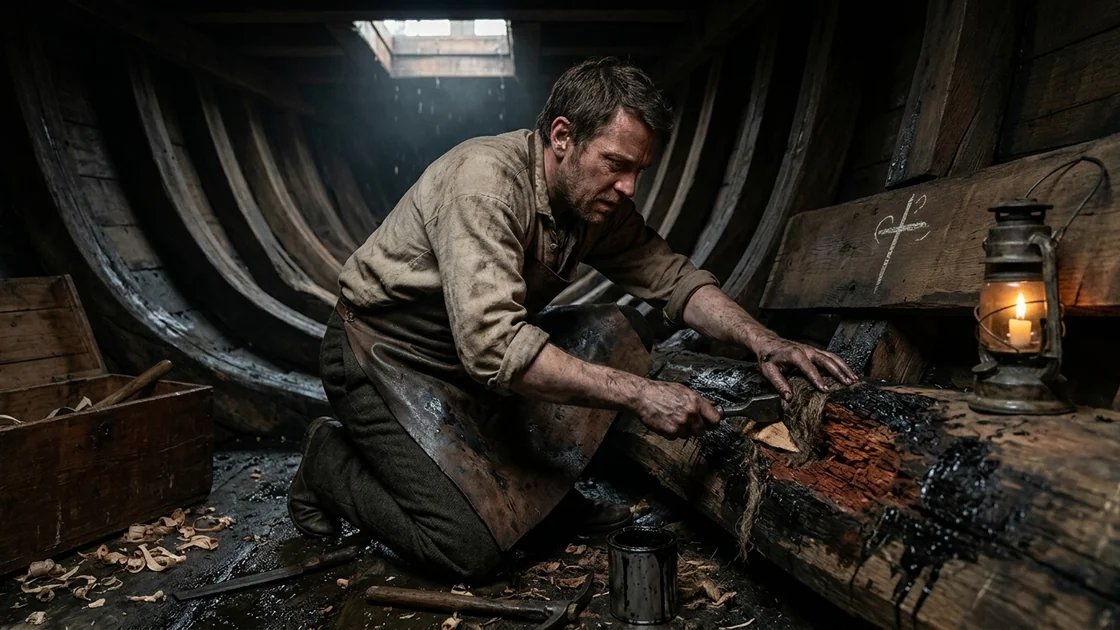
This is the account of Ewan Fletcher, an ambitious shipwright and carpenter aboard the merchant barque Oakhaven, who chose pride, haste, and a shipyard bonus over human life by concealing a structurally compromised futtock beneath fresh oakum and pitch. When the vessel departed Bristol for the West Indies, the hidden rot quietly festered beneath the heavy strain of ocean swells and shifted cargo, until a mid-Atlantic squall tore the weakened timbers apart. As the sea swallowed the ship and every soul aboard, Fletcher alone was cast adrift on a raft of shattered timbers, surviving only to bear the eternal, inescapable weight of his silent sabotage.
Chapter I: The Drydock at Redcliffe
The mud of the Avon was the color of bruised slate, thick and reeking of boiled tallow, dead shad, and the sewage of three parishes. When the tide receded, it left the Oakhaven propped like an eviscerated beast in the slipway, her black-tallow bottom exposed to the drizzle that fell unceasingly over Bristol.
Ewan Fletcher stood knee-deep in the bilge slush beneath her larboard turn of the bilge, his tallow candle sputtering inside a battered horn lantern. The air down here was cold, foul, and stagnant, smelling of rat droppings, damp hemp, and the sour, vinegar tang of fermenting ballast water. In his right hand he held an iron-tipped shipwright’s pick; in his left, a piece of dry chalk.
"Fletcher!"
The voice fell down through the open hatchway two decks above, flat and impatient. It belonged to Master Builder Garrow, whose boots were clean, whose coat was wool-lined, and whose pocket watch was an instrument of torment.
"Aye, Mr. Garrow," Fletcher called back, his neck aching as he tilted his chin upward into the gloom.
"The tide serves on Thursday next, Fletcher. Not Friday. Not Saturday. Mr. MacNair will not pay demurrage for another spring cycle. The copperers are waiting on your timber-work. Have you finished clearing the third futtocks?"
"Nearly so, sir!" Fletcher lied, his voice echoing off the curved ribs of English oak. "Just driving home the trunnels on the larboard run."
"See that you do. If she’s not off the blocks by Thursday dawn, your completion purse goes to the caulkers. Every penny of it."
The square of light two decks above vanished as Garrow moved away, followed by the muffled thud of his heels against the staging planks.
Fletcher turned back to the rib before him. He spat into the limber channel and lifted the lantern.
The timber was a curved piece of English oak, six inches by ten, supposed to form the third futtock—the crucial bone in the vessel’s skeleton that carried the stress from the floor-timbers up through the hull to the lower deck clamps. On the surface, where the broadaxe had smoothed it six weeks ago, it looked pale, dense, and honest. But Fletcher had driven his pick into the lower face, near the scarf joint where it overlapped with the second futtock, and the pick had not bounced. It had sunk.
It had sunk three inches without a sound, as if sliding into a wheel of soft cheese.
Fletcher set his boot against the planking and hauled the tool back out. When the spike pulled free, a trickle of dark, reddish powder followed it, smelling intensely of forest floor, toadstools, and dry, sweet decay.
Heart-rot.
The tree had been dying before it was ever felled. Perhaps in some copse near the Forest of Dean, water had pooled in a crotch fifty feet above the soil, seeping downward through the heartwood decade after decade while the sapwood formed a green, deceitful skin. To the timber merchant, it had looked sound. To the sawyers, who had sliced the balk into compass-timbers, it had seemed fair enough. But here, deep inside the meat of the curve, the wood was nothing more than compressed dust held together by threadbare fibers.
If he condemned the timber, the ship could not be floated on Thursday.
Condemning it meant stripping away three strakes of external planking that had already been steamed, bent, and spiked home. It meant knocking out the ceiling planks inside the hold. It meant sending an apprentice with a hand-cart three miles inland to the timber yards to scour the stacks for a compass-timber of identical sweep and grain, waiting two days for the yard master to price it at gouging rates, and spending forty-eight hours with adze and broadaxe hewing a replacement.
It would take nine days. Perhaps ten.
The bonus promised to him by MacNair & Sons—twelve silver pounds, enough to clear his brother’s indenture at the glassworks and settle his own lodging bills through the dead of winter—would be forfeit. Worse, Garrow would mark him as a slow hand, a carpenter who found ghosts in the grain and cost the firm its tides.
"It sits above the waterline when she's empty," Fletcher muttered to the silence of the hold. His breath puffed white in the horn lantern’s sickly glow. "And when she’s laden... she has nine sister frames within four feet of her."
He drove the pick into the wood again, two inches higher. Here, the oak resisted. The spike bit half an inch and stopped against firm wood. He tapped it with the heel of his palm; it rang dull, but not hollow.
The rot is local, he told himself, the lie sliding smoothly through his mind like grease on a slipway. It is only an egg of dry-rot. It will dry out once she takes the sea air. Salt pickles wood. Everyone knows salt preserves the grain.
He knew better. Every shipwright from the Humber to the Tamar knew that heart-rot does not pickle; it drinks moisture from the bilges, breathes in the dark beneath the ballast, and creeps along the marrow of the oak like a cancer, leaving only a brittle shell that can be crushed between two fingers.
Fletcher set down his pick. His fingers were stiff with the damp chill. He went to his tool chest resting upon the keelson, unlatched the hasp, and pulled out a draw-knife, a mallet, and a tin of Stockholm tar mixed with boiled linseed oil.
He did not call for the boy, Peter. Peter had sharp eyes and an apprentice’s dangerous habit of asking questions about why things were done the way they were done. Instead, Fletcher worked alone in the dripping belly of the ship.
With the draw-knife, he carefully scraped away only the softest spongy crust at the mouth of the cavity, being careful not to widen the breach. He took seasoned white-pine wedges—soft, pliable, and silent—and dipped them into the thick, boiling tar until they were coated black. One by one, with light, muffled taps of his mallet, he drove the pine wedges deep into the heart-rot, packing the void tight until the cavity gave back a solid, convincing sound when rapped with the knuckles.
Then he reached into his leather bag for oakum—tarred hemp fibers plucked from old naval rigging. With a thin caulking iron, he drove ribbons of the black hemp into the seam of the scarf joint, concealing the junction where the rotted futtock met its neighbor. He worked with the frantic artistry of a cosmetic mortician, smoothing the edges, scraping away the excess hemp, and finally smearing the entire surface of the frame with a slurry of coal-tar, slaked lime, and beef tallow.
When he held the lantern up, the frame looked identical to its neighbors: dark, oily, impenetrable, and solid.
He picked up his piece of dry chalk. Upon the face of the poisoned timber, he drew the inspector’s mark—a broad, upright cross with a flourish at the foot.
Sound.
He climbed the ladder into the light of the upper deck. The Bristol sky was turning the color of an old bruise, and down on the quay, the draymen were already whipping the heavy horses toward the gates.
"Fletcher!" Garrow appeared by the capstan, chewing on an unlit clay pipe. "Well?"
Fletcher wiped his blackened hands on his leather apron, feeling the sticky tar cling to the creases of his palms like dried blood.
"The frame is wedged, bolted, and dressed, Mr. Garrow," Fletcher said, his voice even. "She’s tight as a drum. She can take the water on Thursday."
Garrow nodded once, grunted, and made a mark in his calfskin ledger. "Good. The owners have engaged Captain Thorne. He signs the articles tomorrow. You'd best get your chest aboard before the crew fills the forecastle. He likes his tradesmen settled before the foremast hands arrive."
"Aboard?" Fletcher blinked. "I was engaged for the refit, sir. The shore-gang."
"The shore-gang has three carpenters down with the ague," Garrow said without looking up from his book. "And Thorne asked for a man who knows this hull from keel to gunwale. He pays three pounds ten a month, and the completion bonus will be paid into your hand when she docks at Kingston. You’re on the ship's books, Fletcher. Unless, of course, you'd prefer to forfeit the refit money and find work in the yards at Cardiff."
The wind blew off the muddy river, carrying the stench of rotting weed. Fletcher looked back toward the dark hatchway that led down into the belly of the Oakhaven. Beneath the deck, twenty feet down in the damp shadow, the pine wedges were already absorbing the moisture of the bilges, hidden beneath their skin of pitch.
"I’ll fetch my sea-chest," Fletcher said.
Chapter II: The Outward Bound
The Oakhaven dropped her moorings on the twenty-fourth of October, slipping out of the Kingroad with the morning ebb. She was a three-masted merchant barque of three hundred and eighty tons, carrying twenty-two souls, six six-pounder carriage guns for the Caribbean trade, and a belly full of general cargo: Manchester linens in the upper hold, crated iron mongery from the Birmingham foundries, barrels of salt pork, firkins of butter, and four hundred casks of pickled herring stacked three-deep on the ceiling planks.
To the landsman watching from the cliffs of Avonmouth, she was a magnificent spectacle of cordage and bleached duck, leaning gently to the western breeze as she reached for the open waters of the Bristol Channel. Her spars were newly scraped and slushed with mutton fat; her standing rigging was tarred black as jet; her green-painted waist looked vivid against the grey water.
To Ewan Fletcher, standing by the fife-rail of the mainmast with his rule in his pocket, she was a house built over an open grave.
"Mr. Fletcher!"
Fletcher turned to see Captain Daniel Thorne descending the poop deck ladder. Thorne was an old salt-horse, his face carved into hard gullies by forty years of North Atlantic gales and tropical sun. He wore an old blue frock coat with horn buttons, green around the cuffs, and walked with the wide, stiff-legged gait of a man who trusted no deck under his feet until it was three miles from land.
"Sir," Fletcher said, touching his cap.
"The carpenter’s shop in the forward deck-house is your country, Fletcher," Thorne said, leaning his arm against the bulwark and staring forward toward the bowsprit. "I don’t meddle with my tradesmen so long as the tools are bright and the work is swift. But I keep a tight ship on the pumps. Twice a watch, day and night, the rod goes down the well. If she sucks more than three inches an hour in smooth water, I want to know whether it's coming through the garboard or through the glands. Understood?"
"Understood, sir. She was dry as a church when we knocked the blocks out."
"Aye," Thorne grunted, his grey eyes sweeping the rigging. "Garrow speaks well of your eye for timber. That’s why you’re here. A ship is a living beast, Fletcher. She bends, she groans, she takes the water like a duck or she fights it like an ox. The Oakhaven is an ox. Her timbers are thick, but she’s stiff in the shoulders. When she meets a head sea, she doesn’t rise—she punches through. And when a ship punches, her joints complain."
"She’s well-timbered, Captain," Fletcher said. His tongue felt thick and dry against his teeth.
"We shall see what the Western Ocean has to say about that," Thorne replied, and turned back toward the quarterdeck.
Fletcher spent his first three days at sea in an agony of listening.
A ship at sea is never silent. There is the endless hiss of the wake, like grease sizzling in an immense pan; the shriek of the lignum-vitae sheaves spinning in their blocks as the braces are hauled; the drumming of wind against the belly of the sails; and, beneath it all, the deep, groaning conversation of the timbers.
Every wooden vessel is held together by thousands of iron spikes, copper bolts, and trunnels—pins of dried locust-wood that swell when wet to lock plank to frame. As the vessel rolls, these thousands of fastenings work against one another with a rhythmic, multi-toned complaint: the high, dry squeak of the deck clamps; the lower, bass grind of the floor-timbers; the dry snap of the bulkheads shifting an eighth of an inch against their stanchions.
To an experienced carpenter, these sounds were as legible as an open book. But every time the Oakhaven dipped her larboard bow into a rolling green swell, Fletcher felt a sharp, electric stitch between his shoulder blades.
There, his mind would whisper. Was that the third futtock?
He knew precisely where it was. If he stood on the main deck just forward of the galley, it lay seven feet beneath his soles, buried under twenty tons of crated ironware and salt barrels. In the dark of the hold, the pine wedges were holding. They had to be holding. The caulking iron had seated the oakum firmly.
On the fourth morning, out past the Tuskar Rock with Ireland fading into a violet smudge to the north, Fletcher took his sounding rod to the pump-well. The rod was a three-foot length of calibrated iron tied to a line of chalked line. He dropped it down the copper-lined tube beside the mainmast, heard it strike the lead plate in the bottom with a clear clink, and hauled it back up hand over hand.
Peter, the fourteen-year-old apprentice assigned to assist him and the sailmaker, stood nearby, holding an oily rag. The boy had hair the color of hemp tow and clear, stupid, trusting eyes.
"What’s she show, Mr. Fletcher?"
Fletcher held the rod up to the grey morning light. The chalk had washed away to a height of two inches.
"Two inches," Fletcher said, exhaling slowly. "Sweet as a nut."
"The old men in the fo'c'sle said she'd be leaky," Peter said, grinning as he took the rod to wipe it dry. "They said an Avon-built barque always spits her oakum on the first reach. Said we'd be manning the brakes twelve hours a day before we made Madeira."
"The old men in the fo'c'sle are windbags who know more about rum than timber," Fletcher snapped, more harshly than he intended. "The ship is stout. Get you forward and grease the spare spar lashings on the booms. Look for chafe where the chains pass through the hawse-holes."
"Aye, Mr. Fletcher," the boy said, subdued, and hurried forward.
Fletcher wiped his palms on his trousers. Two inches was nothing; it was the ordinary weepage of a wooden hull settling into its skin. Any ship afloat took that much through her rudder-post and her stuffing box.
Yet that evening, when his watch was relieved and the forecastle grew thick with the smell of boiled salt beef and wet wool, Fletcher could not rest. While the hands played cards on the mess-tables or mended their shirts by the light of tallow dips, he took his small adze and his lantern and descended through the fore-hatch.
The lower hold was off-limits without the mate's permission, on account of fire risk from open flames, but Fletcher was the carpenter; his duty was the integrity of the hull, and no mate questioned him when he carried an inspection lantern.
He squeezed through the narrow alleyway left between the tiers of cargo. The air was stiflingly warm down here, heated by the biological fermentation of the grain and salted provisions, and smelled overpoweringly of wet brine, bilge gas, and dead rats. Rats scurried across the tops of the casks as his lantern beam swung back and forth, their eyes shining like red sparks before they vanished into the gaps.
He crept aft until he estimated he was abreast of the larboard fore-chains. The cargo was stowed tight—casks of nails and heavy crates of iron plate wedged with dunnage wood to prevent any movement that might destabilize the ship. He could not reach the outer planking; the heavy oak ceiling—the interior skin of the ship—blocked his view.
He pressed his ear flat against the blackened ceiling planking.
The wood was cold and damp against his cheek. Through the four-inch thickness of the timber, he could hear the Atlantic Ocean rushing past outside with a terrifying, muffled roar—a furious hiss of foam and deep, gurgling undertones that spoke of miles of black water pressing against the ship’s sides with a pressure of tons to every square yard.
And then, as the ship heaved upward over a long swell, he heard it.
Tch-tchk.
It was not the long, healthy groan of seasoned wood bearing a load. It was a faint, clicking tick, like the sound of an insect boring into a dry wainscot, or a dry branch snapping underfoot in an autumn wood.
Tch-tchk.
It came from directly behind the ceiling, exactly where the third futtock was scarfed to the second.
Fletcher closed his eyes. The sweat ran down his forehead, stinging his eyes. It is only the dunnage shifting, he told himself frantically. A crate of ironmongery settling against the battens. Nothing more.
He brought the lantern close to the seam between two ceiling planks. There was no water coming through. The seams were dry, the pitch smooth and hard.
"She’s sound," he whispered into the dark. "She’s sound as an oak can be."
He turned back toward the ladder, his lantern casting wild, elongated shadows across the bulkheads, unaware that in the dark space between the ceiling and the outer planks, where no human eye could reach, the soft pine wedges had already begun to crumble under the transverse shearing stress of the Atlantic swell, turning the hidden dry-rot into an open, pulpy sponge that drank the salt water weeping through the seams.
Chapter III: The Racking Stress
For twenty days the Oakhaven made good progress to the southwest, leaving the grey, bitter waters of the Celtic Sea behind for the long, sapphire swells of the horse latitudes. The wind stayed fair from the northeast, filling her squares and carrying her past Madeira without the need to tack once.
On deck, the crew settled into the mindless, rhythmic routine of a long trade-wind voyage. Men holystoned the decks until the pine glowed creamy white; sails were shifted from the heavy canvas of the northern seas to the thin, worn suits used for the tropics; the pig under the longboat was slaughtered and eaten with sour kraut to keep the scurvy at bay.
Captain Thorne seemed almost relaxed. He walked the poop deck in the late afternoons with his sextant tucked beneath his arm, whistling church tunes between his teeth and occasionally shouting down at the cook for burning the pea soup.
Only Fletcher remained a stranger to the voyage’s easy rhythm.
While other men slept through their watches below, Fletcher would start awake at every change in the ship’s motion. If the Oakhaven rolled heavily to larboard and paused a second too long before recovering her balance, a cold hand seemed to squeeze his lungs. He became a fixture at the pump-well, haunting the mainmast with his sounding rod until the men began to joke that the carpenter was trying to catch codfish out of the bilge.
"She’s making five inches a day, Mr. Fletcher," Callow, the chief mate, said one afternoon. Callow was a thin, sour-faced Cornishman who smelled permanently of tobacco juice and wet dogs. "That’s nothing for an Avon barque. My last ship, the Lady Margaret, made twelve inches in a flat calm, and we sailed her from Liverpool to Valparaiso without losing a biscuit."
"The Lady Margaret had larch timbers, sir," Fletcher said defensively, his knuckles white around the sounding line. "The Oakhaven is oak. Oak shouldn’t yield."
"Well, she’s yielding five inches," Callow spat over the side. "And you’re wearing the brass casing off the well-pipe with that bloody lead of yours. Give it a rest, man. Go plane some oars. You look like a corpse that’s walked out of the lime-pit."
Fletcher went to his shop, but he did not plane oars. He sat on his bench, surrounded by his gouges, his spoke-shaves, and his neatly racked saws, staring at the floorboards.
He knew where the five inches were coming from.
Two days prior, he had managed to drop a lead-line into the limber holes through an inspection port beneath the bread-room. The water in the bilges was not the grey, greasy soup of normal ship-drainage. When he pulled the line up and smelled the tallow on the weight, it did not smell of bilges.
It smelled of sweet oak.
The water was leaching through the heart of the timber, washing the tannin and the rot out of the wood and into the well. The rot was dissolving.
On the twenty-seventh day, the glass began to fall.
It was not the sudden, dramatic drop that warns of a West Indian hurricane, but a slow, sickening decline that lasted through forty-eight hours of oily, dead calm. The sea lost its sapphire blue and turned the color of stagnant lead. The swell, coming from the southwest, grew long, heavy, and oily, sliding beneath the motionless hull with an immense, silent power that made the yards slap furiously against the masts.
The heat was suffocating. The pitch boiled out of the deck seams, sticking to the bare feet of the sailors and smelling like an open tar-kiln. Down in the forecastle, the men lay half-naked on their chests, gasping for air and cursing the dead calm.
At four bells in the afternoon watch, Captain Thorne stood on the poop, staring into the southwest with his spyglass.
"Look at that sky, Mr. Callow," he said quietly.
Fletcher, who was replacing a broken pin in the rail nearby, looked up.
The horizon was gone. In its place stood a wall of copper-colored haze, like the smoke from an immense brushfire. Above it, the clouds were not white or grey; they were a bruised, sickly yellow, shaped like long, curved fingers reaching upward toward the zenith.
"A line-squall?" Callow asked, squinting against the brass glare.
"Worse," Thorne said. "That’s an out-of-season gale from the Gulf. It has teeth in it, and it’s running against the swell. Fletcher!"
"Sir!"
"Get below with your wedges. Check every gun-port lash. Make sure the spare spars on the waist are double-lashed with chain. If one of those seventy-foot sticks breaks loose when she starts to roll, it’ll sweep the decks clean of everything including the galley."
"Aye, sir."
"And Fletcher—" Thorne paused, looking down at him with those hard, pale eyes. "Sound the well before you go."
Fletcher ran to the well. He dropped the rod.
Seven inches.
Two inches more than noon. And the sea was as flat as a parlor floor.
Fletcher felt the bile rise in his throat. He did not report seven inches to the mate. He reported five.
"Still five, sir!" he shouted toward the poop deck, his voice cracking like dry kindling.
"Very good," Thorne acknowledged without turning around. "All hands shorten sail! Clew up the mainsail and the foresail! Take in the topgallants! Down with the flying jib!"
The ship erupted into furious, organized chaos. Men sprang into the rigging, their brown feet flashing over the ratlines like spiders, their shouts echoing back from the slack canvas.
Fletcher did not go below immediately. He stood by the mainmast, his hand pressed flat against the wood of the deck, feeling the hull beneath him.
The ship was waiting.
With every long, slow heave of the glassy swell, the Oakhaven seemed to settle an infinitesimal fraction of an inch deeper into the water. She felt heavy. Her recovery at the top of the swell had lost its crisp, elastic spring; she wallowed like a sow in a mud-wallow, rolling with a slow, sickening reluctance that made the steering gear rattle in its mahogany casing.
She is drinking, he thought, and his heart pounded with a rhythm that made his vision pulse. The rot has washed out. The seam is open.
"Fletcher! You deaf, man?" Callow roared from the forward deck. "Get below and dog those hatches!"
Fletcher took his mallet, his lantern, and his canvas bag of pine wedges, and dropped through the hatchway into the dark.
Chapter IV: The Rupture
The gale struck the Oakhaven at three bells in the first dogwatch, not with a gradual freshening of the breeze, but with the sudden, violent detonation of an exploding magazine.
The first gust tore the fore-topmast staysail out of its bolt-ropes with a crack that sounded like a twelve-pounder firing from the forecastle. Within ten minutes, the ocean was transformed from a leaden sheet into a boiling caldron of white water and blinding spray. The wind did not merely blow; it had mass, weight, and solid fury, screaming through the stripped rigging with a sound so high and terrible that men had to shriek into each other’s ears to be heard at a distance of two feet.
By midnight, the barque was lying-to under a goose-winged main tops'l, her starboard side buried in the foaming green sea that washed continuously over the bulwarks.
Down in the lower hold, Fletcher was on his knees in two feet of black, freezing water.
The water had risen above the level of the limber holes and was now washing across the ballast stones, carrying with it a swirling slurry of old coal dust, rat droppings, and shavings from the carpenters’ refit. The smell was abominable—a thick, suffocating stench of ammonia and decay that made him choke as he crawled along the narrow dunnage-alleyway.
He had left his lantern tied to an iron stanchion three yards back, afraid that the water would extinguish it. In the darkness, lit only by the faint, yellow flicker behind him, he felt his way along the larboard ceiling planks with his bare hands.
The ship was screaming.
Not metaphorically, but literally. The immense lateral pressure of the gale against her sails and the sea against her sides was twisting the hull along its longitudinal axis—a mechanical torment known as racking. Every frame in her body was sliding fractions of an inch against the ceiling and the planking, grinding the trunnels, chewing the iron bolts, and squealing like a thousand pigs in an abattoir.
Then his hand found the spot.
He didn't need the light. His fingers knew the scarf joint of the third futtock as intimately as a murderer knows the face of his victim.
The ceiling planking here had bulged inward by more than an inch. The seam between two six-inch oak planks had parted, and through the gap, a smooth, solid sheet of Atlantic water was driving with the force of a hydraulic ram. It did not merely trickle; it arched into the hold in a hard, curved jet, striking the crated cargo with a continuous, thundering whack that vibrated through the hull.
Fletcher reached into the gap with his naked fingers.
The oakum was gone. The white-pine wedges he had so carefully hammered home in the drydock of Redcliffe had been pulverized into lint by the racking of the frames, leaving the rotten heart-wood completely naked to the sea.
And the timber itself—futtock number seven—was no longer a frame.
It was a cavern.
His hand plunged into the center of the wood up to the wrist. The wood had the consistency of wet, cold oatmeal. Under the immense pressure of the ocean outside, the external three-inch oak planking, deprived of the internal support of the frame, had cracked longitudinally. The sea was forcing the planks inward, opening a seam two fingers wide along a run of six feet.
She has broken her back here, the carpenter thought, his mind strangely detached, almost calm with the terrible certainty of disaster. She cannot bear the racking. The whole larboard flank is working like an accordion.
"Fletcher!"
A voice plunged down through the darkness of the hold. A circle of lantern light dropped through the hatch, illuminating the swirling black water and Fletcher’s dripping, soot-blackened figure.
It was Mr. Callow, his oilskins streaming with salt water, his eyes wide and bloodshot with exhaustion.
"Fletcher! The well has thirty inches! Both pumps are manned, but the water's gaining three inches a glass! Where is she taking it?"
Fletcher withdrew his hand from the ruptured timber. The water hissed between his fingers, smelling intensely of that sweet, rotten forest grave.
"Here, sir!" he screamed against the roar of the water and the wind. "The larboard run! The third futtock has sheared! The planks are springing!"
Callow dropped down the ladder, his sea-boots splashing heavily into the rising bilge. He scrambled along the crates, slipped, caught himself by an iron strap, and thrust his face toward the gap where Fletcher pointed.
The jet of cold brine hit the mate full in the mouth. He wiped it away with a trembling hand and stared into the split seam. Even in the dim lantern light, the spongy, red-brown mush of the decayed oak was unmistakable.
Callow slowly turned his face to Fletcher. The mate’s jaw was slack; his eyes, reflecting the guttering tallow flame, were hollow with a horror that transcended the storm.
"What is that?" Callow whispered, his voice small beneath the howling of the gale above.
Fletcher could not speak. The words dried in his mouth like salt.
"That's dry-rot," Callow said, his voice rising to an accusatory shriek that pierced the thunder of the sea. "The whole bloody heart is gone! It’s rotten as pumpkin! Who passed this timber? Who signed off on this frame?"
"We... we wedged it, Mr. Callow," Fletcher stammered, the water now swirling around his thighs, cold as an executioner's hand. "The bonus... there was no time... the tide served on Thursday—"
Callow lunged forward and grabbed Fletcher by the collar of his woolen shirt, his fingernails digging into Fletcher’s throat.
"You damned, murdering dog," the mate snarled, spitting salt spray into his face. "You drowned us all for twelve silver pounds."
A sudden, monstrous shock slammed into the ship’s larboard quarter. The Oakhaven rolled violently to starboard, her decks angling at forty-five degrees. Callow lost his footing and plunged into the swirling water. Crated ironware, tearing loose from its hempen lashings with a series of loud, whip-like cracks, slid across the ceiling planks with the momentum of falling boulders.
"Look out!" Fletcher screamed.
A two-ton crate of cast-iron stove parts slid down the incline, striking Callow against the bulkhead with a dull, wet crunch that was felt through the timbers rather than heard.
The mate did not scream. He made a soft, sighing sound, like an old woman settling into bed, and slipped beneath the black water. When the crate rolled back with the counter-roll of the ship, only an arm in a yellow oilskin sleeve remained visible, floating limp among the bilge-debris.
Fletcher did not reach for him. He turned and scrambled up the ladder like a beast escaping a slaughterhouse, leaving his adze, his mallet, and the body of the chief mate behind in the drowned dark.
Chapter V: The Brakes
On deck, the world was ending.
The gale had backed into the north, throwing up an enormous, confused cross-sea that hit the Oakhaven from two directions at once. The waves were not mere ridges of water; they were moving mountains of dark green marble, their crests sheared off by seventy-knot winds into blinding sheets of spray that stripped the skin from the men's faces.
The barque was wallowing heavily now, her scuppers permanently under water. She no longer rose to the swells; the green seas simply washed over her forward waist, smashing the longboat’s chocks and carrying away the galley stove-pipe in a shower of hissing steam.
"All hands to the pumps!" Captain Thorne stood by the wheel, his coat gone, his grey hair plastered to his skull like wet paper. Two seamen were lashed to the helm beside him, their arms strain-locked as they fought to prevent the wheel from spinning and breaking their wrists.
"Fletcher!" Thorne roared as the carpenter burst through the companionway. "Where is Mr. Callow?"
"Dead, sir!" Fletcher shouted, his fingernails digging into his palms. "Crushed by the iron-casks! The lower hold has four feet of water! The larboard ceiling has burst!"
Thorne’s face hardened into a mask of grey granite. He did not ask how or why. He was a seaman of fifty years’ standing; he knew the mathematics of displacement, and he knew when a hull had received its death-stroke.
"Man the brakes!" he screamed, pointing toward the twin pump-handles beside the mainmast. "Peter! Johnson! Adams! Lay into it, you bastards! Pump or drown!"
Six men were already at the pump-brakes, their bodies rising and falling in a frantic, mechanical rhythm. The twin brake-handles clattered up and down with an iron, bone-jarring rattle—clank-clank, clank-clank—as the leather pump-buckets worked inside the copper chambers.
A thick stream of water vomited from the pump-shoes onto the deck, rushing down the scuppers back into the sea. But it was not enough. It was a drop taken from a bucket that was being filled by a mill-race.
Fletcher took his place at the starboard brake. He threw his whole weight onto the iron bar, driving his heels into the wet pine planks.
Down. Up. Down. Up.
Beside him worked young Peter, his thin arms bare, his chest heaving with sobbing, ragged breaths.
"We’re not clearing it, Mr. Fletcher!" the boy wept, salt spray and tears running together down his chin. "My feet... the deck is getting softer! She’s sinking, ain't she?"
"Keep your back to it, Peter!" Fletcher shouted, the muscles in his shoulders burning as if bathed in vitriol. "Drive her down! Drive her down!"
Down. Up. Down. Up.
With every stroke of the pump, Fletcher felt the irony grinding into his soul. His hands, which had smoothed the tar over that rotten futtock, were now blistered and bleeding from fighting the water that that very rot had invited into the ship. Every upward stroke was an appeal for mercy; every downward stroke was an admission of guilt.
Clank-clank.
The pump-rods groaned. The water coming up the pipes had changed color. It was no longer clear seawater; it was thick, grey, and foamy, carrying with it the splintered pine shavings and the black hemp oakum he had driven into the seam with his caulking iron.
The pump was choking on his own repair.
"She’s sucking foul!" shouted Adams, an old foretopman on the larboard brake. "The valves are choked with oakum! The leather’s jammed!"
The larboard brake-handle suddenly seized solid, brought up short against its stop. Adams threw his whole weight against it, but it refused to budge.
"Clear it!" Thorne shouted from the quarterdeck. "Draw the spear! Fletcher, get your hook into the barrel!"
Fletcher let go of the starboard brake and fell to his knees beside the pump casing. He unscrewed the brass thumbscrews with his raw fingers, his breath coming in dry, metallic gasps. He plunged his arm down the copper throat of the pump, feeling for the lower clack-valve.
His fingers closed around a slimy, fibrous mass.
He pulled it out.
It was a wad of oakum, six inches long, black with Stockholm tar and intertwined with long, rotting splinters of English oak—the very wood he had chalked with the sign of the cross in the drydock of Redcliffe.
"What is that?" Peter asked, staring down at Fletcher’s hand with his wide, stupid, innocent eyes. "That looks like old rigging, Mr. Fletcher. How’d that get in the well?"
Fletcher looked at the boy. He could not look away. The boy’s face was blue with cold, his teeth chattering like dice in a cup.
"It's nothing," Fletcher whispered.
"She’s broaching!"
The scream came from the helm. A rogue sea, thirty feet high, curled out of the northern darkness like the palm of a descending hand. It did not strike the bows; it caught the Oakhaven broadside on her larboard waist.
The sound was like the impact of a stone fortress falling into the sea.
The bulwarks shattered into thousands of jagged laths with the sound of snapping muskets. The galley house was ripped from its deck-bolts and swept overboard in a tangled mass of splintered timber, pots, and howling steam. The mainmast, its shrouds snapped by the impact like violin strings, shuddered violently, leaned ten degrees to starboard, and then tore out of its step with a shriek of ripping iron that shook the ship from stem to stern.
The falling spar took the pump-well with it.
The six-ton tree of Oregon pine collapsed across the waist, crushing the pump-casings, smashing the brakes into twisted scrap iron, and killing three of the men at the larboard handle where they stood.
The Oakhaven did not recover.
She lay on her beam-ends, her deck angled toward the boiling sea like a cellar door. The water was no longer merely washing across her; it was pouring into her main hatchway in a continuous, green waterfall six feet wide.
Chapter VI: The Foundering
"Cut!" Captain Thorne was crawling along the slanted quarterdeck, an axe in his hand. "Cut away the wreckage! If the mast doesn’t clear, she’ll turn turtle!"
No one had an axe. Fletcher’s shop had been crushed beneath the wreckage of the deck-house.
The sea was inside the ship now. From the open hatches came a terrible, hollow sound—the sound of air being compressed and expelled through the cracks in the decks as thousands of tons of water rushed into the lower hold. It was a long, low moan, like the dying breath of an immense mammal, punctuated by the dull, explosive boom of bulkheads blowing out under the hydraulic pressure below.
"She's going!" someone screamed into the dark. "Every man for himself!"
There were no boats. The longboat was kindling somewhere between the ship and the horizon; the small jolly-boat hanging from the stern davits had been stove-in by the first sea that washed the poop.
Fletcher found himself clinging to the starboard fife-rail, his boots dangling in the white foam that was now swirling six inches beneath the coaming of the quarterdeck.
Beside him was Peter. The apprentice was clinging to a pin with both arms, his eyes shut tight, his mouth moving in a silent, frantic prayer to a God who had long since abandoned that patch of the North Atlantic.
"Mr. Fletcher," the boy wept, his head resting against Fletcher's arm. "I can’t swim, sir. I never learned to swim."
Fletcher looked down at him. In the green, phosphorescent glow of the breaking seas, he could see every line of the boy’s terrified face.
I killed him, Fletcher thought. He is fourteen years old, and his mother gave him to the ship at Kingroad, and I killed him for twelve silver pounds.
"Hold to my belt, Peter," Fletcher shouted, his voice flat, stripped of all emotion by the sheer magnitude of the catastrophe. "Hold to me!"
The Oakhaven gave a violent, sickening shudder.
The rotten futtock, and the six sister frames around it that had been carrying its share of the load, had finally failed completely. Beneath the waterline, a twelve-foot section of the larboard bottom simply dropped out of the hull like a trapdoor.
The ship did not slide down by the head or settle by the stern. She simply fell out from under them.
The ocean did not wait for her to sink; it rose to meet her. A mountain of black water tumbled over the weather rail, and the Oakhaven was dragged straight down into the vortex, her masts hissing as they cut through the foam, her rigging thrashing like the arms of an octopus being pulled into an abyss.
The suction was immense.
It grabbed Fletcher by the legs and pulled him down into the freezing, lightless green. The pressure slammed against his eardrums with a series of sharp, painful clicks. He kicked wildly, his boots feeling like lead weights, his hands clawing at water that had no substance, only cold and speed.
For a few seconds, he felt a small, frantic grip upon the tail of his woolen coat.
Peter.
He reached back into the dark water to grab the boy’s sleeve. His fingers touched cloth—the coarse, wet wool of Peter's jacket. He gripped it with all the strength left in his hands.
Then, from the darkness below, something huge and wooden rose like a projectile. It was a section of the smashed deck-house, torn loose by the air trapped in the hull. The heavy oak beam struck Fletcher across the forearm.
His fingers opened.
The cloth slipped through his grasp. He lunged downward into the blackness, his lungs screaming for air, his hands sweeping the empty sea.
There was nothing.
Only the cold, descending rush of the ship’s death-wake, pulling everything—men, iron, masts, and crimes—down toward the ooze four miles below.
Fletcher kicked toward the light that was not light, only a lessening of the black. His chest was burning, his throat spasming against the saltwater that was forcing its way past his lips.
He broke the surface with a loud, animal sob.
He was alone.
Chapter VII: The Solitary Drift
The storm did not cease with the sinking of the Oakhaven. It raged over the empty water for three more hours, but its fury had become impersonal, an aimless expenditure of wind upon a desert of brine.
Fletcher survived the night not by courage or skill, but by the blind, idiot mechanics of flotsam.
In the dark, his thrashing hand struck a wooden baulk. It was a spare topmast, forty feet long and eighteen inches thick, that had been lashed to the boom and had floated free when the deck collapsed. Attached to it by its chain-gammoning was a six-foot section of the bulwark, forming an unstable, rolling cross that sat half-submerged in the foam.
He dragged himself across the spar, hooking his arms over the iron rings and wrapping his legs around the timber.
Every ten seconds, a breaking sea washed completely over him, burying him in two feet of icy, suffocating foam. He would hold his breath, bury his face into the wet wood until the water cleared his head, and then cough out the brine and gasp for the next lungful of air before the next wave struck.
He did this fifty times. A hundred times. A thousand times.
He was waiting for the morning, believing that light would bring an end to the nightmare.
When the dawn finally came, it brought no salvation; it merely revealed the full, clean horror of his situation.
The wind had died to a stiff breeze. The yellow clouds had broken, leaving a pale, washed-out blue sky through which a weak, cold sun looked down upon the Atlantic.
The ocean was empty.
There were no sails on the horizon. There were no boats. There were no other survivors.
To the north, a patch of yellowish scum—grease, flour, and crushed biscuits from the galley—drifted across the swell. A single wooden sea-chest, painted red, bobbed twenty yards away, its brass lock gleaming in the sun. A dead pig, white and swollen like an enormous bladder, drifted past with its legs sticking straight into the air.
And nothing else.
Twenty-one men. Thorne with his spyglass; Callow with his tobacco and his accusations; the six topmen who had danced along the yards; Adams, who had two daughters in Bedminster; and Peter, who had never learned to swim.
All gone. Down in the clean, cold darkness where the pressure would preserve their faces for a hundred years.
Only the carpenter remained.
Fletcher looked down at the spar beneath his chest.
It was pine. Pure, pale, straight-grained white pine, without a knot or a split in forty feet. It was good, honest timber. It had not lied. It had not taken the completion purse and hurried out of the yard before the tide turned.
"Why me?" he croaked into the empty air. His voice was no louder than the mew of a sea-swallow, stripped of its timbre by the salt that crusted his tongue. "Why not the boy?"
The sea gave back no answer, only the long, rhythmic hiss of the swells sliding beneath his legs.
By noon, the sun had climbed to the center of the sky.
The Atlantic sun does not warm the shipwrecked; it flays them. Fletcher’s woolen clothes dried into a stiff, white armor of crystalline salt that cut into the skin of his neck, his armpits, and his groin with every movement of the spar.
His lips swelled until they split, bleeding small, salty trickles into his beard. His tongue felt like a dry strip of salt beef, too large for his palate, filling his mouth with a thick, gummy mucus that tasted of copper and ash.
He looked down into the water.
The ocean had turned that deep, terrifying indigo that belongs only to the profoundest depths. It was so clear that he could see the sunlight descending in shimmering, golden shafts twenty fathoms down, disappearing into the pure blue nothingness.
And then, out of the nothingness, they came.
The first was small—a six-foot shadow of pale slate-blue that drifted up from the depths with the effortless, liquid grace of an oil-drop in a water-glass. It circled the topmast twice, its pectoral fins extended like rigid aircraft wings, its black, button eyes regarding Fletcher with a cold, incurious intelligence.
It was an oceanic white-tip.
Within an hour, there were three of them. They did not attack; they did not thrash. They merely drifted fifty feet behind the spar, their high, triangular dorsal fins cutting the water with a faint, whispering hiss, waiting for the flotsam to shed its parasite.
Fletcher pulled his legs up out of the water, balancing precariously upon the fifteen-inch round of the spar. The effort made his head spin with a dizzy, nauseating heat.
His mind began to slip its moorings.
When the sun began to drop toward the west, turning the swells into sheets of beaten gold, he saw the boy.
Peter was sitting on the other end of the topmast, ten feet away, his legs trailing comfortably in the water where the slate-blue shadows circled. His tow-colored hair was dry and fluffy in the breeze; his cheeks were round and pink, as if he had just eaten a bowl of hot porridge in the galley.
"Mr. Fletcher," the phantom said, its voice clear and sweet above the sound of the swell.
Fletcher did not scream. He had no voice left for screams.
"Peter," he whispered through his cracked lips.
"Why didn’t you use the elm, Mr. Fletcher? There was a balk of seasoned wych-elm behind the drydock crane. Old Garrow said it was five shillings dearer, but it had no rot in it. Why did you take the oak?"
"The purse, Peter," Fletcher moaned, his forehead resting against the salt-caked wood. "The twelve pounds. My brother... his papers at the glassworks... he had three years left on his bond..."
"My mother had three years left on the parish, too," the boy said, smiling gently. "She’s waiting on the quay at Pill. She thinks I’m coming home with five Spanish dollars and a silk scarf from Kingston."
"Forgive me," Fletcher sobbed, but no tears came; his desiccated body had no moisture left for weeping. "Forgive me, lad."
"The wood was rotten, Mr. Fletcher," the boy said, and his form began to blur into the copper glare of the setting sun. "You wedged it with pine. You covered it with tar. You drew the cross upon it. But the sea knows the grain. The sea always knows the grain."
The phantom vanished, leaving only the empty, glittering swell and the black triangle of a dorsal fin slicing across the track of the sun.
Chapter VIII: The Salt-Pulp
The second night was colder than the first.
The wind died completely, leaving the Atlantic as still as an oil-tank. The stars came out in their terrifying tropical millions—huge, brilliant, and indifferent, burning like frost-fires across the vault of the black sky.
Fletcher lay face down upon the spar, his arms tied to an iron eyebolt with the strips he had torn from his woolen shirt. He had tied himself down because he knew that if he slept, his muscles would relax and the blue shadows waiting beneath the wood would have him before he woke.
His delirium was no longer a series of visions; it had become an architecture.
He was back in the hold of the Oakhaven, but the hold had expanded until it was miles wide, an immense, subterranean cathedral whose vaulted roof was made of English oak ribs that stretched into the black sky. And every rib was rotten.
He was crawling through this forest of dead wood with his mallet and his bucket of tar, trying to wedge the gaps before the ceiling collapsed upon him. But every time he struck a pine wedge, it didn't seat; it went through the wood like a finger through paper, opening a black hole through which the sea poured in an unceasing, laughing torrent.
And from every hole, a face looked through.
Thorne with his dead grey eyes. Callow with his crushed chest. The topmen with their blue lips. They were packed inside the grain of the oak like fossils in limestone, their mouths open, singing a slow, monotonous sea-dirge that vibrated through the timbers.
Sound timber, carpenter. Sound as an oak can be.
He woke to the smell of salt and sun.
His tongue was swollen outside his teeth now, black and cracked like dried leather. His skin was a mass of red, weeping blisters where the salt had eaten through the epidermis, and his fingers were locked into rigid claws around the iron ring of the spar.
He could not turn his head. His neck was stiff as a dead-eye.
He knew he was dying. The medical texts of his trade called it marasmus—the slow, burning exhaustion of the body’s fluids under the action of salt and heat. It was the death that the sea reserved for the men who built ships poorly.
A shadow fell across his face.
It was not a cloud. It was too small, its edges too sharp.
It was a bird.
A small brown petrel, no larger than a thrush, had landed upon the end of the topmast, three feet from his head. It tilted its head, its round, black eye inspecting the ragged, blistered animal tied to the wood.
Fletcher did not move. He could not move.
The bird pecked once at the wood, found nothing, hopped twice along the bark, and launched itself back into the air with a faint, papery flutter of wings.
Fletcher’s eyes followed it.
It flew north. Not high, but low along the troughs of the swell, its wings almost touching the glassy surface.
And there, two miles to the north, against the pale, bleached horizon where the sea met the sky...
A sail.
Not a cloud. It had the square, clean geometry of human hands—a main-topgallant and a royal, white and sharp as paper cutouts against the grey-blue haze.
Fletcher tried to cry out.
What came from his throat was not a shout; it was a dry, rattling hiss, like the sound of dried peas shaken in an ox-bladder. He tried to raise his arm, but his elbow was locked in its socket, his woolen shirt crusted to the skin by layers of dried blood and salt.
He could only watch.
The vessel was a north-bound whaler, deep-laden with oil from the South Seas, her brick-like hull rolling sluggishly as she pushed her way toward Nantucket or New Bedford. She was steering north-by-east, carrying a faint, dying breath of air that had not yet reached Fletcher’s spar.
She was passing him.
Her course would carry her a mile to the eastward. At that distance, against the glare of the morning sun, a half-submerged forty-foot spar with a dead man lashed to its iron-work was invisible. To the lookout at her masthead, it would look like nothing more than a piece of drift-timber, a waterlogged baulk that had dropped from a lumberman’s deck six months ago.
"Look," he hissed against the wood. "Look."
He struggled against his bonds. The strips of woolen shirt cut into the raw flesh of his wrists, but he managed to free his right hand.
He had no flag. He had no hat.
His hand fell upon the only loose object within reach: his caulking iron, which he had slipped into his leather fob-pocket in the drydock of Bristol three weeks ago and which had remained there, forgotten, throughout the gale and the sinking.
The four-inch chisel of blunt, heavy iron was crusted with red rust and dried Stockholm tar.
He took the iron in his shaking, blistered fingers. He could not raise his arm above his head. He could not wave it.
He could only strike.
With the last reserve of strength in his dying body, Ewan Fletcher lifted the iron two inches and brought it down against the iron band of the spar’s gammoning.
Tink.
The sound was tiny. It was an insect's click in the immense, indifferent silence of the Atlantic Ocean.
Tink.
The sound traveled through the iron. It traveled through the wood.
Tink.
A mile away, across the oily, motionless water, a Portuguese boat-steerer leaning over the whaler’s cat-head paused, his hand cupped to his ear, wondering what manner of fish had struck the ship's copper bottom with such an odd, metallic ring.
The whaler's helm moved half a spoke.
Chapter IX: The Survivor’s Tongue
The barque Martha’s Vineyard, ninety-eight days out of the Falklands with eighteen hundred barrels of sperm oil in her belly, picked up Ewan Fletcher at four bells in the afternoon watch.
They had to cut him from the spar. The wool of his shirt had grown into the raw granulations of his skin, and the salt had cemented his trousers to the pine bark like barnacles.
When the two whalemen in the bow of the whaleboat reached down to lift him, his head rolled back, his eyes milky and blind, his lips black as dried liver.
"He’s alive, Mr. Coffin!" one of the oarsmen shouted, his fingers on Fletcher’s wrist. "God knows how, but the heart’s kicking."
"Bring him up," the mate said, his hand on the steering oar. "Gently, now. His skin’s ready to peel off like boiled tripe."
They laid him on a heap of old sailcloth in the bottom of the boat. As they pulled back toward the ship, the mate looked down at the spar they had left behind.
"Avon timber," the mate said, squinting at the iron-work. "That’s an English topmast. Good oak and pine. Must have been a stout ship to carry that."
Fletcher’s mouth moved. A bubble of bloody froth formed at the corner of his lips.
"What’s that, John?" the mate asked, leaning down with his ear to the carpenter’s face. "What are you trying to say?"
"The... futtock..." Fletcher hissed, the sound scraping against his teeth like sand on glass.
"The what?"
"Rotten," Fletcher whispered.
The mate spat into the bottom of the boat and shook his head. "Sun’s turned his head to porridge. He’s raving about timber. Give way, boys. Let’s get him to the captain's locker before he slips his cable."
They carried him aboard the whaler. For twelve days he lay in a bunk in the steerage, between the smell of rancid whale oil and the smoke of the try-works, his body burning with a fever so violent that three men had to hold him down to keep him from dashing his brains out against the deck-beams.
In his delirium, he confessed.
He confessed fifty times. He told the whole story to the empty oil-casks, to the cabin boy who brought him vinegar-water, to the ship’s cooper who sat by his bunk sharpening his adzes.
He told how he had found the heart-rot in futtock number seven. He told of the twelve silver pounds. He told how he had carved the white-pine wedges, how he had dipped them in hot tar, how he had driven them home with muffled taps of his mallet so Master Builder Garrow wouldn't hear. He told how he had covered the murder with oakum and drawn the cross of soundness upon its face.
He told of Peter’s eyes in the green water. He told of Thorne’s grey face. He told of Callow’s dying curse in the flooded hold.
On the thirteenth day, the fever broke.
Fletcher opened his eyes. The light coming down the companionway was grey, cold, and clean. The smell of whale oil was gone, replaced by the fresh, salty chill of a northern autumn.
Captain Obed Macy sat on a sea-chest beside his bunk, peeling an apple with a small pocket-knife.
"You’ve had a long voyage, Fletcher," Macy said, his voice flat, dry, and clean, like a New England meeting-house.
Fletcher tried to swallow. His throat was scarred, his voice reduced to a low, gravelly rasp that would never again rise above a whisper.
"Where are we, sir?"
"Off the shoals of Nantucket. We’ll be alongside the wharf at New Bedford by tomorrow's sunset."
Fletcher lay silent for a moment, listening to the creak of the Martha’s Vineyard’s timbers. She was an old ship, built of heavy live-oak from the Georgia sea-islands, and she groaned with a deep, healthy, solid resonance that spoke of honest labor and sound grain.
"The things I said, Captain," Fletcher whispered, his fingers trembling upon the coarse blanket. "In the fever."
Macy cut a slice of apple and put it in his mouth. He chewed it slowly, his grey eyes watching Fletcher with an expression that was neither pity nor anger, but something colder—the ancient, hard comprehension of men who live by the sea and know what it makes of human flesh.
"You talked a great deal about a ship called the Oakhaven," Macy said.
"Aye."
"You said she broke her back in a gale three hundred miles off the Western Islands."
"Aye."
"You said the sea was monstrous. That the mainmast fell and crushed the pumps. That she went down in five minutes with all hands."
Fletcher stared at the New Englander. "Is that... is that all I said?"
Captain Macy closed his knife with a sharp, definitive click.
"You said you were her carpenter," Macy said, rising to his feet and brushing an apple peel from his dark trousers. "You said she was a fine, stout barque, well-found and well-timbered, but the sea was too heavy for her. You said no ship built by human hands could have stood that gale."
Fletcher’s heart seemed to stop in his chest.
The air in the steerage grew cold.
"Did I... say that?" Fletcher asked, his voice shaking.
"That is what you said," Macy replied from the foot of the ladder. "And that is what I have written in my log-book. The owners in Bristol will have the insurance by the time the mail-packet reaches Liverpool. It is a terrible thing when a stout ship goes down, Fletcher. But wood is only wood, and the sea is the sea. No man can blame the carpenter when the storm is larger than the world."
The captain climbed the ladder and disappeared into the crisp autumn sunlight, his boots ringing sharp and clean against the ladder-rungs.
Fletcher lay alone in the dark bunk.
He looked at his hands, resting upon the blanket. They were scarred, pale, and twisted by the salt-burns into permanent, crooked hooks.
He had escaped.
There would be no inquiry at the Guildhall in Bristol. There would be no trial at the Admiralty. The twelve pounds were lost with MacNair’s ledger, but there would be work in the yards of New Bedford or Boston. Men who knew the compass-timber of the English oak were always needed in the new world. He could live. He could buy an adze, rent a room, walk upon dry flagstones, and drink clean beer that tasted of nothing but malt and hops.
He closed his eyes.
And there, in the quiet darkness behind his lids, he heard it.
Not the gale. Not the shouting of the topmen or the crash of the falling spar.
Just the faint, clear, insect-click of the third futtock, seven feet beneath the waterline, working in the dark.
Tch-tchk.
It did not come from the ship. It came from inside his own ribs, from the marrow of his own breastbone, where the rot had taken root beneath the skin, packed tight with tar and silence, waiting for the first heavy sea to tear the lie apart.
Fletcher pulled the blanket over his face, but the darkness was no refuge; it was the color of Stockholm tar, and through it, the sea was already coming in.