The Quiet Ledger of Arthur Vance
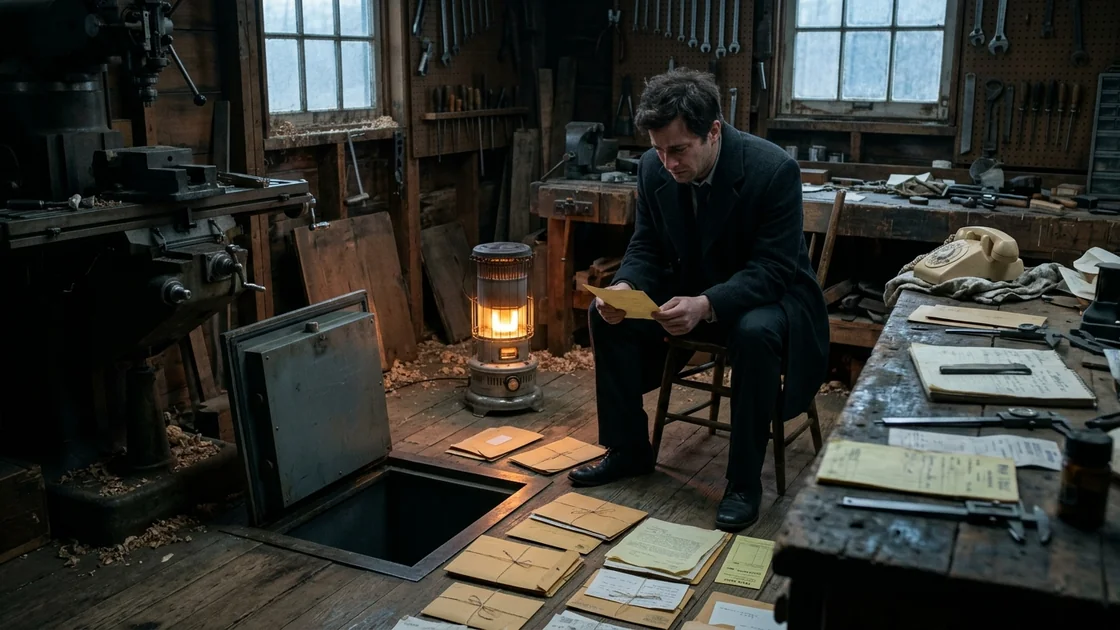
Julian Vance spent eight years building a fortress of resentment against his father, ignoring the persistent buzz of his phone during the man's final weeks, only to be summoned home by a county coroner to an empty farmhouse in rural Pennsylvania. Expecting to find only the relics of an austere, unyielding parent who had once seemed indifferent to his dreams, Julian instead uncovers a forgotten floor safe beneath the floorboards of the workshop, packed with decades of letters, ledgers, and pawn tickets that detail every silent, crushing sacrifice Arthur Vance made to preserve his son's future. As he reads through the paper trail of his father's hidden devotion, Julian is forced to confront the arrogance of his own grievances and the unbearable weight of the calls he chose not to answer.
The phone on the corner of the drafting table possessed an uncanny, predatory patience. It did not ring aloud—Julian had disabled the chime months ago—but the small rectangular motor inside the chassis spun against the reclaimed walnut wood, emitting a dull, insectile drone that rattled his graphite pencils inside their ceramic jar.
Dad Calling.
Julian did not look up from the elevation drawings for the lakefront pavilion. He pressed the tip of his mechanical pencil down until the lead snapped with a dry, sharp click. He blew the gray dust from the vellum, reached over without turning his head, and flipped the phone onto its face. The screen went dark against the blotter, but the vibration persisted through the wood, a rhythmic hum that traveled up the bones of his forearm and nested behind his temples.
"You could just answer it," Marcus said from the doorway of the studio, a rolled set of blueprints tucked beneath his arm like a swagger stick. "Even if it’s just to tell him you’re busy. The dead-air routine is getting loud."
"He’s not calling about anything that matters," Julian said, his voice flat, scrubbed of all color. He clicked the collar of the pencil twice to advance a fresh needle of graphite. "He wants to tell me the gutters need cleaning. Or that the frost killed the winter squash. Or he wants to ask when I’m coming back to Oakhaven to look at some rusted engine block he pulled out of the creek. It’s an ambush, Marcus. It’s always an ambush."
"He’s called four times since lunch, Jules. That’s not squash talk."
"You don't know him." Julian aligned his acrylic parallel rule with the grid lines of the foundation wall. "Arthur Vance doesn't have emergencies. He has obligations, and he expects everyone else to report for duty like farmhands. If I pick up, I’m stuck on that porch for forty-five minutes listening to him clear his throat and talk about people who died thirty years before I was born. I have a deadline with the municipal review board tomorrow morning."
Marcus stood there for another second, his expression hovering between mild pity and professional irritation, before shaking his head and retreating down the carpeted hallway of the firm.
The vibration finally stopped. Julian exhaled, a long, measured release of breath that did nothing to loosen the knot between his shoulder blades. He stared at the back of the glass device. A small red dot appeared in the corner of his screen: Missed Call (11:42 AM). Then another: Voicemail (1).
He did not dial the mailbox. He knew the cadence by heart: the heavy, labored breathing through the receiver, the background ticking of the grandfather clock that had lost five minutes every week since 1994, the clearing of a throat roughened by forty years of limestone dust and woodsmoke, and then the inevitable, sparse message: Julian. It’s your father. Call me when you get a minute. Never an apology. Never an inquiry into how Julian was faring in Chicago, whether the partnership at the firm was holding, or whether the chronic migraines that had plagued him since adolescence had subsided. Just the summons.
Julian worked until nine that night, letting the blue glow of his dual monitors wash over him, drinking cold, bitter coffee until his teeth felt chalky. He drove back to his apartment in Lincoln Park through an unseasonable October sleet that turned the asphalt into an oily, shimmering mirror. When he tossed his keys into the ceramic bowl by the entryway, his phone lit up again.
This time, the screen did not say Dad.
It was an area code from southwestern Pennsylvania—814. A local exchange from the borough of Oakhaven.
Julian’s thumb hovered over the red icon to decline. It was probably Walter Miller, the hardware store owner who served as Arthur’s self-appointed emissary whenever the old man decided Julian had been away too long. But something about the timing—the late hour, the wet, miserable blackness of the night outside—caught his wrist in an invisible vise. He swiped the green bar and brought the phone to his ear.
"Julian Vance?" The voice was neither Walter’s nor his father’s. It was younger, hurried, clinical, backed by the metallic, ambient clatter of a linoleum corridor.
"Yes. Who is this?"
"Mr. Vance, this is Dr. Robert Henderson. I’m the attending physician at St. Jude’s Memorial in Somerset. I’m calling regarding your father, Arthur Vance."
Julian leaned his hip against the kitchen island, his muscles bracing against an instinctive, long-rehearsed defensive posture. "If he sent you to call me because he won't use the hospital phone himself—"
"Mr. Vance," the doctor interrupted, his tone shifting into that unmistakable, leveled flatness that hospital staff reserve for catastrophic news. "Your father was brought in by county EMS approximately forty minutes ago. A neighbor found him in his workshop. We performed CPR for twenty-five minutes, but we were unable to establish a rhythm. His heart had simply sustained too much damage. I’m very sorry, but he passed away at 9:18 this evening."
The hum of the refrigerator rose to fill the room, a low, buzzing roar that drowned out the sound of the sleet hitting the windowpane.
Julian looked down at his shoes. There was a smear of dried drafting clay on the toe of his right boot. "He... he was in the workshop?"
"That’s what the report indicates. The neighbor said the compressor had been running continuously since yesterday afternoon, which was unusual. Mr. Vance, we need you to come to Somerset to sign the release forms and make arrangements with the funeral home. Is there someone who can drive with you?"
"No," Julian said, his voice sounding thin, as if it were being squeezed through a straw. "I can drive."
He hung up without asking another question. He walked into his bedroom, packed three white shirts, a dark charcoal suit he had not worn since an awards banquet two years prior, and a dopp kit into a canvas duffel bag. Then he sat on the edge of the mattress with the lights off, watching the shadows of the rain crawl across the ceiling.
He pulled the phone from his pocket. He tapped the voicemail app. There were eight messages from Arthur Vance, dating back over the last three weeks.
Delete all, his mind whispered, an impulse born of pure terror. If you don’t listen, he’s still waiting. If you don’t listen, the argument isn't over yet.
Julian dropped the phone onto the nightstand, picked up his bag, and walked out into the cold.
The Laurel Highlands in late autumn looked like an old, faded daguerreotype. The mountains were gray ridges of bare oak and skeletal hickory, their summits snagged on low, weeping clouds that smelled of wet slate and coal soot.
Julian crossed the state line shortly after dawn. As the highway narrowed from four lanes to two, the billboards for national insurance agencies and personal injury attorneys gave way to hand-painted signs advertising bulk firewood, fresh cider, and salvation through Christ. The road followed the winding course of Stonycreek, its waters black and swollen with autumn runoff, tumbling over limestone boulders that had been tumbled and cracked by centuries of freeze and thaw.
Oakhaven had not grown; it had merely settled deeper into its foundations, like an old barn whose sill plates were slowly being reclaimed by the mud. The downtown consisted of a post office with a peeling aluminum flagpole, a feed store, two taverns with neon beer signs humming in the morning gloom, and the dry cleaner that still bore the name of a man who had died during the Carter administration.
The Vance place sat three miles outside the borough, up a gravel hollow where the trees pressed in close against the electric lines.
When Julian rounded the final bend, the house appeared through the drizzle like a specter from a half-forgotten dream. It was a two-story farmhouse clad in white pine lap siding that had long since surrendered its gloss, leaving behind a weathered, chalky patina. The wrap-around porch sagged slightly at the northeast corner where the dry-stack stone piers had shifted in the frost. A single green John Deere tractor from the 1960s sat parked beside the woodpile, covered in a blue poly tarp that was weighted down with discarded tire rims.
Julian cut the engine of his Audi. The sudden silence was shocking, broken only by the tick of the hot manifold and the steady, melancholic dripping of water from the cedar eaves.
He stepped out into the gravel. The air smelled precisely as it had when he was twelve: damp mulch, chimney smoke, the faint mineral tang of the limestone quarry two ridges over, and the sharp, resinous ghost of hemlock needles. It was a smell that had once meant safety, and later, a suffocating, unbearable enclosure.
He did not go into the house first. He walked toward the detached workshop behind the summer kitchen.
The shop was a broad, low-ceilinged structure built of rough-cut hemlock timbers, its double doors hung on hand-forged strap hinges. Arthur had spent forty-five years as a precision machinist for the quarry equipment company before retiring to sharpen saw blades, repair tractor transmissions, and turn bowl blanks on an ancient cast-iron lathe.
Julian pulled the latch. The door groaned on its hinges.
Inside, the silence was different from the house. It was dense, thick with the scent of Mobil 1 motor oil, WD-40, cold iron, and dried sawdust. Along the east wall, Arthur’s tools hung on perforated Masonite boards, each tool’s silhouette painstakingly outlined in faded black marker so that an empty peg immediately signaled an absence. Every chisel, every open-end wrench, every ball-peen hammer sat exactly within its assigned boundary.
On the central workbench, an old kerosene heater stood cold. Next to it lay an open pair of brass calipers, a grease-stained notebook, and a small aluminum pill organizer with the plastic flap for Tuesday flipped open.
Julian approached the bench with slow, hesitant steps, his hands shoved deep into his overcoat pockets to keep from touching anything. Beside the calipers lay an old rotary telephone, its cord spliced into a modern gray modular jack that dangled from the rafters. The receiver was off the hook, resting sideways on a shop rag.
Julian stared at it.
He remembered the vibration against his drafting table. He remembered the doctor’s words: The neighbor said the compressor had been running...
Arthur hadn't died in his sleep. He had been here, in the cold, working on something, or trying to reach someone.
Julian reached out with a trembling finger and touched the black Bakelite handset. It was freezing cold. He lifted it to his ear. There was no dial tone, only the faint, ocean-like rush of an open, disconnected line. He set it back down in its cradle with a gentle click that sounded like a gunshot in the cavernous space.
"Julian?"
He spun around, his pulse leaping into his throat.
A woman stood in the doorway, framed against the gray light of the yard. She wore an oversized quilted barn coat, muck boots, and a wool stocking cap pulled low over silver-streaked hair. She held a covered pyrex dish in both hands, wrapped in a faded kitchen towel.
"Mrs. Gable," Julian breathed, his shoulders dropping two inches. "Jesus. You startled me."
Martha Gable had lived on the neighboring fifty acres since Julian was in diapers. She was a woman constructed entirely of sinew, garden dirt, and iron-clad Baptist resolve. She stepped into the shop, her eyes taking in Julian’s city coat, his Italian leather boots, and the pale, hollow circles beneath his eyes.
"I saw the car pull up the lane," she said, her voice dry and steady. "Figured it had to be you. You drive too fast on that gravel, just like you did when you had that little red pickup."
"I wanted to get here before the rain got worse."
"Well, it’s not going to get better. It’s Pennsylvania in November. It only gets worse until April." She set the dish down on the corner of the workbench, carefully avoiding the ring of grease left by an old bearing. "There’s chicken and dumplings in there. It just needs twenty minutes in the oven. You look like you haven't eaten a solid thing since Pittsburgh."
"Thank you," Julian said, though his stomach curdled at the thought of food. "I... I appreciate you finding him, Martha. The doctor said you were the one who called."
Martha looked toward the far corner of the shop, where a heavy floor-standing drill press stood shrouded in sawdust. Her expression softened, the hard lines around her mouth cracking slightly.
"I heard that compressor," she said quietly. "Arthur never left a motor running overnight. Not once in forty years. He was too careful about the power bill, and he was terrified of an electrical fire. When it was still chugging at six in the morning, I put my boots on and walked across the hayfield. He was right there, Julian. By the lathe."
She looked at him directly, her gray eyes clear and unsparing.
"He had his coat on," she added. "He was holding his chest. But he wasn't looking at the door. He was looking at that phone on the bench."
Julian felt a sharp, cold draft pierce his chest, as if someone had opened a cellar door behind his ribs. He swallowed hard. "Did he say anything?"
"He was already gone, honey," Martha said softly. "The paramedics said it was massive. He didn't suffer long, if that’s any comfort to you. Though I suppose people only say that to make the living feel less useless."
She reached into her coat pocket and pulled out a heavy iron ring holding three brass keys and an old, tarnished skeleton key. She held them out to him.
"These are for the house and the cellar door," she said. "The lawyer in town, Mr. Strasser, called this morning. He wants to see you tomorrow at ten. But he told me to tell you that Arthur left instructions in the house. Specifically for you."
"Instructions?" Julian took the keys; they were heavy and cold in his palm. "About the service?"
"Arthur didn't believe in services," Martha said, offering a faint, humorless smile. "He said having people sit around in stiff collars looking at a box was a waste of good working daylight. No, he left something else. He told Strasser that everything you’d ever want from him was in the strongbox."
"What strongbox?"
Martha tilted her head toward the house. "You’ll have to look for yourself. He didn't tell me where he put it, only that you’d know how to get into it if you used your head." She pulled her coat tighter around her throat and turned toward the door. "Eat those dumplings, Julian. You’re no good to the dead if you faint in an empty house."
The interior of the farmhouse was an archaeological preserve of Julian’s childhood.
Nothing had been renovated. The linoleum in the kitchen still featured the gold-and-brown geometric pattern that his mother, Sarah, had chosen from the Sears catalog in 1982, three years before she died of leukemia. The counters were yellow laminate, edged with ribbed aluminum trim. On the refrigerator, held in place by a faded plastic magnet shaped like an ear of sweet corn, was a newspaper clipping from the Somerset Daily American dated May 1999: Oakhaven High Senior Julian Vance Wins Regional Scholastic Art Award.
Julian stood in the center of the kitchen, his canvas duffel bag sitting on the floor by his feet.
The house was cold, hovering around fifty degrees. The ancient coal stoker in the basement was dormant, its iron hopper empty. The only sound was the deliberate, rhythmic tock... tock... tock of the grandfather clock in the dining room, followed by the soft, mechanical wheeze as the brass pendulum reached the apex of its swing.
Julian walked through the rooms like a trespasser.
In the living room, Arthur’s brown vinyl recliner remained angled toward the small woodstove. On the side table sat a pair of wire-rimmed reading glasses with one temple piece repaired with a neat wrap of black electrical tape, an unopened issue of The American Machinist, and a chipped ceramic mug containing a dried disc of black tea.
This was the room where Julian had spent his adolescence suffocating under his father’s silence.
Arthur had been a man of terrifyingly few words. He did not yell; he did not rage. When Julian had announced, at seventeen, that he was not going to enroll in the mechanical engineering program at Penn State and was instead going to attend the School of the Art Institute of Chicago to study architectural restoration, Arthur had simply set his fork down, looked at the table for a long, agonizing minute, and said: That’s an expensive way to learn how to be poor.
When Julian had demanded help with the tuition—help that he knew his father could afford, given forty years of unbroken employment and a lifestyle that bordered on monastic asceticism—Arthur had refused. I’ve got enough put away to keep the roof over this house and not a penny more, he had said, staring out the window at the ridge. If you want to draw pictures for rich people, you pay for it yourself.
And Julian had. He had worked twenty-five hours a week cleaning fryers at a diner on Michigan Avenue, taken out federal loans with predatory interest rates, and spent four years living on day-old bread and cabbage soup, nursing a furious, burning hatred for the man who sat on two hundred acres of prime timberland and let his only son starve in a city five hundred miles away.
When Julian had finally made partner at his firm three years ago, he hadn't invited Arthur to the dinner. He had sent a business card in a blank envelope. Arthur had never acknowledged it.
Julian walked down the narrow hall toward his father’s bedroom on the ground floor.
It was as sparse as a monk’s cell: a single iron bedstead made up with a wool army blanket, a four-drawer chest of drawers made of plain yellow pine, and a small writing desk beneath the window.
On the desk sat a single piece of lined notebook paper, weighted down with an old steel ball bearing.
Julian approached the desk, his heart beating a heavy rhythm against his ribs. He picked up the paper. The handwriting was unmistakable: heavy, angular, the pencil pressed so hard into the pulp that the letters left deep ridges on the reverse side.
Julian, the note read.
The breaker box in the workshop is switched off. Turn it on before you try to use the pump, or the well will draw air. The deed to the north forty is at Strasser’s office. The key to the floor safe is on the third beam above the forge, behind the tin of carriage bolts. The combination is 18-34-07. Don’t call the junkman for the scrap iron until you’ve sorted the brass from the steel. There’s six tons of manganese bronze behind the woodlot that’s worth four times what the scrappers will offer you.
Don’t let them talk you out of the timber rights.
Dad.
Julian let the paper drop.
No I’m sorry. No I wish we had talked. Just instructions on well pumps, scrap metal, and combination locks. Even from beyond the grave, Arthur Vance could not manage a single sentence that did not concern maintenance, property, or mechanical leverage.
"God damn you," Julian whispered into the empty room. The words were small and dry, swallowed immediately by the heavy curtains and the wool blanket. "God damn you, old man."
He stood there for five minutes, waiting for the anger to warm him, but the anger was cold, like everything else in the house. It did not burn; it simply turned into a dull, leaden weight that settled into his gut.
He turned on his heel and walked back out through the kitchen, through the mudroom, and across the wet gravel to the workshop.
The workshop was darker now as the late afternoon light failed. Julian found the main disconnect on the wall, threw the heavy lever with a resounding clack, and watched the fluorescent tubes flicker to life overhead, buzzing like trapped hornets.
He walked over to the forge—a relic of his grandfather’s time that Arthur had kept functional for bending flat stock and repairing farm equipment. Above it, running along the hemlock rafters, were three heavy 8x8 beams blackened with forty years of coal smoke.
Julian pulled a wooden stepladder from the wall, set it on the hard-packed dirt floor, and climbed up.
His fingers reached into the gloom above the third beam. His hand brushed against spiderwebs, the sharp edge of an old hand-saw blade, and finally, the oily, circular rim of a vintage Prince Albert tobacco tin.
He pulled the tin down. Inside, resting on a bed of dry sawdust, was a heavy brass safety-deposit box key, stamped with the number 412, and a slip of yellowed paper containing the same combination from the note: 18-34-07.
He climbed down and looked around the shop floor.
The floor was concrete in the center, but toward the rear, where the lathe and the heavy milling machine stood, Arthur had laid down thick, tongue-and-groove white oak planks to cushion his feet against the cold ground during long hours of standing.
Julian walked to the corner behind the milling machine. A heavy sheet of five-ply plywood had been laid over the floorboards, covered by a greasy rubber mat. He kicked the mat aside, lifted the plywood, and saw it.
Cut directly into the oak floorboards was a flush-mounted steel plate, roughly two feet square, painted with gray rust-inhibiting primer. In the center sat an antique Sargent & Greenleaf combination dial and a heavy brass keyway.
Julian knelt. The concrete surrounding the safe’s steel housing was cold against his knees.
He rested his thumb on the dial. The steel was cool, the knurled edge sharp against his skin. He dialed left to eighteen, watching the white ticks line up with the red witness mark. Right to thirty-four. Left to seven. He inserted the brass key into the cylinder and turned it clockwise.
With a heavy, mechanical thunk that vibrated through the floorboards, the four internal locking bolts retracted.
Julian pulled on the recessed handle. The door, balanced on internal counterweights, swung upward with a whisper of greased steel.
He expected deeds. He expected property tax receipts, the title to the tractor, perhaps a few mason jars stuffed with silver certificates or old hundred-dollar bills that his father had hoarded against the collapse of the banking system.
Instead, the safe was filled with manila envelopes.
Dozens of them. They were stacked in neat, vertical rows, separated by cardboard dividers. Each envelope was tied with coarse butcher’s twine, and on the front of each, Arthur had written a date and a number in his heavy, deliberate pencil script.
Julian reached into the safe and pulled out the first bundle.
The envelope on top was yellowed with age, its edges brittle. On the center of the face, the script read: 1987. Julian – Age 7.
Julian sat back onto the heels of his boots. The shop was dead silent except for the low hum of the fluorescent fixtures. He hesitated, his thumb hooked under the butcher’s twine. For an instant, he felt an overwhelming urge to shove the envelope back into the dark, slam the heavy steel door, and drive back to Chicago. Some doors, once opened, cannot be shut again; they alter the architecture of the room you must live in for the rest of your life.
He slipped the twine off the cardboard.
Inside was not a letter. It was an invoice from the Children’s Hospital of Pittsburgh, stamped PAID IN FULL in red ink, dated September 14, 1987. Attached to it with a rusty paperclip was a canceled personal check signed by Arthur Vance, drawn on the Oakhaven Citizen’s Bank, for the amount of $4,210.00.
Beneath the invoice lay a folded sheet of yellow legal paper. Julian unfolded it.
Sarah’s brother told me to let the state take him, Arthur had written, not to Julian, but to himself, like a man recording entries in a machine log. Said the county would cover the therapy for his speech if we declared the farm insolvent. Said nobody looks down on a man whose wife is dying of the blood sickness. I told him a Vance doesn't take charity from men who sit behind desks with government stamps.
Sold the south pasture to Miller for pulpwood. Forty acres. It hurt to watch them cut the sugar maples your grandfather planted, but the boy spoke his first full sentence without the stutter this morning. He asked where the deer go when it snows. It was worth every tree.
Julian’s breath caught in his throat.
He remembered the south pasture. He had grown up believing Arthur had sold it to buy a new milling machine. He remembered the neighborhood kids talking about how the timber crew had come in and stripped the hillside bare, leaving an ugly, scarred wasteland of briars and slash. He had hated his father for that. He had loved those maples. He had spent an entire summer refusing to look Arthur in the face because the shade at the edge of the creek was gone.
Julian’s hands began to shake. He laid the paper on his knee and reached into the safe for the next envelope.
1992. Julian – Age 12.
Inside this envelope was a broken violin bridge, wrapped in a scrap of oily rag, and three letters from a woman named Eleanor Vance—Julian’s aunt in Philadelphia.
Arthur, the first letter read. You are being absurd. The boy has genuine talent. The instructor says he has perfect pitch. But you cannot expect him to practice on an instrument held together with wood glue and wire. Send him to me for the summer. Let him take lessons at the conservatory. You are suffocating him in that hollow.
Tucked behind the letter was a carbon copy of a bank transfer slip: $1,800.00.
And beneath that, a receipt from a scrap metal foundry in Johnstown, dated August 1992.
The receipt was an overtime statement: Arthur Vance – Third Shift Slag Removal. 84 Hours.
Julian dropped the receipt onto the floorboards.
He remembered that summer. He had wanted to go to Philadelphia so badly he had thrown a plate across the kitchen, shattering it against the wainscoting. Arthur had stood there with his arms crossed, his face like a granite cliff, and said: You’re staying here. You’ve got chores.
Julian had spent that July practicing his violin in his bedroom with the window shut so his father wouldn't hear, crying tears of hot, bitter rage at the tyranny of an uneducated machinist who had no room in his life for beauty.
He hadn't known that his father was working twelve hours a day at the quarry, driving fifty miles to Johnstown to shovel burning slag for eight hours at night, sleeping two hours in the cab of his truck behind the steel mill, all to pay for the hand-carved German violin that appeared on Julian’s bed on his twelfth birthday with no card, no explanation, only Arthur’s grumbled comment: Don’t leave it out in the damp.
Julian’s eyes blurred. The gray shop began to swim. He blinked hard, wiping his face with the rough wool of his coat sleeve, but the wetness wouldn't stop.
"Why?" he whispered into the rafters. "Why didn't you just tell me?"
The shop offered no answer. Only the smell of grease and cold iron.
He pulled another bundle from the safe. This one was thicker, bound with heavy shipping tape that had dried and peeled at the corners.
1999. Julian – Age 18.
This was the year. The year the fracture became an abyss.
Julian pulled out the contents. There were no letters from relatives here. There were only bank statements, mortgage documents, and pawn receipts.
The first document was a formal letter of acceptance from the School of the Art Institute of Chicago, addressed to Julian Vance. Julian remembered the day it arrived; he had danced around the kitchen table, waving the heavy linen paper in front of his father’s face. Arthur had looked at it, wiped his greasy hands on a blue shop towel, and said: Chicago is eight hours away. You don’t know anybody there. You can’t eat architecture.
Julian had screamed at him that night. He had called Arthur a coward, an ignorant provincial who wanted his son to rot in the same dirt that had swallowed three generations of Vances. He had packed his bags that very night and slept on Walter Miller’s couch until the Greyhound bus left for Illinois.
Julian opened the second document in the pile.
It was a mortgage note.
Mortgagee: Arthur J. Vance. Lender: Somerset County Trust.
Principal Amount: $68,000.00.
Collateral: Homestead and 160 acres, Parcel 4B.
Julian stared at the figures. Sixty-eight thousand dollars. In 1999, that was the exact cost of three years of tuition and studio fees at the Art Institute, minus the federal student loans Julian had taken out.
Behind the mortgage note was an official letter from the Dean of Admissions at the Institute, dated July 12, 1999.
Dear Mr. Vance, the letter began.
We acknowledge receipt of your bank draft in the amount of $22,666.00, representing the first-year tuition payment for Julian Vance under the anonymous donor provisions of the Founder’s Heritage Fund. As per your strict written instructions, this payment will be credited to Julian Vance’s student account as a merit-based institutional scholarship. No record of your name or personal involvement will be disclosed to the student, nor will your identity appear in any published list of donors.
We must reiterate, Mr. Vance, that this is an unusual arrangement. Most benefactors wish their children to understand the source of their support. However, we will honor your request as specified in your agreement.
Julian’s fingers went numb. The linen paper slipped from his grasp and drifted to the oily floor.
He reached down and snatched it up, his breath coming in ragged, shallow gasps.
A merit scholarship.
He had won it three years in a row. He had bragged about it to his classmates. He had pinned the award certificates to his studio wall. He had stood at parties in loft apartments in Wicker Park, drinking cheap wine, telling other young artists that he was entirely self-made, that he had escaped an anti-intellectual father who hadn't contributed a single dime to his education, that he had built his career on his own raw talent and the grace of a discerning academic committee.
It had been Arthur.
Arthur, who had never set foot in an art museum in his life. Arthur, who didn't know the difference between a Corinthian capital and a steel I-beam. Arthur, who had walked into the bank in Somerset in his work boots, put the farm that had been in his family since the Civil War on the line, and signed away his own security so that his arrogant, contemptuous son could study shadow patterns and cantilevered concrete.
Attached to the back of the scholarship letter was a single pawn ticket from a shop on Main Street in Johnstown.
Item: 14k Gold Pocket Watch, Waltham, 1912. Engraved: ‘To Arthur Vance, from Father, 1944.’
Amount Advanced: $220.00.
Beneath the ticket, on a torn scrap of a work order, Arthur had written three lines:
He’s got his mother’s hands. If he knows it came from me, he’ll refuse it just to prove he doesn't need me. He’s too much like me for his own good. Let him think the school wanted him. A boy needs to believe the world has a place for him because of what he can do, not because his old man mortgaged the dirt under his feet.
Julian curled over his knees. A sound came out of his throat—a wet, animal choke that he couldn't swallow.
The cold of the shop floor seeped through his trousers, but he didn't move. He sat among the wood shavings and the oil stains, clutching the papers against his chest like a shield, weeping so hard that his ribs ached.
All those years.
All those years of condescension. All those phone calls where he had spoken to his father in that tight, clipped, professional voice, making it clear that he was doing the old man a favor by offering ten minutes of his valuable time. All those Christmases he had spent in Chicago, claiming he had too much project work to make the drive east, when the truth was that he simply didn't want to sit across from a man he considered small, uneducated, and indifferent.
"You idiot," Julian sobbed into the dark. "You stubborn, stupid old bastard. Why did you do it? Why didn't you just tell me?"
He knew why.
Arthur had written it himself: He’s too much like me for his own good.
Arthur Vance didn't know how to bridge a distance with words. He had been raised by men who regarded emotional expression as a form of moral failure, a weakness that invited ruin. When Arthur loved, he did not speak; he built. He shoveled slag. He signed notes. He sold his father’s watch. He took the insults, the coldness, the arrogant disdain of his only child, and he bore it all in silence because he believed that was what a father was for: to be the foundation that remains buried underground, invisible, unpraised, bearing the entire weight of the structure above without cracking.
Julian wiped his eyes with both hands. His face was stained with graphite, grease, and salt.
He looked back into the safe.
There was one more envelope. It sat at the very bottom, tucked into a steel slot beneath the cardboard dividers. It was clean, white, and uncreased.
On the front was written: Julian – To be opened when I’m done.
Julian pulled it out with trembling fingers. He didn't use a knife; he tore the flap open with his thumb, his movements frantic, desperate to hear the voice he had silenced for so many years.
Inside were four sheets of paper from a legal pad, dated August 14 of this year. Just three months ago.
Julian,
If you’re reading this, Strasser has already told you about the safe, or Martha had enough sense to show you where to look. I hope you didn't hire a lawyer from the city to settle things. They charge three hundred dollars an hour to tell you what common sense would tell you for nothing.
The doctor in Altoona told me last month that the ticker is running on borrowed time. The valves are calcified, like an old water pipe that’s been taking hard well water for sixty years. They wanted to crack my chest open and put in pig parts. I told them I was seventy-six years old and I’d seen enough hogs butchered to know I didn't want one running around inside me. I’ve had my share of the light. I have no complaints.
I’ve been calling you these last few weeks. I know you’re busy. Martha says you’re designing buildings that cost millions of dollars. I saw a picture of that glass library you did in Cleveland in a magazine at the clinic. It looked like a crystal that fell out of the mountain. It looked like something your mother would have loved. She always liked things that let the sun all the way through.
I didn't call to ask you to come home and take care of me. I don't want to be nursed, and I sure as hell don't want you sitting by a bed watching me rattle. A man ought to go out in his own clothes, with his boots on, in the place where he worked.
I called because the mortgage is clear. Last month, I made the final payment to Somerset County Trust. Forty-two years after your mother died, and twenty-five years after you went to Chicago. The land is free and clear. Every acre of it. Two hundred and ten acres. The house, the shop, the timber, the mineral rights.
There’s no debt on you, Julian. Not to the bank, not to the government, and not to me.
I know I wasn't an easy man to live with. After Sarah went, the house felt like an empty boiler. Every time I looked at you, I saw her chin, her eyes, and that way she had of listening to things nobody else could hear. I was terrified I’d break you. I didn't know how to raise something that wasn't made of steel or stone. When you wanted to draw, I thought you’d starve because I didn't know anyone who ever made a living with a pencil who wasn't a surveyor. I was wrong about that. You proved that yourself.
If you sell the place, don’t sell it to the coal company. They’ll strip the ridge down to the bedrock and the creek will run orange with sulfur for forty years. Sell it to the state for a park, or let Martha’s boy lease the bottom land for corn. But if you can keep it, Julian, keep it. Even if you only come back once a year to look at the trees. A man needs to know where the ground began under him.
I left the phone off the hook in the shop today because I thought about calling you one more time. But then I figured you were probably in a meeting with some people who have more important things to say than an old man who’s just repeating himself.
You don’t owe me anything, Julian. You never did.
Love,
Your Father.
Julian did not cry out this time.
The grief that hit him was too large for tears, too heavy for sound. It was an iron door closing inside his chest, sealing off eight years of petty, self-righteous anger and leaving him alone with the cold, unalterable truth of who his father had been, and who he had failed to be.
He looked at the date on the letter: August 14.
Arthur had lived for nearly three more months after writing it. Three months of sitting in that vinyl recliner, listening to the grandfather clock lose five minutes a week, watching the phone on the small side table, dialing his son’s number, and listening to it ring four times before the recorded voice clicked on: You have reached Julian Vance. Please leave a message.
Julian pulled his phone from his coat pocket.
The battery icon was red, down to twelve percent.
With shaking thumbs, he opened the voicemail app. He scrolled past the dozens of business calls, the contractors, the landscape architects, down to the folder marked Saved/Unheard.
There were eight messages.
Julian tapped the first one, dated October 4. He brought the phone to his ear.
There was a long silence, filled only with the faint, rhythmic ticking of the clock in the Oakhaven dining room. Then a throat cleared.
"Julian. It’s your father. It’s about two in the afternoon. The frost took the pumpkin vines last night. I was just thinking about that time you built that tree fort in the hemlock by the creek and dropped the hammer on my head. You were so scared you hid in the haymow till dark. I wasn't mad about the hammer, Julian. I was just glad you didn't fall out of the tree. Call me when you get a minute."
A click.
Julian tapped the second message, dated October 12.
"Julian. It’s Dad. I had a man come look at the tractor yesterday. Offered me five thousand for it. I told him he couldn't have it for ten. That old 2020 has got plenty of work left in it. We used to ride you on the fender when you were small enough to fit inside the steering wheel. Anyway. Nothing important. Just checkin’ in."
The third message, October 19. The voice was slower now, thinner, the breathing heavier between words.
"Julian. It’s your father. The maple by the kitchen is turning red. You always liked that one because the leaves came down first. I found that sketchbook you left in the attic from high school. The one with the charcoal drawings of the bridge in Confluence. It’s good work, Julian. It really is. Don’t work too hard. A building doesn't know who drew it. Call me when you have some time."
The fourth. The fifth. The sixth.
Small, fragmented transmissions from an isolated life, reaching out across hundreds of miles of fiber-optic wire, searching for an echo that never came.
And then, the last message.
Timestamp: Yesterday. 11:42 AM.
Julian pressed the button. He closed his eyes.
The background was not the quiet dining room. It was the low, steady rumble of the air compressor in the workshop. Arthur’s voice was cracked, strained, punctuated by a wet, shallow gasp that sounded like air being pulled through gravel.
"Julian..."
A pause. A long, agonizing pause where the only sound was the rattle of the old man’s breath and the hum of the machinery.
"Julian, if you’re there... pick up, son."
Another silence. Julian gripped the phone so hard the glass creaked against his knuckles.
"It’s okay," Arthur whispered through the speaker, his voice barely louder than the hum of the compressor. "I know you’re busy. Don’t worry about... don’t worry about coming out. Just... take care of yourself, Julian. You’re a good boy. You always were."
A dull thump—the sound of the plastic handset dropping onto the workbench.
Then, twenty seconds of the compressor running, steady and indifferent, until the automated system cut the line: If you are satisfied with your message, press one. To re-record...
Julian lowered the phone.
The screen went black. His reflection appeared in the dark glass: pale, wild-eyed, a man stripped of all his grievances, left standing naked in the ruins of his own pride.
He had been thirty feet away from his phone when that call came in. He had snapped his pencil lead. He had flipped the phone onto its face because he didn't want to be interrupted while drawing a pavilion for a tech executive who would sell it in five years.
He had chosen the line on the vellum over the last breath of the man who had bought the paper with his own life.
The rain stopped around midnight, replaced by a still, freezing fog that settled into the hollows like curdled milk.
Julian did not go back to the house. He stayed in the workshop.
He found an old broom and swept the sawdust from the oak floorboards. He gathered every envelope, every canceled check, every mortgage slip, and every pawn ticket, and he arranged them in chronological order on the long workbench beneath the fluorescent light. He laid them out like the blueprint of an invisible life: forty years of labor, forty years of silence, forty years of a love so fierce and terrifying that it had allowed itself to be despised rather than become a burden.
At three in the morning, the cold became sharp enough to bite through his woolen coat.
Julian went to the kerosene heater. He checked the fuel level—Arthur had kept it full to the brim—and turned the brass knob. He struck an old wooden match on the side of the housing and touched it to the wick.
The heater caught with a soft, hollow poof, and a ring of blue flame rose behind the wire mesh, casting a circular, orange glow across the workbench and the tools on the wall. The shop filled with the sweet, oily smell of burning kerosene—the exact smell of his childhood winters.
Julian sat on the wooden stool Arthur had used for forty years. He reached into his coat pocket, pulled out his drawing pad and a 2B graphite pencil, and began to draw.
He did not draw elevations, foundations, or modern steel cantilevers.
He drew the hands of an old machinist: square-fingered, scarred across the knuckles from slipping wrenches, the nails thick and ridged like slate, the palm broad and lined with decades of limestone grit. He drew the brass calipers resting in those hands. He drew the pocket watch that had been sold to pay for his first set of oil paints. He drew the floorboards of the shop, the tongue-and-groove joints fitted together with such care that forty years of frost hadn't buckled them an eighth of an inch.
He drew until the gray light of dawn began to seep through the dirty panes of the shop windows.
At eight o'clock, the sound of a vehicle grinding up the gravel lane broke the silence.
Julian walked to the shop door and pushed it open.
A faded blue Ford pickup pulled into the turnaround. Walter Miller stepped out, wearing a hunting jacket and carrying an old aluminum thermos. Behind him came Martha Gable, carrying a basket covered with a red-and-white checkered cloth.
Walter stopped when he saw Julian standing in the doorway of the shop. He took off his grease-stained ball cap, his gray hair standing up in tufts.
"Julian," Walter said, his voice hesitant, wary. "Martha said you were up here. We... we figured you’d be down at the funeral home by now."
"I’m going at ten," Julian said. His voice was quiet, but it had lost the thin, defensive edge it had carried for a decade. It was steady now, anchored to the dirt beneath his feet. "To see Strasser first, then the funeral director."
Walter looked past Julian into the illuminated shop, his eyes lingering on the neat stacks of paper on the workbench and the safe door standing open in the floor.
"He was a hard man to know, your dad," Walter said softly, looking down at his boots. "Didn't talk much. Sometimes you’d work alongside him for ten hours and the only thing he’d say was ‘pass the wrench.’ People thought he was cold."
"He wasn't cold," Julian said.
Walter looked up, surprised.
"He was just quiet," Julian said, stepping out onto the wet gravel. The morning air was sharp, smelling of cold mud and the smoke from Martha’s woodstove across the field. "He put everything he had into the work so there wasn't anything left over for talk."
Martha walked up the porch steps of the house and set the basket by the door. She looked back at Julian, her sharp eyes taking in the smudges on his face, the dark shadows under his eyes, and the way his hands rested easily at his sides, no longer clenched in the pockets of his coat.
"You staying, Julian?" she asked. "Or are you going back to Chicago after the ground is turned?"
Julian looked up at the ridge behind the house.
The bare branches of the oak trees stood black against the pale morning sky, but along the creek bottom, where the ground was wet and rich, the young maples that Arthur had planted thirty years ago to replace the ones he had sold were standing tall, their trunks straight, their roots buried deep in the limestone soil, holding the bank against the river.
"I’m staying for a while," Julian said. "The well pump needs to be primed, and there’s six tons of manganese bronze behind the woodlot that needs to be sorted before the scrappers come."
Walter stared at him for a second, then a slow, crooked smile spread across his weathered face. "Your old man told you about that bronze, did he?"
"He left instructions," Julian said.
He walked over to his car, opened the trunk, and pulled out his canvas duffel bag. He didn't lock the Audi. He walked up the steps of the farmhouse, took the heavy brass key from his pocket, and inserted it into the lock of the front door.
It turned smoothly, with the silent, oiled precision of a deadbolt that had been cleaned and greased by hand every autumn for forty years.
Julian pushed the door open and stepped inside.
The house was cold, but the light was coming through the east windows now, long, clear beams of morning sun that reached all the way across the old linoleum, through the doorway, and into the dining room where the grandfather clock stood, measuring out the quiet, patient seconds of a life that was finally beginning to speak.