The Price of the Graft
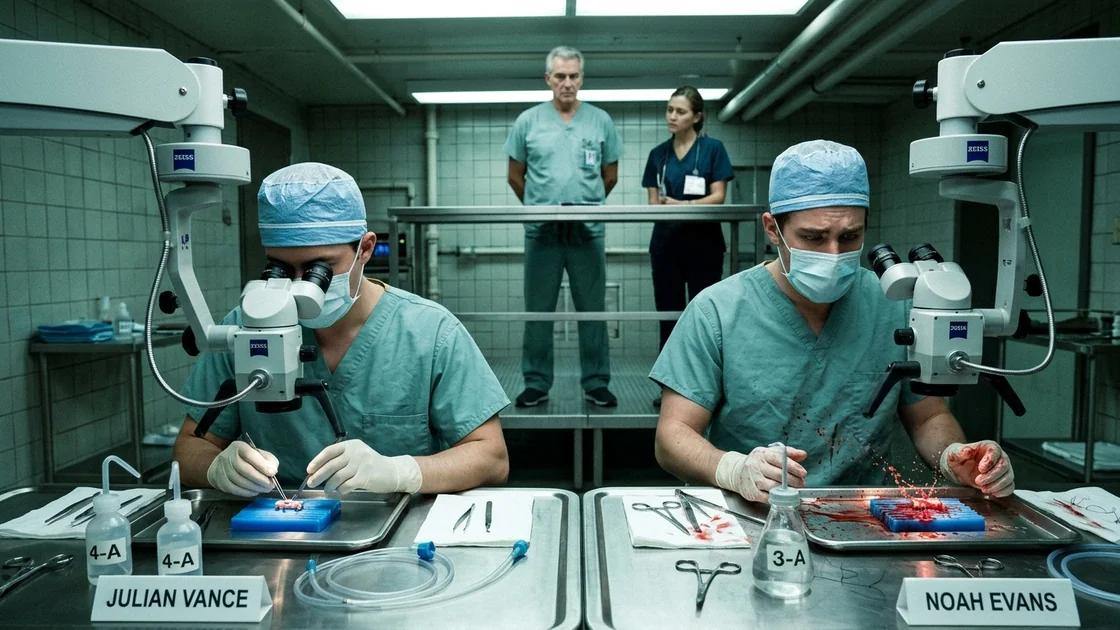
Julian Vance systematically sabotaged his best friend and lab partner Noah Evans during their final microsurgical practical examination at the Highline Institute of Medicine in order to secure the solitary residency position in cardiothoracic surgery. As Julian advanced into the prestigious fellowship under the watchful eye of the department chair, Noah collapsed beneath the administrative humiliation, mounting debt, and psychological disintegration of an inexplicable failure. Julian remained at Noah's side throughout his ruin, masquerading as a loyal confidant while silently bearing the burden of his own calculated betrayal.
Act I: The Crucible of Fourth Year
The basement vivarium of the Highline Institute smelled perpetually of chilled vinegar, alkaline detergent, and the faint, sweet decay of preserved biological specimens. It was a subterranean world insulated from the seasonal shifts of the city above, illuminated only by recessed fluorescent tubes that hummed at a low, concussive B-flat.
Julian Vance leaned over station four, the bridge of his nose resting against the double rubber eyepieces of a Zeiss operating microscope. Through the optics, the world was reduced to an illuminated circle two centimeters in diameter. His field of vision consisted of a segment of bovine coronary artery, three millimeters in internal caliber, pinned into a bed of blue dental wax with stainless steel dissection needles.
Between his right thumb and forefinger, Julian held a pair of titanium Castroviejo needle holders. The tip grasped a microscopic curved needle, finer than an eyelash, threaded with 8-0 polypropylene suture—a strand so gossamer it seemed to disappear if the overhead light drifted by a fraction of a degree. With a steady, circular rotation of his wrist, he drove the needle through the adventitia and media of the vessel, taking precisely one-half millimeter of tissue bite.
"Your entry angle is eighty degrees, Julian," a voice murmured from the adjacent stool. "If you don't hit ninety square, you’re going to tear the intima when you throw the knot."
Julian did not look up from the optics. He could hear the rhythm of Noah Evans’s breathing—measured, slow, possessing the autonomic discipline of someone who had played concert cello before turning to medicine.
"It's eighty-five," Julian muttered, tightening his fingers against the spring action of the Castroviejo. "And the intima holds."
"It holds until you reperfuse at eighty millimeters of mercury," Noah said softly. There was no venom in the correction; there never was. Noah merely adjusted his own microscope, his fingers moving across the coaxial focus knobs with an unhurried, intuitive familiarity that Julian had spent three years trying to dissect, imitate, and surpass. "Then you get a pseudoaneurysm. And then your patient spends their second postoperative night in an open-chest resuscitation."
Julian paused, his needle frozen halfway through the vascular wall. He closed his eyes against the blue light of the microscope. Behind his lids, orange afterimages pulsed in time with his racing pulse.
He knew Noah was right. Noah was almost always right.
When Julian backed the needle out, reset the clamp, and drove it again at a true ninety-degree perpendicular, the bite was clean. The needle exited without dragging the fragile interior lining of the vessel.
"Better," Noah said, his voice dropping into that warm, collegiate cadence that made nurses linger at the nursing stations when he was on call and made the clinical attendings nod with unconscious approval during morning morbidity and mortality conferences. "You overthink the torque, Jules. Stop trying to command the metal. Just let the curvature do the work."
Julian eased his spine back from the stool, hearing the wet pop of his vertebrae against his scrub top. He stripped off his nitrile gloves, letting them snap with an elastic crack against his wrists, and looked at his friend.
Noah Evans was pale, possessing the gaunt, romantic features of an ascetic scholar. Dark hair, cut short and carelessly parted with water in the locker room sink, fell across a forehead lined with the faint creases of perpetual concentration. His lab coat was frayed at the cuffs, the embroidered blue script reading Highline Institute of Medicine - Class of Award faded from cheap institutional laundering. Noah was thirty-one, three years older than Julian, having spent his early twenties working as a paramedic in urban Baltimore to pay down his mother’s medical debts before applying to medical school on an institutional scholarship that barely covered the cost of his textbooks and rent.
Julian, by contrast, was the son of a clinical nephrologist and an appellate judge. His scrubs were privately tailored from breathable, non-static synthetic cotton. His loupes were custom-cast by SurgiTel to match the exact interpupillary distance of his eyes down to the tenth of a millimeter. Yet, despite every structural advantage that capital and legacy could bestow, Julian knew the numbers.
Everyone in the department knew the numbers.
There was precisely one clinical residency slot open in the Department of Cardiothoracic and Vascular Surgery for the upcoming academic year. Dr. Alistair Sterling, the department chairman—a man whose surgical innovations had made him an autocrat within the hospital hierarchy—did not believe in expanding cohorts. He took one trainee per year. One disciple whom he personally molded into an operative machine, introducing them to the private societies, securing their clinical fellowship placements at the Texas Heart Institute or the Pitié-Salpêtrière in Paris, and ensuring their eventual trajectory toward academic royalty.
For eight months, the selection process had narrowed. Two dozen hopefuls had washed out into general surgery preliminaries, anesthesia, or interventional radiology. By the middle of the spring semester, only two names remained on Dr. Sterling’s private board: Julian Vance and Noah Evans.
Their scores on the United States Medical Licensing Examination were separated by a single point. Julian had the edge in first-author basic science publications; Noah had the edge in clinical evaluations, patient advocacy awards, and the unanimous, quiet affection of the operating theater scrub techs, who knew within five minutes of an incision whether an intern was a surgeon or merely an ego with a scalpel.
The final determination rested entirely on the Practical Board Simulation: a four-hour, high-pressure wet-lab examination designed by Dr. Sterling himself. It would take place on the coming Friday morning in the surgical skills lab. The two candidates would work side-by-side on perfused porcine and cadaveric tissue models, performing an end-to-side microvascular bypass under the unblinking gaze of Sterling and the senior evaluation committee.
The winner would receive an envelope on Match Day containing an institutional contract for seven years of residency and an immediate administrative fellowship. The loser would be released into the general match pool, scrambling for unfilled positions in community hospital programs across the Rust Belt or the rural interior.
For Noah, who owed two hundred and forty thousand dollars to private loan syndicates and supported his disabled mother in an assisted-living facility outside Annapolis, failing to secure the Highline residency meant an unmitigated personal and financial catastrophe. For Julian, failing meant something far less tangible, and therefore far more lethal: it meant that he was ordinary.
"You’re staying late tonight?" Noah asked, sliding his instruments into their velvet-lined stainless-steel sterilization cassette.
"Just another hour," Julian said, his voice measured, devoid of the friction that was currently abrading his ribcage. "I want to run through three more end-to-end anastomoses. My knot-tying speed is thirty seconds off Sterling’s benchmark."
Noah looked at him, his gray eyes clear and patient. He reached out and tapped the back of Julian’s shoulder with two fingers. "Don't burn out the retina, Julian. Your hands are good enough. They’ve been good enough since third year. At this point, it's just about nerve."
"Sterling doesn't test nerve," Julian replied, not meeting his gaze. "He tests perfection."
"Perfection is a mechanical error," Noah said, slinging his canvas backpack over his left shoulder. "Machines don't bleed. Patients do. See you at morning rounds. Get some sleep, Jules."
Julian listened to the scuff of Noah’s worn clogs retreating down the asphalt-tiled corridor, through the double fire doors, and up the concrete stairwell toward the street.
When the basement was completely silent save for the air handlers and the hum of the cooling compressors in the specimen lockers, Julian sat down again at station four. He did not pick up his needle holders. Instead, he stared at station three—Noah’s station—where his friend’s personal microsurgical kit sat upon the stainless-steel tray, washed, dried, and ready for the autoclave.
Act II: The Chemistry of Betrayal
The Highline wet-lab practical exam was famous for its hostility. Dr. Sterling did not simply evaluate mechanical execution; he evaluated an operator’s capacity to handle structural failure. During the four-hour procedure, candidates would be presented with sudden hemodynamic surges in the perfusion apparatus, unexpected intimal tears, and simulated systemic coagulopathies that required rapid pharmacological correction.
To ensure standardized baseline conditions, the candidates were permitted to use their own personal micro-instruments—instruments they had spent hundreds of hours balancing, honing, and acclimating to their own neuromuscular patterns—while all biological models, perfusion fluids, and pharmacological agents were provided by the department’s central lab.
On Wednesday evening, thirty-six hours before the examination, Julian was alone in the laboratory pharmacy supply annex. His institutional badge, augmented by his father’s status as an emeritus clinical professor, afforded him unrestricted access to the cold-storage vaults where analytical reagents and preservation media were kept.
Julian stood before the glass-fronted chromatography refrigerator, illuminated by its cold green LED array. His pulse sat at a calm, deliberate fifty-eight beats per minute. The panic that had ridden him for three months had vanished, replaced by the deadening, crystalline lucidity that often took hold of him during twenty-hour trauma rotations.
He had analyzed every variable. Noah’s surgical technique had only one systemic vulnerability: his reliance on fine, delicate tissue tactile feedback. Noah did not use brute force; he floated needles through vessels by feeling the resistance of the microscopic collagen matrix. He worked on the edge of the tissue’s elastic limit.
If a vessel’s wall was subtly degraded—not enough to be visible under eight-power stereomicroscopy, but enough to alter the cross-linking of the collagen fibril network—the tissue would feel normal under light palpation, but it would shear instantly the moment a running suture line was placed under systemic tension.
Julian pulled on a pair of unpowdered nitrile gloves. From his lab coat pocket, he withdrew a fifty-milliliter amber glass vial containing a zero-point-five percent solution of buffered collagenase type IV—an enzyme specifically used in cell biology labs to digest extracellular matrices and isolate endothelial cells from vascular walls without causing macro-structural disruption.
Beside the enzyme sat the standard irrigation flasks used during the examination: sterile physiological saline mixed with low-dose papaverine, an antispasmodic vasodilator used to prevent vascular constriction during microsurgery. Each candidate had their own assigned rack of five irrigation bottles, labeled with their respective station numbers, sitting on the pre-op preparation counter.
Julian approached station three’s assigned shelf. He took bottle 3-A, the primary fluid reservoir Noah would use to flush the graft bed and rinse his biological sutures throughout the first two hours of the anastomosis.
Using a sterile three-cubic-centimeter syringe fitted with a twenty-five-gauge needle, Julian drew zero-point-six milliliters of the concentrated collagenase solution. He inserted the needle through the self-sealing rubber septum of the irrigation flask and depressed the plunger. The clear liquid dissolved instantly into the saline-papaverine matrix. It was completely odorless. It had no optical refraction. At room temperature, it would take roughly forty minutes of contact with the donor vessel's cut edge to cleave the triple-helix collagen fibers, reducing the tensile strength of the vessel wall by nearly seventy percent.
To a casual observer, or even to a surgeon examining the tissue with surgical loupes, the vessel would appear pristine. The pink sheen of the media would remain intact. The cut would look surgically clean. But the moment the microsuture was tied and the perfusion pump engaged to simulate systemic arterial pressure—one hundred and twenty millimeters of mercury—the suture line would not hold. The sutures would cut through the softened margins of the artery like copper wire through wet parchment.
Julian removed the needle, inverted the bottle twice to ensure uniform dispersion, and set it back on Noah’s tray.
He then took Noah’s primary micro-scissors—the delicate, curved titanium Vannas scissors that Noah had purchased second-hand from an estate sale of a retired neurosurgeon and painstakingly polished with diamond paste until the blades met with zero lateral tolerance. Julian opened the hinged jaws. Using an ultra-fine Arkansas stone slip he had brought in his palm, he made two light, vertical passes across the inner shearing edge of the right blade.
Not enough to nick the steel. Just enough to dull the microscopic apex by two microns.
When cutting 8-0 suture, the scissors would feel ordinary. But when cutting through the back wall of an elastic artery, the blunted apex would cause a fractional pinch of the deep intimal layer—an invisible, sub-millimeter disruption that would serve as a mechanical stress concentrator once the collagenase had completed its silent digestion.
Julian placed the scissors back into Noah’s cassette, closed the stainless-steel lid, and snapped the silicone retaining bands in place.
He stripped his gloves, dropped them into the biohazard bin, and walked out into the corridor. His footsteps did not echo on the linoleum. When he emerged onto the street at midnight, the April air was sharp, smelling of wet asphalt and early lilac blooms. He felt entirely clean. There was no racing heart, no nausea, no moral tremor. He had not committed an act of violence; he had simply introduced an imperceptible thermodynamic disadvantage into an already hostile system. Medicine was an enterprise built on managing chaos. Noah would simply encounter more chaos than anticipated.
Act III: The Fracture
The surgical skills laboratory was kept at an ambient temperature of sixty-four degrees Fahrenheit. The air was sterile, cycled through HEPA filters four times an hour, carrying the subtle, sharp ozone scent of cautery testing units and the dense, oily smell of warmed machinery.
Dr. Alistair Sterling stood on the elevated observation dais at the front of the room, flanked by two senior attending surgeons from the vascular division. Sterling was sixty-two, possessing a silver mane cut with military austerity, steel-framed spectacles, and a demeanor of absolute, predatory patience. He wore his scrub top tucked tightly into his scrub pants, without a single wrinkle across his chest, his hands clasped behind the small of his back.
"Gentlemen," Sterling’s voice cut across the room through the public address speaker. "You have three hours and thirty minutes. You will perform an end-to-side anastomosis of the left anterior descending coronary analog, utilizing an inverted internal mammary harvest. You will then revascularize the marginal branch using a reversed saphenous graft segment."
He looked down at the two stations arranged five paces apart.
"The perfusion pump will be initiated at three hours and fifteen minutes precisely. You will be graded on three criteria: intraluminal patency determined by electromagnetic flow meter, structural integrity under a peak pressure challenge of one hundred and forty millimeters of mercury, and the economy of your surgical movements. If your graft leaks more than ten milliliters per minute under challenge, you will receive a non-passing mark for the session. Begin."
Julian seated himself at station four. Noah was at station three.
Between them hung a silence so total that the click of Julian’s foot-pedal activating the microscope light sounded like a gunshot.
"Good luck, Jules," Noah whispered across the gap.
Julian did not answer. He was already inside the glass.
For the first ninety minutes, Julian worked with an icy, automated precision. His hands were steady, devoid of the minor physiologic tremors that plagued lesser operators under observation. He prepared the bed of his host vessel, stripped the perivascular fat with millimeter-wide strokes of his micro-forceps, and marked his landing zone with a micro-caliper. Every movement was economic, a silent exercise in geometric conservation.
Beside him, Noah was working with his characteristic lyrical rhythm. Julian could hear the soft, periodic snip of Noah’s Vannas scissors, the gentle hiss of his bulb irrigator bathing the tissue with fluid from bottle 3-A. Noah was humming faintly—a Brahms sonata—his breathing falling into that low, oceanic cadence that Julian had heard a hundred times in the vivarium.
"Candidate Evans," Sterling’s voice dropped from the speakers. "Your vessel orientation is five degrees off the long axis."
"Compensating for lateral torsion during dynamic perfusion, Dr. Sterling," Noah replied, his tone polite, unruffled, completely respectful.
From the dais, Sterling did not respond. But Julian saw the chairman make a short, definitive note in his leather-bound evaluation ledger.
At two hours and ten minutes, Julian began his running suture. He worked with an 8-0 monofilament, using a continuous parachute technique to drop the graft onto the arteriotomy. The needle moved with an mechanical cadence: in, out, pull, tension, hold. He did not look at Noah’s station, but his peripheral vision caught the movements of Noah’s hands.
Noah had begun to place his posterior row of sutures.
"Come on," Noah muttered, barely audible above the hum of the air filters.
Julian didn't turn his head. "Problem?" he asked, throwing a knot with his micro-needle holders.
"Nothing," Noah said. His voice was slightly tighter now, the cello-like resonance vanishing. "The adventitia feels… soft. A little spongy on the heel."
"Check your hydration," Julian offered smoothly. "The overhead lights dry the tissue out fast."
"I am hydrating," Noah said. Julian heard the bulb irrigator squeeze again. Another wash of the collagenase-spiked papaverine solution cascaded over Noah’s graft, soaking into the delicate, newly cut margins of the vessel, sinking deeper into the proteoglycan scaffolding with every passing second. "It’s fine. Just needs a lighter touch."
Julian tied his sixth knot. His own graft looked immaculate. The tissue was firm, pale pink, glistening with pure, unadulterated saline.
At two hours and forty-five minutes, Noah’s rhythm broke.
It was not a dramatic collapse; it was a microscopic hesitation that only another trained surgeon could detect. Noah had picked up his needle to place the critical heel suture—the suture that would bear eighty percent of the hydraulic drag once the perfusion pump was turned on.
Julian glanced over through the corner of his loupes.
Noah was leaning closer to the eyepieces. His shoulders, usually loose and level, had hiked toward his ears. His right index finger was twitching—a fraction of a millimeter, the subtle betrayal of a nervous system fighting an unexpected tactile signal.
"The edge isn't holding the bite," Noah whispered. The words were not meant for Julian; they were the desperate, bewildered vocalization of an expert craftsman whose tools had suddenly begun to violate the laws of physics.
He drove the needle through the host vessel wall. When he gently pulled the 8-0 suture to cinch the tissue together, there was no resistance. The thread did not pull the edges into apposition. Instead, it slipped cleanly through the margin, leaving a tiny, V-shaped slit where the compromised collagen matrix sheared under the minimal tension of his fingers.
"What?" Noah breathed.
Julian kept his eyes on his own field, placing his penultimate knot. "Noah? You alright?"
"The vessel… the wall is tearing," Noah said. There was an edge of thin, cold panic in his voice now—a sound Julian had never heard from him, not even when they were managing a four-vessel trauma arrest in the emergency bay at three in the morning. "Every time I tension the monofilament, it cuts through. It’s like wet toilet paper."
"Drop your tension," Julian said, his voice a masterclass in clinical concern. "Take a deeper bite. Take a full millimeter."
"I can't take a millimeter on an anterior graft," Noah hissed, his breath fogging the edge of his oculars. "It will stenose the lumen. It’ll drop the flow by half."
From the dais, the heavy footsteps of Dr. Sterling descended the metal stairs. The chairman approached station three, his arms still folded behind his back, his gaze fixed on Noah’s hands.
"Fifteen minutes until perfusion, Candidate Evans," Sterling said flatly.
"Dr. Sterling," Noah said, his voice trembling slightly as he backed away from the eyepieces to look up at the chairman with bloodshot eyes. "There’s an issue with the graft tissue. The tissue integrity is compromised. The wall is friable—far beyond standard biological variation. It’s shedding its adventitia under sub-gram force."
Sterling stepped to the side of station three, looked into the teaching side-arm of Noah’s microscope for five seconds, and stepped back.
"The tissue was harvested from the same institutional lot as Candidate Vance’s, Evans," Sterling said without inflection. "The control samples passed histology this morning. The tissue is identical."
"It's not," Noah said, his voice rising a half-octave, cracking on the vowel. "Look at the edge, sir! Look at the laceration along the heel. I haven't applied more than two grams of tension. The needle is just… it’s cheese-wiring through the wall."
"Then you are using improper vector alignment," Sterling said, checking his vintage Patek Philippe wrist watch. "Or you have blunted your needles during loading. A surgeon does not blame the biology for an operative failure. You have twelve minutes to complete the anastomosis and initiate flow. If you are not tied off when the pump turns over, you will be disqualified."
Sterling walked away, returning to the dais with deliberate, unhurried steps.
Julian looked over at Noah.
Noah’s face had lost all its color. A bead of sweat had formed at his hairline, tracking slowly down his temple before being caught by the elastic rim of his scrub cap. His hands, those steady, miraculous hands that Julian had secretly envied for three years, were shaking with an overt, low-frequency tremor.
Noah bent over the microscope again. He was frantic now. He grabbed a secondary 7-0 suture—thicker, heavier, an act of sheer desperation to hold the disintegrating margin together. But the blunted Vannas scissors had already created a microscopic notch in the back wall. When he tried to place the stay suture, the scissor-cut caught the tear.
With a sound so faint it could only be felt through the metal instruments, the entire back wall of the vessel split longitudinally.
A three-millimeter gap opened in the graft.
"No," Noah whimpered. "No, no, no."
"Three minutes," Sterling’s voice boomed from the ceiling. "Prepare for line pressurization."
"Julian," Noah gasped, turning his head toward station four, his eyes wide, wild, completely stripped of pride. "Julian, look at this. Tell him. Tell him this isn't my bite. You know how I throw this stitch. You’ve seen me do it fifty times. Look at the wall!"
Julian looked at his friend. He held his gaze for two seconds. In those two seconds, Julian felt the world contract into an absolute, freezing point of moral zero.
"I’m sorry, Noah," Julian said, his voice quiet, steady, and clear enough to carry to the observation dais. "I’m in the middle of my final tie. I can't break my field."
"Initiating pump," the lab technician announced.
The electric motors of the perfusion apparatus groaned to life. Clear, red-dyed hydraulic fluid surged through the plastic supply lines, filling the arterial trees of both models.
At station four, Julian’s graft swelled. The suture line held with pristine, architectural beauty. A tiny drop of fluid wept from the third needle hole, then stopped as the pressure stabilized at one hundred and twenty millimeters of mercury. The digital flow meter on his console hummed, displaying a steady, unbroken green readout: 42 mL/min. Patency 98%.
At station three, there was no patency.
The moment the fluid hit Noah’s reconstructed vessel, the entire heel blew out. The weakened, enzymatically degraded collagen gave way in a catastrophic, jagged flap. The red liquid did not weep; it sprayed in a violent, pulsed jet that spattered the blue dental wax, Noah’s sterile gloves, and the glass lenses of the Zeiss microscope.
The digital monitor began to scream with a high-pitched alarm: Pressure drop detected. Flow rate: 0 mL/min. Anastomotic rupture.
Noah did not move. He sat there, his needle holders still clenched in his trembling right hand, his face splattered with red dye, staring into the flood of fluid pooling in the tray.
"Test concluded," Dr. Sterling announced. The chairman did not descend the stairs this time. He simply closed his ledger with an audible, leather-bound snap. "Candidate Vance, clear your station and report to my office at fourteen hundred hours. Candidate Evans… clean your tray."
Act IV: The Collapse
The descent of Noah Evans was not a sudden fall; it was an agonizingly slow, structural decomposition that Julian observed from the vantage point of absolute security.
Julian received the residency. The envelope had arrived on Match Day with the formal gold seal of the Highline Institute, signed by Sterling and the dean of clinical medicine. Julian had celebrated at a private dinner at the Union League Club with his parents, drinking twenty-year-old single malt while his father clapped him on the shoulder and declared that the Vance name had finally regained its rightful place in academic surgery.
Noah did not match.
A failure on a department practical exam did not simply disqualify a student from the Highline residency; it generated an administrative red flag in the Dean’s Letter of Evaluation—the dreaded "Medical Student Performance Evaluation" sent to every program in the country. The letter noted that Candidate Evans had "demonstrated unexpected technical deficiency and emotional lability during high-stakes procedural simulation."
To the competitive surgical programs across the nation, that single sentence was an incurable malignancy. Programs with hundreds of applications for three spots did not investigate; they simply dropped the file into the shredder.
By late May, Noah had vacated his locker in the student lounge. He had not attended graduation. While Julian wore his doctoral velvet and received his hood under the applauding canopy of the city opera house, Noah was sitting in the basement apartment he rented three miles south, where the subway tracks ran above ground and the windows rattled every eight minutes with the passage of the outbound express trains.
Julian visited him on a Tuesday evening in early June, carrying a brown paper grocery bag filled with fresh produce, bread, and two expensive sirloin steaks that he knew Noah could not afford.
The apartment smelled of damp plaster, stale instant coffee, and the sharp, sour tang of unwashed clothes.
"Noah?" Julian called, pushing open the unlocked door.
Noah was sitting on the edge of a mattress that lay directly on the floorboards, without a frame. The room was dark, the cheap vinyl blinds drawn against the afternoon heat. Across the floor, scattered like dry autumn leaves, were hundreds of pages of printouts: journal articles on collagen vascular disease, mechanical properties of porcine graft matrices, microvascular repair protocols, and printouts of histological stains.
Noah was wearing an old grey sweatshirt, the collar stretched and stained with dried tea. His hair was greasy, standing up in erratic tufts where he had spent weeks running his fingers through it in the dark. He had lost at least twenty pounds; his collarbones protruded like thin birch branches beneath his skin, and his wrists looked dangerously fragile.
"Julian," Noah said, his voice flat, hollowed of all resonance. He didn't rise. "You shouldn't have brought food. I’m not… I haven't been cooking much."
Julian set the bag on a laminate counter covered in empty pill bottles and overdue notices. "You have to eat, Noah. You look like you’re in cachexia."
"I was looking at the shear stresses," Noah said, his eyes darting toward the papers on the floor. He didn't seem to have heard Julian’s comment. He picked up a page covered in dense mathematical formulas and microvascular stress-strain curves. "Look at this, Jules. Look at the modulus of elasticity for an eight-millimeter section of porcine anterior descending. It’s impossible."
Julian stood very still, his hands deep in the pockets of his crisp, tailor-made linen trousers. "Noah. Stop doing this to yourself."
"No, listen to me!" Noah surged to his feet, the paper shaking in his hand. For a moment, the old intensity flared in his eyes, but it was curdled now, transformed into the wild, jagged energy of monomania. "The yield strength of that tissue under six-zero or eight-zero suture is three point two Newtons per square millimeter. The pump was set to one hundred and twenty over eighty. Even with hydraulic surge, the wall tension couldn't have exceeded zero point nine Newtons. It couldn't have torn! Not unless the tissue was necrotic."
"Noah—"
"I went to the pathology department," Noah continued, his voice dropping into a frantic whisper, his eyes wide, darting toward the door as if Sterling’s administrative officers might be listening from the hallway. "I asked Dr. Hendershot to pull the paraffin blocks from that day’s tissue lot. You know what he told me? He told me the remaining specimens were incinerated the following morning. Standard biohazard protocol. The whole lot. Gone."
"That's normal protocol, Noah," Julian said gently, taking a step forward and resting his hand on Noah’s shoulder. The bone beneath the cloth felt cold and sharp. "They don't store animal graft tissue after a board simulation. There’s no clinical reason to keep it."
"It wasn't animal tissue, Jules," Noah whispered, his fingers grabbing Julian’s forearm with a sudden, painful grip. "It felt wrong. My hands didn't lie to me. I spent seven years learning the drag of that metal. I know what tissue feels like when it yields. Something happened to that vessel. It was… it was poisoned. Or it was bad stock. Sterling knew it. He had to know it. He just didn't want to admit the department bought defective simulation media, so he pinned it on me."
Julian let Noah grip him. He did not pull away. He looked directly into his friend’s ruined, feverish face with an expression of infinite, sorrowful compassion.
"Noah," Julian said softly, using the low, measured tone one uses with a patient receiving an inoperable pancreatic diagnosis. "Listen to what you’re saying. Listen to yourself. Do you really believe Dr. Alistair Sterling—a man with three endowed chairs and two international surgical medals—would cover up a bad tissue lot just to fail an applicant he personally mentored for two years?"
Noah blinked. The manic focus in his eyes began to waver, fractured by the cold, crushing weight of Julian’s logic.
"I… I don't know," Noah stammered, his grip on Julian’s arm slackening. "Then what was it? My hands don't shake, Julian. You know they don't shake!"
"You were under pressure, Noah," Julian said, his voice dropping to a near-whisper, full of quiet, tragic certainty. "We were both under pressure. It was the most brutal exam in the country. You had the mother’s care payments due that week. You had the loan consolidation coming down. You had everything riding on that three-hour block. You got into your own head. You hit the adventitia at a bad angle, you tore it, and when you saw the tear, you panicked. You over-corrected. You used seven-zero on a friable margin and you ripped it wide open."
Noah stared at Julian. His mouth opened slightly, but no sound came out.
"It happens, Noah," Julian continued, his voice relentless in its gentleness, driving the spike deeper with every syllable. "It happens to great people. It happened to Billy Weston in the neuro residency three years ago. It happened to Sarah Chen during her fellowship boards. The mind… it just misfires under that kind of load. It doesn't mean you aren't brilliant. It just means the circuit broke."
Noah slowly sank back down onto the mattress. His hands fell into his lap, palms upward, limp and empty.
"The circuit broke," Noah repeated. The words were barely a breath. The wild fire that had animated him moments before was extinguished, leaving behind an ash-gray ruin. "My hands. It was my hands."
"You need to let this go," Julian said, kneeling down beside him so they were at eye level. "You’re killing yourself in this basement. The match is over. The year is done. If you spend your time hunting for conspiracies in the pathology lab, they’re going to pull your medical license entirely. They’ll call it clinical paranoia."
Noah looked down at his own fingers. He brought his right hand up to his face, staring at the palm, at the calluses he had formed on the cello strings and the micro-instruments. Then, with a sudden, quiet violence, he closed his fist and struck the floorboards once, twice, three times, until the skin over his knuckles split and a thin ribbon of blood began to seep into the floorboards.
Julian did not stop him. He waited until the self-inflicted blow was finished, then reached into his pocket, withdrew a clean linen handkerchief, and carefully wrapped it around Noah’s bleeding hand.
"Come on," Julian said, his voice steady, patient, fraternal. "Let’s clean this up. I’ll make you some tea."
Act V: The Match Day Ghosts
By October, the residency began in earnest.
Julian Vance was a revelation in the Highline operating theaters. He was efficient, tireless, and devoid of emotional volatility. He arrived at the hospital at four-fifteen every morning, his scrubs immaculate, his patient charts memorized to the third decimal place of their electrolyte balances. Under Sterling’s demanding tutelage, Julian learned to split sternums with a single pass of the saw, to cannulate the aorta without creating a hematoma, and to place fifteen running stitches a minute on the warm, beating myocardium.
Sterling loved him. In the surgeons' lounge, between sips of black espresso, Sterling would point to Julian and tell visiting department chairs from Harvard and Johns Hopkins: "That is what discipline looks like. No theatricality. No artistic temperament. Just pure, repeatable engineering."
Julian smiled, nodded, and accepted the praise.
He lived in an airy, sunlit loft apartment three blocks from the hospital, paid for by his resident stipend and his family trust. He bought a new leather-bound surgical logbook, filling the pages with lists of successful aortic valve replacements, CABG procedures, and ventricular assist device implantations.
He kept Noah’s name in his phone. He called him every Sunday at eight in the evening.
At first, Noah answered.
The updates were brief, increasingly fractured reports from the periphery of existence. Noah had moved out of the city; the basement apartment had become unaffordable after his institutional stipend was formally revoked following his non-graduation status. He had taken a job as a night-shift phlebotomist at a regional diagnostic lab in western Pennsylvania, drawing blood from geriatric patients in nursing homes for nineteen dollars an hour.
"It’s good," Noah had said during a call in November, his voice sounding thin, distant, like an audio recording played through water. "No decisions to make, Jules. You just find the vein, pop the vacutainer, pull the needle. You don't have to worry about the intima. It doesn't matter if the vein bruises a little. Nobody grades you."
"Are you studying for the Step Three exam?" Julian had asked, sitting at his walnut dining table with a glass of Pinot Noir, looking out over the city skyline. "You can still sit for it independently, Noah. If you pass Step Three with a high score, you can re-apply to the second-round match in family medicine or pathology."
"I don't touch the books anymore," Noah had replied quietly. "Every time I look at an anatomical diagram of a vessel… my right hand goes numb. Literally numb. Like a carpal tunnel flare, but the neurologist says the conduction velocities are normal. It’s all psychosomatic. Sterling broke the wire, Julian. Just like you said. The circuit broke."
Julian had felt a cold, sharp flutter in his chest—not guilt, but the terrifyingly pure thrill of an artist whose creation had proven more durable than the medium itself. He had not merely beaten Noah; he had rewritten Noah’s internal reality. He had made Noah believe, in the deepest marrow of his consciousness, that his failure was an innate biological defect.
"Don't say that," Julian had said, his voice thick with performative grief. "You were the best of us, Noah."
"No," Noah had whispered before hanging up. "I wasn't. You were."
By January, the calls went directly to voicemail. The automated operator’s voice informed Julian that the number was no longer in service.
Act VI: The Operating Theater
The winter was brutal. Blizzards swept off the Atlantic, burying the city in three feet of gray, salt-caked slush. Julian spent seventy hours a week inside the hospital, rarely seeing daylight, his life circumscribed by the blue drapes of the operative field and the electronic hum of the cardiopulmonary bypass circuits.
On a freezing Thursday night in February, Julian was on call as the senior resident covering the cardiothoracic service. Sterling was at an international symposium in Zurich; the primary coverage fell to Dr. Marcus Thorne, a weary, competent attending whose primary objective during night call was to sleep as much as the pager permitted.
At two-forty in the morning, the emergency pager on Julian’s belt shrieked its high-priority alarm: TRAUMA BAY 1. LEVEL 1 PENETRATING CHEST. PROTOCOL RED.
Julian sprinted down the stairwells, his clogs slapping against the concrete, his surgical mask already hanging around his neck.
When he burst through the swinging double doors of Trauma Bay 1, the room was a slaughterhouse. Blood was splattered across the white tile floor, pooled beneath the trauma gurney, and smeared in broad, desperate handprints across the stainless-steel equipment carts. Four nurses and two emergency residents were performing frantic, closed-chest compressions on a body that lay pale and slack beneath the high-intensity halogen lights.
"What do we have?" Julian barked, stepping into the splash zone and reaching for a sterile gown and gloves.
"Unidentified male, approximately thirty to thirty-five," the trauma fellow shouted over the alarms. "Found down in an alley behind the interstate bus terminal. Single self-inflicted stab wound to the left anterior chest. Bread knife. He hit the internal mammary or the ventricle. He coded three minutes ago in the rig. We’ve got no pulse, no pressure, PEA on the monitor."
"Get off his chest," Julian ordered, stepping up to the gurney, his Castroviejo reflexes instantly taking over. "Open the chest. Give me a ten-blade and the Finochietto retractor."
Julian took the scalpel. With one continuous, deep sweep across the left fifth intercostal space—the standard "clamshell" incision he had practiced hundreds of times—he divided the skin, the pectoralis muscle, and the intercostal tissue down to the pleura. The rib spreader was inserted; he cranked the wheel, the metal gears clicking like an antique clock as the ribs groaned and separated to expose the pericardial sac.
The pericardium was blue, tense, bulging with clotted blood under pressure—cardiac tamponade.
"Metzenbaum scissors," Julian commanded.
He snipped the pericardium. A fountain of dark, pressurized blood erupted from the sac, covering Julian’s visor and running down his forearms. He plunged his gloved hand into the chest cavity, sweeping away the clots until his fingers reached the heart.
The muscle was fibrillating—a useless, worm-like bag of shivering fibers.
"Internal paddles. Charge to twenty," he said.
He looked down into the wound to identify the laceration.
The blade had entered just lateral to the sternum, severing the left internal mammary artery and nicking the apex of the left anterior descending coronary artery—the exact anatomical junction Julian had reconstructed during the practical examination ten months before.
Julian reached for the suction tip to clear the field. He wiped the blood from the patient’s face with a sterile gauze pad to check for pupillary response.
The gauze swept away the dirt, the street grime, and the dark, dried blood.
Julian stopped.
The suction tip hissed in his left hand, sucking air and red fluid with a hollow, rhythmic slurp.
The face on the gurney was Noah Evans.
His cheeks were sunken, the skin translucent, pale as skim milk. His lips were blue. A thin, ragged scar marked the back of his right hand—the scar from the floorboards of the basement apartment.
"Julian!" the trauma fellow yelled. "The paddles are charged! Clear the bed!"
Julian did not move. He stood frozen, his hand still resting inside the open chest, his fingers touching the warm, shivering muscle of his friend’s heart.
"Vance!" the fellow screamed again. "Clear!"
Julian pulled his hands back two inches. The electrical paddles were applied to the wet myocardium. Thump. The body arched off the table. The monitor continued its flat, discordant drone: Asystole.
"Charge again. Thirty joules," the fellow said.
"Wait," Julian whispered.
"What?"
"Give me the needle holders," Julian said. His voice was no longer that of the pristine, controlled resident. It was thin, stripped, vibrating with an ancient, primeval terror. "Give me an 8-0 Prolene. Now!"
"Julian, he’s in asystole for five minutes, his pupils are fixed—"
"Give me the suture!" Julian roared, his visor fogging completely, his eyes burning behind his loupes.
The scrub nurse slapped the Castroviejo into his palm.
Julian leaned over the open chest. He didn't use the microscope; he didn't have time. He brought his face within six inches of the bleeding coronary artery. The edge of the cut vessel was jagged, torn by the cheap serrated kitchen knife.
Julian drove the needle through the wall.
In. Out. Pull.
The tissue yielded. It held the bite. The collagen was normal. It was firm, strong, human tissue, untainted by collagenase, ready to hold the line if only an operator had the hands to close it.
Julian pulled the thread.
"Hold the knot," he muttered, his fingers flying across the field, throwing loops with a frantic, desperate speed that violated every principle of economy he had ever learned. "Hold it, Noah. Hold the bite. It holds. The intima holds."
The thread snapped.
Julian had pulled too hard. Under the wild, erratic surge of his own adrenaline, his hands—those immaculate, balanced hands—had applied twelve grams of force to an 8-0 monofilament designed for two.
The needle disappeared into the pooled blood of the chest cavity.
"Vance," Dr. Marcus Thorne’s voice cut through the room. The attending had finally arrived, standing at the foot of the gurney in his open white coat, his hair tousled from sleep. He looked at the cardiac monitor, then down at the wide-open, non-responsive chest, and then at Julian’s blood-soaked gloves.
"Step back, Julian," Thorne said softly.
"I can re-anchor it," Julian gasped, reaching blindly for another needle pack on the Mayo stand. His visor was covered in sweat and blood; he couldn't see the numbers on the packaging. "I can take a deeper bite. I can drop a graft from the saphenous. I have the time. Dr. Sterling said we have three hours and thirty minutes—"
"Julian," Thorne said, reaching out and grabbing both of Julian’s wrists, pulling them firmly, inexorably away from Noah’s open ribs. "It’s over. Look at the monitor. He’s been down forty minutes before EMS even found him. The brain is gone. Call it."
"No," Julian choked. "No, he has to match. He has to take the slot. I have his instruments. They’re in my locker. I polished the blades. I polished them with the stone."
Thorne looked at the resident with a sudden, sharp frown of clinical curiosity. "What are you talking about? Vance, step outside. Wash your face."
Thorne turned to the circulating nurse. "Time of death: zero two fifty-one. Notify the medical examiner. It’s a John Doe suicide from the transit terminal."
"His name is Noah," Julian said. He was standing three paces back now, his arms hanging limp at his sides, the blood dripping from his fingers onto the pristine white leather of his clogs, creating little red rosettes on the floor. "His name was Noah Evans. He was… he was a surgeon."
Thorne didn't look up from the chart he was signing. "Not with those hands, he wasn't. Clear the room, team."
Act VII: The Mechanical Limit
The funeral was held in a municipal cemetery forty miles south of Annapolis, on a flat, barren expanse of marshland where the water table was so high that the graves had to be lined with concrete vaults to prevent the coffins from floating.
Julian was the only person in attendance besides Noah’s mother, who sat in a motorized wheelchair with a wool blanket tucked around her paralyzed legs, her eyes clouded by advanced vascular dementia. She did not know who Julian was. She did not seem to know who was in the bronze box suspended above the pit.
Julian wore his dark charcoal suit, his overcoat, and leather gloves. He stood twenty paces behind the wheelchair, his head bowed against the sleet that blew off the Chesapeake Bay, carrying the cold, dead salt smell of winter marshes.
When the minister concluded his brief, non-denominational service, Julian approached the grave. He waited until the cemetery workers had climbed into the cab of their backhoe, waiting for the mourners to leave so they could fill the mud.
Julian reached into the pocket of his overcoat.
He withdrew the pair of titanium Castroviejo needle holders and the curved Vannas micro-scissors that had belonged to Noah Evans. He had spent three nights in his high-rise loft, using an ultra-fine Arkansas stone and diamond lapping paste, trying to restore the microscopic shearing edge he had dulled ten months before. He had worked under his personal microscope until his eyes bled, polishing the steel, trying to remove the two-micron bevel he had ground into the metal.
He had tested them that morning on a segment of silk thread.
They did not cut cleanly. The steel had been altered; once the original crystalline geometry of the blade had been broken, no amount of manual honing could restore the factory edge without removing so much metal that the tips failed to meet. The tool was ruined. It had been ruined the moment he touched it with the stone.
Julian opened his fingers.
The instruments fell into the dark, rectangular hole, landing with a soft, metallic thud against the lid of the concrete burial vault.
He turned and walked back toward his car.
The residency continued.
Two months later, Julian was standing across from Dr. Alistair Sterling in Operating Room 3, performing an elective double-valve replacement on a seventy-two-year-old retired judge.
The field was dry. The bypass pump was humming at a steady four liters per minute. The room was cool, pristine, illuminated by the twin halogen lights that cast no shadows on the exposed human pericardium.
"Take the 4-0 Prolene, Julian," Sterling said, his voice coming through his surgical mask with that familiar, imperious confidence. "Drop the valve onto the annulus. Show me that ninety-degree bite."
Julian reached out his right hand.
The scrub nurse slapped the needle holder into his palm.
Julian positioned the needle over the aortic root. The light hit the metal, reflecting a tiny, blinding pinpoint of blue-white glare into his oculars.
He prepared to rotate his wrist.
Just let the curvature do the work, a voice murmured in the back of his ear, clear and calm, smelling of vinegar, cheap tobacco, and instant tea. Machines don't bleed. Patients do.
Julian tightened his fingers.
His wrist did not turn.
A sudden, deep, freezing numbness blossomed in the center of his palm, tracking upward along the distribution of the median nerve, through the carpal tunnel, up the forearm, and locking his elbow in a rigid, spastic clamp.
His right index finger began to twitch.
It was not a subtle tremor. It was a violent, low-frequency oscillation of the entire hand—a three-hertz mechanical shudder that caused the tip of the needle to rattle against the titanium housing of the prosthetic valve with a distinct, rhythmic click-click-click.
"Julian?" Sterling said, his eyes narrowing above his mask. "What are you doing? Suture the ring."
Julian stared at his hand. He commanded the fingers to close; they remained locked in that trembling, claw-like flexion. He commanded the wrist to rotate; the joint felt as though it had been fused with hot lead.
The needle slipped from the jaws of the Castroviejo. It dropped into the dark, deep recess of the aortic sinus, disappearing beneath the rim of the coronary ostium.
"Vance!" Sterling snapped, reaching his own hand across the field with the speed of an osprey hitting water, shoving Julian’s wrists out of the operative zone with a violent, bone-jarring crack of their sterile forearms. "Step back! Step off the platform!"
Julian stepped back.
His heel caught the edge of the rubber anti-fatigue mat. He stumbled, his back hitting the cold, stainless-steel tiles of the operating room wall.
"Suction," Sterling was barking, his head down, his fingers already working to retrieve the lost needle from the patient’s heart. "Thorne, get in here and take the first assist. Vance is out. Vance, get your hands down. Get out of my theater."
Julian stood against the wall.
He did not wash his hands. He did not unbuckle his scrub top.
He raised his right hand to his face, looking through the clear plastic of his protective visor at the trembling, twitching fingers that hung before his eyes. The tremor had spread to his shoulder now, a rhythmic, concussive vibration that resonated through his clavicle and rattled the teeth in his jaw.
The circuit had broken.
He looked down at the floor, where the saline irrigation fluid from the operative table had dripped onto the blue paper covers of his shoes, pooling in the tiny, microscopic depressions of the linoleum, perfectly still, perfectly flat, reflecting nothing at all.