The Price of Tallow and Bone
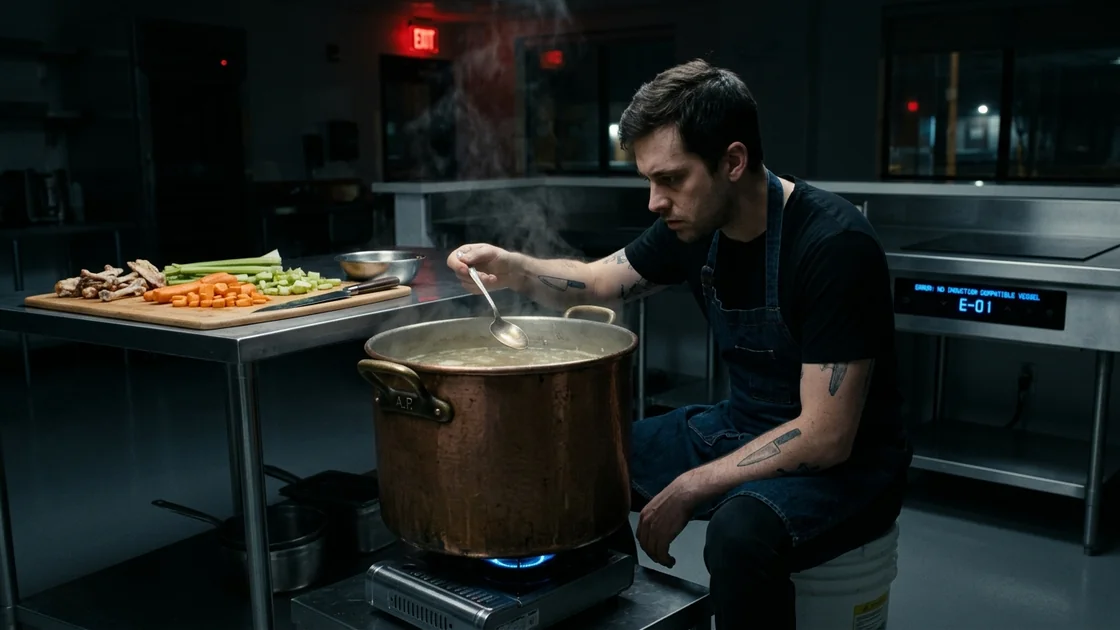
This is the story of Julian Vane, an ambitious sous-chef who systematically dismantled the pristine reputation of his mentor, Chef Arthur Pendelton, by orchestrating a catastrophic health inspection failure at the venerable restaurant L'Auberge d'Or. Driven by an impatient hunger for ownership and backed by predatory private equity, Julian acquired the historic establishment at auction for a fraction of its true value, only to discover that his triumph was a hollow husk as he watched the old master lose his culinary pride, his memory of flavors, and ultimately his will to live.
Chapter One: The Geometry of the Mirepoix
In the basement kitchen of L’Auberge d’Or, time was not measured in seconds or hours, but in the reduction of stocks and the slow, carbonized death of cast iron. The air hung thick with the vaporized ghosts of veal shanks, burnt shallots, and the sharp, mineral tang of wet slate floors scrubbed twice daily with lye and stiff boar-bristle brushes.
Arthur Pendelton stood at the head of the central pass, his tall, slightly stooped frame clad in a double-breasted white jacket that possessed neither embroidery nor modern piping. It was heavy Egyptian cotton, stiffened with starch until the cuffs sounded like breaking cardboard when he moved his wrists. For forty-two years, that coat had remained free of grease splatters. Arthur did not spill. He did not rush. He moved with the terrifying, glacial efficiency of an executioner who had turned his blade to the service of artichokes and pigeons.
"Look at the corner, Julian," Arthur said, not raising his voice above the hiss of the gas range. He did not look back at the young man standing behind his right shoulder. He pointed with the tip of an ancient, carbon-steel paring knife whose blade had been ground down by four decades of whetstones into a slender needle.
Julian stepped closer, suppressing the instinctual twitch of his jaw. He was twenty-nine, his knuckles scarred with the white tracks of sheet-pan burns, his eyes hollowed by eighty-hour weeks and the cold, acidic fire of modern ambition. "Yes, Chef?"
"The brunoise. The celery. You’re pressing down with the heel of the blade before the stroke completes. You’re bruising the cell walls. When that celery hits the hot butter, it will weep water instead of sweating sugar. It will dilute the emulsion. Do you think butter forgives water, Julian?"
"No, Chef."
"Butter forgives nothing," Arthur murmured, turning a single half-inch cube of carrot between his dry, calloused fingers. "The kitchen does not forgive. The city does not forgive. When you step through those brass doors at six o'clock, you leave your sentimentality in the gutter with the cigarette ends. If you cut the vegetable incorrectly, you insult the soil that grew it. Do it again."
Julian stared at the ten-pound mound of root vegetables piled upon his poly-top cutting board. His shoulder blades burned with a dull, throbbing ache that radiated into his neck. He had already spent three hours breaking down whole suckling pigs in the walk-in; the marrow-grease was still lodged under his fingernails beneath his latex gloves.
"Yes, Chef."
"And Julian?" Arthur paused, wiping the pass with a folded linen towel that was bone-white and dry. "Wipe down the stainless beneath your prep table. There is an eighth of an inch of condensed moisture on the underside of the shelf. Rust lives in the dark, my boy. You must shine light into the dark, or you have no business commanding a kitchen."
Julian lowered his head, dragging his knife through the whetstone's slurry. Commanding a kitchen. The words sat like lead in his belly. Arthur had been promising him the kitchen for four years. When the time comes, Julian. When your hand is steady enough. When your palate knows the difference between sea salt harvested in August and sea salt gathered after an October gale.
It was all poetry. It was all antique, suffocating nonsense. Outside the heavy oak doors of L’Auberge d’Or, the dining world was tearing through its own flesh to reinvent itself. In the riverfront district, twenty-five-year-old kids who couldn't bone a shad were opening twelve-seat tasting counters financed by real estate syndicates, charging four hundred dollars a head for lichen frozen in liquid nitrogen and smoked trout roe served on river stones. Food critics who had once bowed before Arthur’s classic civet de lièvre were now tweeting photographs of fermented ant paste and bone-marrow caramel.
L’Auberge was hemorrhaging money. The velvet on the banquettes was thinning, showing the yellowed horsehair beneath. The silver-plated Christofle flatware had lost its luster along the tines of the forks, worn raw by half a century of commercial dishwashers. The building’s landlord, an offshore holding company represented by a razor-thin lawyer named Miller, had already doubled the rent once and was preparing to triple it when the ten-year option came due in the autumn.
Arthur knew it, but Arthur pretended the ledger did not exist. To Arthur, the world was reducible to two things: the quality of the reduction and the cleanliness of the copper. If the dining room was half-empty on a Tuesday, it was because the public had been temporarily seduced by vulgarity, and the only cure was to make the quenelles de brochet even lighter, the velouté even more velvety, the kitchen even more immaculate.
Julian knew better. Julian had been meeting Miller in hotel bars at two in the morning, smelling of clarified butter and exhaustion, drinking neat rye while Miller slid cash-flow projections across damp cocktail napkins.
"The old man is finished," Miller had told him three nights earlier, tapping a gold signet ring against a heavy crystal glass. "The lease terminates in November. He hasn’t made a capital improvement to the plumbing or the HVAC since the Carter administration. The bank holds a second mortgage on his residence to cover the payroll taxes from last winter. If the restaurant defaults, the whole house of cards collapses into the sea."
"He won't sell," Julian had said, his voice flat. "He thinks of this place as a cathedral."
"Cathedrals burn," Miller replied, smiling with teeth that were too straight, too white. "Or they get sold to developers who turn them into condos. The building owners don't care about his sauces, Julian. They care about the rent. But there is a clause in his master lease—Section 14, Paragraph D. 'Sanitary Default.' If the municipal board of health issues a Class Three suspension or revokes the operating license for unsanitary practices, the landlord has the unilateral right to terminate the lease immediately, without the sixty-day cure period. The fixtures stay. The liquor license reverts to the master tenant. And an approved operator can assume the underlying lease at the historic base rate."
Miller had leaned in, the scent of expensive sandalwood cologne cutting through Julian's grease-stained aura. "We need an approved operator. Someone with pedigree. Someone who knows the bones of the space. We put up the capital. We give you thirty percent of the operating company, un-dilutable, and full culinary control. You put your name on the door. You gut the dining room, put in raw concrete, install an open hearth, serve natural wine. You become the prodigal son who rescued the institution from an old man's senility."
"He isn't senile," Julian had whispered.
"Then he is stubborn," Miller said. "Which, in business, produces the exact same balance sheet."
Now, standing in the basement of L’Auberge, Julian looked at the underside of the stainless steel prep table. The condensation was there, a line of clear, trembling droplets clinging to the cold metal. He took his towel, but he did not wipe it away. He let his thumb rest against the cold dampness, feeling the chill of it settle into his bones.
Chapter Two: The Art of Contamination
To destroy a mediocre kitchen is simple. One needs only to stop cleaning; grease will collect dust, dust will harbor mold, and nature will reclaim the corners within a fortnight.
To destroy an immaculate kitchen requires the precision of a surgeon and the cold, detached cruelty of a bacteriologist.
L’Auberge d’Or had scored a ninety-nine on every municipal health inspection since the municipal board began issuing laminated placards in the early nineteen-eighties. The lone point ever deducted had been in 1994, when an overzealous inspector noted that a mop bucket in the rear stairwell had been left with dirty water during the transition between the morning and evening wash-downs. Arthur had personally framed the citation and hung it in his tiny office beside his diploma from the École Hôtelière de Lausanne, a perpetual memento mori of human imperfection.
Julian spent three weeks studying the municipal health code with the obsessive devotion he had once applied to Escoffier’s Le Guide Culinaire. He knew the penal codes, the critical risk violations, the non-critical infractions, and the specific mandates of the city’s notoriously corrupt and bureaucratic Bureau of Food Safety and Community Sanitation.
He knew that Inspector Marcus Finch was assigned to the seventh district. Finch was a small, dyspeptic man with bad feet and a heavy polyester clipboard who had failed out of veterinary school thirty years ago and had spent the subsequent decades punishing the city’s hospitality industry for his own thwarted ambition. Finch could not be bribed with food; he suffered from chronic acid reflux and despised chefs who used butter. Finch could, however, be alerted.
Julian’s sabotage began with the ice machine—a massive, humming Scotsman unit bolted to the rear wall of the dry-storage cellar, hidden behind rows of pickled walnuts and stone jars of Dijon mustard.
The Scotsman was Arthur’s blind spot. It had been installed in 1978. Its exterior casing of galvanized steel was scrubbed weekly with chlorine bleach, but its internal reservoir—a dark, baffled labyrinth of copper tubing and plastic baffle plates—could only be inspected by loosening six rusted hex screws behind the compressor housing.
On a rainy Thursday at two in the morning, after the dishwashers had hung their rubber aprons and Arthur had caught the midnight crosstown bus back to his rent-controlled apartment on 11th Street, Julian locked the basement doors.
He did not turn on the overhead fluorescents. He wore a small, battery-powered headlamp switched to its dimmest red-beam setting. The kitchen was cold, the pilot lights on the Garland ranges whistling softly like an assembly of sleeping engines.
Julian carried a canvas rucksack. From it, he extracted a plastic quart container filled with a thick, viscous slurry he had cultivated over two weeks in his own apartment bathroom: a mixture of unpasteurized brewer’s yeast, warm ditch water, cornstarch, and the scraping of black fungal rot taken from the damp sub-flooring beneath his kitchen sink.
Using a stubby screwdriver, he removed the rear access plate of the Scotsman. The warm, metallic breath of the compressor blew against his face, smelling of hot dust and freon. Julian reached deep into the machine’s upper condensate tray, where the drip line fed water into the freezing grid.
With a long silicone basting brush, he painted the black, sticky culture along the underside of the plastic baffle. He pushed it into the narrow seams where the water trickled over the cooling coils, ensuring that every cube of ice dropped into the restaurant's crystal buckets would carry microscopic filaments of Cladosporium and Pseudomonas—invisible to the naked eye when suspended in liquid, but blooming into oily, iridescent sheets under a laboratory microscope or an inspector's ultraviolet wand.
Next came the flour bins.
Arthur was proud of his flour. He sourced stone-ground red winter wheat from an Amish mill in Pennsylvania, stored in four massive, lidded galvanized tubs that sat beneath the pastry station. Every morning at five, Arthur would plunge his bare, scrubbed arms into the meal to test its dryness, feeling for any humidity that might compromise his puff pastry.
Julian did not touch the wheat. Instead, he unzipped a small compartment in his rucksack and pulled out three brown paper sacks purchased from an exotic grain importer in the industrial canal district. Inside were ten thousand live specimens of Tribolium castaneum—the red flour beetle—along with their eggs, pupae, and the pungent, musky secretion they left behind when disturbed.
He did not dump them on top. Arthur would see them in the morning light.
Julian used a grain probe—a hollow brass cylinder with sliding apertures—to insert the beetles twelve inches deep into the bottom corners of the bins, near the seams where the metal met the stone wall. Down there, where the air was stagnant and the moisture from the wet-mopped floor seeped imperceptibly through the floor joints, the beetles would burrow, reproduce, and deposit their microscopic gray frass. Within seventy-two hours, the entire lower stratum of the four hundred pounds of flour would be crawling with a blind, churning vermin population.
His final stroke was the most dangerous, for it struck at the heart of Arthur's daily pride: the walk-in cooler.
The cooler was a walk-in room lined with porcelain-enameled steel and heavy timber shelving. The centerpiece of the room was the charcuterie rail, where Arthur hung his ducks, his dry-aging loins of prime beef, and his pride: four wild boars shot in the hills of New Jersey, hanging by their hocks, their skins removed, their pale fat glistening like tallow candles under the low-wattage bulb.
Julian did not spoil the meat. To spoil the meat was wasteful, and Julian, despite his betrayal, was still a cook who feared the sin of wasted flesh.
Instead, he went to the thermostat.
The cooler's refrigeration unit was controlled by an antique Minneapolis-Honeywell mechanical dial mounted on the exterior brick wall, its copper capillary tube snaking through the mortar to a mercury bulb inside. Julian knew that Finch carried a calibrated digital probe that took ambient readings every five minutes during an audit.
Julian did not turn the dial. Arthur checked the dial three times a day, tapping the glass with his knuckle.
Julian took a small pair of needle-nose pliers and slipped into the dark space between the cooling fan housing and the insulated ceiling. He found the copper capillary tube. With two fingers, he bent the soft metal until it kinked, restricting the flow of the volatile liquid inside without puncturing the wall.
The dial on the outside would continue to register thirty-six degrees Fahrenheit, held in place by the trapped pressure in the lower segment of the line. But inside the coil, the expansion valve would starved for refrigerant. Over the course of twelve hours, the temperature on the high shelves—where the dressed poultry and the stocks rested—would creep upward, slowly, imperceptibly: thirty-eight, forty-one, forty-four.
Forty-four degrees. Three degrees above the critical limit mandated by the Department of Health. The safe zone was thirty-four to forty. At forty-four, the bacteria did not rot the meat quickly enough to produce the smell of putrefaction; instead, they bloomed quietly in the core of the poultry, multiplying in their billions, silent, odorless, and utterly fatal to an operating permit.
Before he left, Julian reached into his coat pocket and withdrew a small, dead thing: a juvenile brown Norway rat, killed by a snap-trap in the cellar of his own tenement building.
He knelt behind the six-burner sauté station on the main line. He reached behind the grease-trap drainpipe, where the iron stove legs were anchored into the red quarry tiles. He placed the carcass far back in the recess, between the hot copper gas pipe and the wall, where the radiant heat of the ovens would bake the small corpse until it mummified, releasing not a stench of fresh death, but a dry, sweetish, musky rot that could not be detected from the center of the kitchen, but would instantly register on the trained nostrils of Marcus Finch.
He dusted his hands on his trousers, checked his watch—it was 3:45 AM—and slipped out through the delivery hatch into the blue, freezing mist of the alley.
Chapter Three: The Hammer Falls
The morning of Tuesday, October 14, broke over the city like a bruised plum. A thin, cold rain fell from a sky the color of dirty grease, turning the fallen sycamore leaves on the sidewalks into brown, slippery paste.
Arthur Pendelton arrived at the kitchen at four-thirty. He had walked the thirty blocks from his apartment, his umbrella tucked under his arm, his bowler hat—a relic of his apprenticeship in London—pulled low over his gray, bristling eyebrows.
Julian was already there. He had arrived at four, his apron already tied, his knives laid out on his bench like surgical instruments. He was whistling through his teeth—a habit Arthur had tried and failed to break for half a decade.
"You’re early, Julian," Arthur said, hanging his wool overcoat on the hook behind the office door. He sniffed the air once, twice. His nose twitched.
Julian’s heart seized, then beat with a heavy, steady thud. "The stock wasn't clear when I came in, Chef. I’m clarifying it with egg whites."
Arthur frowned. He walked to the twenty-gallon stockpot that sat on the back burner, simmering with the carcasses of fifty chickens roasted with leeks and thyme. He picked up a long silver tasting spoon from the water bath, dipped it, blew upon the liquid, and touched it to his tongue.
He closed his eyes. His face was a map of deep folds, the skin around his temples paper-thin and netted with blue veins.
"The flavor is correct," Arthur said softly. "The balance of bay leaf is slightly prominent, but it will vanish when you reduce it for the glaze. But there is a flatness. Did you skim the fat at four?"
"Yes, Chef."
"Skim it again. A stock should be as clear as stained glass in a cathedral. If you can see through it to the bottom of the pot, God is pleased. If it is cloudy, you are hiding something."
Arthur walked toward the walk-in cooler. Julian stood very still, his knife suspended above a bundle of fresh tarragon. He watched through the small, wire-reinforced window of the kitchen pass.
Arthur opened the heavy insulated door. The latch clattered with its familiar iron thunk. He stood in the entrance, his eyes traveling over the boars, the rows of labeled plastic cambros, the ducks hanging by their necks. He reached up, tapped the exterior thermometer with his index finger.
Thirty-six degrees.
Arthur nodded to himself, stepped inside, pulled four tubs of sweetbreads from the middle shelf, and walked back out, letting the door swing shut on its heavy hydraulic arm.
He had not felt the ceiling air. He had not touched the poultry on the top rack.
At ten-fifteen, the service entrance bell rang. It was not the delivery driver from the meat company; the purveyors used the basement drop-chute.
Julian wiped his station immediately. "I’ll get it, Chef."
"No," Arthur said, drying his hands on his apron. "I will sign for the truffles. The Italian boy always tries to leave them on the wet floor."
Arthur walked down the short corridor to the alley door. Julian followed three steps behind, lingering in the shadow of the dry-storage entrance.
Arthur opened the door.
Standing on the threshold was not the truffle purveyor. It was Marcus Finch.
Behind Finch stood two younger inspectors—a man in a high-visibility yellow vest carrying an aluminum clipboard and an electronic tablet, and a woman with her hair pulled back into a severe net, carrying an industrial black Pelican case.
Finch did not smile. He did not offer his hand. He held up a laminated identification badge bearing the seal of the Department of Health and Mental Hygiene.
"Arthur Pendelton?" Finch’s voice sounded like stones rattling in a tin can.
"Yes," Arthur said. His posture changed instantly. He drew himself up to his full six feet two inches, his chin rising, his chest expanding beneath the stiff cotton coat. "Good morning, Inspector. You are earlier than usual this year. We typically see your department in December."
"We are conducting a targeted sanitary audit based on an inter-agency referral," Finch said, stepping past Arthur without waiting for an invitation. The two junior inspectors filed in behind him like infantry following a tank. "Operational inspection under Section 81 of the Health Code. Please notify your staff that all movement of food inventory must cease until the preliminary survey is complete."
Arthur’s face did not pale; it became stony, the lines around his mouth hardening into granite. "There has never been an operational cessation at L’Auberge d’Or during prep hours. We serve forty covers at noon."
"You won't be serving anyone at noon if I find criticals, Mr. Pendelton," Finch said, unscrewing the protective cap from a six-inch stainless steel thermocouple probe. "Step aside, please."
Julian watched from the doorway. He felt an intense, sickening rush of adrenaline—the same cold, electric terror he had experienced as a boy when he had thrown a stone through the stained-glass window of the village church and waited for the sound of the glass striking the flagstones.
Finch did not begin at the dish station, which was the standard protocol. He walked directly toward the walk-in cooler, his black work shoes squeaking on the quarry tiles.
"Thermometer check," Finch barked to the woman with the Pelican case.
Arthur followed, his hands clasped behind his back in the manner of an admiral inspecting a frigate. "The exterior gauge indicates thirty-six degrees. Calibrated weekly against an ice-point standard."
Finch did not look at the gauge. He pulled the heavy latch open. A puff of cool—not cold, but cool—air drifted into the corridor. Julian smelled it: the faint, warm sweetness of raw poultry whose core temperature had crossed the Rubicon.
Finch reached to the top shelf. He did not ask permission. He drove the digital probe deep into the thickest part of a capon breast resting in an enameled pan.
The digital readout on the handheld unit blinked: 38.2... 41.1... 43.8... 44.6.
The unit beeped—a sharp, high-pitched electronic chirp that echoed off the porcelain tiles like a gunshot.
Finch held the unit before Arthur’s eyes. "Forty-four point six. Critical violation. Holding temperature for raw potentially hazardous poultry exceeded by four point six degrees."
Arthur stared at the digital numbers. For three seconds, his eyes refused to focus on them. "That is impossible. The compressor was serviced in August. Julian, fetch the maintenance log."
"Log doesn't matter," Finch said. "The meat is forty-four degrees. How long has this poultry been in this unit?"
"It arrived yesterday morning," Arthur said, his voice dropping an octave, losing its haughty resonance. "It was broken down at three o'clock. It was placed on the shelf immediately."
"Then it has been incubating for eighteen hours at temperatures conducive to the rapid proliferation of Salmonella enterica and Campylobacter," Finch said. He looked at the junior inspector with the tablet. "Mark it. Five points. Critical. Immediate condemnation and denaturing."
"Denaturing?" Arthur’s voice cracked slightly. "That is Bresse capon. It was flown in from—"
"I don't care if it was flown in from the Vatican," Finch snapped. "It's garbage. Get the bleach."
Before Arthur could speak, the junior inspector stepped forward with a gallon jug of household chlorine bleach, unscrewed the cap, and poured the caustic liquid directly over the pale, fat-rippled skin of the twelve birds. The sharp, alkaline stink of chlorine hit the back of Julian's throat, mingling with the scent of raw fat.
Arthur’s hands unclasped from his back. They fell to his sides, the fingers twitching once, twice, before curling into fists.
"Now," Finch said, turning his back on the ruined meat. "Show me the ice machine."
Julian’s breath caught. He stepped back into the shadows of the dry-storage room, pretending to count tins of conserved tomatoes.
Finch did not merely look into the ice bin. He pulled a heavy, five-cell Maglite from his belt, unscrewed the side filter, and clicked on a blue ultraviolet beam. He leaned his entire upper torso into the belly of the machine, his polyester jacket stretching tight across his shoulders.
The silence in the basement was total, save for the rhythmic, dull thumping of the exhaust fan and the faint hiss of the stockpot.
Finch emerged after two minutes. His face was flushed red, his thin lips pulled back over his yellowed teeth in an expression that was almost sensual in its disgust.
"Pendelton," he said quietly.
Arthur did not move. He stood in the center of the kitchen corridor, his white coat looking suddenly too large for him, the starch in the cuffs sagging in the morning dampness. "Yes."
"Come here. Look at this."
Arthur walked slowly, each step deliberate, as though he were walking across rotten ice. He leaned down and peered into the darkness where Finch was pointing the UV beam.
Under the blue light, the interior baffle was not white. It was glowing with an unearthly, luminescent green and orange crust—a dripping, velvet blanket of bacterial mold that hung down in greasy ropes toward the frozen cubes below.
"Slime mold," Finch said, his voice flat, procedural, merciless. "Active microbial colonization of the potable water contact surface. It’s growing into the distribution tube. You’ve been serving drinks over this for six months. Ten points. Critical."
"This... this cannot be," Arthur whispered. His voice was no longer that of a master. It was the voice of an old man who has returned to his childhood home to find the roof fallen and the floorboards rotted through. "We clean this machine every Monday. Julian... Julian cleans the Scotsman."
Finch turned his dead eyes toward Julian, who was standing three paces away, his face pale, his eyes wide with a perfectly rehearsed mixture of horror and guilt.
"Is that true, son?" Finch asked.
Julian swallowed hard. He looked down at his shoes, then up at Arthur, letting his eyes fill with artificial moisture. "I... I wipe down the outside, Chef. I use the bleach spray on the exterior plates like you showed me. You told me never to touch the rear mechanical screws without the refrigeration mechanic present."
Arthur stared at Julian. His eyes were wide, the pupils dilated until the blue of his irises was reduced to a thin, jagged ring. "You didn't look inside? In four years, Julian, you never took the baffle plate off?"
"You told me not to, Chef," Julian lied, his voice small, breaking slightly at the edges. "You said the gaskets were delicate."
Arthur swayed. It was barely perceptible—a three-inch drift to the left—but Julian saw it. The old man’s center of gravity had slipped.
"Move to the dry storage," Finch ordered his team, not waiting for the tragedy to resolve itself.
In the dry storage, the destruction became absolute.
Finch did not check the rice. He went directly to the third flour bin. He plunged a chrome-plated sampling trier deep into the bottom quadrant, twisted the handle, and withdrew a core sample of the red winter wheat.
He emptied the core onto a clean sheet of white butcher paper.
He did not need a magnifying glass. The paper was alive.
Hundreds of tiny, rust-colored beetles were thrashing in the white dust, frantic in the glare of the fluorescent bulbs. The flour was gray, clotted with web-like strands of insect silk and the oily, yellow excretion of their larvae.
The junior inspector stepped forward with her tablet. "Active coleoptera infestation in primary grain storage. Cross-contamination of bulk staples. Six points. Critical."
"Arthur," Finch said, and for the first time, there was something worse than malice in his voice; there was pity. "When was the last time you emptied these bins to the bare metal?"
Arthur did not answer. He was staring at the beetles. One of the tiny insects had fallen from the paper and was crawling across the toe of his polished black leather shoe. He did not kick it off. He watched it drag its six red legs across the black leather, leaving a faint, microscopic trail of white dust.
"The building," Arthur whispered, his lips dry and flecked with white foam at the corners. "The building is old. The masonry... the bricks weep in the autumn. I have spoken to the landlord many times."
"The landlord doesn't keep the bugs out of the pastry flour, Arthur," Finch said, snapping his clipboard shut with a sound like a rifle shot. "You do."
The junior inspector with the yellow vest walked out of the kitchen corridor, holding a small brown paper bag using a pair of eight-inch stainless steel forceps.
"Found behind the main range line," the young man said, holding the bag open. "Mammalian carcass. Decomposed. In direct contact with primary gas service piping."
Arthur closed his eyes.
He did not look at the dead rat. He did not look at Finch. He did not look at Julian. He reached out with his right hand and caught the edge of the prep table to steady himself. His knuckles turned the color of lard.
"Total score," Finch said, his stylus scribbling across the yellow carbon inspection form with a harsh, scratching sound. "Forty-two demerit points. Four uncorrected critical risk factors: temperature abuse of potentially hazardous poultry, biological contamination of potable ice, widespread coleopteran infestation in bulk flour, and rodent vector activity on the hot line."
Finch ripped the top three copies from the pad. He took a heavy roll of red vinyl adhesive tape from his Pelican case.
"Under the authority of Article 71 of the New York City Health Code, the food service establishment known as L’Auberge d’Or is hereby ordered closed. Immediate cessation of all culinary operations. The operating permit is suspended pending a formal hearing before the Board of Health on the twenty-fourth of this month."
Finch walked down the corridor to the front entrance. Arthur did not follow him.
Julian followed. He watched through the leaded-glass windows as Finch peeled the backing from a massive, nine-by-twelve-inch yellow placard.
The letter was six inches high, printed in bold, black sans-serif type:
CLOSED BY ORDER OF THE COMMISSIONER
Finch slapped it against the inside of the heavy glass door, directly beneath the brass plaque that read: L’Auberge d’Or — Fondée 1974.
The tape adhered with a wet, sucking sound.
Outside, the rain continued to fall, streaking the yellow placard with gray rivulets that looked like grease running down an apron.
Chapter Four: The Carcass at Auction
The scandal did not travel through the city like a wave; it traveled like a contagion through an open wound.
By noon, the food blogs had picked up the closure. By three o’clock, a lifestyle website had published the complete, unredacted inspection report under the headline: THE RATS IN THE TRUFFLE OIL: THE DISGUSTING FALL OF L’AUBERGE D’OR.
The comment sections were a pit of modern schadenfreude. People who had never eaten Arthur’s food, people who could never have afforded his ninety-dollar rack of lamb, celebrated his humiliation with the feral glee of peasants tearing down a bronze statue.
Old white chefs think they’re above the law. Probably hasn't cleaned behind that stove since the bicentennial. Good riddance to overpriced French boomer feed.
Arthur did not read the blogs. He did not possess a smartphone, and his home computer was a desktop unit from 1998 that sat under a dusty sheet in his parlor.
He sat in his darkened dining room, in the corner banquette beneath the oil painting of the Loire Valley that his late wife, Madeleine, had purchased at an estate sale in 1982. The chandeliers were unlit. The gas was turned off at the main meter. The only illumination came from the streetlights filtering through the yellow closure notice on the front door, casting a jaundiced, sickening square of light across the white damask tablecloths.
Julian sat across from him. He wore his street clothes—a dark wool pea coat, clean jeans, no apron. He had brought two paper cups of black coffee from the deli on the corner.
Arthur had not touched his cup. The cardboard had grown soft, the coffee inside cold and skin-filmed.
"The hearing is on Friday, Chef," Julian said softly, his voice pitched to an octave of respectful grief. "The lawyer says we can request an expedited re-inspection if we can demonstrate complete remediation."
Arthur did not turn his head. He was staring at his own hands, resting palms-down on the tablecloth. The skin was yellowed in the dim light, the liver spots prominent against the knuckles.
"Remediation," Arthur said. The word sounded foreign in his mouth, like a pebble he could neither swallow nor spit out. "They bleached the capons, Julian. In forty years, no man has ever poured poison on meat in my presence. No man."
"It’s the procedure, Chef. The new regulations are insane. Everyone knows Finch is an animal."
"Finch did not put the beetles in the flour," Arthur said. His voice was a thin, dry whisper that seemed to come from behind his teeth, without the use of his lungs. "Finch did not grow the mold in the water. I did that."
Julian’s fingers tightened around his coffee cup. "You didn't do that, Arthur. The building is old. The plumbing—"
"I was the master of this house," Arthur said, turning his head at last. His eyes were bloodshot, the whites yellowed and webbed with red veins. "A chef does not blame his stove. A chef does not blame his stone. If the bread is bitter, the baker is cursed. If there is rot in the dark, it is because the master did not bring the candle."
He looked at Julian with an expression so full of naked, unadorned heartbreak that Julian had to look down at the salt cellar to keep from flinching.
"I am old, Julian. The world... the world has become very fast, and my eyes... perhaps my eyes did not see what was there. I looked at the ice, and I saw only the water. I looked at the flour, and I saw only the loaf. I failed Madeleine. I failed you."
"Don't say that, Arthur."
"I have no money for the remediation," Arthur whispered. "Miller called this morning. The remediation company—the industrial scrubbers—they want forty thousand dollars to strip the kitchen to the bare brick and treat the drains with bio-enzymes. The bank will not extend the line of credit. The mortgage on the apartment is thirty days past due. They will foreclose on 11th Street by Christmas."
Julian let five seconds pass—five long, measured heartbeats during which he listened to the rain tapping against the glass.
"There is an investment group," Julian said, his voice dropping into a register of quiet, hesitant reluctance. "A holding company called Caelum Hospitality. They’ve been looking at properties in the district."
Arthur’s eyes drifted back to the Loire Valley painting. "Developers. They want to turn it into a tavern for stockbrokers. Hamburgers on brioche buns. Cocktails served in jam jars."
"No," Julian said firmly. "I spoke to their representative. A man named Miller. He’s cold, Arthur, he’s a finance guy, but he has capital. They want to preserve the space as a restaurant. They would assume the underlying lease, pay off the municipal fines, satisfy the back taxes, and clear the mortgage on your apartment so you don't lose your home."
Arthur was silent for a full minute. "And the name?"
Julian swallowed. This was the razor's edge. "The name would have to change, Chef. Because of the press. The health department report... the brand has been damaged in the public registry. They cannot get an operating license under L’Auberge d’Or."
Arthur reached out. His fingers, trembling with a fine, rhythmic palsy, touched the brass base of the table lamp. "Forty-two years. My name is on the lease, Julian. My life is between these floorboards. If I am not here... what am I?"
"You would be a consultant, Arthur. You would have a lifetime table. You would be the master emeritus. You could come in the mornings, taste the stocks, advise on the menus... without the burden. Without the ledgers. Without the health inspectors."
Arthur turned to Julian, and for an instant, the old, sharp light returned to his eyes—the light that could spot a three-millimeter error in a turnip from across a twenty-foot kitchen.
"And you, Julian? Where do you go in this arrangement?"
Julian met his gaze without blinking. He had practiced this look in his bathroom mirror for three nights, under the harsh fluorescents, until his pupils refused to contract.
"They want me to stay as the executive chef," Julian said, his voice steady, modest, almost sorrowful. "They said if I don't stay, they won't touch the deal. They need continuity for the landlord. I told them I wouldn't do it unless you were protected. Unless your apartment was saved."
Arthur looked at him for a long, terrible moment. Then, his shoulders dropped. The last vestige of the starch in his spine seemed to give way, collapsing inward like an old chimney whose mortar has finally turned to sand.
"You are a good boy, Julian," Arthur whispered. His voice was cracked, the timbre ruined. "You are the son I never had. I am sorry I was hard on you about the mirepoix."
Julian felt a sharp, cold knot twist in his diaphragm—not guilt, but something older and more primitive, like the fear of an animal that has stepped over the threshold of a cave and smelled the sleeping bear.
"You weren't hard on me, Chef," Julian said, rising from the banquette. "You taught me how to hold the knife."
Chapter Five: The Reopening
The transformation of L’Auberge d’Or into Vane took forty-six days and six hundred thousand dollars of Caelum Hospitality’s money.
The crew worked in three shifts, twenty-four hours a day. They tore down the walnut wainscoting that had absorbed forty years of duck fat and Gauloises smoke. They sandblasted the red brick until it was pale and chalky. They ripped up the red quarry tiles in the kitchen, replacing them with seamless, gray poured epoxy that looked like the deck of an aircraft carrier.
The antique copper cookware—two hundred pieces of heavy, hand-hammered Normandy copper, stamped with Arthur’s initials, A.P.—was taken down from the racks. Julian did not sell them; that would have been too obvious. He had them packed into wooden crates and stored in the sub-cellar, behind the new, computerized, stainless steel ice system that washed its own internal conduits with ozone gas every four hours.
In their place, Julian hung carbon-steel pans from Sweden and non-stick ceramic cookware designed for induction burners. The gas ranges were ripped out; in their place sat four sleek, black Schott-Ceran induction hobs that hummed at forty kilohertz and showed the cooking temperature on blue digital liquid-crystal displays.
The front of the house was stripped of its velvet, its damask, and its silver. The tables were made of reclaimed white oak from a demolished grain elevator, their surfaces bare, unvarnished, and illuminated by raw Edison bulbs hanging from braided black cords.
The opening night was the twenty-eighth of January.
The street was blocked with black town cars. The food critics were there, their wool coats smelling of rain and cedar, their faces bright with the scent of a new narrative: The Phoenix of 11th Street: How Julian Vane Rescued the Kitchen of His Disgraced Mentor.
Julian stood at the new pass. He wore a black denim apron with cross-back leather straps, fastened with brass rivets. His sleeves were rolled up to his elbows, revealing a new tattoo on his right forearm: a clean, minimalist line-drawing of a carbon-steel paring knife, its blade pointed toward his wrist.
"Order fire!" Julian called, his voice sharp, clipped, modern. "Table four: two crudos of aged sea bream with fermented gooseberry broth, one tartare of dry-aged dairy cow with smoked bone-marrow emulsion, one charred cabbage with yeast butter!"
"Oui, Chef!" the brigade shouted in unison. They were young men and women in their twenties, their arms covered in tattoos, their hair cropped tight, their movements frantic and athletic. They did not move with Arthur’s glacial, terrifying calm; they moved like line-cooks in a short-order diner on a Saturday night, bouncing on the balls of their feet, sweating through their black headbands.
In the corner of the dining room, at the table nearest the kitchen door—the table Julian had promised him—sat Arthur Pendelton.
Arthur did not belong in the room. He wore his Sunday suit: a three-piece charcoal tweed that smelled of mothballs and cedar, the lapels wide and dated, the cuffs of the trousers frayed along the heel. He sat alone.
On the table before him was not a tablecloth, but the bare, reclaimed oak. A small glass of tap water sat before him, untouched.
Julian stepped down from the pass during the lull between the seven-o’clock and nine-o’clock seatings. He wiped his hands on a clean, black cotton towel and walked to Arthur’s table.
"Chef," Julian said, smiling. He pulled out the steel-framed chair across from Arthur and sat down. "You made it. You like the room?"
Arthur turned his head slowly. His neck seemed too thin for his starched collar; the skin hung down in loose, crepe-like folds, his Adam's apple protruding like an elbow.
"It is very loud, Julian," Arthur said softly. The room was indeed loud; the bare oak, the exposed brick, and the absence of curtains turned the laughter of the venture capitalists and the clattering of the ceramic plates into an industrial roar that bounced off the ceiling like hail on tin. "I cannot hear the food."
Julian chuckled, an easy, performative sound. "We’re doing ninety covers tonight, Arthur. We’re turning the room three times. You don't need to hear the food; you need to see the tickets."
A runner appeared, sliding a shallow, black ceramic bowl before Arthur.
"Compliments of the kitchen, Chef," Julian said, gesturing to the dish. "Aged sea bream. We cure it for six days in kombu, then dress it with a broth made from fermented green gooseberries and oil infused with pine needles from upstate. It’s light. It’s acidic. It cuts through the palate."
Arthur looked at the bowl. There were three translucent slices of raw fish, curled like dead leaves, floating in an oily, pale-green liquid that looked like pond water. Two pine needles rested across the top, like twigs dropped by a bird.
Arthur picked up his fork—a matte-black, powder-coated piece of modern cutlery that felt light and dead in his hand. He did not use the knife. He pushed the tip of the fish into the green broth, lifted it to his mouth, and closed his eyes.
He chewed twice. He did not swallow immediately. He held the fish against the roof of his mouth, his tongue working slowly, methodically, searching for something that was not there.
Julian watched him, his smile freezing slightly at the edges. "Well? The acid balance is twenty-to-one gooseberry to oil. We use the centrifuge to clarify the juice."
Arthur opened his eyes. They were milky, the blue faded to the color of skim milk left in the sun.
"The fish was dead before it was caught, Julian," Arthur said. His voice was entirely without malice; it was filled with a terrible, flat despair.
"What do you mean? It’s Ikejime sea bream from Montauk. Delivered this morning."
"The flesh is tired," Arthur said, laying his black fork down on the bare wood with a faint click. "It has no fight in it. The kombu has extracted the sea, and in its place, you have put the swamp. The pine oil... it smells like the turpentine my father used to clean his boots after hunting in the forest. You cannot taste the water, Julian. You cannot taste the fish. You taste only the machine that made the juice."
Julian’s jaw tightened. The muscle beneath his ear throbbed. "It’s a modern palate, Arthur. People don't want twenty ounces of heavy cream and butter anymore. They want brightness. They want clean lines."
"Clean," Arthur murmured, looking toward the kitchen pass, where the induction burners glowed with their blue, digital displays. "Yes. It is very clean. It looks like an operating theater where a man goes to have his leg cut off."
Arthur reached into his coat pocket, pulled out a clean, linen handkerchief—yellowed around the hem—and pressed it to his lips. He rose slowly from the chair, his knees clicking in the deafening din of the dining room.
"Where are you going, Chef? The venison is coming. We’re serving it with roasted parsnip purée and a chocolate-juniper reduction."
"I am not hungry, Julian," Arthur said. He picked up his wool overcoat from the back of the chair. "I am going home."
"Arthur, wait. Let me get you a car. Miller gave me an account with the black-car service."
"I have two feet, Julian," Arthur said. He turned and walked toward the door, his gait slow, uneven, his left shoulder dipping with each step.
Julian watched him pass through the brass doors, out under the new sign that read, in cold, neon-white letters:
V A N E
He did not look back. He vanished into the rain, his black coat swallowed by the mist of the avenue like a drop of ink falling into a vat of lye.
Chapter Six: The Slow Extinction
During the spring, Vane received three stars from the Times.
The critic called Julian’s food "an uncompromising, ferocious exorcism of the past," and praised him for "stripping the moldering corpse of classic French cuisine down to its elemental, Nordic-influenced bones."
Reservations were booked three months in advance, within thirty seconds of the midnight release on the reservations app. Julian bought a loft in Tribeca with twenty-foot ceilings and polished concrete floors. He bought a German sports car he rarely drove because the traffic between his loft and the restaurant was too thick. He appeared on a morning television show, where he demonstrated how to char an onion until it was black, pulverize it into ash, and use it to rim a cocktail glass filled with mezcal and fermented rhubarb.
Arthur Pendelton did not come back to the restaurant.
In May, Julian’s conscience—a vestigial, irritating thing that flared like a root canal whenever he had too much mezcal after service—compelled him to walk the twelve blocks to Arthur’s apartment on 11th Street.
The building was a four-story brick walk-up that smelled of boiled cabbage, old paper, and the damp, sweetish rot of water pipes that had leaked inside the plaster for fifty years.
Julian knocked on the door of apartment 3B. The brass numeral B had fallen off, leaving only the shadow of its shape in the dark varnish.
He waited two minutes. He knocked again, louder.
The door opened two inches, restrained by a short brass chain.
Through the crack, Julian saw a sliver of Arthur’s face. It was unrecognizable. The old chef had stopped shaving; a white, irregular stubble covered his cheeks and neck, thick and dirty, like mold on dried fruit. His hair, usually brushed back with lavender pomade, stood up in dry, wild tufts above his ears.
"Arthur?" Julian said.
The chain rattled. The door opened slowly.
"Julian," Arthur said. He was wearing an old flannel bathrobe with a torn hem, his bare feet thrust into felt slippers whose soles were separating from the uppers.
The apartment was dark. The curtains—heavy, brown brocade—were drawn tight against the afternoon sun. The air was hot, thick, and smelled of stale tea, dust, and something else—a flat, sharp, ammonia tang that Julian recognized with a jolt of disgust: the smell of an old man who has stopped doing his laundry.
"I was in the neighborhood," Julian said, holding out a paper bag from an artisanal bakery. "I brought you some sourdough. From the new bakery on 4th. They’re using heritage grains from Maine."
Arthur did not take the bag. He stepped back into the room, leaving the door open. "Set it on the table."
The parlor was crowded with the remnants of a life that had been packed into cardboard boxes and never unpacked. Towers of old French culinary reviews—L'Hôtellerie, Le Chef, yellowed issues of Gourmet from the nineteen-seventies—sat in dusty columns against the peeling wallpaper.
On the small kitchen table sat a single, electric hotplate, an aluminum saucepan with a dented base, and a half-empty can of commercial chicken-noodle soup with a bent spoon resting in the broth.
Julian looked at the can. The brand was the cheapest available at the corner bodega—three cans for two dollars, loaded with monosodium glutamate, water, and gray bits of mechanically separated poultry.
"Arthur," Julian said, his throat tightening. "What is this?"
Arthur sat in a winged armchair whose yellow damask was stained dark along the headrest. "It is lunch."
"You’re eating this? This... this is salt water and starch. It has four thousand milligrams of sodium. Where are the vegetables? Where is your butter?"
Arthur looked at the aluminum saucepan with a mild, vacant curiosity. "I cannot taste it, Julian."
"What do you mean you can't taste it?"
"My tongue," Arthur said, touching his upper lip with his yellowed thumb. "It has gone gray. Like the bottom of an iron pot. I tried to make an omelette two weeks ago. I bought eggs from the market. I used the small pan—Madeleine’s pan. I used the butter from Normandy."
He leaned forward, his voice dropping into a dry, conspiratorial rattle.
"It tasted of nothing. It tasted like warm fat. No salt. No sweet. No iron from the yolk. Just... tallow. Like chewing on a candle."
He looked at Julian, his eyes watering, two clear drops escaping the lower lids and running down the deep grooves beside his nose.
"If there is no flavor, Julian... why should I spend four dollars on butter when the salt-water from the tin is fifty cents? The salt-water tells my stomach that it is not empty. That is all the stomach requires when the tongue is dead."
Julian felt a sudden, violent surge of panic—not sorrow, but terror. If Arthur could not taste, then Arthur’s judgment was gone. If Arthur’s judgment was gone, then Julian had not defeated a master; he had merely crushed a sick, senile old man who was already slipping into the dirt.
"It’s just a deficiency," Julian said, his voice rising, loud and aggressive in the quiet, dusty room. "You need zinc. You need fresh greens. You’re sitting in the dark, Arthur. Come to the restaurant. Come to the kitchen. I’ll make you a squab. I’ll make you the squab with the liver toast, the way you showed me in ninety-eight. I’ll make the reduction myself—twenty-four hours, Arthur. No centrifuge. Just the bones, the mirepoix, and the wine."
Arthur shook his head slowly. "The kitchen is gone, Julian."
"It’s not gone! It’s on 11th Street! The address is the same!"
"The walls are there," Arthur whispered, turning his face toward the drawn curtains. "The brick is there. But the house is dead. A kitchen is not a box of copper and iron, Julian. A kitchen is a covenant. You take the life of the pig, you take the root from the dirt, you take the milk from the heifer, and you make them beautiful to atone for the killing. You clean the floor because the dirt is holy. You scrub the pans because the fire is a judge."
He looked back at Julian, his eyes suddenly sharp, piercing through the younger man's stylish clothes, through his new tattoos, through his three-star reviews.
"We broke the covenant," Arthur said.
Julian froze. "What do you mean?"
"The bugs," Arthur said, his voice sinking into a rhythmic, liturgical cadence. "The mold. The dead rat behind the fire. They did not come from the alley, Julian. They came from the heart. I had grown proud. I thought because I had cooked for kings, God would not smell the rot in my own house. The vermin... they were sent to show me what I was. A man who has forgotten his trade. A man whose house was full of dead bones."
He leaned back in the armchair, his breath whistling softly through his dry nostrils.
"I was the master," Arthur murmured, closing his eyes. "And I let the rot in."
Julian stood in the center of the room, the paper bag of sourdough bread clutched in his hand until the crust cracked beneath his fingers, sounding like small bones breaking in the silence.
He wanted to scream. He wanted to shake the old man by his thin, flannel shoulders and shout the truth into his face:
I did it! You didn't fail! You weren't dirty! I put the beetles in the bins! I bent the copper tube! I brought the dead rat from my own cellar! You were clean! You were the master! It was me!
The words rose into his throat, acidic, burning with the hot, bitter bile of his youth. They pressed against the back of his teeth, demanding to be spoken, demanding to release him from the terrible, crushing weight of Arthur’s humility.
If he told him, Arthur would hate him. Arthur would curse him. Arthur would rise up, pick up his carbon-steel knife, and strike him across the face.
And then Arthur would know he had not failed.
Julian looked at the old man. Arthur’s chest rose and fell beneath the flannel robe, slow, shallow, exhausted. His mouth hung slightly open, showing the yellowed, worn teeth that had tasted fifty years of wine and butter.
Julian stood there for three minutes, the silence ticking away like the cooling of a cast-iron stove.
He did not speak.
He set the bag of sourdough on the dusty table beside the can of commercial soup. He reached into his pocket, pulled out five hundred-dollar bills, and laid them under the salt shaker.
Then he turned, walked out of the apartment, and pulled the door shut behind him, hearing the latch click into place like the door of a walk-in cooler.
Chapter Seven: The Bitter Broth
Arthur Pendelton did not live to see the autumn.
He died on a Tuesday in late August, during the hottest week of the summer, when the humidity turned the city’s streets into a steam bath that smelled of melting asphalt and sour trash.
The super found him in his armchair. The coroner said it was heart failure—the simple, unceremonious stopping of an engine that had run out of fuel. There were no signs of struggle. The five hundred-dollar bills were still beneath the salt shaker, covered in a thin, gray layer of dust. The sourdough bread had turned green with mold, its spores blooming inside the paper bag until the crust had collapsed into gray powder.
Julian paid for the funeral.
There were eight people in the chapel at Green-Wood Cemetery: Julian, Miller, three elderly waiters who had retired to New Jersey a decade ago, the woman who ran the French bakery across the street, and two dishwashers who had worked at L’Auberge for twenty years and stood in the back of the chapel in clean, ironed guayaberas, their hats in their hands.
Miller did not stay for the burial. He tapped Julian on the shoulder outside the chapel, his linen suit crisp and unwrinkled despite the ninety-degree heat.
"The lease renewal came through for Vane," Miller said, sliding a silver cigar case from his pocket. "The landlord agreed to the five-year extension without the mid-term audit. You did good work here, Julian. The numbers for July were twelve percent above the forecast."
Julian did not look at him. He was watching the six cemetery workers in green coveralls lower the oak casket into the dry, red earth. "He died thinking he was dirty, Miller."
Miller paused, a butane lighter clicking in his manicured hand. He blew a thin, aromatic stream of blue smoke into the heavy summer air.
"He was old, Julian," Miller said, his voice mild, reasonable, entirely devoid of malice. "If it wasn't the health inspector, it would have been the rent. If it wasn't the rent, it would have been his prostate. Men like that... they don't adapt. They belong to a world that ran on coal and servants. You gave him two years of peace in his apartment. You paid for the box he’s lying in. Don't be sentimental. Sentimental chefs end up running diners in Queens."
Miller turned and walked down the gravel path toward his waiting Mercedes, the gravel crunching beneath his leather soles with a clean, rhythmic regularity.
Julian stayed until the workers had filled the hole.
He did not go back to the restaurant that evening. He let his sous-chef run the pass. He wandered through the Lower East Side, through the fish markets, through the narrow streets where the garbage cans were sweating in the summer heat, smelling the rot, the diesel, the frying oil, the city that Arthur had tried to keep at bay with four decades of starched linen and lye.
At midnight, Julian unlocked the kitchen of Vane.
The restaurant was empty. The servers had gone. The cooks had wiped the induction hobs until they shone like black glass. The epoxy floor was spotless, gray, cold, smelling of the industrial citrus-bleach the night-porter used.
Julian did not turn on the main lights. He walked by the red emergency exit signs, his footsteps silent on the seamless floor.
He went to the sub-cellar.
Behind the automated ice system, behind the cases of natural wine and the vacuum-sealed bags of organic Japanese rice, sat the wooden crates containing Arthur’s copper.
Julian took a heavy pry-bar and tore the lid from the largest crate.
The smell that emerged was not rot; it was the smell of forty years of fire. It smelled of scorched animal fat, tin lining, vinegar, and salt.
He reached in and pulled out a twenty-quart stockpot. It weighed thirty pounds, its sides hammered by hand in Villedieu-les-Poêles before the second World War. On the side, near the heavy bronze handle, were the initials stamped into the metal: A.P.
Julian carried the pot up the stairs to the modern kitchen.
He set it upon the sleek, black induction hob.
Nothing happened.
The hob’s digital display blinked: ERROR: NO INDUCTION COMPATIBLE VESSEL DETECTED.
Copper did not work on induction. The metal was too pure, too non-magnetic; the high-frequency magnetic field passed through it like a ghost passing through a stone wall, generating no heat, no friction, no fire.
Julian stared at the error code. The blue light blinked in the darkness: E-01... E-01... E-01.
He cursed. He grabbed the heavy pot by its bronze handles, dragged it to the prep island, and fetched a portable butane catering burner from the storage closet—a cheap, flimsy tin box with an eight-thousand-BTU flame used for keeping chafing dishes warm at private events.
He set the antique copper pot upon the small blue ring of fire.
He did not use the centrifuge. He did not use kombu. He did not use pine needles.
He went to the walk-in and took the bones of two chickens, four carrots, three stalks of celery, two onions, and a bundle of fresh thyme.
He stood at the cutting board. He picked up his knife—the Japanese knife with the thin, powdered-steel blade that cost six hundred dollars and could split a falling hair.
He began to cut the mirepoix.
He cut the carrots into half-inch cubes. He cut the celery.
He stopped.
He looked at the celery.
The cut was not clean. The edge was slightly bruised, a tiny crescent of green skin pressed flat where the heel of his blade had come down before the stroke was complete. A single droplet of water welled from the cell wall, clear and wet on the wooden board.
You’re bruising the cell walls, the voice said, rustling in the dark corners of the silent kitchen like a beetle in the flour. When that celery hits the butter, it will weep water instead of sweating sugar. Do you think butter forgives water, Julian?
Julian’s breath came fast, ragged, shallow.
"Shut up," he whispered to the empty room.
He threw the celery into the pot. He threw the carrots, the onions, the chicken bones, three gallons of tap water. He did not use the salt harvested after the October gale; he used the salt from the blue cylindrical box with the umbrella girl on the side.
He sat on an upturned plastic pickle bucket beside the tiny butane stove and watched the water.
It took two hours for the thirty pounds of copper to absorb enough heat from the small flame to bring the liquid to a simmer.
The water did not boil; it shivered. A gray, greasy scum rose to the surface—the proteins coagulating, the impurities rising from the cracked marrow of the bones.
Julian picked up Arthur’s silver tasting spoon—the one item he had stolen from Arthur’s office before the auctioneers arrived.
He skimmed the scum. He threw it into a plastic container. He waited ten minutes. He skimmed it again.
The steam rose into his face. It did not smell like the dining room of Vane. It did not smell of fermented gooseberries or charcoal ash. It smelled of a kitchen: old, heavy, damp, smelling of life that had been boiled down to its marrow to feed men who were going to die anyway.
At four in the morning, Julian dipped the silver spoon into the amber liquid.
He blew upon the broth. He touched it to his tongue.
He closed his eyes.
He waited for the memory. He waited for the sixty-year-old wisdom. He waited for the voice of Arthur Pendelton to tell him that the balance was true, that the stock was as clear as stained glass, that God was pleased.
There was nothing.
The broth was hot. It was greasy. It had the mineral taste of the tap water and the dull, blunt saltiness of the blue box. But behind the salt, behind the heat, there was only an emptiness—a flat, gray, hollow void that coated his tongue like candle wax.
He could not taste the chicken. He could not taste the leek. He could not taste the soil.
Julian swallowed. The liquid burned his throat as it went down, leaving a track of red heat behind his sternum, but his tongue remained dead, numb, coated in cold tallow.
He dipped the spoon again. He plunged it deep into the pot, brought it to his mouth, and drank.
Nothing.
He reached into the salt box, took a handful of coarse white crystals, and dumped them directly into his mouth. He chewed the salt. The sharp edges tore his gums; the brine burned his cheek, but there was no flavor—only the sensation of stone grinding against enamel.
"Arthur," Julian whispered. His voice was a rasp, a dry rattle in the cold, gray kitchen. "Arthur, please."
The induction hobs blinked their blue error codes in the dark: E-01... E-01... E-01.
The copper pot sat upon its tiny, hissing blue flame, the liquid shivering, growing cloudy as the heat broke the fat into microscopic globules that could never be skimmed, never be clarified, suspended forever in the dark water like the secret things that live beneath the floorboards, waiting for the master to turn his back so they may begin to feed.