The Price of Iron and Bone
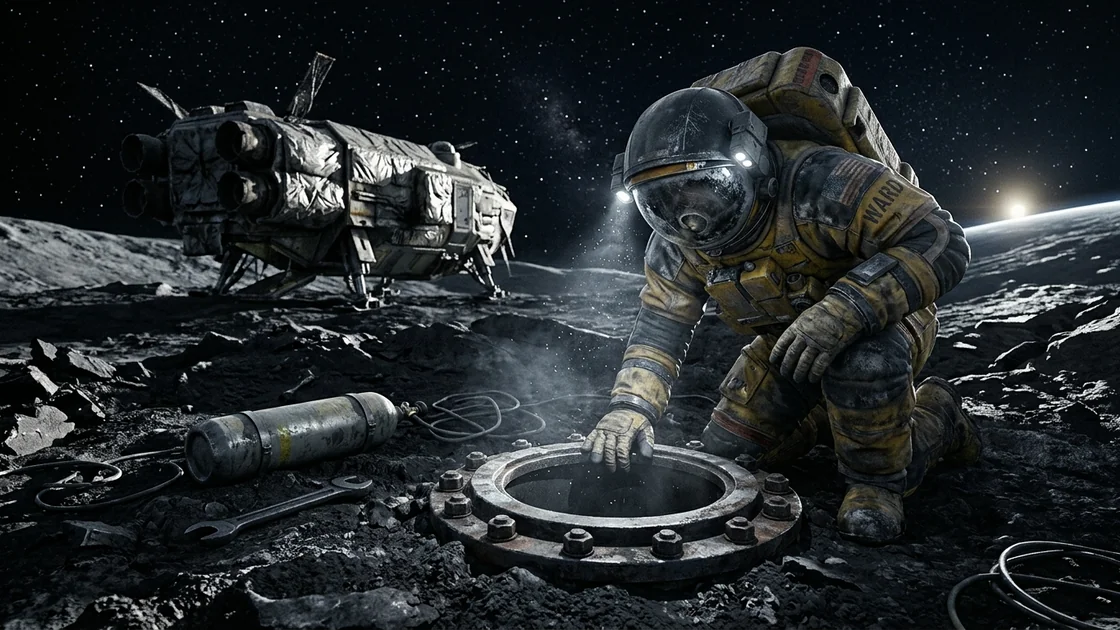
This is the account of Jesse Vance, a deep-space extraction technician who deliberately triggered an excavation charge ahead of schedule in the sub-crustal shafts of asteroid Castor-449. Driven by corporate debt and the discovery of a phenomenally lucrative vein of native isotopic tellurium, Vance chose to collapse the primary transit drift, entombing his three-person crew hundreds of meters below an unstable ceiling of nickel-iron rock. What follows traces the anatomy of that betrayal, the grueling hours of deceit as he secured the corporate discovery bounty under salvage protocols, and the quiet, inescapable horror that waited for him in the freezing dark of the void.
Chapter I: The Core of Castor-449
The void did not have a voice, but it had teeth.
Jesse Vance could feel those teeth gnawing at the seals of his Mark-IV heavy-environment rig. Every time the rotary head of the core drill slammed against the dense silicate shelf of Castor-449, a harmonic vibration traveled through four hundred tons of frame steel, through the magnetic boot-clamps, through his ankles, and settled straight into his teeth. It was a dull, metallic ache that tasted like brass wire and recycled sweat.
"Watch your drift, Jesse," Kellan Ward’s voice broke over the low-frequency suit-comm. It was flat, grainy, stripped of timbre by the three miles of solid rock and the rudimentary carrier wave they used through the stone. "You’re leaning two degrees off the shear line. If you crack the shoulder before the charges are packed, the company will dock us another five percent for slag loss."
Jesse didn’t answer immediately. He adjusted the hydraulic joy-levers, his gloved thumbs working the vernier dials with mechanical precision. On his heads-up display, the telemetry for the drill rig flickered in sick amber hues. Depth: eight hundred and forty meters below the landing apron. Density: twelve point four grams per cubic centimeter.
"Jesse," Kellan repeated. "You copy?"
"I copy, Kellan," Jesse said, his voice husky from eight hours of dry tank air. "I'm on the line. The rock’s got a hard shoulder here. High iron content. It’s chewing the diamond teeth off the bit."
"Chew through it," said Bram Oakes from somewhere down the spur tunnel. Bram’s voice was deeper, slower, accompanied by the clatter of pneumatic anchor pins. "We’ve only got forty hours of scrubber life left on the habitat module before the Covenant swings out of orbital rendezvous. If we miss the burn window, we’re eating cold rations and sweating in our suits for twenty-eight days waiting for the supply tug."
"Nobody is missing the window," Talia Reese interjected. She was the youngest of them, twenty-six standard years old, hired fresh off the lunar docks at Shackleton Crater. She was their surveyor, their rock-witch, her eyes perpetually red from staring at multi-spectral density scans in the cramped telemetry blister. "And you’ll want to see this core plug, Kellan. I’m running the mass spectrometer right now. Jesse, keep the bore clean. Don't blow the dust out with gas; pull it into the vacuum collector."
Jesse pulled back on the feed lever. The roaring head ground to a halt, the sudden cessation of sound leaving an empty ring in his ears that was almost violent. In the darkness beyond the rig’s floodlights, the tunnel was blacker than an open airlock. Castor-449 was an irregular lump of carbonaceous chondrite, three kilometers along its longest axis, tumbling through the inner rim of the Trojan asteroid field. It had no business holding anything heavier than low-grade iron, trace platinum-group gravel, and dirty water ice.
Then the core tube hissed.
Jesse turned in his harness, his floodlights slicing through the plumes of venting coolant vapor. Bram was lumbering up the drift, his massive silhouette looking like a bipedal cargo lifter in his bulky EVA suit. Beside him, Talia was carrying the sealed core receiver, her smaller frame dwarfed by the heavy lead-shielded casing.
"Look at the density readouts," Talia said, her breath fogging the corner of her faceplate. She patched the receiver’s diagnostic port into the tunnel’s local umbilical.
Jesse’s visor HUD flickered, receiving the data burst.
The color-coded gradient did not show the dull green of olivine or the flat blue of nickel-iron. It was a shrieking, crystalline violet. A streak of ultra-dense material, four meters thick, snaking through the belly of the asteroid like a frozen lightning strike.
"Tellurium-128," Talia whispered, her voice trembling with an emotion that was dangerous for a contract laborer to possess: awe. "Native matrix. But look at the isotopic purity. It’s laced with metastable rhenium and natural transuranic dopants. Do you know what this is?"
"Money," Bram grunted.
"It’s not just money," Talia said. "It’s a propulsion-grade seed vein. A single ton of this matrix can stabilize the magnetic pinch-bottles on a torch drive for ten thousand hours. The Vander-Luyten Consortium has been paying five million credits per dry metric ton for unrefined float. This isn't float. This is an anchor vein."
Jesse stared at the violet line on his display. His ocular tracker lingered on the mass estimates generated by the survey software: Estimated block mass: 1,400 metric tons. Estimated gross market yield: 7.2 billion credits.
Seven point two billion.
In his right ear, a soft chime rang. It wasn't the comm. It was the internal clock of his personal bio-monitor, tracking his corporate debt ledger. It updated every six hours, compounding interest on his flight suit, his oxygen consumption, his apprentice training fees, the medical expenses incurred when his lung had collapsed during a blow-out on Callisto eight years ago.
Outstanding Balance: 412,890 credits.
At their standard contract rate, the four of them split an eight-percent recovery bonus on net yield after corporate transport deductions, refining fees, and habitat rental. Eight percent of seven billion was five hundred and sixty million credits, split four ways: one hundred and forty million credits each.
It was enough to buy a villa on the Martian highlands. Enough to buy a clean pair of lungs. Enough to buy a small ship and never look at a drill bit again.
Except that was not how Vander-Luyten contracts worked.
Jesse had read the fine print in the cold, grease-slicked bunk of the Sisyphus, their transport scow. Clause 44-B: Corporate Discovery Prerogative. In the event of an extraordinary claim exceeding the scope of the original survey permit, the finding party was compensated at a flat "appraisal rate" of thirty thousand credits per technician, unless the claim was staked and filed under Solitary Emergency Salvage Protocol.
Thirty thousand credits.
Jesse’s debt was four hundred and twelve thousand. If they went back up that shaft with the core sample and logged it into the ship's terminal together, Kellan would follow the manual. Kellan always followed the manual. He would check the box for "Standard Crew Find." The company would hand them thirty thousand credits, pat them on the back, and send them to the next ice ball while a Vander-Luyten extraction fleet stripped the asteroid to its bones.
"Look at you, Jesse," Kellan’s voice came down the line. The foreman was still fifty meters back, at the junction of the drift and the vertical service chimney, inspecting the main blast anchors. "You look like you've seen an apparition."
"It's a lot of rock," Jesse said, keeping his tone flat, perfectly measured. "How's the chimney, Kellan?"
"Unstable," Kellan said. "The shock from the pilot bore fractured the hanging wall. When we pop this shelf, we're going to need to retreat all the way back to the main lock on the surface before we blow the primary line. We can't stay in the intermediate refuge bay. The whole drift is going to breathe when that charge kicks."
Jesse looked down at the detonator box mounted to the chest of his rig. It was wired into the central multiplexer on the core drill.
"How long to place the secondary charges?" Jesse asked.
"Talia and Bram are heading down into the stope now," Kellan said. "They need twenty minutes to sink the shaped charges into the floor. Bram, make sure you tamp the collars with silicate plugs. If the blast vents upward instead of down into the bedding plane, we'll lose the whole face."
"Got it," Bram said. Jesse watched the two figures step off the drilling platform. They moved awkwardly in the microgravity, their thruster packs puffing tiny, invisible jets of compressed nitrogen to keep their boots seated against the guide rails. They descended into the lower stope, a dark, narrow slot cut directly into the vein of violet rock.
Jesse remained alone on the high platform, perched between the giant steel chassis of the core drill and the dark stone wall.
Above him, the chimney rose like the throat of an extinct beast, three hundred meters of narrow, ladder-lined vertical shaft leading up to the surface habitat and the extraction skiff. Below him, the stope dropped sixty meters into the high-grade pocket.
Between them lay the structural pillar: forty thousand tons of fractured basalt, held in place by three heavy hydraulic jacks and a web of seismic anchor bolts.
"Jesse," Kellan called from the chimney base. "Bring the secondary det-cord down to the stope. Bram needs the high-frequency caps."
"On my way," Jesse said.
He reached down to the console. He didn't pick up the spool of det-cord.
Instead, he pulled open the heavy yellow maintenance hatch below the primary drill controls. Inside lay the remote telemetry transponder—the unit that linked their suit transceivers, the drill’s computer, and the high-yield seismic charges currently sitting in the structural pillar.
His hands were completely steady. That was the thing that surprised him most later, when he remembered it. There was no tremor in his fingers, no frantic pounding in his temples. There was only a cold, crystalline stillness, like liquid helium flowing through his veins.
Thirty thousand credits would leave him in the red. He would die on an asteroid like this, thirty years from now, with dust in his remaining lung and his bones brittle from low-g demineralization, while Vander-Luyten shareholders drank champagne on the orbital rings of Ganymede.
He took the small bypass shunt from his belt tool kit. It was a three-prong copper lead, meant for testing circuits without tripping the safety breakers.
He inserted it across terminals seven and nine.
On his display, the timer for the pillar charges—originally slaved to a fifteen-minute master countdown from the surface skiff—shifted its status.
Remote Sync Disabled. Local Manual Override Engaged. Detonation Delay: 00:00:10.
"Jesse?" Talia’s voice came over the low-frequency link. "Did you drop the telemetry carrier? My suit just lost the seismic feed."
"I'm resetting the repeater," Jesse said. He stepped backward off the drill platform, caught the rung of the chimney ladder with one heavy glove, and engaged his suit’s mechanical ascent winch.
The cable snapped taut. He began to rise into the vertical throat of the shaft.
"Jesse?" It was Kellan now, his voice sharper. "Where are you going? I see your beacon moving up the chimney."
"I had a pressure drop in my primary oxygen bottle," Jesse said. The winch whined, a high, metallic shriek that echoed off the circular walls of the shaft. He was ten meters up. Twenty meters. "I left the caps on the drill deck. I have to swap bottles at the surface cache."
"What the hell are you talking about?" Kellan barked. "Your suit telemetry says your tanks are at eighty percent! Get back down here. Bram can’t set the collars without those caps!"
Jesse looked down between his boots.
Below him, through the crisscrossing network of steel bracing and safety nets, he could see the working lights of his crew. Bram was a broad, bright star at the bottom of the stope. Talia was a smaller, darting firefly next to him. And Kellan was standing on the platform, his faceplate turned upward, watching Jesse ascend.
"Jesse!" Kellan yelled.
Jesse reached to his chest plate. He flicked the safety guard off the detonator switch.
"I’m sorry, Kellan," Jesse said. "The rock was unstable."
"What—"
Jesse pressed the red stud.
Chapter II: The Shattered Throat
Sound does not carry through the vacuum of space, but it travels with terrifying efficiency through solid stone.
When the charges in the structural pillar fired, Jesse did not hear an explosion. He felt a shockwave that hit the soles of his boots like a sledgehammer, driving his knees toward his chest. The steel cable of his ascent winch groaned, stretching like a rubber band, and the vertical ladder frame sheared away from the rock face twenty meters below him with a sound like tearing sheet metal.
Then came the pressure wave.
The stope below was not a vacuum; it was charged with five hundred pounds of volatile drilling mist, vaporized methane from the fractured beds, and trace coolant. When the charges blew, that trapped atmosphere had nowhere to go except up the narrow chimney.
The blast caught Jesse from behind, a roaring fist of compressed air, pulverized basalt, and burning magnesium that launched him upward through the dark shaft. The winch motor stripped its gears, screaming in protest, but the momentum hurled him through the hatchway of the mid-level safety collar.
He slammed against the steel bulkhead, his faceplate striking the rim of a structural beam. A web of fine, silver fractures spread across the outer laminate of his visor, inches from his eyes.
Warning sirens howled inside his helmet.
COLLISION DETECTED. VISOR INTEGRITY: 71%. WARNING: HIGH DUST ENVIRONMENT. EXTERNAL PRESSURE: 0.04 ATM.
Jesse scrambled on his hands and knees across the grated deck of the safety collar. He reached blindly behind him, found the manual wheel of the blast hatch, and threw his weight against it. The heavy titanium seal spun on its threads, groaning against the grit that had already blown into the bearings, and slammed shut into its housing.
He dog-latched the four mechanical dogs.
Below the steel plate, the world went mad.
The asteroid groaned. It was not a mechanical sound; it was the deep, seismic shudder of a minor planet whose internal equilibrium had been shattered. Through the six-inch steel of the blast door, Jesse could feel the pillar collapsing. Millions of tons of nickel-iron, unsupported and shattered by the shaped charges, were sliding into the void of the drift.
It was a chain reaction. The stope ceiling collapsed first, dropping onto the drilling rig, followed immediately by the entire lower third of the chimney shaft. The steel ladders below his hatch were being pinched, twisted, and shredded into ribbons between collapsing slabs of carbonaceous rock the size of city blocks.
Then, through the metal of the hatch, through his gloves, through his bones, the comms system picked up the low-frequency carrier.
The radio was dead—the high-frequency antennas were buried under three hundred meters of pulverized stone. But the bone-phone—the seismic transceiver clamped to the base of his skull—shivered.
"...esse! ...esse! Can you ...ear me?"
It was Kellan. His voice was choked, ragged, drowned in static that sounded like the crackle of grease on a hot stove.
Jesse knelt on the shaking deck, his forehead pressed against the cool steel of the blast hatch. His breath rattled in his throat, each exhalation fogging the cracked glass of his helmet.
"Jesse! The shaft ... the whole hanging wall went! We're pinned in the stope! Bram is down ... the rig tipped over him. Jesse, do you copy?"
Jesse’s thumb hovered over his transmit switch. His throat felt dry, packed with dust that was not there. If he answered, there would be a record. Every transmission would be logged on his suit’s black box. When the recovery team arrived, the data would be pulled. They would analyze the time-stamps. They would see the detonation occurred while he was in the shaft, while the others were in the hole.
Unless there was no log.
He reached to his shoulder pack, unclipped the primary telemetry cable that linked his suit’s internal memory to the transceiver, and twisted it off. The diagnostic readout on his HUD died. His suit was now a ghost, transmitting only on raw analog carrier, recording nothing.
He clicked the button.
"Kellan," he whispered.
"Jesse! Christ! You’re alive!" Kellan’s voice rose, desperate, stripped of its usual foreman’s authority. "We’ve had a catastrophic cave-in. The pillar blew early. The whole drift is gone, Jesse. The chimney below you is completely choked. It's solid slag."
"I know," Jesse said.
"Where are you? Are you at the surface?"
"Mid-level collar," Jesse said. "The blast hatch held. Barely. The ladder line is shredded below me."
"Talia's suit is reading forty percent oxygen," Kellan said, the words tumbling out in a frantic, uncharacteristic rush. "Her secondary tank cracked when the roof dropped. Bram's right leg is pinned under the core drill chassis. I can't lift it alone. The micro-g winch on the rig is dead—no power. You need to get to the surface, Jesse. Get to the skiff. There’s an emergency cutting torch and a high-tonnage jack in the tool locker. Bring them down through the auxiliary air line."
Jesse closed his eyes. The darkness behind his eyelids was clean; the darkness outside was filthy with dust and betrayal.
"The auxiliary line collapsed, Kellan," Jesse said.
A pause. The static hissed and popped like frying fat.
"What?" Kellan’s voice dropped an octave. "The auxiliary line is cased in corrugated titanium. It’s bored through the footwall. It shouldn't have been touched by a drift collapse."
"The whole fault shifted," Jesse lied, his voice dropping into that smooth, practiced rhythm of a veteran technician explaining an unavoidable failure to a grieving family. "The pillar wasn't just holding the drift. It was the key-block for the whole shear zone. When it went, the footwall ground six feet to the left. The titanium casing pinched shut fifty meters above you. Nothing's getting through."
In the silence that followed, Jesse could hear something else over the bone-phone.
It was Talia. She wasn't speaking to him. She was crying, short, hitching gasps that were being chopped up by her suit’s voice-activated microphone. And beneath that, a low, wet groan: Bram.
"Jesse," Talia said, her voice cutting through the carrier wave. She had pulled Kellan’s mic toward her. "Jesse, listen to me. The vein... we're sitting right on the tellurium vein. If you can't come down the shaft, you can use the surface skiff’s maneuvering thrusters. Anchor the skiff over the fracture line and burn the descent engine. It’ll scour the loose fill out of the chimney. It’ll give us an airway!"
"The skiff doesn't have the fuel for a prolonged burn, Talia," Jesse said softly. "You know the fuel margins. If I burn the descent engines to scour the shaft, there won't be enough delta-v left to break orbit and intercept the Covenant."
"Then we wait for the supply tug!" she screamed. "The tug will have fuel! Call them, Jesse! Hit the emergency beacon on the skiff!"
Jesse opened his eyes. He looked at the blast hatch. Just above it, painted in yellow stencil, were the words: VANDER-LUYTEN EXTRACTION DIVISION - SAFETY FIRST.
"The tug is twenty-eight days out, Talia," he said. "How much air do you have?"
Silence.
The static rolled in, cold and indifferent, washing over the link.
"Talia's got eight hours," Kellan said. His voice had lost its panic. It was hollow now, flat, dead as the stone around them. "Bram has maybe twelve, if his internal bleeding doesn't kill him first. I have twenty. Jesse... why did the charges blow early?"
Jesse didn't answer.
"Jesse," Kellan repeated, and this time, the name was not a question. It was an indictment. "We checked the caps. We hadn't set the bypass. Bram was holding the master shunt in his hand when the current hit the line. There was only one other place that circuit could be closed."
"The stone was fractured, Kellan," Jesse said. "A static discharge from the core drill must have jumped the gap."
"You lying son of a bitch," Kellan said, his voice entirely devoid of rage, carrying only an awful, bone-chilling clarity. "You were at the multiplexer. You wanted the claim."
Jesse stood up. The deck was still vibrating, but the large shocks had ceased. The asteroid was settling into its new shape, compacting around the dead space they had carved out of its heart.
"You won't get it, Jesse," Kellan whispered. "The black box on the drill... it survived. The housing is rated for fifty tons of impact. When they dig us out—and they will dig us out, for a vein this size—they'll pull the box. They'll find the command sequence. They'll know you did it."
"Nobody is digging you out, Kellan," Jesse said.
He reached down to the terminal beside the blast hatch. This was the auxiliary control for the chimney’s gravity-settling charges—small emergency packages meant to blow the shaft walls inward in the event of an uncontrollable gas fire, suffocating the shaft to save the surface habitat.
He lifted the plastic shield.
"Jesse!" Kellan yelled. "Jesse, don't—"
Jesse hit the switch.
A hundred meters above the blast hatch, halfway up the chimney, six linear shaped charges sliced through the bedrock. Jesse felt the air suck against his suit as thousands of tons of fractured stone dropped down the vertical shaft, piling on top of the mid-level blast hatch like an iron grave-marker.
The sound through his boots was a dull, final thud.
The bone-phone went dead. The carrier wave didn't just fade; it was snuffed out, crushed beneath a half-kilometer of solid rock that no low-frequency wave could ever hope to penetrate.
Jesse stood in the darkness, illuminated only by the dying yellow amber of his cracked HUD.
He was alone.
Chapter III: The Ledger of the Dead
The climb to the surface through the upper escape trunk was slow, agonizing, and quiet.
Jesse had to use manual hand-picks, dragging himself up the eighty-degree incline of the secondary conduit where the ladder had pulled free from its wall-anchors. His left knee was swollen inside his suit, throbbing with a dull heat that spoke of torn ligaments, and the air from his primary tank tasted increasingly of copper and burnt rubber.
When he finally emerged through the airlock collar onto the surface of Castor-449, the sun was a tiny, blinding needle-point of light against a sheet of velvet black.
The asteroid’s horizon was ridiculously close—less than a hundred meters away in any direction, curving sharply into the void. All around him, the surface was a chaotic jumble of soot-black regolith, jagged spires of iron-rich breccia, and the discarded detritus of human industry: empty cable drums, crushed fuel cylinders, and the tracks of their small crawler rig frozen forever in the undisturbed dust.
Parked on three hydraulic outriggers fifty yards away was the extraction skiff, the Morrigan.
It was an ugly ship, built like a brick of industrial steel wrapped in micrometeorite blankets. Its two reaction-control thruster clusters were smudged with soot, and its landing pads were buried six inches deep in the gray powder of the asteroid’s crust.
Jesse limped across the regolith. Microgravity made every step an exercise in frustration; if he pushed too hard with his good leg, he floated, his boots losing purchase, leaving him kicking uselessly until his suit’s tiny cold-gas puffs brought him back down.
He reached the skiff’s boarding ladder, hauled himself up to the airlock, and punched the cycle code.
The outer door slid shut with a greasy hiss. Pumps labored in the hull, drawing the thin, particulate-laden vacuum out and flooding the chamber with stale, lukewarm nitrogen-mix.
When the inner door green-lighted, Jesse stumbled into the habitat module.
He didn't take off his helmet. He couldn't. The smell of the Morrigan was the smell of three men and one woman who had lived in a space the size of a shipping container for four months: dried soup, armpits, dirty socks, and the sweet, rotten tang of an overtaxed carbon dioxide scrubber.
He walked past Kellan’s bunk. A small magnetic photo frame was stuck to the bulkhead: Kellan’s wife on the promenade at Ceres, holding a child with teeth missing in the front.
Jesse turned his face away.
He sat down in the pilot’s couch. The leather was still warm from Talia’s shift twelve hours ago. Her data-pad was resting on the armrest, its screen displaying an unfinished letter to her sister at the university on Europa.
...the rock here is older than anything we saw in the Belt, Sarah. Sometimes when I turn off the cabin lights, I swear I can hear it singing through the hull plates. Kellan says it’s just thermal expansion, but it doesn't sound like metal. It sounds like...
Jesse reached over and flicked the pad’s power toggle. The screen died.
He pulled the main communications console toward him. The high-gain parabolic antenna was mounted on the skiff’s dorsal spine, pointing out across the void toward the inner system, where the Vander-Luyten relay buoy circled the sun in a slow, patient orbit.
He didn't immediately broadcast.
First, he brought up the ship's log and cleared the local buffer. He plugged his suit’s telemetry pack—the one he had disconnected before the blast—into the console’s diagnostic port.
With steady, deliberate fingers, he began to edit.
Jesse had not spent twenty years in the belt just swinging sledgehammers and guiding drill heads. You couldn't survive in the deep extraction pits without knowing how the machines thought. He opened the raw binary stream of the drill’s master log.
He didn't erase the cave-in. You couldn't hide that kind of mass-displacement; the seismic shock would have registered on the relay buoy’s remote gravimetric sensors anyway.
Instead, he changed three lines of code.
He altered the time-stamp of the seismic anomaly, setting it eighty seconds earlier—placing the initial structural failure before the detonation sequence began. He injected a phantom signal into the gas-monitoring channel: a sudden, explosive pocket of trapped supercritical carbon monoxide, common enough in carbonaceous chondrites, blowing out the structural pillar before the crew could complete their evacuation.
Then, he wrote his narrative into the salvage registry.
LOG: 162173-CASTOR-449-EXT-092. AUTHOR: VANCE, JESSE (TECH-1, ID: 884-VLY). STATUS: EMERGENCY - CATASTROPHIC FACILITY LOSS.
At 06:14 ship-time, during exploratory pilot boring in Drift Three, an unmapped pressurized gas pocket breached the primary structural hanging wall. Spontaneous collapse occurred along the regional fault line.
Foreman K. Ward, Tech-2 B. Oakes, and Surveyor T. Reese were caught in the primary stope collapse. Sub-crustal access ways are completely destroyed. Secondary collapses have closed the auxiliary chimney.
No survival telemetry detected from lower levels.
Drift Three is declared lost. In accordance with Corporate Salvage Code 11-J, the remaining technician (Vance, J.) has initiated solitary emergency containment. Surface survey indicates exposed high-density core section in the collapsed scar.
SOLITARY SALVAGE CLAIM STAKED UNDER SECTION 44-B. CLAIMANT: VANCE, JESSE.
He stared at the words on the green monochrome screen.
Under Section 44-B, a solitary survivor who secured an extraordinary claim following an industrial disaster was entitled to sixty percent of the gross appraisal value, free of crew-share deductions, provided the claim was stabilized and held until the arrival of the corporate recovery team.
Sixty percent of seven point two billion credits.
Four point three two billion.
Jesse Vance was no longer a debtor. He was not a broken technician with a bad lung and a ruined knee. He was an institution. He was an estate. He could buy his own fleet of extraction haulers. He could buy the habitat on Ceres where Kellan’s wife lived and have it painted gold.
He reached for the transmitter switch.
Then, through the hull of the Morrigan, came a sound.
Clang.
Jesse froze. His hand remained suspended an inch above the brass toggle.
The sound had not come from the airlock. It had not come from the engines. It had come from below. Through the landing legs. Through the rock.
Clang. Clang. Clang.
Three rhythmic, mechanical strikes, perfectly spaced. One second apart.
Jesse did not move. He did not breathe. He sat in the pilot’s chair, his cracked visor still reflecting the green glow of his forged claim, listening to the iron bones of Castor-449.
Chapter IV: The Hammer in the Stone
It was impossible.
The chimney was choked with three hundred meters of shattered basalt. Even if they had survived the initial blast—even if the stope hadn't collapsed completely—they were eight hundred meters down, in a pocket with less than twenty hours of breathable air.
There was nothing down there capable of transmitting a mechanical shock through that much loose, uncoupled rock. A hammer strike against the stope wall would have been absorbed by the first ten meters of rubble.
Clang.
It came again. Louder this time. It wasn't a hammer.
Jesse stood up, his boots clattering against the deck plates. He walked to the center of the cabin, knelt down, and pulled open the deck hatch that led to the ship's lower belly-storage and the umbilical port that docked with the asteroid’s bedrock.
He pressed his bare palm against the raw, unpainted titanium of the central structural keel.
The vibration was distinct. It was sharp, crisp, high-frequency.
Clang. Clang. Clang. Pause. Clang. Clang. Clang.
Three short. Three long. Three short.
SOS.
Bram.
It could only be Bram. Bram was the only one who used the heavy pneumatic impact driver. The tool was meant for sinking two-inch anchor bolts into iron ore. It delivered twelve hundred foot-pounds of hydraulic torque per blow.
He was firing it directly into the footwall. Not trying to dig—you couldn't dig through four hundred yards of stone with an anchor gun—but using the bedrock as a sounding board. The footwall was a continuous sheet of solid iron-nickel that ran all the way from the core of the asteroid to the northern plateau, where the Morrigan was docked.
They were alive.
Jesse fell back against the edge of the open hatch, his heart hammering against his ribs like a trapped bird.
"Stop it," he whispered into the empty cabin. "Stop it, Bram. It’s over. Just lay down and turn the oxygen down. Just go to sleep."
Clang. Clang. Clang.
The sound didn't stop. It settled into a rhythmic, merciless beat. Every thirty seconds, the sequence repeated: three short, three long, three short.
They were sitting in the dark, eight hundred meters down, surrounded by billions of dollars of violet rock, taking turns with the anchor gun. They knew the Morrigan was parked directly on the footwall outcropping. They knew that if Jesse was up here, he could feel it.
They were telling him: We know you are there. We are waiting.
Jesse scrambled back to the pilot's console. His hand was shaking now, the cold calm that had sustained him down in the drift evaporating into a hot, sour panic.
If they were still signaling when the Covenant arrived, the salvage team wouldn't just take his word for it. They would drop a seismic probe. They would hear the hammering. They would bring in high-capacity boring rigs from the orbital station. It would take them four days, maybe five, to reach the stope.
And when they opened that pocket, they would find Kellan Ward. They would find Talia Reese. They would find Bram Oakes, sitting with the impact driver in his lap and the master detonator bypass in his hand.
And Jesse would not be an estate. He would not be a billionaire.
Under the Uniform Corporate Maritime Code, intentional sabotage of an extraction shaft resulting in death or attempted murder carried a single sentence: Expulsion without suit. They would put him in the airlock of the Covenant, cycle the door, and kick him into the sun.
He looked at the transmission console. The message was queued.
All he had to do was press the button. The high-gain dish would fire the burst to the relay buoy. Once the claim was logged with the Vander-Luyten registry, it became corporate property under salvage law.
He reached out.
Clang. Clang. Clang.
The deck plates hummed under his boots.
He couldn't send it. Not yet.
Not while the rock was speaking.
Jesse stood up, his face set in a hard, pale mask. He walked back to the suit locker. His Mark-IV was leaning against the rack, its visor shattered, its dust-cover blackened by the blast.
He didn't put it back on. He went to the emergency locker on the port side of the airlock.
Inside hung the secondary suit: Kellan’s suit. It was an older model, a heavy, yellow-trimmed Karpat-7, smelling of stale tobacco and peppermint oil. Kellan always chewed peppermint lozenges when he was on drill shift to keep the sour taste of recycled water out of his mouth.
Jesse stepped into the legs. He pulled the torso over his head, sealed the waist ring, and locked the neck collar. He took Kellan’s helmet off the shelf, looked at the name stenciled across the brow—WARD, K.—and slammed it down over his head.
He picked up the heavy thermite lance from the tool rack.
It was five feet long, a slender tube of tungsten-carbide filled with compressed iron oxide and aluminum powder, designed for burning through jammed drill heads and stuck casing. It burned at four thousand degrees Celsius, underwater or in a vacuum. It didn't need oxygen; it carried its own oxidizer in the chemical matrix.
He grabbed two spare ignition charges and three magnetic seismic clamps.
He wasn't going down to rescue them. There was no way down.
He was going to silence the sounding board.
Chapter V: The Northern Scarp
The footwall did not reach the surface at the landing pad. It cropped out two hundred meters to the north, along the lip of a vertical precipice that dropped into the impact crater known as the Basin of St. Jude.
Jesse trudged through the regolith, his boots sinking deep into the powdery slag. The Karpat-7 suit was too large for him; the arms were three inches too long, and the boots rubbed against his heels with every step, but its telemetry unit was completely dead—a mechanical backup suit with no digital transceiver, no radio link, no black box.
It was a blind suit. A mute suit.
The hammer strikes were clearer now. Even through the dust, he could feel the cadence through the soles of his boots.
Clang. Clang. Clang.
It felt closer, though he knew that was an illusion of the geology. The iron-nickel vein acted like an acoustic waveguide, funneling the energy of Bram’s tool directly along the crystalline bedding plane straight to the scarp.
He reached the edge of the cliff.
The Basin of St. Jude was a black pit, five hundred meters across, carved out by an iron meteorite ten million years ago. At the bottom, lost in shadow, lay the jumbled boulders of the asteroid’s primordial crust.
Right at the rim, exposed to the vacuum like an open bone, was the footwall: a polished, striated wall of native iron, six feet thick, plunging vertically into the dark.
Jesse knelt at the edge. He reached down and laid his gloved hand against the bare metal.
The vibration nearly numbed his fingers.
Clang. Clang. Clang.
He could almost hear Talia’s voice behind it. One, two, three. Again, Bram. Again. Jesse is up there. Jesse wouldn't leave us. Jesse is our mate.
"Jesse is an employee," Jesse said into the silence of his helmet. "Jesse has a balance to settle."
He unslung the thermite lance from his back.
He didn't need to dig eight hundred meters down. He just needed to disrupt the acoustic coupling. If he cut a three-foot gap through the footwall outcropping here at the surface—if he severed the sheet from the landing plateau—the sound waves would hit the vacuum gap and scatter into the loose rubble.
The Morrigan would be silent.
The seismic sensors on the recovery ship would register nothing but the dead, background creak of the asteroid’s thermal expansion.
He set the base of the lance against the iron outcropping. He inserted the first ignition cap into the breach, twisted the locking collar, and pulled the mechanical tripwire.
A blinding flare of ultraviolet light erupted from the tip of the lance.
In the vacuum, there was no flame, only a silent, furious fountain of incandescent white sparks that spewed out into the blackness like a stellar flare. The iron of the footwall didn't crack; it liquefied. It turned into a bubbling, blinding pool of white-hot slag that ran down the face of the cliff like boiling water, freezing into glossy black droplets as it fell through the microgravity into the basin below.
Jesse leaned his weight into the lance. The reaction force tried to push him back off the edge, but his magnetic boots were locked to an iron boulder behind him.
The heat radiated through his suit’s multilayer insulation. The temperature gauge on his wrist began to climb: forty degrees, fifty, sixty. The cooling water in his undergarment screamed as it rushed through the miniature heat exchanger, trying to dump the thermal load into space.
He cut down through the first foot of iron. The lance hissed, a vibration he could feel through the tungsten shaft, chewing through the ancient metal.
Clang.
The hammer struck again, right beneath his feet.
The shock was so close, so violent, that Jesse nearly lost his balance. He jerked the lance backward, the tip pulling out of the liquid trench, trailing a thread of molten steel that drifted away like an orange spiderweb.
Clang. Clang.
The frequency had changed. It wasn't SOS anymore.
It was two strikes. A pause. Two strikes.
In Belt extraction shorthand, two strikes didn't mean Save Our Souls.
Two strikes meant: Stand clear. Heavy equipment moving.
Jesse stared at the molten scar he had carved into the rock.
The ground beneath him was not just vibrating. It was rising.
A hairline crack, black as space itself, opened in the regolith between his boots. It didn't run along the iron vein; it ran perpendicular to it, cutting across the plateau toward the landing pad where the Morrigan stood on her three slender legs.
"No," Jesse breathed.
He hadn't considered the thermal shock.
The core of Castor-449 was sixty Kelvin—two hundred degrees below zero. By pouring four thousand degrees of thermite heat into a stressed, fractured iron outcropping that had already been destabilized by an eighty-ton explosive charge, he hadn't severed the acoustic coupling.
He had created a shear fracture.
The iron plate was expanding. The frozen carbonaceous stone around it was not.
A sound like the breaking of a world passed through his boots: a deep, hollow crack that knocked his magnetic clamps loose from the boulder. Jesse was tossed into the air, tumbling through three feet of vacuum before gravity dragged him back down into the churned dust.
He rolled onto his stomach, looking back toward the landing pad.
The crack had reached the Morrigan.
One of the ship’s three hydraulic outriggers—the port-side gear—was sitting directly over the fissure.
As Jesse watched, the ground beneath the pad simply dissolved. The loose regolith, drained by the opening fault below, poured down into the sub-surface void like sand through an hourglass.
The Morrigan did not explode. She simply tilted.
Slowly, gracefully, with the agonizing leisure of low-gravity physics, the four-hundred-ton extraction skiff tipped to the port side. The landing leg snapped with a sound that traveled through the bedrock like a rifle shot.
The ship’s port maneuvering cluster struck an outcropping of basalt. The titanium tank of high-pressure nitrogen propellant ruptured.
A clean, white plume of gas blasted out across the surface, spinning the ship around like a top on its two remaining legs. The dorsal high-gain antenna—the long, delicate parabolic dish pointed toward the inner system, toward life, toward the Vander-Luyten registry—caught the edge of the crawler track and folded like a wet leaf.
Then the skiff settled on its side in the dust, dead and quiet.
Chapter VI: The Vault of the Dead
Jesse Vance lay on his back in the regolith, staring up at the sun.
His Karpat-7 suit had three hours of oxygen left.
The Morrigan was crippled. The high-gain antenna was crushed. The maneuvering thrusters were vented. Even if he could right the ship with the manual winches—which would take three days of labor he did not have the air to perform—she could not break orbit without nitrogen to orient her main burn.
And eight hundred meters below him, the hammer strikes had ceased.
The thermal crack had severed the footwall outcropping. The acoustic path was broken. He had achieved his goal: the stone was finally silent.
"Kellan?" he whispered into his helmet mic.
There was no answer. Only the white, flat hiss of empty space.
He dragged himself up out of the dust. His knee screamed with pain, a bright, white agony that made him vomit into his helmet’s waste collector. The bitter taste of bile and recycled water filled his mouth.
He limped back to the ship.
The airlock was resting at a thirty-degree angle, half-buried in displaced regolith. He had to dig the hatch clear with his gloved hands, clawing through the freezing gray dirt like an animal until his fingernails were bruised through his pressure gloves.
He cycled the lock.
Inside, the cabin was a ruin. Everything that had not been tied down had slid into the port-side bulkhead: food tins, diagnostic monitors, Talia’s notebooks, spare hydraulic hoses.
The main communications board was dead. The screen was dark, cracked down the center by the impact of a loose tool kit.
Jesse sat down on the slanted floor plates, his back against the bulkhead. He pulled off Kellan’s helmet and let it roll away into the corner.
The air inside the Morrigan was already growing thin. The secondary life-support pump had tripped when the nitrogen vented; the ship’s atmosphere was dropping by zero point zero one bar every ten minutes.
He reached down and picked up Talia’s data-pad from where it had fallen into the scupper.
He turned it on. The battery was at twelve percent.
He looked at the letter she had been writing to her sister. He scrolled past the words about the singing rock, past the drawings of the crystal lattices she had made with a stylus on the touchscreen.
At the very bottom of the file, saved twenty minutes before they had descended into the stope for the last time, was a memo from the Vander-Luyten Regional Claim Office on Ceres.
It was addressed to Ward, Kellan (Foreman, Crew 449).
Jesse clicked the file.
MEMORANDUM: VLY-OPS-7712. SUBJECT: AMENDMENT TO GENERAL EXTRACTION CONTRACT (Trojan Sector).
To Foreman Ward and Crew:
Be advised that as of the first of this standard month, the Vander-Luyten Consortium has revised the Discovery Incentive Guidelines for all independent subcontract crews operating in Sector 4.
Clause 44-B (Corporate Discovery Prerogative) has been rescinded by the Board of Directors under the Fair Share Labor Accord of 2194.
All rare-metal and strategic isotope discoveries exceeding five hundred million credits in net value are now classified as Common Labor Assets. The discovering crew shall receive a mandatory twenty-five percent gross equity share, divided equally among all logged crew members, regardless of corporate permit classification.
Furthermore, all individual crew debts currently held by the Consortium Financing Division are automatically cleared upon the validation of any Tier-1 discovery assay.
We congratulate you and your crew on your continued productivity.
Jesse stared at the small screen until the backlight timed out, plunging the tilted cabin into darkness.
Twenty-five percent.
Divided equally.
One point eight billion credits. And the debt was already gone. It had been gone the moment Talia pushed the core sample into the receiver and the data pinged the relay buoy at the start of the shift.
He hadn't needed to kill anyone.
He hadn't needed to drop the chimney.
He didn't need to steal the claim under Section 44-B.
He had been a free man eight hours ago.
Jesse sat in the dark. The ship groaned as the metal cooled in the long, slow shadow of the asteroid’s rotation. The sun was slipping behind the rim of the Basin of St. Jude, and the temperature inside the unpowered cabin was dropping rapidly toward the killing cold of the void.
He reached out and felt the deck.
Below him, through the floor, through the broken keel, through eight hundred meters of stone, there was nothing.
No hammer. No tool. No SOS.
Just the rock.
Chapter VII: The Ascent of the Ghost
Jesse did not die in the Morrigan.
A man who has spent twenty years on the rock does not know how to simply lie down and let the frost take him. The survival instinct is not an emotion; it is an infection. It lives in the marrow, independent of hope, independent of shame, independent of reason.
When the air in the cabin became too thick with carbon dioxide to draw a clean breath, Jesse pulled Kellan’s helmet back on. He locked the ring. He didn't turn on the radio. There was no one to hear him anyway.
He went to the ship’s tool locker.
He found the mechanical come-along—a five-ton ratcheting hand-winch—and four spools of high-tensile braided steel cable. He took the emergency oxygen bottles from the habitat rack, lashed them to his pack frame with duct tape, and crawled back out through the slanted airlock onto the surface of Castor-449.
The stars were out.
Without the sun, the Milky Way was a brilliant, frozen dust-storm across the sky, millions of diamond points that offered neither warmth nor direction. Castor-449 was tumbling slowly, its shadow stretching out into the dark like a long, black needle.
Jesse walked back to the collapsed chimney.
The crater where the blast hatch had been was a bowl of loose, pulverized basalt, five meters deep. In the center, half-buried under a gray drift of regolith, was the steel rim of the escape conduit he had used to crawl out three hours before.
It was choked. The settling charges he had fired from the mid-level collar had done their work with horrifying efficiency; the top fifty meters of the pipe were filled with crushed rock that had cemented together under the explosive pressure.
He couldn't go down.
He looked across the plateau to the core drill’s surface power module—the primary turbine that had supplied hydraulic pressure to the rig down below before the collapse.
The turbine was dead, but its main umbilical—a four-inch, wire-armored hose meant for pumping high-pressure hydraulic fluid into the depths—was still anchored to the surface manifold.
The hose didn't run down the chimney.
It ran through the pilot borehole.
Jesse dropped to his knees in the dust.
The pilot bore was only twelve inches wide. It had been drilled two weeks ago, before they even started the main drift, to test the rock’s gas content and drop the seismic sensors. It ran straight as a laser from the surface plateau, through the hanging wall, down through the structural pillar, all the way into the roof of the stope.
Eight hundred and forty meters of vertical, steel-cased hole, twelve inches across.
Too narrow for a man. Too narrow for a child.
Jesse crawled to the borehole head. The protective cap was still in place, bolted down with six heavy nuts.
He unclipped his wrench from his belt. He worked frantically, his breath frosting his visor, his bad knee dragging in the dirt. He stripped the first nut. He cursed, his voice cracking in the dry silence of his suit, and threw his entire weight against the handle until the threads sheared with a wet snap.
He pulled the second. The third.
He wrenched the steel cap off the pipe.
A puff of gray vapor—stale, pressurized air from the deep stope—hissed out of the hole, freezing instantly into a spray of white ice crystals that drifted away in the starlight.
Air.
The stope hadn't vented to the vacuum.
The pillar collapse had sealed the bottom of the borehole like a cork, but the pipe itself had held. It was cased in three-quarter-inch manganese steel. It was the only thing on the whole miserable rock that hadn't broken.
Jesse pulled the emergency oxygen bottle from his pack frame.
It was an industrial-grade cylinder, three feet long, filled with forty liters of liquid O2 at two hundred bar. It had a standard brass regulator with a manual dump valve.
He leaned over the borehole.
"Kellan?" he screamed down the pipe.
His voice didn't echo. The twelve-inch steel tube swallowed the sound, carrying it straight down into the gut of the asteroid like a speaking tube in an ancient ship.
"Kellan! Can you hear me?"
Silence.
Then, from the depths of the pipe, so faint that it sounded like a ghost whispering through a flute, came a sound.
A cough.
A dry, rattling, agonizing cough that sounded as if it were tearing a man's lungs to pieces.
"Jesse?"
It wasn't Kellan.
It was Bram. His voice was faint, reedy, stripped of its heavy bass rumble.
"Bram!" Jesse shoved his faceplate as close to the mouth of the pipe as the helmet would allow. "Bram, I'm at the surface! I’m at the pilot bore!"
"Jesse... it’s cold down here," Bram said. His words were spaced five seconds apart, the speech of a man whose brain was starving for glucose and oxygen. "The... the roof... is down. Kellan is... he’s under the plate, Jesse. He stopped... talking... three hours ago."
Jesse felt something cold run down his cheek inside the helmet. A tear, greasy and hot, stinging the corner of his eye.
"And Talia?" Jesse asked, his voice shaking so hard he could barely form the syllables. "Bram, where’s Talia?"
A long pause. The pipe hissed with the faint drift of air rising from below.
"She’s... she’s here," Bram whispered. "She’s got... half an hour left on her scrubber. She’s... she’s holding my hand, Jesse. She thinks we’re... on the shuttle to Callisto. She thinks... she thinks she can see the trees."
Jesse grabbed the oxygen cylinder.
"Bram, listen to me! I have an oxygen tank! I’m dropping it down the borehole! Do you understand? It’s a forty-liter bottle! It’ll give you four days of air! The Covenant will be here in two days! I’ll stay at the pipe! I’ll pump water down! Just stay where you are!"
"Jesse..." Bram’s voice was fading, drifting away like smoke into an exhaust vent. "Why... why did you fire the charge?"
Jesse’s hands froze on the brass valve of the tank.
The stars above him were cold and bright, wheeling across the sky in their ancient, indifferent circles. Down below, eight hundred meters deep, Bram was waiting for the answer. Talia was waiting. Kellan’s corpse was waiting.
"I didn't know," Jesse wept. "Bram, I swear to God, I didn't know about the new contract. I thought... I thought they were going to leave us with thirty thousand credits. I thought they were going to send me back to the pits."
The pipe was silent for so long that Jesse thought the line had died. He thought Bram had slipped away into the dark, leaving him alone on the surface with his steel bottle and his guilt.
Then the flute whispered again.
"Jesse," Bram said, his voice clearer now, filled with an awful, childish confusion. "What... what are you talking about? What contract?"
Jesse stopped.
His breath caught in his throat.
"The... the twenty-five percent," Jesse stammered. "The Fair Share Accord. The memo on Talia’s pad."
"We... we didn't care about the contract, Jesse," Bram said softly. "Kellan... Kellan found the leak three days ago. The core drill was... it was sparking in the manifold. We were going to pull the bit today. We were going to... go home. Kellan was... he was going to buy a garden, Jesse. On Ceres. He... he promised me I could... help with the soil."
A small, choked sound came through the pipe.
A breath.
Then a long, soft exhalation that did not end.
"Bram?" Jesse whispered down the steel tube.
"Bram!"
Nothing.
"Talia!" he screamed, his voice cracking into a high, animal shriek that hurt his throat. "Talia! Pick up the tool! Strike the pipe! Talia!"
The pipe did not strike back.
From the dark below came only the faint, steady sigh of eight hundred meters of cold air, smelling faintly of ancient dust, sweet tellurium, and the bitter, unmistakable iron of death.
Chapter VIII: The Arrival of the Covenant
Forty-six hours later, the Vander-Luyten heavy recovery vessel Covenant dropped out of transit drive three thousand kilometers off Castor-449.
Her arrival was not subtle. Her massive fusion torch lit the asteroid’s jagged horizon with the brightness of a second dawn, painting the black regolith in stark, bone-white relief.
The recovery skiff Gorgon separated from the mothership’s ventral bay and drifted down toward the Northern Scarp on eight blue-white plumes of hydrazine fire. Its landing pads struck the dust fifty meters from the overturned Morrigan, sending up a slow-motion curtain of pulverized iron ore that drifted down like gray snow.
Four men in heavy corporate-recovery suits stepped through the airlock, their chest plates bearing the double-diamond insignia of Vander-Luyten Salvage Division.
They carried cutting gear, seismic imaging arrays, and lead-lined specimen canisters for the tellurium assay.
The team leader, a veteran salvage master named Vance-no-relation, paused at the bottom of the ladder.
His helmet floods cut through the dust, falling on a single figure sitting on an upturned cable spool near the mouth of the pilot borehole.
The figure was wearing a Karpat-7 suit, its yellow trim blackened with soot and grease. The visor was coated in a thick crust of frozen moisture and gray regolith, completely opaque from the outside.
In its lap, the figure held a three-foot brass oxygen regulator, disconnected from its cylinder.
The team leader walked over, his magnetic boots clumping heavily in the dust. He checked his suit’s scanner.
ONE LIFE SIGN DETECTED. HEART RATE: 42 BPM. SUIT O2 RESERVE: 1.2%.
"Jesse Vance?" the team leader asked over the general frequency.
The figure did not move. It did not raise its head.
The salvage master signaled to his two technicians. They stepped forward, their heavy gloved hands taking Jesse by the shoulders, lifting him from the spool.
Jesse’s legs were stiff, his knees locked in place by frozen joint seals. He allowed himself to be moved like an articulated mannequin, his boots dragging through the dust, leaving two parallel trenches in the gray powder of Castor-449.
"We have the survivor," the team leader said to the ship’s comm. "He's in bad shape. High nitrogen narcosis, severe dehydration, early hypothermia. The transport skiff is a total loss—looks like an outrigger failed on an unstable shear zone."
"And the rest of the crew?" the Covenant’s bridge officer asked down the link.
The team leader walked over to the open borehole. He shone his high-intensity floodlight down into the twelve-inch pipe.
The light died thirty meters down, swallowed by the sheer, unreflective darkness of the manganese sleeve.
He unclipped a seismic scanner from his belt, set it against the lip of the pipe, and waited for the return pulse.
The display painted a cross-section of the asteroid’s interior: a jumbled, chaotic nightmare of collapsed stopes, shattered hanging walls, and thousands of tons of compressed rubble.
At the bottom of the borehole, eight hundred and forty meters below, the scan resolved a tiny, three-meter void.
Inside the void were three distinct heat signatures, cooling slowly, now barely distinct from the sixty-Kelvin stone around them.
And surrounding that void, winding through the shattered floor like a ribbon of frozen fire, lay twelve hundred metric tons of pristine, crystalline tellurium-128.
"The crew is gone," the team leader said, his voice flat, professional, entirely devoid of surprise. "Catastrophic structural failure during preliminary blasting. The whole stope folded in on them. Looks like the survivor tried to drop an auxiliary bottle down the survey bore, but he was too late."
"What about the claim?" the bridge officer asked.
The salvage master knelt by the mouth of the pipe. He looked at the serial number stamped into the brass collar of the borehole casing: VLY-CORE-449-01.
He looked back at Jesse, who was being hauled up the ladder of the Gorgon by the two technicians, his head hanging down against his chest plate like a broken doll's.
"The claim is valid," the salvage master said. "The core section is intact. Highest grade assay I've ever seen on an inner-belt rock. It’s an anchor vein, Captain. Worth eight or nine billion on the Ganymede board."
"Understood," the bridge officer replied. "The legal department just confirmed his status. Sole surviving technician of a certified discovery team. The salvage equity goes entirely to Vance under the 2194 Accord. He’s a shareholder now."
"Lucky bastard," the salvage master muttered, switching off his floodlight.
He turned his back on the borehole, walked to the Gorgon’s boarding ladder, and climbed inside.
Chapter IX: The House on the Shore
The estate was called The Shallows.
It sat on the southern coast of the Marineris Sea on Mars, where the geo-engineers had spent eighty years melting the sub-surface permafrost until a cold, slate-gray ocean had filled the ancient canyon floor.
It was three stories of imported limestone, reinforced glass, and black iron, perched on a red basalt cliff that looked down across thirty miles of open water.
Jesse Vance sat in an automated invalid’s chair on the stone terrace, wrapped in a blanket of real Scottish wool that had cost more than his father had earned in forty years of ore hauling.
His right leg was gone, amputated at the hip after the low-g necrosis and the crushing injury he had sustained on Castor-449 had turned gangrenous during the long transit back to Ceres. His remaining lung was synthetic, a silent, smooth-pumping unit of chrome and Teflon that hummed inside his rib cage with a sound like a tiny, distant motor.
He had five hundred million credits in the Bank of the Grand Canal.
He owned three deep-space ore freighters, all named Calamity. He owned seven percent of the shares in the Vander-Luyten Extraction Division. He had two doctors, three servants, and a legal team that lived in a small wing on the north side of the courtyard, whose only job was to ensure that no inquiry from the Ceres Mining Guild ever reached his desk.
The sun was setting.
On Mars, the sun was small, a brilliant turquoise sapphire sinking into the cold blue haze of the western horizon.
A servant—a young Martian boy with long, thin limbs and eyes that never looked directly at Jesse’s face—stepped out onto the terrace carrying a silver tray.
"Your water, Mr. Vance," the boy said.
Jesse didn't turn his head. "Put it on the table, Alan."
"Yes, sir. The courier from the Ganymede exchange brought the quarterly dividend reports. Do you wish to review them?"
"No."
The boy lingered for a second, his soft shoes silent on the red flagstones.
"Sir?"
"What is it, Alan?"
"There was... a woman at the lower gate this morning," the boy said cautiously. "She arrived on the coastal ferry from the northern docks. She didn't have an appointment."
Jesse’s synthetic lung paused for a fraction of a second, its micro-valves clicking softly before resuming their steady, mechanical rhythm.
Hiss. Click. Hiss.
"Did she give a name?" Jesse asked.
"Ward," the boy said. "She said her name was Ward. She had a little boy with her. She said she didn't want any money. She said... she said she just wanted to ask you what Kellan’s last words were. She said you were the only one who was at the borehole."
The Martian wind blew across the terrace, carrying the smell of the new sea: salty, sterile, cold, lacking the ancient, organic rot of Earth's waters. It smelled of pulverized basalt and chemical nitrates.
It smelled like rock dust.
Jesse looked down at his lap. His hands were clean now. The grease had been scrubbed out of his pores with pumice and solvent years ago. The fingernails were smooth, trimmed by a professional manicurist who came every Tuesday.
"Tell her I don't remember," Jesse said.
"Sir?"
"Tell her I was unconscious," Jesse whispered, his voice dry and flat as an empty ore drift. "Tell her the radio was broken. Tell her nobody said anything."
The boy bowed his head. "Yes, sir."
He picked up his empty tray and walked back into the great, quiet limestone house, the heavy oak doors closing behind him with a soft, final click.
Jesse Vance sat alone on the terrace.
The turquoise sun touched the water, spreading a cold, glassy sheet of light across the Marineris Sea.
He lowered his head. He closed his eyes.
He waited for the dark.
He waited for the silence.
And then, through the limestone terrace, through the three miles of red Martian crust, through the soles of his slippers, through the chrome frame of his chair, through the brass teeth in his jaw, it came.
Clang.
Jesse did not move. He did not open his eyes.
Clang. Clang.
Two strikes. A pause.
Clang. Clang.
Stand clear, the stone whispered to him through five hundred million credits of Martian basalt. Stand clear. Heavy equipment moving.
Jesse pulled the wool blanket tighter around his shoulders.
The hammer did not stop. It would never stop.
It would strike through the floorboards while he ate. It would strike through the mattress while he slept. It would strike through the lead walls of his tomb when they finally laid his synthetic lung and his broken bones into the cold Martian red dirt.
He sat on the terrace in the twilight, a billionaire in an empty chair, listening to his crew work the seam beneath his feet, waiting for the ceiling to fall.