The Price of Gilded Sunlight
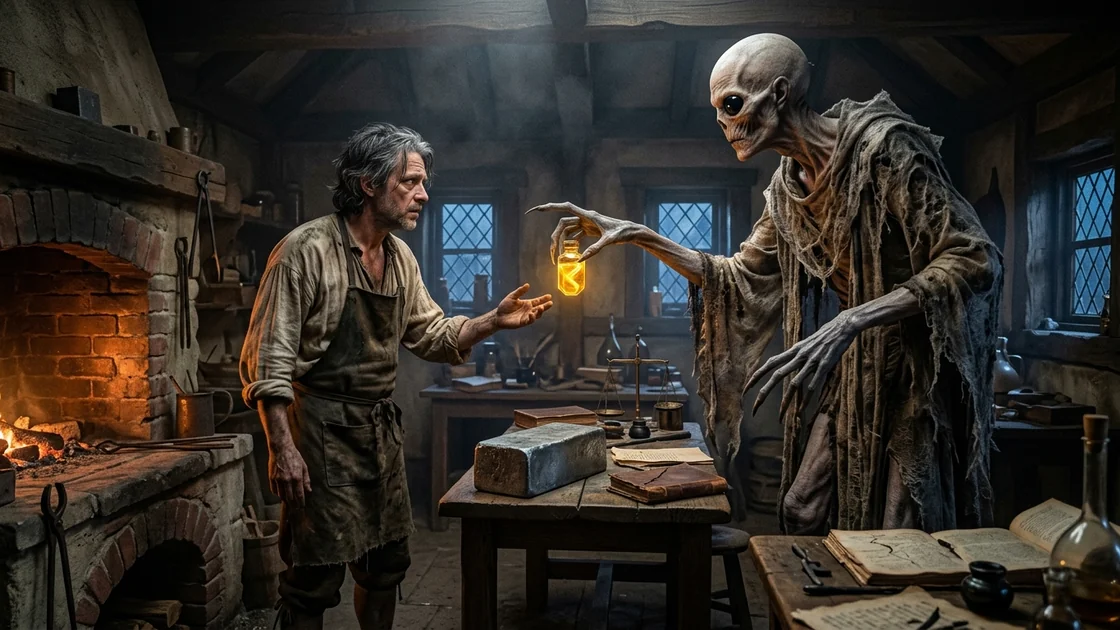
In the secluded valley of Oakhaven, an ambitious alchemist named Nicholas Vance traded the collective joyful memories of his fellow villagers to an ancient demon named Malidra in exchange for the elusive secret of transmuting common lead into pure gold. While Nicholas amassed unheralded riches and unlocked the ultimate mystery of physical matter, he watched in mounting horror as his community withered into a numb, listless waking death, stripped of love, laughter, celebration, and purpose. Burdened by mountains of glittering, worthless bullion and the hollow stares of those he once cherished, Nicholas was forced to confront the true cost of his obsession and seek a devastating path toward atonement.
Act I: The Furnace in the Woods
The crucible did not sing; it sputtered.
Nicholas Vance leaned over the brick hearth, his nose stinging from sulfur, vitriol, and the stale vinegar of his own unwashed linen. For seven years, the stone cottage at the northern fringe of Oakhaven had smelled of boiled bones and roasted antimony. While the valley below greened with spring, burned with summer barley, and drowsed under the clean, blue sheets of winter snow, Nicholas had known only the shades of gray that lived between ash and slag.
He was thirty-two years old, though the mirror of polished speculum bronze hanging behind his worktable claimed he was fifty. Silver threads ran thick through his black hair, and deep trenches framed a mouth that had forgotten how to rest in anything other than a grim, downward curl.
On the table rested a pig of lead—dull, heavy, gray as a wet tombstone. Beside it lay his notebooks, hundreds of pages bound in cracked pigskin, dense with geometric sigils, planetary conjunctions, and notes scrawled in an agitated hand.
The sulfur is too wild, read the latest entry, penned at three in the morning when his candle had drowned in its own tallow. The mercury flees the heat before the soul can bind. Lead remains lead. It mocks me with its weight.
Through the small leaded panes of the laboratory window, the sounds of Oakhaven drifted uphill on the late afternoon breeze. It was the eve of the midsummer feast. Nicholas could hear the distant, joyous thrum of a fiddle, the rhythmic thumping of feet against packed dirt, and the clear, cascading laughter of Clara, the baker’s daughter. Once, Nicholas had danced with Clara under the ribbons of the Maypole; once, he had felt the warmth of her hand in his and imagined a life where the hearth was meant for baking loaves rather than dissolving cinnabar.
That was before his father had died in debtors' prison, clutching a handful of rusted iron nails and raving that the soil of Oakhaven was barren to those who lacked the coin to buy lime and seed. That was before Nicholas had sworn an oath to the cold stars that he would never bend his knee to hunger, that he would drag nobility from the dirt by sheer force of will, that he would master the Chrysopoeia—the sacred art of turning base lead into imperishable gold.
"Foolishness," Nicholas muttered, his voice raspy from breathing furnace fumes. He snatched a pair of iron tongs, lifted the clay crucible from the coals, and tipped its molten contents into an iron ingot mold. The liquid poured like sluggish silver, then cooled rapidly into the same lifeless, leaden gray it had been an hour prior.
He threw the tongs against the stone wall. The clang rang through the small cottage, startling a raven perched on the eaves outside.
"Still blind, Little Raven?"
The voice did not come from the doorway, nor through the window. It resonated from within the chimney, low and dry, like dry leaves scraping across a stone floor in autumn.
Nicholas froze. He had heard whispers before—late at night, when exhaustion blurred the edges of the room—but never a voice so distinct, so heavy with intention. He reached for a heavy iron poker, his knuckles whitening. "Who is there?"
The shadow cast by the furnace upon the whitewashed wall began to detach itself. It did not stretch toward the ceiling as a shadow cast by fire ought to; instead, it pooled, gathered substance, and stepped out from the lime-plastered stone.
The creature was taller than a man, yet folded itself with uncanny elegance into the low-ceilinged room. Its skin had the texture of dried parchment, stretched tight over bones that seemed too numerous and strangely articulated. Its eyes were not eyes at all, but two smooth, polished spheres of obsidian, reflecting the orange coals of the furnace without holding any warmth of their own. It wore robes woven from what looked like charred cobwebs, trailing behind it a faint smell of dried roses, cellar dust, and ozone.
"You have burned much antimony, Nicholas Vance," the entity said, its mouth barely moving. The sound vibrated in Nicholas’s teeth. "You have boiled down horse blood, distilled the dew of May mornings, and spent your youth chasing a principle that does not belong to the kingdom of earth."
"A demon," Nicholas whispered, stepping back until his hips pressed against the heavy oak edge of his workbench. His hand trembled on the iron poker. "An emissary of the Pit."
The creature tilted its head, a motion like a bird observing a worm. "Names are coins that have worn smooth through too much spending. You may call me Malidra. I am an archivist of weights and balances. I do not deal in pits, Nicholas. I deal in commerce."
"I have no soul to sell," Nicholas spat, though his heart hammered against his ribs like a trapped bird. "The churchmen say the soul belongs to God, and even if it did not, I would not yield my eternity for a heap of yellow dust."
Malidra chuckled—a sound like corn husks rustling in a gale. "How touching, your reverence for your phantom soul. Keep it. Keep your salvation, your prayers, your fears of the furnace beyond the grave. I have no use for a scholar’s tattered spirit; it is bitter, dry, and tastes of ink and vanity."
Nicholas hesitated, his grip on the poker slackening by an inch. "Then what do you want? Why come to a beggar’s cellar?"
"I came because your desire reached a certain density," the demon replied, drifting closer. The air in the room grew noticeably colder; Nicholas’s breath bloomed in faint white clouds before his face. "A desire so pure, so unencumbered by mercy or distraction, acts as a beacon. You wish to know the secret. The True Stone. The Red Tincture that coaxes the slumbering sun out of base earth."
"You know it?"
"I was present when the veins of the world were poured," Malidra murmured. "I watched the angels balance the scales of density. Transmutation is no mystery; it is simply an exchange. Lead is heavy because it remembers the fall. Gold is radiant because it remembers the first light. To turn lead into gold, you must provide the memory it lacks."
Nicholas swallowed hard. "Memory? Lead has no mind."
"Everything has memory," the demon hissed softly. "The stone remembers the mountain. The water remembers the cloud. And lead... lead is merely matter that has forgotten how to rejoice. It is tired. It carries the weight of the dark deeps. To awaken it, to elevate it to the majesty of the sun, you must bathe it in the essence of joy."
"Joy?" Nicholas’s brow furrowed. "That is poetry, not natural philosophy. You speak in metaphors."
"I speak in the literal grammar of the cosmos!" Malidra’s voice snapped like an iron trap, vibrating through the stone floorboards. The obsidian eyes flared with a dull, subterranean purple. "Do you think the universe cares for your retorts, your cucurbits, your balances? The universe runs on sensation, on experience, on the sweet, distillation of feeling! What do you think gold is, Nicholas? It is frozen delight! It is the materialization of happiness uncorrupted by time!"
The alchemist stared at the demon, his breath coming quick and shallow. He looked from Malidra’s terrible, parchment face to the dull, gray lump of lead on his table. For years, he had felt that lead was stubborn, that it resisted him not out of chemical defiance, but out of a profound, sluggish despair.
"How does one distill joy?" Nicholas asked, his voice barely a breath.
Malidra smiled, revealing rows of teeth that resembled small, smooth river stones. "You cannot distill what you do not possess. Look at yourself, Nicholas. You have not laughed in ten years. You have not known the warmth of a woman’s breast since your youth. You have forgotten the taste of sweet wine, the thrill of the hunt, the easy comfort of friends by the fireside. You are as dry as an autumn seed husk. You have nothing to give."
"Then the work is impossible," Nicholas said, a bitter despair washing over him.
"Not impossible," Malidra whispered, leaning down until its face was mere inches from the alchemist’s. The smell of old roses grew suffocating. "You have no joy, Nicholas Vance. But your valley does."
The demon turned its head toward the window, where the midsummer music still drifted through the twilight.
"Listen to them," Malidra whispered. "Listen to the sheep-shearers, the milkmaids, the plowboys. They have so much of it. They store it up in their little wooden hearts. Memories of their first kisses under the willow trees. The pride of a father looking at his firstborn son. The laughter of old men sharing cider in the autumn sun. The wild, unthinking ecstasy of children chasing fireflies in the grass. They waste it. They let it spill into the air, where it rots and fades into the ether."
"What would you have me do?" Nicholas asked, his throat dry.
"Not you. Me," said the demon. "I will be the alembic. I will go down into the valley tonight, while they sleep with their bellies full of festival beer and their hearts sweet with merriment. I will draw it forth—not their lives, Nicholas. Not their blood, nor their sanity, nor their breath. Only their joys. Every memory of sunlight, every recollection of comfort, every drop of warmth they have ever hoarded in the dark of their skulls."
"And what will become of them?"
"They will live," Malidra said indifferently. "They will wake. They will plow the fields, milk the cows, bake the bread, and pay their taxes. They will not die. They will simply be... calm. Unbothered by the wild storms of ecstasy. Efficient. Balanced."
"And in return?"
Malidra reached into the folds of its cobweb robes and drew forth a small, hexagonal vial of cut crystal. Inside, swirling like liquid sunlight suspended in oil, was a thick, luminescent golden syrup. It illuminated the dingy room with a radiant, heart-stopping amber glow. Nicholas felt a physical pang in his chest—a sudden, desperate ache to touch it, to possess it, to drown in its brilliance.
"The Secret of the Sun," Malidra whispered. "A single drop of this menstruum, introduced to an ounce of molten lead, will infect it with the memory of light. The lead will weep away its dross and become pure gold. Refined beyond the quality of any mine in Ophir or Bohemia. With this vial, you may turn mountains into treasuries. You will be the richest prince Christendom has ever known. You will buy kingdoms. You will rebuild your father's house in marble and porphyry."
Nicholas looked from the vial to the village below.
The fiddle was playing a reel now, fast and wild. He could picture them: old Master Garrow, who had lost three fingers to the frost but could still out-sing any man in the shire; young Thomas, who had just been apprenticed to the smith and had grinned until his cheeks cracked; and Clara... Clara, whose eyes held the color of hazel twigs in rain, who had brought him a loaf of fresh sourdough three days ago and looked at him with an expression of quiet, wounded sorrow because he had not even thanked her.
It is only memories, a voice whispered within him—a voice that sounded suspiciously like his own, yet carried the cold cadence of the lead on his table. Memories fade anyway. They will make new ones. A man cannot buy bread with a smile. A kingdom cannot be built upon laughter. My father died in the dirt because he had only kindness and no coin.
"Will they suffer?" Nicholas asked.
"Suffering requires comparison," Malidra replied smoothly. "A man who does not remember sweetness does not mourn the vinegar. They will not weep, Nicholas. To weep, one must remember what it was like to smile."
Nicholas reached his hand out. The furnace fire flickered, turning green for a single, shuddering second.
"Give me the vial," Nicholas said.
Malidra did not hand it over immediately. The demon’s obsidian eyes seemed to expand, swallowing the room, the cottage, the stars beyond the window.
"The pact is sealed by the act of taking," the demon murmured. "Tonight, the harvest begins. Tomorrow at dawn, when the cock crows—though none will care to hear it—the crucible will receive its first baptism. Do not weep when you find yourself master of an empire of gray stone, Alchemist."
Nicholas closed his fingers around the cold crystal of the vial.
A shock like lightning surged through his arm, straight into his chest. For a fractional heartbeat, he felt a thousand voices screaming—not in agony, but in a sudden, violent rushing out, like a great sea pulling back from a shore before a tidal wave. He smelled cider, new-mown hay, roasted chestnuts, the sweat of clean work, the scent of lavender on clean bedsheets, all swirling together in a dizzying, intoxicating whirlpool.
Then, silence.
The demon was gone. The cottage was empty save for the furnace coals, which had burned down to a dead, sullen orange. Outside, the fiddle had stopped playing.
Nicholas looked down at his hand. The crystal vial rested in his palm, pulsing with a slow, hypnotic gold light.
Act II: The Sun in the Mold
Nicholas did not sleep that night. He spent the remaining hours of darkness preparing his equipment with methodical, almost manic precision.
He rebuilt the furnace lining with fresh refractory clay. He scrubbed his iron molds with bone-ash until they shone like mirrors. He gathered every scrap of lead he possessed: ancient roof flashing pulled from the derelict chapel at the crossroads, lead fishing sinkers, musket balls, battered pewter tankards heavy with plumbum, and the massive fifty-pound pig that had served as his anvil-weight for three years.
He piled them beside the brick hearth, a mountain of gray, oxidized, sorrowful metal.
When the first pale gray fingers of dawn touched the eastern hills, Nicholas looked out the window. Usually, the dawn chorus of the birds was deafening in June—a raucous, competitive tapestry of thrushes, larks, and blackbirds welcoming the sun.
This morning, there was only a scattering of dry chirps. The birds sang not with passion, but with the mechanical regularity of clockwork toys.
Down in the valley, the village of Oakhaven lay shrouded in a low-hanging, milky mist that did not burn off when the sun crested the ridge. No smoke rose from the chimneys. The cock did not crow; or if it did, Nicholas did not hear it.
His hands shook as he took up the flint and steel. He blew the coals into life, feeding them dry birch, then heavy lumps of sea-coal until the fire roared white-hot within the belly of the furnace.
He placed a crucible into the heart of the flames, heaped it with chunks of dull gray lead, and waited.
The metal softened, lost its shape, and collapsed into a sluggish, slate-colored pool. It skin wrinkled with dross—scum of sulfur and iron. Nicholas used an iron rod to skim the surface until the molten metal shone like dirty mercury, reflecting his own bloodshot, hollow eyes.
"Now," he whispered.
He uncorked the crystal vial.
A single drop fell from the mouth of the vessel. It did not splash. As it touched the liquid lead, the drop bloomed like an ink-stroke in clear water, sending tendrils of fierce, blinding vermilion through the gray metal.
Nicholas gasped and shielded his eyes.
A sound rose from the crucible—not a hiss, but a deep, resonant chord, like the lowest string of an immense harp struck in a cathedral. The acrid smell of burning sulfur vanished, replaced instantaneously by the rich, head-spinning aroma of blooming clover, sun-ripened blackberries, and the crisp ozone of an autumn afternoon.
The gray skin of the lead did not simply change color; it unraveled. It dissolved like a wool cloak falling away from a queen. Beneath it, the liquid churned with an inner, incandescent brilliance that defied the dim morning light of the cottage. It was bright yellow, tinged with a rich, reddish-orange heat that did not scorch the eyes but filled the chest with an inexplicable, terrifying warmth.
With trembling arms, Nicholas took up the tongs. He gripped the crucible, lifted it from the coals, and poured the molten metal into the iron ingot mold.
It flowed like melted light. It filled every corner of the mold with crisp, liquid weight.
Nicholas set the crucible down, his chest heaving, his knees threatening to buckle. He leaned over the mold, watching the surface solidify.
Usually, molten metal puckered and clouded as it froze. This metal did not. It hardened into a mirror of absolute, unblemished perfection. When Nicholas tipped the mold onto his wooden table, the ingot dropped with a dull, heavy thud that shook the dust from his rafters.
It was twenty-four carats. Nicholas did not need a touchstone to know it; he did not need aqua fortis to test it. The gold possessed an aura, an undeniable physical weight of sovereignty that no natural metal mined from the earth had ever achieved. It was warm to the touch, retaining the heat of the fire long after it should have cooled, radiating a faint, buttery glow in the shadowed room.
He had done it.
The work of Geber, of Hermes Trismegistus, of Paracelsus, of Flamel—all achieved in a single night by Nicholas Vance, the debt-ridden alchemist of Oakhaven.
"I am rich," he said to the empty room.
The word felt strange in his mouth. He picked up the bar. It weighed nearly forty pounds. At current market rates in the city of Highspire, this single bar would purchase fifty acres of prime arable land, three teams of oxen, and a carriage lined with Spanish leather. And he had enough lead left on the floor to make twenty more.
"I am the master of the world," he said, louder this time.
He waited for the surge of triumph to crest in his heart—the intoxicating leap of the spirit that he had imagined every night for seven years. He waited for the triumphant tears, the wild, solitary dance, the feeling of his father’s ghost resting at last.
Nothing came.
There was only a cold, heavy satisfaction, like a clerk finishing a long column of figures and finding the balance correct to the penny. The gold sat in his hands, heavy, beautiful, and utterly inert.
I must show them, he thought, a sudden, desperate urge overtaking him. I must go down to the village. I must see their faces when they realize the alchemist is no longer the village lunatic. I must see Clara’s eyes.
He wrapped the ingot in an old piece of homespun linen, tucked it beneath his arm—groaning slightly under its surprising, glorious weight—and stepped out into the morning air.
Act III: The Village of Salt
The road from Nicholas’s cottage to Oakhaven followed the winding course of the Blackwood Brook. Usually, on a midsummer morning, the path was busy. Geese would be driven to the common pasture by shrieking, barefoot boys; women would be walking to the wash-pool with wicker baskets balanced on their hips, trading gossip about who had danced with whom until the torches burned out.
Today, the road was deserted.
The brook ran over its gravel bed with the same musical murmur as always, but the world around it had gone flat. The colors of the trees—the vibrant, juicy greens of oak and alder—seemed muted, as if someone had washed the valley in thin, gray dishwater.
Nicholas quickened his pace, his leather boots crunching loud on the loose gravel. The linen-wrapped bar under his arm was heavy, but its warmth pressed against his ribs, a secret sun tucked against his side.
He reached the village square.
The remnants of the midsummer feast were still scattered across the green. A trestle table stood crooked on the turf, three wooden benches overturned beside it. Ribbons of red, yellow, and blue hung limp from the Maypole, damp with dew and heavy with gray moisture.
Old Master Garrow was sitting on the stone bench outside the Black Bull Tavern. His hands, gnarled like apple roots, rested palms-down upon his knees. His pipe lay on the cobbles at his feet, its stem snapped in two, the unsmoked tobacco spilling into the dust.
"Master Garrow," Nicholas called out, approaching the old man.
Garrow did not jump. He did not turn his head with any curiosity. He merely rolled his eyes slowly toward Nicholas, his face as flat and expressionless as a slab of cured bacon.
"Good morrow, Nicholas Vance," Garrow said. The voice was level, devoid of the gravelly warmth that usually preceded a joke or an offer of a tankard.
"You left your pipe, Garrow," Nicholas said, pointing to the ground. "And the festival... you left the tables out. Did the rain come in the night?"
"No rain," Garrow replied. "The fire went out. So we went to our beds."
"And the singing? You were to lead the harvest chorus at dawn."
Garrow blinked. His pale blue eyes were entirely clear, unclouded by wine or ale, but behind them lay an infinite, terrifying emptiness. It was the look of a well whose bottom had dropped out into an abyss.
"The chorus," Garrow repeated, as if trying to recall the meaning of an archaic word from a foreign tongue. "Yes. We did that last year, I think. Or perhaps we did not. It is noisy. My chest feels tired when I shout like that. What is the purpose of it?"
Nicholas felt a prickle of cold needle-points across the back of his neck. "The purpose? It is midsummer, man! The feast of the sun! The turning of the year!"
"The year turns whether we scream at it or not," Garrow said reasonably. He looked back toward the empty cobbles. "It takes less bread to sit quietly."
Nicholas stepped back, his heart thumping uncomfortably. He left the old man sitting like a carved stone idol and walked toward the forge.
The hammer was falling. Clang. Clang. Clang.
Young Thomas was at the anvil. The boy was usually a creature of wild energy, his face blackened with soot, grinning through his sweat, always boasting of how many horses he had shoed or how he would soon buy his own tools and marry the miller’s niece.
Now, Thomas worked with the mechanical, relentless rhythm of an iron automaton. His face was slack. Sweat poured into his eyes, but he did not bother to wipe it away. Beside him, the forge fire burned low and dull; he was working an iron rod cold, battering it against the horn of the anvil with no apparent purpose.
"Thomas," Nicholas said, standing in the doorway of the smithy.
The boy did not miss a beat. Clang. Clang. "Good day, Nicholas."
"What are you making, lad?"
"An iron bar," Thomas replied without looking up.
"To what end? A plowshare? A tire for a cart?"
"An iron bar," Thomas repeated. "Master says we work iron. I am working iron."
"Where is Master Smith?"
"In the kitchen. Sitting."
Nicholas reached out and seized the boy’s wrist, arresting the hammer in mid-air. Thomas did not struggle. He did not curse or demand to know why Nicholas had touched him. He simply stood there, his arm limp in Nicholas’s grip, waiting for the obstruction to pass.
"Thomas," Nicholas said, peering into the youth’s vacant hazel eyes. "Do you remember yesterday? Do you remember the race down from the ridge? You beat the Miller’s boy. You won the silver penny."
Thomas tilted his head, his brow knitting slightly in mild, intellectual effort. "I ran," he said. "The air was thin in my throat. My legs were sore."
"You won, Thomas! You laughed so hard you fell into the clover, and your father bought a round of perry for everyone at the well!"
"Did he?" Thomas asked. His voice held no anger, no sadness, only a mild, dispassionate curiosity, as if Nicholas were describing the habits of an ant in a distant field. "I think the perry was sour. My head hurt afterward. Why did we run? The ridge is still there. The well is still here."
Nicholas released the boy’s arm. The hammer fell immediately. Clang. Clang. Clang.
A cold, greasy terror began to pool in Nicholas’s gut. He turned and ran across the green toward the bakery.
The door stood open. The smell of baking bread—the most comforting, ancient smell in all of human living—did not fill the room. Instead, there was only the smell of warm flour and woodsmoke.
Clara was kneading dough at the long sycamore table.
Her chestnut hair was pulled back in a loose braid, exactly as Nicholas had seen it a hundred times. Her sleeves were rolled up, her white forearms dusted with flour. She pressed the heels of her hands into the gray lump of dough, folded it, pressed it again.
"Clara," Nicholas said, his voice cracking.
She turned her head. Her face was beautiful, symmetrical, unmarred by any mark of violence or sickness. But her hazel eyes—those eyes that had looked upon Nicholas with shy tenderness when they were fifteen, that had held reproach when he had turned to his retorts, that had wept when her mother died—were smooth and still as frozen pond-water.
"Nicholas," she said. Her voice was musical, but it was the music of a music-box that had lost its resonance chamber—tinny, flat, and thin. "You are up early. The bread will not be drawn until the third hour."
Nicholas dropped the linen bundle onto the table. The heavy gold ingot slammed down with an enormous crack, denting the soft sycamore wood. The linen fell away, revealing the radiant, yellow metal, flashing in the dim light of the bakery like a fallen star.
"Look, Clara," he breathed, leaning over the table toward her. "Look at it!"
Clara glanced down at the gold. Her expression did not change by a hair’s breadth. She did not gasp. She did not reach out a finger to touch the immaculate surface.
"It is yellow," she remarked.
"It is gold, Clara! Pure gold! I made it! In the furnace, from lead! I have found the stone, the tincture, the great secret!"
"It is very heavy," she observed calmly, noting how the wood had indented under its mass. "It will be difficult to carry back up the hill."
"Do you not understand?" Nicholas cried, his voice rising to a frantic, hysterical pitch. He grabbed the gold bar and shoved it toward her hands. "We are free! Oakhaven is free! I can buy every lease from the Earl! I can pave the churchyard with silver! I can build you a manor house of cut marble, Clara! You will never have to bake another loaf of bread! You will wear silks from Genoa and pearls from the Orient!"
Clara looked at him, then down at the dough beneath her fingers.
"Why would I wear silk?" she asked softly. "Wool keeps the wind off just as well. And if I do not bake the bread, the people will have to eat raw meal. That causes swelling in the bowels."
"Clara... please," Nicholas begged. He dropped the gold; it thumped heavily against the floor, rolling into the flour dust, ignored. He reached across the table and took her flour-covered hands in his. Her skin was dry and cool. "Do you remember the bridge? When we were sixteen? The night the sheep broke into the orchard, and we spent three hours chasing them in the dark, and we sat on the stone parapet and ate sour apples until the stars went out?"
Clara looked down at their joined hands. She did not pull away, but neither did she squeeze his fingers.
"The sheep ruined three of father’s russet trees," she said. Her voice was entirely level. "My apron was stained with moss. I had to scrub it with lye three times to get the green out. It made my fingers bleed."
"Was that all it was to you?" Nicholas whispered, tears burning the corners of his eyes for the first time in ten years. "Was there nothing else? You laughed, Clara. You laughed so hard you could not climb the wall, and I lifted you... I lifted you, and you kissed my cheek."
Clara tilted her head, her eyes distant, scanning the empty corridors of her scoured mind.
"I remember the wall," she said after a long silence. "It was wet. The stones were loose. It was dangerous to climb in the dark. We might have broken our ankles."
She gently pulled her hands from his grasp. She picked up the wooden scraper, turned the dough, and resumed her rhythm.
Press. Fold. Press. Fold.
"You should go, Nicholas," she said without rancor. "The dust from your boots is getting into the flour. Master says clean bread sells better."
Nicholas stood in the bakery, surrounded by the smell of yeast and cold ashes. The world seemed to tilt beneath him, sickening and steep.
He looked at the gold bar lying in the corner, half-covered in white flour like a corpse under a sheet.
Suffering requires comparison, the demon had said. They will not weep. To weep, one must remember what it was like to smile.
He had not killed them. He had done worse. He had cut out their hearts and left them the machinery of their meat.
Act IV: The Empire of Dust
The months that followed the midsummer feast were the quietest in the history of the county.
Nicholas Vance did not stop his work. Indeed, an insidious madness overtook him: if the secret had cost so much, it must be used. To leave the lead unconverted would be to admit that the transaction had been a monstrous, futile slaughter of the soul.
Every week, a heavy wagon drawn by four magnificent Percheron horses rumbled up the mountain path to Nicholas’s cottage. It came loaded to the rails with dull, blue-gray pigs of lead bought from the mines of the Peak District. Two days later, it rumbled back down the mountain, its springs groaning, its bed loaded with neat, gleaming stacks of bullion.
Nicholas became an apparition of the high roads.
He traveled to the provincial capital with an armed escort of mercenaries hired from the low countries—men who were paid in double-weight gold sovereigns and cared nothing for the queer, silent valley from whence the wealth flowed. Nicholas bought up the mortgages of every farm within twenty leagues. He bought the titles to the forests, the mineral rights to the hills, the fisheries in the estuary.
He sent architects from Florence to Oakhaven. They arrived with rolls of vellum and cases of brass instruments, intending to tear down the wattle-and-daub hovels and construct a grand, neoclassical town of white freestone, with colonnades, fountains, and formal gardens.
The villagers watched the stone-cutters and masons arrive with the same mild, disinterested detachment they showed to the weather.
When the old tavern was pulled down to make way for a grand, vaulted exchange, Master Garrow merely moved his stool twenty yards to the west, sitting under the eaves of an old tithe barn to watch the dust rise.
"They are building a palace, Garrow," Nicholas said to him one afternoon, stepping out of a velvet-lined coach, wearing a doublet of crimson damask with buttons of carved amber. "It will have baths of marble, heated by hypocausts beneath the flags. You will have a chamber of your own, with feathers from Pomerania to sleep on."
"The stone makes a great deal of dust," Garrow replied, his voice unchanged since midsummer. "It gets in the eyes. When the wind blows, it makes the eyes water."
"Do you want for anything?" Nicholas asked desperately, pulling a handful of heavy gold coins from his pocket and thrusting them into the old man's lap. "Clothes? Meat? Wine from the Rhine?"
The coins spilled from Garrow’s knees, clattering across the dirt, several rolling into a puddle of horse urine. Garrow did not even look down at them.
"The porridge is sufficient," the old man said. "When the sun goes down, I am cold. In the morning, I am less cold. The gold does not burn well in the brazier; it is too heavy and smothers the coals."
Nicholas turned away, his stomach knotting with nausea.
The village had become an open-air crypt. There was no crime, for none possessed the passion of greed or the fury of envy. There was no brawling, no drunkenness, no theft. But neither was there any industry beyond the bare minimum required to keep the lungs pumping and the blood moving.
The fields were cultivated, but only with rye and turnips—crops that grew without tending, that offered caloric sustenance without the need for the joyous labor of the orchard or the vineyard. The apple trees in the common orchard dropped their fruit to rot in the grass; the apples were sweet, and sweetness was an unnecessary complication. The children did not run. They sat in rows along the stone walls, their faces smooth, unblinking, watching the clouds move across the sky with the terrible patience of lizards.
Worst of all were the weddings.
Because the parish priest had been infected with the same pale numbness as his flock, he continued to perform the sacraments as a matter of mechanical duty. When two youths reached an age where the management of a household required another pair of hands, their parents arranged their union with the dispassionate efficiency of horse-breeders.
Nicholas attended one such ceremony in late autumn. It was between the daughter of the wheelwright and the son of the tanner.
There were no flowers. There were no fiddles. There was no ribbon-strewn loaf, no blushing bride, no nervous groom clutching a posy of rosemary. The young man stood before the altar in his work apron; the girl wore her greasy wool skirt.
"Do you take this woman?" the priest asked, his voice droning like a hornets' nest in a dead log.
"Yes," the young man said. "The tannery needs someone to carry the tallow."
"Do you take this man?"
"Yes," the girl replied. "My father’s house is small, and there are three sisters."
They did not kiss. They did not look at one another. When the ceremony was finished, they walked back out into the autumn drizzle, one behind the other, their boots splashing through the mud, their eyes fixed on the gray line of the road ahead.
Nicholas stood in the back of the cold, damp church, clutching his golden rosary beads until the wire bit into his flesh. He felt an urge to scream—to rip the tiles from the roof, to throw his gold into the river, to tear his fine crimson clothes into ribbons and smear his face with muck.
He was the richest man in the kingdom. The King’s ministers sent him letters bearing the royal seal, begging for loans to fund the wars in France; dukes offered their daughters to his bed; universities sent scholars to beg for his patronage.
And he was utterly alone in a graveyard of breathing meat.
Act V: The Anatomy of Melancholy
Winter came, cruel and white.
In Oakhaven, the snow was not an occasion for sledding, nor for gathering by the hearth to tell tales of boggarts and saints while the kettle sang on the crane. The villagers simply shuttered their windows and sat in their dark rooms, eating cold salted meat and dry bread, conserving their wood because hauling it through the drifts required effort. Several old people died in their beds—not from frostbite, but because they simply forgot to pull the blankets up over their shoulders when the fires went out. They had felt the cold, certainly, but they had lacked the motive of fear or the desire for comfort that prompts a beast to burrow into the straw.
Nicholas spent his days in his great new house, built halfway up the mountain between the village and his old cottage. It was a monstrosity of white Portland stone, with twelve hearths, a library of ten thousand volumes, and floors of polished Italian marble that reflected the chandeliers like black ice.
It was freezing.
No matter how many cords of seasoned oak his servants—strangers hired from the capital, who quickly grew unnerved by the local populace and fled within a fortnight—heaped upon the hearths, the rooms remained inhabited by a pervasive, damp chill.
Nicholas sat in his great hall, wearing three fur-lined cloaks, surrounded by chests of solid gold coin.
He was working again. Not on transmutation—he had enough gold to buy the Papacy twice over—but on the Counter-Work.
For three months, his tables had been covered with texts on neurology, demonic pacts, the Kabbalah, and the obscure writings of the Persian physicians who wrote of the Ruh—the vital spirit that animates the humors.
If joy is a substance, Nicholas reasoned in his leather-bound journal, his hand shaking with cold and fever, then it must have an opposite. Or rather, it must have an affinity. If it was drawn forth by an alchemical principle, it can be re-precipitated. Matter cannot be annihilated; the philosophers agree on this. The joy of Oakhaven still exists. It is in the demon's keeping, or it has been converted into the radiance of the gold itself.
He looked up at the ingots stacked against the wall.
They glowed, even in the shuttered gloom. Their warm, butter-yellow light was the only color in the vast, gray hall.
The gold remembers, Malidra had said. Gold is radiant because it remembers the first light. To turn lead into gold, you must bathe it in the essence of joy.
Nicholas stood up, his joints aching. A horrifying, brilliant realization struck him with the force of an iron cudgel.
"It is not in the demon’s bellies," he whispered, his eyes wide and wild. "It is here."
He stumbled toward the wall of bullion. He pressed his bare hands against the cold, immaculate metal of the nearest bar.
Under his fingertips, the gold seemed to thrum with a faint, microscopic vibration—like the purring of a cat or the singing of a wire in the wind.
He closed his eyes and pushed his consciousness through his skin, using all the arts of concentration he had learned through twenty years of alchemical meditation. He ceased to breathe. He silenced his own pulse. He sought the prima materia beneath the golden form.
Suddenly, a vision exploded behind his eyelids.
It was not his own.
He smelled lilac and sun-warmed linen. He was six years old, running through a hayfield, his mother’s voice calling his name from the porch, promising bread and honeycomb. The sheer, overwhelming, bursting ecstasy of being alive, of having knees that did not ache, of knowing that the afternoon was infinite and that the sunset was merely an invitation to tomorrow...
Nicholas gasped, pulling his hand away as if the metal were white-hot iron. He tumbled backward onto the marble flags, his breath tearing from his throat in ragged sobs.
"It is in the metal," he wept, clutching his chest. "Their first kisses... their children's laughter... their quiet comfort by the winter fire... it is all here. I melted their souls and turned them into coin."
He stood up, possessed by a sudden, violent fury.
He took up a heavy iron sledgehammer from the hearth-side. He swung it with all his might against the stack of gold bars.
CLANG.
The hammer bounced off the ingot with a ringing chime that sang through the high vaults of the hall. The bar was not dented. It was not scratched. It lay there, perfect, radiant, and untouchable, mocking him with its unyielding, sunny brilliance.
"Return them!" Nicholas screamed toward the rafters. "Return them, you filthy worm! I revoke the trade! Take the gold! Take the manor! Take my skin, take my eyes, take my breath! Give them back their light!"
The shadows in the corners of the hall did not move.
The cold remained.
From the far end of the long gallery, near the great double doors of Hungarian oak, a slow, rhythmic clapping began.
Clap. Clap. Clap.
Nicholas spun around, the sledgehammer raised in his shaking hands.
Malidra stood between the marble pillars.
The demon looked taller now, its cobweb robes thicker, richer, woven through with threads of pure, shining crimson and gold that had not been there in the cottage. Its parchment face was less drawn; its cheeks held a faint, horrible blush of stolen vigor. Its obsidian eyes reflected the distant furnace fire with the luster of wet oil.
"An excellent performance, Nicholas Vance," the demon murmured, drifting down the center aisle of the hall without its feet touching the stone. "You have the makings of a tragedian. The King’s players in London could not have staged a finer display of late-blooming remorse."
"Malidra!" Nicholas roared, charging down the hall, the hammer swinging in a vicious arc toward the entity’s skull.
The iron hammer did not strike bone. It passed through the demon's neck as through a bank of foul-smelling fog. The momentum carried Nicholas forward; his boots slipped on the polished marble, and he crashed heavily to his knees, the hammer skittering across the flags until it struck a pillar with a dull clink.
Malidra turned around gracefully, looking down at the alchemist with an expression of mild, patient pity.
"You always had a crude understanding of natural philosophy, Nicholas. Iron disrupts flesh. It does not disrupt an agreement."
"I break the pact!" Nicholas wheezed, his mouth tasting of blood where he had bitten his lip in the fall. "The law of contracts allows for restitution! I have all the gold! Every dram! Every grain! I will return it to you! Melt it back into lead! Let the light return to the valley!"
Malidra chuckled—the same sound of dry corn husks, but louder now, filled with the resonance of a hundred stolen midsummers.
"Melt it back?" the demon asked. "Have you ever tried to un-bake a loaf of bread, Nicholas? Have you ever tried to gather the smoke from an oak log, compress it back into wood, and plant it in the earth to grow again?"
"You said it was a balance!"
"It was," Malidra purred. "And the balance has settled. The joy of Oakhaven has found its permanent form. It is the most stable element in the universe. Gold does not rust, Nicholas. It does not oxidize. It does not tarnish. It does not decay. That was what you desired, was it not? You hated the transience of life. You hated that your father’s joy was crushed by a bad harvest. You wanted something that would last. I gave it to you. Their happiness is now immortal. It will sit in these chests for ten thousand years, unblemished by grief, untouched by sickness, clean of the dirt of living."
"They are dying!" Nicholas shouted, rising to his feet and lunging toward the demon, his fingers clawed like talons. "They are living corpses! They do not love! They do not hope! Clara looks at me as if I were a stone by the roadside!"
Malidra’s obsidian eyes flared with a sudden, dreadful intensity that rooted Nicholas to the floorboards, freezing his blood in his veins until he could not even twitch an eyelid.
"And why shouldn't she?" Malidra hissed, its voice dropping into a register that made the marble floor shudder. "Did you love them, Nicholas? Did you love Clara when you took the vial from my hand? Did you love Master Garrow when you listened to his song and calculated how many pounds of plumbum his merriment could elevate? You were the first corpse in this valley, Little Raven. You were dead before I ever crossed your threshold. You merely wished for the rest of the world to match your own coldness, so that you would not feel so alone in your winter."
Nicholas closed his eyes. The demon’s words were colder than the frost on the windows, because they were true.
He had not traded their joy because he hated them. He had traded it because he had deemed it trivial. He had looked upon their small, bright, messy lives from his high cottage and judged their happiness to be a toy—something cheap and easily surrendered in the pursuit of Great Things.
"Is there no price?" Nicholas whispered, his head bowed, his tears dripping onto the cold flags. "No sacrifice? You are a demon. You trade in pain. Take mine. Take all of it. Let me burn in your pit for eternity. Flay my spirit with hooks of sulfur. Only give them back their sunlight."
Malidra stepped closer, its cobweb robes brushing against Nicholas’s crimson damask. The scent of dried roses was gone, replaced entirely by the smell of scorched earth and wet ash.
"You have no joy to offer, Nicholas," the demon said softly. "And pain? The Pit is paved with pain; it has no value in the high markets. Pain is as common as gravel. But..."
The demon hesitated, its head cocked at that terrible, avian angle.
Nicholas looked up, a glimmer of desperate hope flaring in his chest. "What? Name it!"
"There is one thing," Malidra mused, its long, gray finger tracing the line of Nicholas’s jaw. The touch was like the edge of an icicle. "An alchemical curiosity. A rare distillation that I have seldom encountered in my long collecting."
"Tell me!"
"Memory is not merely the recollection of light," Malidra whispered. "It is also the anticipation of it. When a man suffers, he endures because he believes that tomorrow will hold some small drop of sweetness. He anticipates the dawn. But you... you know what you have done. You know the exact weight of the crime. Your grief is not the simple, stupid sorrow of a child whose bird has died. It is the profound, mountainous, architectonic agony of a creator who has murdered his own world."
The demon leaned down, its obsidian eyes inches from Nicholas’s face.
"Your sorrow, Nicholas Vance. It is magnificent. It is dense. It has the weight of lead, yet the sharpness of diamond. If I were to take your sorrow—all your grief, all your guilt, all your memory of what Oakhaven used to be—and place it into the crucible... it might act as a universal solvent. It might dissolve the golden matrix and release what is trapped within."
Nicholas did not hesitate. "Take it."
"Wait," Malidra said, a cruel, mocking smile playing over its stone-like teeth. "You do not understand the nature of the solvent, Alchemist. If I take your memory of what was lost, you will not remember that you saved them. You will not remember Clara’s face before the midsummer feast. You will not remember your father’s kindness, nor the song of the midsummer fiddle. And more: the vessel must be broken for the tincture to work. You cannot live without the memory of your crime. It is the only thing that holds your soul together."
"I will die?"
"No," Malidra whispered. "You will be what they are now. But forever. You will be the sole inhabitant of this great, cold palace. You will sit among your piles of dull, useless lead—for the gold will return to base metal when its soul departs. You will have no joy, for you gave that away months ago. You will have no sorrow, for I will have eaten it. You will have no name, for a name requires a story, and your story will have been scoured from your mind like grease from a trencher."
The demon pointed toward the window. Down in the valley, the first gray light of another dead winter dawn was breaking over the snow-covered roofs of Oakhaven.
"The village will wake," Malidra said. "They will remember everything. They will remember their laughter, their dances, their loves, and their sorrows. They will remember the six months of winter sleep as a bad dream, a passing mist. But they will not remember you. Your name will be gone from the parish register. Clara will marry the smith, or the miller, or no one at all, and she will never look toward the mountain path and wonder why the smoke no longer rises from the alchemist’s chimney."
Nicholas looked down at his hands—the hands that had held the crystal vial, that had turned the lead, that had grasped for an empire of dust.
"They will be happy?" he asked.
"They will be human," the demon corrected. "They will be fragile, messy, and brief. They will suffer when their children cough in the night, and they will leap for joy when the rye harvest is gathered before the rain. They will have their daylight."
Nicholas stood tall. For the first time in seven years, the downward curl of his mouth softened. He did not smile—he had forgotten how—but the grimness left his brow.
"Take the solvent," Nicholas said.
Malidra’s face broadened into an expression of ecstatic, ravenous hunger. "So be it, Nicholas Vance. The Great Work is accomplished."
The demon did not reach for his throat. It reached into his chest.
Its gray, many-jointed hand passed through the crimson damask, through the ribs of bone, through the fibrous muscle of the heart, straight into the center of Nicholas’s being.
Nicholas did not scream. He could not.
He felt a sensation of immense, rushing suction, as if a great whirlpool had opened within his skull. He saw his whole life pass before him, not as a sequence of events, but as a tapestry of light and shadow.
He saw Clara standing under the hazel trees, her face radiant with a summer sun that had never existed; he saw his father’s eyes, clear and proud, before the debt had broken him; he saw the midsummer ribbons streaming in the wind; he saw the agony of the bakery, the horror of the silent church, the crushing, monstrous weight of the gold bars upon the sycamore table.
He felt the guilt—that exquisite, agonizing iron band that had crushed his lungs for six long months—being pulled from him like an arrow drawn from an infected wound.
The pain was incredible. It was the pain of a man being flayed from the inside out.
And then, the light broke.
Act VI: The Salt of the Earth
The morning broke over Oakhaven not with mist, but with a cold, clear, sapphire brilliance that made the snow sparkle like a field of crushed glass.
Down in the village, Clara sat up in her bed.
She gasped, clutching her linen shift to her throat, her chest heaving as if she had just surfaced from a deep, suffocating pool of black water. Her cheeks were wet. She reached up a hand to touch them, staring at her damp fingers in astonishment.
"Tears?" she whispered.
Why was she crying? She looked around her small, familiar chamber. The winter light was streaming through the shutters, painting golden bars across her patchwork quilt.
Suddenly, a sound broke through the floorboards from the bakery below—a loud, clattering crash, followed by a string of inventive, furious, and wonderfully colorful oaths.
Her father had dropped the peel again.
Clara let out a sound—halfway between a sob and a shriek—and then she began to laugh. She laughed until her ribs ached, until she had to bury her face in her pillow to keep from waking the neighbors. It was a laugh that had been stored up behind a dam for half a year, bursting through the rotted timber of a nightmare she could not quite recall.
She threw off the quilt, her bare feet hitting the cold floorboards, uncaring of the chill.
She ran to the window and threw the shutters wide.
The valley was alive.
From the smithy, the hammer was ringing—not the dull, clockwork clang of an automaton, but a wild, syncopated rhythm, accompanied by the booming, off-key baritone of young Thomas singing a tavern catch about a milkmaid and a friar.
Across the green, Old Master Garrow was standing on the bench outside the Black Bull, waving his walking stick at a flock of geese that had invaded his cabbage patch, his face purple with magnificent, healthy fury.
"You scoundrels! You gray-feathered devils! Get out! Get out or I'll have you in the pot before noon!"
People were coming out of their cottages, rubbing their eyes, blinking at the bright sky, laughing nervously, calling to one another across the snow.
"Did you have the dream, neighbor?"
"Aye... a strange dream. Like being under water."
"I thought my fire had gone out forever!"
"Look at the sun! Lord preserve us, look at the sun!"
Clara leaned over the windowsill, breathing in the cold, clean air. It smelled of woodsmoke, baking bread, horse dung, and fresh snow. It was the sweetest perfume she had ever known.
She looked up toward the northern ridge, where the dark line of the pine forest met the white snowfields.
High up on the slope, half-hidden among the trees, stood an enormous, strange ruin of white stone. It looked like the carcass of an ancient temple, its roof half-fallen, its grand columns choked with winter ivy and drifts of snow.
Clara frowned slightly.
"Has that always been there?" she asked herself softly.
She tried to remember. It seemed to her that there had once been a cottage there—a small, smoky place where an old eccentric had lived, a man who worked with fires and bottles. What was his name? Peter? John?
She could not remember. The space in her mind where that name ought to have lived was smooth and white, like a fresh drift of snow that had filled an old ditch.
"Clara!" her father bellowed from the bottom of the stairs. "Are you going to sleep until the thaw? The yeast is rising! The oven is hot! We have three shires to feed today, girl!"
"Coming, Father!" she shouted back, her voice ringing clear and true across the snowy rooftops.
She turned from the window, forgetting the ruin on the hill, forgetting the white stone and the strange, half-remembered coldness of the summer past. She ran down the wooden stairs, her heart beating fast, her mind already full of flour, yeast, and the sweet, daily work of the world.
Epilogue: The Ingot of Gray Plumbum
The great hall was silent save for the dripping of water from the vaulted ceiling.
A thaw had come, and the snow was melting through the broken slates of the roof. The water fell into a puddle on the floor—a puddle that reflected neither marble nor porphyry, for the stone was merely rough, gray limestone, green with lichen and stained with bird droppings.
Against the far wall sat stacks of metal.
They were not gold. They were dull, heavy, bluish-gray pigs of common lead, their surfaces chalky with white oxidation. Several of them had been dented by an iron hammer; another bore the faint, indented square of an old maker’s mark from the mines of the Peak.
In the center of the hall, seated upon a rough block of fallen masonry, sat a man.
He wore an old, patched cloak of homespun wool, so worn that the threads were visible like the veins on an old leaf. His hair was white, long, and tangled with dry bits of straw. His face was entirely smooth—not young, but unlined by any memory of grief, terror, triumph, or love.
His eyes were clear, pale gray, like the sky before a November storm.
He held a piece of dry crust in his hand. He chewed it slowly, dispassionately, with the steady, rhythm of an ox working its cud.
When he had finished the crust, he brushed the crumbs from his knees with a hand that had once known the weight of the Chrysopoeia. He looked at his fingers. They were stained with black lead-dust and red brick-dust, the nails cracked and thick.
He did not know who had built the stone walls around him. He did not know why the gray bars were stacked against the wall. He did not know why his knees ached when the damp crept up from the valley floor.
A raven flew down through the hole in the roof, its black wings whistling through the cold air. It landed on one of the lead ingots, cocked its head, and peered at the man with a round, obsidian eye.
"Caw," the raven said.
The man looked at the bird.
He felt neither fear nor pleasure. He simply observed the gloss of its black feathers, the curve of its beak, the way its claw gripped the dull gray edge of the metal.
"Lead," the man said.
The word was heavy and flat in his mouth. He did not know why he said it. It had no meaning to him, beyond the sound it made when his teeth came together.
Down in the valley, the church bells began to ring for noon.
The sound drifted up through the bare birch trees, carried on the soft, wet breeze of the coming spring. It was a cheerful sound—a messy, swinging, chaotic peal, rung by three men who were probably sharing a jug of cider between the ropes, their laughter rising with the music into the vast, open sky.
The man in the ruin listened to the bells.
He did not know what they were celebrating. He did not know that down in the village, a girl with hazel eyes was brushing flour from her apron and laughing at a joke told by a smith with soot on his brow. He did not know that the sunlight pooling on the green had been purchased with the currency of his own immortal spirit.
He felt the sun touch his face through the gap in the stones.
It was warm.
The man tilted his head back, closed his pale, empty eyes, and let the light rest upon his skin.
It was neither good nor bad. It was merely warm.
And for the man who had bought the sun, it was enough.