The Price of Breath
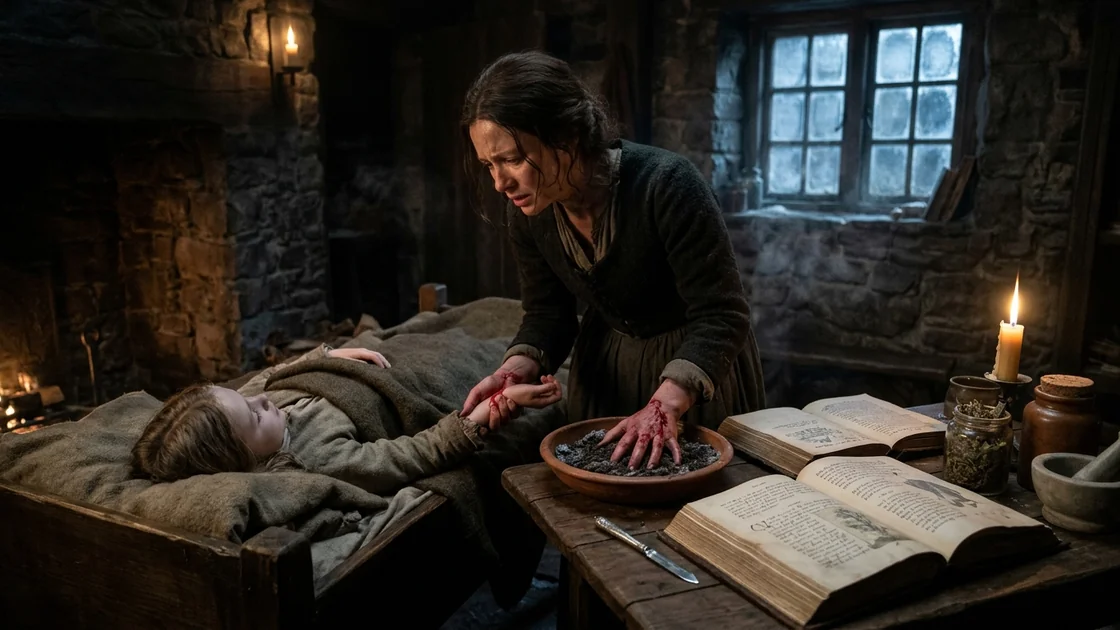
This is the story of Maren, a solitary village healer in the valley of Oakhaven, who defied the ancient natural laws when her young daughter fell fatally ill with the grey lung. Driven mad by despair and the memory of all the lives she could not save, Maren unlocked a hidden ancestral grimoire and performed a forbidden rite of blood transference, believing she was casting the sickness into the dark loam of the earth. She saved her daughter, but the ancient blood rite demanded a living harbor, quietly creeping through the soil and into the cradle of her neighbor's newborn infant. As the village celebrated one miracle, it watched in horror as an innocent baby began to wither from the exact same blight, forcing Maren into a suffocating labyrinth of guilt, suspicion, and a devastating ultimate choice.
Chapter I: The Frost on the Windowpane
The winter of the red frost had lingered far too long in the basin of Oakhaven. It was not true snow that fell from the leaden clouds, but a pale, gritty rime that tasted of zinc and ash, crusting over the eaves of the thatched cottages and choking the winter rye before it could ever pierce the soil. The villagers spoke in hushed tones over their hearths, their voices scraping like dry husks, fearful of drawing the breath of the valley too deeply into their chests.
In the small stone cottage at the southern edge of the village, Maren sat beside a narrow cot, listening to the rattle of her daughter’s lungs.
The sound was not human. It was the sound of dry river gravel being turned by a swift, unseen current, a wet friction that caught in the throat and refused to yield. Seven-year-old Lyra lay under a heap of boiled wool blankets, her skin the color of skimmed milk, her lips dyed a bruised, petulant plum. With every ragged inhalation, her small collarbones rose like the ribs of an upturned skiff.
"Mother," the girl whispered, though her eyes remained shut against the dim glow of the tallow candle. "It feels like cold stones. In my ribs."
"Hush, sweetling," Maren said, her voice steady with the practiced, hollow composure that every healer learns to wear like a mask. She dipped a strip of linen into a basin of cold spring water steeped with marsh mallow and crushed wintergreen. She pressed it gently to Lyra’s fever-bright brow. "The broth is simmering. The comfrey will ease the tearing. Drink a swallow when you can."
"It tastes like soot," Lyra murmured, her voice slipping away into a faint, whistling wheeze. Her small chest hitched, seized by a spasm that arched her back off the straw mattress. When she coughed, she did not cry out; she had no breath left for weeping. Only a dry, shuddering gasp followed, and on the white linen Maren held to her mouth, a faint smear of greyish phlegm appeared, threaded with black, spider-thin filaments.
The Ash Lung.
Maren stared at the stain, her heart turning to lead in her ribs. For three centuries, the records in the village chapel had charted the passing of the Ash Lung. It came upon the valley every three generations, born of the stagnant damp of the copper bogs to the north. It took the old first, turning their spit to charcoal and their minds to wanderings; then it took the young, hardening their lungs into something brittle as baked shale. No decoction had ever turned it back. Not the silver-weed steeped in goat’s milk, not the steam of burnt juniper barks, not the prayers of the valley priests who beat their breasts until they were bruised.
Once the black threads appeared in the phlegm, the ledger gave a child three days. Lyra was on her second.
Maren rose, her knees cracking in the cold room. She crossed to the wide oak worktable that spanned the length of the cottage wall. Upon it lay the tools of her trade: rows of earthenware jars containing dried lungwort, coltsfoot, powdered stag horn, and dried elderberry; brass scales green with verdigris; a heavy stone mortar stained with the sap of a hundred root-gatherings. She had spent fourteen years curing the people of Oakhaven. She had set the broken tibia of Tomas the weaver so straight that he walked without a limp; she had pulled Martha, Tomas's wife, through three terrifying hemorrhages when her womb refused to hold its fruit; she had purged the summer agues and cooled the milk-fevers.
Yet here, before the only life that gave meaning to her own breath, her remedies were nothing more than dust and withered grass.
"There is no herb for the stone," her grandmother had told her decades ago, when Maren was still a barefoot girl gathering sweet cicely in the woods. Her grandmother had been the valley’s healer before her, a stern, dark-eyed woman who kept her books locked in an iron-bound chest beneath the floorboards. "When the earth calls for the lung to turn to earth, water and leaf cannot argue with it. Only blood remembers the shape of living breath."
Maren had forgotten those words for years, or had chosen to bury them beneath the clean, sensible science of decoctions and splints. Blood magic was forbidden by the Edict of the Iron Synod, punishable by the stake and the erasure of one’s name from the town records. To cut the vein for power was to invite the Oldrot into the soul.
From the bed, Lyra gave a sudden, stifled cry.
Maren was at her side in an instant. The child’s eyes were open now, wide and glassy, unfocused. Her small hands clawed weakly at the air, her fingernails already showing the dull, slate-grey hue of suffocation. Her ribs heaved violently, but no air entered; the passages had collapsed into spasms, sealed shut by the black phlegm.
"Maren..." Lyra gasped, calling her mother by her name as she did only when panic stripped away her youth. "I can't... I can't reach it. The air is too high."
"I have you. I have you, Lyra," Maren whispered, gathering the frail body into her arms. The child was burning, a dry, unnatural heat radiating from her skin like stones pulled from a kiln. Maren pressed her cheek against Lyra’s hair, which smelled of sickness, fever, and vinegar.
She will not see the dawn, the cold voice in Maren’s mind spoke. It was the physician’s voice, detached and merciless. By midnight the lungs will fill with fluid. By the third watch, her heart will tire of the labor.
Maren lowered her daughter gently back onto the damp pillows. Her hands were shaking, not with fear, but with a terrifying, absolute clarity.
She stood up, walked to the far corner of the kitchen where the dried hams hung from the rafters, and pushed aside a heavy pine dresser. Beneath it, the floorboards were uneven. She pulled her skinning knife from her apron sheath, wedged the tip into a notch between the second and third planks, and pried upward.
The wood came away with a dry groan. In the hollow space beneath lay a bundle wrapped in oilcloth, bound with strips of cured pigskin.
Maren knelt in the dust. The smell that rose from the cavity was not of dust or mice, but something older—the scent of copper, river silt, and dried myrrh. Her fingers were steady now as she untied the knots. The oilcloth fell away to reveal a thick, square volume bound in calfskin that had darkened to the shade of bruised flesh.
Her grandmother’s grimoire.
She carried it to the table, her breath catching in her throat as she laid it beside her innocent jars of thyme and fennel. She did not open it immediately. She stood with her palms flat against the leather, feeling the bizarre, faint warmth that seemed to seep through the hide.
Across the garden hedge, not thirty paces away, a light flickered in the window of the weavers' cottage. Tomas and Martha were awake. Just two weeks ago, Martha had finally, miraculously, brought a child to term—a boy they had named Isaac, a round-cheeked, robust infant whose lusty wails could be heard across the lane even through the shuttered windows. Maren had delivered him herself. She had cut his cord, tied it with clean linen thread, washed the vernix from his skin, and placed him upon Martha’s weeping breast.
Life is cheap in the winter, Maren thought, her eyes burning. The world takes and takes, and leaves us with our hands full of dead grass.
She opened the book.
The pages were made of thick vellum, handwritten in an ink that had faded from black to a deep, rust-colored brown. There were no illustrations of demons or horned beasts, only precise anatomical sketches—the branching networks of veins, the delicate architecture of the liver, the chambered chambers of the heart—annotated in a compact, archaic script.
She turned the brittle leaves until she found the chapter she had glimpsed only once in her youth, when her grandmother had caught her snooping and struck her across the knuckles with a willow rod.
De Translatio Morbi. The Transference of Malady.
Maren read, her lips moving silently as she translated the archaic Latin mixed with the old valley dialect.
The breath of life is a fixed measure, the text read. The rot cannot be slain by salt or fire once it has taken root in the soft spongy meat of the chest; it may only be drawn. As water seeks the lowest channel, so the corruption seeks the deeper red. The operator must prepare the conduit with three cuts of silver: the thumb to yield the will, the wrist to yield the life, the heart to seal the passage. Let the blood flow into a vessel of unblemished earth. The earth shall swallow what the flesh cannot endure. The rot shall pass into the clay, and the clay shall give it to the deep roots.
Maren’s eyes lingered on the sentence: The earth shall swallow what the flesh cannot endure.
"The earth," she whispered aloud. The room was freezing, but sweat pricked her hairline. "The soil takes all things. It rots the fallen leaf and makes of it black loam. It turns the dead calf into grass."
It seemed clean. It seemed just. She was not bargaining with spirits or offering prayers to the forgotten lords of the bogs. She was merely using the primal law of sympathetic movement. Her blood would be the siphon; the basin of damp soil would be the well. She would draw the black filaments from Lyra’s lungs into her own veins, and then cast them down into the clay before they could take purchase in her own chest.
She looked back at the cot. Lyra’s breath had become a dry, clicking wheeze. The girl’s hand twitched, her eyelids fluttering open to reveal pupils dilated until they were nearly all black.
"Mother..." the child croaked. A tiny bubble of dark, foamy blood appeared at the corner of her lips.
There was no time. To hesitate was to murder her.
Maren moved with the swift, frantic precision of an operating surgeon. She cleared the oak table, sweeping the harmless dried leaves and jars aside with a clattering sweep of her forearm. From the cold cellar beneath the pantry, she brought up a wide, shallow bowl of unglazed terracotta, baked from the red clay of the riverbank. She took a spade, unlatched the back door, and stepped out into the biting wind.
The garden was frozen hard as iron. She had to strike the frost-crusted earth three times with the spade before the blade bit deep, prying loose several thick clods of black, leaf-rich garden soil from beneath the snow line. She carried the freezing earth inside, dumped it into the terracotta bowl, and placed it upon the table.
From her case of surgical instruments, she selected a lancet of pure silver, typically reserved for opening cataracts and draining the joints of gouty lords.
She approached the bed. "Lyra. Listen to me, sweetling. I am going to make you well. Do you hear me? I am going to take the stones away."
The child could not nod. Her chest hitched in an agonizing spasm that seemed to pull her ribs inward.
Maren lifted her daughter from the cot, wrapping her in a clean linen sheet, and carried the feather-light frame to the table. She laid Lyra down beside the bowl of frozen earth. The child was so light, so terrifyingly close to becoming nothing at all.
"Close your eyes," Maren commanded gently.
She took the silver lancet. Her grandmother’s instructions echoed in her ears: The conduit must be three cuts.
Maren turned her left hand over. Without allowing herself to flinch, she drew the silver blade across the fleshy pad of her left thumb. The blood welled instantly, bright, hot, and crimson. She pressed the bleeding thumb against Lyra’s forehead, tracing a vertical line down the bridge of her nose to her chin.
Next, she took Lyra’s limp right wrist. With the utmost care, she nicked the skin just over the radial artery—only deep enough to draw a single, heavy bead of dark, sluggish blood that barely moved, thickened by the disease.
Maren then made the second cut upon herself: a deep, stinging horizontal slice across the inside of her own left wrist.
She brought her bleeding wrist against her daughter’s.
The contact was like touching an open flame to ice. A sharp, electric shudder tore through Maren’s arm, shooting up into her shoulder with the force of an iron bar. She gasped, her knees buckling against the table edge, but she did not pull away. She clamped her fingers around Lyra’s small wrist, forcing the wounds together, flesh against flesh, blood mingling with blood.
She began the incantation, the words harsh and guttural, syllables that felt like river gravel in her mouth, completely alien to the sweet melodies she used to sing at Lyra's bedside.
“Sanguis ad sanguinem. Terra ad terram. Quod corrumpit carnem, recedat in humum.”
At first, nothing happened. There was only the sound of the wind rattling the wooden shutters and the agonized wheezing of the girl. Then, Maren felt the pull.
It did not feel like magic; it felt like a dreadful hydraulic suction.
From the point where their wrists met, something cold and thick began to crawl up the veins of Maren’s forearm. It was not her own blood. It felt heavy, like quicksilver, and bitterly, unnaturally cold. As it entered her bloodstream, her lungs seized. A sudden, violent pain bloomed behind her breastbone, identical to the description Lyra had given: cold stones.
Maren could see it. Beneath the pale skin of her arm, dark, thread-like streaks were rising, moving against the natural pulse, crawling upward toward her shoulder like black ink injected into milk.
On the table, Lyra gave a long, shuddering gasp. Her eyes rolled back into her head, and her whole body bowed upward.
Maren wept through clenched teeth, the agony in her chest expanding until she could not draw breath. The room began to spin; the smell of copper was overwhelming, drowning out the scent of vinegar and herbs. She felt the rot reaching for her heart, its jagged, freezing tendrils seeking the warm meat of her life.
The vessel, the text had said. The clay.
With her free right hand, Maren seized the silver lancet. She did not hesitate. She drove the point into the fleshy base of her own left palm, twisting it to open a third, wider channel, and slammed her bleeding palm face-down into the bowl of black, freezing soil.
“Take it!” she screamed into the empty cottage, her voice cracking into a dry, blood-flecked bark. “Take the black! Drink it, earth, and be done!”
The sensation that followed was a violent, tearing vacuum.
The cold within her chest did not dissipate; it was dragged downward. It rushed through her arm, through the lacerated palm, and into the wet earth. The soil in the terracotta bowl hissed. A faint, foul-smelling vapor—smelling of sulfur, wet grave-shrouds, and burnt metal—rose from the dirt, curling toward the ceiling. The black clods of earth seemed to shudder, turning a dull, sickly grey where her blood pooled over them.
Maren held on until her vision faded to a tunnel of grey pinpricks. The world hummed with a terrible, low-pitched vibration, like the plucked string of an immense iron harp.
Then, the connection snapped.
Maren collapsed to her knees on the stone floor, her head striking the edge of the oak table. She lay there for several long moments, her face pressed against the cold flags, unable to move, unable to think. Her left arm was completely numb, throbbing with a dull, bruised ache.
Slowly, the sound returned to the room.
It was not the sound of gravel turning in a river.
It was the soft, rhythmic, unobstructed sound of air moving through healthy lungs.
Maren pushed herself up with her right arm, her heart hammering against her ribs like a trapped bird. She dragged herself to her feet and looked at the table.
Lyra lay peacefully upon the linen sheet. The bruised purple hue had faded from her lips, replaced by a faint, petal-soft pink. Her chest rose and fell with smooth, deep regularity. The dark filaments that had webbed beneath her skin were gone. When Maren leaned over her, trembling, she felt the warm, moist breath of her child against her cheek—clean, smelling only of sleep and sweet saliva.
The fever had broken entirely. The skin was cool to the touch.
Maren fell over her child’s body, weeping without restraint, burying her face in the small, warm hollow of Lyra’s neck. "You are whole," she sobbed, kissing the limp brow, the smooth cheeks, the eyelids that fluttered now in a normal, dream-filled slumber. "You are whole, my heart, my life."
It was done. The impossible had been accomplished.
She turned to the table. In the bowl, the earth lay quiet. It looked ruined, covered in a crusted, iridescent sheen that looked like oil on water, smelling so intensely of rot that Maren had to gag.
She could not leave it in the house. The sight of it made her skin crawl with a visceral, creeping revulsion.
Wrapping her wounded hand in a clean tea towel, Maren took the heavy terracotta bowl in her arms. She unlatched the back door and stepped out into the black, freezing midnight. The wind whipped her skirts around her shins, biting at her exposed skin, but she felt invincible. Her child was breathing.
She walked to the edge of her garden plot. Between her cottage and the small home of Tomas and Martha ran a low stone dyke, overgrown with dead raspberry brambles and dormant hawthorn bushes. On the other side of the dyke, just beneath the small casement window of the weavers’ bedroom, lay a patch of soft loam where Martha had cultivated sweet peas during the summer.
Maren approached the wall. Her hands were shaking with exhaustion and the lingering shock of the blood-rite.
The earth shall swallow what the flesh cannot endure.
She tipped the terracotta bowl over the low stone wall, dumping the tainted, blood-soaked soil into the deep loam of the boundary ditch, right at the roots of the sleeping hedge. The clods fell with a wet, heavy thud into the darkness.
"Be buried," Maren whispered, kicking a scattering of clean snow over the dark patch with the toe of her boot. "Turn to dust and sleep."
She turned back to her cottage, bolted the heavy oak door against the night, and sat beside her daughter’s bed until the first pale grey light of morning filtered through the frost.
Chapter II: The White Cradle
The dawn did not break with gold; it filtered through the valley mists like thinned milk, cold and flat. Inside the cottage, the iron pot was bubbling over a rejuvenated fire of birch logs, filling the small room with the comforting, nutty fragrance of roasted oats and dried apples.
Lyra was sitting up in bed, propped against a mound of dried-heather pillows. Her hair, though tangled, held its natural honey luster once more. She held a wooden spoon in her small fist, scraping the bottom of her bowl with ravenous enthusiasm.
"Can I go out to the barn to see the barn-cat’s kittens, Mother?" she asked, her voice clear and bright as a copper bell.
Maren stood by the hearth, her hands clasped tightly before her apron to hide the heavy bandages that swathed her left palm and wrist. She had spent an hour before dawn treating her own cuts with comfrey salve and binding them tight with clean linen, inventing a story about a slipped paring knife and a shattered carboy of elderberry wine.
"Not today, sweetling," Maren said, her voice shaking slightly despite her best efforts. She walked to the bed and smoothed down a stray lock of Lyra's hair. "The frost is bitter, and you have been very sick. You must stay by the hearth until your strength is entirely your own."
"I don't feel sick," Lyra protested, though she leaned her head affectionately against Maren’s waist. "I feel as light as a thistledown. My chest doesn't have the stones anymore."
The stones, Maren thought, a cold shiver passing through her spine that had nothing to do with the winter air. They are gone. Buried in the dark.
She smiled down at her daughter, feeling a surge of triumph so fierce it choked out the faint whisper of unease that had troubled her dawn prayers. She had done what no physician in the capital could do. She had ripped her daughter from the jaws of the Ash Lung. What did an old law written by superstitious priests matter against the simple, glorious reality of Lyra’s laughter?
A sudden, sharp banging on the front door shattered the morning stillness.
Maren jumped, her heart leaping into her throat. Her eyes darted instinctively to the pine dresser beneath which the grimoire lay once more hidden in its dark hole. She composed her features, smoothed her apron, and crossed the room.
"Who is there?" she called out through the heavy timber.
"Maren! In the name of God, Maren, open!"
It was Tomas the weaver. His voice was cracked, raw with a jagged terror that made Maren’s breath freeze in her chest.
She threw the bolt back and pulled the door open.
Tomas stood upon the frost-dusted threshold, wearing no coat, his coarse woolen tunic unlaced at the neck despite the biting cold. His face was gray as wood ash, his eyes wide and bloodshot, trembling with a palsy of pure terror. In his hands, he clutched his leather weaver’s cap, twisting it between his calloused fingers until the seams groaned.
"Tomas," Maren said, stepping forward. "What is it? What has happened?"
"It’s the boy," Tomas gasped, his breath pluming in white clouds between them. "It’s little Isaac. He won't... he won't take the breast. He’s turning blue, Maren. Martha is screaming. Come—please, you must come now!"
A sudden, unnatural chill swept through the doorway, smelling not of the winter frost, but of damp, copper-tainted earth.
Maren did not move for half a heartbeat. A bizarre, paralyzing numbness crept into her fingers. "Isaac was healthy yesterday afternoon," she said, her voice sounding strange and distant in her own ears. "I saw Martha walking him by the gate."
"He was fine when we lay down," Tomas wept, tears cutting clean tracks through the lint-dust on his cheeks. "He woke at the second watch, crying strange. Like he was choking. When Martha picked him up, he was burning hot, but his hands were like ice. Now he can’t draw breath. Come, Maren, I beg of you! You’re the only one who knows the herbs!"
"Yes," Maren said, her instincts as a healer tearing through the sudden, suffocating fog that threatened to envelop her mind. "Yes. Go back to Martha. Keep him warm. Do not give him water—he might choke. I will fetch my bag."
Tomas did not wait; he turned and bolted back across the lane, his bare clogs sliding dangerously upon the rime-crusted stones.
Maren turned back into the room. Lyra was looking at her, her large eyes wide with child-like concern.
"Is the baby hurt, Mother?"
"He has a chill, sweetling," Maren said, her voice unnaturally brisk. She hurried to the apothecary shelf, throwing vials into her leather satchel with erratic haste: dried belladonna for spasms, elder-flower water to reduce the fever, oil of thyme to rub upon the throat, a small horn spoon. "Stay by the hearth. Do not touch the kettle. I will be next door."
She slung the satchel over her shoulder, wrapped her thick wool shawl around her head, and stepped out into the freezing lane.
The path between her cottage and Tomas’s was barely thirty paces, bounded by the low stone dyke. As she hurried past the hedge where she had cast the soil the night before, her foot caught on a frozen rut. She stumbled, catching herself on the rough stones of the wall.
Her gaze fell involuntarily upon the earth below.
The snow that had blanketed the lane was undisturbed everywhere—except here. Beneath the weavers’ casement window, the snow had completely melted away in an irregular circle roughly six feet across. In the center of this ring of black, exposed mud, the dormant hawthorn hedge did not look asleep; it looked dead. Its woody stems were blackened, brittle as charcoal, covered in a strange, velvety grey mold that seemed to thrum faintly in the pale daylight.
Maren’s breath caught in her throat. Her left palm, beneath its thick linen bandages, suddenly flared with a throbbing, white-hot agony, as if the cut had been reopened with a red-hot iron.
No, she thought, her mind recoiling in blind panic. No, no. It was earth. The book said the earth would swallow it.
A piercing, ragged scream tore through the morning air, coming from the upper window of the weavers' cottage. It was Martha’s voice—the sound of a mother watching the world end.
Maren turned and ran.
She burst through the front door of the weavers’ cottage without knocking. The small living room was cold; the hearth fire had died down to a handful of smoking cinders, abandoned in the chaos. The smell of loom-grease and raw wool was completely overwhelmed by another scent—a heavy, sweetish, metallic odor that turned Maren’s stomach.
It was the smell that had risen from the terracotta bowl the night before.
She scrambled up the narrow, ladder-like stairs to the sleeping loft.
Martha was kneeling on the floorboards beside the white birchwood cradle Tomas had carved with his own hands throughout the long autumn. The young mother was rocking back and forth, her uncombed hair falling over her face, clutching a bundle of flannel against her chest. Tomas stood over her, his hands pressed against his temples, weeping openly and uselessly.
"Martha," Maren said, dropping to her knees beside the woman. "Let me see him."
"He won't breathe, Maren," Martha wailed, her voice cracking into a high, hysterical register. She did not look at Maren; her eyes were locked onto the bundle in her arms. "I tried to feed him, but his tongue is thick. He’s biting at the air. Make him stop. Please, you brought him into the world, make him breathe!"
Gently, firmly, Maren reached down and eased the flannel away from the infant's face.
The sight struck her like a physical blow.
Little Isaac, barely three weeks out of the womb, was unrecognizable. The healthy, pink plumpness of his cheeks had collapsed into hollow, waxy folds. His skin had taken on the dreadful, unmistakable hue of thinned slate. But it was his throat that made Maren’s blood run cold as well water.
Beneath the translucent skin of the newborn's neck and chest, a network of fine, dark filaments stood out in sharp relief. They spread upward from his breastbone like the delicate, branching roots of a black weed, crawling toward his jaw and the hollows behind his small ears.
His tiny mouth was open, his dry, pink tongue protruding slightly. Every few seconds, his whole frame would convulse with a dry, clicking wheeze—a tiny, bird-like mimicry of the sound that had filled Maren’s own cottage twelve hours earlier.
The Ash Lung.
In an infant.
In three hundred years of the village records, the Ash Lung had never touched a babe at the breast. It was impossible. The old doctors had written that the milk of the mother protected the unweaned child from the mists of the copper bog; the sickness required the lungs of those who had walked the earth and breathed its dust.
Maren’s trembling hands hovered over the child. She touched Isaac’s forehead. He was radiating the same dry, scorching heat that had burned Lyra.
"How..." Maren whispered, the word slipping from her lips before she could stop it. "How long has he been like this?"
"Since the middle of the night," Tomas choked out, leaning down. "Around the third watch. I woke up because the room felt... it felt like a cellar. The window was latched tight, but the cold was coming up through the floorboards. Then Isaac started this clicking. Maren, what is that on his chest? What are those black marks?"
Maren could not speak. The room seemed to tilt on its axis, spinning away into a dark, roaring vortex.
The breath of life is a fixed measure.
The words of her grandmother’s grimoire blazed across her memory, not in the academic Latin she had translated, but with the brutal, savage reality of their true meaning.
The corruption cannot be slain... it may only be drawn. As water seeks the lowest channel, so the corruption seeks the deeper red.
She had poured the tainted blood into the earth, believing the soil would destroy it. But the earth was not an empty void. Beneath the garden dyke, the roots of the hawthorn reached deep, intertwining with the stone foundations of the weavers' cottage. And above those stones, asleep in a cradle of unseasoned birch, lay the newest, most tender, most fragile life in the entire valley.
The blood rite had not destroyed the rot. It had merely used Maren as a siphon, pulling the disease from her child and discharging it into the soil—where it had found the nearest living vessel incapable of resistance.
A three-week-old child whose soul had barely tethered itself to his flesh.
"Maren?" Martha’s voice was pleading now, her hand clutching at Maren’s wool apron with desperate strength. "You have herbs, don't you? Some sweet-water? A poultice? Tell me what to boil. Tell me what to do!"
Maren looked into the young mother’s eyes. She saw there the exact same raw, animal terror that had possessed her own soul only yesterday. She saw the unendurable agony of a mother about to watch her child suffocate in her arms.
And she knew, with the sickening certainty of a condemned murderer, that she had put it there.
She had traded Isaac’s life for Lyra’s.
Chapter III: The False Physic
"We must... we must cool his blood," Maren stammered, her voice thick and clumsy. She reached into her satchel, her fingers fumbling blindly among the jars. She had to do something. She had to maintain the fiction of the healer, if only to buy herself time to keep from collapsing onto the floorboards in screams of confession.
She pulled out a vial of distilled rosewater and elder-blossom. "Tomas, bring me clean water from the well. Not the butt—the deep well. It must be cold."
"I'll go," Tomas cried, bounding toward the stairs like a madman.
Maren took Isaac from Martha’s arms. The woman resisted for a fraction of a second, her arms tightening protectively, before the authority of the physician broke her grip. Martha let the baby go, burying her face in her skirts, weeping until her shoulders shook with violent tremors.
Holding the child was an agony beyond description. Isaac was so small that he fit entirely along Maren’s forearm. His heart was fluttering beneath his ribs like a dying moth, beating at twice its normal speed as it fought against the tightening vise in his chest.
With trembling fingers, Maren unswaddled the infant.
The black filaments were spreading even as she watched. They were not veins; they were colonies of the rot, living tendrils that pulsed with a slow, ghastly rhythm just beneath the epidermis. As Maren touched the infant’s ribs, Isaac gave a faint, shuddering whimper. A single fleck of grey, charcoal-threaded foam appeared on his lower lip.
Maren pulled a horn spoon from her bag and tipped three drops of the elder-blossom water into the child’s mouth.
Isaac did not swallow. The liquid simply pooled in his cheek, dribbling out of the corner of his mouth to stain the white flannel. His throat muscles were already rigid, locked in the fatal tetany of the Ash Lung’s final hours.
Useless, the physician’s mind whispered, cold and pitiless. You know this is useless. You know that elder-flower cannot unseat a blood-curse.
Tomas returned, panting, carrying a wooden pail of sloshing well water.
Maren soaked a clean linen cloth and began to wash the infant’s burning skin. Every time the cold cloth touched his chest, Isaac’s tiny limbs twitched in feeble protest. The water did nothing to cool the fever; it seemed to evaporate from his skin in faint, greasy vapors that carried the unmistakable stench of the bog.
"Is it working?" Martha asked, crawling across the floorboards on her knees, peering up with desperate, reddened eyes. "Maren, is his skin cooler? Look at his hands—they aren't so blue, are they?"
Maren could not look at her. She kept her eyes fixed on the baby’s chest. "It takes time, Martha. The fever is deep."
"What is this sickness?" Tomas demanded, his voice hardening with the defensive, desperate anger of a helpless father. "I have lived in this valley for thirty years. I saw the rot take old Master Garrow five winters ago. It took him two weeks! His legs swelled first! Why is my boy choking? He has never set foot outside this cottage!"
"The air..." Maren began, her throat so dry the words felt like broken glass. "The winter damp has settled in the foundations. The red frost carries bad humors."
"Then why isn't every child in the lane choking?" Tomas slammed his fist against the doorframe, his knuckles splitting against the pine. "Why isn't your Lyra sick? She had the cough last week—Martha said she heard her barking like a fox through the hedge!"
The question hung in the small, steamy room like an executioner’s axe.
Maren felt her bandages burn against her wrist. The three cuts—the will, the life, the seal—throbbed in time with her racing pulse.
"Lyra is ill," Maren lied, her voice dropping to a whisper. "She is in her bed even now. I left her to come to you."
Tomas looked down, shame instantly replacing his anger. "Forgive me, Maren. I... I am out of my wits. God forgive me. You came to help us, and I am snarling like a cur."
"It is... it is understandable," Maren said, her stomach twisting with such intense self-loathing that she tasted bile.
She continued the meaningless ministrations for two hours. She applied poultices of crushed mustard and linseed to the baby's feet; she burned dried sage in a small iron dish to 'cleanse the air'; she rubbed sweet oil into his rigid throat.
Nothing changed. The child was sinking.
By midday, Isaac’s breath was no longer a rattle; it was a faint, intermittent sigh. The spaces between his inhalations grew longer, five seconds, then eight, then ten. Each time he paused, Martha would stop breathing too, leaning forward with her mouth open, until the child’s chest gave another agonizing, convulsive hitch.
Maren knew the signs. She had sat by sixty deathbeds in her life.
The infant would not survive until sunset.
"I need more herbs," Maren said abruptly, standing up. She thrust the bundle back into Martha’s arms. Her hands were shaking so violently that she nearly dropped the baby. "My stock of dried lungwort is low. I have... I have a stronger tincture in my still-room. I must fetch it."
"Don't leave us, Maren!" Martha pleaded, reaching out with one hand while cradling the dying infant with the other. "Please, don't let him die while you’re gone!"
"I will be five minutes," Maren said, her voice wild, almost ferocious. "Five minutes, Martha. Hold him close. Keep the cloth on his head."
She did not wait for an answer. She scrambled down the stairs, nearly falling down the steep wooden steps, and burst out into the lane.
The cold air struck her face like a slap, but it could not cool the fire in her veins. She ran across the lane, her boots slipping on the frozen mud, and tore through the front door of her cottage, slamming it shut and throwing the heavy iron bolt.
"Mother?" Lyra called from the hearth. She was sitting on a low stool, drawing pictures with a piece of charcoal on the hearthstone. "Did you fix the baby?"
Maren did not answer. She could not look at her daughter. Looking at Lyra’s clear, rosy skin, at her untroubled eyes, at the easy, rhythmic rise and fall of her chest, filled Maren with a monstrous, horrifying duality: a fierce, maternal joy that her daughter was alive, and an absolute, paralyzing horror at the price that had been paid for it.
She walked straight to the dresser, dragged it aside with a screech of wood against stone, and yanked the floorboard up.
She snatched the calfskin grimoire from the hole, slammed it down upon the worktable, and began frantically turning the brittle, yellowed leaves.
"There must be a counter-rite," she muttered to herself, her fingernails tearing at the vellum margins. "There must be an unbinding. If blood can carry it, blood can take it back."
Her eyes scanned the dense, archaic script, moving past sketches of the nervous system, past recipes for poisons distilled from hemlock and toadstool, until she reached the section on the Translatio.
She read the annotations at the bottom of the page—the small, cramped notes her grandmother had added in a faded, violet-tinted ink.
Nota bene, the old woman had written. The Siphon is an absolute vessel. The rot cannot be unmade, for it is part of the Great Decay that balances the Creation. Once it has been drawn from the first vessel, the conduit cannot reverse its flow. Should the operator attempt to draw the corruption back into the original flesh, the vessel shall rupture, and both souls shall be consumed by the Black Bile within the space of a single hour.
Maren’s heart stopped.
"Both souls," she whispered.
If she attempted to draw the sickness back from Isaac into Lyra, Lyra would not merely return to her previous state—she would die instantly, her chest ruptured by the returning tide of corruption.
And what of Maren herself?
She read further, her finger tracing the trembling lines of her grandmother's hand:
Can the Operator take the burden into their own flesh? Only if the vessel is unsealed. But the Operator who has already opened the conduit is marked by the pact. Their flesh has become the pipe, not the cistern. If the pipe is plugged, the pressure of the rot shall shatter the mind and turn the marrow to cinder. To save the receiver, a new life must be offered—or the Operator must complete the Great Translation, which is the surrender of the Root.
"The surrender of the Root," Maren said aloud, the words echoing hollowly in the quiet room.
She knew what that meant. In the ancient terminology of the blood-healers, the Root was the seat of one’s own life-force—the heart’s blood, untainted by disease, given wholly and voluntarily as a replacement for the vessel that had been wronged.
It was not a cure. It was an execution.
A soft knock came at the door.
Maren snapped the grimoire shut, her body going rigid. She shoved the heavy book under a bundle of dried lavender on the table and stood up, her hand dropping to the hilt of the small knife in her apron pocket.
"Who is it?" she called out.
"It is Kenneth," a deep, slow voice answered through the timber. "And Brother Paul. Open the door, Maren."
Kenneth was the village elder, a man of sixty winters who held the deeds to every tenant cottage in Oakhaven. Brother Paul was the deacon sent by the Iron Synod three years ago to oversee the spiritual health of the valley—a lean, pale man with eyes like chipped slate, who spent his days inspecting the church tithes and sniffing out the remnants of the old folk-customs.
Maren wiped her sweating palms on her apron. She looked at Lyra.
"Go into the bed-closet, Lyra," she whispered urgently. "Pull the curtain. Do not come out until I tell you."
Lyra’s eyes widened with fear, but she obeyed, slipping behind the heavy wool curtain that partitioned the sleeping alcove from the kitchen.
Maren drew a slow breath, smoothed her hair, and unlatched the door.
Chapter IV: The Shadow of the Synod
Elder Kenneth stood in the snow, leaning heavily upon a stout staff of peeled ash. He was a large, broad-shouldered man, his beard streaked with white like the frost on the hedges, his face lined with the hard wisdom of forty seasons of plowing. Beside him stood Brother Paul, wrapped in the black woolen habit of his order, a heavy leaden crucifix resting against his breastbone. His hands were tucked deep into his wide sleeves, his sharp, narrow face pinched with the cold.
"Maren," Kenneth said, nodding solemnly. "We have just come from Tomas’s house."
"He told us you were here gathering physic," Brother Paul said, his voice flat, nasal, and entirely devoid of warmth. His pale eyes drifted past Maren’s shoulder, scanning the interior of the cottage with methodical suspicion. "We went to offer the last commendation for the infant’s soul."
"He is not dead yet," Maren said, stepping slightly to the side to block their view of the worktable.
"He will be before the bell strikes none," Brother Paul said coldly. "The child is under a judgment. I have seen the black throat once before, in the mining camps of the high ridge. It is the sign of the Iron Rot. But it has never been seen in a babe of three weeks."
"The seasons are disordered," Kenneth said, sighing heavily. "The red frost has poisoned the wells. I have told the council we must boil the water from the common cistern."
"This is no disorder of the seasons," Brother Paul snapped, his eyes snapping back to Maren’s face. "The seasons follow the divine law. What is happening in that house across the lane is an inversion of nature. An infant does not rot from the chest outward without an agency."
Maren felt her skin prickle with cold sweat, but her voice remained level. "If you are looking for an agency, Brother Paul, look to the copper bogs. The vapor has hung over the valley for three weeks. I have treated four elders for the cough this month alone."
"Aye," Kenneth agreed, nodding slowly. "Old Garrow’s widow is spitting blood even now."
"Old women spit blood because they are worn out," Brother Paul said, taking a step forward, forcing Maren to yield a half-step backward into the room. He did not ask for permission; he crossed the threshold, his black skirts rustling like the wings of a crow. "They do not develop the black web upon the skin in the space of six hours. And there is another matter."
He turned his cold, predatory gaze upon Maren.
"Tomas tells us that your daughter was at death’s door yesterday evening."
The air in the cottage seemed to vanish.
Maren felt her left hand throbbing violently within its bandages, the pain pulsing in sync with her frantic heartbeat. "Lyra was very ill. She had the winter fever."
"Tomas said it was the Ash Lung," Brother Paul said, his voice dropping to a low, dangerous purr. "He said Martha heard her coughing through the wall—the dry gravel cough. He said he expected to find your blinds drawn this morning in mourning."
"Tomas was mistaken," Maren said, her fingernails digging into the palm of her right hand so hard the skin threatened to break. "He was terrified for his own son, and his fear magnified what he heard. Lyra had a severe bronchial chill. I gave her an infusion of coltsfoot and black elderberry. The fever broke at midnight."
"Indeed?" Brother Paul murmured. He took another step into the room, his eyes darting to the hearth, to the drying bundles of herbs, and finally to the heavy worktable.
Beneath the bundle of dried lavender, the thick corner of the calfskin grimoire was barely visible.
Maren’s breath caught in her throat. Her hand crept silently toward the small paring knife resting upon the dresser. If he moved the lavender, if he saw the calfskin, she would have to strike him. The thought came not from malice, but from the blind, cornered instinct of an animal protecting its den. If Brother Paul saw that book, Lyra would be taken to the Synod's cells, and Maren would hang from the village gibbet before the red frost could melt.
Brother Paul’s eyes lingered on the table for a heartbeat that felt like an eternity. Then, his gaze shifted down to Maren’s bandaged left hand.
"You have injured yourself, Maren," he noted softly.
"A slipped knife," she said immediately. "I was chopping dried angelica roots by candlelight. My hand slipped."
"A deep cut, it seems. To require such thick linen." He took a step toward her, his face inches from hers. She could smell the sour, stale scent of fasting on his breath. "There are strange signs in the lane, healer. Beneath the weavers' window, the hawthorn hedge has withered to ash in a single night. The snow has melted in a circle of scorched earth. It smells of brimstone and old slaughter."
"A pocket of marsh gas," Kenneth offered from the doorway, shivering in his wool cloak. "The ground is full of it near the old peat trenches. Come, Brother Paul, leave the woman be. If she has a physic that can ease the child’s passing, let her take it. Martha is out of her head with grief."
Brother Paul did not take his eyes off Maren.
"The Iron Synod has long memories, Maren," the priest whispered, his voice so low that Kenneth could not hear him over the whistling wind. "We remember your grandmother. We remember the rumors that followed her when the great murrain took the cattle forty years ago, and her own herd remained fat and sleek. The church was lenient then. We did not burn the cottage. But the world is growing colder, and the patience of the righteous is short."
"I am a healer, Brother Paul," Maren whispered back, her eyes staring directly into his pale pupils without blinking. "I serve the people of this valley. I have pulled your own acolytes through the spotted ague. If you have an accusation to make, bring the bailiff and the irons. If not, get out of my cottage and let me tend to the dying."
For a long moment, the priest held her gaze. A faint, cruel smile touched the corners of his thin lips.
"Go, then," he said, stepping back toward the door. "Take your physic to the child. Let us see if your herbs can undo what has been done."
He turned and swept out of the cottage, his black robes billowing in the freezing gust. Elder Kenneth gave Maren a troubled, sorrowful look, touched his woolen cap, and followed the priest back down the snowy path.
Maren stood by the open door until their footsteps faded into the distance. She slammed the door shut, dropped the iron bolt into its cradle, and collapsed against the rough timber, her breath coming in ragged, suffocating gasps.
From behind the bed-curtain, Lyra emerged, her small face pale, her hands trembling.
"Mother?" she whispered. "Is the priest going to hurt us?"
Maren looked at her child. She saw the soft curve of Lyra's cheek, the bright blue of her eyes, the life—pure, clean, and vibrant—that pulsed through her veins.
And then she saw Isaac’s slate-grey face, his tiny chest hitching in useless, agonizing spasms.
What have I done?
The question did not come with the frantic panic of earlier; it came with the crushing, immovable weight of an avalanche. She had saved her own child by murdering another woman's son. She had used her knowledge, the sacred trust placed in her by the people of this valley, to commit an atrocity so monstrous that even the freezing earth had recoiled from it, scorching the hedge and poisoning the soil.
"No, sweetling," Maren said, her voice dropping into a hollow, dead calm. "No one is going to hurt you. I promise you that."
She crossed the room to the worktable. She did not look at the jars of herbs. She moved the bundle of lavender aside and opened the calfskin grimoire once more.
She turned to the final page of the Translatio.
The Surrender of the Root.
She read the words again, not with terror, but with the cold, deliberate focus of an artisan studying a blueprint.
If the Operator shall take the corruption into their own vessel to liberate the innocent, the blood must not be shared through a conduit of flow, for the flow is spent. The Operator must become the Hearth. The living marrow must be emptied of its own light, that the darkness may find room to settle. This is not a translation of sickness; it is a substitution of souls.
The rite requires the Silver Lancet, the Basin of Clay, and the Three Pledges.
The First Pledge: The blood of the heart, poured into the clay.
The Second Pledge: The breath of the lungs, drawn through the mouth of the receiver.
The Third Pledge: The seal of the bone, broken and not restored.
Know this, Operator: The child shall wake, but the Hearth shall grow cold forever. The rot that took hours to consume the tender flesh shall consume the adult marrow in the space of fifty heartbeats. There is no return. There is no grace.
Maren closed the book.
She did not weep. She felt a strange, terrifying peace descending upon her, like the stillness that settles over a frozen lake after the storm has blown itself out. The fever in her mind had broken, replaced by an absolute, crystalline understanding of what had to be done.
She could not live in this cottage, listening to Lyra’s laughter, knowing that across the lane, Martha was sitting beside an empty cradle. She could not walk the paths of Oakhaven, dispensing dried mint and sage, knowing that she was a monster who had purchased her joy with the stolen breath of an infant. And she could not let Brother Paul discover the truth, for his justice would be fire, and in that fire, Lyra would be left alone in a merciless world.
She looked at Lyra.
"Lyra," she said softly.
The girl looked up from her stool.
"I must go back to Isaac," Maren said. "I will be there for a long time. I need you to do something very important for me. Can you do that?"
Lyra nodded eagerly, wanting to be brave. "Yes, Mother."
"Take your warm coat. Take the small basket with the smoked pork and the dried cheese. I want you to walk up the hill, past the churchyard, to Aunt Clara’s farm."
Clara was Maren’s sister, a sensible, stout-hearted woman who had five children of her own and a husband with a warm hearth.
"Now?" Lyra asked, looking toward the window where the afternoon light was already beginning to fade into the purple dusk. "In the cold?"
"Now," Maren said firmly. She knelt before her daughter, buttoning the thick wool coat, wrapping a bright red woolen scarf around her neck. She looked into her daughter’s face, memorizing every line, every eyelash, the small scatter of freckles across the bridge of her nose. "Tell Clara that I have sent you because there is sickness in the lane, and I must spend the night tending to Tomas’s boy. Tell her... tell her that I love her, and that she must raise you to be a good woman. A woman who knows the herbs, but fears the roots."
Lyra’s lip trembled. "Aren't you coming to get me tomorrow?"
Maren pressed her forehead against her daughter’s, closing her eyes, breathing in the scent of her clean hair one last time.
"I will be with you," Maren whispered, her voice breaking slightly before she forced it back into stillness. "Whenever you smell the wild thyme on the hills. Whenever you hear the rain on the thatch. I will be with you, sweetling. Now go. Run through the back garden. Do not stop to look at the hedge. Go straight to Clara’s gate."
She kissed Lyra’s cheek, a long, fierce press of lips that held all the love, all the sorrow, and all the desperate hope of her ruined life.
She opened the back door, watched her daughter run across the snowy field like a bright red leaf blown by the wind, until the small figure vanished over the crest of the hill.
Then, Maren went back to the table.
She picked up the silver lancet, the wide terracotta bowl, and a clean linen cloth. She did not take her satchel of herbs.
She left her cottage, leaving the door unlocked, and walked back across the frozen lane into the house of the dying.
Chapter V: The Hearth and the Shadow
The weavers' cottage was silent now, save for the dreadful, mechanical clicking from the loft.
Tomas sat on the lowest step of the stairs, his head buried in his hands, not moving even when Maren pushed the door open. He looked up, his eyes dull, completely hollowed out by grief.
"It is nearly over, Maren," he said, his voice flat, dead. "Brother Paul said we must let him go. He said it is the will of the Synod's God."
"The Synod does not decide who breathes," Maren said, her voice ringing with an authority so cold and sharp that Tomas blinked, startled out of his stupor.
She climbed the stairs.
In the loft, Martha was lying on the bed, her face pressed into the pillow, her body shaking with dry, silent sobs. The cradle had been moved to the center of the room. Inside it, Isaac lay perfectly still. His chest barely moved; the intervals between his breaths had stretched to fifteen seconds. His face was no longer slate-grey; it was darkening to the dull, plum-black of an unmade bruise. The black filaments upon his throat had thickened, forming a solid, raised web of corrupted flesh that choked off the larynx.
Maren set the terracotta bowl upon the small side-table beside the cradle.
"Martha," Maren said gently.
The young mother did not move.
"Tomas," Maren called down the stairs. "Take your wife down to the hearth. You must boil water. All the water in the cistern."
Tomas appeared at the top of the stairs, looking bewildered. "Water? Maren, what good is water now? He is dying."
"Do you want your son to live, or do you want to dig his grave in the frozen ground?" Maren’s voice was like a whip-crack in the small room. She did not look at him; she was already rolling back the sleeves of her tunic. "Take Martha downstairs. Keep her there. No matter what sounds you hear from this room—no matter what cries, or what crashes—do not come up these stairs until I call you. If you break the threshold, the boy dies. Do you understand me?"
Tomas stared at her, seeing something in her eyes that terrified him—a wild, incandescent resolve that looked less like medicine and more like madness. But a drowning man will clutch at a sword blade. He stepped to the bed, lifted his weeping wife in his arms, and carried her down the narrow steps.
Maren waited until she heard the sound of the kitchen door closing below.
She was alone with the dying.
She looked at Isaac. "Forgive me, little brother," she whispered, her voice soft as falling snow. "I took what was yours to give to mine. Now I pay the debt."
She did not hesitate. The time for hesitation had ended when she sent Lyra over the hill.
She took the silver lancet. She unwrapped the bandages from her left hand, exposing the three angry, half-healed cuts from the night before.
She began the rite of the Hearth.
The First Pledge: The blood of the heart.
Maren took the lancet in her right hand. She did not cut her thumb, nor her wrist. She unlaced the linen shirt at her collar, feeling for the space between her third and fourth ribs, just over the apex of her heart.
The skin was cold, goose-pimpled with the chill of the room.
She set the tip of the silver blade against her flesh.
“Take the vessel,” she whispered in the ancient tongue, her voice steady, resonant with an unnatural power that seemed to draw the shadows of the room inward toward her. “The cistern is broken. Let the spring return to its source.”
She drove the blade inward.
The pain was not a sharp sting; it was an immense, stunning percussion that took the breath from her lungs in a silent gasp. She felt the silver bite deep, piercing the pectoral muscle, sinking toward the pericardium. She twisted the blade half a turn, as the text had commanded, and withdrew it.
A thick, dark jet of arterial blood followed, hot as boiling wine.
Maren caught it in the terracotta bowl. She held the vessel against her chest, letting her life-blood pour into the unglazed clay until the bottom was completely covered, swirling with a rich, steaming crimson that filled the cold room with the sweet, copper scent of vital life.
Her vision blurred instantly, the edges of the room turning grey and wavering. Her heart pounded violently, protesting the sudden loss of pressure, each beat sending a sharp throb of agony through her chest.
She set the bowl down upon the edge of the cradle.
The Second Pledge: The breath of the lungs.
Maren leaned over the dying infant. Isaac’s eyes were half-open, glazed with the dull film of approaching death. His lips were cold as river stones.
Maren placed her hands upon the sides of the white birch cradle. She leaned down until her mouth was pressed directly over Isaac’s small, blue lips, sealing her mouth against his, covering his tiny nostrils with her own breath.
She did not blow air into his lungs.
She inhaled.
She reached deep into the core of her spirit, opening every channel she had spent a lifetime guarding, turning her own lungs into an empty, hungry void. She willed the corruption to leave the tender flesh of the child and seek the greater warmth, the deeper red, the prepared hearth of her own bleeding body.
For a terrifying, motionless second, nothing moved.
Then, Isaac’s whole body arched.
A violent, freezing shock tore through Maren’s mouth. It did not taste of air or blood; it tasted of pure, concentrated rot—the taste of old graves, of copper slag, of stagnant water choked with drowned leaves.
She felt it rushing down her throat like a swarm of freezing needles.
Down it went, into her trachea, branching outward into the bronchi, tearing into the alveoli of her lungs. The pain was instantaneous and absolute. It felt as if someone had poured molten lead into her chest, lead that instantly froze into jagged shards of ice.
Beneath her, Isaac gave a sudden, piercing shriek.
It was not a wheeze. It was the loud, furious, indignant cry of a healthy newborn whose sleep had been violently disturbed.
Maren pulled back, collapsing against the side-table, her hand clutched to her chest.
She looked into the cradle.
The transformation was miraculous, terrifying in its speed. The dark filaments upon Isaac’s throat were withering away, turning to pale ash, dissolving back into the translucent skin like morning mist before the sun. The blue hue vanished from his cheeks, chased away by a furious, healthy rush of crimson blood. The child kicked his small legs, his fists waving in the air, his lungs working with furious, unblemished power, his screams filling the loft with the glorious, deafening noise of living breath.
The rot was gone.
And it had found its home.
Maren fell to her knees upon the floorboards, her back slamming against the timber wall.
She could not breathe.
The Ash Lung, which had taken three days to slowly strangle Lyra, had been concentrated into a single, lethal draught. In her adult lungs, hollowed out by the loss of blood from her heart, the disease moved with the speed of a forest fire.
She looked down at her hands.
Beneath the skin of her wrists, the black web was not creeping—it was exploding outward, thick as whipcord, black as pitch, crawling up her arms toward her throat. She could feel her lungs hardening, the soft, spongy meat of her life turning into brittle, calcified stone in the space of a dozen heartbeats.
A dry, rattling cough seized her, so violent that it slammed her forehead against the floorboards. When she pulled herself up, she spat a thick, heavy pool of black bile onto the unglazed terracotta bowl.
The Third Pledge, the grimoire had said. The seal of the bone.
She knew what that meant now. The rot was expanding so swiftly that her ribs felt as though they were being crushed inward by an iron band. Her collarbones creaked with the unnatural strain.
She heard frantic footsteps on the stairs.
"Maren!" Tomas’s voice shouted. "The baby! I hear him crying!"
The door flew open. Tomas and Martha burst into the room, their faces pale with terror, expecting to find their son dead.
Instead, they saw Isaac kicking in his cradle, screaming with the full force of his lungs, his cheeks pink, his eyes bright with tears.
Martha gave a wild, broken cry of joy, falling upon the cradle, scooping her child into her arms, pressing him against her chest, weeping with an ecstasy so pure it seemed to illuminate the dim loft. "He’s breathing! Tomas, look at him! He’s warm! He’s whole!"
Tomas fell to his knees beside his wife, his arms wrapping around both of them, his great shoulders shaking with sobs. "A miracle," he wept, pressing his face into his son’s flannel. "A miracle of God!"
Neither of them looked at the corner of the room.
Maren sat slumped against the wall, hidden in the deep shadows beneath the eaves. She could not speak. Her throat was completely filled with the black, calcified stone of her own ruined breath. She could feel her heart slowing, struggling against the thick, freezing sludge that had replaced her blood.
Forty heartbeats.
She watched the young family. She saw the tears streaming down Martha’s face; she saw Tomas kissing his wife’s hair; she saw the tiny, perfect fingers of little Isaac curling around his father’s thumb.
The debt was paid.
The measure of breath was restored.
With the last shred of strength remaining in her trembling limbs, Maren reached down to her apron pocket. She pulled out the silver lancet, still stained with her own heart’s blood, and slipped it into the dark space between two floorboards, letting it drop into the darkness below, where no Synod priest would ever find it.
Fifty heartbeats.
A great, cold peace settled over her chest. The pain vanished, replaced by an immense, weightless silence. The world seemed to be fading into a soft, white mist—not the red frost of the valley, but the clean, sweet snow of the high meadows where the wild thyme grew.
She saw Lyra running through the snow, safe and warm in her red scarf, reaching the gate of Clara’s farm. She saw her daughter growing tall, walking the forest paths, gathering the sweet cicely and the comfrey, living under the open sky.
The earth takes all things, Maren thought, her head tipping back against the pine wall, her eyes looking through the small casement window toward the grey winter sky. And the earth is satisfied.
Her chest gave one final, faint flutter—a soft, dry sigh that did not disturb the joyous weeping of the parents across the room.
Her eyes remained open, clear and untroubled, reflecting the pale light of the evening star that had just pierced the valley mists.
Epilogue: The Garden at the Edge
They buried Maren the healer two days later, on the windy hill behind the chapel, just outside the consecrated ground where the Iron Synod permitted those who died of the Black Bile to be laid.
Brother Paul had insisted upon the unconsecrated ditch. He had stood over her frozen corpse in the weavers' loft, his face dark with suspicion, pointing at the black web that covered her throat and the single, deep wound over her heart. He had declared that she had died of a sudden, virulent manifestation of the Oldrot, brought on by her sinful dabblings in the humors.
Yet the villagers had not allowed her to be cast into a common pit.
Tomas the weaver had carried her coffin upon his own shoulders, refusing to let the church bearers touch the wood. Behind him had walked every mother in the valley of Oakhaven whose child had ever been pulled from the grip of the ague, their hands filled with dried sprigs of winter-mint and dried rosemary, casting them into the grave until the pine box was covered in green.
Little Lyra did not attend the burial. She remained at Clara’s farm on the high ridge, sitting by the great stone hearth, wrapped in a blanket that smelled of sheep's wool and birch smoke. She did not weep as the other children did; she looked out the window toward the valley, her hand resting over her small chest, feeling the smooth, easy rhythm of her own breath, remembering the words her mother had spoken into her hair:
Whenever you hear the rain on the thatch. I will be with you.
Down in the lane between the cottages, the winter of the red frost finally broke three weeks later.
The southern winds came up from the sea, melting the gritty rime from the eaves and washing the zinc-taint from the fields. The snow retreated from the lanes, swelling the river until it roared over the weir with the clean, white foam of spring.
Beside the low stone dyke, where the black hedge had withered to ash, a strange thing happened when the April sun warmed the mud.
The dead hawthorn did not revive. But from the center of the scorched circle of earth, right where Maren had dumped the terracotta bowl, a new shoot pierced the wet loam.
It was not a weed, nor was it the black briar of the bog.
It was a lungwort plant—the largest any elder in the valley had ever seen. Its leaves were broad and heart-shaped, dappled with spots of brilliant, milky white, its flowers blooming in twin clusters of deepest violet and brightest rose.
When little Isaac, healthy and fat-cheeked, was carried past the hedge in his mother’s arms that summer, he would reach his small hands toward the bright blossoms, laughing at the way they swayed in the warm valley breeze.
And though the villagers avoided looking directly at the spot where the old healer’s cottage stood empty and shuttered, Martha would often stop by the low stone dyke. She would reach down, break off a single leaf of the spotted plant, and press it to her lips, before laying it gently upon the cradle of her living son.