The Poisoned Aquifer of Blackwood Falls
Arthur Finch was a senior analytical chemist at the Sterling-Vance chemical processing facility who discovered a catastrophic leak of synthetic surfactants into his hometown aquifer and chose personal security over the truth. For five years he buried the chromatograms, collected his promotions, and convinced himself that dilution would render the toxin harmless before it migrated past the industrial buffer zone. When an unprecedented cluster of renal and lymphatic cancers devastated the children and families of Blackwood Falls, Arthur was forced to confront the direct consequences of his delay. His eventual confession brought down the corporation, but it could neither undo the biological damage inflicted on his neighbors nor earn him redemption in the community he permanently scarred.
Chapter I: The Baseline Run
The baseline run on Column Seven should have been a flatline of clean solvent, a quiet trace across the phosphor-green screen of the Agilent 7890 gas chromatograph. It was four in the morning on an unseasonably warm Tuesday in October, and Arthur Finch was working alone in the subterranean analytics suite of Sterling-Vance Specialty Materials. The ventilation hoods breathed with an endless, sterile hum, pulling ambient fumes through charcoal beds and venting them into the dark sky above Blackwood Falls, Ohio.
Arthur adjusted his wire-rimmed glasses and squinted at the retention time.
At 14.2 minutes, a sharp, jagged peak pierced the baseline. It was not a ghost peak from a degraded septa or a rogue pocket of methanol. It had the distinct, unmistakable fragmentation pattern of perfluoro-octyl ethylphosphonic acid—a proprietary fluorinated intermediate known within the company’s internal patents simply as SV-44.
SV-44 was an industrial surfactant engineered specifically for military-grade hydraulic lubricants and high-temperature metal plating. It possessed sixteen carbon-fluorine bonds arranged in an unyielding tail, bonds so thermodynamically stable that biological enzymes could not cleave them, sunlight could not crack them, and soil microbes starved upon contact. It was indestructible. It was also never supposed to leave the closed-loop reaction kettles in Building C.
Arthur had pulled the sample himself six hours earlier from Monitoring Well 12B, a shallow monitoring point drilled into the upper gravel layer three hundred yards south of the plant’s unlined secondary containment pond. The pond had been excavated in 1968, lined only with compacted native blue clay that the plant managers had long claimed was impervious to hydraulic transit.
"It’s just clay," Arthur whispered to the empty room. His voice sounded paper-thin against the drone of the compressors.
He ran the integration algorithm again. The system calculated the concentration: eighty-four parts per billion.
In the world of synthetic polyfluoroalkyl substances, eighty-four parts per billion in raw groundwater was not a trace; it was a deluge. Federal advisory guidelines for legacy perfluorooctanoic acid at that time were hovering around seventy parts per trillion. SV-44 was present at more than a thousand times that potency, and its toxicity profile, as outlined in Sterling-Vance’s confidential mammalian feeding trials from the early nineties, was marked by severe hepatomegaly, cellular hyperplasia in the proximal renal tubules, and catastrophic endocrine disruption in Sprague-Dawley rats.
Arthur printed the spectral readout. The dot-matrix printer on the corner bench shrieked its rhythmic, mechanical cry, feeding tractor-feed paper into the wire tray. He tore the sheet free, his thumb smudging the fresh black ribbon ink near the signature line.
He knew what this meant hydrogeologically. Monitoring Well 12B sat on the crest of the Mahoning-Cedar aquifer divide. The water table there did not flow north toward the industrial drainage canal where the plant had its permitted National Pollutant Discharge Elimination System outfalls. It dipped south-southwest, tilted at an angle of fifteen degrees by the subterranean limestone shelf that ran directly beneath the Blackwood Falls municipal wellfield.
The municipal wellfield served fourteen thousand people. It served his sister, Marion, who ran a small nursery and greenhouse on Route 9. It served the elementary school where his childhood friend, Clara Bennett, taught fifth-grade science. It supplied the tap from which Arthur himself filled his kettle every morning in the drafty Victorian house he had inherited from his father.
He walked to the window of the basement laboratory, a ground-level casement that looked out across the asphalt apron toward the perimeter fence. Beyond the chain-link and the razor wire, the sodium-vapor lamps cast an amber glow over the autumn maples. The leaves were turning bronze and falling into the mud.
Arthur did not call the state environmental protection agency. He did not notify the municipal water board. Instead, he folded the printout twice, slipped it into the breast pocket of his lab coat, and waited for the sunrise.
Chapter II: The Architecture of Deferral
At eight-thirty that morning, Arthur stood on the polished walnut floor of the executive suite on the fourth floor of the administration building. Richard Vance, the executive vice president of manufacturing and the grandson of the plant’s co-founder, sat behind a desk devoid of paper, looking out over the steam plumes of the drying towers.
Vance was fifty-two, lean, with the silver-threaded hair and casual posture of a man who viewed technical complications as administrative inconveniences to be smoothed over by legal counsel and insurance adjusters.
"Eighty-four parts per billion, Arthur?" Vance asked without turning his head. He was holding the chromatogram Arthur had handed him three minutes prior. "You’re certain of the calibration curve?"
"I ran the standards twice, Richard," Arthur said. He had kept his hands behind his back to hide the tremor in his fingers. "I replaced the electron multiplier last week. The signal-to-noise ratio is pristine. The compound is SV-44. It’s leached through the clay under the secondary lagoon."
Vance finally turned, setting the paper down on the desk with a dry, rustling sound. "The clay was certified in 1982 by the Army Corps of Engineers."
"The clay is forty years older now, and the fluorosurfactant acts as a wetting agent," Arthur explained, his voice tightening with technical precision. "It lowers the surface tension of the pore water. It eats through clay micro-fissures five times faster than benzene or standard industrial effluent. If it’s in Well 12B, it’s already past our slurry wall. The Darcy velocity in that gravel layer is roughly two hundred feet a year."
Vance leaned back, folding his hands across his stomach. "Two hundred feet a year. So it’s not at the town wells."
"No. Not yet. But the gradient pulls it there. In four years, maybe five, it reaches the cone of depression for Wells 3 and 4. Those are the high-yield municipal pumps. Once it enters the distribution mains, you can’t filter it out with conventional sand or chlorination. It will require granulated activated carbon on a municipal scale, or reverse osmosis. Millions of dollars. And that’s after we disclose to the Ohio EPA."
Vance let the silence stretch between them. From the hallway came the sound of a secretary’s heels clicking on terrazzo, followed by the muffled laughter of sales reps discussing the high school football game.
"Arthur," Vance said gently, leaning forward. "Do you know what our market capitalization is this quarter?"
"I’m an analytical chemist, Richard. I monitor the tanks."
"We are currently in the final due-diligence stage of a merger with Kem-Tech Global," Vance said, his voice dropping to a conversational murmur. "A one-point-two-billion-dollar acquisition. If we log an uncontrolled release of an unregulated, persistent perfluorinated substance directly into a municipal drinking water source today, the Ohio EPA doesn't just issue a consent order. They freeze our site permits. The Department of Justice opens a grand jury inquiry into the historic waste manifests from the eighties. Kem-Tech walks away. The plant closes."
"Richard, the water—"
"The plant employs twelve hundred people in this valley, Arthur. Your neighbors. Your sister’s customers. The tax base that keeps Blackwood High open. We close, this town becomes another hollowed-out Appalachian ghost yard within eighteen months."
"It’s toxic," Arthur said, the words catching in his throat. "The animal studies from ninety-four—"
"The animal studies were high-dose oral gavage in rodents," Vance interrupted cleanly. "Fifty milligrams per kilogram. You’re talking about parts per billion. Nanograms. There is no human epidemiological evidence that SV-44 causes pathology at that exposure level. None exists because the compound is proprietary. There are no published federal standards for SV-44. None."
"Because we haven't given them the data!" Arthur’s voice cracked slightly, and he instantly regretted the volume.
Vance did not flinch. He picked up the printout, folded it neatly along Arthur’s original creases, and opened the middle drawer of his desk. He dropped the paper inside and closed it with a soft click.
"We are going to remediate, Arthur," Vance said with steady, reassuring authority. "We are engineering an interceptor trench along the southern boundary. We’ll pump, we’ll aerate, we’ll treat on-site with experimental resins. But we need time. We need twenty-four months to close the Kem-Tech deal and capitalize the capital expenditure fund. If we panic the regulators now, nobody gets cleaned up, and everyone in this valley loses their livelihoods."
Vance stood up, walked around the desk, and placed a heavy, warm hand on Arthur’s shoulder. Arthur felt the weight of it like lead ballast.
"You’ve been here sixteen years, Arthur. You’re forty-four years old. You’re due for the director’s chair in Quality Assurance when Henderson retires next spring. That’s a corporate grade, full stock participation, and a retirement package that means you never have to worry about your sister’s medical expenses again." Vance squeezed his shoulder gently. "Keep this off the LIMS database. Log 12B as an indeterminate matrix interference. Run the testing off-line, keep the raw data in your personal bench log, and monitor the plume. If it accelerates toward the property line, we re-evaluate. Deal?"
Arthur looked at Vance’s silk tie, patterned with tiny burgundy lozenges. He thought of his sister Marion, whose multiple sclerosis treatments were funded almost entirely through the comprehensive catastrophic-health rider on his corporate benefits plan. He thought of his laboratory, his instruments, the quiet dignity of his life.
"I need to keep testing the perimeter wells," Arthur whispered.
"Of course," Vance said smoothly. "Science first, Arthur. Always."
Arthur left the office. The air in the carpeted corridor smelled of fresh coffee and lemon furniture wax. He walked back down the stairs to the basement, his chest aching with a hollow, cold pressure that he would carry, day and night, for the next eighteen hundred and twenty-six days.
Chapter III: The Five-Year Drift
A lie does not remain static; it requires an ecosystem.
In the spring that followed, Henderson retired, and Arthur was duly promoted to Director of Quality Assurance and Environmental Compliance. His salary increased by forty percent. He moved from the small, drafty Victorian into a newer split-level on the wooded ridge north of town—a neighborhood that, Arthur knew with shameful relief, drew its water not from the valley’s municipal system, but from an isolated bedrock well tapping the deep, pristine Berea Sandstone.
Whenever he visited his sister Marion in her bungalow on Elm Street, he brought five-gallon carboys of mountain spring water from the regional distributor.
"The tap water tastes of chlorine lately, Mari," he would tell her, setting the heavy polycarbonate jugs by her pantry. "The old pipes in this ward are shedding rust. Use this for the tea."
Marion, whose fingers were beginning to curl from neuropathy, would laugh and swat his arm. "You chemists are all snobs. Water is water, Artie. The city tests it every week. They put the report in the utility bill. Look, all checkmarks."
Arthur could not look at the utility bills. He knew what the city tested for: total coliforms, lead, copper, nitrates, and trihalomethanes. They used colorimetric kits and basic ion chromatography. They did not have high-resolution quad-pole mass spectrometers. They could not see SV-44. To their instruments, the surfactant was invisible, a ghost passing through the municipal sand beds without leaving a fingerprint on their paper strips.
In his new role, Arthur no longer loaded the auto-samplers himself. That work was delegated to younger technicians—fresh graduates from Youngstown State and Akron who were eager to please and lacked the institutional memory to question why Monitoring Well 12B had been quietly decommissioned and plugged with bentonite grout in the autumn of the merger year.
"Basing well integrity was compromised by surface runoff," Arthur had written on the abandonment permit filed with the county. He had signed his name on the line marked Certified Professional Geologist/Chemist. His hand had not shaken.
Behind Building C, the promised interceptor trench was never dug. The Kem-Tech merger took eighteen months instead of twenty-four, and when the transnational conglomerate finally assumed control, Richard Vance was elevated to the regional board of directors in Chicago. The new plant manager was an efficiency specialist from Houston named Geller, who looked at the interceptor trench proposal as an uncapitalized liability and deferred it indefinitely to meet his year-end operational expenditure targets.
"We’ll revisit the site hydrogeology in the next five-year permit review cycle," Geller told Arthur over lunch in the corporate dining room. "If the state isn’t barking, Arthur, don't throw meat over the fence."
Arthur said nothing. He took another sip of his iced tea.
Every night, he sat in his study on the north ridge, opened his personal safe, and stared at the blue cloth-bound laboratory notebooks he had kept from his years at the bench. He had built a mathematical transport model using simple advection-dispersion equations on an old spreadsheet.
He knew the Darcy velocity. He knew the effective porosity of the gravel: 0.28. He knew the hydraulic gradient: 0.006.
By year three, the leading edge of the plume would have crossed the plant’s southern boundary fence into the municipal park.
By year four, it would have entered the cone of depression for Municipal Well No. 3, the deep pump that supplied the south side of town, the industrial flats, and Blackwood Elementary School.
By year five, the concentrations in the finished water would not be nanograms. The continuous extraction from the city’s high-capacity turbine pumps would draw the core of the plume directly into the intake manifolds.
He told himself that the liver had remarkable regenerative capabilities. He told himself that the human kidney was different from the rodent kidney, that the half-life of fluorinated surfactants in human serum might be weeks, not years. He searched the emerging literature in the Journal of Toxicology and Environmental Health late at night, his face illuminated by the cold blue glow of his laptop, looking desperately for any paper, any abstract, any industry-funded white paper that would tell him that perfluorinated compounds passed through the human body without binding to proteins, without triggering apoptosis, without turning the cellular machinery of the renal cortex against itself.
He found nothing to comfort him. Instead, he found Swedish studies on perfluorooctane sulfonate showing human serum half-lives of five point four years. He found toxicological profiles showing profound affinities for human serum albumin and fatty acid-binding proteins.
He closed the laptop. He poured three fingers of bourbon. He drank it in the dark, listening to the wind sweep through the oaks on the ridge, telling himself that tomorrow he would draft an anonymous memorandum to the EPA’s Region 5 office in Chicago.
He did not write the memorandum. He had a mortgage; he had stock options that were vesting; he had Marion’s home-health aide to pay for. Five years passed like a single, drawn-out exhalation under water.
Chapter IV: The Valley of the Sick
The first sign did not come from an agency report; it came from the obituaries in the Blackwood Falls Crier.
Arthur had kept a subscription to the local weekly paper even after moving to the ridge. In the winter of the fifth year, the names began to cluster in ways that defied demographic logic.
Evelyn Grace Miller, age 8. Thomas Ray Jenkins, age 11. Marcus Vance Davies, age 41.
The causes of death were rarely stated openly in the short print blocks, wrapped in euphemisms of "after an extended illness" or "passed away peacefully at Children’s Hospital in Pittsburgh." But Arthur knew the local physicians. He knew Dr. Ronald Vance—Richard’s second cousin—who maintained a general practice on Market Street.
In late January, Arthur went into town to pick up Marion’s prescription at the pharmacy. The air was gray, thick with the smell of wet coal ash and woodsmoke from the stoves in the lower flats.
While waiting at the counter, he saw Clara Bennett.
Clara was forty-three, Arthur’s age, a woman who had once possessed a wild, sun-freckled laugh and an effortless grace that Arthur had quietly worshipped from across the homeroom aisle throughout high school. She had stayed in Blackwood Falls, married an ironworker who died young of an industrial accident, and poured her life into her fifth-grade students and her only son, Leo.
She was standing by the display of heating pads, holding a small brown bottle of anti-nausea medicine. Her coat was worn at the cuffs, her hair pulled back into a hasty, brittle knot. Her face was hollowed by exhaustion, her skin gray and translucent around the eyes.
"Clara?" Arthur stepped forward, clearing his throat.
She turned, blinking as if pulling herself back from a great distance. "Arthur. Hello."
"How are you? How’s... how is school?"
A strange, humorless smile touched the corners of her mouth. "School is quiet, Arthur. Half my class is out. Some kind of winter bug, we thought. But it’s not clearing up."
"What do you mean?" Arthur felt a cold needle of panic pierce his stomach.
"Leo’s been sick since Thanksgiving," she said softly. Her voice lacked resonance, deadened by sheer weariness. "He started having back pain. A twelve-year-old boy with lower back pain. We thought it was football. Then he woke up three weeks ago and his urine was dark. Red-brown. Like iced tea."
Arthur stopped breathing. His heart hit his ribs like an iron piston. "Did you take him to Children’s?"
"We’ve been there for two weeks," she whispered. "They found a mass on his left kidney. A clear-cell carcinoma. They had to take the whole kidney out on Thursday, Arthur. The surgeon... the surgeon said he hasn’t seen a tumor like that in a child Leo’s age in twenty years of practice. And then on the pediatric oncology floor, we met two other families from the flats. Both kids with the same thing. One kidney, one Wilms tumor, another with testicular cancer in an eighth-grader."
She reached out and touched Arthur’s sleeve. Her fingers were cold through his wool coat. "What is going on down here, Artie? Is it something in the air from the plant? The plant says everything is in compliance. Richard Vance came to the school board meeting and said the emissions are lower than they were in the nineties."
Arthur looked into Clara’s eyes. He saw the trust there—a childhood trust that assumed Artie Finch, the smart boy who went to college and became a scientist, would know the answer and tell her the truth.
"I..." His throat constricted until he could barely draw air. "I don’t work on the stack emissions, Clara. I’m... I’m in administrative compliance now."
"He’s twelve, Artie," she said, her voice cracking for the first time. A single tear cut a path through the dust on her cheek. "He hasn't even learned how to shave yet. He’s lying in that bed with tubes coming out of his neck, asking me if he did something wrong to get sick."
"He didn't do anything wrong," Arthur choked out.
"Then why is this happening?"
The pharmacist called Clara’s name. She pulled her hand back from Arthur’s coat, apologized faintly, and walked to the counter. Arthur stood frozen in the center of the aisle, surrounded by rows of brightly colored bandages and cough syrups, feeling the floor beneath his feet dissolve into an abyss of black, saturated gravel.
Chapter V: The Night Sampling
That night, Arthur did not go home to the ridge.
He waited until eleven o'clock, sitting in his sedan with the lights off in the gravel parking lot of an abandoned lumber yard bordering the municipal park. The temperature had dropped to twelve degrees Fahrenheit; the frost formed intricate, fern-like patterns on his windshield, fed by his ragged breath.
In the passenger footwell sat an aluminum field kit he had stolen from the QA inventory room that afternoon: six fifty-milliliter polypropylene conical tubes, a field fluorometer, a peristaltic pump powered by a twelve-volt motorcycle battery, and a clean length of silicon tubing.
He wore dark Carhartt coveralls and carried a heavy iron spanner.
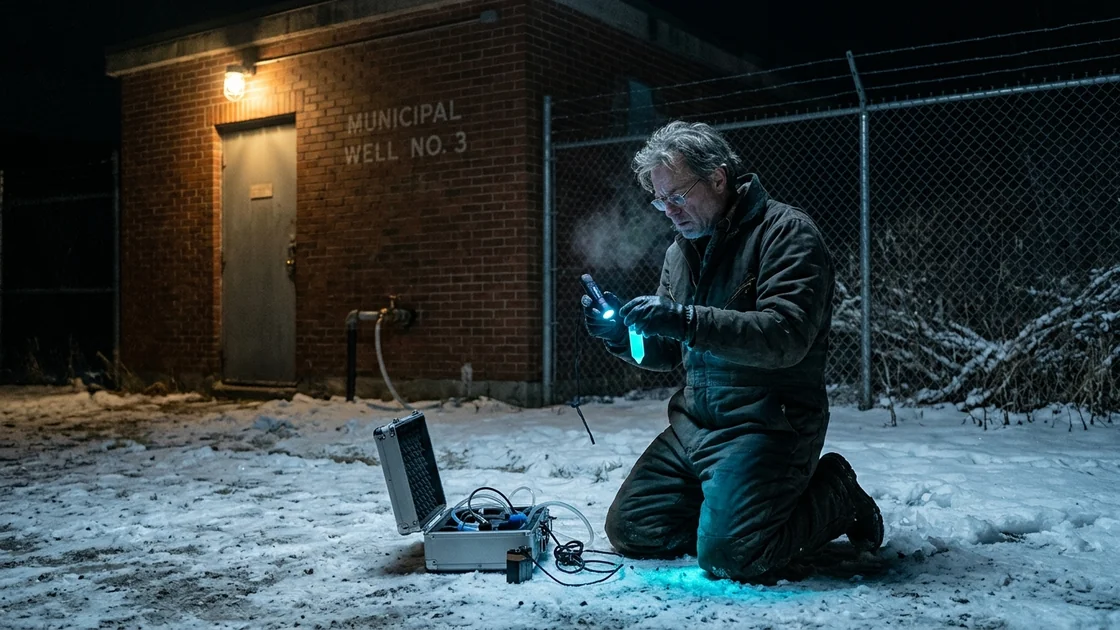
Arthur walked across the frozen turf of the park, his boots crunching in the brittle snow. The park was deserted. At the far edge, near the frozen bank of Cedar Creek, stood the brick pump-house for Municipal Well No. 3. It was a modest, utilitarian structure built in the 1950s, surrounded by an eight-foot chain-link fence topped with barbed wire. A solitary bulb burned over the steel entry door.
Arthur approached the security fence at the rear, where the willow scrub along the creek provided cover from the road. Using the spanner, he unbolted the lower corner of the wire mesh, peeled it back with a groan of stressed metal, and crawled through into the enclosure.
The air inside the pump-house perimeter smelled of ozone and wet iron. The heavy pump motor was running, its low-frequency vibration humming through the soles of his boots as it drew thousands of gallons of water per minute from the deep gravels three hundred feet below.
On the discharge manifold outside the brick wall, there was a brass sampling tap used by the municipal water technicians for their monthly chlorine residual checks.
Arthur set down his field kit. His hands, clad in thin nitrile gloves beneath his wool mittens, were already numb with cold. He stripped off the mittens with his teeth.
He connected the silicon tube to the brass petcock, opened the valve, and let the water flush into the snow for two full minutes. The water ran clear, steaming faintly in the sub-zero air. To the naked eye, to the tongue, to the nose, it was immaculate. It was the pride of Blackwood Falls—cold, crisp water filtered through millions of tons of glacial outwash.
Arthur filled the first polypropylene tube, capped it, and labeled it with a grease pencil: MW-03-RAW-001. He filled the remaining five tubes in rapid succession.
He did not have the GC-MS here in the snow, but he had brought an experimental solid-phase fluorescent dye kit—a quick-screening method developed by 3M for detecting perfluorinated carboxylic and sulfonic acids at high concentrations. The dye bound selectively to the fluorinated tails, shifting its emission wavelength from yellow to brilliant turquoise under an ultraviolet lamp.
He drew five milliliters from the first tube into a quartz cuvette, added three drops of the reagent, and clicked on the hand-held 365-nanometer blacklight.
The liquid did not glow yellow.
It flared with a violent, electric cyan.
The color was so bright it cast blue shadows against the white snow at his feet. The intensity of the luminescence told him everything his mathematical model had predicted five years ago.
The concentration was not eighty-four parts per billion. It was not even the trace contamination he had found in Well 12B.
The core of the SV-44 plume had reached the municipal wellhead. It was being pulled into the pump at full strength, concentrated by the hydraulic depression cone that the city had been deepening every summer to water its lawns and fill its municipal pools.
The people of Blackwood Falls were not just sipping trace molecules; they had been drinking, cooking with, bathing in, and absorbing SV-44 at concentrations unprecedented in the history of industrial toxicology. They had been doing it for at least three years.
Twelve-year-old Leo Bennett had been drinking it every day at the drinking fountain outside his fifth-grade classroom.
Arthur dropped the quartz cuvette. It shattered on the frozen concrete footer of the pump house, the electric-blue fluid splashing across his boots and freezing instantly into needles of toxic ice.
Arthur fell to his knees in the snow. He put his face into his gloved hands and began to heave, dry, violent sobs tearing at his chest. There were no tears; the cold was too intense, his throat too dry. He was a man who had calculated the trajectory of a bullet five years ago, watched it leave the barrel in slow motion, stood by as it traveled across the valley, and was now watching it strike a child directly between the shoulder blades.
"God," he whispered into the frozen gravel. "Oh God, what did I do?"
There was no answer from the dark valley, only the rhythmic, mindless thrum of the pump, continuing to pull the poison out of the earth and push it into the pipes of the sleeping town.
Chapter VI: The Archive in Building 4
Arthur did not go home. He drove back to the plant at two in the morning, badging through the automated gate. The night security guard, an elderly man named Pete who had worked there since Arthur was a boy, barely looked up from his crossword puzzle.
"Working late, Dr. Finch?"
"Special audit, Pete," Arthur said, his voice flat.
He parked behind Building 4. Building 4 was the oldest structure on the Sterling-Vance footprint—a red-brick relic from the nineteenth century that had once housed a boiler shop and now served as a repository for decommissioned physical files, historic batch sheets, and obsolete process blueprints. The company had digitized its operations in 2012, but the legacy files—the ones that had never been scanned because their existence was an inconvenience to subsequent corporate owners—remained in fireproof steel cabinets in the dry basement beneath the old stamping floor.
Arthur knew where they were. He had helped inventory them fifteen years ago when the plant had changed hands from the original Vance family trust to the first corporate consortium.
He carried a crowbar and an empty canvas duffel bag down the wooden staircase into the basement. The air was thick with the scent of silverfish, decaying paper, and damp mortar.
He bypassed the row of administrative personnel files and went straight to the green filing banks labeled Special Synthetics: Historical Safety Data (1974–1998).
The drawers were secured with a hardened steel Master Lock. Arthur did not have the key. He set the edge of the crowbar against the hasp and threw his weight onto the lever. The old rivets groaned, wood splintered from the frame, and with a sharp, metallic snap that sounded like a rifle shot in the enclosed basement, the hasp sheared off.
Arthur pulled the top drawer out. It rolled forward with a screech of rusted ball bearings.
He began flipping through the hanging folders. His fingers moved with frantic speed through yellowed manila tabs: Compound SV-12 Synthesis, Compound SV-31 Biodegradation Trials (Failed), Compound SV-44: Synthesis and Isolation.
Behind that folder sat a thick, red buckram binder labeled: SV-44: Internal Toxicological Review – Mammalian Feeding Studies – Project 88-B.
Arthur pulled it out and opened it on the top of the filing cabinet under the bare incandescent bulb.
The dates were from August 1989. The lead investigator was Dr. Harold Vance, Richard Vance’s late uncle.
Arthur read the executive summary, his eyes tracking down the faded mimeographed text:
...Administration of SV-44 via drinking water to male and female Sprague-Dawley rats at doses as low as 0.5 mg/kg/day resulted in 100% incidence of renal adenomas and clear-cell carcinomas within eighteen months. Compound exhibits extreme bioaccumulation, binding preferentially to alpha-2u-globulin and human serum albumin analogs. Estimated biological half-life in human tissue exceeds eight years.
Recommendation: Under no circumstances should Compound SV-44 be permitted to enter wastewater streams tributary to municipal or surface water bodies. Due to high environmental persistence and low renal clearance, exposure in humans presents an unacceptable risk of cumulative oncogenesis.
Paper-clipped to the back of the report was a handwritten memo on Sterling-Vance executive stationery, dated October 14, 1989. It was signed by Richard Vance’s father, the former CEO:
Hal: Archive this. Do not submit to EPA under TSCA Section 8(e). Destruction of primary synthesis data is not advised due to patent defenses, but dissemination outside this facility will terminate the product line. Seal in Building 4.
Arthur stared at the paper. They had known. They had known thirty-five years ago.
They had known when they dug the unlined lagoon in the clay. They had known when Richard Vance looked Arthur in the eye five years ago and told him that there was no human epidemiological data. There was no human data because they had buried the animal data that would have made human exposure a felony.
Arthur did not stop at the red binder. He pulled the entire folder: the groundwater monitoring logs from the seventies, the baseline soil core analyses from 1981 showing that the clay layer was fractured by root casts and sand seams, and the internal memos from the Kem-Tech merger detailing how the remediation costs had been stripped from the balance sheet to inflate the acquisition price.
He stuffed the folders into the canvas duffel bag until the zipper strained against the weight of the paper.
He walked out of Building 4, down the concrete apron, and back to his car. The sky in the east was beginning to turn a sickly, bruised violet. The first shift of workers was starting to arrive, their headlights sweeping across Arthur’s car as they pulled into the employee lot.
Arthur saw young men he recognized—men who played softball with his cousins, men whose children went to school with Leo Bennett. They were getting out of their trucks, carrying their lunch pails and insulated thermoses, thermoses filled from their kitchen taps that morning with clear, odorless, cold municipal water.
Arthur closed the trunk of his car, got into the driver’s seat, and drove out through the gate. He did not wave to Pete.
Chapter VI: The Whistle
The office of the Cleveland Plain Dealer was three hours north, through a sleet storm that turned Interstate 77 into a lane of gray slush.
Arthur did not make an appointment. He walked into the lobby on Superior Avenue at nine in the morning, his Carhartt coveralls still stained with mud and road salt, the heavy canvas duffel bag hanging from his right shoulder.
He approached the security desk. "I need to speak with whoever covers environmental investigations."
The security guard looked at his disheveled hair, his red-rimmed eyes, and his mud-crusted boots with obvious skepticism. "You have an appointment, sir?"
"Tell them I have thirty-five years of internal corporate testing and current municipal groundwater data for a Class 1 carcinogen currently serving fourteen thousand people in Blackwood County," Arthur said. His voice was entirely level now, emptied of panic, emptied of fear, carrying only the hard, flat weight of irrevocable catastrophe. "Tell them if they don't want it, I’m walking across the street to the United States Attorney’s office."
Twenty minutes later, Arthur was sitting in a windowless conference room on the fifth floor. Across the table sat Elena Cruz, an investigative reporter in her late thirties who had made her reputation covering industrial runoff in the Cuyahoga basin, and a junior attorney from the newspaper’s legal department.
Arthur did not introduce himself with his title or his credentials. He unzipped the duffel bag, took out the red binder from 1989, and placed it in front of Cruz.
"My name is Arthur Finch," he said. "I am the Director of Quality Assurance for Sterling-Vance Specialty Materials. I am a licensed analytical chemist."
He laid out the 1989 mammalian study. He laid out the 2019 chromatograms from Monitoring Well 12B that he had pulled from his safe that morning. He laid out the field data from four hours ago from Municipal Well No. 3.
Finally, he laid out his own personal laboratory notebook, pointing to the mathematical migration model he had drawn five years ago.
Elena Cruz turned the pages of the 1989 study, her eyes widening as she read the handwritten memo from Richard Vance’s father. She looked up at Arthur.
"How long has this been in the city water?" she asked.
"The plume hit the southern boundary three years ago," Arthur said. "It has been inside the municipal distribution mains at toxicological concentrations for at least twenty-four months."
Cruz looked at the dates on the chromatograms. She pointed her finger at the first run—Arthur’s run from Column Seven, dated October 12, 2019.
"You ran this test five years ago," she said.
The room was completely quiet. Arthur could hear the low hum of the fluorescent lights above them, identical to the hum in his basement lab in Blackwood Falls.
"Yes," Arthur said.
"You knew five years ago that the plume was migrating toward the municipal wellfield?"
"Yes."
The newspaper’s attorney leaned forward, his face hardening. "Mr. Finch, did you report these 2019 findings to the Ohio EPA? Did you file a whistleblower complaint under the Safe Drinking Water Act or the Clean Water Act?"
"No," Arthur said.
"Why not?" Cruz asked. Her voice was not angry; it was worse than angry. It was the cold, clinical inquiry of an anatomist dissecting an organ that had already begun to putrefy.
Arthur looked down at his hands. The skin around his nails was dry and cracked from winter solvents. There was still a trace of blue ink on his thumb from the printer paper five years ago.
"Because they promised me they would remediate it," Arthur said, the words tasting like ashes in his mouth. "Because Richard Vance told me it would ruin the town if the plant closed. Because I had a sister with multiple sclerosis who needed my health insurance. Because I was a coward."
Cruz stared at him for a long moment. She pulled a digital recorder from her bag, set it between them, and pressed the red button.
"State your full name, your title, and start from the beginning, Mr. Finch," Cruz said. "From the day you loaded the standard on Column Seven."
Arthur spoke for five hours. He did not soften his language. He did not obscure his own role behind the passive voice. He did not say "mistakes were made" or "the data was misinterpreted." He detailed every meeting, every withheld report, every falsified well abandonment permit, and every concentration spike he had predicted and monitored in silence while the children of his hometown drank from the taps.
When he was finished, he stood up, gave Cruz his phone number and his home address, and walked out of the building.
He did not drive back to the ridge. He drove straight to the Blackwood County Sheriff’s Department in the center of town.
Chapter VII: The Deluge
The story did not break as a whisper; it broke as an artillery shell.
The Cleveland Plain Dealer ran the investigation on a Sunday morning under a banner headline: "THE POISON WE DRANK: How Sterling-Vance and Its Chief Chemist Hid Thirty Years of Carcinogenic Contamination in Blackwood Falls."
By noon, the wire services had picked it up. By Monday morning, television news trucks with satellite dishes were parked bumper-to-bumper along Market Street, their microwave masts extending into the gray winter sky.
The federal government moved with a speed that was grotesque in its contrast to the five years Arthur had wasted.
At seven o'clock Monday morning, three black Suburbans with federal government plates pulled up the winding driveway to Arthur’s split-level on the ridge. Four agents from the EPA’s Criminal Investigation Division, accompanied by two federal marshals, stepped out into the snow.
Arthur was sitting at his kitchen table, dressed in a clean suit, his hands resting flat on the wood next to an overnight bag he had packed the evening before.
He did not make them knock twice. He opened the door, offered them coffee—which they refused—and turned his back so they could place the steel handcuffs around his wrists.
They led him down his front walk in front of a camera crew from an NBC affiliate that had been waiting at the base of his drive. Arthur did not lower his head. He did not pull his coat over his face. He looked straight into the lens, his expression vacant, dead, accepting the public exposure as the first fractional installment of a debt that could never be settled.
He was driven to the federal courthouse in Youngstown, where he was arraigned on multiple felony counts: conspiracy to violate the Safe Drinking Water Act, making false statements to a federal agency under Title 18, and intentional concealment of toxic releases under CERCLA.
The magistrate judge looked down at Arthur with an expression of thinly veiled disgust. The Assistant United States Attorney did not mince words:
"The defendant was not merely an employee following orders, Your Honor. He was the chief technical authority at the facility. He held the data in his hands in 2019. He modeled the destruction of the town’s aquifer on his personal computer and chose to conceal those facts in exchange for corporate advancement and stock options while hundreds of citizens, including dozens of minor children, were subjected to chronic toxic exposure."
Bail was set at two million dollars, corporate surety. Arthur did not post it. He had no desire to return to the ridge. He was remanded to the county jail in Mahoning County to await trial.
While Arthur sat in a eight-by-ten cell, the reality of what he had permitted descended upon Blackwood Falls like a biblical plague.
The Ohio EPA issued an immediate, emergency "Do Not Drink" order for the entire municipal water system. The National Guard was deployed to the high school parking lot, setting up massive water distribution points where thousands of residents stood in lines that stretched for two miles through the freezing rain, waiting to receive their daily rations of plastic water jugs.
The state brought in mobile treatment units, but the tests were horrifying: SV-44 had penetrated not only the water mains, but the municipal wastewater system, the school plumbing, the local dairy processing plant, and the sediment of Cedar Creek for seven miles downstream.
Property values in Blackwood Falls dropped to zero overnight. Banks suspended mortgage originations within the county zip codes. The Sterling-Vance facility was seized by federal marshals under an emergency injunction; its gates were padlocked, its workers locked out without severance or health benefits as the Kem-Tech parent company immediately filed for Chapter 11 bankruptcy protection to insulate its core assets from the tidal wave of toxic tort litigation.
The town Arthur had claimed he wanted to save was destroyed more completely than if a tornado had leveled every home and storefront along the valley floor.
Chapter VIII: The Gymnasium
Arthur spent four months in the Mahoning County facility before his legal defense team—appointed by the court after his assets were frozen by civil injunctions—negotiated an appearance before a special joint session of the Blackwood Falls Town Council and the Federal Agency for Toxic Substances and Disease Registry.
The meeting was held in late April in the Blackwood High School gymnasium—the very gymnasium where Arthur had received his high school diploma thirty years before.
Arthur was brought in through the back athletic entrance, his ankles shackled, wearing an orange correctional jumpsuit. Two armed federal marshals flanked him.
The gymnasium was packed to the steel rafters. More than two thousand people filled the bleachers and stood on the polished hardwood court where the basketball hoops had been pulled up toward the ceiling. The air was suffocatingly hot, thick with the smell of sweat, wet raincoats, and an overwhelming, vibrating fury that hummed in the room like an electrical transformer.
When Arthur was led to the microphone at the center table, the crowd did not boo.
They made a sound that was far worse: a low, collective intake of breath, followed by a silence so heavy it felt as though the atmospheric pressure in the room had doubled.
Arthur sat down. He did not look at the council members or the federal officials seated to his left. He looked at the bleachers.
He saw the men he had worked with. He saw his high school English teacher, now an old woman in a wheelchair with a nasal cannula feeding oxygen into her lungs.
In the third row of the bleachers, directly across from him, sat Clara Bennett.
Beside her was Leo.
The boy was shockingly thin. His skin was the color of skim milk, his skull bald and mapped with blue veins from chemotherapy. He was wearing a baseball cap that was three sizes too large for his head, sitting between his mother’s knees with a blanket pulled over his lap. Clara was not shouting. She did not have a sign. She simply held her son’s thin, blue-veined hand against her breast and stared at Arthur with eyes that were completely empty of life.
The mayor of Blackwood Falls, a former lathe operator named Kowalski whose own granddaughter was currently undergoing dialysis at Cleveland Clinic, opened the floor.
"Arthur Finch," Kowalski said, his voice trembling through the gym’s PA system. "You asked for this opportunity to make a statement to your community prior to your formal plea entry in federal court. The council has granted this request against our better judgment, because the people of this valley deserve to look at your face while you explain what you did."
Arthur reached for the microphone. His hands were shaking so violently that the steel base rattled against the folding table. The sound boomed through the speakers like thunder.
He leaned forward. The shackle chain between his wrists clinked against the microphone stem.
"I have no defense," Arthur said. His voice was cracked, raw from months of silence in his cell.
A woman in the bleachers began to cry, a high, thin wail that cut through the room.
"Five years ago," Arthur said, "on October 12, 2019, I ran the sample from Monitoring Well 12B. I knew what SV-44 was. I knew its molecular weight. I knew its partition coefficient. I knew that it did not break down in sunlight, that it did not bind to soil organic matter, that it would travel through the gravel bed directly into Well Number 3."
He stopped. He had to breathe through his mouth; his chest felt as if it were bound in steel bands.
"Richard Vance asked me to wait," Arthur continued, looking directly at the floorboards between his feet. "He told me that the company would remediate. He told me that if I reported it, the plant would close, the jobs would leave, and the town would die. And I... I told myself that I was keeping silent to protect the town."
A man’s voice roared from the bleachers: "You protected your paycheck, you bastard!"
The crowd surged forward against the folding chairs separating the bleachers from the court. The federal marshals immediately placed their hands on their sidearms, stepping in front of Arthur.
"Let him speak!" Kowalski slammed his gavel down on the council desk. "Let him finish!"
The crowd settled, but the air remained taut, trembling with the desire to tear Arthur limb from limb.
Arthur looked up. He did not look away from the man who had shouted.
"You’re right," Arthur said. "I protected my paycheck. I protected my house on the ridge. I bought bottled water for my sister while I let your children drink the water from the creek. I calculated the days it would take for the poison to reach your taps. I knew the month it would arrive. I watched the obituaries. I did nothing."
He turned his head slowly, his eyes finding Clara Bennett.
"Clara," he whispered into the microphone.
Clara did not move. Leo looked up at his mother, then looked at Arthur with the wide, uncomprehending eyes of a child who could not understand how the man in the orange suit was connected to the sickness that had cut his body open and taken his strength.
"I cannot ask for your forgiveness," Arthur said to her. "Forgiveness would be an obscenity. There is no sentence a federal judge can give me that will restore Leo’s kidney. There is no fine that Sterling-Vance can pay that will clear the blood of this town. I am a chemist. I know the thermodynamics of this molecule. It will be in your bodies until you die. It will be in the soil under this floor for ten thousand years."
He stood up. The marshals grabbed his arms, but Arthur did not pull away; he simply stood as straight as the iron shackles would allow.
"I am pleading guilty to all counts," Arthur said, his voice carrying through the rafters without the microphone now, shouting into the vast, silent cavern of the gym. "I am testifying against Vance. I am testifying against Geller. I am turning over every document, every logbook, every email. But do not let them tell you that this was a failure of the regulations. Do not let them tell you that this was an unforeseen technical accident."
He pointed his shackled hands at his own chest.
"The failure was here," Arthur shouted, tears finally breaking from his eyes, hot and scalding against his hollow cheeks. "I was the one who could see the poison, and I chose to let you drink it. May God have more mercy on my soul than I had on this valley."
The gym erupted. Men broke through the folding chairs. Women screamed curses that echoed off the championship banners hanging from the ceiling. The marshals did not wait; they hauled Arthur off his feet and dragged him backward through the athletic door, slamming the heavy steel panic bar behind them as fists and water bottles slammed against the exterior metal.
Chapter IX: The Long Half-Life
Arthur was sentenced in November of that year at the federal courthouse in Cleveland.
The judge, a man known for his procedural restraint, departed upward from the federal sentencing guidelines, citing the "unprecedented scale of depraved indifference to human life."
Arthur was sentenced to twenty-seven years at the Federal Correctional Institution in Terre Haute, Indiana—a sentence that, at fifty years old, was effectively a life term. Richard Vance, who fought the charges through three tiers of white-collar defense firms, was convicted of wire fraud, environmental crimes, and involuntary manslaughter; he received thirty-two years.
The town of Blackwood Falls did not recover.
The federal government declared the entire valley a Superfund site. The municipal wells were capped with three-foot-thick plugs of reinforced concrete, never to be opened again. A massive overland pipeline was constructed from thirty miles away to pump finished water from Lake Erie into the town, but by the time the pipeline was completed, four thousand people had already abandoned their homes, walking away from mortgages on houses that could not be sold for the cost of their lumber.
The plant was demolished. Building C, Building 4, and the administration suites were torn down by workers in Level B hazardous-material suits, the rubble loaded into plastic-lined rail cars and shipped to a specialized repository in the Utah desert.
Where the plant had stood for eighty years, there remained only a vast, flat field of crushed limestone surrounded by two layers of chain-link fence, monitored by automated solar-powered sampling wells that reported their data directly to a satellite network.
In his cell in Terre Haute, Arthur worked in the prison library.
He was not permitted to work in the maintenance shop or the laundry; his status as an environmental felon whose actions had harmed children made him a target for the general population, and he spent twenty-two hours a day in protective custody.
Every month, he received a single letter from his sister Marion.
She had been moved to an assisted-living facility in Columbus, paid for by the state after Arthur’s assets were liquidated for the victims’ restitution fund. Her letters were short, written with an adaptive pen she held between both hands:
Dear Artie:
The spring here is cold. They have a garden with yellow pansies. Clara Bennett’s son Leo died on Tuesday morning at the hospice in Akron. He was thirteen. Clara did not have a service in Blackwood; she buried him in her parents' plot in Pennsylvania. Nobody from town went because nobody has gas money anymore.
I don't hate you, Artie, but I can't come see you. Every time I take a drink of water from the plastic cup by my bed, I look at the bottom of it and I wonder what you saw in those machines.
Your sister, Marion.
Arthur kept the letters in a cardboard box under his steel bunk.
He did not write back. He had no words that could fit onto a page that would not feel like an insult to the paper they were written on.
Instead, every evening after the final count, Arthur would sit on the edge of his bunk with a stub of pencil and a pad of lined legal paper.
He did not pray. He did not read the Bible that the prison chaplain had left on his shelf.
He drew chemical structures.
He drew the eight-carbon chain of SV-44. He drew the sixteen fluorine atoms, each one paired to a carbon, the bonds short, unyielding, perfect in their geometric symmetry.
In the margins of the paper, he calculated the decay rates.
The carbon-fluorine bond dissociation energy is approximately 485 kilojoules per mole. It is the strongest single bond in organic chemistry.
To break that bond requires a temperature of more than one thousand degrees Celsius, or a geological epoch of cosmic radiation.
In human blood, the half-life was five point four years.
In the gravel beneath Blackwood Falls, the half-life was infinite.
Arthur looked through the narrow, high window of his cell. The sky above Terre Haute was black, devoid of stars, clouded over by the exhaust of the Midwestern plains.
He knew that long after he was dead, long after his bones had turned to dust in the prison cemetery behind the north wall, long after the town of Blackwood Falls had been forgotten and reclaimed by the sumac and the scrub oaks, the molecules he had watched emerge from Column Seven on that October morning would still be there.
They would still be drifting through the cold limestone beneath the valley floor, completely intact, completely unchanged, blind and immortal, waiting in the dark water for the end of the world.