The Phantom Pack of Victoria Strait
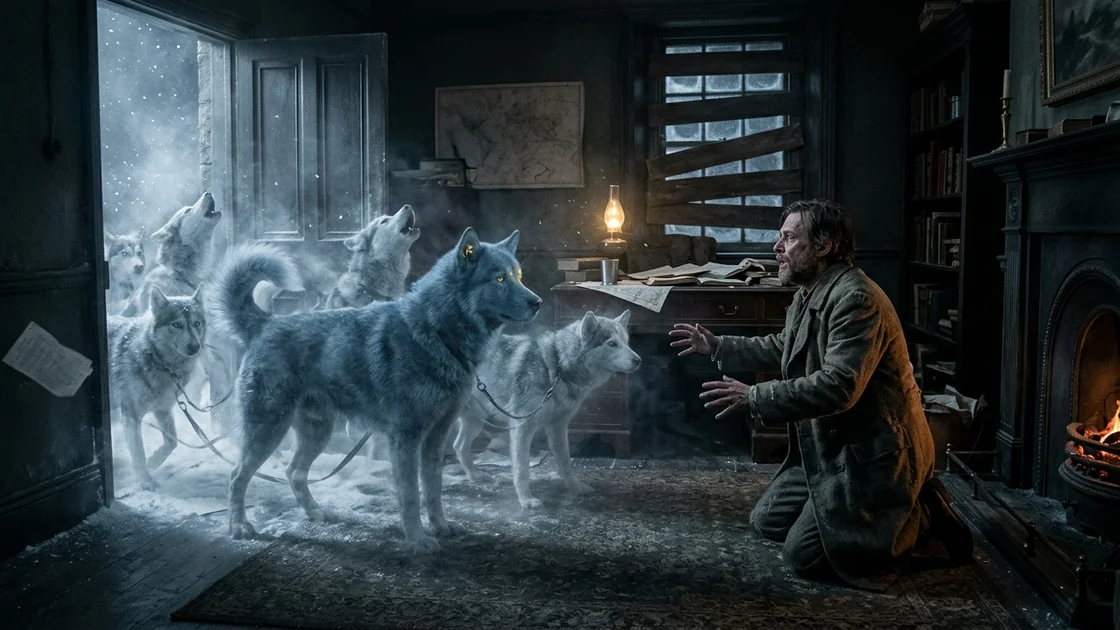
Julian Finch returned from the Queen Maud Gulf as the sole survivor of the ill-fated Boreas expedition, celebrated by the Royal Geographical Society for having walked six hundred miles across the pack ice to safety. Yet the public triumph concealed an atrocity born of hunger, wherein Finch severed the tether of his eight sled dogs upon a disintegrating ice floe to preserve his remaining pemmican, abandoning the faithful beasts to drown or starve in the Arctic swell. Settled in an isolated manor on the Northumbrian coast, Finch finds himself utterly unable to rest, pursued across oceans and years by the ceaseless chorus of their howling, an acoustic curse carried upon every draft that strips away his sanity until the boundary between the English winter and the frozen grave dissolves entirely.
I. The Anatomy of Sleeplessness
In the winter of 1894, sleep was no longer a state of restoration for Julian Finch; it was a contested territory, a shallow basin of black water into which he was dragged by exhaustion only to be hauled back by his ears.
He lived at High Crag, a square-jawed stone house planted on a cliff edge three miles north of Craster, where the North Sea battered the dark basalt columns of the Whin Sill. It was a residence chosen precisely for its hostility. Finch had convinced himself that the scouring salt air and the monotonous, heavy percussion of the breakers would act as a buffer against memory. He had caulked the high sash windows himself with boiled linseed and hemp; he had hung thick woolen drugget across every doorframe; he had stuffed the chimney throats with horsehair bungs, save for the single flue in his study where a coal grate burned night and day with a sullen, orange heat.
None of it availed him.
The wind on that coast was an insidious thing. It was not a singular current, but an orchestra of drafts that discovered every microscopic fault in the masonry. It sang through the keyholes with a high, reed-like vibration; it vibrated the iron tie-rods within the walls until the mortar shed a fine, white dandruff onto the floorboards; it sucked at the coal gas in the grate, causing the flames to leap and hiss like disturbed vipers.
Yet within those mechanical noises—within the groaning of the joists and the thrash of the stunted gorse upon the headland—Finch heard the voices.
They were not human voices. A human scream possesses an inflection of outrage, a sudden spike of will that breaks against its own weakness. What rose through the floorboards at High Crag was something far more ancient, rhythmic, and collective: the rising cadence of eight throats pitched to the key of open ice.
It began always with the tenor. That was Micah, the little cross-breed with the wall-eye and the torn left ear, whose voice had always been the first to answer the evening cook-pot. Then, a fifth lower, dropped the heavy, vibrating baritone of Old Tom and his brother Prince, deep-chested mastiff-huskies who pulled at the wheel until their hocks wept blood. And beneath them all, like the scrape of granite upon shale, rolled the long, dry, mourning note of Anvik.
Anvik had been the king dog. A beast sixty pounds in weight, blue-gray as river slate, with a skull three fingers wider than any domestic retriever and eyes the yellow of spoiled honey.
Finch sat in his leather armchair with a tartan blanket pulled up to his armpits, an unread folio of hydrographic charts resting on his knees, his right hand gripped around a pewter tumbler of Scotch whisky that had long since gone flat and lukewarm. His knuckles were permanently enlarged at the joints—the legacy of frostbite sustained during the third winter—and the flesh over his cheekbones had that shiny, stretched look peculiar to men who have lived for months on the edge of scorbutic collapse.
"It is an acoustic phenomenon," he said aloud to the empty room. His voice was cracked, the vocal cords scarred by the inhalation of air at fifty degrees below zero. "The configuration of the chimney breast creates a Helmholtz resonator. The aperture of the flues corresponds to the frequency of the gale. That is all. It is simple mechanics."
The coal in the grate shifted with a small, brittle clatter.
Outside, rising from the direction of the sea, the wind found a newly opened seam in the lead flashing along the parapet. The note sharpened. It caught the lower draft, split upon the stone mullion, and ascended through two octaves until it became a clean, unbroken, desolate wail.
It was not the chimney.
Finch closed his eyes, and instantly the darkness behind his lids was not the amber gloom of High Crag, but the flat, blinding, non-Euclidean white of the Victoria Strait in the middle of May.
II. The Ice-Lock
Three years earlier, in August of 1891, the barque Boreas had slipped her moorings at Dundee, provisions calculated for thirty-six months, her hull re-sheathed with greenheart to resist the nip of the floes. She was to complete the mapping of the southern coast of King William Island and penetrate the unknown leads west of the Boothia Peninsula.
Finch had gone out as the expedition’s surveyor and second officer. He was thirty-two then, an ambitious man trained under Markham, convinced that the geography of the earth was a puzzle designed specifically to be solved by disciplined Englishmen with sextants and pocket chronometers. He believed in order; he believed in the neat ledger-lines of the traverse book; he believed, above all, in the supremacy of calories over distance.
The Arctic does not debate calories; it swallows them.
By the second autumn, the Boreas was no longer a ship; she was an island of oak embedded in an infinite desert of rafted pressure-ice. The current from the north had jammed the straits with paleocrystic floes—ancient, dirty blocks twenty feet thick that squealed against the hull day and night with the sound of grinding bones. By November, the timbers in the bread-room had buckled; by February, the ice had climbed over the port bulwarks and frozen solid in the waist, cementing the ship into the very medium that was crushing her.
Captain Sterling had died first, not of scurvy, but of an apoplexy brought on by the sight of the mainmast splintering like a pine needle under the lateral thrust of the ice-sheet. The command devolved upon Finch.
There were fourteen men and eight dogs.
The men were deteriorating. Scurvy had begun its quiet, purple work beneath their skin. It started as small, dark petechiae on the calves, like flea-bites that refused to fade, then spread into broad, wood-hard hematomas that locked the knee joints at right angles. The gums softened, turned the color of pickled cabbage, and rose up around the teeth until chewing hard biscuit became an exercise in agony.
The dogs, by contrast, thrived as long as the pemmican held. They were Greenland dogs, bought at Godhavn for three sovereigns apiece, with thick under-jackets of greasy wool that no gale could penetrate. They slept outside on the snow, curled with their tails over their black muzzles, their breath rising in steady, white plumes like the vents of tiny subterranean furnaces. They did not care about the Union Jack, nor the Northwest Passage, nor the Northwest Company’s missing fur-posts. They cared only for the sled-harness, the flick of the sealskin whip, and the rancid fat that Finch cut for them with a hand-saw from the salt-beef barrels.
Between Finch and Anvik, there had existed that peculiar, dry understanding that sometimes grows between an officer and his most reliable subordinate. Anvik did not fawn. If Finch reached out a mittened hand, the dog would neither shrink nor lean into the touch; he would simply turn his heavy head, regard the man with those flat, unreadable yellow eyes, and wait for the harness to be thrown over his neck.
On the third day of the retreat—after the Boreas had finally rolled onto her beam-ends, her deck-beams popping with the report of heavy artillery, and gone down head-foremost into four hundred fathoms of black water—it was Anvik who had kept the team from bolting over a pressure ridge when an ice-crack suddenly opened beneath the runners of the main sledge.
The sledge had carried their survival: six hundred pounds of pemmican, their two chronometers, the dry matches, and their only canvas tent. It had slipped sideways, dangling over a lead of slush-filled water that smelled of ancient kelp and rot. The men had scattered, their scurvy-rotted tendons failing them on the slick ice, crying out in panic.
Finch had stood on the brink, his boot-heels digging into the drift, hauling on the trace until his palms blistered through his woolen mitts.
"Anvik!" he had roared, his voice tearing against the drift. "Huit! Anvik! Huit!"
The gray brute had turned his body into a single, straining bow of muscle. He had not looked back at the chasm behind him; he had dropped his belly to the crusted snow, his claws tearing into the hard-packed sastrugi until small chips of blue ice sprayed from his pads. The other seven dogs, feeling the leader set his weight, had leaned into the fan-hitch with him. They did not pull as dogs; they pulled as an engine, their ribs expanding and contracting in violent, synchronized snorts.
Inch by inch, the sledge had come up. The wood had screamed against the lip of the ice; the iron runners had bitten into the verge; then, with a heavy, sodden thud, the entire mass had crested the ridge and righted itself on the level floe.
Finch had fallen to his knees in the snow, his heart hammering against his ribs like an iron bell. Anvik had stood twenty paces ahead, his tail curled tightly over his spine, his flanks heaving, licking a smear of pink brine from his black gums.
Finch had crawled to him, stripped his right mitten, and buried his bare, sweating fingers in the dense, oily ruff behind the dog’s ears.
"Good lad," Finch had whispered, his breath crystallizing instantly in the beast's fur. "Good lad. We make the beach together, or none of us do."
The dog had not blinked. He had merely looked southward, toward the blank, blinding glare where the horizon should have been, his nostrils testing the drift for the smell of open water.
III. The Arithmetic of the Lead
By April, the party was no longer fourteen. It was four.
Ten men lay under cairns of limestone rubble along the west shore of King William Island—cairns so shallow that the Arctic foxes had already found them before the sledges were two miles out of sight. The four who remained were Finch, a carpenter’s mate named Cloutier whose feet were black to the mid-calf with dry gangrene, an ordinary seaman named Evans whose mouth was a cavern of bleeding ulcers, and a boy named Peter who had ceased to speak three weeks prior, after his brother had died of scurvy pneumonia in the sleeping bag beside him.
They were hauling two sledges now, or rather, the dogs were hauling one sledge upon which Cloutier lay lashed beneath two frozen buffalo robes, while Finch, Evans, and Peter dragged a small light pram behind them.
The rations were simple. They were recorded in Finch’s pocket notebook in the back of his transit book, written with a pencil lead so cold it tore the yellowed paper:
April 14: Pemmican remaining, 41 lbs. Biscuits, 18 lbs. Tea-dust, 2 lbs. Lime juice all spoiled by frost. Men weak. Dogs showing rib, but working. Estimated distance to Fort Reliance: 310 miles.
Three hundred and ten miles. At their current rate of march—six miles on a good day, two miles when the sastrugi ran transverse to their course—they had food for twelve days. If they halved the ration again, they had twenty-four.
It was a problem in simple division, and Finch was a man who understood arithmetic.
On the seventeenth of April, Peter sat down on an overturned hummock of rafted ice to adjust the deer-sinew lashing on his snowshoe. When Finch went back for him twenty minutes later, the boy was still sitting there. He was upright, his head tilted back slightly as if studying the pale, haloed disc of the mock-sun that hung over the southern sky. Finch took his arm; the sleeve was stiff as oak timber. Peter’s eyes were open, frozen into two pearls of cloudy ice. Finch did not spend twenty minutes digging a cairn through the crust. He took the boy’s mitten-strings, his remaining half-biscuit, and his compass, and he walked back to the sledge.
Evans died three nights later inside the tent. He died noisily, drowning in his own pulmonary fluids while Cloutier wept into his buffalo skins and the dogs outside turned three times in the drift and settled their tails over their noses.
Now there were two.
And then, on the twenty-second, Cloutier spoke from the sledge. His voice was no longer that of a man; it was the whistling sound of a broken bellows.
"Mr. Finch."
Finch stopped. He had been pulling in the traces beside Anvik, his forehead leaning into the broad canvas breast-strap, his eyes fixed on the black heels of the dog before him.
"What is it, Cloutier?"
"The dogs."
Finch turned slowly. The glare was atrocious; even through his slitted wood-and-mica goggles, the light was an iron needle thrust through the center of his brain. "What about them?"
"They’re eating... sixteen ounces a day between the pack. Four ounces of dried beef. Half an ounce of lard."
"They pull you," Finch said. "Without them, you stay here."
"I stay here anyway," Cloutier said.
He did not say it with self-pity. It was merely another statement of fact, like the temperature or the bearing of the magnetic pole. Finch walked back to the sledge. He pulled back the stiffened edge of the buffalo skin. Cloutier’s face was the color of mutton tallow, his nose black and shriveled at the tip where the circulation had ceased a fortnight before. The smell that rose from the sledge was not the clean, metallic stink of the pack ice; it was the sweet, sickening odor of mortified flesh.
"I can’t walk, sir," Cloutier whispered. "And you can’t drag four hundred pounds of sledge and timber through the pressure ridges off Point Victory. Not alone. You know the ice ahead. It’s all rubble. The current’s smashing it against the shoals."
"We have thirty pounds of pemmican," Finch said. His voice was level, almost academic.
"Thirty pounds," Cloutier repeated. "For eight dogs and two men. If you kill the dogs, sir... you might make the river. You could live on the meat. They’re lean, but there’s blood in them."
Finch looked at the team.
They were lying down now, taking advantage of the halt. Anvik lay at the head, his great chin resting on his outstretched paws, watching Finch through slitted eyes. Micah was licking a patch of snow between his forelegs; the dog’s ribs showed through his coat like the wicker framework of a basket. They were exhausted, their coats matted with frozen urine and rime, but they were not dying. They were Arctic beasts; they had been bred for this white vacuum for three thousand years. If there was flesh to be had, they would run until their pads split to the bone.
"I cannot kill them," Finch said.
"Why not?"
"The cartridges are wet. We have four left for the Snider. If I miss, or if the powder hangs fire..." He paused. "And I cannot butcher them with the knife. Not Anvik."
Cloutier turned his head away, looking out toward the west, where the ice-blink shone like a rim of brass against the gray sky.
"Then leave me the carbine," Cloutier said.
Finch did not answer. He took the leather water-bottle from inside his flannel shirt, where it had been thawed by the heat of his armpit, and held it to the carpenter’s black lips. Cloutier swallowed twice, then closed his eyes.
"Leave me the carbine, Mr. Finch. And take the pemmican."
IV. The Severance
Julian Finch did not leave the carbine. To leave a firearm was against the Admiralty regulations for the preservation of government stores; he told himself that. He also told himself that Cloutier might miss, and that a man who has botched his own end is a worse companion to leave behind than a man who has simply slipped away into the white cold.
He left Cloutier with six biscuits, half a tin of spirits of wine in an open saucer, and his own mother’s Bible tucked between his knees under the robes. He did not look back after he hooked his shoulders into the hauling harness.
Now it was Finch and the eight dogs.
He was no longer riding on the sledge; he could not afford the weight. He walked ahead of the team, breaking the trail with his snowshoes, his lungs burning as if he were inhaling crushed glass. Every thirty yards, he had to stop and lean upon his poles, his head drooping between his shoulders, saliva hanging from his beard in long, icicle pendants.
Whenever he stopped, the team stopped. Anvik would watch him. There was no reproach in the animal’s yellow gaze, only that dreadful, canine patience that is colder than cruelty. The dog knew that the man was the provider of fat; he knew that the man held the iron knife that opened the red tins; he knew that when the man stopped permanently, the order of the sledge would change.
On the twenty-seventh of April, they struck the great lead.
It was an open lane of water, three hundred yards wide, that stretched east and west as far as Finch’s snow-blind eyes could follow. It had opened during the night under the influence of an offshore gale—a great, black, smoking wound in the sea. The water was not still; it was greasy and thick with frazil ice, rolling in heavy, slow swells that lifted the edge of the floe with a hollow, booming sound: hump-ah, hump-ah, hump-ah.
To cross was impossible. To go around meant three days’ march to the east, along the jagged pressure ridges where the ice had stacked itself forty feet high in chaotic pyramids of green glass.
Finch had two days of food left.
He sat on the sledge, his boots hanging over the runner, his hands shoved deep into his beaver-tail mitts. He did not feel cold anymore. That was the most dangerous symptom; he knew the medical treatises by heart. When the skin ceased to register the frost, it meant the peripheral nerves were dying, that the blood was retreating to the core like a beaten regiment falling back on its citadel.
He looked into the red tin. There was a lump of pemmican remaining no larger than his two fists. It was gray-brown, speckled with yellow suet and hair.
Sixteen ounces.
If he gave it to the dogs, they would have two ounces each. It would keep them moving for six hours, perhaps eight. Then they would look to him. They would gather in a semi-circle around the sledge, their ears pricked, their tongues lolling, their yellow eyes fixed upon his throat. He had seen what dogs did to a dead man when the harness was broken; he had seen the remains of Lieutenant Gore’s sledge-driver on the ice off Cape Felix.
If he kept the pemmican for himself, he had five days. In five days, the drift might close the lead. In five days, he might reach the land-ice south of Simpson Strait, where the ptarmigan nested in the dwarf willows.
The arithmetic was finished. The sum had been reached.
He stood up. His joints gave off a dry, crackling sound like breaking kindling.
"Anvik," he called softly.
The dog rose immediately, his ears turning forward. The other seven dogs remained curled in the drift, their coats frosted with white rime, saving their strength.
Finch walked out onto the narrow tongue of the floe where the team was anchored. The ice here was a detached pan—a raft perhaps sixty yards across, separated from the main body of the pack by a deep, tide-cut crack that was already weeping gray brine. It was connected to the shore-fast ice by only a slender bridge of rafted slush, not four feet wide.
The dogs were tethered to an ice-anchor—a heavy ash stake driven into a hole bored with an auger. The main trace, an inch-thick hemp line tarred against the moisture, ran from the stake to the swivels of the fan-hitch.
Finch did not look at Anvik’s eyes. He kept his gaze fixed on the dog’s gray shoulder, where the fur was worn short by the friction of the harness strap.
"Sit," Finch whispered.
Anvik did not sit. He took two steps toward Finch, his nose extending, sniffing at the pockets of the officer’s sealskin parka. He smelled the lard. He smelled the salt. He smelled the dying animal within the clothes.
Finch drew his clasp-knife from his belt. It was a Sheffield blade, four inches long, with a horn handle. His fingers were so thick and clumsy that he had to use his teeth to haul the blade open, the cold steel tearing a small patch of skin from his lower lip.
He knelt by the anchor stake.
The wood of the stake was frosted white. The hemp line was frozen stiff as an iron rod, coated in a crystalline glaze where the spray from the lead had reached it.
He did not cut the traces at the harness. If he did that, they would follow him. They would leap the gap; they would run behind his sledge; they would pace him like a pack of wolves, their bellies hollow, until he lay down to sleep.
He placed the blade against the hemp at the very base of the stake, where the rope entered the drift.
He began to saw.
The frozen fibers did not part easily. They shrieked under the steel with a high, dry, rhythmic sound: skritch, skritch, skritch.
Anvik moved. The dog took one pace forward, his forepaws landing on the hemp trace just ahead of Finch’s hand. He lowered his great head until his whiskers brushed Finch’s cheek. The dog’s breath was warm; it smelled faintly of old bone and the tallow Finch had greased the sledge-runners with three days before. It was the only warm thing within three hundred miles.
Finch did not pause. He sawed with the desperation of a man cutting a gangrenous foot from his own leg.
Skritch. Skritch.
Three strands parted. The white hemp untwisted, the core fibers dry and pale as flax.
Anvik let out a low, questioning whine—the small, domestic sound he made when the sled-sheet was lifted in the morning and he waited for his dried fish.
Skritch.
The last strand snapped with a dry ping, like an over-tightened violin string.
Finch did not wait. He scrambled backward on his hands and knees, his boots slipping on the brine-slick crust. He reached the narrow neck of slush that connected the pan to the main ice. He crossed it, his weight driving his moccasins three inches into the gray, semi-liquid mush, and gained the solid shelf of the land-fast pack.
He turned.
Then, with his long ash ice-pole—the pole he had used for thirty days to probe for hidden crevasses—he drove the steel-shod tip into the seam. He threw his weight against it.
The bridge of slush did not break; it sheared.
A thin, dark ribbon of black water appeared between the shelf and the floe. It was no wider than a finger at first. But the tide was running south-southeast through the strait, a five-knot current driven by the Arctic basin’s slow, hemispheric wheel.
The crack became a foot.
Anvik had not moved. He stood by the severed stake, his head low, the loose trace trailing behind him in the snow like a dead snake. He looked at the expanding gap of water with that mild, distant curiosity the dogs always showed toward the leads. He had crossed hundreds of them; he assumed the man would find the crossing place.
"Go," Finch croaked, his voice cracking behind his teeth. "Get out. Go south."
The other dogs were waking now. Micah stood first, shaking his coat until the frost flew from him in a silver cloud. Old Tom and Prince lifted their heads, their nostrils working as they caught the sharp, cold stink of the open brine widening between them and the sledge.
The gap was six feet now. Ten feet.
The floe, caught by the main thrust of the channel current, began to rotate. It moved with a sickening, majestic deliberation, turning like a great millstone, drifting away from the land-fast shelf toward the middle of the strait, where the dark, steaming water was flecked with whitecaps.
Then Anvik understood.
He walked to the edge of the floe. He stopped where the blue ice crumbled into the grease-water. He looked across the twenty feet of black brine that now separated him from Finch.
He did not bark. He did not leap. The water was death; even a Greenland dog knew that sixty seconds in that black broth would freeze the muscle until the limbs were like cast iron.
He lifted his black nose to the leaden sky.
His chest swelled—that immense, barrel-ribbed chest that had pulled three thousand miles of British timber through the white wastes. His lips pulled back from his yellow canines, exposing the gray gums, the black tongue, the white frost of his whiskers.
The cry that came from him was not a dog’s howl. It was the ancient, dry voice of the wilderness itself, stripped of all service, all loyalty, all the small, pathetic pretenses of the whip and the harness. It was a long, descending minor third that held itself against the wind, flat, clean, and terrifyingly cold.
Then Micah joined him.
Then Old Tom. Then Prince. Then the four bitches behind them.
They sat on their haunches on the drifting circle of ice, their heads tilted back at the identical angle, their throats pumping in unison. The sound was not chaotic; it was an eight-part round, each voice entering as the other peaked, weaving a dense, impenetrable fabric of sound that rolled over the black water and struck the ice-cliffs of the shore like iron shot.
Finch turned his back.
He hooked his shoulders into the sledge-harness. He took his poles.
He walked.
He took ten steps, and the sound was in his neck. He took twenty, and it was in his marrow. The sound did not diminish as he increased his distance; the acoustic miracle of the Arctic atmosphere—that cold, dense air that can carry the sound of an axe-blow for four miles—seemed to amplify the chorus, funneling it down the narrow canyon between the sea-wall and the pack.
Owooooooo-ah. Owooooooo-ah.
It was the howl of the abandoned, but it had no grief in it. That was what Finch could not bear. Grief can be answered; grief is a transaction between those who remain and those who are gone. This was merely an announcement. It was the statement of an absolute debt that could never be settled, sung by creatures who had no concept of tomorrow, but who knew with every fiber of their ancient wolf-blood that they had been put outside the circle of the fire.
He walked until his lungs bled into his mouth. He walked until the mock-suns set and the gray twilight became the black of an Arctic midnight.
When he finally collapsed into a drift under the lee of a grounded berg, six miles to the south, he pressed his palms over his ears until the knuckles cracked.
The wind was blowing from the north.
Through his mittens, through his beaver-cap, through his skin, through the four inches of his skull, the singing reached him: thin, sharp, and immortal, carried upon the salt breath of the strait, rising and falling with the rhythm of the tide that was carrying them out into the crushing mill of the Victoria pack.
V. The Return of the Hero
The relief steamer Diana picked Julian Finch off the rocks of Point Ogle on the fourteenth of August, 1892.
He was alone. He was found sitting in an upturned skin kayak he had bought from an Enuk hunter for three silver waistcoat buttons and the iron hoop of a salt-pork keg. He had twenty-two ounces of dried caribou meat remaining, his transit book, and the pocket chronometer, which he had kept wound to the very morning of his rescue.
The surgeon of the Diana wrote in his log:
Mr. Finch presents an extraordinary spectacle of fortitude. His limbs are much wasted, his teeth loose, his skin covered with scorbutic ulcers that are only now beginning to granulate. Yet his mental faculties remain singularly lucid upon all points of survey and navigation. He speaks of the loss of his thirteen companions with that Christian resignation proper to an English officer, though he is curiously reticent regarding the disposal of his sledge-teams, stating merely that they ‘perished in the service of the Queen upon the ice of Victoria Strait.’ He suffers from an obstinate insomnia which our tinctures of opium seem wholly unable to alleviate.
London received him as it always received its survivors: with that hungry, theatrical reverence that costs nothing and demands a spectacle.
He was brought before the Royal Geographical Society in the great hall at Savile Row. There were gaslights in glass globes that hummed like hornets; there were rows of gentlemen in broadcloth with silk facings; there were ladies with feathered hats that nodded like hearse-plumes.
Upon the dais stood a large map of the Arctic Archipelago, its blanks filled in with red ink according to Finch’s traverse book. A new island had been named after him: Finch’s Land. A narrow body of water, through which he had crawled on his knees while his boots rot from his feet, was now Finch Reach.
The President, Sir Roderick Murchison, had hung the Founder’s Medal around Finch’s neck. The gold was heavy; it rested against his chest with the chill of an axe-blade.
"To Julian Finch," Sir Roderick had proclaimed, his mutton-chop whiskers trembling with institutional pride, "who, when the Boreas was crushed in the grip of the eternal frost, did not despair, but led his men with an unbending will; who saw his comrades fall one by one into their icy resting places; who, when left utterly alone with his sledges, triumphed over the brute forces of nature and brought home to us the knowledge of those desolate shores. A man who has demonstrated that the Anglo-Saxon character is never more magnificent than when it stands solitary against the void!"
The applause had been immense. It had rolled down from the gallery like an avalanche.
Finch had stood at the lectern. His black coat, tailored for him in forty-eight hours by an outfitter in the Strand, hung from his shoulders as if it were draped over a surveyor’s tripod. His collar was three sizes too large; his scrawny neck turned within it like a turtle’s.
He had looked out at the sea of pale, clean faces.
He had opened his mouth to deliver his paper: Observations on the Tides and Pack-Drift in the Channels South of King William Island.
The gas-jets above him had flared. A draft had come through the tall mahogany doors at the back of the hall—a common London draft, carrying the smell of wet horses, coal smoke, and the greasy mud of the Thames.
It had whistled through the brass filigree of the ventilator grille high up in the cornicing.
Finch had stopped.
His eyes had rolled toward the ceiling. The sound was faint—scarcely more than a whisper—but within that whisper, clear as the strike of an eight-day clock, he had heard the tenor. Micah.
He had clutched the edges of the lectern until the walnut veneer cracked under the pressure of his deformed thumb-joints. His breath had come short and dry, smelling of the stale port he had drunk in the anteroom to steady his hands.
"Mr. Finch?" Sir Roderick had whispered, leaning forward with an anxious, paternal frown. "Are you unwell, my dear sir? The excitement..."
Finch had leaned down to the microphone—that new, brass-mounted horn that had been installed to carry his words to the rear benches.
"They were sixty yards out," he had said.
The hall had gone silent. A lady in the third row lowered her mother-of-pearl opera glass.
"I beg your pardon?" Sir Roderick murmured.
"The current was running five knots," Finch said. He was not looking at the audience; he was looking through the mahogany floor, through the gas-pipes, through the gravel of London, into the black water beneath the floe. "The ice-anchors were ash. Three inches in diameter. I could not spare the lead-shot. The powder was damp. It would have fouled the locks."
"Finch," Sir Roderick said, rising now, his hand touching the explorer's arm with an urgent, warning grip. "You are among friends, sir. You are in London."
Finch had looked at the President. His eyes were wide, the pupils contracted to small, black pinpricks despite the gloom of the hall.
"They did not drown immediately," Finch said to the two thousand people who had paid three shillings each to hear him speak. "The floe was sixty yards wide. It would have lasted three days before the ground-swell broke it upon the shoals. They had no blubber. They would have eaten the harness first. The leather was oak-tanned. Then Old Tom would have gone. He was the weakest. Prince would have eaten his brother. That is the nature of the beast. But Anvik... Anvik would have been the last."
He had pulled himself free of the President’s hand. He had stepped back from the lectern, his Founder’s Medal swinging against his waistcoat like a brass plumb-bob.
"The wind," he had whispered, his voice falling into that cracked, raspy register that no drawing room could accommodate. "You must close the upper sashes. The sound... it comes down through the flue."
They had led him off the stage.
The newspapers the following morning had been exquisitely discreet. The Times had spoken of "the severe physical and nervous exhaustion incident to prolonged exposure in the polar regions," and had commended the Society for having granted the heroic officer an immediate leave of absence to the bracing air of the Northumberland coast.
VI. The Siege of High Crag
He had been at High Crag eighteen months, and he had not slept more than two consecutive hours since the day he took the lease.
The house had become an apparatus of defense. He had dismissed the housemaid after three weeks because her broom made a scratching sound upon the stairs that reminded him of claws testing the crust of a drift. The cook, an ancient Northumbrian woman named Mrs. Peake who had the broad, flat dialect of the dales, remained only because she was stone-deaf and did not look at him when she laid his cold salt beef and bread upon the side-table.
Finch had methodically murdered the light.
He had boarded up the northern windows with three-inch spruce planks, sealing the joints with pitch and tallow. The southern windows were shuttered and barred. He lived by the light of three oil lamps that burned seal oil—he had ordered a barrel of it from a cooper in Hull, convincing himself that the domestic smell of lard and paraffin was an irritant that kept his senses sharp.
The study smelled like the Boreas’s tween-decks: rancid fat, wet wool, stale tobacco, and the dry, vinegar stink of a human body that has ceased to wash.
His sleep-regime was recorded in a new notebook, which lay beside his old transit book on the desk:
Nov. 3: Lay down 11:15 p.m. Woke 12:08 a.m. Wind W.N.W. Heard Micah distinctly from the scullery pipe. Paced hall 40 minutes. Lay down 1:30 a.m. Woke 2:10 a.m. The pack is circling the stable-wall. Prince and Old Tom in the throat of the chimney.
Nov. 4: Tincture of laudanum, 40 drops. No effect. The acoustic resonance has shifted to the floor joists. Anvik is beneath the boards. He is using the draft from the wine cellar to sustain the note.
Nov. 5: Sleet. The wind has backed to the North. The leads are closing. If the leads close, they can cross.
He was starving again.
It was not that there was no food; Mrs. Peake left bread and salt beef every morning in the pantry, but Finch could scarcely force his throat to open. His body seemed to recognize that every calorie consumed was an act of theft, an extension of an existence that had been legally forfeit on the twenty-seventh of April, 1892.
He had lost forty pounds since his return to England. His wrists were the thickness of broomsticks; his gums, which had begun to heal on the Diana, had softened once more, bleeding around the bicuspids with that familiar, salty taste he remembered from the long haul across Simpson Strait.
On the night of the twelfth of December, the great gale came.
It was a depression that had formed off the coast of Greenland, had swept south past Iceland, and was now hurling the entire weight of the Arctic Ocean against the east coast of Britain. The barometric pressure dropped so low that the mercury in Finch’s marine barometer retreated into the cistern, leaving the tube empty and pale as a dead bone.
By nine o'clock, the roar of the sea upon the rocks below High Crag was so loud that the foundations of the house trembled. It was not a sound; it was an earthquake—a deep, seismic pounding that rattled the pewter plates upon the dresser and caused the oil in the lamps to shiver in concentric rings.
Finch did not sit. He stood in the center of his study, his overcoat on, his sealskin mitts tucked under his arms, his ice-pole in his right hand.
He knew what the gale meant.
"A northerner," he said. His voice was a thin pipe against the bellow of the chimneys. "A northerner brings the pack south. It brings the floes out of the straits. It clears the Victoria channel."
He listened.
Through the bass drum of the sea, through the thrash of the chimney pots, it came.
It was louder than it had ever been. It was no longer a phantom draft, no longer an acoustic trick of Helmholtz resonance or lead flashing.
It was outside the door.
It was in the gravel yard between the house and the stable.
Awooooo-ah. Awooooo-ah.
Micah was at the gate—the little wall-eyed dog who could run fifty miles on three ounces of suet. He was singing his high, yapping tenor, demanding his entry, demanding his harness, demanding the scrap of salt-pork skin that Finch had carried in his pocket for five hundred miles.
Old Tom and Prince were at the scullery door, their heavy shoulders leaning against the timber, their low, dry baritones vibrating the stone flags of the floor until Finch’s boot-soles tingled.
And Anvik.
Anvik was not at the door. Anvik was on the roof.
Finch heard the claws. Skr-t-t, skr-t-t. The sound of dog-claws on slate—the sound they made when they scrambled over the rafted pressure ice at forty below, looking for the man who carried the iron knife.
"You cannot be here," Finch whispered, his knuckles white around the ash pole. "The latitude is fifty-five north. The current is five knots southeast. The water was thirty-eight degrees. You were seventy miles from the land-ice. You had no fat."
The wind struck the house with a sound like a sixty-four-pounder broadside.
A sash-window in the upper hall—a window Finch thought he had secured with four-inch screws—blew inward with a violent crash of glass.
The draft did not enter as air; it entered as a solid, white presence. It was the north. It smelled of frozen brine, dead kelp, the rot of stranded whales, and the absolute, clean zero of the polar cap.
It extinguished the lamps in the hallway with a single snap.
The door of the study flew open, the heavy brass latch shearing from the frame as if it were made of lead.
The cold entered the room. It rolled across the carpet like a gray fog, freezing the warmth of the coal grate in an instant, turning the breath in Finch’s throat into a hard ball of ice that would neither go down nor come up.
And then the howling was inside the house.
It was not one sound, but many. It came from the stairwell; it came from the skirting boards; it came from the empty bookshelves where his survey reports sat bound in red morocco leather. It was that terrible, descending minor third—the voice of eight beasts who had done their duty, who had hauled three tons of British iron and dying men until their hocks cracked, and who had been left upon a twelve-foot cake of ice without their wage.
Finch dropped his pole.
He fell to his knees upon the carpet. He reached up with his mittened hands and tore open his coat, tore open his flannel shirt, exposing his chest—that white, rib-furrowed desert where the Founder’s Medal lay cold against his breastbone.
"Anvik!" he screamed into the roaring darkness of the hall. "Huit! Anvik! Huit!"
He waited for the teeth.
He wanted them. He had wanted them for nine hundred days. He wanted the heavy, gray jaws to close upon his throat; he wanted the clean, honest tear of the canines through the carotid artery; he wanted to be dragged down onto the ice, to feel the warm, greasy breath upon his cheeks, to have the red ledger balanced at last with his own muscle and fat.
"Come in!" he wept, his forehead striking the floorboards. "The harness is cut! The traces are clear! Come in, you devils! Come in!"
The house answered with the scream of the gale.
A slate was torn from the roof and smashed upon the yard flags outside. The curtains in the study whipped straight out, horizontal as pennants, their velvet fringes snapping like pistol shots.
Through the doorway, stepping out of the swirling white draft of the hall, something moved.
It was large. It stood three feet at the shoulder. Its coat was not the clean tweed of England, but the thick, gray-and-blue fleece of the Arctic dog, matted with the yellow grease of the seal and rimed with the white salt-crust of the Victoria Strait.
Its eyes were yellow. They did not burn; they were the flat, unblinking yellow of Arctic lichen on a limestone shore.
It stopped at the threshold. It looked at Finch, who lay upon his belly in the dirt of his own carpet, his arms outstretched, his throat bare.
The animal did not growl. It did not spring.
It merely stood there in the draft, its great chest expanding, its black nostrils testing the air of the Northumbrian manor. It smelled the coal smoke; it smelled the whisky; it smelled the terror of the man who had bought his life for thirty-two ounces of pemmican.
It looked at him with that terrible, ancient patience that was more merciless than the knife.
Then it lifted its muzzle.
The note it struck was so pure, so high, so cold, that the glass in the remaining picture-frames shivered and fell from the walls. It was the song of the long lead, the song of the floe that never reaches the shore, the song of the team that waits forever in the traces while the current carries them into the night.
Finch did not scream again.
He closed his eyes. He reached out with his bare, deformed hand—that hand from which the nails had fallen two winters before—and he reached across the threshold.
His fingers touched fur.
It was not the warm fur of a living dog by a hearth. It was the fur of a beast that has been five days in the sea-ice—coarse, stiff with rime, cold as the iron runner of a sledge that has sat all night in a seventy-mile gale.
The frost entered his fingertips. It ran up his radial artery like liquid mercury; it struck his elbow; it seized his shoulder; it gripped the left ventricle of his heart with the dry, immovable certainty of an Arctic freeze.
VII. The Inquest at Craster
The fishermen found him two mornings later, after the gale had spent its fury upon the dunes of Budle Bay.
He was not in the house.
He had walked—or crawled—half a mile out along the narrow basalt spit that forms the southern horn of the cove. He was dressed only in his night-shirt and his polar overcoat, his feet bare, his left hand clutched tightly around the gold Founder’s Medal, which he had ripped from its ribbon with such force that the wire had cut deep into the flesh of his palm.
He was sitting upright against a dry-stone dyke, his back to the sea, looking south toward the low, gray silhouette of Dunstanburgh Castle.
The doctor who came out from Alnwick was a sensible man who had seen many men die of exposure on the hills during the lambing storms.
"He died of the cold, of course," the doctor told the coroner’s jury gathered at the Jolly Fisherman in Craster. "The brain was congested, as is usual in cases of hypothermia. A man in his enfeebled condition, wandering forth in a gale of that magnitude without boots or trousers... it is a wonder he survived two hundred yards."
"And the marks upon his throat?" the coroner asked, peering over his spectacles at the post-mortem certificate. "The report mentions certain... abrasions."
The doctor gave a short, dismissive cough.
"The headland is covered in sea-gorse, Mr. Coroner. The spines are three inches long and hard as copper wire. The wind was blowing at seventy miles an hour. A man stumbling in the darkness must necessarily sustain scratches upon his hands and neck. There was nothing more."
"No signs of... violence?"
"None. Save that which the man did to himself. His lungs were empty. His stomach contained nothing but two ounces of water and some fibers of wool, presumably from his own sleeve, which he had bitten in his delirium."
A juror—an old fisherman who had sailed in the Greenland whalers out of Peterhead forty years before—leaned forward across the oak trestle.
"Did you find his dogs, sir?"
The coroner frowned. "The deceased had no dogs, Mr. Swinhoe. He lived alone. He was notoriously solitary."
"He had them," the old man muttered, his gray eyes fixed upon the rain that was now beating against the inn’s small, diamond-paned windows. "I heard 'em."
"You heard the gale, Swinhoe," the coroner said sharply. "We all heard it. The wind through the rocks at the Black Middens makes a noise like a kennel in full cry. It has done so since the days of the Danes."
"It wasn't the Middens," the fisherman said softly. He did not look at the coroner; he looked at his own calloused hands, which were curled like dry kelp on the wood. "The Middens have a rumble. This was high. It had a tenor to it. A tenor and a king-dog. You can’t mistake a Greenland team if you’ve once heard 'em on the pack. They sing when the ice is moving. They sing to tell the driver they’re ready for the meat."
"That will do," the coroner said, tapping his pencil on the ledger. "We will record a verdict of death by misadventure, accelerated by temporary insanity brought on by privation in foreign parts."
He signed the page with a clean, steel-nibbed dip of ink.
"The parish will bury him," the coroner added, rising from the table. "There are no relatives. His papers are to be forwarded to the Admiralty, though I understand from the vicar that they contain nothing but columns of figures—tides, longitudes, and rations—that are of no interest to anyone now living."
Outside, the wind had veered to the east.
It was coming across the water from the Skagerrak, a low, wet, salt draft that brought the smell of rotting wrack into the harbor mouth. It sang through the shrouds of the herring luggers tied to the stone pier; it whistled under the eaves of the cottages; it ran up the long, barren face of the Whin Sill until it found the empty rooms of High Crag.
In the study, where the window remained broken and the snow lay an inch deep upon the carpet, the chimney gave off a low, sustained, hollow moan.
It was not loud. It was merely the note of the air entering the iron flue—a vibration of seventy-three cycles per second, descending through the dampers, splitting upon the grate, and dying away into the cold masonry of the foundation.
It was a small sound.
A domestic sound.
A sound that any man might sleep through, provided his hands were clean, his ledgers were balanced, and he had never heard the ice-trace snap in the middle of Victoria Strait.