The Pale Bloom of Saint Jude
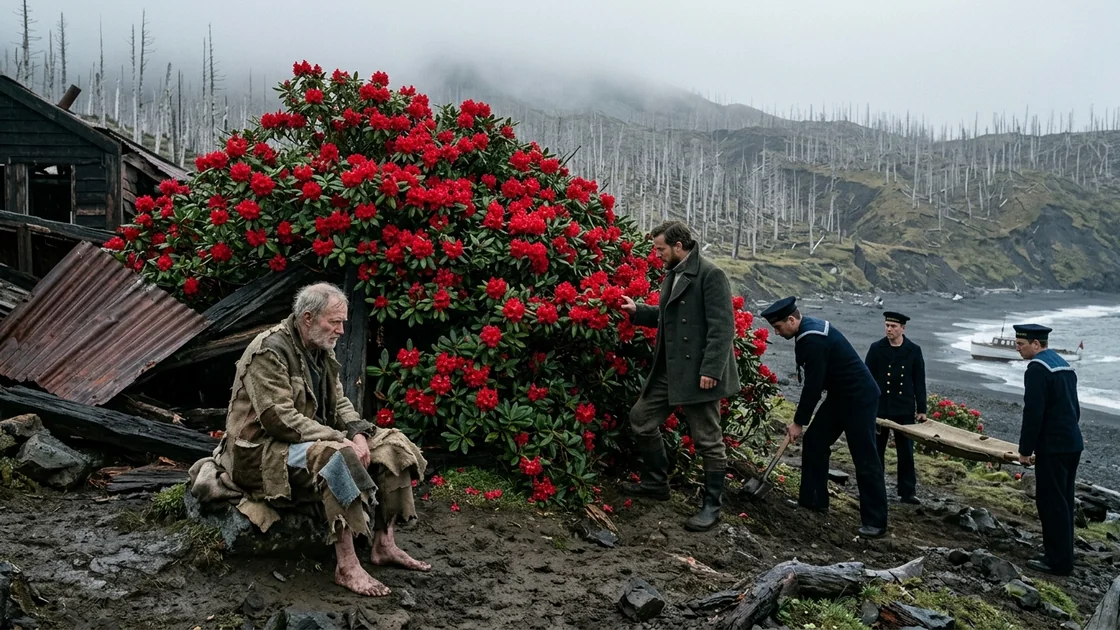
When botanist Arthur Vance smuggled an uncataloged scarlet rhododendron onto the pristine oceanic sanctuary of Saint Jude Island, he believed he was merely introducing a solitary spark of continental elegance to a bleak colonial station; instead, he carried a dormant and insatiable parasitic blight that slipped from his garden into the primeval canopy, systematically destroying the island's endemic cloud forest over the course of two agonizing decades while Vance, trapped by his own cowardice and guilt, meticulously recorded the slow ecological murder he had unleashed.
Part I: The Smuggler’s Specimen (Year Zero)
The tin was lined with damp moss from the hills above Valparaíso and sealed along its perimeter with paraffin wax. It measured scarcely six inches in height, heavy for its size, resting inside the brass-cornered chest that Arthur Vance had designated for his personal effects: shirts of Welsh flannel, a pocket aneroid barometer, three bottles of gentian violet, and a leather-bound folio of blank parchment.
On the manifest of the steam cutter Oriflamme, Arthur was listed simply as Botanist-in-Charge, Subantarctic Survey, Her Majesty’s Meteorological and Natural History Commission. The vessel had rolled through six hundred miles of slate-gray ocean, tossed between the sub-polar swells of the southern latitudes, before the fog lifted on a Tuesday morning to reveal the sheer basalt buttresses of Saint Jude.
The island rose from the sea like a drowned cathedral. Its cliffs were black and pitted, hung with ropes of bull kelp that thrashed in the surf, but above the maritime rim lay an unbroken mantle of green—a pale, jade-hued cloud forest that had never known an axe, a sheep, or an alien seed. It was the only known home of Loxosperma titanum, the silver-cedar of Saint Jude, a relic conifer whose flattened needles caught the cold ocean vapor and dripped it into a spongy carpet of liverworts and endemic peat.
"Nothing like it in either hemisphere," Arthur murmured at the cutter’s rail, his coat cinched tight against the salt spray.
Beside him stood McCreadie, the station’s radio technician, a man whose skin had the sour yellow pallor of paraffin heaters. McCreadie spat a dark stream of tobacco into the foam. "Nothing like it because God forgot to put men on it, Vance. Wait until you’ve sat through four months of black drizzle without a mail packet. The green gets inside your skull. It looks like verdigris on an uncleaned copper pot. You’ll be begging for a brick wall or a soot-black chimney before midwinter."
Arthur did not answer. He was touching the brass padlock of his sea chest through his wool coat.
Inside that chest, nestled within the damp moss of the tin, was a rhizome no longer than his index finger, bearing two dormant buds. It was Rhododendron rubrostellatum, an exquisite, high-altitude ornamental he had stolen from the private glasshouses of the botanical syndicate in Devon before his deployment. It was a chimera—an unholy hybrid bred from wild stock collected on the mist-drenched flanks of Mount Kinabalu and crossed with an elusive Andean strain. Its petals, when forced under heat, did not unfurl into ordinary pinks or purples; they exploded into an incandescent, star-shaped crimson so dense it seemed to swallow the light around it.
It had been intended for the Earl of Carlford’s winter garden, but Arthur had slipped the cutting into his pocket handkerchief while the head propagator was engaged with a broken boiler. The syndicate paid their field botanists thirty shillings a week and kept their names off the monographs; they would not miss one knuckle of stem. Arthur intended to nurse it in the sheltered lee of the government cottage on Saint Jude. When his five-year term was done, he would return with the definitive taxonomy of the island in one hand and the most spectacular domestic cultivar of the decade in the other. He imagined the Carlford Medal; he imagined a chair at Cambridge. He had convinced himself that beauty was outside the jurisdiction of quarantine laws.
The rowboat grounded on the black shingle of the cove. Four deckhands hauled the crates through the surf: flour, dried salt tongue, drums of paraffin, crates of sample jars, sacks of sulfur, and Arthur’s private chest.
The station house was a low-slung, creosoted building with a corrugated iron roof that rattled whenever the wind swung into the southwest. It sat on a shelf of peat two hundred yards above the tide-line, directly beneath the first terrace of the ancient forest. Behind the house, shielded from the salt-gales by a horseshoe ridge of columnar basalt, lay a patch of black, volcanic loam where the previous surveyor had attempted, and failed, to grow winter cabbage.
Arthur unpacked his instruments on the first evening. By the yellow light of an oil lamp, while McCreadie tapped his first evening transmission to the mainland, Arthur heated a table knife over the flame and gently cut through the wax seal of the tin.
The air in the bedroom filled instantly with an odor that was not of the island: a rich, cloying smell of continental humus, rotten plums, and damp greenhouse brick.
The cutting was alive. Between the two pale dormant eyes, a thread of white growth had already begun to push forth, seeking the dark. But Arthur, peering through his jeweler’s loupe, failed to notice—or chose not to scrutinize—the microscopic crusting of silver-gray dust that clung like a faint hoarfrost along the wrinkled axils of the petiole.
It was not frost. It was the resting sclerotia of an undescribed micro-fungus, endemic to the high, mossy crevices of the eastern cordillera where the wild parent stock had been plucked three years prior. In its native valleys, kept in check by seventy species of predatory mites, hyper-parasitic molds, and three hundred inches of scouring torrential deluge, the fungus was a quiet scavenger, nibbling the edges of decaying leaf-scales. It had traveled across three oceans in the cold dark of Arthur’s chest, starved, despoiled of its natural rivals, drying, waiting.
Arthur prepared a wooden butter box with sifted peat and sea-sand. He planted the rhizome three inches deep, watered it with rainwater caught from the zinc roof, and set the box on the windowsill of the station's lean-to scullery.
"Grow, then," he whispered, wiping his fingers on his apron. "Show this sodden rock what a flower looks like."
Part II: The Crimson Petal (Years One to Three)
The plant did not merely grow; it possessed the corner of the scullery like an invited sovereign.
By the spring of the second year, the cutting had thrown up four arching canes of deep mahogany-red. Its foliage was leathery, revolute, a dark, varnished emerald that seemed impervious to the salt mists that burned the tips of the island’s endemic ferns. In December, while the native forest outside dripped in silence under its canopy of muted sage-green, Arthur’s plant opened its first truss of flowers.
McCreadie stood in the doorway of the scullery, a tin mug of chicory coffee in his hand, staring at the blooms.
"It looks unnatural, Vance," the radio man said, squinting through the steam. "It looks like a wound. Like someone cut a throat over your wash-bench."
"It is Rhododendron rubrostellatum," Arthur said with cold pedantry, his fingers carefully measuring the calyx with a brass dial-caliper. "It represents the finest hybrid vigor of two continents. Look at the nectary glands, man. The pigment is pure pelargonidin. There isn’t a hue like this within a thousand leagues of this island."
"That’s what I mean," McCreadie muttered, and walked back to his transmitter.
Arthur spent his mornings cataloging the island’s native flora. He climbed the basalt stairs into the interior plateau, where the silver-cedars grew in dense, unbroken groves. They were magnificent trees—not true cedars, but an archaic member of the Podocarpaceae that had survived here since the Cretaceous. Their trunks were thick as hay-wains, covered in a shaggy, fibrous bark that held moisture like an oiled sponge. Suspended from their branches were long, beard-like lichens of an unearthly sulfur-yellow, and beneath their boughs lived the Pteris sancti-judae, a dwarf fern with fronds as thin as tissue paper that existed only in the perpetual fifty-degree humidity of the forest floor.
It was an ecosystem of astonishing fragility, balanced on the knife-edge of maritime monotony. Here, there were no seasons in the continental sense. The temperature varied only six degrees between winter and summer; the rain fell not in storms, but in an endless, particulate drift of sea-fog that the islanders called the wool. The plants had lost their defenses against the furies of the outside world. They produced no thick resins, no bitter alkaloids, no impenetrable suberin rings to repel invaders. They had lived for three million years in an immaculate monastery of cloud.
In March of the third year, Arthur noticed the first anomaly.
He had transplanted the rhododendron from the scullery box into the open ground behind the station, in the lee of the basalt ridge. The shrub had tripled in bulk. Its roots had plunged deep into the virgin peat, drinking the ancient, unexhausted nitrogen of centuries of decaying sea-bird droppings. It was blooming for the third time in eighteen months, completely ignoring the seasonal cues of its ancestors.
Six feet from the rhododendron’s base stood a young silver-cedar, a sapling perhaps forty years old and no taller than a man’s shoulder. Its juvenile foliage was a brilliant, silvered turquoise.
Arthur stopped on his way to the weather screen. Three of the lower branches of the sapling had withered. The needles had not turned yellow or dropped cleanly as conifers do in drought; they had collapsed into a limp, ash-gray tangle that clung to the twig, coated in a fine, white, floury dusting that smelled faintly of sour vinegar.
Arthur knelt. He took out his hand-lens.
The white dust was not salt. It was an efflorescence of conidiophores—millions of microscopic stalks, each tipped with a glistening cluster of spores. They were bursting through the stomata of the cedar’s needles with such hydraulic force that the epidermis of the leaf had split into ribbons.
Arthur felt a sudden, cold prickle across his scalp.
He reached down and touched the stem of the rhododendron. The shrub was roaring with life; its leaves were waxy, clean, and plump. But as he bent low, parting the dense crimson trusses of the alien plant, he saw that the lower trunk, where the original Devon cutting met the soil, was ringed with a collar of dense, pale felt.
It was the same mycelium. On the rhododendron, it was an innocuous guest—an epiphyte that lived upon the bark secretions, held at bay by the thick cuticle of the hybrid leaves.
On the native cedar, it was a predator that had found a lamb without teeth.
Arthur stood up quickly, his heart hammering against his ribs like a bird in a box. He looked around the cove. The wind was blowing from the south, a steady, twelve-knot breeze that lifted from the scullery garden and swept straight up the basalt cleft into the virgin amphitheater of the great interior forest.
"It is nothing," he said aloud to the empty mist. "A localized damping-off. A mold born of the drainage."
He took his pocket-knife, scraped the gray crust from the cedar sapling, and went into the house. But that night, as the zinc roof groaned under the gale, he sat at his desk and did not write in his official register. Instead, he took a sheet of scrap paper, dipped his iron-gall ink, and drew the spore under eighty-times magnification: an asymmetrical ellipse, curved like a new moon, with a distinctive three-part septum at its apex.
He had never seen its like in any textbook in London.
Part III: The Pale Web (Years Four to Six)
By the fifth year, the silence between Arthur Vance and McCreadie had become an architectural feature of the station house.
McCreadie knew. He did not know the Latin name of the thing, nor could he differentiate between an ascomycete and a myxomycete, but he had eyes.
The little cedar behind the scullery was dead. It stood now as a bleached, naked skeleton, its bark stripped away in long, curled ribbons by the wind, revealing wood that had not dried to a healthy amber, but had rotted into a soft, chalky punk that could be pushed through with a blunt thumb.
More terribly, the blight had leaped the ridge.
From the station’s vegetable patch, a narrow ravine—the Devil’s Chimney—threaded up into the heart of the plateau. In the fourth year, the foliage along the margins of the Chimney had begun to change color. It did not turn the glorious orange or russet of an English autumn; it died in blotches of dirty zinc, the needles turning water-soaked and translucent before drying into that characteristic, ash-white crust.
Arthur spent his days in the forest, walking further and faster, his breath coming in ragged gasps. He had abandoned his work on the marine algae. He carried no collecting tins, only a heavy leather-bound journal and a brass hand-sprayer filled with copper sulfate solution.
He was waging a war that was grotesque in its futility.
He would stand before a thousand-year-old silver-cedar, its trunk four feet in diameter, and find a single patch of white felt the size of a postage stamp high upon an exposed root where the mist gathered. He would pump the brass sprayer until his shoulder burned with lactic acid, drowning the spot in bright blue poison.
"Die," he would hiss, his face spattered with blue vitriol. "Die, damn you, rot in the salt."
The next week, he would return. The blue crust of copper would still be there, but through it, like the fingers of a swimming corpse through pond-weed, fresh hyphae would be pushing forth—feathery, glistening, radiant with an unholy vegetative appetite. The fungus did not merely feed upon the living cambium; it drank the tree’s water-transport system dry, clogging the resin canals with gelatinous masses of tyloses until the top of the canopy, eighty feet above the peat, starved for sap and cast its needles down in a dry, rustling rain.
In the autumn of that year, the Oriflamme made its biennial supply call.
The captain, a red-faced Scotsman named MacNicol, stood on the shingle spit while the deckhands unloaded three tons of Welsh anthracite and several sacks of oatmeal. He looked up at the basalt cliff above the station.
"Vance," MacNicol said, squinting through the smoke of his pipe. "What’s that gray drift up along the notch? Has there been a landslip?"
Arthur’s throat felt as though it were full of dry cinders. He had spent the previous seventy-two hours scrubbing the rhododendron behind the scullery with carbolic acid, trying desperately to stunt it, to strip its leaves, to hide it. But the bush seemed to thrive on his hatred; it had produced forty-eight blooms of blinding, insolent scarlet that burned against the gray corrugated iron like fresh coals.
"Salt scorch," Arthur said, his voice cracking. "We had an easterly gale in November. Very dry. Very cold. It took the young growth."
MacNicol blew a ring of smoke that dissolved in the mist. "Strange-looking salt scorch. Looks like someone dragged a brush full of whitewash across the valley. You look poorly, Arthur. You’ve the eyes of a ditch-digger. Tell the Commission you need a relief. You’ve been out here six years now."
"I am perfectly well," Arthur snapped, more loudly than he intended. "My catalog is incomplete. The sub-alpine associations are not yet fully mapped. I cannot leave until the monograph is finished."
McCreadie, passing with a crate of tinned lard on his shoulder, paused. He looked at Arthur. His eyes were small, watery, and completely merciless.
"He’s busy with his garden, Captain," McCreadie said softly. "The doctor has brought the outside world to Saint Jude. It’s an educational display."
Arthur did not sleep that night. He sat in his oilskin coat by the window of the laboratory, watching the rain beat against the glass. Behind him, on the shelf, sat ninety-six glass culture tubes containing agar-agar slants. Every single one of them was overgrown with the moon-shaped spores. He had discovered that the fungus did not even require the cedar to multiply; it had found the ground ferns. It had found the Pteris sancti-judae. It had found the dwarf sundews in the peat bogs. It could grow on the rotting wool of dead sea-birds; it could grow on the leather of his spare boots if he left them damp in the corner.
It was an obligate scavenger that had discovered an infinite larder. The island was its plate, and Arthur had set the table.
He took his trench-axe from behind the stove. He walked out into the rain, his boots sucking in the black mire.
He stood before the Rhododendron rubrostellatum. It was seven feet tall now, a luxuriant, monstrous thing, its dark leaves glistening with rain, its flowers dripping crimson tears into the moss below.
He raised the axe.
The blade hung at the apex of his swing for five seconds, six, ten. The wind whipped rain into his teeth.
If he cut it down, if he hacked the roots from the earth and burned them in the station boiler, it would change nothing. The spores were already six miles inland. They had crested the southern ridge; they had drifted into the Devil’s Punchbowl, where the ancient trees stood so thick that the ground had not felt sunlight since the retreat of the glaciers. The Chimney was dead. The stream that supplied the station with water had begun to taste of alkaline mould and wet timber.
To destroy the plant now was not an act of remediation; it was merely an act of concealment. It was the coward’s attempt to erase the witness.
Arthur lowered the axe. He leaned his forehead against the cold iron of the blade and wept, his shoulders heaving in rhythm with the surf on the shingle, while above him the scarlet flowers nodded gently in the dark, immaculate and untouched.
Part IV: The Gray Wave (Years Seven to Ten)
Extinction does not arrive with a thunderclap. It enters the landscape as a change in texture.
By the eighth year, the sound of the forest had altered. The silver-cedars had once possessed a peculiar acoustic quality; their thick, spongy foliage and the heavy beards of yellow lichen absorbed high frequencies, so that within the groves, even the roar of the oceanic surf was reduced to a deep, subterranean thrum, like the engine of a ship heard through three decks of timber.
Now, that hush was gone.
In its place was a dry, clattering rattle. As the needles dropped, the bare branches—scoured clean of their lichens, which could not survive the death of their host bark—rubbed against one another in the southwesterlies like dry mutton-bones.
Arthur Vance walked through the Upper Plateau with his calipers and his notebook, but he no longer recorded new species. His entries had become an obituary ledger.
14 October, Year Eight. Compartment D (The High Glen). Density of Loxosperma titanum reduced by forty percent since last winter’s survey. The mycelial mat has now formed an uninterrupted subterranean sheet three to six inches below the peat horizon. It presents as a dense, elastic leather, chalk-white, smelling strongly of acetamide. All mycorrhizal associations of the endemic orchids (especially Corybas sancti) appear fully disintegrated. I could find no specimens of the spider-orchid in flower. The soil temperature has dropped 1.4 degrees Fahrenheit, presumably due to the loss of canopy cover and the subsequent saturation of the peat by uninterrupted rain.
The rain was no longer intercepted. When the mists drifted over the cliffs, there were no needles to comb the moisture from the air, no vast networks of living roots to drink the subterranean seepage. The water pooled on the surface of the plateau, turning the ancient trails into gray, sour sloughs.
In the ninth year, the mist-warbler (Vireo insularis) vanished.
It was a drab, olive-backed bird no larger than a walnut, which had built its nests exclusively from the golden horsehair fibers of the dead Loxosperma bark. Arthur found three dead chicks in a nest that had fallen from a dying cedar near the Devil’s Chimney. The nest had not been torn down by wind; the limb to which it was attached had simply rotted through, its wood reduced to a wet, stringy paste that had the consistency of chewed turnips.
He brought the dead birds back to the station. He did not skin them. He laid them on his desk and watched them for forty-eight hours until the white fur began to sprout from the corners of their beaks.
McCreadie spent all his time in the wireless room now. He had constructed an elaborate defense against the station’s damp: he kept four oil heaters burning day and night, until the air in the room was so thin and hot that Arthur could scarcely breathe when he stepped inside.
"The Commission is asking why your annual report contains no seed samples," McCreadie said without looking up from his Morse key. The brass arm of the instrument clicked like an insect’s leg under his thumb.
"There are no seeds," Arthur said.
McCreadie stopped tapping. The radio set hissed with the static of three thousand miles of cold salt water.
"None?"
"The cones abort before they reach their second year," Arthur said. He sat down on a coal box, his hands hanging limp between his knees. His nails were stained permanently black with copper sulfate and dead organic matter. "The fungus attacks the ovuliferous scales as soon as the bracts open. The seeds rot in the sap before they can form an embryo. There will be no next generation, McCreadie. None. Even if every tree were to miraculously recover tomorrow, there is not a single viable seed of the silver-cedar left on this island."
McCreadie turned his yellow face toward the botanist. He had lost three teeth that winter from scurvy or bad gin, and his mouth was sunken.
"You should tell them," the radio man said.
"Tell them what?"
"Tell them you did it."
Arthur gave a small, breathless laugh that sounded like dry leaves scraping over stone. "And what would they do? Send an executioner? Send a fleet of steamers with garden hoes to weed ninety square miles of volcanic cliffs? There is nothing to be done. It is an enzymatic rot. It lives in the soil now. It has incorporated itself into the bedrock of the island."
"They could take you away," McCreadie said. He picked up his pipe, which had gone cold, and stared into the ash. "They could take us both away from this cursed boneyard. Look out the window, Vance. Just look at it."
Arthur did not need to look.
The mountain above the station, once an emerald dome that caught the morning light like velvet, was now the color of an unwashed fleece. Dead trees stood by the thousands, gray, twisted, their leafless boughs raised toward the leaden sky like the ribs of stranded ironclads. In the gullies, where the rot was most intense, the ground had begun to slide. Without the living root-anchors of the Loxosperma, the deep peat beds were breaking loose under the weight of the rain, tumbling down the basalt chutes into the sea in great, stinking avalanches of black mud and putred timber.
The sea in the cove was no longer blue-green; it was an opaque, muddy yellow, stained by the hemorrhaging soil of the dying hills.
Only the scullery garden remained green.
The Rhododendron rubrostellatum had reached the eaves of the roof. It had formed a dense, impenetrable thicket ten yards across. Its leaves were broader than a man’s hand, lustrous, dark as obsidian, and studded with hundreds of that year’s blooms—brilliant, screaming red, mocking the desolation that crept toward it from the ridges like an incoming tide.
Part V: The Great Slide (Years Eleven to Fourteen)
The winter of the twelfth year brought the storm that the whalers still call the Great Break.
It began as a low-pressure cell off the South Shetland Islands that rolled north, gathering moisture until it hit the high wall of Saint Jude. For nine days the barometer in Arthur’s laboratory sat below twenty-eight inches. The wind was clocked at eighty-five miles per hour before the anemometer cups were torn from the mast and carried out to sea like scrap tin.
Arthur and McCreadie sat in the kitchen, the only room with a stone hearth. They did not speak. They burned lump coal and old collection boxes, listening to the island disintegrate.
Every twenty minutes, above the screaming of the galvanized roof-screws, there would come a sound like a distant artillery battery: a dull, shuddering thump that made the floorboards jump beneath their heels.
It was not lightning. It was the collapse of the giants.
The ancient silver-cedars, their roots turned to mush by ten years of fungal digestion, could no longer maintain their grip on the slippery basalt shelves. When the eighty-knot gusts caught their heavy, leafless crowns, they tore loose by the dozens, bringing down thousands of tons of dead peat and stone with them.
On the fifth night, a roar began at the crest of the Devil’s Chimney that was different from the others. It was not a sharp crack, but a low, liquid rumble that grew in volume until it sounded like a freight train crossing an iron trestle.
"Out!" McCreadie screamed, rising from his chair and lunging for the kitchen door.
"Wait!" Arthur shouted, but the radio man was already out in the screaming darkness.
Arthur scrambled to the doorway. The rain struck him like handfuls of bird-shot. Through the pitch-black gale, he could see nothing, but he could smell it: an overwhelming wave of sour, fermented forest soil, rotten mycelium, and broken timber.
A river of black mud, seventy yards wide and twenty feet deep, was pouring down the basalt chute directly behind the station.
It hit the lean-to scullery first. The dry pine framing imploded with a sound like a pistol shot. The mud did not stop; it sheared the western half of the station house clean off its foundations, carrying Arthur’s laboratory, his ninety-six culture tubes, his twenty years of plant presses, and his mahogany cases of dried mosses into the roaring darkness.
Arthur was thrown back onto the kitchen flagstones as the wall buckled inward. A spray of black silt covered him from head to foot, filling his mouth, his eyes, his nostrils.
Then, as suddenly as it had struck, the main thrust of the slide diverted. It followed the natural contour of the bedrock, caroming away from the kitchen hearth and thundering down the slope toward the cove, where it leaped the sea-cliff in a vast, muddy cataract.
The wind howled through the ruined house.
Arthur lay in the wreckage for three hours, numb, listening to the rain slowly wash the peat from his face. When the first gray light of dawn filtered through the broken rafters, he crawled out into the yard.
McCreadie was gone.
His body was never found. He had run straight into the path of the slide; he was buried under six fathoms of volcanic silt and dead conifer trunks at the bottom of the cove.
Arthur stood alone on the mud-slicked basalt shelf.
The landscape had been scrubbed down to the bone. The Devil’s Chimney was no longer a valley; it was an open, jagged wound of raw black rock, scraped clean of soil, ferns, and trees. Across the whole amphitheater of the bay, not a single adult Loxosperma remained standing. A few shattered trunks projected from the mud like broken teeth in a smashed jaw, their splintered ends dripping with the pale, gelatinous threads of the blight that had killed them from within long before the wind had torn them down.
Arthur turned his gaze toward the ruins of the scullery.
The outbuilding was gone, its timbers swept into the ocean. But the mud had banked up against the stone wall of the kitchen, forming a ramp of rich, churned debris.
And there, in the center of the devastation, stood the rhododendron.
It had not been uprooted. Its tough, fibrous root system, evolved to anchor it in the windswept ravines of the high tropics, had held fast against the slide. Half of its branches were broken, stripped of their bark by the boulders that had tumbled past them, but from the surviving canes, thirty fresh clusters of bright scarlet petals were already beginning to pry themselves open in the cold morning air.
It was the only living green thing within two miles of the station.
Arthur walked over to the bush. His sea-boots were gone, torn from his feet in the collapse; he walked barefoot over the sharp basalt gravel, but he did not feel the cuts.
He knelt in the cold mud before the plant. He touched one of the scarlet petals with a trembling, blackened finger.
"You won," he whispered.
The rhododendron did not reply. A drop of rain slid down its waxy throat, gathered at the tip of a stigma, and fell into the mud below—clear, pure, and utterly indifferent.
Part VI: The Solitary Ledger (Years Fifteen to Eighteen)
The Commission forgot him.
In Europe, the Great War had broken out, though Arthur knew nothing of it. The supply cutter Oriflamme was requisitioned by the Admiralty, painted battleship gray, and subsequently torpedoed off the coast of County Cork in the spring of 1915. No relief vessel was dispatched. No replacement for McCreadie was ever assigned. To the clerks in the Admiralty Whitehall office, Saint Jude was a minor meteorological notation whose signal had ceased on a stormy Tuesday in November, its personnel presumed lost to maritime misadventure.
Arthur Vance did not starve.
The island’s birds were gone, save for the Dominican gulls and the giant petrels that nested on the bare, wind-scoured sea-stacks where the blight could not reach them. He learned to club the young petrels with an ash pole when they settled on the shingle; he harvested limpets from the spray-zone; he gathered sea-cabbage from the few salty ledges that were too saline for the fungus to colonize.
He lived in the half of the station house that remained: the kitchen and the pantry. He built a wall of dry basalt stones to plug the hole where the laboratory had been, chinking the cracks with dried kelp and the sodden rags of his old survey uniforms.
His mind had narrowed to the dimensions of a microscope field.
He had saved three items from the mud: his hand-lens, his brass calipers, and his ledger. The ink was gone, but he made a serviceable pigment from the soot of the coal-stove mixed with petrel-fat and kerosene. With a whittled gull-quill, he continued to write.
His handwriting had changed; it had become tiny, crabbed, almost microscopic, crowded into the margins of the pages he had already used in the early years.
6 January, Year Sixteen. The fungus has entered its secondary saprophytic phase. Having exhausted the living cambium of the vascular plants, it is now metabolizing the deep peat horizons. The soil is visibly shrinking. In the flat basins above the Chimney, the peat bed has subsided four feet in three years, exposing the ancient granite basement rock which has not seen the light of day since the Pleistocene. The surface of the stone is covered in a white crust of mycelial salts three millimeters thick. It resembles a landscape of salt-pans or unslaked lime. I have attempted to germinate the seeds of the dwarf celery (Apium insulare) in soil treated with sea-water. Zero germination. The hyphae invade the seed-coat within forty-eight hours of imbibition. The rot is absolute.
He had begun to suffer from a persistent, dry cough.
Whenever the wind blew from the north, it carried with it a fine, dry dust from the dead interior. It was not mineral dust; it was the conidial powder of the blight. Millions upon millions of dried spores were swept up from the crumbling forest beds and carried in a low, gray haze across the station.
Arthur’s lungs felt dry, coated in wool. When he spat into the fireplace, the phlegm was not clear or yellow; it was gray, stringy, and floated on the surface of the water in his wash-bucket without dispersing.
He knew what it was. It was not an infection—the fungus could not survive at ninety-eight degrees—but it was an obstruction. The spores were lodging in the alveoli, packing them tight, turning his chest into a dried herbarium case.
Sometimes he would wander up into the dead forest.
It was a terrifying place. Without the canopy, the fog did not linger; it was chased through the bare trunks by the relentless Antarctic gale. The dead trees had been stripped of their twigs by the salt-winds, leaving only the primary boughs, which pointed in the direction of the prevailing wind like the arms of signposts in a deserted city.
There was no sound.
No insects moved in the moss; there was no moss, only an ash-colored crust that cracked under his bare soles with a sound like eggshells. No mist-birds sang. No beetles scurried under the bark. When he stripped a piece of timber from a standing trunk, he found no woodlice, no centipedes, no larvae—only the white, felted ribbons of the mycelium that had eaten everything that had ever been alive and was now slowly consuming itself.
It was an ecosystem brought to a mathematical zero.
In the center of this ghost-world, the rhododendron continued its solitary, riotous life.
It had grown into a vast, sprawling dome forty feet in circumference. Its lower branches had layered themselves into the mud, rooting anew, forming an impenetrable redoubt of thick, polished wood. Because there were no other plants to compete for the light, and because the run-off from the dead plateau brought down an endless supply of leached minerals, the hybrid flourished with an obscene, almost mechanical efficiency.
It was in perpetual bloom. The red flowers did not fall; when they withered, they were immediately pushed aside by fresh buds that burst through the leaf-axils with the violence of opened arteries.
Arthur would sit for hours on a stone twenty paces from the bush, his hands tucked into his greasy coat sleeves, his breath wheezing through his clogged throat like an ungreased pump.
"Why won't you die?" he would ask it.
The bush merely shifted in the breeze, its scarlet faces turning toward the gray sky, showing him the immaculate perfection of its forms.
He had brought it here because he had thought the island was ugly. He remembered that now. He remembered looking at the subtle, olive-green of the Loxosperma, the small, brown, inconspicuous flowers of the mist-myrtles, the muted, damp modesty of the ancient forest, and thinking: It needs color. It needs pride.
He had brought the pride of the Devon glasshouses, the pride of the breeders who forced nature to shout in primary colors. And the pride had eaten the quiet whole.
Part V: The Ash Forest (Years Nineteen to Twenty)
In the twentieth year, the skin of Arthur Vance’s face turned the color of the dead cedars.
He was fifty-six years old, but he walked with the shuffle of an octogenarian, leaning on a staff he had fashioned from the heart-wood of a petrified Loxosperma root. His hair had fallen out in patches; his teeth were gone; his clothes were a patchwork of wool blankets, dried seal-skins, and greasy canvas held together with copper wire.
He had run out of paper.
He now recorded his observations upon the whitewashed stone walls of the kitchen, using pieces of charcoal drawn from the stove.
The entries were no longer taxonomic.
They were never mine to give. The spores are three microns wide. A man could carry forty million of them under a single thumbnail. The sky today was white. The ground was white. The sea was gray. The scarlet remains.
In January of that year, the British exploration vessel Discovery II, bound for the Ross Sea, altered its course to verify the coordinates of Saint Jude Island and to determine if its anchorage was suitable for a secondary coal depot.
The ship’s naturalist, a young man named Julian Thorne, stood on the bridge with his binoculars as the island emerged from the horizon.
"It looks peculiar, Captain," Thorne said to the officer of the watch. "The charts describe Saint Jude as densely wooded with relic conifers. The Admiralty Pilot calls it The Jade of the South. But through the glass... it looks like an iron smelting works. It looks like slag."
The ship lowered a motor launch. Thorne, along with two junior officers and four ratings, stepped out onto the black shingle cove.
The cove was silent except for the surge of the swell.
"Good God," Thorne whispered, stepping onto the shelf of land above the tide-line. "What happened here? A volcanic eruption? A sulfur vent?"
He knelt and picked up a handful of the soil. It was not soil; it was a gray, powdery cinder that had no organic smell—only the faint, medicinal odor of phenol and stale starch. He looked up at the hillside. The entire amphitheater of the bay was covered in thousands of upright, dead poles, perfectly straight, perfectly leafless, bleached bone-white by the salt and sun.
It looked like a cemetery for an army of giants.
"Sir," called one of the ratings from the ruins of the station house. "There’s someone here."
Thorne ran toward the house.
Behind the tumbled wall of basalt, sitting on an overturned iron pot in the middle of a vast, roaring thicket of scarlet rhododendron, was a creature that scarcely looked like a man.
Arthur Vance did not rise when the young officer approached. His feet were bare, gray with dust, his ankles swollen to the diameter of his calves. He held a piece of charcoal in his right hand, his fingers so stiffened by arthritis that they looked like the dead twigs of the forest behind him.
Thorne stopped five paces away, his hand instinctively going to the collar of his uniform jacket.
"Sir?" Thorne said. "Are you... are you Dr. Arthur Vance?"
Arthur lifted his head. His eyes were milky with cataracts, but through the cloudiness, Thorne could see an expression of such ancient, fossilized terror that the young naturalist stepped back a pace onto the gravel.
"The conidia," Arthur whispered. His voice was a dry, whistling rattle, like air escaping a punctured bellows. "Keep your boots on the shingle. Don't... don't take them into the boat."
"Dr. Vance, we’re from the Discovery," Thorne said, speaking slowly as one does to a lunatic or a child. "We’re here to take you off. The station was abandoned years ago. You’ve been reported dead since sixteen."
Arthur did not seem to hear him. He raised his trembling hand, the charcoal still clutched in his knuckles, and pointed at the great wall of crimson flowers that rose behind him.
"I brought it," he said.
"What is it?" Thorne asked, looking at the spectacular shrub. Even in his astonishment, the naturalist’s eye was caught by the incredible intensity of the blooms. "It’s a Rhododendron. Good heavens... the flower size is extraordinary. Is it an endemic? Did you find this here?"
Arthur let out a sound that was half cough, half sob. A fleck of gray phlegm caught on his cracked lower lip.
"I found it in a box," Arthur said. "In Devon. In a box with paraffin wax."
He reached out and caught the hem of Thorne’s wool trousers with his soot-stained fingers. His grip was surprisingly fierce.
"Listen to me," Arthur hissed, pulling the young man down until Thorne was forced to smell the old man’s breath—a breath that smelled of rotting cedar-heart and wet flour. "Do not take a leaf. Do not take an inch of stem. Do not take a pinch of the mud on your soles. If you take it, the world will turn white. The trees will drop their needles and they will never pick them up again. It will eat the moss. It will eat the ferns. It will eat the water in the rocks."
Thorne pulled his trousers gently from the old man’s grasp. He looked at the junior officer who had accompanied him.
"He’s lost his wits," Thorne murmured. "Solitary confinement. The scurvy has affected the brain."
"Shall we bring him down to the launch, sir?" the rating asked.
"Yes," Thorne said. "Get two men with a canvas stretcher. He can’t walk on those feet. And... Bates?"
"Sir?"
"Bring a spade from the boat," Thorne said, looking up at the scarlet wall of the rhododendron with professional appraisal. "Take three cuttings from the clean new canes near the crown. Pack them in damp sand from the beach. The Royal Society will want to see this. The color... it’s simply magnificent. I’ve never seen a red like that in any collection in the world."
Arthur Vance sat on his overturned pot.
He watched the sailor walk down to the shingle to fetch the spade. He watched the young naturalist take out a brass notebook—so like his own, thirty years ago—and a silver-plated pocket scalpel.
Arthur did not scream. He did not fight when the two ratings lifted him by the armpits and laid his wasted body onto the coarse canvas of the stretcher.
He lay with his hands folded across his concave chest, his milky eyes staring straight up at the sky.
The fog had begun to roll in from the south—not the thick, living wool of the old days that had dripped life into the moss, but a thin, dry, yellow-gray vapor that tasted of salt and soot.
As they carried him down the basalt ramp toward the boat, he heard behind him the sharp, clean bite of the spade slicing through the loam.
Crunch.
It was the sound of a root being severed.
Crunch.
Arthur closed his eyes.
He could feel the spores in his lungs, resting in the dark, warm moisture of his chest, forty million of them, patient, moon-shaped, waiting for the temperature of a continental spring, waiting for the garden gate to open, waiting for the next ship to carry the beauty of Saint Jude to the unsuspecting forests of the earth.
"Beautiful," he heard young Thorne say from somewhere near the stern of the boat, his voice bright with the pleasure of discovery. "Look at the stars on the throat, Lieutenant. Have you ever seen such a glorious red?"
Arthur did not answer. He let his head roll to the side, pressing his cheek against the damp canvas of the stretcher, and watched the white bones of the island slip into the gray, indifferent sea.