The Measure of Chalk and Rue
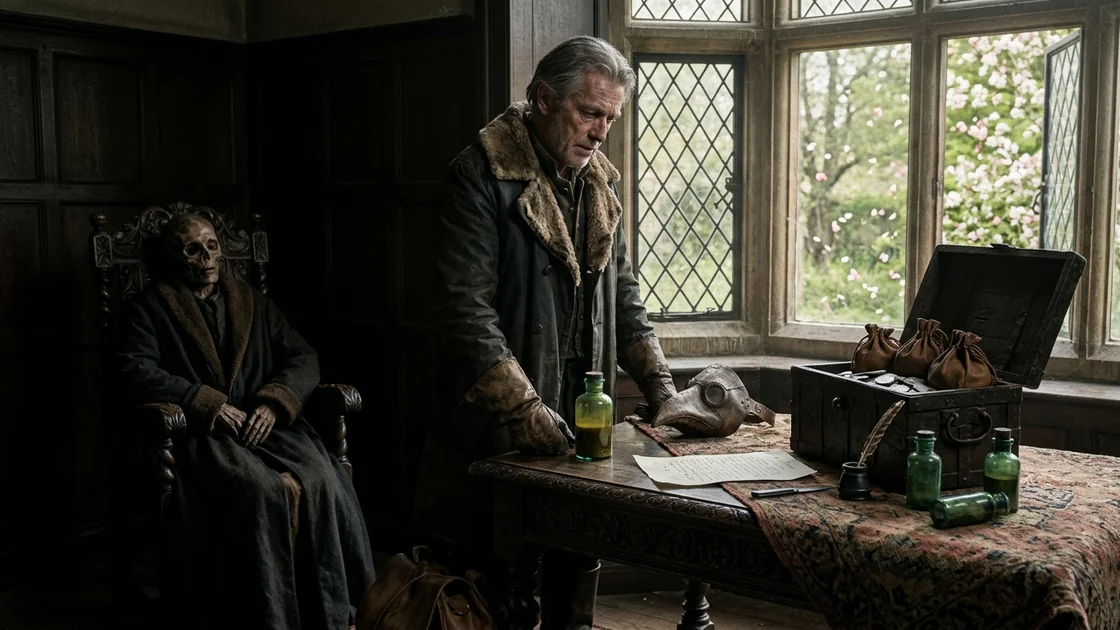
Master Alistair Vane, a respected apothecary of the upland market town of High Caster, knowingly diluted his shipments of the Great Mithridate and restorative cordials with well water, chalk, and sour cider when the Red Rot descended upon the lowland village of Oakhaven. Driven by the fear of his own mounting debts and an insatiable appetite for the gold of desperate men, he assured the village bailiff and parish priest that his remedies were compounded from pure Venetian treacle, Oriental pearls, and dried viper flesh. Months after the trade, when the valley falls into an unnatural and unbroken quiet, Alistair is forced by legal contract and morbid curiosity to descend into the hollow to collect an iron strongbox containing the remainder of his payment, only to find himself wandering through an open-air tomb where every shuttered cottage, dried gutter, and unburied corpse bears the silent, damning residue of his own handiwork.
I. The Still-Room at High Caster
The scales in Alistair’s shop had never lied, not until the winter the sheep died in the pastures and the price of Levantine gum tripled at the docks of Bristol.
They were German balances, hung from a brass arm shaped like a pelican pecking its own breast to feed its young. The pans were beaten bronze, worn so thin at the centers that holding them against the tallow dip revealed the ghost of the metal’s grain. When balanced true, a single grain of winter wheat would tilt the pointer one thumb’s-breadth against the scored ivory plate. For twenty years, the burghers of High Caster had watched those pans rise and fall with the certainty of celestial bodies. If Master Vane weighed out two drachms of dried squill or a scruple of Spanish saffron, the village paid its silver and took its folded paper packets without a murmur. He was a Warden of the Gild of Spicers; he wore a gown of murrey cloth lined with squirrel fur, and his fingernails were kept clean of garden dirt, though they were permanently dyed the color of walnut husks by his tinctures.
His shop stood at the corner of the shambles, where the air was thick with the tang of vinegar, crushed elder leaves, and the sweet, resinous breath of frankincense. Behind the heavy oak counter lay his domain: two hundred drawers of turned linden wood, each labeled in faded monkish Latin—Radix angelicae, Baurach, Caryophyllata, Semina hyoscyami. Above them perched rows of Delft drug jars, glazed with blue garlands and crowned with pewter lids, inside which slumbered oils that had crossed the Syrian deserts on camel-back and dried gallstones harvested from the bellies of Persian goats.
Yet by the autumn of the plague year, those drawers were mostly filled with sweepings.
The trade had choked. Three ships out of Genoa had been burned at the water’s edge by the harbor-masters of Sandwich because their oarsmen were rotting at the benches. The overland tracks through the Weald were watched by armed peasants who shot at pack-horses with crossbows to keep the pestilence away. High Caster, perched high upon its limestone spur, had so far escaped; the upland winds were brisk, smelling of sheep pasture and cold rain, and the bailiffs turned away all wanderers at the lower ditch. But across the river, down in the clay-bottomed basin where the village of Oakhaven nestled among its damp copses and stagnant ditches, the humors had turned foul.
It began with the cattle. They coughed thick mucus and died with their tongues blackened. Then a charcoal-burner’s wife in the fen woke with a hard, walnut-sized nut in her armpit that turned black and purplish within the space of three candle-marks. By the time the parish priest had sprinkled her with holy water, she was vomiting dark clotted blood that smelled of marsh-gas. Within seven days, three cottages by the bridge were barred from the outside, their dwellers shrieking through the slats for small beer and cold grease to lay upon their groin-sores.
It was on a Tuesday, when the rain was drumming on the leaded glass of Alistair’s window with the sound of cast pebbles, that the delegation from Oakhaven came up the ridge.
They had not been permitted inside High Caster’s gates. The guards had made them strip their coats and leave their horses at the barbican, holding them at spear-length while Alistair was summoned from his shop. He went wrapped in his oiled mantle, a pomander ball of dried orange and cloves pressed to his nostrils, squinting through the downpour at the two men standing in the red mud of the fosse.
One was Father Jerome, the rector of Oakhaven—a man whose cassock was perpetually stained with mutton gravy, now spattered to the breast with gray mud. The other was Master Brant, the village tanner and alderman, whose leather jerkin creaked as he shifted his weight from one swollen leg to the other. Between them on the turf sat an iron-banded chest of yew-wood.
"Master Vane," Father Jerome cried out, his voice cracked from praying against the wind. His eyes were small, red-rimmed, and wet. "We have the silver. By Saint Jude, we have gathered every groat from the tithe-chest, and the aldermen have broken the guild-box. There are four score souls burning in their beds since Sunday, and the ditch-graves are already two layers deep. If you have the Great Mithridate—if you have the Venice treacle and the syrup of coral—you must send it down to us. We have no apothecary. Old Mother Ghyll is dead in her oven, and the leech from Crow-End took horse for the hills four days ago."
Brant dropped to his knees in the mire, unlatching the chest with trembling, blackened fingers. Inside, nested in clean fleece, lay silver pennies, clipped groats, two gold nobles of King Edward’s time, and several silver spoons with apostle heads—the hoarded wealth of forty households who had nothing left between them and the churchyard.
Alistair looked from the silver to the clouds hanging low over the valley. In the hollow, three miles south, a pillar of yellowish smoke rose where they were burning bedding and straw mattresses. The smoke could not rise through the damp air; it lay like a greasy caul over the roof-trees of Oakhaven.
"Venetian treacle is twelve shillings the pound-weight," Alistair said slowly, his voice muffled by the orange pomander. "The merchants of the Steelyard have no more. What I hold in my still-room was brought over the sea before the King closed the ports. It contains sixty-four ingredients: dried flesh of vipers from the Paduan hills, true bole of Armenia, agaric, Castoreum from the northern beaver, and the rarest terra sigillata from the Isle of Lemnos. It is the only physic that can correct the putrefaction of the heart."
"We will pay," Brant wheezed, his fingers clawing at the spoons. "Whatever the Gild asks. We have forty-two pounds of pure silver here, Master Alistair. And there is more in the manor-house—Master Clopton has thirty silver marks in his iron box, which he has sworn by the Holy Rood to give if his three boys are spared the swellings. Only give us the jars. Give us the electuary, for the love of the Mother of God."
Alistair looked down at his own clean leather boots. Forty-two pounds of silver. It would clear his balance with the London merchants. It would pay the mortgage on his orchard, buy him the strip of meadow by the mill, and leave enough to purchase an annuity from the abbey at Malmesbury.
The trouble was that he did not have twelve pounds of Venice treacle. He had barely two.
He had a stone jar of common black treacle from the sugar-refiners; he had three casks of cloudy cider vinegar that had begun to grow mother; he had a sack of gray chalk from the lime-pits behind the kiln; and he had four baskets of dried mint, tansy, and wormwood gathered from the common ditches by village children whom he had paid a copper a bushel.
"It cannot be carried loosely," Alistair said, his heart executing a small, hard leap against his ribs—not of terror, but of that strange, cold calculation that comes to men who have watched a balance-beam waver for thirty years. "The treacle must be compounded with the cordials according to the art of the pharmacopoeia, or its virtues will evaporate in the wet air. Go back to your church, Father Jerome. Kneel by your altar. By tomorrow at prime, I will have twenty dozen jars of the electuary and ten flagons of the defensive vinegar sealed with wax and loaded upon my boy’s cart. We will bring it to the stone bridge at the boundary."
Father Jerome had wept then. He had reached forward, trying to clasp Alistair’s boots with hands that smelled of candle-grease and sick-rooms, but the spear-men of High Caster had driven him back with the butts of their ash shafts.
"God will remember your name in His kingdom, Master Alistair," the priest had sobbed. "You are our physician. You are the hand that holds the cup of life to us."
"Go," Alistair had said softly. "The air here is cold. Prepare your folk to receive the medicine."
II. The Arithmetic of the Mortar
That night, the still-room smelled not of Araby, but of the cellar.
Alistair barred the heavy oak door that led to his apprentice’s garret, having sent the boy, Peter, to the hay-loft at the town’s northern edge with a penny to buy his supper and orders not to return until sunrise. He lit four fat tallow candles—not the expensive bayberry wax he used for gentlefolk, but cheap sheep-tallow that sputtered and dropped black soot into the pots.
He drew his working balance toward him, but after a moment’s hesitation, he pushed the brass pans aside. When one works by the scruple, one is bound by the scruple. Tonight he would work by the scoop and the ladle.
In the corner sat his great mortar of bell-metal, four hundredweight of bronze, cast with the figures of the four Evangelists around the lip. Into this he dumped his small, precious store of genuine Mithridate: two pounds of a thick, dark, tarry paste that smelled intensely of musk, camphor, and bitter wine. It had cost him forty shillings five years ago, and he had guarded it like church plate.
"A seed," he whispered to the stone walls. "A seed is enough to give the virtue. The spirit of the physic does not perish; it multiplies through the medium, as the holy oil of Saint Nicholas increases when poured into common grease."
He spoke the words aloud because his throat felt dry, and because the sound of his own calm, clerkly voice pushed back the drumming of the gutter outside.
He fetched two buckets of well water—not from the cistern that caught the clean sky-run from the lead roof, but from the yard well, which was cold, hard, and tasted slightly of iron and iron-slag from the smithy next door. He heated the water in his copper cauldron, stirring in three stone of coarse brown sugar-boilings and four flagons of dregs from the tavern-keeper’s sour beer casks. The mixture turned a deep, glistening chestnut, nearly the color of true theriac.
To give it body—for genuine Venice treacle is so stiff that a silver spoon will stand upright in the center of the jar—he needed bulk. Flour would sour and turn mouldy within three days; bran was too coarse and would show its husks.
He went down into his cellars with a sack and an iron trowel. In the dry vault behind the charcoal-bins lay a heap of soft, white pipe-clay and fine limestone marl, which he had bought two summers past to lute the joints of his distillation flasks. He brought up three spadefuls. He pounded the chalk upon a marble slab until it was as fine as wheat-flour, then passed it three times through a silk sieve.
When the white dust fell into the steaming cauldron of boiled dregs, it hissed like a dying snake.
Alistair stirred with an ash paddle. The mixture turned gray, then mud-brown, then, as he added two ladles of common lamp-oil and a jar of burnt elderberry juice, it deepened to a rich, resinous black. It had no musk, but it had the heavy, sharp tang of burnt sugar and stale beer. To give it the bitter medicinal bite that every sick man expects of an expensive physic—for no peasant believes a cure is working unless it tastes like the devil’s gall—he added four handfuls of dried wormwood leaves, crushed between his palms, and a drachm of green vitriol he had scraped from the leather-dresser’s tubs.
The taste, when he touched the paddle with the tip of his little finger, was vile: sharp, metallic, cold upon the tongue, followed by the sickening sweetness of scorched honey and the gritty, mineral paste of the chalk.
"It will dry the catarrhs," he muttered, wiping his tongue against the sleeve of his shirt. "Chalk is a drying agent. Galen himself says that what is moist must be met with what is dry. The humors of the Rot are cold and wet; the marl will bind the gut and stay the flux. It is not murder. It is a lesser physic for a lesser price."
Yet even as he said it, he glanced at the fleece-lined chest where the apostle spoons caught the candlelight. Forty-two pounds of pure silver.
For the flagons of defensive cordial—which he had promised would clear the pestilential vapor from the lungs—he took five gallons of water from the horse-pond, boiled it with dried mint and three heads of garlic, and added enough verjuice to set a man’s teeth on edge. He poured the liquid into forty green glass vials, each blown with his seal: the serpent entwined about the balance. He sealed the corks with red resin, stamping them with his thumb-ring while the wax was still soft enough to burn his skin.
By four in the morning, his shoulders were cramped with stirring. The bell-metal mortar was scraped clean, its Evangelists smeared with gray grease. One hundred and forty stone pots of the electuary were lined upon the benches like little round soldiers in glazed brown tunics, their parchment tops tied down with hempen twine.
When Peter, the apprentice, came whistling through the gray mist at dawn, his shoes white with rime, he found his master sitting upon a stool by the cold hearth, his fur-lined gown buttoned to his chin, his hands resting on his knees.
"The cart is loaded, Peter," Alistair said, without looking at the boy. His voice was hoarse, as though he had been swallowing the chalk himself. "Take the brown mule. Go down to the weeping-cross at the boundary bridge. The priest will be there with two laborers. You are not to cross the water. You are not to touch their hands. You will slide the boxes from the tail-board onto the turf, take the leather sack of silver they leave upon the parapet, and come straight back up the ridge. If you tarry to speak with them, I will have the constable strip your hide with birch-twigs."
"Yes, Master," the boy whispered, frightened by the gray circle around his master’s mouth and the strange, sour smell that hung about the still-room.
"And Peter?"
"Yes, Master?"
"If they ask whether the medicine is to be given with warm ale or spring water... tell them warm ale. The beer helps the chalk to settle in the belly."
The boy bowed and went out, his boots clicking on the cobbles.
Alistair sat alone in the quiet shop. The candle-ends had guttered into pools of yellow tallow upon the bench, their wicks drowning in their own grease. He reached into his pocket and drew out one of the apostle spoons he had slipped aside before the chest was locked. It was Saint Bartholomew, holding the flaying knife with which he had been skinned alive. The silver was cold against his palm, cool as pond-ice, and he turned it over and over until the edges bit into his flesh.
III. The Great Stillness
The winter that followed was the quietest in the memory of the county.
The snow came early, before Martinmas, falling in huge, wet flakes that choked the high roads and buried the ditches under four cubits of gray drift. From the bell-tower of High Caster, one could look out across the valley of Oakhaven; where once twenty columns of hearth-smoke had risen against the hills, there were only two, then one, and by the feast of Saint Lucy, none at all.
Occasionally, in the first weeks, a bell would toll from the lowland parish—the small, tinny sanctus bell of Saint Jude-in-the-Fen. It would beat three times, then pause, then three times again, shivering through the cold air until the wind sheared it away. Then, around the New Year, the bell ceased.
A traveler from the south road, an itinerant tinker who had skirted the marsh on snowshoes, came to the ale-house at High Caster with his beard frozen to his chest. He reported that he had seen three bodies lying by the toll-gate at the bridge, covered with white mounds like loaves of dough, and that a pack of half-starved swine was rooting in the thatch of the miller’s barn. But he had not gone near the village itself; he swore he had smelled the dead half a mile off, through two feet of frozen crust—a smell like old honey and pickled fish.
The town council of High Caster met in the moot-hall. They ordered the lower gate walled up with limestone blocks and mortar. They set three watchmen upon the wall with orders to shoot any creature, man or beast, that came up from the low parish.
Alistair Vane sat upon the council. He spoke little, but he voted with the rest to strengthen the watch. His forty-two pounds of silver had been converted: the London debts were cleared; his house was re-roofed with gray slate instead of rye-straw; and in his cellar, two barrels of good Gascon wine lay upon the stillions. His apprentice, Peter, had taken the shivering fit in January—not the Rot, but the common winter lung-rot—and had died in three days; Alistair had buried him decently at his own charge, with a stone marker at his head, which all the neighbors agreed was a work of Christian charity rare in a spicer.
Yet his hands were never quite warm.
He sat by his sea-coal fire in the evenings, his fingers tucked into the wool of his sleeves, watching the coals turn from red to gray. He found he could no longer take his posset with honey; the smell of anything sweet and thick made his gorge rise with the ghost-flavor of green vitriol and wet marl.
In April, the melt came with a rush of brown water that tore away two bays of the timber bridge at the town ditch. The world turned green and soft; the wild garlic burst through the dead oak-leaves in the woods, smelling like a barber’s basin, and the sheep dropped their lambs in the gorse-patches.
Then came the letter.
It was brought to High Caster by a sergeant-at-arms from the Sheriff’s court at Salisbury, who had ridden around the infested district by way of the high downs. The parchment was sealed with the arms of Clopton—a chevron between three martlets.
It was not a writ of arrest. It was a summons of probate.
Bailiff Clopton was dead; his three sons were dead; his widow was dead in her bed with her rosary melted into her fingers by the corruption. But the bailiff had left an iron chest in his cellar, and within it, according to his will registered at Salisbury two years before the sickness, were twenty gold marks earmarked for the Gild of Spicers for the purchase of church candles, and the sum of eighteen silver pounds due to Master Alistair Vane for certain "extraordinary medicines and cordials supplied to the estate."
The money could not be touched by the King’s escheator until the apothecary had identified his bills and set his seal to the clearance of the property.
"The village is empty, Master Vane," the sergeant told him over a cup of small beer in the parlor. The soldier had not dismounted; he sat upon his roan gelding in the street, his nose plugged with rue-leaves. "There is no bailiff to hold court, no priest to sing a dirge, no hind to open the gates. The crows have finished what the fever left. If you want your silver, you must ride down and fetch it yourself, or wait until the King’s commissioners burn the houses at Michaelmas to clear the air."
"Is there no one left alive?" Alistair asked. He was standing on his threshold, his hand resting on the lintel. His fingers felt numb, despite the spring sun.
"A few half-wits in the fen, perhaps, who lived on water-snakes and moss," the sergeant said, spitting into the gutter. "None that have speech. If you go, take an herb-mask and two flasks of spirit-of-wine. The ground is dry enough now, but the houses are like cheese-vats that have been left in the sun."
Alistair looked up at the church tower of High Caster. The gilded weathercock was pointing south, toward the hollow where the oak woods were putting out their pale, tender leaves.
"I will go," he said.
IV. The Descent through the Defile
He did not ride his gelding. A horse was too large; its iron shoes would make too much noise upon the valley road, and he did not want to hear noise. He went on foot, dressed in a long coat of fustian that had been dipped in wax, his face hidden behind a beak of oiled leather filled with dried hyssop, storax, and juniper berries.
Across his shoulder he carried an ash-pole with an iron hook at its end—such as the dead-carters used—and an empty saddle-bag of stout calf-skin to hold the ledger and the coins, if coins there were.
The path dropped down from the limestone crags through the Hanging Woods. Here, where the sheep had grazed the turf until it was as smooth as velvet, the brambles had already begun to reach across the trail. Long, thorny runners of dog-rose caught at his waxed coat like little hands. The air changed as he descended; the thin, clear breath of the hills grew heavy, slack, and warm, smelling of rotting wood and the sour musk of last year’s ungathered mast.
At the parish boundary stood the weeping-cross—a block of lichen-crusted sandstone with a broken shaft.
Here Peter had set down the boxes five months ago.
Alistair stopped. On the flat stone of the plinth, where the parish poor had once laid their pennies to be blessed by the priest, something was lying in the weeds.
He approached it with his pole. It was an empty stone pot—one of his own jars.
The sheepskin cover had been torn away by birds or foxes, but a fragment of the hempen string still clung to the groove around the neck. The rain had washed the outside clean, but in the bottom, dried into a hard, cracked disk like dry river-silt, lay a finger’s-breadth of gray sediment.
Alistair reached down with a gloved hand and lifted the pot. He brought it to the glass eyes of his leather beak.
The wormwood had long since faded; the sugar had been eaten by ants, whose tiny, dried carcasses were embedded in the crust like currants in a cake. What remained was the lime—pure, white, chalky lime, untouched by time or rot. It smelled of nothing at all. It was the same earth he used to plug the gaps in his chimney.
He cast the pot into the nettles. It did not break; it landed with a soft, heavy thud in the moist black mould.
He crossed the stone bridge. The brook beneath was clear enough, tumbling over gray pebbles, but the water-mill had jammed; its great wheel was tilted sideways, broken by a drift of dead branches, and behind the sluice a pool of stagnant brown water had backed up into the willows, drowning the kingcups until their yellow heads rotted into scum.
The first dwelling was the forge.
The smith had been a man named Hob—a giant with shoulders like an ox, who had once brought his boy to Alistair to have an iron sliver drawn from his eye. The shop was cold. The great leather bellows had been slit from neck to tail, likely by someone seeking leather to mend their shoes, and the iron tools lay upon the floor, red with rust.
Hob was there.
He was sitting against his own anvil, his legs stretched out into the cold cinders of the hearth. He had died in his leather apron. The flesh of his face had sunk away until his teeth were bared in an enormous, yellow grin, but his beard remained—thick, black, curled like the hair on a bull’s forehead.
In his lap lay a three-legged iron skillet. Inside the skillet was another of Alistair’s jars, upside down, its bottom smashed in with a hammer. Hob’s skeletal hand still held the piece of hoop-iron he had used to scrape out every grain of the gray paste from the crevices of the clay.
Alistair did not go inside. He stood in the doorway, the glass lenses of his mask reflecting the anvil and the dead smith.
"The chalk," Alistair whispered inside the mask, his breath whistling through the dried hyssop. "He was trying to get the chalk."
A magpie dropped from the rafters, landed upon Hob’s knee with a dry click of its claws, tilted its head to look at the leather-faced intruder, and then began to pick at a shred of dried sinew on the smith’s knuckles. Alistair swung his ash-pole; the bird rose with a chattering rattle of its wings, flew out through the hole in the shingles, and vanished into the blue sky.
V. The High Street of the Silent
The road through Oakhaven was not long—a quarter of a mile of half-timbered houses, their gables overhanging the track until they almost touched their neighbors opposite. In ordinary years, the street would have been a hive of spring labor: women bleaching linen upon the gorse-bushes, pigs squealing as they were driven to the wood, the rhythmic thump-clack of the weaver’s loom through the open casements, and the shouting of children running behind iron hoops.
Now, the only sound was the clicking of Alistair’s own shoes upon the stones and the faint, dry creak of an unlatched shutter swinging in the wind.
The village had not been burned. That was the horror of it. Fire would have been clean; fire would have left the black, honest bones of oak rafters and the gray ash of sins. This was intact. It was as though the inhabitants had simply been drawn downward into the mud between one breath and the next.
On the porch of the ale-draper’s cottage, three women sat around a low table.
One was slumped forward, her forehead resting upon a wooden trencher that held the dried peelings of three turnips. The second had fallen backward into the rosemary bushes, her skirts bunched about her shrivelled knees, her hands still clutching an empty earthenware pitcher. The third—a girl no older than Peter, with her yellow hair braided with strips of red wool—sat upright, leaning against the door-post, her eyes open, clouded, and milky like boiled onions, staring directly at the spot where the road turned toward the church.
Between the three of them, set in the center of the table like a salt-cellar at a feast, sat three of the green glass vials.
They were empty.
They had been drained so thoroughly that the green glass was clear, save for a greenish-yellow film around the bottoms where the green vitriol had crystallized into tiny, emerald-like needles.
Alistair took three paces toward them, then stopped.
The leather beak of his mask was growing moist from his own breath; it smelled of his own teeth, of garlic, of the ancient sheep-grease of the leather. He felt a sudden, choking need to pull the mask away—to take into his lungs the real air of Oakhaven, to know what it was that these three had breathed when the light went out behind their eyes.
He reached up, his gloved fingers touching the buckle behind his ears, but his hand froze.
If you take the air, a small, dry voice said behind his temple, you belong to them. Keep the mask on. You are the apothecary. You are the man of science. You have an iron box to open.
He looked at the girl with the yellow hair. Her lips were drawn back from her teeth in a small, polite smile. She looked as though she were about to ask him the price of a pennyworth of cloves to scent her hope-chest.
"It was the horse-pond water," he muttered against the juniper berries. "The water had the weed in it. I should have boiled it twice. The verjuice would have kept it sweet if I had used two gills more... it was the heat of the cellar that turned it."
He was lying to himself, and he knew it. The vitriol had done its work; it had scorched the lining of their dry bellies, leaving them to burn with a double fire—the fire of the pestilence within, and the fire of the false physic in their entrails.
He moved on.
A cottage to his left had its door open wide. Inside, in the cool, green gloom, a loom stood with an unfinished length of gray frieze still stretched upon the beams. Upon the stool sat the weaver, his head fallen forward between his arms upon the breast-beam. On the floor beside him lay two children, wrapped together in a single sheepskin fleece. They looked small, like two bundles of dried twigs dropped by a wood-gatherer.
On the sill of the window sat a wooden spoon and a bowl of dried pap—flour and water, gray with mould. In the center of the bowl was a thumb-sized dollop of the black electuary, untouched, dried into the consistency of horn.
A dog—a great, gaunt mastiff whose ribs showed through its mangy hide like the laths of a broken basket—crept out from behind the weaver’s water-butt. It did not bark. It had forgotten how to bark. It lowered its head, its yellow eyes fixed upon Alistair’s boots, its tail tucked tight between its hams, and backed away into the shadows of the garden, step by step, until the nettles swallowed it.
"Even the curs know," Alistair said.
He felt a heavy, dull ache in his knees. The calf-skin bag on his shoulder felt as heavy as if it were already filled with lead.
He looked down at the gutter that ran down the center of the street. It was full of dead leaves, dried horse-muck, and broken crockery. But every few yards, half-buried in the silt, lay another green vial, another brown pot, another fragment of parchment with his own neat, clerkly script still legible upon the scrap: Take three drachms at the rising of the dog-star... Dissolve in warm water when the sweat begins...
The whole village was paved with his labels. They were like the paper prayers the Tibetans were said to hang from trees, only these were prayers to the God of Chalk and Cider.
VI. Saint Jude-in-the-Fen
The lych-gate of the church was blocked by a wheelbarrow that had been overturned in the mud. Inside the barrow were two sacks of lime, their burlap rotted away, the white powder slaked by winter rains into two hard, rounded stones like loaves of bread.
Beyond it, the churchyard looked as though it had been rooted by a herd of monstrous swine.
The parish had run out of ground before it ran out of dead. The old graves had been reopened; the green turf had been rolled back like an old rug, and across the northern wall—the side where they usually buried only suicides, unbaptized infants, and executed felons—a long trench had been dug, five feet wide and fifty paces long.
The trench had not been filled.
It had been covered with hurdles of woven hazel-twigs, and upon the hurdles they had thrown a few spadefuls of yellow clay, but the winter frost had cracked the hurdles, and the clay had washed down into the pit.
Alistair did not look into the trench. He kept his eyes fixed upon the church porch, but as he walked the narrow flagstone path, his ash-pole struck something soft among the grass.
It was an arm.
It protruded from beneath the sod, gray, thin as a willow-wand, the fingers curved like bird-claws around a bronze crucifix. The wood of the cross was black; the figure of the Savior had lost its gilding, leaving only the dull, green-spotted brass.
Alistair stepped over it. His boots made a sucking sound in the moss that had grown over the stones.
The church door was unbolted. It swung inward with a long, rusty groan that echoed through the empty nave with the sound of a horn.
Inside, the light fell through the clear glass windows in broad, dusty shafts, illuminating the drift of swallow-droppings that covered the oak pews. The rood-screen was still draped with the black veil of Lent; no one had been alive to take it down on Easter morning. The candles upon the altar had guttered into long, dirty ribs of tallow that hung down to the carpet like icicles.
They had brought the sick into the church at the last.
The pews had been dragged against the walls to make room for straw pallets. The straw was still there, flattened into dark, greasy mats upon the cold flags. Upon them lay the parish of Oakhaven: twenty, thirty, forty shapes, covered with old blankets, with horse-cloths, with church-vestments taken from the aumbry.
At the steps of the chancel sat Father Jerome.
The priest was dressed in his alb, but it was yellowed with the discharge from his lungs and stained across the chest with the dark, iron-colored vomit of the Rot. He had died sitting with his back against the chancel rail, his legs tucked beneath him, his head tipped back so that his jaw hung open toward the painted rafters where the wooden angels held their shields.
Between his feet lay a wooden tub—a butter-firkin.
Alistair walked down the aisle, his boots clicking like hammer-strokes upon the stone. Each step took an immense effort of his thighs; his limbs felt leaden, as though he were wading through a river of warm treacle.
He reached the chancel steps. He looked down into the butter-firkin.
It was half-full of a gray, pasty liquid.
Father Jerome had not distributed the jars one by one to the sick. When the panic had grown too great—when fifty men and women were screaming in the pews for the holy physic—he had emptied all the jars into the tub. He had mixed them with holy water from the font; he had stirred them with the processional cross, and he had ladled out the chalk and the vitriol and the well-water to the dying with an iron soup-ladle.
The ladle lay upon the flags beside him. It was crusted with the dried sediment, white as salt.
Upon the altar, propped against the missal, was a sheet of parchment. It was not a holy book; it was the parish register, written in the priest’s crabbed, trembling hand.
Alistair reached out with his iron hook, caught the corner of the sheet, and dragged it down to where he could read it through his glass goggles.
The last entries were dated December:
12 Dec. Died, Margaret of the Mill, after three spoonfuls of the Great Physic. Her belly swelled like a bladder. 14 Dec. Died, Thomas Fletcher and his two daughters, having taken the defensive vinegar. They cried that their throats were full of knives. 16 Dec. Died, the Widow Brant. She said the Master Apothecary had put the dust of church-tiles into the jars. God forgive her, for her mind was wandering with the heat. 18 Dec. No more oil for the lamps. The medicine is gone, save the dregs in the tub which are thick as lime. The people say it was not the treacle of Venice, but the silt of the river. But I tell them the Master is a godly man, and the fault is in our sins. If the physic does not heal, it is because the Lord hath set His face against this place. 20 Dec. It is very cold. The Holy Bread is frozen in the pyx. My own throat is dry as an ash-board. I have drunk the washings of the firkin, but it tastes of stone.
There were no more entries. A blot of black ink had dried where the pen had dropped from the priest’s fingers, running down the page like a black tear until it reached the name of Saint Jude.
Alistair let the parchment fall. It drifted down onto the greasy straw with a dry, rustling sound.
He looked at Father Jerome’s face.
The skin was like old parchment stretched over a basket of hazel-ribs. The eyes were gone—the mice or the beetles had taken them—leaving two dark, round holes that seemed to stare with a strange, mild curiosity at Alistair’s leather snout.
"The fault was not in your sins, Father," Alistair said.
His voice inside the mask sounded tiny, thin, like the buzzing of a fly under an overturned cup.
"The fault was fifteen shillings the stone for chalk," he said. "And the carriage from London was two groats the hundredweight. It was all set down in the day-book. Every man must have his margin. If I had sold you the true theriac, you would have died all the same. The plague is an arrow of the Almighty; no spice can turn the point of it. Galen says... Avicenna says..."
His words faltered. The names of the great physicians sounded ridiculous in the cold nave, like the names of horses shouted in an empty stable.
Avicenna had never seen this church. Galen had never looked into a butter-firkin filled with well-water and lime-marl.
He turned his back on the altar and looked down the long aisle toward the west door. The sun had shifted; the shafts of light were yellow now, filled with the golden motes of dust his boots had raised from the straw. The dead lay in their rows, quiet as bundles of wool in a warehouse, waiting for nothing at all.
VII. The Manor House and the Strongbox
The manor-house of Master Clopton stood upon a knoll behind the church, surrounded by an orchard of cider apples.
The trees were in full flower. The pink and white petals drifted down upon the unpruned grass with every breath of the afternoon wind, covering the stone steps with a carpet fit for a queen’s wedding. The house was of stone, with two high chimneys and an oriel window that looked toward the downs.
Here, at least, the doors were shut.
Alistair used his iron hook to lift the heavy iron latch of the kitchen door. The wood was swollen with winter damp, and he had to set his shoulder against the oak to force it open. It gave way with a sound like a pistol-shot, releasing into the sweet spring air a gust of cold, stagnant cellar-stench that made even his hyssop-filled mask seem useless.
He walked through the kitchen. The pots still hung from the crane; a side of bacon, now only a gray, hairy skin filled with bone-meal, hung from the chimney-hook.
He found Bailiff Clopton in his parlor.
The room was paneled in dark oak, with a carpet from Flanders laid upon the table. The bailiff had died in his great carved armchair, his wool-lined gown wrapped tight about him, his feet resting upon a footstool filled with horsehair.
He was entirely dry.
The air in the stone room had been so cold and still that the flesh had not rotted; it had mummified, turning the color of walnut-wood, the skin shrinking tight over the cheekbones until he looked like an image carved from an old root.
On the table before him sat two things: an ink-horn with a dry quill, and the iron strongbox.
Beside the box lay a slip of paper with Alistair’s own name upon it, written in the bailiff’s neat, formal chancery hand: To Master Vane, of High Caster, for the second delivery of the restorative cordial, eighteen pounds in silver groats.
The key was in the lock.
Alistair approached the table. His calf-skin bag was slipping from his shoulder, the strap cutting into his neck through the waxed coat.
He reached out his gloved hand to turn the key.
It was an easy turn. The tumblers were well-oiled; they clicked back with a clear, musical ping that sounded strangely cheerful in the room.
He lifted the heavy lid.
Inside were three leather bags, each tied with whipcord, and upon them lay eighteen silver groats, loose, shiny, and bright. They had been polished with sand before they were put into the box; they did not look like the silver of the dead. They looked like the silver that buys beef in the market, that pays the mason for three perches of ashlar, that buys a new gown of scarlet cloth for the feast of Saint John.
Alistair reached for the first bag.
His fingers touched the leather. It was cold—colder than the well-water, colder than the apostle spoons.
He tried to lift it, but his hand seemed to have lost its strength. The muscles of his forearm trembled; a sudden, sharp spasm ran from his wrist to his shoulder, as though he had touched an eel from the bottom of the black fen.
He looked up from the silver to the face of Bailiff Clopton.
The mummified head had tilted slightly to one side when the door was forced. One eye-socket, dry and empty, seemed to be examining the sleeve of Alistair’s coat—the sleeve that had been dyed brown with walnut-juice to hide the stains of the shop.
"It was eighteen pounds," Alistair said to the dry face. "That was the price agreed. Two shillings for the vial of cordial, and eighteen pence for each pot of the paste. The carriers took three groats a day. It was all set down."
The bailiff said nothing. A spider, small, brown, and long-legged, ran out from the lace of his collar, scurried across the parchment on the table, and vanished into the open keyhole of the strongbox.
Alistair looked down at his own hand.
He was still wearing the heavy gloves of oiled calfskin. He had not taken them off since he left High Caster. He had touched nothing with his bare flesh—not the gate, not the pots, not the dead priest’s hand. He was safe. The Rot was outside the leather; the leather was whole; the wax was tight.
Yet beneath the leather, his palms were sweating. The sweat was cold, greasy, and smelled—or so it seemed to his nostrils—of sour vinegar and the dregs of beer.
He seized the three leather bags and stuffed them into his sack. He swept the loose groats from the Flemish carpet into his palm with a single, frantic stroke of his iron hook, then tipped them into the leather pouch. They fell against the bags with a heavy, leaden clink-clank.
The bag was full now. It weighed thirty pounds or more. It hung from his shoulder like a child—like a dead child being carried to the pit.
He turned to leave the room, but as he reached the threshold, his eye was caught by a shelf behind the door.
There sat three green bottles.
They were full.
The wax upon their corks was unbroken. The red impression of his own thumb-ring—the coiled snake and the scales—was clear and sharp in the vermilion seal.
Clopton had not taken them. He had paid for them; he had laid the silver upon the table; he had set the bottles upon the shelf to be ready for the hour when the chest-tightness began. And then, it seemed, the hour had come with such a swift, merciful fury that he had not even had the time to break the wax.
Alistair reached out with his pole and hooked the nearest bottle from the shelf.
It dropped into his gloved left hand.
The glass was thick, green, and cold. Through the cloudy walls, he could see the dark, murky liquid—the horse-pond water, the crushed mint, the garlic, the green vitriol that had now settled into a pale, yellowish sludge at the bottom.
He held it up to the afternoon light that streamed through the oriel window.
A single ray of sunlight struck through the glass, turning the sludge into a bright, venomous emerald. It looked beautiful. It looked like the elixir of life that the Arabians wrote of—the water that flows from the fountain in the garden of Irem, which makes old men young and clears the blood of all earthly taint.
"A drachm of vitriol," he whispered. "To give it the bite."
A sudden, terrible curiosity took him—a madness born of the silence, the smell of hyssop, and the thirty pounds of silver dragging at his shoulder.
He set the sack upon the floor. He laid his ash-pole against the door-post.
With his right hand, he drew his apothecary’s knife from his belt—the small, sharp blade he used for cutting roots and scraping the horn plates of his lanterns. He slipped the blade beneath the red wax.
The seal popped off in a clean, round disk. It fell upon the carpet and rolled until it struck the foot of the dead bailiff’s chair.
Alistair pulled the cork.
The smell that came out was not the smell of the plague. It was the smell of his own still-room on that November night: the stale, sweet, metallic stench of boiled beer, copperas, and bruised ditch-mint. It was the smell of his own greed, preserved under seal for five months like a specimen in a jar.
He took the leather mask by its snout.
With a swift, violent motion, he unbuckled the straps behind his head and tore the leather from his face.
The air of Oakhaven hit him like a wet sheet.
It was not foul. That was the monstrous thing. It was not foul at all. It smelled of apple blossoms. It smelled of moist grass, of wild honey, of the cold limestone downs after an April shower. It was the sweetest air he had breathed since Michaelmas.
The village had finished dying months ago. The rot had done its work; the worms had finished; the earth had taken back its dead and covered them with buttercups and wild mustard. There was no pestilence left in the street. There was only the spring, indifferent, clean, and young, blowing through the windows of the empty houses.
The only foul thing in the parish of Oakhaven was the bottle he held in his hand.
Alistair raised the vial to his mouth.
He did not drink. He touched the lip of the green glass to his tongue.
The taste was sharp, sour, and vile. It tasted of old iron, of well-bottoms, of chalk ground between the teeth, of a lie told in the rain to two men who had knelt in the red mud and prayed for their children.
He spat upon the Flemish carpet.
The spit was black—a dark, brownish-red clot that lay upon the blue wool like a slug.
Alistair stared at it.
He touched his own neck, beneath the jaw, where the great vessels throb.
There was no swelling. The skin was cool, dry, and smooth. His heart was beating with a slow, heavy stroke, like the pendulum of the great clock in Salisbury cathedral: one-two, one-two, one-two.
He was not sick. God had not struck him. The Red Rot had passed him by, as the angel had passed by the doors that were marked with the blood of the lamb.
He had forty-two pounds of silver in High Caster. He had eighteen pounds of silver in the calf-skin sack at his feet. He had the orchard by the mill; he had the slate roof; he had the apostle spoons in his cupboard.
He was the most prosperous apothecary in the hundred of High Caster.
He looked down at Bailiff Clopton.
"I am whole," Alistair said.
The word sounded flat, small, and dead in the quiet room.
He waited for an answer. He waited for a sign—for the dead hand to rise, for the spider to speak, for the ceiling to split and the fire to fall from heaven.
Nothing happened.
The apple petals continued to drift past the window. A blackbird began to pipe in the orchard, its song clear, sweet, and liquid, celebrating the return of the sun and the abundance of worms in the untended soil.
The world did not care. The church did not care. The King was in his palace at Westminster, counting his customs; the Pope was in Avignon, drinking wine from gold cups; and the God of Abraham was busy with the stars.
There was only Alistair, the dead bailiff, and the silver.
VIII. The Walk back to the Light
He did not put the mask back on.
He left it lying upon the parlor table, beside the empty strongbox, its glass goggles staring up at the carved oak ceiling. He left his ash-pole leaning against the kitchen door.
He took only the calf-skin bag.
He walked out through the orchard. The apple blossoms fell upon his bare head, lodging in his gray hair and clinging to the fur of his collar. He did not brush them away.
He walked down the high street of Oakhaven with his head up.
He did not look at the three women on the porch of the ale-house, but as he passed them, he saw out of the corner of his eye that the girl with the yellow hair had lost her smile; the wind had moved her head, so that she now looked down at her own empty lap, where the green vial had rolled against her skirts.
He did not look at the forge, where Hob sat by the anvil.
He did not look at the church, where the butter-firkin sat upon the chancel steps.
He walked with the heavy, measured tread of a merchant returning from a fair. The bag of silver bounced against his hip with every stride—clink-clank, clink-clank, clink-clank. It was the only sound in the valley. It was the rhythm of his life: forty grains to the scruple, three scruples to the drachm, eight drachms to the ounce, sixteen ounces to the pound.
Everything had been weighed. Everything had been paid for.
When he reached the weeping-cross at the boundary bridge, the sun was sinking behind the high limestone spur of High Caster. The cliffs were red as hot iron; the shadow of the hill stretched across the valley like an arm, blue, cold, and long, swallowing the village house by house, orchard by orchard, grave by grave.
At the bridge, he stopped.
The empty jar was still lying in the nettles where he had thrown it that morning.
Alistair stood upon the parapet. He looked down into the brook.
The brown water was running faster now, swollen by the evening melt from the high pastures. It tore through the broken branches of the mill-dam, swirling around the mossy piers of the bridge in cold, amber pools.
He swung the calf-skin bag from his shoulder.
The leather was dark with his own sweat where it had rested against his neck. The straps were stretched; the seams were strained by the weight of the silver groats.
He held the bag over the water.
If he dropped it, it would sink to the gravel bottom in an instant. The brook would wash over it; the silt would cover the leather; the weed would wrap around the buckles. In ten years, the silver would still be there, clean, cold, and bright, while the bones of the village rotted into black loam.
"If I drop it," he whispered, "who is healed?"
The brook had no answer. It only murmured over the stones, carrying down to the lower fens the dead leaves of last year’s autumn.
Alistair stood for a long time, his arms hanging over the parapet, the thirty pounds of silver suspended between his hands and the dark water.
His shoulders ached. His fingers were stiff.
Then, with a slow, deliberate movement, he drew the bag back.
He did not drop it.
He slung it across his shoulder once more, adjusting the strap so that it rested upon the callous that twenty years of carrying medicine-crates had worn into his collarbone.
He turned his face toward the ridge.
The gate of High Caster was open. They were waiting for him. The watchmen would see him coming up the trail; they would recognize his murrey-colored coat; they would shout to the constable to clear the way for Master Vane.
They would ask him if the village was truly dead.
They would ask him if he had found the bailiff’s chest.
He would tell them that the village was quiet. He would tell them that the air was clear. He would go to his house; he would pay the stone-masons; he would buy the meadow by the mill; and he would sit by his sea-coal fire and drink his Gascon wine from a silver cup.
And every morning, until the day his own joints stiffened and his own breath failed, he would go down into his still-room. He would take the German balance from its hook. He would place a grain of wheat in the left pan and a grain of dust in the right, and he would watch the brass pelican peck its own bronze breast to see which way the beam would fall.
He began the climb up the path.
Behind him, in the hollow, the night came down upon Oakhaven. The mist rose from the marsh, white and cold, creeping through the apple orchards, sliding through the empty windows, filling the church from the rood-screen to the door, until the butter-firkin and the dead priest and the stone pots were all drowned in the same quiet, gray sea.
The blackbird stopped singing.
The only sound left upon the road was the clicking of the spicer’s shoes upon the flint, and the small, dry rattle of eighteen silver groats shaking against the bones of his back.