The Measure of Broken Glass
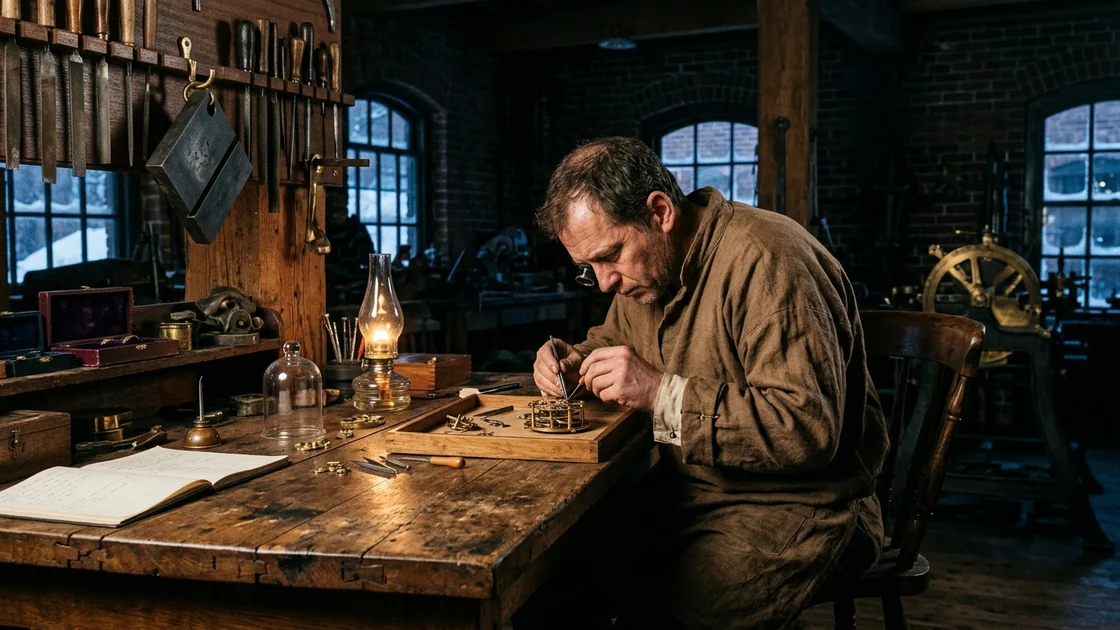
Julian Mercer spent three decades trying to outrun the memory of an autumn evening when, fueled by youth and bitter despair, he helped desecrate the sanctuary of an eccentric clockmaker named Tobias Albright. When Tobias passes away and leaves his entire estate to Julian, the bewildered draftsman returns to the decaying river workshop only to uncover ledgers, letters, and quiet interventions proving that the solitary man he terrorized had spent a lifetime acting as his anonymous savior.
Chapter I: The Notice of Bequest
The letter arrived on a Tuesday in late November, delivered in a manila envelope that smelled faintly of iron shavings and damp cellar stone.
Julian Mercer sat at his drafting table in the third-floor apartment he rented above an upholstery shop in Southwark. Outside, the rain was a steady, gray needlework sewing the sky to the chimney pots. Across his desk lay half-inked schematics for a municipal drainage station in Leeds—routine, uninspired work that paid his coal bills and little else. At forty-four, Julian had the hunched shoulders of a man who spent his life coaxing straight lines out of warped rulers. His knuckles bore small white commas of scar tissue, souvenirs of an adolescence spent in places where things were broken rather than built.
The envelope had been forwarded twice. It bore the return seal of Sterling & Finch, Solicitors at Law, an address in the river town of Blackwood, thirty miles upstream. Julian had not set foot in Blackwood since the summer of 1994, when he had boarded a south-bound coach with a canvas duffle bag, twenty-two pounds in change, and the distinct, choking sensation that if he lingered another week, the earth would open and swallow him whole.
He opened the letter with an ivory-handled bone folder, taking care not to tear the parchment within.
Dear Mr. Mercer, the typed script began, crisp and unforgiving beneath an embossed crest.
We write to inform you of the passing of Mr. Tobias Albright, formerly of The Millrace Foundry, Blackwood, who departed this life on the fourteenth of October last, at the age of ninety-one. Pursuant to the provisions of the decedent’s Last Will and Testament, dated fourth of May, 2002, you have been named the primary beneficiary and sole residuary legatee of his estate, including the real property, mechanical instruments, personal effects, and all associated holdings.
Julian lowered the paper. The rain rattled against the glass, sudden and violent.
Tobias Albright.
The name had not crossed his lips in thirty years, yet it lived in the quietest, most shameful cellar of his memory. It was an echo associated not with warmth or family, but with the hollow crump of splintering pine, the sharp silver chime of dropped gears, and the smell of paraffin oil pooling on flagstones.
Julian rubbed his thumbs against his palms. The skin there was calloused from pencil leads and drafting knives, but beneath the flesh, his nerves remembered a colder texture: the jagged edge of an antique marine chronometer smashed against an anvil.
"It’s a mistake," he muttered into the quiet room. "A clerk pulled the wrong registry. Or a namesake."
He picked up the second sheet. Clipped to the legal text was a handwritten note on heavy, cream-laid paper, yellowed around the margins as if it had been sealed inside an airtight tin for years. The hand was an antiquated copperplate, spider-thin, each ascender looped with trembling precision.
Julian, the note said. The keys are beneath the third flagstone to the right of the waterwheel sluice, though Mr. Sterling will provide you with the brass set. Do not sell the gear-cutting engine to the scrap merchants in Whitechapel; they know the price of copper but not the pitch of an escapement. What was fractured can be pinned. Come home and look at what remains.
There was no signature, only a small mark drawn in faded ink at the foot of the page: the silhouette of a five-spoke wheel, its teeth unevenly spaced, like the comb of a music box that had survived a fire.
Julian sat motionless until the room lost its light. When the coal fire burned down to ash and the streetlamps flickered to life below his window, casting elongated bars of amber through the wet glass, he stood, folded the papers back into the envelope, and packed an overnight satchel.
He did not know why he was going. An inheritance from a stranger was a curiosity; an inheritance from an enemy was a summons.
Chapter II: The Road to the Blackwood Sluice
The local omnibus dropped Julian at the crossroads two miles outside Blackwood’s municipal square. The road had not changed, though the trees had grown thick and wild, their bare branches arching over the tarmac like the ribcage of an immense, overturned barge.
Blackwood had been built upon the confluence of two swift, brown rivers that once powered three dozen woolen mills and ironfoundries. By the nineteen-eighties, the mills had closed one by one, their waterwheels choked with willow-herb and their slate roofs collapsing into the raceways. When Julian was a boy, the town was defined by the whistle of the five o’clock shift that no longer blew, and the bitter, idle men who leaned against the red-brick walls of the closed Methodist chapel, passing bottles in brown paper sacks.
His mother, Martha Mercer, had worked thirty years at the dry-goods counter of the cooperative store until her joints seized up with arthritis. His father had died before Julian could form an image of his face—a dockworker whose heart had failed under a crate of pig iron. Julian had grown up in a terrace house where the wallpaper curled from dampness and the winter tea was brewed from twice-boiled leaves.
He walked with his hands deep in his coat pockets, the gravel crunching beneath his boots. The morning fog was rising from the canal, smelling of marsh grass, coal soot, and rotting alder leaves.
He passed the old schoolyard, its iron railings now scaled with orange rust, and turned down Millrace Lane. The road descended steeply toward the river gorge, where the water ran faster, foaming around ancient limestone cutwaters.
At the bottom of the gorge stood The Foundry.
It was not a single house, but a sprawling, timber-and-brick complex that had begun life in the eighteenth century as a millwright’s shop, later expanding into an brass-casting yard, an optical workshop, and a three-story residential tower capped by a conical slate roof. A wooden flume, black with moss, carried a stream of water from the millrace directly into the lower masonry, where a narrow iron wheel turned with a rhythmic, subterranean clack-thump, clack-thump that Julian felt in the soles of his boots before he could hear it.
Tobias Albright had lived there alone for as long as the town could recall. He had been an old man even when Julian was a boy: tall, impossibly lean, with a gray beard cut square across the breast of his canvas smock, his fingers permanently stained with walnut oil and graphite. He was not a hermit in the reclusive sense—he came to town twice a month to buy salt, saltpeter, flour, and whale-oil soap—but he spoke only when spoken to, and then in a low, gravelly voice that sounded like water flowing over pebbles.
The boys of Blackwood had told monstrous tales about him. They said he had been an apprentice to an alchemist in Prague; they said he kept human fingers pickled in glass jars to test his bone-saws; they said he had buried gold sovereigns beneath his floorboards after his brother drowned in the weir.
Julian paused at the rusted iron gate. The gate hung open, held back by a twist of wire.
"You're thirty minutes late, Mr. Mercer," a voice called out.
From the porch of the residential wing stepped a small, dry-looking gentleman wearing a heavy tweed overcoat and carrying a pigskin briefcase. He had round spectacles perched on an aquiline nose and a wool scarf wrapped three times around his throat.
"Mr. Sterling?" Julian asked, approaching the steps.
"The same," the solicitor said, offering a gloved hand that was surprisingly firm. "Arthur Sterling. I drew up Mr. Albright’s instruments twenty-two years ago. I have been coming out here once a quarter ever since to ensure he hadn't frozen to death over an assembly bench. He was a difficult man to assist, Mr. Mercer. He possessed an extraordinary resistance to comfort."
"I don't understand this," Julian said, his voice flat against the murmur of the river. "There must be family. A nephew. A cousin in Lancashire. Anyone."
Sterling produced a heavy iron ring holding a dozen brass keys, each tagged with parchment labels in that same spindly, beautiful hand.
"Tobias Albright had no family living at the time of his death," Sterling said, unlocking the broad oak door. "His brother died sixty years ago. His wife died in the spring of forty-seven. He had a daughter who died in infancy. If there are second cousins in the West Riding, he took pains to legally exclude them. He named you. Exclusively. Specifically. With three conditions that cannot be called onerous."
Julian stood on the threshold. The smell hit him first: camphor, tallow, beeswax, old paper, and the sharp, alkaline bite of vinegar used to clean oxidized copper. It was the exact smell that had clung to his own jacket thirty years ago when he had fled into the night.
"What conditions?" Julian asked.
"First, that you reside here for seven consecutive days before deciding whether to keep or liquidate the property," Sterling said, stepping into the hall. "Second, that you do not open the locked cabinet in the cellar until the evening of the seventh day. Third, that you do not burn any papers found in the drafting loft."
Sterling set his briefcase on a long walnut refectory table that ran along the north wall of the entrance hall. The wood was clean, though dull with age; someone had swept the floor recently, leaving neat furrows in the fine sawdust near the baseboards.
"And if I refuse?"
"Then the entire estate—the land, the structures, and the balance of nineteen thousand pounds held in trust at Barclays—escheats to the Crown," Sterling said simply. He removed his glasses, polished them with a silk square, and looked directly into Julian’s eyes. "He was entirely of sound mind, Mr. Mercer. I had him examined by two separate physicians from Leeds when the will was amended. He anticipated your reluctance. In fact, he told me: 'Julian will want to run away from it, because he thinks the stones have teeth. Tell him the teeth are made of pine, and pine rots.'"
Julian looked away, his eyes tracing the timber beams of the ceiling. A chill seemed to settle into his ribs.
"He remembered," Julian whispered.
"He remembered everything," said the solicitor. "The inventory is on the sideboard. The pantry is stocked with tea, tinned beef, and dry biscuits. The pump at the scullery sink draws sweet water from the upper spring. I shall return on next Tuesday morning at nine o’clock with the deeds and the final discharge papers. Until then, the keys are yours."
Sterling did not wait for an invitation to leave. He tipped his hat, pulled his scarf higher around his chin, and stepped out into the mist, the heavy oak door swinging shut behind him with the dull, conclusive thud of a bank vault.
Chapter III: The Anatomy of a Sins
Alone in the house, Julian did not inspect the pantry or build a fire in the hearth. He stood in the entrance hall until the footsteps of the solicitor had vanished down the lane, his satchel resting on the floor beside his boots like an abandoned creature.
His pulse was hammering in his throat.
October 28th, 1994.
He had been fourteen. His mother had been bedridden for three weeks with what the dispensary doctor called "congestion of the pleural lining"—a polite name for the gray fluid filling her lungs while the coal grate stood cold because there were no shillings left for the meter. Julian had been hungry for forty-eight hours, living on crusts soaked in water with a pinch of salt.
In the alley behind the railway arches, Corey Vance and Leo Ramos had been waiting. Corey was seventeen, with teeth yellowed from cheap tobacco and knuckles scarred from pub brawls; Leo was sixteen, thick-set, stupid, and terrified of his older brother. Corey had a short crowbar tucked into the sleeve of his donkey jacket.
"The old crank down the race," Corey had said, spitting into the cinder path. "He don't use banks. My uncle seen him come out of the post office with fifty quid in cash every Michaelmas. He keeps it under the floorboards behind the lathe. He’s ninety if he’s a day. We go in through the flume hatch, get the tin, and we’re out before he can find his slippers."
Julian hadn't wanted the money for sweets or cinema tickets. He had wanted two sacks of anthracite, three tins of condensed milk, and the bottle of brown syrup the chemist kept behind the mahogany counter that stopped his mother’s coughing fits so she could sleep for four hours without weeping.
"I’m not breaking nothing," Julian had said, his voice cracking with the humiliating squeak of puberty.
"Nobody asked you to break nothing, little clerk," Corey had sneered, shoving him against the brickwork. "You’re thin enough to drop through the ventilator above the turbine. You slide down, slip the iron latch on the lower workshop door, and you keep watch. You get twenty percent. That’s ten quid. Enough to buy your old lady her medicine and a bonnet to go with it."
They had waited until midnight, when the rain had turned the Blackwood gorge into a roaring sluice of black water.
They hadn't found gold sovereigns.
When Julian had dropped through the narrow, grease-slicked vent into the lower shop, his boots had landed not on flagstones, but on a shelf of glass tubes—long, calibrated cylinders used for measuring the specific gravity of liquids. They had shattered beneath his heels with a sound like ice snapping on a pond. Panic, cold and electric, had seized him. He had scrambled to the heavy timber door, his fingers slipping on the iron bolts, and when the wood groaned open, Corey and Leo had burst through like two dogs into a larder.
They had not looked for tins. They had looked for everything and found only things they could not understand.
Tobias Albright’s workshop had been a paradise of precision. For sixty years, he had made marine chronometers for the Admiralty, balance wheels for master clocks, and micro-metric transit instruments for surveying stars. Every shelf held dozens of turned mahogany boxes lined with velvet; every drawer contained miniature brass gears, pinions cut to the thousandth of an inch, hairsprings fine as a woman’s eyelash coiled inside watch-glasses filled with sweet oil.
Corey, enraged by the absence of banknotes, had gone mad.
"Where is it?" he had screamed, his crowbar swinging through an arched cabinet of glass-fronted drawers. "Where does the old bastard keep it?"
The destruction had been methodical, senseless, and total. Corey had swept his crowbar along the main workbench, sending three months of finished work crashing to the stone floor: a compensated pendulum with mercury-filled steel cylinders, an antique English lever escapement with an inverted balance, an astronomical dial painted on silvered brass that bent double beneath Leo’s iron-shod boots.
Julian had stood paralyzed against the brick pillar, his hands pressed to his ears to shut out the sound of brass snapping like poultry bones.
"Stop," he had whispered. "Corey, stop, there’s nothing here. Let’s go."
"Shut your mouth!" Corey had roared, kicking over a stone jar of nitric acid used for etching. The liquid had hissed across the flagstones, sending up a choking, white vapor that smelled of scorched tin and lemon peel.
And then, the light had appeared.
At the head of the wooden staircase leading down from the residential tower, a door had opened. Tobias Albright had stood there, wearing a flannel nightshirt over his gray trousers, holding an iron oil lantern in his left hand. He had carried no gun, no club, no poker.
He had not shouted. He had not blown a whistle or called for the watch.
He had simply walked down the stairs, one step at a time, his boots unlaced, his lantern held high so that the yellow light illuminated the wreckage: the smashed cases, the gears crushed into the flagstones, the pool of acid eating the brass teeth of a thirty-year-old dividing engine.
Leo had bolted instantly, scrambling through the open flume door like a rat. Corey had hesitated, his crowbar raised, his chest heaving.
"You touch me, you old ghost, and I’ll split your skull," Corey had spat.
Tobias had not looked at Corey. His eyes, large and watery behind thick, wire-rimmed lenses, had drifted over the broken brass, over the puddle of acid, and then—with a terrible, slow deliberation—they had settled on Julian.
Julian had been frozen to the pillar. In his right hand, without knowing he had picked it up, he held a heavy steel scribing block—a solid wedge of hardened metal with a needle-sharp point used for marking steel plates. He had gripped it like a weapon, though his entire arm had been shaking so violently that the point clicked against the stone wall behind him: tick-tick-tick-tick.
Tobias had looked at Julian’s face. He had looked at Julian’s torn canvas plimsolls, soaked through with icy canal water; he had looked at the ribs visible beneath Julian’s thin woolen jersey; he had looked at the terror in the boy’s eyes.
"The balance is ruined," the old man had said. His voice was not angry. It had been filled with an immense, ancient fatigue, as if he were noting the change in the weather. "The teeth were forty-eight to the inch. I cut them in July."
Corey had lunged forward, knocked the lantern from the old man’s hand—it had shattered on the stones, the oil catching for a brief, terrifying second in a blue ribbon of flame—and bolted through the door into the darkness.
Julian had dropped the scribing block. It had landed on a pile of mahogany shavings with a soft thud.
He had wanted to run, but his legs had turned to water. He had fallen to his knees among the brass shavings, his palms pressing into the sharp splinters of glass.
The old man had not struck him. In the dying blue light of the spilled oil, Tobias Albright had knelt down beside him. His long, calloused fingers—fingers that could balance a jewel on the tip of a needle—had reached out, caught Julian by the wrist, and lifted his hand from the broken glass.
Julian had expected him to twist the arm behind his back, to hold him until the constables arrived with their iron cuffs and damp cells.
Instead, the old man had turned Julian’s hand over, looking at the blood welling from three small cuts in the heel of his palm.
"You have thin fingers," Tobias had said quietly, his breath smelling of cloves and dry tea. "A draftsman’s hands. Why do you use them to smash gears?"
Julian had tried to speak, but only a dry sob had torn out of his throat. He had pulled his hand away with a desperate jerk, scrambled backward through the flume door, and tumbled into the freezing raceway, dragging himself through two feet of mud and weeds until he reached the bank.
He had run until his lungs burned with the taste of blood. Two days later, his mother had been admitted to the union infirmary; three weeks later, she was dead. Julian had never returned to the Foundry. When he saw Albright in the high street six months later, Julian had crossed the road and hidden behind the coal merchant’s dray until the old man passed.
And now, thirty years later, the dead man had given him the keys.
Chapter IV: The Scarred Benches
The workshop was silent save for the ceaseless clack-thump of the small turbine beneath the flags.
Julian walked down the wooden stairs, his satchel still clutched in his hand. His adult feet fell on the same steps that had creaked beneath Albright’s slippers that night.
The lower shop was vast, occupying the entire ground floor of the old masonry mill. High, arched windows along the river wall let in a cold, slate-gray light that fell upon six long workbenches, each anchored to the floor by four-inch baulks of English oak.
Julian stopped at the first bench.
It was the bench Corey had struck with the crowbar. The deep, jagged gouges in the oak were still there, but they were no longer raw wounds. Tobias had planed the splinters smooth, filled the deep gashes with a dark, resinous pitch, and set small butterfly joints of pale sycamore across the cracks to hold the wood together.
On the bench sat the dividing engine—the very machine Julian had seen drowning in nitric acid.
Julian approached it slowly, setting his bag on the floor. He leaned over the brass wheel. It was four feet in diameter, its perimeter engraved with thousands of microscopic hatch marks. Where the acid had eaten into the metal thirty years ago, the brass was darker, pitted like the surface of an ancient coin, but each tooth had been rebuilt. Julian could see the microscopic lines where new brass had been dovetailed into the old, held by tiny silver rivets no larger than the head of a pin, then filed down until the profile was true.
It was not a repair made for utility alone. It was a work of devotional patience. It must have taken five years of dawn-to-dusk labor with an eyeglass and a needle-file to restore those three hundred teeth.
Beside the engine lay a small, leather-bound register. Julian opened it.
The entries were written in Albright’s copperplate hand, dated meticulously:
November 12, 1994: Cleaned acid from the index wheel. Four teeth destroyed on the secondary quadrant. Cleaned with chalk and oil.
January 4, 1995: Spliced new brass into tooth 112. The solder must be soft enough not to warp the rim, but hard enough to withstand the pawl. Failed twice.
March 22, 1995: The boy was seen near the canal basin today. He looks thinner. He was carrying a sack of turnips from the parish allotment. His boots have no heels.
Julian’s breath caught in his throat.
He turned the page, his thumb leaving a faint white smudge on the dry paper.
June 18, 1995: Martha Mercer buried today at St. Jude’s. Rain heavy. Julian stood by the elder bush near the sexton’s shed. He did not have an umbrella. I spoke to the rector afterward regarding the parish maintenance fund. The boy must not go to the workhouse school in Ripon; the master there is a brute who beats the boys with a hazel rod.
August 30, 1995: Paid the first term’s fee for the Bluecoat Grammar School at Ripon under the name of the 'Trustees of the Weaver’s Benefaction.' Rector Evans will handle the receipts. Julian believes the money came from his mother’s distant cousin in Halifax. It is better he thinks so. A boy cannot learn mathematics if he thinks he is eating bread bought by a ghost.
Julian dropped the book against the bench. The pages rustled, then fell open to an entry three years later:
October 14, 1998: Julian has taken first prize in mechanical drawing. The headmaster sent me his drawing of a water-turbine housing. His lines are clean. His verticals do not waver. He has the eye for the gap—the space where the oil must go between the steel and the brass. I have purchased his drawing from the school board for three guineas. It hangs in the tower room.
Julian felt the room tilt around him. The steady clack-thump of the waterwheel seemed to speed up, drumming against his temples.
"No," he said aloud. "No, this isn't..."
He turned and ran up the stairs, taking them two at a time, his coat catching on the iron banister.
He burst into the residential tower.
The second floor was a combination of kitchen and library. Books lined every wall from the floor to the exposed timber ceiling: treatises on horology by Berthoud, Harrison, and Graham; volumes on spherical trigonometry, metallurgy, and celestial mechanics; leather-bound sets of the Philosophical Transactions of the Royal Society.
In the center of the room, above an iron stove that still held the gray ashes of Albright’s last fire, hung a single framed drawing.
Julian stood before it, his boots rooted to the sheepskin rug.
It was an ink-and-wash drawing on watermarked Whatman paper: A Proposal for an Inward-Flow Radial Turbine, with Details of the Gate Mechanism and Bearing Brackets. In the lower right corner, in the stiff, self-conscious handwriting of an eighteen-year-old trying to appear twenty-five, was written:
Julian Mercer, Form VI, The Bluecoat School, Michaelmas Term, 1998.
Julian remembered the day he had drawn it. He had worked thirty-six hours without sleep in the unheated attic of his boarding house, his fingers so numb he had had to warm the nib of his ruling pen over a tallow candle to keep the ink flowing. When the rector had told him an anonymous patron of the school had bought the sheet for three guineas, Julian had wept in the dormitory washroom, because three guineas had meant he could buy his first set of German-made brass compasses and a pair of trousers that reached his ankles.
He reached out. His trembling fingers touched the dark walnut frame. The glass was clean, wiped free of dust only days before the old man had died.
Behind the drawing, tucked into the margin between the mount and the glass, was a folded slip of blue paper. Julian slid it out with careful, clumsy fingers.
It was a canceled check, drawn on the Blackwood Union Bank, dated November 3, 1998.
Pay to the order of Julian Mercer: Three Guineas.
Signed: Tobias Albright.
On the back, in Albright’s hand, was a single sentence:
The teeth were repaired. The drawing is true.
Chapter V: The Ledgers of Providence
The rain stopped toward evening, leaving the sky the color of a bruised plum over the moors.
Julian did not eat. He built a small fire in the kitchen stove with kindling from the scullery box, watching the yellow flames lick through the birch bark until the cast-iron top began to tick with expanding heat. He found a tin of black tea in the larder, brewed a pot with water from the copper kettle, and sat at the long table surrounded by the papers he had brought down from the drafting loft.
There were seven ledgers in all, bound in green cloth with corners of rough calfskin. They covered the years from 1994 to 2018.
They were not diaries; they were the account books of an engineer who regarded human charity as an exercise in structural mechanics—a matter of calculating strain, tensile strength, and the distribution of loads so that a fractured beam did not collapse entirely.
Julian opened the second volume, dated 1999–2003.
September 14, 1999: To Messrs. Henderson & Son, Land Surveyors, Leeds: Twenty-five pounds, being the premium for the articled apprenticeship of J. Mercer. (Note: Instruct Henderson that the boy is not to be used merely for carrying chains or making tea. He must be set to the drafting table three days a week. If he lacks mathematical instruction in the calculus of stresses, Henderson must pay for the evening lectures at the Mechanics' Institute and debit my account under Account 'B'.)
March 4, 2001: Julian has contracted scarlet fever at his lodgings in Hunslet. Sent Dr. MacIntyre from Harrogate with two carboys of carbolic and five pounds for the landlady to provide clean linen and mutton broth daily. MacIntyre reports the boy was delirious for three days, calling out about broken glass and an iron weight. I must ensure he does not return to work before the chest has cleared.
August 12, 2003: Julian has completed his articles. Henderson informs me he has been offered a junior post with the North-Eastern Railway at eighty pounds per annum. A respectable beginning. He has designed a signal-box bracket that saves forty pounds of cast steel per unit. He has his father’s shoulders, but his mother’s chin. He walks with his head down, as if he expects someone to strike him from behind.
Julian covered his face with his hands.
The fire in the stove hummed, the iron throat of the flue drawing the heat upward into the damp stones of the tower.
All through his twenties, Julian had believed himself to be an orphan of the world—a boy who had dragged himself up from the cinder heaps of Blackwood by sheer, solitary grit. He had been proud of his loneliness. He had worn his friendlessness like a suit of plate armor, telling himself that he owed nothing to any living soul because no soul had ever given him anything without demanding twice its value in return.
When his first employer, Henderson, had unexpectedly given him a bonus of ten pounds at Christmas in 2000, Julian had spent it on drafting instruments and had written a curt, formal note of thanks, convinced the old Scotsman was merely trying to keep him from seeking higher wages elsewhere.
Now he saw the ledger entry for that same Christmas:
December 20, 2000: Sent Henderson twelve pounds. Ten for Julian’s bonus, two for Henderson’s trouble. The boy must have new boots; the soles of his current pair are thin as card, and he walks four miles a day through the slush.
"Why?" Julian whispered into the empty room. "Why didn't you tell me? Why didn't you make me pay for it?"
The silence of the house gave no answer except the steady, subterranean pulse of the millrace.
Julian stood up and walked to the high, arched window that looked out over the river. The moon had broken through the cloud cover, casting a cold, metallic sheen over the black water as it plunged over the weir.
Below him, in the lower garden between the masonry wall and the raceway, stood a small orchard of stunted damson trees. Their trunks were twisted, their branches bare, but their bases were neat, banked with river gravel and pruned with the same geometric precision that Albright applied to his clock-teeth.
Julian remembered Corey Vance. Corey had been sent to the penal colony at Portland five years after that night, after he had nearly killed a night watchman during a robbery at the railway goods yard. He had died there of typhus at twenty-seven. Leo Ramos had drifted to Manchester, working the docks until he was crushed between a timber lighter and a granite pier.
Only Julian had escaped.
He had escaped not because he was cleverer, or stronger, or more virtuous than Corey or Leo. He had escaped because an old man with an eyeglass and a pot of nitric acid had decided to catch him by the wrist, lift him from the broken glass, and spend thirty years rebuilding him, gear by gear, tooth by tooth, in the dark.
Chapter VI: The Unfinished Chronometer
On the fourth day of his stay, a heavy, unseasonal snow fell across the valley, burying the road to Blackwood under six inches of white silence.
Julian spent the hours working in the shop. He did not know what else to do. He found an old smock hanging behind the door—thick, brown linen that smelled of lavender and neat’s-foot oil—and slipped his arms into the sleeves. It was slightly too long for him, but across the shoulders, it fit with an uncanny, unsettling precision.
He found the central workbench clear, save for a wooden tray covered with a square of oiled silk.
Julian lifted the silk.
Beneath it lay a marine chronometer—not an antique, but a machine in the process of being born.
The main plate was five inches across, turned from solid phosphor-bronze. The pillars that supported the upper bridges were shaped like tiny Doric columns, their capitals turned with microscopic fluting. The train was half-assembled: the great wheel, the fusee, and the center wheel were already pinned into their jewel-bearings, but the balance—the beating heart of the instrument—was missing.
Beside the tray lay a set of jeweler's tweezers, three small screwdrivers with boxwood handles, and a glass bell jar.
Inside the bell jar sat the balance wheel.
It was a bimetallic compensation balance, designed to expand and contract with the heat of the tropics or the cold of the Arctic sea so that its rate remained true to within a tenth of a second a day. The rim was made of brass and steel laminated together, cut through at two opposing points so that the free ends could curl inward or outward with the temperature.
It was incomplete.
One of the tiny gold compensation screws along the rim—screws no larger than a grain of mustard seed—had been left half-threaded into its hole. Beside it lay the tap, an infinitesimal needle of threaded steel with a handle no thicker than a toothpick.
Julian picked up the eyeglass that lay beside the tray. He screwed it into his right eye socket, leaning down until the bronze plate filled his vision.
The work was breathtaking. There were no file marks, no burrs, no uneven edges. Every surface had been lapped with diamond dust and oil until it reflected the light like gray water.
Julian looked at the gold screw. He picked up the boxwood-handled screwdriver. His hand, which had held nothing smaller than a 0.2-millimeter technical pen for twenty years, was shaking.
He set the tool down.
"I can't," he muttered. "I'll break the tap."
He walked away from the bench, his smock rustling against the timber drawers. He paced the length of the shop, counting his strides: thirty-two paces from the flume wall to the forge, fourteen paces from the dividing engine to the tool racks.
Every tool hung in its place. The gouges, the chisels, the scraping irons, the hand-vises, the pin-tongs—all arranged by size, their steel polished, their wooden handles darkened by forty years of Albright’s palms.
Julian stopped before the tool rack.
In the center of the mahogany board, hanging from a small brass cup-hook, was an object that did not belong among the fine Swiss files and English chisels.
It was the steel scribing block.
Julian took it down from the hook. It was heavy, cold, and dark with age. The base was scarred where it had fallen onto the flags thirty years ago; the sharp needle-point was slightly blunted at the tip.
Tobias had not ground the point down. He had not polished out the nick in the base. He had kept it exactly as it had fallen from Julian’s fourteen-year-old hand, hanging it among his most delicate instruments like a trophy—or a reminder.
Julian turned the heavy iron wedge over in his hands.
On the bottom of the lead-weighted base, scratched into the soft metal with an engraving needle, were two lines of text:
J.M. October 28, 1994. The weight that falls can also drive the wheel.
Julian stood in the center of the cold shop, holding the iron block against his chest.
The waterwheel below the flags continued its slow, indifferent turn: clack-thump, clack-thump, clack-thump. It was the sound of time being measured out, not in hours or minutes, but in foot-pounds of work—the river spending its weight against the curved paddles of the wheel, turning the shafts, driving the pumps, keeping the water from drowning the foundations.
Julian returned to the bench.
He did not take off the smock. He sat down on the high wooden stool, adjusted the paraffin lamp so that its yellow beam fell directly upon the brass tray, and screwed the jeweler’s eyeglass back into his eye.
He picked up the tweezers with his left hand and the tiny screwdriver with his right.
He rested his wrists against the edge of the oak bench, taking three slow, deep breaths, exactly as his drawing master had taught him thirty years ago when he had to ink an unbroken curve across a three-foot sheet.
The tremor in his fingers slowed, flickered, and died.
With the tip of the tweezers, he engaged the head of the gold compensation screw. With the screwdriver, he found the microscopic slot. He turned his wrist—a sixteenth of an turn, then an eighth, feeling through the boxwood handle the delicate, terrifying bite of the threads engaging the steel rim.
The screw turned. It did not bind. It did not shear.
It sank into the rim until its polished head sat flush against the shoulder of the brass laminate.
Julian lowered his hands. He took the eyeglass from his eye and let out a long, ragged breath that fogged the cold glass of the lamp chimney.
Outside, the snow was falling thicker now, drifting against the lower panes of the workshop windows, sealing the Foundry inside a world of white silence where the only living things were the river, the iron wheel, and the draftsman sitting at the dead man’s bench.
Chapter VII: The Seventh Night
On Monday evening, the snow ceased, and a hard, blue frost gripped the valley.
It was the seventh night.
According to the terms read by Arthur Sterling, Julian was now permitted to open the locked iron cabinet that stood in the damp cellar beneath the turbine flume.
Julian took the smallest brass key from the ring—the one labeled simply No. 12: Vault—and lit the oil lantern. He carried no tools with him, only the key and a woolen blanket he had wrapped around his shoulders against the cellar damp.
The stairs to the lower cellar were cut directly into the living limestone of the gorge. Water seeped through the fissures in the rock, glistening like snail trails in the yellow light of the lantern. At the bottom, the noise of the river was no longer a murmur; it was an immense, roaring presence, separated from the cellar floor only by a two-foot wall of cyclopean granite masonry through which the heavy iron axle of the waterwheel passed.
In the corner, bolted to the stone wall above the high-water line, stood the cabinet.
It was not large—perhaps three feet high and two feet wide—made of boilerplate iron riveted together with heavy, round-headed bolts. It looked more like a small marine boiler than a safe.
Julian inserted the key into the central ward. The lock was stiff, its tumblers dry from years of river damp. He leaned his shoulder against the iron door, turning the key with both hands until he felt the heavy brass bolt drop with a dull, subterranean clonk.
The door swung open on forged iron hinges that screamed against their pins.
Julian held the lantern high.
Inside the cabinet there were no bars of gold, no stacks of banknotes, no family silver.
There were only three objects.
The first was a wooden box of watercolors—Windsor & Newton, their cakes dried and cracked with sixty years of age—with a porcelain mixing palette clean as bone.
The second was a small leather case containing a woman’s silver pocket watch, its crystal cracked down the middle like an open eye, its hands frozen at twelve minutes past four.
The third was a thick bundle of letters, tied with tarred marline twine, resting upon a flat cedar board.
Julian reached in and lifted the bundle of letters. The cedar board beneath them was engraved with a name:
Rachel Albright (1945–1947)
Julian set the letters on the flagstone floor, his knees sinking into the damp moss that grew between the stones. He picked up the silver pocket watch.
He pressed the release catch. The cuvette sprang open. Inside the back cover, scratched with a dry point, was an inscription:
To Tobias. Keep the rate true, though the ship go down. Rachel, 1944.
Julian sat back against the cold limestone wall.
He knew the story now, though no man had told it to him. He remembered the old cemetery behind the chapel in Blackwood—the small, weed-choked plot near the weir where three slate markers stood together beneath a weeping ash: Hannah Albright, beloved wife, died March 12, 1947. Rachel Albright, daughter of the above, aged eighteen months, died April 4, 1947.
The spring of forty-seven had been the year of the great thaw, when the Blackwood gorge had overflowed its banks in twelve hours, sweeping away the weavers' cottages along the race, drowning forty people in their beds before the alarm could be rung.
Tobias Albright had lived forty-seven years after that flood.
He had lived forty-seven years in the very room above the water that had drowned his wife and child, listening night after night to the same wheel turning in the same dark raceway, cutting his brass gears to the forty-eighth of an inch, measuring time that had ceased to have any meaning for him on the day his daughter’s cradle floated out through the broken flume gate into the river.
Julian picked up the bundle of letters.
They were not letters from his wife. They were addressed to Tobias Albright, written in dozens of different hands, bearing postmarks from Leeds, Manchester, London, Newcastle, and Edinburgh.
Julian untied the marline twine.
The top letter was dated June 1962:
Dear Mr. Albright, it read. The boy, David Thorpe, whom you sponsored through the brass-molder’s guild at Sheffield, has passed his examination with distinction. He has been taken on at the Vulcan Works. He does not know the source of the premium, as you requested. He believes the grant was from the Ironmongers’ Company. He asks that I send you his first test casting—a six-inch gear blank—which I enclose by parcel post today.
Julian opened the second letter. It was dated November 1971:
Mr. Albright: The girl, Mary Henderson, has completed her nurse’s training at St. Thomas’s. The hospital fees were settled from the trust account as instructed. Her brother, whom you assisted after the coal-pit collapse at Altofts, is now working as a clerk on the canal board. Neither has been informed of your name.
There were dozens of them. Fifty. A hundred.
Julian sat on the cold floor of the cellar, the lantern flickering as the draft from the river blew through the weeping stone.
Tobias Albright had not been a recluse who hated the world.
He was a man who had been shattered into fifty pieces by an unendurable blow, and who had spent fifty years down in the dark, picking up other broken things—broken brass, broken boys, broken apprentices, children drowning in the industrial silt of the valley—and silently, secretively, pinning them together with gold and silver rivets so that they might hold the weight of life without snapping.
Julian looked down at his own hands.
He had thought himself Albright’s victim; then he had thought himself Albright’s penitent.
Now he understood the terrible, magnificent truth: he was simply Albright’s work.
Julian had been one of the ruined wheels Albright had found in his shop. The old man had looked at the terrified, violent, half-starved boy who had smashed his instruments, and he had not seen a criminal to be punished. He had seen an escapement that had jumped its banking pins—a mechanism running wild because its hairspring was tangled in soot and grease.
And so he had set to work. He had planed the gouges out of the bench. He had spent his savings through third parties to give the boy an eye for the straight line, a hand for the ruling pen, a profession that would lift him out of the coal dust and the workhouse graves.
And at the end, when his own ancient hands could no longer hold the eyeglass or turn the micro-metric screw, he had called Julian home, laid the tools upon the oak bench, and died, leaving the unfinished chronometer waiting for the apprentice’s hand.
Julian bowed his head over the cedar board.
He wept—not with the bitter, frightened tears of the fourteen-year-old boy in the acid fumes, but with the slow, cleansing grief of a man who has finally seen the measure of the grace that has held him up his entire life.
He wept until his lantern smoked and died, leaving him in the absolute darkness of the Foundry cellar, with only the river roaring beyond the stone and the steady, tireless heartbeat of the waterwheel turning below: clack-thump, clack-thump, clack-thump.
Chapter VIII: The Measure of What Remains
Arthur Sterling arrived precisely at nine o’clock on Tuesday morning, his black umbrella dripping sleet onto the gravel path.
He carried his pigskin briefcase, his woolen scarf, and a set of parchment deeds tied with pink legal tape.
When Julian opened the door, the solicitor blinked through his round spectacles, momentarily startled.
Julian was not wearing his town coat. He wore the heavy linen smock, its cuffs turned back and pinned with two brass paperclips. His cheeks were smudged with charcoal from the stove, and his fingers were dark with whale oil and emery paste.
"Mr. Mercer," Sterling said, stepping into the hall. "The seven days have expired. I trust you have found the property... habitable?"
"It is cold," Julian said. "The roof above the forge needs twenty slates replaced before the spring rains. The raceway wall has two cracked stretchers near the lower sluice that must be rebuilt with hydraulic lime."
Sterling set his briefcase on the refectory table. He unbuckled the straps and drew out the deeds.
"Then you have decided to liquidate?" Sterling asked, his tone neutral, professional, detached. "I have already received an inquiry from a timber merchant in Keighley who is interested in the parcel for the storage of pulp-wood. He would clear the masonry within the year. The trust funds, of course, would be transferred directly to your account in London."
Julian did not answer immediately. He walked to the window, looking down at the orchard, where the frost was beginning to drip from the damson boughs beneath a pale, watery sun.
"No," Julian said.
The solicitor paused, his fountain pen suspended above the parchment.
"No?"
"The gear-cutting engine cannot be moved," Julian said, his voice quiet, clear, and steady. "The bed is keyed directly into the bedrock of the valley. If you move it two inches, the vibrations from the road will ruin the pitch of the index plate. Tobias spent five years setting it true."
Sterling looked over the top of his spectacles. A faint, almost imperceptible smile touched the corners of his thin lips.
"And what will you do with an optical workshop and a three-story mill, Mr. Mercer? You are a draftsman for the Leeds municipal drainage board."
"I resigned yesterday," Julian said. "I posted the letter to the town clerk."
Julian turned back from the window. He walked to the refectory table and laid an object down beside the legal deeds.
It was the unfinished chronometer.
The bimetallic balance was in its place now, suspended between two sapphire jewel-holes beneath the polished brass bridge. The gold compensation screw was flush; the hairspring, fine as an eyelash, coiled inward in a perfect Archimedean spiral, its outer curve pinned to the stud with a tiny wedge of hard boxwood.
Julian touched the rim of the balance with the tip of his finger.
He gave it a gentle, quarter-turn impulse.
The balance swung free. It turned one hundred and eighty degrees, paused for an infinitesimal fraction of a second against the tension of the spring, and then—smooth, silent, and true—it swung back.
Tick.
The sound was not loud. In the vast, vaulted hall of the old mill, it was no louder than the crack of a dry twig or the drop of a single bead of water from a limestone stalactite.
Tock.
The escapement caught the impulse. The escape wheel turned one tooth, its polished steel flank sliding across the jewel face with a whisper of pure, frictionless geometry.
Tick. Tock. Tick. Tock.
The solicitor looked down at the brass instrument. The detached, professional neutrality of his face cracked, revealing beneath it the tired, affectionate sorrow of an old friend who had kept a secret for thirty years.
"He told me you would see it," Sterling said softly.
"He was an arrogant man," Julian said, his eyes bright with unshed tears. "He thought he could calculate everything. He thought he could take a ruined, worthless boy who smashed his life’s work, and file him down until he was square with the world."
"And did he?" the solicitor asked.
Julian reached down. He picked up the heavy bone pen from the solicitor’s tray, dipped the nib into the black ink, and signed his name at the foot of the parchment deed: Julian Mercer, Millwright and Horologist.
"No," Julian said, looking at the brass wheel beating between its jewels like a small, mechanical heart. "He didn't make me square. He left the scars where they were, so I would remember that things don't hold together because they're whole."
He laid the pen down beside the inkstand.
"They hold together because someone took the time to pin the fractures with gold."
Chapter IX: The Work at the Weir
In the spring of 1995, the river had risen, but the new oak sluice gate held.
By summer, the boys of Blackwood had found a new legend to tell in the alleyways behind the railway arches.
They said the old man in the Foundry had died, but that another had taken his place—a tall, quiet man with gray hair at his temples and an architect’s smock who worked late into the night beneath a green-shaded lamp. They said he was just as mad as the first; he bought old iron from the carters, repaired the town clock when its chimes froze in January, and never charged a penny to the church wardens.
And sometimes, on Saturday mornings, if a boy was caught throwing stones through the leaded windows of the old church or stealing coal from the sidings, the constables did not take him to the lockup in the market square.
They brought him down the steep gorge road to the iron gate that was always held open by a twist of wire.
There, the draftsman would be waiting on the timber porch. He would look at the boy’s torn trousers, his dirt-caked knuckles, and the fierce, cornered terror in his eyes.
He would not reach for a cane or a constable’s ledger.
He would simply reach into his pocket, pull out a heavy, dark wedge of iron with a blunted needle-point, set it on the oak bench between them, and say:
"Come inside. The wheel is turning, and there is work to be done."