The Measure of a Debt
Julian Mercer lives in a four-hundred-square-foot basement apartment with a single window that frames only the boots of passing pedestrians, working twelve-hour night shifts as an orderly at the St. Judecrest Neurological Rehabilitation Center. Two years earlier, on an unlit rural bend slick with October sleet, his sedan struck nine-year-old Leo Vance and fled into the dark, leaving the boy with severed thoracic vertebrae and a ruined future. Incapable of turning himself in to the police out of an agonizing, self-preserving cowardice, Julian instead dismantled his entire middle-class existence, liquidated his home and retirement accounts through an anonymous offshore conduit, and took the lowest-paid support role at the very facility where Leo was committed. While Leo endures the grueling mechanics of relearning how to live in a paralyzed body, and his exhausted single mother Clara fights to keep their heads above a mountain of catastrophic debt, Julian works silently in the background, scrubbing floors, emptying bedpans, lifting the boy he broke, and methodically funneling hundreds of thousands of dollars into Leo's hospital account under the guise of an untraceable philanthropic trust.
I. The Wet Sleet
The sound never fully left the inner architecture of Julian’s ears. It was not a grand explosion, nor the cinematic screech of burning rubber; it was a dull, hollow percussive slap, like a heavy burlap sack of wet loam dropped from a roof onto gravel. Then, the tinny clatter of a small aluminum scooter skittering into the ditch, and the rain resuming its uninterrupted monologue against the windshield.
Julian had not touched wine that evening. He had not been texting. He had merely been tired—the hollowed-out, dry-eyed exhaustion of a junior partner at a structural engineering firm who had spent seventy-two consecutive hours redesigning a highway interchange that a city council committee had deemed four percent too expensive. His eyes had drifted for three seconds toward the dashboard clock: 10:14 PM. When he looked up, the yellow slicker had already caught the halogen beams.
He had hit the brakes, but the anti-lock system had pulsed uselessly over a skin of river-silt and leaves on Route 9. There had been the sickening lift of the front-left chassis, the thud, the slide, and the silence.
For two minutes, Julian sat in the idling Volvo. The heater hissed, smelling of dust and damp wool. Through the wiper-cleared arcs of glass, the night was empty. No headlights approached from either direction. No farmhouse windows glowed through the dripping hemlocks. He had opened the door, stepped out into the biting mist, and walked to the front bumper.
The boy was lying six feet down the culvert, half-submerged in the rushing run-off, motionless. One arm was bent beneath his ribcage; his yellow raincoat was torn at the shoulder, revealing a blue-and-gray striped thermal shirt. The scooter lay twenty feet further, its tiny rear reflector crushed into red crumbs.
Julian had not checked the pulse. He had not knelt. A cold, primeval wave of pure panic—an instinct so vile and cowardice-soaked that it felt like an acid bath inside his marrow—seized his spine. He saw his name in the county gazette. He saw his career evaporate. He saw the cold, iron bars of the state correctional facility at Green Haven. He had backed away, his boots sliding in the mud, scrambled into the leather driver’s seat, pulled the door shut with a muffled click, and driven away.
He did not go home. He drove ninety miles north to an unmonitored logging trail, spent five hours with a bucket of creek water and a nylon brush scouring the plastic fender, and then, two weeks later, traded the car for cash at an auto salvage yard outside Scranton, claiming he had struck a fallen beech limb during the storm.
The newspaper told him the rest three days later: Nine-year-old Leo Vance of Westfall found hypothermic and critically injured on County Route 9; driver sought in hit-and-run. Two weeks later: Local youth survives, but faces permanent paralysis below the T6 vertebra. Three weeks later: Community organizes pasta dinner for Clara Vance, single mother facing astronomical trauma costs.
Julian did not go to prison. He went somewhere far worse: he remained inside himself. The guilt was not an emotional pang; it was a physical parasite that laid eggs in his throat, making food taste of scorched copper and turning sleep into a series of suffocation dreams. By the sixth month, he had resigned from the engineering firm. He sold his townhouse in the historic district. He sold his father’s cherry-wood desk, his drafting table, his index funds, his watch. Through an uncommunicative, substance-dulled attorney in Jersey City who specialized in anonymous estates and debt shielding, Julian established a blind, revocable charitable trust called the Oakhaven Medical Endowment, naming the Vance child as its sole designated beneficiary.
Then, he moved into the basement flat on Elm Street, eight blocks from St. Judecrest. He applied for the position of night-shift orderly. He listed five years of nonexistent hospice maintenance work on a falsified resume that no one at the understaffed hospital bothered to verify beyond a perfunctory criminal background check—which, to his bitter shame, came back entirely clean.
II. Floor Four, Corridor East
The hospital smelled of three distinct chemicals: a citrus-scented quaternary floor cleaner, the stale ozone of the air handling units, and the faint, sweetish undertone of chlorhexidine skin scrub.
Julian arrived every day at 3:45 PM, fifteen minutes before his shift began. He wore standard hospital-issue ceil-blue scrubs, washed with unscented detergent until the cotton had gone limp and faded to the color of late-winter sky. He was thirty-four, but he carried his shoulders like an old dockhand who had spent forty years unloading salt-cod from holds—drawn inward, slightly bowed, presenting the smallest possible surface area to the room.
"Mercer," the charge nurse, an iron-haired woman named Barbara who had worked the pediatric rehabilitation floor since the Carter administration, would say without looking up from her terminal. "Room 412 needs a full linen change. Then 408 is coming back from physical therapy and needs two people for the slide-board transfer. Vance is in 408."
"Yes, ma'am," Julian would say. His voice was naturally flat, low, and stripped of cadence. He had practiced it in his bathroom mirror until he sounded like an air compressor cycling down.
Julian gathered the fitted sheets, the waterproof draw-sheets, and the quilted blue pads from the linen closet. He moved through the halls with the practiced, silent gait of a man trying not to trigger a tripwire. His rubber-soled clogs made no sound on the high-gloss vinyl composite tile.
Room 408 had a window that looked out over the gravel roof of the loading dock, beyond which rose the soot-colored towers of the old regional grain silos. It was a narrow room, divided by an accordion curtain that was currently drawn back, as the other bed had been vacated that morning by a teenager with an incomplete cervical lesion who had been moved to long-term assisted living.
On the bedside table sat an assortment of plastic dinosaurs with chipped paint, a tube of zinc oxide cream, three bruised clementines, and a stack of worn comic books whose covers had curled from the humidity of the bathroom.
At 4:15, the door swung wide. Leo Vance was wheeled in by Sarah, the lead pediatric physical therapist.
"Look at this," Sarah said with the aggressive, professional brightness common to pediatric specialists. "The champion did five whole minutes on the parallel bars with the braces today. He didn't even yell at me once."
Leo Vance did not look like a champion. He looked like an anchor that had been dropped into forty fathoms of cold gray water. He was ten now, but he had the frail, stretched-out look of an indoor plant that had grown toward a crack of light in a cellar. His hair was cowlicked, dark brown, and badly cut—Clara cut it herself with sewing shears during visiting hours to save fifteen dollars. His legs, tucked into gray fleece sweatpants, lay entirely limp on the vinyl footrests of the pediatric chair, their outlines thin as birch poles.
"I didn't yell because I was trying not to throw up," Leo said. His voice was slightly hoarse from the effort of his session.
"That still counts as polite," Sarah said. She turned to Julian, who was standing by the head of the bed, holding the transfer board. "Mercer, you got his lower half?"
"Yes," Julian said.
He stepped forward. He did not look at Leo's eyes; he had learned that looking into the boy's eyes caused a small, electric shudder to travel down the muscles of his forearm that made his hands shake. Instead, he looked at Leo’s knees. He knelt slightly, his knees cracking in the quiet room.
"Ready, Leo?" Julian asked quietly.
"Whatever," the boy muttered. He caught the yellow overhead trapeze bar with two hands that were surprisingly calloused from the wheel rims, his small knuckles white.
Julian reached out. His large, thick-fingered hands went under Leo’s thighs, just above the popliteal crease. Through the thin fleece, he felt the cool, flaccid weight of the quadriceps. There was no tone there—no resistance, no involuntary recoil against the intrusion of an orderly’s touch. The boy’s legs were simply meat and bone, divorced from the central telegraph of his mind.
Julian lifted. The sensation of that dead weight was, to Julian, the exact gravitational equivalent of the night of October twelfth. Every day at 4:15, he had to pick up the consequence of his cowardice and set it down upon a clean cotton draw-sheet.
"One, two, three," Sarah grunted, sliding Leo’s torso across the polished beechwood board.
Leo landed on the mattress with a soft whuff. His face twisted in brief irritation as his left leg flopped outward at an unnatural angle. Julian immediately reached over, straightened the limb, placed a foam abduction wedge between his knees to prevent the skin from rubbing, and pulled the thermal blanket up to Leo’s waist.
"He needs to be turned every two hours," Sarah said, scribbling on the whiteboard above the bed. "Skin check on the sacrum looked good today, Mercer, so whatever barrier cream you're using, keep it up. His mom’s in the business office again."
Julian’s fingers tightened on the edge of the sheet. "The business office?"
"Insurance dispute," Sarah sighed, clicking her ballpoint pen. "Medicaid’s trying to kick him down to the county home in Newburgh. They say he’s reached 'functional plateau.' If they do that, he loses three days of occupational therapy a week." She shook her head, glanced at Leo, who had already reached for his dinosaur with an air of deliberate, protective deafness, and walked out.
Julian lingered. He took the plastic water pitcher from the tray. "You want fresh ice, Leo?"
"No," the boy said. He was staring at the tail of a plastic stegosaurus. "It tastes like the freezer."
"I'll get it from the nutrition station down on Three," Julian said. "They have the crushed ice. Doesn't smell like plastic."
Leo didn't answer. He turned the dinosaur upside down and began picking at a speck of old glue on its belly.
Julian stood by the foot of the bed for five seconds longer than was professional. His palms were damp. He could smell the boy’s skin—a clean, slightly sour smell of sweat and baby wipes. You don't know me, Julian thought, the silence screaming between his teeth. You think I am the man who brings the crushed ice and the clean sheets. You think I am the furniture that moves.
"Julian?" the boy said without looking up.
"Yeah?"
"Tell my mom when she comes up that I don't want the noodle soup. The noodle soup makes me gag."
"I'll tell her," Julian said.
III. The Architecture of the Fund
At 2:00 AM, the rehab hospital became an aquarium. The primary lights were extinguished, leaving only the floor-level green and amber guide strips along the corridors. The floor squeaked under Julian’s clogs with an occasional wet plip. The only sounds were the intermittent chimes of the enteral feeding pumps, the rhythmic thump-hiss of an alternating-pressure mattress in Room 415, and the distant, tinny murmur of the night nurses watching reality television at the central desk.
Julian sat in the janitor’s closet on the third floor, surrounded by fifty-gallon drums of neutral cleaner and stacks of unbleached paper towels. A single bare bulb hung from a frayed yellow cord above him.
He had a small black ledger open on his knee. He worked by the light of a cheap LED clip-on lamp.
His wages as an orderly were $16.40 an hour. After payroll taxes, union dues, and the uniform rental fee, his biweekly take-home pay was $1,042. His rent was $650 a month, utilities included. He spent $45 a week on food: steel-cut oats, frozen peas, bulk eggs, brown rice, and the clearance bread that the bakery behind the bus depot discarded on Tuesday evenings. He had no telephone line, only a six-year-old flip phone with twenty prepaid minutes for emergencies.
Everything else had been stripped away. But his orderly wages were merely the fuel for his own metabolic maintenance; they were not the restitution. The restitution came from the Oakhaven Medical Endowment.
Before the incident, Julian had been frugal. He had possessed an investment portfolio worth roughly $410,000, the equity in his townhouse had amounted to $185,000, and his father, a surveyor who had died five years prior, had left him eighty acres of dry scrub-oak land in Wayne County, Pennsylvania.
Over the last eighteen months, Julian had liquidated all of it through Abernathy, the lawyer in Jersey City. Abernathy was eighty-one, half-blind from diabetic retinopathy, and took ten percent off the top for the privilege of never looking Julian in the eye and never asking where the checks came from or why they were being remitted to the account of a pediatric paralytic in Dutchess County.
Julian turned the page of the ledger.
October 4: Inpatient physical therapy (billed): $14,200. Paid by
Oakhaven: $14,200.
October 18: Specialized lightweight carbon chair (Quickie Q7 custom
fit): $8,450. Paid by Oakhaven.
November 2: Bowel and bladder management supplies (six-month supply,
hydrophilic catheters, closed system): $2,180. Paid by
Oakhaven.
Balance remaining in trust account: $184,310.42.
It was not enough.
Julian stared at the red ink of the final balance. A child with a T6 complete transection required approximately $2.8 million over the course of an average lifetime, assuming no catastrophic complications like autonomic dysreflexia, sepsis from decubitus ulcers, or renal failure brought on by chronic urinary tract infections. $184,000 would carry Leo through the end of the year and perhaps buy the adapted van Clara so desperately needed, but it would not carry him to manhood.
The door of the janitor’s closet creaked open three inches. Julian snapped the ledger shut and slid it behind a five-gallon container of floor stripper with the speed of an addict hiding a pipe.
It was Marcus, the night maintenance engineer, holding an empty grease gun.
"Still hiding in here, Mercer?" Marcus said, leaning against the doorframe. "You're the only guy I know who spends his break sitting next to the toilet augers."
"It's quiet," Julian said, his throat tight.
"Quiet’s one thing. Being weird is another. You know Barbara’s looking for you? 408 pulled his external drainage bag loose again. Floor’s wet."
Julian stood immediately, brushing chalky floor-wax dust from the knees of his scrub pants. "I'll take care of it."
"Hey," Marcus said, stepping back to let him out. "You see that lady hanging around the lobby today? The Vance kid's mother?"
"I saw her."
"Word is someone paid the whole six-figure balance on her account. Administrative office is going nuts trying to figure out if it's some tax dodge from that pharmaceutical CEO who lives up on the hill. She was down there crying on the floor in front of billing. Couldn't even stand up."
Julian felt a sharp, metallic pain under his sternum, as though someone had dragged the tip of a file across his lower ribs. He nodded once, keeping his face turned toward the linoleum, and squeezed past Marcus into the hall.
"People get lucky sometimes," Julian said.
"Lucky?" Marcus let out a short, wet snort. "Her kid's in a chair for the rest of his life, Mercer. That ain't lucky. That's just paying for the funeral while the body's still warm."
IV. The Mechanics of Flesh
In Room 408, the smell was sharp and ammonia-rich.
Leo was lying on his side, his face buried in the synthetic foam pillow, his small fists clenched so tightly that his fingernails were leaving white indentations in his palms. The bedside floor was pooled with pale yellow fluid that had soaked into the blue throw-rug Clara had brought from home.
"I didn't mean to," the boy said into the pillow. His voice was muffled, thick with the furious, humiliated tears of a child whose body had betrayed him in his sleep. "The hose got caught on the bed rail when I tried to reach my Game Boy."
"It doesn't matter, Leo," Julian said.
He did not call for the day-shift orderly who was supposed to be cross-covering. He went to the supply cabinet in the corner, fetched the personal protection kit, the sterile wash basins, the disposable chux pads, and the heavy plastic yellow biohazard bag.
He worked methodically. He didn't speak soothing nonsense; he had learned that children in chronic recovery despised nothing more than the singsong cheerfulness of nurses who smelled like vanilla lotion and lied about how much things were going to hurt.
"Lift your left shoulder," Julian instructed quietly.
Leo pulled himself up with the trapeze. Julian rolled the sodden pad away from the boy’s hips, wiped the skin with warm water and skin-prep cleanser, dried it with three deliberate, non-abrasive presses of a microfiber towel, and reconnected the drainage apparatus to a fresh Foley catheter kit. His fingers were steady now. The trembling only happened when he was idle; when he had the physical filth of his act to clean, his hands were as precise as the German drafting compasses he used to keep in his velvet-lined cases.
"Does it feel cold?" Julian asked.
"No," Leo said. Then, a second later: "I can't feel it anyway. You know that."
"You can feel the sheet," Julian said, tucking the clean cotton under the boy's flank. "Your hands feel it."
"Big deal."
"It is a big deal," Julian said, not looking up. "The hands are twenty-seven bones each. Half the bones in your body are in your hands and feet. If you have your hands, you can draw. You can build things."
Leo turned his head around. His eyes were red-rimmed, his cheeks blotched with salt-tracks. "Build what? Block towers?"
"Engines," Julian said, his voice flat and steady. "Circuit boards. Bridges. The people who design bridges don't dig the dirt with their feet, Leo. They sit at light tables with technical pens and calculate the load-bearing capacity of cold steel. A bridge doesn't care whether the man who calculated the shear stress can walk or not. The bridge only cares if the math was right."
Leo watched him. It was the first time the boy had looked at Julian’s face for more than three consecutive seconds. He studied Julian’s receding hairline, the pale, hollow spaces under his orbital bones, the small scar on the bridge of his nose where he had caught an errant level forty years ago.
"You talk weird for a guy who cleans up pee," Leo said.
"I used to work with math," Julian said. He dropped the dirty towels into the yellow bin and tied the neck of the bag with a double-knot.
"Why'd you stop?"
"I wasn't good enough at it," Julian said. "I made a mistake in the calculations."
"Did something fall down?"
Julian stood up with the bag in his hand. The weight of it pulled his right shoulder down two inches. "Yes," he said. "Something fell down."
He turned off the small overhead spotlight, leaving only the dim wall bracket behind the television. "Go to sleep, Leo. Clara’s going to be here at seven with those breakfast rolls you like."
"She’s not coming at seven," the boy said, his voice dropping into the flat, empty register again. "Her car broke its water pump yesterday on the bypass. She had to take the 5:15 bus. She won't be here till eight-thirty."
Julian paused at the threshold, the yellow plastic bag cold against his thigh.
"The water pump?"
"Yeah. The man at the garage told her it was four hundred dollars and she sat on the curb and cried so loud the dog next door started barking. She didn't think I heard her on the phone, but I was listening through the door." Leo turned back toward the wall, pulling the blanket over his ears. "Everything costs four hundred dollars. Or four thousand. Everything."
Julian stood in the hall for a long time after the heavy fire door clicked shut behind him.
V. The Visitor
Clara Vance smelled of cold rain, cheap menthol cigarettes, and the fried shortening of the diner where she worked the morning counter.
She was thirty-two, but she had the thin, brittle wrists of an octogenarian and the grey, paper-like skin of someone whose adrenal glands had been firing at maximum capacity for twenty-four months without a recess. She wore an oversized olive-drab parka with an acrylic fur hood that had gone matted and stiff from repeated soakings.
Julian saw her through the glass partition of the family consultation lounge on the fourth floor at noon the following day. He had stayed over his shift—four hours of voluntary overtime to cover for an orderly who had called out with a sinus infection.
She was sitting on the edge of a floral-patterned vinyl couch that had lost its spring, holding a manila envelope so tightly that her knuckles were yellow. Across from her sat Mr. Gidley, the hospital’s patient accounts administrator—a man with gold-rimmed bifocals and the manicured, bloodless hands of a mortuary cosmetician.
Julian was mopping the baseboards outside the lounge. He kept the wet mop moving in long, lazy figure-eights, the stringy head slapping against the cove base with a rhythmic, wet thwack.
"I don't understand," Clara’s voice came through the open transom. It was cracked at the edges, like dry pine being split with a blunt wedge. "The hospital... you're saying it's cleared? All of it?"
"Through the end of the current billing cycle, Mrs. Vance," Gidley said. He had a beige spreadsheet spread across his knees. He sounded almost aggrieved; administrators hate unexplained reconciliations almost as much as they hate bad debt, because mystery represents a failure of the system’s predictive machinery. "A direct electronic settlement from the Oakhaven Medical Endowment via Chase Manhattan in New York. Sixty-eight thousand four hundred and ten dollars. Including the durable medical equipment line items that your primary insurer denied last month."
"Who are they?" Clara leaned forward. Her greasy hair fell across her forehead; she didn't push it back. "Is it a church? Is it that state program for crime victims? Because the detective told me three months ago that the hit-and-run file was inactive. He said unless someone turned up with a dented bumper, they didn't have anywhere to go."
Julian’s mop stopped. His back was turned to the door. He stared at the brass kick-plate of the doorframe. A drop of sweat ran down the groove of his spine, cold as a spider.
"The endowment documents specify total anonymity," Gidley said, his voice dropping into that rehearsed, institutional tone designed to terminate conversations. "We have no contact information beyond a post office box in Jersey City and the trust account identifier. It is fully legal, the funds have cleared the federal reserve clearinghouse, and your balance is currently zero. In fact, there is a credit balance of four thousand dollars earmarked specifically for outpatient transportation."
Clara did not weep. Julian had expected her to weep; he had prepared himself for the theatrical gratitude that people in movies displayed when their mortgages were burned.
Instead, she let out a strange, clicking sound from the back of her mouth—a dry, bitter hiccup.
"They think they can just do that?" she whispered.
Gidley blinked behind his gold rims. "I beg your pardon?"
"They just... they drop sixty thousand dollars from the sky like bird droppings?" Her voice was rising, vibrating with an unnatural, furious frequency that made Julian’s skin prickle. "Who has that kind of money? The man who hit him? Is that who it is?"
Julian’s hand seized on the wooden handle of the mop so hard that a splinter through his nitrile glove pricked the flesh of his thumb.
"Mrs. Vance," Gidley said, his chair squeaking as he leaned back. "I understand this has been an extraordinary trauma, but I assure you, this is a legitimate philanthropic—"
"A guy hits my kid," Clara said, her voice dropping into a hiss that carried clearly into the hall. "He leaves him in a ditch with his back broken in two pieces like a dry stick. He doesn't call an ambulance. He doesn't leave a note. He lets him lie there in forty-degree mud until Mr. Henderson’s bird dog finds him at four in the morning. And then some... some lawyer in Jersey sends you a check so he doesn't have to think about what he did?"
"There is no indication that this trust is connected to the perpetrator," Gidley said, though his tone had grown cautious, the bureaucratic instinct for liability detection kicking in. "Many wealthy families establish foundations for—"
"I don't want his dirty money," she said.
Julian held his breath. The corridor seemed to lose all atmospheric pressure. The hum of the air units died behind a roar of blood in his ears.
Refuse it, he thought, a terrifying, ecstatic spasm of self-destruction flaring in his brain. Refuse it. Send it back. Force me to walk into the police station. End it.
"Mrs. Vance," Gidley said, his voice flat and cold now. "If you refuse the settlement, the hospital will immediately reinstate the collections protocol against your personal assets. We will be forced to place a lien on your property on Maple Avenue, and Leo will be transferred to the county facility in Greenport by Friday afternoon. They have four beds to a room and one physical therapist for forty patients. Is that what you want for your son?"
The silence returned. It lasted for sixty seconds. Julian watched a brown water stain on the ceiling tile above him, shaped vaguely like the continent of Africa.
Then came the rustle of the paper being shoved back into the envelope.
"Where do I sign?" Clara Vance whispered.
VI. The Rungs of the Ladder
By December, the snow had settled over the Hudson Valley, burying the gravel roof outside Leo’s window in three feet of crusty, soot-speckled white.
Julian had taken a third-shift janitorial route at an all-night laundromat two miles from the hospital. He worked there from 10:00 PM until 2:00 AM, then ran three miles through the salt-slush to St. Judecrest to start his hospital shift at 3:30 AM. He slept four hours in the afternoon on a foam camping mat laid across the bare concrete of his basement floor, wrapped in an army surplus wool blanket that smelled of mothballs.
His weight had dropped from one-hundred-and-eighty pounds to one-hundred-and-forty-eight. His cheekbones protruded like two flat granite ledges; his scrub tops hung from his clavicles like curtains on an iron rod.
"Mercer," the day-shift orderly, a stocky Dominican kid named Hector, told him one morning while they were restocking the sterile utility room. "You look like garbage, man. You look like you got that consumption from the history books. You eating?"
"I eat," Julian said. He was stacking one-liter bottles of sterile saline on the upper shelf. His triceps trembled with each reach.
"You look like a skeleton in a blue bag," Hector said. "Go down to the kitchen. The kitchen ladies like you. Tell 'em you forgot your lunch, they'll give you three of them breakfast burritos from the doctor’s lounge. They just throw 'em out anyway."
"I have food," Julian said.
He went to Room 408 at 10:00 AM. Leo was in his chair, working with an occupational therapist named Miriam.
They were using a wooden board with dozens of small brass pegs. Leo had to pick up each peg with a pair of reverse-action tweezers, rotate it one-hundred-and-eighty degrees in his palm without dropping it, and seat it in a numbered hole.
The boy was sweating. His lips were dry and peeled, his hair stuck to his temples with perspiration. He was making a low, rhythmic grunting noise with each attempt.
Drop.
The brass peg hit the vinyl tile with a small ping.
"Damn it!" Leo shouted. He slammed the tweezers down on the tray table. "It's stupid. I don't need to do this. I'm not gonna be a jeweler."
"Leo," Miriam said with infinite, exhausting patience. "Fine motor coordination in the fingers compensates for trunk instability. If you can control your hands completely, you don't need the abdominal wall to stabilize your torso when you're writing or working a joystick. Pick it up."
"No," Leo spat. He looked at the floor. His eyes were wild, hateful, cornered. "Pick it up yourself, Miriam. You're the one with the legs that work."
Miriam sighed, her shoulders dropping. She had three other children waiting in the gym; she was forty-two minutes behind on her billing units for the morning. "We'll take five minutes," she said, checking her watch. "Mercer, could you...?"
"I'll get it," Julian said.
He knelt on the floor beside the chair. He found the tiny brass cylinder near the wheel-lock. He picked it up between his thumb and forefinger.
Instead of handing it to Miriam, he held it out to Leo.
"Look at the end of it," Julian said.
Leo glared at him, his chest heaving under his flannel shirt. "What?"
"Look at the end," Julian repeated. His voice had no give in it. It was not the therapeutic voice; it was the voice of a site engineer pointing at a cracked grade-beam. "The machinist who turned this peg didn't finish it with a file. He used a lathe with a dull cutter. You see those tiny circles on the flat part? Like tree rings?"
Leo blinked, his anger momentarily derailed by the specificity of the statement. He leaned down, his small nose two inches from Julian’s gray-skinned fingers.
"Yeah. So?"
"Those rings are three-thousandths of an inch deep," Julian said. "You can't feel them with your palms because your palms have too much calloused skin from the chair rims. But your index finger has seven hundred tactile nerve endings in every square centimeter. If you touch the end with the very tip of your finger, right near the nail bed, you can count how many rings there are."
Leo hesitated. His breath smelled of the grape-flavored fluoride rinse the nurse had made him use after breakfast. Slowly, with an awkward, stiff-armed movement, he raised his hand and pressed the pad of his index finger to the brass.
His brow furrowed. The room was completely quiet except for the hum of the radiator under the window.
"Four," Leo muttered.
"Five," Julian said. "There's one right on the edge you missed. Try it again."
The boy pressed harder. "Yeah. Five."
"Now put it in the hole," Julian said, standing up. "Use the finger, not the tweezers. The tweezers are for people who don't know how to use their hands."
Leo looked at the wooden board. He didn't look at Miriam, who was watching Julian with a raised, curious eyebrow. With two fingers, shaking slightly from the concentration, Leo lifted the peg, balanced it between his index and middle fingers like a cigarette, and drove it home into hole twenty-two with a sharp, wooden click.
"There," Leo said, his chin tilted up.
Julian didn't praise him. He took his rag and his bottle of surface disinfectant and began wiping down the armrests of the spare armchair.
"Ten more," Julian said toward the wall. "Before the soup comes."
VI. The Cost of Lumber
By March, the trust fund had dwindled to $42,000.
The specialized home modifications were what did it. The Vance house was a 1920s Sears-catalog kit home on a narrow lot in Westfall, built on a foundation of dry-laid fieldstone that had shifted over ninety winters. The doorways were twenty-eight inches wide—four inches too narrow for an adult-sized manual chair, let alone the power-assist rig Leo would need as his shoulders developed the chronic bursitis typical of long-term chair users. The front porch had five rotting spruce steps. The bathroom had a cast-iron tub with four-inch clawed feet that Clara could no longer lift him into without her lumbar discs screaming in protest.
The estimate from the only accessible-design contractor in the county was $54,000.
Julian sat in the public library on Grand Street, four miles from his apartment, using a terminal that charged twenty cents for fifteen minutes of internet access. He had a stack of nickels on the mousepad.
He looked at his personal checking account: $312.14.
He had no more land. He had no more index funds. He had sold his car, his bicycle, his engineering degrees—framed in mahogany, which he had sold to a secondhand shop for twelve dollars after peeling the parchment out—and his grandfather’s gold signet ring.
He had one thing left: his life insurance policy.
It was an old whole-life policy his father had purchased for him when he was eighteen, with a death benefit of $250,000 and a cash surrender value of roughly $38,000. But if he surrendered it, he would receive only the $38,000. If he died, the full $250,000 would be paid out to the designated contingent beneficiary—which, thanks to an amendment he had executed through Abernathy six months earlier, was the Oakhaven Medical Endowment.
Julian looked at the screen. The terminal timer read: 02:14 remaining.
He could walk down to the river. The Hudson was running high with meltwater, full of gray shelf-ice and floating cedar logs. The current at the point below the railroad bridge was eight knots. It would take four minutes. The medical examiner would call it a suicide, or perhaps an accidental fall from the slippery rip-rap.
Then he stopped.
The insurance policy contained a standard two-year contestability clause regarding self-destruction. But worse: if he died, the trust would have money, but Leo would have no one to check his sacral ulcers at 3:00 AM. No one would tell Hector that Leo’s left foot had to be positioned at ninety degrees in the boots to prevent the Achilles tendon from freezing into a permanent equinus deformity. No one would watch Clara through the glass to know when she was five minutes from collapsing under the weight of the laundry bags.
A dead man could only pay a bill once. A living man could mop the floor every night for thirty years.
He closed the browser window. He took his last three nickels, put them back into his scrub pocket, and walked out of the library into the gray, sleet-choked afternoon.
He did not take the bus. He walked three miles to the Westfall Lumber and Building Supply yard on the industrial canal.
The owner was a man named Vinnie, whose brother had been a concrete finisher Julian had employed eight years ago on the Interstate 84 overpass project.
"Julian Mercer?" Vinnie squinted through the dusty plexiglass of the sales counter. He hadn't seen Julian in five years. "Jesus, Julian. What happened to you? You look like you got ran through an aggregate crusher."
"I need framing lumber," Julian said. His voice was hoarse from the wind. "Two-by-fours. Pressure-treated four-by-fours for posts. Five sheets of three-quarter exterior plywood. A gallon of exterior deck screws. And forty feet of aluminum angle iron."
Vinnie looked at him, then down at the slip of paper Julian had pushed across the counter.
"This for that camp up in Shandaken?"
"It's for a house in town," Julian said. "I can't pay you today. I can give you eighty dollars now, and seventy dollars every Friday for the next sixteen months. I'll sign a promissory note with an interest rate of eight percent. And I'll work your yard on Sunday mornings. Four hours. Restacking the wet pallets."
Vinnie picked up the yellow pencil behind his ear and tapped it against the formica. "You're an engineer, Mercer. You made seventy bucks an hour five years ago. You want to restack wet two-by-eights for twelve dollars in store credit?"
"Yes," Julian said.
Vinnie stared at him for a long, uncomfortable minute. Through the window behind him, a forklift was beeping as it backed into the drywall shed.
"You got a truck?" Vinnie asked.
"No."
"I'll deliver it," the old man said, spitting into an empty coffee cup. "On the curb. Wherever you want it. But if you miss a Friday, Julian, I'm taking the aluminum back with an angle grinder, you understand me?"
"I understand," Julian said.
VII. The Carpenter on Maple Avenue
Clara Vance did not know who was building the ramp.
She had come home from the 3:00 PM to 11:00 PM shift at the diner on an icy Tuesday to find three pallets of lumber stacked on her narrow strip of crabgrass, covered with a blue tarp held down by chimney bricks. Nailed to the center post was a computer-printed sheet with the logo of the Hudson Valley Architectural Access Project—an organization that existed only as an assumed-name filing Julian had registered with the county clerk the previous Monday for twenty-five dollars.
The letter stated that her home had been selected for a full-accessibility demonstration retrofit funded by a regional community development block grant.
"Did you call them?" she asked Leo the next day in Room 408, holding the letter by its corners as if it might be coated with lye.
"No," Leo said. He was sitting on the edge of the bed, working on his transfer technique with two slide-boards. "Maybe Sarah did. Sarah said she was gonna write a letter to the Lions Club about the porch."
"Sarah didn't do this," Clara said. She walked to the window. Her face was gray in the winter light. "The Lions Club gives you two hundred dollars and puts your picture in the Pennysaver with four guys in purple vests. This letter says they're widening the bathroom door and putting in a roll-in shower with twin drainage sumps. That's twelve thousand dollars, Leo."
"Well, good," the boy said, grunting as he swung his hips onto the second board. "Then I won't have to smell like the sponge anymore."
"Nothing is good," she snapped, her voice cracking with the old, familiar terror that had lived in her teeth for two years. "Nobody does twelve thousand dollars of carpentry for nothing. People don't just... people don't drive past a house and say, 'Look at that lady, let's go build her a porch.' There's something wrong with it."
Julian was in the room. He was stripping the plastic pillow protectors with a spray bottle of disinfectant. His back was to her. He did not move. He kept his cloth moving in smooth, circular sweeps across the blue vinyl.
"Sometimes people get grants," he said to the wall.
Clara turned around, her eyes narrowing. She looked at his back—the rounded, thin curve of his spine through the faded ceil-blue scrubs.
"What did you say?"
Julian turned around slowly. He did not look at her eyes; he looked at the collar of her faded denim jacket, which was missing its middle button.
"The state has block grants," he said, his voice flat, completely devoid of inflection. "Under the 1990 Americans with Disabilities Act, Title Three. If a municipality doesn't spend its federal allotment for rural barrier removal by the end of the fiscal quarter, the funds are reallocated to local contractors who specialize in fast-track modular retrofits. It's common."
Clara stared at him. Her eyes were small, brown, and suspicious as a crow’s. "How do you know that?"
"I used to work in construction," Julian said. He took the pillowcase and shook it out with a crisp snap. "Before I came here."
"What kind of construction?"
"Roads," Julian said. "Curb cuts. Retaining walls."
Clara looked back down at the letter in her hand. Her thumb rubbed against the cheap twenty-pound bond paper. "They're gonna start on Saturday. It says I don't even have to be home. They said they have their own generator."
"That's how they do it," Julian said. "They don't want people in the way."
He took the dirty laundry bag and walked out into the corridor before she could ask another question.
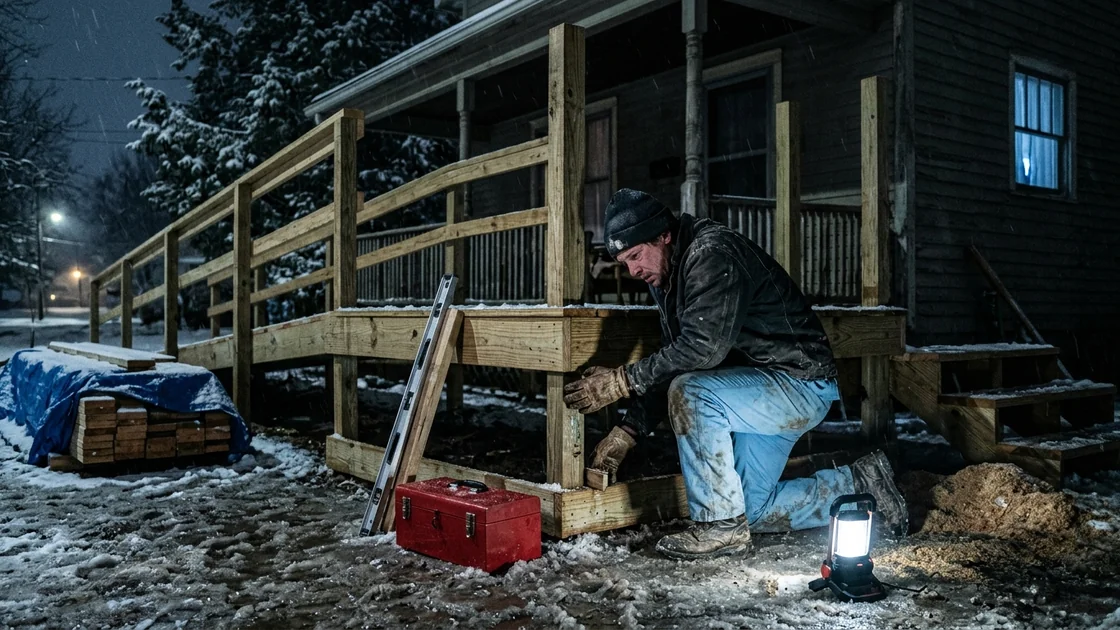
On Saturday morning, at 6:00 AM, Julian was on Maple Avenue.
The temperature was nineteen degrees. The ground was frozen hard as cast iron, the ruts in the driveway filled with gray, glassy ice. He had walked the four miles from his basement apartment carrying a red steel toolbox in each hand and a six-foot level strapped to his back with bailing twine.
He worked in the blue, predawn shadows, wearing two pairs of wool socks inside his work boots and a grease-stained knit cap pulled down to his eyebrows. He did not use the loud circular saw until 8:30 AM, out of respect for the neighbors; instead, he spent two hours with an antique eight-point hand saw, cutting the four-by-four uprights with rhythmic, silent strokes that sent sweet-smelling yellow sawdust curling down into the crusted snow.
He knew the math. He didn't need to consult the ADA guidelines; he had them committed to memory like verses of scripture. One inch of rise for every twelve inches of run. The porch was thirty-six inches above the frozen gravel. That meant thirty-six feet of ramp, broken into three twelve-foot sections with two five-by-five landing platforms to allow for the turning radius of a standard thirty-two-inch wheelbase.
He dug the post holes with a two-man manual auger, throwing his whole forty-eight-pound frame against the t-handle, twisting the steel bit into the frost until his palms blistered through his leather gloves and the blood from his split knuckles soaked through the cotton liners.
By noon, his breath was coming in short, wheezing rattles. His chest felt as though it had been bound with wet rawhide that was drying in the wind.
The front door opened.
Clara stood on the sill, wearing her winter coat over a pair of flannel pajamas. She held a chipped stoneware mug with steam rising from it.
Julian froze. He was kneeling in the dirt, holding a four-foot level against the second stringer, his knees sunk six inches into the half-thawed mud.
"You're the guy from the fourth floor," she said.
Julian did not answer immediately. He slowly lowered the level, keeping his face angled toward the hemlock trees across the street.
"I work for the contractor on weekends," he said. The lie was stiff, dry, and tasted of gravel. "Mr. Henderson."
"There wasn't any Henderson on the letter. It said Hudson Valley Access."
"Henderson’s the sub," Julian said. He took a breath; his lungs felt like dry paper bags. "He does the framing. I do the layout."
Clara walked down the two steps that remained of the old porch, her boots crunching in the sawdust. She held the mug out toward him.
"It's Maxwell House," she said. "There's canned milk in it."
Julian looked at her hand. Her fingers were short, rough-skinned, the nails cut straight across and stained with the grease from the diner grill. He reached out with his leather work glove, stiff with frozen clay, and took the mug.
"Thank you," he said.
She didn't go back inside. She stood there in the nineteen-degree wind, her arms crossed over her ribs, watching him work. Her breath came in small, irregular puffs of white mist.
"Leo likes you," she said suddenly.
Julian nearly dropped the mug. The hot coffee sloshed against his thumb, scalding through the wet leather.
"He doesn't like anybody," she continued, her voice flat, conversational, stripped of everything except the heavy, leaden reality of their existence. "He hates the nurses. He hates the physical therapists. He calls Sarah the 'smiling drill sergeant.' But he told me you showed him how to count the circles on a brass pin."
"He has good hands," Julian said into the coffee mug. "He has the hands of a draftsman."
"He was gonna play Little League this spring," she said. She wasn't crying; she said it the way someone might report that it had rained in Albany three weeks ago. "He had the gray pants with the blue piping on the side. He used to keep his glove under his mattress with a baseball wrapped in three rubber bands to make the pocket. I gave the glove to the Salvation Army last month. I couldn't look at it behind the water heater anymore."
Julian did not speak. He could not speak. If he opened his mouth, he felt that the black water from the culvert would come pouring out of his throat, drowning the porch, the ramp, the frozen yard, and both of them together.
"You think he's ever gonna get out of that bed?" she asked.
"He's out of the bed," Julian said, his voice dropping an octave, harsh and scrape-dry. "He was in the chair three hours yesterday."
"You know what I mean," she said.
Julian looked down into the black surface of the coffee. A thin film of steam was swirling across the surface, reflecting the dead, white sky.
"No," Julian said. "He isn't going to walk. The cord was cut. The bone healed, but the wire is broken. You can't splice the wire."
Clara looked at him for a long time. Her eyes were very clear in the cold air—not angry, not weeping, just hollowed out until there was nothing left inside them but the gray sky and the hemlock trees.
"At least you don't lie like the ones in the white coats," she said. She turned and walked back up the two steps into the house, pulling the storm door shut behind her with a dry, metallic rattle.
Julian knelt in the frozen mud for ten minutes after she was gone, holding the warm mug against his chest until the porcelain went cold as stone.
VIII. The Ledger Closes
By the following October, two years after the sleet on County Route 9, Leo Vance was discharged from St. Judecrest Neurological Rehabilitation Center.
He was not cured. He would never be cured. But his transfer technique was clean; he could slide from his chair to the toilet and back without assistance using a shortened sixteen-inch birch board. His sacral skin was intact, clear of the deep, necrotic craters that killed so many young paraplegics in their first five years. He had learned to manage his own catheterization schedule with an alarm on a cheap digital watch, and his shoulders had broadened, the deltoids thick and functional beneath his blue-and-gray thermal shirts.
The total bill for his twenty-four months of inpatient and outpatient care had amounted to $412,680.14.
The balance was zero.
On his final morning, Julian was not on the fourth floor. He had been reassigned to the basement laundry facility—a subterranean cavern beneath the boiler room where four industrial tunnel washers, each the size of a city bus, shook the concrete foundation with their slow, hydraulic thumping.
The air in the laundry was ninety-five degrees and ninety percent humidity, thick with the smell of chlorine bleach, sour linen, and the alkaline dust of commercial soap powder.
Julian was feeding wet sheets into the flatwork ironer—a massive, steam-heated steel roller eight feet wide that dried and pressed the cotton in a single, roaring pass. His shirt was soaked through, sticking to his ribs; his skin had the pale, waterlogged look of a turnip that had spent the winter in a root cellar.
A pair of feet appeared on the open-grate iron stairs that led down from the maintenance corridor.
It was Abernathy.
The lawyer had never come to St. Judecrest. Julian had never seen him in anything other than his dim, smoke-yellowed office in Jersey City, surrounded by stacks of maritime law digests from 1964.
Abernathy wore an ancient wool overcoat that had lost its nap, carrying an umbrella with a broken rib that dangled like a spider’s leg. He walked with the slow, shuffling gait of a man who was eighty-two and whose feet had gone entirely numb from peripheral neuropathy.
Julian did not stop feeding the sheet into the roller. The canvas belts caught the hem, pulling the wet cotton into the dark, steam-hissing gap between the steel drums.
"The trust account is closed," Abernathy said. He did not shout, but his thin, reedy voice cut through the mechanical roar of the washers with the persistence of a dentist's drill.
Julian reached for another sheet from the aluminum bin. "Did the final disbursement clear?"
"Yesterday morning," Abernathy said, leaning against the safety railing. "The accessible bathroom renovation. The hydraulic van lift. And the four-year maintenance contract for the motorized tilt-in-space chair. The account has a balance of fourteen dollars and twenty-two cents. Chase will close it for inactivity at the end of the month."
"Good," Julian said.
"It is not good," Abernathy said, his watery, rheumy eyes blinking through thick lenses coated with steam from the ironer. "You have no more assets, Julian. You have no pension. You have no real property. You have forty-four dollars in your local checking account and your wages here are being garnished by the state for the delinquent property taxes on that Pennsylvania acreage you sold under market value."
"I know," Julian said.
"If you have an appendicitis tomorrow, you will be a ward of the county."
"I know."
The old lawyer reached into his overcoat and pulled out a small, crumpled envelope. It was not legal size; it was a cheap, yellow greeting-card envelope that had been handled by someone with grease on their thumbs.
"She came to my office," Abernathy said.
Julian’s hands stopped four inches from the moving belts of the ironer. A gust of superheated steam hit his face, smelling of scorched sizing.
"Who?"
"The mother," Abernathy said. "Mrs. Vance. She took the bus to the Port Authority, then took the PATH train to Journal Square, then walked two miles in the rain with the boy’s medical records in an accordion file. She asked every business with 'Oakhaven' in the name within six zip codes until she found the registered agent address for the trust."
Julian felt his heart make a single, violent leap against his ribcage, like a carp dropped on a wooden dock, then go dead and silent.
"What did you tell her?" Julian’s voice was barely louder than the hiss of the steam trap.
"I am eighty-two years old, Julian," Abernathy said dryly. "I have forgotten more client confidences than the state bar association has ever recorded. I told her the trust was established by an anonymous consortium of highway safety engineers who had lost children in hit-and-run accidents and wished to remain entirely private."
Julian let out a long, ragged breath that sounded like a tire deflating in the mud.
"Did she believe you?"
"Of course not," Abernathy said. "She is not an idiot. She knows there is no consortium. She knows there is only one person who pays that kind of money for one specific boy on one specific road."
Abernathy held the yellow envelope out over the iron railing.
"She left this for the trustee. She said if I didn't take it, she would sit on the linoleum in my waiting room until the police came. My secretary was frightened of her. She has the look of people who have survived a famine."
Julian did not reach for the envelope. "Throw it in the boiler."
"I am not your courier," Abernathy said, his voice hardening slightly. "I have fulfilled the terms of our retainer. The trust is dissolved. My fee was paid. What you do with her letter is a matter between your own conscience and whatever god you think you are bargaining with down here in this basement."
The old man dropped the envelope onto the corner of the ironer’s feed table, turned on his heel, and began the slow, creaking ascent up the iron stairs, his broken umbrella trailing behind him like a dead bird.
IX. The Letter
The yellow envelope lay on the corner of the feed table for three hours while Julian ironed six hundred bed-sheets, four hundred pillowcases, and ninety-two draw-sheets for the third-floor spinal ward.
At 3:00 PM, when the shift-change bell rang through the laundry, he took the envelope, put it into the pocket of his scrub pants, and walked up the three flights of stairs to the main entrance.
He did not go out through the front lobby. He went out through the ambulance dock, past the red-and-white rigs idling in the cold October drizzle.
It was raining again. The exact same rain—a thin, freezing sleet that coated the asphalt of Route 9 with a skin of grease and crushed hemlock needles.
He walked three blocks to the municipal bus shelter on the corner of Elm Street. The shelter was made of scratched, yellowed plexiglass, covered with stickers for local plumbing services and faded flyers for missing cats. The wind blew through the two-inch gap between the panels, whistling like a flute.
Julian sat on the cold wooden bench. His knees were stiff; his hip joints ached with the deep, dull arthritic burn that comes from six years of forty-hour weeks on wet concrete.
He took the envelope from his pocket. It had no stamp. On the front, written in blue ballpoint pen with the slightly unsteady, heavy-handed script of someone who had learned to write in a Catholic parish school fifty years ago, was:
To the Man with the Car.
Julian’s breath stopped. The paper felt heavy, thick, damp from the river mist.
He tore the top edge with his thumb. Inside was a single piece of lined notebook paper, torn from a spiral binder with the ragged fringe still attached to the left margin.
There was no date. There was no greeting.
I know who you are, the letter said.
I didn't know at first. I thought you were some rich bastard from the hills who had a wife with a judge for a brother. I thought you were someone who could afford to hire people to wash his car three times a week so the blood wouldn't stick to the plastic.
Then I saw you on the ramp.
You don't hold a hammer like a man who works for twelve dollars an hour, Mercer. My father was a carpenter for forty years in Kingston. He had hands like yours—cracked at the thumb, flat across the nails, but careful with the wood. A man who builds a ramp thirty-six feet long when thirty would have passed the inspector is a man who is trying to build a ladder out of hell.
And I saw your boots.
You wore the same boots with the split seam on the left heel every night you came into 408 to empty the bag. You think because you didn't look at my face that I didn't look at your feet? When you're sitting in a plastic chair twelve hours a day waiting for your son to learn how to pee through a plastic straw, you look at the floor. You look at every shoe that comes through that door. I know the sound of your rubber heels better than I know the sound of my own sister’s voice.
Julian lowered the paper. The bus was coming down Elm Street, its yellow high-beams cutting through the gray sleet, reflecting in the long, oily puddles along the curb. The pneumatic brakes let out a long, wet scream as the vehicle slowed.
He did not get on. He sat in the shelter, the paper trembling in his fingers.
I went to the police station in Red Hook three months ago, the letter continued. I sat in the room with the detective, the one with the dirty necktie who told me two years ago that my case was a dead dog. I had your name on a piece of paper. I had your address on Elm Street. I had the license number of that old blue truck you rented from the lumber yard.
I sat there for two hours while he was at lunch.
I looked at the bulletin board. They had six pictures of kids who had been killed by drunk drivers on the taconic. They had the drivers' pictures too. Young boys with their hair slicked back, looking surprised that their lives were over. Some of them got five years. Some of them got eight. In four years, they're out, working at a car wash in Poughkeepsie, drinking beer on their mother’s porch on Sunday afternoon.
If I give them your name, you go to Green Haven.
You sit in a cell for six years. The state pays eighty thousand dollars a year to keep you in an orange suit. And who pays the therapy bill when Leo turns twelve and his hips start to subluxate because his adductors are tighter than his glutes? Who comes at 4:00 in the morning when the sewer backs up in the cellar and the boy’s chair is stuck in the hallway?
The detective came back from lunch. He had a mustard stain on his lapel. He asked me what I wanted.
I told him I forgot my glasses and I walked out.
You don't get to go to prison, Julian.
Prison is for people who get to be finished. You don't get to be finished. You're gonna stay in that basement on Elm Street. You're gonna wake up at three in the morning and you're gonna smell the floor bleach and the dirty sheets until your hair is as white as that ceiling tile you were staring at in the office.
Every time Leo gets a pressure sore, you're gonna be the one who cleans it. Every time the chair needs a new set of bearings, you're gonna work the yard on Sunday for that old crook Vinnie until your back sounds like dry kindling.
You broke him.
Now you carry him.
Don't you ever look at me again. Don't you ever speak to my boy unless you're telling him which way to hold the wood. If you leave this town, if you move three miles north or two miles south, I will take this paper to the district attorney before your bags are in the trunk.
The ramp is three inches too high on the left landing. The water sits there when it rains. Fix it before the frost.
Clara.
X. The Work
The bus pulled away, its diesel exhaust hanging blue and heavy in the cold, wet air of Elm Street.
Julian sat in the shelter until the streetlights flickered on—dull, amber globes through the sleet, humming with sixty-cycle current.
He read the letter three times. Then he folded it along its original creases, took a small box of kitchen matches from his scrub pocket, struck one against the damp abrasive strip, and touched the sulfur head to the blue ballpoint signature.
The paper burned slowly, the moisture in the fibers resisting the small yellow flame. It charred into black, delicate lace that curled inward, smelling of wood pulp and sulfur, until only the unburned corner between his thumb and forefinger remained. He dropped the black ash onto the wet concrete between his boots and ground it into the gray slush with the heel of his clog.
He stood up.
His knees made a sharp, dry sound, like two stones being struck together underwater. His joints were stiff from the wind, his scrub shirt damp across his shoulders.
He did not walk back to his basement apartment.
He turned toward Grand Street. He walked four blocks to the tool shed behind the municipal maintenance garage where Vinnie kept the gravel spreaders. In the dark behind the salt bin, under a piece of corrugated tin he had hidden three months ago, lay his four-foot level, his red steel toolbox, and an eight-pound sledge.
He took the tools. He did not run. He walked with the heavy, rhythmic, deliberate gait of an orderly carrying a full laundry hamper down an endless linoleum hall.
The rain was turning to snow now—heavy, wet flakes that did not freeze, but melted as soon as they touched the warm asphalt of Route 9.
On Maple Avenue, the house was dark except for the single small window in the rear corner—the boy's room. Through the thin curtains, Julian could see the blue, rhythmic flicker of the television screen. Leo was awake, watching the late-night programs, his calloused hands resting on the armrests of the Quickie Q7, his thin legs tucked into the fleece blanket that had been washed two hundred times until the blue was gone.
Julian did not go to the door.
He knelt in the dark beneath the left landing of the ramp, where the water had pooled in the hollow of the spruce stringer. The frozen mud was cold through the knees of his scrub pants, soaking into the cotton within ten seconds, freezing against his skin.
He set the four-foot level on the wet wood. The bubble was three-eighths of an inch to the west.
He took the cold chisel from his box, positioned the steel edge against the cedar blocking beneath the sill, raised the sledge, and, with the practiced, silent precision of a man who understood the exact load-bearing capacity of an unyielding debt, began to drive the wood true.