The Margin of Ten Minutes
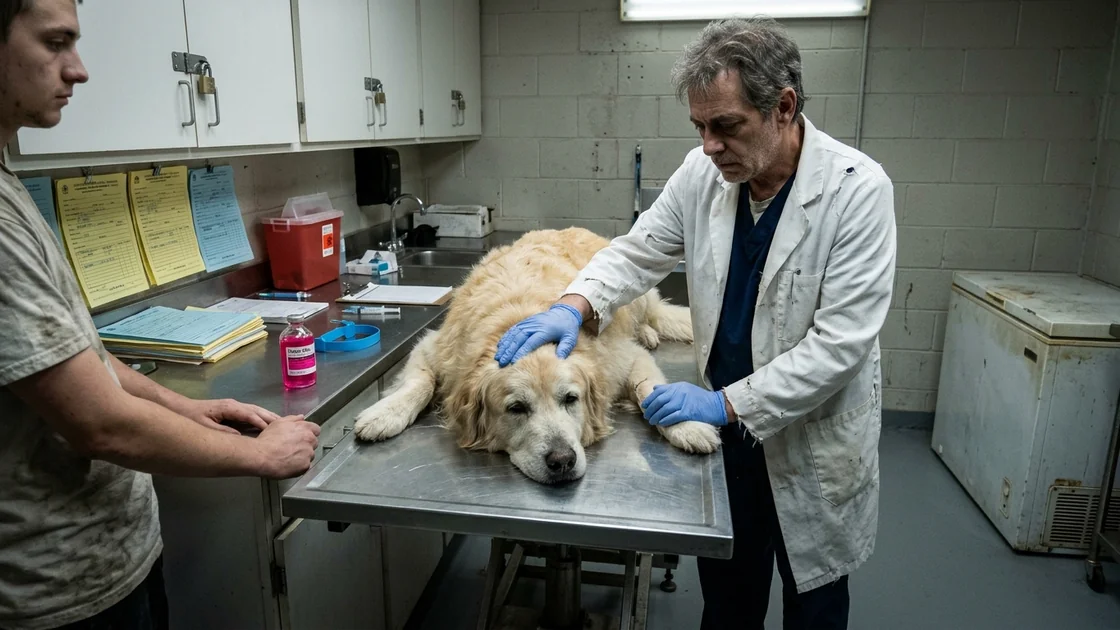
Dr. Arthur Vance, an exhausted veterinarian at the municipal animal intake facility of Blackwood County, mistakenly euthanizes an elderly golden retriever named Barnaby after a chaotic morning log swap conflates the dog with an untreatable bite-case surrender. Just ten minutes after the lethal injection is administered, the Henderson family arrives at the front desk with registration papers, microchip records, and desperate relief, forcing Arthur to step out from behind the sterile shield of shelter protocol and confront the catastrophic consequences of clerical neglect, institutional decay, and his own eroded vigilance.
I. The Ambient Pressure
The ventilation system in the clinical wing of Blackwood County Animal Care and Control did not circulate air so much as it redistributed heat and distress. It produced a low, resonant drone in the key of B-flat that vibrated through the cinderblock walls, through the soles of Arthur Vance’s oil-resistant rubber clogs, and settled directly behind his ocular nerves.
It was eight in the morning on an unseasonably warm Thursday in October. Arthur stood over the stainless-steel prep island in Treatment Room 2, holding a lukewarm mug of instant chicory coffee that tasted primarily of scorched well water. Through the reinforced wire glass of the double doors, the corridor of Kennel Block A stretched sixty yards into an echoing gloom. Even now, before the doors were unlocked to the public, the sound was continuous: eighty-four dogs barking in varying registers of frantic boredom, panic, territorial aggression, and kennel neurosis. The concrete absorbed none of it. It bounced off the lime-washed walls and met the ceiling’s corrugated tin, producing an acoustic wash that Arthur had spent fourteen years learning to convert into white noise.
Lately, the white noise had begun to fail.
"Doctor Vance?"
He didn't turn immediately. He took one more sip of the bitter coffee, waiting for the small muscle under his left eye to stop its rhythmic twitching. When he turned, Marcie was standing in the doorway, clutching a stack of manila folders against her purple scrub top. She was twenty-four, with two silver hoops in her left nostril and dark circles under her eyes that rivaled his own. She had been the primary intake coordinator for eight months, which, in Blackwood County tenure, made her an experienced veteran.
"The board is full," she said, her voice flat, carrying the mechanical cadence of someone reporting casualties from a front line they had ceased trying to understand. "We took in twenty-six strays overnight from the county traps and the drop-boxes. Field services brought in four cruelty seizures from the trailer park off Route 9. Animal control picked up three road hits—one dead on arrival, two mangled. I put the mangled ones in Holding Three for triage."
"Did you run fluids on the hit-and-runs?" Arthur asked.
"I started a line on the shepherd mix. The pit mix has agonal respirations. I don't think he’s going to make nine o'clock." She looked down at the folders in her hands, her thumbs flicking the edges like cards in a deck. "The director sent an email at six-thirty. We’re at one-hundred-and-forty percent capacity. State health inspector is due next Tuesday. He wants twenty-two cage vacancies cleared in Block C before noon."
Block C was the isolation and non-adoptable corridor. In shelter parlance, clearing vacancies did not mean adoptions. Adoptions happened in Block D, where the puppies, the small terriers, and the designer doodles were groomed, photographed under ring lights, and displayed for the weekend crowds. Block C was the holding ground for the broken, the aggressive, the unchipped, the ringworm-colonized, and the expired strays whose statutory seventy-two-hour holding periods had run their quiet, bureaucratic course.
"Give me the manifests," Arthur said. He set his mug down on the edge of the sink, beside a half-empty jug of chlorhexidine scrub.
Marcie handed him four folders. They were stained at the edges with water rings and kennel grease. "Intake was a mess last night, Art. The terminal in the vestibule went down during the electrical storm around midnight. The night-shift officer, Higgins, wrote everything out on the manual triplicates. His handwriting looks like he used an unbent paperclip."
"Did he run the chips?"
"He wrote down that he did. But the scanner in bay four has a cracked diode. Sometimes it beeps even when it doesn't read, or it drops the last four digits of the hex sequence. I left a requisition form on the director's desk three weeks ago."
Arthur flipped through the papers. Yellow triplicate sheets, smeared with carbon, dog hair, and the faint, unmistakable smell of kennel disinfectant. He knew the drill. He had performed it several thousand times over the course of his career. When he had graduated from veterinary school in Columbus, he had believed in epidemiological control, herd health, progressive shelter medicine, and community outreach. He had imagined himself an advocate for the voiceless.
Now, he was an actuary with a DEA license. He was the terminal point of an endless, leaking pipe that society refused to fix at the source. The county gave him an annual operating budget that wouldn't have sustained an upscale suburban private practice for four months, handed him hundreds of tons of doomed mammalian tissue each year, and asked him to keep the disposal costs within the line items approved by the Board of Supervisors.
"Let’s do the walk," Arthur said, reaching into the pocket of his lab coat for his grease pencil. "Show me the list."
II. The Paperwork of Oblivion
The corridor between Treatment Room 2 and Kennel Block C was narrow, lit by bare fluorescent tubes that hummed at sixty cycles per second. The air grew colder as they moved toward the back of the facility, though the smell shifted from generic pine cleaner to the thick, alkaline stench of wet concrete and fear.
Marcie walked a half-step ahead of him, her finger tracing the manual intake log.
"Cage 38," she said, raising her voice over the din. "Brindle boxer mix. Severe bite history. Owner surrender. He bit the owner's ten-year-old through the wrist yesterday afternoon. Quarantine hold waived by owner signature; requested immediate humane dispatch."
Arthur looked through the wire mesh of Cage 38. The dog was crouched at the back, its lips pulled back over brown-stained teeth, its hackles raised in a permanent crest along its spine. It didn't bark; it made a low, dry rattling sound in its chest that sounded like dried beans shaken in a gourd.
Arthur marked a red X with his grease pencil on the plastic slate attached to the gate. "Cage 38. Confirmed. Next."
"Cage 40. Feral hound cross. Trapped out by the timber mill. Emaciated, advanced demodectic mange, bilateral ocular discharge. Untouchable."
Arthur looked. The hound was curled into a ball so tight it looked like a pile of wet burlap. Its skin was leathery, raw, and bleeding at the joints. It did not raise its head.
"Red X," Arthur said.
They moved down the row. The choices were made with the swift, terrible efficiency that the shelter demanded. To linger was to invite sentimentality, and sentimentality was an unaffordable luxury that led directly to administrative paralysis. If you spent ten minutes weeping over a mange-ridden hound, you fell behind on the surgeries, the bite quarantines were neglected, the medications were delayed, and the county shelter descended from a grim purgatory into an outright circle of hell. Speed was not callousness; speed was the only prophylaxis against total system collapse.
They reached the end of the western corridor.
"Cage 42," Marcie said, squinting at the carbon copy. A drip of condensation from an overhead pipe hit the paper, causing the cheap blue ink of Higgins’s handwriting to blossom into a fuzzy violet star. "Wait. Higgins wrote forty-two here, but then he crossed it out and wrote forty-four. Or forty-four crossed out to forty-two."
Arthur stopped. His knees gave a sharp, familiar throb. "Which is it, Marcie? The board in the prep room said forty-four."
Marcie stepped closer to the wall light, holding the paper up to her face. She tapped the yellow sheet. "Okay, look. Intake 8892 is a mastiff-pit mix, stray, aggressive, picked up on Elm Street. Picked up at two in the morning. That was supposed to be forty-two. But forty-two’s latch was broken by that rottweiler on Tuesday—the one that bent the bolt. So Higgins must have shifted the stray mastiff down."
She looked at the run in front of them.
Cage 42 was empty, its gate secured with an orange plastic zip-tie that read DO NOT USE - LATCH DEFECTIVE.
"Right," Marcie muttered. "So the mastiff is in forty-four."
"Check the card on the gate," Arthur said, his hand hovering over his coat pocket.
They walked to Cage 44.
The card tucked into the clear plastic sleeve on the chain link was a standard white cardstock index. It had been filled out in pencil. It read: Intake #8892 - Large Mix - Stray - Intake Date: 10/23 - Evaluation: Aggressive / Unhandled.
Arthur peered through the chain link.
Lying on the raised fiberglass cot in the center of the run was a large dog. Its coat was not the short bristle of a mastiff, but a thick, wavy cream-and-gold, grayed heavily around the muzzle, the eyes, and the paws. It was a retriever mix—perhaps golden retriever and Great Pyrenees, or some oversized shepherd cross that had softened with extreme age. Its head rested on its front paws. Its ears, long and velvety, were laid flat back against its skull.
When the shadow of Arthur and Marcie fell across the concrete, the dog did not lunge, nor did it rattle its throat like the boxer in 38. It simply opened two rheumy, brown eyes. The right eye had a mature cataract, a milky pearl floating behind the pupil. The dog let out a long, shuddering sigh, its tail lifting from the cot and thumping twice—a slow, hesitant thud-thud—against the fiberglass frame.
Arthur frowned. He looked from the dog to the card.
"This says large mix, stray, aggressive," Arthur noted, his voice flat. "This animal isn't aggressive. It’s geriatric."
Marcie leaned down, checking her clipboard again. "Higgins put down: Attempted bite during impoundment. Subject had to be roped and carried."
"He probably had to be carried because his hips are fused with osteoarthritis," Arthur muttered. He reached a gloved knuckle toward the wire.
The dog didn't move away. It slowly, stiffly, raised its heavy golden head, stretched its neck forward, and pressed the dry leather of its nose against the chain link, sniffing Arthur's knuckle with a soft, wheezing inhalation. Its breath smelled faintly of stale cornmeal and old meat.
"Look at his muzzle, Marcie. This dog is eleven, maybe twelve years old."
"Higgins wrote: Intake 8892, picked up without collar, no chip detected." Marcie’s radio squawked loudly on her hip, the voice of the front-desk clerk piercing the air: Marcie, I need you up front. The transport van from the rescue league is here and they won't take the three-legged cat without the health certificate signed.
Marcie sighed, pressing her hand against her forehead. "Art, I don't know what to tell you. If Higgins brought him in as an aggressive stray bite-case at two in the morning, and he’s on the red list for Block C clearance, we don't have an open run in Block B to re-evaluate him. Block B is double-stacked with the cruelty seizure hounds."
"Did anyone check him for a chip with the new reader?"
"The new reader is in the director’s office. The director is at a county budget meeting in the city until two. Higgins used the wand in the bay. He logged it: No chip detected."
Arthur looked down at the dog. The dog was still watching him with those rheumy, patient eyes. The tail thumped once more, then went still, as if the effort required to signal friendliness was too great an expenditure of its dwindling energy reserves.
A wave of profound, leaden weariness washed over Arthur. He felt it in his teeth, in the stiffness of his cervical spine, in the dry, sour taste that lingered on the back of his palate. He had seen this dog a thousand times. Not this specific dog, but its twin, its cousin, its spiritual sibling. The dog whose family had moved away; the dog whose owner had died in a nursing home; the dog dumped on a rural road because its veterinary bills for rimadyl and glucosamine had eclipsed the household grocery budget; the dog that had wandered away through a broken gate because its mind was slipping into canine dementia, wandering the ditches until animal control scooped it up with a control pole.
Even if the dog wasn't an aggressive bite-case—even if Higgins had mistaken the panic of a half-blind, deaf animal being throttled by a steel cable for viciousness—what was the reality?
The reality was that large, twelve-year-old mixed-breed dogs with degenerative joint disease and cloudy lenses did not walk out of Blackwood County Animal Care and Control on an adoption leash. They lingered. They spent three weeks in a damp concrete run, their hips deteriorating on the cold floor, their coats matting with feces, until they developed kennel cough or cage depression, and then they were brought to the prep room anyway, their final days defined by the howling terror of Block C.
"Art?" Marcie asked, her hand on her radio. "I have to go deal with the transport driver."
Arthur stared at the card. Intake #8892.
If Higgins had mislabeled the behavior, the clerical reality remained unchanged: an unchipped, uncollared, elderly stray in a shelter running at one-hundred-and-forty percent capacity, under direct administrative order from the county to clear twenty-two runs before the state inspector arrived with his clipboards and his threat of municipal decertification.
If he spared this dog, which dog in Block C took its place? The six-month-old pit puppy with the skin infection that could be cured with twenty dollars worth of cephalexin? The mother cat with the five unweaned kittens in the intake closet?
"Arthur?" Marcie repeated.
He took the red grease pencil from his pocket. The waxy tip touched the white cardstock. He drew the slash down from right to left, then across from left to right.
The red X settled over the number 8892.
"Bring him back after you clear the transport van," Arthur said. His voice was quiet, hollowed out of all resonance. "I'll do the prep."
III. The Quiet Protocol
The euthanasia room was not called the euthanasia room in the county facility’s structural blueprints. On the architectural schematics filed in the basement of the County Courthouse, it was designated as Clinical Procedure Room B.
It was seven feet wide by ten feet long. The floor was seamless gray poured epoxy, slanted toward a central brass drain. There were no windows. The walls were lined with white composite cabinetry, secured with heavy chrome hasps and combination padlocks. The room contained an adjustable stainless-steel hydraulic table, a floor scale that had not been calibrated since 2018, a red biohazard sharps bin, and a heavy-duty industrial chest freezer whose compressor kicked on every fourteen minutes with a violent, metallic shudder.
Arthur Vance sat on a backless rolling stool, spinning a blue plastic tourniquet between his thumb and forefinger.
On the stainless-steel counter to his right sat a multi-dose vial of Fatal-Plus. The liquid inside was an intense, unnatural shade of deep cerise pink. It looked like concentrated syrup for shaved ice, or children's liquid amoxicillin, but its chemical identity was pure, unadulterated sodium pentobarbital—three hundred and ninety milligrams per milliliter, combined with propylene glycol, ethyl alcohol, and benzyl alcohol as preservatives.
It was an extraordinarily efficient poison. It worked not through cruelty, but through an overwhelming, catastrophic depression of the central nervous system. First the cerebral cortex went dark; then the basal ganglia; then the respiratory centers in the medulla oblongata were smothered. The diaphragm ceased its excursions. The carotid pulse thinned, flickered, and stopped. Death was typically complete within thirty seconds of intravenous delivery. It was clean. It was painless. It was the only merciful thing this building had to offer, and Arthur Vance had dispensed thousands of liters of it over the course of his adult life.
The door opened.
It was not Marcie; it was Pete, the morning kennel attendant. Pete was nineteen, wore rubber boots that reached his knees, and smelled perpetually of bleach and wet sawdust. He was holding the dog from Cage 44 by a short nylon slip-lead.
The dog did not resist. It walked with a slow, swaying, hitching gait, its hindquarters swinging out to the left with every second step—a classic presentation of advanced coxofemoral subluxation. Its nails, overgrown and clicking sharply against the epoxy floor, sounded like dice rolled across a table.
"He's real slow, Doc," Pete said, wiping his nose on the sleeve of his gray county-issue t-shirt. "Didn't even need the pole. He just walked right out when I opened the gate."
"Help him up," Arthur said, adjusting the hydraulic pedal with his foot to lower the table.
Pete bent down, slipping his arms under the dog’s chest and abdomen. The dog let out a small, grunting puff of air as it was hoisted onto the cold metal surface. Its front legs splayed slightly on the slippery steel before finding purchase.
Arthur stood up. He did not look at the dog's face. That was an old, protective discipline: you look at the vein, you look at the syringe, you look at the mucous membranes, you look at the corneal reflex. You do not look at the eyes until you are checking for the fixed, dilated state that confirms somatic death.
"Intake 8892," Arthur recited, reaching for the yellow intake triplicate that Pete had brought with the dog. "Stray, male, uncastrated."
Arthur reached under the dog’s tail, performing a perfunctory anatomical check.
He paused.
The dog was castrated. The scrotum was a small, empty, shriveled fold of pigmented skin, soft with age.
Arthur’s hand remained there for a beat. He frowned, his fingers tracing the perineal raphe. "The sheet says intact male."
Pete shifted his weight from one boot to the other. "Higgins probably just checked the box without looking under the skirt, Doc. You know how he is on the graveyard shift. If the dog's got long hair, Higgins just writes 'intact' so the shelter doesn't get dinged for missing an altered status on intake fees."
Arthur felt a tiny, sharp needle of disquiet prick the base of his skull. It was a familiar sensation—the institutional friction that occurred when human fatigue, bureaucratic indifference, and systemic volume ground against one another. It happened every day. A dog listed as black-and-tan was actually brindle; a female listed as spayed had an abdominal scar that turned out to be an old laparotomy for an intestinal foreign body; an age listed as two was clearly eight.
"Let me see the scanner," Arthur said.
"Marcie’s got it up front," Pete said, looking at his watch. "The transport driver is arguing about the health papers. She's swamped, Doc. And I got six more in Block C that need to be brought back before the lunch whistle. The incinerator guy is coming at eleven-thirty to empty the freezer."
The incinerator guy. The schedule. The state inspector. The twenty-two vacancies.
The weight of the morning bore down on Arthur’s shoulders like a concrete lintel. He looked at the dog’s right foreleg. Pete was already reaching around the dog's elbow, occluding the cephalic vein with his thumb, rolling the vessel outward so it stood up beneath the thin, papery skin.
The dog stood motionless on the table. It did not struggle. It did not pull its leg back. It lowered its head, resting its chin on the cold lip of the stainless-steel examination trough.
Arthur reached out his left hand and ran his thumb over the dog’s forehead. The fur between its ears was remarkably soft, worn smooth as old flannel. There was a small, raised sebaceous adenoma—a benign wart of old age—just above the left eyebrow.
"Easy, old man," Arthur whispered.
The dog’s tail gave one more faint, muffled twitch against the metal table. Click. Click.
Arthur picked up the twenty-milliliter syringe. It was loaded with twelve milliliters of Fatal-Plus—an intentional overdose, calculated to ensure rapid cardiac arrest without the risk of an agonal stage or secondary excitation. The pink fluid caught the harsh fluorescent glare of the ceiling tube, glowing with an almost theatrical, synthetic luminosity.
He uncapped the eighteen-gauge needle with his teeth.
"Hold him steady, Pete."
"Got him, Doc." Pete leaned his chest over the dog’s shoulders, not with violence, but with the firm, clumsy weight of a young man who had done this many times and wanted it to go smoothly.
Arthur seated the needle into the vein with a single, practiced motion.
The dark, venous blood flashed instantly back into the clear hub of the needle—a rich, deep crimson bloom that swirled into the bright pink solution like dye dropped into water. It was a perfect stick. Clean, central, unobstructed.
Arthur’s thumb found the plunger.
He paused for two seconds. In those two seconds, the room was completely silent except for the low B-flat hum of the air vent and the wet, rhythmic breathing of the dog on the table. Arthur felt the dog’s skin under his fingers—cool, loose, carrying the faint, unmistakable domestic smell of carpet fibers, laundry detergent, and dry kibble. Not the rank, sour rot of a dog that had lived on the streets for months.
Domestic.
"Wait," Arthur murmured.
"What?" Pete asked, his forehead pressed against the dog’s scruff.
Arthur looked down at the dog’s neck. He parted the thick, wavy fur around the collar line.
There was no collar. But there was an indentation—a subtle, persistent flattening of the undercoat that formed a continuous horizontal band around the circumference of the neck. It was the indelible groove worn into the fur by a leather or nylon strap that had been worn for years and removed only recently.
"Did this dog come in with a collar?" Arthur asked, his thumb freezing on the syringe plunger.
"I don't know, Doc," Pete said, his voice straining slightly with the effort of holding the seventy-pound animal still. "Higgins processed him at two in the morning. If it had a collar with no tags, Higgins usually just cuts 'em off and tosses 'em in the trash barrel by the sally port so they don't get hung up on the chain-link gates."
Arthur looked at the yellow sheet on the counter again.
Intake #8892.
The blue ink was smeared where the condensation had fallen. But beneath the smear, in the space marked Location Found, Higgins had scrawled: Cor. of 4th & Maple.
Fourth and Maple was not the industrial timber mill district. It was not the rural scrubland off Route 9 where the feral packs ran the drainage ditches. Fourth and Maple was the heart of the historic district—a neighborhood of clapboard houses, wrap-around porches, manicured lawns, and children’s bicycles left lying on the grass.
"Doc?" Pete said. His arms were beginning to shake from maintaining the isometric hold. "My arms are cramping up. Are we doing this or not?"
Arthur closed his eyes for a fraction of a second.
He thought of the director’s email. He thought of the twenty-two cages. He thought of the state inspector. He thought of the fifty other dogs currently barking themselves hoarse in Block A, their feces smearing the floor, waiting for food that wouldn't arrive until two in the afternoon because the budget for temporary kennel staff had been slashed by the county commission.
Even if the dog had lived in a house on Maple, it was here now. If an owner hadn't come in three days...
Wait.
Arthur looked at the date on the sheet.
Intake Date: 10/25.
Today was October 25th.
"Pete," Arthur said, his voice suddenly sharp, slicing through the mechanical drone of the room. "What was the date of impoundment?"
"I don't know, Doc! Last night! Higgins’s shift!"
"If he came in last night, his seventy-two-hour holding period doesn't expire until Sunday," Arthur said. The syringe felt cold and enormous in his palm. "Why is he on the morning clearance list?"
Pete let out an exasperated breath. "Doc, Marcie said Block C clearance. Higgins tagged him as an owner surrender bite-case. Look at the box! The box for Surrender - Immediate Euthanasia Authorized is checked!"
Arthur’s gaze dropped to the bottom right of the yellow sheet.
There was a checkmark in the box. A heavy, black ballpoint checkmark. Beside it was an illegible scrawl that purported to be an owner's signature.
Arthur stared at the signature.
A bite case. An owner surrender. A family that brought their old dog to the shelter in the dead of night because he bit a child, signing the paper that released the county from the seventy-two-hour holding requirement, authorizing immediate dispatch. It happened all the time. People were cowardly. They didn't want to look their regular veterinarian in the eye and pay four hundred dollars to have their old, failing dog put down; they waited until midnight, drove to the county facility, invented an aggressive incident to justify their abandonment, signed the surrender waiver, and sped away into the darkness.
It made sense. It explained the collar groove. It explained the castration that Higgins hadn't bothered to record. It explained the domestic smell.
The dog was a discard. A convenient, late-night disposal.
"Doc, please," Pete groaned. "He's slipping on the metal."
The dog had begun to tremble. Not with rage, but with the profound, exhausting terror of an old animal whose feet could not find traction, whose joints were screaming with pain, and who had been handled by three different strangers in the space of twenty minutes. It leaned its heavy head down, pressing its wet nose into the crook of Arthur’s lab coat, right over his hip.
Arthur Vance let out the breath he had been holding. The brief spark of investigative inquiry died, smothered under the crushing, familiar weight of institutional fatalism.
There is no other way out of this room for you, old boy, Arthur thought. Even if I stop, you sit in that cage until Sunday, and then we do this anyway. There are no rescues for twelve-year-old bite cases. There is only this table.
"All right," Arthur said quietly. "Hold his head."
He depressed the plunger.
The pink fluid moved through the clear barrel of the syringe in a smooth, silent column. It entered the cephalic vein without resistance.
Five milliliters.
The dog’s ears twitched once, as if listening to a distant sound that hadn't quite reached the room.
Eight milliliters.
The dog’s posture softened. The tension that had held its arthritic spine rigid drained away like water through a broken dam. The heavy head grew heavier against Arthur’s hip.
Ten milliliters. Twelve.
Arthur withdrew the needle. A single, tiny bead of pink-tinged blood welled at the puncture site. Pete released his hold, stepping back, his hands hanging limp at his sides.
The dog did not fall; it simply collapsed inward, sliding down onto its side on the stainless steel. Its ribs expanded once—a deep, full, diaphragmatic inspiration that sounded like a sigh of immense relief—and then they settled.
Arthur placed the bell of his stethoscope over the dog’s left fourth intercostal space.
Lub-dub.
Lub... dub.
...
Lub...
...
Silence.
Arthur listened for fifteen seconds, counting the empty, static-filled beats of his own pulse in his ears. The chest did not move. The corneal reflex was absent; when Arthur touched the tip of his finger to the dog’s open brown eye, the lids did not twitch. The pearl of the cataract stared back at him, milky and vacant under the fluorescent tubes.
"Time of death," Arthur said, glancing at the round wall clock above the sink. "Ten-forty-two."
"Right," Pete said. He was already reaching for the heavy black plastic cadaver bag that hung from a dispenser roll beneath the table. "You want him in the bottom freezer, Doc? The top one’s jammed full of the cruelty cats."
"Bottom is fine," Arthur said.
He turned his back to the table, walked to the sink, and turned on the cold water. He picked up the bottle of chlorhexidine and began to scrub his hands, watching the bright pink residual drop of Fatal-Plus swirl down the brass drain, mixing with the brown foam of the soap until it vanished completely into the municipal sewers.
IV. The Interlude
The administrative offices of Blackwood County Animal Care and Control were separated from the kennel blocks by a ten-foot breezeway intended to serve as a sound trap, though it achieved little more than trapping the smell of wet dog and cold concrete between two sets of self-closing fire doors.
Arthur walked into the staff breakroom at 10:48 AM.
The room was furnished with a faux-wood laminate table whose edges were chewed away by decades of shelter mascots, four mismatched folding chairs, and an industrial drip-coffee maker that sat on a metal filing cabinet labeled SURPLUS VACCINE RECORDS 2012–2015.
He poured the remaining dregs of the chicory coffee into his mug and sat down. He pulled the DEA Form 222 logbook toward him.
Every milliliter of pentobarbital had to be accounted for under federal law. The DEA did not care that Blackwood County was at one-hundred-and-forty percent capacity; the DEA did not care that the state inspector was coming; the DEA cared only that the pink fluid went into animal bodies and did not leak into the illicit street supply.
Arthur uncapped his blue ballpoint pen. His fingers were stiff, the skin dry and cracked around the cuticles from decades of surgical scrub.
Date: 10/25. Time: 10:42. Patient ID: Canine / Intake #8892. Weight: 72 lbs. Volume Administered: 12.0 mL. Administering Practitioner: A. Vance, DVM (Lic. #44092).
He signed his name—a rapid, jagged stroke that had long since lost the individual letters of his identity, becoming a mere cardiogram trace of his compliance with federal drug schedules.
He closed the book. He took a sip of the coffee. It was lukewarm and tasted of silt.
On the other side of the wall, through the thin plasterboard that separated the breakroom from the public lobby, he could hear the front door chime. It was a cheap, two-tone electronic chime that went off whenever someone crossed the threshold from the gravel parking lot.
Ding-dong.
Then came the muffled sound of voices. A woman’s voice—high, thin, vibrating with that specific, breathy oscillation that Arthur recognized instantly. It was the sound of someone who had been crying for hours, trying desperately to sound coherent and polite to a municipal clerk behind a three-inch sheet of scratch-resistant plexiglass.
Then a man’s voice. Deeper, louder, carrying the gravel of sleep deprivation and long-distance driving.
Arthur didn't look up. People cried in the lobby every single day. They cried because their landlord had found their pit bull and issued a three-day notice to vacate; they cried because their mother had gone into hospice and her six cats were being surrendered to a facility that had a ninety-percent feline euthanasia rate; they cried because they had lost their dog four weeks ago and were finally accepting that he was never coming back.
The lobby was a theater of delayed grief. You learned to ignore the audio. If you didn't, the noise would hollow out your skull until there was nothing left to operate the syringes.
Arthur picked up the next manila folder on the stack.
Intake #8893. Feline, Domestic Shorthair. Severe stomatitis, full-mouth dental resorption. Unowned.
He reached for his grease pencil.
The breakroom door flew open with such violence that the brass handle punched a fresh, circular dent into the drywall behind it.
Marcie stood in the doorway.
Her face was not the dull, grayish mask of routine fatigue that she had worn twenty minutes ago. It was completely, starkly white. Her mouth was open, her lips pale, and her chest was heaving as if she had just sprinted the entire length of the gravel driveway.
"Arthur," she whispered.
She didn't call him Art. She didn't call him Doc.
Arthur set the grease pencil down. The waxy stick rolled off the edge of the laminate table and dropped to the linoleum with a soft, hollow tap.
"What is it?"
"The dog," she said. Her voice cracked on the consonant, turning into a strangled squeak. "In forty-four."
Arthur felt the room contract. The low B-flat hum of the air vent seemed to drop an octave, vibrating directly against his diaphragm. "What about him?"
"Who was he?"
"Intake 8892," Arthur said, his voice dropping into the hard, defensive cadence of a man who knows he is standing on a structural seam that is about to rupture. "The bite-case surrender. The mastiff mix Higgins processed at two in the morning."
Marcie put both hands against the doorframe, as if her legs were no longer capable of supporting the weight of her torso. She looked at him with an expression of pure, unadulterated horror.
"Arthur," she said, her voice shaking so hard her teeth clicked together. "The mastiff mix is in the intake sally port. In Higgins’s truck. Higgins never unloaded him. Higgins had a flat tire on the way back from Elm Street, parked his truck in the sally port bay at three in the morning, and went home sick with the stomach flu without clearing the bed."
Arthur sat completely still.
The air in the breakroom seemed to vanish, replaced by an inert, unbreathable gas.
"Then who," Arthur asked, every syllable deliberate, slow, and ice-cold, "was in Kennel 44?"
Marcie reached behind her back and pulled a damp, rumpled piece of blue carbon paper from her pocket. It was not the yellow surrender sheet. It was a field impound slip—the blue slip used by the daytime animal control officers for stray recovery.
"His name is Barnaby," Marcie whispered. "Officer Miller picked him up yesterday afternoon at five-fifteen on Maple Street. He was wearing a red leather collar with a brass tag that had come unscrewed. Miller couldn't read the owner's phone number, so he scanned him. The chip was an Avid nineteen-digit European standard. Miller’s scanner couldn't read the frequency, so he marked him as Hold for Day Staff - Run Avid Scanner."
She began to cry—quiet, silent tears that spilled instantly over her eyelashes and ran down her cheeks, dripping off the silver hoops in her nose.
"He put him in Kennel 44 because 42 was broken. He didn't have a plastic sleeve, so he left the blue slip on the front counter. When the storm hit last night, the wind blew the slip behind the filing cabinet."
Arthur stood up. His knees did not hurt. He did not feel his body at all. He felt like an empty suit of clothes suspended in the middle of the small, airless room.
"And the card?" Arthur asked. "The card on the gate that said Intake 8892, Aggressive?"
"Higgins," Marcie sobbed, covering her mouth with her fist. "Higgins came in at midnight, saw the dog in forty-four, assumed it was the mastiff he’d picked up on Elm Street, wrote out the card from his clipboard, and hung it on the gate. He never looked at the dog. He was working in the dark because the fuse blew."
The lobby door chime sounded again through the drywall.
Ding-dong.
Then, the high, clear, silver sound of a child’s voice, ringing through the linoleum corridor with the terrible, piercing clarity of an innocent entering a slaughterhouse:
"Mommy! The lady said he’s here! Barnaby’s here!"
Arthur Vance looked at the clock on the breakroom wall.
It was 10:52 AM.
Ten minutes.
Ten minutes ago, the pink fluid had reached the heart.
V. The Lobby
The lobby of Blackwood County Animal Care and Control was designed to discourage people from lingering.
There were no cushioned chairs, only a single row of institutional fiberglass bench seating bolted to the floor, colored an uninviting shade of municipal mustard. The walls were covered in faded, curling posters warning about the penalties for abandoning animals on county property (a Class B misdemeanor, punishable by a five-hundred-dollar fine and up to thirty days in the county jail) and outdated rabies vaccination clinic schedules from three seasons prior.
Standing by the front counter were three people.
David Henderson was forty-two years old, wearing a pair of rumpled khaki shorts, boat shoes without socks, and a navy-blue polo shirt that was deeply creased across the chest from a seatbelt. His hair was messy, sticking up at the crown where he had run his hands through it during a twelve-hour drive through the night. His eyes were bloodshot, circled with the dark, purple bruises of desperate exhaustion, but his mouth was curved into the first fragile, tentative smile of a man who believes the nightmare has finally ended.
Beside him stood Claire Henderson. She was holding a blue canvas tote bag. Sticking out of the top of the bag was a large, squeaking vinyl hamburger toy, chewed down to the foam at the edges, and an unopened box of milk-bone biscuits. She had one hand on the shoulder of her nine-year-old daughter, Maya.
Maya was wearing pink light-up sneakers, denim overalls, and a t-shirt that had a cartoon golden retriever wearing sunglasses printed on the chest. In her small hands, she was clutching a red leather collar. Attached to the D-ring of the collar was a brass nameplate that had been polished so bright it caught the yellow glare of the lobby’s overhead bulbs.
The front desk clerk, a sixty-year-old woman named Brenda who had worked for the county since the Carter administration, was staring at the computer monitor with a look of utter, paralyzed confusion. Her fingers hovered over the keyboard like petrified twigs.
"I don't understand," Brenda was muttering, her voice trailing off as Arthur stepped through the breezeway door. "The system says... it says there’s a stray hold, but then the clearance log..."
"Good morning," David Henderson said, turning toward Arthur.
He didn't see the lab coat; he saw the stethoscope hanging from Arthur’s neck, the badge that said Director of Veterinary Services, and he immediately reached out a broad, calloused right hand.
"Doctor? Thank God. I’m David Henderson. This is my wife, Claire, and our daughter, Maya."
Arthur did not take the hand. He couldn't. His hands were stuffed deep into the pockets of his white coat, clenched into fists so tight that his short-trimmed fingernails were biting into the flesh of his palms, threatening to break the skin.
David’s hand hung in the air for a second, then lowered, his smile faltering slightly at the edges, though his voice remained buoyant with the frantic, manic energy of relief.
"We were on vacation in the Outer Banks," David explained, speaking rapidly, leaning toward Arthur over the low wooden counter that separated the public area from the administrative pens. "We left Barnaby with my brother-in-law in town. On Tuesday afternoon, during that thunderstorm, a branch came down on the back fence. Barnaby got spooked and slipped through the gap. We drove twelve hours straight from North Carolina. We didn't even stop for breakfast. We called the emergency dispatch from the highway at seven this morning and the officer said an older golden mix had been picked up on Maple Street yesterday afternoon."
"Maple Street," Claire echoed, her voice trembling with that high, breathless joy. She reached into her canvas bag and pulled out a blue plastic folder. "We have everything, Doctor. His rabies certificate, his county registration, his adoption papers from when we got him from the rescue eight years ago. And his chip number! He’s an Avid chip—we have the registration card right here."
She laid the papers on the counter, smoothing them down with a flat, trembling palm, her wedding ring clicking against the laminate.
"He's twelve," she said, her eyes shining with unshed tears that were now tears of pure deliverance. "He’s almost completely deaf, and he has arthritis in his back legs. He can't run very far. When the storm hit, we were so terrified he’d fallen into the retention pond behind the school. When the officer told us he was safe here... we just..."
She covered her mouth, letting out a short, wet laugh that was half-sob.
Maya stepped forward. She held up the red leather collar. The brass plate gleamed.
"Look, Doctor," Maya said, her voice clear, proud, and utterly devoid of doubt. "I brought his collar. My uncle took it off him to give him a bath before the storm, and that's why he didn't have it on when he got lost. He doesn't like to sleep without it because the bell makes a little noise he likes. Can I go back and get him? I want to see his tail go."
Arthur Vance stood two feet away from the child.
In the back of his mind, with a cold, terrifying detachment that felt like watching a train derail from three miles away through a telescope, he cataloged the physical symptoms of shock in his own body. His peripheral vision had completely collapsed, narrowing to a circular tunnel three inches wide that contained only the little girl’s pink sneakers and the brass plate on the collar. The sound of the kennel ventilation had disappeared entirely; he heard only the wet, hydraulic pump of his own blood through his carotids.
Behind the plexiglass, Brenda looked up from the screen. She looked at Arthur. Her jaw moved once, twice, like an old sheep chewing dry grass, but no sound came out. She had found the record. She had found the time-stamped entry Arthur had made in the DEA log just eight minutes ago.
Marcie had not come into the lobby. She was standing in the shadows of the breezeway, her face pressed against the cinderblock wall, her shoulders hitching in silent, rhythmic convulsions.
"Doctor Henderson," Arthur began.
His voice did not sound like his own. It sounded like an iron grate being dragged across gravel. It was too low, too flat, stripped entirely of the professional, modulated warmth that veterinarians use to deliver bad news.
David Henderson blinked. His smile disappeared completely. A tiny, vertical crease formed between his eyebrows.
"It's just David," he said slowly, his eyes narrowing as he looked at Arthur’s face. "Is... is something wrong? Did he hurt his leg? The officer said he was walking a little stiff, but..."
"Mr. Henderson," Arthur said. "Claire. Maya. Please come into the consultation room."
Claire’s hand, which had been resting on Maya’s shoulder, tightened instantly, bunching the denim of the little girl’s overalls.
"No," Claire said.
The word was very small, but it hit the air with the weight of an anvil. The fragile, buoyant joy that had filled the room thirty seconds prior evaporated instantly, replaced by a cold, chemical terror that was older and deeper than language.
"No," Claire repeated, her voice dropping an octave, becoming hard, brittle, and dangerous. "Why would we go into a room? Where is Barnaby? Just bring him out. We have the impound fee. We have cash. David, give him the cash."
David didn't reach for his wallet. He was staring at Arthur’s eyes. Men who have been through disaster recognize the look of an engineer who has just realized the bridge has collapsed while the train was halfway across.
"Doctor Vance," David said, his voice dropping into a register that made Brenda pull back from the counter behind him. "Where is our dog?"
Arthur looked down at Maya.
The little girl was still holding the red collar. She was looking at him with the pure, unclouded curiosity of a child who has never experienced a catastrophe that could not be repaired with a bandage, an apology, or a replacement scoop of ice cream.
"Please," Arthur said, stepping aside and holding the door to the small, four-chair administrative consultation room open with an arm that felt as heavy and brittle as cast iron. "Please come inside."
VI. The Rupture
The consultation room was four feet wider than the room where Barnaby’s body was currently cooling in a heavy-gauge polyethylene bag, but it felt significantly smaller.
It contained a round wood-grain veneer table, three molded plastic chairs, a wall clock with a broken sweep-second hand that was permanently frozen at 4:15, and a box of generic facial tissues with a decorative floral cover.
David did not sit down. He stood in the center of the room, his boots planted wide, his shoulders hunched forward like a defensive lineman waiting for the snap.
Claire sat on the edge of the nearest plastic chair, but she did not lean back. She sat with her knees pressed tightly together, holding Maya against her chest. Maya was facing outward, her chin tucked over her mother’s collarbone, her eyes darting between Arthur’s white coat and the box of tissues on the table.
Arthur closed the door. The latch clicked—a tiny, definitive sound that seemed to seal the four of them into a separate dimension where the normal rules of civil society no longer applied.
Arthur did not sit down. He walked to the other side of the small table, placed both hands flat on the veneer, and leaned his weight onto his wrists. He knew that if he did not lean on the table, his knees would buckle.
"There has been," Arthur said, "a catastrophic clerical error."
The phrase hung in the air, grotesque and administrative. It was the language of insurance adjusters, airline spokespersons, and municipal risk managers. It was a cowardly phrase, and the moment it left his mouth, Arthur felt a wave of self-loathing so intense it produced a sharp, metallic taste of bile under his tongue.
"What does that mean?" David Henderson asked. His voice was dangerously quiet. "A clerical error about what? Is he sick? Did someone lose him?"
"No," Arthur said.
He looked directly into David Henderson’s bloodshot eyes. He owed this man that much. He owed him the terrible, naked violence of the truth, unvarnished by euphemism or bureaucratic mitigation.
"Barnaby was brought in yesterday afternoon," Arthur said. "He was placed in Kennel 44. Last night, during the electrical storm, the night intake officer processed an aggressive, severely injured dog surrendered by an owner for immediate euthanasia. The officer made an error in the physical log. He recorded that animal as being in Kennel 44."
Claire’s breathing stopped.
She did not gasp; she simply ceased to draw air. Her face went slack, the muscles around her mouth and eyes relaxing into an expression of profound, blank incomprehension.
"This morning," Arthur continued, his voice steady only because it had become entirely detached from his humanity, operating on the pure, cold motor reflex of an executioner reading a decree, "under direct administrative order to clear the non-adoptable quarantine wing, I was given the manifest for Kennel 44."
David Henderson took a half-step forward. The wood-grain table shook as his thigh struck the edge.
"What are you saying?" David hissed. His fists were clenched at his sides, the veins on his forearms standing out like blue cords. "What are you telling me, Vance?"
"I performed the euthanasia," Arthur said.
The word euthanasia did not belong in the room. It was too soft, too Greek, too clinical.
"He died," Arthur said, forcing himself to use the monosyllable, forcing the leaden weight of the reality into the small, airless space. "He died at ten-forty-two. Ten minutes before you came through the door."
For five seconds, nothing happened.
In those five seconds, the world remained intact. Maya’s red collar was still clean; Claire’s blue canvas bag still held the squeaking hamburger; David’s boat shoes were still dry from the morning dew in the parking lot. The universe had not yet adjusted its geometry to accommodate the fact that an innocent, twelve-year-old family dog had been systematically poisoned by the state twenty feet away through two cinderblock walls.
Then the geometry shifted.
The sound that came out of Claire Henderson was not a scream. It was a dry, choking rattle—the sound of an animal that has taken a high-velocity projectile through the lung. She doubled over, her forehead hitting the wood-grain table with a dull, sickening thwack, her arms wrapping around her daughter’s waist with a frantic, bone-crushing intensity.
"No," she choked out against the laminate. "No, no, no, no, no. No. You didn't. You didn't. David, tell him he didn't. He’s lying. They sold him. They gave him to a rescue. David!"
David Henderson did not shout.
He took two steps around the table. He was six inches taller than Arthur and thirty pounds heavier. His face was no longer red from driving; it had turned an ash-gray color, mottled with dark, purple blotches of fury. He grabbed Arthur by the lapels of his white laboratory coat, lifting the veterinarian up onto the balls of his clogs, slamming him back against the wall behind him.
A framed poster—The Ten Commandments of Responsible Pet Ownership—rattled against the plaster and fell, the glass cracking down the center as it hit the floor.
"You killed him?" David whispered.
He was so close that Arthur could smell the sour chicory coffee from David's thermos, the mint of his chewing gum, the salt of his sweat. His fingers were twisted into the polyester of Arthur’s coat, pressing the hard edge of the collar into Arthur’s jugular.
"You killed my dog?"
"David!" Claire wailed from the table.
Maya had begun to scream. It was a high, thin, unbroken shriek of pure childhood terror—not because she understood death, but because she was watching her father hold a doctor against the wall while her mother wept face-down on a broken table.
"He was chipped!" David roared, his voice finally breaking, exploding into a volume that rattled the hollow core door, that penetrated the breezeway, that silenced the barking in Kennel Block A. "He was chipped, you bastard! We paid for the chip! We registered the chip! He had a family! He was twelve years old and he never bit a soul in his life! He slept at the foot of my daughter’s bed for nine years!"
"I know," Arthur said.
He did not resist. He did not raise his hands to defend his throat. He let his arms hang limp at his sides. He looked into David’s eyes with an expression that was neither defensive nor apologetic, but vacant with a profound, bottomless guilt.
"Hit me," Arthur whispered.
David’s breath was coming in ragged, whistling gasps. His fingers tightened until Arthur’s coat began to rip along the shoulder seam—the sharp, popping sound of nylon threads tearing through cheap cotton.
"Hit me," Arthur repeated, his voice quiet, almost gentle. "Go ahead, Mr. Henderson. I won't stop you. The police won't stop you. Hit me."
David Henderson looked at Arthur’s face.
He saw a man who was already dead. He saw a man whose eyes were empty caverns of gray concrete, whose skin was the color of a basement floor, who was offering his jaw not out of courage, but out of a pathetic, desperate desire for physical punishment to balance an administrative atrocity that could never, under any legal or moral ledger, be balanced.
David’s hands began to shake.
He did not hit him.
He shoved Arthur back against the wall with such force that the back of Arthur’s head met the cinderblock with a dull, wet thud, and then David let go, stumbling backward as if he had touched an open forty-eight-volt transformer.
"You're a butcher," David said. His voice was suddenly thin, reedy, ruined. "You're not a doctor. You're a municipal butcher."
Claire was still on the floor, on her knees now, rocking Maya back and forth. Maya had dropped the red collar. It lay on the gray linoleum between the cracked glass of the picture frame and Arthur’s clogs.
"I want to see him," Claire gasped, her hair hanging across her face, soaked with saliva and tears. "David, I want to see him. I don't believe him. I want to see Barnaby. Bring him out here. Bring him out right now!"
Arthur straightened his coat. The right shoulder seam was torn open, exposing the blue scrub fabric beneath.
"You don't want to see him, Mrs. Henderson," Arthur said, his voice flat, hollow, dead. "Please. Don't remember him like that."
"Don't you tell me what I want!" she screamed, her voice rising to a pitch that tore her vocal cords. "Don't you dare tell me what I want, you monster! You killed him in the dark! You killed him while we were driving! We were ten minutes away! We were on the bypass! We were at the stoplight on Route 4! He was waiting for us and you killed him!"
She began to pound both fists against the floor, hitting the linoleum with rhythmic, concussive blows that bruised her knuckles.
"Bring him to me!" she screamed. "Bring him to me! Bring him to me!"
VII. The Viewing
The county shelter did not have a viewing room.
When families came to identify the bodies of animals that had been hit by cars or seized in cruelty investigations, they were typically taken to the sally port—the garage bay where the animal control trucks backed up to the loading dock. It was cold, concrete, and smelled of diesel exhaust and stagnant puddle water.
Arthur Vance walked back through the breezeway alone.
Marcie was not there. She had locked herself in the handicap stall of the women’s restroom; through the hollow metal door, Arthur could hear the dry, rhythmic sounds of her retching into the porcelain bowl.
Brenda was still at the front desk, staring straight ahead at the wall, her hands folded in her lap, refusing to look at the paperwork on the counter.
In Treatment Room B, Pete was gone. He had finished his shift or slipped away to Block C to avoid the blast radius of the explosion that everyone in the building had felt through the floorboards.
The room was clean. Pete had washed down the stainless-steel hydraulic table with a diluted pine solution. A fresh roll of paper towels sat on the counter.
The industrial chest freezer in the corner hummed its low, menacing B-flat, the compressor rattling the wire basket inside.
Arthur walked to the freezer. He unlatched the heavy zinc hasp.
The cold air that spilled over the lip of the freezer was thick, smelling faintly of old rime frost, freezer burn, and the faint, coppery scent of biological waste. Inside, stacked three deep, were the heavy black plastic bags. Each was sealed with a yellow zip-tie, tagged with an adhesive inventory label.
He found the bag that had been placed on the bottom right forty-five minutes ago.
Intake #8892 (Canine / Geriatric Mix).
Arthur reached in. The bag was heavy—seventy-two pounds of dense, limp mass that had not yet begun to freeze, but had lost the warmth of life, carrying that peculiar, rubbery resistance of freshly dead muscle tissue.
He lifted it out. His back seized—a sharp, hot spike of lumbar pain that had plagued him for a decade—but he did not adjust his grip. He carried the black bag in his arms, cradling it against his chest like an infant, walking slowly down the short corridor toward the small examination room adjacent to the sally port.
He set the bag on the zinc examination table.
He reached into his pocket for his surgical scissors. He snipped the yellow zip-tie.
He pulled back the thick, six-mil black plastic.
Barnaby lay on his right side. His eyes were closed now—Arthur had pulled the lids shut before leaving the room, an old, useless habit from his days in small animal practice. His wavy golden fur was clean, though it was slightly flattened where his body had pressed against the corrugated bottom of the freezer basket. The gray on his muzzle looked extraordinarily white against the dark zinc of the table.
Arthur reached out. With the sleeve of his coat, he carefully wiped a small smear of condensation from the dog’s black nose leather.
He walked to the door and opened it.
David and Claire stood in the doorway. Maya was not with them; Brenda had taken the girl into the administrative office, offering her a stale box of animal crackers that had been sitting in the supply cabinet since Christmas.
Claire saw the golden head on the zinc table.
She did not scream this time.
She made a sound like a small, wounded rodent—a high, paper-thin whimper that had no breath behind it. She crossed the room in two stumbling steps, her knees hitting the zinc table with a loud, metallic clatter, her arms throwing themselves across the dog’s ribs.
"Barnaby," she whispered. "Barnaby. Barnaby, baby. Barnaby."
She buried her face in the thick fur of his neck—the fur that still bore the faint, flattened ring where his red leather collar had rested for eight years. She pressed her nose into his ear, inhaling deeply, drawing the scent of his skin into her lungs as if she could pull whatever remained of his soul back through his pores.
"He's cold," she gasped, her head whipping around to look at Arthur with an expression of wild, feral accusation. "Why is he so cold? He’s only been gone... you said..."
"He was placed in the holding cooler," Arthur said, his voice stripped of every pretense of comfort. "Immediately after."
David Henderson did not touch the dog at first.
He stood at the head of the table, his hand hovering two inches above the dog’s forehead, his fingers trembling with a violent, rhythmic palsy.
"Barnaby," David said. His voice was thick, choked with phlegm and tears. "Barnaby, buddy. I’m sorry. I’m so sorry. I should have fixed the fence. I knew the fence was rotting by the gate. I was going to fix it this weekend, buddy. I was going to fix it on Saturday."
He brought his hand down.
His broad, scarred palm rested on the soft fur between the dog’s ears, right over the small, warty adenoma Arthur had noted forty minutes earlier. David’s thumb began to move—a slow, habitual stroke that moved forward over the brow, over the cataract-blind eye, down to the side of the muzzle.
"We were ten minutes away," David said.
He was not looking at Arthur now. He was looking at his dog’s gray whiskers.
"We stopped at the Exxon on the bypass," David whispered, his words tumbling out in a slow, monotonous confession. "Claire wanted to get a coffee. Maya had to use the bathroom. I told them... I told them to hurry up. I said, 'Come on, guys, let’s get Barnaby before the shelter gets busy.' But Maya couldn't get the lock on the stall door open. We lost five minutes. We lost five minutes because the lock was stuck."
He dropped his head onto the dog’s shoulder, his broad back hitching once, twice, three times, until the room was filled with the terrible, ugly sound of a grown man weeping without restraint.
Arthur Vance stood against the cinderblock wall, six feet away.
He did not look away. He did not close his eyes. He forced himself to watch every heave of David’s shoulders; he forced himself to hear every broken, nonsensical apology Claire whispered into the dead ear; he forced himself to look at the small, pink dot on the dog’s right foreleg where his own needle had entered the cephalic vein.
This was the sentence.
The county would not fire him. The union would protect him; the director would cite the storm, the power outage, the broken scanner, Higgins’s handwriting, the administrative overload, the one-hundred-and-forty-percent capacity. The county attorney would settle with the Hendersons out of court for the statutory value of an aged, mixed-breed dog—perhaps four hundred dollars for the veterinary costs, plus the replacement value of the animal under state property law, which viewed dogs not as children, not as family, but as chattel, no different than a damaged wheelbarrow or a broken television set.
There would be no disciplinary suspension from the State Board of Veterinary Medical Examiners. They would find that he had acted in accordance with the standard of care for a municipal shelter veterinarian executing a signed euthanasia authorization under emergency disease-control and capacity protocols.
He would remain in this building.
He would come back tomorrow morning at eight o'clock.
He would walk through Kennel Block A. Pete would bring him another yellow triplicate sheet. He would draw another twelve milliliters of Fatal-Plus. He would find another vein.
"Get out," David said.
The voice was quiet. It came from the depths of the dead dog's wavy coat.
Arthur did not move immediately. "Mr. Henderson—"
"Get out of this room," David said, raising his head.
His eyes were red, swollen, and filled with a cold, absolute, eternal hatred that would outlive Arthur Vance, that would outlive this shelter, that would outlive the county itself.
"Take your hands out of your pockets, walk out that door, and don't you ever look at my family again."
Arthur took his hands from his pockets.
He bowed his head—a single, minute inclination of his skull that acknowledged everything, that apologized for nothing because no apology could span the chasm of what had been done—and he turned.
He walked out into the sally port.
VIII. The Machinery
At 1:15 PM, Director Robert Sterling arrived from the county administrative complex in the city.
Sterling was fifty-five, wore a charcoal-gray suit with an open collar, and had the sleek, well-fed appearance of a former prosecutor who had transitioned into municipal administration because the pension was guaranteed and the hours were predictable.
He did not go to the viewing room. The Hendersons had already left. David had carried Barnaby’s body out to the back of their Subaru Outback wrapped in a clean white sheet that Brenda had found in the laundry closet. Maya had walked behind him, holding the empty red collar against her stomach, staring at the gravel between her sneakers with the hollow, stunned gaze of a child who had just learned that the world was governed not by justice or love, but by arbitrary, catastrophic chance.
Sterling sat in Arthur’s swivel chair in the veterinarian's office, reading the incident report Arthur had spent an hour typing on the ancient, clacking desktop computer.
"It’s a bad look, Art," Sterling said, not looking up from the page. He turned the sheet over, his gold signet ring clicking against the faux-wood desk. "The Henderson guy... he’s an architect. He knows people on the town council. He’s already called the county commissioner’s office twice from his car."
Arthur sat on the small metal step-stool by the medicine cabinet. He had not changed his coat. The torn shoulder seam hung down, exposing the dark blue cotton of his scrub top beneath.
"The log was falsified," Arthur said. His voice was completely flat. "Higgins didn't verify the animal. He checked the owner surrender box on a stray hold."
"Higgins is a thirty-year employee with the Teamsters," Sterling said smoothly, setting the paper down. "He has seventeen sick days banked. He’s going out on medical leave starting tomorrow for stress-related hypertension. The union rep has already notified personnel."
Sterling leaned back, folding his hands over his stomach.
"The scanner had a cracked diode," Sterling continued. "You noted that yourself in the maintenance request three weeks ago. Marcie misfiled the blue slip during the power outage. You signed the DEA book. You administered the dose."
"I killed the dog," Arthur said. "Yes, Bob. I know that. I was there."
Sterling sighed, rubbing the bridge of his nose. "I’m not saying you're a criminal, Art. God knows you’ve done ten thousand of these without a hiccup. The county knows what you deal with here. But we have the state inspector coming on Tuesday. The press is already sniffing around the shelter’s live-release rates because of that goddamned Facebook group—the 'Save Blackwood Paws' people."
He picked up a pen from the desk and tapped it against the blotter.
"If this gets into the local paper—Beloved Family Pet Euthanized Ten Minutes Before Owners Arrive—we’re going to have three hundred soccer moms with picket signs outside the gates on Monday morning. The commissioner will pull our capital improvement bond. We can kiss the new isolation wing goodbye."
"What do you want me to do, Bob?" Arthur asked.
He looked at Sterling’s polished black oxfords. They were spotless. They had never stepped in parvo diarrhea; they had never slipped on the blood in the drain of Treatment Room B; they had never walked through the cold rime of the cadaver freezer.
"I want you to take four days of comp time," Sterling said. "Starting now. Go up to the lake. Turn your phone off. Brenda and Marcie have been instructed to refer all inquiries regarding Intake 8892 to the county public information officer. The official line is that the animal was impounded in critical, moribund condition following a severe traumatic incident and was humanely dispatched in accordance with state veterinary emergency protocols."
Arthur looked at the director.
"He wasn't moribund," Arthur said. "He had a wart on his eyebrow and a cataract. He wagged his tail twice on the table."
Sterling’s face hardened. The smooth, political affability vanished, replaced by the cold, flinty authority of a bureaucrat who has identified an existential liability in his operating perimeter.
"In the report, Doctor Vance, he was moribund. Higgins’s supplementary notes will state that the animal was recumbent, hypothermic, and in acute distress following impoundment. That is the county’s position. That is the position that protects your license, that protects this facility, and that keeps the state inspector from shutting this building down next week and forcing us to transfer three hundred animals to the rendering plant in Mason City."
Sterling stood up. He adjusted his suit jacket, smoothed his tie, and looked at his watch.
"Go home, Art. Take a shower. You smell like the cages."
IX. The Walk
Arthur Vance did not go to the lake.
He did not go home.
He waited until Director Sterling’s silver sedan had pulled out of the gravel driveway, its tires crunching softly as it turned toward the highway. He waited until Marcie had left, her eyes still red, her car backfiring once as it rattled down the road. He waited until Brenda had locked the cash drawer, set the night alarm on the lobby door, and driven away in her ancient Buick.
At five o'clock, the shelter went dark.
The county did not pay for nighttime illumination in the administrative wing. Only the emergency exit signs glowed, casting a dim, red, spectral light across the linoleum floors.
Arthur walked back through the breezeway.
He did not turn on the overhead fluorescents. He didn't need them; he knew every seam in the concrete, every chipped edge of the cinderblocks, every low-hanging pipe by heart.
In Kennel Block A, the barking had finally subsided into the dull, miserable murmur of the night. The dogs lay on their fiberglass cots or on the bare concrete, their bodies curled tight against the evening chill that was beginning to seep through the uninsulated corrugated tin roof.
He walked past Cage 38. The aggressive boxer mix was asleep, its twitching legs running through some violent, confined dream.
He walked past Cage 40. The mangy hound was still alive, breathing in slow, shallow gasps, its leathery skin shivering under the draft from the ventilation intake.
He reached Cage 44.
The run was empty.
Pete had hosed it down before he left. The concrete floor was still damp, dark with water that had not yet evaporated. In the center of the run, the fiberglass cot sat bare, its green plastic weave scratched and stained by a decade of doomed paws.
Arthur stepped into the run. He pulled the heavy chain-link gate shut behind him. The latch clicked—the heavy, cold drop-pin falling into the slot with a dry, definitive clack.
He sat down on the edge of the cot.
The concrete was cold beneath his rubber clogs. The smell was still there—not the smell of Barnaby, but the smell of the room: bleach, ammonia, old dampness, and the faint, lingering trace of the cerise pink fluid that had been washed down the drain twenty yards away.
He pulled his hands from his pockets.
In his right palm, he held a small object he had picked up from the floor of the consultation room after the Hendersons had left.
It was a small brass screw—the tiny, threaded bolt that had worked its way loose from Barnaby’s collar during the thunderstorm two days ago, allowing the nameplate to slip, allowing the dog to become an anonymous number in a municipal file, allowing the machine to do what the machine was built to do.
It was no bigger than a grain of rice. It weighed less than an envelope.
Arthur rolled the brass screw between his thumb and forefinger. The metal was cool against his dry, cracked skin.
He thought of the ten minutes.
If David Henderson hadn't stopped for coffee at the Exxon on the bypass.
If Maya hadn't struggled with the stuck lock on the bathroom stall.
If Higgins had possessed a working flashlight.
If the printer hadn't jammed during the midnight storm.
If the county commission had approved the twenty-two-hundred-dollar requisition for the new microchip readers with the multi-frequency diodes.
If he had stopped his thumb on the syringe plunger when he noticed the collar groove in the wavy golden fur.
Ten minutes.
A human life, an animal life, an entire world of loyalty, memory, and love, erased entirely by a margin that didn't even register on the county payroll sheets. A margin so thin it could be slipped between two manila folders and lost behind a metal filing cabinet.
Through the wire mesh of the gate, Arthur looked down the long, dim corridor of Kennel Block C.
On Tuesday, the state inspector would arrive.
He would carry a black clipboard. He would check the logbooks. He would inspect the refrigeration units. He would ensure that the number of bodies matched the number of entries in the DEA schedule, that the chlorhexidine solution was mixed to the appropriate parts-per-million, and that the county of Blackwood was operating within the permissible parameters of municipal waste disposal.
The inspector would find everything in order.
The records would be clean. The signatures would be present. The vacancies would be cleared.
Arthur Vance sat in the dark of Kennel 44, his back pressed against the chain link, his head bowed until his forehead touched his knees.
He did not weep. He had forgotten how to weep twelve thousand dogs ago.
He simply sat, listening to the sixty-cycle hum of the ventilation vent, holding the tiny brass screw in his fist, while outside, across the bypass, through the historic district, and down the quiet, oak-lined corridor of Maple Street, the lights in the houses flickered on, one by one, illuminating warm, carpeted living rooms where the empty red collars lay on the kitchen tables, waiting for dogs that were never, ever coming home.