The Maestro and the Splintered Cedar
This story follows Julian Vance, the revered music director of the Highspire Symphony Orchestra, whose lifelong insecurity and obsessive perfectionism curdled into vicious envy upon the arrival of Emil Cruz, a nineteen-year-old violin prodigy of singular, intuitive brilliance. Unable to endure the boy's effortless communion with the music, Julian subjected the frail young soloist to a calculated, devastating public humiliation during a packed open rehearsal. The psychological assault broke Emil completely, driving him to smash his grandfather's handmade violin onto the stage and abandon music forever, leaving Julian to spend his remaining decades haunted by the silence he manufactured.
I. The Architecture of Precision
Julian Vance did not believe in grace. He believed in geometry, discipline, and the severe subjugation of human weakness. For forty-three years, the podium had served not as a platform for self-expression, but as an altar of administrative control. Under his direction, the Highspire Symphony Orchestra had evolved from a regional ensemble of middling reputation into a machine of terrifying mechanical purity. In Berlin, Vienna, and Chicago, his recordings of the late German romantics were cited by conservative critics as models of structural lucidity: tempos were maintained with metronomic fidelity, vibrato was rationed like grain during a siege, and the dynamic swells never exceeded the exact decibel tolerances Julian scribbled into the margins of his dog-eared Bärenreiter scores.
Yet, at sixty-four, Julian was haunted by the suspicion that he was merely a master mechanic in a world that hungered for prophets.
He lived in an austere penthouse overlooking the gray slate rooftops of the city. His living room contained neither television nor decorative art; there was only a grand piano whose lid was never raised, walls lined with alphabetized critical editions of scores, and an audio system engineered to reproduce the clinical frequency responses of concert halls without warmth or flattery. Every morning at five-fifteen, he drank black tea, boiled an egg for three minutes and twenty seconds, and sat at his desk with a mechanical pencil, dissecting five bars of an orchestral score. He calculated the breath capacities of his woodwinds; he marked the bowing divisions of his cellos; he analyzed the harmonic modulations down to their cold mathematical roots.
He had sacrificed everything for this mastery: two marriages that had dissolved under the quiet freeze of his emotional absence, friendships he had discarded whenever a colleague showed signs of artistic compromise, and his own early ambitions as a concert pianist, which had died the day he realized his hands were too small and his nervous system too stiff to navigate the Liszt sonatas without perspiration.
"Art is not feeling," he was fond of telling the incoming fellows at the conservatory. "Feeling is cheap. The gutter is full of feeling. Art is the architecture that survives when feeling has burned itself out."
It was during the planning of the Highspire’s centennial winter season that the board of directors first presented the name of Emil Cruz.
Julian had resisted. He had intended to engage Arthur Pendelton, a reliable, sixty-year-old English virtuoso whose interpretation of the Sibelius Violin Concerto was as dry, predictable, and indestructible as cured beef. But the board was terrified of falling subscriptions. The auditorium had begun to show embarrassing patches of empty red velvet in the upper balconies during subscription weeks.
"The boy sold out three consecutive nights at the Concertgebouw on four days' notice, Julian," the executive director, Marcus Webb, had pleaded over lunch at the Union Club. Marcus was a man who smelled perpetually of lavender water and panic. "The Dutch press called him an apparition. They said his playing was like hearing the instrument before the invention of modern conservatory pedagogy. Raw. Incandescent."
Julian had set down his silver fork with deliberate slowness. "The Dutch press is notoriously susceptible to adolescents with untamed hair and romantic biographies. What are his credentials? Did he place at the Queen Elisabeth? Has he worked with Norrington or Abbado?"
"He has no credentials," Marcus replied, leaning in. "That is precisely the point. He grew up in an orchard town in the interior. His grandfather was a carpenter who made violins out of salvaged bridge timbers and local spruce. The boy never attended a conservatory. A retired concertmaster heard him playing at an agricultural fair when he was fourteen and gave him lessons for free. He doesn't play competitions. He doesn't have an agent—his sister answers his correspondence. The public is ravenous for him."
"A sideshow," Julian said coldly. "A natural. A musical feral child."
"A soloist who will fill the hall for our centennial gala," Marcus countered, his voice firming with the authority of the board's checkbook. "We have already issued the contract for the Sibelius. We expect you to accommodate him."
Julian said nothing more. He paid his half of the bill, walked back through the biting sleet to the symphony hall, and locked himself in his study. He pulled the score of the Sibelius Concerto from the shelf. He stared at the opening page: the muted, shimmering violins whispering their icy pianissimo, the loneliest landscape in all of twentieth-century music, awaiting the entrance of a solitary human voice. He imagined an unwashed provincial youth sawing away with unearned bravura, trampling through Sibelius’s desolate tundra with the heavy boots of a vulgar sentimentalist.
Julian’s jaw tightened until his molars ached. He would not allow his orchestra to be made a backdrop for an amateur’s circus act. If the boy was an imposter, Julian would expose the seams of his craft before the first movement had reached its development.
II. The Scent of Pine and Turpentine
Emil Cruz did not look like an apparition when he arrived for the first preliminary rehearsal on a damp Tuesday morning in late January. He looked like an undernourished boy who had slept in his clothes on an overnight train.
He was thin, with narrow, sloping shoulders that seemed drawn together in an instinctive posture of self-defense. His skin had the grayish pallor of someone who lived indoors under cheap fluorescent bulbs, and his fingers were long, red-knuckled, and scarred across the fingertips with the pale calluses of endless, solitary labor. He stood in the wings of Highspire Hall clutching a scuffed leather case that lacked the protective canvas cover typical of expensive instruments.
Julian did not go to meet him. He remained on the podium, his back turned to the wings, adjusting the height of his music stand by quarter-inches while the orchestra tuned. The brass were blatting warm-up scales; the oboe was sounding its piercing, nasal A; the concertmaster, a severe Austrian named Klaus Brandt who had served Julian for twenty years with the loyalty of a prison warden, was applying rosin to his bow with methodical strokes.
"Mr. Cruz is here, Maestro," the stage manager whispered, appearing at Julian’s elbow.
Julian let five seconds tick by before he turned. He looked down from the six-inch elevation of the podium, his silver spectacles catching the harsh glare of the overhead work lights.
"Mr. Cruz," Julian said, his voice flat, projecting easily into the empty four-thousand-seat auditorium. "You are eight minutes late for your call."
The young man flinched. He pulled a cheap tin watch from his trouser pocket, looked at it with wide, startled hazel eyes, and then looked back up. "I am sorry, sir. The streetcar... I didn't know which entrance was the artists' gate. I walked around the block twice."
The voice was soft, slightly cracked, lacking the confident baritone of modern young men groomed by public relations agencies.
"In this orchestra, eight minutes is the difference between an overture and silence," Julian said, loud enough for the first violins to hear. A faint, obedient ripple of snickers ran through the second desks. "Take your place. We will begin with the opening phrase. No pleasantries. We have fifty-five minutes before the union mandates a break."
Emil Cruz stepped onto the soloist's rug. He did not open his case immediately; his hands were trembling as he worked the tarnished brass latches. When the lid fell back, Julian leaned forward slightly, his sharp eyes inspecting the instrument.
It was an oddity. It had none of the glossy, golden-amber perfection of a Stradivarius or a modern Vuillaume copy. The varnish was dark, thin, and uneven, a shade between dried plum and walnut stain, clearly applied by hand in an environment lacking industrial dust controls. The scroll was carved with a strange, deep sweep that was slightly asymmetrical, and the wood of the two-piece back had a tight, undulating flame that looked wild, almost knotty.
"What is that?" Julian asked, his baton hovering over his left hand.
"My grandfather made it," Emil said quietly, lifting the violin by its neck with an almost religious tenderness. "From spruce he took out of a chapel that burned in seventy-six. The maple is from the hill behind his barn."
"A folk instrument," Julian murmured, not hiding his disdain. "Let us hope it has enough acoustic core to carry past the sixth row. Klaus, give him an A."
Brandt sounded the pitch. Emil tuned. He did not pluck the strings aggressively like conservatory soloists; he drew his bow across the gut strings with an agonizingly light touch, listening not merely to the fundamental frequency, but to the overtones, tilting his head until his ear was an inch from the tailpiece, his eyes closed, his face slackening into a state of total absorption that made him appear suddenly years younger, almost childlike.
Julian tapped his baton sharply against the metal stand. The sound cracked through the hall like a gunshot. Emil’s eyes flew open, his shoulders snapping back into their defensive hunch.
"Whenever you are finished communing with your ancestors, Mr. Cruz," Julian said. "The Sibelius. Bar one. Pianissimo. Watch my left hand for the rubato in bar twelve, though I doubt you will need reminding that Sibelius is not Tchaikovsky. Restraint is the price of admission here."
Julian turned to the orchestra. He raised his arms. The high strings settled into their shivering, divided pianissimo—sixteen desks of violins rustling like dry autumn leaves in an arctic wind. The texture was clean, cold, and utterly devoid of pulse, exactly as Julian had rehearsed them on Monday.
Four bars. Eight bars.
Julian flicked his wrist, inviting the soloist's entry.
Emil Cruz placed the bow on the G string.
Julian had prepared himself for many things: for a scratchy, thin tone born of an amateur's unrefined right arm; for an erratic, sentimental slide into the opening high D; for an unsteady tempo that he could immediately crush under the weight of the lower strings.
He was not prepared for the sound that came out of that dark, misshapen wooden box.
It was not loud, but it possessed a terrifying, physical immediacy that struck Julian squarely in the diaphragm. It did not sound like metal scraping against gut; it sounded like an exhalation of breath across an ancient, frozen surface. The note bloomed not from the string, but from the air three feet above the instrument, carrying with it a dark, resinous grain that tasted of crushed juniper, wet loam, and old woodsmoke. It entered the hall not by conquering the space, but by altering the atmospheric pressure within it.
The second violins faltered for a fraction of a second. Julian’s left hand, which had been raised to impose a rigid, moderating tempo, froze in mid-air.
The boy was not playing the Sibelius that Julian knew. He was not observing the clean, metric divisions of the critical edition. His tempo was fluid, moving with the terrifying logic of water finding a crevice in rock. He lingered on the descending minor third, not with the vulgar sob of a salon virtuoso, but with a desolate, dry grief that made Julian’s skin prickle with an emotion he had spent forty years systematically purging from his own work: awe.
Worse than the tone was the boy’s physical state. The nervous, shivering provincial had vanished. In his place stood an instrument of terrifying transparency. Emil’s head was tilted back, his lips slightly parted, his eyes fixed on some point in the upper gallery that did not exist. The violin seemed not to be tucked under his chin, but to have grown directly out of his clavicle. His bow arm was long, loose, and effortless, drawing miles of dark, unbroken silk from the strings without the slightest visible tension in the wrist or shoulder.
He navigated the terrifying double-stops on the second page not as technical hurdles to be cleared with athletic display, but as sudden, violent fractures in the landscape—cries of a solitary animal trapped between ice and stone.
Julian looked down at his own score. The black notes on the page looked dead, like dried beetles pinned to cardboard under glass. For three minutes, the Highspire Symphony Orchestra did not sound like Julian Vance’s precision engine; they sounded like a living, breathing shadow following a lone child into an abyss.
Julian’s heart began to hammer with a sensation so violent and sickening that his vision dimmed at the periphery.
It was not admiration. It was not professional respect.
It was pure, unadulterated, sulfurous envy.
It was the realization—instantaneous, intuitive, and absolute—that this awkward, half-starved boy possessed by nature what Julian had failed to acquire through fifty years of ascetic, monastic labor. The boy did not know music theory; he did not know the historical performance practice of the Joachim school; he had not spent forty years in libraries analyzing the sketches of the masterworks. Yet he knew the truth. He held the secret in his scarred, dirty fingernails.
Julian’s baton came down with a vicious, horizontal slash that cut the air like a cleaver.
"Stop," Julian barked.
The orchestra stumbled to a halt, the double basses groaning as they damped their strings. The sudden silence in the hall was suffocating.
Emil lowered his violin slowly. The trance broke; his shoulders collapsed back into their pathetic, rounded slouch, and he blinked at Julian, his face wet with a light sheen of sweat.
Julian did not look at him. He turned to the second violins. "The intonation in bar fourteen was inexcusable. Miss Halloway, you were sharp. You are rushing the sixteenth-notes because you are listening to the soloist instead of watching my stick. The soloist is not your conductor. I am your conductor."
He turned slowly to Emil. He let his gaze travel from the boy's scuffed work shoes, up his ill-fitting trousers, to the dark, varnish-stained violin.
"Mr. Cruz," Julian said, his voice dropping into a register of quiet, venomous civility. "This is not an Appalachian barn dance. You are playing Jean Sibelius. Sibelius was an aristocrat of the northern spirit. He was not a drunken peasant weeping into his cabbage soup."
Emil’s face drained of what little color it had. "Maestro?"
"Your rhythm is an anarchy," Julian said, enunciating each syllable with surgical precision. "You are stretching the first theme until it has no spine. You are treating the bar lines as suggestions. You are indulging in an emotional masturbation that is offensive to anyone who understands the architecture of the work."
The orchestra was dead silent. Klaus Brandt shifted uncomfortably in his chair, his eyes dropping to his shoes. Even for Julian, this tone was uncommonly brutal for the first twenty minutes of a reading.
"I was... I was playing what is between the staves," Emil whispered, his voice trembling so violently that the bridge of his violin rattled against the belly.
"Between the staves there is nothing but white paper, Mr. Cruz," Julian snapped. "White paper and the composer’s silence. You are paid to play the ink. We will take it again from bar one. And this time, you will keep your feet planted on the floor. The swaying is theatrical, it is vulgar, and it makes you look like a marionette with severed strings."
Julian turned back to the orchestra. "Bar one. And this time, do not allow yourselves to be dragged into the mud."
They played it again. Emil Cruz played as he was told: with his feet nailed to the boards, his bow speed restricted, his rubato flattened into the gray, lifeless metronomic grid that Julian demanded. The sound became small. The resinous, smoky core evaporated, leaving only the brittle, thin tone of an unlacquered box played by a terrified boy whose fingers had turned to ice.
Julian conducted with a cold, triumphant smile playing at the corners of his thin lips.
There, he thought, watching the boy struggle to maintain his intonation against the rigid, unyielding pulse of the lower strings. There is your prodigy. A balloon waiting for a needle.
III. The Architecture of Cruelty
Over the next three days, Julian did not conduct the Sibelius Concerto; he conducted an execution.
Envy is a patient, scholarly emotion. Unlike anger, which burns hot and exhausts its fuel quickly, envy is capable of constructing long-term engineering projects. Julian did not shout at Emil again during the closed rehearsals. Instead, he deployed forty years of pedagogical authority to systematically disorient, undermine, and dismantle the young man’s intuitive grasp of his instrument.
Julian knew that an intuitive musician is like a sleepwalker: he can navigate the highest, narrowest roofline with absolute security only so long as he does not look down, only so long as he does not ask himself how his feet are finding the slates. Julian’s strategy was to force Emil to look down at every step.
"Your fourth finger in the octave passages, Mr. Cruz," Julian would say, halting the orchestra with an apologetic sigh during Wednesday’s rehearsal. "You are shifting from the elbow rather than the wrist. It causes an audible friction in the shift. Let us hear the shift alone. Ten times, please. Just the shift."
Emil would stand alone on the stage, the eighty members of the orchestra sitting in stony, embarrassed silence, while the boy attempted to isolate a physical motion he had performed naturally since childhood. By the fourth repetition, Emil’s arm would begin to lock with self-consciousness; by the seventh, his intonation would waver; by the tenth, the shift was a painful, clumsy slide that sounded like an amateur’s first lesson.
"Fascinating," Julian would say, tapping his chin with his pencil. "A fundamental defect in your early training. It is what happens when one learns without a master. We shall have to cover it with the horns. Let us proceed."
He changed tempos without warning. In the third movement—that colossal, driving danse macabre that Donald Tovey called a "polonaise for polar bears"—Julian would set a tempo in the morning that was blisteringly fast, forcing Emil’s fingers into desperate, frantic articulation. Then, at the afternoon session, he would drag the tempo down to a ponderous, leaden crawl, leaving the soloist exposed, running out of bow, his tone gasping for momentum that never came.
"You cannot hold the pulse, Mr. Cruz," Julian would observe coldly. "You are entirely dependent on your own internal adrenaline. You have no structural metric sense."
Emil grew visibly thinner over the course of the week. He stayed at a cheap, drafty boarding house near the docks, refusing to use the hotel suite the symphony had booked for him. Between rehearsals, musicians saw him sitting alone in the darkened greenroom, staring at the walls, his violin resting on his lap like a sick child. He did not eat the sandwiches the stage crew left out. He drank lukewarm tap water from a paper cup until the rim was shredded by his nervous teeth.
His sister, a plain, quiet girl named Clara who wore a knitted wool shawl and spoke with the flat vowels of their rural province, came to the hall on Thursday afternoon. She waited by the stage door after the rehearsal, her face pale with worry.
Julian encountered them in the corridor outside the administration offices. Emil was carrying his case, his head down, while Clara spoke to him in frantic, hushed whispers, rubbing his cold hands between her own.
"Ah, Mr. Cruz," Julian said, stopping. He wore his heavy cashmere overcoat and leather gloves, looking every inch the patrician master of the house. "You are resting, I hope? Tomorrow is the open dress rehearsal. Two thousand patrons, the press, the conservatory faculty. A critical audience. They do not have the patience of our regular subscription crowd."
The girl stepped in front of her brother. Her eyes were small, dark, and furious. "Why are you doing this to him?" she asked, her voice shaking.
"Clara, don't," Emil whispered, tugging at her sleeve.
"No, Emil," she said, facing Julian. "I have heard him play since he was seven years old. He played for our mother when she was dying, and the room was full of light. When he plays with you, he looks like a man being beaten with sticks. You are trying to kill him."
Julian looked down at her with cool, aristocratic amusement. "My dear young woman, this is not an amateur circle in a village church. This is the Highspire Symphony. We deal in standards, not family sentiment. Your brother has a small, undisciplined talent that has been grossly inflated by provincial flatterers. If he cannot survive the rigor of a professional rehearsal, he should return to carving fence posts. Good afternoon."
Julian walked past them, his leather soles clicking sharply against the terrazzo floor. He felt an invigorating, cold warmth in his chest. It was the sensation of a commander who has drawn the enemy onto ground of his own choosing, where the mud was deep and the artillery was already sighted.
He knew what would happen at the open rehearsal. Emil Cruz was already hollowed out. His confidence was shattered; his muscle memory was poisoned by doubt; his relationship with his instrument had been turned from an ecstatic union into an agonizing mechanical calculation.
Julian had only to deliver the final blow in front of witnesses. He would not simply defeat the boy; he would extinguish him. He would prove to Marcus Webb, to the board, to the critics who had dared to use the word prophet, that there were no short cuts to Parnassus—that the boy was nothing more than a trick of light, an empty vessel that Julian could crush with a single movement of his hand.
IV. The Open Rehearsal
The Highspire Hall was designed in the late nineteenth century to intimidate the human soul. Its interior was a cavern of gilded plaster, blood-red damask, and three tiers of cantilevered boxes that hung over the stalls like the teeth of an open leviathan. The acoustics were notoriously dry and unforgiving: every cough, every rustle of a program, every microscopic flaw in intonation was magnified and hurled back at the stage with clinical clarity.
By ten o'clock on Friday morning, the hall was three-quarters full. The open dress rehearsal was an established tradition of the Highspire season, attended by the city’s cultural elite, retired music teachers with scores open on their laps, groups of conservatory students with notebooks, and the senior critics of the morning broadsheets.
Julian Vance entered from the stage left door with his customary, imperial gait. The applause was polite, respectful, and restrained—the sound of an audience that knew its place before an acknowledged master. Julian bowed with minimum deflection of his neck, turned to the podium, and unbuttoned his rehearsal jacket.
Emil Cruz walked out three paces behind him.
A murmur ran through the stalls. The boy looked disastrous. His black suit was too short in the sleeves, exposing his pale, knobby wrists. His hair was plastered to his forehead with cold sweat, and he walked with a strange, dragging gait, as if his feet were weighted with iron. He carried his dark violin at his side, hanging down like a dead pheasant.
He did not look at the audience. He did not bow. He dropped onto the soloist's chair behind the podium, his breathing rapid and shallow.
Julian tapped his baton once. The house lights dimmed slightly; the work lights over the stage remained at their glaring, white intensity.
"We will run the concerto without stops," Julian announced to the orchestra, though his voice carried to the back row of the dress circle. "From beginning to end. As if it were performance conditions. If there are... structural failures, I will indicate them, but we will not halt unless the ensemble becomes unsustainable."
He turned to Emil. Emil did not look up; he was staring at the f-holes of his violin, his thumb obsessively rubbing a small, bare patch of spruce where the dark varnish had worn away near the bridge.
"Mr. Cruz," Julian said softly. "Sibelius. Whenever you are ready to rejoin civilization."
Julian raised his baton. He gave the downbeat for the divided violins.
The pianissimo shimmer began. Julian kept it slightly louder than usual—not the mysterious, distant arctic mist of his recordings, but a firm, gray, uncompromising carpet of sound that left no acoustic shadow for the soloist to hide in.
Emil Cruz raised his instrument. Julian saw that the boy’s entire left shoulder was trembling.
The bow touched the G string.
The first phrase was a tragedy. The dark, miraculous tone of Tuesday morning was gone. In its place was a thin, dry, paralyzed scrape. Emil was thinking about his fourth finger; he was thinking about the angle of his wrist; he was thinking about Julian’s stick hovering above him like a blade. He missed the high D by a quarter-tone, the intonation souring the entire opening period.
A sharp rustle went through the conservatory students in the sixth row. Pencils moved across score paper.
Emil tried to correct it, but the correction was clumsy, an audible, sliding hitch that betrayed his complete loss of nerve. He reached the descending octave passage that Julian had forced him to repeat fifty times. His hand locked. His thumb jammed against the neck of the violin. The phrase did not cascade down the fingerboard; it stumbled, fell, and broke into a series of disconnected, glassy squawks.
Julian did not stop. He maintained the tempo with ruthless, ironclad precision. His baton moved like the arm of an industrial piston, refusing to yield a fraction of a second to allow the boy to recover his breath or reset his hands.
Down. Two. Three. Four. Down. Two. Three. Four.
The orchestra marched forward, trampling the soloist under the heavy, brass-weighted chords of the first tuttis. Emil stood beside the podium like a drowning man in a shipping lane. When his next solo entry came, his bow skittered across the strings, producing a horrific, whistle-like harmonic—the sound of horsehair failing to bite the gut.
He was crying. Julian could see the tears dropping onto the dark maple ribs of the violin, leaving tiny, dark rings on the unvarnished wood.
Still, Julian drove the orchestra forward. He did not look at Emil; he looked straight ahead at the empty center aisle of the stalls, his face a mask of aristocratic sorrow, the face of a great artist suffering under the incompetence of a charlatan who had been forced upon him by a venal board of directors.
Then came the cadenza.
The cadenza in the first movement of the Sibelius is not an ornamental break; it is the structural spine of the entire movement. It is unaccompanied. It is five minutes of absolute, terrifying exposure, where the soloist must construct an entire world out of raw double-stops, sweeping arpeggios, and a dark, brooding polyphony that demands the technical command of a titan and the emotional courage of an ascetic.
The orchestra reached the arrival chord. The woodwinds held their long, suspended note, and then, at Julian’s signal, they dropped away into silence.
The stage belonged to Emil Cruz.
The silence in Highspire Hall was absolute. Two thousand people held their breath, their eyes fixed on the ragged boy standing in the white glare of the overhead lamps.
Emil did not begin immediately. He lowered the violin from his chin. He wiped his nose with the back of his left hand, leaving a smear of rosin and sweat across his cheek. He looked out into the darkness of the hall, as if searching for an escape route, for an open door, for his sister’s woolen shawl.
"Begin, Mr. Cruz," Julian’s voice cut through the stillness. It was not a whisper; it was a stage-manager’s command, dry and clinical. "The cadenza. We do not have until Sunday."
Emil lifted the instrument back to his shoulder with an effort that looked physically painful, as if the wood now weighed fifty pounds.
He played the opening arpeggio.
It was out of tune. It was not merely slightly sharp or flat; it was tonally incoherent. The boy’s fingers had lost their memory. They were falling into the gaps between the intervals, searching blindly for the notes like a man reaching into a box of broken glass. He tried to navigate the great ascending sequence of double-stops, but his bow arm had begun to spasm. A horrible, dry, rattling sound came from the strings—the sound of wood striking wood, of horsehair shivering without velocity.
He stopped.
He stood in the center of the stage, his bow suspended four inches above the violin, his chest heaving, his mouth open in a silent, jagged gasp.
A cough sounded from the first tier. Someone dropped a metal pen; it clattered down three rows of concrete flooring with agonizing clarity.
Julian did not wait. He had calculated this moment with the precision of an artillery officer.
He did not cut the rehearsal short with a discreet word to the stage manager. He did not step down from the podium to whisper encouragement.
He laid his baton down on the score. He took off his silver spectacles, folded them with deliberate, metallic clicks, and placed them in his breast pocket. He turned his body fully toward the auditorium, resting his elbow on the brass rail of the podium, addressing the two thousand patrons, the critics, the board members, and the conservatory students with the weary, patient voice of a man who has decided that mercy would be an insult to art.
"Ladies and gentlemen," Julian said.
His voice was magnificent. It had the deep, resonant projection of an actor from the Comédie-Française. It reached every corner of the hall without the slightest strain.
"I must apologize to you."
A frozen, terrible stillness fell over the orchestra. Klaus Brandt looked up from his desk, his face gray with shock.
"For forty years," Julian continued, his voice calm, rational, and devastating, "the Highspire Symphony has stood for the integrity of our cultural inheritance. We have stood for the principle that greatness is not an accident of nature, nor is it a commodity to be manufactured by public relations agencies seeking to exploit the gullibility of a sentimental public."
He turned his head slowly, looking down at Emil Cruz, who was staring at him with the wide, uncomprehending eyes of an animal caught in the lights of a locomotive.
"We have been asked to present to you a prodigy," Julian said, his lip curling around the word as if it were a piece of rotten fruit. "We were told that we were to witness an apparition. What you have witnessed instead is the inevitable result of vanity, ignorance, and a total, catastrophic lack of technical preparation."
Emil made a small, choking sound in his throat.
"This is not music," Julian said, his voice dropping into a register of icy, pedagogical finality. "This is a charlatan’s parody of music. It is an insult to Jean Sibelius; it is an insult to this venerable orchestra; and it is an insult to the intelligence of every person who has entered this hall today. I will not permit my musicians to participate in a fraudulent spectacle. Mr. Cruz, you may leave the stage. This orchestra will perform the Sibelius with Mr. Brandt taking the solo part, or we will not perform it at all."
The silence that followed was so profound that the hum of the air-conditioning system thirty feet above the stage sounded like the roar of a distant sea.
Julian turned back to his music stand. He picked up his baton. He picked up his glasses. He did not look at Emil again. He was finished with him. The boy was erased. The narrative was set. The critics would write of Julian Vance’s uncompromising artistic integrity, of his courageous defense of classical standards against the vulgar populist trends of the music industry.
"Klaus," Julian said, looking down at his concertmaster. "From bar fifty-four. If you please."
V. The Splintering
Emil Cruz did not leave the stage.
He did not walk toward the stage left wings where his sister Clara was already running toward him, her hands outstretched, screaming something that was muffled by the thick acoustic drapes.
He stood frozen on the soloist's rug.
His face had undergone a terrifying metamorphosis. The pale, sweating boy had vanished. His skin was now the color of tallow, tight against the bones of his skull, and his eyes were wide, black, and completely empty. There were no tears in them now.
He looked down at his right hand. He was still holding his bow—a cheap, unbranded stick of Brazilwood that his grandfather had planed from an old carriage shaft, tipped with a piece of bone.
With a slow, deliberate movement, Emil brought his left hand up to the neck of the bow.
He did not break it across his knee. He held it in front of his face, between his two thumbs, and snapped it cleanly in half.
The sound of the wood fracturing was surprisingly loud. The tension of the horsehair caused the two broken ends to whip back against his wrists, but he did not blink. He let the pieces fall to the floor.
Then he looked at the violin.
He did not look at Julian. He looked only at the instrument. He looked at the asymmetrical scroll; he looked at the two-piece back made of maple that had grown on the hill behind his grandfather’s barn; he looked at the dark, uneven varnish made of turpentine and plum juice that smelled of his childhood.
He raised the violin above his head with both hands.
Julian heard the gasps from the first row of the stalls. He turned around, his baton still raised in his right hand.
"Mr. Cruz—" Julian began, a sudden, cold needle of alarm puncturing his composure.
Emil did not shout. He did not utter a single human syllable. He brought the violin down with the entire weight of his body against the cast-iron rim of the conductor's podium.
The sound was not musical. It was a sickening, wet, explosive thwack that was accompanied by the high, metallic scream of four strings snapping simultaneously under extreme tension.
The instrument did not merely crack; it disintegrated. The belly—the thin, eighty-year-old spruce that had survived the burning of the village chapel—shattered into dozens of long, razor-sharp splinters that scattered across the stage, sliding over the polished parquet floor like needles of bone. The neck separated from the body, the ebony fingerboard peeling away with a dry screech of hide glue. The bridge flew into the air, struck Julian Vance squarely on the cheek, and bounced into the orchestra pit.
The dark back of the instrument—the wild, knotty maple—remained partially intact, cracked down the center seam, hanging by a few shreds of wood from the shattered rib structure.
Emil Cruz did not stop.
He dropped to his knees on the soloist's rug. With his bare, bleeding hands, he gathered the remaining fragments of the body—the broken ribs, the splintered soundpost, the curling shards of spruce—and he ground them against the brass edging of the podium step. He pressed his palms into the splinters until the red wood was stained with real, dark human blood. He crushed the scroll under his heel, stamping on the hand-carved spiral until it was reduced to a pulp of gray shavings and dust.
"Emil! Emil, stop! My God, stop!"
Clara reached him first. She threw her woolen shawl over his shoulders, dropping to the floor beside him, her arms wrapping around his neck, pulling his bleeding hands away from the jagged shards of spruce.
The stage was pandemonium. The second violins were standing; two cellists had dropped their instruments and were rushing forward; Marcus Webb had appeared in the stage left wings, his face green, his hands clutching his thinning hair.
Emil Cruz did not struggle against his sister. When she pulled him back, he let himself be drawn away. His hands hung down at his sides, dripping blood onto the white cuffs of his shirt, onto the stage floor, onto the scattered fragments of cedar and maple.
He stood up slowly. He looked down at the pile of debris at the base of Julian’s podium.
It was no longer an instrument. It was a handful of kindling, a mess of horsehair, and four tangled coils of silver and aluminum wire.
Julian Vance stood on his six-inch platform, his baton still frozen in his hand, his cheek stinging where the bridge had struck him. He looked down into the boy’s eyes.
For three seconds, the conductor and the prodigy stared at one another through the glaring, white heat of the rehearsal lamps.
There was no hatred in Emil’s eyes. There was no anger, no accusation, no grief.
There was only a vast, terrifying, absolute zero.
It was the look of a house whose interior has been completely gutted by fire, leaving only the blackened exterior walls standing around a heap of cold ash. The music had not merely been driven out of him; the place where the music had lived had been salted, burned, and plowed into the earth.
Emil turned. He did not pick up his coat. He did not pick up his scuffed leather case, which lay open and empty like an open coffin beside the soloist's chair.
He walked off the stage.
He walked past his weeping sister, past the frozen stagehands, past Marcus Webb who reached out a hand to touch his arm and then recoiled as if he had touched a corpse. He walked through the heavy stage door, out into the alley, and into the freezing, gray rain of the city.
He did not look back.
VI. The Hollow Triumph
Julian Vance conducted the centennial gala on Saturday evening.
Klaus Brandt did not play the Sibelius. The concertmaster had submitted his immediate resignation on Friday afternoon, packing his double case and leaving the city on the six o'clock train to Vienna without speaking a single word to Julian. Three other principal string players had reported sudden illnesses.
Marcus Webb had wanted to cancel the concert, but Julian was immovable.
"We do not cancel," Julian had said in the emergency meeting of the executive committee. "If we cancel, we concede that this institution is subject to the emotional tantrums of unstable adolescents. We will play the Brahms First Symphony. We will play the Academic Festival Overture. We have performed them fifty times. We do not need a soloist."
The gala went forward. The house was sold out.
The audience, having read the morning papers—which had reported, with varying degrees of sensationalism, that the "untrained prodigy Emil Cruz suffered a catastrophic nervous breakdown during rehearsal"—was electric with a strange, voyeuristic tension.
When Julian walked onto the stage, the applause was louder, more sustained, and more aggressive than usual. The conservative patrons were rallying around their general. They were applauding the man who had stood up for decorum, for standards, for the dignity of their grand hall against the chaos of the outside world.
Julian bowed. His face was pale, his thin lips set in a straight, bloodless line. He had applied a small piece of flesh-colored plaster to his cheek where the violin bridge had cut his skin.
He raised his baton. He conducted the Brahms.
It was a performance of terrifying, monolithic competence. Every tempo was preserved with diamond-hard precision; every balance between brass and woodwinds was maintained according to the markings in the Bärenreiter score. There was not a single millimeter of rubato that had not been calculated fifty years ago.
The critics were ecstatic. On Sunday morning, the chief critic of the Gazette wrote:
"In the face of an unfortunate and tawdry episode that threatened to derail the centennial celebrations, Maestro Vance demonstrated once again why he remains the undisputed moral center of our musical life. His Brahms was not an apology; it was a fortress. It was a reminder that art belongs not to the undisciplined and the erratic, but to those who have the moral fortitude to submit themselves to the severe, eternal laws of form."
Julian read the review in his austere penthouse, sitting at his desk with his three-minute-and-twenty-second egg and his black tea.
He folded the paper. He did not feel triumphant.
He felt nothing.
He looked at his hands. They were steady. His pulse was sixty-two beats per minute. Everything was in its place: the scores were alphabetized; the living room was silent; the audio system was calibrated to perfection.
He stood up and walked to the window. Down below, the city was gray and slushy under a low winter sky. Somewhere out there, among the tenements or on an outbound train, was the boy with the scarred fingernails.
Julian closed his eyes.
He tried to recall the sound of the Brahms from the night before. He tried to remember the great, soaring horn theme in the finale, the noble chorale of the trombones.
He could not hear it.
The only sound that came into his mind was that single, terrible, resinous G from Tuesday morning—the tone that had smelled of wet loam and burnt chapel timbers, the sound that had entered the hall not by conquering space, but by changing the air itself.
And then, immediately following it, the sharp, wet thwack of wood splintering against cast iron, and the high scream of four strings dying at once.
Julian opened his eyes. The room was cold. He went to the thermostat, but the reading was sixty-eight degrees—precisely where he kept it.
He sat down at his piano. For the first time in nine years, he lifted the heavy mahogany lid. He placed his stiff, aging fingers on the keys. He tried to play the opening chord of the Sibelius: the shimmering, divided A minor harmony.
His fingers struck the ivory. The sound was flat, percussive, and dead. It sounded like an iron gate swinging shut in an empty yard.
Julian took his hands off the keys. He lowered the lid. He did not touch the instrument again.
VII. The Thirty Years' War
Julian Vance remained music director of the Highspire Symphony for another twelve seasons, but the spirit had leaked out of the institution like water from a cracked cistern.
The musicians never spoke to him of Emil Cruz. They did not need to. A wall of cold, professional glass had descended between the podium and the desks. They played with exquisite precision; they followed his beat with absolute fidelity; they gave him precisely what was written on the Bärenreiter pages, and not one single atom more.
The orchestra became famous for its clinical frigidity. Soloists disliked coming to Highspire; they described Julian Vance as a mortician who dressed the masterpieces in their best clothes before putting them in the ground.
Julian retired at seventy-six.
His retirement gala was a discreet, expensive affair at the Union Club. Speeches were made by Marcus Webb’s successor, a younger man who spoke entirely in the language of strategic philanthropy and audience demographics. A bronze bust of Julian was unveiled; it had his sharp nose, his thin spectacles, and his severe, unsmiling mouth. Julian looked at it and thought that the sculptor had been unusually perceptive: the eyes were completely blank, two smooth hollows of polished metal that looked out at nothing.
He moved away from the city. He bought a small, gray stone house on the northern coast, where the wind blew incessantly off the gray salt water and the only trees were stunted, twisted pines that grew sideways against the rocks.
He lived alone. He hired an elderly woman from the nearby village who came three mornings a week to clean the slate floors and cook his simple, tasteless meals. He had no dog, no cat, and no radio.
He had brought his library of scores with him, thousands of volumes bound in red and blue buckram, but he did not open them. They stood on the pine shelves in his sitting room like the headstones in a military cemetery.
As his eightieth year approached, Julian began to lose his hearing.
It was not the sudden, tragic deafness of Beethoven; it was the slow, bureaucratic deterioration of old age. The high frequencies went first. The shimmer of the violins, the sparkle of the triangles, the bright attack of the flutes faded into a uniform, cottony silence. Then the middle registers began to blur.
Yet, as the outside world grew quieter, his internal memory grew monstrously loud.
He could no longer remember the faces of his parents. He could not remember the face of his first wife, nor the melodies of the symphonies he had spent forty years conducting without scores.
He remembered only Emil Cruz.
He saw the boy with an hallucinatory clarity that was far more vivid than the stone room in which he sat. He saw the scuffed shoes; he saw the red, knobby wrists protruding from the short coat sleeves; he saw the cheap tin watch; he saw the four bleeding lines where the snapped strings had whipped across the boy's skin.
And he heard the violin.
In the dead of night, while the North Atlantic gales rattled the leaded glass of his bedroom windows, Julian would lie awake in the dark, and that dark, resinous tone would bloom in the corner of the room. It was not the thin, broken playing of the open rehearsal; it was the miraculous, effortless exhalation of Tuesday morning. The phrase that had moved like water finding rock. The descending minor third that tasted of crushed juniper and old smoke.
It played over and over again, an infinite loop of unattainable beauty that Julian had killed with his own hands out of nothing more noble than the spite of a bureaucrat who had encountered a god.
One morning in early spring, Julian called his solicitor in the city.
"I need you to find someone," Julian said, his voice now high, reedy, and cracked with age.
"A musician, Maestro?"
"No," Julian said. "Not a musician. A man named Emil Cruz. He would be forty-nine years old now. He lived in the interior. In the orchard district."
"Is there an estate matter? A royalty?"
"Find him," Julian whispered. "Find him and bring me an address. I do not care what it costs."
VIII. The Town on the Estuary
It took the private inquiry agency seven months to find him.
They did not find him through the musicians' union, nor through the copyright registry, nor through any conservatory directory. They found him through a voter registration roll in a dying industrial port town three hundred miles north, on an estuary where the timber barges used to unload before the mills closed down.
His sister Clara had died of pneumonia twelve years earlier. Emil Cruz lived alone.
The report was brief:
Subject resides at 14 Water Street. Employed since 1994 at Miller & Sons Marine Joinery. Performs specialized wood restoration on small wooden craft and historical ship fittings. Has no criminal record. No bank accounts of significance. Lives in an apartment above a commercial sail-loft. Neighbors report he is quiet, speaks rarely, and lives an entirely solitary existence.
Julian Vance did not send a letter. He did not make a telephone call.
He withdrew five thousand dollars in cash from his account—for what purpose, he did not know—packed an overnight bag with his heavy coat and his silver-headed walking stick, and hired a private driver to take him north in a heavy, black town car.
It was late October. The salt marshes along the coastal highway were turning the color of rusted iron under a sky that looked like wet zinc.
The driver, a polite young man who did not know who Julian was, drove with the smooth, indifferent efficiency that Julian would once have admired. Julian sat in the rear seat, his swollen, arthritic hands resting on the silver knob of his stick, his eyes watering from the gray light that leaked through the tinted glass.
They reached the port town at four in the afternoon.
It was a place of rotting pilings, rusted corrugated iron, and salt-stained clapboard buildings that leaned against one another for support. The air smelled of low tide, diesel fuel, and damp sawdust.
Water Street was an unpaved lane running along the edge of an abandoned canal. Number 14 was a two-story wooden warehouse with peeling white paint and a wooden ramp leading down to a slipway where three wooden skiffs were hauled up on rollers, their hulls split and their ribs exposed like the carcasses of sheep.
Julian had the driver wait at the corner.
"Do you require assistance, sir?" the driver asked, looking through the rear-view mirror at the trembling, eighty-two-year-old man who looked as though he might be scattered by the first stiff gust of sea air.
"No," Julian said. "Wait here with the engine running."
Julian stepped out into the mud.
The air was bitterly cold. It tasted of salt and wet cedar. Julian leaned heavily on his stick, his leather shoes sinking into the black, oily gravel of the lane as he made his way toward the open doors of the workshop.
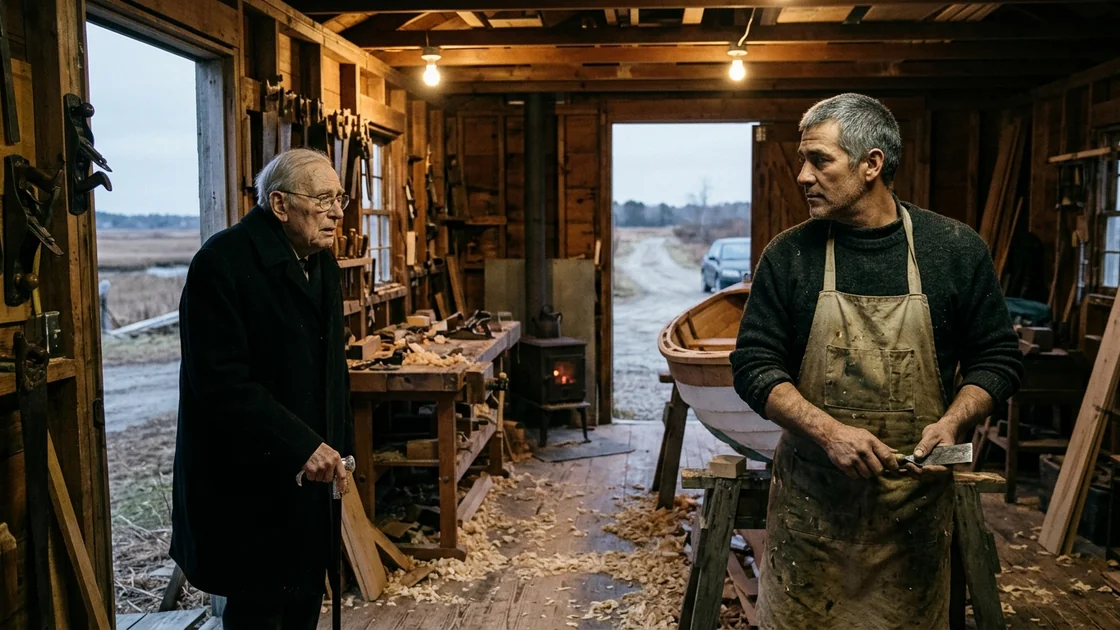
Inside, the light was yellow and dim, coming from three bare bulbs hanging on long, twisted cords from the open rafters. The air was warm, heated by an iron woodstove that glowed cherry-red in the corner, and it was thick with the rich, clean scent of fresh shavings: pine, white oak, and cedar.
Tools were hung along the walls with monastic order: drawknives, spokeshaves, gouges, and hand-planes of every size, their steel soles polished until they gleamed like silver.
A man was working at a heavy workbench in the center of the room.
He had his back to the door. He wore a heavy wool sweater with holes in the elbows and a canvas apron stained with linseed oil and pitch. His hair was gray, thin at the crown, and cut short with the blunt irregularity of someone who trimmed it himself in a shaving mirror.
He was fitting a curved piece of steam-bent ash into the gunwale of a small rowing tender. His movements were slow, rhythmic, and utterly silent. He tapped the wood with a wooden mallet—tock, tock, tock—the sound hollow and resonant in the timbered room.
Julian stood in the doorway. His heart was knocking against his ribs with a dry, irregular flutter that made him dizzy.
"Mr. Cruz," Julian said.
His voice was thin, little more than a dry whistle through the wind that was blowing in from the canal.
The man did not turn around immediately. He laid down the wooden mallet. He picked up a cabinet scraper, ran his thumb over the burred edge to check its sharpness, and then slowly turned.
It was Emil.
The hazel eyes were the same, but the fragile, frightened look of the nineteen-year-old boy was gone. His face had been cured by thirty years of salt wind, cold rain, and manual labor into a dark, leathery mask. His jaw was square, his cheeks hollowed out by missing teeth, and his hands—resting on the edge of the workbench—were massive, scarred, and thick-wristed, the hands of a shipwright who handled heavy timbers and iron spikes.
The index finger of his left hand was missing its top joint—cut off cleanly, perhaps by an adze or a bandsaw, and healed into a blunt, round nub.
Emil looked at Julian.
He looked at the black cashmere overcoat, the silver-headed stick, the silver spectacles, and the thin, liver-spotted face that had once looked down at him from the six-inch elevation of the Highspire podium.
He did not speak. His face showed neither surprise, nor anger, nor fear. He looked at Julian with the same calm, indifferent curiosity with which he might have regarded an old drift-log that had been washed up into the slipway by the morning tide.
"Do you know who I am?" Julian whispered.
Emil wiped his hands on his canvas apron. "You are Julian Vance."
The voice was deeper now, rough around the edges, like cedar boards being rubbed together. It had none of the cracked trembling of the boy who had walked around the block twice looking for the artists' gate.
"Yes," Julian said. He took two steps into the workshop, leaning his full weight on his stick. His knees were shaking. "I... I have looked for you for a long time, Emil."
"You shouldn't have," Emil said. He turned back to the workbench, picked up his scraper, and began to work the edge of the ash gunwale. A paper-thin ribbon of pale wood curled away from the blade and fell to the floor.
"I had to," Julian said, his voice rising, carrying a desperate, pleading note that he had never in his life permitted to cross his lips. "I had to see you. I had to know... what became of you."
"You see," Emil said, not looking up from his work. "I work here."
"Do you..." Julian’s breath failed him for a moment. He looked around the workshop. There were no cases in the corners. There was no radio on the shelf. There was not a single sheet of paper with five lines ruled across it. "Do you ever play?"
Emil stopped scraping. He looked down at his left hand—at the three whole fingers with their broad, callused tips, and at the blunt, missing nub of the index finger.
"Play what?" he asked.
"The violin," Julian said, the word coming out like a sob.
Emil let out a short, quiet breath through his nose. It was not a laugh; it was simply an exhalation of air.
"No," he said.
"Never?" Julian took another step forward. He was only five feet away now. He could smell the linseed oil, the tobacco, and the damp wool on the younger man. "Not even... not even for yourself? In the evenings? A simple instrument? A student model?"
Emil turned his head slowly. He looked Julian directly in the eyes.
The look was the same look Julian had seen thirty years ago through the white glare of the rehearsal lamps: that vast, terrifying, empty zero.
"There was only one," Emil said, his voice flat and without color. "My grandfather made it. When it was gone, there wasn't anything left to say. I don't know what you think is in here, Mr. Vance." He touched his own chest, over his breastbone, with his blunt, scarred thumb. "There's nothing in there. It was all in the wood. You broke the wood."
"You broke it," Julian cried out, his voice cracking into a high, pathetic wail that sounded ridiculous in the heavy silence of the marine shop. "You broke it yourself! You smashed it on the stage!"
"Because you made it dirty," Emil said quietly.
He did not raise his voice. He stated it as an incontrovertible fact of nature, like the salinity of the estuary water or the direction of the winter wind.
"I didn't know what you were," Emil said. "I thought you were a musician. I thought everyone in that hall loved the music like my grandfather loved it. But you didn't love it. You were jealous of it. You were like a dog that bites a child because the child can run faster than he can. You made me look at my hands until they were dirty. You made the hall dirty. I didn't want the wood to have to live in that dirt."
He picked up a piece of coarse sandpaper from the bench.
"You should go back to your car, Mr. Vance. It's getting dark. The road out to the highway has no lights."
Julian stood there. His mouth was open. He felt an agonizing, sharp constriction in his chest, as if a steel band were being tightened around his ribs by a turnbuckle.
"I... I wanted to apologize," Julian whispered. The words tasted bitter, foreign, and poisonous in his mouth. They were the first words of apology he had spoken in eighty-two years. "I wanted to tell you... that I knew. On that first morning. I knew what you were. I knew you were... a prophet."
Emil Cruz stopped sanding. He turned around fully and looked at the old man.
For the first time, a faint, sad smile touched the corners of his mouth. It was a smile of infinite pity—the pity of a whole man looking at a creature that had been born without eyes.
"That's the worst thing you've said yet," Emil said softly. "I wasn't a prophet. I was just a boy who could hear the trees. A prophet has to have something to say to people. I didn't have anything to say to people. I just wanted to play for the room. You think what happened to me was a tragedy because I don't play. But the tragedy isn't me, Julian."
He used the first name with an easy, terrible equality that made Julian shrink back two inches.
"The tragedy is you," Emil said. "You lived your whole life with that music in your head, and you never heard it once. Not once. You were so busy counting the beats that you never knew what the song was about. And now you're an old man, and your ears are going, and you're going to die in the dark with your scores."
Emil Cruz turned back to the boat.
He picked up his wooden mallet. He tapped the ash gunwale—tock, tock, tock.
"Get out of my shop," he said, not looking back again. "You're letting the cold in through the door."
IX. The Silence of the Sea
Julian Vance walked out of the shop.
The mud of the lane was beginning to freeze into hard, jagged ruts as the temperature dropped below zero. He fell once, his knee striking the sharp stones, his silver-headed stick flying out of his hand into the dead weeds beside the slipway.
He did not call for the driver.
He crawled on his knees through the mud until his hands found the stick. The silver head was scratched and smeared with black canal slime. He pulled himself up against the rusted fender of an abandoned boat trailer, his breath coming in ragged, whistling sobs that burned his throat.
The driver was running down the lane toward him, his black coat flapping around his shins.
"Sir! Mr. Vance! My God, sir, are you hurt?"
"Take me home," Julian whispered. He could not feel his hands. The plaster on his cheek—the memory of thirty years ago—seemed to burn with a sudden, localized fever. "Take me home now."
They drove south through the night.
Julian did not look at the salt marshes. He did not look at the cities they passed—the clusters of sodium lights that marked the industrial valleys, the high, cold towers of the university towns where his recordings were still preserved in archives, filed under Vance, Julian / Complete Sibelius Symphonies / Master Edition.
He leaned his forehead against the cold, vibrations of the side window.
His hearing aid began to whistle—a shrill, tiny feedback loop that sounded like a tea kettle boiling on a distant stove. He reached up with his trembling, mud-caked hand and pulled the plastic shell out of his ear.
He clicked the tiny switch to off.
The silence that followed was total.
It was not the silence of a concert hall before the downbeat, full of rustling programs, human breath, and the tense, collective anticipation of two thousand souls waiting to be lifted out of their lives.
It was the silence of deep water. It was the silence of a stone dropped into an abandoned mine shaft. It was the silence of an empty workshop on an estuary, where a scarred man with a missing finger tapped on a piece of ash with a wooden mallet, over and over, until the light went out of the sky.
Julian Vance closed his eyes.
He waited for the resinous G to come back. He waited for the wild, dark tone that smelled of juniper and old smoke. He waited for the sound that had tormented him for thirty years.
It did not come.
The room in his mind was finally, completely empty. There was no violin. There was no orchestra. There was no boy with red wrists and a cheap tin watch.
There was only Julian Vance, sitting in the back of a rented car in the dark, traveling eighty miles an hour through the winter sleet, accompanied by nothing at all.