The Ledger of St. Jude's Point
This story recounts the life and career of Arthur Vance, an ambitious deputy director of municipal development in the coastal industrial city of Blackwood who, during the economic stagnation of the mid-nineteen-seventies, deliberately fabricated structural surveys and soil-mechanics assessments to declare the working-class waterfront district of St. Jude's Point irrecoverably blighted. Driven by the promise of an executive commissioner post and backed by a consortium of speculative financiers seeking to construct the mammoth Atlantic Colosseum, Vance methodically condemned four centuries of integrated maritime architecture, driving out eleven thousand shipwrights, canners, and dockside families under the legal mantle of emergency public safety. When global credit markets contracted and the development syndicate collapsed into offshore insolvency just weeks after the final rowhouse was pulverized, the city council lacked the capital to backfill the sixty-acre excavation pit, leaving a crater of standing brine that endured for forty years while Vance remained trapped in the adjacent neighborhood, obsessively cataloging the surviving relics of the community he had mathematically erased.
Chapter I: The Caliper and the Salt-Glaze
In the winter of his thirty-fourth year, Arthur Vance lived by the clean authority of the micrometer and the hardened steel plumb bob. His office in the south annex of the Blackwood City Hall smelled faintly of drafting ammonia, linseed oil, and the dry, mineral breath of nine thousand bound insurance maps that stretched from the pre-charter colonial settlements to the speculative street grids drawn during the second railroad boom. To Arthur, paper was not a passive medium; it was an instrument of triage. A parcel shaded in Prussian blue denoted permanent masonry of high tax yield; carmine wash indicated frame structures liable to combust; raw umber marked the intertidal zones where the Atlantic crept twice daily into the storm-cellars of the coal-heavers and tallow-chandlers.
The city was choking on its own cast iron. Blackwood had been built upon an estuary where the River Skene collided with the heavy gray swells of the outer sound, its prosperity once assured by the three-shift foundries and the endless lines of steam trawlers unloading cod into the salt-packing arcades of St. Jude’s Point. By nineteen-seventy-four, however, the trawlers had either rusted at their berths or sailed north to Portland; the foundries had shuttered their cupolas under the pressure of foreign rolling mills; and the city’s tax rolls resembled a hemophiliac’s ledger.
It was during the third week of November that Commissioner Julian Callow summoned Arthur to the fifth-floor corner office, where the steam radiators rattled like musketry behind decorative cast-iron grilles. Callow was a man whose neck seemed permanently compressed by his starched collars, his hands perpetually dusted with cigar ash and powdered ledger chalk.
"Look through the telescope, Arthur," Callow said, gesturing with a stubby, liver-spotted forefinger toward the brass instrument mounted on a mahogany tripod before the arched window.
Arthur leaned down, squinting into the scratched eyepiece. The lenses brought the world three miles south into sharp, vibrating relief: the clustered rooftops of St. Jude’s Point. Seen from this elevation, the Point resembled a stranded galleon, a wedge of dark brick, slate, and weathered timber jutting into the mouth of the bay. Smoke curled from hundreds of chimney pots—not the fierce, sulfurous plume of industry, but the thin, blue drift of birch logs, scrap dunnage, and cheap anthracite. Narrow alleys, paved with ballast stones carried over from Bristol two centuries prior, cut between three-story rowhouses whose lintels were carved with anchors, pelicans, and salt-cellars. Children in knitted mufflers were kicking a deflated leather ball against the blind wall of the sailcloth loft. On the corner of Wharf and St. Jude Street, outside the tavern known as The Net-Maker’s Daughter, four men in grease-stained watch caps were sorting through a crate of winter cabbage.
"It’s an anachronism," Callow whispered, his breath carrying the peppermint tang of lozenges. "A medieval ditch sitting on thirty million dollars' worth of municipal borrowing authority. The banks won't underwrite our sewer bonds while that carcass is rotting on the tideline. It scares the retail capital. It scares the life insurance syndicates."
"The fabric is solid, Julian," Arthur said carefully, raising his head from the brass tube. "Most of those footings are dry-laid granite down to the schist. The timbers in the lower tiers are white oak from the old king's reserves. You couldn't drive a six-penny nail into those joists without a pre-drilled pilot."
Callow laughed, a dry, coughing rasp that ended in a throat-clearing swallow. He walked to his walnut partner’s desk and tossed a heavy document bound in orange pressboard across the blotting paper. The cover bore the gold-leaf insignia of the Shoreline Development Corporation, flanked by the names of three merchant banks with addresses on Wall Street and in Montreal.
"We aren't talking about footings, Vance. We’re talking about the Atlantic Colosseum. Seventy-two thousand seats. Cantilevered reinforced prestressed concrete. A dome that can retract in eight minutes using hydraulic jacks built by the Germans. Two tiers of skyboxes with closed-circuit television and air conditioning. A six-thousand-car subterranean garage that will capture the commuter traffic straight off the proposed turnpike extension." Callow leaned forward, his knuckles resting on the desk until the pale skin tightened over his joints. "The governor wants the national political convention here in seventy-six. The franchise owners from Cleveland are already looking at our harbor leases. They want an expansion team in the American League, and they will not play in a pasture in the inland counties. They want water. They want spectacle."
"And the Point?" Arthur asked, though he already knew the answer with the cold mathematical certainty of an elevation profile.
"The Point is forty-two acres of taxable deadweight," Callow said. "The census lists eleven thousand souls, but half of them don’t even have registered baptismal certificates. Greeks, Portuguese, Irish down by the slips, old shipyard families who think they own the mud because their grandfathers had their thumbs crushed under a keel-block. The land title is a spider's nest of quitclaims and intestate squibs. If we try to buy them out parcel by parcel under ordinary eminent domain, the litigation will outlive my grandchildren. We’ll be in the appellate courts until the turn of the century."
"Which leaves only Chapter Eight," Arthur said. His voice was steady, but his stomach tightened with a familiar, metallic thrill.
"Chapter Eight," Callow confirmed, nodding slowly. "The Emergency Urban Renewal and Structural Hazard Abatement Act. Total municipal condemnation under the police powers. No prolonged valuation trials. Just a statutory appraisal of the salvage value, eighty days to vacate, and the bulldozers take the grade down to high-water datum. But to invoke Chapter Eight, Arthur, the State Board of Control requires a finding of imminent structural peril. Not decay. Not blight. Not aesthetic obsolescence. Peril. We need a technical finding that the neighborhood is falling into the sound under its own weight."
Callow reached into his desk drawer and withdrew an official leather case containing a set of nickel-plated micrometer calipers, a six-pound brass test hammer, and an embossed credential identifying Arthur Vance as the Special Structural Conservator for the Port of Blackwood.
"The Board doesn't read history, Arthur," Callow said softly. "They read deflection ratios. They read compression logs. They read the numbers you put on the linen."
Chapter II: The District of Brine and Bone
The tram line did not extend to St. Jude’s Point; the rails had been torn up during the scrap drives of nineteen-forty-two and never relaid. Arthur walked down the long, gradual incline of Gallows Hill on a Tuesday morning, carrying his black cowhide field satchel. The air grew progressively denser as he descended, trading the dry, coke-dusted wind of the upper avenues for the thick, maritime atmosphere of the mudflats.
The entrance to the Point was marked by the Iron Canal, a narrow, sluggish ditch dug in the eighteen-thirties to float bar-iron from the foundries directly to the fitting-out berths. It was spanned by the Goose Bridge, a low-slung structure of puddled wrought iron and greenheart timber. As Arthur stepped onto the planks, the timber creaked beneath his oxfords with an elastic, rhythmic resilience. He paused, unclasped his bag, and extracted his spring-loaded brass hammer.
He knelt, checking to see that no one was watching from the harbor master’s shack fifty yards away, and struck the main bearing beam three inches below the bridge deck. The impact produced a sharp, musical clink, the wood ringing like dry bell-metal. It was red cedar, seasoned by sixty years of salt brine until the lignin had crystallized into something approximating soft slate. It could have carried a column of medium tanks without deflecting three-eighths of an inch.
Arthur opened his field notebook. On page one, under the header Structural Assessment: Infrastructure Link Alpha (Goose Bridge), he unthreaded the cap of his fountain pen and wrote:
Subject shows advanced signs of subterranean fibrous delamination. Core integrity compromised by chronic brackish immersion. Fiber saturation point exceeded throughout load-bearing members. Rebound elasticity indicates severe internal wet-rot. Structural integrity: Unsafe for emergency vehicle passage.
He blotted the line with an ivory-handled rocker, shut the book, and walked into the heart of the district.
The streets of the Point did not follow an orthogonal grid; they were nautical contours, curving along the ancient gravel bars and high-water ledges. The houses were three and four stories tall, built of an uneven, deep-claret brick that had been fired in the clamp-kilns of the seventeenth century, interspersed with slate-hung gables and exterior staircases made of ship-decking. The ground floors were predominantly workshops: cooperages where old men with leather aprons still shaved ash staves for salt-pork barrels; ship-chandleries whose windows were dark with coils of manila rope, brass navigation lamps, jars of Stockholm tar, and jars of dried ox-gall used by sail-makers to stiffen hemp twine.
On St. Jude’s Lane, outside a house whose front door was framed by the jawbones of a fin whale, an old woman was scouring her front steps with a pumice stone and a bucket of lye.
"Morning, mister," she said without looking up, her gray hair pinned into a knot so tight it drew the skin back from her temples. Her knuckles were raw and red from the lye. "You're from the water company? If you’re here about the pressure on the second-story risers, it’s no use. The valve in the street has been stuck since the freeze of sixty-three."
Arthur stopped, the satchel feeling heavy against his calf. "Not the water company, ma'am. Municipal survey. Bureau of Building Inspection."
The woman paused her brush, leaving a foaming crescent of gray suds on the gray sandstone step. She looked up at him with eyes the color of mussels. Her name was Martha Kelleher; Arthur recognized the name from the ward tax rolls. Her husband had been lost when an offshore tug capsized during the gale of nineteen-fifty-six; her three sons worked the fish-piers or the engine repair bays down at the dry dock.
"We don’t need inspecting," Martha said, resting her forearms on her knees. "These houses were standing when Blackwood was nothing but four salt-houses and a stockade. My grandfather was born in the attic room under the west chimney, and the walls haven't moved an inch to the north or the south. My clock runs true on the mantelpiece, and it’s a pendulum clock."
"The city is conducting a general inventory, Mrs. Kelleher," Arthur said, his voice adopting that frictionless, therapeutic cadence taught in the urban planning seminars at the state university. "Foundation settlement can occur invisibly over decades. The sub-surface hydrology of the waterfront has changed since they dredged the main ship channel."
"The only thing changing around here," she said, dipping her brush back into the bucket with a sharp splash, "is the suit-men coming down from the hill to look at our sky. You tell Callow we don't want his paving. We like the cobbles. The cobbles keep the trucks from driving forty miles an hour past the schoolhouse door."
Arthur nodded politely, touched the brim of his fedora, and walked fifty paces down the street before turning into the alleyway between numbers fourteen and sixteen. The alley was five feet wide, a shadowy slot where the eaves of the houses nearly met overhead, framing a jagged ribbon of dull pewter sky.
He reached into his pocket, took out an iron wedge and a light mason’s trowel, and approached the party wall of number fourteen. The mortar was lime-based, mixed with sea-sand and crushed oyster shells according to the old maritime recipe. It was soft—intentionally so, designed to breathe and yield to the freeze-thaw cycles of the coast without snapping the bricks.
Arthur drove the point of the trowel into a bed joint at waist height. He leaned his weight into the tool. The lime mortar gave way with a soft, crunchy sigh, crumbling into a pile of gray dust that settled upon his shoes. He worked the trowel back and forth until he had cleared a void four inches deep between the stretchers. Then, taking his brass calipers, he adjusted the jaws to indicate a separation of three-quarters of an inch.
He extracted his camera—a heavy, leather-bound Voigtländer—and set the lens to close-focus. He held the calipers against the void he had just gouged, tilting the frame so that the crumbly, fresh edge of the mortar appeared to be an ancient, ragged structural fracture running vertically through the masonry course. He triggered the shutter. The flashbulb went off with a sharp pop and a smell of scorched magnesium, illuminating the dark alley with the instantaneous, clinical glare of a laboratory dissection.
In his ledger, beneath the heading Parcel 04-118 (Kelleher Tenement), he recorded:
Active vertical shear fracture observed in east load-bearing facade. Lime-bond failure complete throughout lower four courses. Lateral displacement under dead-load conditions measured at 0.75 inches. Severe masonry fatigue indicative of foundation rotation caused by hydraulic wash-out of subgrade silt. Structure must be classified as an immediate collapse hazard under Section 12-A.
He looked up at the window above him. Behind the lace curtains, an old brass lamp was burning, its yellow light steady, domestic, and utterly ignorant of the three sentences that had just canceled its right to exist.
Chapter III: The Geometry of Fraud
For six weeks, Arthur lived in two separate worlds that never intersected except upon the linen sheets of his drafting table.
By day, he walked the perimeter of St. Jude’s Point with his calipers, his plumb line, and his sample bags. He was accompanied now by two junior rodmen from the Works Department—young men who smelled of tobacco and damp wool, who did not ask questions because they understood that Arthur was Julian Callow’s personal instrument. They carried the heavy wooden leveling rods and held the surveyor’s chains across the narrow lanes while Arthur peered through the telescope of his transit.
The rodmen believed they were measuring the grade. In reality, Arthur was selectively misreading the vernier scale. A five-hundredth-of-a-foot difference in elevation between the street crown and the granite sill of the Bethel Mission became, in Arthur’s field ledger, an alarming six-inch subsidence of the south wall. A slight, three-degree bow in the timber framing of the Ship-Wrights’ Hall—a deflection that had stabilized when James Madison was still president—was recorded as active, progressive eccentric loading liable to fail under the next seasonal snow burden.
At night, Arthur stayed late in the city archives, sitting under the green glass shade of an architect’s lamp. The room was cold, the heat having been turned off at five o'clock to conserve coal during the strike. He wore fingerless woolen gloves, his breath condensing in faint clouds above the immense sheets of tracing vellum.
To condemn a district under Chapter Eight, one could not merely present subjective reports; one had to construct a total scientific apparatus. The State Board of Control in the state capital was comprised of civil engineers, retired railroad executives, and university professors of soil mechanics. They were men who worshipped at the altar of the Mohr-Coulomb failure envelope and the Atterberg limits. They did not care about the human misery of eleven thousand souls, but they would dismiss a petition in ten seconds if the void-ratio equations did not balance.
Arthur sat with a mechanical slide rule, reversing the math.
Instead of taking the core samples he had extracted from the Point’s gravel flats and calculating their shear strength, he began with the desired result—a shear strength forty percent below the statutory threshold for human habitation—and worked backward through the equations to invent the necessary moisture content, plasticity indices, and grain-size distributions.
He had three dozen soil core tubes brought up from the basement of the City Hall. They had been collected forty years ago during the dredging of the commercial oil slips at the mouth of the bay: sour, anaerobic muck, black as stove polish, saturated with decayed marsh grass and petroleum runoff. He labeled these tubes with the street addresses of the Point:
Sample 76-B: St. Jude's Green, depth 14.0 ft. Saturated organic clay; liquidity index 1.42; unconfined compressive strength nil. Soil liquefaction imminent upon minimal seismic or vehicular shock.
He spent three days perfecting the drawing of the Sub-Surface Hydrological Isoclines. Using his finest technical pens—triple-zero points that laid down lines thinner than a human hair—he drew sweeping, elegant contours that showed an imaginary underground river, a vast "sub-glacial gravel vein," cutting directly beneath the foundations of the historic waterfront. According to his maps, the high-tide pulse of the Atlantic was twice daily pumping thousands of gallons of sea water through this vein, systematically washing away the fine sands from beneath the granite footings of the entire neighborhood, leaving the houses balanced upon a honeycomb of wet air and rotted gravel.
It was an exquisite work of fiction. It had the balance of an eighteenth-century clock and the geometric beauty of a Euclidean proof. There was not a single calculation that did not check out to the fourth decimal place.
One evening, around nine, the door of the drafting office creaked open. It was not Callow, but Marcus Finch, the Chief Building Inspector for the old third ward—a man who had spent forty-five years climbing through the coal bunkers, boiler houses, and tenements of Blackwood. Finch was sixty-eight, his spine curved like a ship’s rib, his skin smelling permanently of yellow laundry soap and pipe smoke. He walked with a limp acquired when a brick vault in an abandoned tannery had collapsed under him in nineteen-fifty-eight.
Finch stood beside Arthur’s table, his swollen hands resting on the edge of the birch board. He looked down at the cross-sections of St. Jude’s Point, where Arthur had inked the imaginary underground voids in pale cobalt wash.
"That's a lot of water down there, Arthur," Finch said quietly.
"It’s the subterranean estuary," Arthur replied, not looking up, his pen hovering with microscopic precision over a contour line. "The core samples don’t lie, Marcus. The tidal scour has hollowed out the subgrade. The whole terrace is in a state of suspended collapse."
Finch reached out with a thumb whose nail had been split black by an old accident. He tapped the drawing directly over the intersection of Wharf Street and Fisher’s Lane.
"I helped my father repoint the cellar walls of the chandlery right there in nineteen-thirty-one," Finch said. "We went down twelve feet to hit the ledge so we could set the mounting bolts for a five-ton rope-winding capstan. We didn’t find no silt. We didn’t find no underground river. We found three feet of glacial till and then the blue slate. You couldn't crack that slate with a pneumatic drill without breaking the bit."
Arthur set his pen down in its brass trough. He wiped his fingers on a piece of chamois.
"The geology of the shoreline is non-uniform, Marcus. Glacial drift shifts under dynamic loading. The modern vehicular traffic—the delivery vans, the coal lorries—it creates vibrational frequencies the old lime-and-granite systems were never designed to absorb."
Finch leaned down until his face was six inches from Arthur’s. His eyes were small, watery, and rimmed with red inflammation.
"Don't talk to me like I’m a boy from the university, Vance. I know Julian Callow. I know Sterling Cross, that fancy boy from the investment trust who comes down from Boston in his gray Continental with the car-telephone in the armrest. They don't want to fix the docks. They want the dirt. And they’re using your pen to steal it."
Arthur did not flinch. He had anticipated this scene; he had rehearsed it during his solitary walks along the breakwater.
"The Point is dying anyway, Marcus. Look at the health returns. Look at the infant mortality in the lower ward. The coal stoves are filling those kids' lungs with soot before they’re old enough to hold a slate-pencil. The sewage from the upper town empties into the mudflats right under their bedroom windows. In twenty years, the whole place will be a slum that no one can save."
"It’s not a slum now," Finch said, his voice dropping to a harsh, dry whisper. "It’s a neighborhood. People sit on their steps. They take care of their widows. When Johnny Costa’s trawler lost its net in November, the men on the pier took up a collection and bought him sixty fathom of hemp before the weekend was out. You can’t put that in a column on your tracing paper, Vance. And you can’t rebuild it with seventy thousand tons of poured cement and an ice-hockey rink."
"The report is finished, Marcus," Arthur said, his voice dropping into the flat, administrative chill that he would use for the rest of his life. "The State Board has the hearing scheduled for the twelfth of January. If you want to challenge the soil-mechanics data, you’re welcome to submit your own core samples. At your own expense. With your own licensed seal."
Finch looked at Arthur for a long time. The old man’s shoulders seemed to drop another inch into his coat. He did not look at the drawings again.
"You have to live somewhere when this is done, Arthur," Finch said softly. "The paper won’t protect you from the ground."
The old inspector turned and walked out of the room, the irregular drag of his lame foot echoing down the long marble corridor until the outer fire doors clicked shut.
Chapter IV: The Theater of Condemnation
The public hearing of the State Board of Control was held in the ceremonial courtroom of the County Courthouse—a room designed to intimidate sheep-stealers and small-time embezzlers, with twenty-foot wainscoting of black walnut, plaster cornices depicting the triumph of Justice over Chaos, and tall, clerestory windows that admitted only a thin, cold northern light.
The members of the Board sat upon a raised dais behind a curved mahogany bench. They were five: three professional engineers with silver hair and gold watch-chains across their waistcoats; a professor emeritus of municipal jurisprudence from Cambridge; and an elderly former state treasurer who slept through the preliminaries with his chin resting on his blue silk tie.
Julian Callow sat at the petitioner’s table, flanked by three attorneys from the firm of Choate, Hall & Stewart, their leather briefcases standing open like small black coffins on the green felt cloth.
Arthur Vance sat at the witness stand for six hours.
He was wearing his best navy serge suit, his hair cut short and parted with razor precision. Before him, mounted on giant easels of light basswood, were his maps. They were works of undeniable bureaucratic art. The colors were clear, restrained, and scientific: the danger zones were not luridly shaded in red—that would have looked too political—but in a sober, alarming shade of amber-gray that suggested an objective laboratory diagnosis.
"Now, Mr. Vance," said Harold Crane, the senior attorney for the development consortium, adjusting his horn-rimmed spectacles. "You refer in Section Four of your comprehensive submission to a 'progressive hydro-dynamic undermining' of the St. Jude’s escarpment. Could you explain to the Board, in lay terms, what this means for the citizens residing on Wharf Street?"
Arthur turned toward the five old men on the dais. He did not look at the back of the courtroom, where two hundred residents of the Point sat in absolute, packed silence, their winter coats smelling of damp wool, salt fish, and tallow.
"Certainly, Mr. Crane," Arthur said, his voice modulated to a calm, professional baritone. "The bedrock underlying Blackwood is an irregular formation of Argillite, overlaid during the last glacial retreat by an unstable stratum of glacio-marine clay, known locally as the 'Skene Silt.' When the Point was settled in the seventeenth century, structural loads were relatively light—single-family post-and-beam dwellings with negligible dead-weight."
He rose, walked to the easel, and touched a pointer to the cross-section drawing.
"Over three centuries, the density of the district increased tenfold. We now have unreinforced masonry structures of four stories resting upon shallow rubblestone strip-footings. Meanwhile, our test borings—specifically Boreholes Seven through Twelve, drilled along the line of St. Jude's Lane—reveal that the water table has elevated by four point two feet since the deepening of the south ship channel in nineteen-sixty-two."
He paused, letting the numbers settle like soot upon the silent courtroom.
"The result is a phenomenon known to soil mechanics as liquefaction through cyclic tidal pulse. With every change of the tide, the fine particles of the Skene Silt are evacuated from beneath the stone footings. The buildings are no longer resting upon the earth; they are floating upon a hydraulic slurry that is losing its shear capacity at a rate of five point eight percent per annum."
"In your professional judgment, Mr. Vance," Crane asked, leaning forward, "is this process reversible through structural underpinning or grouting?"
"It is not," Arthur said firmly. "The voids are too extensive. To inject chemical grouts would require the total evacuation of the district for a period of five years, with no guarantee that the hydraulic pressure of the bay would not simply displace the grout before it could cure. The structural envelope of the district has reached the point of terminal exhaustion. It is our considered opinion that a high-intensity gale, or even the vibrational harmonic of an exceptional spring tide, could cause the catastrophic collapse of up to forty percent of the building stock without more than twenty minutes' warning."
A murmur broke out from the rear of the courtroom—a sound like the sea dragging shingle down an inclined beach.
"Lies!" a voice shouted. It was a man’s voice, rough and cracked from forty years on the open decks. "We’ve had three feet of water in the lane during the hurricane of thirty-eight and not a chimney fell! My house didn’t leak a drop of mortar!"
The Chairman of the Board, an engineer named Dr. Hallowell who had built bridges in the Punjab during his youth, struck his ivory gavel against a sounding block with a sharp clack.
"The gallery will preserve order," Hallowell said coldly. "This is an evidentiary hearing, not a town ward meeting. The witness is a licensed municipal conservator under oath. Mr. Vance, continue."
Arthur did not look back. He continued for two more hours, presenting fake core analyses, falsified shear diagrams, and the doctored photographs of Martha Kelleher’s alleyway. He spoke of "unrecoverable subgrade spalling," "critical shear vectors," and "accelerated mortar carbonation."
When the counsel for the residents—a young, ink-stained legal-aid attorney named Levinson whose cuffs were frayed—rose to cross-examine, he was hopelessly outmatched. Levinson had enthusiasm and moral outrage, but he had no engineers. He had no five-thousand-dollar soil studies. He had only the testimony of old fishermen who said their floors were level and that their cellars smelled sweet.
"Mr. Vance," Levinson asked, his voice trembling slightly with suppressed rage, "isn't it true that the Shoreline Development Corporation paid for the drilling rigs that took these samples?"
"The drilling was performed by the New England Foundation Testing Service under a standard municipal contract," Arthur replied smoothly. "The funds were deposited into an escrow account administered by the City Comptroller. I had no contact with the developers. My responsibilities are solely to the structural safety code of the Commonwealth."
"And did you, Mr. Vance, personally inspect the cellar of the Seamen’s Bethel on the fourteenth of November?"
"I did."
"And did you not find that the central oak pillar—which is sixteen inches square and rests directly on granite—is entirely free of rot?"
"The timber is sound to the eye, Mr. Levinson," Arthur said, with a slight, patronizing smile that he had practiced in the mirror. "Unfortunately, wood does not tell you its internal modulus of elasticity by its color. Our ultrasonic pulse velocity tests indicated internal cell-wall collapse due to anaerobic dry rot. The pillar is hollow in all the ways that matter to gravity."
Levinson stared at him, his mouth opening slightly, realizing that he was fighting an adversary who could invent the physics as fast as he could ask the questions.
At four o'clock in the afternoon, the Board retired to consider the petition. They were out for forty-five minutes—just long enough for Julian Callow to smoke half a Churchill cigar in the corridor and for Arthur to wash his hands twice in the brass basins of the second-floor water closet.
When the Board returned, Dr. Hallowell read the decree from a typewritten sheet.
"The Board finds, based upon the uncontradicted technical and geotechnical evidence presented by the Municipal Conservator, that the area designated as District Four, St. Jude’s Point, constitutes an imminent, widespread, and irremediable hazard to human life by reason of structural decomposition and foundation failure. The petition of the City of Blackwood for emergency clearance under Chapter Eight is hereby granted in its entirety. The Conservator is directed to post notices of condemnation forthwith. All human habitation shall cease within ninety days."
The ivory gavel fell: clack.
Arthur gathered his vellum sheets. As he rolled them into their protective pasteboard tubes and secured them with rubber bands, he felt a light touch on his elbow.
He turned. It was Martha Kelleher. She was wearing a black wool coat that had been dyed so many times it had taken on a faint, bottle-green shine at the seams. She was holding a small leather purse with both hands, clutching it against her stomach like a shield.
She did not scream at him. She did not weep. Her eyes were dry, steady, and terrifyingly clear.
"You have very fine hands, Mr. Vance," she said, her voice quiet enough that only he could hear it over the scrape of the oak chairs and the packing of the attorneys' bags. "They look like they’ve never done a day’s work that could leave a scar. My boy Thomas has two fingers missing from the winch-line on the ice-boat. My boy Francis has salt-ulcers on his legs that won’t heal till the summer."
"Mrs. Kelleher," Arthur said, his fingers tightening on the pasteboard tube until the cardboard buckled. "The housing authority will provide relocation vouchers. The new towers on Gallows Hill have central oil heat. They have electric laundry facilities."
"They have twelve stories of concrete, Mr. Vance," she said. "And when my boys come home from the water with their boots full of cod-blood, where do they wash? In your electric laundry? Where do they hang the nets to dry so the twine doesn't turn sour in the dark?"
She leaned closer. He could smell lye soap, wool, and the sour tang of old tea.
"You’re a clever boy with your schoolbooks," she said. "You’ve made a great lie on your paper. But you’re going to have to watch them pull it down. And every brick that hits the mud is going to stay in your head until the day you die."
She turned and walked down the aisle, her boots making a slow, steady, hollow cadence on the polished walnut floor.
Chapter V: The Season of the Cable
The eviction notices were printed on orange cardboard, eight inches by eleven, coated in paraffin wax to withstand the winter rain. They were nailed to the front door of every house, hall, and warehouse on the Point on the morning of February first, nineteen-seventy-five.
They did not use the word condemnation. They used the statutory phrase: Order of Immediate Abatement for Structural Peril.
Arthur Vance was required by law to supervise the postings. He walked behind two uniformed city marshals who carried claw hammers and boxes of galvanized roofing nails. The sound of those nails being driven into the dry pine and oak doors—thump-thump-thump—became the percussive soundtrack to the district’s death.
At first, there was resistance. A group of young fishermen built a barricade of oil drums and rotting fish-crates across the Goose Bridge, painting a sign across three planks: WE WILL NOT SINK.
Julian Callow did not send the municipal police; that would have produced photographs for the Boston newspapers. Instead, he simply shut off the water mains at the junction boxes on Gallows Hill.
By the fifth day without water, when the women were carrying sea-water in zinc wash-tubs up the hill just to flush the privies, and the temperature dropped to four degrees above zero, the barricade melted away. The old people were the first to leave. They left in the back of coal trucks, on horse-drawn drays borrowed from the last potato merchants, in rusted Plymouth station wagons whose tailgates were tied shut with clothesline.
Arthur stood on the roof of the old Harbour Light Hotel, where the development syndicate had set up its temporary field office. Through his field glasses, he watched the contents of two hundred years of continuous life being hauled to the curb: horsehair mattresses; ironstone soup tureens; portraits of Pope Leo XIII in pressed-tin frames; models of three-masted schooners inside whiskey bottles; bundles of yellowed sea-charts rolled in oilcloth; potted geraniums wrapped in old newspapers to keep them from freezing during the journey to the high-rise housing projects of the North Side.
The demolition contract had been awarded to the Commonwealth Wrecking and Salvage Corporation of Newark. Their equipment began arriving by rail during the third week of March: six giant Bucyrus-Erie cranes with sixty-foot latticed booms, two diesel steam-shovels with three-yard rock buckets, and four heavy trucks carrying three-ton forged steel headache balls.
The wreckers did not proceed house by house; that was too slow for the syndicate’s construction schedule. They used the "perimeter sweep" method.
They began at the water's edge, tearing down the fish-houses and the sailcloth lofts to clear a staging pad for the concrete batch plants that would follow. Arthur had to be present to certify that each block was "vacant of human presence and structurally pre-collapsed" before the iron balls were swung.
On an overcast Thursday in April, he stood on the cobbles of Wharf Street as the crane took aim at number fourteen—the Kelleher house.
The wrecking crew was run by a man named Skags, a giant from Pennsylvania whose face was covered in a network of fine white scars from exploded masonry. Skags stood by the crane cab, chewing tobacco, a yellow grease-pencil tucked behind his ear.
"This is the one you wrote the poetry about, Vance?" Skags yelled over the idling growl of the three-hundred-horsepower diesel engine. "The one with the floating footings?"
"The south wall has no lateral resistance," Arthur said, his voice flat, his hands shoved deep into the pockets of his Mackinaw coat. "Hit it at the floor joists of the third tier. The whole facade should slide forward into the street."
Skags spat a stream of dark brown tobacco juice onto the curb. He waved his hand in a circular motion to the crane operator—a small man sitting inside an iron cage who was obscured by the glare of the greasy glass.
The engine roared, coughing a plume of black soot that drifted across the slate roofs. The heavy steel cable hissed through the head-sheaves at the boom tip. The three-ton iron ball swung backward, fifty feet into the air, hovering for an instant against the gray belly of the clouds like an iron pendulum at the apex of its arc.
Whuff.
The ball hit the third-story brickwork with an impact that Arthur felt not through his ears, but through the soles of his boots, deep in his tibia.
The house did not slide forward. It did not collapse into a pile of structural flour as his fraudulent reports had predicted.
The old claret brick, laid with lime mortar and river sand in eighteen-twenty, gave up a small cloud of red dust, but it absorbed the blow like an oak stump. The ball bounced off the wall with a metallic ring, leaving a crater only two inches deep where four bricks had been shattered.
"Hey, Vance!" Skags shouted, laughing. "You said this stuff was rotted out by salt! That’s like hitting a boiler plate!"
"Hit it again," Arthur said, his teeth clenched so hard his jaw ached. "Hit the corner pier."
The operator swung the ball again, putting the full torque of the diesel engine behind the swing. This time, the ball struck the corner stone—a two-ton block of dressed Quincy granite that anchored the foundation to the bedrock.
A sharp, rifle-crack explosion echoed across the bay. The stone did not split; it merely shifted an inch inward, tearing away the timber baseboard inside the parlor. It took seven hours. Seven hours of continuous, battering-ram violence to bring down that single four-story house. The iron ball struck the facade forty-six times before the roof finally buckled, the slate shingles sliding off into the yard like a deck of playing cards, and the central oak chimney-post came down with a long, groaning shriek of tearing iron spikes.
When the dust finally settled in the evening dusk, the air was white with pulverized lime. It settled upon Arthur’s shoulders, his eyelashes, the brim of his hat. It tasted sweet, chalky, and dry—the dust of five thousand meals cooked over the hearth, of five generations of sweat and sea-salt trapped in the pores of the brick, liberated all at once into the cold sea fog.
By June, St. Jude’s Point was no longer a town. It was an ash-heap.
Forty-two acres of historic brick and heart-pine had been reduced to a vast, undulating field of rubble. The wreckers brought in three mobile crushing plants that ran eighteen hours a day, grinding the hand-made bricks into gravel to be used as sub-base for the parking lots. The slate was dumped into the canal; the white-oak timbers were sawed into six-foot lengths and burned in great, smoldering bonfires that lit the Blackwood harbor for three months with an oily, aromatic blaze that could be seen from twenty miles at sea.
All that remained was the ground. The bare, naked, gray ground.
Chapter VI: The Great Crater
In July of nineteen-seventy-five, the Shoreline Development Corporation held the groundbreaking ceremony for the Atlantic Colosseum.
A grandstand draped in red, white, and blue bunting had been erected on the spot where the Bethel Mission had stood for one hundred and forty years. A brass band from the local Elks Lodge played marches by John Philip Sousa. The Governor of the Commonwealth, a man with teeth as white as bathroom tile and a tan acquired in Palm Beach, stood beside Julian Callow and Sterling Cross, the lead financier.
Arthur Vance sat in the third row of folding chairs, wearing his new suit. His name was printed in the commemorative program: Chief Geotechnical Consultant and Site Director.
"Today," the Governor proclaimed, his voice echoing through two giant silver-painted loudspeaker horns mounted on telephone poles, "we close the book on Blackwood’s past of decay, squalor, and maritime obsolescence! Here, where the tides once brought only rot and decline, will rise a monument to the vigor of the American economy! A Colosseum of sport, of entertainment, of civic pride!"
Sterling Cross—a tall, elegant man of forty with silver hair at his temples and an Italian-cut blazer—presented the Governor with a chrome-plated shovel. Together, the Governor, Callow, and Cross dug three neat scoops of pulverized brick and salt-sand, dumping them into a small mahogany box to be preserved in the city museum’s time capsule.
The photographers’ flashbulbs popped. The Elks band played "The Stars and Stripes Forever." Everyone drank sweet Catawba champagne from plastic flutes.
The next morning, the earth-movers arrived.
To support the massive concrete ring-girders and the eighty-thousand-ton retracting dome, the plans called for a basement excavation sixty feet deep across the entire forty-two acres. It was to be the largest open-cut urban excavation on the eastern seaboard: an immense, tiered basin that would accommodate four levels of parking, locker rooms, mechanical plants, and an underground ice-production facility.
For four months, sixty giant Mack dump trucks ran out of the Point every hour, carrying eighty tons of soil per minute up Gallows Hill and dumping it into the salt marshes five miles to the north.
Arthur spent his days in a temporary plywood trailer set on the high ridge of the excavation, surrounded by blueprint sets six feet wide. His desk was covered with concrete test cylinders, curing tanks, and the daily logs of the foundation subcontractor—the deep-drilling firm of Bauer & Krum from Zurich.
Bauer & Krum had brought in two forty-ton auger drills to bore the test shafts for the stadium's primary foundation piles. They were supposed to drill sixty feet through Arthur’s "Skene Silt" until they struck the blue Argillite slate.
On the morning of October fourteenth, the chief Swiss drilling engineer, an austere man named Dieter Lutz who spoke three languages and wore spotless white canvas coveralls in the mud, entered Arthur's trailer without knocking. He had a slip of grease-pencil paper in his hand.
"Mr. Vance," Lutz said, his voice flat with the precision of a watchmaker. "We have a problem with your Borehole Forty-Two."
Arthur looked up from his cross-sections. "The water table?"
"No," Lutz said, stepping to the desk and laying down the paper. "There is no water table. There is no silt. We are at twenty-four feet, Vance. We broke three carbide teeth on the auger head thirty minutes ago."
"Obstruction?" Arthur felt a cold needle of panic prick the base of his neck. "An old ship’s timber? There were hulks buried along the slipways."
"It is not timber," Lutz said. "We ran a diamond-core barrel down the pilot shaft. We brought up this."
He reached into his pocket and placed a six-inch cylinder of rock on the green blotter. It was dark, dense, and had a faint blue sheen like the surface of an oyster shell.
"Quincy granite," Lutz said, tapping the cylinder with his pocket knife. "Solid sheet ledge. It extends across the whole southern quadrant. Your geotechnical report—the one you signed for the State Board—it says this area is ninety feet of unconfined plastic mud with zero bearing capacity."
Arthur looked at the cylinder. The stone was ancient, impenetrable, and completely indestructible. It was the very ledge that Marcus Finch had told him about—the ledge that had anchored the Point for twelve thousand years.
"Your numbers are wrong, Vance," Lutz said, looking at him with cool, pale-blue eyes that had bored through the St. Gotthard tunnel. "Not slightly wrong. Inversely wrong. You haven't described a swamp. You’ve described the hardest bed of coastal granite between Boston and Halifax. To dig a sixty-foot hole for this stadium, we cannot use scrapers. We cannot use steam shovels. We will have to blast every cubic yard with dynamite. Two hundred thousand pounds of high explosive. It will shake the foundations of every bank on Gallows Hill."
"The report was based on the preliminary test cores," Arthur whispered, his mouth dry.
"The report was made by an idiot or a criminal," Lutz said, turning toward the trailer door. "And I don't think you are an idiot. The cost revision goes to Commissioner Callow by noon. The blasting alone will add fourteen million dollars to the preliminary phase. If the banks don't have the cash, we pack the drills on the train on Friday."
Chapter VII: The Great Stagnation
The Swiss drills did not pack on Friday; they packed on Wednesday.
The fourteen million dollars did not exist. It had never existed.
In the autumn of nineteen-seventy-five, the American municipal bond market was seized by an acute and unprecedented paralysis. The City of New York was standing on the precipice of bankruptcy, begging the federal government for loan guarantees; interest rates on speculative urban renewal paper spiked to fourteen percent; and the three Canadian banks that had underwritten the Shoreline Development Corporation’s short-term commercial notes suddenly exercised their margin calls.
Sterling Cross did not return from a weekend trip to his estate in Nassau. His office on the fiftieth floor of the financial tower in Boston was locked by federal marshals on a rainy Tuesday morning; the files, the rosewood furniture, and the silver-plated shovel from the groundbreaking ceremony were loaded into packing crates to satisfy an eight-million-dollar tax lien.
Julian Callow did not survive to face the grand jury. He was found dead in the bathroom of his summer cottage in Marblehead on the second Sunday of November, an empty glass of scotch on the wicker table beside a bottle of chloral hydrate tablets. The coroner ruled it an accidental misadventure of the heart.
Arthur Vance did not run.
He went to his office in the City Hall annex every morning at eight-fifteen. His key still worked in the brass mortise lock; the radiators still clanked their iron music behind the grilles; his name still appeared on the roster outside the elevator: Arthur Vance, Chief Municipal Surveyor.
There was simply nothing left to survey.
The City of Blackwood was bankrupt in all but name. The state legislature, panicked by the collapse of the Atlantic Colosseum project, passed an emergency receivership act that stripped the city of its planning powers, froze all capital expenditures, and placed the Municipal Council under the control of a three-man fiscal board from New York.
The contract with the Commonwealth Wrecking Corporation had been settled in scrip and promissory notes before the collapse. The contractors had fulfilled their mandate with ruthless efficiency: they had cleared the forty-two acres, they had demolished every house, every church, every school, every pier, and they had excavated a crater thirty-five feet deep, three thousand feet long, and eight hundred feet wide.
And there they stopped.
There was no money to blast the blue granite ledge. There was no money to pour the concrete footings. There was no money to install the stormwater pumping stations.
And, most crucially, there was no money to backfill the hole.
To haul forty-two acres of earth back down from the inland marshes, to compact it in six-inch lifts, and to restore the grade to street level would have cost seven million dollars—twice the city’s entire annual operating budget for public safety.
The receivers did what all receivers do: they erected an eight-foot chain-link fence around the perimeter, hung fifty signs that read DANGER—MUNICIPAL PROPERTY—NO TRESPASSING, and laid off forty percent of the building inspectors.
Arthur was not laid off. His civil-service tenure, acquired under the pre-reform charter, was iron-clad. His salary had been reduced by twenty-five percent under the emergency wage stabilization decree, but he was legally unmovable.
He was assigned to a new desk in the basement of the Annex, between the sewer-maintenance records and the dead storage for dog licenses. He had no rodmen. He had no draftswomen. He had a telephone that rang only when a title-abstract firm needed to know the width of an easement abandoned in eighteen-eighty-four.
He took an apartment on the third floor of an old brownstone on the lower slope of Gallows Hill—a building that sat just fifty yards from the northern fence line of the Colosseum site.
His bay window looked out over the wasteland.
In the winter of nineteen-seventy-six, the Atlantic found the excavation.
During an astronomical spring tide accompanied by a northeast gale, the salt water surged over the wooden sheet-piling of the old Iron Canal, breached the low dike behind the ruins of the Goose Bridge, and poured into the thirty-five-foot excavation with the roar of a drowning cataract.
It took four days for the basin to fill.
When the tide retreated, the water did not drain. The blue granite floor, which Arthur had claimed was porous mud that would suck the buildings down into the deeps, held the sea water like an immense, enameled iron tub.
The forty-two acres became a dead lake.
A lake of black brine, thirty feet deep, right in the center of the city’s waterfront. The rainwater from the street gutters of Gallows Hill drained into it, carrying oil slicks, cigarette butts, and discarded tire casings that floated upon the salt water without sinking. The edges of the pit, where Arthur’s imaginary "Skene Silt" met the air, did not form a beach; they collapsed in vertical, jagged slabs of brown clay, leaving a raw, necrotic cliff-line that slowly encroached upon the perimeter fence.
The people of Blackwood called it Callow’s Pond.
Arthur Vance called it nothing. He simply sat at his window every evening after his four-minute walk from the City Hall, a glass of water on his table, his field glasses resting on the sill, watching the water turn from slate-gray to oil-black in the dying light.
Chapter VII: The Archive of the Disappeared
The years did not pass in Blackwood; they accumulated like silt in a dead-end canal.
By nineteen-eighty-eight, Arthur Vance’s hair had turned the color of the lime dust that had once covered his coat on Wharf Street. He had grown thin—not with the clean, ascetic lean-ness of an athlete, but with the dry, shrunken angularity of a pressed fern in an herbarium. His fingers, once so steady with the ruling pen, had developed a faint, rhythmic tremor that he suppressed by keeping them clenched in his pockets.
He was fifty-one years old, but he walked with the careful, shuffling tread of an octogenarian. He wore the same three tweed jackets, their elbows patched with squares of pigskin that he had sewn on himself using an awl and waxed sail-twine.
His life had developed a terrifying, monastic symmetry.
At eight-thirty, he walked to the Annex basement. His job was now entirely archival: the receivers had long since departed, leaving Blackwood a hollowed-out service town whose waterfront was dominated by scrap-metal yards, discount carpet warehouses, and the vast, chain-linked emptiness of the pond. Arthur was the only man alive who understood the pre-consolidation land titles. When a real estate developer wanted to build a fast-food drive-through on the inland bypass, Arthur was the one who went into the iron vaults to confirm that the parcel was not encumbered by an eighteen-forty water-right or an unextinguished churchway.
He was universally respected for his accuracy. He never made an error. He could cite the book and page of every deed recorded in the county between eighteen-twenty and nineteen-seventy from memory.
"Ask Vance," the young city attorneys would say, tossing a file onto their desks. "He doesn't have a life, but he knows where every six-inch pipe is buried."
At five o'clock, he walked home.
He did not buy meat from the butcher on the hill; he ate canned sardines, saltines, and boiled potatoes with butter. He did not own a television set. He had two thousand books, but they were not novels or philosophy; they were the annual reports of the Massachusetts Harbor Commissioners, the proceedings of the American Society of Civil Engineers from eighteen-ninety to nineteen-forty, and thirty-four volumes of the Geological Survey of the North Atlantic Littoral.
And he had the Ledger.
The Ledger was an immense, elephant-folio volume that he had stolen from the Stationery Office during the liquidation of the Planning Department in nineteen-seventy-seven. It was bound in heavy sheepskin with brass corners, containing eight hundred pages of hot-pressed rag paper that would not yellow in five centuries.
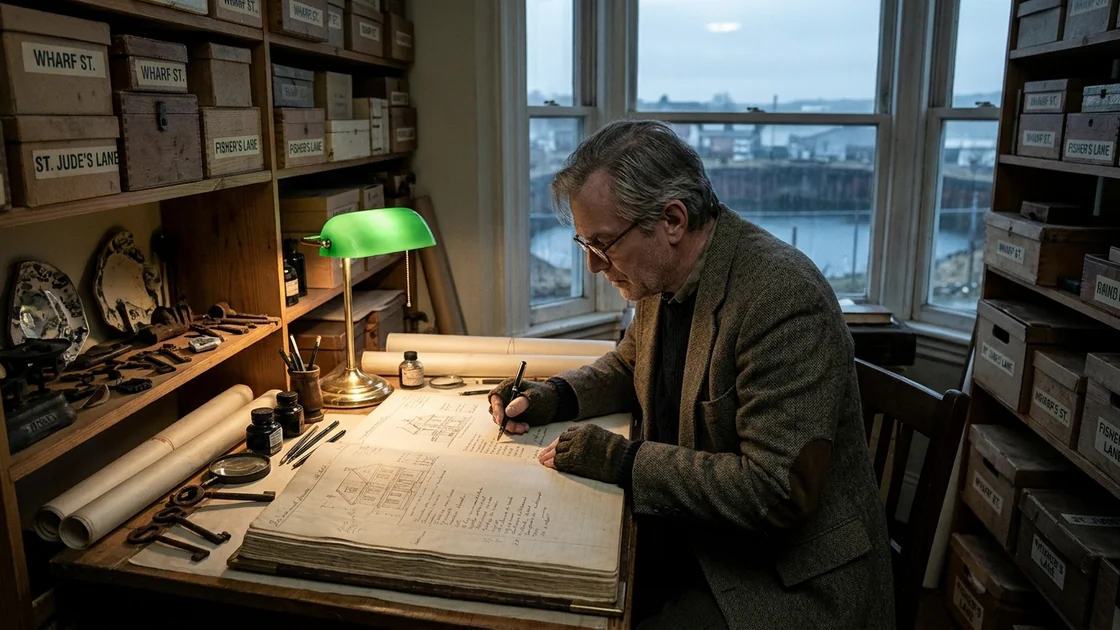
In this ledger, Arthur Vance was reconstructing St. Jude’s Point.
Every evening, from six o'clock until midnight, under the light of a green-shaded student’s lamp that hissed faintly with kerosene, he worked on the restoration.
He had gathered the ward census of nineteen-seventy, the church registers of St. Jude-by-the-Tide, the baptismal books of the Portuguese mission, the tax assessment rolls of nineteen-sixty-eight, and the commercial delivery logs of the Blackwood Ice & Coal Company.
On page one hundred and twelve, under the entry for 14 Wharf Street, he had drawn an elevation profile of Martha Kelleher’s house that was so detailed it included the three cracked slates beneath the south dormer and the small, wrought-iron scraper shaped like a running fox on the bottom step.
Below the drawing, in his exquisite, microscopic surveyor’s script, he wrote:
Occupants, 1975: Kelleher, Martha (widow, age 63); Kelleher, Thomas (son, age 32, deckhand, trawler 'Gull'); Kelleher, Francis (son, age 29, machinist, drydock); Kelleher, Michael (son, age 22, missing at sea, 1973).
Structural Specifications: 3-tier masonry, common bond. Bricks manufactured by Skene Brickworks, 1834. Mortar: oyster-lime/sand aggregate, 1:3 ratio. Floor joists: hemlock, 3x10, eighteen-inch centers. Hearth: slate flag on fieldstone base.
Dispersal: Martha Kelleher relocated to North Terrace Housing Project, Apt 8-C, March 14, 1975. Deceased, November 4, 1981 (myocardial infarction, St. Luke's Hospital). Thomas Kelleher relocated to New Bedford, 1977. Francis Kelleher: address unknown.
Artifact: 1 pair brass-framed spectacles, iron fire-tongs (recovered from debris heap, April 22, 1975).
Arthur did not merely record the families; he collected their ghosts.
In the three rooms of his apartment, stacked on pine shelves that lined every wall from baseboard to picture rail, were two thousand cigar boxes, shoe boxes, and fruit crates, each labeled with a street address.
Inside these boxes were the fragments he had scavenged during the six months between the eviction and the filling of the pond.
He had walked the ruins at night with a miner’s carbide lamp strapped to his head, his pockets bulging with plastic specimen bags. He had collected what the wreckers’ bulldozers had spared: broken fragments of transfer-printed willow-ware plates; hand-forged copper boat-nails; small clay pipes smoked down to the stem by long-dead dock-wallopers; children’s marbles made of unglazed stone; brass drawer-pulls shaped like acorns; a silver thimble with a dent in the crown; a receipt for six cords of birch firewood dated November twelve, eighteen-ninety-one.
He spent his Sundays cleaning these things. He had small bottles of muriatic acid, alcohol baths, dental picks, and horsehair brushes. He would clean a corroded brass latch until the maker’s mark—E. Clark, Blackwood, 1852—emerged from the green oxide with the sharp clarity of an engraving.
Then he would wrap it in acid-free tissue paper, place it in the box labeled with the house from which it had come, and cross-reference the item on page sixty-four of the Ledger.
He was not mourning. Mourning was an emotional condition that implied the possibility of solace. Arthur Vance was conducting an audit. He was balancing a column of figures whose sum was zero, but whose remainder was his own breathing soul.
Chapter VIII: The Visitor
In the winter of nineteen-ninety-five, twenty years after the fall of the Point, Blackwood experienced its coldest December since the century began.
The salt pond froze.
It was rare for the brine to freeze; the salt concentration was twice that of the open sound, kept dense by decades of industrial runoff and evaporation. But for eighteen days the wind blew steadily from the Arctic barrens of Quebec, dropping the temperature to twenty below zero every night until the forty-two acres of standing water were transformed into a single, seamless sheet of bottle-green, opaque ice.
The ice was not flat. It had frozen under the lash of a sixty-knot gale, creating a jagged, stepped landscape of frozen pressure-ridges, brine-heaves, and stranded rafts of black timber that had floated up from the bottom of the excavation.
Arthur Vance stood at his bay window on a Saturday afternoon, wearing his thick coat and a woolen scarf wrapped twice around his chin.
Through his field glasses, he saw a figure out on the ice.
It was a man, walking alone in the center of the vast, frozen depression, three hundred yards from the fence line. He was wearing an olive-drab army field jacket with the hood pulled up, his hands shoved deep into his pockets. He was not skating; he was merely walking, his boots slipping occasionally on the smooth glaze, stopping every few yards to look down through the translucent green ice into the thirty feet of black water beneath.
Arthur set the glasses down. His heart, usually an imperceptible pump that functioned with low-pressure efficiency, was knocking against his ribs with a dry, irregular flutter.
He took his key from the hook, put on his galoshes, and went down the narrow staircase to the street.
The wind on Gallows Hill was like a wet razor. The street was empty; even the stray dogs had retreated into the cellarways. Arthur walked down the hill to the corner where Wharf Street had once begun—now merely an angle of chain-link fence topped with three strands of rusted barbed wire.
There was a hole in the fence. The local teenagers had cut through the zinc mesh with wire-cutters ten years ago to dump stolen mopeds into the water.
Arthur leaned down, his joints clicking like dry twigs, and crawled through the gap. The frozen clay of the embankment was steep, twenty feet of thirty-degree slope covered in brown, frosted weeds and broken glass. He slipped, his knees striking the hard ground, but he did not feel the pain. He slid the last ten feet, his boots landing with a dull, hollow thud upon the green ice.
The ice groaned—a deep, resonant whumpf that traveled across the entire forty-two acres like an acoustic shockwave, vibrating in the marrow of his shins.
The man in the army jacket turned around.
He was about forty-five, with a square, weathered face, heavy stubble the color of rusted wire, and a blue anchor tattooed on the webbing between the thumb and forefinger of his right hand. His eyes were small, gray, and rimmed with the red veins of a man who worked outdoors and drank cheap rye to keep his kidneys warm.
Arthur stopped ten paces from him. The wind whistled through the chain-link fence behind them with the thin, mournful shriek of a flute played out of tune.
"You shouldn't be out here," Arthur said, his voice coming out as a thin, white vapor. "The brine ice doesn't freeze true. The salt pockets don't set. It has no shear strength."
The man looked at Arthur, his gaze traveling from the old man’s salt-encrusted galoshes to the threadbare velvet collar of his coat, up to the spectacles that were beginning to frost over at the corners of the lenses.
"You’re Vance," the man said. It was not an accusation; it was an identification, spoken with the absolute certainty of a harbor pilot identifying a buoy.
Arthur did not answer. He pulled his scarf tighter.
"I’m Thomas Kelleher," the man said. "Francis is dead. Lung rot in the shipyard at Bath. The old lady went in eighty-one."
"I know," Arthur said. "November fourth. St. Luke's."
Thomas Kelleher pulled his hands from his pockets. His right hand was missing the top joints of the index and middle fingers—the old winch-line injury Martha had described in the courtroom twenty years before. He blew on his knuckles, his breath smelling of cloves and peppermint schnapps.
"We had an attic," Kelleher said, looking down between his boots. "The window faced the south spit. When the fleet came around the horn from the Georges Bank, you could see the lights on the masts through the dormer before the bell-buoy started ringing. I used to sit up there with a tin whistle my uncle carved out of an alder branch."
He tapped the green ice with the heel of his heavy work boot.
"Where is it?" Kelleher asked. "Under here?"
Arthur did not have to consult his maps. The coordinates were engraved into his retina. He took two steps to the left, turned three degrees to the south, and pointed with his cane to a point five feet behind Kelleher’s heel.
"The hearth is there," Arthur said. "Twelve feet below the ice. The granite footing is still on the ledge. Lutz didn't blast the southern quadrant. It’s sitting there in the silt."
Kelleher looked down. Through the twenty-four inches of bottle-green ice, nothing was visible except an emerald gloom, speckled with tiny, frozen bubbles of marsh gas and the black, drifting streamers of pond-weed.
"Why did you do it, Vance?" Kelleher asked. He did not sound angry. His voice was curious, heavy with the flat, tired resignation of a class of men who had spent four centuries watching their ships go down and their wages cut by men who lived on the hill. "Callow was a thief. We knew Callow. My father threw Callow down the steps of the Bethel in fifty-two when he came down to shake down the collection plate for the ward campaign. But you—you didn't steal the money. You didn't run off to the islands with Cross. You’re still living in that rat-hole on the corner. You look like you haven't had a beef-steak since the bicentennial."
Arthur looked at the ice. A long, hair-line crack ran from between his feet toward the center of the lake, clean and straight as an inked line on vellum.
"The paper required it," Arthur said.
"The paper?" Kelleher repeated, his brow furrowing.
"The city was an equation that wouldn't clear," Arthur whispered. The wind caught his words, tearing them into white threads. "Callow showed me the balances. If the district stayed, the city died. If the district was condemned, the money came. It was an abstract problem in mechanics. You don't understand the pressures. The tax base was sixty percent below the replacement value of the services. The state was going to disincorporate Blackwood. They were going to turn the whole municipality into an unincorporated county ward."
"So you made up the water," Kelleher said.
"I made up the water," Arthur confessed. "I made up the void ratios. I made up the shear vectors. I made the ground soft because the law wouldn't let me condemn it for being old."
Kelleher took a step toward him. Arthur did not retreat. He stood his ground on the unstable salt ice, his cane resting on the spot where the Kelleher hearth had stood, his thin coat shivering in the gale.
Kelleher reached into his army jacket. For a second, Arthur thought he was reaching for a marlinspike or an old friction-lock knife. He felt a sudden, sharp relief—a longing for the iron to strike him between the ribs, to have the math cancelled once and for all by a Kelleher hand on Kelleher ground.
Instead, the man withdrew a small, flat bottle of amber liquor. He unscrewed the metal cap, took a long swallow, and held it out toward Arthur.
"Drink," Kelleher said.
Arthur hesitated. "I don't—"
"Drink, you son of a bitch," Kelleher said, his voice dropping into a flat, nautical command. "It’s six below zero and you’re standing on thirty feet of dead water."
Arthur took the bottle. His fingers were so numb he could barely feel the glass. He brought it to his lips. The rye was cheap, fiery, and burned his throat like raw kerosene, but it sent a sudden, painful bloom of warmth through his shrunken chest. He coughed, his eyes watering behind his spectacles.
He handed the bottle back.
Kelleher wiped the neck with his sleeve, took another pull, and screwed the cap back on with the three fingers of his right hand.
"My mother told me," Kelleher said, looking past Arthur toward the gray, frozen skyline of Blackwood, "before she died in the high-rise... she said you were the one who had to hold the rope. She said Callow was just the dog, but you were the leash."
"I have the things," Arthur said, the words tumbling out of him against his will, desperate and pleading. "In the apartment. I have the fire-tongs. I have the plates. I have your grandfather’s navigational log from the schooner Covenant. I found it in the cellar crawlway under the coal bin. I cleaned the mold off every leaf. I bound it in calfskin. It’s on the third shelf."
Thomas Kelleher looked at him with an expression of profound, quiet horror. It was the look a man might give to an embalmer who had kept his sister’s fingers in a jar of spirits behind the clock.
"You keep them, Vance," Kelleher said, turning away toward the hole in the fence. "They belong to you now. You bought them with the dirt."
He began walking across the green ice, his boots crunching with a dry, rhythmic rhythm.
"Kelleher!" Arthur called out, his voice cracking against the wind.
The man did not turn.
"Kelleher! The ice! Stay off the northern quadrant! The sewer outfall—it keeps the water thin!"
The man did not look back. He walked steadily toward the frozen clay bank, reached the fence, slipped through the cut wire, and disappeared up the hill into the gray, gathering dark of the city.
Arthur stood alone on the center of the lake.
He looked down through the soles of his galoshes. Beneath him, deep in the green water, the blue granite ledge held the weight of the sea, the weight of the forty-two acres of absence, the weight of the eleven thousand souls who had been scattered like salt-sand across the inland counties.
The ice spoke beneath him again: cr-r-ack.
A fissure ran from his heels five hundred feet across the bay, opening a dark line of open water two inches wide that immediately began to smoke in the freezing air.
Chapter IX: The Final Survey
Arthur Vance lived to be seventy-two.
He did not die of heart failure or stroke; he died of an acute, galloping lobar pneumonia contracted during the great freeze of nineteen-ninety-eight, when the power grid failed across the northeast and his apartment dropped to fourteen degrees.
He was found by the building superintendent on a Tuesday morning, sitting at his walnut drafting table, wearing his overcoat, his muffler, and his fingerless gloves.
The room was spotless.
The two thousand boxes were stacked in perfect, military alignment against the walls, each label centered, each index number inked in red drafting ink.
The great sheepskin Ledger lay open on the blotting paper before him.
The pen was still in his right hand, dried black ink crusting the iridium nib. His last entry, written on page seven hundred and ninety-eight, was not an address or a name. It was a technical drawing.
It was an elevation map of St. Jude's Point, drawn at a scale of one inch to one hundred feet.
It did not show the city that had been destroyed in nineteen-seventy-five. It did not show the Atlantic Colosseum with its eighty-thousand-ton concrete dome. It did not show Callow’s Pond.
It showed an impossible, theoretical city.
The streets were drawn along the contours of the granite ledge, but they were paved with non-porous porphyry. The houses were three-tiered, but their joints were calculated according to the most modern theories of dynamic elastic recovery. The walls were unreinforced brick, but between the stretchers were invisible ties of drawn titanium. The foundations went down through the imaginary Skene Silt, down through the glacial drift, down through the blue slate, anchoring themselves deep in the cooling basalt of the earth's mantle, four miles below the harbor floor.
It was a city that could not fall.
A city whose compression strength was infinite. A city whose void ratio was zero. A city that could float upon an ocean of salt-brine for ten thousand years without deflecting three-thousandths of an inch from the true vertical.
Beside the Ledger was a brown paper envelope containing Arthur Vance’s last will and testament.
It was two pages long, typed on the old manual Underwood in the Annex basement. It had been witnessed by the Chief Clerk of the Probate Court and the woman who cleaned the marble floors of the City Hall.
There were only three clauses:
First: I direct that my body be cremated without religious ceremony of any kind, and that the expenses of my sepulture shall not exceed forty dollars.
Second: I give, devise, and bequeath the eight hundred bound volumes of the St. Jude's District Reconstruction Archive, together with the two thousand cataloged specimen cases containing the material remnants of the fourth ward, to the Trustees of the Blackwood Public Library, upon the express condition that they shall be maintained as a single, indivisible collection under the title: 'The Ledger of St. Jude's Point: An Inventory of Structural Delusion.'
Third: In the event that the Trustees of the Library shall decline said bequest, I direct my executor to carry the said books, records, maps, and specimen boxes to the northern bank of Callow's Pond, and there, using five gallons of commercial mineral spirits, burn the entire collection down to white ash, casting the residue into the thirty-foot excavation at the point where Wharf Street intersected the tide.
The Trustees did not decline the bequest.
They were embarrassed by it—the city was still trying to attract pharmaceutical campuses and suburban office parks to the bypass, and the name of St. Jude's Point was a reminder of a scandal that everyone who owned a golf club had spent twenty years trying to forget.
They did not place the collection in the main reading room. They put the boxes and the great sheepskin Ledger in the sub-basement of the library, behind the collection of eighteen-century sermons and the annual balance sheets of the Blackwood Gas Light Company.
There they sat, dry, clean, and silent, in the fifty-degree darkness.
Epilogue: The Salt Meadow
In the spring of two thousand and twelve, thirty-seven years after the first headache ball swung into the Kelleher house, the city finally solved the problem of Callow’s Pond.
They did not build the stadium. They did not backfill the hole.
A young woman named Dr. Elena Silva, an ecological engineer from the state maritime institute who had never heard the name Julian Callow and who knew Arthur Vance only as an obscure signature on fifty-year-old street layout maps, received a federal grant from the Environmental Protection Agency.
The project was called the Urban Estuarine Wetland Mitigation Experiment.
Contractors were brought in with long-reach hydraulic excavators. They did not try to pump the water out; they did not try to drill the granite ledge.
They simply cut three sixty-foot notches through the old iron-sheet piling of the Goose Bridge, breached the sea wall in four places, and opened the excavation permanently to the twice-daily pulse of the Atlantic tide.
The salt water came in, not as an invading catastrophe, but as an ancient, patient tenant returning to an abandoned lease.
With the tide came the Spartina grass.
The seeds, carried down from the river marshes by the spring runoff, found purchase in the pulverized lime mortar and the crushed brick gravel that had lined the bottom of Arthur’s excavation for forty years. By the third summer, the green shoots were six feet high, their roots wrapping themselves around the buried granite footings of Wharf Street, their stems trapping the gray silt until the water cleared to the color of pale tea.
Ribbed mussels colonized the ruins of the cellar walls. Blue crabs scuttled through the spaces where the cooperage floors had been. Great blue herons, flying south along the Atlantic flyway, began to drop down into the center of the forty-two acres, standing motionless on one leg upon the submerged granite sill of the Bethel Mission, waiting for the mummichogs to swim through the gaps in the stone.
The city built a wooden boardwalk out over the marsh.
It was made of recycled plastic lumber that would not rot in the salt air, with stainless steel railings and educational signs every fifty yards: THE BLACKWOOD TIDAL PRESERVE: A MODEL OF URBAN RE-WILDING.
On Sunday afternoons, young couples from the newly converted loft apartments in the old upper-town foundries would push their baby carriages out along the boardwalk, stopping to read the signs about the carbon-sequestration capacity of the cordgrass and the nesting habits of the snowy egret.
None of them looked at the bottom.
If one leans over the rail at low tide, however, when the sun is directly overhead and the salt breeze clears the ripples from the surface of the channel, one can still see the ground.
Down through three feet of clear, green water, half-buried in the silt and the mussel-beds, there is a line of dark claret bricks, laid three stretchers to a header, running straight and true toward the deep channel.
They are immovable.
The lime mortar has long since dissolved, replaced by the living cement of the sea-worms and the gray root-tendrils of the marsh grass. The bricks do not float. They do not slide. They do not rotate on their axes.
They rest upon the blue slate ledge, twelve feet below the municipal grade, holding the earth against the sky, waiting for the paper to rot away.