The Ledger of Mare Frigoris
When an orbital freight disaster leaves Lunar Outpost Eos-IV with half the oxygen necessary to survive an unexpected eleven-month blackout before rescue, Station Commander Arthur Vance faces a mathematical certainty that doom awaits all sixty-two souls under his command. Desperate to ensure the survival of the young technical crew and the children of the settlement, Vance exploits a classified administrative override within the environmental matrix, systematically suffocating the station's twenty-six retired pioneers resting in metabolic stasis. As the months drag on and the air remains artificially breathable, Vance must conceal his quiet atrocities from his suspicious chief engineer while the psychological toll of breathing the stolen life of his mentors erodes his sanity beneath the crushing silence of the lunar ice.
Chapter I: The Arithmetic of Mare Frigoris
The explosion of the automated freighter Caelum-7 did not make a sound, but Arthur Vance felt it through the basalt under his boots.
It traveled as a brief, high-frequency stutter through three miles of vacuum-compacted lunar crust, vibrating up through the shock-absorbing pylons of Sub-Level 4, humming through the deck plates of Eos-IV, and finally settling in the titanium filings of his prosthetic left ankle.
Arthur did not look up from the environmental telemetry monitor immediately. He counted four seconds, watched a coolant valve on Sabatier Loop B jump from thirty-four percent open to forty-two, and then lifted his chin toward the primary observation dome.
Above him, five hundred kilometers over the northern rim of Mare Frigoris, a bright, blooming smear of magnesium white and hydrazone crimson expanded against the starfields. It looked like an iris opening and closing in an eye that didn't care about the dark. The Caelum-7 had not cleared its burn for orbital insertion. It had impacted the trailing booster of the orbital shuttle platform, shearing its liquid-oxygen tanks, its emergency nitrogen slurry, and forty metric tons of shelf-stable agricultural concentrates into a glittering, expanding cloud of hypersonic debris that would pepper the northern highlands for the next six weeks.
"Telemetry confirms catastrophic loss," Chief Engineer Maya Lin said. Her voice was too flat, the product of eight years of simulated crises that had never, until this second, involved the total destruction of the station's lifeline. "Impact telemetry was lost at twelve-fourteen UTC. She’s gone, Arthur. Not a pod survived. The debris cone is already dropping below radar horizon behind the Montes Jura."
Arthur stood up slowly. He was fifty-eight years old, which made him thirty years younger than the oldest men and women on the base, but twelve years older than anyone currently walking upright. His uniform was dark gray wool-synthetic, faded at the cuffs from recycled laundry washings, and smelled faintly of vinegar and dry copper—the permanent perfume of Eos-IV.
"What was our reserve margin on the liquid scrubbers?" Arthur asked.
Maya didn’t look at her screen. She knew the number. Every engineer in the Mare Frigoris district knew the number because they looked at it every morning before their first cup of reconstituted chicory. "Sixty-eight days on open cycle. Ninety-four days if we drop the atmospheric density in the commons to sixty kilopascals and mandate twenty-hour dorm shifts."
"The next transfer window from Earth isn't for two hundred and ten days," Arthur said. "And they don't have a spare hull in low-Earth orbit. The Vanguard is still dry-docked at Lagrange-1 for thruster replacement."
"Then they’ll expedite," Maya said, her fingers finally trembling as she tapped the glass of her console. "They’ll pull a freighter out of the Jovian run. They’ll slap a booster on an empty water tender and send it on an open trajectory. They won't leave sixty-two people down here to choke on their own exhale."
"Expedited transit on a direct brachistochrone burn still takes five months to assemble and thirty-five days to cross," Arthur said evenly. He stepped to the edge of the pit, looking down into the mechanical trenches where the scrubbers hummed like wet hornets. "At best, we are looking at three hundred and twenty days before an airlock opens with fresh canisters. At worst, four hundred."
Maya looked at him then. Her face was pale beneath the sick green glow of the terminal. Her dark hair was pinned back with a plastic cable tie, and her collar was crooked. "Arthur. The math doesn't work."
"I am aware of the arithmetic, Maya."
"No, you aren't listening to me," she whispered, leaning over the console so the two tech-trainees three desks down wouldn't hear her. "We have sixty-two people on this manifest. Thirty-six active personnel. Two children. And twenty-four in the low-temperature stasis vaults."
Arthur's eyes drifted to the status board on the bulkhead. At the bottom of the schematic, glowing in soft, reassuring amber, was the icon for Sector 9: The Crypt.
It was not an official name, but no one called it the Long-Term Dormitory anymore. Sector 9 was an old lava tube forty meters beneath the primary station hub, reinforced with corrugated basalt liners and flooded with liquid argon. There, suspended in metabolic slow-motion at negative sixty-two degrees Celsius, lay the foundation of the base.
They were the first drillers, the first core-sample geologists, the engineers who had dug the water out of the ice-traps of Peary Crater when Eos was just three inflatable tents and a leaking solar mast. Most of them were past eighty. They were people whose bone density had dissolved after thirty years in point-one-six gravity; whose lungs were scarred by the micro-shards of raw lunar silica that no suit filter could ever completely catch; whose kidneys had failed under cosmic radiation that punctured the early regolith shielding. They were waiting. They were resting while the United Nations Lunar Development Agency decided whether to fund their repatriation to Earth's heavy, crushing gravity—a journey that would likely break their brittle femurs—or allow them to sleep until the deep-tissue cellular therapy clinics at Armstrong Station were finished.
"The pods consume negligible reserves," Arthur said.
"Negligible isn't zero," Maya snapped. "The stasis suite uses five hundred liters of medical oxygen per month for membrane flushing and micro-perfusion. The cryo-chillers run on the secondary reactor tap. But even if we turn off the commons, even if we pull the children into the operations core and turn the hydro-gardens into mulch to pull the nitrogen out of the roots, we run out of breathable atmosphere on day one hundred and eighty-four."
"Day one hundred and eighty-four," Arthur repeated.
"Everyone dies in six months, Arthur. The relief fleet will find an outpost full of frost and carbon dioxide. They’ll have to scrub our skins off the deck plates with steam hoses."
Arthur reached out and touched the frame of the primary viewport. The glass was four layers of laminated quartz, three inches thick, cold as bone. Outside, the lunar landscape stretched out toward the northern darkness, a sea of gray ash frozen under a sky that had never seen a cloud. The shadows of the rim craters were long, black knives pointing toward his station.
"We will assemble the department heads at twenty-two hundred," Arthur said. "Until then, no one speaks of the Caelum’s loss outside this room. Tell the night shift that the freighter experienced a telemetry lock failure and has been diverted to a secondary parking orbit for recalibration."
"Arthur, that’s a lie. The whole station saw the flash."
"They saw a flash," Arthur said, turning his back to the glass. "They did not see the inventory list disintegrate. Give them eight hours of work before you give them eight months of terror. Go, Maya."
She stared at him for a second, her jaw tight, then nodded once and walked briskly down the metal stairs toward the life-support trenches.
Arthur stood alone in the center of the command bridge. He did not look at the stars again. Instead, he pulled his personal access stylus from his pocket and slotted it into the commander's auxiliary terminal.
He brought up the life-support ledger:
Total System Volume: 142,000 cubic meters. O2 Replenishment Rate (Electrolysis): 0.12 kg/hr (Degraded). O2 Consumption Rate (Current Manifest): 1.84 kg/hr. Projected Zero-Point: October 14th.
He clicked through the sub-directories. He looked at the active personnel.
There was Elena Gomez, thirty-two, hydrologist, mother of six-year-old Leo and four-year-old Clara. There was Paul Kalu, twenty-seven, who kept the drill-heads from melting in the titanium pits. There were the seven apprentices from the Nairobi Polytechnic who had arrived on the last cycle, eager, clumsy, their bones still full of Earth-calcium, their skin still brown from real sunlight.
Then he opened the file labeled Vault-9: Metabolic Low-Load Reserves.
Twenty-four names.
Briggs, Donald. Age: 84. Service: 34 years. Status: Hypothermic Stasis (Cardiopulmonary preservation). Cruz, Althea. Age: 79. Service: 29 years. Status: Hypothermic Stasis (Neuro-degenerative plateau). Hargrove, Sean. Age: 88. Service: 41 years. Status: Hypothermic Stasis (Multi-system senescence). Vance, Eleanor. Age: 82. Service: 30 years. Status: Hypothermic Stasis (Pulmonary fibrosis).
Arthur’s thumb hovered over the screen.
He didn't touch Eleanor's name. He didn't need to. He knew her file by heart. He knew that her lung capacity was sixteen percent of normal, that her hands were so twisted by rheumatoid arthritis brought on by thirty years of working in cold, unheated pressure suits that she couldn't hold a spoon when she finally went under three years ago.
She was his mother’s younger sister. She had met him at the airlock when he first arrived on the Moon as an eighteen-year-old surveyor with grease behind his ears and vomit on his suit collar. She had slapped his helmet with a heavy, thermal-gloved hand and told him that if he cried for the sky he’d lost, she’d throw him out the hatch herself.
Arthur pulled the stylus out. The screen went black.
He looked down at his own hand. It was steady. It was the only part of him that was.
Chapter II: The Architecture of Murder
The maintenance access to Sector 9 did not go through the main residential spoke. It was reached via the old water-pipe tunnels, a section of the base that had been abandoned twenty years ago when the automated processing plant was bored into the permafrost of the crater floor.
The air here was four degrees lower than in the command hub. The walls were uninsulated, raw basalt scored by the mechanical teeth of an old Robbins continuous-miner. Every three meters, an old low-yield halogen bulb hung inside a yellow wire cage, casting long, cage-like shadows that swayed whenever the heavy circulation blowers pulsed from the ventilation shafts above.
Arthur carried an old maintenance kit—a heavy, scuffed canvas bag containing analog bypass toggles, a multi-meter, and a hand-held terminal that did not connect to the station’s optical mesh network.
He arrived at the hatch of Vault 9 at twenty minutes past three in the morning.
The rest of Eos-IV was asleep, or trying to be. Maya’s announcement had been delayed, but the rumors had seeped through the bulkheads like freon gas. The mess hall had been silent at dinner; people had eaten their gray soy-patties without looking at each other, their ears straining at every micro-drop in pressure, every rattle of the ductwork.
Arthur slipped his command card into the manual slot. The mechanical tumblers clunked—a heavy, wet sound in the vacuum-adjacent isolation of the crawlspace.
The hatch swung inward with a sigh of pressurized nitrogen.
Inside, Vault 9 looked like an automated warehouse for meat.
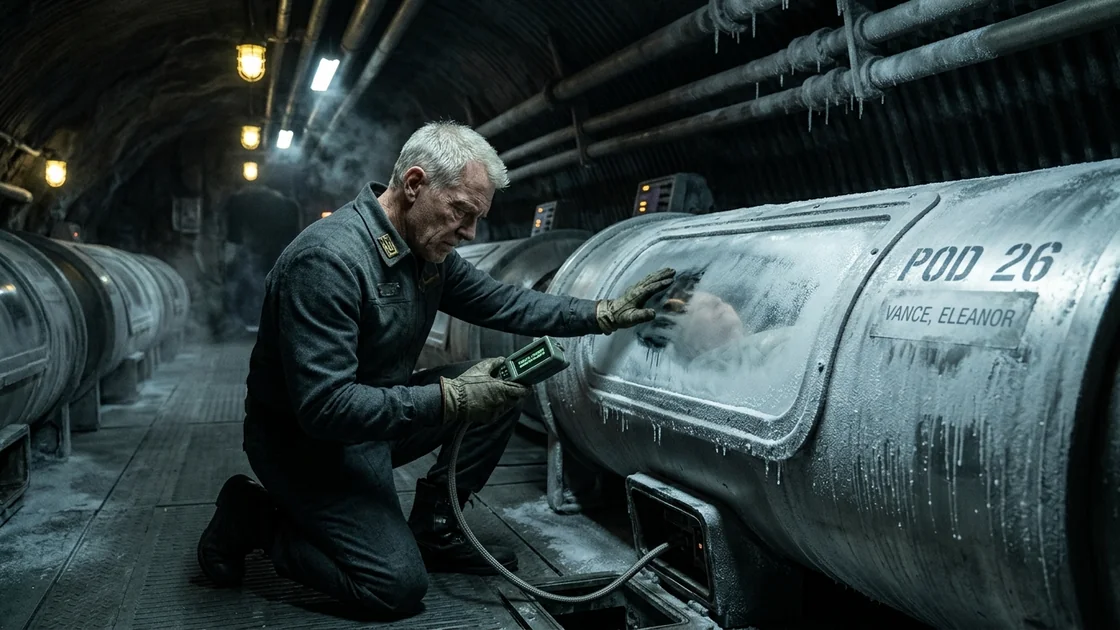
The ceiling was low—scarcely two meters high. Two parallel rows of brushed aluminum cylinders lay flat on the floor, mounted on heavy rubber vibration dampers. Each cylinder was two and a half meters long, with an oval inspection port made of six-ply polycarbonate, frosted over with a thick crust of rime. Thin, braided stainless-steel lines ran from the heads of the pods into a central overhead manifold, carrying liquid nitrogen and a slow, pressurized stream of fluorochemical-oxygen emulsion.
The only sound was the clicking of the solenoid valves: tick... tick... tick... like twenty-four iron clocks marking out a century that wasn't moving.
Arthur walked to Pod 01.
He wiped his sleeve across the inspection glass. The frost smeared, leaving greasy tracks of moisture that instantly began to re-freeze. Beneath the glass, Donald Briggs lay with his head tilted back, his mouth slightly open around an endotracheal silicone sleeve. His hair was pure white, fine as dandelion fluff, floating slightly in the thick, viscous gel that filled the pod’s upper chamber. His skin had that strange, translucent quality of pickled lard, yellowed at the temples where the pulse-monitoring nodes were stapled into the skin.
Briggs had built the air scrubbers that were currently failing three levels above.
He had designed the three-stage catalytic converter that took the station's sweat and urine and turned it into water clear enough to mix with baby formula. If Briggs were awake, he would have looked at Maya Lin’s math, spit into the recycler drain, and spent seventy-two hours straight inside the intake plenums with an arc-welder and a roll of lead-tape, swearing until the numbers worked.
"You're too old, Don," Arthur whispered to the frost. "Your lungs would turn to soup in twelve hours if we brought you up."
Arthur pulled the maintenance kit onto the deck, unzipped it, and took out an auxiliary diagnostic interface.
He didn't intend to vent the pods. A sudden decompression would trigger four dozen redundant atmospheric alarms on Maya’s board in Operations. The pressure drop would scream across the bridge, the automated scrubbers would dump their emergency reserves to balance the leak, and Maya would be down here with a crash axe before he could seal the hatch.
He had spent two days studying the firmware protocols of the cryo-chambers.
The pods did not keep their occupants alive through brute force; they balanced them on the knife-edge of biological arrest. Every forty minutes, the system administered an electrical micro-pulse to the vagus nerve to prevent complete neuro-synaptic collapse, while a miniature roller-pump pushed sixty milliliters of hyper-oxygenated emulsion through the femoral shunt.
If one were to change the delivery parameters—not by shutting them down, but by altering the atmospheric dilution ratio inside the gas-permeable membrane from twenty-one percent oxygen to six percent—the pod’s local diagnostic routine would not flag a failure.
The system would assume the patient was entering a scheduled stage of deep-torpor cycling.
The pod would note the drop in arterial oxygenation. It would attempt to compensate by increasing the hypothermic depth, dropping the core temperature by one-tenth of a degree every four minutes to lower the metabolic demand. The subject's brain would not wake up. The heart would not struggle. The oxygen-starved cells would simply cease to exchange ions across their membranes. The metabolic curve would drop down, down, flat as the horizon of Mare Frigoris, until the biological machine simply became a mineral deposit.
The pod’s external LED would switch from Active Preservation to Stasis Latency.
To the main computer, Pod 01 would merely appear to be running in "High-Efficiency Conservation Mode."
It would consume ninety-eight percent less auxiliary power.
And it would consume zero oxygen.
Arthur knelt at the foot of Pod 01. He popped the plastic maintenance hatch with his thumb. Behind it was a circuit cluster, sealed in amber silicone to protect it from condensation. He plugged the diagnostic cable into the service port.
The handheld screen lit up, illuminating his lined, sunken eyes.
SELECT PROTOCOL: RE-CALIBRATION / DEEP-CYCLE PRESERVATION. ENTER AUTHORIZATION: COMMANDER CLASS-A.
Arthur entered his code: VANCE-8819-A.
The screen flashed yellow: WARNING. DEEP-CYCLE PRESERVATION WILL REDUCE TISSUE PERFUSION BELOW MINIMUM VIABLE RECOVERY THRESHOLDS FOR SUBJECTS > 70 YEARS. RECOVERY PROBABILITY DROPS TO: < 3%. CONFIRM OVERRIDE?
Arthur looked at Briggs’s face beneath the glass.
He remembered being twelve years old, running through the regolith tunnels of Old Sector 2. He had dropped a wrench down an open ventilation shaft, and it had punctured an unarmored secondary water line. Two hundred liters of chilled water had erupted into the corridor, instantly freezing into razor-sharp crystals that threatened to short out the power bank for the nursery. Briggs had come around the corner, two hundred pounds of gristle and red hair, wearing a greasy coverall and no helmet. He hadn't screamed at Arthur. He had grabbed the broken pipe with his bare, leather-calloused palms, holding the metal together while the boiling-cold water turned his skin black, shouting: "Get the clamps, Artie! Don't look at my damn hands, get the clamps!"
Arthur pressed the key: CONFIRM.
A soft, wet click came from the foot of the pod.
Inside the clear tubes, the light blue fluid shifted to an oily gray. The digital readout on the pod's frame flickered:
SPO2: 94%... 88%... 71%... 54%...
The solenoid valves slowed their rhythm. Tick... long silence. Tick...
The machine did not whine. It did not protest. The frost on the glass thickened slightly as the refrigeration unit pulled the temperature down another three degrees to match the slowing pulse of Briggs’s dying cells.
Arthur did not wait for the line to flatline. He knew how long it took for eighty-four-year-old brain tissue to suffocate when it was cold: twenty-two minutes.
He unplugged the diagnostic lead. He stood up, his knee joints popping in the dry air, and walked three paces to the right.
Pod 02.
Cruz, Althea.
She had been the station’s first chief medical officer. She had delivered seven babies on this rock, including the little Gomez girl who had just learned to write her own name with chalk on the recreation room floor. Althea had a gap between her front teeth and a laugh that sounded like an engine with a dry cylinder.
Arthur knelt.
He popped the maintenance cover. He plugged the cable in.
SELECT PROTOCOL. ENTER AUTHORIZATION. CONFIRM OVERRIDE.
He worked with a strange, methodical rhythm. He did not let himself pause between the pods, because he knew that if he paused, if he let the silence of Vault 9 fill his ears, he would hear the tiny, rhythmic clicks of the valves changing tempo. He would hear the sound of the future being purchased with the past.
Pod 03. Sean Hargrove. The surveyor who had found the deep ice pocket at the North Pole that made Eos-IV possible in the first place.
CONFIRM.
Pod 04. Miriam Sachs. Who had spent twenty years maintaining the hydroponic root systems, singing German lullabies to the tomatoes because she swore the vibration helped the fruit set in low gravity.
CONFIRM.
Pod 05.
Pod 06.
Pod 07.
By the time he reached the end of the first row, his knuckles were white from holding the plastic housing of the terminal. His coveralls were soaked with sweat that smelled rank and sharp against the chemical dryness of the room. The air in the vault was thinning—every time he opened a maintenance port, a few cubic centimeters of nitrogen-mix escaped into the exhaust system. His head throbbed with the dull, iron ache of early hypoxia.
He crossed the central aisle.
He stopped in front of Pod 24.
The name on the plate was not Eleanor Vance. Her pod was at the end of the row, Pod 26.
He walked past 24. He walked past 25.
He stood before Pod 26.
Eleanor was small. Even in her prime, she had barely been five feet tall, but she had lived with a ferocity that made everyone in the outpost step off the center of the gangway when she came down the tube. Now, submerged in the gel, she looked like a bundle of sticks wrapped in parchment. Her lips were blue-gray, pulled tight over her gums.
Arthur reached out. His fingers hovered over the glass, right above her forehead.
"You told me not to cry for the sky," he said to the frost.
His voice didn't carry. The insulation of the room ate it instantly, dropping the sound into the basalt below.
"The freighter blew, El. It blew all over the mountains."
He knelt down. His knees hit the metal frame of the pod with a loud clang that made him flinch.
He opened the maintenance flap. The port was slightly dusty; no one had plugged into this unit since she was wheeled down here forty-two months ago.
He inserted the terminal.
SELECT PROTOCOL: RE-CALIBRATION / DEEP-CYCLE PRESERVATION.
The cursor blinked. A green square, eight pixels wide. It blinked once every second, regular as an executioner's footstep.
He could leave her.
One pod wouldn't make the difference. One pod was forty liters of oxygen a month. Forty liters was half an hour of breathing for the children. It was twelve hours of work for an engineer on the scrubbers. It was nothing. It was an error in the rounding. It was a leak in a single flange on the airlock manifold.
If you leave her, a cold, quiet voice said behind his eyes, you are not a commander. You are a butcher who spares his own house.
If Maya found the logs—and she would look, eventually, because Maya was an engineer who didn't believe in ghosts, only in mass-balance equations—what would she see? She would see twenty-three dead pioneers, and Eleanor Vance sleeping peacefully through the famine. She would know that Arthur hadn't made an executive calculation; he had made a sacrifice to his own cowardice.
Arthur looked back toward the open hatch of the vault.
Through the dark corridor, he imagined he could hear the base. He could hear the hum of the main reactor, five hundred yards away. He could hear the seventy-two thousand liters of air moving through the ducts, passing through the lungs of the children, passing through the lips of the young tech-trainees who still wrote letters to their mothers in Valparaíso and Osaka, letters that would never be sent if the air ran out in October.
He turned back to the terminal.
He did not close his eyes. He looked directly at Eleanor’s gray, ruined face through the frost.
He entered the code: VANCE-8819-A.
WARNING. RECOVERY PROBABILITY DROPS TO: < 3%. CONFIRM OVERRIDE?
He pressed the key with his thumb, pressing so hard the plastic casing of the handheld cracked under the force.
CONFIRM.
The valve clicked.
SPO2: 91%... 84%... 62%...
Arthur pulled the cable out before the numbers hit forty. He packed the diagnostic tool back into the canvas bag. He zipped the bag with a steady, deliberate motion, then took an aerosol can of gray industrial primer from his pocket and sprayed the screwheads on the maintenance hatches, sealing them with a thin film of lacquer that would show if anyone tried to turn them with a wrench.
He walked out of Vault 9.
He pulled the heavy hatch shut until the steel dog-latches engaged with a dry, permanent thud.
He took his card out of the access lock. Then, using his stylus, he altered the door’s local access script: RESTRICTED AREA. HIGH-VOLTAGE COOLANT HAZARD. AUTHORIZATION REQUIRED: COMMAND LEVEL ONLY.
When he reached his quarters on Level 2, it was five o'clock in the morning.
He sat on the edge of his bunk without taking off his boots. He reached up, took a deep breath through his nose, and held it.
The air was cool. It tasted of lime-slurry, recycled sweat, and the sharp, metallic tang of the Sabatier scrubbers. It was sweet. It was clean. It was the most expensive thing in the solar system.
He breathed out.
Chapter III: The Phantom Air
The human body at rest consumes approximately five hundred and fifty liters of pure oxygen per day. In twenty-four hours, twenty-four human bodies consume thirteen thousand two hundred liters.
On a lunar station, thirteen thousand two hundred liters of oxygen is not an abstraction. It is an enormous, pressurized sphere of cold gas that must be pumped, scrubbed, dehumidified, and pushed through thousand-meter loops of aluminum ductwork.
By the fourth week after the Caelum-7 disaster, Chief Engineer Maya Lin was losing her mind over the telemetry.
Arthur found her in the Environmental Control room at midnight. The floor around her stool was littered with thermal-paper strips and aluminum drink pouches filled with cold, bitter tea. She had three different terminal windows open simultaneously, comparing the daily load calculations with the historical averages from the previous six years.
"It doesn't balance, Arthur," she said before he had even crossed the threshold. She didn't look up. Her eyes were rimmed with red, her fingernails bitten down to the pink quick. "Look at this curve."
Arthur paused, his canvas bag tucked under his arm. "The conservation measures are working. We dropped the dormitory pressure by twelve percent. That explains the reduction."
"No," she said, spinning her chair around. Her voice was brittle, vibrating with an exhaustion that had crossed over into hysteria. "A twelve percent drop in partial pressure explains an eight percent drop in consumption efficiency. Humans breathe faster when the air is thin to maintain blood saturation. The total mass consumption remains roughly static unless they stop moving."
She tapped the screen with a sharp, plastic pen.
"We are running five hundred liters a day under our minimum survival consumption model. Every single morning, when I run the mass-balance through the Sabatier, we have more oxygen in the core reserves than we should have based on the active crew manifest."
Arthur leaned over her shoulder, placing one hand on the back of her chair. He could smell her hair—unwashed, greasy with hydraulic mist. "You're complaining that we aren't dying fast enough, Maya?"
"I’m an engineer, Arthur! Things don't just happen in a sealed system! Mass cannot be created or destroyed. If there is oxygen in the system that shouldn't be there, it means one of two things: either we have an unrecognized chemical reaction occurring in the regolith seals—which could mean a fatal runaway oxidation event—or our flow meters are drifting."
"And if they are drifting?"
"If they are drifting," she whispered, "then we are actually running out of air faster than the screen says we are, and we’re going to hit the wall without warning. We’ll wake up one morning, the pumps will cavitate, and thirty seconds later we’ll all be fish on the floor."
Arthur stared at the green curves on the display. He knew every millimeter of those lines. He had drawn them himself, in blood he hadn't had to wash off his hands.
"Have you checked the agricultural racks?" he asked quietly.
"I checked them twice. The potatoes are half-dormant. We cut their light cycles to six hours to save power; they’re barely producing enough O2 to balance their own root-rot."
"The water tanks?"
"Hydrolysis is locked off at the primary breakers. We aren't splitting water because we can't afford the megawatt-hours." She grabbed his wrist. Her fingers were cold, like the frost on Briggs’s window. "Arthur. Where is the air coming from?"
Arthur pulled his wrist away, gently, and stepped to the main distribution board.
"The low-temperature modules," he said.
Maya froze. Her brow furrowed. "Vault 9? The stasis pods?"
"I ran a diagnostic on their cooling loops two weeks ago," Arthur said, his voice level, completely devoid of inflection. "The primary compressors were over-cycling. They were dumping auxiliary heat into the sub-ducts, which was skewing the temperature gradient in the lower levels. When I re-calibrated the chillers, I noticed that the automated preservation systems had dropped into deep-cycle conservation."
Maya scrambled to her terminal, her fingers flying over the keypad. "Deep-cycle? That’s impossible. Deep-cycle requires a medical board sign-off. It’s an end-stage protocol."
"The system flagged an input-power drop after the freighter debris hit the north field," Arthur lied. He watched her screen. He knew what she would see; he had spent three hours every night for a week re-writing the local firmware logs with his administrative stylus, burying the overrides inside seventy thousand lines of automated telemetry. "The station computer prioritized life support for the active habitat. It re-allocated the metabolic margins in Sector 9."
Maya looked at the numbers cascading down her monitor. Her eyes widened.
"They're... their core temps are down to negative seventy," she breathed. "Arthur... the metabolic consumption on Pods 01 through 26 is practically zero."
"They are pioneers, Maya. They designed those pods to protect the station first."
"No, you don't understand," she said, her voice dropping to a terrified whisper. She looked at him, her face completely blank with shock. "At negative seventy, without an active fluorochemical perfusion cycle... their cerebral cortexes aren't being preserved. The neuro-electrical activity... Arthur, look at the telemetry! There are no brainwave traces on Pod 04. Or Pod 12. Or Pod 19."
She stood up so fast her chair screeched against the deck plate and tipped over, clattering against the metal floor.
"They aren't in stasis," she gasped. "They’re dead. They’re all dead."
"Maya—"
"Donald Briggs is dead! Althea Cruz is dead!" She backed away from him, her hands coming up to her mouth. She hit the edge of the secondary console, knocking a stack of printed maintenance schedules into the air. They fluttered down like gray leaves. "The computer didn't do this. The life-support firmware doesn't have the authority to alter metabolic perfusion without an authenticated physical key."
She stopped.
She looked at Arthur.
She looked at his right hand, which was resting quietly on the grip of his canvas bag. She looked at the gold-plated administrative stylus tucked into the breast pocket of his dark wool jacket.
"You," she whispered.
"Maya, listen to me."
"You killed them."
"I balanced the ledger."
"You murdered them! You walked down into the dark and you turned them off!" Her voice broke into a jagged shriek that bounced off the steel bulkheads.
Arthur moved with an efficiency that surprised them both. In three strides, he had crossed the small room, caught her by the shoulder, and pushed her back against the terminal frame. He didn't hurt her—his grip was firm, almost fatherly, but it was unyielding. With his free hand, he slapped the manual door toggle.
The heavy hydraulic hatch slid shut, locking them inside the small, screen-lit cube of Environmental Control.
"Keep your voice down," Arthur said. His face was three inches from hers. She could smell the recycled chicory on his breath, the dry dust of his skin. "Elena is sleeping twenty meters down that hall. Leo is sleeping. Clara is sleeping. If you scream, you wake them. And if you wake them, what are you going to tell them? That you found twenty thousand liters of air, but you’d rather they choke on their own vomit in September so you can feel clean about Donald Briggs?"
"They built this place!" she sobbed, tears cutting lines through the gray dust on her cheeks. "Briggs gave his hands to this base! Althea saved your life when you had the decompression sickness in '14! How could you look at her? How could you look at her face and pull the line?"
"I didn't pull the line," Arthur said, his voice dropping lower, until it was just a rasping vibration against the hum of the scrubbers. "I changed the mix. It was twenty minutes. They didn't wake up. They didn't hurt. They went from one sleep to another."
"You had no right!"
"I am the Commander of this station!" he snarled, his mask slipping for a fraction of a second, his eyes blazing with an ancient, feral rage that made her shrink back against the glass. "That is not a title for the parades at the Agency! It is not a gold braid on a clean suit! It means when the sky falls, I decide who carries the weight! If I hadn't done it, we would have had sixty days. Sixty days, Maya! Look at the board!"
He reached out and grabbed her chin, forcing her head toward the primary life-support monitor.
"Look at it! Day one hundred and forty! We still have ninety-eight kilopascals of pressure! We have three hundred and ten days of air remaining in the primary loop! The Vanguard will be here in two hundred and forty days! We are going to live!"
"Not them," she wept. "Not them."
"No," Arthur said, releasing her. He stepped back, his chest heaving, his fingers twitching toward his empty pockets. "Not them. They were eighty years old, Maya. They had no bone left. They had no marrow. They were never going back to Earth. If we took them out of those pods today, their ribs would collapse under their own muscle spasms. They were going to die in those boxes."
"They were alive when you went down there," she said. She was slumped against the console now, her knees bent, looking up at him with an expression of pure, unadulterated horror. "They were alive, Arthur. And you decided they were garbage."
"I decided they were our elders," Arthur said quietly. "And their last duty to this base was to give us their breath."
He picked up her chair and set it back on its legs. He retrieved the papers from the floor, neatly squared them against his thigh, and laid them on the desk.
"You have two choices, Chief Engineer," he said, his voice returning to that dry, rhythmic monotone that had governed Eos-IV for fifteen years. "You can open the comms channel right now. You can broadcast to the base that I am a murderer. You can tell Paul Kalu and the apprentices that their grandfathers are dead. They will mutiny. They will put me in the brig. They will try to revive the pods, and they will find nothing but gray meat and frost. Then they will spend the next five months looking at each other, counting every breath, wondering which of them has the right to the next liter."
He pointed toward the red emergency comms lever on the wall.
"Go on. Pull it."
Maya didn't move. She sat on the deck, her hands clasped between her knees, her shoulders shaking with silent, ragged breaths.
"Or?" she whispered.
"Or you fix the flow-meter calibration logs," Arthur said. "You tell the night shift that we found an efficiency gain in the low-temperature sub-loops. You keep the children breathing. You keep the apprentices working. And when the Vanguard comes, you let them go home to their sky."
She looked at him, her eyes dark, hollow pits. "And what about you?"
Arthur looked at the status board.
At the bottom of the screen, the amber light for Sector 9 had turned a dark, bruised violet.
"I am going to stay here," he said. "The Moon is made of gray basalt, Maya. It doesn't care what you bury in it."
Chapter IV: The Weight of Ghost Liters
The four months that followed were the quietest in the history of Eos-IV.
The conservation measures, reinforced by the "discovery" of the auxiliary reserves, allowed the outpost to drop its alert status from Red to Amber. The ration of chicory was restored to half-measure. The lights in the hydro-gardens were turned up to eight hours a day, and the dwarf cabbages began to unfurl their pale, crinkled leaves like green hands reaching for the fluorescent tubes.
Elena Gomez brought Leo and Clara to the command bridge on the two-hundredth day.
She carried a small cake made of ground soy meal, dehydrated applesauce, and sugar rations that the kitchen staff had saved for three weeks. It had a single birthday candle made of paraffin-dipped string stuck in the center.
"It’s Leo’s seventh," she told Arthur, standing shyly at the bridge door. "We know we aren't supposed to burn open flames, Commander. But Chief Lin said if we did it right under the intake vent on Loop 3, the scrubbers wouldn't even register the hydrocarbon trace."
Arthur looked down at the boy.
Leo was wearing a miniature jump-suit made from old gray bedsheets. He had his father's broad, flat nose and his mother’s wide, wet eyes. He looked up at the Commander with that total, terrifying trust that only children on the frontier have—a trust that assumed the walls would never leak, the glass would never crack, and the man with the silver pins on his collar had everything under control.
"Seven," Arthur said.
"Seven," Leo said proudly. "I can jump the three-meter mark in the gym. Paul said when I'm ten, I can go on the tractor."
Arthur knelt down. His prosthetic ankle clicked, a sharp, metallic sound that made the little girl, Clara, jump behind her mother's leg.
"You like the air in here, Leo?" Arthur asked.
The boy blinked, confused. "The air?"
"Does it taste good?"
Leo laughed. "It tastes like nothing! It tastes like cold."
"It's good air," Arthur said. He reached out and touched the boy’s cheek. The skin was warm, soft, pulsing with blood that was ninety-nine percent saturated with oxygen. "It was made by very good people. People who wanted you to be seven."
"Can I blow the candle?"
"Blow it," Arthur said.
The boy leaned forward and blew. A tiny puff of gray smoke rose from the string, curled into the air intake, and vanished into the three miles of ductwork behind the wall.
Elena thanked him, her eyes bright, and led the children away.
Arthur stayed on his knees for a long time after they left, his fingers resting on the cold deck plate where the boy’s boots had been.
"You shouldn't have done that," Maya said from her station.
She had not looked at him directly in ninety days. When she had to speak to him, she addressed his forehead or the wall six inches over his left shoulder. Her work was impeccable. She had balanced the logs so thoroughly that even an audit team from the Agency’s inspectorate would have needed three months of forensic computing to find the seam where the twenty-six lives had been snipped out of the wire.
"He's a healthy boy," Arthur said, pulling himself up using the handrail.
"He’s breathing Donald Briggs’s lung capacity," she said to her monitor. "Every time he runs down the hall, he uses three liters of Althea Cruz. You’re feeding them the old people, Arthur. You’re turning them into cannibals who don't even know what's in their mouths."
Arthur walked to the observation dome.
The lunar day had come again. Outside, the sun was a blinding, naked furnace hanging over the jagged peaks of the rim mountains. The shadows had shrunk into black puddles around the boulders. Everything was white, gray, and black—the colors of an unprinted page.
"Did you run the diagnostics on the stasis chillers this morning?" he asked.
"No," she said.
"They need to be checked. If the temperature drops below negative eighty, the residual fluids will expand and fracture the pod manifolds. If the manifolds crack, the coolant will vent into the lower sub-ducts."
"Check them yourself," she spat. "It’s your graveyard."
Arthur looked at his reflection in the quartz glass. His hair had gone completely white over the winter. The lines around his eyes were deep, caked with dry skin flakes that he couldn't moisturize because water rations were still locked at three liters a day.
"I will," he said.
He went down to Vault 9 every Tuesday at midnight.
He didn't bring the terminal anymore. He brought a rag and a bucket of warm water mixed with industrial detergent.
The automated systems were still running their low-draw maintenance routines, but without the active perfusion cycles, the pods had developed a thick, gray-green crust of desiccated algae along the base seals where the condensation dripped onto the floor.
Arthur would kneel beside each pod, dip his rag into the bucket, and wipe down the aluminum frames.
He wiped the rime from Donald Briggs’s viewport.
Briggs had changed. The cold had drawn the water out of his facial tissues; his skin had shrunk against his skull like wet leather dried over rocks. His nose was sharp as an eagle's beak, his eyelids sunken into gray hollows. He looked like an artifact pulled from an Egyptian salt-mine.
"Day two hundred and twelve, Don," Arthur said to the glass. "The scrubbers on Loop B are holding. Maya had to replace the secondary ceramic rotor, but she used the spare you turned on the lathe back in '08. It fit. She didn't want to use it because your initials were stamped on the flange, but I told her if she didn't, we’d all be smelling burnt bearing grease by Friday."
He rinsed the rag. The water in the bucket was dark gray, greasy with old mineral oils.
He moved to Althea’s pod.
"The Gomez girl has your laugh," he told her. "She dropped a plastic plate in the mess hall yesterday and tried to catch it with her foot, the way you used to do with the sample flasks. She missed and kicked it right into the soup kettle. Paul yelled at her, but Elena just gave her an extra biscuit."
He wiped the frost from her nameplate. Cruz, Althea. CMO.
"We have sixty days left," he whispered. "The Vanguard cleared its Mars-crossing vector three days ago. They’re running the engines at one-point-two Gs. The telemetry is solid. They have forty tons of compressed gas in their forward cargo hold. Forty tons, Althea. Enough to fill the whole crater. Enough to make a wind."
He moved down the row.
He spoke to Sean Hargrove about the ice-yields in the south pits. He spoke to Miriam Sachs about the cabbages, telling her that they were small and bitter, and that she had been right about the German songs—without the singing, the leaves came out tough as boot-tongues.
And finally, he sat on the deck in front of Pod 26.
He didn't clean Eleanor's glass. He had cleaned it once, three months ago, and her face had looked so small, so much like a dead bird he had found behind his father's barn in Ohio when he was eight years old, that he hadn't been able to stand up for twenty minutes.
He leaned his back against the cold aluminum of her pod, pulled his knees up to his chest, and looked down the long, silent corridor between the machines.
Tick... tick... tick...
The solenoids were still firing. The pods were still waiting for someone who was never coming back.
"I don't know what to do with the hands, El," he said into the darkness.
His voice sounded thin, like an old radio with a dying cell.
"They're going to want to take them out when the ship comes. The Agency rules say every body must be returned to the terrestrial registry for genetic profiling and final clearance. If they pull them out of the gel, the medical officers will see the arterial crystal formations. They'll see that the cells didn't starve from pump failure. They'll see the hypoxia markers in the liver."
He tilted his head back until his skull rested against the metal shell. He could feel the deep, rhythmic vibration of the nitrogen chiller humming through the bone behind his ear.
"They'll put me in a room," he said. "They'll have three lawyers from Zurich and a doctor from the Naval Hospital in Bethesda. They’ll have the transcripts. They’ll have the logs Maya kept."
He closed his eyes.
"They'll ask me why I didn't draw lots."
That was the question that woke him every morning at four o'clock, his chest burning, his bedsheets wet with sweat.
Why didn't you draw lots?
If he had gathered the sixty-two people in the commons, put sixty-two slips of paper into a bucket, and drawn twenty-six names, would that have been leadership?
He imagined Elena Gomez drawing a black spot. He imagined dragging her down the stairs while Leo screamed and beat his little fists against Arthur's thighs. He imagined putting Paul Kalu into the gel while the nineteen-year-old apprentices wept in the corners of the mess hall.
"No," he whispered to Eleanor's pod. "You don't ask the children to pay for the house. You don't ask the seed to feed the ground."
The pod didn't answer. The chiller clicked. A single drop of water fell from an uninsulated valve forty feet away, hitting the basalt deck with a tiny, sharp plink that sounded like a hammer hitting an anvil three miles off.
Chapter V: The Vanguard
The Vanguard did not arrive like a ghost; it arrived like an earthquake.
On the two-hundred-and-eighty-fourth day, the northern horizon lit up with a brilliant, persistent blue-white flare that did not fade. The Vanguard’s primary ion-fusion drive was decelerating twelve thousand metric tons of steel, fuel, and human mercy into lunar orbit.
Within six hours, the landing craft Amphion dropped through the thin sunlight, its chemical thrusters barking like artillery over the Montes Jura, kicking up a rooster-tail of regolith dust that rose fifty meters into the vacuum before falling back like gray lead shot.
Arthur stood on the primary observation deck in his full dress uniform.
The wool was stiff, smelling of cedar-blocks and plastic wrap. The silver braid on his shoulder was tarnished slightly by the sulfur traces that always lingered in the lunar air, but his buttons were polished until they showed the distorted, convex reflections of the bridge lights.
Beside him stood Maya Lin.
She had washed her hair. She was wearing a clean service tunic, but her face was thinner than it had been in the winter, her collarbones sharp as ridges under the cloth. She had not spoken to Arthur in twenty-four hours, not since the Amphion had confirmed its final approach radar lock.
"The airlock is cycling," she said. Her voice was completely empty. "Docking Tube 1."
Arthur watched the monitors.
The inner hatch of Docking Tube 1 swung open. First came the pressure: a great, wet gust of heavy, rich Earth-atmosphere that tasted of damp loam, rain, hydraulic grease, and real ozone. It was ninety-nine kilopascals of thick, dense planet-air, so rich it made Arthur's sinuses sting and his head spin with a sudden, intoxicating rush of oxygen.
Then came the men.
They were huge. They were wearing terrestrial heavy-G transit gear, thick-padded suits of orange and white nylon that made them look like mountain bears compared to the gray, stick-thin crew of Eos-IV.
Leading them was Captain Thomas Bennett, a man Arthur had known twenty years ago at the Houston flight center. Bennett had thick red eyebrows, cheeks that were pink from three weeks of heavy-G training, and eyes that were wide with an almost religious reverence as he looked at the surviving crew.
"Arthur," Bennett bellowed, his voice booming through the corridor with a volume that made the apprentices flinch. "By God, Arthur. You did it."
Bennett caught Arthur by both shoulders, pulling him into an embrace that nearly cracked Arthur’s brittle, lunar-adjusted ribs.
"We thought you were gone," Bennett said, pulling back, his hands heavy on Arthur's shoulders. "When the Caelum went, the telemetry models at headquarters gave you six months at best. They were preparing the memorial service in Geneva back in June. And here you are. Look at you. Every single active crewman on his feet. The children... we saw the little girl through the observation port. She was waving."
"We conserved," Arthur said. His voice was very quiet, barely audible over the roaring of the Amphion’s support umbilicals, which were already pumping high-pressure liquid oxygen into the base’s depleted reserve spheres.
"Conserved?" Bennett laughed, a great, wet terrestrial bark. "You performed an administrative miracle, Vance. Maya, your mass-balance reports are going to be taught at the Academy for the next fifty years. The way you balanced the Sabatier scrubbers against the low-load cycles... the Director himself told me to give you this."
Bennett reached into his breast pocket and pulled out a small, velvet-covered box. He pressed it into Maya’s hand.
She didn't open it. She held it in her palm like it was a piece of hot slag from the slag-pits, her fingers stiff, her knuckles white.
"Thank you, Captain," she said, her voice a flat, dead line.
Bennett didn't notice. He was already looking past them, down the long corridor toward the central hub where the crew was gathering, weeping, touching the orange nylon sleeves of the rescue team, smelling the wool jackets that still carried the scent of rain from the landing pad at White Sands.
"We have three medical teams coming through the hatch," Bennett said, turning back to Arthur. "We’re going to begin the staging for evacuation immediately. Active crew first, then the apprentices. The heavy transport will be down in forty-eight hours to begin the transfer of the Sector 9 pods."
The bridge went very quiet.
The hum of the Amphion’s pumps seemed to change pitch, dropping into a low, rhythmic growl that shook the floor.
"Sector 9," Arthur said.
"Yes," Bennett said, his face softening into an expression of professional sympathy. "We received the telemetry update forty days ago about the automated deep-cycle transition. The Director wanted to express his personal condolences, Arthur. To lose Donald Briggs... Althea Cruz... your aunt Eleanor. It’s a terrible blow to the service. But the fact that their life-support signatures held long enough for us to recover their remains for terrestrial interment... well, it’s a comfort to the families."
Arthur looked at Maya.
She was looking down at the small velvet box in her hand. Her thumb was tracing the edge of the gold-leaf lettering on the lid: FOR DISTINGUISHED SERVICE TO THE COLONIAL CORPS.
Arthur turned back to Bennett.
"The remains are not going back to Earth, Thomas," Arthur said.
Bennett blinked, his red eyebrows drawing together. "What do you mean? The regulations—"
"The regulations are for people who belong to the sky," Arthur said. He spoke clearly now, his voice cutting through the noise of the bridge with the authority of thirty years on the ice. "These people lived forty years in Mare Frigoris. Their lungs were full of silica. Their bones were made of this basalt. They never wanted to be buried in the mud under ten tons of terrestrial air. They wanted to stay where the work was done."
"Arthur, the families—"
"I have their personal directives in my safe," Arthur lied. His face was like a stone carved out of the crater rim. "Every one of them signed a North-Polar Codicil before they went into the gel. If you attempt to move their pods into the heavy-G field of the Amphion, the remaining cellular integrity will collapse. They will liquefy before you clear lunar orbit."
Bennett hesitated. He was an officer of the line; he understood ships, he understood trajectories, he understood the brutal arithmetic of the orbital transfers. But he did not understand the dark, frozen politics of the men who lived beneath the basalt.
He looked at Maya Lin.
"Is that true, Chief?" Bennett asked. "Are the tissues too degraded for transport?"
Maya did not look up from the small box.
The bridge seemed to hang in an absolute vacuum. A single liter of air—cold, clean, smelling of rain—drifted between them, moving toward the scrubbers that were no longer screaming for help.
Maya closed her fingers over the medal.
"The Commander is correct," she said, her voice scarcely louder than the click of a stasis valve. "The cellular structures are non-viable for heavy-G acceleration. Any attempt to lift the pods from Sector 9 will result in total structural failure of the specimens. Their final resting state must remain undisturbed."
Bennett looked between them for a long moment, then let out a heavy sigh that smelled of coffee and tobacco.
"Understood," he said. "I’ll have the legal attaché amend the manifest. We’ll seal the vault with concrete before we lift. We’ll leave a plaque on the surface above the tube."
"A plaque would be appropriate," Arthur said.
"What should it say?" Bennett asked, taking out a small digital notebook. "Something from the Charter?"
Arthur looked past Bennett’s shoulder, out through the four-layer quartz dome toward the gray, frozen waste of the northern rim, where the mountains stood like white gravestones against a sky that was always black.
"Tell them," Arthur said, "that they gave everything they had to this station."
"Everything?"
"Yes," Arthur said. "Every last liter."
Chapter VI: The Last Watch
The evacuation of Eos-IV took eleven days.
They went up in groups of twelve: the apprentices first, their faces shining with a wild, hysterical joy as they scrambled up the ladder into the Amphion; then the technical staff; then Elena Gomez and her children.
Little Leo had a new toy—an orange plastic model of the Vanguard that one of the crewmen had given him. He ran around Arthur’s legs three times before his mother caught him by the collar.
"Say goodbye to Commander Vance, Leo," she said, her eyes wet, her face scrubbed clean.
"Goodbye, Commander," the boy said, saluting with the plastic spaceship. "Are you coming on the big boat?"
"Not today, Leo," Arthur said. He reached down and smoothed the collar of the boy’s new flight-suit. "I have to lock the doors."
"Are you going to be cold?"
"No," Arthur said. "The heaters run on the big engine. It stays warm."
Elena looked at Arthur. She didn't know about the math. She didn't know about the valves. But she had lived on the Moon long enough to know the look of a man who has stayed too long in the low gravity, a man whose heart has grown too thin to pump water up a hill.
She took his hand, pressed it between her two warm, soft palms, and kissed his cheek.
"Thank you, Arthur," she whispered.
"Go on, Elena," he said. "The air is waiting for you."
She carried Clara up the ramp. Leo ran behind her, making rocket noises with his mouth until the pressure seal closed behind them with a heavy, pneumatic thunk.
Maya Lin was the last to leave.
She was standing at the entrance to Docking Tube 1, wearing her transit harness, her kit bag at her feet. She held her service authorization tablet in her left hand.
"The reactors are automated," she said, reading from the checklist without looking at him. "The Sabatier loops are flushed with dry nitrogen to prevent mold. The commons are vented to thirty kilopascals to reduce seal stress. The primary bridge power will drop to standby when the Amphion breaks umbilical connection."
"Good," Arthur said.
She lowered the tablet.
She looked at him then, really looked at him, for the first time since the night in Environmental Control. Her eyes were not angry anymore. They were simply old—as old as his, as old as the gray basalt that had eaten their youth.
"You're going to stay down there," she said. It wasn't a question.
"Someone has to monitor the core seals while the concrete sets," Arthur said.
"The concrete is automated, Arthur. The engineering crew from the Vanguard poured the cap six hours ago. Vault 9 is two meters of solid slag and lime under the deck plates. A drill couldn't get through it in thirty days."
"Then I’ll keep the watch from here," he said.
Maya reached into her pocket. She took out the gold-leaf box Bennett had given her. She set it on the small maintenance ledge beside the airlock door.
"I can't keep it," she said.
"You earned it, Maya. You kept the station alive."
"I kept your secret alive," she said. "That’s not engineering. That’s just being an accomplice."
Arthur looked at the small velvet box.
"They lived, Maya. The children are in the ship. The boys are in the ship."
"I know," she said. She stepped into the airlock ring. Her boots made a hollow, ringing sound on the grooved titanium floor. "That’s the worst part. Every time I see a child breathe for the rest of my life, I'm going to smell Donald Briggs's skin."
She looked at him through the narrow port of the inner hatch.
"Goodbye, Arthur."
"Goodbye, Chief."
Arthur hit the cycle button.
The inner hatch swung shut. The heavy steel pins turned, locking with a final, mechanical clatter. Through the thick glass, he saw her face for a second—white, small, framed by the dark rubber of her pressure hood—and then the nitrogen purge kicked in, filling the tube with thick, white fog that wiped the glass clean.
Ten minutes later, the station shook.
It was not the stutter of an explosion this time; it was the slow, massive, shuddering push of forty thousand pounds of thrust against the docking collar. The Amphion was lifting.
Arthur walked slowly up the metal stairs to the bridge.
The main displays were dark. The long banks of consoles had dropped into their sleep-cycles, their screens showing only the slow, pulsing green line of the station's core heartbeat.
He did not sit in the commander's chair. He walked to the central observation dome and stood where he had stood nine months before, looking north.
The Amphion rose on a pillar of diamond-hard blue flame, climbing through the black sky toward the small, silver star that was the Vanguard. It didn't leave a trail; there was no smoke, no cloud, only that brilliant, expanding needle of light piercing the dark until it joined the ship that would take them back to the green world.
Arthur watched it until the light was gone.
The bridge was very cold now. The automated conservation protocol had dropped the temperature to four degrees Celsius. His breath came out in small, pale clouds that lingered in the still air before drifting toward the ceiling vents.
He reached into his pocket and pulled out his administrative stylus.
He slotted it into the commander's auxiliary terminal.
The screen flickered to life, casting its soft, green light over his hands.
EOS-IV: MINIMUM OPERATIONAL CONFIGURATION. ACTIVE PERSONNEL: 01. HABITABLE VOLUME: COMMAND CORE ONLY. O2 RESERVES: 4,200 LITERS.
Arthur looked at the number.
Four thousand two hundred liters.
For one man, at rest, that was eight months. For an old man who didn't move much, who didn't run, who sat very quietly in the dark and looked at the mountains, it was ten.
He clicked through to the environmental controls.
He did not look at the Sabatier loop. He did not look at the scrubbers.
He brought up the manual exhaust valve for the Command Core.
The screen asked for authorization: VANCE-8819-A.
He typed it in with one finger, slowly, feeling the smooth plastic of the keys under his calloused skin.
SELECT DISCHARGE RATE: 0.5 LITERS / MINUTE.
The computer did not flag an error. It did not warn him of tissue collapse or the loss of metabolic equilibrium. It assumed the Commander was venting an auxiliary ballast line.
CONFIRM?
Arthur looked out the window.
The Moon was very quiet. It was the quietest place in the creation of God. There were no rivers running under the ice; there were no trees dropping their leaves in the autumn; there were no birds dying in the grass behind the barn. There was only the basalt, the stars, and forty meters below his boots, two meters of fresh concrete holding down twenty-six iron boxes that had finally stopped clicking.
"You were right, Don," Arthur said to the dark. "The lathe-work held."
He pressed the key.
CONFIRM.
A soft, steady hiss came from the ceiling vent behind his head.
It was not loud. It was scarcely more than the sound of a woman sighing in her sleep, or the sound of the wind through dry wheat on a farm in Ohio that had been sold thirty years ago.
Arthur leaned back against the quartz glass, crossed his ankles, and watched the northern rim turn gray as the long shadow of the crater wall crept across the ice.