The Ledger of Lowell's Crossing
In the river town of Lowell's Crossing, Ohio, Arthur Pendelton was regarded for over three decades as an unassailable pillar of prudence, community stewardship, and financial wisdom. When a series of disastrous, unhedged options contracts wiped out the core reserves of his independent advisory firm, Arthur could not bear the public disgrace of failure or the loss of his standing among the people who had known him since boyhood. Rather than confess to his catastrophic mismanagement, he engineered an exclusive, fraudulent private equity fund promising stable, conservative returns, systematically soliciting the life savings of his closest neighbors, lifelong friends, church brethren, and immediate family members. For nearly four years, Arthur sustained the illusion of miraculous prosperity through fabricated quarterly statements and Ponzi-style distributions, all while watching the compounded deficit spiral toward an inevitable, ruinous reckoning that would ultimately shatter the foundation of his family and leave an entire town spiritually and financially destitute.
Part I: The Brass on Maple Street
The brass plaque beside the double doors of 114 Maple Street had been polished every Tuesday morning for twenty-seven years by Arthur Pendelton himself. It read: Pendelton Wealth Management — Prudence, Integrity, Legacy. The building had once been the town’s dry-goods emporium, built of river stone and kiln-fired red brick during the prosperous years of the Wheeling & Lake Erie railroad boom. Arthur’s grandfather had purchased bolts of calico there; Arthur’s father had run a modest insurance brokerage from the second-floor mezzanine; Arthur had bought the whole building outright in the summer of 1994, outfitting the interior with wainscoting of oiled walnut, forest-green carpets that swallowed footfalls, and tall windows that looked out over the town square toward the bronze doughboy statue.
To the people of Lowell’s Crossing, Arthur did not simply work on Maple Street; he was an extension of the municipal architecture. He was sixty-one years old, possessed of a mild, scholarly face framed by silver-rimmed spectacles, and he wore charcoal wool suits cut with modest Midwestern restraint. When the high school band needed new brass sousaphones, Arthur wrote a check. When the steeple of the First Presbyterian Church was struck by summer lightning, Arthur served as chairman of the restoration committee. He was the man who had helped the millwrights roll their pensions into conservative annuities when the tube mill closed in 2003, and he was the man who had sat at kitchen tables across the county while widows wept into paper napkins, gently taking the envelopes of insurance proceeds from their trembling hands and promising that they would never have to worry about the winter heating oil.
Yet, on this particular Tuesday in early October, Arthur did not carry his tin of Brasso and his yellow flannel cloth downstairs. He sat behind his wide executive desk, staring into the bluish flicker of two forty-inch monitors. The reflection of the numbers danced across his glasses like tiny, neon insects.
The master custodial account at Apex Clearing showed an aggregate liquid balance of $14,218.44.
Four years earlier, that number had been $3,450,000.
The story of the disappearance was not exotic; it lacked the glamorous malevolence of high-finance thrillers. It had begun with pride. In the late autumn of 2020, rattled by the erratic wildness of pandemic markets and terrified that his clients’ conservative bond ladders were failing to keep pace with the rising costs of groceries, medicine, and tractor diesel, Arthur had strayed from the narrow path of his father’s philosophy. A college acquaintance who ran an offshore boutique fund in San Juan had whispered to Arthur about an algorithmic arbitrage strategy tied to natural gas futures and volatility indexes. Arthur had dipped a toe in with two hundred thousand dollars of the firm’s discretionary house account.
Within two months, the position had returned thirty percent. The ease of it had made Arthur dizzy. For forty years he had preached the dull, grueling gospel of index funds, municipal bonds, and compound interest; he had spent his life accumulating fractional percentages while watching hedge fund managers on television speak like gods. He had believed, with the fatal vanity of a provincial king, that he had finally unlocked the secret door to wealth that could permanently insulate his firm and his family from the rust-colored decline eating away at the Ohio valley.
In February of 2021, an unpredicted deep freeze in Texas crippled the energy sector, breaking the mathematical models Arthur’s broker had relied upon. The margin calls came not like a knock on the door, but like a firestorm through dry timber. Over four consecutive trading sessions, as Arthur sat frozen in his chair with cold sweat soaking through the collar of his shirt, the fund plummeted. In an act of pure, suffocating panic, attempting to double down to recover the hole before the monthly statements generated, Arthur had authorized three heavily leveraged short positions.
The market had not turned. By Friday afternoon, 1.8 million dollars of client retirement funds had ceased to exist.
He remembered walking down to the riverbank behind the old depot that evening, listening to the dark, churning water of the Muskingum grinding chunks of shale against the bridge piers. He had stood there until two in the morning, considering the cold river. If he stepped in, the insurance policy would pay his wife, Martha, and the scandal of his gross incompetence would be mitigated by the tender, forgiving veil of mourning. But he had not stepped in. He had feared the black water, and he had feared God, but most of all he had feared the humiliation of being remembered as an idiot.
He had convinced himself that the losses were temporary—an anomaly, an act of God. All he needed was time. Three years, perhaps five, of aggressive, quiet maneuvering to earn the principal back. But to buy time, he needed capital. He could not report the losses on the monthly custodial sheets; if the clients saw their balances halved, the panic would be instantaneous, the state regulators would arrive with their briefcases, and his name would be dragged through the Lowell’s Crossing Crier.
And so, sitting in the blue dark of his office that weekend in 2021, Arthur had opened a fresh spreadsheet and created the Keystone Horizon Yield Fund.
Now, in October of 2024, the Keystone Horizon Yield Fund was not an investment vehicle; it was a hungry, hollow furnace that consumed everything Arthur dropped into its mouth. The market had not cooperated; every desperate, covert trade he had made over the intervening thirty-six months had bled like a severed vein.
The office door clicked open downstairs. The brass bell chimed.
Arthur shut the browser window with a snap of his wrist and pulled a manila folder over the keyboard. He stood up, smoothed the front of his vest, and composed his face into the warm, untroubled expression of a country doctor who had never seen a fatal diagnosis.
"Arthur?" a voice called up the stairs. It was a heavy, gravelly voice, worn down by forty years of inhaling metal dust and coolants at the axle plant. "You up there, Artie?"
Arthur stepped out onto the mezzanine. Standing below in the entryway, wiping his boots on the cocoa mat, was Jim Gable.
Part II: The Gathering of Souls
Jim Gable had lived across the hedge from Arthur for thirty-two years. Their children had built treehouses together in the ancient silver maple that straddled their property line; they had shoveled each other’s driveways after every blizzard since the blizzard of ’93. Jim was a broad, stooped man with knuckle joints swollen from osteoarthritis and a deep, permanent crease across his forehead from squinting into the chuck of an engine lathe.
"Morning, Jim," Arthur said, his voice dropping into the soothing, low-register cadence that had calmed generations of worried blue-collar retirees. "Come on up. Martha make you bring back that hedge trimmer?"
Jim chuckled, climbing the stairs with a slow, heavy step, gripping the mahogany banister. "No, kept that for myself. Sarah wants me to clear out the lilac bushes before the ground hardens up. Morning, Artie."
Arthur ushered him into the inner office, pulling out the heavy leather armchair opposite his desk. Jim sat down, sighing as his weight settled, and laid an old, grease-stained vinyl portfolio on the polished edge of Arthur’s desk.
"Coffee?" Arthur asked.
"Nah, gives me the sour stomach these days," Jim said. He rubbed his hands together; the skin of his palms sounded like dry autumn leaves. "Artie, I got the notice from the plant pension board yesterday. The final buyout paperwork."
Arthur’s heart gave a single, violent kick against his ribs, then settled into the dull, cold thrum that had become his constant companion. He sat down slowly.
"They're offering the lump sum," Jim continued, tapping the vinyl folder with a thick, calloused index finger. "Three hundred and forty-two thousand. Either that, or I take the monthly check of eighteen hundred. Sarah and I spent half the night at the kitchen table with a pencil. With her hips going, and the cost of the supplemental insurance... eighteen hundred doesn't leave much room to breathe if the roof goes or the truck dies."
Arthur opened the folder, though he already knew every line of the boiler-plate pension distribution form. "The monthly check is safe, Jim," Arthur heard himself say. A small, honorable voice inside him—the dying ember of who he had been for fifty-seven years—screamed to tell Jim to take the monthly check, to sign the paper, to run as far from 114 Maple Street as his bad knees could carry him.
"Safe, yeah," Jim muttered, leaning forward, resting his forearms on his knees. "Safe like starvation on the installment plan. Artie, I worked thirty-eight years in that noise. I don't want Sarah worrying about whether she can turn the thermostat to sixty-eight in January. Clara was telling Sarah after choir practice last week about that fund you got her into. That private trust."
Clara. Arthur’s sister. A widow whose husband had died of lung cancer in 2019, leaving her a small farm and two hundred and eighty thousand dollars in life insurance. Arthur had taken Clara’s money two years ago. He had paid her eight hundred dollars every month on the fifteenth, like clockwork, out of money he had taken from Frank Miller’s IRA.
"The Keystone Fund," Arthur said, the syllables tasting like zinc.
"That's the one," Jim said eagerly. His eyes, faded blue and honest, looked directly into Arthur’s. "Clara says it’s paying near eight percent, clear as glass, backed by infrastructure paper. She says you got her set up so she doesn't even have to look at the market tickers. She said you only take on family and folks you know."
"It’s... it's a restricted vehicle, Jim," Arthur said, his tongue feeling thick. "It isn't for general retail clients. The liquidity is limited. The regulatory requirements are... demanding."
"I don't need liquidity," Jim said firmly. "I don't want to buy a boat, Artie. I want Sarah to have the income. If you can put that three hundred and forty thousand into Keystone, that's what, twenty-seven thousand a year? More than double what the plant’s offering on the monthly. That’s life-changing for us. That means Sarah can get the injections for her joints down in Zanesville without checking the balance on the debit card every week."
Jim reached across the desk and put his hand over Arthur’s wrist. The heat of the man’s skin, rough and scarred from flying iron chips, burned through Arthur’s cuff.
"I trust you, Artie. You know that. Hell, my dad trusted your dad with the fire insurance on the barn back in sixty-two. If you tell me it’s good, I’m signing this over to you today."
Arthur looked down at Jim’s hand. For a split second, the veil of self-deceit ripped completely away, and he saw himself with terrifying clarity: a ghoul sitting in an oiled-walnut office, preparing to take thirty-eight years of sweat, grease, metal slivers, and ruined cartilage and drop it into a bottomless pit to pay for his own vanity.
"The yields," Arthur whispered, "are not guaranteed by the FDIC, Jim."
"Nothing’s guaranteed in this world except the graveyard, Artie," Jim laughed softly. "I know the markets go up and down. But you’re steering the boat. You’ve never steered anybody in this valley wrong. You’re our guy."
Arthur reached into the side drawer of his desk. His hand did not tremble; he was amazed at how steadily his fingers moved. He withdrew a crisp, newly printed subscription agreement for the Keystone Horizon Yield Fund, LLC. It had been drafted from a template he had downloaded from a legal services website in the dead of night, modified with invented covenants and the fictitious letterhead of The Allegheny Trust & Clearinghouse Company.
"You'll need to sign sections four and seven, Jim," Arthur said. "And initial the disclosure on page nine."
Jim didn't read page nine. He didn't even put on his reading glasses. He took Arthur’s heavy silver pen, pressed his thumb down to steady his hand, and scrawled his name on the lines Arthur indicated.
"I’ll have Apex initiate the rollover transfer from the plant’s plan administrator," Arthur said, pulling the documents back toward his chest. "You should see the first monthly distribution check by the twentieth of next month."
"God bless you, Artie," Jim said, standing up and exhaling a long, deep breath that sounded like a weight being lifted off his spine. "You don't know what this does for Sarah’s nerves. Come over Sunday for pie? Sarah’s making blackberry."
"I’ll... I’ll try, Jim," Arthur said. "Martha’s got some things planned for the grandchildren, but I’ll try."
When Jim’s boots finished their descent down the stairs and the brass bell on the front door clinked shut, Arthur dropped his head onto the leather-bound blotter. He did not cry. He merely smelled the cedar oil of the desk and the old dust in the rug, wondering how many days of life Jim Gable’s three hundred and forty thousand dollars had purchased for him.
At the current burn rate—paying Clara her eight hundred, paying Frank Miller his distribution, paying the monthly redemptions for old Mrs. Halloway, whose daughter had begun asking why her mother's quarterly dividend checks came from a regional credit union instead of a national brokerage—Jim's money would keep the Keystone Horizon Yield Fund afloat for roughly nine months.
If Arthur did not trade it.
If I put two hundred thousand of it into the healthcare ETF, Arthur thought, his mind immediately sliding back into the obsessive, feverish groove it had worn for three years, and if the FDA approves that new cardiovascular line in November... I could clear forty percent. I could put Jim’s money back, pay off Clara’s principal, and nobody would ever know.
He sat up, wiped his spectacles with his silk handkerchief, and opened the transfer portal.
Part III: The Sunday Hearth
The Pendelton family dinner was held every third Sunday at Arthur and Martha’s house on Orchard Lane. It was a sprawling white Queen Anne Victorian with a wraparound porch, surrounded by three acres of manicured lawn that sloped down toward the creek. Arthur had bought it for Martha on their twenty-fifth anniversary. It was the kind of home that broadcast permanence; the timbers had been hewn from virgin oak in 1890, and the chimneys were built of river stone that had withstood every flood and tornado for more than a century.
The dining room table was set with Martha’s mother’s china—white porcelain with a thin rim of beaten gold. The room smelled of roasted pork loin, rosemary potatoes, and warm yeast rolls.
At the head of the table sat Arthur. To his right was Martha, her hair now an elegant silver, her eyes carrying the serene, unquestioning calm of a woman who had never once in forty years looked at a bank statement or worried about an electric bill. Beside her sat their daughter, Emily, holding her seven-month-old daughter, Chloe, on her lap while her husband, Dennis, cut his meat with precise, deliberate strokes.
Dennis was thirty-one, an assistant vice president at the regional bank branch in Cambridge, twelve miles north. He was an earnest, sharp-featured young man with clean fingernails and a crisp, corporate haircut, who wore button-down oxford shirts even to Sunday dinners. He looked at Arthur not merely as a father-in-law, but as an oracle of financial respectability.
Across from them sat Clara, Arthur’s sister, wearing the lavender cardigan she had knitted herself, her hands fluttering as she talked about her church circle’s upcoming rummage sale.
"Artie," Clara said, spooning applesauce onto her plate, "I saw Jim Gable at the post office yesterday. He looked ten years younger. He told me you got his pension straightened out."
Arthur chewed his meat carefully, willing the dryness in his throat to yield to saliva. "Jim worked hard," he said evenly. "He deserves to have his retirement handled with dignity."
"He was singing your praises to anybody who’d listen by the stamp window," Clara said, her eyes shining with sisterly pride. "He told Pete Vance that you were getting him near eight percent on his money. Pete looked like he was about to choke on his pipe."
Dennis paused his knife and fork, looking up across the table. "Eight percent? In this yield environment, Artie? The ten-year Treasury is barely scraping four. Are you using private credit or mezzanine debt?"
Arthur felt a tiny drop of sweat slide down his ribcage under his undershirt. He took a sip of ice water before answering. Dennis was the only person in the family who knew what a balance sheet looked like; Dennis understood basis points, durations, and liquidity tranches.
"A proprietary blend, Dennis," Arthur said, offering a practiced, paternal smile. "Short-duration municipal paper mixed with some private infrastructure liens. We have access to non-correlated secondary markets through a boutique clearing house in Pittsburgh. It’s an illiquid structure—institutional grade. Not something the retail branches can touch."
Dennis nodded slowly, his eyes narrowing slightly—not with suspicion, but with the hungry curiosity of an ambitious junior banker. "I was looking at our regional deposit runoff last quarter," Dennis said, leaning forward. "People are pulling money out of our two-year certificates because they can’t live on three and a half percent. Emily and I have been talking, Artie."
Emily looked up from Chloe, smiling gently at her husband, then at her father. "Dennis wants to talk about Chloe’s future, Dad. And our savings."
Arthur’s knife clattered slightly against the edge of his china plate. He immediately pressed his hand over the silver to quiet it. "What about your savings, Dennis?"
"We’ve got about eighty-five thousand in the bank’s money market," Dennis said, lowering his voice in deference to the family dinner table. "It’s sitting there getting eaten alive by inflation. And Emily’s grandmother’s trust distribution came through last month—another forty thousand. We want Chloe to have options, Artie. I want her to go to Kenyon or Denison without having to take out loans like I did. If you could put our hundred and twenty-five into the Keystone Fund... even for five or six years while she’s small... that compounding would set her up for life."
The dining room went very quiet, save for the rhythmic clanking of the grandfather clock in the corner.
No, Arthur thought. Not Dennis. Not Emily. Not Chloe.
He looked at his daughter. Her face was the same face that had looked up at him from the handlebars of her first two-wheeler; she had his chin, his hazel eyes, his absolute trust. She believed her father was the strongest wall between her family and the cold winds of the world.
"Dennis," Arthur said, his voice coming out thinner than he intended. "You're a banker. You know that concentration risk is real. You have a young family. You ought to keep that liquidity in liquid commercial paper, or short-term notes. Cash is... cash gives you freedom."
Dennis smiled, shaking his head. "Artie, I know risk. If this were some broker out of Cleveland or a tech startup on the internet, I wouldn't dream of it. But it’s you. You’re managing the fund. You’re family. If I can't trust my own father-in-law with my daughter’s future, who in God’s name can I trust?"
"He’s right, Artie," Martha chimed in, beaming at Dennis. "You’ve done so wonderfully for Clara, and you’ve helped Jim and Sarah. Why on earth shouldn't you help our own children? Don't be so cautious all the time. Sometimes you’re so conservative you make yourself miserable."
"That’s his job, Mom," Emily laughed, reaching over to pat Arthur’s hand where it lay motionless beside his water glass. "Dad’s the anchor. But we really want this, Dad. We brought the checkbook with us."
Arthur looked down at his daughter’s small, warm hand resting on his liver-spotted knuckles. The air in the room felt heavy, wet, and impossible to draw into his lungs. He felt like a man strapped to the cowcatcher of a locomotive that was picking up speed down a mountain grade, watching the washed-out trestle appear through the pines.
If he refused them, Dennis would ask why. Dennis would want to see the prospectus. Dennis would ask who the primary custodian was, why the clearing firm was an obscure shell company in Pittsburgh, and why the fund wasn't registered with the Ohio Division of Securities. A flat refusal from the benevolent family patriarch would arouse the very suspicions that would blow the roof off his life.
"All right, Dennis," Arthur said softly. "Bring the paperwork by the office on Maple Street on Monday. We’ll... we’ll set Chloe up."
"Thanks, Dad," Dennis said, his face lighting up with genuine gratitude. He raised his wine glass. "To the family anchor."
Clara and Martha raised their glasses, the crystal chiming together like church bells on a bright, frosty morning. Arthur raised his glass, touched it to his lips, and swallowed the wine, which tasted of nothing at all.
Part IV: The Midnight Press
The building at 114 Maple Street was dark at midnight, save for the single green-shaded lamp in Arthur’s second-floor office.
Outside, a late October rain was falling, stripping the last yellow leaves from the ginkgo trees along the curb and plastering them against the wet asphalt. The street below was deserted; the tavern at the corner of Third had closed at eleven, and the only sound was the steady, rhythmic gurgle of the downspout feeding into the storm drain.
Arthur stood in front of the heavy-duty laser printer in the supply room behind his desk. The machine hummed with a low, mechanical purr, spitting out crisp sheets of 24-pound ivory linen paper.
Each sheet was topped with the elegant, embossed seal he had designed himself: a pair of balanced scales superimposed over a mountain ridge, enclosed in an oval ring that read The Keystone Horizon Yield Fund, LLC — Custodial Asset Statement.
Arthur took the first sheet off the tray.
CLIENT: Clara Pendelton Miller
ACCOUNT: #KY-8842-A
PERIOD ENDING: September 30, 2024
BEGINNING BALANCE: $291,412.18
CURRENT YIELD (Q3): 1.94%
DIVIDEND DISTRIBUTION: $2,400.00
ENDING BALANCE: $294,655.57
STATUS: FULLY VESTED / COLLATERALIZED
The numbers were clean, beautiful, and completely fictional.
There was no account #KY-8842-A. There was no
$294,655.57. Clara’s original money had been vaporized thirty-one months
ago in a disastrous attempt to play the bounce on an oil-refining stock
that had instead gone into Chapter 11. Her actual balance was whatever
scrap remained in the checking account Arthur kept at the local savings
and loan under the name Pendelton Property Holdings—a balance
that stood tonight at $3,114.02.
The next page rolled off the drum, warm and smelling of ozone.
CLIENT: James R. & Sarah E. Gable
ACCOUNT: #KY-8910-G
PERIOD ENDING: September 30, 2024
BEGINNING BALANCE: $342,000.00
INITIAL DEPOSIT VESTED: SEPTEMBER 12, 2024
ACCRUED DIVIDEND: $1,368.00
ENDING BALANCE: $343,368.00
STATUS: FULLY VESTED / COLLATERALIZED
He picked up the sheets, took them to his desk, and laid them out in rows. Next came the statement for Mrs. Evelyn Halloway: $184,000. Then Pete Vance, who had brought in his logging company’s reserve account two weeks after talking to Jim Gable at the post office: $115,000. Then Marta Ortiz, who ran the bakery across the square, who had handed Arthur sixty thousand dollars from her flour-dusted apron pocket, begging him to keep it safe from the inflation that was doubling the price of butter: $60,000.
And finally, the top sheet:
CLIENT: Dennis M. & Emily P. Weaver
ACCOUNT: #KY-8944-W
PERIOD ENDING: September 30, 2024
INITIAL DEPOSIT: $125,000.00
ENDING BALANCE: $125,000.00
Arthur looked at the stack. In total, the fictitious paper wealth documented on his desk amounted to $4,812,000 across forty-two accounts.
Forty-two people who sat in the pews around him every Sunday. Forty-two people who waved to him when he walked to the post office. Forty-two people who had given him their youth, their labor, their sweat, their inheritances, and their security, because they believed that Arthur Pendelton was an honest man.
He opened his desk drawer and pulled out the blue stamp pad. With a heavy, deliberate motion, he pressed his signature stamp onto the bottom right corner of each page: Arthur V. Pendelton, Managing Director & General Partner.
The ink was dark blue, matching the color of the river at twilight.
He folded each statement into thirds, slid them into the custom window envelopes that bore the post office box in Pittsburgh he had rented to maintain the fiction of an outside administrator, and stacked them into a postal bin. Tomorrow morning, he would drive sixty miles north to Canton and drop them into a blue collection box outside the main terminal, so that the postmark would not say Lowell’s Crossing. He had done this every quarter for three years. It was a ritual of exquisite, solitary torment.
When he finished, he turned back to his screen.
Dennis’s check for $125,000 had cleared on Thursday. Arthur had split it: $25,000 had gone immediately into the Pendelton Property Holdings account to cover the upcoming November distribution checks for Clara, Jim, and Mrs. Halloway. The remaining $100,000 he had wired to his brokerage account.
Arthur opened the trading terminal. His eyes were bloodshot, his throat burning from the bitter black coffee he had been sipping since seven.
He had found a trade. A biotech firm based in San Diego had a Phase 3 trial result for an Alzheimer’s therapeutic coming out between November 10th and 15th. The whispers on the institutional boards were ecstatic; the stock was trading at eighteen dollars, and if the efficacy data hit the primary endpoints, the analysts were projecting a jump to sixty-five on the open.
A four-bagger.
If he put the entire hundred thousand into out-of-the-money call options expiring in late November, and the stock popped to sixty, that hundred thousand would turn into seven hundred and fifty thousand dollars overnight.
With seven hundred and fifty thousand, he could replace Dennis’s principal. He could replace Clara’s principal. He could start unwinding the Keystone fund, telling the clients that the regulatory climate was changing and that he was shifting everyone into low-yield, safe index funds. He could close the Pittsburgh box. He could stop driving to Canton in the dawn mist. He could breathe.
It’s Alzheimer’s, he told himself, staring at the candle charts. The market wants this drug. The country needs this drug. It’s an honorable thing to invest in.
His finger hovered over the mouse. The blue light from the monitor made the skin of his hand look gray, like the hand of a corpse.
He clicked: BUY TO OPEN — 500 CONTRACTS — DEC $25 CALLS @ $2.00.
The confirmation chime sounded—a sweet, bright, digital ping that sounded like a silver coin falling onto marble.
Arthur closed the laptop, slumped back into his leather chair, and covered his face with his hands. He did not sleep, but the dark remained total.
Part V: The Cold Frost of December
Winter came down through the Muskingum Valley with a cruel, iron bite that year. By the first week of December, the river was choked with slabs of gray ice that groaned and shrieked as they ground against the concrete footings of the bridge. The wind screamed through the bare branches of the oaks on Orchard Lane, and Arthur’s joints ached with an intensity he had never felt before.
The biotech trial results had not been released between November 10th and 15th.
On November 26th—the day before Thanksgiving—the FDA had issued a clinical hold due to three cases of cerebral edema in the trial cohort. The stock had not opened at sixty-five dollars. It had opened at two dollars and twelve cents.
Arthur’s five hundred contracts had expired worthless on the third Friday of November. The hundred thousand dollars of Dennis and Emily’s money—the money for little Chloe’s education, the money from Emily’s grandmother’s trust—was gone. It had ceased to exist in less than forty-eight hours.
Now, on a Monday morning so cold that the frost remained on the inside of the office storm windows, Arthur sat at his desk wearing his heavy overcoat. The radiator clanked and hissed against the baseboard, but the heat seemed unable to penetrate the room.
The phone on his desk rang. The sound made him jump, his knee striking the underside of the desk.
He looked at the caller ID: GABLE, JAMES.
Arthur closed his eyes. He took three slow, ragged breaths, lifted the receiver, and pressed it to his ear.
"Arthur Pendelton."
"Artie?"
It was Jim, but his voice was completely different. The gravelly warmth was gone; it sounded shrill, cracked, and trembling with a terrified, breathless speed.
"Jim? What is it? What’s wrong?"
"It’s Sarah," Jim choked out. Arthur could hear the harsh, sterile hum of a fluorescent-lit room in the background, accompanied by the periodic, electronic chirp of a monitor. "She collapsed on Saturday, Artie. In the kitchen. I thought it was her hip, but... oh God, Artie, they took her down to Zanesville in the ambulance, and then they life-flighted her up to the Cleveland Clinic yesterday morning."
Arthur gripped the edge of the desk. "What did they find, Jim?"
"It’s in her marrow. Acute leukemia. Some kind of blast crisis. The doctors up here... they say she’s got a shot, Artie, but they have to start her on some new targeted therapy this afternoon. Some monoclonal drug that isn't on our insurance formulary yet."
Jim began to sob—the raw, horrifying weeping of an old man who has never had to cry in public before.
"The hospital administrator was just in here with the clipboard, Artie," Jim wept. "They need a deposit. They need two hundred and ten thousand dollars to initiate the protocol because we’re out-of-network for the experimental wing. Two hundred and ten thousand."
The room seemed to tilt. Arthur stared at the brass plaque on his wall: Prudence, Integrity, Legacy.
"Artie, you there?" Jim gasped into the phone. "I told the lady my money’s with you. In the Keystone fund. I told her you could wire it up to the Clinic’s finance office this morning. I got the routing numbers and the account codes right here. Artie, please tell me you can wire it today. If they don't start the infusion by four o'clock, they say her kidneys are gonna shut down."
Arthur opened his mouth, but no sound came out. His vocal cords felt as dry as calcified bone.
Two hundred and ten thousand dollars.
In the firm’s operational account, he had four thousand one hundred dollars. In his personal checking, he had seven hundred. Every single credit card he owned was drawn to its limit to pay for Martha’s domestic accounts and to keep up the appearance that nothing was amiss.
"Artie?" Jim’s voice was rising in panic. "Artie, you hear me?"
"I... I hear you, Jim," Arthur managed to croak.
"Can you wire it? The whole three hundred and forty, if you have to! Just liquidate the fund. Break whatever certificates you gotta break. I don't care about the penalty. I don't care about the interest. Just send the money to the Clinic so they can save my wife!"
Arthur looked out the window. Down on the square, Marta Ortiz was sweeping the snow from the threshold of her bakery, wearing a red wool hat that her daughter had made her.
"Jim," Arthur said, his voice terrifyingly calm, deadened by the absolute arrival of the end. "The Keystone Fund is... it’s an institutional structure, Jim. The underlying notes have thirty-day settlement cycles. You know that. It’s in the prospectus."
There was a silence on the other end of the line—a silence so cold and vast that Arthur could hear the distant hiss of oxygen through a wall tube in Cleveland.
"What?" Jim whispered. "Artie, what are you talking about? My wife is dying in this bed."
"The redemption provisions require a thirty-day notice for capital withdrawal," Arthur said, the lie rolling off his tongue with the horrifying, reflexive ease of a machine. "It’s... it’s the regulatory framework. The Pittsburgh clearing house doesn't hold cash; it holds physical debt obligations. I can’t... I can't just press a button and liquidate two hundred thousand dollars in three hours."
"Thirty days?" Jim’s voice broke into a high, wild shriek. "She doesn't have thirty days, Arthur! She doesn't have thirty hours! You told me this was safe! You told me this was my money!"
"It is your money, Jim," Arthur whispered. "It is. But the liquidity..."
"Call the clearing house!" Jim screamed. "Call them right now! Tell them it's an emergency! Tell them my wife is dying! Artie, I’ll get in the truck and drive to Pittsburgh myself! Give me the address! Give me the name of the man who signs the checks!"
"Jim, don't do that. You stay with Sarah. I will... I will handle it."
"Give me the number, Artie! Give me the phone number for the Allegheny Trust!"
Arthur looked down at the desk blotter. There was no number. If Jim called the directory assistance for Pittsburgh, there was no listing for The Allegheny Trust & Clearinghouse Company. There was only a metal box inside a strip-mall shipping annex on McKnight Road, stuffed with three years of returned junk mail and dust.
"I’m getting in the car, Jim," Arthur lied, his voice trembling now. "I’m driving to Columbus to our regional partner. I will see if we can get a bridge loan against your position from the institutional desk. I will call you from the car."
"Artie, if she dies because of some goddamned paperwork..." Jim choked, unable to finish the sentence. The line went dead with a hard, plastic clatter.
Arthur sat in the silence. The radiator hissed.
He did not get in his car. He did not drive to Columbus. He sat at his desk for two hours, watching the hands of the grandfather clock crawl toward noon.
At eleven-forty, the front door downstairs opened. The bell chimed.
Arthur did not move. He listened to the footsteps coming up the stairs. They were not the heavy, dragging footsteps of an old machinist; they were brisk, athletic, and sharp.
Dennis walked into the office.
He was not wearing his banker’s overcoat; he was wearing a heavy flannel jacket, his hair blown sideways by the freezing wind off Maple Street. His face was white, his jaw set so hard that the muscles looked like walnuts beneath his skin.
In his hand, he held a manila envelope.
Part VI: The Discrepancy
Dennis did not say good morning. He did not ask after Arthur’s health. He walked straight to the executive desk, threw the manila envelope onto the blotter, and remained standing, leaning forward with both hands planted on the edge of the walnut wood.
"Dennis," Arthur said, feeling the world contract to the size of a pinprick. "What are you doing away from the branch?"
"I had a corporate compliance audit this morning, Artie," Dennis said. His voice was dangerously low, vibrating with an energy that made the hairs on Arthur’s arms rise. "A routine quarterly check on employee-affiliated accounts and outside investment vehicles. The bank requires us to disclose all non-depository holdings for immediate family members to avoid conflict-of-interest flags."
Arthur said nothing. He stared at the brass paperweight on his desk.
"I submitted the custodial statement you gave me," Dennis continued.
"The one with the Keystone Horizon Yield Fund letterhead. The one
showing our hundred and twenty-five thousand dollars sitting in account
#KY-8944-W at Allegheny Trust."
Dennis reached out, tapped the envelope, and leaned closer.
"Our head of compliance pulled the routing transit number on the clearing draft, Artie. Then he ran the CUSIP numbers on the underlying municipal paper listed on page three of the asset inventory."
Dennis stopped. He took a breath that sounded like a saw cutting through green pine.
"The CUSIP numbers belong to a wastewater bond issued by the city of Eugene, Oregon, that matured in 2018. They don't exist anymore. And the clearing company... The Allegheny Trust & Clearinghouse Company... doesn't have an SEC registration number. They don't have a CRD number with FINRA. They aren't in the DTCC directory."
Dennis took another step closer, his eyes drilling into Arthur’s face.
"Artie, who has our money?"
Arthur looked up. He looked at his son-in-law—this boy who had asked for his permission to marry Emily on the back porch six years ago, drinking sweet tea and sweating through his linen shirt.
"Dennis," Arthur began, his voice dry and hollow, "it’s a private-placement structure. The exemptions under Regulation D..."
"Don't lie to me!" Dennis roared, slamming his open palm down onto the desk with a crack that sounded like a pistol shot. "Do not speak to me like I’m an ignorant farmer who doesn't know what a clearing house is! I work in a bank, Arthur! I spent three hours on the phone with the Ohio Division of Securities in Columbus before I drove over here! They’ve never heard of Keystone Horizon! There is no master custodial account in Pittsburgh! There is no municipal paper!"
The sound of Dennis’s voice echoed down the stairwell, vibrating into the empty, quiet street.
"Where is Emily’s money?" Dennis whispered, tears of pure rage and terror suddenly springing to his eyes. "Where is the money my wife’s grandmother left her? Where is Chloe’s college fund, Arthur?"
"I... I had losses, Dennis," Arthur said. The words came out not with a bang, but with the pathetic, squeaking wheeze of a punctured tire.
Dennis blinked, staggering back half a step as if he had been struck with an iron pipe. "What?"
"In twenty-one," Arthur said, looking down at his own liver-spotted hands. "The freeze in Texas. The energy derivatives. I was trying to... I was trying to protect the clients from inflation. The market moved the wrong way. We lost sixty percent of the house capital."
Dennis stared at him, his mouth slightly open, his face draining of whatever color remained. "You lost it in twenty-one? Three years ago?"
"I couldn't report it," Arthur whispered. "If I reported it, the firm would have been liquidated. Everyone would have lost everything. The town... my father built this business, Dennis. He spent forty years building this reputation. I couldn't let it disappear because of a freak winter storm."
"So what did you do?" Dennis asked, his voice shaking with a horror so profound that he sounded like a child waking from a nightmare. "What did you do with our hundred and twenty-five thousand?"
"I tried to make it back," Arthur said. "There was a biotech company. In San Diego. The clinical trial..."
Dennis put both hands to his head, gripping his hair so tightly that his knuckles went white. "You gambled it. You took my daughter’s money... you took Emily’s inheritance... and you gambled it on a penny-stock biotech call?"
"It wasn't a penny stock!" Arthur cried out, a pathetic spark of his old professional pride flaring up and dying in the same breath. "It was a Phase 3 trial! The science was sound!"
"It’s gone," Dennis said. It was not a question. It was a statement of fact, cold as the river ice outside. "All of it. It’s gone."
"There is... there’s four thousand dollars in the reserve account," Arthur whispered.
Dennis let out a short, hysterical laugh that cut through the room like broken glass. He turned away, walked to the tall window that looked out over the square, and leaned his forehead against the cold pane.
"Jim Gable called me an hour ago," Dennis said, his back to Arthur. "He called the bank branch, looking for you. He thought maybe you were at our office trying to arrange that wire for Sarah. He was screaming, Arthur. He was screaming that his wife was going to die in Cleveland because you wouldn't wire his pension."
Arthur closed his eyes. He did not speak.
Dennis turned back around. His face was no longer angry; it had settled into a look of absolute, merciless disgust.
"You took Jim’s pension too, didn't you?"
Arthur didn't answer. He didn't have to.
"And Clara?" Dennis’s voice dropped to a whisper. "Your own sister? The insurance money from Robert’s death?"
Arthur felt a tear, hot and greasy, finally track its way down his dry cheek, catching in the gray stubble along his jawline. "I paid her every month," he said. "Eight hundred dollars. Every month on the fifteenth. She never missed a check."
"You paid her with my money!" Dennis yelled, his voice cracking. "You took our hundred and twenty-five thousand and you used it to pay Clara her eight hundred dollars, so she wouldn't find out you’d robbed her blind two years ago! You ran a bucket shop! You ran a greasy, back-alley Ponzi scheme right here on Maple Street!"
"I was trying to save everyone!" Arthur wept, burying his face in his hands. "I was trying to keep the town whole! If the market had turned... if that drug had been approved... I would have put it all back! Every cent! I never took a penny for myself! Look at my suits! Look at my car! I drive an eight-year-old Buick! I didn't buy a yacht! I didn't go to Vegas! I stayed right here!"
"You didn't stay here out of honor, Arthur," Dennis said, his voice deadly cold, reaching into his pocket and pulling out his car keys. "You stayed here because you were terrified of what would happen when the sun came up."
Dennis walked to the door. He stopped on the threshold, his hand on the brass knob.
"Where are you going?" Arthur asked, looking up through his wet spectacles.
"I’m driving to Orchard Lane," Dennis said. "I’m taking Emily and Chloe to my parents’ house in Zanesville. And then I’m calling the Ohio State Highway Patrol and the county prosecutor."
"Dennis... please. Think of Emily. Think of Martha. This will kill your mother-in-law."
Dennis looked back at him. "Martha is married to a thief. She’s going to find out today, or she’s going to find out when the deputies put the yellow tape across the front porch. It doesn't matter which."
Dennis walked out. His boots did not linger on the stairs; he took them three at a time. The brass bell on the front door clinked shut, and then the heavy oak door slammed with a force that rattled the glass in the mezzanine cabinets.
Part VII: The Kitchen on Orchard Lane
The Buick LeSabre was cold. Arthur did not turn on the heater; he did not turn on the radio. He drove the three miles from Maple Street to Orchard Lane at twenty miles per hour, watching the gray farm fields pass by through the salt-crusted windshield. The corn stubble stood up through the thin crust of snow like rows of broken teeth.
When he turned into the long gravel driveway of the Victorian house, he saw Dennis’s silver crossover parked near the garage, its engine running, twin plumes of white exhaust billowing into the freezing air.
Arthur parked beside it and turned off the ignition.
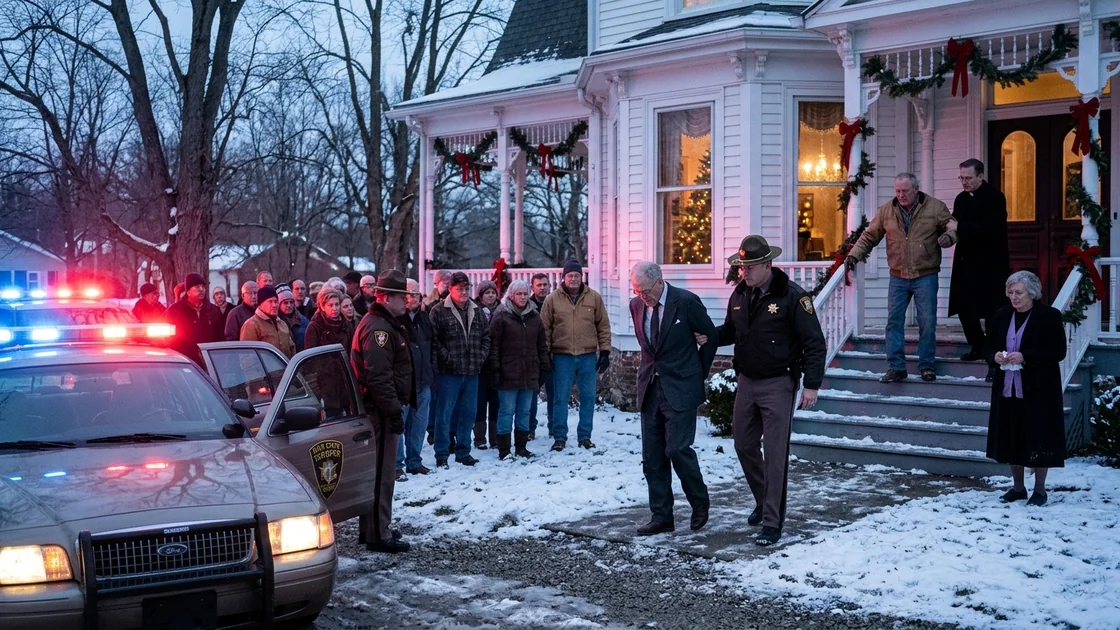
He sat for a moment, looking at the house. The wraparound porch was decorated with the pine boughs and red velvet ribbons that Martha had hung the weekend after Thanksgiving. In the living room window, the eight-foot Fraser fir was already lit with tiny, warm white bulbs, casting a golden glow across the lawn.
He got out of the car. His legs felt like two wet sacks of sand.
As he walked up the steps to the back porch, the kitchen door flew open.
Emily came out first. She was carrying Chloe in her car seat, wrapped in three layers of pink fleece. Emily was not wearing a coat, only a thick wool sweater. Her face was streaked with black mascara, her eyes swollen, her mouth twisted into an ugly, agonized mask of grief and disbelief.
"Emily," Arthur said, reaching out his hand.
She did not flinch; she simply moved around him as if he were an obstacle on the pavement—a dead animal or a fallen branch. She walked straight to Dennis’s car, opened the rear door, and clicked the car seat into the base with a sharp, violent snap.
"Emily, listen to me," Arthur begged, following her down the steps, his shoes slipping in the slush. "Please. Let me explain what happened."
Emily turned on him. She did not yell. She spoke with a savage, venomous quiet that struck Arthur harder than any blow Dennis could have delivered.
"You stole Chloe’s future," she whispered. "My own father. You sat at our table. You ate our food. You held my baby on your knee, knowing you had already taken everything we had."
"I was trying to make it back, sweetheart—"
"Don't call me sweetheart!" she screamed, the sound tearing through the quiet afternoon air. "Don't you dare touch me! I hope they lock you in a hole until you rot, Arthur! I hope you die in a concrete box!"
She climbed into the passenger seat and pulled the door shut. Dennis did not look at Arthur. He shifted the car into reverse, backed out of the drive with the tires spinning and spitting gravel against the frozen hedge, and accelerated down Orchard Lane toward the state route.
Arthur stood in the driveway, the smell of burning rubber and cold exhaust lingering in the air.
He turned back toward the house.
Standing on the back porch, holding the storm door open with one frail, trembling hand, was Martha.
She was wearing her apron—the blue gingham one with the embroidered daisies. Her face was gray, the color of wet river clay. She looked at him not with anger, but with the hollow, uncomprehending stare of someone who has just witnessed an artillery shell detonate in their garden.
"Artie?" she said. Her voice was faint, barely louder than the winter wind in the eaves. "What did Dennis say? What was he talking about?"
Arthur climbed the porch steps slowly, each riser feeling like a mountain. He reached the top, stopped two feet from his wife of thirty-seven years, and let his head drop onto his chest.
"The money is gone, Martha," he said.
"What money?" she asked, her hand fluttering to her throat, fingering the small gold cross he had bought her for their thirtieth anniversary. "What money, Artie? The church fund?"
"All of it," Arthur said. "Clara’s. Jim Gable’s. Dennis and Emily’s. The whole firm. There isn't any money left."
Martha looked past him, down the empty driveway where her daughter and granddaughter had just vanished. She looked at the snow on the lawn, then at the Christmas wreath on the door.
"You're lying," she whispered. "You’re making a joke. This is about some tax thing with the bank."
"It isn't a joke, Martha."
She stepped back into the warm kitchen, her slippers scuffling on the linoleum. Arthur followed her in, shutting the heavy door behind him. The kitchen smelled of cinnamon and orange peel; Martha had been simmering a potpourri pot on the back burner of the stove.
She walked to the kitchen table—the round maple table where they had eaten breakfast every morning since 1989—and sat down. She did not take off her apron. She folded her hands in her lap, her knuckles white, and stared at the centerpiece of dried pinecones and gilded acorns.
"What did you do, Artie?"
Arthur stood by the sink, leaning his weight against the porcelain basin. He told her.
He did not spare himself; he did not use the euphemisms of high finance. He did not talk about non-correlated yields, derivative spreads, or liquidity tranches. He told her that he had lost the money in the stock market three years ago. He told her that he had printed fake papers in the middle of the night. He told her that he had taken Jim Gable’s three hundred and forty thousand dollars to pay back other people, and that he had gambled Emily’s money on a drug trial that had failed.
He told her that Jim’s wife was dying in Cleveland because the hospital wanted two hundred thousand dollars that Arthur had already spent.
Martha sat motionless throughout the entire confession. She did not cry. She did not shout. She simply listened, her eyes fixed on the pinecones, while the grandfather clock in the hallway chimed three o'clock, then three-fifteen.
When he was finished, the silence in the kitchen was so total that Arthur could hear the faint, electrical hum of the refrigerator.
"Clara called while you were driving home," Martha said, her voice completely devoid of expression.
Arthur looked up.
"She wanted to know if you had the tax documents for her house sale ready," Martha whispered. "She said she’s putting an offer on that little villa down in Florida, near Sarasota. The one near her cousin. She said she’s going to use two hundred thousand of her Keystone money to pay for it cash. She said she was so glad you’d kept it safe for her."
Arthur gripped the edge of the sink until the porcelain bit into the flesh of his palms. He felt a sudden, violent surge of nausea and had to dry-heave into the drain.
"Artie," Martha said, her voice dropping into a tone he had never heard from her before—a cold, dead whisper from the bottom of an open grave. "What are the people at church going to say?"
Arthur wiped his mouth with his sleeve. He looked at his wife, and for the first time in his life, he saw that she did not care about the numbers, or the market, or the law. She cared about the shame. She was looking at the total, catastrophic annihilation of her social universe—the ladies’ auxiliary, the garden club, the front pew on Sunday, the respect of thirty-five years of quiet, small-town elevation.
"They're going to say I’m a criminal, Martha," Arthur said. "Because that’s what I am."
The doorbell on the front porch rang.
Not the friendly, double-tap of the mailman or the neighbor. A long, continuous, authoritative buzz that resonated through the floorboards.
Arthur did not move.
"Is that the police?" Martha asked. She did not look at the hallway. She looked down at her apron.
"Probably," Arthur said.
"Take off your coat," she said, her voice cracking slightly. "You look like a tramp with that coat on."
Arthur slowly unbuttoned his wool overcoat, hung it over the back of a kitchen chair, and straightened his tie. He pulled his silver-rimmed spectacles from his pocket, wiped them on his sleeve, and set them onto the bridge of his nose.
Then he walked down the long, carpeted hallway, past the lit Fraser fir, past the portraits of his ancestors on the wallpapered wall, and opened the heavy front door.
Part VIII: The Gathering at the Curb
It was not the state troopers. Not yet.
Standing on the porch, his work jacket unzipped despite the fourteen-degree weather, his gray hair wild and matted with sweat, was Jim Gable.
Beside him stood Frank Miller, who had owned the lumber yard before his back gave out; behind them on the porch steps stood Pete Vance, his logging boots caked with red clay; and on the walkway, leaning against the iron railing with a look of pale, horrified bewilderment, was Clara.
Dennis had not called the highway patrol first. Dennis had called the town.
Jim Gable did not look like the man who had sat in Arthur’s office two months ago, laughing about the sour stomach coffee gave him. His eyes were wide, bloodshot, and rimmed with yellow crust; his mouth was trembling, his hands curled into violent, shaking fists at his sides.
"Jim," Arthur said, his voice flat.
"Where is it, Artie?" Jim asked. He did not yell. He spoke with the desperate, ragged breath of an animal that has been caught in a leg-hold trap for three days. "Dennis called me from the road. He said... he said you told him there wasn't no money. He said you told him you gambled it."
Clara stepped up onto the porch, her face white, her fingers clutching a damp handkerchief to her lips. "Artie, tell him Dennis is lying. Dennis has had some kind of breakdown, hasn't he? Tell Jim he’s wrong. You’ve got my money, don't you, Artie? The money from Robert’s insurance?"
Arthur looked past them. Down at the end of the driveway, more cars were pulling up to the curb. Marta Ortiz’s flour-dusted van was there; the Reverend Tom from the Presbyterian church was stepping out of his sedan, his black coat flapping in the river wind.
The news had moved through the town like an ammonia leak, invisible and suffocating, killing every green thing it touched in minutes.
"Arthur!" Jim stepped forward, grabbing the lapels of Arthur’s suit jacket with both hands. The wool tore with a dull, wet sound. "Sarah is in the ICU! The doctors are waiting for the transfer codes! Where is the money, you son of a bitch?"
Arthur looked directly into Jim Gable’s eyes—the faded blue eyes that had watched their children play in the silver maple between their yards.
"There is no money, Jim," Arthur said.
The silence that followed was not like the silence in the office, or the silence in the kitchen. It was the silence of a house collapsing into its own cellar.
Jim’s hands remained clamped to Arthur’s jacket for three seconds, four seconds, five. His brain seemed unable to process the physical meaning of the words. Then, his face crumpled into a terrible, soundless grimace, and he did not punch Arthur; he did not strike him. He simply dropped his head against Arthur’s chest and began to wail—a high, keening howl of pure, unadulterated ruin that brought Mrs. Gable’s sister to her knees on the frozen grass of the lawn.
"You killed her," Jim wept into the fabric of Arthur’s shirt. "You killed my Sarah. You knew... you knew she didn't have thirty days, and you took it anyway."
Clara did not scream. She stood on the edge of the porch, looking at her brother as if he were a stranger who had stepped out of the woods wearing her brother’s skin.
"Arthur?" she whispered. "My house? The farm money?"
"I don't have it, Clara," Arthur said, his voice completely dead. "I spent it in twenty-two."
Clara looked at him for another moment, then slowly turned around and walked down the steps. She did not speak to anyone. She did not look at the neighbors who were gathering by the mailbox. She walked out into the middle of Orchard Lane, her lavender cardigan flapping in the freezing wind, her arms wrapped around her chest, walking toward the highway like a person who had forgotten where she lived.
From down the road, the sirens began.
They were faint at first—a distant, warbling cry rising out of the river valley from the south, where the state patrol barracks sat beside the interstate. Two cars, then three, their red and blue strobe lights reflecting off the bare branches of the sycamores along the creek.
The neighbors on the lawn did not scatter. They stood in the freezing slush, forty people who had known Arthur Pendelton since he was a boy in knee-pants carrying the church collection basket, watching him stand on his grand Victorian porch with his lapel torn and Jim Gable weeping against his ribs.
Reverend Tom walked up the steps, his face pale, his clerical collar crooked. He put his hand on Jim Gable’s shoulder, gently pulling the broken machinist away from Arthur’s chest.
"Jim," the reverend whispered. "Come on, Jim. Let’s get you in the car. We’ll find a way. We’ll get the church council together."
"There isn't no way, Tom," Jim choked out, his spit hanging in strings from his chin. "There isn't no money in this county to replace three hundred thousand dollars. We’re done. Sarah and me... we’re done."
The first cruiser swung into the driveway, its gravel-tires throwing gray slush across Martha’s flowerbeds. Two state troopers got out, their campaign hats squared, their hands resting instinctively near their duty belts. Behind them came the county sheriff’s car, the tires crunching to a halt beside Dennis’s tire tracks.
Sheriff Miller—whose uncle had been Arthur’s high school civics teacher—walked up the porch steps slowly. He looked at Arthur with an expression that was neither angry nor triumphant; it was the exhausted, sickening look of a man who has to pull a dead neighbor out of a crushed combine.
"Arthur," Miller said.
"Jack," Arthur replied.
"We got a call from Dennis Weaver up at the Cambridge barracks," Miller said, looking down at the torn wool of Arthur’s lapel, then past him into the warm hallway where the Christmas tree was glowing. "He made some statements about the firm. He brought in some records."
"Dennis is correct," Arthur said.
Miller sighed, a cloud of gray steam rising from his mustache. "You want to come down to the municipal building, Arthur? We ought to do this out of the cold."
"Yes," Arthur said. "Let me... let me tell Martha."
"Martha knows, Artie," the sheriff said gently, stepping between Arthur and the door. "Trooper Davis is going to sit with Martha until her sister gets here from Coshocton. You need to come with us now."
Arthur looked at the cruiser. The red and blue lights were sweeping across the face of the house, painting the white gingerbread trim with alternating flashes of crimson and ice-blue.
He turned his head. Through the tall living room window, he could see Martha sitting on the sofa beneath the portrait of his grandfather. She had not turned off the Christmas tree. She had not taken off her apron. She was sitting with her hands in her lap, looking straight ahead at the dark television screen, as still and cold as the river stone in the chimney.
Sheriff Miller took Arthur’s right arm. He did not use force; he guided him down the steps as if he were an elderly patient being led from a clinic. But at the bottom of the steps, beside the cruiser’s rear door, the sheriff reached behind his belt and produced the steel cuffs.
The click of the ratchets was very loud in the winter air.
Click. Click.
The steel was so cold it burned Arthur’s wrists.
He was placed in the back of the cruiser. The plastic seat was hard and smelled of disinfectant and old wet wool. Through the wire mesh partition, he watched the neighbors. They did not shout insults; they did not throw stones. That would have been easier to bear. Instead, they stood in small, silent clusters along the edge of Orchard Lane, their faces gray with an unspeakable, hollow shock.
They looked at the cruiser not with rage, but with the empty, terrifying realization that the world they had inhabited—the world where a man’s name on Maple Street meant safety, where a neighbor’s promise was better than a bond, where their small, hard-won lives were guarded by the men they broke bread with—was an illusion that had been sold to them by a ghost.
As the cruiser backed down the drive, Arthur looked out the side window toward the property line.
There was the silver maple. The treehouse he and Jim Gable had built for Emily and little Jimmy thirty years ago was still up there—a few gray, rotting boards clinging to the fork of the limb, covered in snow, holding nothing at all.
Part IX: The Ledger of the Valley
The federal detention center in Milan, Michigan, was five hours north of Lowell’s Crossing, across a flat, featureless expanse of frozen farmland that looked the same in January as it did in March.
Arthur Pendelton sat in the visitor’s room at a small laminate table bolted to the linoleum. He was sixty-two years old now, but in the fourteen months since his arrest, his hair had gone completely white, thinning until his pink scalp showed through like tissue paper. His silver spectacles had been replaced by state-issued wire frames with thick, round lenses that made his hazel eyes look huge and watery.
He wore an orange cotton jumpsuit with BOP stenciled across the shoulder blades. His fingernails were clean; he had spent the morning working in the facility’s laundry, folding white towels into stacks of twenty-five.
The heavy steel door at the end of the room clicked, and a woman walked in.
It was not Martha. Martha had moved to an apartment in Dublin, outside Columbus, to be near her sister; she had filed the dissolution papers in April through a lawyer Arthur had never met. She had not visited him once. She had not written. The Queen Anne house on Orchard Lane had been seized by the United States Marshals Service and sold at auction on the courthouse steps in Zanesville for two hundred and forty thousand dollars—less than half its appraised value—to a property developer from Cleveland who planned to divide the three acres into commercial storage units.
The woman who walked to the table was Clara.
She had aged ten years. Her hair, which she had always dyed a modest chestnut, was streaked with dull iron-gray; she wore no makeup, and her coat was an old, brown tweed that Arthur remembered her buying at the Sears in Zanesville twelve years ago.
She sat down across from him. She did not reach across the table. Between them lay the three inches of empty gray laminate that the guards insisted upon.
"Hello, Artie," she said. Her voice was thin, like paper that had been left in the sun until it was brittle.
"Clara," Arthur said. His voice was hoarse from disuse. In the detention unit, he rarely spoke more than a dozen words a day. "You shouldn't have driven all this way. The roads between Toledo and here are always bad this time of year."
"The roads were fine," she said.
She set her purse in her lap. Her hands remained folded over the clasp.
"How is Martha?" Arthur asked, though he knew he had no right to speak her name.
"She’s with Sarah," Clara said.
Arthur looked up, his watery eyes widening slightly behind the round lenses. "Sarah?"
"Sarah Gable," Clara said. Her voice had no inflection; it was as flat as the Michigan horizon. "She lived, Artie."
Arthur let out a long, ragged breath that sounded like a sob. "Thank God. The Clinic... they found a way?"
"The plant union took up a collection," Clara said. "And the church mortgaged the parish hall. They got seventy thousand together, and the hospital agreed to do the experimental line on a hardship basis. She’s in remission. She’s in a wheelchair, and she can't use her left hand because of the nerve damage from the blast crisis, but she’s living."
"Thank God," Arthur whispered again, bowing his head.
"Jim works the night shift at the convenience store out by the bypass," Clara continued, her words falling like small, hard stones onto the table. "He’s sixty-four years old, Artie. He stands behind that cash register from eleven at night until seven in the morning, selling lottery tickets and diesel to truckers. His knees are so swollen by four in the morning that he has to lean against the cigarette rack to keep from falling over."
Arthur closed his eyes, but the darkness brought no relief; it only brought back the smell of the cedar oil on his desk and the sound of Jim’s boots on the stairs.
"And you, Clara?" Arthur asked, terrified of the answer. "Where are you?"
"I’m in the tenant house on the Miller farm," she said. "Frank let me have it for four hundred a month. The state securities restitution fund sent me a check in November. Five thousand two hundred dollars. They said that’s my pro-rata share of the recovery from the office furniture and the Buick."
She looked at her brother’s face—the face she had looked up to when he was the boy who could do long division in his head, the boy who had won the county spelling bee, the boy their father had said would be the great man of the family.
"Dennis and Emily don't talk to me," Clara said softly. "They don't talk to Martha. Dennis got a job at a commercial lender in Indianapolis. He took Emily and Chloe out of Ohio altogether. He told Frank Miller that he didn't want his daughter growing up in a county where people remembered the name Pendelton."
Arthur’s chest hitched. A single, dry spasm shook his shoulders, but no tears came. His body seemed to have run out of moisture months ago.
"Clara," he whispered. "I swear to you... before God... I never meant for anyone to lose a dollar. I thought... I thought I could beat it back. I thought if I just had enough time..."
"You didn't think about us at all, Artie," Clara said. Her voice was not angry; it was worse. It was the calm, terrifying certainty of someone who has looked into the bottom of a dry well and understood that there was never any water there to begin with. "You only thought about how you’d look at the Rotary luncheon if people knew you weren't as smart as your father."
Arthur had no answer. The silence of the prison visiting room hummed with the fluorescent lights, the distant rattle of keys, and the low murmurs of two inmates three tables down speaking to their children through the glass.
Clara reached into her pocket and pulled out a small, folded piece of paper. She laid it on the table and pushed it across the laminate with one finger until it rested against Arthur’s orange sleeve.
"What is this?" Arthur asked.
"It came to my post office box last week," she said. "From the bankruptcy trustee in Columbus. It’s the final accounting for Pendelton Wealth Management."
Arthur looked at the paper. It was a single sheet of cheap twenty-pound copy stock, printed with a standard court header:
UNITED STATES BANKRUPTCY COURT
SOUTHERN DISTRICT OF OHIO
EASTERN DIVISION

IN RE: ARTHUR V. PENDELTON, DEBTOR.
CASE NO. 24-51102

SCHEDULE OF ALLOWED UNSECURED CLAIMS: $4,912,418.12
TOTAL LIQUIDATED ASSETS RECOVERED: $318,402.19
TRUSTEE & ADMINISTRATIVE EXPENSES: $112,014.00
NET DISTRIBUTABLE TO VICTIMS: $206,388.19
FINAL DISTRIBUTION RATE: 4.2018%
Four cents on the dollar.
Forty-two people had given him thirty years of their lives, and the court had returned to them four cents for every dollar they had trusted to the brass plaque on Maple Street.
"Pete Vance had to sell his skidders," Clara said, her voice dropping into a whisper that barely reached Arthur’s ears. "He’s working as an equipment operator for the county road crew now. Marta Ortiz closed the bakery in October. She couldn't get credit from the flour mill in Canton because she didn't have the collateral anymore. The building’s empty. The whole square is dark by five o'clock, Artie. Even the hardware store is struggling because nobody’s spending a dime they don't have to."
She stood up. She pulled her brown tweed coat tightly around her shoulders, buttoning the large plastic buttons up to her throat.
"I’m not coming back here, Artie," she said.
Arthur looked up at her, his hands trembling against the table. "Clara... please. Don't leave me here alone. You’re my sister."
Clara looked down at him through the wire-rimmed spectacles, her hazel eyes—so like his own—clear, cold, and entirely empty of love or hatred.
"My brother died in February of twenty-one," she said. "The man sitting here is just someone who looks like him, wearing a suit the taxpayers paid for."
She turned and walked toward the steel door. She knocked once on the small, wire-reinforced window. The lock clicked, the heavy door swung open, and Clara Pendelton walked through it into the gray Michigan corridor.
The door shut with a heavy, final thud that echoed through the linoleum room like the dropping of an iron gate.
Arthur remained at the table.
He sat alone in the humming light, looking down at the cheap white paper the court had sent. He looked at the numbers: four million nine hundred and twelve thousand. Two hundred and six thousand. Four cents.
He remembered the smell of the yellow flannel cloth and the tin of Brasso. He remembered the cold river water against the bridge piers in 2021, and the way the stars had looked between the iron girders of the trestle. He remembered how easy it would have been to lean forward, to let the current take him, to let his name remain clean in the cemetery on the hill behind the church, beneath the granite stone that his grandfather had carved with his own hands.
He had wanted to live. He had wanted his standing. He had wanted the people of Lowell’s Crossing to nod to him when he walked past the barber shop.
A guard in a gray uniform walked over to the table, his hand resting on the handle of his pepper spray.
"Time’s up, Pendelton," the guard said, tapping his watch. "Shift change in the laundry. Move it."
Arthur stood up. He did not take the court paper; he left it lying on the laminate, beneath the white glare of the ceiling tubes. He walked toward the inner door that led back to the housing tier, his orange slip-on shoes scuffling against the floor, his back curved into the permanent, broken stoop of a man carrying a ledger that could never be balanced.