The Ledger of Broken Stones
In the occupied river city of Oakhaven, a minor registry clerk named Jonas Vance harbored a quiet, bitter resentment toward a charismatic tailor named Julian Karr, whose careless charms and petty cruelties had long wounded Jonas's fragile pride. Desperate for favor with the occupying military authority and eager to see his rival humbled, Jonas whispered Julian's secret curfew hideout to the secret police, believing the man would merely be sentenced to a term of forced labor. Instead, the subsequent midnight raid breached a concealed cellar vault beneath the floorboards, uncovering not only Julian but an innocent family of five who had spent months in hiding, delivering them all to the firing wall at the railyard. Trapped within the confines of his own deceit and haunted by the unbearable weight of what his petty spite had wrought, Jonas spent the remaining months of the siege unraveling beneath the gaze of a silent, watchful town, discovering that no amount of repentance can wash the blood from a cowardly hand.
I. The Salt on the Desk
The winter had stripped Oakhaven down to its iron ribs. Gray clouds hung low over the slate roofs like wet wool, smelling perpetually of bituminous coal, cabbage water, and the sour oil the occupation garrison used to grease the bolts of their carbines. Down along the docks of the Blackwater River, the cranes were frozen into skeletal postures, their cables encrusted with rime, swinging only when the northern gale drove off the marshes.
Jonas Vance worked with his knuckles wrapped in strips of boiled linen. His desk in the Department of Domestic Records was situated beneath a high, arched window through which the draft entered like a thin blade. The building had once been the municipal library, but the soldiers had burned the philosophical collection in the courtyard during the first week of the October surrender, using the great leather-bound folios to heat their broth. Now, rows of deal tables stretched across the parquet floor, manned by men who spoke in whispers and smelled of ersatz chicory.
Across the ledger before him, Jonas drew lines in iron-gall ink. It was tedious work, the work of cataloging what remained: grain quotas, cordwood allowances, the confiscation lists of brass fixtures and carriage horses. Every citizen of Oakhaven had been reduced to a slip of cream-colored cardstock, stamped with an indigo crest depicting an eagle perched upon a broken wheel.
"Vance," a voice murmured from behind the register.
Jonas did not turn immediately. He finished the stroke of his pen, blotting the number 412 with a pinch of gray sand. When he looked up, Sergeant Malec was standing at the end of the partition. The sergeant was a squat man from the southern provinces of the occupying empire, possessing teeth the color of wet pine and eyes that seemed never to focus entirely upon the person speaking to them, but rather on the throat or the pocket.
"The Captain wants the fuel registers for the fifth district," Malec said, his accent thick and flat, flattening vowels like iron rolling over hot tin. "The bakeries especially. He thinks they are baking under the floor after the ten o'clock bell."
"The bakeries have no flour, Sergeant," Jonas said quietly. His voice had the dry, rustling texture of dry husks. "The mill at the weir was emptied on Tuesday."
"He didn't ask about the flour. He asked about the wood. People burn things when they are cold, Vance. When they burn things, they congregate. When they congregate, they talk." Malec leaned forward, resting a hand heavily on the brass divider. His nails were rimmed with black grease. "You have relatives in the fifth, don't you?"
"No," Jonas lied smoothly. "My family was from the uplands. They died during the river campaign."
"A clean ledger, then," Malec grunted. He reached into his coat and produced an apple—a small, withered thing, bruised on one side, but unmistakably fruit. He set it on the corner of Jonas's desk with a sharp thud. "Clean ledgers are useful. Dirty ones are burned. Don't forget the difference."
Jonas looked at the apple. In the fourth year of the war, a single piece of fresh orchard fruit was worth more than an entire month’s allocation of paper notes. His stomach gave an involuntary, painful spasm.
"Thank you, Sergeant."
"Don't thank me. Thank your own good memory. The Captain appreciates a citizen who understands the shape of the street."
Malec turned and walked away, his jackboots squeaking on the neglected parquetry. Jonas remained motionless until the heavy oak doors at the end of the hall swung shut. Then, slowly, with fingers that trembled slightly from the cold, he took the apple and placed it in the deep pocket of his woolen overcoat. He did not eat it. To eat it would be to accept the contract, and though he had already accepted it twenty times over in the last six months, he still clung to the pathetic ritual of delay.
He had become an informant not out of ideology—he despised the soldiers with their stiff collars and foreign prayers—but out of an exquisite, suffocating terror. When the garrison had first arrived, they had hanged three clerks from the lampposts in the market square merely to establish the tempo of civil administration. Jonas had stood in the crowd, feeling the spray of slush from an armored car’s wheels against his stockings, watching the boots of the chief registrar twitch against the damp brick. In that moment, something inside his spine had turned to tallow. He realized that the world was divided cleanly into those who made lists and those who were written upon them.
Yet fear alone was not what drove him into the back office of the Kommandantur twice a week. There was another poison, older and slower, running through his blood like ditch water.
At five o'clock, the bells of the cathedral—now muted by order of the provost marshal to avoid signaling illegal gatherings—struck their hollow, cracked tones. Jonas cleared his nibs, capped his ink, and slipped out into the gray twilight.
The street smelled of wet slate and horse manure. Along the Avenue of the Weavers, the shopfronts were boarded shut with rough-sawn pine, their display windows long since shattered by artillery concussions or scavenged for greenhouse frames. As he walked, his head down against the sleet, Jonas felt the apple bumping against his hip like a warm stone.
He passed the tailor’s shop at number fourteen.
The shutters were latched, but a seam of yellow light leaked from beneath the lintel. A painted sign, swinging crookedly on one hinge, read: Karr & Sons – Fine Habit-Making, Linens, and Trimmings. The "Sons" had died at the border forts, but Julian Karr remained, living like an insolent fox in a ruined hedgerow.
Jonas slowed his pace. The snow was beginning to stick to the woolen folds of his muffler. Through the chink in the shutter, he could hear laughter—not the pinched, nervous titter of the breadlines, but a round, full-throated sound that belonged to the years before the river gates were broken.
He heard Julian's voice, clear and musical, followed by the clink of glass.
Wine. Real wine, not the fermented beet juice sold under license at the railway tavern. Julian had wine, Julian had warmth, and Julian had the effortless, infuriating grace of a man who had never once trembled before an officer’s desk.
Jonas stopped in the shadow of an overhanging archway, his teeth chattering. He remembered the summer before the war, when the world was still green and broad. He remembered the garden party behind the guildhall, where Jonas had spent three weeks’ wages on a pale blue waistcoat, hoping to speak to Clara Vane, the magistrate's niece. He remembered standing by the lime trees, tongue-tied, his palms sweating through his threadbare gloves, while Julian Karr—draped in an unbuttoned velvet coat, smelling of sweet almond soap and tobacco—had strolled between them, caught Clara by the elbow, and led her toward the bandstand with a single, mocking glance back at Jonas.
A clerk's son, Julian had said later, loud enough for the table of apothecaries to hear, is born with ink in his marrow and lard in his heart. Give him a sunbeam and he will try to measure it with a yardstick.
The laughter had followed Jonas home through the warm June dark, and it had stayed with him through the bombardments, through the fires, through the long, freezing nights when his mother died coughing into her handkerchief. Julian had survived the siege with his shop intact, his curls oiled, and his insolence undiminished. While Jonas lived on turnip peels and dried cod, Julian always seemed to find lard, dried plums, and tobacco. He flouted the curfew with impunity, boasting that he knew the cellarways between the Upper Market and the Tanneries better than the rats that birthed there.
A door down the alley banged open. A woman stepped out, wrapped in a rabbit-fur cape that Jonas recognized instantly. It belonged to the widow Geller, whose husband had been shot in the second purge. She was laughing, her face flushed with drink, clutching a parcel wrapped in brown butcher’s paper.
Julian appeared in the doorway behind her, framed in the warm candlelight. He wore a patched silk smoking jacket, his shirtsleeves turned back to reveal forearms corded like ash boughs.
"Go by the lane behind the cooperage, Marta," Julian said, his voice carrying easily over the hiss of the sleet. "The patrol with the spaniel stays on the embankment until nine. If they stop you, tell them you’re delivering mended linen for the major's shirts. They don't touch the linen."
"You're a devil, Julian," the woman whispered, leaning in to press her lips to his cheek. "Where did you get the tea?"
"The angels drop it from the clouds when the clouds aren't looking," he laughed, slapping her lightly on the hip. "Go on now. Mind the ice at the corner."
Jonas pressed himself back against the damp brick until the rough mortar bit into his shoulder through his coat. His breath came in thin, ragged plumes.
Julian stood on the threshold for a long moment after the woman was gone, looking up into the dark sky, watching the snow fall against his open throat. He looked utterly untroubled, utterly free. He did not look like a man who spent his afternoons calculating how many ounces of sawdust could be mixed into rye meal without stopping a child's bowels. He looked like an owner of the world.
He thinks the war is just another winter, Jonas thought, his hands clenching inside his pockets until the apple bruised under his thumb. He thinks he can dress it in wool and walk around it.
The window shutter swung closed. The latch dropped. The street returned to its dead, gray silence, broken only by the distant, rhythmic thrum of the diesel generator at the railway depot.
II. The Bargain of the Tanner’s Pit
The basement office of the Kommandantur was heated by a large cast-iron stove that roared like a furnace, fed with old library furniture and confiscation crates. It was the only room in the entire administrative quarter where Jonas Vance ever felt his bones truly thaw, yet he never ceased to shiver while sitting in it.
Captain Meyer sat behind a desk constructed from two drafting tables pushed together. He was a small, pale man with hair the color of lard, combed flat across a narrow skull. He wore wire-rimmed spectacles with thick, green-tinted lenses that disguised the direction of his pupils, giving his face the unsettling symmetry of an insect. Unlike Malec, who was crude and smelled of sour fat, Meyer smelled of carbolic soap and dried lavender.
"You are late, Vance," the Captain said without looking up from his papers. His pen made a dry, scraping sound on the vellum.
"The snow was heavy on the bridge, sir," Jonas said. He stood with his hat held in both hands against his stomach. "The guard at the gate was checking work permits individually."
"The guard was doing his duty. You should have anticipated the delay and departed earlier. Order is not an accident of the weather; it is an assertion of the will against the weather." Meyer set the pen into a brass groove. He removed his green spectacles, wiped them with a scrap of chamois, and replaced them. The magnified, milky eyes settled upon Jonas's chin. "What do you have for the fifth district?"
"The wood registers are complete, sir. The baker on Weaver Street has thirty bundles of dried lath beyond his declaration. He hid them behind the kneading troughs."
"A trifle," Meyer dismissed with a flick of his fingers. "Thirty bundles of lath will keep our stove alive for two hours. I am not interested in two hours of heat, Vance. I am interested in the movement of goods. There is a leak in the grain reserves from the central silo. Flour is appearing in the houses along the river. Where is it crossing?"
Jonas hesitated. His fingers dug into the brim of his felt hat.
"I have heard rumors," Jonas began, his throat dry.
"I do not pay you in ration vouchers for rumors. I can hire ten schoolboys with a basket of cabbage ends to bring me rumors. I pay you for locations, Vance. For names that correspond to numbers on my map." Meyer pointed with an unsharpened pencil toward a large tactical plan of Oakhaven mounted on the wall. Small red, blue, and black pins were driven into the parchment like swarming beetles. "The south quarter is quiet. The east quarter is compliant. The river corridor—your corridor—is a nest of grease. It lacks discipline."
"There is Julian Karr," Jonas said. The name came out of him before he had fully weighed the sound of it in the warm, close room. It sounded smaller than he had imagined, like a dried bean dropped into an empty kettle.
Meyer’s eyebrows shifted slightly beneath his pale brow. "The tailor?"
"Yes, sir."
"We have looked at Karr. He is an egotist. He mends tunics for the second-battalion officers. He charges them five times the tariff, but he does it with silk thread he had hidden before the crossing. They like him. Major Brandt says he tells amusing stories about the old town council."
"He does more than mend tunics," Jonas said, a sudden, hot flush rising into his temples. The memory of the silk smoking jacket, the laugh, the woman with the tea, rose up to choke him. "He runs contraband. English leaf, dried currants, tins of lard. He moves them during the curfew hours. He boasts that the patrols are blind."
"Does he?" Meyer’s tone was dangerously level. He picked up his pencil again, tapping the eraser against the blotter. Tap. Tap. Tap. "Boasting is not a crime under the military code, Vance. It is merely bad taste. Can you tell me where he keeps his stock?"
"Not in the shop," Jonas said, his mind racing, piecing together the fragments he had gathered from weeks of listening to the women in the breadlines, the whispers of the drunken coopers, the small, spiteful observations he had stored away like nuts in a hole. "The shop is searched every month. He uses the old tannery cellar behind the millrace. The one that was abandoned after the spring flood."
Meyer leaned back. The leather of his chair groaned. "The tannery belongs to the municipal trust. It was condemned four years ago. The floor is sunken."
"Underneath the drying vats," Jonas insisted, leaning forward an inch, drawn into the web of his own invention and memory. "There is a brick cistern. It was used for storing lime before the flood. The water never reached the second tier. Karr has a cot there, and a brazier. He uses it when the patrols are thick on the High Street. He meets his runners there after midnight."
Jonas believed this. He truly believed it. Julian had mentioned the old lime-cistern once, years ago at the tavern, calling it the only dry spot in the lower town where a man could keep an extra pair of boots without the mildew eating the welt. It was entirely like Julian to turn a damp hole into an insolent sanctuary.
"And how does he enter?" Meyer asked. His voice had lost its dismissive tone. It was now thin, sharp, and cold as a wire.
"Through the drainage sluice on the canal side," Jonas whispered. "The iron grate is broken. A man can squeeze through if he doesn't mind the muck. Then there is an iron door behind the third vat. It’s secured with a boatman’s padlock."
Meyer stared at him through the green lenses. For several seconds, the only sound was the crackle of a spruce plank collapsing in the stove.
"You have been very observant, Vance," the Captain said softly.
"He is an arrogant man, sir," Jonas said, trying to steady his voice, trying to make it sound like the objective civic duty he pretended to serve. "He thinks the uniform is something he can cut and resew to his liking. He makes a mockery of the curfew. A few months at the labor camp at the quarry... it would teach him that the new order does not have favorites."
Meyer smiled. It was the first time Jonas had ever seen the man’s lips part in that manner; they revealed small, perfectly even teeth that did not seem to belong to an adult mouth.
"The labor camp," Meyer murmured. "Yes. The quarry is very instructive in the winter. The granite is hard, and the soup is thin. It teaches a man the precise value of a minute."
He reached into a drawer beneath the desk and pulled out a small slip of cardstock—a yellow one, not cream. He scribbled three words upon it and pushed it across the table toward Jonas, along with a small paper packet that smelled faintly of chicory and tobacco.
"The third vat," Meyer said. "Tonight?"
"He was there yesterday," Jonas said, his fingers closing over the paper packet. "He had tallow candles. He will be there tonight. The patrol on the river side is light on Thursdays."
"The patrol will not be light tonight," said Meyer. "You may go, Vance. Take the alley behind the abattoir. There is an inspection team on the main boulevard, and they do not like to see clerks walking about after seven without an armed escort."
Jonas bowed. His neck felt stiff, as if the vertebrae had fused into salt. He slipped the yellow voucher and the packet into his pocket, beside the bruised apple that still lay there like a cold weight.
"Vance," Meyer called out just as Jonas reached the heavy iron door.
"Yes, Captain?"
"If this is another cobbler's quarrel—like the business with the dyer in the third ward whose cellar contained only six sacks of rotten potatoes—you will spend the remainder of the month clearing the dead horses from the marsh road. By hand."
"It is not a cobbler's quarrel, sir," Jonas said, his voice firm with the sudden, ugly certainty of his revenge. "Julian Karr is there. I swear it."
III. The Architecture of the Vault
The snow ceased around ten o'clock, leaving the city locked in a blue, crystalline silence. The moon was a curved shard of ice high above the chimneys, casting long, sharp shadows across the drifts that choked the gutters.
Jonas did not go home to his garret near the railway embankment. He could not. His room was eight feet by ten, under the rafters, where the frost formed on the inside of the windowpanes in intricate, fern-like patterns that seemed to watch him. If he sat there, he knew he would listen to the bells, counting the minutes until the patrol went out.
Instead, he stood in the entrance of a collapsed grain store fifty yards upriver from the old tannery. The ruins offered an unobstructed view across the frozen canal toward the low, sprawling brick complex of the leather works. The roof had fallen in during the first bombardment, leaving only the brick chimneys and the massive stone foundations that sat in the black sludge of the canal like the piers of a broken bridge.
The cold was absolute. It did not merely touch the skin; it reached into the marrow, setting up an ache that felt like iron nails driven into his joints. Jonas pulled his woolen scarf up over his nose, his breath freezing instantly into crusts of ice against his eyelashes. He kept his hands stuffed deep into his pockets, fingers curled around the bruised apple, which had now frozen solid as a cobble.
Why am I here? he asked himself, his teeth chattering so hard they ached. I should be in bed. I should be asleep.
He wanted to see it. That was the naked, shameful truth that squirmed beneath his ribcage. He wanted to see Julian Karr brought out into the snow in his fine shirtsleeves. He wanted to see the insolence cracked out of his face like an eggshell. He wanted to see the tailor’s dapper curls matted with mud, his hands tied behind him with telephone wire, being shoved into the back of an olive-drab truck while the neighbors watched from behind their cracked shutters. He wanted Julian to know—even if the name was never spoken—that the clerk he had mocked at the summer ball had possessed the power to reach out through the dark and strip him of everything he was.
At half-past eleven, the sound came: not the rumble of an engine, but the dry, rhythmic crunch of studs on hard-packed snow.
They came along the towpath in single file, five men in long greatcoats with their collars turned up, their helmets covered in white calico to blend with the snow. Malec was at their head, carrying a short-barreled submachine gun across his chest by its canvas sling. Behind him came four privates, their rifles tipped with long, triangular bayonets that gleamed like needles in the moonlight.
They moved with the methodical, heavy competence of butchers entering an abattoir. There was no shouting, no lantern light. They knew the way.
Jonas watched from his shadow, his heart hammering against his ribs like a bird in a wicker cage. He felt a sudden, sharp prick of terror. What if Julian wasn't there? What if the tannery was empty, save for the dry dung of rats and the smell of old hemlock bark? Captain Meyer’s voice echoed in his memory: By hand. The dead horses from the marsh road.
The soldiers reached the broken drainage sluice. Malec knelt, his knees sinking into the drift, and inspected the iron bars. He raised a hand, signaling to the men behind him. One of the privates produced a pair of long-handled bolt cutters from under his arm. There was a dull, heavy snap that carried across the frozen canal like the cracking of river ice.
One by one, the soldiers dropped into the black mouth of the culvert.
The street was empty again. The moon slid behind a chimney stack, plunging the canal into deep, cobalt shadow.
Jonas leaned against the broken brick of his shelter, his mouth open, breathing the bitter air. He waited. Five minutes passed. Ten. The silence was heavier now, swollen with an unbearable tension that seemed to make the very telephone wires hum in the frost.
Then came the sounds from beneath the earth.
They were muffled at first—the dull thud of heavy boots against stone, the splintering crack of wood that had stood dry for fifty years. Jonas imagined the scene: Julian leaping up from his cot, his wine bottle overturning, his clever, mocking mouth dropping open in sudden comprehension as the flashlights caught him in the corner between the drying vats.
Then there was a shout. Not a man's shout.
It was high, thin, and shrill—a scream that had no words in it, the sound a horse makes when it breaks its leg in a ditch.
Jonas stiffened. His fingers slipped from the frozen apple.
A woman?
Had Julian brought Marta Geller there? The fool. The reckless, arrogant fool. To bring a woman to a contraband cellar...
A second scream followed, shorter this time, cut off by the dull, flat thud of a rifle butt striking bone. Then, a sharp series of three shots: crack, crack, crack. They did not sound like the heavy service rifles; they were the lighter, barking reports of an officer's sidearm.
From the dark mouth of the culvert, black smoke began to drift, smelling of cordite and burning straw.
A moment later, the first figure was shoved out into the moonlight.
It was not Julian.
It was an old man, wearing a waistcoat over an undershirt, his suspenders trailing in the snow. His hair was long and white, plastered to his forehead with dark, glistening blood that looked black in the moonlight. He fell onto his hands and knees in the drift, gasping, coughing up great red gobbets of phlegm.
"Get up," a soldier's voice barked from the hole. A boot caught the old man in the ribs, rolling him onto his side.
Behind him came another. A woman, young, her hair tied in a yellow kerchief, carrying a bundle wrapped in an old woolen shawl against her breast. She was not crying; she was screeching, a rhythmic, animal noise that seemed to come from her belly rather than her throat. A private shoved her forward by the nape of her neck, his bayonet point hovering an inch from her shoulder blades.
And then two more. Children. Girls, neither of them older than eight or nine, their thin legs bare above woolen socks that had slipped down into their shoes. They were clinging to each other's coats, their faces gray with cellar-dust, their eyes wide and white like those of cattle in a stockade.
Jonas felt the air leave his lungs. His vision narrowed until the world consisted only of that small, moonlit patch of towpath across the black water.
"No," he whispered into his muffler. The wool was wet against his lips. "No, no. That's the tannery. The lime vault."
Finally, Julian Karr was brought out.
He was not wearing his silk coat. He wore a rough sheepskin vest, torn down the front. His face was unrecognizable—not from violence, though his lip was split and bleeding—but from an expression so raw, so completely stripped of grace and irony, that he looked like an idiot. His arms were pinned behind him by a soldier twice his size.
As Julian hit the snow, he did not look at the soldiers. He looked back at the woman with the bundle.
"Leave them," Julian screamed. His voice was hoarse, shredded, breaking into a dry sob. "They don't know anything! They’ve been down there since the autumn! They didn't know about the flour! They didn't know!"
Malec emerged last. He had his submachine gun slung over his back again. In his hand, he carried a small, square ledger bound in black cloth—not the contraband lists Jonas had described, but a prayer book with a tarnished silver clasp.
Malec walked over to the old man who lay in the snow. He did not say a word. He drew his pistol, cocked it with his thumb, and pressed the muzzle against the base of the man's neck.
Crack.
The old man’s body jerked once, violently, his feet drumming against the frozen slush, then lay still. The snow around his white hair turned black under the moon.
The woman with the yellow kerchief did not scream this time. She dropped to her knees beside the corpse, still holding the bundle with one arm, reaching out with the other to touch the old man’s woolen shoulder. Her hand was shaking so violently she could not close her fingers.
Jonas Vance fell back against the wall of the ruined grain store. His knees gave way beneath him, and he slid down into the rubble until he was sitting in the frozen horse-dust and broken tile. He jammed his hands over his ears, but the sound of the children weeping—a thin, reedy piping like the cry of sandpipers on the riverbanks—leaked through his fingers, through his skull, through the dry, hollow chambers of his heart.
He had not known.
The thought beat against his temples with the force of an iron bar. I did not know. He only said the lime vault was dry. He only said he kept his boots there. How could I know they were under the vats? How could I know who he was hiding?
He looked down at his trembling hands. The paper packet of tobacco and the yellow ration voucher had slipped from his pocket into the snow between his feet. The bright yellow paper looked like a splash of bile against the white crust.
Across the water, the diesel engine of a three-ton truck grunted into life. The headlights snapped on, two blinding shafts of yellow light that cut through the blue dark, illuminating the exhaust smoke that billowed behind it like gray wool.
The soldiers did not shoot the others there. They loaded them into the truck—the woman, the two small girls, Julian with his arms wired behind his back, and the bundle that had stopped making any sound at all. The old man was left where he lay, a dark heap against the canal bank, his suspenders trailing into the black slush.
The truck ground its gears and moved away toward the railway siding, its chains clinking against the icy wheel-wells until the sound was swallowed by the wind.
IV. The Registry of the Dead
In the morning, the light was the color of a wet slate. The frost had not lifted; it had merely thickened, coating the trees along the embankment with a greasy, gray fur.
Jonas was at his desk at eight o'clock. His stockings were wet through from his walk through the drifts, his feet numb within his boots, but he sat as straight as an iron rod, his pen moving across the columns of the fuel register.
District 5. Bakeries. Allotted cordwood: 12 metric quintals. Actual delivery: 9 metric quintals. Deficit: 3 quintals.
His hand did not shake. That was the terrible thing. The hand that had held the pen for nine years under the old mayor, that had written out the permits for the market stalls and the marriage certificates for the weavers, functioned with a horrible, mechanical precision. It seemed to have detached itself from his brain, operating as an independent instrument of steel and bone.
"Vance," a voice said.
It was not Malec this time. It was Herr Gross, the chief archivist, an old man who had survived four changes of government by never speaking above a whisper and never wearing any color other than dark gray. He stood beside Jonas's desk, holding a bundle of manila folders tied with red tape.
"The Captain wants these processed before the midday bell," Gross said. His eyes were red-rimmed from the cold, his breath smelling of the dried caraway seeds he chewed to disguise the lack of tobacco.
"What are they, sir?" Jonas asked, his voice steady, flat, dead.
"Deletions," Gross said simply. He did not look at Jonas. He set the folders on the blotter, his old, paper-spotted hand lingering for a moment on the cardstock as if he were smoothing a blanket over a sleeping child. "The special court met at six this morning. The railyard detail is already finished."
Gross walked away, his slippers shuffling softly across the unwashed floorboards.
Jonas looked at the folders.
There were six of them. The red tape was knotted with military efficiency—a double half-hitch that could be undone with a single pull of the loop.
His fingers went to the tape. The knot gave way with a dry snick.
The first file bore the name: Dreven, Tomas. Age: 68. Profession: Master Watchmaker. Status: Non-compliant. Residence: Unlawful (Sub-structure, Ward 5).
A small oval photograph was affixed to the upper left corner with a brass eyelet. It showed the old man from the canal bank, but taken twenty years before. His hair was iron-gray then, his beard trimmed neatly into a square spade, wearing a high celluloid collar and a silk cravat with a modest pearl pin. His eyes were direct, calm, the eyes of a man who spent his afternoons adjusting the balance wheels of pendulum clocks, confident that time was a series of regular, orderly beats that could always be set right with an ivory wrench.
Across the photograph, Captain Meyer had stamped a single word in purple ink: LIQUIDIERT.
The second file: Dreven, Elsbeth. Age: 31. Profession: Teacher of Music. Status: Non-compliant.
The woman in the yellow kerchief. In the photograph, her hair was piled high on her head in the fashion of the previous decade, her mouth curved in a slight, tentative smile, as if she were about to encourage a small child whose fingers had stumbled over a scale by Clementi.
LIQUIDIERT.
The third and fourth files were thinner. They did not have photographs, only handwritten slips from the parish registry that had been annexed two years before.
Dreven, Maren. Age: 8. Dreven, Lise. Age: 6.
Across both cards, the purple stamp had been applied with such force that the metal rim had bruised the cardstock, leaving an embossed ring around the ink: LIQUIDIERT.
The fifth card was merely an index slip, without a full folder:
Dreven, Infant (Male). Unregistered. Age: Approximately 4 months.
The stamp was there, too. It was slightly smeared, as if the ink had not dried before the card was shoved back into the sorting box.
Jonas sat with his hands flat on either side of the folders.
Dreven.
He knew that name. Tomas Dreven had kept the watch shop under the arcade by the cathedral. When Jonas was twelve years old, his father had taken him there to have his grandfather’s silver pocket watch cleaned. Jonas remembered the smell of the shop—whale oil, boxwood sawdust, and the endless, intricate music of forty clocks all ticking out their slightly different versions of the hour. Old Dreven had worn an eyeglass screwed into his cheek, his fingers so delicate they could lift a hairspring without bending the coil.
Julian had not been running tea.
Julian had not been moving lard.
Julian had been bringing them bread. He had been bringing them the cabbage water from his own stove, the tallow candles from his own workbench, the charcoal to burn in their brazier so the smoke would not rise through the floorboards of the drying vats. For four months—through the first freezes, through the November searches, through the tightening of the ration cordon—Julian Karr had been keeping five souls alive beneath twelve feet of wet brick and rotten hemlock bark.
And Jonas had traded them for an apple, a paper slip of chicory, and the small, filthy satisfaction of seeing his rival dragged through the slush.
"Vance."
Jonas did not startle. He looked up slowly.
Captain Meyer stood before the desk. He was dressed in his walking coat of field-gray wool, with a collar of dark green velvet that looked almost soft against his pale, lard-colored neck. He had his gloves on—fine, gray calfskin that showed the shape of his knuckles.
"You have the Dreven files," Meyer said. It was not a question.
"Yes, sir," Jonas said. His tongue felt large and dry, like a piece of salted beef in his mouth.
"Draw the red line through the registry books. From the church rolls, the tax rolls, the ration distribution lists. Everything back to the census of thirty-four. I want the family removed from the record entirely by three o'clock."
"Yes, sir."
Meyer tapped the head of his walking stick against the floorboards. Tock. Tock.
"The tailor is still in the cells," Meyer added, his tone conversational, as if he were discussing the repair of a roof gutter. "He has refused to provide the names of the persons who supplied the forged identity cards found in the woman’s bodice. He seems to believe that silence has some sort of theatrical merit."
Jonas said nothing. He could not look at the green lenses of Meyer’s spectacles; he looked instead at the second button of the Captain's coat, which was made of dull horn, carved with four small, symmetrical holes.
"He will speak by nightfall," Meyer continued. "Or he will not. It makes very little difference. The court has already signed his transfer to the lime pits at the fortress. A very stubborn man, Vance. Arrogant. Just as you described him."
Meyer reached into his pocket and produced two more yellow cards. He dropped them on the desk, right atop the file of the infant who had possessed no name.
"Your work was efficient," Meyer said. "The information regarding the drainage sluice was accurate to within three meters. The commander has authorized a double allocation of fuel vouchers for your quarter for the month of February. You may collect the coal from the railyard siding this afternoon."
"Thank you, sir," Jonas said. The words came from somewhere outside him, spoken by the dead thing that had inhabited his skin since midnight.
"Take the coal early," Meyer advised, turning to leave. "The wind is coming off the marsh again. It will be five below zero before the sunset, and the railyard is an unpleasant place to linger when the trucks are working."
V. The Railyard Siding
The coal depot at the railyard was situated behind the engine sheds, where the ground was black with fifty years of cinders and grease, now frozen into an iron crust that cracked beneath the wheels of the handcarts.
A long line of citizens stood between two wooden barricades, their heads down, their breath rising in gray plumes into the freezing afternoon air. Most were women and old men, their bodies padded with layers of mismatched rags, holding zinc buckets, wicker baskets lined with sacking, or the small wooden sleds that children had once used on the hills of the municipal park.
Jonas stood near the head of the line, clutching his yellow voucher.
Because his card was yellow—the color of administrative favor—he did not have to wait in the long queue that stretched back toward the cattle pens. A soldier with a white armband examined his stamp, grunted, and pointed toward the small shed beside the weighing scales.
"Two hundredweight," the soldier said. "Take it from the second bunker. Don't touch the briquettes; those are for the garrison."
Jonas walked into the bunker. The coal was piled high against the timber walls, black, jagged lumps that caught the pale, wintry light like obsidian. The air was thick with carbon dust that tasted of sulfur and dry rock.
He knelt with his shovel, his hands clumsy in his woolen mittens.
Scratch. Chink.
He drove the iron blade into the pile. The lumps rolled down the face of the heap with a dry, rattling sound that made his stomach heave. It sounded like the gravel being shoveled into the trench behind the lime vats.
"Vance."
Jonas dropped the shovel. He did not want to look around, but his neck turned against his will.
Julian Karr was standing five paces away, leaning against the timber partition that separated the coal bunker from the railway spur.
He was not dead. Not yet.
He was dressed in a gray convict’s smock that had no collar, his bare neck mottled purple by the wind. His hands were bound before him with heavy hemp rope, the fibers stiff with frost. His face was a map of blue and black contusions, his right eye swollen completely shut, the lid the color of an overripe plum. But his left eye—clear, gray, and sharp as a cobbler's awl—was open.
And it was fixed entirely upon Jonas.
A guard stood ten yards off, his back turned, lighting a pipe against the shelter of an empty cattle car.
Julian did not shout. He did not curse. When he spoke, his voice was only a dry, whistling whisper that barely carried over the hiss of the steam locomotive shunting three tracks away.
"You," Julian said.
Jonas could not move. His feet seemed to have grown into the frozen cinders. He held the handle of the iron shovel like a drowning man holding a spar.
"Julian," Jonas croaked. The name was a prayer, an apology, a plea for the earth to open and swallow the coal shed, the railyard, and every stone of the ruined city.
"You were at the corner," Julian said. His good eye did not blink. "Yesterday noon. You saw the widow Geller. You saw the tea."
"Julian, I didn't know—"
"You thought it was tea," Julian said. The swollen mouth twisted into a parody of that old, arrogant smile Jonas had hated for seven years. It was a terrible smile, bloody and broken, but it still possessed the awful, aristocratic weight of a man who looked down from a high balcony. "You thought it was tobacco. You thought I was selling lard to the officers’ whores."
"I swear to God," Jonas wept, the tears freezing instantly against his wind-burned cheeks, burning like drops of acid. "I swear on my mother’s soul, Julian, I thought it was you. Only you."
Julian let his head fall back against the rough pine boards. A small, bubbling laugh rose from his chest, wet and rattling with blood.
"You fool," Julian whispered. "You small, miserable, ink-stained fool. Did you think I would spend four months sleeping on a wet stone floor for two tins of English leaf?"
"Julian—"
"Tomas Dreven made the clock for your grandfather," Julian said, his eye drifting toward the gray sky where the smoke from the shunting engine mingled with the clouds. "He told me about it once. He said your father was a decent man who always paid his bills in silver. He wondered what had become of you. He asked me if you were still at the registry. He thought... he thought perhaps you might find a way to slip an extra ration sheet into the drawer for his girls."
Julian turned his head back. The eye was cold now, empty of anger, empty even of hatred. It held only that infinite, icy indifference that Jonas had seen in the faces of the soldiers who had hanged the clerks in the square.
"He died thinking you were dead, Jonas. I told him you had died in the first winter. I didn't want him to know that the boy who used to look at the clocks had turned into a rat."
"Come on, you!" the guard barked from the siding, tapping his rifle against the cattle car’s iron rung. "Move the bags, tailor! The engine isn't going to wait for your health!"
Julian did not look back at Jonas. He turned with a clumsy, shuffling gait, his boots dragging through the black dust, his bound hands tucked into his smock to keep them from the wind. He climbed into the open cattle car where thirty other men stood packed like posts in a fence, their gray smocks fluttering in the gale.
Jonas remained on his knees in the coal bunker.
The wind drove a flurry of soot across his face, blackening his lips, his cheeks, the wet tracks where his tears had run. He looked down at his shovel. The two hundredweight of coal lay before him, jagged, heavy, and cold—the price of five names, three generations, and the soul of a city.
He did not fill his sacks. He left the shovel standing upright in the heap, like a marker over an empty ditch, and walked out into the gray, freezing twilight.
VI. The Echo in the Floorboards
The weeks that followed were marked by the peculiar, deadened silence that comes before the end of a long siege. The western front was collapsing; everyone knew it, though the official broadsheets still spoke of tactical adjustments and the invincible reserves of the interior. In the nights, the horizon toward the river marshes glowed with a dull, intermittent orange, like the belly of a dying stove, and the windows of Jonas’s garret rattled with the passage of heavy artillery trains that rolled westward and never returned.
In the Department of Domestic Records, the work became frantic and absurd.
Captain Meyer no longer asked for the bakeries' wood quotas. He spent his afternoons burning documents in the library courtyard. A great, greasy column of black smoke rose continuously from the pit, carrying with it the charred fragments of baptismal certificates, deeds of trust, tax rolls, and the yellow cards of the dead. Sometimes, a scrap of paper half-consumed by flame would land on the window ledge of Jonas’s office, its edges curled like dried leaf-tobacco, showing only a partial name or a date from the previous century before the wind tore it away into the frozen gutters.
Jonas did not speak to anyone. He did not eat the bruised apple, which had thawed into a brown, mushy ball on his table before finally rotting into a gray fuzz; he threw it into the stove, where it hissed for three seconds and smelled of vinegar.
He lived on gray bread and hot water. He lost twenty pounds in three weeks, until his coat hung from his narrow shoulders like an undertaker’s pall. His eyes retreated deep into their sockets, ringed with dark, yellowish circles that looked like old grease stains.
When he walked through the streets, he could not look at the houses.
Every cellar grate seemed to be breathing. Every opening in the curb, every iron drain, every dark archway behind a cooper's shop seemed to hold the thin, reedy piping of the two girls who had possessed no shoes. When the wind blew through the telephone wires, he did not hear the northern gale; he heard the woman with the yellow kerchief, making that rhythmic, animal noise against the chest of her dead father.
He went to the old tannery only once.
It was a Sunday, the church bells silent, the streets deserted under a heavy, wet fall of sleet that turned the snow into porridge.
He climbed through the broken drainage sluice, not caring that the black muck of the canal soaked through his trousers, ruining his only good woolen cloth. He crawled on his knees through the dark culvert until he reached the sunken floor beneath the drying vats.
The place smelled of wet lime, old leather, and stale cordite.
The soldiers had done their work thoroughly. The partition of old oak planks that had disguised the lime cistern had been hacked down with axes. Inside the vault—a space no larger than the hold of a small canal barge—a broken iron brazier lay on its side, surrounded by scattered gray ashes.
In the corner, half-buried under a drift of dry lime that had spilled from a split barrel, lay a small object.
Jonas crawled toward it on his belly, his hands dragging through the cold dust.
It was a wooden doll, roughly carved from a piece of ash bough. Its features had been drawn with a scrap of charcoal: two round eyes, a crooked nose, and a wide, looping smile that had been smudged by a child’s wet thumb. It was dressed in a scrap of yellow wool—a piece torn from the same cloth as Elsbeth Dreven’s kerchief.
Jonas took the doll in his hand.
The wood was ice-cold. It did not have the weight of a stone; it felt like nothing at all, like the shell of a beetle that had died in the winter.
He sat on the floor of the vault, in the dark beneath the heavy timber vats, and held the doll against his mouth. He did not weep. The capacity for tears had been burned out of him on the day at the coal bunker, leaving only a dry, scratching ache in his throat that felt like he had swallowed a handful of river sand.
I am a clerk, he told the dark. I only kept the books. I didn't pull the trigger. I didn't load the truck. I only gave them a name.
The vault offered no answer. Only the slow, rhythmic drip, drip, drip of water leaking through the cracked brickwork from the canal above, counting out the seconds until the city fell.
VII. The Reckoning of the Registry
The end came in the second week of March.
The artillery was no longer a distant rumble; it was an overhead shriek that tore the slate from the roofs and turned the church towers into smoking stumps. The garrison had begun its retreat on Tuesday, blowing the bridges behind them with charges of dynamite that shook the foundations of every house from the docks to the upper market.
The municipal library was abandoned.
The clerks had fled, taking with them whatever they could carry—sacks of dried beans, bundles of firewood, the brass inkwells from the desks. Only Jonas Vance remained.
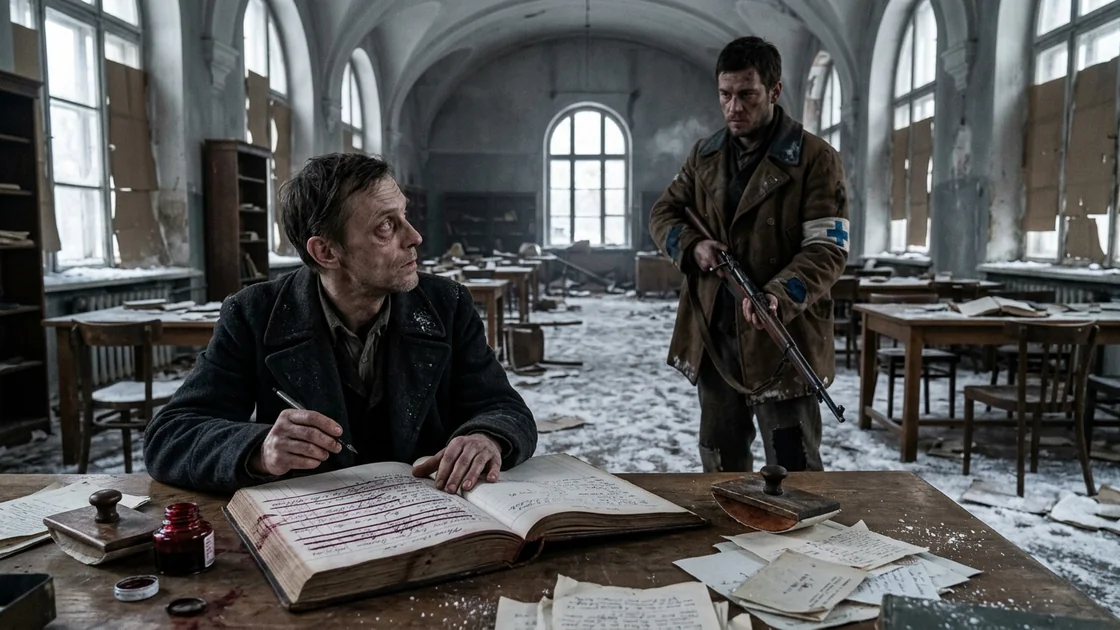
He sat at his table in the middle of the great, empty hall. The windows were all broken now, covered with rough sheets of cardboard that flapped in the cold wind like the wings of crows. The parquet floor was covered in an inch of gray slush, coal dust, and the soot from the courtyard fire, which had finally died in the rain, leaving a black crater filled with half-burned ledgers.
Jonas was working.
Before him lay the great leather-bound volume: The Register of Inhabitants, Ward Five.
He had stolen a bottle of red ink from the Captain's abandoned desk in the basement. It was not the thin, watery stuff used for balancing the wood registers; it was the thick, bright carmine the military court used for death warrants.
With a steel ruler and a brand-new Gillott nib, Jonas was drawing lines.
He found the page for Karr, Julian.
A previous clerk had already drawn a black line through the entry, with the notation: Transferred to District Command, January 14.
Jonas dipped his pen into the red ink. With a hand that was now completely steady, he drew two thick, scarlet bars across the black notation, obliterating it. In the margin, in his finest, most formal clerk's hand—the hand he had learned thirty years before from the Christian Brothers—he wrote:
Restored to the Roll of Honor. Murdered by the State, January 15.
He turned the pages back, his fingers moving carefully through the damp vellum until he reached the letter D.
Dreven, Tomas. Master Watchmaker.
The black line was there, stamped with Meyer's purple seal.
Jonas took his pen and crossed out the seal with three red strokes that looked like the gashes of a small knife. Beneath the name, he wrote:
Citizen of Oakhaven. Died in the defense of his house.
He did the same for Elsbeth. He did the same for Maren. He did the same for Lise.
And then, at the bottom of the page, where the blank lines waited for the names of children who should have been born in the years after the peace, he added:
Dreven, An Unnamed Boy. Age: Four months. Murdered in the snow at the Third Vat.
The red ink was wet. It gleamed in the gray light coming through the cardboard like fresh arterial blood.
A sudden noise at the end of the hall made him look up.
A man was standing in the doorway. He was not a soldier of the garrison. He wore a patched brown coat, a white armband with the blue cross of the Provisional Council, and he carried an old hunting rifle by its leather strap. His face was blackened with soot, his eyes wide and bloodshot from lack of sleep.
It was Martin, the baker’s son from Weaver Street—the one whose thirty bundles of lath Jonas had reported to Captain Meyer two months before.
Martin walked slowly down the long aisle between the empty deal tables, his boots splashing in the slush that covered the floor. He stopped three paces from Jonas’s desk, looking at the small, emaciated figure in the threadbare coat, looking at the red bottle of ink, looking at the great volume with its wet, scarlet lines.
"Vance," Martin said. His voice was thick with hatred, but it was an exhausted hatred, a hatred that had lived on cold cabbage and fear for four years.
"Martin," Jonas said. He did not close the ledger. He did not reach for his hat.
"The soldiers are gone across the river," Martin said, his fingers tightening on the forestock of his rifle. "The bridge at the water-gate is down. The council is meeting at the guildhall."
"I know," Jonas said.
"They have the records from the basement," Martin continued, his voice dropping into a register that was nearly gentle in its finality. "The ones the Captain didn't burn. They found the yellow cards, Vance. They found the receipts for the coal."
Jonas looked down at the red line beneath the infant's name.
"I didn't take the coal," he whispered. "I left the shovel in the bunker."
Martin stared at him for a long, terrible moment. Then, slowly, he raised the rifle. The barrel was long and blue, smelling of rancid pork fat and old powder.
"Julian was my cousin," Martin said simply.
Jonas did not flinch. He did not close his eyes. For the first time in nine years—since the day the first armored car had turned into the market square—he felt the tallow in his spine harden back into bone. He felt the cold air coming through the torn cardboard, smelling of the river, smelling of the wet slate, smelling of the city that was no longer his.
"He was a brave man," Jonas said, and for once, the words were not a lie, not a bargain, not a slip of paper dropped on a desk. They were the truth, paid for in red ink that would outlast them both.
"Yes," Martin said. "He was."
The shot was very loud in the high, vaulted hall. It echoed off the empty pine partitions, off the cracked plaster of the ceiling, off the blank, white walls where the books had once stood, carrying out through the broken windows into the gray, melting snow, where the bells of the cathedral were beginning, slowly and out of tune, to ring.