The Ledger of Broken Names
This story chronicles the moral undoing of Julian Mercer, a veteran investigative reporter at a dying regional daily who fabricates confidence out of ambiguity to satisfy a brutal midnight deadline. In publishing a half-baked rumor linking Arthur Vance, the soft-spoken mayor of a struggling timber town, to a fictitious industrial kickback scheme, Julian triggers a chain reaction of public hatred, financial ruin, and personal tragedy. As Vance is hounded from office, abandoned by his community, and driven into reclusive destitution, Julian receives awards and digital promotions built entirely upon the wreckage of an innocent life. Only when the truth surfaces too late does the reporter realize that journalistic corrections cannot resurrect the living dead, leaving him to wander the margins of the town he dismantled in a futile search for absolution.
Chapter I: The Dashboard
The newsroom of The Capital Inquiry did not smell of ink or hot lead, nor had it for fifteen years. It smelled of ozone, burnt hazelnut coffee from an automated dispenser that groaned whenever its hopper engaged, and the damp wool of coats left to dry over the backs of mesh ergonomic chairs. Beneath the suspended ceiling tiles, whose acoustic baffles were water-stained in shapes that resembled forgotten archipelagos, thirty-two reporters sat bathed in the flat, blue luminescence of twin monitors.
Julian Mercer sat at desk fourteen. Positioned directly beneath an air-conditioning vent that rattled every four minutes like an asthmatic lung, his station offered a clear sightline to the large overhead monitor mounted above the city desk: the Chartbeat dashboard.
On that screen, every writer’s soul was quantified in real time. Concurrent visitors were represented by pulsing neon needles; average engaged time was rendered in sickly shades of amber and viridian; referral paths from social feeds drifted across the black canvas like schools of plankton. Above them all sat the goal meter—a white horizontal bar that had to be filled by the conclusion of the evening shift if the paper’s digital syndicate was to meet its quarterly advertising impressions.
It was 10:48 PM on a Tuesday in late October. The room was mostly empty. The day shift had departed hours earlier, leaving behind paper coffee cups with lipstick stains, crumpled takeout bags from the Thai kitchen down Fourth Street, and the faint, persistent clicking of three night-crawlers working the police blotters.
Paul Finch stood behind Julian’s shoulder. Finch did not touch the chair; he hovered, his hands shoved deep into the pockets of his corduroy trousers, his breath smelling of wintergreen lozenges and stale tobacco. He was fifty-four, had survived three rounds of corporate equity buyouts, and wore the permanent, defensive slouch of a man who knew his severance package had already been calculated in an Excel spreadsheet stored on a server in Chicago.
"We have sixty-four thousand unique visits between now and midnight to hit the syndicate tier, Julian," Finch said. His voice was low, devoid of inflection, a mere transmission of pressure. "The metro council piece on the sewer levy did seven hundred clicks. It was dead on arrival. The city doesn't care about pipes. They care about blood, and they care about thieves."
"I told you," Julian said, his fingers resting motionless on the keys of his mechanical keyboard. "The Highcomb story isn't ready. The paper trail ends in a holding company out of Dover, Delaware. The registration has an agent name, but the bank authorizations are missing the counter-signature. I don't have the bank records confirmed by a second source."
"The memo is signed," Finch said.
"The memo is a photocopy of an internal draft," Julian replied, turning his head slightly, though he avoided Finch’s watery, bloodshot eyes. "It has Arthur Vance’s initials on the margin. Initials, Paul. Not a full signature. Anyone with an office pen could have scrawled an 'A.V.' beside that appropriation line."
Finch leaned down. The scent of wintergreen grew sharp. "The state audit committee convened at four this afternoon. They confirmed they’re looking into municipal bond anomalies in the upper valley. Vance was in the building. A stringer saw him coming out of the third-floor elevator looking like he’d been hit by a freight train."
"Looking nervous isn't an indictment."
"He wouldn't take your call."
"It was nine o'clock at night. His office was closed."
"You called his personal cell," Finch said, tapping the edge of Julian’s laminated desk with a fingernail that had been bitten down to the quick. "He declined it. Twice. That’s a refusal to comment. In this business, Julian, an executive refusal to deny an audit is the comment. We run the story, we state that Mayor Vance was unavailable for comment, and we update the ledger when he wakes up tomorrow and realizes his phone is ringing off the hook."
"If I publish this without the Delaware cross-reference, we are asserting that the mayor of a town of twelve thousand people diverted three hundred and fifty thousand dollars from a public school seismic retrofit fund into an unlisted land development trust held by his brother-in-law." Julian spoke the words plainly, hoping that hearing their clinical legal weight would shock Finch’s editorial instincts into sobriety.
Instead, Finch smiled—a tight, dry movement of the lips that did not reach his eyes. "We aren't asserting anything. We are reporting that state auditors are investigating allegations that the funds were diverted. We attribute the memo to documents obtained by The Inquiry. It’s bulletproof, Julian. It’s hedged. It’s standard practice."
"It's dirty."
"It’s fifteen thousand page views in the first twenty minutes," Finch whispered. "It’s the front page of the morning web-briefing. It’s syndication across the valley wire. Or, of course, you can tell the managing board tomorrow morning why we missed our regional impressions for the third consecutive cycle. I’m sure the guild rep will make a very moving speech while they hand you your box."
Finch straightened up, turned, and walked toward his glass-walled office at the rear of the floor. Through the glass, Julian could see the glow of Finch’s monitor reflecting off his bald pate.
Julian turned back to his screen.
On the left monitor, a document sat open in a plain-text editor. It
was titled VANCE_DRAFT_V2.txt.
Julian Mercer was thirty-seven years old. Ten years ago, he had won a regional investigative reporting award for exposing groundwater contamination caused by an asphalt plant in the southern tier of the state. He kept the bronze medallion in a drawer beneath his spare socks; occasionally, he would touch its raised lettering to remind himself of the cold, clean precision that had once governed his craft. Back then, an editor would have held a story like this for three weeks, demand that three independent forensic accountants verify the Delaware filings, and send the reporter to camp on the subject's front lawn until he looked him in the eye.
Now, the CMS featured a small, blinking square in the lower right corner: an algorithmically generated readability score, flanked by a search-engine-optimization preview tool that suggested adding the words scandal, fraud, and arrest to the sub-headline to maximize search indexing.
Julian glanced at the digital clock on the bottom toolbar. 10:52 PM.
He opened his notebook. The pages were covered in his hurried, left-leaning scrawl. Tip received Monday 8:15 AM. Caller would not give name. Directs to clerk's file 88-B. Delaware entity: Alder Shannock LLC. Incorporator: Marcus Vance.
Marcus Vance was Arthur Vance’s younger brother. Marcus was a chronically indebted contractor who had declared bankruptcy twice in Portland. That much was true. But Marcus Vance’s middle name was Arthur. Arthur Vance’s middle name was Robert. The signature on the Alder Shannock documents was simply "M. A. Vance."
Julian had called the Delaware Division of Corporations at four that afternoon. The clerk had been indifferent, the connection bad. Yes, Alder Shannock was active. No, the registered agent does not list beneficial ownership without a formal subpoena or an expedited search fee of one hundred and fifty dollars. Julian had put in the voucher for the search fee; accounting had replied with an automated message that non-essential operational disbursements required seventy-two hours for managerial clearance.
"Seventy-two hours," Julian whispered to the empty desk.
His phone vibrated against the laminate wood. It was an internal Slack notification from Finch.
Finch: Clock is ticking, Jules. Night lead needs to be locked before the 11:15 print lock and digital blast. Let’s go.
Julian stared at the draft. His hand moved to the mouse. He highlighted a sentence in the third paragraph:
While documents do not conclusively demonstrate Mayor Vance's personal execution of the transfer, sources close to the regulatory inquiry confirm that his office authorized the release of the municipal bond tranches under emergency executive powers.
It was a cowardly sentence. It was built entirely of load-bearing qualifiers: do not conclusively demonstrate, sources close to, regulatory inquiry. It was designed by a decade of defensive writing to survive a libel suit while planting an indelible image in the mind of any casual reader: that Arthur Vance was a thief caught with his hands in the public till.
He deleted the first clause.
Now it read:
Sources close to the regulatory inquiry confirm that Mayor Arthur Vance's office authorized the release of the municipal bond tranches under emergency executive powers, redirecting funds intended for school safety into a shell company controlled by his family.
The prose was cleaner now. It moved with the cruel velocity that modern digital distribution demanded. It was sharp, declarative, and impossible to ignore.
Julian stood up, walked to the water cooler, filled a paper cone with lukewarm water, drank it in one pull, crushed the cone, and dropped it into the plastic receptacle. He looked over at the city desk. Finch was watching him through the glass partition, the blue light of his monitor making his face appear corpse-like, impassive.
Julian sat back down. He highlighted the headline:
HIGHCOMB MAYOR LINKED TO DIVERTED SCHOOL FUNDS IN STATE CORRUPTION PROBE
He clicked the button marked Submit to Copy Desk. Three seconds later, an automated ping confirmed that the copy desk had bypassed formal line editing under the "Breaking Executive Privilege" tag.
At 11:04 PM, the story went live.
Julian watched the Chartbeat monitor. For thirty seconds, nothing happened. The needles remained flat. Then, a single red spark flared in the lower quadrant. A retweet from a state political blog. Then another. Then the aggregate feed of a regional television affiliate picked it up.
The white bar at the top of the monitor began to creep forward like a drop of ink spreading through linen. Within four minutes, the concurrent reader count for Julian’s article hit eight hundred. Within ten, it crossed three thousand. The comments section at the bottom of the article opened like a fresh wound, filling with expressions of performative disgust from people who had never heard of Highcomb, had never met Arthur Vance, and would never know the color of the school buildings whose roofs were supposedly being stolen.
Julian stayed at his desk until midnight. His name was attached to
the byline in bold, dark letters. Beneath it, his company email address
was displayed for all the world to see:
jmercer@capitalinquiry.com.
When he finally shut down his monitors and pulled his coat around his shoulders, his phone was buzzing continuously in his pocket. Retweets, mentions, an email from a producer at an affiliate in Seattle asking if Julian could appear on their seven o'clock morning broadcast via webcam.
He walked out of the building into the cold autumn drizzle. The streets of the capital were slick and black, reflecting the neon signs of the all-night parking garages. He felt a dull, sick throb behind his temples—a physical pressure that he mistook, in the arrogance of his craft, for the simple exhaustion of a job completed against the clock.
Chapter II: Highcomb
Sixty miles north of the capital, the town of Highcomb lay tucked into the fold of the Shannock River valley. It was a place that had been built on cedar and hemlock, then sustained by a small tool-and-die foundry, and was now surviving on little more than memory and the stubbornness of people who lacked the capital to leave.
The houses on the lower terraces were mostly wood-frame bungalows built during the post-war boom, their paint peeling under the damp coastal air, their driveways populated by pickup trucks with rusted wheel wells and children’s bicycles left out in the grass.
Arthur Vance lived at 414 Maple Street. He had lived there for thirty-two years.
He was sixty-one years old, with thin, silver-gray hair that stood up slightly at the crown no matter how much water he used when combing it, and large, knobby hands that bore the tiny white scars of four decades of amateur carpentry. Before he had been elected mayor, he had taught eighth-grade physical science at Highcomb Middle School. There was scarcely an adult under the age of forty-five in the valley whom he had not instructed on the principles of density, mass, and the life cycle of the common newt.
On the morning of Wednesday, October twenty-seventh, Arthur woke at 5:30 AM, as he always did.
The house was cold. The oil heater in the basement had developed a knock in its injector pipe that he had been meaning to bleed for a fortnight, but the municipal budget hearings had run until nine every evening for two weeks, leaving him with only enough energy to wash his face, kiss his wife Clara on the cheek, and fall into bed with his glasses still resting on the bridge of his nose.
He walked down the narrow, carpeted stairs in his flannel robe, his bare feet feeling the chill through the weave. In the kitchen, he switched on the drip coffee maker and walked to the front door to retrieve the print edition of The Highcomb Record, the four-page local weekly that came out twice a week.
He opened the wooden front door.
A white television news van was parked directly across the street, its telescoping microwave mast already extended twenty feet into the gray morning sky, cutting through the damp branches of his neighbor’s walnut tree. A young woman in a beige trench coat stood on the sidewalk beside it, holding a microphone with a blue foam windscreen, speaking with animated intensity into a camera mounted on a tripod.
Arthur blinked. He rubbed his eyes beneath his glasses.
"What in the world...?" he muttered.
He stepped onto the porch in his slippers. The cold mist hit his bare ankles. Across the street, the woman with the microphone saw him. Her eyes widened; she gestured frantically to the cameraman, who hoisted the rig onto his shoulder with an athletic, practiced heave.
"Mayor Vance!" the woman called out. Her voice was bright, sharp, carried over the quiet street like a whistle. "Mayor Vance! Can you give us a response to the Mercer investigation? Are you planning to step down before the council emergency meeting tonight?"
Arthur stood frozen on the top step. His first thought was not of panic, but of a curious, detached confusion. "I... I’m sorry?" he said, his voice cracking slightly with the sleep still in it. "What are you talking about?"
The cameraman was already halfway across the asphalt, his lens pointed directly at Arthur’s chest. The red recording light on top of the camera winked like a small, malevolent eye.
"The three hundred and fifty thousand dollars, Mayor," the reporter said, advancing onto the bottom step of his porch. She was young, perhaps twenty-four, with makeup that was far too heavy for six o’clock in the morning. "The state audit has confirmed the money from the seismic fund went to your family's LLC in Delaware. Did your brother act on your instructions, or were you an equal partner in the enterprise?"
Arthur’s hand caught the white railing of the porch. The wood was slick with rain. "My brother? Marcus hasn't lived in this valley for twelve years. What are you... what are you saying?"
"Arthur?"
The voice came from behind him. Clara was standing in the doorway, her quilted dressing gown pulled tight around her throat. Her face was pale, devoid of color, her eyes wide as she looked from the cameraman to the woman on the steps, and then to the street beyond, where a second car—a sedan with the logo of a metropolitan radio station on the door—was pulling up to the curb with its tires squealing against the wet leaves.
"Get inside, Clara," Arthur said. His voice was no longer confused; it had gone flat, thin, brittle.
"Mayor Vance, just one question—did you know about the Delaware registration before the audit committee convened?"
Arthur stepped back into the house, reached out, and pulled the heavy oak door shut. The latch clicked with a sharp, final sound. Outside, someone began to knock—first with knuckles, then with the flat of a palm against the wood.
"Arthur," Clara said, her fingers digging into the sleeve of his robe. "What is that? Who are those people?"
The telephone in the hallway began to ring.
It was not the polite, intermittent ring of a neighbor calling to ask about garden clippings. It was the sustained, urgent cadence of an instrument that was being dialed from a dozens of different points across the state simultaneously. As soon as the answering machine clicked on—Arthur’s own voice, calm and folksy, asking the caller to leave a message for the Vance residence—the speaker filled with the sound of a voice he did not recognize:
"You thieving piece of trash. You stole money from children. We know what you did. You're going to rot in prison."
Clara gasped, her hand flying to her mouth.
The machine beeped. Another message began immediately:
"Mayor Vance, this is David Keller from the Associated Press. We are running the Capital Inquiry report on the wire in twenty minutes. We need your on-the-record response regarding the Alder Shannock transfers..."
Arthur walked to the small telephone table. His knees felt loose, disconnected from his hips, as though the cartilage had dissolved in the space of three minutes. He picked up the handset, then immediately set it back down off the cradle to break the connection. The line buzzed with a loud, off-hook tone that filled the narrow hallway like an alarm.
"Where is the computer?" Arthur asked.
"In the den," Clara whispered. "Arthur, please, talk to me. What is Alder Shannock?"
"I don't know," Arthur said. He was looking at his own hands; they were shaking with an ague he could not control. "Clara, I swear before God, I don't know what that is."
They went into the small back room that served as an office. The desk was piled with manila folders: blueprints for the town's proposed community health clinic, reports on water main corrosion along the north ridge, schedules for the volunteer fire department’s annual fish fry. In the center sat an aging desktop computer with an LCD monitor that took three minutes to warm up.
Arthur clicked the browser icon.
He didn't have to search for the website of The Capital Inquiry. The regional news aggregator that served as his home page had already pinned the headline to the top of its layout in bold, thirty-six-point type:
HIGHCOMB MAYOR LINKED TO DIVERTED SCHOOL FUNDS IN STATE CORRUPTION PROBE
Arthur leaned forward, his nose nearly touching the glass. He read the article. He read it once, quickly, his eyes jumping over the adjectives and the citations. Then he read it a second time, slowly, aloud, his finger tracing the lines on the screen as though he were teaching a child to read.
Sources close to the regulatory inquiry confirm...
Alder Shannock LLC, an entity registered to Marcus A. Vance...
Emergency executive authorization...
"Marcus," Arthur said, the name coming out as a dry croak. "Marcus registered something. But... but the seismic bond money wasn't diverted. It’s in the valley depository. We didn't spend it because the soil surveys for the middle school annex came back with high liquefaction risk. We were waiting for the state engineer to sign the variance."
"Call Bob," Clara said. Her voice was rising, trembling on the edge of hysteria. "Call Bob Higgins. He's the city attorney. He'll tell them. He has the vouchers."
Arthur picked up his mobile phone from the desk. There were forty-seven unread text messages and twenty-two missed calls. He found Bob Higgins’s name in his contacts and pressed the green icon.
The call went straight to voicemail.
"You have reached the Law Offices of Higgins & Cole. Our office is currently closed. If this is an emergency..."
Arthur hung up. He tried the home number.
On the fifth ring, Bob Higgins answered. His voice sounded muffled, as though he were speaking with a towel over the receiver.
"Bob," Arthur said. "Thank God. Have you seen this? Have you seen what they put on the internet?"
Silence on the other end. For five seconds, the only sound was the breathing of an old friend who had stood beside Arthur at his wedding thirty-five years before.
"Bob?"
"Arthur," Higgins said, his voice flat, exhausted, and terrifyingly distant. "I can't talk to you."
"What do you mean you can't talk to me? There are television vans in my hydrangeas, Bob! They’re saying we stole the seismic retrofitting funds for an LLC Marcus owns. You have the valley depository receipts in the city safe! Tell them to go down to the bank!"
"Arthur, listen to me," Higgins said, and for a moment, the professional veneer cracked, revealing a deep, trembling dread. "The state attorney general’s criminal division called my house at five this morning. They served a preservation order on all municipal records at six-fifteen. Two agents are sitting in the clerk’s office right now, Arthur. They changed the deadbolts on city hall."
"They... they did what?"
"They’re impounding the hard drives. They have an audit memo with your initials on it authorizing an inter-fund transfer to a third-party account under the code-name Shannock Project. Marcus had a subcontractor bid on that project two years ago, Arthur. His bid was rejected, but his paperwork was in the file."
"The initial wasn't mine!" Arthur shouted. He had never shouted at Bob Higgins in his life; the sound of his own voice startled him, bouncing off the wood-paneled walls of his study like an insult. "You know my handwriting, Bob! I sign with the full stroke! I’ve never initialed an appropriation in my life!"
"It doesn't matter what I know, Artie," Higgins said, using the childhood nickname for the first and last time that day. "The press has the memo. It’s out there. The governor’s office just issued a statement expressing 'profound disappointment' at the allegations and calling for your immediate suspension from the regional council. The party leadership called me ten minutes ago. They want your resignation on the city desk before noon."
"I won't resign," Arthur whispered. "If I resign, it means I took it. I didn't take a dime, Bob. You know my house. You know the roof leaks! You know I drive a nine-year-old Buick with a rusted tailpipe! Where would I put three hundred thousand dollars?"
"The story says Delaware, Artie," Higgins said softly. "The internet says Delaware. And once people hear Delaware, they don't look at your roof. I have to go. My partners are telling me that representing the municipality creates a conflict if I advise you personally. Get a lawyer, Arthur. A criminal defense lawyer. Don't use anyone from the county. Go to the city."
The line went dead.
Arthur held the phone to his ear until the three-tone disconnect signal began to sound. He looked through the den window.
The rain had stopped, but the sky remained the color of wet slate. On the street outside, four more news vehicles had arrived. A small crowd of townspeople had gathered at the corner of Maple and Sixth—people he recognized from the hardware store, the father of a girl he had taught five years ago, the woman who ran the dry cleaners. They were standing together beneath dark umbrellas, staring at his front porch with expressions that were not merely curious, but venomous.
One of them, a man in a high-visibility work jacket, was holding a cardboard sign that had been hastily lettered with a black permanent marker:
WHERE IS OUR MONEY, MAYOR?
Chapter III: The Momentum
By Thursday afternoon, Julian Mercer had not slept in thirty-six hours, but his bloodstream was saturated with caffeine and the thin, electric euphoria of professional validation.
The Highcomb story was no longer just an article; it was an "exclusive development" that had spawned seven sub-stories across the paper’s digital network. Julian had written four of them himself:
Highcomb Council Calls Emergency Session Following 'Inquiry' Revelations
Vance’s Brother Marcus: A History of Financial Failures in the Upper Valley
State Auditor General Confirms 'Irregularities' in Shannock Bond Oversight
Editorial: The Breach of Trust in Our Small Towns
The metrics were historic for a non-election cycle. The article had been aggregated by The Washington Post, referenced in an afternoon segment on MSNBC, and linked by every major political clearinghouse in the Northwest. The Chartbeat needle had not dropped below three thousand concurrent readers all morning.
At 2:15 PM, Julian was summoned to the corner office of Harold Sterling, the executive editor of The Capital Inquiry.
Sterling was a man of sixty-eight who had once been an editor at the Chicago Tribune. He possessed the frosty, aristocratic demeanor of the pre-digital press barons, though his desk was now covered with the same printouts of digital retention metrics that haunted everyone else.
Paul Finch was already there, sitting in a low leather armchair, his arms crossed over his chest with an expression of proprietary satisfaction.
"Mercer," Sterling said, gesturing to a seat opposite him. "Sit."
Julian sat. The leather was cold against his trousers.
"The Attorney General announced an investigatory panel twenty minutes ago," Sterling said, sliding a sheet of paper across the mahogany desk. "They’re opening a preliminary inquiry into municipal procurement practices across five counties, with Highcomb as the focal point. That’s our scoop. The wire is attributing it to us by name."
"Thank you, Mr. Sterling," Julian said.
"Finch tells me you had reservations about the Delaware filing."
Julian felt a small, cold knot tighten in his gut. He glanced at Finch, whose face remained an unreadable mask.
"I... I wanted to confirm the ultimate beneficiary on the LLC before we ran," Julian said carefully. "The documentation showed Marcus Vance as the incorporator, but the link between Marcus’s account and Arthur Vance’s personal accounts was based on an audit memorandum that didn't have an authenticated receipt."
Sterling took off his wire-rimmed glasses and wiped them with a silk handkerchief. "Journalism, Julian, is not a court of law. We do not require proof beyond a reasonable doubt to report that an official is being scrutinized by state regulators. We require that our sources be real, that the documents exist, and that the public interest warrants the exposure. The memo exists, does it not?"
"It exists," Julian said. "The auditor’s office confirmed they are holding it."
"And Arthur Vance’s office had the authority to issue the bond warrants?"
"Yes. Under the emergency charter."
"Then there is no story to walk back," Sterling said simply. He put his glasses back on, the lenses catching the gray light from the window behind him. "Vance has gone to ground. He canceled the council meeting last night. His deputy mayor resigned at noon, stating she was 'sickened' by the revelations. The town council has voted five to zero to retain outside counsel to initiate removal proceedings."
Sterling leaned forward, his elbows resting on the desk. "You’ve done good work, Mercer. You’ve demonstrated that even in these small, forgotten hollows, the public purse cannot be raided with impunity. This is the kind of reporting that justifies our subscription model. The publisher has approved a two-thousand-dollar merit bonus for the series. Finch will arrange the payroll update."
Julian swallowed. His throat felt dry, coated with the metallic taste of too many breath mints. "I appreciate that, Mr. Sterling. But I still need the Delaware documents. I want to see the bank transfers. If the state is opening a formal probe, the subpoenaed records should be available within a week. I’d like to go up to Highcomb myself. Talk to the clerk. See the original ledgers."
Finch spoke up from the armchair. "No need, Julian. The wire has three stringers outside Vance’s house right now. The local television guys are covering every sneeze. What we need from you now is the follow-up on the state audit director. There are rumors that two other mayors in the district used the same bond counsel. That’s where the growth is. Don't look backward, Julian. Look at the perimeter."
"He’s right," Sterling said, already looking down at a spreadsheet on his desk. "Highcomb is done. Arthur Vance is politically dead. The only question now is whether he goes to the state penitentiary at Walla Walla or takes a plea for five years of probation. Focus on the systemic story. Good work."
Julian stood up. His legs felt stiff.
He walked out of the office and back through the newsroom. On the wall beside the water cooler, the first edition of the evening print run had been pinned to the corkboard. His headline looked enormous in black ink, sharp-edged and permanent:
HIGHCOMB MAYOR LINKED TO DIVERTED SCHOOL FUNDS
Underneath, in smaller type: By Julian Mercer, Inquiry Staff Writer.
He walked past his desk to the men's room. He stood before the mirror and looked at his reflection. His skin was gray, the bags beneath his eyes dark and puffy. He looked like an intruder in his own clothes.
He reached into his pocket and pulled out his phone. He had received
an email seven minutes earlier from an unfamiliar address:
claravance48@gmail.com.
Julian’s thumb hovered over the screen. He tapped it open.
Mr. Mercer,
You do not know me, but I am Arthur Vance’s wife. My husband has spent forty years serving this town. He taught your state representative science when he was twelve years old. He built the ramp at the Presbyterian church with his own hands when Mrs. Henderson broke her hip.
He did not steal that money. He did not know Marcus had registered that company. Marcus is a sick man with a gambling addiction who has used Arthur’s name for thirty years to borrow money from credit unions. Arthur paid off Marcus’s debts twice out of his own teacher’s pension so Marcus wouldn't go to jail.
My husband cannot sleep. He sits in the chair by the window and he does not speak. Our neighbor threw an empty bottle through our basement window this morning. The children who live across the street were shouting at Arthur through the fence.
You did not ask him. You called his office when it was dark and then you printed that he was a thief. Why didn't you come here? Why didn't you knock on our door? If you had looked at him, you would have known.
Please. If there is any decency in you, tell the people that you made a mistake.
Clara Vance.
Julian stared at the screen. The small letters seemed to vibrate against the white background.
He thought of the Delaware search voucher that had been delayed for seventy-two hours. He thought of the initials on the margin of the memo: A.V.
He thought of Paul Finch’s face: An executive refusal to deny an audit is the comment.
Julian did not reply to the email. He did not delete it. He moved it into a folder labeled Highcomb - Archive, locked his phone, washed his hands with cold water until his knuckles were red, and went back to his desk to write sixteen hundred words on the state auditor general’s regulatory framework.
Chapter IV: The Sentence Before the Trial
In Highcomb, the execution of Arthur Vance did not require a jury, a judge, or a black cap.
By the second week of November, the seasonal rains had set in with a relentless, slate-gray fury that turned the valley bottoms into soup. The timber trucks that rumbled down Route 9 rolled with their fog lamps on at noon, their tires throwing sheets of brown water across the road signs that proclaimed: Welcome to Highcomb — A Town with a Future.
Someone had spray-painted over the word Future with red industrial enamel: THIEVES.
Arthur had not left his house in nine days.
His Buick sat in the driveway, its windshield covered in a thick carpet of sodden yellow maple leaves that had begun to rot into the wiper blades. On the third day of his isolation, someone had slashed the two rear tires. He had not called the police; the police chief, a man whose son Arthur had coached in Little League twenty years earlier, had already submitted an affidavit to the state investigators stating that the mayor had "consistently demonstrated unusual interest in municipal bond disbursements."
Inside the house, the light was always dying. Arthur had drawn the heavy velvet drapes across the front windows to shut out the television vans, which had dwindled from five to two, but remained parked at the curb like vultures that had already fed on the soft tissue and were now waiting for the marrow to soften.
Clara moved through the rooms like a shade. She did not cook; they ate cold toast with margarine, tinned soup heated in a small saucepan that Arthur forgot on the burner until the enamel began to scorch, and saltine crackers straight from the wax sleeve.
"The bank sent a letter," Clara said. She was sitting at the kitchen table, her reading glasses perched on her nose. Her hair, which she had dyed a soft chestnut every month since her fortieth year, had begun to show a wide, cruel band of white at the part.
Arthur was sitting across from her, wearing an old wool cardigan whose elbow had torn loose. He was paring an apple with a small carbon-steel pocketknife. He sliced off a thin ribbon of skin, let it drop onto a paper napkin, and did not look up.
"Which bank?" he asked.
"The First Valley," Clara said, her voice dry, paper-thin. "They’re calling the personal line of credit we took out for the roof. They say the change in your employment status violates the covenant on the unsecured debt. They want seventeen thousand dollars by the first of December."
"We don't have seventeen thousand dollars," Arthur said softly.
"I know."
"We have four thousand two hundred in the savings account."
"Bob Higgins’s firm sent a bill this morning," she continued, her voice neither angry nor sad, but flat with the terrible efficiency of an inventory clerk. "For the two hours he spent on the phone with the investigators on Tuesday before he withdrew. Eleven hundred dollars."
"I’ll pay Bob," Arthur said. "Bob was good to us when your mother died."
"Bob told the town council that you should be removed under the moral turpitude clause, Arthur. It was in the paper yesterday."
Arthur’s knife stopped moving. A small bead of moisture—apple juice or sweat—shone on the ball of his thumb.
"Bob has a family," Arthur whispered. "He has two boys at the state college. He can't be seen... he can't be near me, Clara. You must understand that. If he stands near me, the mud splashes on him too. People have to protect their own."
"And who protects you?" Clara’s voice suddenly cracked, the paper-thin control shattering into a high, ugly sob that made Arthur flinch. "Who protects us? You gave this town everything! You spent every Saturday for thirty years cleaning the brush out of the river park! You didn't take the stipend for the mayoralty for five years because the library didn't have enough money for new reference books! And they’re standing on our lawn spitting on your car!"
"Clara..."
"Don't 'Clara' me!" she cried, rising from the table with her hands clenched into fists against her dressing gown. "Look at you! You’re hiding in the dark like a dog that’s been kicked! Go out there! Call the television people! Make them look at the ledgers! Marcus is in a rehab clinic in California, Arthur! His own lawyer told the state that Marcus used your name on five different corporate forms without your knowledge! Why isn't that in the paper?"
Arthur looked at the apple in his hand. He had cut it down to the core; the seeds were black and small, like insects trapped in amber.
"It was in the paper," Arthur said.
"Where? Where was it?"
"On page twelve," Arthur said. "At the bottom. Two sentences. It said Marcus Vance’s legal representative claimed his client acted independently. Then it said the state prosecutor’s office declined to dismiss the inquiry, pending a forensic review of the municipal servers."
"Two sentences," Clara whispered.
"The internet didn't run it," Arthur added, his voice descending into that flat, rhythmic murmur that had become his only defense. "The boy who wrote the first piece—the Mercer boy—he didn't write about Marcus’s lawyer. He wrote about the governor’s ethics task force. That’s what people want to read about. They don't want to hear that a sick man in California signed his brother’s name on a piece of trash paper from Dover. That doesn't make anyone feel righteous."
The doorbell rang.
Both of them froze. It was not the electric chime of the front door; it was the sharp, metallic tap of the brass knocker on the back porch.
Arthur stood up. "Stay here."
He walked through the laundry room, past the washer that had been out of balance since August, and looked through the small diamond pane of the back door.
Standing on the porch was Thomas Caldwell.
Caldwell was sixty-five, a retired shop teacher who had served on the town council with Arthur for twelve years. His jacket was zipped up to his chin, his cap pulled low against the drizzle.
Arthur turned the deadbolt and opened the door four inches. "Tom."
Caldwell did not look at Arthur’s face; his eyes remained fixed somewhere around the second button of Arthur’s cardigan.
"Arthur," Caldwell said. He shifted his weight from one boot to the other. "I won't come in."
"It's raining, Tom. Come in and have some coffee. Clara’s up."
"No," Caldwell said. "I can't. Martha saw me walking down this way. I told her I was going to the hardware store."
Arthur waited. The silence between them was louder than the rain dripping from the aluminum gutter overhead.
"The council met in executive session this morning," Caldwell said, his voice dropping so low that Arthur had to lean closer to hear him over the wind. "They have the petition, Artie. Eight hundred signatures. The council is going to vote for the emergency vacancy declaration tonight at six. If you don't resign by five, they’re going to pass the censure motion. It’ll be in the permanent county record. It means your pension... the municipal supplement from the state service pool... it’ll be frozen while the grand jury sits."
Arthur felt a cold wind slip through the four-inch gap in the door, chilling his shins. "Tom, the grand jury hasn't even been impaneled. The state attorney hasn't filed an indictment."
"Doesn't matter," Caldwell said, and for the first time, he looked up. His eyes were small, watery, and filled with a desperate, defensive hostility. "The state association suspended our municipal bond rating this morning, Arthur. The sewer expansion is dead. The bank won't roll over the short-term notes for the road crew. The town is broke because nobody will buy our paper as long as your name is on the warrant list. We can't pave the streets. We can't pay the winter road-salt contract."
"Because of a lie," Arthur said.
"Because of you," Caldwell spat, the anger finally breaking through his shame. "Because you let your degenerate brother run around using our town’s name to borrow money! Because you didn't check the files! Because you sat there in your office playing with your wood projects while the wolves were at the door! We’re all going down with you, Arthur! My boy’s shop class doesn't have lumber for next semester because the state frozen the categorical aid! Do you understand that?"
Arthur looked at Caldwell’s face. He saw the hatred there—not the cold, abstract hatred of an internet commenter, but the deep, intimate loathing of a neighbor who felt his small, fragile world slipping into the dirt and needed a sacrificial animal to lay on the altar.
"I’ll have the letter on the clerk’s desk by four," Arthur said.
Caldwell stared at him for a second, his mouth half-open, as though he had prepared for an argument and was cheated by the surrender. He nodded once, pulled his cap lower over his eyes, turned, and walked down the back steps into the gray, unrelenting rain.
Arthur closed the door. He turned the deadbolt.
He walked back into the kitchen. Clara was still sitting at the table, her hands flat against the Formica.
"Get the good stationery from the desk, Clara," Arthur said. "The white paper with the town crest that they gave me when we dedicated the bridge."
"Arthur, no," she wept.
"Get the paper, Clara," he said softly. "The town needs road salt."
Chapter V: The Retraction
Julian Mercer did not receive the Pulitzer Prize for local reporting, though his series was submitted by the paper’s management with four glossy binders of supporting clippings and web analytics. He did, however, receive a glass plaque from the Regional Associated Press Association at an awards banquet held in the ballroom of the Hilton Hotel in Portland in early March.
The plaque sat on Julian’s desk at The Capital Inquiry. It read:
FOR DISTINGUISHED INVESTIGATIVE REPORTING
JULIAN MERCER
THE HIGHCOMB INQUIRY
The newsroom had undergone another reorganization during the winter. Twelve more reporters had been laid off; their desks had been removed entirely, replaced by three long tables where freelance contributors and "content partners" sat with their personal laptops. The Chartbeat monitor had been replaced by an even larger screen that integrated social media sentiment analysis, rendering public response in three colors: green for positive engagement, red for outrage, and blue for commercial conversions.
It was 4:30 PM on a Friday. Julian was working on an enterprise piece about environmental remediation funds along the lower Columbia River when his telephone rang.
It was an internal extension: Finch.
"Julian. Come in here for a minute."
Julian stood up. His knees made a clicking sound that had become habitual over the winter. He walked to Finch’s office.
Finch had not changed, except that his corduroy jacket had been replaced by a cheap microfiber fleece with the paper’s digital logo embroidered on the chest. He was sitting behind his desk with a manila folder open before him. Beside the folder lay a single sheet of cream-colored legal paper with the letterhead of the State Attorney General’s Office.
"Sit," Finch said.
Julian sat. "What is it?"
Finch turned the legal paper so Julian could read it.
It was a formal declination memorandum signed by the Chief of the Public Integrity Division.
Julian’s eyes scanned the paragraphs, his training allowing him to extract the decisive phrases within seconds:
...following an exhaustive forensic analysis of the records of Alder Shannock LLC, the Delaware Division of Corporations, and the municipal depository of the Town of Highcomb...
...no evidence was discovered demonstrating that former Mayor Arthur R. Vance possessed beneficial ownership, managerial control, or knowledge of the incorporation of Alder Shannock LLC...
...the initials 'A.V.' appearing on the marginal audit voucher of July 14 were determined by the State Forensic Laboratory to have been executed by Marcus A. Vance without authorization...
...funds appropriated for seismic mitigation remained at all times within the insured custody of the Valley Depository and were never transferred to any secondary account...
...the Department considers this matter closed and will take no further action with respect to Arthur R. Vance.
Julian sat motionless. The paper seemed to hum with a faint, white vibration.
"They aren't filing," Julian said.
"No," Finch said. He took a sip of water from a plastic bottle. "They aren't filing."
"Marcus forged the initials."
"Looks like it."
"The money was never diverted. It was in the bank the entire time."
"Under an encumbered code that the town clerk hadn't reconciled since the system migration two years ago," Finch said, his voice entirely flat, clinical, detached. "The state auditor admitted they misread the ledger index. The three hundred and fifty thousand dollars was sitting in an escrow sub-account with a twelve-digit identifier that matched Marcus’s old project bid code by sheer administrative coincidence."
Julian brought his hands up to his face, his fingers pressing into his eye sockets until red sparks bloomed in the dark behind his lids. "Jesus Christ. Jesus Christ, Paul."
"Don't get dramatic," Finch said.
"Dramatic?" Julian’s hands dropped; he stared at the editor with eyes that were suddenly wild. "We destroyed him. We ran twelve stories calling him a thief. We put his house on the front page of the Sunday edition with the headline The Anatomy of a Municipal Heist!"
"We reported what the state audit committee reported," Finch said without raising his voice. He leaned back in his swivel chair, the plastic hinges groaning beneath his weight. "We reported what the documents in the clerk’s office showed at the time. The documents were real. The audit was real. The Attorney General’s investigation was real. We didn't invent the inquiry, Julian. The inquiry happened."
"Because we forced their hand!" Julian shouted. Two reporters sitting at the long tables outside Finch’s glass partition turned their heads. Julian didn't care. "We ran that piece at eleven o'clock at night to beat an impression quota! I had forty-eight hours left on the Delaware search! If we had waited two days—forty-eight hours, Paul—we would have had the beneficial ownership statement showing Arthur Vance wasn't on the registration!"
"And if we had waited two days," Finch said coldly, "the television guys would have had the audit memo and we would have been chasing their exhaust. We played the hand we had with the information we possessed. That is what daily journalism is. It’s a first rough draft of history. History revised itself. It happens."
"We have to retract," Julian said.
"We are not retracting," Finch said.
"What?"
Finch picked up a sheet of paper from the folder. "A retraction is an admission that we fabricated or acted with reckless disregard for the truth at the time of publication. We did neither. Our reporting was accurate to the public record as it existed on October twenty-sixth. What we will do is run a clarification and an update on the resolution of the state probe."
He slid the draft across the desk.
It was three paragraphs long. It was slated for page B-8 of the Saturday print edition, nestled between an advertisement for a hearing-aid clinic and the regional livestock reports.
CORRECTION & UPDATE: On Oct. 26, The Inquiry reported that state regulatory authorities were reviewing municipal bond allocations in Highcomb associated with former Mayor Arthur Vance and an entity known as Alder Shannock LLC. On Friday, the State Attorney General’s Office announced it has concluded its review and found no evidence of criminal wrongdoing by Mr. Vance, determining that fund allocations remained within municipal control and that corporate filings naming Mr. Vance were executed without his authorization. The Inquiry regrets any confusion resulting from earlier coverage of the preliminary findings.
Julian read the words: regrets any confusion.
"He lost his office, Paul," Julian whispered. "His wife’s brother told me he had to sell his house to pay his legal retainers. He’s living in a trailer on the south road outside of town. He has nothing."
"The market in Highcomb was already declining," Finch said, closing the folder with a dry, decisive snap. "Look, Julian. I know it’s rough. Nobody likes to see an old guy get put through the meat grinder. But Arthur Vance was an elected official. He assumed the risk of public life. When you take the gavel, you take the target that’s painted on it. You wrote the stories the public needed to see based on the state’s own documents. Now the state cleared him, and we’re reporting that too."
"On page B-8?"
"The digital version will be linked as an addendum to the original story," Finch said, turning back to his keyboard. "It’ll have an editor’s note at the top. The algorithm will index it. It’ll be there for anyone who searches his name."
"Nobody searches his name anymore," Julian said. "They already decided who he was five months ago."
Finch did not look up from his screen. His fingers were already moving across the keys, drafting the evening distribution schedule. "Then that’s between them and their God, Mercer. Not you and me. File the update by six. I want it cleared before the weekend traffic slows down."
Julian walked out of the office.
He did not sit down at his desk. He walked past his computer, past the glass plaque with its gold lettering, past the water cooler and the acoustic ceiling tiles that resembled lost archipelagos. He walked down the back stairwell, into the basement garage, got into his ten-year-old Honda Civic, and turned the ignition key.
The dashboard illuminated. The fuel gauge was half full.
He backed out of the space and drove up the concrete ramp into the gray, dying light of the afternoon. He did not turn south toward his apartment; he turned north, toward Route 9, toward the mountains that were disappearing beneath a wall of dark, low-hanging clouds that smelled of snow.
Chapter VI: The Hollows
The drive to Highcomb took an hour and twenty minutes, but to Julian, it felt like an ascent into an older, colder century.
As the four-lane highway narrowed into a two-lane county artery, the billboards advertising personal injury attorneys and regional casinos vanished, replaced by hand-painted signs for chainsaw repair, raw honey, and scrap metal salvage. The timber along the river had been clear-cut on the lower ridges five years earlier; the stumps stood black and rotting among the hemlock scrub, like the headstones of a cemetery that had been forgotten by its parish.
He entered the town limits at 6:15 PM.
The streetlights along the main thoroughfare were only half-lit—every second lamp was dark, an austerity measure enacted by the new town council to stave off default. The storefronts were mostly vacant: the pharmacy had paper taped over its windows; the sporting goods store was advertising an inventory liquidation sale that appeared to have ended months ago; the neon sign of the Shannock Tavern sputtered erratically, its middle letters dead so that it read only: S NNOCK T VE N.
Julian stopped at the single gas station on the corner of Maple Street.
A young man with grease beneath his fingernails and an oil-stained beanie sat behind the counter inside a cage of reinforced acrylic. Julian bought five dollars' worth of regular gas and paid with a twenty-dollar bill.
"Do you know where Arthur Vance lives?" Julian asked, his voice sounding thin through the circular brass speaking grate.
The clerk looked at him through the scratched plastic. His eyes were dull, skeptical. "Who's asking?"
"A friend," Julian said.
The clerk gave a short, humorless grunt that was half-cough. "Artie don't have friends coming through here in city cars. If you’re another one of those television people, you’re late. They all packed up before Christmas."
"I’m not television," Julian said. "I just... I have some papers for him."
The clerk took the twenty-dollar bill, slid a five and a ten through the metal drawer, and gestured with his thumb toward the north ridge. "He ain't on Maple anymore. The bank took the house in January. He’s up on the old mill road. Past the second cattle guard. There’s a gravel spur that leads down to the gravel pit. He’s got an old twenty-four-foot Fleetwood parked by the creek. You can't miss it. It's the only thing up there that ain't trees or rusted iron."
Julian took the change. "And his wife?"
The clerk stared at him for a long moment. His face was entirely devoid of expression—the blank, flat stare of people who have learned that curiosity is an expense they cannot afford.
"Clara died in February," the clerk said.
Julian’s hand remained on the edge of the metal drawer. The change sat beneath his fingers, cold and greasy. "She... what?"
"Pneumonia," the clerk said. "She was down in that cold house without the oil heater working after the power company cut the secondary service. Took her three days. Artie carried her out to the road himself because the ambulance wouldn't come up the driveway on account of the ice. Go on up the hill if you’re going. I’m locking the pumps at seven."
Julian walked back to his car.
The air had gone completely still. A dry, granular snow—the kind that comes before a deep freeze—had begun to sift down through the bare branches of the street trees, bouncing off the hood of his car with a faint, whispering hiss.
He drove north.
The road climbed sharply past the town limits, turning from cracked asphalt into rutted macadam, and finally into packed gravel that threw sharp stones against the undercarriage of his car. The forest closed in on both sides—second-growth Douglas fir, dense and black, their lower boughs dead and matted with gray lichen.
He crossed the second cattle guard. The iron pipes clattered beneath his tires with a hollow, booming sound that echoed down the ravine.
Two hundred yards further, a wooden mailbox leaned drunkenly into the ditch. It had no name on it, only three reflective numbers that had half-peeled away: 8 - 1.
Julian turned the wheel. The car lurched down a narrow spur that descended toward the sound of rushing water.
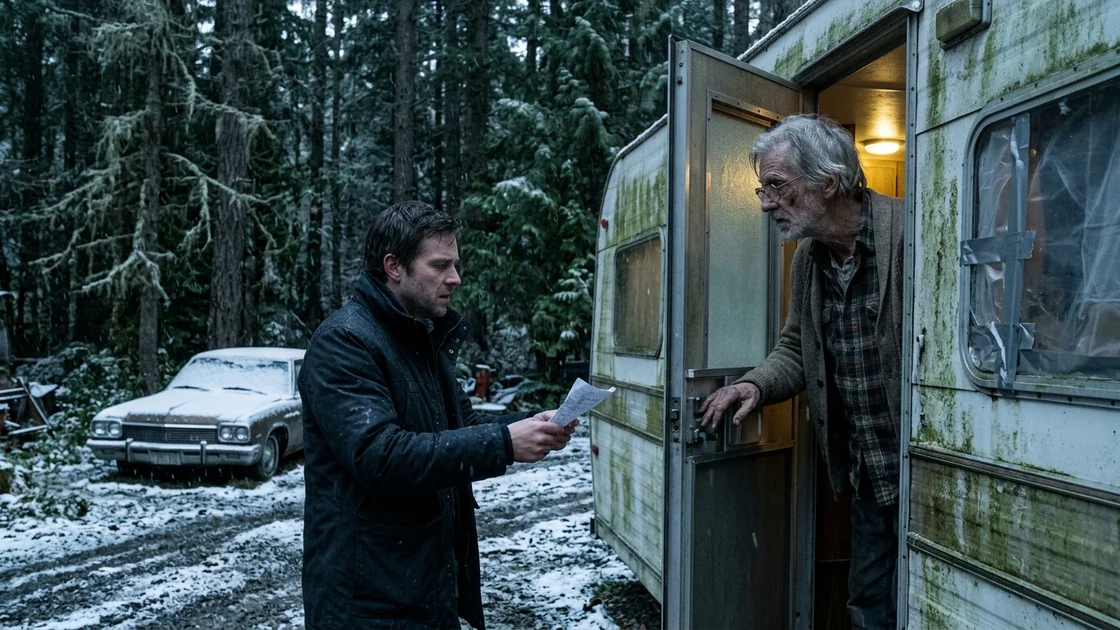
At the bottom of the hollow, in a clearing that had once been used for staging logs, sat the trailer.
It was an old aluminum-sided Fleetwood from the late nineteen-seventies, its white paint chalked and streaked with green algae from the overhanging hemlocks. A silver stovepipe poked through the roof, venting a thin, wavering thread of blue smoke that smelled of burning alder wood. Beside the trailer sat the old Buick, its front bumper resting on two wooden blocks, its windows gray with frost.
A single five-gallon bucket, turned upside down, served as the front step.
Julian turned off the engine.
The silence that filled the car was immediate and absolute. There was no hum of servers, no distant murmur of traffic, no rhythmic clicking of mechanical keyboards. There was only the sound of the creek—the Shannock River, small and vicious up here near its headwaters—tumbling over black river stones, and the dry tick-tick-tick of the cooling radiator.
Julian sat in the dark for five minutes.
In his jacket pocket, he had the printout of the Attorney General’s declination memo. He had folded it into thirds; the edges were already softened by the moisture of his palm.
He opened the door. The cold air struck his face like a wet rag.
He walked across the frozen gravel, his dress shoes slipping on the river stones. As he approached the trailer, he saw that a small window beside the door had been patched with plastic sheeting and duct tape. Through the milky plastic, a yellow light flickered—the light of a kerosene lamp or a low-wattage bulb running off a generator.
He stepped onto the upside-down bucket. The plastic groaned beneath his weight.
He knocked on the aluminum door.
The sound was hollow, like striking an empty biscuit tin.
Inside, there was a long silence. Then the sound of slow, dragging footsteps—the sound of someone who moved with great deliberation, as though his joints were filled with sand.
A bolt turned. The door swung inward six inches.
Arthur Vance stood in the gap.
Julian would not have recognized him from the photograph in the paper’s digital library. The man on the city desk server had been plump, with pink cheeks, clear eyes behind wire-rimmed spectacles, and the comfortable, slightly untidy appearance of a high school teacher who liked his lunch.
The man in the doorway was a skeleton wrapped in gray flannel.
His cheeks were sunken into two deep, shadowed caverns; his beard was a three-week growth of patchy, dirty-white stubble; his eyes, small and watery behind lenses that were smudged with grease, looked at Julian with an expression that was neither fear nor surprise, but a terrible, infinite exhaustion. He wore two shirts—a denim work shirt over a thermal undershirt—and his collarbones projected beneath the cloth like the rungs of a ladder.
"Yes?" Arthur said. His voice was a dry reed rattling in the wind.
Julian took off his gloves. His hands were shaking. "Mayor Vance?"
"I’m not the mayor," the old man said softly. "The mayor is Mr. Henderson. He has the office at town hall. You have the wrong turn-off."
He began to close the door.
"Mr. Vance, please," Julian said, his hand reaching out instinctively to catch the aluminum frame. "I’m... my name is Julian Mercer."
The door stopped.
It did not open wider, but it stopped.
Arthur Vance stood behind the threshold, his hand resting on the latch. He did not move; he did not flinch; he did not curse. He simply looked at Julian’s face—looked at his hairline, his nose, his mouth, as though he were examining a diagram in an old textbook that he had forgotten how to teach.
"Mercer," Arthur said.
"Yes, sir."
"The boy from the capital."
"Yes, sir."
Arthur looked past Julian’s shoulder, out into the dark clearing where the snow was beginning to whiten the black hood of the Honda, and then up at the hills where the hemlocks stood against the sky.
"Clara isn't here," Arthur said.
"I know," Julian said. His voice was scarcely more than a whisper. "The man at the store told me. I’m... I’m deeply sorry, Mr. Vance."
Arthur made a small, vague gesture with his free hand—a wave that dismissed the apology, the snow, the forest, the entire state that lay beyond the mountains. "She liked the garden on Maple Street," he said. "She had thirty-two rosebushes. She knew the names of all of them. Queen Elizabeth. Peace. Double Delight. She used to wrap them in burlap every November so the frost wouldn't get the graft."
He looked back at Julian. "They dug them up."
"Who?"
"The people who bought it from the bank," Arthur said. "They brought an excavator in January. They wanted to put a three-car garage there for their boat. Clara watched them do it from the car while we were packing the last of the linen. She didn't cry. She just... she stopped eating after that. She said everything tasted like wet dirt."
"Mr. Vance," Julian said, reaching into his pocket. His fingers were so stiff from the cold that he could scarcely extract the folded cream paper. "I came to bring you this. The Attorney General... they issued the final report this morning. They cleared you. Completely. They found the receipts in the escrow ledger. They confirmed Marcus forged your initials on the memo. They’ve closed the file."
He held the paper out.
Arthur looked at the paper. He did not take it.
The wind came down the ravine, carrying the smell of the creek and the cold, mineral odor of snow hitting stone. The plastic over the broken window rattled with a frantic, rhythmic chatter.
"They cleared me," Arthur repeated.
"Yes, sir. It’s all here. Fully signed. An official declination."
"Is it in the paper?"
"Yes," Julian said, though the lie tasted like iron on his tongue. "It’s in the paper. We ran an update. A full correction."
Arthur looked down at his own hand—the hand that held the latch. The knuckles were swollen, purple with arthritis, the nails thick and yellowed like horn.
"Does it say where the three hundred and fifty thousand dollars went?"
"It never left the bank, Mr. Vance," Julian said, his voice rising, desperate to impart the truth that had arrived six months too late. "It was an accounting error by the state auditor. The money was always there. The middle school can build the annex. The town can have the road salt. It was all there. You didn't do anything."
Arthur Vance gave a slow, gentle shake of his head.
"No," he said.
"Mr. Vance, read the report—"
"You don't understand, Mercer," Arthur said, and for the first time, his voice took on a faint shadow of the pedagogical clarity he had once used in his classroom. "The money doesn't matter. The annex doesn't matter. The town thinks I stole from their children. They thought it in October. They thought it in December when the council voted. They thought it when Clara died."
He pointed a finger toward the trees on the ridge.
"Every person in that valley looked at me and decided that forty years of my life was a trick," Arthur said. "They looked at my house, they looked at my wife, they looked at the way I walked to the post office, and they said: He was a thief the whole time. He just hadn't been caught."
He looked Julian in the eyes.
"How do you print that out of a man’s head, Mercer? What paper do you write that on?"
Julian’s hand dropped. The folded document fluttered in his grip, the legal paper stiff in the freezing air. He had no answer. He had twenty-five thousand words in his clip file; he had an AP award on his desk in the capital; he had a two-thousand-dollar merit bonus sitting in his checking account. And he had not a single syllable that could bridge the three feet between his chest and the door of that trailer.
"You should go," Arthur said. "The snow gets deep on the cattle guard. A car like that... the oil pan will catch on the iron."
"Mr. Vance," Julian choked out. "Let me help you. I have money. I can... we can get you an apartment in the city. You don't have to stay in this hole. I can pay the first year's lease. I can—"
"I don't want your money, boy," Arthur said. His voice was not angry; it was colder than anger, purer than hate. It was the simple, absolute refusal of a creature that had been removed from the order of things. "I have my wood. Tom Caldwell brings up a half-cord of alder every two weeks. He drops it at the turn-off. He doesn't look at me, and I don't look at him, but he leaves the wood."
Arthur took half a step backward into the trailer.
"Tell your paper," the old man said, his fingers tightening on the door, "that they don't need to send anyone else. There’s nothing left to take."
The door closed.
The bolt turned inside. The sound was small, dry, and final.
Julian stood on the plastic bucket. The snow was falling faster now, large, wet flakes that settled on his hair, on his shoulders, on the cream-colored legal memorandum that remained in his hand.
He waited.
He waited for two minutes, five minutes, ten. The stovepipe continued to puff its thin, blue smoke into the hemlocks. Through the plastic sheeting, the yellow light remained motionless. No sound came from within—no weeping, no pacing, no movement of pots or pans.
Finally, Julian stepped down into the gravel.
He walked to the Buick. He took the folded paper from the Attorney General’s office and slid it beneath the passenger-side wiper blade, tucking it deep against the glass so the wind would not carry it into the creek. The wet snow immediately began to whiten the folds, blurring the state seal into a gray smudge.
He got into his car.
He backed up the spur, the tires spinning twice on the slick stones before catching the frozen gravel. He crossed the cattle guard, the iron pipes clattering like dry bones in the dark, and turned down the mountain toward the capital.
Chapter VII: The Ledger
Julian Mercer did not return to The Capital Inquiry.
He drove back to the city that night, arriving at his apartment at three in the morning with his shoes soaked through and his hands numb. He did not unpack his briefcase. He did not turn on the radiator.
He sat at his kitchen table and wrote a single sentence on a sheet of blank printer paper:
I resign my position as investigative reporter at The Capital Inquiry, effective immediately.
He drove to the newspaper building at six o’clock, before the morning shift arrived. He used his keycard to enter the garage, took the elevator to the fourth floor, and walked through the dark, silent newsroom.
The Chartbeat monitor was dark, running an automated diagnostic sequence: WAITING FOR HOST CONFIGURATION...
He walked to desk fourteen.
He placed his keycard, his company identification badge, and his letter of resignation on the mousepad. Beside them, he placed the bronze medallion he had won ten years before for the asphalt plant story, and the glass plaque from the Associated Press that had arrived three weeks earlier.
He took his notebook—the one with the left-leaning scrawl that read Alder Shannock LLC—and walked to the paper shredder beside the copy desk.
He looked at the teeth of the machine.
He did not shred it.
"That would be too easy," he said to the empty room.
He put the notebook back into his coat pocket.
He walked out of the building.
He never worked for another newspaper. When his savings ran out six months later, he moved to a small coastal town two hundred miles south, where he took a job as a night watchman at a cold-storage warehouse for seafood.
His shift ran from midnight to eight in the morning. His duties consisted of walking the perimeter of four concrete buildings every forty-five minutes, checking the digital temperature gauges on the ammonia refrigeration units, and signing his initials in a paper logbook that hung from a clipboard beside the rear delivery dock: J.M.
Every time his pen touched the paper to make those two letters, his hand hesitated for a fraction of a second.
He lived in a single room above a laundromat that smelled permanently of bleach and damp lint. He had no television; he had no computer; he had a prepaid cellular phone that he used only to call the pharmacy when his asthma inhaler needed a refill.
He bought the regional papers once a week, on Sundays.
He did not read the front pages. He did not read the investigative exclusives or the political roundups. He turned directly to the obituaries in the valley section, his finger moving slowly down the columns of names, searching for the letter V.
For two years, the name did not appear.
Then, in the third week of November, in a damp, gray autumn that smelled of the same rot he remembered from the Shannock hollows, he found it.
It was four lines long, printed in the smallest type the paper owned, beneath an announcement for a retired machinist from Centralia:
VANCE, Arthur R., 63, formerly of Highcomb, died Nov. 14 at his residence. No services are scheduled. Arrangements under the direction of the County Coroner’s Indigent Burial Fund.
Julian Mercer sat on the bench outside the laundromat with the paper spread across his knees.
The street before him was wet, gray, and empty. A seagull stood on a rusted light pole, its feathers ruffled against the coastal fog, looking down at the gutters with an indifferent, predatory gaze.
Julian took his pen from his pocket.
He drew a small, neat rectangle around the four lines. He did not write anything beside it. He did not weep. He simply held the paper until the salt air softened the cheap pulp, causing the black ink to bleed slightly into the margins, until the letters became gray and faint, like words written on water, like names inscribed on a ledger that had already been closed by someone who did not care to know the balance.