The Ledger of Broken Cells
Arthur Vance, Senior Vice President of Clinical Development at Aethelgard Pharmaceuticals, discovers that the companys flagship pulmonary drug Lumicor induces catastrophic centrilobular liver necrosis during Phase II trials. Driven by an impending eighty-four million dollar stock vesting event tied to an accelerated FDA Breakthrough Therapy designation, Arthur orchestrates a clandestine reclassification of patient deaths, systematically scrubbing adverse hepatotoxicity metrics from the central trial database and exiling the lead biostatistician who noticed the lethal pattern. As the drug receives regulatory momentum and the stock surges, Arthur executes his windfall divestment, only to watch his engineered fabrications buckle under the weight of international Phase III patient casualties, triggering an exhaustive federal investigation that exposes the architectural cruelty of his greed.
Chapter I: The Threshold of Hy’s Law
The glass walls of the eighth floor at Aethelgard Therapeutics were engineered to filter out the humid, chalky glare of a Cambridge July, rendering the world in cool slate tones. Arthur Vance liked the tint; it made the Charles River look less like a silted urban channel and more like a strip of polished steel. He stood with his thumbs hooked into the pockets of his charcoal trousers, his breath misting faintly against the pane as the HVAC system hummed its monotonous, hundred-thousand-dollar hum.
Behind him, on the cherrywood conference table that had been imported slab by slab from an estate in Vermont, lay a three-inch binder bound in heavy black vinyl. Its cover bore a single white label: AE-4112 / Phase IIb: Cohort 4-Efficacy & Hepatic Tolerability (Interim).
"We aren't talking about mild enzyme elevation, Arthur," Clara Reyes said. Her voice lacked the performative hysterics Arthur had trained himself to dismiss in junior scientists. Instead, it was dry, rhythmic, and worn down by three consecutive sleepless nights spent running survival regressions in SAS. "This isn't an adaptive response. It’s not transaminitis that resolves after cycle three."
Arthur didn’t turn around. He watched a rowing shell glide beneath the Longfellow Bridge. "Every antifibrotic on the market nudges alanine aminotransferase. You know the literature as well as I do, Clara. Pirfenidone kicks up transaminases in fifteen percent of patients. Nintedanib does the same. If we panicked every time an AST curve kissed three times the upper limit of normal, we’d still be treating idiopathic pulmonary fibrosis with prednisone and zinc."
"Look at the bilirubin," Clara said. The sharp slap of her palm against the binder was the only concession she made to frustration. "Page eighty-four. Look at Subject 2044. Then look at Subject 2109."
Arthur turned slowly. He was fifty-two years old, with silver hair cropped close to a skull that looked as though it had been chiseled by someone who despised excess stone. His tailored cuffs were fastened with plain platinum studs; he wore no rings, no fitness trackers, no sentimental detritus. He looked precisely like what Wall Street wanted him to look like: an oncologist-turned-regulator-turned-executive whose very carriage implied mathematical inevitability.
He walked to the table and pulled the binder toward him, turning the pages not with the agitation Clara clearly desired, but with the steady, dampening indifference of an auditor.
The charts were clean. Clara had always run clean trials. On the left was the dosage escalation ladder for Lumicor, their selective oral galectin-3 inhibitor designed to halt collagen cross-linking in terminal lung tissue. On the right was the hepatic safety profile.
Arthur’s eyes went immediately to the scatter plots. Two dots sat far outside the cloud of standard deviations, elevated into the upper right quadrant of the coordinate plane—a sector of chart space that toxicologists colloquially called The Dead Zone.
"Both subjects crossed the threshold," Clara said, leaning over the table. She pointed a pen with a chewed plastic cap at the numbers. "ALT greater than eight times ULN, accompanied by total bilirubin climbing past two point five milligrams per deciliter. That’s pure Hy’s Law, Arthur. Clear, textbook Hy’s Law. If you have true drug-induced liver injury with jaundice under Hy’s framework, the historical mortality rate is at least ten percent. We have fifty-eight patients enrolled in Cohort 4. We’ve already killed two."
"Subject 2044 was a seventy-one-year-old retired boilermaker from Gary, Indiana," Arthur said without looking up. "A lifelong smoker with thirty years of occupational asbestos exposure and a history of non-alcoholic steatohepatitis. His liver was already a scarred sponge."
"And Subject 2109?" Clara countered. "Thirty-eight-year-old female. Scleroderma-associated interstitial lung disease. Zero baseline hepatic abnormalities. Normal viral panel, normal ultrasound at baseline, normal IgG levels. She was randomized to the high-dose eighty-milligram arm six weeks ago. Last Thursday she presented to the emergency room at Cleveland Clinic with asterixis and scleral icterus. Her INR was three point two by Friday afternoon. By Saturday morning, her brain was herniating through the foramen magnum. She died of cerebral edema secondary to fulminant hepatic necrosis."
"The Cleveland Clinic PI noted an atypical acetaminophen ingestion in the initial intake notes," Arthur remarked, his voice flat, neutral, and unyielding.
"Ten grains of Tylenol," Clara said, her voice rising half an octave before she caught herself and dropped it to a harsh whisper. "Five hundred milligrams. He recorded it as a footnote because the husband mentioned she took one tablet for a tension headache forty-eight hours before admission. You cannot attribute acute centrilobular collapse to half a gram of paracetamol, Arthur. It’s an insult to the data. It’s an insult to her."
Arthur closed the binder with a soft, airless thwack. He looked at Clara. She was brilliant, thirty-four, recruited straight out of the Harvard T.H. Chan School of Public Health, and completely illiterate in the brutal calculus of modern biotechnology capitalization.
"The interim unblinding package goes to the Scientific Advisory Board on Thursday," Arthur said evenly. "The FDA teleconference for the Breakthrough Therapy Designation application is scheduled for September twelfth. If we flag these two deaths as drug-related Hy’s Law cases in the safety narrative right now, the agency will slap a full clinical hold on the eighty-milligram arm before the month is out."
"Then they should," she whispered. "Because if we dose Cohort 5 at eighty milligrams, more people are going to drown in their own ammonia."
"A clinical hold kills the Series D-to-public crossover," Arthur said, as if explaining compound interest to a child. "It delays our Phase III initiation by eighteen months. It drives the valuation down sixty percent. We lose our manufacturing slots at the Lonza facility in Visp. Aethelgard doesn't have the runway to sit in regulatory purgatory while we chase idiopathic liver signals that are almost certainly confounded by polypharmacy and baseline organ failure."
"They aren't confounded," she insisted, her brown eyes drilling into his. "I re-ran the pharmacokinetic profiles. Lumicor has a secondary amine metabolite—M3. We saw it accumulate in the canine studies at high doses, but the safety report buried it as non-toxic because the dogs died of intussusception before the liver could fail. M3 forms a reactive quinone intermediate that binds covalently to microsomal proteins in hepatocytes. It depletes glutathione until the cell simply ruptures. It’s not idiosyncratic, Arthur. It’s mechanism-based. It’s an intrinsic toxin."
Arthur let silence settle into the room. He walked back to the window. Down below, a white delivery van with the FedEx logo maneuvered through the maze of Kendall Square construction. He thought of his desk three doors down. In the bottom drawer, inside a leather presentation folder, sat his revised executive compensation agreement, signed by CEO Malcolm Ward four weeks earlier.
Tranche C: 1,200,000 common shares, options exercisable at $2.10, vesting contingent upon receipt of FDA Breakthrough Therapy Designation for AE-4112 and successful pricing of an Initial Public Offering yielding no less than $200 million in gross proceeds.
Investment banks had already run the comps. In an IPO fueled by Breakthrough status for a drug with pristine Phase II efficacy data, Aethelgard would debut at seventy dollars a share.
Eighty-four million dollars. Not equity on paper, not hypothetical value tied up in milestone escrows, but registered, fully liquid, convertible stock on the NASDAQ Global Select Market. It was enough money to insulate three generations of his bloodline from every economic indignity of the modern world. It was enough money to purchase silence, immunity, and absolute detachment.
"You're a brilliant statistician, Clara," Arthur said, turning back to face her with a warm, measured smile that had disarmed dozens of review panels. "You see every tree with exquisite clarity. But my job is to see the forest. The forest is sixty thousand people dying of IPF every year, their lungs turning into dry clay, suffocating in their own beds. We are going to save thousands of them. And in drug development, thousands of lives are sometimes purchased with two very ambiguous, very tragic data points."
"They aren't ambiguous," she said, her voice trembling slightly.
"Leave the binder," Arthur commanded gently. "I will draft the safety addendum for the advisory board myself. I want you to go home, Clara. Take tomorrow. Spend some time outside the data clean-room. When you come back on Monday, we will look at the Cohort 5 protocol amendments together."
She looked at the binder, then at Arthur. For a terrifying second, Arthur thought she was going to scream, to reach across the polished wood and claw at his calm, handsome face. Instead, she took her chewed pen, clipped it to the neck of her lanyard, and walked out without saying another word.
Chapter II: The Architecture of Erasure
The eighth floor was entirely empty by nine o'clock that evening. The janitorial staff, mostly Cape Verdean women with heavy carts of microfiber cloths, knew not to vacuum Arthur’s office while his door was shut. A discreet amber light set into the wall above his handle indicated Executive Session.
Arthur sat at his desk, his jacket off, his shirtsleeves rolled precisely twice to reveal his sinewy forearms. Before him on the high-resolution monitor was the central clinical trial database, hosted on an encrypted Medidata Rave environment.
He had the administrative credentials. As Chief Medical Officer and SVP of Regulatory Affairs, he held the keys to the audit trails. He knew the system’s weaknesses because he had helped design its validation protocols six years ago when Aethelgard was a seven-person shop operating out of a shared lab bench in Watertown.
Every change in an electronic case report form (eCRF) was logged. If an investigator changed an AST reading from 45 to 450, the change was timestamped, attributed to an IP address, and flagged for monitor verification. That was the primary regulatory layer—the one the FDA looked at when they conducted a routine BIMO (Bioresearch Monitoring) audit.
However, the primary layer had an interface with the safety database—an instance of Oracle Argus managed by a contract research organization in Hyderabad called ClinVigilance. The interface was controlled by mapping algorithms that transformed raw eCRF entries into standardized MedDRA (Medical Dictionary for Regulatory Activities) terms.
Arthur opened the file for Subject 2044.
The initial SAE (Serious Adverse Event) report entered by the site coordinator in Gary had listed the primary cause of death as: Acute Hepatic Failure secondary to Drug-Induced Liver Injury.
Arthur clicked into the adjudication window.
Field 12-B: Sponsor MedDRA Reclassification.
He selected the drop-down menu. He did not change the laboratory values. Changing raw numbers was crude; it left clumsy cryptographic fingerprints that any forensic data specialist could uncover during a pre-approval inspection. The laboratory values—the four-digit transaminases, the skyrocketing bilirubin—would remain buried in the forty-thousand-page appendices of the final clinical study report, where review teams rarely looked unless a flagged term directed them there.
Instead, Arthur changed the syntax of the event.
He clicked on the primary MedDRA preferred term. He reclassified Acute Hepatic Failure to Hepatic Cirrhosis with Terminal Decompensation.
In the rationale box, he typed with steady, unhurried fingers:
Review of historical records reveals longitudinal history of chronic non-alcoholic steatohepatitis complicated by subclinical portal hypertension and occupational toxin exposure. The reported event represents the natural progression of end-stage pre-existing metabolic liver disease, accelerated by intercurrent respiratory infection and subsequent hemodynamic instability. No plausible mechanistic relation to study drug AE-4112.
He moved to Subject 2109—the thirty-eight-year-old woman from Cleveland.
This was more dangerous. There was no pre-existing liver disease to invent. Her baseline scans were immaculate.
Arthur pulled up the secondary hospitalization records that the site had forwarded via secure PDF. He scrolled through the scanned pages of handwritten ICU charts until he found the emergency department triage intake: Pt reports mild headache, took 1-2 Tylenol tabs 2 days prior. Denies alcohol, illicit substances.
He clicked into the ClinVigilance safety narrative.
Field 14-C: Concomitant Medication Contribution.
He designated Acetaminophen Toxicity as the Primary Suspected Etiology.
In the narrative field, he wrote:
Subject presented with fulminant hepatic failure following unquantified, unmonitored ingestion of over-the-counter acetaminophen in the setting of severe systemic scleroderma. Given the known, high-potency hepatotoxic profile of acetaminophen in individuals with autoimmune cachexia, and the absence of similar patterns in the broader trial population, the event is adjudicated as toxic hepatitis secondary to accidental paracetamol overdose. The study drug AE-4112 is considered non-contributory. Event outcome: Fatal.
He didn't stop there. He went into the protocol-specified safety run-lists for the upcoming Breakthrough Therapy dossier. The algorithm pulled only those SAEs classified as Probably Related or Definitely Related into the executive summary table. By re-adjudicating both cases to Unlikely/Unrelated, he caused them to vanish from Table 2.1: Treatment-Emergent Serious Adverse Events of Special Interest.
They were now ghosts, relegated to the omnibus safety appendices—hundreds of pages of dense, single-spaced line listings that lay beneath the narrative summary like silt beneath a pond.
His telephone rang. It was 10:14 PM.
Arthur picked up the receiver without looking at the caller ID. "Vance."
"Arthur? It’s Malcolm."
Malcolm Ward, the CEO, spoke with the breathless, aggressive cadence of an ex-Morgan Stanley managing director who had realized twenty years ago that selling synthetic biology to aging billionaires was far more lucrative than packaging debt.
"I’m still at the office, Malcolm."
"How does the unblinding cut look for Cohort 4? Cowen and Goldman are hosting the private dinner at the Union Club tomorrow night. The lead healthcare partners from Baker Brothers and Deerfield will be there. I need to be able to tell them that the FVC data isn’t just good—I need to tell them it’s transformative."
FVC—Forced Vital Capacity. The primary efficacy endpoint. The measure of how much air a dying man could force out of his rotting lungs.
"The efficacy is magnificent," Arthur said, his voice entirely steady. "At forty weeks, the eighty-milligram cohort shows an eighty-two milliliter improvement over placebo. It’s not just halting disease progression, Malcolm. It’s reversing the fibrotic matrix. The galectin-3 inhibition is melting the collagen."
Malcolm let out a low, guttural laugh. "Jesus Christ. That’s not a drug, Arthur. That’s a license to print ten-dollar bills. What about safety? Clean?"
Arthur looked at the screen. The two red dots on Clara’s Hy’s Law scatter plot seemed to glow against the dark interface, like embers on a cooling grate.
"Completely manageable," Arthur said. "Expected background noise for an end-stage elderly population. Mild, transient GI symptoms, a few reversible transaminase bumps that tracked with standard baseline variance. Nothing that will slow down Breakthrough designation."
"God damn it, I love you, Arthur," Malcolm said. "Get some sleep. Tomorrow night we celebrate. Next year we ring the bell."
Arthur hung up. He did not go home immediately. He sat in his leather chair and watched the cursor blink against the white field of the adjudication narrative.
His heart was beating at fifty-six beats per minute. He checked his pulse against the clock on the wall. Calm. Rhythmic. Pristine.
He knew what Clara did not understand: The system was designed to be lied to. The FDA did not have the staff, the time, or the institutional will to re-verify every adjudication in an eighty-thousand-page New Drug Application unless an overt statistical anomaly triggered an alert. By changing the MedDRA categories, he had dismantled the tripwire. The machine would glide forward on the grease of its own momentum.
Chapter III: The Sidelining
Clara Reyes did not come to work on Monday.
When Arthur arrived at eight-fifteen, her cubicle outside his office suite was unoccupied. Her desktop monitors were dark; her white coat, embroidered with C. Reyes, PhD - Biostatistics, was gone from the hook behind her chair.
At nine o'clock, Arthur walked down to the second floor, where Human Resources was housed in a cheerful, pastel-colored labyrinth designed to look like a Scandinavian preschool.
He found Eleanor Vance—no relation, a coincidence that had provided endless fodder for awkward orientation jokes—in her corner office. Eleanor was a woman who spoke exclusively in the therapeutic, corporate vernacular of risk mitigation.
"Where is Dr. Reyes?" Arthur asked, leaning against the doorframe.
Eleanor looked up from her iPad, her expression shifting instantly into a rehearsed mask of solemn concern. "Arthur. Come in. Close the door."
Arthur did so, taking a seat in the low-slung, foam-padded chair opposite her.
"Clara sent an email to the compliance hotline at two o'clock on Sunday morning," Eleanor said quietly. "She copied Malcolm, myself, and the head of our Data Safety Monitoring Board."
Arthur felt a tiny, cold needle of adrenaline prick the back of his neck, but his expression remained as placid as a frozen pond. "Did she?"
"She alleged data manipulation regarding the hepatic safety profile of Lumicor. She claimed that two patient deaths were misclassified to circumvent FDA safety review guidelines." Eleanor folded her hands on her desk. "She was quite specific."
"I see," Arthur said. He sighed, a slow, disappointed exhalation that conveyed neither panic nor anger, but the weary sadness of a mentor whose student had succumbed to madness. "I was afraid of this."
Eleanor tilted her head. "Afraid of what?"
Arthur reached into his pocket, took out a silver pen, and rolled it between his fingers. "Clara has been under immense strain over the last six months. Her mother passed away from idiopathic pulmonary fibrosis in February. Did you know that?"
"I... no, I didn't," Eleanor said, blinking.
"Yes. It was why I recruited her from Chan," Arthur lied smoothly, effortlessly, constructing the narrative with the speed of an author who knows his characters better than they know themselves. "She was emotionally invested in this program to an unhealthy degree. She desperately wanted Lumicor to be a miracle. When we unblinded Cohort 4, she couldn't reconcile the statistical reality of drug development with her personal grief."
"She seemed very certain about the chemical mechanism," Eleanor said, glancing at a printed document on her blotter. "She spoke about an M3 metabolite. Covalent binding."
"An unverified hypothesis," Arthur said dismissively. "One she developed in isolation, without running it through our lead medicinal chemist, Dr. Chen. Clara is a statistician, Eleanor, not a molecular toxicologist. She saw two tragic deaths in a frail, dying patient cohort and experienced an acute clinical overreaction. On Friday afternoon, she was hysterical in my office. She demanded we shut down the entire program."
Eleanor frowned. "Shut down the program? When we’re three months out from Breakthrough?"
"Precisely," Arthur said. "She threatened to sabotage the filing if I didn't agree with her conclusions. I told her to take the weekend to compose herself. It appears she decided to weaponize the compliance channel instead."
He leaned forward, his voice dropping to a low, confidential pitch that radiated authority.
"Look at the data, Eleanor. I spent five hours on Friday night re-reviewing the hospital charts with the independent clinical monitors. Subject 2044 had late-stage NASH. Subject 2109 ingested a massive, unmonitored dose of paracetamol while suffering from autoimmune cachexia. Neither case falls under Hy’s Law when evaluated by experienced clinicians. Clara is seeing phantoms because she cannot bear the fact that people die while we are trying to cure them."
Eleanor looked down at the paper. "Malcolm was very disturbed by her email. He called me at six this morning."
"Malcolm is a CEO," Arthur said. "He knows how sensitive the market is to whistleblower optics. But we cannot allow the neurotic breakdown of a mid-level biostatistician to derail a therapeutic program that will save sixty thousand lives a year and secure the financial future of this company."
"What do you recommend?" she asked.
"Place her on administrative leave," Arthur said without hesitation. "Paid, of course. Full benefits. Invoke the standard wellness protocol. We cut off her access to the internal network immediately—not as a punitive measure, but to protect the integrity of the unblinded database prior to regulatory submission. Then we hire an independent auditor—someone from Quintiles or Parexel—to perform a full, third-party validation of our safety tables."
Eleanor nodded slowly. "That’s very prudent. It protects the company from a retaliation claim while addressing the governance aspect."
"And Clara?" Arthur added, his eyes softening with synthetic compassion. "Make sure she knows we care about her. Offer her the executive counseling package. When the trial is public and the NDA is filed, she will look back and realize that we saved her from her own instability."
By noon, Clara Reyes’s corporate badge had been deactivated. Her laptop was collected by security from her apartment in Somerville. The official internal announcement stated that Dr. Reyes was taking a temporary personal leave to attend to family matters, and that clinical biostatistics would temporarily report directly to Dr. Vance.
Arthur stood by his window that afternoon, watching the storm clouds gather over the harbor. On his screen, the updated Breakthrough Therapy Designation briefing document sat open.
In Table 1.4: Overall Tolerability Profile, the row labeled Drug-Induced Liver Injury (DILI) read: 0 (0.0%).
He saved the document and clicked Submit to Regulatory Repository.
Chapter IV: The Market Clears
The fourteenth of November was the coldest day Boston had seen in three decades. The wind coming off Massachusetts Bay tore through the concrete canyons of the Financial District, rattling the heavy revolving doors of the Langham Hotel.
Inside the ballroom, the air smelled of roasted squab, white truffles, and expensive cologne.
Arthur Vance sat at the table of honor, flanked by Malcolm Ward and the managing director of global healthcare equity underwriting for Morgan Stanley. Across the room, two ten-foot projection screens displayed a live feed from the NASDAQ composite ticker.
AETH: $74.20 (+41.30)
The bell had rung six hours earlier in New York. The IPO had priced the night before at twenty-two dollars, well above the revised range. When the stock opened for trading at ten-fifteen that morning, the bid was thirty-six. By two in the afternoon, it had punched through seventy on trading volume that exceeded forty million shares.
Aethelgard Therapeutics was now valued at 4.2 billion dollars.
"Look at that line," Malcolm said, his face flushed red from four glasses of vintage Krug. He leaned over Arthur’s shoulder, pointing an unsteady finger at the screen. "That’s not a stock, Arthur. That’s an erection. Wall Street has decided that idiopathic pulmonary fibrosis is a dead disease."
Arthur smiled politely, sipping a sparkling water with a twist of lime. He had not touched a drop of alcohol all evening. His senses were dialed to an unnatural, hyper-vigilant frequency.
"The phase III protocol is ambitious, Malcolm," Arthur said softly. "Eight hundred patients across seventy sites. North America, Western Europe, and five centers in South Korea."
"Let them enroll eight thousand!" Malcolm laughed, slapping Arthur’s back with a violence that made the crystal wine glasses sing. "The money is in the vault! We raised three hundred and eighty million today! We have the cash to run trials on the moon if we want to!"
The Morgan Stanley underwriter, a sleek thirty-five-year-old with teeth like polished porcelain, raised his glass toward Arthur.
"Congratulations, Dr. Vance. The FDA Breakthrough designation was the pivot point. The street was skeptical about the galectin-3 target until that notice went public. That safety narrative you put together—clean as a surgical strike. The review division bought the efficacy signal without blinking."
"The science was sound," Arthur replied modestly.
"The science was fucking brilliant," the banker said. "You gave them an efficacy delta they couldn't ignore, and you showed that the compound was as benign as aspirin. That doesn't happen in respiratory trials. It just doesn't."
Arthur looked down at his phone beneath the edge of the tablecloth.
A notification had arrived from his private wealth manager at J.P. Morgan Private Bank.
Transaction Confirmed: Rule 10b5-1 Blind Trust Diversification Plan Activated.
Tranche C Options exercised: 1,200,000 shares @ $2.10. Immediate Market Sale executed @ weighted average price of $72.84. Gross Proceeds: $87,408,000.00. Net Cash Proceeds (Post-Withholding & Margin Liquidation): $51,642,880.14. Current Status: Deposited in Escrow / Short-Term Treasury Settlement.
Fifty-one million dollars. Net. In the clear. Wired into triple-A tax-free municipal bonds and six-month United States Treasury bills.
He closed the app.
He felt no joy. He felt no surge of triumph. What he felt was an overwhelming, icy sensation of relief, identical to the feeling a soldier gets when an artillery shell lands thirty yards away in the mud and fails to detonate.
He was out.
The lockup agreement had been modified by the underwriters three weeks prior to the offering—a standard exemption for senior scientific executives to "facilitate personal estate planning and tax equalization." He had structured the 10b5-1 plan through an irrevocable dynasty trust based in Sioux Falls, South Dakota. Even if the roof caved in tomorrow, the money was beyond the jurisdiction of common tort litigation. It was behind three layers of legal slate.
Arthur excused himself from the table and walked out of the ballroom, down the carpeted corridor toward the quiet sanctuary of the hotel library.
He stood before the marble fireplace, warming his hands. The fire crackled, spitting tiny blue sparks against the brass mesh screen.
His phone vibrated in his jacket pocket. A text message from an unknown number.
Arthur unlocked the screen.
I saw the ticker, Arthur. His name was Thomas Finch. He was seventy-one. His wife was named Martha. They were married for forty-eight years. She still lives in Gary. She thinks he died because his lungs gave out. Clara.
Arthur stared at the screen for ten seconds. His thumb hovered over the glass.
He did not reply. He did not save the contact. He tapped the screen three times: Delete Message. Block Caller. Clear Deleted Items.
He put the phone back in his pocket, adjusted his platinum cufflinks, and walked back into the ballroom to accept the congratulations of men who did not know the price of their wine.
Chapter V: The Korean Cluster
Six months after the IPO, the world was a different color. It was spring in Kendall Square, and the weeping willows along the river were bursting into a violent, chemical green.
Arthur had submitted his resignation in February.
He had orchestrated his departure with the same clinical perfection he brought to regulatory dossiers. He had cited the grueling pace of the public offering, a long-deferred desire to spend time with his wife at their new estate in the hills behind Camden, Maine, and the completion of his scientific mandate: Lumicor was successfully transitioning into its pivotal global Phase III trial, dubbed PULMO-1.
The board had wept. Malcolm had offered him the chairmanship; Arthur had declined, accepting instead a retainered consulting role that paid fifty thousand dollars a quarter for "strategic regulatory advisory services," an arrangement that required him to attend precisely four video conferences a year and look thoughtful.
His office was now a three-story colonial overlooking the dark waters of Penobscot Bay. He spent his mornings walking his two German Shepherds along the granite ledges, watching the lobster boats trace white arcs through the chop. He spent his afternoons managing his portfolio, shifting eight-figure blocks of capital through private equity syndicates and sovereign wealth funds.
He had won.
Then, on a Tuesday morning in late May, his encrypted laptop—the one Aethelgard had provided for his consulting duties—chimed with an emergency notification from the PULMO-1 Global Clinical Monitoring Committee.
Arthur sat in his leather armchair, the dogs sleeping at his feet, and clicked the link.
The screen split into four video windows.
In the upper left was Dr. Chen, the chief medicinal chemist. In the upper right was Marcus Brody, the former VP of Safety who had taken over Arthur’s role. In the lower left was a woman Arthur didn't recognize—a severe, sharp-featured physician named Dr. Sun-Hee Kang, speaking from a sterile conference room at the Asan Medical Center in Seoul.
"Arthur, thank you for joining," Brody said. He looked terrible. His skin had the grey, greasy sheen of a man who was living on cold espresso and modafinil. "We have an emergent situation with the East Asian cohort."
Arthur kept his face relaxed. "What’s the signal, Marcus?"
Dr. Kang spoke, her English precise, uninflected, and lethal.
"We enrolled forty-two patients across three sites in Seoul and Busan between January and March," she said. "High-dose arm, eighty milligrams daily. As of midnight last night, eight patients have been admitted to our intensive care unit with acute liver failure."
Arthur felt his stomach drop, a physical falling through space that lasted several seconds before his training took over.
"Eight?" Arthur said, his voice measured. "Out of forty-two?"
"Nineteen percent," Kang said. "And the clinical course is catastrophic, Dr. Vance. These are not slow decompensations. These are patients whose liver enzymes were completely normal at their Week 4 visit. By Week 6, they are presenting with profound hepatic encephalopathy, INR greater than four, and total bilirubin levels exceeding twenty milligrams per deciliter. Two died yesterday afternoon. Three more are currently listed for emergency liver transplantation. The surgical team took one to the OR three hours ago. The liver was totally liquified. Centrilobular necrosis. Massive hepatic dropout."
"Did you run viral panels?" Arthur asked, leaning into the camera. "Hepatitis E is endemic in certain rural areas near Busan. Concomitant herbal supplements? Red yeast rice? Traditional decoctions?"
"We ran thirty-six separate viral and toxicological screens per patient, Dr. Vance," Kang said, her voice dropping into an icy register. "They are negative. All of them. This is not viral. And it is not an herbal interaction. We biopsied the explanted liver from Subject 5012. The tissue was analyzed via liquid chromatography-mass spectrometry at Seoul National University."
She turned a document toward the camera.
"We found massive intracellular accumulation of a reactive quinone intermediate linked to the M3 metabolite of AE-4112. The compound is covalently bound to the mitochondrial membranes of the hepatocytes. It has destroyed the electron transport chain. The cells simply suffocated."
Arthur felt the room contract around him. The sound of the waves crashing against the rocks below his Maine house suddenly sounded incredibly loud, like artillery.
The dog studies, he thought. The canine studies.
"Is there an East Asian genomic polymorphism?" Dr. Chen interrupted, his hands fluttering nervously into the camera frame. "Perhaps a CYP2C19 poor-metabolizer status? Something that would cause M3 accumulation that we didn't see in our North American Phase II?"
"We looked at the Phase II data," Dr. Kang said, her eyes staring directly through the fiber-optic line into Arthur’s skull. "Or rather, we looked at what was published in the New England Journal summary. The safety profile was described as immaculate. Zero Hy's Law cases. But when my team re-examined the omnibus appendices in the FDA filing yesterday—the raw line listings from the US trials—we found two subjects from Phase IIb. One in Gary, Indiana. One in Cleveland."
The silence on the line was absolute. Arthur didn't move a muscle. He didn't blink.
"Those cases were thoroughly adjudicated by the clinical review team," Arthur said, each word chosen with the care of an engineer placing dynamite in a borehole. "Subject 2044 had terminal pre-existing NASH. Subject 2109 died of an unmonitored acetaminophen toxicity. They were confounded."
"They were not confounded," Kang said. Her voice cut like a scalpel. "The Cleveland patient had an M3 liver concentration profile identical to the explanted tissue from my patient this morning. The Cleveland Clinic held her tissue samples in their bio-repository. We had them re-assayed by our lab six hours ago via cross-institutional MTA. It is the exact same mechanism, Dr. Vance. The exact same metabolic catastrophe."
Brody covered his mouth with his hand. "Jesus Christ. Jesus... Arthur, did you know about this?"
"Of course I didn't know about an idiosyncratic metabolic pathway in East Asian demographics," Arthur said sharply, pivoting instantly into an offensive posture. "We ran the clinical program according to standard ICH-GCP guidelines. The Phase II data was reviewed by the independent DSMB. If the Cleveland bio-repository had data on M3 accumulation, it was never forwarded to the regulatory safety team before the database lock."
"We have to pause the trial," Brody whispered. "We have to initiate a worldwide voluntary hold. Immediately."
"If we pause PULMO-1," Chen said, his voice cracking, "the stock... the company won't survive it. We have eighty million dollars in clinical payables due this quarter."
"People are dying in my ICU right now, Dr. Chen," Dr. Kang said. "I am not interested in your payables. If Aethelgard does not notify the Korean Ministry of Food and Drug Safety within twelve hours, I will file the report myself as a clinical investigator. And then I will call the FDA."
The call ended four minutes later.
Arthur closed the laptop.
He stood up and walked to the window. Outside, the fog was rolling in from the bay, thick, white, and suffocating. It erased the lobster boats; it erased the granite ledges; it erased the water.
He walked into his bathroom, stood over the porcelain sink, and vomited his breakfast into the drain.
He looked up at the mirror. He was fifty-three years old. His hair was pristine; his skin was smooth; his linen shirt cost four hundred dollars.
And he knew that the slate was starting to crack.
Chapter VI: The Subpoena
The black Suburbans did not come with sirens.
They came on an overcast Thursday in November, almost exactly two years to the day after Arthur had watched the ticker hit seventy-four dollars at the Langham Hotel.
Arthur was sitting in the study of his Maine house, reading a monograph on early American furniture, when the gravel on the driveway crunched beneath the weight of three heavy vehicles.
He did not run. He did not reach for the telephone. He sat very still, his hands resting on the armrests of his wingback chair, listening to the car doors slam in unison.
The men who knocked on his door did not look like the corporate lawyers Arthur was accustomed to dealing with. They wore dark windbreakers with yellow lettering across the back: FBI and FDA-OCI—Office of Criminal Investigations.
Arthur opened the door.
The lead agent was a woman in her late forties with short, iron-grey hair and a jawline that suggested she had spent twenty years running down interstate drug cartels before being assigned to white-collar pharmaceutical fraud.
"Arthur Vance?"
"I am Dr. Vance."
She held up a leather credential case. "I’m Special Agent Miller, Federal Bureau of Investigation. This is Special Agent Geller from the FDA Office of Criminal Investigations. We have a grand jury subpoena issued by the United States District Court for the District of Massachusetts, along with a search warrant for these premises."
She handed him a folded document.
Arthur did not read the legal preamble. His eyes went directly to the operative paragraphs:
...any and all records, electronic or paper, including but not limited to electronic mail, text messages, internal memoranda, raw SAS datasets, clinical trial audit trails, adjudication notes, and financial records concerning or relating to the investigational new drug AE-4112 (Lumicor), clinical trials AE-4112-002, AE-4112-003, AE-4112-004, and PULMO-1...
"My lawyers are Ropes & Gray in Boston," Arthur said, his voice quiet, calm, and utterly devoid of color. "Mr. William Sterling. I assume you will permit me to contact him."
"You can call him, Dr. Vance," Agent Miller said. "After my agents secure your electronic devices. Please step away from the desk. Do not touch your phone. Do not touch the computer."
Four agents entered the house. They worked with a terrifying, practiced efficiency. They slipped anti-static covers over his monitors; they placed his encrypted laptop into a metallic Faraday bag; they pulled hard drives from the basement server rack that powered his security systems.
Arthur stood in the center of the kitchen, watching them dismantle his life.
"You should know," Arthur said, his hands folded across his chest, "that every clinical decision made during the Lumicor program was reviewed by an independent Data Safety Monitoring Board. Clinical development is an inherently uncertain enterprise. Biological systems do not always conform to statistical expectations."
Agent Miller didn't look up from her clipboard. "Save it for the deposition, Dr. Vance. We aren't here because of biological systems."
"Then why are you here?"
She looked up at him then, her eyes small, flat, and completely immune to his silver-haired authority.
"We have the mirror image of your Medidata Rave administrative database from July sixteenth of two years ago," she said. "The one you accessed at ten-fourteen PM from your office computer in Cambridge. The one where you spent four minutes and thirty-two seconds re-adjudicating Subject 2044 and Subject 2109 from acute liver failure to cirrhosis and Tylenol poisoning."
Arthur felt his knees loosen slightly, but he caught himself against the edge of the granite countertop.
"Audit trails," she said softly. "You built the validation system, Dr. Vance. You should have known that the local server cached the raw terminal keystrokes to an unmapped partition in the Dublin data center. It took our forensic guys three days to reconstruct the entire session. We have every backspace. We have every deleted draft. We even have the draft where you wrote 'hepatic necrosis probable' before you deleted it and wrote 'paracetamol overdose'."
She paused, letting the silence fill the immaculate kitchen.
"And Dr. Reyes kept her SAS scripts," Miller added. "The ones you told Eleanor Vance were the product of a hysterical breakdown. She had them certified by an independent notary on the Sunday morning before you locked her out of the building."
Arthur said nothing.
"Eleven people are dead in Seoul, Arthur," Miller said, dropping the professional title for the first time. "Four more died in Munich last week before the Paul-Ehrlich-Institut could pull the drug off the shelves. These weren't boiling boilermakers from Indiana. One of them was an eighteen-year-old girl with familial pulmonary fibrosis."
She signaled to the agents carrying the black boxes.
"Have your lawyer call the United States Attorney’s office by nine tomorrow morning," she said. "The indictment will be unsealed at noon."
Chapter VII: The Deposition
The room was on the eleventh floor of the John Joseph Moakley United States Courthouse in South Boston.
Through the floor-to-ceiling windows, Arthur could see the tugboats maneuvering through the harbor, their wakes carving white lines into the green-grey chop. It was the same water he had watched from Cambridge, but from this angle, looking east toward the open Atlantic, there was no protection. There was only the horizon, vast, indifferent, and cold.
Arthur sat at the end of a long laminate table. Next to him was William Sterling, whose hourly rate was twelve hundred dollars and whose expression suggested that he was already calculating how much of Arthur’s wealth would survive the government’s forfeiture claims.
Across from them sat Assistant United States Attorney Sarah Feinberg, a woman of forty with severe wire-rimmed glasses and two stacks of red-labeled exhibits that reached the height of her chest.
A court reporter sat in the corner, her fingers dancing over her machine with a soft, rhythmic tick-tick-tick.
"State your name for the record," Feinberg said.
"Arthur Vance."
"And your occupation?"
"Formerly Senior Vice President of Clinical Development and Chief Medical Officer at Aethelgard Therapeutics."
"Dr. Vance, I’m showing you what has been marked as Government Exhibit 104-B."
She pushed a document across the table. It was a printed copy of an electronic case report form from the Gary, Indiana site for Phase IIb.
"Do you recognize this document?"
Arthur looked at it. His reading glasses sat low on his nose. "It appears to be the serious adverse event report for Subject 2044."
"Look at Field 12," she said. "The initial entry made by the site coordinator, Dr. Aris Thorne. What does it say?"
"It says: Acute Hepatic Failure secondary to Drug-Induced Liver Injury."
"And who modified that field on July sixteenth at ten-sixteen PM?"
"My name is attached to the modification," Arthur said evenly.
"Did you examine Subject 2044 in person?"
"No. Clinical executives at the sponsor level do not treat trial subjects directly."
"Did you speak with Dr. Thorne before making that modification?"
"I don't recall the specific telephone logs from that evening."
"We have the telephone logs, Dr. Vance," Feinberg said, her voice flat, metallic, and devoid of theatricality. "You did not call Dr. Thorne. You did not call the site. You did not request an independent hepatology consult. You sat in your office, thirty minutes after your biostatistician warned you that the drug was killing patients, and you changed that entry to Hepatic Cirrhosis with Terminal Decompensation."
"It was an adjudication," Sterling interrupted smoothly. "The sponsor has the legal authority and the regulatory duty to adjudicate ambiguous safety reports based on the totality of the clinical evidence."
"Thank you, counselor," Feinberg said, not looking at him. She looked at Arthur. "What was the totality of the clinical evidence, Dr. Vance? Was it the fact that your options package was tied to an FDA Breakthrough designation?"
"That had no bearing on my medical judgment," Arthur said.
"None?"
"None."
Feinberg pulled another document from the stack. Government Exhibit 112.
"This is an internal memorandum dated June fourth of that same year. It’s an email from you to Malcolm Ward. Subject: Breakthrough Designation Valuation Modeling."
She read aloud from the paper:
Malcolm: If we receive the designation by Q3, the investment banks believe we can clear the fifty-dollar valuation hurdle easily. If we receive a clinical hold or a request for an extensive hepatic safety expansion cohort, the IPO timeline slips into the next fiscal year, and we face severe dilution from the Series D liquidation preferences. We cannot afford an ambiguous safety signal at this juncture.
She set the paper down and looked at Arthur.
"Did you write that email, Dr. Vance?"
"I wrote hundreds of emails regarding corporate strategy," Arthur said. "Biotechnology companies require capital to conduct trials. Without capital, development stops, and patients who have no other therapeutic options die. That is not an evasion; that is the foundational reality of the industry."
"Subject 2109," Feinberg said, ignoring his speech. "The thirty-eight-year-old woman from Cleveland. Her name was Andrea Miller. Did you write an email about her?"
"I don't believe so."
"No," Feinberg said, pulling Government Exhibit 145. "You didn't write an email. You wrote a note in your personal leather notebook, which Agent Miller recovered from your home in Maine. Page forty-two. Would you like me to read it to you?"
Sterling leaned over the table. "I object to the characterization of private notes—"
"The objection is noted," Feinberg said. She read from the notebook:
'Reyes says M3 is suicide inhibition. Dogs showed nothing because gut failed first. If Andrea Miller is Hy's Law, 4-E is dead. Break the link to 4112. Look for acetaminophen. Look for anything.'
The court reporter’s machine clicked in the silence. Tick-tick-tick.
Arthur looked at the window. The sky had turned a dark, bruised violet. A squall was moving in from the bay.
"Is that your handwriting, Dr. Vance?"
"It is my handwriting."
"When you wrote 'Break the link to 4112', what did you mean?"
Arthur looked at her. For the first time in two years, his mask slipped, just a millimeter, just enough to reveal the cold, mechanical engine humming behind his eyes.
"I meant what any scientist means when an anomalous data point threatens to invalidate five years of research," Arthur said, his voice dropping into a register that made even Sterling turn to look at him. "You look for alternate hypotheses. You look for confounding variables. If you stop a clinical trial every time a sick person dies, you will never approve an oncology drug. You will never approve an immunosuppressant. You will leave the entire human race to the mercy of their degenerative diseases because you don't have the stomach for the collateral damage."
"Andrea Miller didn't have a degenerative liver disease," Feinberg said. "She had a lung condition that had a ten-year median survival. She walked into your trial on her own two feet. She had two children, Dr. Vance. When she died, her liver was the consistency of wet cardboard."
"That is tragic," Arthur said.
"It isn't tragic, Dr. Vance," Feinberg said, leaning across the table until her face was six inches from his. "Tragic is an earthquake. Tragic is a storm. What you did was wire fraud. It was securities fraud. And under Title 18, Section 1111, when an act of fraud results in the death of a human being through deliberate deprivation of regulatory oversight, it is depraved-heart second-degree murder."
Sterling was on his feet. "We are done here. We are terminating this session immediately."
"We are done when I say we are done," Feinberg said, her eyes never leaving Arthur’s face. "The indictment includes twenty-four counts of securities fraud, sixteen counts of wire fraud, two counts of making false statements to a federal agency, and twenty-eight counts of introduction of an adulterated drug into interstate commerce with intent to defraud."
She dropped the final folder onto the table. It hit the wood with a heavy, concussive thwack.
"The United States is seeking full forfeiture of all assets traceable to the Series D and IPO proceeds, including your accounts at J.P. Morgan, your residence in Maine, your brownstone in Boston, and your private equity investments in South Dakota."
She took off her glasses and cleaned them with a small microfiber cloth.
"We aren't offering a plea, Dr. Vance. You are going to die in a federal penitentiary."
Chapter VIII: The Ledger
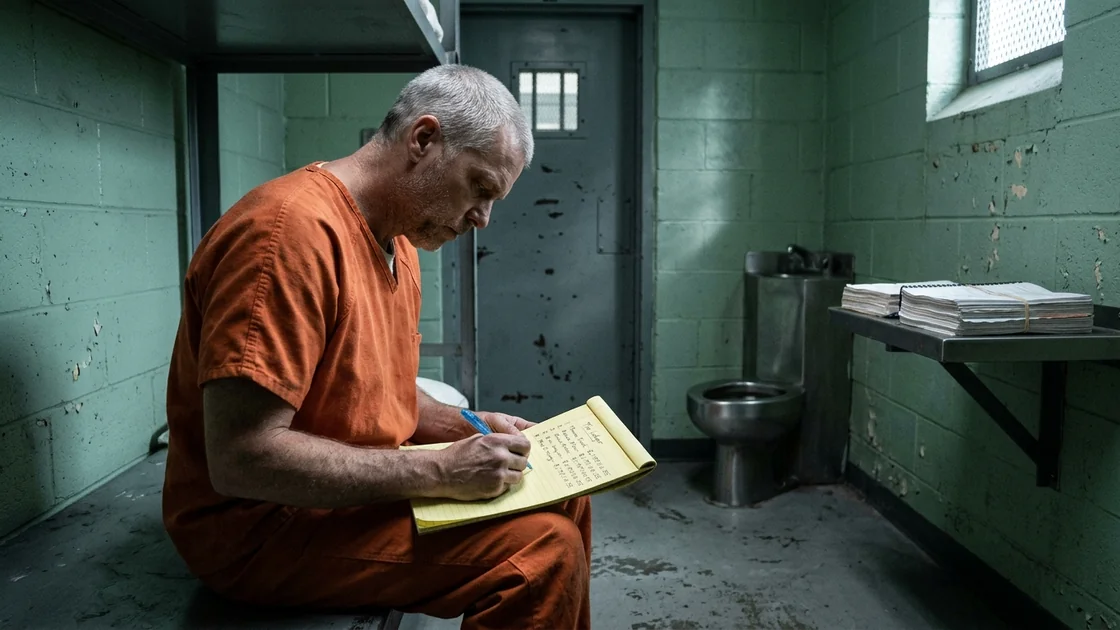
Arthur Vance sat on the narrow, metal-framed bunk of his cell at the Donald W. Wyatt Detention Facility in Central Falls, Rhode Island.
The transition from the Camden estate had taken seven months of legal skirmishing, but the federal judge had ultimately revoked his bail after finding that Arthur had attempted to transfer six million dollars to an irrevocable trust in the Cook Islands through an intermediary in Zurich.
The cell was eight feet by ten feet. The walls were cinderblock, painted an institutional, glossy mint green that had begun to peel near the floor. A single high window, reinforced with heavy steel mesh, admitted a narrow strip of daylight that tracked across the grey floorboards like the hand of a sun-dial.
He wore an orange jumpsuit made of rough polyester that irritated his neck. His silver hair had grown long and wild; they did not allow inmates to have professional styling scissors, and the jailhouse barber had simply taken a three-eighths-inch guard to his skull three weeks ago.
On the small steel shelf above his toilet lay a stack of legal transcripts, three inches thick, held together with heavy rubber bands.
Beside them lay a single piece of yellow legal paper.
Arthur held a short, flexible plastic pen—the kind given to inmates in administrative segregation so they cannot sharpen the shaft into a weapon.
He was not writing a legal brief. He was not writing a letter to his wife, who had filed for divorce four months ago and had successfully retained eighteen percent of their non-forfeited pre-marital assets after cooperating fully with the Department of Justice.
He was writing a list.
He had numbered the lines from one to twenty-nine.
- Thomas Finch (Gary, Indiana)
- Andrea Miller (Cleveland, Ohio)
- Kim Sung-Ho (Seoul, South Korea)
- Park Ji-Young (Seoul, South Korea)
- Choi Min-Soo (Busan, South Korea)
- Bae Dong-Sun (Busan, South Korea) ...
He had memorized the names from the Phase III clinical hold addendum that the FDA had released to the public when they permanently revoked the IND for Lumicor.
Across from each name, Arthur had written a number.
Not their ages. Not the dates of their deaths.
He had written the dollar value of his stock sales divided by twenty-nine.
$2,987,616.55.
Every name was worth two million, nine hundred and eighty-seven thousand, six hundred and sixteen dollars and fifty-five cents.
He stared at the numbers.
He tried to find the emotion that the court-appointed psychologist had insisted he was suppressing. He waited for the guilt, the horror, the moral revulsion that Clara Reyes had displayed in his office that afternoon in Cambridge.
It did not come.
What he felt was something far colder, far more terrifying: a mathematical clarity that refused to soften.
He had built a machine. The machine was designed to turn human flesh into capital. It had done so with remarkable efficiency until an unexpected biological parameter—an unpredicted quinone intermediate, a missing enzyme in an East Asian cohort—had introduced a non-recoverable error into the calculation.
The error had not been his greed.
The error had been his optimism. He had believed that the liver was tough enough to take it. He had believed that the human organism was as resilient, as capable of absorbing trauma, as the balance sheet of a Delaware corporation.
The heavy steel door at the end of the tier clanged open.
Footsteps echoed along the concrete floor—the hard, rubbery squeak of institutional boots.
"Vance," a guard called out, stopping before his bars.
Arthur didn't look up from his yellow pad. "Yes?"
"Your attorney left a message. The First Circuit denied the interlocutory appeal on the forfeiture order. The South Dakota trust has been unsealed. The Treasury has seized the escrow accounts."
Arthur nodded once, slowly.
"Thank you, Officer."
The guard lingered for a second, looking through the bars at the old man with the shaved head and the flexible pen.
"What are you writing?" the guard asked.
Arthur looked down at the yellow legal pad. He looked at line twenty-nine: Hanna Weber (Munich, Germany) - $2,987,616.55.
"A balance sheet," Arthur said quietly.
"For what?"
"For an asset that has already been liquidated," Arthur said.
The guard grunted, rattled his baton against the steel crossbar out of habit, and walked back down the corridor, the sound of his boots fading into the heavy, antiseptic hum of the prison ventilation system.
Arthur sat in the fading light. The strip of sun on the floor shrank, turning from gold to grey, then to a thin, cold blue, until the cell was entirely dark.
He did not turn on the overhead fluorescent tube. He sat with his hands resting on his knees, his back straight, his eyes open in the dark, counting the names he could no longer see, waiting for the ledger to balance.