The Last Bow of Julian Mercer
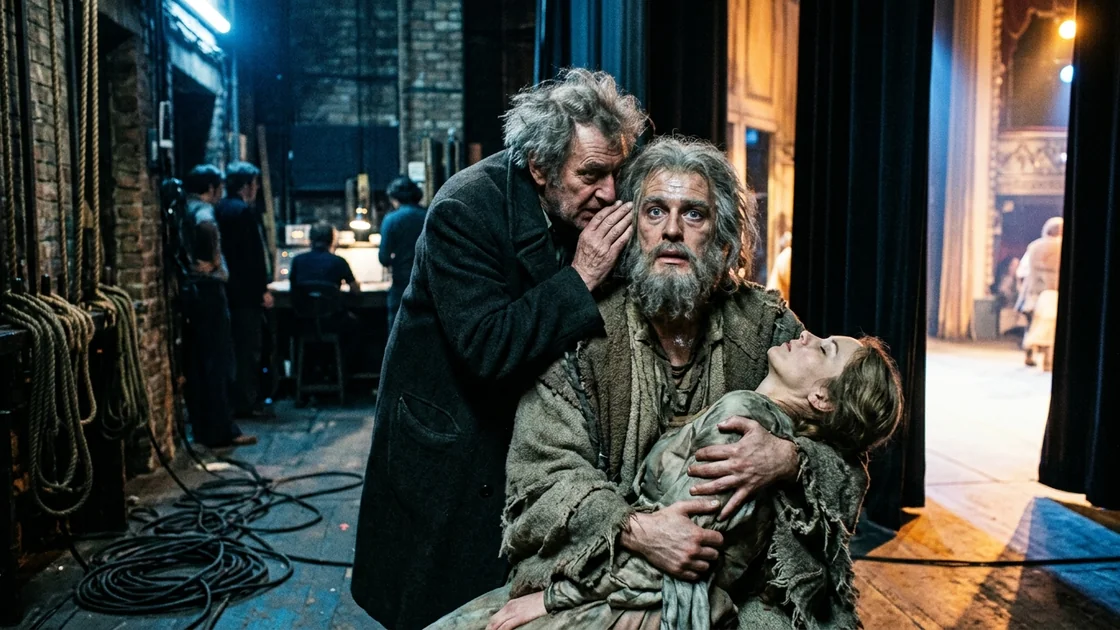
This is the story of Arthur Vance, an aging titan of the London stage whose terror of obsolescence drove him to commit an unforgivable act of sabotage against his gifted young understudy, Julian Mercer. During a high-stakes West End gala performance of King Lear attended by the world's most influential critics and producers, Vance feigned a sudden illness to force Julian into the spotlight, only to intercept the boy in the wings right before the climactic final act and curtain call with a whispered, fabricated tragedy about the death of Julian's hospitalized sister. The resulting psychological collapse on stage ruined Julian's career forever, leaving Vance to inhabit his hollow glory for decades until the silence of his own forgotten life finally forced him to reckon with the boy he broke.
Act I: Greasepaint and Rust
The dressing room smelled of cold mutton fat, dried lavender, and Leichner greasepaint sticks softening near the incandescent bulbs of the vanity. It was a smell Arthur Vance had inhaled six nights a week, with two matinees, since the coronation of the Queen. To the tourists who queued along the damp brick alley of Shaftesbury Avenue, the Duke of Clarence Theatre was an altar of high Victorian culture, its plaster cherubs gilded with Dutch metal that flaked like dandruff upon the stalls. To Arthur, it was merely an iron cage where the bars were painted red.
He was sixty-seven years old, though his knees swore he was eighty. In the silver-backed hand mirror—a gift from John Gielgud after an unremarkable run of The Tempest in sixty-four—Arthur examined the topography of his throat. The skin hung in loose, crepey folds, yellowed beneath the harsh dressing-table lights. No amount of blended carmine or theatrical talc could disguise the truth: the king was rotting from the chin down.
Across the room, sitting quietly on a battered wicker hamper packed with wool doublets, sat Julian Mercer.
Julian was twenty-three. He had the sharp, hungry cheekbones of an Italian street urchin and eyes that were far too large for his face—dark, watery, and terrifyingly clear. He sat with his script balanced across his corduroy trousers, his lips moving silently, tracking the rhythm of lines he already knew backward, forward, and in his dreams. He had not been hired for his name; he had no name. He had been dredged up from a provincial rep company in Yorkshire because the director, Peter Halloran, had seen him play Oswald in Leeds and declared that the boy possessed "an unholy, lacerating innocence."
Arthur hated him with every chamber of his failing heart.
"You’re tapping your boot again, Mercer," Arthur said without turning from the glass. His voice was a magnificent instrument, honed by decades of tobacco and Shakespearean vowels—a deep, resonant cello with a crack of thunder at the bottom.
The tapping stopped instantly. "Sorry, Mr. Vance. Nervous habit."
"A nervous habit belongs in the street or in the scullery," Arthur remarked, dipping a badger-hair brush into a pot of liquid latex. "On the boards, an involuntary movement is an insult to the playwright. The audience does not pay six pounds fifty for your nervous system. They pay for the illusion that humanity possesses dignity."
"Yes, Mr. Vance. Of course."
Julian bowed his head. He was always bowing his head. That was the most intolerable thing about him: his deference. Had the boy been arrogant, had he arrived from RADA with a scarf tossed over his shoulder and a sneer for the old guard, Arthur could have dismissed him, could have crushed him with a theatrical anecdote or had him sacked by the second week of rehearsals. But Julian had arrived carrying Arthur’s dry cleaning. He had listened to Arthur’s windy recollections of the Old Vic with damp-eyed reverence. He had brought Arthur lozenges when the London fog settled into the old man's chest.
And then, during technical week, when Arthur’s sciatica had flared up so brutally that he could not mount the wooden rostra for the storm scene, Julian had stepped onto the chalked lines to walk the cues for the lighting technicians.
Arthur had watched from the shadows of the royal box, wrapped in a camel-hair coat, a flask of cheap gin pressed against his ribs.
Julian had not simply walked the cues. He had murmured the verse. At first, it had been a whisper, a courtesy to the stage manager. But by the time the lighting board reached cue forty-two—the great sweep of amber and steel-blue simulating the heath—the boy had caught fire. He had not bellowed like Arthur; he had not used the booming, declamatory cadence of the Edwardians. He had spoken the storm into existence. He had made Lear sound like a man who had looked into an open grave and found it warm.
In the darkness of the box, Arthur had felt a cold sweat coat his collar. He had known, with the terrible intuition of an actor whose prime has slipped into history, that if that boy ever spoke those lines before an audience, Arthur Vance would be dead before he was buried.
"Your sister," Arthur said now, dabbing a streak of greasepaint across his temple to simulate the ravages of madness. "How is the little creature?"
Julian looked up, his face softening with that painful, naked sincerity Arthur found so vulgar. "Stable, Mr. Vance. Thank you for asking. The doctors at Brompton say the lung has cleared somewhat. She’s... she’s still very weak. But the new treatment is helping."
"A heavy expense for a boy on an understudy’s wage," Arthur said softly.
"I do the night shifts at the bottling plant in Bermondsey twice a week," Julian said, offering a faint, self-deprecating smile. "And Mr. Halloran slipped me five pounds extra for helping with the wardrobe trunks."
"Charming," Arthur murmured. "The noble proletarian. King Lear would weep."
A knock rattled the thin wood of the dressing room door. Mona, the deputy stage manager, poked her head inside. She had two pencils stuck into her gray bun and a clipboard clutched to her chest like a breastplate.
"Half-hour, Mr. Vance," she said crisply. Then her eyes darted to Julian, lingering with a look that Arthur did not miss—a look of pity, or perhaps anticipation. "House is packed tonight, Arthur. Sir Cedric Thorne is in the front row of the stalls. And Wardle from the Times. And two gentlemen from the Vivian Beaumont in New York."
Arthur’s hand paused on the badger brush.
"Wardle?" Arthur asked, keeping his voice level. "Wardle reviewed us on opening night. Why would he return for a Tuesday in the fifth week?"
Mona hesitated, shifting her weight from one sensible shoe to the other. "He... well, there were rumors, Arthur. Word gets around the Garrick Club that this production has evolved. He wanted to see how the run was holding up."
"I see," Arthur said. "He wants to see if the old dog can still bark without coughing up phlegm."
"Don't be dramatic, Arthur. Half-hour, please."
She shut the door.
Arthur stared into the mirror. Sir Cedric Thorne—the man who controlled every major commercial transfer from London to Broadway. And Wardle, the butcher of Fleet Street, whose single paragraph could extend a run by six months or kill it by Saturday night.
They had not come to see Arthur Vance. Arthur had already been judged: “A sturdy, conventional Lear, occasionally rising to rhetorical vigor, but weighed down by the mannerisms of an earlier era.” That had been Wardle's verdict five weeks ago.
No. They had come because someone had talked. Halloran, most likely. Halloran had been whispering in the bistros of Soho that the real production was waiting in the wings—that the understudy was a lightning bolt waiting to strike.
Arthur turned his gaze to Julian. The boy was looking down at his script again, but his fingers were trembling against the margin of Act V.
"Julian," Arthur said softly.
"Yes, Mr. Vance?"
"Fetch me my tea from the green room. The lemon slices are in the tin beneath the urn. Be quick about it. The voice feels like sandpaper tonight."
"Of course, Mr. Vance."
The boy stood up, adjusted his frayed collar, and slipped out of the room with the quiet efficiency of a ghost.
Arthur waited until the sound of Julian’s footsteps had died away down the concrete corridor. Then, slowly, with the theatrical precision of an executioner laying out his instruments, Arthur reached into his coat pocket and withdrew a telegram.
Act II: The Anatomy of Treason
The telegram had arrived at the stage door three hours earlier, tucked among the fan mail from elderly ladies in Eastbourne. Arthur had intercepted it purely by accident while looking for his ration of theatrical lozenges.
It was addressed to Julian Mercer, c/o Duke of Clarence Theatre.
Arthur had opened it without a flicker of shame. An old actor has no morals regarding correspondence; curiosity is the only vice that keeps the blood circulating.
The message was brief, typed on the yellow ribbon of the General Post Office:
BROMPTON HOSPITAL REPORTS CLARA STABILIZED STOP CRISIS PASSED FOUR PM STOP RESTING COMFORTABLY STOP VISIT TOMORROW MORNING STOP NURSE HIGGINS.
Arthur smoothed the creased yellow paper against the marble top of his vanity.
Clara Mercer was Julian’s twin sister, eighteen months younger, an invalid whose chronic pulmonary ailments had been the anchor dragging Julian into poverty. Julian talked about her endlessly—her drawings, her courage, her small, fragile life. The boy lived in terror of the telephone call that would tell him the lungs had finally surrendered to the water.
Arthur stared at the telegram. If Julian knew Clara was safe, he would spend the evening in the wings, calm, attentive, ready.
And if Arthur played the role tonight?
Arthur closed his eyes and imagined the scene: himself, sixty-seven, puffing and blowing through the storm, his knees aching, his voice cracking on the high notes of “Howl, howl, howl!” He saw Sir Cedric Thorne checking his pocket watch in the stalls. He saw Wardle scribbling into his small notebook: “Vance shows his age... an exhaustion that is not entirely theatrical.”
And then, tomorrow, the whispers would begin. Why didn't they let Mercer on? Have you heard Mercer do the reconciliation scene? He makes Vance look like a wax museum.
Arthur’s hands began to shake. It was not the tremor of palsy; it was the violent, sickening vibration of vanity under threat. He had given his youth to this monstrous profession. He had sacrificed two marriages, had fathered a daughter who would not speak to him from her home in Surrey, had lived on stale sandwiches and bad sherry in freezing provincial digs, all for the singular, divine drug of hearing twelve hundred people stop breathing at the end of a line.
He could not survive becoming a footnote to a boy’s beginning.
The door clicked open. Julian entered, carrying a chipped enamel mug steaming with dark tea.
"Here you are, Mr. Vance. Three slices of lemon, just as you like."
Arthur did not take the mug. Instead, he leaned back in his chair and pressed his palm to his left breast. He let his breath come in short, ragged gasps.
"Mr. Vance?"
Julian froze, the mug hovering between them.
"The... the draught," Arthur whispered, his voice thin and fluttering like a dying bird. "Mona... left the dock doors open... the wind..."
"Mr. Vance, what is it? Your chest?"
Julian set the mug down so quickly that hot tea sloshed across the makeup brushes. He was beside Arthur in an instant, his face white with terror.
"My pills," Arthur wheezed, his eyes rolling back slightly into his head—a trick he had learned from Charles Laughton during the filming of a forgotten costume drama in fifty-two. "In my... my street coat... no, not there... the carminatives..."
"Should I call Mona? I’ll fetch the doctor!"
"No!" Arthur hissed, gripping Julian’s wrist with surprising strength. His fingers were cold, coated in greasepaint. "No doctors. If the management... if the board knows... they’ll cancel the tour. The insurance... they’ll close the house, Julian."
"You can't go on like this," Julian stammered, his eyes darting frantically toward the door. "You’re gray, Mr. Vance. You're shaking!"
Arthur allowed his head to fall forward against his chest. He let out a long, shuddering groan that sounded like floorboards giving way in an abandoned house.
"The curtain," Arthur whispered. "The curtain rises in twenty-five minutes. Wardle is out there. Thorne is out there. The theater is full of hyenas, Julian. If the curtain stays down, we are all finished."
Julian stared at him, the realization dawning in his large, dark eyes with the horror of an oncoming locomotive.
"No," Julian whispered. "Not me. Not tonight."
"You know the cues," Arthur murmured, his voice fading to a deathbed rasp. "You have the lines. You have the fire, don't you? Isn't that what Halloran said in the bar? The boy has the fire."
"Mr. Vance, I’ve only walked it! I’ve never done the full run with the company! The costume... the beard..."
"The beard is hanging on the block," Arthur said, his hand sliding limp from Julian’s wrist to dangle uselessly toward the carpet. "The costume is on the dummy. You are my understudy, Mercer. If I drop dead on the horsehair sofa, you take the crown. Or are you a coward?"
The word hit the boy like an open-handed slap. Julian flinched.
"I am not a coward," Julian said, his voice dropping an octave, steadying despite the terror that made his knees shake.
"Then call Mona," Arthur whispered, turning his face to the wall. "Tell her Arthur Vance has had an attack. Tell her the king is fallen. And put on the rags, boy. Put on the rags."
Act III: The Rags of Majesty
The chaos that erupted in the backstage corridors of the Duke of Clarence was unlike anything Julian had ever experienced.
Mona’s voice cut through the damp air like a circular saw. "He what? Where is he? Arthur! In God’s name, Arthur!"
She burst into the dressing room, followed by Halloran, who was still chewing on an unlit cigar, his dinner jacket dusted with ashes. They found Arthur Vance slumped on the wicker hamper, his face buried in a towel, his breath rattling like dry leaves in an iron drain.
"Can he speak?" Halloran demanded, grabbing Arthur by the shoulder. "Arthur! It’s Peter. Can you do it? We can cut the storm scene down—we can give you a stool for Act II—"
"He can’t stand, Peter," Mona said, her fingers on Arthur’s pulse. Her own face was pale beneath her stage makeup. "The pulse is like a trip-hammer. If we push him out there, he’ll have an infarction before the third scene."
Halloran swore, a stream of filthy, rhythmic curses that bounced off the mirrors. "Thorne is in the stalls. The Vivian Beaumont money is sitting in row D. If I put a dark house up tonight, the syndicate pulls out of the spring season."
"We don't go dark," a voice said from the corner.
Halloran turned.
Julian was already standing in his stocking feet, holding the heavy wool tunic of King Lear against his ribs. His face was entirely devoid of color, but his jaw was set with a terrifying, rigid resolve.
"The understudy," Mona whispered.
Halloran stared at Julian. The director’s cigar stopped midway to his mouth. "Mercer. You’re twenty-three. You look like a starved choirboy."
"The wig covers the hairline," Julian said, his words coming with the unnatural clarity of someone stepping off a cliff. "The crepe hair hides the jaw. The cloak adds three stone. I know every syllable Vance speaks. I know every syllable the others speak back to him. You have eighteen minutes until the overture."
Halloran looked from Julian to the heap of Arthur Vance on the hamper. Arthur let out another miserable, whistling moan from beneath the wet towel.
"God help us," Halloran muttered. "Mona, get wardrobe. Get Mrs. Gable with the spirit gum and three boxes of grey wool. Tell the company: the understudy is on. And tell the house manager to make the announcement from the stage before the house lights dim."
"No," Julian said sharply.
Halloran blinked. "What did you say?"
"No announcement," Julian said. His voice was trembling now, but he did not back away. "If you tell them Arthur Vance is ill and an understudy is on, three hundred people will demand their refunds before the first cue, and the critics will spend the first act writing their obituaries for the production. Make the announcement in the interval. Give me the first act."
Halloran stared at him for four long seconds. Then a slow, savage grin split the director's face.
"You arrogant little bastard," Halloran whispered. "Wardrobe! Move your bloody legs!"
For the next fifteen minutes, Julian was subjected to the violent, frantic ministry of backstage craft. Mrs. Gable, smelling of gin and peppermint, slathered spirit gum across his cheekbones and chin with a stiff brush that burned his skin. She pressed clumps of coarse yak hair into the adhesive, yanking his head this way and that as she trimmed it with dull scissors.
"Hold your mouth shut, love," she hissed, puffing powder into his eyes. "Don't sneeze or the nose falls off."
They dropped the heavy, greasy wool tunic over his head. It smelled of Arthur Vance—of lavender water, stale armpits, and thirty years of greasepaint ground into the seams. It was heavy, like being buried in wet earth. The hem dragged against Julian’s ankles; Mrs. Gable went to her knees with safety pins, swearing as she stabbed her fingers.
Arthur remained on the wicker hamper, curled into a ball of theatrical misery, watching through the slit between the damp towel and his palm.
He saw the boy transform.
It was not a gradual change; it was an eviction. Julian Mercer was vanishing beneath the paint and the wool, and in his place stood an ancient, terrifying ruin of a man. The boy’s posture did not simply slump; it compressed, as if the weight of forty years of bad governance and familial treachery had settled directly onto his cervical vertebrae.
"Places!" the loudspeaker crackled from the wall. "Places, please, for Act I. Beginners to the stage."
"Go," Halloran whispered, pushing Julian toward the door. "Go out there and make them forget that old fossil ever lived."
Julian did not look back. He stepped into the corridor, his boots clumping heavily against the concrete, his long wool mantle trailing behind him like a funeral shroud.
Arthur Vance sat up slowly on the hamper.
The towel fell from his hands. His breathing was no longer ragged. His pulse, had Mona checked it now, was cold, slow, and entirely steady.
He stood up, walked to the dressing room door, and clicked the latch shut. Then he reached into his trousers, pulled out the telegram, and folded it into a tight, sharp square no larger than a matchbook.
Act IV: The Conflagration
From the wings, hidden behind the black serge of the prompt-side legs, Arthur Vance watched the impossible happen.
He had expected the boy to drown. He had expected the cavernous acoustics of the Duke of Clarence to swallow Julian’s thin northern voice. He had expected the company—veterans of Stratford who had played these scenes with Olivier and Redgrave—to turn their backs on the upstart, to crowd him out of the lighting pools, to leave him stranded in the shadows of the painted scenery.
They did nothing of the kind.
From the moment Julian stepped through the central archway in Act I, Scene 1, carrying the heavy oak staff like an old shepherd leaning against a gale, the air in the theater changed.
Julian did not shout. He did not bellow the division of his kingdom as Arthur had done for thirty performances, shaking his fists at the gallery like a drunken alderman. Julian spoke with the terrifying, whispered authority of a man whose mind was already beginning to drift into the fog. When he turned to Goneril, played by the formidable Evelyn St. John, his voice was not angry; it was wounded, bewildered, pathetic.
Evelyn, who had despised Arthur Vance for three decades of upstaging and sprayed saliva, looked at Julian and did something she had never done during the entire run: she wept real tears during her speech of dismissal.
In the stalls, the silence was absolute.
It was not the polite silence of an audience waiting for an old favorite to finish his turn. It was the suffocating, electric silence of twelve hundred people realizing that they were present at a resurrection.
Arthur crept further into the shadows near the prompt corner. He saw Wardle in the fifth row. The critic had stopped writing. His notebook sat closed upon his knee, his pen held loosely between two fingers, his mouth slightly open. Near the center aisle, Sir Cedric Thorne was leaning forward, his hands gripping the brass rail of the orchestra pit.
The interval came like a thunderclap.
When the heavy velvet curtain plunged down at the end of Act III, the applause did not wait for the house lights. It began in the stalls—a sharp, rattling percussion that spread instantly to the dress circle and the gods.
Halloran was waiting in the wings as Julian came off. The director seized the boy by the wool of his shoulders and shook him with manic, terrifying glee.
"You’re doing it, you little devil!" Halloran barked, his face crimson. "Do you hear them? They don't know who you are, but they know you're not Vance! The house manager is going out now to announce your name. By midnight, Mercer, your salary triples. By tomorrow morning, Thorne will have the contract on my desk for New York!"
Julian stood trembling, his chest heaving beneath the suffocating wool tunic. The yak-hair beard was soaked with his sweat; his eyes were wild, glazed with the unnatural trance of an actor who has crossed the line between technique and possession.
"Is he... is Mr. Vance alright?" Julian gasped.
"To hell with Vance!" Halloran laughed, shoving a paper cup of water into Julian's hand. "Vance is finished! Drink that. You've got the heath in two minutes. Kill them, Julian. Tear their bloody hearts out!"
Arthur shrank back into the gloom beneath the iron spiral staircase that led to the fly floors.
Vance is finished.
The words echoed in his skull with the mechanical persistence of a death knell. He saw the reviews that would appear on Thursday: “A revelation at the Duke of Clarence... the creaking artifice of Mr. Vance replaced by the blazing genius of a newcomer... a generational shift.” He saw the producers crossing his name off their lists with red wax pencils. He saw the empty afternoon walks through Battersea Park, the tea shops where nobody turned around, the quiet, dreadful slide into the obituary columns of the Stage: “Arthur Vance, 71, actor of the old school.”
He looked down at his right hand. Between his thumb and forefinger, the sharp edge of the folded telegram dug into his flesh.
He did not plan it with malice; he planned it with the instinctive, animal cunning of a creature whose burrow has been invaded by a younger, stronger beast. It was not murder; it was self-defense. If the boy survived tonight, Arthur died. It was as simple, as ancient, and as pitiless as that.
Act V: The Poison in the Wings
The fifth act of King Lear is a meat grinder.
By the time the actor reaches the entrance with the dead Cordelia in his arms, his heart is beating against his ribs like a bird in a chimney, his mouth tastes of copper, and his sanity is held together by the thread of stage discipline. He must carry eight stone of dead weight through an archway, stagger down three steps in semi-darkness, and deliver the four howls that represent the ultimate collapse of Western language.
Julian Mercer had spent the previous two hours tearing himself into scraps.
He had performed the reconciliation scene with such heartbreaking fragility that two stagehands on the fly rail had dropped their ropes to watch. He had made Lear’s madness seem not like grand opera, but like the quiet, dreadful confusion of an old man whose slippers have been misplaced in a burning house.
Now, he stood in the wings on the prompt side, waiting for his final cue.
The stage was dark. Across the boards, behind the painted flats representing the British camp near Dover, the stage combatants were finishing their clattering duel. Edmund had fallen; the trumpet had sounded.
Julian stood in the blue spill of the working light, his arms already aching as he held the limp body of Cordelia—played by young Sarah Crisp, whose silk tunic was damp with Julian’s sweat. Julian’s head was down, his forehead pressed against Sarah’s stage-bloodied temple, gathering the last ounce of his nervous energy for the final, terrible ascent.
Mona was at the prompt desk, her finger poised over the cue light for the curtain call tabs.
"Stand by, prompt side," she whispered into her headset. "Stand by, Julian. On the trumpet call. Five seconds."
Arthur Vance stepped out from behind the velvet tormentor.
He was not wearing his stage clothes; he was wearing his black overcoat, the collar turned up against the backstage drafts, his gray hair wild and uncombed. He looked like an apparition from an engraving of the plague year.
He did not approach Halloran or Mona. He moved with the silent, gliding step of an old mime, slipping through the tangle of cables until he was standing twelve inches behind Julian’s right ear.
The boy did not see him. Julian’s eyes were shut tight, his breath whistling through his nostrils as he prepared to scream.
Arthur leaned forward. His breath, smelling of peppermint and sour stomach acid, brushed the wet skin behind Julian’s ear.
"Julian," Arthur whispered.
The boy flinched, but could not turn; his arms were locked around the girl’s body.
"Mr. Vance? You're up... you're better—"
"Be brave, boy," Arthur whispered. The voice was low, intimate, heavy with an obscene, vibrating sorrow. "The hospital called the stage door five minutes ago. Mona didn't want to tell you until the curtain was down."
Julian’s body went completely rigid. Sarah Crisp felt the shift; she shifted slightly in his arms, her eyes fluttering open beneath her greasepaint.
"What?" Julian breathed. The word wasn't spoken; it was torn from his lungs.
"The lungs filled up at eight," Arthur hissed softly, his lips almost grazing the yak-hair beard. "She drowned in her bed, Julian. She was calling for you. She asked why Julian wasn't there. She died ten minutes ago, alone in the ward."
The trumpet sounded from the prompt desk.
Ta-ta-ra! Ta-ta-ra!
"Go on, Julian," Arthur whispered, his voice cracking with monstrous tenderness. "Go on out there. Thorne is waiting. Wardle is waiting. Show them your art, boy. Show them how well you can play grief."
"Go!" Mona hissed from the desk, waving her arm frantically in the darkness. "Go, Julian! Lear entrance! Go!"
Julian did not move. He stood as if he had been struck by a high-voltage cable. His eyes, fixed on the black floorboards between his boots, stretched wide—wider than Arthur had ever seen human eyes open. The pupils were pinpricks in a field of red veins.
"Julian!" Mona snapped, her voice rising to a panicked whisper. "You're late! Enter!"
Sarah Crisp, realizing something was horribly wrong, whispered from his arms: "Julian, the cue! Walk! Just walk!"
A strange, mechanical shudder passed through the boy’s shoulders. He took a step forward into the light.
Then another.
He did not carry the girl like a king carrying his murdered child. He dragged her. His arms had lost their tension; Sarah’s heels bumped against the wooden stage floor with a sickening, hollow rhythm: thump, thump, thump.
The stage lighting hit him—forty thousand watts of brutal, amber-tinted brilliance.
The audience, which had been leaning forward in breathless anticipation of the legendary “Howl, howl, howl!”, saw an old man stagger through the archway. But it was not an old man. The yak hair was peeling away from the left side of his chin, revealing the pale, smooth skin of a terrified boy beneath.
Julian stopped in the center of the stage, in the full glare of the center spot.
The audience waited.
The company—Kent, Albany, Edgar—stood in their frozen semi-circle, their eyes fixed on him, waiting for the line that would unleash the final deluge.
Julian opened his mouth.
No sound came out. His jaw worked up and down like that of a landed fish suffocating on the gravel of a riverbank. A string of thick, clear saliva hung from his lower lip, catching the light like a diamond thread.
Sarah Crisp lay across his knees, her eyes wide with real panic now, staring up at him through her stage dirt.
"Julian," she hissed under her breath. "Say the line. Howl. Say it!"
Julian looked past her. He looked past the footlights. He looked into the black, gaping mouth of the auditorium—into the pit where twelve hundred well-dressed strangers sat waiting to be entertained by his sister’s death.
A noise came from his throat.
It was not Shakespeare. It was not art. It was an animal noise—a high, wet, strangulated squeal, like a piglet being crushed beneath an iron wagon wheel.
He dropped Sarah Crisp.
He did not lower her; he simply unclenched his fingers. The actress hit the stage floor with a heavy, unpadded thud that made the front row of the stalls gasp.
Julian clutched his own face. His fingernails, blackened with theatrical dirt, dug into his cheeks. With a single, violent, hysterical wrench, he tore the grey yak-hair beard from his skin. The spirit gum took strips of his own flesh with it; blood, bright and thin, welled up along his jawline, mingling with the white talc and the carmine greasepaint.
"Clara?" he screamed.
The voice was not the deep, gravelly cello of the ruined king. It was the shrill, broken voice of a boy from Yorkshire whose heart had just been pulverized.
"Clara! Where are you? Where did they put you?"
In the stalls, Sir Cedric Thorne stood up, his program tumbling from his lap to the carpet. Wardle leaned forward, his brow furrowed in disgusted confusion.
"Julian!" the actor playing Albany hissed, stepping forward with his hands outstretched, trying to shield the boy from the house. "My lord, look up—"
Julian turned on him like a rabid terrier. He did not see Albany; he saw an enemy, a jailer, a ghoul. He struck the veteran actor across the breastplate with both hands, sending the older man sprawling backward into the footlights with a tremendous crash of sheet metal and splintering wood.
The house erupted.
A woman in the dress circle shrieked. Programs rustled like dry leaves in a sudden gale. People were standing in the stalls, craning their necks, murmuring in shock and disgust.
"Curtain!" Mona’s voice screamed over the backstage tannoy, abandoning all discipline. "Bring it down! Bring the iron down! Now!"
The counterweights groaned in the flies. The massive red velvet house tabs plunged toward the stage, their heavy gold fringe hitting the boards with a dull, final thud.
Julian stood in front of the curtain, stranded on the narrow apron between the velvet and the blazing footlights.
He did not know where he was. He was covered in his own blood and greasepaint, his hair wild, his wool tunic torn at the neck where he had tried to claw his own throat open. He fell to his knees, his hands beating against the wooden apron, screaming his sister’s name into the blinding darkness of the stalls until his voice broke into a bloody, gurgling cough.
From the prompt wing, Arthur Vance watched as two stagehands rushed out from the pass door, seized the boy beneath his arms, and dragged him backward through the split in the velvet curtain.
Julian’s boots left two dark, parallel lines through the dust on the stage floor.
Arthur Vance stood in the shadows, his hands deep in the pockets of his black overcoat. His fingers touched the telegram.
He turned to Halloran, who was leaning against the prompt desk, his face gray, his cigar crushed to powder in his fist.
"A pity," Arthur whispered, his voice trembling with exquisite, mournful regret. "A terrible, terrible pity. The boy simply... lacked the fiber, Peter. A talent, yes. But no fiber."
Act VI: The Blacklist and the Solitary
The theatrical world does not forgive a performer who breaks the frame.
A missed entrance can be excused; drunkenness has a long and honorable pedigree on the English stage; even an actor who forgets his verse can be saved by a clever prompter. But to vomit one's private madness across the footlights—to destroy the collective dream of twelve hundred people, to assault a fellow player, to drag an actress across the boards like a sack of turnips and scream like a lunatic in the center spot—that is the unpardonable sin.
The reviews on Thursday did not mention the brilliance of Julian's first three acts. Wardle wrote a single, scathing column that became legend in the Garrick Club:
"The experiment at the Duke of Clarence ended on Tuesday evening not in tragedy, but in hysterical catastrophe. A young understudy whose name it would be an act of charity to omit proved that the modern fashion for unbridled emotionalism is no substitute for the technical discipline of the master. One felt less like a spectator at the court of Britain than a witness to a vulgar nervous collapse in a railway waiting room. When Mr. Arthur Vance returned to the boards on Wednesday evening, his voice may have shown the fatigue of his recent indisposition, but his presence reminded us of what has been lost: an actor who understands that Lear’s agony is poetry, not pathology."
Julian Mercer never returned to the Duke of Clarence.
He did not return to his flat in Camden. When he arrived at the Brompton Hospital at midnight on Tuesday, his face still streaked with dried blood and greasepaint, the night nurse had looked at him through the glass partition with terror.
"Clara Mercer," Julian had croaked, his hands leaving bloody smudges on the reception counter. "Where is the body? Where did you take her?"
"Mr. Mercer?" the nurse had said, stepping back from the glass. "What are you talking about? Clara is asleep. She had her broth at seven. She’s sleeping like an angel."
Julian had stood there, in the cold, linoleum-tiled corridor smelling of carbolic and boiled cabbage, while the truth slowly crawled into his skull like an earwig.
The telegram had not been a death notice. The voice in the wings had not been an act of mercy.
He had walked back into the London night.
He did not go to the police; what law had been broken? He did not go to the stage union; who would believe an unstable understudy whose hysteria had been witnessed by the theater editor of the Times? He did not confront Arthur Vance. To confront Arthur Vance would be to acknowledge that the monster had known him better than he had known himself—that Vance had found the single loose wire in Julian’s soul and pulled it until the whole machine caught fire.
Julian took a room near the docks in Rotherhithe. He worked the night shifts at the timber yards, carrying heavy baulks of wet pine until his back was permanently bent and his actor’s hands were calloused and split by splinters.
His sister Clara lived for four more years.
She died in eighty-two, not of pulmonary edema, but of a quiet, unspectacular heart failure in a convalescent home in Margate, paid for by Julian’s dock wages. On the afternoon of her funeral, Julian sat on the shingle beach, throwing grey pebbles into the gray sea, listening to the gulls scream lines from Shakespeare he could no longer remember without tasting blood.
Act VII: The Memorial
Thirty-two years passed with the cruel, greasepaint speed of theatrical time.
Arthur Vance lived to be eighty-nine.
He had outlived Peter Halloran; he had outlived Wardle; he had outlived two monarchs and three theatrical agents. He had been awarded the CBE in the Queen's Birthday Honours in ninety-one—not a knighthood, which rankled him until his dying day, but enough to ensure that when his name was mentioned in the Guardian, it was preceded by the word distinguished.
He had spent his final decade living in a tall, narrow terraced house in Richmond, surrounded by framed playbills, silver-plated cigarette cases inscribed by forgotten leading ladies, and the smell of cat urine and damp wool. His knees had finally surrendered entirely; he spent his days in an electric bath-chair, being wheeled between his bay window and his television by a succession of silent Portuguese nurses whom he called by the names of Shakespearean attendants: “Boy,” “Oswald,” “Gentleman.”
His mind remained sharp—too sharp. The alcohol that had preserved his liver had failed to dull his memory.
In the long, blue afternoons when the rain drummed against the glass overlooking the Thames, Arthur did not think of his triumphant Shylock at Stratford. He did not think of his Benedick, which had toured South America under the auspices of the British Council.
He thought of the snap of the spirit gum.
He remembered the exact sound of Julian Mercer’s beard tearing away from the flesh of his cheek. He remembered the look in the boy’s eyes—not hatred, not anger, but that terrifying, bottomless bewilderment of a child who has reached for his mother’s hand and found a handful of wasps.
One Tuesday in October, Arthur’s current nurse—a middle-aged woman named Maria whose English was limited to fifteen nouns—wheeled him into the study.
"Mail, Mr. Vance," she said, dropping three envelopes onto his lap.
Two were gas bills. The third was a small, cream-colored invitation from the Royal Theatrical Fund.
They were holding a memorial service at St. Paul’s, Covent Garden—the Actors' Church—for Sir Cedric Thorne, who had finally died in a nursing home in Sussex at the age of ninety-four.
Arthur stared at the card.
Thorne had been the last one. With Thorne gone, there was no one left alive who had been in the stalls that night. No one who remembered the Duke of Clarence in seventy-eight. Halloran was in a niche at Golders Green; Sarah Crisp had married an Australian sheep farmer and vanished into the outback; Wardle had choked on an oyster at the Savoy twenty years ago.
"Maria," Arthur croaked, his voice now reduced to the dry rattle of a dead snake in a box. "My coat. The black one with the astrakhan collar."
"Is raining, Mr. Vance," she said.
"Get the coat, you ignorant peasant," Arthur wheezed. "And call the car. The King has business in town."
Act VIII: The Actors' Church
The Actors' Church was cold, despite the gas heaters rumbling in the aisles.
The pews were half-empty. A memorial service for a ninety-four-year-old producer is an archaeological event; most of the mourners were elderly actors who had come primarily to check who among their contemporaries was looking worse than themselves, mixed with a few young drama school students who had been ordered to attend by their tutors to show respect to a man whose money had built their rehearsal rooms.
Arthur sat in his bath-chair in the side aisle, near the memorial plaque for Boris Karloff. He wore his black coat, his knees covered by a tartan rug. His eyes, watery and yellowed behind thick bifocals, surveyed the crowd.
They were ghosts. All of them. Men with dyed hair and voices that projected too loudly into the quiet nave; women with silk scarves tied around throats that had once been praised by Agate.
The service was interminable. An archdeacon with an actor’s delivery read from Ecclesiasticus: “Let us now praise famous men, and our fathers that begat us.”
Arthur did not listen. His gaze had wandered to the back of the church—to the dark stone corner near the font, where the damp from the street seeped through the heavy oak doors.
A man was sitting on the low stone bench near the umbrella stand.
He was not dressed in theatrical mourning. He wore a greasy, oil-stained donkey jacket with orange plastic patches on the shoulders, the kind worn by council road-sweepers or dockers. His trousers were stiff with salt and dirt; his boots were cracked across the toe-caps.
His hair was entirely white, cropped close to the skull like an inmate's, and his back was bent into a permanent, defensive curve. But even from thirty feet away, even through the smoky gloom of the church, Arthur Vance recognized the cheekbones.
Those terrifying, beautiful Italian cheekbones.
The breath caught in Arthur’s throat with the sound of a dry valve snapping.
Julian Mercer did not look at the altar. He did not look at the coffin covered in autumn chrysanthemums. He sat with his hands between his knees—large, scarred, brutalized hands that had spent thirty years shifting timber and gravel. He was watching the service with the dull, patient neutrality of an animal that has come into a barn out of the sleet.
Along his left jawline, visible even in the dim light of the church candles, ran a thin, jagged white scar—the place where the spirit gum and the flesh had parted company thirty-two years before.
Arthur’s heart began to hammer against his ribs. It was not the majestic, rhetorical rhythm of Lear; it was the panic of an old thief who hears the constable’s boots on the cellar stairs.
He wanted to tell Maria to turn the chair. He wanted to flee out the side door, into the safety of the Bedford Street drizzle, back to his television and his cat-piss parlor in Richmond.
Instead, his hand reached out and touched the electric toggle on the armrest.
The little motor whined. The rubber wheels turned slowly on the flagstones.
The mourners in the rear pews turned their heads, frowning at the mechanical disruption of the archdeacon’s eulogy. Arthur did not see them. He steered the chair down the side aisle, past the stone pillars, past the brass plaques honoring comedians who had died of dropsy and tragedians who had died of neglect, until the chair stopped three feet from the stone bench by the font.
The engine clicked off. The church was silent save for the archdeacon’s drone: “...their bodies are buried in peace; but their name liveth for evermore...”
Julian Mercer did not move. He did not look up. He smelled of cold grease, damp wool, and stale tobacco—the cheap tobacco of the docks.
"Julian," Arthur said.
The voice was thin. It was no longer a cello; it was an old comb wrapped in tissue paper.
Julian turned his head slowly.
His eyes had not changed. They were still too large for his face, still watery and dark, but the terrifying innocence that Peter Halloran had praised was gone. In its place was a flat, deep, impenetrable silence. It was the look of a well that had run dry fifty years ago, down which no bucket had dropped for a generation.
He looked at Arthur Vance.
He looked at the black coat with the astrakhan collar. He looked at the silver-plated crest on the electric bath-chair. He looked at the withered, spotted hands clutching the tartan rug.
He showed no surprise. He showed no hatred. He did not rise from the bench with the fury of an injured ghost.
"Mr. Vance," Julian said quietly. His voice was husky, ruined by forty years of sea air and shouting over the noise of cranes, but the northern cadence—the soft, rounded vowels of Leeds—was still there, buried beneath the rust.
"You... you came," Arthur whispered.
"I read about Sir Cedric in the evening paper," Julian said. He looked toward the coffin with a faint, distant curiosity. "I had a half-day at the yard. I thought I’d see what he looked like in a box."
Arthur’s fingers tightened on the tartan rug until the joints turned white. "Julian... about that night."
Julian’s eyes drifted back to Arthur’s face. He did not speak. He simply waited, with that terrible, peasant patience that Arthur had always found so vulgar.
"You must understand," Arthur’s words came tumbling out now, desperate, hurried, stripped of all rhetorical elegance. "The pressure... the critics... Thorne was there, Julian. Thorne had the New York contracts. Halloran was going to replace me. They were going to throw me into the street like an old dog. I had given forty years to that theater! Forty years! I had nothing else, Julian. No wife, no child who would look at me... nothing but the boards."
Julian watched him. His face did not twitch. The white scar on his jaw remained pale against his weather-beaten skin.
"The telegram," Arthur gasped, his breath smelling of the peppermint he still used to disguise his decay. "It was on my vanity. I had it in my hand. Your sister... she was stable, Julian. She was alive. The telegram said she was resting. I had it in my pocket when I told you."
He waited.
He waited for the blow. He waited for Julian to seize him by his velvet collar, to tip the electric chair onto the flagstones, to scream the truth through the nave of the Actors' Church, to denounce him before the archdeacon and the critics and the ghosts.
He wanted the blow. An actor can survive being hated; hatred is an emotion with a long theatrical history; hatred has a shape, a rhythm, a cue.
Julian Mercer looked down at his own hands—the thick, calloused thumbs, the broken fingernails stained with creosote.
"I know," Julian said softly.
Arthur froze. "You... you know?"
"The sister at the Brompton told me," Julian said, his voice flat, even, devoid of any resonance. "The next morning. She told me the telegram had been delivered to the stage door at five o'clock. She told me it said Clara was out of the woods."
Arthur’s mouth dropped open. A line of thin saliva, just like the one that had hung from Julian’s lip in seventy-eight, appeared at the corner of his withered mouth.
"You knew?" Arthur whispered. "You knew it was a lie?"
"Not until the morning," Julian said. "That night... that night I believed you."
"Then why didn't you come back?" Arthur’s voice rose to a shrill, cracked piping that caused three mourners near the font to glare at him. "Why didn't you go to Halloran? You could have told him! You could have told Thorne! You could have told the union that I broke you—that I lied to you in the wings!"
Julian turned his head and looked Arthur Vance fully in the eyes.
For the first time, Arthur saw what was at the bottom of the well. There was no rage. There was no desire for vengeance. There was only a vast, terrifying, arctic indifference.
"To tell them what, Mr. Vance?" Julian asked quietly. "That you were an old man who was afraid of being forgotten? They knew that already. Everyone knew that."
"Julian—"
"I didn't leave because of the lie, Mr. Vance," Julian said. He leaned his head back against the cold stone of the church wall, looking up at the high, vaulted timber roof where the dust floated in the gray light. "I left because of what happened when the curtain went down."
"What happened?"
"I was glad," Julian whispered.
Arthur blinked. "Glad?"
"When I was on that stage," Julian said, his words barely louder than the murmur of the organ pipes beginning the recessional hymn, "when I tore that beard off my face, when I was screaming for Clara... I realized something. I didn't care about the verse. I didn't care about the Vivian Beaumont. I didn't care about Sir Cedric Thorne or the people in the stalls. I realized that the whole thing... your whole life, Mr. Vance... it’s an empty room. It’s an empty room full of grown men painting their faces and pretending to be hurt so that strangers will clap their hands before they go to a restaurant."
Julian stood up from the stone bench.
He was not tall, but his shoulders were thick now, solid with the real, unglamorous weight of physical labor. He stood over Arthur Vance’s bath-chair like an oak tree looking down at a broken wheelbarrow.
"You thought you took my life from me, Mr. Vance," Julian said, reaching down to pick up his plastic lunch-pail from the floor. "You spent thirty years sitting in your dressing room thinking you were a villain in a play. You weren't a villain. You were just an old man with bad knees who wanted to hear them shout one more time."
Julian adjusted the collar of his donkey jacket against the draft from the door.
"Clara lived four years after that night," Julian said, his voice entirely calm. "I was there every Saturday. I held her hand when she had the cough. I took her to the pier at Margate when the sun was out. If I’d been in New York... if I’d been playing the king at the Vivian Beaumont... I would have been at a cocktail party when she died. I would have sent a wreath from a florist."
He looked down at Arthur Vance one last time. There was no pity in his eyes; there was only the cold, clear recognition of something small and insignificant that had finally ceased to matter.
"Thank you for the tea, Mr. Vance," Julian said softly. "The lemon was very good."
He turned and walked toward the heavy oak doors of the church.
His boots did not clump with the theatrical authority of an actor’s entrance; they shuffled softly against the flagstones, the sound of an ordinary man going back to his shift on the river.
The doors creaked open, admitting a momentary blast of cold London rain and the roar of traffic from the Strand, then clicked shut behind him.
Epilogue: The Dark House
The memorial service ended twenty minutes later.
The mourners filed out past Arthur’s chair, nodding to him with the solemn, meaningless respect paid to ruins.
"Splendid to see you, Arthur," an elderly baronet murmured, patting his shoulder. "Holding up the standard, eh? The old guard."
"Yes," Arthur whispered. "The old guard."
Maria came to take the handles of the chair. "We go home now, Mr. Vance? The rain is very heavy. Your chest, it will get the cold."
"No," Arthur said. His voice was so faint she had to bend her ear to his mouth.
"What you say, Mr. Vance?"
"Leave me," he whispered.
"The church is closing, Mr. Vance. The priest, he has to lock the doors."
"Five minutes," Arthur croaked, his hand fumbling with his coat pocket, pulling out a crumpled ten-pound note and shoving it into her palm. "Five minutes, Maria. Wait in the porch."
She looked at the money, shrugged, and walked away down the aisle, her flat shoes squeaking on the wet stones.
Arthur sat alone in the center of the nave.
The church was empty now. The candles around Thorne’s empty catafalque had been snuffed; the smell of extinguished tallow hung in the cold air, bitter and greasy, like Leichner paint sticks left too close to a bulb.
Arthur looked down at his hands.
They were clean. They had never shifted timber. They had never held a dying sister’s hand on a pier in Margate. They had held nothing their entire lives but props—wooden swords, tin chalices, cardboard crowns, and scripts written by men who had been dead four hundred years.
“You spent thirty years thinking you were a villain in a play.”
The words did not echo; they simply sat in the stone church, heavy, motionless, and true.
He had not ruined a genius. He had not crushed a titan in the egg. He had merely revealed to a boy that the temple was made of lath and plaster, and the boy had walked out into the sunlight and left the priest alone in the dark.
Arthur reached out and clicked the toggle of the bath-chair.
He turned the chair toward the altar.
The Duke of Clarence had been demolished twelve years ago; a Japanese bank now stood on the site where the dressing rooms had been. There was no stage door. There was no call-board. There was no green room where the lemon slices sat in the tin beneath the urn.
There was only this: an old man with an astrakhan collar sitting in a motorized chair, waiting for a curtain that had already fallen thirty years ago, in an empty house where no one had stayed to watch the bow.