The Lantern at Marrow Head
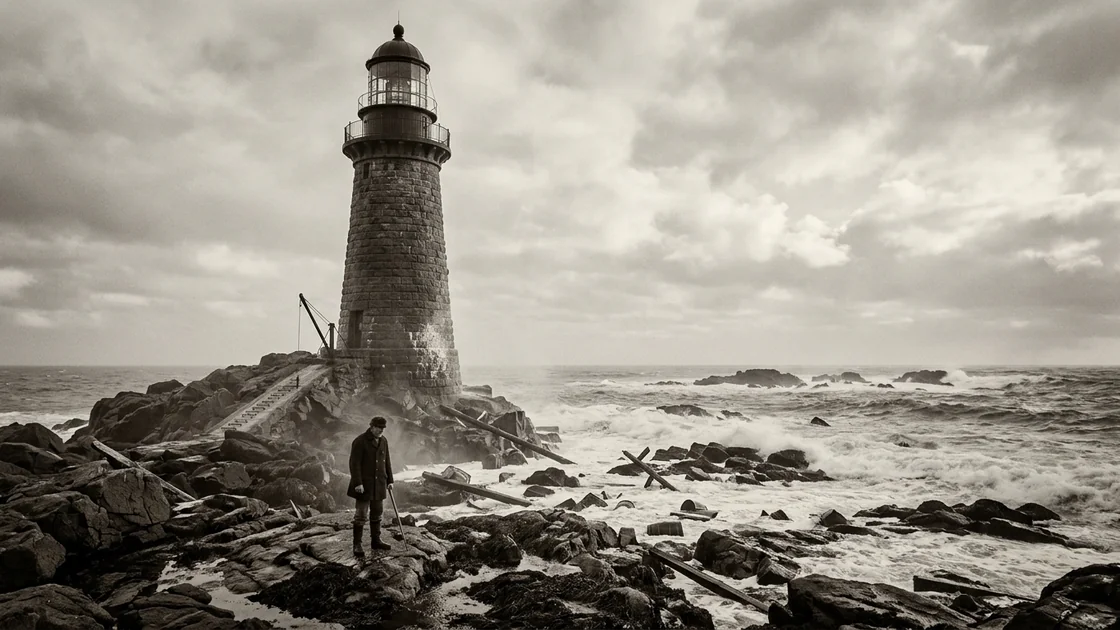
This is the account of Phineas Crane, the sole keeper of the light on the desolate granite crag of Marrow Head during the autumn of 1874. Tasked with warning maritime traffic away from the treacherous reefs guarding the northern shipping channel, Crane succumbed to isolation and the grip of rum during an unprecedented October gale. As the mechanical lamp failed in the blinding squall, an inbound passenger vessel struck the reef and broke apart, leaving Crane to confront the ruin wrought by his negligence and the ghosts of the lives he extinguished in the surf.
I. The Pillar on the Skerry
The tower was raised from sixty thousand blocks of blue-veined granite, dovetailed one into the other with Portland cement, so that when the heavy seas struck her base, she did not crack or yield, but rang like a great church bell cast in stone. The sound travelled up through the hollow core of the stairwell, rattling the copper saucepans upon the hooks in the kitchen, humming through the iron rungs of the service galleries, and setting the mercury in the optic basin trembling in micro-ripples of silver grease.
Phineas Crane had lived within that ringing stone for eleven years. He knew the pitch of every wind that blew out of the Labrador current or down from the Arctic Circle. A south-wester had a wet, blubbering bellow, like a bull stuck in an estuary mudflat; a north-easter had the clean, shrill screech of an iron blade across an anvil; while the rare, dead-eyed gales that came spinning off the Newfoundland banks sounded like nothing so much as a runaway locomotive dragging a chain across the shingles.
His world was eight feet in diameter at the parapet, widening to twenty at the cellar, where the sea water seeped through the porous bottom courses and formed a greenish brine that smelled of kelp and drowned dogfish. Above that lay the coal store, the water cisterns, the bunk-room with its curved bunk lashed with hemp, the kitchen with its squat cast-iron stove, the service room where the colza oil stood in forty-gallon vats, and finally, perched at the pinnacle like an immense, faceted diamond, the lantern room.
In the lantern room, the air was never cold. Even on days when the spray froze into sheets of greasy rind against the outer glazing, the heat from the concentric Argand wicks was trapped inside the copper dome, smelling fiercely of parched glass, heated brass, and the nutty, fatty stench of vegetable oil. The great lenticular apparatus—a hyper-radiant Fresnel assembly constructed in Paris by the brothers Barbier—hung upon a circular track of steel rollers, its four tons of cast brass and fluted flint-glass turned by a clockwork movement driven by a three-hundred-pound lead weight that descended slowly through the central pipe of the stair.
Every four hours, the weight reached the floor of the oil room. Every four hours, day or night, fair weather or foul, Phineas was bound by the regulations of the Board of Northern Lights to grasp the iron crank and wind the cable back upon the drum, one hundred and eighty revolutions, until the lead hung once more just beneath the floorplates of the lantern.
"Keep the light," the printed rules framed upon the parlor wall proclaimed in black-letter type. "The Keeper shall be responsible that the lamp is trimmed, that the wicks are cleared of snuff, that the oil is warmed to free liquidity, and that the glass is maintained free of smoke and condensation from sunset to sunrise. The Keeper shall not sleep during his watch; he shall not quit the lantern room during a gale; he shall hold no commerce with spirits; for in his vigilance lies the safety of the Queen’s subjects and the honor of the Service."
Phineas had framed the sheet himself when he took the station. In those early days, his wife, Martha, was still breathing, her lungs not yet eaten out by the white damp of the Aberdeen tenements, and he had believed that doing one’s duty before God and the Commissioners was a sufficient wall to build against the emptiness of the sea. But Martha had died in the third year of his service, while the spring pack-ice had sealed Marrow Head from the mainland for seven weeks. The tender could not reach him. He had laid her out upon the zinc table in the cellar, wrapping her in a piece of oiled sailcloth, with four bricks at her feet, and had gone up every four hours to wind the weight and trim the wicks while she cooled into the stone below.
Since that winter, the tower had ceased to be an outpost of the world and had become its only remnant. The supply tender, The Cormorant, appeared four times a year if the weather was kind, dropping barrels of salt pork, hard ship-bread, casks of oil, and sacks of dry potatoes into the crane-cradle that Phineas swung out over the surge. Sometimes the master of the tender would shout news through a megaphone—a king had died, an empire had fallen in the east, a great fire had gutted some distant town whose name Phineas forgot before the smoke from the cutter’s stack had dissolved into the horizon.
None of it mattered within the stone. What mattered was the glass. What mattered was the five-wick burner that must be kept level to the sixteenth part of an inch, lest the flame smoke and soot the inner mirrors. What mattered was the wind.
On the twenty-third of October, the wind was dying, which was the worst thing it could do.
The sea had gone flat, the color of wet lead, with a long, sluggish heave that swung out of the south-east. It was a heavy swell, thick as molasses, that did not break upon the Outer Reef but rose over the jagged black teeth of the rocks like grease rising in a broth, then slipped away without a sound. When the gulls left the ledges at noon, they did not fly inland toward the cliffs of Cape Wrath; they flew high and straight to the south, their white bellies flashing against a sky that was neither blue nor grey, but the sickly yellow of an old bruise.
Phineas stood upon the gallery with a chamois leather in his fist. He had spent three hours polishing the storm panes, breathing upon the thick plate glass and rubbing until the salt bloom was gone. The air smelled of sulfur and dead bladderwrack. When he laid his hand against the copper railing, he felt a faint, steady tremor—not the hammer of the waves, for there were none yet, but the ground-swell of the ocean itself, vibrating against the basalt foundation forty fathoms down.
He went inside, dogging the heavy iron door behind him, and looked at the cistern barometer that hung beside the galley hatch.
The column had fallen half an inch since dawn. The meniscus was curved downward like the back of a diving loon, the silver mercury shivering against the ivory scale.
"She’s coming," he said to the empty room.
The kettle on the stove was cold. He did not light it. His joints ached with an ancient, gnawing dampness that seemed to have got into the bone-marrow through his boot-soles. In the cupboard beneath his bunk, tucked behind two spare bibles and a stack of rusted tins of preserved mutton, sat an oak firkin with iron hoops.
It was not government issue. It had come off a French lugger from Saint-Malo that had run into the lee of the Head two months ago to patch a split gaff, trading the small cask of Martinique rum for three fathoms of spare manila rope and half a sack of dried peas. Phineas had hidden it immediately, not from any fear of the Inspector—who was not due until the spring—but from himself. He had kept it there as a man keeps a loaded pistol in a drawer: not intending to pull the trigger, but comforted by the knowledge that the lead was there if the darkness became too wide to bear alone.
He looked at the barometer again. The mercury had slipped another tenth. A draft, thin and sharp as a needle, came through the keyhole of the lantern stair and touched the nape of his neck.
II. The Cask beneath the Flags
The light was lit at four o'clock, an hour before the sun went down behind the landward mist. It was a tedious process that required a steady hand and a clear eye. Phineas first turned the brass cock that admitted the oil from the gravity reservoir above the mantle into the burner tubes. He waited until the yellow fluid had soaked the concentric cotton rings, then struck a phosphorus match on the sole of his shoe and touched it to the cotton.
For the first ten minutes, the flame was pale, fluttering, and dirty, throwing off greasy threads of soot that made him cough. He stood over it with the curved brass shears, snipping the charred threads from the wicks, adjusting the draft-valves beneath the plate until the five rings of fire merged into a single solid cylinder of white incandescence that roared with a dry, hollow throat.
He threw the pawl of the clockwork out of gear, released the friction brake, and watched the four-sided frame begin its slow, stately waltz. Flash—thirty seconds—dark. Flash—thirty seconds—dark. The giant bulls-eye lenses caught the heart of the flame and flung it outward through the plate glass into the gathering murk: a beam four feet thick, blazing out across fifteen miles of black water, sweeping over the Outer Fang, over the sunken ribs of the Lady Elgin, over the long, drowning shoals where the cod spawned in fifty fathoms.
When he was certain the machinery was true, he descended to the kitchen.
The wind had arrived just after five. It had not come with a blast, but with a low, whistling sigh that tightened the stays of the lightning conductor and made the copper cowl on the chimney spin with a dry, screeching complaint. Within an hour, that sigh had broadened into a steady, flat roar that sounded like the discharge of a hundred blast furnaces.
Phineas sat at the scrubbed pine table. His tea-mug sat before him, but it did not contain tea.
The rum was dark as walnut juice, thick and sweet on the tongue, with a fierce, oily fire that caught in the back of the throat and burned all the way down into the belly. It had the smell of molasses, old oak, and something sun-baked and foreign—a smell that had nothing to do with salt-crust, rotten weed, or the damp stone of Marrow Head.
"Just a dram to grease the knees," he told the tea-kettle.
The first swallow had loosened the knot behind his temples. For forty-eight hours, ever since the barometer had started its long, sickening slide, his head had felt as though it were clamped in an iron vise. Every wave that slapped the base of the tower had seemed to strike his own ribs. But with the rum, the iron loosened. His hands, which had taken to trembling when he wound the weights, lay upon the table as steady as anchors.
He drank again. The warmth spread out from his ribs into his arms, down to his cold feet, smoothing the raw edges of his thoughts.
Outside, the first great sea hit the tower.
It was not a wave of the common sort; it was a wall of solid deep-water, lifted out of the mid-Atlantic by the fetch of three hundred miles, running green and unbroken until it took the submerged shelf of the Head. The tower did not merely ring; it shuddered. The oil in the lamp-bracket on the wall sloshed against the tin reflector, and the iron fire-shovel fell from its hearth-hook with a clatter that sounded like a musket shot.
Phineas did not move. He only raised his eyes to the ceiling.
Up there, seventy feet above his hair, the great glass cage was turning. Flash. Dark. Flash. He could hear the faint, rhythmic clack-tick, clack-tick of the escapement through the floor joists. It was a good sound. It meant the weights were falling, the drums were turning, the light was doing its work without him. The light did not need a man; it needed only oil and lead, two dead things that understood gravity better than any creature of flesh.
He poured another three fingers of the dark liquor into the mug. The bottle was nearly half empty now.
Through the deep, narrow embrasure of the kitchen window, he could see nothing but a boiling sheet of white. The spray was reaching the fifth level now, sixty feet above high-water mark, striking the three-inch glass like gravel thrown by the shovelful. The wind was backing round to the north-north-west, the dangerous quarter—the quarter that drove every ship crossing from Liverpool or the Clyde straight onto the horn of the reef if they did not keep their westing.
"They'll have sea-room," Phineas muttered, his tongue feeling thick and dry against his teeth. "The masters know the Head. They see the flash, they haul their wind. Every jack-man of them knows the Marrow."
He drank again, tilting the mug back until the sugar-sediment at the bottom drifted against his lip.
A great lassitude had settled into his bones. It was not the wholesome tiredness that comes from eight hours at the oar or a long day scaling the rust from the exterior plates; it was a heavy, sweet poison that made his eyelids feel as though they were lined with sand. The stone walls seemed to lean in toward him, not in threat, but like old friends crowding close to keep out the gale.
He thought of Martha. It was strange how clearly he could see her face when the rum was in him. When he was sober, she was only a grey shadow in a bonnet, a voice he couldn't quite catch above the noise of the surf. But now, she was sitting opposite him on the empty bench, her hands folded in her apron, her grey eyes looking at him with that quiet, sorrowful patience she always had when the pain was bad in her side.
"You ought to go up, Phin," she seemed to say. "The weight's near the bottom."
"Plenty of time, girl," he whispered, his head nodding until his chin touched his woolen waistcoat. "Ten minutes yet. The four hours aren't up till eight bells."
The clock on the wall, an old eight-day movement with a brass pendulum, said twenty minutes past seven. Or was it twenty minutes past eight? The hands seemed to swim in the yellow lamplight, the black numerals sliding into one another like the ripples in the oil vat.
The wind took a new note—a high, piping shriek that found the lead flashing under the lantern floor and tore at it with iron fingernails. A sheet of water, green as grass, struck the kitchen glass with such violence that the iron frame groaned, and a trickle of salt spray hissed across the hot lid of the stove.
Phineas Crane closed his eyes. Just for the space of forty winks, he thought. Just until the rum had finished its work with his knees. He would sleep ten minutes, and then he would take the grease-pot and the crank, he would go up the spiral, and he would wind the weight until the pawl clicked three hundred times.
His head dropped forward onto his arms, his cheek coming to rest in a puddle of spilled spirits on the pine planks.
III. The Quenching
In the lantern room, the heat was suffocating.
The five wicks burned fiercely, but they had begun to grow crusts of carbon—black, cauliflower-like knobs of charred cotton that blossomed upon the rims of the burners. Because there was no hand to turn the knurled brass knobs and lower the wicks, the flames began to stretch, drawn up by the draft through the copper cowl until they touched the lower edge of the central ruby chimneys.
Soot, greasy and dense as squid-ink, began to curl up into the reflectors.
At ten minutes before nine, the lead weight, descending through its iron pipe, touched the bumper-spring at the level of the oil room. The cable slackened. The brass drum, deprived of its downward draw, slowed its rotation. The escapement gave three more sluggish, metallic clicks—clack... tick... clack—and then stopped.
The great lens stopped turning.
Instead of a sweeping, rhythmic pulse that traversed the sea every thirty seconds, warning the mariner of his distance and bearing, the light became a fixed, dead stare. It pointed its south-eastern beam directly over the spine of the reef known as the Devil’s Tail, while the rest of the circle—three hundred and twenty degrees of wind-shattered ocean—fell into absolute, pitch-black nothingness.
Then the carbon did its work.
The center wick, choked by its own unburnt fuel, flared violently, a yellow tongue of flame leaping six inches above the glass chimney. The sudden, intense heat cracked the flint-glass tube from base to crown. With a sound like the snap of a pistol, a triangular segment of glass fell inward across the wick, knocking the burning cotton flat into the oil well.
A cloud of white, acrid smoke filled the lantern room. It was not the clean vapor of burning colza, but the smothering smudge of boiling oil and scorched brass. The flame, deprived of its draft by the shattered chimney, guttered, turned a dull, smoky red, and began to wallow in the pool of spilled oil that had overflowed the reservoir.
For five minutes, a dim, sick light struggled through the soot-blackened panes.
Then, with a faint, oily sigh, the flame drowned itself in its own fuel.
The lantern room went black.
Outside, the gale was reaching its fury. The sea was no longer breaking in separate waves; the ocean had been lifted bodily into the air by ninety miles of wind, turned into a flying sheet of white foam and salt brine that obliterated the boundary between the sea and the sky. The granite tower stood eighty feet into the roaring dark, invisible, silent, and blind.
Seven miles to the south-east, running before the gale with her canvas stripped to a double-reefed main tops'l and a storm trysail, was the three-masted iron-hulled packet Saint Florentina, twenty-two days out from Liverpool for Saint John, New Brunswick.
She carried three hundred and twelve souls: forty-six crew, twenty-two cabin passengers, and two hundred and forty-four emigrants in the steerage—weavers from Paisley, farm-laborers from Norfolk, and whole families from the stony hills of Connaught who had scraped together their last silver crowns to leave the hunger behind them forever.
Her master, Captain Hector MacDiarmid, was fifty-two years old and had spent thirty of those years upon the Western Ocean. He stood upon the poop deck, his boots lashed to the mizzen fife-rail by three fathoms of ratline, his beard frozen into a solid wedge of salt ice. Beside him stood the second mate, a young man named Campbell, whose knuckles were white where he gripped the binnacle casing.
"We should have picked up the Marrow by now, sir!" Campbell shouted into the captain’s ear, cupping his mouth with his mittens. "By dead reckoning, we were twelve miles off the Tooth at eight bells!"
MacDiarmid shook his head, clearing the salt from his eyelashes. "The drift has been east-north-east all through the dog-watches! We’re five miles to the south’ard yet! Keep her head up into the wind, man! Don’t let her fall off!"
"Can’t see the light, sir! Not a blink!"
"The fog has her!" the captain roared back. "It’s a thick gale! I’ve seen the Marrow drowned in drift so thick you couldn't see her from her own slipway! Watch for the flash! Thirty seconds, remember! One long flash, then thirty seconds dark!"
The Saint Florentina plunged into a hollow between two seas, her bows disappearing up to the catheads in a boiling cauldron of green water. The iron plates of her hull groaned as she was lifted by the stern, the rudder kicking with such force that the two quartermasters at the wheel were thrown across the grating, their arms bruised by the spokes.
Down in the steerage, the oil lamps had been extinguished for four hours to prevent a conflagration if the ship should broach. Two hundred and forty people sat in the complete, stinking dark of the lower deck, jammed between rough pine bulkheads, holding their children upon their knees, listening to the iron ribs of the ship squeal against the hammer of the sea. Some were praying in English, some in the high, nasal Gaelic of the western islands; some were too sick even to pray, lying in their vomit upon the sodden ticking of their mattresses, waiting for the dawn or the end of the world.
"Look there!" Campbell screamed suddenly, pointing with a stiff arm over the larboard bow. "A light! A white light!"
MacDiarmid raised his night-glass, steadying his elbows on the rail.
Through the mist and the spray, he caught a momentary glint—not the white, piercing brilliance of a first-order Fresnel lens, but a low, dull, yellowish spark that flickered once and then vanished. It was the last, dying flare of the cracked burner before the oil drowned it.
"There she is!" the captain shouted, his voice cracked with relief. "She’s to the larboard! We’re clear of the reef! She’s bearing north-north-west! Port your helm, Campbell! Port your helm and run her south! We’ll round the headland and take the offshore water!"
He had mistaken the dying spark for the light upon the mainland at the Cape, ten miles further west. He did not know that the Marrow was dark. He did not know that the light he thought was on his quarter was sitting directly upon his course, and that the long, invisible spine of the Devil’s Tail lay three ship-lengths ahead, hidden beneath three fathoms of white foam.
"Port the helm!" the mate bellowed down the voice-pipe. "Hard over!"
The ship swung her head into the trough. The wind caught her upon the beam, laying her over until her lee scuppers were drowned, and the yard-arms seemed to rake the tops of the seas. She gathered speed, plunging down the slope of a great swell like a sled running down an icy hill.
There was no sound of a warning bell. The bell at the Marrow Head was worked by a water-wheel in the lower cellar, and the sea had smashed the sluice-gate three hours before.
The lookout on the forecastle head had only time to draw half a breath. He saw no rock, no stone, no cliff; he saw only that the blackness ahead had suddenly turned white, as though an immense field of snow had been dropped into the sea.
"Breakers!" he shrieked, his voice thin as a gull’s cry against the hurricane. "Breakers under the—"
The Saint Florentina struck at sixteen knots.
She did not hit the granite cliff of the tower. She hit the outer tongue of the reef—a flat, serrated shelf of iron-hard gneiss that rose out of forty fathoms like an axe-blade.
The collision did not stop her at once. It tore her bottom out from the stem-post to the mainmast as clean as a cooper strips a stave from a rotten cask. The sound was not a crash; it was a screech of tearing iron plates, an explosion of sheared rivets that sounded like a battery of artillery firing along her decks.
The masts went together. The foremast snapped twelve feet above the deck, its three yards of foreign pine coming down across the forward hatchway, crushing the timbers and smashing the escape ladder into splinters. The mainmast tore out of its step, taking the iron deck-beams with it, falling backward through the cabin skylight and into the saloon where the women were huddled with the steward.
The ship rose upon the crest of the next sea, was carried twenty yards further onto the shelf, and then came down upon her side. The spine of her keel cracked with a report that was heard above the thunder of the reef, and the sea poured into her steerage through a gap thirty feet wide.
IV. The Waking in the Pit
Phineas Crane woke because his forehead was wet.
The room was cold—not the damp chill of the tower, but the killing cold of an ice-house. The fire in the stove had gone out, its ashes drowned by the water that was pouring down the stove-pipe in a continuous, brackish stream.
He sat up, his neck muscles screaming with pain. He had slept with his cheek upon the bare oak of the table, and the hard grain was pressed into his skin like an iron brand. His mouth was full of the foul, sweetish taste of stale rum, and his tongue felt twice its natural size, parched and rough as shark-skin.
The lamp on the kitchen wall had gone out. The oil was dry.
"Martha?" he croaked.
No voice answered him. There was only the sound of the wind, which had dropped from its screaming fury into a long, desolate wail, and the steady thump-thump-thump of the sea against the base of the tower.
He sat in the pitch darkness, his mind groping through the fog of his intoxication like a blind man through a briar patch. Something was wrong. Not the cold, not the water on the floor, not the pounding in his temples. Something else.
The clock.
He listened. The kitchen clock was ticking, its pendulum swinging with its dry, wooden click. But from above—from the lantern room—there was no sound.
No clack-tick. No hum of the gears. No smell of hot glass.
The air in the stairwell smelled only of cold sea-water and... soot.
The realization did not hit him like a blow; it went through him like an iron rod pushed through his bowels, slow and freezing cold. He did not jump up; he could not. His legs were numb from the hips down, deadened by the cold and the drink. He dragged himself to the door of the stairwell, pulling his body along by the edge of the dresser, his woolen stockings soaking in the pool of water that covered the flags.
"No," he whispered. "No. No, Phin. No."
He found the iron handrail of the spiral stair. He pulled himself up, rung by rung, his knees knocking against the granite risers. The tower was dark all the way to the top. Usually, the lantern cast a warm, golden shimmer down the spiral, lighting the wet steps with a reassuring glow. Now, it was like climbing into an abandoned coal-shaft.
At the fifth landing—the oil room—he struck his forehead against the iron crane-bracket and did not feel it. He reached out into the blackness. His hand touched the weight-cable.
It was slack.
He felt down the wire with trembling fingers until he reached the lead weight. It was resting solid upon the timber balks of the floor. It had been resting there for hours.
Phineas began to weep—a high, dry whimpering that came from the back of his throat like that of a beaten dog. He scrambled up the last twelve rungs into the lantern room, pushed the trap-door open with his shoulders, and stood up into the glass cage.
The stench of carbon was thick enough to gag a horse.
The lantern room was black as the inside of a coffin. The five-wick burner was cold. When he touched the brass casing, his hand came away covered in a thick, sticky grease of condensed soot. He felt for the chimney; his fingers closed on jagged shards of broken glass that sliced through his skin, but he did not pull his hand away. He stood there, the blood dripping from his thumb onto the dead wick, staring out through the soot-streaked storm panes into the Atlantic.
The storm was breaking.
The clouds had been torn apart by the north-wester, leaving ragged rifts through which a cold, white three-quarter moon peered down upon the sea. The water was still running high—immense, foam-crested hills that marched out of the north—but the air was clear.
Below him, five hundred yards to the south-east, the Devil’s Tail was laid bare by the falling tide.
The reef looked like the carcass of a whale that had been stripped by sharks, its long, black ribs protruding from the surf. But it was not a whale that lay wedged between the outer teeth.
It was an iron ship, broken into three pieces.
The fore-part had been thrown high onto the rocks, its bowsprit pointing toward the lighthouse like an accusing finger. The midships section had collapsed inward, its iron frames flattened like an empty wicker basket, while the stern lay five fathoms deep in the churning white water of the gut, with only the tip of the taffrail and the white curve of a lifeboat’s davit showing above the foam.
Around the reef, floating in the white eddy of the undertow, was an immense, undulating carpet of wreckage: barrels, timber spars, sea-chests, mattresses, straw bolsters, crates of hardware, and white rags that did not move like rags, but turned over and over in the wash with the slow, limp indifference of the dead.
Phineas did not scream. He did not move. He stood with his bloody hand resting upon the cracked lens, his mouth open, his breath coming in short, white puffs against the frozen glass, watching the moon light the names of the drowned upon the shingles below.
V. The Work of the Tide
The dawn was clean and bright, with a pale, cold sky that seemed to have been washed of all its color by the rain. The wind had dropped to a light breeze that smelled of brine and the bitter tang of crushed kelp.
Phineas Crane came down the granite steps of the slipway.
He was dressed in his shore-going clothes—his black broadcloth coat, his hard hat, and his leather boots—as though he were going to chapel on a Sunday morning in Peterhead. He carried a coiled heaving-line over his shoulder and a boat-hook in his left hand. His face was the color of lard, and his eyes were sunken deep into their sockets, red-rimmed and dry.
He had not relit the lamp. There was no need for the lamp now; the sun was up, and the world could see what had been done.
The tide was at the low slack. The gut between the lighthouse rock and the Devil’s Tail was sixty yards wide, a channel of green, clear water that was usually impassable, but now, with the great ebb that followed the gale, was shallow enough for a man to wade if he kept his footing against the weed.
He did not use the dory. The dory had been stove in upon its chocks by a sea that had leaped the parapet at the height of the storm. He stepped off the lowest iron rung into the water.
It came to his waist, cold as an iron belt, taking the breath out of his throat with a sharp gasp. He leaned against the boat-hook, his boots slipping upon the greasy bladder-wrack, and dragged himself across the gut to the outer rocks.
The smell reached him before he climbed out of the water.
It was not the smell of the sea. It was the smell of a wrecked town: wet soot, soaked flannel, broken vinegar casks, orange peel, the greasy grease of animal fat from the ship’s galleys, and the sweet, sick scent of spilled flour that had turned into paste upon the rocks.
The first body he came upon was that of a girl, perhaps sixteen years old.
She was wedged into a cleft of the rock by her heels, her head hanging downward into a rock pool where three small spider-crabs were crawling over the pebbles. Her red hair was plastered across her forehead like a tangle of wet weed, and she wore a dress of coarse blue linsey-woolsey that had been torn down the back, showing the white, smooth skin of her shoulder-blades. Her boots were gone, her small, round feet grey and wrinkled like lard from the salt water.
Phineas stood over her for a long time. He did not touch her.
"From the west," he said to the rock pool. "A Galway girl."
He moved further onto the shelf.
The wreckage was piled ten feet deep in the gullies: split tea-chests from Canton, crates of Birmingham ironmongery with the bright axes and shears already rusting in the salt air, bolts of calico that had unwound and wrapped themselves around the boulders like winding-sheets.
Beneath an overturned spar lay the ship’s carpenter, his leather apron still tied around his neck, his hands frozen into two stiff claws around an adze he had been trying to use when the decks came down. A little further on, sitting upright against a granite boulder with his legs stretched out before him as though he were resting on a bench on the quay, was an old man with a grey beard and the brass buttons of an officer upon his pea-coat. His eyes were wide open, clear and blue, looking directly through Phineas Crane toward the eastern horizon.
It was Hector MacDiarmid. He had found his reckoning.
Phineas walked among them like a sexton through a crowded churchyard after an earthquake. He counted them as he went, his lips moving silently, his fingers twitching against the ash shaft of the boat-hook.
Twelve... thirteen... fourteen.
In a sandy pocket where the sea had cleared the rocks, he found a pine cradle. It had been lashed with clothes-line to a hatch-cover, but the line had parted or been cut. The cradle was empty, but beside it, washed up into the soft fringe of sea-tangle, was a bundle of grey flannel no larger than a suckling pig.
Phineas dropped the boat-hook.
He knelt in the wet sand, his knees sinking into the grit. He reached out his hands—the hands that had held the rum-mug, the hands that had failed to turn the brass winch, the hands that had trimmed the wicks for eleven years without a fault—and lifted the bundle.
The infant’s face was white and perfect, save for a small blue bruise upon the left temple where it had struck a timber. Its eyes were closed as though it were sleeping in its cot in some warm farm kitchen in the shires, with the cat purring by the fender and the kettle on the hob.
Phineas pressed the bundle against his black broadcloth coat. The child was not cold with the cold of the sea; it felt like a stone carved from lard, heavy and solid, with no life in it to answer the beating of his own heart, which was hammer-hard and wild against his ribs.
He sat down upon a drift-log, holding the infant against his chest, and looked back at the lighthouse.
From here, the tower looked small. It was only an eighty-foot pencil of blue stone, standing upon a black tooth of rock in the middle of a vast, sparkling desert of blue water. The sun struck the glass of the lantern room, setting the facets of the Fresnel lens blazing with a cold, rainbow fire—the same fire that had slept in the dark while three hundred people were beaten against the granite.
"Why didn't you ring the bell?" he asked the tower.
The tower did not answer. A black-backed gull landed upon the top of the copper cowl, folded its wings, and looked down at him with its yellow, pitiless eyes.
VI. The Silence of the Stone
He spent the afternoon carrying the bodies out of the tide’s reach.
It was an impossible task for one man, but he worked with the slow, terrible strength of a madman. He would not leave them to be eaten by the dogfish or torn by the gulls when the flood-tide came back.
He took the young girl first. He lifted her by the shoulders, her wet hair dragging across his knees, and carried her up the slippery ledges of the Tooth to a high, flat platform of rock that remained dry even at the top of the spring springs. He laid her down with her face toward the land, folding her small, bleached hands across her breast.
Then he went back for the captain. The old man was heavy, his sea-boots full of water, his wet broadcloth weighing like lead. Phineas had to drag him by the armpits, his own breath coming in ragged, bloody gasps, his boots slipping upon the weed until his shins were raw and bleeding from the granite edges.
By mid-afternoon, he had carried eleven of them to the ledge: four women, five men, and two children. The others—the scores of others who had been trapped in the steerage when the hull iron buckled—were beyond his reach. He could see their clothing floating in the green shadows of the submerged compartments, rising and falling with the surge like sea-anemones in a cave.
When the tide began to make again, swirling through the gut with a loud, sucking murmur, he crossed back to the lighthouse.
He was wet to his neck. His fine black coat was torn at the armpits and plastered with salt-grease and sand. He climbed the spiral stair, his boots leaving wet, brown tracks upon the white granite of the steps.
In the kitchen, the clock was still ticking.
It was half-past four. The sun was going down again, sliding into a thick bank of purple cloud that lay along the western horizon like an iron bar. In half an hour, it would be night.
He went to the cupboard. The small oak cask sat upon the flags where he had left it. There was still two inches of rum in the bottom—enough to bring the warmth back to his hands, enough to turn the roar of the surf into a distant hum, enough to put him back to sleep upon the pine table so that he would not have to see the moon come up over the ledge where the eleven were lying.
Phineas Crane picked up the iron fire-shovel.
He did not pull the bung. He raised the heavy spade with both hands and brought the iron edge down upon the center of the cask with all the weight of his shoulders.
The oak staves split with a wet thunk. The iron hoops sprang off, ringing against the stone floor, and the dark, fragrant rum gushed out across the flags, mingling with the salt water and the sand he had brought in from the reef. The smell filled the room—sweet, spicy, and thick—the smell of his ruin.
He did not look at it. He threw the shovel into the corner, took his matches from the tin box on the shelf, and climbed to the lantern.
The lantern room was cold as a vault.
He took his scraper and his rags. For two hours, in the gathering dusk, he worked upon the lens. He scraped the soot from the brass-work; he picked the shards of the broken chimney from the burner tubes; he wiped the four-ton prisms with turpentine until the glass was clear and blue once more.
From the locker under the watch-bench, he took a new glass chimney—the last spare he had on the station. He fitted it into the brass gallery with fingers that were cut to the bone, tightening the small thumb-screws until it stood true and plumb to the hair of an inch.
He filled the gravity reservoir with fresh colza oil. He trimmed the five wicks, cutting the charred cotton straight across with the silver shears, not leaving a single thread higher than its fellow.
Then he struck a match.
The cotton caught with a faint pop. The yellow flame ran round the rings, settled, and began to lift into the chimney. Phineas adjusted the damper. The flame whitened, stretched, and turned into that fierce, silent cylinder of white light that could be seen from five leagues out.
He went to the clockwork. He swung the heavy iron crank onto the spindle.
One... two... three...
His back screamed with pain. The salt-crust in his armpits tore against his flesh with every turn. His breath came in dry, whistling sobs that rattled the glass panes of the case.
Fifty... fifty-one... fifty-two...
The lead weight rose through its iron conduit, inch by inch, lifting three hundred pounds of dead metal from the floor of the oil room toward the roof.
One hundred and seventy-nine... one hundred and eighty.
The pawl clicked into the last tooth. Phineas Crane released the friction brake.
The great machine began to turn.
Clack-tick. Clack-tick.
The four giant bulls-eyes began their slow, stately waltz around the flame. The beam—four feet thick, blazing with the light of three thousand candles—struck through the glass and leaped out into the darkening sea.
It passed over the Outer Fang. It swept over the white breakers of the Devil’s Tail. It illuminated, for the space of three seconds, the broken iron hull of the Saint Florentina, the tangled rigging, the floating barrels, and the eleven white faces lying upon the granite ledge with their hands folded upon their breasts.
Flash.
Thirty seconds dark.
Flash.
Thirty seconds dark.
Phineas Crane sat down upon the iron watch-stool. He did not go down to the kitchen to eat. He did not fetch a blanket to cover his wet shoulders. He sat with his hands resting upon his knees, his eyes fixed upon the brass escapement as it chopped the seconds into little morsels of iron sound, keeping the watch he had forgotten to keep.
VII. The Dead-Watch
A lighthouse is built to keep the living from the rocks, but for three days and three nights, Phineas Crane kept the light for the dead.
He did not sleep. When his eyelids grew heavy, he would take a pinch of dry salt from the canister he had brought up from the kitchen and rub it directly into the corners of his eyes until the stinging tears washed the drowsiness away. When his knees began to buckle, he stood upon one leg like a crane, leaning his brow against the freezing iron of the lantern frame until the pain of the cold iron woke him to his senses.
Every four hours, the weight reached the bottom of the pipe.
Every four hours, he took the iron crank in his raw, swollen hands and wound it back to the top. One hundred and eighty turns. He counted them aloud in the darkness of the service room:
"One for the girl with the red hair. Two for the carpenter. Three for the man with the brass buttons. Four for the babe in the grey flannel."
By the second night, the voices had begun.
They did not come from the sea; they came from the stairwell. The spiral tube of the tower acted like a great ear-trumpet, gathering the sounds of the water around the base, the whistling of the wind through the foundation chinks, and the hollow slap-slap of the swell in the empty oil-cellar, throwing them up into the lantern room with the clarity of speech.
They were not angry voices. That was the horror of them.
They were the ordinary voices of folk in an inn or upon a quay-side. He heard a woman asking if the water was on the boil; he heard a boy whistling a tune that Phineas had known forty years ago in Dundee—something about a herring-boat and a girl with ribbons in her cap; he heard the low, gravelly voice of Captain MacDiarmid discussing the price of bunker coal in Halifax with a man who had a soft, southern drawl.
Sometimes they would come up the stairs.
He would hear the wet, sucking sound of boots upon the granite steps—shluck... shluck... shluck—coming up from the cellar, past the coal store, past the kitchen, past the bunk-room. He would stand at the top of the trap-door with his scraper in his hand, his heart frozen in his throat, waiting for the latch to lift.
"Come up, then," he would whisper to the iron plate. "Come up and have a look at the wick. It's clean enough tonight. You can see your faces in the reflector."
The latch never lifted. The sound would stop at the threshold of the service room, and then there would be only the clack-tick of the clockwork and the long, smooth rush of the wind against the dome.
On the third morning, the fog came down.
It was not the thin, grey mist of the gale, but a white, silent wall that rolled off the northern banks like sheep’s wool, blanketing the sea in a dead, muffled calm. The water was flat as lard. There was no swell, no surf, no sound save for the dripping of the condensed moisture from the copper eaves of the gallery onto the stones below.
Phineas went out onto the walkway to start the fog-horn.
The horn was an old caloric engine that burned coal to compress air into an iron reservoir, which was then discharged through a five-foot trumpet of hammered brass pointed toward the south-west. It was an unruly, filthy brute of a machine that required two hours of hard shoveling to get its cylinder warm enough to turn the flywheel.
He went down to the cellar for the coal.
The cellar was half-full of water from the spring tide. Two barrels of salt pork were floating among the timbers of his wrecked dory, bumping gently against the granite wall with every lift of the sea through the drain-holes. As he reached the bottom step, his lantern light fell upon something that had been washed in through the lower archway during the height of the gale and left behind by the ebb.
It was an open sea-chest.
The lid had been smashed off, and its contents had been churned by the water into a tangled mass of wet linen and paper. Resting upon the top of the heap was an album—a small, square book bound in brown leather with a brass clasp that had rusted into a lump of green verdigris.
Phineas picked it up. The paper was sodden, the leaves sticking together like layers of wet onion-skin, but as he turned the pages with his thumb, a photograph fell out into his palm.
It was a tintype, taken upon a plate of iron no larger than a calling-card.
It showed a young man and a young woman standing before a painted backdrop of a garden with marble urns and rose bushes. The man was awkward in a new woolen coat that was too short in the sleeves, his large, work-hardened hands resting upon the back of a wicker chair. In the chair sat the girl with the red hair he had laid upon the ledge.
She was dressed in the same blue linsey-woolsey, but her hair was pinned up with combs, and she was smiling—a shy, crooked little smile that showed a gap between her two front teeth. Across the bottom of the plate, written in a cramped, schoolmaster’s hand in purple ink that had begun to run into the grey varnish, were the words:
Mary and Sean. July the 9th, 1874. For the new home.
Phineas Crane held the tin plate in his hand for a long time.
He did not put it in his pocket. He laid it upon the flat stone of the threshold, where it could dry if the sun ever broke the mist.
"I kept the light, Mary," he said to the empty cellar. "I have it burning now. There’s six feet of wick and the oil’s full to the lip. You can see it from ten miles off, if the fog would lift."
He did not light the fog-horn. He could not. To start the engine meant leaving the lantern room for two hours while the fire caught, and he had sworn to the empty air that he would not leave the glass again until someone came to take the crank from his hand.
He went back up the seventy steps.
He sat upon the watch-stool. The light turned. The white beam shot into the fog, was caught by the tiny droplets of water, and was flung back into his face as a blinding, milky glare that showed him nothing but his own reflection in the wet glass.
VIII. The Tender’s Whistle
On the fifth day after the wreck, the fog broke.
A light breeze came out of the west, peeling the white vapor off the sea in long, rolling scrolls like canvas being rolled from a floor, until the great blue arc of the horizon stood clean and sharp once more.
At noon, Phineas heard a sound that did not come from the stairwell.
It was a thin, high squeak—the whistle of a steam cutter.
He went to the gallery rail, holding onto the copper bar with both hands to keep his knees from folding beneath him.
Two miles to the south, rounding the point of the mainland, was the Cormorant. She was coming on under both steam and sail, her black hull throwing a wedge of white water from her bows, the blue ensign of the Northern Lighthouse Board trailing from her gaff. She was three weeks early. Some coaster must have picked up the flotsam—the barrels of flour or the pine cradles—and carried the news into the port at Oban.
Phineas did not run down to the slipway. He did not wave his hat.
He went inside, took the station logbook from its drawer beneath the watch-desk, and laid it open upon the blotting paper. The ink in the inkstand was dry, turned into a black crust; he spit into it, working the point of his steel nib around the rim until he had gathered enough black mud to make a mark.
The last entry was in his own hand, written six days ago, on the twenty-third:
Wind S.E. Barometer 28.9. Sea heavy. Light lit at 4:10. All in good order. P. Crane, Keeper.
He dipped the pen again. His fingers were so stiff that he had to hold the cedar holder between his first and second knuckles like an old carter holding a pipe.
October 24, he wrote. A great gale from the N.N.W. The burner cracked at the fourth hour. The lamp was out. The ship Saint Florentina came ashore upon the Tail at five bells of the night watch. All hands lost, or near to it. I was in liquor.
He stopped. The nib scratched against the rough rag paper, leaving a blot the size of a sixpence beside the word liquor.
He looked at the pen. He had half a mind to cross the last three words out. Who was to know? He could tell the Commissioners that the mechanism had broken—that the iron teeth of the bevel-gear had stripped under the weight of the gale, or that the chimney had shattered from a flaw in the French glass and drowned the wicks before he could reach them through the smoke. The sea told no tales; the three hundred were dead, and the rum had run through the scuppers into the tide four days ago.
A man might save his skin. A man might save his bread. They would dismiss him, surely, for failing to keep a spare burner upon the lamp-stage, but they would not hang him. They would not put him in iron bracelets and try him for manslaughter before the High Court in Edinburgh.
He looked through the storm panes.
The tide was out again. On the high shelf of the Devil’s Tail, the eleven bodies were still lying. The gulls had found them now; three large gannets were wheeling over the rock where the girl lay, their long, white wings whistling as they turned in the sun.
Phineas dipped the pen a third time.
He did not cross out the words. Beneath them, he added in his large, round hand:
I let the flame die. The blood is upon my head. Phineas Crane.
He laid the pen across the ledger, closed the book, and placed his brass watch upon the cover to keep the pages from curling in the draft.
From below came the sound of an iron oar-lock and the rattle of a boat-hook against the granite slipway.
IX. The Inquiry on the Rock
The men who came up the spiral stair did not climb like Phineas.
They climbed with the heavy, cautious steps of landsmen, their leather-soled boots slipping upon the damp risers, their breath coming loud and short as they took the seventy steps. There were three of them: Mr. Traill, the District Superintendent for the Board; Captain Henderson, the master of the Cormorant; and a tall man in a dark blue coat with brass naval buttons and a cocked hat, whom Phineas did not know.
Traill was the first through the trap-door. He was an elderly man with thin, white hair combed over a freckled scalp, dressed in a heavy beaver coat with a velvet collar. He carried a leather portfolio under his arm and smelled of lavender water and peppermint drops.
He stopped upon the watch-stool platform, blinking in the bright glare of the lantern room.
"Crane?" he said, his voice shrill with the effort of the climb. "Good God, man. What has happened here?"
Phineas did not rise. He sat upon the iron rung of the gallery ladder, his legs dangling, his hands resting upon his knees. His black coat was grey with salt, his trousers torn at both knees, and his face was so hollowed by hunger and watchfulness that the bones of his cheeks looked as though they would burst through the skin.
"The lamp is burning, sir," he said. His voice was not much more than a dry croak, like two slates rubbed together. "You’ll find the wicks level and the oil true to the mark."
Traill looked at the burner. He looked at the French lenses, which were clean as church silver, humming as they turned on their steel track.
Clack-tick. Clack-tick.
"The lamp?" the Superintendent cried, his mouth trembling with rage or cold. "The lamp? Man, the whole channel is choked with timber! There are two hundred corpses washing in the surf between here and the Cape! We passed five miles of wreckage before we sighted the Head! The Saint Florentina—the Liverpool packet! What happened to your light on the night of the twenty-fourth?"
The man in the naval coat stepped forward. He had a hard, square face with grey whiskers and cold eyes that took in the cracked oil-funnel, the blood upon the brass shears, and the black blotches upon the floor-plates.
"Are you the only man on this rock?" he asked.
"I am," Phineas said.
"Where is your assistant?"
"He took the fever in August, sir. The tender took him off. The Board was to send an extra hand with the October stores."
Traill reddened. "The stores were delayed by the weather! That is no excuse, Crane! No excuse at all! You know the regulations! In the event of an assistant’s absence, the keeper is to maintain a double watch—he is to remain in the lantern room—"
"The book is on the desk," Phineas said.
He pointed with his chin toward the pine table.
The three men moved together toward the watch-desk. Captain Henderson reached out and lifted the brass watch, turning the logbook over. Traill adjusted his spectacles, his fat, clean fingers trembling as he turned to the page.
Silence fell upon the lantern room.
The only sound was the slow, mechanical movement of the clockwork and the faint puff-puff of the steamer’s donkey-engine down by the slipway.
The Superintendent read the lines once. He read them twice. Then he took off his spectacles, wiped them with a silk handkerchief from his pocket, and looked at Phineas Crane as though the man had suddenly turned into an adder.
"Is this your hand?" Traill’s voice had lost its shrillness; it was low, flat, and hollow.
"It is, sir."
"You were... you were intoxicated? During the hurricane?"
"I was."
"And the burner went out?"
"It did. At nine o'clock, or thereabouts. The chimney cracked."
"And the ship struck while the light was quenched?"
"She struck the Devil’s Tail at half-past ten," Phineas said. He spoke without any tone at all, as though he were reading the depth of water from a sounding-line. "She was running south, thinking she was past the Marrow. She took the rock amidships and broke her back."
Captain Henderson made a small, choking sound in his throat and turned his face to the glass, looking down at the sea.
"God have mercy on you, Crane," the naval officer whispered. "How many were they?"
"Three hundred and twelve," said Phineas. "I have eleven of them on the high ledge. The girl with the red hair is there. And the captain. The others are in the water."
Traill closed the ledger with a soft slap that sounded like a shovel of earth falling upon a coffin-lid. He tucked the book under his arm, his hands shaking so violently that he nearly dropped his spectacles.
"Constable," he said, turning to the naval officer, "take him down to the cutter."
The officer—who was an Inspector of the County Constabulary from Stornoway—stepped forward and took a pair of iron handcuffs from his greatcoat pocket. The iron was bright and blue, polished by the cloth of his lining.
"Phineas Crane," he said, "I take you into custody in the Queen’s name, for gross negligence upon the high seas, to answer for the deaths of the passengers and crew of the Saint Florentina."
Phineas held out his wrists.
The iron was cold—colder even than the copper rail of the gallery—and it bit into the sores where his skin was already broken. The click of the ratchet was a sound he knew; it was the same pitch as the pawl on the clockwork drum.
"May I fetch my hat, sir?" he asked.
"You will come as you are," the Inspector said.
They turned toward the trap-door. As the Superintendent reached the ladder, he paused, looking up at the revolving glass.
"Henderson," he said to the captain of the cutter, "who is to keep the light?"
"The second mate," Henderson said, his voice thick with disgust. "I’ll leave Campbell and two hands from the deck. They’ll keep her turning until you can get a crew from the mainland."
Phineas Crane stopped at the head of the ladder. He looked back at the Barbier lens.
The great prisms were moving through the sunlight, splitting the white noon into long, crawling bands of emerald, crimson, and gold that slid across the granite wall like water-snakes. The flame was clear, straight, and tall, roaring with that dry, hollow throat he had listened to for eleven years.
"Mind the third burner," he said to Henderson. "The screw is stripped in the thread. You have to pack it with a slip of cedar wood, or it'll crawl up when the oil gets hot."
Henderson did not answer him. He only took him by the shoulder and pushed him down into the darkness of the stair.
X. The Crossing of the Gut
They brought him down the slipway to the cutter’s gig.
Four sailors sat at the thwarts, their oars tossed, their faces turned away from him toward the open sea. They were men from the Hebrides who had cousins upon the emigrant ships; they knew what had come ashore at the Cape. They did not speak to him. When his boots rattled upon the bottom-boards of the boat, one of the bow-men spat into the water and muttered an oath in Gaelic that sounded like the crack of dry gorse.
The Inspector sat in the stern-sheets, his hand resting upon the wooden handle of his truncheon, his eyes fixed upon the prisoner’s face.
"Shove off," Captain Henderson called from the stones.
The bow-man leaned his weight against the boat-hook. The gig slipped away from the iron rungs of Marrow Head, lifting her nose to the long, easy swell that was rolling into the channel.
Phineas Crane sat in the bottom of the boat, his iron-bound wrists resting upon his knees.
As the gig cleared the shelter of the lighthouse rock, it crossed the mouth of the gut that led to the Devil’s Tail. The tide was rising now, the green water hissing through the narrow passages between the black teeth of the reef, lifting the long streamers of kelp until they looked like the hair of drowned women floating in the surge.
The gig passed within thirty yards of the high ledge.
The eleven were still there. The sun was directly over them now, beating down upon the white stones, upon the coarse blue dress of the girl, and upon the small grey bundle that Phineas had laid between two flat stones to keep it from the wind.
The child was still there.
A great black-backed gull was sitting upon the stone beside it, its head turned to one side, its yellow bill gleaming in the light.
Phineas half-rose from the floor-boards, the iron chain of the handcuffs clinking against the thole-pins.
"Sit down!" the Inspector barked, his hand going to his hip.
Phineas did not look at the officer. He looked at the gull.
"Shoo!" he cried, his voice breaking into a dry, whistling scream that had no human sound left in it. "Get off! Get off her, you devil! The light’s burning! I tell you, the light’s burning!"
The gull did not move. It only lifted its wings an inch, settled them again upon its back, and opened its black beak to let out a single, rattling croak that was swallowed by the murmur of the surf.
"Sit down, Crane," the Inspector said again, but his voice was softer now, and he reached out his hand and touched the old keeper’s shoulder, pressing him gently down toward the bottom of the boat. "There’s nothing more for you to do on the Marrow."
The four men bent to their oars.
The gig leaped forward, its ash blades biting into the green water with a steady, rhythmic thump-chunk, thump-chunk that drowned the sound of the reef. They pulled away from the rock, out into the broad, clean water of the channel, where the sea was three hundred fathoms deep and blue as ink.
Phineas Crane did not turn his head to look at the tower again.
He lay with his forehead pressed against the wet pine ribs of the boat’s skin, listening to the water running past the cedar planks three inches from his ear. It sounded like the river he had known when he was a boy in the hills—the river where the trout jumped in the summer evenings, before he had ever seen the sea, before he had ever smelled the burning oil, before he had learned that a man may carry three hundred souls into the dark by the turning of a brass key.
Behind them, high upon its granite tooth, the great lens at Marrow Head turned in the silence of the noon.
Flash.
Thirty seconds dark.
Flash.
Thirty seconds dark.
The beam struck out across the empty water, seeking the ships that had already passed, warning the sea of the rock that was no longer hidden, while the white gulls dropped from the sky like falling snow and settled upon the bones of the Saint Florentina.